A “Karen” on the residential management board sent people posing as police officers to handcuff my wife right in our own driveway—moments later, six actual police cars arrived, and they addressed my wife as “Sheriff Calder.”
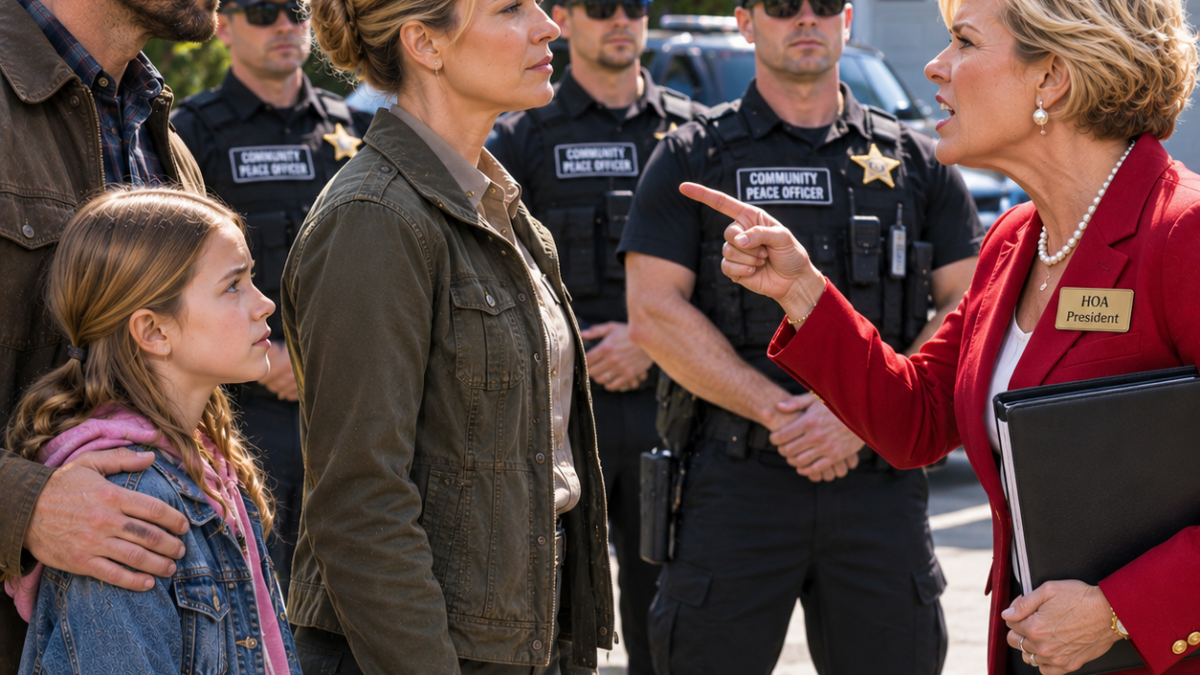
A “Karen” on the residential management board sent people posing as police officers to handcuff my wife right in our own driveway—moments later, six actual police cars arrived, and they addressed my wife as “Sheriff Calder.”
Two men wearing fake silver stars twisted my wife’s arms behind her back in our own driveway while my nine-year-old daughter screamed from the front door and our HOA president watched with a coffee mug in her hand.
My wife let them put the cuffs on, looked one of them directly in the eyes, and quietly asked, “Are you absolutely sure you want to do this?” because nobody on that street knew she had become the county sheriff three weeks earlier.
What Judith Harcourt didn’t know was that Naomi had already spent eleven weeks building a case around the HOA’s private “officers,” its missing reserve money, and a red folder I wasn’t supposed to see yet.
At 6:42 on a quiet Tuesday morning, two men in black uniforms were standing in my driveway with my wife’s hands cuffed behind her back.
One of them had his knee pressed against the rear bumper of Naomi’s SUV.
The other was shouting at me to stay away.
My daughter Maya stood barefoot in the doorway.
Nine years old.
Pajamas.
Hair still messy from sleep.
She was crying so hard she could barely form words.
“Mom!”
The bigger man turned toward her.
“Go inside.”
Maya froze.
He pointed.
“Inside. Now.”
I moved toward her.
He stepped into my path.
“Stay where you are.”
I looked at the silver star stitched onto his chest.
COMMUNITY PEACE OFFICER.
Not sheriff.
Not police.
Not deputy.
Not anything that meant what he wanted everyone watching to believe it meant.
My wife knew that too.
Naomi turned her head as far as the cuffs allowed.
Her voice was calm.
Almost unnaturally calm.
“Evan.”
“I’m here.”
“Don’t touch them.”
The bigger man tightened his grip.
Naomi never looked at him.
She looked at me.
“Film everything.”
That was the moment I understood something was wrong in a way I hadn’t understood five minutes earlier.
Not wrong like an HOA argument.
Not wrong like a violation notice.
Wrong like Naomi knew something I didn’t.
I pulled out my phone.
The smaller man saw me.
“No recording.”
I raised it anyway.
“This is my driveway.”
He stepped toward me.
Naomi said:
“Do not interfere with my husband.”
The man laughed.
“Ma’am, you’re in no position to give orders.”
Naomi looked at him.
Then at the star on his chest.
“Are you representing yourself as law enforcement?”
PART2:
The bigger one smirked.
“Community peace officers. Same authority on private HOA property.”
Naomi’s expression changed by maybe half an inch.
If you weren’t married to her, you would have missed it.
I didn’t.
That was almost a smile.
“Say that again.”
He frowned.
“What?”
“Slowly.”
He stepped closer.
“We are authorized peace officers for Oakridge Commons.”
Naomi nodded once.
“Thank you.”
He had no idea what he had just given her.
Neither did I.
Not yet.
My name is Evan Calder.
At the time, Naomi and I had lived in Oakridge Commons for a little over two years.
It was the kind of neighborhood real-estate agents described as “quiet, controlled, and exceptionally well maintained.”
Perfect lawns.
Matching black mailboxes.
Stone entrance walls.
Decorative streetlights.
Homes painted from an approved palette of twelve colors that somehow all looked beige.
The HOA had rules about trash cans.
Rules about basketball hoops.
Rules about flags.
Rules about how long your garage could remain open.
Rules about seasonal decorations.
Rules about how many vehicles could sit in a driveway even if every one of them belonged to the people who lived there.
Most of it was annoying but manageable.
Then Judith Harcourt became HOA president.
Judith was fifty-four.
Pearls.
Expensive blazers.
Perfect white SUV.
Hair that never moved even when the wind did.
She had lived in Oakridge for eleven years and spent most of them moving slowly upward through every committee that gave her another reason to tell people what they were doing wrong.
Landscape committee.
Architectural review.
Neighborhood security.
Vice president.
Then president.
The first year under Judith felt different.
Rules stopped being rules.
They became tools.
If she liked you, your trash can disappearing behind the fence at 8:10 instead of 8:00 was not worth discussing.
If she didn’t like you, a photograph appeared in your email with a time stamp.
The fines got bigger.
Inspections became more frequent.
And then Harcourt Safety Group appeared.
Judith presented it as a professional security upgrade.
Private neighborhood patrols.
Compliance support.
Emergency response.
“Peace officers.”
That phrase should have made more people ask questions.
It didn’t.
Two black SUVs started circling the neighborhood.
The men inside wore black tactical-style uniforms.
Silver star patches.
Utility belts.
Radios.
Handcuffs.
No guns that I ever saw.
But everything about them was designed to make you assume police.
They pulled over teenagers on golf carts.
Stopped contractors.
Demanded identification from visitors.
Knocked on doors over noise complaints.
Once, I watched one of them stand in the middle of a driveway and order an elderly homeowner to open his garage because someone had reported an unapproved freezer visible when the door was raised.
I worked in corporate compliance law.
Not criminal law.
Not policing.
But I knew enough to understand that putting a star on your shirt did not magically give you state authority.
I asked about it at an HOA meeting.
Judith smiled.
“Harcourt Safety Group operates under the association’s private-property authority.”
“That isn’t what I asked.”
“What are you asking, Evan?”
“Are these men licensed security officers?”
“They are trained.”
“Licensed?”
“Our counsel reviewed the contract.”
Another nonanswer.
I asked for a copy.
She told me to submit a records request.
So I did.
That was when our problems really started.
The truth was, I had already been asking questions before the security issue.
Our HOA dues had nearly doubled in two years.
Special assessments had appeared.
A reserve fund that once paid for roofs, drainage, roads, and common-area repairs had somehow become unavailable whenever homeowners asked for actual repairs.
The community pool needed resurfacing.
Delayed.
Drainage problem on Pine Hollow Court.
Delayed.
Clubhouse HVAC.
Delayed.
Yet Judith somehow found money for security vehicles.
Cameras.
Uniforms.
A gatehouse renovation.
New landscaping.
Consulting.
I asked for financial records.
Annual statements.
Reserve balances.
Vendor contracts.
Board approvals.
Related-party disclosures.
The kind of boring paperwork nobody wants to read until something is wrong.
Judith looked at me across the clubhouse table.
Her smile stayed.
Her eyes did not.
“Why?”
“Because I’m a homeowner.”
“That isn’t an answer.”
“It actually is.”
“We have an independent treasurer.”
“Then records should be easy to produce.”
She closed the folder in front of her.
“You have a history of creating unnecessary conflict.”
“I’ve asked two questions in two years.”
“And both at meetings.”
“That’s where questions go.”
Her eyes went cold.
That was the first time I remember thinking:
She isn’t irritated.
She’s worried.
The following morning, a notice appeared on our front door.
MANDATORY COMPLIANCE INSPECTION.
VEHICLE VIOLATION.
SAFETY REVIEW.
Issued by:
HARCOURT SAFETY GROUP.
Maya found it first.
“Dad?”
I was making coffee.
“What?”
“Are we in trouble?”
She handed me the paper.
I read it.
“No.”
“What does mandatory mean?”
“It means somebody wants us to think we don’t have a choice.”
She frowned.
“That sounds like trouble.”
I looked at her.
“Fair point.”
Naomi came downstairs already dressed for work.
Dark pants.
White blouse.
Hair pulled back.
No uniform.
No visible badge.
She read the notice.
Her face did not change.
“Leave it.”
I looked at her.
“What?”
“Don’t respond yet.”
“Why?”
“Just don’t.”
That should have told me more than it did.
Three weeks earlier, Naomi had officially become County Sheriff of Calder County.
Her predecessor retired after a health issue halfway through his term.
Naomi had been chief deputy before that.
The county board appointed her to serve until the election.
Our close friends knew.
Our families knew.
Obviously I knew.
But nobody in Oakridge Commons did.
Naomi wanted it that way.
Her address had been removed from most easily searchable public-facing county directories because of prior threats tied to cases she had worked.
Her office did not publish home information.
At home, she drove an unmarked SUV.
No decals.
No campaign sign.
No uniform unless necessary.
Most of our neighbors thought she worked in “county administration.”
Judith had apparently reached the same conclusion.
At home, Naomi wasn’t Sheriff Calder.
She was Naomi.
She burned pancakes.
Forgot wet laundry in the washing machine.
Fell asleep halfway through documentaries.
Lost her keys at least twice a week.
Maya complained that her mother was the only sheriff in America who needed help opening pickle jars.
But in public, Naomi was one of the calmest people I had ever met.
And for several weeks before the driveway incident, she had become even quieter.
The night before everything happened, I found her at the kitchen table after midnight.
A thick red folder sat in front of her.
Printed bank statements.
Photographs.
Several written complaints.
A chart with company names.
When I entered, she closed it.
“What’s that?”
“Work.”
“You usually don’t hide work.”
“I’m not hiding it.”
“You just closed the folder.”
She looked at me.
“I can’t talk about it yet.”
“Is this about Oakridge?”
Silence.
That answered me.
“Naomi.”
“Evan.”
“What is happening?”
“Two more weeks.”
“Two more weeks until what?”
She rubbed her eyes.
“Until I can tell you more.”
“You’re investigating the HOA?”
“I didn’t say that.”
“You didn’t have to.”
She reached across the table.
“I need you to trust me.”
I hated that sentence.
Not because I didn’t trust her.
Because it always meant she knew something dangerous and could not share it.
“Are we safe?”
“Yes.”
“Maya?”
“Yes.”
“You?”
She hesitated just long enough for me to notice.
“Yes.”
I sat across from her.
“Are you sure?”
“Deputies are aware of the situation.”
That should have been my answer.
Instead I asked:
“Does Judith know who you are?”
“No.”
“Does Harcourt Safety?”
“No.”
“Should they?”
“Not yet.”
I leaned back.
“This is insane.”
“I know.”
“What happens in two weeks?”
She looked at the red folder.
“Hopefully nothing dramatic.”
Naomi said that at 12:17 a.m.
Six hours and thirteen minutes later, Harcourt Safety Group put her in handcuffs.
The black SUV entered our street around 6:30.
No county plates.
Roof-mounted light bar.
Dark windows.
By 6:34, it was stopped in front of our house.
Naomi was loading her work bag into the rear seat of her SUV.
I stood inside helping Maya find one missing shoe.
The doorbell rang.
Then pounding.
I looked out.
Two men.
I recognized both.
Kyle Brant.
Tyler Voss.
Brant was the larger one.
Former bouncer, from what I had heard.
Voss was younger.
Maybe thirty.
Always followed Brant’s lead.
Naomi was already talking to them before I reached the driveway.
Brant said:
“This vehicle has not been registered with the association’s security system.”
Naomi looked at her SUV.
“It doesn’t need to be.”
“It’s parked in violation.”
“No.”
“We also have a compliance inspection order for this residence.”
“I’m not consenting to a search.”
Brant smiled.
“You don’t have to consent.”
That was the first dangerous sentence.
Naomi’s eyes settled on him.
“Under what authority?”
“HOA safety enforcement.”
“That isn’t a legal authority to search my home.”
“You’re interfering with an inspection.”
“Correct.”
Brant took one step closer.
“Ma’am, step away from the vehicle.”
Naomi remained still.
“Are you giving me an order as a private security employee?”
He looked at Voss.
Then back.
“We’re community peace officers.”
Naomi asked:
“Are you identifying yourselves as law enforcement officers?”
Brant smirked.
“Same thing.”
That was when Naomi told him to repeat it.
He did.
Then Voss reached for her arm.
Naomi could have stopped him.
I knew that.
She had trained deputies in defensive tactics.
Even at forty-one, she could put both of those men on the ground faster than I could have explained why it happened.
Instead, she let Voss take her wrist.
Brant grabbed the other arm.
They twisted both behind her back.
Maya screamed.
I moved.
Brant shoved me.
Hard.
My shoulder struck the mailbox post.
Pain shot through my upper arm.
Naomi snapped:
“Evan. Stop.”
I froze.
She looked at me.
“Film.”
So I did.
The cuffs clicked.
Neighbors emerged.
Doors opened.
Phones appeared.
And then Judith came walking across the lawn.
Travel mug.
Cream slacks.
Red blazer.
She looked less like somebody witnessing an arrest and more like someone arriving to inspect catering.
“Oh, Naomi.”
She shook her head.
“You should have just paid the fine.”
Naomi said nothing.
Judith stopped beside Brant.
“Has she been cooperative?”
Brant laughed.
“No.”
Judith looked at me filming.
“You’re making this worse.”
“For who?”
“For your family.”
I kept the phone raised.
Naomi looked toward Judith.
“Who authorized these men to detain me?”
Judith lifted her chin.
“I did.”
Naomi nodded once.
“Good.”
Judith frowned.
“What is that supposed to mean?”
“Nothing.”
Brant started guiding Naomi toward the black SUV.
She stopped.
“One phone call.”
Brant laughed.
“This isn’t a movie.”
Judith waved one hand.
“Let her.”
I think Judith wanted everyone watching to see how reasonable she was.
Brant took out a phone.
He held it near Naomi’s ear.
“Number?”
She gave it.
He dialed.
A man answered.
Naomi said seven words.
“Mark, it’s Calder. Oakridge. Bring everyone.”
Then she hung up.
Brant pulled the phone away.
“That’s it?”
Naomi smiled.
“That’s it.”
Judith ordered the tow truck forward.
A flatbed had been waiting half a block away.
That detail mattered later.
They had not come to inspect.
They had planned a seizure.
“Tow the SUV.”
Naomi said:
“Do not enter that vehicle.”
Judith looked at Brant.
“Search it first.”
Brant opened the driver’s door.
He leaned inside.
Then stopped.
On the center console sat a county radio.
Not a commercial scanner.
A real encrypted sheriff’s office unit.
He looked down.
Under the passenger seat was a locked hard case.
Then he saw the leather badge wallet partly visible inside Naomi’s work bag.
Brant’s face changed.
He backed out.
“Judith.”
“What?”
“I don’t think we should tow this.”
“Why?”
He lowered his voice.
She snapped:
“Speak up.”
Brant pointed into the SUV.
“There’s police equipment.”
Judith rolled her eyes.
“She works for the county.”
“No.”
He shook his head.
“This is different.”
Then we heard engines.
Far away at first.
Low.
Then louder.
Many of them.
Voss turned toward the entrance to Oakridge.
His face drained.
Judith kept talking.
“Whatever county property is in the vehicle can be inventoried.”
Nobody listened.
The first sheriff’s SUV turned onto Maple Court.
Then another.
Then another.
Six total.
Three came from the north entrance.
Three from the south.
They stopped in a controlled line.
No screaming sirens.
No dramatic skidding.
Just lights.
Doors opening.
Uniformed deputies stepping out.
Calm.
Focused.
Hands visible near their belts.
Every neighbor went silent.
Brant released Naomi’s arm.
Voss stepped backward.
Judith’s voice became thin.
“What is this?”
Naomi said nothing.
Undersheriff Mark Dillard walked down the middle of the street.
Fifty-one.
Twenty-seven years in the department.
Naomi trusted him more than almost anyone.
He passed Judith.
Passed Brant.
Passed Voss.
Walked directly to Naomi.
He removed a handcuff key.
Unlocked the right cuff.
Then the left.
Naomi rubbed one wrist.
Dillard said, loud enough for everyone to hear:
“Sheriff Calder, perimeter is secure.”
Judith dropped her coffee.
The mug hit the driveway.
Ceramic shattered.
Coffee spread across the concrete.
Nobody moved.
Brant whispered:
“Sheriff?”
Naomi walked to her SUV.
Took out the leather wallet.
Opened it.
Gold badge.
CALDER COUNTY SHERIFF.
She clipped it to her belt.
Then she turned.
“Kyle Brant.”
His mouth opened.
“Tyler Voss.”
Voss looked toward the black SUV as though considering running.
Two deputies were already there.
Naomi said:
“You are being detained pending investigation for impersonating peace officers, unlawful restraint, assault, and related offenses arising from this incident.”
Brant looked at Judith.
“She told us—”
Naomi raised one hand.
“Don’t.”
Then she looked directly at him.
“You will have an opportunity to speak with investigators.”
Her voice stayed quiet.
Almost gentle.
“But you should think very carefully before you decide what to say without an attorney.”
Dillard stepped in.
He took over the arrests.
That mattered.
Naomi was the victim of the immediate incident.
She was not going to personally run the arrest process.
Deputies separated Brant and Voss.
Read rights.
Secured their equipment.
Photographed the fake star patches.
Body cameras.
Radios.
Cuffs.
Judith finally found her voice.
“This is absurd.”
Naomi turned toward her.
“This is a private community.”
No response.
“We hired licensed security.”
Naomi opened her work bag.
Pulled out the red folder.
The same one from our kitchen table.
“Did you?”
Judith went pale.
Naomi opened it.
“Six residents have filed formal complaints involving Harcourt Safety personnel.”
Judith stared.
“One complaint came from Abraham Feldman.”
A murmur moved through the neighbors.
Everyone knew Abe.
Seventy-four.
Retired accountant.
Walked with a cane after hip surgery.
He lived three houses down.
Naomi looked toward his house.
The door opened.
Abe stepped outside.
He wore a cardigan over his pajamas.
Cane in one hand.
Judith turned.
“Abe.”
He didn’t answer her.
Naomi asked:
“Mr. Feldman, are you comfortable speaking here?”
He nodded.
His voice shook.
“Two months ago, they came to inspect my garage.”
He pointed toward Brant.
“And another man.”
“Why?”
“Judith said somebody reported an unauthorized freezer and tools stored too close to the door.”
A few neighbors muttered.
Abe continued.
“I told them no.”
His grip tightened around the cane.
“They forced the door upward.”
Judith interrupted.
“That is not what happened.”
A deputy said:
“Ma’am, let him speak.”
Abe looked at Naomi.
“They shouted.”
He swallowed.
“I got dizzy.”
His wife had died the previous year.
He lived alone.
“I fell.”
I remembered the ambulance that morning.
Nobody had known why it came.
Abe continued:
“They were filming me.”
Judith said:
“They were documenting the inspection.”
Abe turned toward her.
“I asked them to call 911.”
The street went silent.
“They said they had to finish recording the violation first.”
Judith looked away.
A neighbor whispered:
“Oh my God.”
Abe pointed toward Naomi.
“She came to the hospital later.”
That was how the investigation started.
I learned the whole timeline afterward.
Eleven weeks earlier, Abe had complained directly to the sheriff’s office.
At first it sounded like a private HOA dispute.
Then another resident came forward.
A woman stopped by two “peace officers” who claimed authority to search her trunk because a contractor had reported she removed HOA landscaping stones.
Then another.
A teenager detained for forty minutes after refusing to identify the friend riding in his car.
Then financial questions.
Then the Harcourt Safety contract.
Naomi’s office quietly referred part of the financial matter to state investigators.
Naomi had not told me because my own records request became relevant after she had already opened the investigation.
She didn’t want me changing my behavior because of what she knew.
At first I was furious when I learned that.
But not yet.
At that moment, Judith was still standing in our driveway trying to explain why none of this was her fault.
“These were compliance incidents.”
Naomi turned a page.
“Harcourt Safety Group.”
She read.
“Registered office?”
Judith said nothing.
“Owners?”
Silence.
“Licensing?”
Judith crossed her arms.
“My attorney can answer.”
“Good.”
Naomi closed the folder.
“You’re going to want him.”
Judith’s face hardened.
“This is retaliation because I enforced HOA rules against your family.”
Naomi shook her head.
“No.”
She pointed toward Brant.
“This morning gave us new evidence.”
Then toward my phone.
“And approximately fifteen independent camera angles.”
Every neighbor filming suddenly looked at their phones.
I finally caught Naomi alone behind her SUV while deputies processed the scene.
I was shaking.
Not from fear anymore.
Anger.
“You knew.”
She looked at me.
“Some of it.”
“You let them handcuff you.”
“Evan—”
“You let them put hands on you in front of Maya.”
Her face changed.
“I know.”
“You used our driveway as bait.”
“No.”
“What do you call this?”
“An anticipated enforcement attempt.”
“That sounds worse.”
She stepped closer.
“Deputies were staged two streets away from five this morning.”
I stared at her.
“What?”
“Dillard had teams north and south.”
“You knew they were coming today?”
“We had reason to believe Judith ordered a public compliance action.”
“Did you know they would cuff you?”
“No.”
That mattered.
“But you suspected?”
“I suspected they might overstep.”
I looked toward Maya.
She was inside now with our neighbor Claire.
“You let it happen.”
Naomi’s eyes filled slightly.
She almost never cried at work.
“I let them make the decision.”
“That is not the same thing?”
“No.”
She lowered her voice.
“They had been warned before.”
“By who?”
“Residents. Attorneys. A county investigator.”
“And they kept doing it.”
“Yes.”
“You could’ve identified yourself immediately.”
“I could have.”
“Why didn’t you?”
“Because the second I said Sheriff, everything would change.”
I looked at her.
“That was the point.”
“Yes.”
She glanced toward Brant being placed in a cruiser.
“I needed their actual conduct documented.”
“You needed them to commit a crime.”
“I needed them to choose whether to commit one when they believed I was an ordinary homeowner.”
That sentence hurt.
Because I understood it.
Naomi continued:
“The second either of them touched you or Maya, deputies had orders to move.”
“And you?”
“I knew what I was doing.”
I laughed once.
Angry.
“You were in cuffs.”
“I’ve been in cuffs during training.”
“Not in front of our daughter.”
She closed her eyes.
“I know.”
That was the first time her voice broke.
“I’m sorry.”
I didn’t answer.
We had that argument properly later.
Not on the street.
At 8:17, Dillard walked over.
“Sheriff.”
Naomi turned.
“We’re ready.”
“For what?”
Dillard looked toward Judith.
Naomi took a breath.
“The warrant.”
Judith heard.
“What warrant?”
Nobody answered her.
At 9:00 a.m., sheriff’s deputies and state investigators entered the Oakridge Commons clubhouse under a search warrant.
Naomi did not participate in the physical search because of the morning incident.
She remained outside while Dillard and the investigative team handled execution.
I stayed home with Maya.
At 9:23, Naomi called.
“You okay?”
“No.”
“Fair.”
“Maya wants you.”
There was a pause.
“Put her on.”
I handed her the phone.
Maya sat on the couch.
“Mom?”
“I’m here.”
“Are the bad men gone?”
Naomi looked at me through the video call.
“Yes.”
“Are you coming home?”
“Soon.”
“Were you scared?”
Naomi waited.
“A little.”
Maya looked confused.
“But you’re sheriff.”
Naomi smiled.
“Sheriffs get scared too.”
“Then why didn’t you fight them?”
“Because sometimes the safest thing is not fighting.”
Maya thought about that.
“Did Dad fight them?”
I said:
“Your father got shoved into a mailbox.”
Naomi laughed.
Maya laughed too.
That helped.
The search of the clubhouse lasted most of the day.
I learned the details later from records that eventually became public.
The warrant had been signed at 5:15 that morning by Judge William Whitaker.
The probable-cause affidavit was built on eleven weeks of complaints, financial subpoenas, corporate records, witness interviews, and evidence related to Harcourt Safety Group.
The driveway incident wasn’t the basis for the warrant.
It was the last reckless act before execution.
Judith’s HOA treasurer was Wesley Crane.
Fifty-eight.
Accountant by training.
Always sweating even when the clubhouse was cold.
When deputies arrived, he stood outside demanding to know whether he needed a lawyer.
Dillard told him that was his decision.
Judith kept insisting there was nothing to find.
Then investigators reached the president’s office.
A locked steel safe stood behind her desk.
According to Naomi, Judith said it contained only “confidential association documents.”
The warrant covered it.
A locksmith opened it.
Inside:
Cash envelopes.
A handwritten ledger.
Several USB drives.
Vendor invoices.
Blank violation forms.
Copies of homeowner checks.
One envelope marked simply:
B.
Another:
K.B.
Another:
V.
State investigator Dana Whitfield began matching entries.
The numbers pointed toward something larger.
Then investigators obtained the current reserve account statement.
Oakridge Commons had once held approximately $1.9 million in accumulated reserves across multiple designated accounts.
Current liquid reserve balance available in the principal account?
Just over $41,000.
Not everything missing was necessarily stolen.
That distinction mattered.
Some money had been spent legitimately.
Roof repairs.
Insurance.
Pool work.
Legal fees.
Landscaping.
But hundreds of thousands had gone through vendors connected directly or indirectly to Judith.
Including:
Harcourt Safety Group.
Lake House LLC.
Harcourt Community Consulting.
A vehicle leasing company.
The state investigator already knew some of that.
The safe gave them internal ledgers tying invoices to decisions.
Then HOA attorney Stanley Greer arrived.
Briefcase.
Expensive suit.
Angry.
“I represent the association.”
Dillard handed him the warrant.
Greer read it.
Then again.
He looked at Judge Whitaker’s signature.
Closed the folder.
And stopped shouting.
That told Judith more than anything.
Wesley Crane broke before lunch.
Not dramatically.
No screaming confession.
He asked for an attorney.
Then later, with counsel present, began cooperating.
According to his later testimony, Judith controlled vendor selection far more directly than ordinary board records suggested.
Harcourt Safety Group was not an independent outside contractor.
Judith had a financial interest through another entity.
Kyle Brant was being paid through a management arrangement connected to her company.
The security company lacked the licensing Judith had repeatedly claimed existed.
Its “community peace officer” title had no governmental meaning.
The silver stars were costume and branding.
Not authority.
The investigation widened.
Judith was not handcuffed in front of the clubhouse immediately.
That part of neighborhood legend became exaggerated later.
She was questioned.
Released initially.
Then arrested after prosecutors approved charges tied to financial misconduct, conspiracy, and aspects of the security operation.
When deputies eventually escorted her out through the Oakridge entrance in cuffs days later, the whole neighborhood watched.
Pearls.
Gray coat.
Hands in front.
No one cheered.
That part I remember clearly.
Every porch had somebody on it.
People watched quietly.
Like a neighborhood finally exhaling after two years of living under somebody else’s constant threat.
The story spread fast.
Local news.
County papers.
Regional television.
“HOA SECURITY ARRESTS COUNTY SHERIFF.”
Terrible headline.
Technically dramatic.
Maya hated seeing our house on TV.
Naomi hated it more.
For three days, reporters parked near the entrance.
Naomi asked the county to handle public statements without using our address footage whenever possible.
Most complied.
Judith’s supporters tried one argument immediately:
Sheriff Calder abused her office over a personal HOA dispute.
That was serious.
Naomi knew it.
So she requested that the state attorney general’s public integrity unit independently review her role.
She also recused herself from key charging decisions related to Judith after the driveway incident.
Dillard handled sheriff’s office operations.
State investigators handled financial evidence.
The district attorney made charging decisions.
Naomi was not going to give Judith’s attorneys an easy argument that the entire case existed because two private guards embarrassed the sheriff.
Weeks later, the independent review found the investigation had begun before our household became a compliance target and had been supported by multiple complainants and financial evidence.
That mattered.
So did my anger.
Naomi and I had one of the worst fights of our marriage that week.
Not about Judith.
About Maya.
We sat at the kitchen table.
The red folder was gone.
Evidence room.
Naomi looked exhausted.
I said:
“You should have told me there was a chance something could happen at home.”
“I couldn’t compromise the operation.”
“I’m not asking for case details.”
“I know.”
“You let our daughter watch strangers cuff her mother.”
Her face tightened.
“I didn’t plan that.”
“But you knew deputies were staged.”
“Yes.”
“You knew Judith was escalating.”
“Yes.”
“You knew our house could become the location.”
“Yes.”
“Then why was Maya standing at the door?”
Naomi looked down.
Because there was no good answer.
Finally:
“I thought they would serve a notice.”
“Not arrest you.”
“No.”
“And when they grabbed you?”
“I made a judgment.”
“That evidence mattered more than stopping it?”
“No.”
She looked at me.
“I judged that resisting would create more danger.”
I said nothing.
She continued:
“If I had identified myself after Voss grabbed me, they might have panicked.”
I knew she was right.
“Brant was already agitated.”
“Yes.”
“I moved toward them.”
“Yes.”
“You stopped me.”
“Yes.”
Her eyes filled.
“I was protecting you.”
“That doesn’t make me feel better.”
“I know.”
We sat silently.
Then Naomi said:
“I’m sorry Maya saw it.”
I looked at her.
“I’m sorry you went through it.”
She reached across the table.
That didn’t erase the fight.
But it started ending it.
Maya recovered faster than either of us.
Children sometimes do.
That evening she climbed onto Naomi’s lap on the porch.
She traced one faint bruise around Naomi’s wrist.
“Does it hurt?”
“A little.”
“Did you know those men were fake?”
“I knew they weren’t police officers.”
“Then why did they have stars?”
“Because they wanted people to think they had more power than they really did.”
Maya thought about that.
“Did it work?”
“For a while.”
“Were you brave?”
Naomi kissed the top of her head.
“I was scared.”
Maya looked up.
“That isn’t what I asked.”
I laughed from the other chair.
Naomi smiled.
“Yes.”
Then she said something I remembered.
“Being brave isn’t always loud, sweetheart.”
Maya waited.
“Sometimes it’s staying calm until the right moment.”
The emergency HOA meeting happened two weeks later.
The clubhouse was so full people stood outside.
Judith was suspended from all HOA authority pending criminal proceedings.
Wesley had resigned.
Three board members claimed they had never seen the complete Harcourt Safety contracts.
That became a separate argument.
Residents demanded audits.
Every fine issued through Harcourt Safety enforcement was frozen.
Then reviewed.
Many were voided.
Vehicle penalties.
Inspection charges.
Unauthorized “security assessment” fees.
Abe Feldman sat in the front row with his cane.
Someone asked who should take over.
Abe raised one hand.
People quieted.
He said:
“Somebody who doesn’t need a badge to be honest.”
That line got repeated all over Oakridge.
A temporary board was elected.
Not Abe.
He refused.
Smart man.
They chose a retired school principal named Carol Mendoza.
Carol’s first board action was boring.
That was a compliment.
Independent forensic audit.
Vendor review.
Outside HOA counsel.
New records policy.
No private security until proper licensing and scope could be independently verified.
Residents approved everything.
The financial audit took months.
The original claim that all $1.9 million had simply vanished turned out to be too simple.
Some money had been lawfully spent.
A significant portion, however, had been diverted through undisclosed related-party contracts, inflated invoices, and transactions investigators alleged had no legitimate HOA purpose.
Lake House LLC became particularly important.
It owned a lake property in Judith’s name through a company structure.
Payments labeled “strategic property consulting” had moved from HOA accounts toward entities connected with it.
Harcourt Safety had received large payments despite lacking required licensing for much of the work it claimed to perform.
Those transactions became the heart of the financial case.
Brant and Voss faced separate charges tied to impersonation, unlawful restraint, assault, and earlier homeowner incidents.
Their defense attorneys argued they believed Judith had authority to empower them.
Prosecutors answered with training materials.
Internal messages.
Uniform orders.
Scripts.
One Harcourt Safety document instructed personnel to identify themselves verbally as:
“Community peace officers responsible for code enforcement.”
Another instructed:
“Use authoritative language. Residents comply when they believe consequences are immediate.”
That sentence made me sick.
The company’s entire business model depended on people not stopping to ask what authority actually existed.
A badge-shaped patch.
Black uniform.
Light bar.
Confident voice.
For most residents, that was enough.
It almost worked on me.
And I knew better.
Months later, I learned what Judith had told Brant the night before our driveway incident.
Investigators recovered messages and a recorded call.
Judith wanted the Calder compliance action visible.
“Make it public.”
Then:
“Make her an example.”
Brant asked whether Naomi might create trouble because she “worked somewhere with the county.”
Judith answered:
“She’s nobody. Some county office.”
I read that transcript three times.
Not because the insult mattered.
Because it explained the whole thing.
Judith had no idea who Naomi was.
And because she believed Naomi had no institutional power, she felt safe humiliating her.
That told me more about Judith than any bank statement.
A person’s character is not revealed by how they treat powerful people.
It is revealed by how they treat people they believe cannot fight back.
The criminal cases moved slowly.
Almost a year.
Motions.
Discovery.
Financial analysis.
Witness interviews.
Naomi stayed away from public commentary.
No victory interviews.
No jokes.
No television appearances beside the defendants.
She testified when subpoenaed.
So did I.
Abe.
Other residents.
State investigators.
Wesley Crane eventually entered a cooperation agreement.
His testimony connected several financial decisions directly to Judith.
Brant and Voss reached separate resolutions.
Both were convicted on charges related to impersonation and unlawful detention or assaultive conduct.
Their exact sentences differed.
Neither walked away pretending the silver star had been harmless theater.
Judith’s case lasted longest.
She ultimately pleaded guilty to a group of financial and conspiracy-related charges as part of a negotiated resolution.
Restitution was enormous.
Approximately $1.9 million across the financial orders and related recovery obligations tied to the HOA losses and associated claims.
Not every dollar went directly from Judith’s pocket.
Insurance.
Recovered assets.
Civil settlements.
Company funds.
Property proceeds.
The mechanics were complicated.
But Oakridge recovered enough that the reserve accounts could be rebuilt without another immediate special assessment.
Judith received a state-prison sentence.
Years.
Not weeks.
At sentencing, the courtroom was full.
I sat behind Naomi.
Judith entered wearing a dark suit.
No pearls.
Her attorney beside her.
When given a chance to speak, she said she had started with the intention of protecting the neighborhood.
Maybe she believed that.
She said residents had demanded stronger security.
Probably true.
She said financial decisions had become complicated.
Also possible.
Then the judge spoke.
Judge Whitaker.
Same judge who had signed the search warrant at 5:15 that morning.
He did not yell.
He talked about trust.
Association power.
Fiduciary duty.
Private actors imitating public authority.
How rules become dangerous when people with control decide ordinary residents are obstacles instead of people.
Judith looked toward Naomi once.
Naomi did not smile.
Did not look triumphant.
She simply nodded once.
Small.
Professional.
Like somebody acknowledging that a long job had finally reached the point where it belonged to the court, not to her.
On the drive home, I asked:
“You okay?”
“Yes.”
“Really?”
“No.”
Better answer.
“What are you feeling?”
She looked out the passenger window.
“Tired.”
“Anything else?”
“Sad.”
“For Judith?”
“For everybody.”
She looked at me.
“Abe should never have ended up in an emergency room because somebody wanted a freezer inspection.”
I nodded.
“Maya should never have watched two idiots handcuff her mother.”
“That too.”
“You could’ve included that first.”
She smiled.
“I knew you would.”
The morning after sentencing, I walked to the entrance of Oakridge with a cordless drill.
One last Harcourt Safety sign remained attached to a decorative post.
AUTHORIZED SECURITY ENFORCEMENT ZONE.
I removed the screws.
Naomi stood beside me in uniform.
Maya held her hand.
Several neighbors watched from porches.
Some waved.
I pulled the sign free.
Maya looked at it.
“What are you going to do with that?”
“Trash.”
“Can I have it?”
“No.”
“Why?”
“Because I don’t want to find it hanging on your bedroom door.”
She smiled.
“That would be funny.”
“It absolutely would not.”
Naomi laughed.
I set the sign in the back of my truck.
Then looked down the street.
No black patrol SUVs.
No fake stars.
No clipboard waiting on somebody’s porch.
Just neighbors.
Carol Mendoza had replaced Oakridge’s security system with something much simpler.
Real licensed security for overnight property patrol.
No pseudo-police uniforms.
No handcuff authority beyond what ordinary law allowed.
No code enforcement.
No garage inspections.
No intimidation.
HOA violations went through written notice.
Appeal.
Hearing.
Records.
Boring.
Again:
Compliment.
Abe received refunded fines.
So did dozens of other residents.
Some civil settlements followed.
The HOA apologized publicly.
Not the vague kind.
Specific.
The board acknowledged that prior leadership had allowed private security personnel to exceed lawful authority.
It acknowledged failures in financial oversight.
It acknowledged residents had been improperly intimidated.
Then they changed procedures.
That mattered more than apology language.
A year later, Oakridge looked almost exactly the same.
Perfect lawns.
Matching mailboxes.
Same stone walls.
Same houses.
That surprised me.
For two years, Judith had acted as though civilization itself would collapse if she didn’t control everything.
It didn’t.
People still cut their grass.
Trash cans still went behind fences.
Neighbors still cared what the community looked like.
Turns out you do not need fear to get adults to maintain homes.
Imagine that.
Carol eventually asked me to join the finance committee.
“No.”
“You’re a compliance lawyer.”
“Exactly.”
“We need someone annoying.”
“Also exactly.”
“You spent months requesting records.”
“Because Judith hid them.”
“So now help us design a system where nobody can.”
I looked at her.
“That is unfairly reasonable.”
“I know.”
I joined for one year.
One.
I helped create a records-retention policy.
Vendor conflict disclosures.
Reserve-fund approval thresholds.
Independent review for related-party contracts.
Quarterly homeowner reports.
No single board officer could unilaterally approve major vendor payments.
I left when the year ended.
Carol tried to convince me to stay.
“No.”
“Six more months.”
“No.”
“Three?”
“No.”
“Fine.”
She paused.
“Naomi says you’re stubborn.”
“She married me.”
“Her mistake.”
Fair.
Naomi won the sheriff election the following fall.
By then everybody in Oakridge knew exactly what she did.
The campaign sign situation became ridiculous.
Neighbors wanted to put CALDER FOR SHERIFF signs everywhere.
Naomi refused to let our HOA become her campaign headquarters.
One sign on our own lawn.
That was it.
Maya wanted two.
“No.”
“Why?”
“Because one lawn, one sign.”
“Is that an HOA rule?”
Naomi looked at me.
I said:
“Do not start.”
Maya grinned.
Election night, Naomi won.
Not because of Oakridge.
The county was much larger.
She had spent years in law enforcement before becoming sheriff.
The driveway story helped name recognition, which she hated discussing.
Reporters always wanted the dramatic version.
“Sheriff arrested by fake HOA cops.”
Naomi corrected them every time.
“I was unlawfully detained by private security personnel falsely representing their authority.”
Less exciting.
More accurate.
One reporter asked:
“Did you allow them to handcuff you as part of a sting?”
Naomi answered:
“No.”
Then explained:
“There was an ongoing investigation. Deputies were staged nearby because we anticipated possible confrontation. The decision by those individuals to physically restrain me was theirs.”
That distinction mattered to her.
It mattered to me too.
History becomes fiction quickly if nobody corrects the interesting parts.
People claimed Naomi had personally planned her own arrest.
False.
People claimed six SWAT teams surrounded the neighborhood.
False.
Regular sheriff’s units.
People claimed Judith was arrested on the spot while holding her coffee mug.
False.
People claimed deputies discovered exactly $1.9 million in cash inside the safe.
Definitely false.
Most of what mattered was less cinematic.
Bank records.
Vendor ownership.
Licensing files.
Witness statements.
Search warrants.
Contracts.
Emails.
The driveway was simply the moment everybody saw the system Judith had built.
That was enough.
One Saturday, nearly two years after the incident, Brant’s old black SUV appeared in a county auction lot.
Seized or surrendered during the case.
I happened to drive past.
COMMUNITY PEACE OFFICER markings had been removed.
You could still see the outline where the vinyl had protected the paint.
I took a picture.
Sent it to Naomi.
Her reply:
NO.
I wrote:
I DIDN’T SAY ANYTHING.
She replied:
YOU WERE THINKING IT.
I was.
Would have made a funny farm vehicle.
Probably for the best.
Abe Feldman lived another four years.
He became one of Maya’s favorite people.
Taught her chess.
Terrible idea.
She became ruthless.
When he died, his daughter found a folder of HOA documents in his desk.
At the top was the original complaint he made against Harcourt Safety.
One sentence had been underlined:
I am afraid they will do this to someone who cannot prove what happened.
His daughter gave Naomi a copy.
Naomi kept it in her office.
Not the red folder.
A new one.
She told every new deputy supervisor the same thing:
Complaints that look small are still complaints.
Power rarely begins with the biggest abuse.
It starts with somebody realizing nobody stopped the smaller one.
That was Judith’s story.
First fines.
Then inspections.
Then aggressive security.
Then restraints.
Then private companies.
Then money.
Each step looked survivable by itself.
People complained.
Then adjusted.
Then stopped complaining because it cost too much emotionally.
By the time two men felt comfortable putting handcuffs on a woman in her own driveway over an HOA vehicle violation, the real problem had existed for years.
Naomi being sheriff made the ending dramatic.
But that was never the point.
Judith should not have needed to know Naomi was sheriff to treat her lawfully.
Brant should not have needed a gold badge in his face to understand that private HOA employment did not turn him into police.
Voss should not have needed six real sheriff’s SUVs arriving to remember that handcuffs are not costume accessories.
That became the lesson I carried away from everything.
People love stories where a bully chooses the wrong victim.
There is satisfaction in it.
Judith thought Naomi was nobody.
Then learned she was sheriff.
Big reversal.
Clean justice.
But the deeper problem is hidden inside that idea.
What if Naomi really had been nobody?
What if she worked at the grocery store?
What if I had not been a lawyer?
What if there were no deputies staged nearby?
Would what Brant did have been less wrong?
Of course not.
Abe Feldman was not sheriff.
Judith’s men terrified him anyway.
The teenager they detained was not powerful.
The woman whose car they tried to search did not have county officers waiting nearby.
Those were the people Naomi cared about.
Not winning some reveal.
Making sure ordinary residents did not need titles to be treated like they had rights.
One evening, years later, Maya asked about that morning.
She was fourteen by then.
Tall.
Confident.
Old enough to remember more than we wished she did.
We were sitting on the porch.
Naomi was still in uniform.
Maya said:
“Mom?”
“Yeah?”
“When those guys arrested you…”
Naomi looked at me.
I stayed quiet.
“They didn’t arrest me legally.”
“I know.”
“But when they cuffed you, did you already know they were going to jail?”
Naomi thought about it.
“No.”
Maya looked surprised.
“Really?”
“No.”
“I thought you knew everything.”
“I definitely do not.”
I said:
“Thank you.”
Naomi ignored me.
Maya asked:
“Then why were you so calm?”
Naomi looked down the street.
“Because panic would not have helped.”
“That’s it?”
“Mostly.”
“Were you mad?”
“Very.”
“You didn’t look mad.”
“Good.”
Maya smiled.
“Were you scared?”
Naomi nodded.
“Yes.”
Maya looked toward the driveway.
Same spot.
New mailbox post.
No marks left.
“You told me being brave isn’t loud.”
“I remember.”
“Is that still true?”
Naomi looked at her.
“Usually.”
Then Maya asked:
“What is power?”
I expected Naomi to give some sheriff answer.
Authority.
Responsibility.
Law.
Instead, she said:
“Power is what you do when nobody can stop you.”
Maya waited.
Naomi continued:
“And character is what you choose not to do.”
I looked at her.
That was better than the line she gave reporters.
Maya nodded.
Then went inside because she remembered she had homework.
Naomi leaned back.
“Too dramatic?”
“A little.”
“Sounded good.”
“It did.”
We sat quietly.
Maple Court looked almost identical to the morning Brant and Voss arrived.
That was the strange thing.
Trauma does not always leave visible architecture.
Same driveways.
Same mailboxes.
Same streetlights.
The difference was in documents.
Rules.
Who could approve money.
Who could hire security.
Who could inspect what.
How complaints were handled.
The systems nobody sees until they fail.
Judith believed power was visibility.
Red blazer.
President title.
Guard vehicles.
Silver stars.
Public enforcement.
Humiliation.
Naomi believed almost the opposite.
The strongest power she used that morning was restraint.
She knew who she was.
She knew what authority she had.
And she did not need to announce it until the moment announcing it protected everybody else.
Judith had told Brant:
Make her an example.
In the end, Naomi did become an example.
Just not the one Judith intended.
Not an example of why homeowners should fear the HOA.
An example of why anyone claiming power should be forced to explain where that power comes from.
A uniform is not authority.
A badge-shaped patch is not authority.
A title is not authority.
A clipboard definitely is not authority.
Authority has limits.
Procedures.
Accountability.
And when someone refuses to recognize those limits because they think the person in front of them is “nobody,” sooner or later they choose the wrong driveway.
I still have the video from that morning.
I rarely watch it.
Sometimes attorneys asked for copies during litigation.
Sometimes investigators did.
The original stays archived.
One frame is enough for me.
Naomi standing beside her SUV.
Hands behind her.
Brant looking confident.
Judith in the background with her travel mug.
Nobody in that image knows what the next ten minutes will look like.
Except Naomi.
Maybe not all of it.
But enough.
She knew the difference between real authority and a costume.
She knew six sheriff’s units were two streets away.
She knew Mark Dillard would answer.
And she knew that sometimes the clearest way to expose people abusing power is to give them one final opportunity to choose not to.
Brant could have stopped.
Voss could have stopped.
Judith could have stopped them.
None did.
That choice belonged to them.
The consequences did too.
Oakridge Commons eventually became boring again.
Exactly how neighborhoods should be.
We still have rules.
People still argue about fences.
Carol once spent forty-seven minutes mediating whether a homeowner’s pergola was “warm cedar” or “orange cedar.”
I nearly missed Judith after that.
Nearly.
But nobody knocks on doors wearing fake stars.
Nobody searches garages.
Nobody charges security enforcement fees.
And nobody stops Naomi when she leaves for work.
Every morning, she puts her bag in the same unmarked SUV.
Same driveway.
Same spot where the cuffs went on.
Sometimes Maya rides with her.
Sometimes I stand in the doorway with coffee.
No black vehicle.
No barrier.
No one asking who Naomi thinks she is.
Everyone knows now.
But that isn’t why they leave her alone.
They leave her alone because the rules finally apply to the people enforcing them too.
That is the part I care about.
Judith Harcourt spent two years teaching Oakridge that power meant making other people afraid to say no.
My wife ended that lesson in one morning without shouting once.
And years later, when I think about that Tuesday at 6:42 a.m., I don’t remember the six sheriff’s SUVs first.
I don’t remember Judith’s coffee mug breaking.
I don’t remember the badge reveal.
I remember Naomi looking at the men holding her arms and asking one quiet question.
“Are you absolutely sure?”
They were.
That was their mistake.








