A K9 Was Slammed Into a Wall at a Military Checkpoint—Then One Name Made the Entire Terminal Go Silent
PART2:
He was wet from the storm.
But he did not shake himself dry.
He did not sniff the floor.
He did not pull toward strangers.
He did not react to rolling luggage, radios, carts, raised voices, or the constant opening and closing of the terminal doors.
He simply sat.
Perfectly balanced beside the older man.
Watching.
Miller felt the dog’s dark amber eyes settle on him.
There was something irritating about that stare.
Not aggression.
Not fear.
Evaluation.
As though the animal had already decided exactly what kind of man stood behind the checkpoint.
Miller frowned.
“I don’t have time for pets today.”
He pointed his stylus toward the secondary corridor.
“Domestic animals go through Gate Four. Read the signs, pops.”
The older man did not react
No irritation.
No embarrassment.
No attempt to explain himself quickly.
He simply moved the papers a little closer across the counter.
“He’s not a pet.”
His voice was low.
Controlled.
“He’s a retired military working dog. His authorization is in the packet.”
Miller snatched the paperwork.
He flipped through it too quickly to actually read it.
Medical waiver.
Transportation authorization.
Veterinary movement clearance.
Retirement documentation.
Service-animal designation.
Several pages carried seals and signatures Miller did not recognize.
That irritated him even more.
Behind the older man, the line began to shift impatiently.
A contractor sighed.
Someone dragged a duffel another foot across the wet floor.
A mechanic checked his watch.
Miller could feel everyone waiting for him.
His migraine pulsed harder.
He pushed the packet down against the counter.
“Look.”
The older man waited.
“I don’t care if he opens doors for you, finds your medication, or brings you your slippers.”
Several people in line looked up.
Miller continued.
“This is a secure military transit hub. You don’t walk a hundred-pound dog through the main concourse because somebody stapled a few forms together.”
The Shepherd exhaled once.
A slow breath through his nose.
Miller’s eyes snapped toward him.
The dog had not moved.
But one ear had turned toward Miller’s voice.
“What?” Miller muttered.
The older man’s expression changed for the first time.
Barely.
“He doesn’t like shouting.”
Miller gave a short laugh.
“He doesn’t like shouting?”
“No.”
“Well, he’s going to have a difficult morning.”
The old man looked down at the Shepherd.
The dog looked back at him immediately.
No command had been given.
No leash had tightened.
They simply looked at one another.
Something passed between them.
Miller did not understand it.
That was his second mistake.
“Move him away from the checkpoint.”
“He’s exactly where he needs to be.”
Miller’s face tightened.
“Sir, I’m not asking.”
The older man slowly raised his eyes.
“And I’m telling you his clearance permits him to remain beside me.”
The terminal seemed to shrink around Miller.
He could feel the people behind them watching now.
That made everything worse.
He stepped around the checkpoint podium.
The German Shepherd rose.
Not suddenly.
Not threateningly.
One smooth movement.
He positioned himself beside the older man’s leg.
Miller stopped.
For the first time, he saw how large the dog really was.
The broad shoulders.
The deep chest.
The scars hidden beneath thinning fur.
The strange stillness of an animal that had once been trained to move only when movement mattered.
“Control your dog.”
“He is controlled.”
Miller stared at the Shepherd.
The dog stared back.
Then Miller made the decision that would follow him for the rest of his military career.
He reached down.
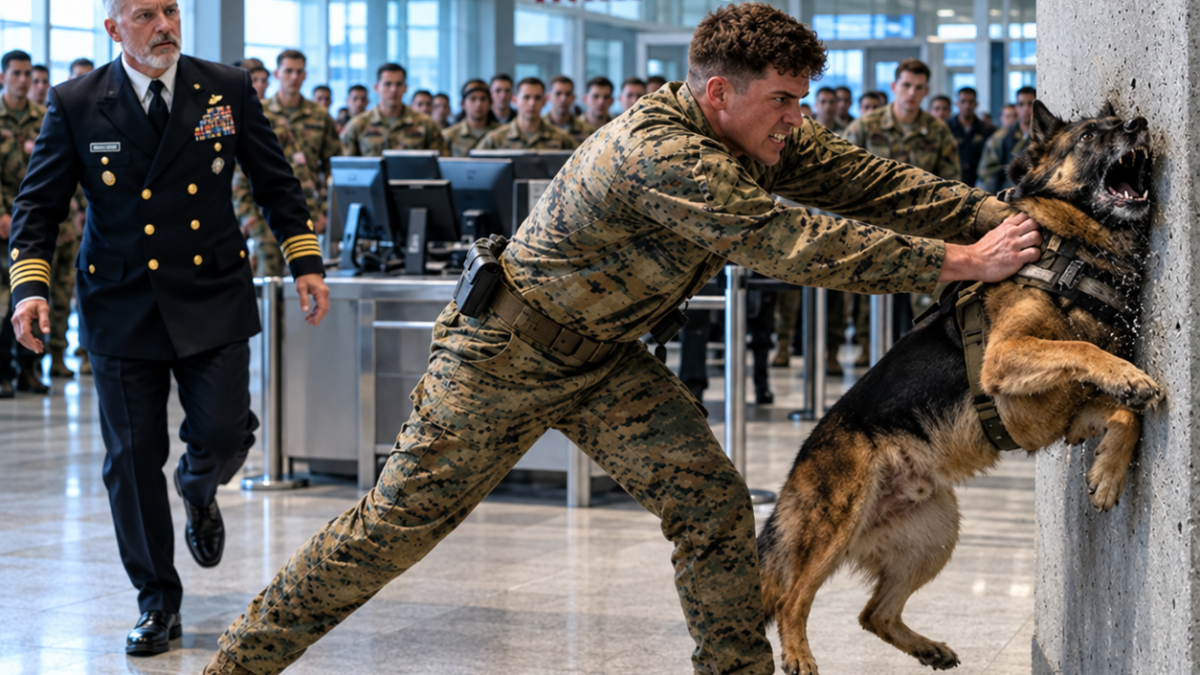
Grabbed the old leather harness.
And shoved.
The German Shepherd lost his footing on the wet tile.
His shoulder struck the concrete wall beside the checkpoint.
A sharp yelp cut through the terminal.
Everything stopped.
Conversations.
Rolling carts.
Bootsteps.
Even the people waiting in line seemed to stop breathing.
The Shepherd dropped to one knee.
For a second, he remained there.
Confused more than angry.
The older man did not move.
That frightened Miller more than shouting would have.
Slowly, the Shepherd tried to stand.
The man crouched beside him.
One hand rested gently against the dog’s neck.
His voice changed.
Softened.
“Easy.”
The German Shepherd’s breathing slowed immediately.
Then the man said his name.
“Atlas.”
Twenty feet away, a Navy captain dropped the coffee cup in his hand.
It struck the floor.
Nobody looked at it.
The captain stared at the dog.
Then at the older man.
His face lost all color.
“Oh, God.”
Miller turned.
“What?”
The captain was already moving toward them.
Behind him, two senior officers had stopped near the security doors.
One of them whispered:
“That’s Atlas.”
Miller looked down at the gray-muzzled German Shepherd struggling to steady himself beside the wall.
For the first time that morning, his migraine disappeared beneath something colder.
“Who?”
Nobody answered him immediately.
The older man rose.
He stood slowly beside the dog.
Then he removed the rain-darkened canvas jacket.
Underneath was a plain navy sweater.
Nothing more.
He did not need anything more.
The captain reached them and came to attention.
Not in front of Miller.
In front of the old man.
“Admiral Sullivan.”
The terminal went silent all over again.
Corporal Trent Miller looked from the captain—
to the old man—
to the German Shepherd pressed against his leg.
And finally understood.
He had not shoved somebody’s pet.
He had just put his hands on Atlas, the retired combat K9 who had served beside Admiral Eden Sullivan through three deployments—and whose name still appeared on one of the most classified rescue citations in Naval Special Warfare history.
Then the dog shifted half a pace forward, placing his body subtly between Miller’s aggressive posture and the older man’s leg.
Miller saw the movement.
He felt the eyes of the line behind him.
Something hot and stupid flashed through his chest.
“Back the animal up,” Miller ordered.
The older man’s eyes remained fixed on him.
“Process the papers, Corporal.”
The words were quiet.
They were also unmistakably a command.
That made it worse.
A civilian in a dirty old coat had no right to speak to him that way.
Miller stepped out from behind the podium.
His hand dropped toward his utility belt, not touching the weapon, but close enough to make a point. It was a small intimidation tactic, one he had used before on nervous recruits and mouthy contractors. Usually it worked.
The old man did not move.
The dog did.
Miller reached toward the man’s chest as if to shove him back from the checkpoint.
The German Shepherd reacted instantly.
He did not bite.
He did not leap for Miller’s throat.
He executed a clean block, throwing his seventy-pound body into Miller’s shin to break his forward momentum. A sharp warning bark cracked through the air.
Miller stumbled sideways.
Not hard.
Not enough to hurt him.
But enough to embarrass him.
And humiliation, in a young man who mistakes authority for identity, can become violence faster than thought.
“You stupid mutt!” Miller shouted.
He lunged.
His hand closed around the thick leather strap of the dog’s harness.
The German Shepherd planted his paws, trying to brace, but the wet linoleum offered no traction. Miller twisted with blind fury, using his full body weight. The dog’s paws slid. His shoulder slammed against Miller’s thigh.
Then Miller lifted and swung.
The German Shepherd hit the reinforced concrete pillar beside the checkpoint with a terrible sound.
Not a dramatic sound.
Not the sound movies give violence.
It was dull.
Wet.
Final.
Concrete grated against fur and bone.
A single yelp tore from the dog’s throat and echoed down the transit corridor before the hum of a departing cargo transport swallowed it.
The dog dropped to the floor.
He did not scramble up.
He collapsed onto his side, panting rapidly, rib cage heaving in shallow, broken pulls. One front paw curled inward and trembled. His mouth opened. A thin line of blood appeared along his gum.
The entire terminal went silent.
No boots.
No murmurs.
No impatient complaints.
Only the dog’s ragged breathing and the relentless sleet striking the plexiglass outside.
Miller stood over him, chest heaving.
His hands suddenly felt numb.
He adjusted his collar.
“Next time,” he said, trying to make his voice hard, “you bring a dog onto my base, you keep it on a damn leash.”
He expected the old man to shout.
He expected rage. Panic. Cursing. Maybe a punch.
He expected everything except what happened.
The old man stopped looking at him.
Slowly, with absolute control, he lowered himself to the cold linoleum beside the injured dog.
There was no panic in his movements.
No wasted motion.
He pulled tactical gloves from his jacket pocket, unfastened the harness straps with precise fingers, and laid the leather aside. The ripping sound of Velcro seemed louder than the storm.
“Easy, Duke,” he whispered. “Easy, boy. Let me see.”
The German Shepherd whined low in his throat and licked the man’s knuckles.
Blood stained the old man’s skin.
The man ran his hands along the dog’s side with a familiarity that had nothing to do with pet ownership and everything to do with battlefield medicine. He pressed gently along the ribs. When he reached the right side of the chest, Duke flinched so violently his jaws snapped at empty air on reflex.
Then he forced his head back down.
Panting.
Trusting.
“Two cracked,” the man murmured. “Maybe broken. Lung sounds clear. No pneumothorax yet. Stay with me, buddy.”
Miller shifted his weight.
The silence in the terminal began to suffocate him.
The adrenaline was draining away, and with it came the first cold edge of consequence.
People were staring.
Not with respect.
Not with the nervous obedience Miller usually expected when he raised his voice.
With disgust.
And fear.
“Hey,” Miller said, trying to restart his authority. “I said get the animal out of the thoroughfare. You’re blocking the line.”
The old man finished his assessment.
Then he stood.
He did not brush the dirt from his knees.
He turned to face Miller.
Miller took an involuntary step back.
The man’s eyes held no warmth at all.
They were not wild.
They were not furious in the ordinary way.
They were the eyes of someone who had seen cities burn and learned long ago that anger was only useful when disciplined.
“You are Corporal Trent Miller,” the man said.
It was not a question.
He had read the name tape.
“Yeah,” Miller said, though the word came out weaker than he wanted. “And you’re loitering in a restricted—”
“What the hell is going on here?”
The voice cut through the terminal like a blade.
Miller turned.
Captain Sarah Hayes was striding down from the command offices, boots striking sharply against the floor. She was officer in charge of the transit hub, a hard-nosed commander who terrified Miller even when nothing was wrong.
Today, something was very wrong.
She took in the stalled line, the bleeding dog, the scattered papers, Miller’s defensive posture, and the old man in the canvas jacket.
“Captain,” Miller said quickly, snapping to attention. “This civilian refused to control his animal. The dog became aggressive and attempted to bite. I subdued it.”
Hayes did not look at Miller.
Her eyes had moved past him.
To the old man.
She froze.
The color drained from her face so completely that for one second Miller thought she might be sick.
She did not look at the papers.
She did not look at the dog.
She looked at the scar through the man’s eyebrow.
Then she snapped her heels together so hard the sound echoed off the vaulted ceiling.
Her salute was rigid.
Perfect.
Terrified.
“Admiral Sullivan, sir.”
Miller’s brain stopped.
The word hung in the air like a blade.
Admiral.
The old man in the wet canvas coat did not return the salute.
Captain Hayes swallowed. “We weren’t expecting your transport for another two hours, sir. Your detail isn’t even here yet.”
Miller looked from Hayes to the man.
Admirals wore stars.
Admirals traveled with aides and security.
Admirals did not stand in contractor lines smelling like wet wool and dog.
But Captain Hayes was still saluting.
And the old man was still looking at Miller.
“Captain Hayes,” Admiral Eden Sullivan said, his voice perfectly even, “are your guards typically trained to assault combat veterans, or is this a special initiative you’ve implemented in my absence?”
Hayes finally looked down.
She saw Duke.
The blood on the floor.
The shallow movement of the dog’s chest.
Her composure cracked.
“Sir,” she said, barely above a whisper. “Is that—”
“That,” Sullivan said, pointing one steady finger toward the dog, “is Sergeant Major Duke.”
Miller felt the floor tilt.
“He served two combat tours in the Typhon Trenches,” Sullivan continued. “He pulled four Marines out of active mortar fire. He holds three Purple Hearts and a Silver Star for dragging my unconscious body out of a burning command transport.”
Sullivan took one step toward Miller.
Miller’s knees threatened to give.
“And your corporal here just threw him against a concrete wall because he was inconvenienced.”
Hayes turned slowly toward Miller.
The look in her eyes was not anger.
It was the look you give a man who has already destroyed himself and has not yet realized the body is still standing.
“Corporal Miller,” she said, voice low and venomous, “remove your sidearm. Step away from the podium.”
“Captain, I didn’t know,” Miller stammered. “He wasn’t in uniform. The dog wasn’t marked. It was an accident.”
“It was a demonstration of character,” Sullivan interrupted.
His voice cut cleaner than shouting ever could.
“A man who hurts an animal to prove his power has neither discipline nor worth.”
He knelt again beside Duke and stroked the dog’s head.
Duke leaned into the touch, eyes half-closed, enduring pain with the silent stoicism of a creature who had survived far worse than a petty boy in a uniform.
“Captain Hayes,” Sullivan said without looking up, “get a medevac team down here now. I want a veterinary surgeon waiting in the trauma bay.”
“Yes, sir.”
Hayes tapped her comms and began barking orders.
Sullivan looked back at Miller.
“As for you, Corporal,” he said softly, “you are going to stand exactly where you are until the medics take my partner. Then you and I are going to have a very long conversation about the chain of command.”
Minutes stretched into lifetimes.
The terminal remained locked in suffocating paralysis. Contractors stood like statues. Mechanics held their bags without shifting. Security personnel looked at the floor, at Hayes, anywhere but at Miller.
Miller stood at attention, muscles trembling, staring at the gray, water-stained wall above Sullivan’s head.
If he looked down, he would see the dog.
If he looked down, he would see the admiral’s hands stained with blood.
He tried to swallow.
His throat had sealed shut.
The doors to the main concourse burst open.
Four medics rushed in.
They did not bring a standard gurney.
They brought a low-profile tactical stretcher, the heavy kind used for extracting wounded operators under fire. Two carried hard cases. Their faces were pale and set.
The lead medic, a master sergeant with a graying beard, dropped to his knees beside Duke.
“Sir.”
His hands hovered over the dog.
“Let us take him.”
Sullivan did not move away entirely. He shifted just enough to give them space, but kept one hand on Duke’s neck.
“Two suspected rib fractures, right lateral side,” Sullivan reported. His voice had dropped into the clipped precision of a battlefield commander. “Breathing shallow but regular. Heart rate elevated. Blunt force trauma directly to the thoracic wall. Concrete impact.”
The medics moved with urgent discipline.
Clippers buzzed through the fur on Duke’s foreleg.
A needle pierced skin.
An IV line was taped down in seconds.
Duke whined, a high thin sound that made several people in line look away. He tried to lift his head toward Sullivan.
“Stay down, Sergeant Major,” Sullivan whispered.
He leaned over, resting his forehead against Duke’s damp, graying snout.
“You’re relieved. Let them work.”
Duke’s tail gave one weak thump against the floor.
Then the sedatives took hold.
His body went limp.
The restraints clicked around the tactical board.
Miller flinched at every sound.
The medics lifted the seventy-pound German Shepherd in unison. Duke’s head rolled slightly against the padding, and Sullivan’s hand followed until the last possible second.
“We have Trauma Bay Three prepped,” the lead medic said. “Dr. Evans is scrubbing in now.”
Sullivan stood and watched them carry his partner away.
His face gave nothing.
His eyes followed the stretcher until it disappeared through the double doors.
Then silence rushed back into the terminal, heavier than before.
Sullivan wiped his bloody hands on his canvas jacket.
The rust-colored streaks blended into the old stains.
He turned to Captain Hayes.
“Clear this terminal. Halt all outbound movement through this corridor. Ground the cargo transports if you have to. I want the hall empty in three minutes.”
“Yes, sir.”
Hayes turned and gave orders with frantic precision.
People moved quickly. Contractors were redirected through secondary corridors. Mechanics gathered their bags. Security personnel began clearing the space with the anxious urgency of men who understood they had just witnessed something that would travel far beyond the terminal.
Within two minutes, the massive hall was empty.
Only Sullivan, Hayes, and Miller remained.
Miller’s legs felt like wet sand.
Excuses piled up in his mind.
He was tired.
The shift had been long.
The old man had provoked him.
The dog had moved first.
He had not known.
He had not known.
But looking at Sullivan, those excuses burned into ash before they could reach his tongue.
The admiral walked toward him.
He stopped two feet away.
Close enough that Miller could smell wet wool, copper blood, and bitter black coffee.
“Corporal Miller.”
The volume was barely above a whisper.
It was the most terrifying sound Miller had ever heard.
“Sir,” Miller rasped.
“Do you know why we issue uniforms?”
Miller’s eyes flicked down to his own tactical vest, the polished badge, the sidearm Hayes had not yet removed.
“To identify personnel, sir.”
“No.”
Sullivan’s eyes moved over him slowly.
“We issue uniforms to strip away the illusion of the individual. When people look at you, they are not meant to see Trent Miller. They are meant to see authority, discipline, restraint, and the honor of the institution you represent.”
His finger tapped the badge on Miller’s chest.
A light tap.
A terrible one.
“When you put this on, you inherit a monopoly on violence. You are given a weapon, a radio, and the legal authority to detain, hurt, or kill under circumstances most civilians will never understand. It is one of the heaviest burdens a society can place on a human being.”
His hand dropped.
“And you used that burden to abuse an old dog because you were annoyed.”
Miller’s eyes burned.
“He stepped at me, sir. I thought he was hostile.”
“He stepped between you and me,” Sullivan corrected. “He put his body in the path of a threat. He did what he was trained to do. He protected his handler from an undisciplined, emotional coward.”
The word struck harder than any blow.
Coward.
“I have commanded tens of thousands of men and women,” Sullivan said. “I have sent people into mud and fire on ground that does not even have names. I know exactly what weakness looks like.”
He leaned slightly closer.
“It does not look like fear. Fear is natural. Weakness looks like you. A small man using a big stick to feel tall.”
Captain Hayes stood perfectly still behind him.
Miller’s face crumpled.
“You thought he was a mutt,” Sullivan continued. “That mutt cleared IEDs in the Typhon Basin for two years. He lost half his hearing to an artillery shell outside Forward Base Kestrel. He carried shrapnel in his hip for six months because medevac helicopters could not land under anti-air fire. He has bled more for that uniform than you ever will if you live to be a hundred.”
Sullivan stepped back, as if standing near Miller had become physically distasteful.
“I am not going to strike you. I am not going to scream at you. That would imply you are worth the expenditure of my energy.”
He looked at Hayes.
“Captain.”
“Sir.”
“Strip this man of his weapon. Confiscate his comms. He is relieved of duty effective immediately.”
“Yes, sir.”
Hayes stepped forward.
Her face was a mask of disgust.
She unbuckled Miller’s gun belt. Miller did not resist. His hands hung at his sides as the belt clattered onto the desk.
She ripped the comms earpiece from his collar.
“You will be processed for a general court-martial,” Sullivan said, tone now bureaucratic, almost bored. “The charges will include assault on a superior commissioned officer, destruction of military property, abuse of authority, and conduct unbecoming. Sergeant Major Duke outranks you in service, sacrifice, and moral standing. I will personally ensure the judge advocate pursues the maximum penalty available.”
Miller’s breath broke.
“You will never wear this uniform again,” Sullivan said. “You will never hold a position of authority over another living creature again.”
“Please,” Miller whispered.
His voice collapsed into a ragged sob.
“It was a mistake. My career—”
“Your career ended the moment you laid hands on my partner.”
Sullivan turned away.
“Be grateful you are walking to the brig.”
He did not wait for a response.
He walked toward the exit doors.
The sleet outside struck him full in the face when he stepped out, but he did not seem to feel it.
A black transport SUV had already pulled to the curb. A nervous driver held the rear door open.
“Base hospital,” Sullivan said, climbing in. “Fast.”
The SUV tore away from the curb.
Inside the vehicle, Sullivan sat in darkness, staring at his hands.
Duke’s blood had dried in the creases of his knuckles.
For the first time all day, the icy facade cracked.
His chest hitched.
One quiet, shuddering breath escaped him.
He leaned his head against the cold window and watched the base blur past.
Hold on, buddy.
Just hold on.
The base hospital was a sterile fortress of white tile, humming machinery, and antiseptic sharp enough to sting the throat.
Sullivan bypassed the front desk entirely, muddy boots leaving a trail across the immaculate floor. Staff members took one look at his face, recognized the commander of the Seventh Fleet, and flattened themselves against walls to let him pass.
He found Trauma Bay Three.
The red light above the doors was illuminated.
Surgery in progress.
Sullivan did not pace.
Pacing wasted energy.
He sat on a hard plastic chair directly across from the doors, elbows on knees, hands clasped tightly together.
Time lost all military usefulness.
Minutes did not report themselves.
Seconds did not obey.
He sat while nurses hurried past, casting nervous glances in his direction. He sat while his aide-de-camp arrived with a fresh uniform and hot coffee, only to be dismissed by one silent wave.
He did not want clean clothes.
He did not want coffee.
He wanted the red light to turn off.
His mind went where it always went when Duke was hurt.
Back to the Typhon Basin.
Gray mud.
Toxic rain.
Artillery pounding the sky apart.
Men shouting through comms that were already half-dead from interference.
The command bunker had been hit just after 0300.
Sullivan remembered the ceiling coming down.
The world folding into concrete, steel, heat, and darkness.
He remembered the pressure on his chest, the impossible weight that pinned him under the remains of a tactical table. He remembered trying to breathe and receiving only dust. He remembered voices fading, then vanishing.
Then paws.
Frantic digging.
Claws tearing through rubble until they bled.
A muzzle forcing itself through a gap barely wide enough for air.
Duke.
Young then.
Stronger.
Half-mad with urgency.
The dog had clawed, bitten, pulled, and refused to leave. When Sullivan’s hand had finally moved, Duke clamped his jaws around the tactical rig and dragged his broken body through a gap just seconds before the secondary explosion collapsed what remained of the structure.
Duke had not just saved his life.
Duke had argued with death and won.
The red light clicked off.
Sullivan stood so fast his joints protested.
The double doors swung open.
Dr. Mara Evans stepped out in green surgical scrubs, pulling down her mask with one hand. She looked exhausted, but her eyes held the kind of steadiness Sullivan needed.
“Admiral.”
“Report.”
“Three fractured ribs,” she said. “One splintered close to puncturing the right lung. We went in, set the bone, secured it with a plate. There’s internal bruising and he’s going to be extremely sore for the next few weeks.”
Sullivan did not breathe.
“The lung is intact,” Evans added. “His vitals are strong. He’s tough as nails, Admiral. He’s going to pull through.”
The air left Sullivan in one long, controlled exhale.
For a moment, all the weight he had been holding seemed to drop through the floor.
“Can I see him?”
“He’s under heavy sedation. He won’t wake for a while.”
“Can I see him?”
Evans nodded. “Yes, sir.”
Duke lay in recovery beneath heated blankets, a wide bandage wrapped around his barrel chest. A line ran into his foreleg, delivering fluids and pain medication. Under harsh surgical lights, he looked smaller than he had ever looked on any battlefield.
Older.
Mortal.
Sullivan pulled a metal stool beside the table and sat.
He rested his hand on the unbandaged part of Duke’s broad head.
The fur behind the notched ear was still soft.
“I’m here, buddy,” he whispered. “I’m right here.”
Duke did not wake.
But as Sullivan’s thumb stroked the familiar spot behind his ear, the German Shepherd let out a long, shuddering sigh in his sleep and leaned slightly into the touch.
Outside, Alaskan sleet hammered the base without mercy.
Inside the recovery room, the war was over for the day.
Sullivan leaned his head against the edge of the steel table, closed his eyes, and matched his breathing to the slow rhythm of the machine monitoring his partner’s heart.
By dawn, the story had already spread.
No one knew the full truth yet, but military bases run on official channels and unofficial oxygen. Something had happened in the transit terminal. A corporal had injured a K9. An admiral had been involved. Captain Hayes had cleared an entire corridor. Military police had escorted Corporal Miller away without his weapon, without his comms, and without the arrogant posture he had worn like armor only hours earlier.
At 0600, Hayes stood outside the hospital recovery room with a formal report folder tucked beneath one arm.
She had slept zero minutes.
Her uniform was immaculate anyway.
Sullivan stepped into the hall.
For a moment, Hayes’s eyes went past him toward the room where Duke slept.
“How is he, sir?”
“Alive.”
Relief passed over her face so quickly most people would have missed it.
Sullivan did not.
“Good.”
“Your report?”
Hayes handed him the folder. “Preliminary witness statements. Terminal camera stills. Medical report pending. Miller is in holding under guard. JAG has been notified.”
Sullivan opened the folder.
He read silently.
Hayes stood at attention.
After a moment, he looked up.
“Your checkpoint has problems.”
“Yes, sir.”
“You knew that before last night.”
Hayes’s face tightened.
That was answer enough.
Sullivan closed the folder.
“Explain.”
Hayes did not attempt to protect herself.
“Miller had two prior complaints for aggressive conduct toward civilian contractors. One formal counseling for misuse of tone with medical transport staff. No physical incidents documented before last night.”
“No physical incidents documented,” Sullivan repeated.
Hayes swallowed. “No, sir.”
“That is not the same as no physical incidents.”
“No, sir.”
Sullivan studied her.
Hayes had the rigid misery of an officer who knew the failure was not only the corporal’s.
“You are not responsible for every stupid, cruel impulse inside the skull of a subordinate,” Sullivan said. “You are responsible for what your command tolerates before stupidity becomes injury.”
“Yes, sir.”
“Fix it.”
“I will, sir.”
“No.” Sullivan’s voice hardened. “You will begin today. Service animal processing will be retrained. Use-of-force escalation will be audited. Every guard in that terminal will understand that tired is not an excuse, irritation is not authority, and a badge is not a permission slip for contempt.”
“Yes, sir.”
“And Captain?”
“Yes, sir?”
“If any man or woman under your command calls Duke a pet again, I will consider it a failure of education and start with the instructor.”
Hayes’s jaw tightened.
“Yes, sir.”
She hesitated.
Then, carefully, she said, “Sir, may I ask something?”
“You may ask.”
“Why were you in the contractor line?”
Sullivan looked back through the glass at Duke.
“Because Duke hates escorts.”
Hayes blinked.
That had clearly not been the answer she expected.
Sullivan continued. “He spent too many years in convoys, too many years around men with guns pretending not to be afraid. Crowds bother him less when no one makes him the center of one.”
His eyes moved back to Hayes.
“And because I have spent forty years watching people behave differently when they know rank is in the room. Sometimes it is useful to see what happens when they think it isn’t.”
Hayes absorbed that in silence.
Last night, what had happened was Trent Miller.
But Miller had not appeared from nothing.
That was what made Hayes look as if the floor had shifted under her.
“Dismissed, Captain.”
Hayes saluted.
This time, Sullivan returned it.
Barely.
But enough.
Corporal Trent Miller spent the next forty-eight hours in a holding cell staring at his own hands.
Without his belt, sidearm, comms, and badge, he looked younger than he had in the terminal. Small, almost. The uniform remained, but it no longer protected him from himself.
At first, he replayed the moment in fragments that favored him.
The dog moved.
The old man gave a command.
The line was backing up.
He was tired.
He had not known.
He had not known.
But memory was not loyal when fear stripped the lies away.
Again and again, he saw the dog’s body hit the pillar.
He heard the yelp.
He saw the blood on Sullivan’s hands.
The worst part was not that Duke had been decorated.
The worst part was that Duke’s service record changed nothing about the actual wrongness.
Miller knew that now.
He had not hurt a dog because the dog was dangerous.
He had hurt a dog because he could.
That knowledge sat in his stomach like lead.
When the JAG attorney came in, Miller asked one question before she even sat.
“Is the dog alive?”
The attorney looked at him for a long moment.
“Yes.”
Miller put both hands over his face.
The relief that hit him was not enough to save him from anything.
But it was still relief.
The hearing came faster than anyone expected.
Admiral Sullivan did not use influence to delay, soften, or dramatize the process. He used it to make sure every fact arrived intact.
Terminal camera footage showed the old man presenting papers.
Showed Duke stationary.
Showed Miller stepping across the line.
Showed Duke blocking, not attacking.
Showed Miller grabbing the harness.
Showed the impact.
Witness statements matched.
The medical report confirmed three fractured ribs, blunt-force thoracic trauma, internal bruising, and surgical repair.
Captain Hayes testified about Miller’s prior counseling.
The judge advocate read Duke’s service record into evidence.
Sergeant Major Duke.
Military working dog.
Two combat tours.
Explosive detection.
Personnel recovery.
Four confirmed combat extractions under fire.
Three Purple Hearts.
Silver Star.
Retired with honors.
The courtroom remained very still during that part.
Sullivan sat in dress uniform, expression unreadable, hands folded before him.
Duke was not present.
He was still recovering.
Miller stood with his defense counsel and stared straight ahead.
When asked if he wished to make a statement, Miller’s mouth opened once before sound came.
“Yes, ma’am.”
His voice shook.
“I told myself I made a mistake because I didn’t know who they were. But that’s not true. I made a choice before I knew who they were. I thought they didn’t matter.”
He swallowed hard.
“I thought the man was nobody. I thought the dog was just an animal. I thought my anger mattered more than their dignity.”
No one moved.
“I was wrong before I touched the harness. I was wrong when I raised my voice. I was wrong when I stepped across the line. And when Sergeant Major Duke did what he was trained to do, I punished him for protecting someone from me.”
His eyes flicked toward Sullivan and then away.
“I don’t ask for forgiveness. I don’t think I deserve to ask for that. I just want the record to say I understand now that rank didn’t make what I did wrong. His medals didn’t make it wrong. It was wrong when I thought no one important was watching.”
The words did not save his career.
They were not meant to.
Miller was stripped of rank, sentenced to confinement, discharged under conditions that ensured he would never again serve in uniform, and barred from security work involving weapons or authority over detainees, service animals, or military transit personnel.
Some thought the punishment harsh.
Others thought it lenient.
Sullivan said nothing publicly.
But when the sentence was read, he closed his eyes for one second.
Not in satisfaction.
In exhaustion.
Duke came home from the hospital fourteen days later.
Home, for Sullivan, was a temporary command residence on base that he had occupied for six months without ever making it look lived in. There were classified folders in one room, a locked cabinet in another, and exactly three framed photographs on a shelf.
One of Sullivan in a formal command portrait.
One of his late wife, Helena, taken twenty years earlier on a windy pier.
One of Duke in full working gear, younger, ears sharp, eyes bright, standing in mud beside Sullivan after the Typhon campaign.
The residence smelled faintly of old leather, coffee, and now antiseptic.
Duke moved slowly.
The bandage around his chest made him look broader and more fragile at once. Every breath was careful. Every step measured. Sullivan walked beside him with one hand hovering near the harness, not touching unless needed.
For a dog who had once crossed rubble under mortar fire, the three porch steps were an insult.
Duke stopped at the bottom.
Looked up.
Looked at Sullivan.
Sullivan looked back.
“No,” the admiral said. “You are not too proud for help.”
Duke huffed.
It was not quite a protest, but it carried intent.
Sullivan crouched carefully, slid one arm beneath Duke’s chest and another behind his hind legs, and lifted.
Pain flashed through Duke’s body. He whined once, low and involuntary.
Sullivan’s jaw tightened.
“I know,” he whispered. “I know.”
He carried him inside and set him on the thick orthopedic bed that had arrived that morning after Sullivan ordered three different aides to stop asking if he needed anything and simply acquire the best one on base.
Duke lowered himself with a sigh.
Sullivan sat on the floor beside him.
Admirals did not sit on floors in uniform.
Sullivan did.
Duke’s eyes followed him.
“You’re relieved from porch duty,” Sullivan said.
Duke blinked.
“Temporarily.”
The dog’s tail tapped once.
Recovery was slow.
Too slow for Duke.
Too slow for Sullivan.
The surgeon warned against sudden movement, stairs, rough terrain, and long walks. Duke required pain medication, wound checks, breathing monitoring, and assisted mobility. Sullivan learned the schedule more carefully than he had learned some battle plans.
Medication at 0600.
Small meal.
Ten-minute supported walk.
Rest.
Breathing check.
Wound inspection.
Second dose.
Ice.
Heat.
Repeat.
Captain Hayes came by on the third day with updated training protocols.
She found Sullivan in shirtsleeves, kneeling beside Duke with a pill hidden inside turkey.
Duke accepted the turkey, swallowed, then gave Sullivan a look of deep betrayal when the medicine followed.
Hayes stopped at the doorway.
“Bad time, sir?”
“All times are bad when medicine is involved.”
Duke turned his head toward Hayes.
She stepped inside slowly.
“May I?”
Sullivan nodded.
Hayes crouched at a respectful distance.
“Sergeant Major.”
Duke watched her.
“I owe you an apology,” she said.
Sullivan said nothing.
Hayes continued, voice steady but strained.
“My checkpoint failed you. My command failed you before Corporal Miller ever touched you. I allowed complaints to become paperwork instead of correction. That will not happen again.”
Duke blinked.
Hayes seemed to accept that as judgment.
Sullivan studied her.
“Show me.”
Hayes placed a tablet on the coffee table.
New training modules.
Mandatory service animal recognition briefings.
Body camera activation requirements at all high-friction checkpoints.
Complaint escalation procedures.
Use-of-force review board changes.
A new policy requiring handlers and service animals to remain together during transit processing unless medically impossible.
Sullivan read without comment.
When he finished, he looked up.
“Good beginning.”
Hayes nodded. “Beginning, sir.”
That was the correct answer.
A month later, Duke walked back into the terminal.
Not because he needed to.
Because Sullivan believed places of injury should not always remain places of fear.
The morning was clear this time.
No sleet.
No sideways rain.
Sunlight struck the reinforced glass and turned the polished floor pale gold.
The checkpoint had been rearranged. Wider lanes. Better signage. A clearly marked service animal processing area. Two guards stood behind the desk, both newly trained, both visibly nervous when they recognized Sullivan.
Captain Hayes was present too.
Not for ceremony.
For accountability.
Duke walked slowly at Sullivan’s left side, harness fitted loosely around his healing chest. His ribs had mended enough for careful movement, but the fur shaved for surgery was still growing back in uneven patches.
As they approached the yellow line, one young guard stepped forward.
“Admiral Sullivan, Sergeant Major Duke,” she said, voice steady despite the tension in her shoulders. “Welcome through. Documentation already verified, sir. Do you need any medical accommodation before boarding?”
Sullivan looked at her name tape.
Private Alina Reyes.
“No.”
Reyes nodded. “Understood, sir.”
Then, after the briefest hesitation, she looked down at Duke.
“Thank you for your service, Sergeant Major.”
Duke’s ears shifted.
His tail gave one slow thump.
Sullivan looked at Hayes.
Hayes did not smile.
But something in her face eased.
They moved through the checkpoint without incident.
For most of the terminal, it was a small moment.
For Hayes, it was proof of repair beginning.
For Sullivan, it was something harder to name.
Duke walked past the concrete pillar where he had been thrown. He slowed there, nose working faintly. Sullivan stopped with him.
The pillar had been cleaned.
There was no visible blood.
No mark left for strangers to notice.
But Duke remembered.
So did Sullivan.
The dog leaned against his leg.
Not heavily.
Just enough.
Sullivan rested his hand on Duke’s head.
“You’re all right,” he murmured.
Duke looked up.
Then forward.
They walked on.
Three months after the incident, Sullivan received a letter.
It was not sent through official channels. It arrived by military mail, forwarded from confinement through JAG review, then screened by Sullivan’s aide before reaching his desk.
The envelope was plain.
The handwriting was uneven.
Admiral Sullivan, sir.
Sullivan considered throwing it away unread.
Then Duke, lying near the office window with his chest fully healed but his movement still a little stiff, lifted his head as if the paper had made a sound only he could hear.
Sullivan opened it.
Corporal Miller no longer signed with rank.
Just Trent Miller.
The letter was not long.
Sir,
I know I do not have the right to ask anything from you. I am not writing to ask for forgiveness, leniency, recommendation, or contact.
I am writing because during the hearing, I said I understood that what I did was wrong even before I knew who you were. I meant it then, but I understand it more now.
In confinement, they assigned me to kennel maintenance for non-working dogs under supervision. At first, I thought it was some kind of humiliation. Maybe it was. But there is an older dog here named Mags. She was used for breeding before she was rescued, and she still flinches when people move too fast.
The first week, she would not come near me. I thought I was being patient, but really I was waiting for her to make me feel better about myself.
She did not.
One of the handlers told me, “You are not owed trust because you stopped being dangerous for five minutes.”
I think about that every day.
I think about Sergeant Major Duke every day too.
I will not insult you by saying the work has changed me already. I do not think change should be announced before it is proven.
But I wanted the record, somewhere outside my own head, to say this:
I hurt him because I wanted power in a moment when I felt small.
That is the truth.
I am sorry.
Trent Miller
Sullivan read it twice.
Then he placed it on the desk.
Duke pushed himself up slowly and came to stand beside the chair.
His notched ear tilted.
Sullivan looked at him.
“No,” he said. “I’m not answering.”
Duke stared.
Sullivan sighed.
“You are far too forgiving for someone with three plated ribs.”
Duke’s tail moved once.
Sullivan did not write back that day.
Or the next.
A week later, he sent one sentence through JAG.
Mr. Miller,
Do not tell me you are sorry.
Show every living thing you meet from now on.
E. Sullivan
Years passed, and the story changed as stories do.
In some versions, Duke had been slammed so hard the entire terminal shook.
In others, Sullivan had revealed himself by throwing open his coat to show stars, which never happened.
Some claimed Miller fainted.
He had not.
Some claimed Sullivan ruined him with a single phone call.
That was not true either.
Miller had ruined himself with a single choice.
The truth was quieter and far more important.
A young man with authority mistook contempt for control.
An old dog did his duty.
A commander refused to let rank become the only reason the wrong mattered.
And a military base changed its procedures because pain had exposed a failure no inspection had caught.
Duke lived four more years.
Four good years.
Not easy ones.
The plated rib ached in cold weather. His hip stiffened. His hearing worsened. He stopped jumping into transports and allowed Sullivan to lift him with only moderate judgment in his eyes. He remained suspicious of polished floors, uninterested in ceremonial praise, and deeply committed to stealing sausage when medical staff were distracted.
He attended two fleet ceremonies, one retirement banquet, and the dedication of the new Mercer Service Animal Transit Wing.
The plaque near the entrance read:
IN HONOR OF ALL WHO SERVE WITHOUT SPEAKING.
Below it, in smaller letters:
Sergeant Major Duke
Military Working Dog
Typhon Basin Veteran
Silver Star, Three Purple Hearts
Partner. Protector. Marine.
Sullivan stood through the ceremony with one hand resting lightly on Duke’s harness.
Captain Hayes, now promoted, stood nearby.
Private Reyes, now a sergeant, helped demonstrate the new processing protocols to visiting command staff.
No one mentioned Corporal Miller.
That was not the day’s purpose.
But later, Sullivan saw a maintenance worker near the kennels pause beside Duke, remove his cap, and lower his head.
Older now. Thinner. Civilian clothes. No rank.
Trent Miller.
Security stiffened, but Sullivan lifted one hand slightly.
Let him stand.
Miller did not approach.
He did not ask to touch Duke.
He simply looked at the old German Shepherd from across the walkway and whispered something Sullivan could not hear.
Duke turned his head.
For a long moment, dog and man looked at each other.
Then Duke gave one slow blink and turned back toward Sullivan.
Miller wiped his face with his sleeve and walked away.
Sullivan never knew whether Duke had forgiven him.
He did not claim that kind of knowledge.
Dogs had their own moral universe, cleaner and more immediate than men deserved.
But he knew this: Duke had not needed Miller’s destruction to be honored.
He had needed humans to learn.
And some had.
When Duke died, it was not in war.
Not in a terminal.
Not on a floor under fluorescent lights.
He died in Sullivan’s quarters on a winter morning, lying on the thick orthopedic bed near the window while snow fell silently beyond the glass.
Sullivan sat beside him on the floor, one hand behind the notched ear.
Duke was very old by then.
His muzzle almost entirely white.
His breaths came slow and shallow.
Dr. Evans had come in civilian clothes. Hayes stood in the hallway because she said she was there for Sullivan but could not quite make herself enter until called. Reyes waited outside with Duke’s old harness folded in her hands.
Sullivan leaned close.
“You’re relieved,” he whispered, voice breaking for the first time in years. “Let them work.”
But this time there was no work left to do.
Duke’s tail moved once.
Barely.
A final answer.
Then he was gone.
At the memorial, Sullivan spoke only briefly.
He did not list every medal.
He did not retell every mission.
He did not describe the day at the terminal in detail, though everyone there knew it.
He stood at the podium in dress uniform, older than most people wanted to notice, and looked at the folded harness placed beside Duke’s ashes.
“There are men who serve because they believe history is watching,” he said. “There are men who serve because they want medals, promotion, command, or a name carved somewhere permanent.”
He rested one hand on the podium.
“Duke served because the person beside him needed to come home.”
No one moved.
“He did not understand flags the way we do. He did not understand rank. He did not understand politics, strategy, speeches, or memorials. He understood fear. He understood trust. He understood that when danger came, he could put his body between it and the person he loved.”
Sullivan’s voice lowered.
“That is not lesser service. It is the purest form of it.”
Captain Hayes bowed her head.
Sergeant Reyes cried openly.
Even Robert Haines, Sullivan’s oldest aide and a man rumored to have tear ducts made of classified steel, removed his glasses and looked down.
Sullivan looked at the harness.
“He was my partner,” he said. “He was my witness. He was the reason I lived long enough to become the man standing here. And when he was hurt by cruelty, he reminded this institution that honor does not begin with medals. It begins with how we treat the vulnerable when we think no one important is watching.”
He stepped back.
That was all.
Years later, young guards at Joint Base Mercer still heard the story during training.
Not the exaggerated version.
Captain Hayes made sure of that.
She told it plainly.
A dog sat at a checkpoint.
A corporal abused power.
An admiral revealed a truth too many people forget.
Authority does not create character.
It reveals it.
Then she would point to the service animal processing lane, to the body cameras, to the use-of-force policy, to the photographs of working dogs and handlers lining the wall.
At the center hung one photo of Duke.
Not young.
Not posed in heroic profile.
Old, gray-muzzled, wearing a leather harness, amber eyes fixed calmly on the camera.
Beneath it were Sullivan’s words:
A uniform gives you permission to act.
It does not give you permission to forget your soul.
And beside that, in smaller text:
Sergeant Major Duke.
He stood between danger and his handler one last time.
May we be worthy of what he taught us.
The concrete pillar was still there in the terminal.
People passed it every day without knowing.
Boots crossed the polished floor.
Rain struck the plexiglass.
Coffee burned on warmers.
Flights arrived.
Cargo moved.
Lines formed.
Orders were given.
But those who knew the story sometimes glanced at that pillar and remembered the sound that had once silenced an entire terminal.
The yelp.
The impact.
The moment a young man discovered too late that cruelty committed against the powerless has a way of summoning every power in the room.
And they remembered the old admiral kneeling on the floor, hands covered in his partner’s blood, whispering not like a commander, not like a legend, not like a man whose name filled history books.
Just like a friend.
Easy, Duke.
Stay with me.
I’m here.








