A Jewelry Store Manager Threw a Muddy Boy Out for “Stealing” a Diamond—Then the Elderly Owner Came Downstairs, Hugged Him, and Revealed Who He Really Was
PART3:
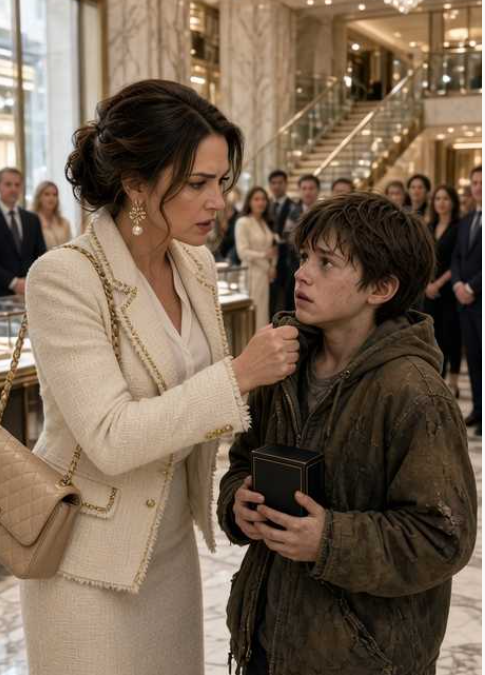
“This is not a playground,” she snapped. “And Mr. Harrison does not meet with children off the street.”
“I’m not—”
She stepped closer.
“Open the box.”
“No.”
“Open it.”
“I can’t.”
That was when the room changed.
I saw it happen.
A frightened child became, in Victoria’s mind, a thief.
Not because she had evidence.
Because she had permission from her own prejudice.
She grabbed the front of his wet jacket and yanked him toward the nearest display case.
“Open it.”
The boy cried out, not from pain exactly, but shock.
Several customers turned fully now.
A woman near the bridal counter lifted one hand to her mouth.
A man in a navy suit frowned but did not move.
My head of security, Paul, stepped forward uncertainly, then stopped when Victoria shot him a look.
That was another failure I would have to answer for.
“I didn’t steal anything,” the boy said.
“Then why are you carrying a jewelry box?”
“I was told to.”
“By who?”
“I can’t say.”
Victoria’s lips curled.
“You can’t say because you’re lying.”
“I’m not.”
“Search him,” she ordered.
Two security guards moved toward him.
The boy hugged the box against his chest.
“Please,” he said. “Please don’t.”
He tried to turn away, not to escape the store, but to shield the box.
Victoria grabbed him again.
His sock slipped on the marble.
The box nearly fell.
She ripped it out of his hands.
“No!” he screamed. “Please don’t open it!”
That scream moved through me like a knife.
I was already on the stairs.
Daniel followed close behind.
Victoria held the box high, triumphant.
“Let’s see what you thought you were taking.”
The boy lunged for it.
One guard caught his arm.
Victoria shoved him backward.
He fell hard onto the marble floor, landing on his hands and knees.
This time, the room gasped.
For one second, nobody moved.
Then Victoria pointed down at him.
“Call the police.”
The boy looked up at her, tears mixing with rain on his face.
“I didn’t steal it.”
She looked down at him with a disgust so complete it seemed to empty her of humanity.
“People like you don’t belong around diamonds.”
Then she said the sentence that would later be quoted in every witness statement, every news article, every courtroom transcript.
“Take him out.”
The guards grabbed him under both arms.
That was when my voice reached the floor.
“Let him go.”
Every person in the store froze.
I was halfway down the staircase.
I did not shout.
I have learned over many years that power rarely needs volume when it is real.
The guards released the boy immediately.
Victoria turned.
“Mr. Harrison, I’m sorry, but this child was caught stealing—”
“Let him go,” I repeated.
This time, even she stopped speaking.
The boy stumbled toward me, shaking so badly he nearly fell again.
I reached the bottom of the stairs and opened my arms.
He crashed into me.
Mud, rain, and all.
I held him.
Not carefully.
Not politely.
I held him the way a grandfather holds a child who has been frightened by adults who should have known better.
“My boy,” I whispered.
His small hands clutched my jacket.
“I tried to bring it to you,” he sobbed.
“I know.”
“She took it.”
“I know.”
“She thought I stole it.”
“I know.”
The entire store was silent.
I looked up.
Victoria had gone pale, but not pale enough.
Not yet.
“You grabbed him?” I asked.
Her mouth opened.
“I—I didn’t know—”
“You accused him of stealing?”
“I thought—”
“You threw him on my floor?”
She had no answer for that.
Good.
There was none.
I held out my hand.
“Give me the box.”
Her fingers trembled as she placed it in my palm.
I opened it.
Inside was not a diamond.
Not exactly.
It was a ring.
Small.
Old.
Set with a deep blue sapphire surrounded by tiny diamonds. The gold was worn at the underside from decades of use. It was not the most valuable piece Harrison & Vale had ever handled, not by appraised price.
But to me, it was priceless.
My wife’s ring.
Margaret’s ring.
The one she wore the day we opened our first little store forty-two years earlier, before the flagship, before the private clients, before the vaults, before men in suits used phrases like market dominance and asset expansion around conference tables that still sometimes felt too large for me.
I closed the box.
My hand shook once.
Then steadied.
“Victoria,” I said, “do you know who this boy is?”
She swallowed.
“No, sir.”
I looked down at Eli.
His face was buried against my coat.
Then I looked back at my store manager.
“He is my grandson.”
The silence deepened.
Even the rain against the front windows seemed to quiet.
Victoria’s face emptied of color.
“And one day,” I continued, “this entire store will belong to him.”
A customer near the engagement counter whispered, “Oh my God.”
Victoria stared at Eli.
Then at the box.
Then at me.
I could see the calculations beginning behind her eyes. How badly had she damaged herself? Who had seen? Could she apologize? Could she claim misunderstanding? Could she turn it into concern for security?
People like Victoria rarely feel shame first.
They feel danger.
But that was not the end.
Not even close.
Because what nobody in that showroom understood yet was that the muddy child had not come only to deliver a ring.
He had delivered a verdict.
“Paul,” I said to the head of security.
“Yes, Mr. Harrison.”
“Escort Ms. Langley to the rear office. She is not to access her computer, her phone, her files, or the safe.”
Victoria’s eyes widened.
“Sir—”
“Not another word.”
She closed her mouth.
Then I looked at the customers.
“My apologies,” I said calmly. “The store will be closing for the day. Any pending consultations will be rescheduled privately.”
A man near the watches cleared his throat.
“Mr. Harrison, should we give statements?”
I looked at Victoria.
“Yes,” I said. “You should.”
Eli clung to me harder.
I bent and picked him up even though he was thirteen and almost too tall for it. He did not protest. Some children become very young again after terror. I carried him toward the private elevator, mud streaking the front of my suit.
No one dared mention it.
Inside the elevator, with Daniel beside us, Eli finally lifted his head.
“Grandpa,” he whispered, “did I do it wrong?”
That question nearly broke me.
I pressed my hand against the back of his head.
“No,” I said. “I did.”
He looked confused.
“I should never have let you walk into that room alone.”
“You told me it was a test.”
“It was.”
“Then she failed.”
I closed my eyes.
“Yes.”
The elevator opened into my private office.
Eli had only been there once before. He remembered the massive desk, the old photographs, the framed newspaper article announcing the first Harrison & Vale store, and the glass case displaying the first jeweler’s loupe I ever owned.
He did not know about the blue folder in my locked drawer.
Not yet.
I set him down and took the small key from his pocket.
That had been part of the test too.
The box held Margaret’s ring.
Eli held the key.
Both were necessary.
The ring belonged emotionally to the family.
The key opened the truth.
I unlocked the drawer and removed the thick blue folder.
“What is it?” Eli asked.
“Something you need to understand before you inherit anything.”
Daniel stood near the desk.
“Everett,” he said quietly, “he’s thirteen.”
“I know.”
Eli looked from him to me.
“I want to know.”
Of course he did.
He was his mother’s son.
And, God help me, mine too.
I opened the folder.
The first page contained company accounts.
The second showed transactions.
The third showed payments to four small companies that appeared legitimate if a person was too busy, too trusting, or too impressed by polished signatures.
Eli leaned closer.
“These are vendors?”
“They pretend to be.”
“What do they do?”
“Nothing.”
He frowned.
“Then why do we pay them?”
“Because someone has been stealing from us.”
His eyes moved to the total.
He went still.
“Six million dollars?”
“More, probably.”
He looked toward the closed office door.
“Victoria?”
“Possibly.”
“Is that why you sent me downstairs?”
“That is part of why.”
His face tightened.
“You wanted to see if she was stealing?”
“No,” I said. “I wanted to see if she was cruel.”
He stared at me.
“That’s worse.”
Children have a way of placing truth on the table without the protective cloth adults like to use.
“Yes,” I said. “It is.”
I walked to the window.
Below us, police cars had pulled up. Victoria stood near the rear hall, speaking rapidly to an officer. Even from above, I could see her hands moving in elegant, useless circles.
“I have spent my life learning how to judge diamonds,” I told Eli. “Color. Cut. Clarity. Weight. Light. Flaws. Value. I know how to judge a balance sheet. I know how to judge a business deal. I know how to tell when someone is selling me confidence instead of truth.”
I turned back to him.
“But I should have learned sooner that the hardest thing to judge is character.”
Eli looked at the folder again.
“Did Dad know?”
That hurt more than I expected.
Richard.
My son.
Eli’s father.
The man who had spent most of his life believing inheritance was a substitute for earning anything.
“I don’t know,” I said.
It was the most generous answer I could give.
Eli nodded, but his eyes lowered.
Richard had disappointed him enough that the possibility did not shock him.
That was another indictment against me.
I had hidden Eli from the company for years. Not completely. Not illegally. But quietly. Carefully. After Richard’s marriage fell apart and Eli’s mother, Laura, took him away from the family’s public chaos, I agreed to keep his life ordinary. I paid for his school through a trust. Sent birthday gifts with no logos. Visited privately. Never photographed him at company events. Never named him publicly as heir.
I told myself I was protecting him.
And I was.
But protection and secrecy are cousins. If you are not careful, one becomes the other.
Downstairs, Victoria kept repeating the same sentence.
“I didn’t know who he was.”
A young police officer finally asked her the question that would follow her through the rest of the investigation.
“Would you have treated him differently if you had?”
She did not answer.
Because everyone already knew.
The next morning, Daniel Price spread documents across my conference table.
He had worked through the night with our outside legal team, internal audit access, and, eventually, a court-approved preservation order. Harrison & Vale looked calm from the street that morning. The display windows still glittered. The diamonds still caught the light. The doormen still wore white gloves.
But inside, the walls were opening.
“I found the same four shell companies,” Daniel said.
He pointed to a chart.
“Three routes. One ends with a personal investment account linked to Victoria Langley.”
No surprise there.
I had expected it.
That did not make it hurt less.
“Another connects to a private company owned by Richard.”
Eli sat in the corner, school backpack at his feet, silent.
I had told him he did not have to attend.
He said, “Numbers tell stories. I want to learn to read them.”
So I let him stay.
Not because children should carry adult corruption, but because this corruption had already reached for him. Better he see it in daylight than feel it moving in shadows.
Daniel continued.
“The third route leads to an investment fund with hidden beneficial ownership. We are still tracing it.”
“Marcus?” I asked.
Daniel’s mouth tightened.
“Possibly.”
Marcus Vale was our senior financial consultant, though the Vale name in Harrison & Vale no longer came from his branch directly. His grandfather had been my wife’s uncle and my first partner. Marcus had inherited the name, the suits, and the ability to sound indispensable while avoiding measurable responsibility.
“What story do the numbers tell?” I asked Eli.
He looked at the pages.
“That someone thought nobody would notice.”
“Exactly.”
“And they were almost right.”
I did not answer.
That was the most painful part.
Victoria was called upstairs at two that afternoon.
She entered my office wearing a cream suit, pearl earrings, and the expression of a woman who had slept badly but still believed presentation mattered.
“Close the door,” I said.
She did.
“You know why you’re here.”
“I made a mistake.”
“What kind?”
“I handled a situation badly.”
“No.”
She blinked.
“You judged a child by his clothes. You humiliated him. You put your hands on him. You ordered guards to drag him out because you believed he had no one powerful behind him.”
Her mouth trembled.
“I am deeply sorry, Mr. Harrison.”
“Your apology is not the issue.”
I slid a document across the desk.
“This is.”
She looked down.
The color drained from her face.
A vendor report.
Payments from shell companies into her investment account.
She stared at the page.
“I can explain.”
“Good,” I said. “Explain why money belonging to Harrison & Vale has been entering your account.”
She said nothing.
That silence did what the apology could not.
It told the truth.
Victoria’s office was searched that evening.
Investigators found invoices hidden beneath a false bottom in a filing cabinet. A second phone. Copies of vendor checks. Draft emails never sent. A folder labeled WHITFIELD RESOLUTION.
The name stopped me cold.
Whitfield was Laura’s maiden name.
Eli’s mother.
My attorney, Margaret Cho, opened the folder while I stood beside the conference table.
Inside were drafts concerning the family trust.
Eli’s name appeared on several pages.
One document claimed I intended to transfer certain assets to Richard.
Another suggested Eli’s inheritance was conditional.
Another implied that if Eli remained “outside the active family structure,” his future control of Harrison & Vale could be legally delayed or reduced.
At the bottom of one document was my signature.
Almost.
Not quite.
“They forged it,” I said.
Margaret nodded.
“It appears digitally copied from an older trust amendment.”
“I was overseas six weeks ago.”
“The creation date matches that period.”
Eli stood across the room, arms folded.
He had not spoken in ten minutes.
Finally, he asked, “Why would they do that?”
I answered honestly because lies would have been easier, and he deserved better.
“Because they believed they would inherit more if you inherited less.”
He looked down.
Not crying.
Not yet.
A child can absorb betrayal very quietly when he has been disappointed before.
The following week, Richard returned from a business trip.
My only son walked into the office wearing a charcoal suit, an expensive watch, and the impatient expression of a man accustomed to being annoyed by consequences.
He stopped when he saw investigators.
“What’s happening?”
“Sit down,” I said.
Richard gave a nervous smile.
“I don’t like that tone.”
“You will like it less in a moment.”
He sat.
I placed the documents in front of him.
“Explain.”
He glanced down.
His face changed.
“Dad, this isn’t what you think.”
“What do I think?”
“That I stole money.”
“Did you?”
“No.”
I slid a bank statement toward him.
“Six hundred thousand dollars.”
He stared.
Another.
“Two hundred thousand.”
Another.
“Eight hundred thousand.”
Richard looked up.
“Someone used my accounts.”
“Who?”
“I don’t know.”
“Daniel,” I said.
Daniel stepped forward with access logs.
“The logins originated from your home computer.”
Richard went pale.
“My wife uses that computer.”
His current wife.
Chloe.
Young, elegant, socially ambitious, and always smiling at Eli with the strained warmth of someone pretending not to see an obstacle.
“Your wife?” I asked.
Richard swallowed.
“Yes.”
“Then call her.”
Chloe denied everything at first.
People always do.
Denial is the first luxury of the guilty.
Then investigators found the emails.
She had been communicating with Victoria.
Asking about the family trust.
Asking how much Eli would inherit.
Asking whether I could legally change my will.
Asking, in one particularly damning message, whether “the boy’s public legitimacy” could be challenged if Richard regained active control before my death.
The boy.
Not Eli.
Not your son.
The boy.
Victoria wanted money.
Chloe wanted influence.
Marcus wanted a larger role and access to company assets he believed his branch of the family had been denied.
Richard wanted to be seen as innocent while benefiting from everyone else’s ambition.
Eli was the common target.
That night, I took him home myself.
Not to Richard’s house.
Never again.
To the townhouse where he lived with his mother, Laura.
She opened the door before I could knock twice.
Her face went from anger to fear when she saw Eli.
“What happened?”
“He’s all right,” I said quickly.
“No, he’s not,” she said, looking at her son.
Mothers can read wreckage beneath calm.
Eli stepped into her arms.
For the first time since Victoria threw him to the floor, he cried like a child.
Laura held him and looked at me over his shoulder with a fury I deserved.
“I trusted you,” she said.
“I know.”
“You said he would be safe.”
“I thought he would be.”
“You sent him into that store alone?”
My silence answered.
Her eyes filled with tears, but her voice stayed sharp.
“You used him.”
That landed harder than anything Victoria had said.
“I did,” I admitted.
Eli pulled back.
“Mom—”
“No,” I said. “She’s right.”
Laura stared at me.
“I wanted to expose something rotten without understanding that exposing rot still means putting someone near it. I thought because I loved you both, my plan could not be cruel.”
My voice roughened.
“I was wrong.”
Laura’s anger did not disappear.
It should not have.
But something in her face shifted because I had not defended myself.
Eli wiped his cheeks.
“Grandpa didn’t know she’d hurt me.”
Laura touched his face.
“He should have known adults can.”
That sentence stayed with me.
Later, after Eli showered and changed clothes, Laura and I sat in her small kitchen while he slept on the couch with a blanket pulled to his chin.
“I owe you an apology,” I said.
“One?”
“At least one.”
She folded her arms.
“For what part?”
“For not telling you sooner how much danger surrounded the trust. For hiding behind the idea of giving him a normal childhood while letting Richard believe there was room to maneuver. For underestimating Chloe. For overestimating myself. For today.”
Laura looked toward the living room.
“I left this family because Richard treated love like an inheritance dispute. I didn’t want Eli raised around people who smiled while calculating what he was worth.”
“I know.”
“No,” she said. “You respected my decision, and I appreciated that. But you also kept things vague because vague was comfortable. Vague let everyone pretend.”
She was right.
Again.
I thought of the store. Of Victoria saying people like you. Of Eli on the marble floor. Of Richard’s pale face when the bank statements appeared. Of Chloe’s emails.
“I am going to name him publicly,” I said.
Laura looked back at me.
“He is thirteen.”
“Yes. And the secrecy is no longer protecting him. It is making him a target people can pretend not to recognize.”
“He deserves a childhood.”
“He does.”
“He deserves school and friends and bad haircuts and math homework, not board meetings.”
“He will have those,” I said. “But he will also have the truth.”
Laura studied me.
“And Richard?”
“Removed from all company access pending investigation.”
“Chloe?”
“Her attorneys can speak to ours.”
“Victoria?”
“Terminated. Criminal referral.”
“Marcus?”
“Soon.”
The third route took longer.
Men like Marcus do not steal plainly. They do not leave fingerprints on envelopes or crude transfers to personal accounts. They build distance. They use funds, consultants, pass-through entities, influence agreements, special advisory fees. They make theft look like structure.
But numbers tell stories.
Daniel followed the money through six accounts, two offshore layers, a charitable advisory fund, and finally to a private investment vehicle controlled by Marcus Vale.
When confronted, Marcus did not pale like Victoria.
He smiled.
“Everett,” he said, “you are misunderstanding a strategic repositioning.”
We were in the boardroom.
He stood at the far end of the table as if distance could protect him.
“Strategic repositioning?” I repeated.
“Harrison & Vale has been vulnerable for years because of sentimental governance. Your attachment to a child outside the operational structure created uncertainty. Richard was unstable. Victoria was greedy, obviously. Chloe overreached. But the company needed continuity.”
“You stole from it.”
“I preserved value.”
“For yourself.”
“For the name.”
I almost laughed.
“The name?”
“This company is Harrison & Vale.”
“My wife was a Vale,” I said. “You carry the name because your grandfather was her uncle and my first partner. Do not confuse proximity with ownership.”
His face tightened.
“There are investors who agree with me.”
“There were.”
I slid the papers across the table.
“Now there are prosecutors who do.”
Marcus finally stopped smiling.
The board removed him that day.
The criminal process took months.
Victoria tried to cooperate early, offering Marcus and Chloe in exchange for leniency. Chloe blamed Victoria. Richard blamed Chloe. Marcus blamed everyone’s incompetence. The only person who did not speak publicly was Eli, which was the one mercy I insisted on.
Still, the story broke.
Of course it did.
A muddy boy thrown to the floor in a luxury jewelry store.
An elderly owner revealing the boy was his grandson and heir.
A fraud investigation.
A family trust conspiracy.
It had everything the public loved: cruelty, wealth, reversal, scandal, and a child with a face people could pity.
Reporters camped outside the store for a week.
Customers canceled appointments, then rescheduled when curiosity outweighed principle. Former employees called with stories. Current employees came to me privately, some ashamed, some relieved.
One young sales associate named Priya told me, “I almost said something when Victoria grabbed him.”
“Why didn’t you?”
She looked at the floor.
“I was afraid of losing my job.”
That was the answer I received in different forms from ten different people.
Fear had been managing my store as much as Victoria had.
So I changed the store.
Not the displays.
Not the chandeliers.
The bones.
Every employee underwent retraining, but not the empty kind companies announce after scandals. We rewrote security protocols. No employee could physically handle a child or vulnerable person except to prevent immediate harm. Client dignity policies applied to everyone who crossed the threshold, whether they bought a ten-million-dollar necklace or came in from the rain asking for directions.
I created an anonymous reporting system outside management control.
I raised wages for junior staff, because people afraid of poverty are easier for people like Victoria to control.
I appointed Priya interim floor manager.
She cried when I offered it.
Then she said, “I should have spoken up.”
“Yes,” I said.
She flinched.
“And now,” I continued, “you will build a floor where the next person can.”
Six weeks after the incident, we reopened officially.
I asked Eli if he wanted to stay home.
He said no.
This time, he came through the front door wearing jeans, clean sneakers, and a navy sweater Laura had ironed even though he complained nobody irons sweaters.
The staff knew him now.
That was the point.
But I watched carefully.
Not to see whether they bowed.
To see whether they softened.
Priya met him near the entrance.
“Good morning, Eli,” she said. “I’m glad you’re here.”
Not Mr. Harrison.
Not sir.
Not heir.
Eli.
He smiled.
“Thanks.”
Then he walked to the display case where Victoria had accused him and stood there for a moment.
I approached slowly.
“You okay?”
He nodded.
“I keep thinking about what the officer asked her.”
“What question?”
“Would she have treated me differently if she knew who I was?”
I looked at him.
“What do you think?”
“Yes.”
“And what does that tell you?”
He stared at the diamonds beneath the glass.
“That knowing who someone is shouldn’t be what makes you treat them like a person.”
My throat tightened.
“No,” I said. “It shouldn’t.”
He looked up at me.
“Can we do something?”
“What kind of something?”
“A fund. Or a program. For kids who need clothes for interviews. Or families who need help. Or people who get judged before they can explain.”
I smiled faintly.
“You sound like your grandmother.”
“Is that good?”
“It is one of the best things anyone could say about you.”
We created the Margaret Harrison Foundation that winter.
Not as a public relations bandage, though people accused us of that at first. I understood. Rich men often discover charity after embarrassment. The skepticism was earned.
So we did it quietly at first.
Uniform grants.
Emergency family assistance.
Job-interview clothing.
Legal aid partnerships for young people in guardianship disputes.
Scholarships for children of service workers.
And, at Eli’s insistence, a program called First Door, designed around one rule: no child asking for help should be turned away because of how they look when they arrive.
The first time Eli spoke at a foundation meeting, he was so nervous he dropped his notecards.
He picked them up, cheeks red, then looked at the room and said, “I know what it feels like when adults decide your worth before they know your name.”
Nobody moved.
He continued.
“I don’t want other kids to have to prove they belong before someone helps them.”
That was the day I stopped worrying about whether he would be ready to inherit Harrison & Vale.
Not because he understood diamonds.
Because he understood value.
Victoria was sentenced eighteen months later.
The judge noted her cooperation but also the cruelty of the incident that exposed her.
“Financial crimes often begin,” he said, “with the belief that other people are less real than one’s own desires.”
Victoria cried in court.
I did not know whether the tears were for what she had done or for what she had lost.
Maybe, by then, even she didn’t know.
Richard avoided prison but lost access to every company position, every voting mechanism, and nearly every illusion he had maintained about himself. He and Chloe divorced quietly after she accepted a plea agreement. Marcus fought longest, spent most, and fell hardest.
Eli asked once if I was sad about Richard.
“Yes,” I said.
“Even after what he did?”
“Yes.”
“Why?”
“Because disappointment does not erase love. It changes where you can safely place it.”
He thought about that.
“Do you still love Dad?”
“Yes.”
“Do you trust him?”
“No.”
Eli nodded.
“That makes sense.”
It did not feel like it made sense.
But it was true.
Years later, people would remember the public version of the story.
The muddy boy.
The cruel manager.
The shocking reveal.
The heir.
The scandal.
But I remember smaller things.
The way Eli’s hands shook around the velvet box.
The mud on my suit after I held him.
The officer asking Victoria whether kindness would have required recognition.
Laura saying adults can hurt children.
Priya admitting fear had kept her silent.
Eli standing before a room of donors, saying no child should have to prove they belong.
And the ring.
Margaret’s ring.
The one in the black velvet box.
After the investigation ended, I gave it to Eli—not to wear, of course, but to keep in the family safe.
“This ring opened the first store,” I told him. “Your grandmother wore it when we had nothing but debt, hope, and a display case we could barely afford.”
He held the box carefully.
“Why did you send it with me that day?”
“Because I wanted the staff to believe you were carrying something valuable without knowing the most valuable thing in the room was you.”
He looked up.
“That was dramatic.”
I laughed.
“Your grandmother used to say the same thing.”
Then his expression grew serious.
“Grandpa?”
“Yes?”
“If I ever run this place, I don’t want people to be scared of managers.”
“Good.”
“And I don’t want security to treat poor people like criminals.”
“Good.”
“And I don’t want anyone to say people like you unless they mean people like you matter.”
That one took me a moment.
Then I nodded.
“Then you may be exactly the kind of person who should run it.”
On the second anniversary of that terrible day, Eli asked to visit the store before opening.
We arrived early.
No customers.
No cameras.
No reporters.
Just the morning cleaning crew, a few sales associates, Priya reviewing appointments, and light catching the glass cases.
Eli walked to the spot where Victoria had shoved him.
The marble had been polished countless times since then.
No mark remained.
But he knew.
So did I.
He stood there for a while, taller now, shoulders broader, the soft roundness of childhood beginning to sharpen into adolescence.
“I used to hate this spot,” he said.
“I know.”
“Now I think it helped.”
I looked at him sharply.
He held up a hand.
“Not what happened. That was awful. I mean… it showed us.”
“Yes.”
He looked around the store.
“Do you think people can change?”
“Some.”
“How do you know which ones?”
“You don’t always. But you watch what they do after truth reaches them.”
He nodded.
“What did truth do to Victoria?”
“Frightened her.”
“Dad?”
“Exposed him.”
“Marcus?”
“Cornered him.”
“Priya?”
I smiled.
“Strengthened her.”
“And me?”
I looked at my grandson standing in the store that would one day be his.
“It made you kinder without making you weak.”
He looked embarrassed, which told me the compliment had landed.
Just before opening, a woman came to the front door.
She was not a client.
That much was clear.
Her coat was worn. Her hair was damp from rain. She held the hand of a little girl, maybe seven, whose backpack zipper had split open. The woman looked uncertain, the way people do when luxury architecture tries to convince them they have no right to enter.
Our doorman reached for the handle.
For one brief second, the old memory tightened inside me.
Then he opened the door warmly.
“Good morning,” he said. “Come in out of the rain.”
The woman hesitated.
“I’m sorry. I know this is a jewelry store. We’re looking for the foundation office. They said someone could help with school uniform vouchers.”
Priya, from across the floor, stepped forward immediately.
“Yes,” she said. “You’re in the right place.”
The little girl stared at the diamonds as she passed.
Nobody watched her hands.
Nobody looked at her shoes.
Nobody treated her like a problem.
Eli saw it too.
He looked at me.
Not smiling exactly.
Something deeper.
The kind of look that says a painful thing has not been erased, but it has been answered.
That morning, as the store opened and light moved across millions of dollars in diamonds, I realized the real inheritance had never been the building, the vault, the name, or the accounts.
It was the lesson.
A diamond’s value is determined by what it can endure under pressure without losing its light.
People are different.
Pressure does not reveal our value.
It reveals our choices.
Victoria saw a muddy child and chose contempt.
My employees saw cruelty and chose fear.
I saw corruption and chose a test that nearly cost my grandson his trust in me.
Eli saw humiliation and chose to build a door for someone else.
That is why, when people ask me if the boy who walked into Harrison & Vale that day was truly ready to inherit an empire, I tell them the truth.
No child is ready for an empire.
Most adults aren’t either.
But he was ready to ask the question that everyone in that store should have asked before touching him, judging him, or throwing him to the floor.
Not, “Who are you?”
Not, “What are you worth?”
Not, “Who protects you?”
But simply:
“Are you okay?”
Everything decent begins there.








