A Hungry 8-Year-Old Boy Knocked on a Lonely Rancher’s Door in a Snowstorm—Then the Rancher Saw His Widowed Mother Freezing Behind Him
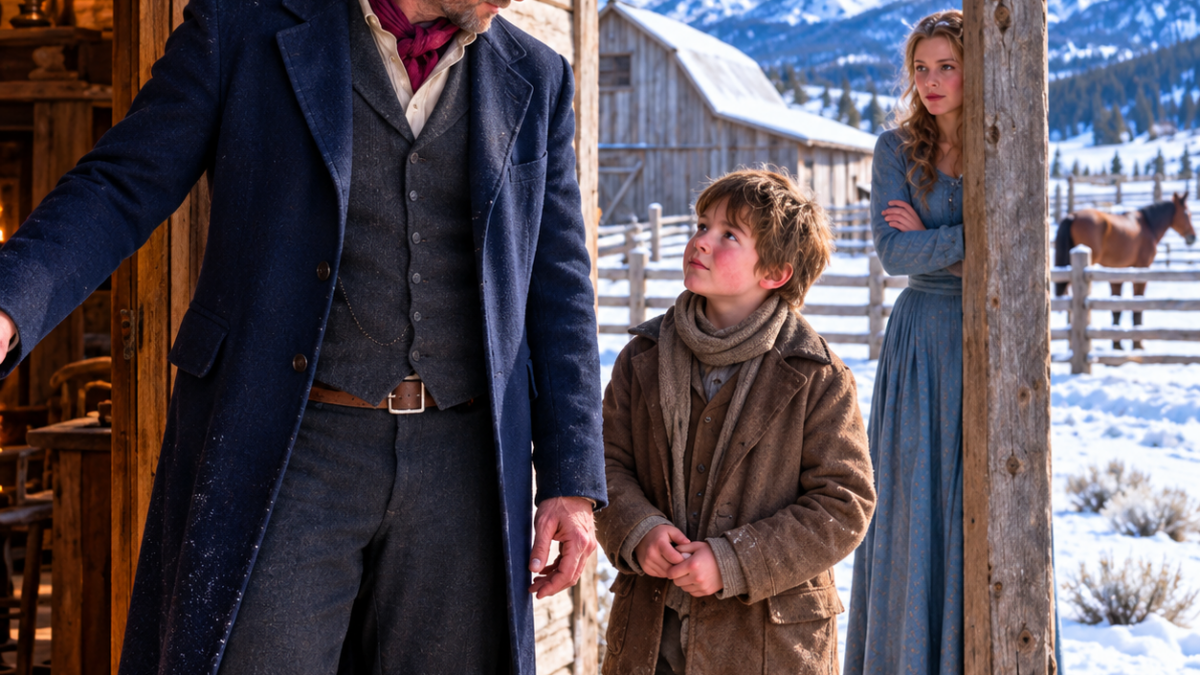
A Hungry 8-Year-Old Boy Knocked on a Lonely Rancher’s Door in a Snowstorm—Then the Rancher Saw His Widowed Mother Freezing Behind Him.
The eight-year-old boy standing on my porch in the middle of a Utah winter asked for only one thing: “Mister, is there anything I could eat?”
I was already reaching for the door when I noticed him looking over his shoulder, and thirty feet away a young widow stood half-hidden behind a porch post, shaking in a dress too thin for the snow because she had decided whatever food I had belonged to her son, not to her.
I had spent six years eating alone at a table set for one after fever took my wife and little girl, but before that morning was over, I had placed three plates beside the fire—and none of us understood yet that those three plates would change the rest of our lives.
My name is Henry Reev.
In March of 1888, I was forty-two years old and had become very good at being alone.
There is a difference between loneliness and solitude.
At least that was what I told myself.
Loneliness sounded like weakness.
Solitude sounded chosen.
So when neighbors asked how I managed the Reev ranch without family, I always answered the same way.
“Work keeps a man occupied.”
That usually ended the conversation.
The ranch sat several miles from the nearest proper settlement, where the land opened beneath a sky so wide that a man could feel either wonderfully free or painfully small depending on the day.
I raised cattle, kept a few horses, grew what I could, traded what I could not, and spent winters measuring life by chores.
Break ice.
Feed stock.
Check fences.
Split wood.
Carry water.
Eat.
Sleep.
Repeat.
The house had once sounded different.
I had almost forgotten how different.
Susan used to sing while making biscuits.
Not well.
That detail is important.
My wife possessed many talents.
Singing was not among them.
Our daughter Mary thought Susan had the finest voice in the territory because children are generous with people they love.
Mary was seven when she died.
Susan followed four days later.
Fever.
One winter.
One terrible week.
No gunman.
No wagon accident.
Nothing a man could fight with his hands.
That was almost worse.
I had spent my life believing enough strength and hard work could solve whatever stood in front of me.
Then my daughter burned with fever while I changed wet cloths on her forehead.
Then my wife began coughing.
Then the doctor stopped meeting my eyes.
PART2:
By the time spring came, two graves sat beneath a cottonwood east of the house.
And I learned there were problems a man could survive without ever solving.
For six years I kept Mary’s room closed.
Her little quilt remained folded near the foot of the bed.
A blue ribbon hung from the bedpost.
There was a carved wooden horse on the shelf that I had made badly one Christmas and that she had loved anyway.
Dust gathered.
I occasionally cleaned the room enough to preserve it.
Never enough to change it.
I told myself that was practical.
I told myself I might decide what to do with those things someday.
Someday is a useful word when a man wants to avoid admitting he has chosen never.
The morning Tobias knocked, snow had fallen most of the night.
Not a blizzard.
That would come later.
This was steady, dry snow driven by cold wind across the pasture.
I had already been awake two hours.
Fed the horses.
Checked a cow near calving.
Brought in wood.
PART3:
Coffee on the stove.
Bacon in the pan.
One plate on the table.
Then came the knock.
Three small taps.
Pause.
Then two more.
Nobody visited my ranch before sunrise in weather like that without trouble following.
I reached for my coat.
Opened the door.
The boy stood there.
Eight, I guessed.
Maybe younger.
Cold can make a child look smaller.
His coat was barely a coat at all.
Brown wool worn shiny at the elbows.
One button missing.
Shirt underneath.
Boots too large.
No proper gloves.
His face was red from wind.
Brown hair stuck damp against his forehead.
But his eyes were steady.
That was what I noticed.
Hungry.
Cold.
Afraid.
Still determined not to cry in front of a stranger.
“Mister?”
His teeth nearly clicked when he spoke.
“Yes?”
He swallowed.
“Is there anything I could eat?”
No story.
No practiced begging.
No attempt to make me pity him.
Food.
I stepped aside.
“Come in.”
He did not move.
His gaze flicked past me toward the table.
Then back over his shoulder.
I followed it.
At first I saw only snow.
Fence.
Porch post.
Then movement.
A woman.
Thirty feet away near the far edge of the porch.
I do not know why I had not seen her.
Maybe because she was deliberately trying not to be seen.
She stood with both arms crossed tight over herself.
Dark hair mostly hidden beneath a thin scarf.
Long brown dress.
No proper winter coat.
Boots soaked nearly black.
Snow caught on her shoulders.
She was watching the boy.
Not me.
Him.
I looked down.
“That your mother?”
He nodded.
“Why’s she standing there?”
His gaze dropped.
“She said the food was for me.”
I waited.
“Not for her.”
Something about that sentence made me angry.
Not at the boy.
Not at the woman exactly.
At whatever sequence of events had convinced her that hunger had to be divided into who deserved relief.
“What’s your name?”
“Tobias.”
“Tobias what?”
“Pharaoh.”
I glanced toward his mother.
“Your mother got a name?”
“Lucinda.”
“All right.”
I stepped out.
Cold hit immediately.
The woman straightened.
“Ma’am.”
“We don’t mean trouble.”
Her voice was soft but guarded.
“I didn’t say you did.”
“My boy hasn’t eaten proper since yesterday.”
“And you?”
“I’m all right.”
That lie was poor enough to insult us both.
“No, you aren’t.”
Her jaw tightened.
“We’ll move on as soon as he’s eaten.”
“No.”
For the first time, she looked directly at me.
“No?”
“You’re both coming inside.”
“That isn’t necessary.”
“Neither is freezing on my porch.”
“I won’t take food meant for my son.”
“I have enough food to feed two people.”
She glanced toward Tobias.
“You don’t know us.”
“That hasn’t stopped the weather.”
Her pride rose.
I could see it physically.
Chin.
Shoulders.
The very thing keeping her upright was also preventing her from accepting help.
I knew something about pride.
So I stopped making it charity.
“My bacon’s already cooked.”
I said.
“Biscuits too.”
“If you leave them sitting while we argue, they’ll turn cold, and then I’ll have three problems instead of one.”
“What three?”
“You, the boy, and ruined breakfast.”
Tobias almost smiled.
Lucinda did not.
Not yet.
But she followed us inside.
The heat changed her face.
People starving or freezing often try to hide what comfort does to them because relief exposes need.
Lucinda’s eyes closed for half a second when the fire reached her.
Then reopened.
“I’ll stand.”
“No.”
I pulled out a chair.
She remained by the door.
“You needn’t set anything for me.”
I took another plate from the cupboard.
Then a third.
I had not used three plates at once in six years.
The sound of them touching the table seemed louder than it should have.
“I wasn’t going to feed your boy and let his mother stand hungry in my kitchen.”
“I can pay—”
“With what?”
She stiffened.
Wrong question.
I could see it.
I softened my voice.
“Sit down.”
“We’ll sort everything else after you eat.”
Tobias already sat.
He looked at his mother.
Lucinda finally surrendered to the chair.
I served bacon.
Beans.
Biscuits.
Potatoes left from the evening before.
Tobias tried to eat slowly.
Failed by the third bite.
Lucinda ate as if every mouthful required permission.
Small.
Controlled.
Never reaching until Tobias had enough.
I put another biscuit on her plate.
She looked at me.
“I didn’t ask.”
“I noticed.”
“I’ve had enough.”
“You’re still looking at the food.”
That earned the first flash of irritation.
Good.
Anger requires energy.
“Do you always argue with strangers at breakfast?”
“Only the hungry ones.”
Tobias laughed through a mouthful.
Lucinda looked at him.
Then me.
A corner of her mouth moved.
Barely.
I decided not to point it out.
When Tobias slowed enough to breathe between bites, I asked:
“Where are you headed?”
“Millbrook.”
Lucinda answered.
I knew the place.
“Long way west.”
“Yes.”
“In March.”
“Yes.”
“With a boy.”
Her eyes narrowed.
“Yes.”
I lifted both hands slightly.
“No judgment.”
“Sounded like it.”
“Observation.”
“Men often call judgment observation.”
Tobias watched us like a spectator at a prize fight.
I leaned back.
“You have family there?”
“A cousin.”
“You sure she’s there?”
“No.”
That surprised me.
Lucinda wiped her mouth carefully.
“She was there four years ago.”
“And you’re walking there on four-year-old information?”
“We’re traveling there.”
“You’re walking.”
“When necessary.”
I looked at her boots.
“Been necessary often?”
“Enough.”
Tobias interrupted.
“We rode with a man hauling grain for eleven miles.”
Lucinda looked at him.
“Tobias.”
“What?”
“We did.”
I hid a smile.
“How long have you been traveling?”
“Three weeks.”
“From where?”
She named a settlement roughly sixty miles back east.
In winter conditions, with a child, sixty miles could feel like six hundred.
“What happened there?”
Lucinda’s hands went still around the cup.
I knew I had reached something private.
She answered anyway.
“My husband died.”
I said nothing.
People rush to fill grief with phrases.
Sorry.
God’s plan.
He’s in a better place.
I had heard all of them after Susan and Mary.
None helped.
So I waited.
“Logging accident.”
Lucinda continued.
“Last autumn.”
“Tobias’s father?”
“Yes.”
Tobias stared at his plate.
“What was his name?”
The boy answered this time.
“Caleb.”
I nodded.
“Good name.”
“He was strong.”
Tobias said.
Lucinda’s eyes moved toward him.
“He was.”
“What happened to the house?”
I asked.
“Rented.”
Lucinda said.
“Without Caleb’s wages, I managed two months.”
“Then?”
“The landlord gave us another week.”
There was no anger in her tone.
“He had his own bills.”
“I sold furniture.”
“Clothes.”
“What I could.”
She nodded toward a small trunk visible near the porch where they had left it.
“That’s what remains.”
“And Millbrook?”
“My cousin Martha.”
“If she’s there.”
“If she’s there.”
“And if she isn’t?”
Lucinda met my eyes.
“We’ll decide then.”
That answer bothered me more than if she had begged.
There was no plan after Millbrook.
Only forward.
Sometimes survival is just giving uncertainty a town name.
I poured coffee.
Lucinda put her hand over her cup.
“No more.”
“You sure?”
“Yes.”
Tobias said:
“She hasn’t eaten in two days.”
Silence.
Lucinda closed her eyes.
“Tobias.”
“You told me not to lie.”
The boy sounded honestly confused.
I looked at her.
“Two days?”
“I had some.”
“When?”
No answer.
“You gave him your food.”
“He’s eight.”
As though that settled every question.
Maybe it did.
The wind outside rose.
Snow rattled against the window.
I went to check the sky.
Clouds thickening.
The morning had darkened.
Fresh storm coming.
“You aren’t leaving today.”
Lucinda stood.
“We should.”
“You could.”
She stopped.
“But you won’t make Millbrook.”
“I’ve traveled in worse.”
“With him?”
Her eyes went to Tobias.
That was the weak point.
Not herself.
Never herself.
I continued.
“Road west crosses low country near the creek.”
“Snow drifts deep there.”
“Storm closes it, you’re stuck without shelter.”
“I won’t keep you.”
“I didn’t ask you to.”
“You don’t know how long.”
“Tonight.”
“Then we see tomorrow.”
Lucinda hated the answer.
Which told me it was the right one.
A man can sometimes offer help more easily if he gives it boundaries.
One night.
Not forever.
No debt implied.
She looked at Tobias.
The boy was fighting sleep in his chair now that food and warmth had reached him.
“Fine.”
She whispered.
“One night.”
The storm stayed six days.
By late afternoon, wind drove snow sideways so hard the barn vanished from the kitchen window.
Road disappeared.
Fence lines became white ridges.
Any question of leaving ended.
Lucinda accepted that with less argument than I expected.
Weather had made the decision for her.
The problem became sleeping arrangements.
I had one good bedroom.
Mine.
Mary’s room stayed closed.
There was a small guest room technically, but I had filled it with boxes, tack, and things I had never bothered sorting.
Lucinda stood in the hallway.
“We can sleep on the floor.”
“No.”
“We’ve done worse.”
“That doesn’t make it sensible.”
“Tobias and I can share the couch.”
“He’s already asleep sitting upright.”
Tobias had proved her point from near the fire.
I made the decision.
“You take my room.”
Lucinda turned.
“Absolutely not.”
“I’ll sleep in the tack room.”
“The barn?”
“Heated enough.”
“No.”
“I’ve done it before.”
“So have I.”
I looked at her.
“I’m not letting a woman who walked sixty miles in winter sleep on a floor while I stretch out in a feather bed.”
“You’re not responsible for me.”
“That appears to be your favorite sentence.”
“It’s true.”
“Tonight I own the roof.”
“Roof comes with rules.”
“What rules?”
“Nobody freezes indoors.”
She folded her arms.
“Do all ranchers become tyrants once strangers enter their kitchens?”
“Only successful ranchers.”
That time she smiled properly.
Small.
Tired.
But real.
I slept in the tack room.
It was cold.
I had exaggerated the heat quality.
I did not admit that later.
Morning brought more snow.
And Lucinda working in my kitchen.
I entered through the back door expecting silence.
Instead, bread smell.
A kettle.
Lucinda at the counter.
Tobias sitting with a mug of milk.
“What are you doing?”
Lucinda did not turn.
“Breakfast.”
“You’re a guest.”
“I ate your food yesterday.”
“So?”
“So I’m cooking.”
“You don’t owe—”
She turned then.
“I don’t accept charity easily, Mr. Reev.”
“Henry.”
“Mr. Reev.”
Clearly not Henry yet.
“This is what I can offer.”
She gestured toward the kitchen.
“Until I can earn actual wages again.”
I understood.
Not stubbornness for sport.
Dignity.
Lucinda had lost husband, house, furniture, security.
She was not going to lose the right to contribute if she could help it.
“All right.”
I said.
“Then your biscuits are payment.”
“For what?”
“Breakfast.”
“They’re your flour.”
“Labor costs.”
She considered.
“Fair.”
The arrangement began there.
By the second day, Lucinda found a basket of shirts I had intended to mend for roughly two years.
She sat beside the fire and repaired them.
On the third morning, she cleaned the kitchen window.
“You don’t need to do that.”
I said.
She scrubbed harder.
“I know.”
“Then why?”
“It hasn’t seen soap since President Cleveland took office.”
“That’s inaccurate.”
“How inaccurate?”
I thought.
“Not enough to help my argument.”
Tobias laughed from the floor.
The boy attached himself to my chores.
At first I tried sending him back inside.
He ignored me.
“Your boots are too large.”
“They were Paw’s cousin’s boy’s.”
“That sentence doesn’t improve the boots.”
“They work.”
He nearly fell into a snowbank ten minutes later.
I caught him by the collar.
“Excellent boots.”
He grinned.
He asked questions constantly.
Why did horses sleep standing?
Why did cows chew twice?
Why did I keep salt in blocks?
Why was one saddle different?
Why did snow squeak when very cold?
Why was the barn roof shaped that way?
Why did I live alone?
That last one came on the third evening.
We were banking the fire.
Lucinda was in the kitchen.
Tobias sat cross-legged near the hearth.
“Did you always live here alone?”
“No.”
“With who?”
I nearly said:
“That’s enough questions.”
Old habit.
Shut the door.
Instead:
“My wife.”
“What was her name?”
“Susan.”
“Where is she?”
Children ask the question adults avoid.
“She died.”
Tobias looked toward the floor.
“Oh.”
“And my daughter.”
His head came up.
“You had a girl?”
“Yes.”
“How old?”
“Seven.”
“I’m eight.”
“I noticed.”
“What happened?”
“Fever.”
“Both?”
“The same week.”
Silence.
Then:
“Is that why half your house looks like nobody lives in it?”
I stared at him.
He was not insulting me.
Simply observing.
The upstairs parlor remained sheet-covered.
The guest room stored junk.
Mary’s door shut.
Susan’s sewing table untouched.
“Suppose it is.”
I said.
“Why?”
“Didn’t see much point using rooms nobody needed.”
Tobias thought.
Then said:
“We need rooms.”
I laughed before I could stop myself.
Lucinda appeared at the kitchen doorway.
“Tobias.”
“What?”
“That was rude.”
“No.”
I said.
“It was accurate.”
That night, lying in the tack room, I heard the house through the wall.
Faint.
Tobias laughing.
Lucinda telling him to settle.
Floorboards.
A chair moving.
Human sounds.
For six years I had believed silence meant peace.
Now the silence after they went to bed felt like something had stopped.
The next morning, Tobias found Mary’s door.
Of course he did.
Children are drawn to whatever adults avoid.
I was carrying wood when I saw him in the hall.
Hand reaching toward the knob.
“Not that one.”
My voice cracked across the house.
Too sharp.
Tobias froze.
His hand dropped.
Fear crossed his face.
Immediately I hated myself.
I set the wood down.
Walked to him.
“That’s Mary’s room.”
He looked at the door.
“I didn’t know.”
“I know.”
“I’m sorry.”
“No.”
I knelt.
“No fault of yours.”
He waited.
I looked at the handle.
“Some doors just take a man longer to open than others.”
Tobias nodded as if this made perfect sense.
Children often accept truths adults spend years resisting.
Lucinda stood farther down the hallway.
She had heard.
She said nothing.
Her silence was different from mine.
Not absence.
Respect.
That evening, after Tobias went to sleep, she found me by the fire.
“You never asked what happened to Caleb.”
She said.
I looked up.
“Didn’t feel it was mine to ask.”
“Most people do.”
“Why?”
“They think knowing the details gives them the proper amount of sympathy.”
I understood that too well.
“If you wanted me to know, I figured you’d tell me.”
Lucinda sat across from me.
For several moments she watched the fire.
“Tree came down wrong.”
“Logging?”
“Yes.”
“He was careful.”
She smiled faintly.
“Annoyingly careful.”
“Checked equipment twice.”
“Would lecture other men.”
“That day…”
Her fingers tightened.
“One tree shifted as another was cut.”
“Caleb saw it too late.”
I said nothing.
“I’ve spent nights wondering whether I should’ve asked him to stay home.”
“Why would you?”
“He complained his shoulder hurt that morning.”
“Was it bad?”
“No.”
“Then why would you have stopped him?”
“I don’t know.”
Exactly.
Grief creates imaginary doors backward through time.
If only I had said.
If only she had stayed.
If only the doctor arrived earlier.
If only I had noticed.
If only.
“I spent six years asking questions like that.”
I said.
Lucinda looked at me.
“Find any useful answers?”
“Not one.”
She nodded.
“Neither have I.”
For the first time, we were not rancher and widow.
Host and traveler.
We were two people who knew what it meant to replay a morning that could not be changed.
The storm passed after six days.
Sun broke across the snow.
Road visible again.
I woke to movement in the house.
Lucinda packing.
Tobias’s shirts folded.
The small trunk open.
Blanket rolled.
Something inside me tightened.
I had known they would leave.
Of course.
That had been the agreement.
One night.
Then weather stretched it.
Still temporary.
“You don’t need to leave the minute the road opens.”
Lucinda kept folding.
“We do.”
“Why?”
“We’ve taken enough.”
“You worked every day.”
“In exchange for shelter.”
“So?”
“So now I continue to Millbrook.”
“You don’t know your cousin’s there.”
“No.”
“You don’t know whether she has space.”
“No.”
“You know there’s another storm possible before spring properly turns.”
“Yes.”
I realized my argument sounded less practical with each sentence.
More personal.
Lucinda noticed too.
She stopped.
“Henry.”
First time she used my name.
That made everything worse.
“What?”
“We cannot stay simply because leaving is difficult.”
I almost said:
“It isn’t difficult.”
Lie.
Instead:
“I’ll drive you.”
“To Millbrook?”
“At least as far as the roads allow.”
“You’ve work here.”
“Ranch won’t collapse in a day.”
She studied me.
“Thank you.”
I went outside.
Harnessed the team.
Every buckle irritated me.
Every movement of the horses brought us closer to departure.
I told myself I wanted my house back.
Quiet.
Routine.
No boy asking why cows had four stomachs.
No woman reorganizing my kitchen.
No second and third plates.
That was what I had wanted for six years.
Wasn’t it?
Then I looked toward the window.
Tobias’s face appeared.
He waved.
I understood.
I was not afraid they needed me.
I was afraid they would stop.
That was new.
And terrifying.
I led the team around front.
Lucinda’s trunk was already near the wagon.
Tobias stood beside it.
He looked toward the barn more than toward the road.
I stopped.
“Before we load.”
Lucinda waited.
“I have another option.”
Her expression guarded immediately.
“I don’t want charity.”
“I know.”
“I mean it.”
“So do I.”
I put one hand on the wagon rail.
“I need help.”
That was not entirely a lie.
My accounts were poor.
House neglected.
Work endless.
But I had managed alone.
Need can change after you discover an alternative.
“What kind?”
Lucinda asked.
“House.”
“Books.”
“Accounts.”
“Meals if you prefer.”
“Whatever arrangement we agree.”
“Wages?”
“Regular.”
Her eyes narrowed.
“How much?”
Good.
Practical.
I named a fair amount.
Maybe slightly generous.
Not insulting.
“There’s a cabin east of the barn.”
“I saw it.”
“Needs cleaning.”
“Roof sound.”
“Stove works.”
“You and Tobias could live there.”
“Rent?”
“None deducted.”
“Henry.”
“It’s part of the wage arrangement.”
“No claim beyond employment.”
“If you decide to leave later, you leave.”
“If you decide today you want Millbrook, I drive you.”
Lucinda said nothing.
I continued:
“No debt.”
“No promises.”
“No pity.”
She studied me so long I became uncomfortable.
“You’re not doing this because you feel sorry for us?”
“I’ve had six years of people feeling sorry for me.”
“I know the taste.”
“This isn’t it.”
“What is it?”
That question nearly exposed more than I could manage.
“Work.”
I said.
“Honest work.”
“And Tobias?”
“He’s already convinced himself he runs my barn.”
Tobias nodded seriously.
Lucinda looked at him.
The boy tried to appear neutral.
Failed.
“Do you want to stay?”
She asked.
Tobias looked at me.
Then the horses.
Then his mother.
“If you do.”
Smart boy.
He knew better than to decide for her.
Lucinda looked toward the road west.
Then back at the ranch.
“I’ll stay.”
I did not breathe.
“For the work.”
She added.
“Nothing else promised.”
“Nothing else asked.”
I unloaded the trunk myself.
The cabin took two days to make properly livable.
Lucinda refused to let me repair everything alone.
Tobias carried wood one piece at a time.
A job that could have taken me six trips took thirty.
I did not mind.
By April, snow retreated.
Mud replaced it.
Then grass.
The ranch changed slowly.
Not because new buildings appeared.
Because there were people moving through it.
Lucinda proved better with figures than I had been since Susan died.
One evening she brought my account ledger to the porch.
“You’ve been overpaying your feed supplier.”
“No.”
“Yes.”
“How much?”
She showed me.
I swore.
Tobias, sitting nearby, repeated the word.
Lucinda looked at me.
“That one came from Henry.”
The boy said helpfully.
“Thank you.”
She replied.
Then to me:
“Two seasons.”
“I’ve had other things to do.”
“Yes.”
“Apparently giving away money.”
She rode into town with me the next week.
The supplier, Mr. Haskell, attempted to explain the difference in pricing.
Lucinda listened.
Then calmly pulled out three invoices from another ranch.
I had never seen a man’s confidence disappear so politely.
The prices corrected.
On the ride home I said:
“You enjoyed that.”
“No.”
“You did.”
“Perhaps slightly.”
“Remind me never to owe you money.”
“I already keep your books.”
“Too late.”
She smiled.
Warmth between us became dangerous in small pieces.
Not sudden.
Not forbidden.
Just cumulative.
The way she tucked loose hair behind one ear when concentrating.
The way she hummed while kneading bread.
The way she always stopped humming if she noticed me listening.
One afternoon I said:
“You needn’t stop.”
She looked embarrassed.
“Habit.”
“Bad habit.”
“Caleb used to tease me.”
The name no longer made the air awkward.
That mattered.
“You miss him?”
She looked at me as though it were a foolish question.
“Every day.”
I nodded.
“Susan too.”
“Every day?”
“Not always in the same way.”
That was true.
At first grief had been weather.
Everywhere.
Later it became landscape.
Still present.
No longer the only thing.
Tobias changed too.
Within a month, “Mr. Henry” became “Henry.”
Neither Lucinda nor I mentioned it.
The boy followed me through spring work.
Fence repair.
Calving.
Horse care.
Planting.
I gave him small jobs.
He treated every one as sacred.
One evening we were fixing wire along the north pasture.
Tobias was unusually quiet.
That alone alerted me.
“What?”
He shrugged.
“You’ve asked only fourteen questions today.”
“Maybe I’m tired.”
“You’re eight.”
“Impossible.”
He continued holding the wire.
Then:
“Sometimes I forget Pa’s voice.”
I stopped.
Tobias stared at the ground.
“I remember things he said.”
“But not how they sounded.”
I set down the pliers.
“That happens.”
His eyes filled.
“Feels wrong.”
“Why?”
“Like I’m losing him.”
“You’re not.”
“How do you know?”
I took time.
Because wrong comfort teaches children not to trust you.
“You might forget pieces.”
“That’s true.”
“Memory does that.”
“But forgetting the exact sound of a voice doesn’t mean you stop loving the person.”
He swallowed.
“I like it here.”
“Also true.”
“Sometimes I feel bad.”
“Because of Caleb?”
He nodded.
“Like if I like being here, maybe I didn’t love home enough.”
I understood that perfectly.
Six years of living in an empty house because happiness had felt disloyal.
I sat on the fence rail.
“Your father’s voice doesn’t disappear because you found another place worth liking.”
Tobias listened.
“A man can hold on to one thing and reach for another.”
“Doesn’t make either less true.”
“You believe that?”
I looked toward the ranch house.
Lucinda had laundry moving in the spring wind.
“I spent six years not believing it.”
“And now?”
“Getting convinced otherwise.”
He thought.
Then asked:
“What was Mary like?”
The question should have hurt.
It did.
But not enough to stop me.
“Stubborn.”
“How stubborn?”
“More stubborn than you.”
“That’s impossible.”
“Considerably.”
He grinned.
“She liked horses.”
“What kind?”
“All.”
“Even mean ones.”
“She had a mare?”
“Pony.”
“Chestnut.”
“Named Daisy.”
“That’s a bad horse name.”
“Tell her.”
The sentence escaped before I thought.
Tell her.
As if Mary waited somewhere nearby.
My throat tightened.
Tobias pretended not to notice.
Good boy.
“She would’ve liked you.”
I said.
“You think?”
“Yes.”
“She liked anybody who asked too many questions.”
“That doesn’t sound true.”
“It isn’t.”
He laughed.
That week, a letter came for Lucinda.
Official envelope.
County seat.
A dry-goods merchant needed a bookkeeper.
Someone in town had apparently recommended her after hearing what she had done with my supplier dispute.
Good wages.
Room above the shop.
Steady.
Respectable.
Independent.
Everything I had claimed I wanted for her.
She showed me the letter after supper.
“It’s a good position.”
I said.
“Yes.”
“Better wages than I pay.”
“Slightly.”
“Room included.”
“Yes.”
“Closer school access for Tobias.”
“Yes.”
Each answer cut.
I kept my face still.
“You should consider it.”
Lucinda studied me.
“You want me to?”
Wrong question.
“I want you to have the choice.”
“That isn’t the same answer.”
“No.”
She waited.
I wanted to say:
Stay.
I wanted to tell her the house had begun breathing again.
That Tobias’s boots beside the door looked right.
That I listened for her humming.
That I had started buying coffee in amounts meant for more than one person.
That three plates no longer felt strange.
But I had promised myself the first morning by the wagon that any decision she made here would remain hers.
If she stayed because I made dependence sound like love, I would despise myself.
So I said:
“It’s good work.”
Lucinda looked disappointed.
Then thoughtful.
The next morning I saw her reading the letter again.
All day I waited.
I hated myself for waiting.
That evening she came to the house.
Tobias was at the barn.
She placed the letter on the kitchen table.
“For the first time since Caleb died, I can leave here without being afraid.”
I said nothing.
“I have money saved.”
“A respectable offer.”
“I could take Tobias and go tomorrow.”
My chest tightened.
“Yes.”
“That’s why I’m staying.”
I looked up.
Lucinda’s eyes held mine.
“If I had nowhere else to go, staying would still be survival.”
“Now it’s a choice.”
“Mine.”
“Entirely.”
“Yes.”
I did not trust myself to speak.
So I reached across the table.
Turned my hand palm upward.
An offer.
Not a demand.
Lucinda looked at it.
Then placed her hand in mine.
We sat like that.
No declaration.
No kiss.
Just contact.
Sometimes the most important step forward is quiet enough nobody outside the room would notice.
By autumn, pretending became ridiculous.
Neighbors noticed.
Tobias definitely noticed.
One evening he asked:
“When are you marrying Ma?”
I nearly dropped my coffee.
Lucinda, fortunately, was not present.
“What?”
“You heard me.”
“Who said anyone’s marrying?”
“Nobody.”
“Then why ask?”
He looked genuinely puzzled.
“Because you look at her.”
“How?”
He demonstrated something so foolish I refused to dignify it.
“I do not.”
“You do.”
“You’re eight.”
“Still have eyes.”
“Go do your letters.”
“That means I’m right.”
“Go.”
He left laughing.
Children are intolerable when confident.
Before any proposal, there was something else I had to do.
Mary’s room.
One autumn afternoon, I stood before the door.
Lucinda appeared behind me.
“You don’t have to.”
“I know.”
That helped.
I turned the knob.
The room smelled closed.
Dust.
Old wood.
Faint lavender from Susan’s sachets long since dried.
Lucinda remained near the threshold.
I stepped in.
Mary’s bed.
Quilt.
Ribbon.
Carved horse.
Everything smaller than memory.
I touched the bedpost.
Six years collapsed.
For a moment I could hear Mary coughing.
Susan moving bowls.
Doctor’s boots.
I closed my eyes.
Lucinda said nothing.
Eventually:
“What was her name?”
“Mary.”
“I know Tobias asked.”
“I wanted to hear you say it.”
I looked at her.
“Mary.”
The name hurt.
Then passed through.
We cleaned.
Slowly.
Not erasing.
Sorting.
Clothes donated.
Some things boxed.
Quilt folded.
Ribbon kept.
I picked up the carved horse.
Crude thing.
One leg shorter.
Mary had carried it everywhere for months.
I put it in a box.
Lucinda said:
“Keep that out.”
“Why?”
“No reason something loved has to disappear before a room can become useful again.”
I stared at the horse.
Then put it back on the shelf.
By season’s end, Tobias used a small desk near the window for lessons on cold afternoons.
Mary’s room became partly his learning room.
Not yet bedroom.
That came later.
The carved horse remained.
One day Tobias asked if he could touch it.
“Yes.”
He picked it up carefully.
“Horse has a crooked leg.”
“I was learning.”
“You ever got better?”
“No.”
He returned it exactly where it had been.
That gesture meant more than he knew.
I proposed to Lucinda on the porch.
Not romantically by modern standards, I expect.
No ring at first.
No kneeling.
The sun was lowering over pasture.
I had repaired that porch during summer because Tobias nearly put his foot through a rotten board.
Lucinda sat with her accounts.
I stood nearby for several minutes saying nothing.
She finally looked up.
“You’re making me nervous.”
“I’m considering something.”
“Dangerous.”
“Usually.”
I sat.
“Lucinda.”
Her expression changed.
She knew.
“I’m not offering rescue.”
I said.
“You’ve made plain enough you don’t need it.”
Her eyes softened.
“I’m asking because you can leave.”
“Because you have money.”
“Work elsewhere.”
“Choices.”
“And you stayed.”
I took a breath.
“I loved Susan.”
Lucinda nodded.
“I know.”
“You loved Caleb.”
“Yes.”
“I don’t want either of us pretending those lives didn’t happen.”
“I couldn’t.”
“Neither could I.”
I looked toward the barn where Tobias was supposedly doing chores and probably listening from somewhere.
“I’m asking if you’d have me as husband.”
“And if you’d allow me to help raise Tobias.”
“Not in Caleb’s place.”
“Beside whatever memory he keeps.”
Lucinda looked toward the pasture.
“I didn’t come here looking for a husband.”
“I know.”
“Didn’t ask if you were looking.”
That earned a laugh through tears.
I continued:
“Asked if you’d have one now that you found him anyway.”
“Yes.”
Simple.
No speech.
“Yes.”
I exhaled.
“You might make a man suffer longer.”
“Considered it.”
“Why didn’t you?”
“Winter’s coming.”
“Efficient.”
“Always.”
Tobias appeared from behind the porch corner.
“I knew.”
Lucinda stood.
“How long have you been there?”
“Not long.”
“How long?”
“Enough.”
I pointed toward the barn.
“Go.”
“Should I call you Pa now or after the wedding?”
Everything stopped.
Tobias realized it too.
The confidence left his face.
He looked down.
“Sorry.”
I crossed the porch.
Kneeled in front of him.
“You call me whatever feels right.”
“I don’t want to forget Pa.”
“You won’t.”
“If I call you that…”
“It doesn’t take the word away from Caleb.”
He stared.
“I can have both?”
I put a hand on his shoulder.
“Yes.”
The wedding was small.
Winter again.
Neighbors.
Food.
A preacher who talked too long.
Tobias stood between us as though personally responsible for the entire event.
He told at least four people:
“I knew before they did.”
Probably true.
Only after the wedding did Tobias move from the cabin into the house permanently.
Into Mary’s old room.
That decision took me longer than the proposal.
Lucinda never pushed.
Tobias never asked.
One evening I simply said:
“There’s no reason you should walk through snow from the cabin all winter.”
Tobias looked at Mary’s door.
“You sure?”
“No.”
Honest.
“Do you want me to stay in the other room?”
“There isn’t another good room.”
“I can stay in the cabin.”
I saw the boy trying to protect me.
An eight-year-old adjusting his place so a grown man did not have to feel pain.
“No.”
I opened the door.
“This room held someone I loved.”
“It can hold someone else I love too.”
There.
First time I said it.
Tobias looked at me.
Then quickly away because boys believe tears disappear if nobody looks directly at them.
We carried his bed in.
Not replacing Mary’s bed exactly.
Her old frame had been stored.
Tobias’s smaller bed went near the opposite wall.
Desk remained.
Carved horse on shelf.
That first night he stood in the doorway.
“Good night, Pa.”
Then disappeared inside before I could answer.
I stood there.
Lucinda came beside me.
Her hand found mine.
Neither of us spoke.
I had spent six years believing healing would require forgetting enough to stop hurting.
I had been wrong.
Mary existed.
Susan existed.
Caleb existed.
They did not need removal for the living to take another step.
The heart is not a house with one room.
Love is not furniture requiring something old to be thrown out before something new can enter.
The dead do not become less loved because the living stop freezing beside their graves.
That winter, almost exactly a year after Tobias first knocked, snow began falling while we ate supper.
Three plates.
Three chairs.
No one outside.
Lucinda still kept Caleb’s lumber notebook.
The same one she carried across sixty miles.
Its early pages contained measurements.
Timber counts.
Then travel records.
Places they slept.
Meals.
Dates.
Toward the third week, the notes about her own food became scarce.
Later pages held ranch accounts.
Feed costs.
Sales.
Repairs.
Wages.
A whole life changed inside one book.
Before supper, she opened it.
Wrote something.
Closed it.
“What?”
I asked.
“Nothing.”
Tobias reached.
“Let me see.”
“No.”
“Why?”
“Because it’s mine.”
After much complaint, she turned the book so we could see.
One final line beneath the travel record.
March 1888 — Reev Ranch. Three plates. We stayed.
Tobias smiled.
“Remember when I knocked?”
“Plainly.”
“You didn’t know us.”
“No.”
“Good thing you opened the door.”
Matter-of-fact.
As if this were a simple fact like snow being cold.
I looked at Lucinda.
She looked at me.
The boy went back to eating.
I had no better assessment.
Good thing.
Years later, I would remember details differently.
Not the grand events.
The small ones.
Three plates touching wood.
Lucinda standing in snow refusing food for herself.
Tobias wearing boots two sizes too large.
The first loaf of bread.
The first time she hummed without stopping when I entered.
The feed supplier losing an argument.
A boy confessing he could no longer hear his father’s voice.
A letter offering Lucinda a better job.
Her hand crossing the table to mine.
Mary’s door opening.
The carved horse remaining.
“Good night, Pa.”
Those are the things a life is made from.
People later said I rescued Lucinda and Tobias.
I never liked that telling.
I gave them breakfast.
Shelter.
Work.
Maybe opportunity.
They gave something too.
The ranch had survived before them.
So had I.
Survival is a low standard.
A house can stand upright and still not be a home.
I had kept the roof repaired.
Animals fed.
Accounts badly enough maintained.
Firewood stacked.
What I had not kept alive was any reason to look forward to evening.
Tobias changed that with questions.
Lucinda changed it by moving through rooms I had allowed to become monuments.
Neither demanded I forget.
That is why I could love them.
Lucinda never tried to become Susan.
I never asked her.
I never tried to become Caleb for Tobias.
That would have been impossible and wrong.
One spring morning, years later, Tobias asked if we could visit Caleb’s grave.
He was older.
Almost twelve.
The grave lay far east near their old settlement.
I said yes.
Lucinda looked surprised.
“You don’t mind?”
“Why would I?”
She did not answer.
We traveled.
Three days.
Found the churchyard.
Tobias stood in front of the stone.
He had remembered less of Caleb’s voice by then.
But more stories.
Lucinda had made sure of that.
“Pa used to whistle badly.”
“He cut bread too thick.”
“He once fell through a shed roof.”
Stories keep a person shaped in memory.
I stood back.
Not threatened.
This was his father.
I was his Pa too.
Both could be true.
On the return journey, Tobias rode beside me.
“Thank you.”
“For what?”
“Going.”
“You think I’d stop you?”
“No.”
“Maybe when I was eight I wondered.”
“And now?”
“No.”
Good.
That meant I had done something right.
Another year, Lucinda came with me to Susan and Mary’s graves.
We brought wildflowers.
She stood quietly.
Then placed one stem on Susan’s marker.
“Thank you.”
She whispered.
I looked at her.
“For what?”
Lucinda wiped her eye.
“For loving him before I did.”
I nearly broke apart.
Not because Susan could hear.
Because Lucinda understood love did not need enemies.
Past against present.
Dead against living.
We did not have to choose.
That may have been the greatest gift our strange beginning gave us.
Permission to carry more than one truth.
Lucinda missed Caleb.
Loved me.
Tobias remembered his father.
Called me Pa.
I loved Susan.
I loved Lucinda.
I mourned Mary.
I delighted in the boy occupying her old room.
None canceled anything.
People like simple emotional arithmetic.
One love ends.
Another begins.
One family lost.
Another replaces it.
Real hearts are messier and more generous.
New love sits beside old grief until neither needs to fight for the chair.
When I think back to the winter morning where everything began, I remember Lucinda’s dress.
Too thin.
Arms crossed.
Her refusal to step onto my porch.
That image bothers me even now.
Not because she was weak.
She was the strongest person I had met.
Because she believed hunger was something she could absorb on behalf of her child.
Two days without food.
Still:
Feed him.
Not me.
I admired it.
Later I learned not to romanticize it.
Love should not always require self-erasure.
Lucinda had to learn that too.
After we married, she occasionally skipped meals during tight seasons out of old habit.
I noticed.
“Eat.”
“I’m not hungry.”
“Poor lie.”
“Tobias needs—”
“Tobias has eaten.”
“We have enough.”
She would pause.
The old calculation still running.
Then eat.
Safety takes time to become believable.
For Tobias too.
For months he hid pieces of bread.
First in coat pockets.
Then under a cloth near his bed.
Lucinda found them.
Cried privately.
We never punished him.
He had learned food could vanish.
So every morning I made sure he saw supplies.
Flour bin.
Potatoes.
Beans.
Smokehouse.
Not to boast.
To teach his nervous system something words could not.
There will be food tomorrow.
One winter later, the hidden bread stopped.
I knew he finally believed us.
That was family.
Not the wedding.
Not the papers.
Not the new last name.
The day a hungry boy stopped hiding bread because he trusted breakfast would come.
Years passed.
Tobias grew taller.
His boots finally fit.
Then he outgrew mine.
The ranch expanded.
Lucinda’s bookkeeping saved us more money than I care to admit.
She became known in the county as the woman merchants should not attempt to overcharge.
Susan would have liked her.
I believe that.
Mary would have followed Tobias everywhere.
I believe that too.
Do I know?
No.
Some beliefs are not claims.
They are ways the living make peace with rooms the dead can no longer enter.
Lucinda and I had more children later.
Two.
A girl first.
We did not name her Mary.
That was important.
She deserved her own name.
Anna.
Then Samuel.
Tobias became the older brother who pretended younger children annoyed him while carrying them everywhere.
The table needed more plates.
Four.
Then five.
I sometimes stood in the kitchen before supper and looked at them.
The table I had once set for one.
The first change had been three.
Three was the miracle.
Everything after grew from it.
Lucinda caught me staring once.
“What?”
“Nothing.”
“Poor lie.”
I smiled.
“Remember the first breakfast?”
“Every time it snows.”
“So do I.”
She put another plate down.
“Good thing you had enough bacon.”
“That’s what saved us.”
“Not the bacon.”
“No?”
“The biscuits.”
“Mine were better.”
“They were not.”
Marriage.
Some arguments deserve lifelong commitment.
When Tobias became a man, he chose ranching.
Partly ours.
Partly another spread nearby.
He married a schoolteacher.
On his wedding morning, he came to me.
Older than Caleb had been in some of his earliest memories.
“Can I ask something?”
“Always.”
“Would Pa have been proud?”
The question still existed.
After all those years.
I answered:
“Yes.”
“How can you know?”
“I can’t.”
“Then?”
“Your mother knew him.”
“She says yes.”
“And I know you.”
“Any decent father would be.”
Tobias looked down.
Then:
“You are.”
“What?”
“A decent father.”
I had to turn away.
He laughed.
“Still bad at crying?”
“Still bad at talking.”
“Fair.”
At the reception, he called me Pa in front of everyone.
No hesitation.
No guilt.
Somewhere inside him Caleb had become secure enough in memory that my place no longer threatened his.
That took years.
Worth every one.
Lucinda kept the old notebook until she died.
Yes.
Eventually that day came too.
We all get there.
She was seventy-one.
Long life by the standards of what she might have expected on the morning she stood freezing behind my porch post.
Illness took her slowly enough for goodbye.
Cruel gift.
Useful gift.
Near the end, I found her reading the notebook.
Pages brittle.
Ink faded.
The line still there.
Three plates. We stayed.
“You kept that thing all these years.”
“Of course.”
“Accounts are useless now.”
“Most of your accounting was useless when current.”
“Insulting a dying woman?”
“You started it.”
She smiled.
Then became serious.
“Henry.”
“Yes?”
“Did you ever regret opening the door?”
I stared at her.
“What kind of foolish question—”
“Answer.”
“No.”
“Not once.”
“Not even during the feed supplier argument?”
“Especially not.”
Her eyes closed.
“I almost didn’t let Tobias knock.”
“I know.”
“I was ashamed.”
“For being hungry?”
“For everything.”
“Widow.”
“No house.”
“No money.”
“A child I could barely feed.”
“I thought if I asked somebody for help, it meant Caleb had died and I had failed after him.”
I took her hand.
“You didn’t fail.”
“I know that now.”
She looked toward the window.
“I didn’t then.”
“Tobias saved us.”
I said.
Lucinda smiled.
“He asked for breakfast.”
“Same thing.”
After she died, I placed the notebook in the drawer with family papers.
Not buried.
Not destroyed.
It belonged to the story after us.
Tobias eventually inherited it.
Years later, one of his children asked me to tell the story.
“About Grandmother in the snow.”
I did.
But I corrected the title.
She was not simply a mother waiting in snow.
She was Lucinda.
Bookkeeper.
Widow.
Wife.
Mother.
The woman who negotiated Haskell down in eleven minutes.
The woman who could make bread better than mine and never stopped knowing it.
A person should not be reduced to the moment someone found them desperate.
Neither should Tobias.
He was not forever the hungry boy at my door.
He grew.
Worked.
Loved.
Made mistakes.
Raised children.
Still asked too many questions.
And I was not forever the lonely rancher who rescued them.
I was a man they rescued from a quieter kind of danger.
A life narrowed until surviving it looked enough like living that I had stopped noticing the difference.
That is why, when people tell the story now, I insist on one detail.
I opened the door.
Yes.
But so did they.
Tobias opened the door to noise.
Responsibility.
Fatherhood I thought had died with Mary.
Lucinda opened the door to companionship without betrayal.
Love after grief.
A house capable of holding memory without becoming a tomb.
I gave them heat.
They gave the heat somewhere to go.
I gave them food.
They gave me a reason to set more plates.
Maybe that is what grace looks like.
Not one person standing above another handing down rescue.
People meeting at the exact moment each has something the other cannot provide for himself.
Lucinda needed shelter.
I needed life inside the shelter I already had.
Tobias needed a meal.
I needed a voice asking questions at my table.
No one knew.
That is the beauty.
Some turning points do not arrive dressed like destiny.
They knock quietly.
Three times.
Pause.
Twice more.
You open because that is what a decent person does.
Only years later do you realize the rest of your life had been standing on the other side.
When I was old, snow became harder on my joints.
I stopped doing most winter work myself.
Grandchildren ran the barns.
I sat nearer the fire.
The ranch house had changed.
Expanded.
Repaired.
Rooms used.
Mary’s old room had become many things over decades.
Tobias’s bedroom.
A study.
Then a room for grandchildren.
But the carved horse remained on the shelf.
Nobody moved it.
One evening, the season’s first snow began.
I sat at the table.
The house full.
Children.
Grandchildren.
Too many plates.
Someone complained we needed a larger table.
I laughed.
“No.”
“Why?”
Tobias, gray-haired by then, knew before I answered.
“This table’s staying.”
He said.
One of the grandchildren asked:
“What’s special about it?”
Tobias looked at me.
“You tell it.”
So I did.
Utah territory.
March 1888.
Cruel winter.
A knock.
A hungry boy.
His mother standing away from the door because she had decided she did not deserve part of the food she was asking for him.
I told them about three plates.
The storm.
The cabin.
The notebook.
I told them Mary’s room stayed closed six years.
How Tobias almost opened it too soon.
How eventually we opened it together.
I told them about Caleb and Susan.
Because stories become dishonest when new happiness erases old love.
At the end, my youngest granddaughter asked:
“What if you hadn’t opened the door?”
The room went quiet.
I looked toward Tobias.
He looked at me.
Old question.
No answer.
“We don’t know.”
I said.
“But I did.”
That was enough.
Lives are made from decisions that seem small when they happen.
Open.
Close.
Stay.
Leave.
Ask.
Answer.
Three plates instead of one.
We spend too much time wondering what would have happened if we chose differently.
I had done enough of that after Susan and Mary.
Lucinda after Caleb.
At some point, a person has to stop building imaginary lives from roads not taken.
This one was ours.
A boy knocked.
I opened.
His mother came inside.
We ate.
We stayed.
I do not believe every stranger at your door is destiny.
I do not believe suffering automatically happens for a reason.
Caleb did not need to die so Lucinda could meet me.
Susan and Mary did not need fever so I could understand grief.
Tobias did not need hunger to become my son.
Loss does not become good because life afterward contains beauty.
That would insult the dead.
What I believe is simpler.
When loss has already happened, the living still get choices.
Close every door.
Or sometimes open one.
Not because what came before matters less.
Because you are still here.
Lucinda taught me that staying alive and continuing to live are different duties.
Tobias taught me children can ask the question adults spend years avoiding and survive the answer.
Susan taught me love can remain even after the house loses the sound of it.
Mary taught me a closed room cannot preserve a child.
Only memory can.
Caleb, though I never met him, taught me that loving another man’s widow required respecting the life she had before me.
All of them sat at our table in ways invisible but real.
Maybe that is why I never feared ghosts after that.
The people we loved were not ghosts.
They were history.
And history did not need to leave for supper to be served.
The last time I read Lucinda’s notebook, I stopped at the same line.
March 1888 — Reev Ranch. Three plates. We stayed.
Four words at the end.
Three plates. We stayed.
No mention of romance.
Marriage.
Children.
Years.
Everything hidden inside “stayed.”
That is how life often works.
The most important decisions rarely know their own consequences.
A widow chooses one more night.
A rancher offers paid work instead of pity.
A woman with enough money to leave chooses to remain.
A grieving man opens his daughter’s room.
An eight-year-old says “Pa” before anyone is ready.
Small moments.
Then decades.
If there is anything worth remembering from my story, it is not that I was generous.
I was not unusually generous.
I had food.
They were hungry.
A man should feed them.
The harder act came later.
Allowing myself to want them there without turning that want into obligation.
Giving Lucinda a choice.
Opening rooms.
Believing happiness did not betray grief.
Letting Tobias love two fathers.
Letting myself love two women across different parts of one life without making either less important.
Those were the harder doors.
The first one only required a hand on a latch.
Still, everything began there.
One cold morning.
A boy in boots too large.
“Mister, is there anything I could eat?”
And behind him—
a woman waiting in the snow.
I thought I was inviting two strangers inside long enough to warm themselves.
I did not know the boy would become my son.
I did not know the woman would become my wife.
I did not know an old house I had kept silent for six years was about to fill with arguments, laughter, muddy boots, bad stories, account books, children, and more love than I had believed a heart could safely hold after losing so much.
I only knew a mother should not freeze outside while her child ate inside.
So I set another plate.
Then one more.
Three.
And for the first time in six years, the table looked less like a place where a man survived supper—
and more like somewhere a family might begin.








