A Homeless Man Died on a Park Bench in December—Then His Cat Waited There for 63 Days Through Two Snowstorms.
PART3:
“Across the street.”
“You want me to watch the counter?”
“I’ll be two minutes.”
She was not.
The cat saw her approaching.
His ears flattened.
He stood on Thomas’s chest.
“Easy.”
Ellen stopped several feet from the bench.
She knew the cat.
Sort of.
Thomas called him Red.
Nobody else could touch him.
“Morning, Red.”
The cat stared.
Thomas did not move.
Ellen knew before she reached him.
There was something about stillness when a person was dead.
Not simply absence of movement.
The body seemed to have stopped belonging to the moment around it.
“Thomas?”
Nothing.
She moved closer.
The cat hissed.
“I know.”
Her voice broke.
“I know, sweetheart.”
She crouched near the bench.
“Thomas?”
She touched two fingers to the back of his hand.
Cold.
Not winter cold.
Different.
Ellen pulled out her phone.
The cat did not leave him while she called 911.
He stayed when the ambulance came.
He stayed when the paramedics checked for a pulse they already knew they would not find.
He stayed when police arrived.
He stayed beneath the bench when officers searched Thomas’s pockets.
No wallet.
No driver’s license.
No phone.
Twenty-seven dollars and fourteen cents.
A bus transfer.
Three cough drops.
A plastic grocery bag containing half a sandwich.
A folded photograph too water damaged to make out clearly.
And three unopened packets of cat food.
One officer looked at them.
Then at Red.
“Guess we know who those were for.”
Ellen heard him.
She turned away.
When the medical examiner’s transport team arrived, Red became frantic.
He had tolerated the strangers as long as Thomas remained on the bench.
The moment they lifted Thomas onto the stretcher, the cat changed.
He jumped onto the seat.
Meowed.
Then louder.
He followed the stretcher.
One of the attendants blocked him gently with a leg.
“Sorry, buddy.”
Red darted around.
The vehicle doors opened.
The stretcher went inside.
The doors closed.
Red stood beneath the bumper.
“Move him,” someone said.
Ellen stepped forward.
“Wait.”
The engine started.
Red flinched.
Then ran to the side of the vehicle.
“Red!”
Ellen chased him.
The van pulled away slowly.
The cat ran after it.
Twenty feet.
Thirty.
Then stopped.
He stood in the road until a horn sounded.
Ellen rushed out and grabbed him.
Red twisted violently.
His claws tore through her glove.
“Okay!”
She released him.
He ran straight back to the bench.
Jumped onto it.
Turned once.
Then sat where Thomas’s legs had been.
Facing the street.
The officer watched.
“What happens to the cat?”
Ellen looked at him.
“What do you mean?”
“Animal control?”
“I don’t know.”
“You know who owns him?”
She looked at the empty bench.
“I guess nobody now.”
That sentence bothered her immediately.
Nobody.
As if the relationship had disappeared because one half of it had died.
“He belongs to Thomas.”
The officer glanced toward the departing medical examiner’s van.
“Not anymore.”
Red sat facing the road.
Ellen would later remember wanting to hit the officer for saying it.
Not because he was cruel.
Because he was technically correct.
And sometimes technically correct things were unbearable.
Animal control came two hours later.
They brought a carrier.
Red disappeared under a parked car.
They tried food.
No.
A humane trap.
He circled but would not enter.
Eventually the officer stood.
“We’ll come back.”
Ellen frowned.
“You’re leaving him?”
“We can’t chase him into traffic.”
“What happens tonight?”
The officer looked at the sky.
“Can you put out food?”
“That’s not what I asked.”
“We’re over capacity.”
“There’s a shelter three blocks away.”
“They’re full too.”
Ellen knew the shelter.
Thomas had known it better.
Months earlier, during one of the coldest weeks of the previous winter, outreach workers had convinced Thomas to consider sleeping indoors.
Ellen remembered that evening.
She had been closing the laundromat when outreach worker Daniel Reeves came inside with Thomas.
Thomas stood awkwardly near the dryers.
Red sat outside the glass door.
Daniel bought coffee.
“Tell her,” Thomas said.
Daniel looked tired.
“The warming shelter has beds.”
Ellen smiled.
“That’s good.”
Thomas shook his head.
“Not for him.”
He pointed at Red.
Ellen looked outside.
The cat was sitting on the sidewalk.
“They don’t allow animals?”
“No.”
Daniel said, “We can find temporary placement for Red.”
Thomas’s face hardened.
“Where?”
“A foster maybe.”
“For how long?”
“We’d work it out.”
Thomas stared through the glass.
“No.”
Daniel sighed.
“We’ve done this already.”
“Then stop asking.”
“Tom, it’s eleven degrees.”
“He sleeps inside my coat.”
“That does not make this safe.”
Thomas looked at him.
“You ever had everything taken from you?”
Daniel was silent.
Thomas pointed toward Red again.
“That cat stayed.”
Ellen remembered the way he said it.
Not sentimental.
Not dramatic.
Simple.
Factual.
“He stays with me.”
Daniel rubbed his forehead.
“We’re not trying to separate you permanently.”
Thomas laughed once.
“That’s what everybody says before they separate you.”
Ellen had not understood then.
She would later.
That night, Thomas went back to the bench.
Red crawled inside his coat.
The shelter bed remained empty.
Now Thomas was dead.
And the same shelter still did not have a place for the cat.
By noon, Red had eaten one packet of the food Thomas carried.
Ellen opened it on the bench.
He watched her from under a bush.
She stepped away.
He approached.
Ate half.
Then climbed back onto the bench.
He did not leave that night.
Or the next.
People assumed he would.
Cats wandered.
Cats found warmth.
Cats followed food.
Cats survived.
Red did all of those things in very small circles.
But every circle ended at the bench.
On Wednesday morning, he was there.
Thursday.
Still there.
Friday.
Still there.
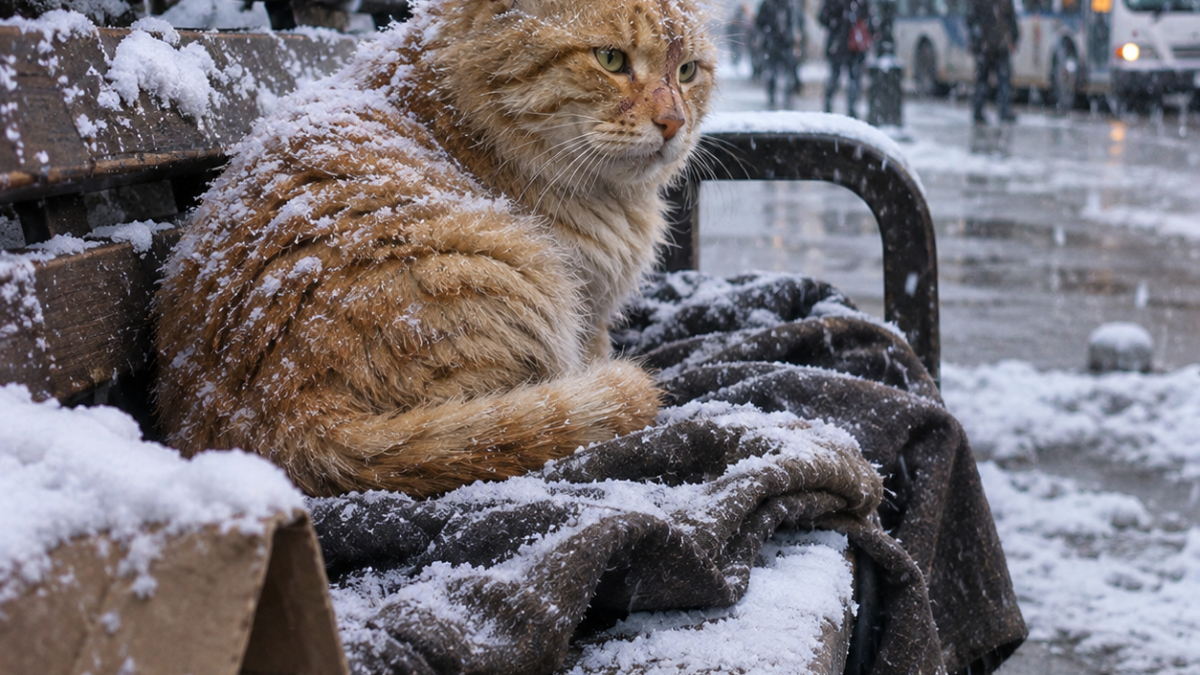
On Saturday, snow began.
The forecast had called for two inches.
Upstate New York ignored forecasts like that because two inches barely qualified as weather.
By noon, four inches covered the park.
Ellen stood inside the laundromat and watched Red.
He sat on the bench.
Snow collected along his back.
At first, it melted against his fur.
Then stopped melting.
The orange darkened beneath white.
“Why won’t he move?” Nina asked.
Ellen stared.
“He’s waiting.”
“For what?”
Ellen did not answer.
At one o’clock, she took food outside.
Red jumped down.
Ate several mouthfuls.
Then returned to the bench.
At two, snow reached the seat around his paws.
At three, he curled tightly.
At four, Ellen could no longer stand it.
She brought a cardboard box from the laundromat.
Cut an entrance.
Lined it with two old towels.
Set it beneath the bench.
Red inspected it.
Then climbed back onto the seat.
“You’re an idiot.”
He blinked at her.
“You know that?”
No response.
“Thomas would call you an idiot too.”
The name changed something.
Red looked toward the road.
Ellen swallowed.
“He’s not coming.”
Red kept watching.
She crouched.
“He’s not.”
The cat’s tail curled around his paws.
Ellen stood.
“Fine.”
She went back inside.
At closing time, Red remained.
Ellen left the laundromat lights on overnight.
She told herself it was security.
It was not.
The next morning, Red was in the box.
But Ellen noticed something.
He had turned it.
The entrance faced the bench.
At first she assumed wind had shifted it.
Then she moved the box to protect it from snow blowing across the sidewalk.
Red climbed inside.
Paused.
Came back out.
Walked around the box.
Pushed against one side with his body.
He could not move it.
Ellen stared.
“Do you want to see the bench?”
Red looked at her.
She rotated the box.
Opening toward the seat.
He went inside.
Lay down.
Eyes fixed on the place Thomas used to sit.
Ellen covered her mouth.
“Oh, Red.”
The second snowstorm arrived nine days after Thomas died.
This one was worse.
Temperatures dropped toward seven degrees.
Wind drove snow sideways between buildings.
City crews cleared sidewalks.
A plow buried one side of the park entrance.
Ellen called animal control again.
“He’s still there.”
“We’ve tried trapping him.”
“Try harder.”
“We need him to enter the trap.”
“He’s going to freeze.”
“Can you bring him inside?”
“He won’t let anyone catch him.”
“Then keep providing shelter and food.”
“You understand how ridiculous that sounds?”
The dispatcher remained patient.
“Ma’am—”
“No. A man died because he wouldn’t leave the cat, and now the cat is going to die because nobody can figure out what to do with him?”
Silence.
“I’m sorry.”
Ellen laughed without humor.
“So is everyone.”
She hung up.
That afternoon, Ruth Kaplan entered the laundromat.
Ruth was sixty-eight.
Retired nurse.
Five-foot-two.
Gray hair cut short.
The kind of woman who had spent forty years telling surgeons when they were wrong and had no intention of becoming agreeable in retirement.
She carried a folded thermal blanket.
“That the cat?”
Ellen looked through the window.
“Yes.”
Ruth marched outside.
“Wait.”
Ellen followed.
Ruth placed the blanket inside the box.
Red hissed.
Ruth sat down on the snow-covered end of the bench.
“You can hiss.”
Red stared.
“I’ve had worse patients.”
He did not move.
Ruth adjusted the blanket.
“Use it or don’t.”
Then she returned to the laundromat.
Ellen handed her coffee.
“You know him?”
“No.”
“Thomas?”
“Seen him.”
“Why the blanket?”
Ruth looked out the window.
“Because he’s cold.”
That was the entire explanation.
The next morning Ruth arrived at six.
Red was inside the box on the blanket.
Facing the bench.
The morning after that, she returned.
Then again.
Soon it became a routine.
Six o’clock.
Ruth.
Coffee from Ellen.
Cross the street.
Fresh water.
Food.
Check Red from a distance.
Replace wet bedding if he allowed it.
Sometimes he hissed.
Sometimes he ignored her.
Once he swatted the air.
Ruth nodded approvingly.
“Good. Still got attitude.”
By the third week, Red recognized her.
Not enough to touch.
Enough not to hide.
She started calling him Bench.
Ellen objected.
“That’s a terrible name.”
“He needs something.”
“He has a name.”
“Red.”
“That’s what Thomas called him.”
Ruth considered.
“Then Red.”
But in her own mind, he became Bench.
Because every morning that was where she found him.
On the bench.
Under it.
Beside it.
Always within sight of it.
Never more than a few hundred feet away.
Volunteers from a feeding program began helping.
They left warmed water in insulated bowls.
One volunteer built a better shelter from plastic storage bins and foam insulation.
Red refused it.
He preferred the cardboard box.
“It’s warmer,” the volunteer said.
Ruth shrugged.
“He doesn’t care.”
“Why not?”
“Wrong view.”
They moved the insulated shelter so the entrance faced Thomas’s seat.
Red entered that night.
Everyone learned.
Everything faced the bench.
Food.
Shelter.
Blankets.
Red’s world had become a compass.
Thomas was north.
Even gone.
By week four, Ruth started noticing weight loss.
At first it seemed impossible.
People were feeding him every day.
But grief did not respect calorie calculations.
Red ate enough to stay alive.
Not enough to thrive.
Sometimes he would take two bites and stop when a bus pulled into the depot.
His head would rise.
He would stare at the doors.
People stepped off.
Students.
Workers.
Travelers pulling luggage.
Red watched each one.
Then returned to his food.
One morning, a man wearing a green army jacket crossed the park.
Red shot out of the box.
Ruth gasped.
“Red!”
The cat ran.
Faster than anyone had seen him move in weeks.
He stopped ten feet behind the man.
The stranger turned.
“Hey, buddy.”
Red froze.
Wrong face.
Wrong smell.
Wrong voice.
He backed away.
The man crouched.
“You okay?”
Red turned and walked back to the bench.
Not ran.
Walked.
Slowly.
Ruth cried in the laundromat bathroom afterward.
Ellen stood outside.
“You okay?”
“No.”
“Want me to come in?”
“No.”
A moment later Ruth opened the door.
“I hate this.”
“I know.”
“He thought—”
“I know.”
“He thought it was him.”
Ellen nodded.
Ruth wiped her eyes angrily.
“Cats aren’t supposed to understand death like this.”
“Who told you that?”
Ruth had no answer.
Thomas still had no legal name.
Police fingerprint checks produced nothing useful.
No current identification.
No active missing-person report.
No family immediately found.
People called him Thomas because that was what he called himself.
Outreach workers believed his last name might be Miller.
Or Mills.
Maybe Mitchell.
His paperwork had never been complete.
He did not like offices.
He distrusted forms.
He disappeared when people pressed too hard.
After his death, Daniel Reeves tried to reconstruct his life.
That was how Ellen learned the rest.
Daniel came into the laundromat one afternoon carrying a folder.
“I think I know who he was.”
Ellen looked up.
“Thomas?”
Daniel nodded.
Ruth was sitting near the dryers.
She came over.
“What does that mean?”
“We found an old shelter intake from another county.”
He opened the folder.
Thomas Andrew Mercer.
Born 1960.
Former address in Utica.
Previous occupation listed as mechanic.
Emergency contact blank.
Ellen stared.
“Mercer.”
“Probably.”
“Family?”
Daniel shook his head.
“Still working on it.”
“What happened to him?”
“We don’t know everything.”
“But?”
Daniel looked at Red through the window.
“There was an eviction about four years ago.”
“Why?”
“Apartment building sold. New owner renovated.”
“That made him homeless?”
“Not by itself.”
Daniel hesitated.
“He was already behind.”
“On rent?”
“Yes.”
“Why?”
“Medical bills maybe.”
Ruth’s face tightened.
“What kind?”
“His wife.”
Ellen looked at Daniel.
“He was married?”
“Widowed.”
Silence.
“She died?”
“Three years before he became homeless.”
Daniel continued.
“Cancer.”
Ruth sat down.
“There was a daughter listed on an old utility account.”
Ellen’s eyes widened.
“You found her?”
“No.”
“The record is old. Name changed maybe.”
“What’s her name?”
Daniel looked at the folder.
“Emily.”
Ruth glanced toward the cat.
“Did he ever talk about her?”
Ellen shook her head.
Not to her.
Thomas talked about weather.
Baseball.
Cars.
Cats.
Rarely himself.
Daniel turned a page.
“He also had a cat before Red.”
Ellen frowned.
“What?”
“Intake note says he refused emergency housing because he wouldn’t surrender an animal.”
“When?”
“Four years ago.”
“Red?”
“Maybe.”
Daniel looked toward the bench.
“Age would fit.”
That meant Red had been there from almost the beginning.
Not picked up after Thomas became homeless.
Not some stray who wandered into his life later.
He had gone with him.
From apartment to street.
From street to shelter door.
From shelter door back outside.
Ellen imagined the moment.
Thomas standing with bags.
An eviction notice.
A cat carrier maybe.
A shelter worker saying:
No animals.
And Thomas making a choice.
The same choice he would keep making.
One bed inside without Red.
Or the street together.
Ruth whispered, “He picked the cat.”
Daniel corrected her gently.
“He picked not to abandon him.”
That distinction mattered.
By week five, Red’s orange coat had become dull.
His fur tangled beneath his chest.
Frost had damaged the tips of his ears.
One already bore Thomas-era damage.
Now both were darkening at the edges.
Ruth took photographs and sent them to a veterinarian.
The response came quickly.
He needs to come in.
Ruth stared at the message.
“Excellent.”
Ellen looked over.
“What?”
“Apparently we should just explain that to him.”
They tried a humane trap again.
Red would not enter.
They tried covering it.
No.
Tuna.
Chicken.
Sardines.
Nothing worked.
Red knew cages.
Perhaps from some earlier part of life.
Or perhaps he simply knew that entering one meant leaving.
He refused.
Ruth sat beside the trap.
“You are going to die because you’re stubborn.”
Red watched the bench.
“Thomas was stubborn too.”
His ear twitched.
“That was not a compliment.”
Ruth started talking to him every morning.
Not baby talk.
Conversation.
She told him about nursing.
Three decades at St. Mary’s.
Emergency department first.
Then cardiac.
Then hospice.
She told him about her husband David, who had died six years earlier.
Aneurysm.
Sudden.
One morning he made breakfast.
By lunch she was signing forms no spouse should have to sign.
“I waited too,” she told Red.
The cat remained inside his box.
“Not on a bench.”
She poured water into his bowl.
“But I kept listening for his key.”
Red watched her.
“For months.”
Ruth sat back on her heels.
“Every elevator door in my building.”
She smiled sadly.
“Stupid.”
Red blinked.
“Grief makes you stupid.”
She hesitated.
“No.”
“Not stupid.”
“Faithful to an old routine.”
That was what she eventually understood about Red.
People called it waiting.
But perhaps waiting was too simple.
Red did not know how to rearrange a life after Thomas disappeared.
His entire structure had been built around one person.
Thomas woke.
Red woke.
Thomas ate.
Red ate.
Thomas moved.
Red followed.
Thomas slept.
Red pressed against his chest.
Then one morning the center disappeared.
Red kept doing the rest.
He was not waiting because somebody had explained return.
He was maintaining the only life he understood.
By week six, reporters heard about him.
A local news photographer came to the park.
Ruth hated him immediately.
“Don’t get close.”
“I’m just getting some footage.”
“You’re frightening him.”
“I have a long lens.”
“Then use it from across the street.”
The reporter interviewed Ellen.
Then Ruth.
“What do you think keeps the cat here?”
Ruth looked toward Red.
“Loyalty.”
“Do you think he understands his owner died?”
“I think he understands the man vanished.”
“Do you think he’s grieving?”
Ruth gave him a look.
“What do you think?”
The reporter smiled nervously.
“We’re asking you.”
“Then yes.”
“What do you want people to take from this story?”
Ruth did not hesitate.
“That Thomas was a person.”
The reporter blinked.
“We’re talking about the cat.”
“I know exactly what you’re talking about.”
Her voice hardened.
“Everyone wants the loyal-cat story.”
She pointed toward the bench.
“But that cat had someone worth waiting for.”
The reporter remained silent.
“Thomas was homeless.”
Ruth continued.
“He was not nobody.”
The segment aired that night.
The station used footage of Red sitting in snow.
Then a photograph of Thomas taken months earlier by an outreach volunteer.
For the first time, thousands of people saw the two of them together.
Thomas sitting on the bench.
Red tucked inside his coat with only his head showing.
The image changed everything.
Calls came.
Food donations.
Blankets.
Offers to adopt Red.
People wanted him.
Suddenly.
Ruth found this irritating.
“He doesn’t need twelve strangers fighting over him.”
Ellen smiled.
“Better than nobody caring.”
“Barely.”
One caller claimed to be Thomas’s cousin.
False.
Another said she had known him in high school.
Possible.
Then a woman called the station from Pennsylvania.
Her name was Emily Carter.
She said Thomas Mercer was her father.
Daniel called Ruth that evening.
“We found her.”
Ruth sat down.
“His daughter?”
“Yes.”
“Is she coming?”
“She’s driving up tomorrow.”
Ellen closed the laundromat early the next day.
Emily arrived shortly after noon.
She was thirty-seven.
Dark hair.
Tired face.
Thomas’s eyes.
Ruth recognized them immediately.
Emily stood across the street from the park for almost a minute before crossing.
Red was on the bench.
She stopped ten feet away.
“Oh my God.”
Ruth stayed beside her.
“You knew him?”
Emily nodded.
“Red.”
The cat looked up.
Emily covered her mouth.
“That’s him.”
“You remember him?”
“My dad got him from behind an auto shop.”
She laughed through tears.
“He was this skinny orange kitten living under a tire rack.”
Red watched her.
“He called me that night.”
Emily’s voice broke.
“Said he had found somebody who needed him.”
Ruth looked at her.
“Were you close?”
Emily shook her head.
“No.”
Honesty.
Immediate.
Painful.
“No.”
She sat on the far end of the bench.
Red did not leave.
“When Mom died, Dad disappeared into himself.”
Emily looked at her hands.
“He drank for a while.”
“Was he violent?”
“No.”
She shook her head.
“Never.”
“Just gone.”
She swallowed.
“Even when he was sitting right in front of you.”
Ruth understood that too.
“I had kids.”
Emily continued.
“My husband got a job in Pennsylvania.”
“I kept asking Dad to come.”
“He wouldn’t.”
“Then he got evicted.”
“Did you know?”
“After.”
Her voice cracked.
“He lied.”
“Said he was staying with a friend.”
She looked at the park.
“By the time I found out he was outside, we had a terrible fight.”
“What about?”
“I told him I’d come get him.”
“He said no.”
“I told him I’d bring Red too.”
“He didn’t believe me.”
Ruth said nothing.
Emily wiped her eyes.
“He said everybody says that until the cat becomes inconvenient.”
The same fear.
Again.
“He stopped answering calls.”
“I got angry.”
She looked at Red.
“Then I stopped calling as often.”
“How long?”
“Two years.”
Ruth did not rescue her from the guilt.
Emily did that herself.
“I should have kept calling.”
“Yes,” Ruth said softly.
Emily looked at her, surprised.
Most people would have said:
You did what you could.
Don’t blame yourself.
Ruth had spent too long in hospice for lies that sounded kind.
“You should have.”
Emily began crying.
Ruth continued.
“And he should have let you help.”
Emily nodded.
“Both can be true.”
Red jumped down from the bench.
Emily froze.
He approached.
Slowly.
Sniffed her boots.
Then her coat.
Emily whispered, “Hey.”
Red’s head lifted.
She extended no hand.
“You remember this smell?”
Ruth wondered if he did.
Family.
A house long gone.
A voice once heard through phone speakers.
Red circled Emily once.
Then jumped back onto the bench.
Emily laughed through tears.
“Still rude.”
Ruth smiled.
“Very.”
Emily brought a box of Thomas’s old belongings the next day.
Photographs.
A baseball cap.
A flannel shirt.
She placed the shirt inside Red’s shelter.
His reaction was immediate.
He froze.
Sniffed once.
Then again.
He climbed inside.
Turned.
Pressed his face into the fabric.
Emily broke down.
Ruth held her.
That night Red slept on the shirt.
The next morning he still refused to leave.
Emily offered to take him.
He would not let her touch him.
They tried coaxing.
Nothing.
Ruth said, “Don’t force him.”
“He’s dying out here.”
“I know.”
“Then what are we waiting for?”
“For him to be catchable without terror.”
Emily looked at the frostbitten ears.
“We may not have time.”
She was right.
Week seven.
Red developed a cough.
Small at first.
Then wet.
His eyes watered.
He ate less.
Ruth called the veterinarian again.
The answer became urgent.
Respiratory infection.
Possibly pneumonia if untreated.
Get him in.
They tried another trap.
Red refused.
Emily cried in frustration.
“He doesn’t know we’re trying to save him.”
Ruth looked toward the bench.
“Thomas didn’t know either.”
“What?”
“When people offered shelter.”
Emily stared.
“He thought help meant losing Red.”
Ruth lowered her voice.
“Fear can make rescue look like another threat.”
By week eight, Red was visibly weak.
He moved less.
The volunteers stopped trying to approach.
They focused on food.
Water.
Warmth.
Ruth came at six.
Every morning.
No exceptions.
One morning the temperature was three degrees.
Ruth found Red outside the shelter.
Sitting on the bench.
Snow crusted beneath his paws.
“Why?”
He looked at the bus depot.
Ruth followed his gaze.
A bus had just arrived.
Passengers stepped off.
Red watched every one.
Ruth sat beside him.
“Not today either.”
The cat remained.
“I’m sorry.”
Ruth had said those words to dying patients.
Families.
Children.
Widows.
She had never hated them more.
On day sixty-two, Red ate almost nothing.
Ruth called Emily.
“I think tomorrow we stop waiting.”
“What do you mean?”
“We sedate if we have to.”
“Can they do that?”
“A vet can come.”
“What if he runs?”
“He barely can.”
Silence.
Emily whispered, “Okay.”
Ruth went home that night and did not sleep.
At 5:30 the next morning, she made coffee.
Put on three layers.
Picked up a clean blanket.
Then walked to the park.
It was day sixty-three.
The sky had not yet brightened.
Streetlights reflected on frozen snow.
Ruth crossed toward the bench.
She knew something was wrong before she reached it.
Red was not visible.
She crouched near the shelter.
“Red?”
No movement.
Her heart hammered.
“Red.”
She looked inside.
He was lying flat.
Not curled.
Flat.
Eyes half-open.
Ruth dropped the blanket.
“Oh no.”
She reached in.
For the first time in sixty-three days, Red did not hiss.
Did not pull away.
Did not run.
Ruth touched him.
His body was cold.
Far too cold.
“Hey.”
His eyes moved toward her.
“Don’t you do this.”
She slid both hands beneath him.
He weighed almost nothing.
A large-framed cat.
Six pounds, she would later learn.
Ruth tucked him inside her coat.
His head rested beneath her chin.
She stood.
The bench was empty behind her.
Ruth looked at it.
“I’m taking him.”
She did not know who she was talking to.
Thomas maybe.
“Okay?”
The park gave no answer.
Ruth tightened her arms around Red.
“I’m taking him.”
She drove through three red lights.
At the clinic, veterinary technician Kara Mills took one look at the bundle in Ruth’s arms.
“Treatment room.”
Dr. Steven Price arrived within seconds.
Temperature.
Too low.
Weight.
Six pounds, two ounces.
Dehydration.
Severe.
Respiratory infection.
Likely weeks old.
Malnutrition.
Frostbite.
Cracked rear paw pad.
Ear tips damaged beyond saving.
Steven looked at Ruth.
“How long outside?”
“Sixty-three days.”
He stared.
“What?”
“Sixty-three.”
“In this weather?”
“Yes.”
He looked down at the cat.
“Why?”
Ruth’s face collapsed.
“He was waiting for somebody.”
Steven did not ask anything else.
Red spent four weeks recovering.
The first two days were critical.
Warm fluids.
Antibiotics.
Careful nutrition.
Pain management.
Treatment for his paw.
Eventually surgery to remove dead tissue from the frostbitten ear tips.
When he woke, both ears were shorter.
One already torn.
Now both carried winter permanently.
Emily visited.
So did Ellen.
Daniel came.
Even Nina from the laundromat stopped by.
Ruth came every day.
She sat beside the cage.
Read.
Talked.
Waited.
Red gradually stopped hiding when she arrived.
On day six, he ate an entire small meal.
On day nine, he stood without wobbling.
On day eleven, he walked into Ruth’s lap.
She froze.
Kara saw.
“Don’t move.”
Ruth whispered, “I’m not breathing.”
Red circled once.
Then sat.
Ruth stared down.
“Seriously?”
He began purring.
Ruth cried silently.
Kara walked away before she did too.
Emily watched from the doorway.
“He picked you.”
Ruth looked up.
“No.”
“He did.”
“You’re family.”
Emily smiled sadly.
“Not the family he knows.”
She came closer.
“I have two dogs and three kids.”
Ruth laughed.
“Poor man.”
“He hates dogs.”
“Strongly.”
Emily crouched beside them.
“I want him safe.”
Ruth looked at Red.
“So do I.”
On the day he was cleared to leave, Steven handed Ruth the discharge papers.
She stared.
“What?”
“Adoption paperwork too.”
“I haven’t said yes.”
Kara walked past.
“You bought three cat beds.”
“They were on sale.”
“Six bowls.”
“Different purposes.”
“A heated window perch.”
Ruth frowned.
“The apartment is drafty.”
Steven smiled.
“What name?”
“Red.”
Emily was sitting nearby.
She shook her head.
“My dad called him Red because he said naming animals made losing them harder.”
Ruth looked at her.
“That worked well.”
Emily laughed.
“No.”
Ruth thought about the park.
The bench.
Sixty-three mornings.
“Bench.”
Everyone stared.
Emily smiled first.
“Bench?”
“Terrible?”
“Very.”
Ruth looked down at the cat.
“Bench.”
He blinked.
Steven typed it.
BENCH KAPLAN.
Ruth pointed at the screen.
“Absolutely not.”
“What?”
“He does not get my last name.”
Kara laughed.
“Too late.”
That first night, Bench entered Ruth’s apartment at 4:12 p.m.
She set the carrier down.
Opened it.
Stepped back.
Bench emerged cautiously.
He inspected the hallway.
Kitchen.
Bedroom doorway.
Living room.
Then stopped at the window.
It overlooked the street.
Not Franklin Park.
A different street.
Cars.
People.
A bus stop one block away.
Bench jumped onto the sill.
Sat.
And stared outside.
Ruth prepared dinner.
He did not move.
She washed dishes.
Still there.
At seven, she turned off a lamp.
Still watching.
At seven fifteen, she sat behind him.
“You know he isn’t coming down that street.”
Bench’s ears moved.
“I’m sorry.”
He remained.
Ruth did not close the curtains.
For three hours, he watched.
The next night he did it again.
Then again.
For two months, every evening ended the same way.
Window.
Watch.
Listen.
Ruth never stopped him.
Friends told her to distract him.
Move furniture.
Close curtains.
“She’s reinforcing it,” one person said.
Ruth almost laughed.
“Grief is not a behavior problem.”
So the curtains stayed open.
Bench watched.
Then one evening, after almost nine weeks in the apartment, he left the window before dark.
Ruth was reading in bed.
She felt weight beside her.
Bench jumped up.
He walked to the left side.
Turned three times.
Lay down.
Facing the bedroom window.
Ruth looked at him.
“Moving the watch?”
Purr.
She turned off the light.
“Fine.”
From that night forward, Bench slept there.
Always on the left.
Always facing glass.
The legal paperwork around Thomas took months.
Emily eventually claimed his remains.
He had been held while officials searched for family.
She chose cremation.
Ruth attended the memorial.
So did Ellen.
Daniel.
Marcus from the feeding program.
Several people from the park.
Thomas had spent years believing he was largely forgotten.
Thirty-eight people came.
Emily stood in front of them holding his old baseball cap.
“I was angry with my father.”
Her voice shook.
“I think he was angry with me too.”
She paused.
“I wish I could make this story simpler.”
Nobody moved.
“He was not perfect.”
“He drank after my mother died.”
“He pushed people away.”
“He lied about how bad things were.”
“He refused help.”
Emily swallowed.
“But he loved that cat.”
She looked toward Ruth.
“And when he had almost nothing left, that love cost him something.”
The room was silent.
“He was offered a warm bed.”
She continued.
“He chose a freezing bench because he thought the alternative meant abandoning the last living thing that trusted him.”
Emily’s eyes filled.
“I spent a long time being angry about that.”
She looked down.
“Now I mostly wish someone had offered both of them a bed.”
After the memorial, Daniel approached Ruth.
“That sentence is going to bother me forever.”
“Which?”
“Both of them.”
Ruth nodded.
“Good.”
Daniel looked surprised.
“Good?”
“If it bothers you, change something.”
Within a year, Daniel helped create a pilot emergency program allowing unhoused people with animals to enter temporary accommodation together.
It was small.
Six rooms.
Barely enough.
But it existed.
The first guest was a fifty-three-year-old woman and her elderly beagle.
Ruth visited once.
She stood outside the room.
Woman asleep.
Dog curled against her knees.
Ruth went home and told Bench:
“Thomas would be insufferably proud.”
Bench did not care.
He wanted dinner.
The park bench was removed six months after Thomas died.
City renovation.
New pathways.
New lighting.
New benches.
When Ruth learned, she went to Franklin Park.
Workers had already unbolted it.
The old wood-and-metal bench sat in a maintenance truck.
“Wait!”
One worker looked over.
“You need something?”
“That bench.”
“What about it?”
“Where’s it going?”
“Dump probably.”
“No.”
He frowned.
“No?”
Ruth pointed.
“I want it.”
The worker laughed.
“Ma’am, you can’t just take city property.”
“Who do I ask?”
“Parks department.”
Ruth called.
Then emailed.
Then called again.
Then involved Emily.
Then Daniel.
Then a local reporter.
Two weeks later, the city surrendered the bench for a community memorial project because everyone involved became exhausted by Ruth Kaplan.
It was restored.
Not polished into something new.
The scratches remained.
The worn slats.
The small gouge near one side where Thomas used to tie plastic bags.
A brass plaque was added.
Emily chose the words.
THOMAS MERCER AND RED
THEY STAYED TOGETHER.
FOR EVERYONE STILL WAITING TO BE SEEN.
The bench was installed outside the new pet-inclusive shelter program.
When Ruth brought Bench there in a carrier for the dedication, she did not know what would happen.
She opened the carrier inside a secure fenced courtyard.
Bench stepped out.
He was heavier now.
Almost twelve pounds.
Coat bright.
Ears shortened.
Left ear still torn.
He saw the bench.
Stopped.
Ruth’s heart broke before anything happened.
“Bench.”
He walked toward it.
Slowly.
Sniffed one leg.
Then the seat.
Then underneath.
Emily began crying.
Bench jumped onto it.
Everyone became silent.
He sat in Thomas’s old place.
Facing outward.
Ruth waited.
One minute.
Two.
Three.
Bench sniffed the air.
Then something extraordinary happened.
Nothing.
No crying.
No panic.
No frantic searching.
He simply sat.
Looked.
Then jumped down.
Walked back to Ruth.
And rubbed against her leg.
Emily sobbed.
Ruth picked him up.
“You done?”
Bench pressed his face beneath her chin.
“Yeah.”
She looked toward the plaque.
“So am I.”
Years passed.
Bench became a local legend he did not deserve and did not understand.
Children knew him from news stories.
Volunteers recognized him.
People sometimes asked Ruth if they could pet “the famous cat.”
Bench generally declined.
He remained suspicious of strangers.
Loved roast chicken.
Hated the vacuum.
Despised closed doors.
Started every morning by screaming until Ruth opened the bedroom curtains.
He never became cuddly with everyone.
Only Ruth.
And eventually Emily.
Emily visited several times a year.
Bench always approached her differently.
Slowly.
Sniff.
Pause.
Then head bump.
Ruth called it the Thomas inspection.
“He knows.”
Emily never asked what exactly he knew.
Maybe scent.
Maybe voice.
Maybe nothing.
It did not matter.
When Bench was approximately eight, Ruth woke one winter morning to snow.
Heavy.
Silent.
The kind that transformed parked cars into smooth white shapes.
She sat up.
Bench was already at the window.
Her chest tightened.
“Hey.”
He looked back.
“Don’t get nostalgic.”
She opened the curtains fully.
Snow fell.
Bench watched.
Ruth expected him to freeze.
Hide.
Pace.
Instead, he climbed down.
Walked to the bed.
Jumped up.
Curled on the left side.
His back pressed against her hip.
Ruth touched his shortened ear.
“You’re staying in?”
Bench closed his eyes.
She smiled.
“Smart.”
At ten that morning, they walked through the apartment together.
Warm floor.
Full water bowl.
Two unused cat beds.
One ridiculous heated mat.
No frost.
No cardboard.
No empty bench.
Ruth thought about the first six o’clock morning.
Red staring at one spot.
Waiting.
She had once believed the goal was to make him stop.
Stop watching.
Stop returning.
Stop remembering.
She eventually understood healing did not work like that.
Bench never forgot.
He simply learned that memory could exist beside something new.
Thomas.
And Ruth.
The bench.
And the bed.
Loss.
And safety.
One did not erase the other.
Emily once asked Ruth:
“Do you think Dad knew Red loved him?”
Ruth answered without thinking.
“Yes.”
“How?”
“Because he stayed outside for him.”
Emily looked down.
“Maybe Dad stayed outside for Red because Red had already stayed through everything else.”
Ruth considered that.
“Probably.”
They sat quietly.
Emily smiled sadly.
“They saved each other.”
Ruth shook her head.
“No.”
Emily looked surprised.
Ruth explained.
“People say that because it sounds nice.”
She looked toward Bench sleeping nearby.
“But I don’t think love always saves you.”
Emily listened.
“Thomas still died.”
“Red nearly did too.”
Ruth’s voice softened.
“But love meant neither of them was alone.”
That was different.
Sometimes that was everything.
Thomas had been a mechanic.
A husband.
A father.
A widower.
A man who lost money.
A man who drank too much for a while.
A man who refused help.
A man who needed help anyway.
A homeless man.
None of those descriptions were complete.
Red had known only one version.
The man who split sandwiches in half.
The man who tucked him into a coat before sleeping.
The man who protected him from rain.
The man who said no when somebody offered warmth at the price of separation.
The man who stayed.
So when Thomas disappeared, Red did what Thomas had taught him.
He stayed too.
Through one day.
Four.
Nine.
Twenty.
Forty.
Sixty-three.
Snow filled the park.
Buses came and left.
People crossed the street.
Food appeared.
Blankets appeared.
Strangers spoke softly.
The world kept explaining in ways Red could not understand that Thomas was gone.
Still, every morning, he faced the empty seat.
Waiting.
Not because loyalty is always reasonable.
Not because grief is.
Not because love protects the body from cold.
It does not.
The frostbite proved that.
The malnutrition proved that.
The cracked paw proved that.
Love did not keep Red warm enough.
People did.
Ellen.
Ruth.
Emily.
Volunteers.
Veterinarians.
A community that finally noticed.
And maybe that was the part worth remembering.
Thomas had once believed that if he accepted help, someone would make him choose between survival and the creature he loved.
Too often, he had been right.
After he died, people spent months trying to prove that the choice should never have existed.
The six pet-friendly rooms did not end homelessness.
They did not fix poverty.
They did not bring Thomas back.
But when winter came again, six people slept indoors with the animals who had kept them alive emotionally when very little else had.
One of those men had a gray cat named June.
The first night, he sat on the edge of the shelter bed and cried because staff had placed a litter box in the bathroom.
Daniel asked if something was wrong.
The man shook his head.
“No.”
He looked at the cat.
“Just nobody ever said she could come too.”
That sentence traveled back to Ruth.
She sat beside Bench that night.
“You hear that?”
Bench cleaned a paw.
“Apparently your terrible stubbornness did something useful.”
He looked at her.
Ruth smiled.
“Thomas’s too.”
Years after the original park renovation, strangers sat on the new benches without knowing what happened there.
People ate lunch.
Teenagers checked phones.
Travelers waited for buses.
Children chased pigeons.
Nothing remained to mark the exact place where Thomas died.
Ruth eventually liked that.
At first she had been angry.
She wanted a plaque.
A stone.
Something permanent.
Then she understood Thomas’s memorial did not need to remain at the place he died.
The better memorial stood somewhere warm.
Outside a building that let people enter with their animals.
A restored bench.
A brass plaque.
And sometimes, on sunny afternoons, an old orange cat sitting there beside a retired nurse who always carried treats.
When Bench grew older, Ruth stopped taking him often.
He preferred home.
The left side of the bed.
The window.
His routine.
He still startled when the front door opened unexpectedly.
But now the reaction lasted seconds.
Door.
Startle.
Ruth’s voice.
Relax.
That sequence became another kind of healing.
Not never being afraid.
Knowing fear would end.
One night Ruth returned from dinner later than usual.
She opened the apartment door.
Bench appeared from the bedroom.
He froze.
Then saw her.
His body visibly softened.
Ruth set down her purse.
“There you are.”
Bench walked over.
Rubbed against both ankles.
“You thought I wasn’t coming back?”
He meowed.
Ruth crouched.
“I come back.”
She scratched beneath his chin.
“That’s what we do now.”
Bench purred.
Ruth had never made promises easily after David died.
Forever felt arrogant.
Tomorrow felt negotiable.
But she could promise return when she walked to the store.
She could promise breakfast.
Medicine.
Warmth.
An open curtain.
A place on the bed.
Small promises.
Kept repeatedly.
That was how trust rebuilt itself.
Not with one rescue.
With thousands of ordinary returns.
The final time Ruth visited Thomas’s memorial bench with Bench, he was nearly eleven.
Slow.
Arthritic.
Still orange.
Still scarred.
Still stubborn.
Emily came with her children.
Her oldest son, Thomas’s grandson, was sixteen.
He had never met his grandfather.
He sat beside the plaque.
“So he really slept outside because of the cat?”
Emily nodded.
“Yes.”
“Even when they offered a shelter?”
“Yes.”
The boy looked at Bench.
“That’s crazy.”
Emily smiled sadly.
“Maybe.”
Ruth sat down.
“Love can make people unreasonable.”
The boy read the plaque again.
“They stayed together.”
“Yes.”
Bench climbed onto the bench with difficulty.
The boy reached toward him.
Ruth said, “Let him smell you.”
He did.
Bench sniffed.
Then accepted one stroke.
The boy smiled.
“He looks rough.”
Emily laughed.
“Runs in the family.”
Bench turned and sat facing the street.
For a moment the old image returned.
The cat.
The bench.
The watch.
Ruth felt grief rise.
Then Bench looked back at her.
Not the street.
Her.
He walked across the seat.
Slowly.
Then settled beside her.
Ruth placed one hand on his back.
Emily watched.
She knew what it meant.
The waiting was over.
Not because Thomas mattered less.
Because Bench had finally learned that staying did not always mean remaining in the place where someone disappeared.
Sometimes staying meant carrying them forward.
Thomas stayed inside the cat.
In habits.
Trust.
Old fears.
The strange way Bench liked sleeping beneath blankets.
The way he preferred the left side.
The way he watched doors.
The way he divided food mentally, always leaving a few bites before returning later.
Little pieces of a life shared outdoors.
Ruth never tried to remove them.
They belonged to him.
Years earlier, on a Tuesday morning in December, the city had taken away a man few people could fully identify.
No relatives arrived that day.
No obituary appeared immediately.
No funeral procession stopped traffic.
There was only an empty bench.
And one orange cat who refused to accept emptiness as an answer.
For sixty-three days, he returned to the same place.
Through two snowstorms.
Seven-degree nights.
Hunger.
Infection.
Frostbite.
Every bus that arrived offered another possibility.
Every footstep could have been familiar.
Every man in an old coat deserved one more look.
Thomas never returned.
But other people did.
Ellen returned with food.
Ruth returned at six every morning.
Volunteers returned with water.
Emily returned after years of distance.
Veterinarians returned Bench to health.
And eventually Bench discovered something he had never expected.
The world could contain more than one person who stayed.
That did not replace Thomas.
Nothing did.
It simply meant his life did not end at the bench.
Neither did Bench’s.
Long after the park was renovated, after snow melted, after news cameras disappeared, after strangers stopped sharing photographs online, an orange cat with shortened ears slept every night beside a retired nurse.
Always on the left.
Always facing the window.
Sometimes the front door opened unexpectedly.
Bench would startle.
His body would stiffen.
For one instant, old fear returned.
Then Ruth would walk in.
And the moment he saw her, he relaxed.
Because once, the person Bench loved had vanished through a door and never come back.
But now he had learned another possibility.
Some people leave.
Some people are taken.
Some people disappear before you are ready.
And some people come home.
Thomas had spent his final years refusing to abandon the cat who stayed when almost everything else in his life fell away.
Bench spent sixty-three freezing days refusing to abandon Thomas’s empty place.
Nobody taught either of them that loyalty.
No shelter program.
No command.
No reward.
No warm bed.
It had been built quietly through cold nights, divided meals, and one coat large enough for a man and a cat.
The world had called Thomas homeless.
Bench never did.
To Bench, home had never been an apartment.
It had never been four walls.
It had never been the park.
Home was the chest he slept against.
The hand that divided the last sandwich.
The voice that said his name after dark.
The man who stayed.
And when that man was gone, Bench did the only thing love had ever taught him to do.
He stayed too.
Until somebody finally came and stayed for him.








