A Homeless Man Died on a Park Bench, but His Cat Refused to Leave—For 63 Days and Two Snowstorms, He Kept Waiting in the Same Spot
PART3:
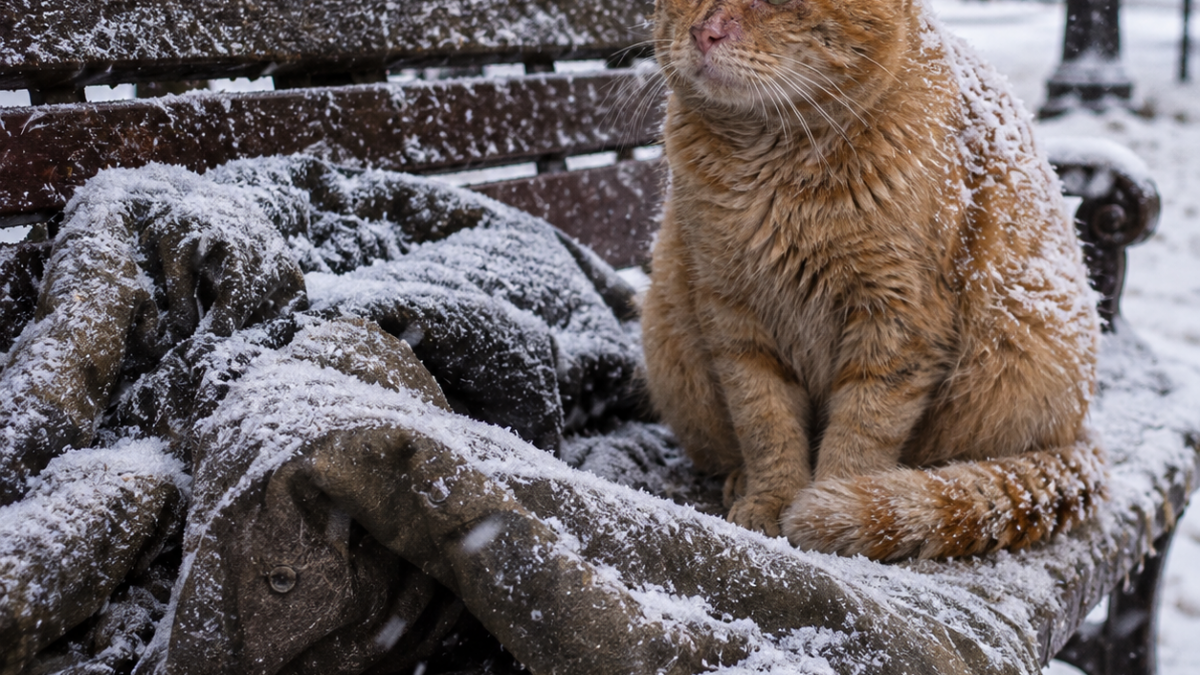
Only his orange head remained visible.
A laundromat customer photographed them once.
Thomas saw.
“Don’t.”
The woman apologized and deleted it.
He was not interested in becoming one of those inspirational images strangers posted with captions about kindness.
He wanted to be left alone.
Mostly.
But he talked to Denise Carter.
Denise owned Carter’s Wash & Fold across from Franklin Square.
She was fifty-three, divorced, loud, and incapable of watching someone starve within sight of a building containing two vending machines.
She had known Thomas almost two years.
Not well.
Enough.
“Coffee?”
He would nod.
“Sugar?”
“Two.”
“Food?”
“If you’re throwing it out.”
She learned not to say she was giving him anything.
Thomas had pride arranged in unusual places.
If she said:
“I bought you breakfast.”
He might refuse.
If she said:
“Guy didn’t pick up this sandwich.”
He accepted.
The cat was easier.
Denise would open the laundromat door and call:
“Orange criminal.”
The cat came immediately.
Thomas pretended to be offended.
“He has a name.”
“What is it?”
Thomas never answered.
That became a running argument.
“You can’t keep telling me he has a name and not tell me the name.”
“He knows it.”
“Well, I don’t.”
“He doesn’t care.”
“He might care if he gets lost.”
Thomas would look at her then.
“He doesn’t get lost.”
There was confidence in the sentence.
Denise remembered it later.
Everyone did, once the cat began waiting.
Two months before Thomas died, Bellweather Outreach Alliance sent a team through Franklin Square before the first hard freeze.
The team included Jenna Morales, a thirty-one-year-old social worker who had been trying to get Thomas indoors for almost a year.
Jenna liked him.
Thomas liked her enough to argue.
That was progress.
“You know you’re on my list.”
“You have bad taste.”
“I’ve been told.”
“You bother everybody this much?”
“Only my favorites.”
The cat sat beside Thomas.
Jenna pointed.
“And your tiny landlord.”
Thomas looked down.
“He charges too much.”
The city shelter had space that night.
Jenna had checked.
She brought the paperwork.
“Come on.”
“No.”
“Tom.”
“No.”
“It’s going to twenty-two tonight.”
“I know.”
“You’ve got a respiratory history.”
“I know.”
“Last January you ended up in the ER.”
“I know.”
“You want me to keep going?”
Thomas looked at the cat.
Jenna already knew the answer.
Animals were prohibited inside Haven Street Men’s Shelter.
Not service animals.
Not emotional-support pets without documentation.
Not companion animals.
No kennels.
No outdoor enclosure.
No partnership with boarding facilities.
The policy existed because of allergies, sanitation, bites, insurance, and a hundred practical reasons that sounded reasonable inside conference rooms.
On the sidewalk, it became simpler.
Come in.
Leave him.
Thomas had asked once whether someone could hold the cat overnight.
Jenna had made calls.
Animal control.
Full.
Private rescue.
No intake space.
Emergency foster list.
Dogs only that week.
City humane facility.
Would accept owned surrender if Thomas permanently relinquished him.
That last part ended the discussion.
“You want me to give him away?”
Jenna had said:
“Just so you’re safe.”
Thomas stood.
“Then I’m safe here.”
“Tom—”
“No.”
“It’s one night.”
“For you.”
“He could be warm too.”
“Somewhere I don’t know.”
Jenna stopped.
Thomas put both hands into his pockets.
The cat pressed against his leg.
“You go somewhere every night?”
“Yes.”
“You know where?”
“Yes.”
“You know who’s there?”
“Yes.”
He nodded toward the orange cat.
“So does he.”
Jenna remembered that conversation word for word.
The shelter administrator later said Thomas had “declined placement.”
Technically true.
That phrase became one of the reasons people got angry.
Declined placement sounded like a man rejecting safety.
It did not sound like a man being told safety had one condition.
Leave your family outside.
On December 6, the temperature in Bellweather fell to sixteen degrees before dawn.
At 5:42 a.m., a city bus driver saw Thomas lying strangely on the Franklin Square bench.
He had passed sleeping people before.
This looked different.
The driver called 911.
Paramedics arrived.
Thomas was unresponsive.
The orange cat sat beneath the bench.
When one paramedic approached, the cat hissed.
Not lunging.
Warning.
The crew worked around him.
Thomas was already gone.
Later, the medical examiner would list probable cardiac arrest complicated by exposure and underlying health conditions.
No violence.
No overdose.
No dramatic mystery.
Cold.
Illness.
A body that had spent too many winters without enough protection.
Police searched his pockets.
No wallet.
No ID.
A transit receipt.
Two dollars and thirty-seven cents.
A folded napkin.
A key that fit nothing anyone could find.
One prescription bottle with the label worn away.
No phone.
No emergency contacts.
The city removed his body at 6:31 a.m.
The cat followed the stretcher three steps.
Then stopped.
Denise was opening the laundromat.
She saw the ambulance.
Ran outside.
“What happened?”
A police officer said:
“Ma’am, step back.”
“That’s Thomas.”
“Did you know him?”
“A little.”
“Full name?”
She opened her mouth.
Nothing came.
Thomas.
Maybe.
She looked at the cat.
He had jumped onto the bench.
He sniffed the place where Thomas had been lying.
Then sat.
Facing the street.
Denise said:
“What about the cat?”
The officer glanced.
“Animal control can pick him up.”
“Will they?”
“I’ll call it in.”
He did.
Denise heard him.
Orange stray cat.
No obvious owner.
Park location.
Potentially feral.
That last word bothered her.
“He’s not feral.”
The officer shrugged.
“That’s how dispatch categorizes unknown outdoor cats.”
“He belongs to him.”
The officer looked toward the departing coroner vehicle.
“Not anymore.”
Denise never forgot that sentence.
Not anymore.
As though belonging ended the second one body stopped breathing.
Animal control did not arrive that day.
The call was classified nonemergency.
By noon, the cat remained on the bench.
Denise brought food.
He ate.
Then returned to the exact spot Thomas had occupied.
That night, she left a folded towel beneath the bench.
The next morning, the towel was untouched.
The cat sat above it.
Day two.
Same.
Denise called animal control herself.
“There’s a cat outside Franklin Square.”
“Yes, ma’am.”
“His owner died.”
“Is the animal injured?”
“Not that I can tell.”
“Contained?”
“No.”
“Can you contain him?”
“He isn’t mine.”
“Then we can add the location for pickup.”
“You already did.”
“Let me check.”
Hold music.
“Yes, I see the report.”
“When are you coming?”
“We’re prioritizing injured and dangerous animals.”
“He’s sitting where his dead owner was.”
Silence.
Then:
“Ma’am, if the cat is eating and ambulatory, he’s not an emergency.”
Denise hung up.
Day three, Jenna Morales came to the park.
She had learned of Thomas’s death through outreach records.
She stood beside the bench.
The cat watched her.
Jenna whispered:
“I’m sorry.”
She wasn’t sure which of them she was apologizing to.
Thomas.
The cat.
Both.
She called Haven Street.
Asked whether Thomas had been offered placement recently.
Yes.
Declined.
Reason?
Animal.
She already knew.
She called the municipal humane facility.
“Can you take his cat?”
The intake coordinator asked:
“Is there proof of ownership?”
“His owner died.”
“Do you have vaccination records?”
“No.”
“Is he handleable?”
“I think so.”
“Is he indoors?”
“No.”
“Then he would enter as stray.”
“Fine.”
“We’re over capacity.”
“So what happens?”
“If animal control brings him, we assess.”
“They aren’t bringing him.”
“Then I don’t know what to tell you.”
Jenna looked at the orange cat.
Snow was forecast.
“How full are you?”
“Very.”
“What if someone brings him directly?”
“We’re not accepting public stray intake this week.”
“His person died.”
“I understand.”
“Do you?”
The coordinator’s voice hardened.
“Ma’am, we have one hundred and twelve cats in a facility built for eighty.”
Jenna stopped.
That was real too.
No villains yet.
Only systems.
Doors.
Rules.
Capacity.
Everyone having a reason to say not us.
On day four, the first storm arrived.
Snow began before noon.
Four inches expected.
Wind from the northwest.
Denise watched from the laundromat window.
The cat sat on the bench.
At first the snow melted against his fur.
Then accumulated.
Orange became dusted white.
One hour.
Two.
He moved beneath the bench briefly.
Then climbed back up.
Denise could not stand it.
She carried a plastic storage bin across the street.
Cut an entrance.
Placed towels inside.
Set it beside the bench.
“Come on.”
The cat watched.
“I’m not asking you to like me.”
Nothing.
“Get in the damn box.”
He blinked.
Denise put food inside.
He stepped down.
Ate half.
Then jumped back to the bench.
By 4:00 p.m., snow covered the seat around him.
Denise walked out again.
“You’re as stupid as he was.”
The cat’s ears moved.
She immediately regretted it.
“No.”
She brushed snow from the bench with one hand.
“He wasn’t stupid.”
The cat remained still.
“He just loved you.”
Denise cried.
The cat did not move.
That evening, she called the local shelter again.
This time she reached a supervisor named Curtis Hale.
She explained.
Dead homeless man.
Cat still waiting.
Storm.
“Can someone take him?”
Curtis asked:
“Is he social?”
“Yes.”
“You touched him?”
“No.”
“Then how do you know?”
“He eats beside people.”
“That doesn’t mean social.”
“Can you send someone?”
“We don’t have an officer available.”
“I can bring him.”
“We’re intake closed.”
“It’s snowing.”
“Ma’am—”
“It’s snowing.”
“I understand you’re upset.”
There are phrases people should never use when someone is already angry.
That was one.
“You understand I’m upset?”
Curtis sighed.
“We cannot create space that doesn’t exist.”
“So he freezes?”
“That is not what I said.”
“What did you say?”
“I said we are full.”
“Then where does he go?”
Curtis paused.
“If you’re able to provide temporary shelter—”
“My landlord doesn’t allow cats.”
“Then perhaps a rescue organization.”
“I called three.”
“I’m sorry.”
“That’s it?”
“I don’t know what else you want me to do.”
Denise looked across the street.
The cat sat beneath the bus shelter now, body tucked tight.
“I want one person in this city to say he’s their problem.”
Curtis did not answer.
That sentence traveled later.
It appeared in a newspaper article.
Then at a city council meeting.
Then on a poster held by a woman nobody knew.
SAY HE’S OUR PROBLEM.
But that was weeks away.
At the time, the cat simply endured the storm.
A retired nurse named Evelyn Marsh first saw him on day six.
Evelyn was sixty-eight.
Widowed.
Retired from St. Joseph’s Hospital after thirty-seven years in nursing, most of them emergency and cardiac care.
She lived four blocks from Franklin Square.
Every morning at 5:45 she walked to the bus depot café for coffee because retirement had not convinced her body to sleep past the hours it had known for decades.
Denise pointed through the laundromat window.
“You know about the cat?”
“What cat?”
“That one.”
Evelyn looked.
Orange shape near the bench.
“Stray?”
“His owner died.”
Denise explained.
Evelyn listened.
Then crossed the street.
The cat watched her approach.
She did not reach.
Nurses learn quickly that frightened beings dislike unexpected hands.
“Hello.”
The cat blinked.
Evelyn looked at the cardboard shelter.
Wet towel.
Bad insulation.
She returned home.
Came back with a thermal emergency blanket, fleece, and a foam board from her basement.
By noon, the plastic shelter was lined.
She placed it close to the bench.
The cat inspected it.
Entered.
Came out.
Sat again facing the bench.
Evelyn noticed the direction.
“He’s watching it.”
Denise said:
“He’s been watching it for almost a week.”
“What was the man’s name?”
“Thomas.”
“Last name?”
Denise shook her head.
Evelyn hated that.
Not the missing surname.
The fact that death had made the man harder to describe than the weather.
On day nine, the second storm came.
Worse.
Temperature fell to seven degrees overnight.
Wind chill below zero.
Snow blew sideways across Franklin Square.
Evelyn arrived at 5:58 a.m.
The cardboard-and-plastic shelter was half-buried.
She knelt.
“Orange boy?”
Two amber eyes appeared.
Alive.
She almost cried from relief.
The cat had finally stayed inside overnight.
But he had positioned himself at the opening.
Facing the bench.
Evelyn reached toward the food.
He hissed weakly.
“Fair.”
She withdrew.
Placed fresh water in a heated bowl Denise had purchased.
Food.
Then sat on the bench.
The cat watched her.
Evelyn said:
“He’s not coming back.”
The words felt cruel.
Maybe necessary.
She had said similar things in hospital rooms.
He’s gone.
She’s gone.
They did everything they could.
There are sentences reality requires even when nobody wants them.
The cat blinked.
Evelyn touched the empty bench.
“You know that?”
Nothing.
She came every morning after that.
Six o’clock.
Sometimes 5:55.
Sometimes 6:10 if the sidewalks were bad.
Food.
Water.
Check shelter.
Look at ears.
Look at paws.
Listen for coughing.
By week three, the cat began recognizing her.
He did not approach.
But his body relaxed slightly when she appeared.
Evelyn started calling him Bench.
At first as a joke.
“Morning, Bench.”
Then the name stayed.
She told Denise:
“It’s temporary.”
“Sure.”
“Until someone knows his real name.”
“Sure.”
Bench lost weight.
Slowly at first.
Then visibly.
His shoulders sharpened.
Hip bones appeared.
The orange coat became dry.
He ate daily, but winter required calories he wasn’t getting.
He also began coughing.
Not coughing exactly.
Harsh sneezes.
Nasal discharge.
Evelyn worried.
“Respiratory infection.”
Denise asked:
“Can cats get pneumonia?”
“Yes.”
“Can it kill him?”
“Yes.”
They called again.
This time Evelyn called.
Retired nurse voice.
Calm.
Precise.
“I have an adult male domestic shorthair, approximately five years old, outdoor exposure for over three weeks, declining body condition, probable upper respiratory infection, possible cold injury.”
The dispatcher responded differently.
“Can you secure the animal?”
“No.”
“Is he aggressive?”
“No.”
“Can you transport?”
“If I can catch him.”
“Then bring him to the municipal humane facility.”
Evelyn almost celebrated.
Then the dispatcher added:
“They may not be able to admit if he’s not critically ill.”
“He’s losing weight.”
“Assessment determines intake.”
Evelyn borrowed a carrier.
Bench refused.
Food trail.
No.
Blanket trap.
He ran under the bench.
Evelyn stopped trying.
She feared driving him away from the only place he trusted.
A rescue volunteer attempted a humane trap.
Bench entered halfway.
Then backed out.
Second attempt.
Same.
He would eat near people.
He would sit within four feet of Evelyn.
But confinement terrified him.
One evening, Jenna Morales visited and understood why.
Thomas had hated enclosed spaces too.
The city shelter had been dormitory-style.
Rows of cots.
Crowded.
No privacy.
Maybe the cat had spent years learning that staying close to Thomas meant avoiding cages, shelters, vans, unfamiliar hands.
Nobody could know.
But Bench’s behavior carried history.
By week four, the story reached a local Facebook group.
Photo.
Orange cat.
Snow.
Bench.
Caption:
THIS CAT’S HOMELESS OWNER DIED AND HE HAS BEEN WAITING AT THE SAME PARK BENCH FOR ALMOST A MONTH.
People shared.
Then argued.
Why hasn’t animal control taken him?
Someone should adopt him.
That’s animal cruelty.
Why doesn’t the nurse take him?
Why didn’t the homeless man surrender him before dying?
Why do people prioritize animals over humans?
Why didn’t the shelter let the man bring the cat?
That last question changed everything.
A reporter named Claire Donnelly saw the post.
Claire worked for the Bellweather Ledger.
Twenty-nine.
Two years away from abandoning local journalism for corporate communications because local journalism paid badly and made everyone angry.
She visited Franklin Square.
Evelyn was there.
Bench sat inside the shelter.
Claire asked:
“Can I photograph him?”
Evelyn said:
“From there.”
No close approach.
Claire complied.
Then she asked about Thomas.
Evelyn knew almost nothing.
Denise knew more.
Jenna knew the most.
Jenna hesitated before speaking.
Client confidentiality still mattered after death.
She could discuss policy.
Not private medical information.
Claire asked:
“Was he offered shelter?”
“Yes.”
“And refused?”
Jenna looked toward Bench.
“He refused a shelter that would not allow his cat.”
That was different.
Claire wrote it down.
“Was there no pet option?”
“No.”
“Emergency boarding?”
“Not available to us.”
“Did you ask?”
“Yes.”
“Who said no?”
Jenna paused.
“Several places.”
Claire began making calls.
Haven Street Men’s Shelter.
Bellweather Municipal Humane Services.
City Human Services Department.
Mayor’s office.
Animal control.
Everyone responded carefully.
The man had declined services.
The shelter followed safety regulations.
Animal intake capacity was strained.
No one agency had authority over both human shelter and companion-animal boarding.
Claire kept hearing versions of the same sentence.
There was no policy.
Then she found something.
A city budget document.
Buried inside a winter emergency grant from the state.
One line:
COMPANION ANIMAL TEMPORARY BOARDING / CRISIS HOUSING SUPPORT.
$18,500.
Claire stared.
She called Human Services.
A communications officer said:
“That funding may be used at departmental discretion.”
“Was any used this winter?”
“I’d have to check.”
“Was any used for Thomas?”
“We cannot discuss individual clients.”
“Was any used at all?”
Silence.
“I’ll get back to you.”
Claire called Jenna.
“Did you know the city had money for emergency pet boarding?”
Jenna went quiet.
“No.”
“You’re sure?”
“I would remember.”
“Eighteen-five.”
Jenna swore.
She had spent months telling clients no option existed.
She called her supervisor.
Her supervisor called a director.
By afternoon, people were nervous.
The money existed.
The program did not.
A state grant had allowed Bellweather to contract with local kennels or veterinary boarding facilities so unhoused residents would not have to choose between shelter and companion animals during extreme weather.
The city had never created the contracts.
Why?
That became the investigation.
The Human Services director, Gregory Mallon, explained in an internal email that pet boarding was “administratively burdensome,” raised “liability concerns,” and risked encouraging “nonessential companion animal dependency among street populations.”
Claire obtained the email through a public records request.
The phrase spread faster than the cat photograph.
NONESSENTIAL COMPANION ANIMAL DEPENDENCY.
Denise read it aloud inside the laundromat.
“What the hell does that mean?”
Evelyn knew exactly what it meant.
“It means somebody with an office decided Thomas’s cat was optional.”
Jenna was furious.
Not theatrical fury.
Professional betrayal.
She had sat in cold parks telling people she had no pet option.
The city had been given money specifically to create one.
No one told outreach teams.
No contracts.
No procedure.
Funds remained untouched.
Thomas had declined Haven Street three separate times during cold-weather outreach.
Each record listed:
CLIENT DECLINED.
PET BARRIER.
No one escalated.
No one activated the grant.
No one even knew how.
Claire’s article ran on a Sunday.
Headline:
CAT WAITS WEEKS FOR HOMELESS OWNER WHO DIED AFTER REFUSING PET-FREE SHELTER; CITY HAD UNUSED FUNDS FOR ANIMAL BOARDING.
Bellweather exploded.
Not literally.
Politically.
Council members demanded answers.
The mayor announced a review.
Gregory Mallon accused the Ledger of oversimplifying “a complex service-delivery environment.”
That phrase did not help.
A radio host replayed it next to a photograph of Bench in snow.
Online comments became vicious.
Evelyn hated that too.
She did not want people threatening city employees.
The desk clerk at Haven Street had not created policy.
Animal control officers had cages overflowing.
Veterinary staff worked double shifts.
The problem was not that every person inside the system was cruel.
The problem was that everyone had been able to point somewhere else.
Human shelter:
No animals.
Animal shelter:
No capacity.
City:
No contract.
Outreach:
No option.
Police:
Nonemergency.
And between all of them sat one man and one cat on a bench.
Then only the cat.
By week five, Bench’s ears began changing color.
Evelyn saw it first.
Tips darkened.
Then hardened.
Frostbite.
“Damn it.”
She called Dr. Priya Patel at Northside Veterinary Clinic.
Priya had treated animals from the feeding program before.
Evelyn explained.
Priya said:
“Bring him.”
“I can’t catch him.”
“Then we need someone who can.”
A rescue trapper came.
They tried a drop trap.
Bench avoided it.
Food inside a carrier.
No.
Sedative in food was considered and rejected without direct veterinary supervision.
Every attempt stressed him.
After one, Bench disappeared for six hours.
Evelyn thought she had ruined everything.
At 4:00 p.m., he returned.
Walked directly to the bench.
Sat.
She cried from relief and frustration.
“Why won’t you let us help you?”
Bench stared toward the empty seat.
He had one rule.
Stay.
Everything else was negotiable.
Week six.
The city council held a public meeting.
Evelyn did not attend.
She was with Bench.
Denise went.
So did Jenna.
Claire sat at the press table.
Gregory Mallon testified.
He explained procurement delays.
Insurance complications.
Boarding capacity.
Regulatory questions.
All true in some form.
Then Councilwoman Ruth Adler asked:
“Did your department know that the state grant allowed emergency pet boarding?”
“Yes.”
“Did outreach workers know?”
“I can’t speak to every employee.”
“Did this man’s assigned outreach worker know?”
Mallon paused.
“No.”
“Was there a written procedure?”
“In development.”
“How long had the funding been available?”
“Eleven months.”
“Eleven months and still in development?”
“We wanted to implement responsibly.”
Adler looked down at a photograph.
Bench in snow.
“Did you spend any of the eighteen thousand five hundred dollars?”
“No.”
The room reacted.
Mallon continued:
“The funds were not lost.”
Adler looked up.
“The man was.”
Silence.
That sentence made every broadcast.
Jenna testified next.
She did not accuse.
She described.
Three offers.
Three refusals.
Same reason.
Cat.
She had attempted alternatives.
No intake.
No boarding.
No foster.
She told council:
“I wrote ‘pet barrier’ in his file three times.”
Her voice shook.
“I believed that phrase meant I had documented a problem.”
Pause.
“Now I think I documented a warning.”
Denise spoke.
No prepared statement.
“I run a laundromat.”
She looked around.
“I don’t know grants. I don’t know liability. I know that man slept across from my business for three winters.”
Her eyes filled.
“He wasn’t easy. He didn’t trust people. Sometimes he smelled bad. Sometimes he was rude.”
Nobody moved.
“But that cat slept inside his coat.”
She pointed toward Mallon.
“So when you say ‘nonessential dependency,’ I want you to understand what you’re talking about.”
Mallon looked down.
Denise continued.
“He had one thing in this city that acted like he mattered.”
Her voice broke.
“And you told him he could be warm if he left it outside.”
No applause.
The council chair had prohibited it.
But the silence felt louder.
The city announced immediate emergency contracts with two veterinary boarding facilities and one nonprofit rescue.
Temporary.
While permanent policy was developed.
Animals could be boarded for up to fourteen days during severe-weather placement, longer by review.
Owners retained legal ownership.
No surrender required.
Jenna received the policy in her email.
She printed it.
Held the paper.
Then cried in the outreach office bathroom.
Too late for Thomas.
Maybe not too late for the next person.
Bench knew none of this.
He was getting sicker.
Week seven.
His coat matted.
Sneezing worsened.
He spent longer inside the box.
He still came out when Evelyn arrived.
Most mornings.
Then one morning he didn’t.
She knelt.
“Bench?”
A weak sound.
He looked at her.
She offered food.
He ate two bites.
Water.
A little.
Evelyn looked at his body.
He had lost almost a third of his weight.
Maybe more.
“I need you to let me catch you.”
Bench closed his eyes.
She began doing something different.
She sat.
No carrier.
No trap.
Just sat.
Every morning.
Forty minutes.
An hour.
Food beside her.
Bench eventually came closer.
Day forty-nine, he ate within three feet.
Day fifty-two, two feet.
Day fifty-four, Evelyn placed her hand on the ground.
Bench sniffed it.
No touch.
Day fifty-five, nose to finger.
Day fifty-seven, he rubbed his cheek once against her knuckle.
Evelyn almost moved.
Stopped herself.
Nurses learn not to celebrate too soon.
Day fifty-eight, Bench allowed her to stroke the top of his head.
Once.
His coat felt brittle.
Ear tips hard.
She whispered:
“Thank you.”
He stepped away.
Returned to the bench.
Day sixty.
Another cold snap.
Temperature fourteen.
Evelyn asked Dr. Patel:
“How long?”
“Until what?”
“Until his body gives up.”
Priya paused.
“You’re asking me to estimate without examining him.”
“I know.”
“If he’s as thin as you say, respiratory symptoms, frostbite, prolonged exposure…”
Silence.
“Not long.”
Evelyn hung up.
She went to the park at 5:00 the next morning.
Bench was there.
Day sixty-one.
Food untouched.
Day sixty-two.
He ate a teaspoon.
Evelyn called Denise.
“I think tomorrow we have to force it.”
“How?”
“Blanket.”
“He’ll run.”
“Maybe.”
“What if he never comes back?”
Evelyn looked at the cat.
“What if he doesn’t make it through another night?”
That decided it.
They planned for dawn.
But Bench solved the problem first.
Day sixty-three.
6:02 a.m.
Evelyn walked toward Franklin Square carrying food, gloves, and a thick coat.
Fresh snow dusted the ground.
The box looked too still.
She knew before reaching it.
Not dead.
Maybe.
But wrong.
“Bench?”
No response.
She crouched.
The orange cat lay on his side.
Eyes half open.
Breathing shallow.
Evelyn touched his shoulder.
No hiss.
No retreat.
His body was cold.
Too cold.
“Okay.”
Her nurse voice returned.
Calm.
“Okay, sweetheart.”
She removed her coat.
Wrapped him.
Bench barely moved.
He weighed almost nothing.
Evelyn stood with the bundle against her chest.
For the first time in sixty-three days, the cat left Franklin Square.
He did not look back.
Northside Veterinary Clinic opened at seven.
Priya arrived early because Evelyn had called from the car.
She met them at the side entrance.
“Treatment.”
No paperwork first.
Bench went into warming blankets.
Temperature dangerously low.
IV catheter difficult because he was dehydrated.
Weight:
6 pounds, 3 ounces.
For a cat his frame, expected healthy weight around eleven to twelve pounds.
Severe muscle wasting.
Upper respiratory infection.
Dehydration.
Malnutrition.
Cracked left rear paw pad.
Frostbite both ears.
Parasites.
Dental disease.
Old scars.
No microchip.
Priya examined the ears.
“The tips aren’t viable.”
Evelyn closed her eyes.
“Remove them?”
“Once he’s stable.”
“Will he make it?”
Priya looked at Bench.
Then Evelyn.
“I don’t know.”
There it was again.
The phrase every nurse knows.
I don’t know.
Evelyn sat outside the treatment area for four hours.
Denise arrived with coffee.
Jenna came at lunch.
Claire later.
Nobody planned a gathering.
It happened.
Bench had become a city argument.
Inside the clinic, he was simply a sick orange cat.
At 2:15 p.m., Priya came out.
“He’s responding.”
Evelyn stood.
“Can I see him?”
“For a minute.”
Bench lay beneath warming blankets.
IV line.
Eyes closed.
Evelyn touched his head.
His ear tips looked black.
She whispered:
“You don’t have to watch anymore.”
Bench opened his eyes.
Not much.
Enough.
For four days, he remained hospitalized.
Then seven.
Then two weeks.
Recovery did not move straight upward.
He developed diarrhea after refeeding too quickly.
Medication adjusted.
Respiratory infection improved.
Then worsened.
He received nebulization.
Antibiotics.
Fluids.
Nutrition.
On day eleven, he stood voluntarily.
On day thirteen, he hissed at a veterinary assistant.
Everyone celebrated.
“That’s a good thing?” Evelyn asked.
Priya smiled.
“He has opinions again.”
At week three, the damaged ear tissue was surgically removed.
The tips of both ears became permanently shortened.
The left slightly more.
When Bench woke, he hated the protective collar.
He removed it twice.
Priya described him as “medically improved and administratively difficult.”
Evelyn said:
“Sounds familiar.”
She meant Thomas.
Though she had never known him well.
By then, Thomas’s legal identity still had not been established.
Fingerprints produced no immediate match.
No missing-person report.
No relatives.
The medical examiner released a public notice.
Nothing.
He was eventually buried through the county indigent program.
A small marker.
UNKNOWN THOMAS
DECEMBER 2022
That bothered Claire enough to keep searching.
She found an old outreach intake form containing a birth month but no surname.
A free clinic record.
Initial T.
Possible previous residence in Pennsylvania.
Nothing confirmable.
Maybe Thomas was his real name.
Maybe not.
The city wanted a memorial service after the story became public.
Evelyn opposed it.
“So we ignored him alive and become sentimental when cameras arrive?”
Jenna agreed.
They held something smaller.
Six people.
Denise.
Jenna.
Evelyn.
Claire.
Carl the bus driver.
And a priest who ran the winter meal program.
No speeches from officials.
They stood near the bench one evening.
Denise placed a paper coffee cup beside it.
Two sugars.
Jenna placed a photocopy of the new pet-boarding policy.
Not because Thomas could see it.
Because she needed to.
She whispered:
“Should’ve had this before.”
Then folded it.
Took it back.
Littering would have annoyed Thomas.
At the clinic, Bench improved enough to enter foster care.
Priya asked Evelyn:
“You taking him?”
Evelyn said:
“Temporarily.”
Priya smiled.
“Of course.”
“I mean it.”
“You named him.”
“Everybody named him.”
“You visit twice a day.”
“He needs continuity.”
“You bought three orthopedic beds.”
“One was on sale.”
Priya stopped arguing.
Bench went home with Evelyn on a Tuesday.
Exactly four weeks after she found him collapsed.
Her apartment was on the second floor of an old brick building.
Two bedrooms.
Quiet.
No other pets.
Large living room window facing Maple Street.
She placed his carrier near the couch.
Opened it.
Bench stayed inside.
Ten minutes.
Twenty.
Forty.
Evelyn made tea.
Read.
At one hour, Bench emerged.
Slow.
Short ears.
Thin body.
He mapped the room.
Wall.
Sofa.
Table.
Window.
Then climbed onto the windowsill.
Evelyn had placed a padded mat there.
Bench sat.
Faced the street.
And did not move for three hours.
Evelyn never closed the curtains again.
Not at night.
Not during storms.
Not when neighbors could see inside.
She understood something the city had taken too long to learn.
Watching was not bad behavior.
It was history.
For almost three years, Bench’s job had been to keep track of one man.
Where Thomas walked.
Where he sat.
When he returned.
At night, he crawled inside Thomas’s coat.
If Thomas disappeared into a soup kitchen, Bench waited outside.
If he crossed the street, Bench followed.
If he slept, Bench guarded.
Then one morning strangers took Thomas away.
Bench remained where he had last known him.
What else should he have done?
Animals do not receive death certificates.
No one explained:
He isn’t coming back.
The body disappeared.
The scent remained.
So Bench watched.
In Evelyn’s apartment, the window became his new bench.
Night one.
Three hours.
Night two.
Two and a half.
Night three.
Almost four.
He slept under the coffee table afterward.
Would not enter the bedroom.
Week two, he started sleeping on the couch.
Week three, at the foot of Evelyn’s bed.
Week five, beside her legs.
Two months after adoption, Bench finally slept through an evening without sitting at the window first.
Evelyn noticed immediately.
She almost felt guilty.
“It’s okay.”
Bench opened one eye.
“You can stop.”
He went back to sleep.
The city investigation continued.
Gregory Mallon was placed on administrative leave.
Not because one email killed Thomas.
The review found broader failures.
Grant money unimplemented.
Poor communication with outreach teams.
No emergency pet protocol despite documented barriers.
Several prior cases where unhoused residents refused shelter due to animals.
One woman slept in her car through a cold snap because her senior dog could not enter.
A veteran remained in an encampment with two cats.
A couple separated because one person entered shelter and the other stayed outside with their dog.
Thomas was not an isolated anomaly.
He was the case people could no longer look away from because an orange cat had made the cost visible.
Mallon eventually resigned.
Some demanded criminal charges.
There were none.
Policy failure is rarely that simple.
City council redirected the unused funds.
Expanded them.
Emergency boarding contracts became permanent.
Two shelters created pet-friendly rooms using grants and private donations.
A nonprofit built six insulated outdoor kennel units connected to a family shelter.
Outreach workers received a new form.
Not:
PET BARRIER.
Instead:
COMPANION ANIMAL PLAN REQUIRED.
Name.
Species.
Boarding option.
Vaccination status if known.
Transport.
Owner consent.
Return plan.
Jenna stared at the new form the first time she used it.
The client was a fifty-seven-year-old woman named Maribel.
She had a thirteen-year-old Chihuahua named Chico.
Temperature forecast:
Nine degrees.
Maribel said:
“I won’t leave him.”
Jenna answered:
“You don’t have to.”
She almost cried saying it.
Chico went to a contracted veterinary boarding facility for three nights.
Maribel entered shelter.
Three days later, they reunited.
No viral story.
No reporter.
No dead person.
No cat freezing on a bench.
Just a policy working.
Jenna sent Evelyn one text.
It worked today.
Evelyn knew what she meant.
She looked at Bench sleeping on the bed.
“That’s yours.”
He stretched.
Didn’t care.
Six months after Thomas died, Franklin Square underwent renovations.
The old benches were removed.
Trees trimmed.
New lighting.
Paved paths.
Security cameras.
Planters.
The exact bench where Thomas died was loaded onto a maintenance truck with six others.
Denise saw.
Called Evelyn.
“They’re taking it.”
Evelyn walked over.
Bench stayed home.
She stood behind the fence.
Workers unbolted the metal frame.
The bench was not special.
Green paint.
Rust beneath one armrest.
One slat warped.
No plaque.
No marker.
No name.
Denise said:
“They should save it.”
“For what?”
“I don’t know.”
Evelyn thought about that.
A memorial?
Museum of civic failure?
A shrine people could photograph?
Thomas had hated photographs.
She said:
“Let it go.”
Denise looked surprised.
“What about him?”
“The bench wasn’t him.”
“What about Bench?”
“He doesn’t need it.”
Evelyn hoped that was true.
The park reopened.
Nothing marked the spot.
People complained online.
Someone started a petition for a memorial plaque.
The city offered to install one.
Jenna asked Evelyn what she thought.
“Not my decision.”
“Whose is it?”
That was the problem.
Thomas had no known family.
No legal representative.
The cat couldn’t vote.
Eventually the city chose something broader.
Not on the bench.
Near the park entrance.
A small sign about winter outreach and companion-animal assistance.
No Thomas photograph.
No cat picture.
At the bottom:
NO ONE SHOULD HAVE TO CHOOSE BETWEEN SAFETY AND THE ANIMAL THEY LOVE.
Evelyn approved.
Mostly.
She still wished Thomas’s name could have been there.
If Thomas was even his name.
Bench gained weight.
Six pounds became seven.
Eight.
Nine.
Eventually ten and a half.
Priya said:
“That’s enough.”
Evelyn laughed.
“He disagrees.”
Bench became neutered once healthy enough.
Vaccinations.
Dental work.
His coat softened.
Orange deepened.
The scar across his nose remained.
His ears stayed short forever.
People recognized him occasionally.
“Is that the park cat?”
Evelyn disliked the question.
She usually said:
“His name is Bench.”
The adoption became official on his first day medically cleared.
There had never really been another possibility.
The shelter paperwork asked:
REASON FOR ADOPTION.
Evelyn wrote:
HE WAS READY.
Then crossed it out.
Wrote:
I WAS.
She kept that version.
Bench learned apartment life.
Radiators.
Vacuum cleaner.
Elevator bell.
Neighbor’s footsteps.
Door buzzer.
He was terrified of the front door opening unexpectedly.
Every time, his body flinched.
Sometimes he ran to the window.
Sometimes under the bed.
Evelyn began announcing herself.
“It’s me.”
Key.
Door.
“Bench, it’s me.”
Over months, the reaction softened.
Eventually he lifted his head.
Listened.
Relaxed.
But never completely.
The first snowstorm after adoption was difficult.
Bench sat at the window before the first flakes stuck.
Hours.
Evelyn watched.
The storm intensified.
He began pacing.
Window.
Door.
Window.
Hallway.
Then back.
Evelyn sat on the floor.
Bench walked past twice.
Third time, he stopped.
She held out her hand.
No reach.
He sniffed.
Then rubbed his scarred nose against her fingers.
Evelyn whispered:
“You’re inside.”
He sat.
Snow covered Maple Street.
Bench watched.
Eventually he climbed into her lap.
First time.
Evelyn did not move for forty minutes.
Her left leg went numb.
She considered it a fair price.
The second winter was easier.
Bench still watched snow.
But from the bed.
The third, he slept through the first snowfall entirely.
Evelyn took a photograph.
Did not post it.
Just kept it.
Bench curled on blue blanket.
Short ears.
Face against her ankle.
Outside the window, snow.
That photograph meant more to her than every picture of him waiting in Franklin Square.
People liked dramatic loyalty.
The starving cat in snow.
The empty bench.
Sixty-three days.
Evelyn preferred the less dramatic version.
A cat sleeping deeply enough to stop watching.
That was healing.
Not forgetting.
Resting.
Claire Donnelly wrote a follow-up one year later.
She interviewed Evelyn at the apartment.
Bench sat on the window ledge for the first twenty minutes.
Claire asked:
“Do you think he was waiting for Thomas?”
Evelyn considered.
“I think he was waiting where Thomas had always returned.”
“Difference?”
“Yes.”
“How?”
Evelyn looked at Bench.
“I don’t know whether cats understand death the way we do.”
She stroked his back.
“But he understood absence.”
Claire wrote that down.
“Do you think Thomas chose homelessness because of him?”
“No.”
Claire looked up.
Evelyn continued:
“I think Thomas was homeless, and when offered one particular form of shelter, he chose not to abandon the cat.”
“That sounds like a distinction you care about.”
“I do.”
“Why?”
“Because people keep saying he chose the streets for his cat.”
Pause.
“He didn’t choose the streets. He chose the cat after the streets were already where he was.”
Claire stopped typing.
Evelyn continued.
“If we tell the story wrong, we make his death romantic.”
She looked toward the window.
“It wasn’t romantic.”
The apartment was quiet.
“He shouldn’t have had to prove loyalty by freezing.”
That became the final line of Claire’s article.
People shared it.
Not as widely as the snow photograph.
Truth rarely travels as fast as tragedy.
But it reached the right people.
A shelter director in Syracuse called Bellweather asking for the pet-boarding policy.
A county in Pennsylvania requested grant language.
An outreach group in Vermont used the case during winter planning.
One animal-rescue coalition began keeping emergency crates specifically for unhoused clients entering warming centers.
Thomas’s name remained uncertain.
Bench’s story became policy anyway.
Three years after the park winter, Bench was about eight.
Evelyn was seventy-one.
She joked that they were aging competitively.
Bench slept on her bed every night.
Always left side.
Always facing the window.
Evelyn never trained that.
Never moved him.
The left side belonged to him.
One night her granddaughter, Sophie, visited.
Sixteen.
She asked:
“Why does he always face outside?”
Evelyn said:
“Habit.”
“From the bench?”
“Probably.”
“Does he miss that man?”
Evelyn looked at the cat.
“I hope so.”
Sophie seemed surprised.
“You hope he misses him?”
“Yes.”
“Why?”
“Because being safe now shouldn’t require him to erase who loved him before.”
That was something Evelyn understood from nursing.
People often believed healing meant replacing.
New home.
New friend.
New relationship.
New life.
As though love could be transferred like a hospital bed.
It doesn’t work that way.
Bench did not need to stop belonging to Thomas in order to belong to Evelyn.
Both could exist.
One gone.
One here.
Some nights Bench still woke when footsteps sounded in the hallway.
He would raise his head.
Wait.
Listen.
Occasionally he went to the front door.
Sat.
Evelyn never said:
He’s not coming.
Not anymore.
She simply waited.
After a minute, Bench usually returned.
The city changed too.
Not perfectly.
No policy fixes homelessness.
No animal-boarding grant creates affordable housing.
People still slept outside.
Shelters still filled.
Animals still complicated placements.
But the question changed.
Before Thomas:
Do you have a pet?
If yes, problem.
After Thomas:
What is the plan for your animal?
Small difference on paper.
Enormous difference at midnight in winter.
Jenna remained in outreach.
Every December 6, she walked through Franklin Square before work.
Not ceremony.
Just habit.
The original bench was gone.
She knew approximately where it had been.
Sometimes she brought coffee.
Two sugars.
She would stand there for a few minutes.
Then leave.
One December morning, she saw a man sleeping beneath the bus shelter.
Small dog under his coat.
She approached.
“Morning.”
He woke defensively.
“What?”
“Outreach.”
“No.”
“Okay.”
She crouched several feet away.
“Cold tonight.”
“I know.”
“You staying out here because of him?”
The man looked at the dog.
“Shelters don’t take dogs.”
Jenna smiled slightly.
“This one does, indirectly.”
“What?”
“We can board him three blocks from where you’ll sleep.”
The man stared.
“No surrender?”
“No.”
“I get him back?”
“Yes.”
“How much?”
“Nothing.”
He did not trust her.
Thomas wouldn’t have either.
Jenna took out the form.
Showed him.
“Your dog stays yours.”
The man read it twice.
“What’s the catch?”
“No catch.”
“There is always a catch.”
Jenna looked toward the place where the old bench had been.
“Used to be.”
That night, the man entered shelter.
The dog went to boarding.
Three days later, they reunited.
Nobody photographed it.
That was the kind of success Thomas should have had.
Evelyn learned about it from Jenna.
She sat beside Bench on the bed.
Told him.
He yawned.
“Your legacy is apparently administrative paperwork.”
Bench cleaned one paw.
“Thomas would probably hate that.”
Another paw.
“But he’d like the dog.”
Bench looked at her.
Evelyn smiled.
“Yeah.”
The years softened the public memory.
Most people forgot.
That’s normal.
Bellweather had new scandals.
New elections.
New crises.
Franklin Square became cleaner.
The laundromat changed owners after Denise retired to North Carolina.
The bus depot renovated its waiting area.
Claire moved to Albany for a larger newspaper.
Gregory Mallon left public service.
Jenna stayed.
Evelyn stayed.
Bench stayed.
Somebody occasionally posted the old snow photo.
Remember the cat who waited for his homeless owner?
Comments filled again.
Loyalty.
Heartbreaking.
Animals are better than people.
Evelyn disliked that last one.
Animals were not better than people.
People had fed Bench.
Built shelter.
Brought blankets.
Treated him.
Changed policy.
Adopted him.
People had also failed Thomas.
Human beings were capable of both.
That was the point.
One evening, Bench developed a habit of sleeping beneath Evelyn’s chin.
This was new.
Previously left side, facing window.
Now, occasionally, he turned inward.
Evelyn noticed immediately.
“You’re changing the rules.”
Bench purred.
His purr had grown louder with age.
Or maybe Evelyn’s hearing had changed.
She placed one hand against his side.
Warm.
Heavy.
Alive.
The first time she carried him, he had weighed six pounds and felt cold enough to die in her coat.
Now he pressed almost eleven pounds against her ribs.
She thought of Thomas holding him inside a parka.
Three winters.
Maybe Bench remembered that warmth when he curled against people.
Maybe not.
There was comfort in not needing to know.
At approximately ten years old, Bench began developing kidney changes.
Early.
Manageable.
Priya was still his veterinarian.
She looked at the lab values.
“Not terrible.”
Evelyn said:
“That’s your medical opinion?”
“It’s my optimistic medical opinion.”
Diet changed.
More water.
Monitoring.
Bench complained.
He hated prescription food.
Evelyn tried flavors.
He rejected them with dignity.
“You survived two snowstorms and this is where you draw the line?”
Bench walked away.
They negotiated.
Life went on.
One December anniversary, Evelyn dreamed about Thomas.
Strange, because she had never known him alive.
In the dream, he sat on the old bench.
Face indistinct.
Bench the cat sat beside him.
Evelyn approached.
Thomas said:
“You can go.”
She woke before knowing who he meant.
The cat?
Himself?
Her?
At six that morning, she walked to Franklin Square.
Bench remained home because of the cold.
The park was empty.
She stood near the old location.
No plaque there.
No mark.
Snow from the night before had covered the ground.
She thought about memorials.
People want physical evidence.
Something happened here.
A name.
A date.
A stone.
Thomas had almost none.
But he had consequence.
A policy.
A form.
A kennel contract.
A social worker telling someone:
You don’t have to leave your dog.
Maybe consequence was another kind of memorial.
Evelyn returned home.
Bench sat at the window.
Waiting.
This time for her.
She opened the door.
His body flinched.
One second.
Then relaxed.
Evelyn closed the door.
“It’s me.”
Bench walked toward her.
Slow now.
Older.
Short ears.
Scarred nose.
He pressed against her ankle.
She bent.
Lifted him.
He allowed it.
That alone would have shocked anyone who knew the cat in Franklin Square.
Evelyn carried him to the couch.
Sat.
Bench climbed onto her chest.
His head tucked beneath her chin.
She whispered:
“You waited too long once.”
The cat purred.
“You don’t have to do that again.”
Outside, people crossed Maple Street.
Buses stopped.
Cars passed.
Someone laughed.
A siren sounded in the distance.
Bench’s ear moved.
Then relaxed.
He slept.
Thomas never knew the city changed because of him.
He never knew the grant was found.
Never knew officials argued over email language.
Never knew a councilwoman would say, “The man was.”
Never knew other people entered shelter without abandoning their animals.
He never knew the cat survived.
That was perhaps the cruelest part.
If Thomas had known anything during his final night, he might have worried about only one thing.
What happens to him if I don’t wake up?
The answer, for sixty-three days, was terrible.
The cat waited.
Through snow.
Hunger.
Frostbite.
Illness.
The smell fading from the bench.
The footsteps of strangers.
The absence of the coat he once slept inside.
He stayed until staying nearly killed him.
Then another person stayed for him.
Evelyn.
Every morning.
Six o’clock.
Food.
Water.
Blanket.
Patience.
Until Bench became weak enough to let himself be carried.
People often called that loyalty.
Bench’s loyalty to Thomas.
Thomas’s loyalty to Bench.
Evelyn thought the word was too simple.
Loyalty makes it sound noble.
Clean.
Chosen.
What happened between Thomas and the cat had been built from survival.
Two unwanted lives making a small agreement.
You stay near me.
I’ll stay near you.
Food gets divided.
Warmth gets shared.
If one disappears around a corner, the other waits.
For three years, the agreement worked.
Then Thomas disappeared for the last time.
Bench kept his side anyway.
That was why he remained.
Not because he understood funerals.
Not because he knew sixty-three days was extraordinary.
Not because he wanted strangers to learn a lesson.
He waited because waiting had always worked before.
Thomas always came back.
From the soup kitchen.
From the clinic.
From the public restroom.
From wherever people went when they left the bench.
He always came back.
Until one morning he didn’t.
And the cat had no language for the difference between gone for an hour and gone forever.
So he stayed.
One day.
Four.
Nine.
Twenty.
Forty.
Sixty-three.
Until his body could not keep the promise anymore.
Years later, nothing at Franklin Square identified the exact spot.
No original bench.
No plaque with Thomas’s verified name.
No statue of an orange cat.
Most people walking through had no idea.
That was fine.
Evelyn eventually decided she liked it that way.
The lesson did not belong to a piece of metal.
It lived elsewhere.
Inside the boarding agreement clipped to an outreach worker’s folder.
Inside the heated kennel holding a homeless woman’s dog for three nights.
Inside the shelter room that now allowed one person to sleep while knowing his cat was safe across town.
Inside a retired nurse’s apartment where an orange tabby no longer had to sit in snow to prove that he loved someone.
And every night, when Evelyn turned off the lamp, Bench still chose the left side of her bed.
He circled twice.
Lowered himself.
Faced the window.
Sometimes he watched for a few minutes.
Sometimes not at all.
Then Evelyn placed one hand against his back.
Warm.
Solid.
Here.
Outside, the city moved on.
Inside, Bench slept.
He had finally learned something Thomas never got the chance to know.
Sometimes staying does not have to mean waiting in the cold.
Sometimes the person who comes through the door is not the person you lost.
Sometimes home changes shape.
And sometimes love survives not because you refuse to move from the place where someone disappeared, but because eventually, after a very long winter, you allow yourself to leave it.








