A Homeless Little Girl Offered Me Her Last Piece of Bread in the Freezing Rain—Then the Photograph in Her Pocket Revealed a Truth I Never Saw Coming
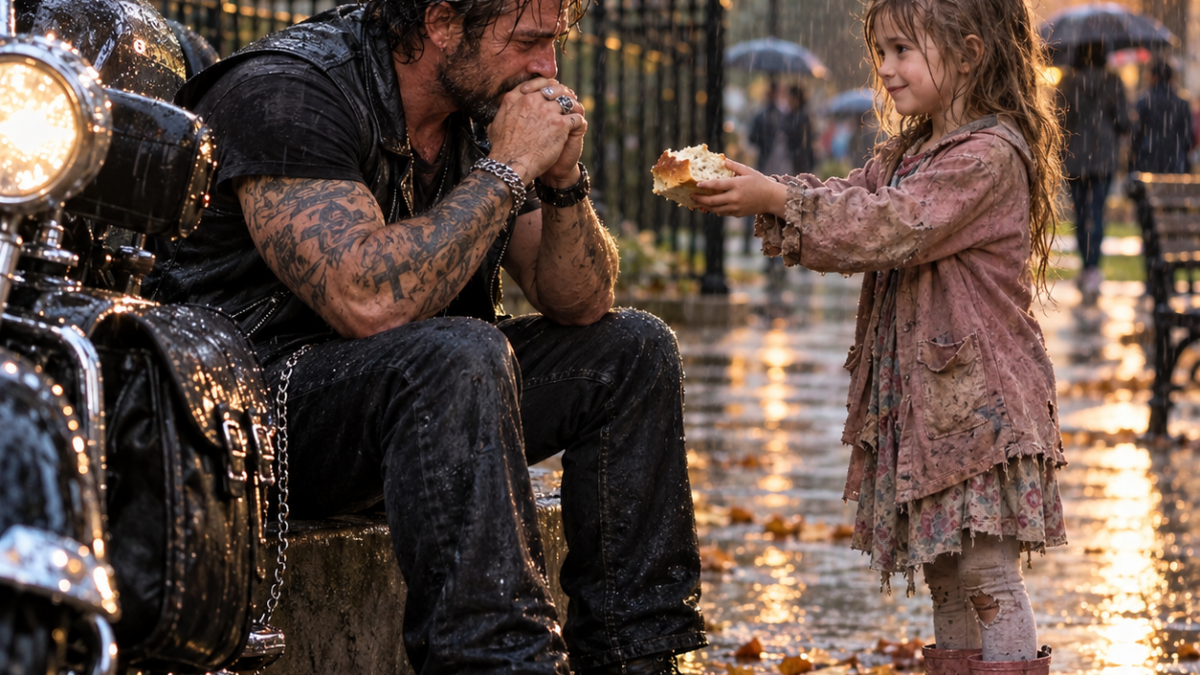
PART3:
Tears filled her eyes.
“Because I’m waiting for someone.”
“Who?”
She hesitated, then looked around the street as if she was afraid someone might hear.
That was when I saw the fear beneath the hunger.
Emily reached under the sweater, beneath my jacket now, and pulled out a small plastic bag tied with string. She handled it carefully, like it held treasure. Inside was a photograph, folded twice and protected from the rain.
She untied the string and handed it to me.
The moment I opened it, my fingers began to tremble.
Emily stood in the picture beside another child.
A boy.
He was thinner than I remembered. Older. His hair longer. His smile cautious, like he had learned to use it sparingly. But there are things a father knows before the mind can argue.
The tilt of his head.
The crease near his left eye.
The shape of his mouth.
Lucas.
My son.
The street vanished around me.
The rain, the headlights, the noise, the cold, all of it fell away.
There was only that photograph and my boy staring back from it.
“Emily,” I whispered, barely able to breathe. “Where did you get this?”
“He gave it to me.”
My heart slammed against my ribs.
“When?”
She looked past my shoulder toward the crowded street.
Then she said one word.
“Yesterday.”
For one second, I thought I might collapse right there onto the wet pavement.
Yesterday.
Not a year ago.
Not a faded memory.
Not a maybe from some stranger who wanted reward money.
Yesterday.
Lucas had been here.
In Chicago.
Close enough to meet this child.
Close enough to place a photograph in her pocket.
Close enough that the air around me suddenly felt full of him.
I grabbed the photograph with both hands like it might disappear.
“Where, Emily? Where did you see him?”
She slowly raised one arm and pointed across the street.
Through sheets of rain and the blur of headlights, I saw a narrow brick building squeezed between a laundromat and a closed bookstore. Its faded blue awning read HARBOR HOUSE COMMUNITY CENTER.
“Over there?” I asked.
Emily nodded.
“He was there yesterday.”
My first instinct was to run.
Every part of me wanted to cross the street, throw open every door in that building, and demand to know where Lucas had gone. I wanted to grab every adult by the collar and shake answers loose. I wanted action, movement, noise, anything but standing still one more second while my son’s photograph burned in my hand.
But Emily was still beside me, soaked through, shivering inside my jacket.
For the first time in a year, I forced myself not to chase blindly.
I looked down at her.
“Emily, did Lucas tell you he was coming back?”
“He said he would try.”
“Try?”
She nodded.
“He said somebody was watching where he went.”
The words landed hard.
“Who was watching him?”
“I don’t know.”
There was no drama in her voice. No adult understanding of danger. Only the solemn uncertainty of a child repeating words she had not fully understood.
I looked at the photograph again.
Lucas stood beside Emily in front of a painted wall covered in paper stars. His smile was small and cautious, but it was his smile.
He was alive.
For one full year, I had fallen asleep wondering whether I would ever know that much.
Now I did.
And strangely, instead of relief, the ground beneath my life seemed to shift.
Because if Lucas was alive, close, and leaving clues, then he was not simply gone.
He was hiding.
Or being hidden.
“Come on,” I told Emily. “We’re going inside together.”
This time, she did not pull away.
Harbor House smelled like coffee, wet coats, tomato soup, and old radiator heat. The front room was warm and bright. Shelves of donated books lined one wall. Another held board games, canned food, folded winter coats, and a row of children’s boots in mismatched sizes. A bulletin board near the entrance advertised free meals, legal aid clinics, grief counseling, job readiness workshops, and a holiday coat drive.
The second we stepped inside, a woman in her late fifties rushed from behind a desk.
“Emily!”
The little girl’s shoulders relaxed so completely I nearly staggered.
The woman wrapped a blanket around her before looking at me.
“Where did you find her?”
“Outside,” I said.
Her face tightened.
“Emily, honey, we’ve been looking everywhere.”
“I was waiting.”
“For Daniel?”
Emily shook her head.
“For Lucas.”
The woman’s gaze snapped toward me.
That was enough.
“You know that name,” I said.
She looked at the photograph in my hand, then at my face.
“Who are you?”
“My name is Jack Ross.”
Her expression changed.
Not dramatically. No gasp. No step backward. Just sudden stillness, like someone had heard a glass break in another room.
“I’m Lucas Ross’s father.”
For several seconds, the only sound was rain tapping the windows.
The woman looked toward Emily.
“Sweetheart, would you go into the kitchen with Ms. Patel? I think there’s hot chocolate.”
Emily looked uncertain.
I crouched beside her.
“I’m not leaving.”
“You promise?”
“I promise.”
She studied me with that serious expression children use when deciding whether an adult deserves belief.
Then she nodded.
Before leaving, she whispered, “He said his dad fixes motorcycles.”
I could barely speak.
“He remembered that?”
“He said you could make any motorcycle sound better.”
A laugh escaped me, broken and wet with grief.
“That sounds like him.”
Emily followed a volunteer into the kitchen.
The woman motioned toward a small office.
“My name is Margaret Hale,” she said. “I run Harbor House.”
I followed her inside.
Before she closed the door, I asked, “Where is my son?”
“I don’t know.”
My hope stumbled.
“You reacted when I said my name.”
“Because Lucas told me about you.”
“When?”
“Yesterday.”
I had imagined this moment for a year.
Finding someone who had spoken to Lucas. Someone who could tell me what he looked like, what he sounded like, whether he was frightened, whether he still remembered me.
Now that I had her in front of me, I had too many questions and could not decide which one mattered most.
Margaret pulled out a chair.
“You should sit down.”
“I’ve spent a year sitting in police stations and lawyers’ offices. Please just tell me what happened.”
She nodded, accepting that.
“Lucas came here yesterday afternoon with a woman.”
“My ex-wife?”
“I don’t think so.”
My chest tightened.
“What did she look like?”
“Mid-sixties perhaps. Gray hair. Green coat. Very polite. Lucas called her Aunt Claire.”
The name meant nothing to me.
“Lucas doesn’t have an Aunt Claire.”
“At least, not one you know?”
“I know his family.”
Margaret gave me a thoughtful look.
“Do you know your ex-wife’s entire family?”
That stopped me.
Rebecca rarely spoke about her relatives. Her parents had died before Lucas was born. Or so she told me. She had once mentioned an older sister who left home when they were teenagers, but whenever I asked questions, Rebecca changed the subject. I had assumed the relationship had simply ended.
Maybe I had assumed too much.
“What exactly did Lucas say?”
Margaret folded her hands on the desk.
“The woman came here asking about temporary housing resources. She said they were traveling and their arrangements had fallen through.”
“Traveling from where?”
“She didn’t say.”
“And you didn’t call the police?”
“There was no obvious reason to. Lucas appeared healthy. Tired, perhaps, but healthy. He wasn’t asking for help. The woman was attentive to him. Nothing about the situation immediately suggested danger.”
I hated hearing it.
I understood it too.
To everyone else, Lucas was simply a boy with an older relative.
Only I knew an entire city had been looking for him.
“Then how did Emily meet him?”
“Emily has been coming here with her mother for several weeks.”
I frowned.
“She told me her mother was gone.”
Margaret’s face softened.
“She is, temporarily. Emily’s mother, Sara, is recovering from surgery at a county rehabilitation facility. Emily has been staying with a family friend named Daniel. There was confusion this afternoon about who was picking her up. She slipped outside while staff were trying to reach him.”
Relief moved through me.
Emily was not alone in the world.
Not truly abandoned.
She was a frightened child caught between adults doing their best and a system complicated enough to make her believe gone meant forever.
“Why did she say she doesn’t know her father?”
“She doesn’t. Sara raised her alone.”
I looked through the office window toward the kitchen.
Emily sat wrapped in a blanket, both hands around a mug. For a moment, I remembered Lucas at seven, sitting at my kitchen counter swinging his legs while I made pancakes too large for the pan.
“How long was Lucas here?”
“About two hours.”
“Why?”
“Claire was making phone calls. Lucas joined an art activity with the other children. He and Emily started talking.”
Margaret hesitated.
“What?”
“There’s something you should know.”
My pulse quickened.
“Lucas asked me whether we had a phone he could use privately.”
I stood straighter.
“Did he call me?”
“No.”
“Who did he call?”
“I don’t know. He dialed the number himself. No one answered.”
“Did he leave a message?”
“Yes.”
“What did he say?”
Margaret thought carefully.
“Something like, ‘Tell him I remember the lake.’”
The room narrowed around me.
“The lake?”
“Yes.”
I reached for the back of the chair.
There was only one lake he could have meant.
Not Lake Michigan.
A small lake in Wisconsin where my father had taken me when I was a boy. Years later, I had taken Lucas there, just once. It rained almost the entire weekend. We slept inside a cabin with a leaking roof and played cards because we could not fish.
On the last morning, the sky cleared.
Lucas and I walked to the end of the dock while mist floated above the water.
He had been eight.
“Dad,” he asked, “if I ever get lost, how will you find me?”
I laughed because I thought he was joking.
“I’ll look everywhere.”
“What if everywhere is too big?”
“Then give me a clue.”
“What clue?”
I pointed across the lake.
“Something only you and I would understand.”
He thought for several seconds.
“The lake?”
“The lake.”
After that, it became our private joke. Whenever I left notes in his lunchbox, sometimes I wrote, Remember the lake.
I sat down.
Lucas had been trying to contact someone who could reach me.
“Do you know what number he called?”
Margaret looked uncomfortable.
“We normally wouldn’t give out information from our phone records.”
“He’s my son.”
“I understand.”
“I have court documents. Police reports. Anything you need.”
“I believe you.”
“Then please.”
She nodded slowly.
“I’ll check.”
She stepped into the adjoining room.
I remained there, staring at the rain.
A moment later, Emily appeared in the doorway.
“Can I come in?”
“Sure.”
She climbed into the chair opposite me.
“You found out where Lucas is?”
“Not yet.”
“Oh.”
“But you helped me more than you know.”
She took a careful sip of hot chocolate.
“Lucas said you wouldn’t stop looking.”
My eyes lifted.
“He said that?”
Emily nodded.
“He said his dad was stubborn.”
Despite everything, I smiled.
“He’s right.”
“He said it like it was good.”
That nearly undid me.
“What else did he tell you?”
She considered the question.
“He likes blueberry pancakes.”
“I know.”
“And motorcycles.”
“I know that too.”
“And he misses a dog named Pepper.”
I blinked.
Pepper belonged to Mrs. Ruiz, my neighbor. Lucas used to walk her whenever Mrs. Ruiz’s arthritis bothered her.
“He misses Pepper?”
“He said she probably forgot him.”
“She didn’t.”
Emily looked pleased.
“I told him dogs remember.”
“Good answer.”
She swung her feet under the chair, then added, “He told me not to tell the green-coat lady about the picture.”
I stared at her.
“Why?”
“I don’t know.”
“Did he say anything else?”
“He said, ‘Keep it until the right person comes.’”
My throat tightened.
“How would you know who the right person was?”
Emily gave me a look as if the answer were obvious.
“He said you had a gray beard and a motorcycle jacket with a red wing.”
I looked down at the embroidered patch on my shirt.
Ross Custom Cycles.
Red wings flanked a silver wrench.
Lucas had known exactly what he was doing.
The photograph was not an accident.
It was a message.
Margaret returned holding a piece of paper.
“The phone record shows the number.”
She handed it to me.
I recognized it immediately.
Marcus Bell.
My old friend.
My brother in every way that mattered outside blood.
Marcus had ridden beside me for almost fifteen years. He handled accounts at the garage, organized charity rides, kept the business steady when grief made me reckless, and spent countless nights helping me search for Lucas. He had been the man telling me not to give up when I no longer believed there was anywhere left to look.
“Are you sure?” I asked.
“That is the number dialed.”
I checked again.
There was no mistake.
“Did Marcus tell you Lucas called?” Margaret asked.
“No.”
My phone was in my hand before I realized I had reached for it.
Then I stopped.
Calling Marcus might give me answers.
Or it might destroy the only clue Lucas had managed to leave.
I forced myself to think.
“Can you tell me where Lucas went after leaving here?”
Margaret nodded toward the front window.
“Claire called a cab.”
“To where?”
“I don’t know, but one of our volunteers helped carry their bags outside. She might remember the company.”
Twenty minutes later, we had another piece.
Lakefront City Cab.
Margaret contacted them while I called Detective Elena Ruiz, the officer who had stayed attached to Lucas’s case long after most people would have accepted there was nothing more to do.
She answered on the second ring.
“Jack?”
“I found him.”
Silence.
Then, carefully, “Tell me what you mean.”
“Someone saw Lucas yesterday.”
I told her everything.
The photograph.
Emily.
Harbor House.
Claire.
The phone call to Marcus.
When I finished, Elena said, “Don’t call Marcus yet.”
“You think he knows something?”
“I think we don’t know what he knows.”
That distinction mattered.
Marcus was my friend.
I refused to turn suspicion into guilt simply because his number had appeared.
“What do I do?”
“Send me the photograph and the phone record. I’ll work on the cab company through official channels.”
“And I’m supposed to do nothing?”
“You’re supposed to do the hardest thing you’ve done all year.”
“What’s that?”
“Think before you run.”
I almost argued.
Then I looked through the glass toward Emily.
She was drawing at a small table, safe and warm now, her tongue caught between her teeth as she concentrated.
Maybe Elena was right.
Every failed lead over the past year had taught me the same brutal lesson.
Desperation could turn anything into an answer if you wanted badly enough.
I needed facts.
By early evening, Daniel arrived for Emily. He was a school custodian in his early thirties, soaked from the rain and close to tears when he saw her. He knelt immediately.
“I am so sorry, Em.”
“You said four.”
“I know. My phone died, and the bus stalled. I should’ve made another plan.”
Emily crossed her arms.
“I waited.”
“I know.”
He did not make excuses.
He simply held out his hand.
After a moment, Emily took it.
Before leaving, she came to me.
“Will you find Lucas?”
“I’m going to try.”
She frowned.
“He said you always find what’s broken.”
That sentence followed me all the way back to the garage.
Ross Custom Cycles was dark except for the office light.
Marcus’s truck was parked outside.
I remained on my motorcycle for several minutes, rain dripping from the awning above me, the photograph sealed inside my jacket.
Then I went in.
Marcus sat at my desk with paperwork spread around him. He looked up immediately.
“Where have you been? I called you twelve times.”
I closed the door.
“Did anyone call you yesterday?”
His expression barely changed.
But I knew Marcus.
I had watched him negotiate with suppliers, bluff through poker games, and talk nervous teenagers through their first engine rebuild.
There was a pause.
Only half a second.
But it was there.
“What kind of call?” he asked.
“A call from a boy.”
Marcus looked down.
My chest tightened.
“Marcus.”
He exhaled.
“Yes.”
The room became very still.
“You spoke to Lucas?”
“No.”
“You got a message from him?”
“Yes.”
“And you didn’t tell me?”
“I was going to.”
“When?”
“When I knew whether it was real.”
I stared at him.
“You let me spend another night believing my son could be anywhere in the country.”
“I was trying to protect you from another false lead.”
“You don’t get to decide that.”
“I know.”
His voice was quiet.
That kept me from saying something I would regret.
Marcus reached into his jacket.
“There’s more.”
He placed an envelope on the desk.
My name was written across the front.
JACK.
The handwriting belonged to Rebecca.
I recognized it instantly.
“Where did you get this?”
“It was delivered yesterday morning.”
“By who?”
“A courier. No return address.”
“Before Lucas called?”
“Yes.”
I stared at him.
“Why didn’t you give it to me?”
“Because Rebecca asked me not to.”
My hands curled.
Marcus continued before I could speak.
“She said I could give it to you only if Lucas made contact.”
“He did.”
“Yes.”
“So why wait?”
“Because there was another instruction.”
Marcus turned the envelope over.
On the back, beneath a strip of clear tape, Rebecca had written one sentence.
If Lucas remembers the lake, Jack is ready to know everything.
My hands went cold.
“Know what?”
Marcus shook his head.
“I don’t know.”
I opened the envelope.
Inside was a single key and a folded piece of paper.
No letter.
No explanation.
Only an address.
A storage facility on the northwest side.
Locker 214.
Beneath it, in Rebecca’s handwriting, were six words.
Start with what I was afraid to tell you.
I read the sentence three times.
For one year, I had believed Rebecca had simply taken Lucas from me.
Now Lucas was leaving clues.
Rebecca had prepared a key.
Marcus had waited for a phrase only my son and I understood.
And somewhere inside locker 214 was a truth my former wife had apparently hidden for years.
I looked at Marcus.
“What was Rebecca afraid to tell me?”
He shook his head again.
“I think that’s what she wants you to find out.”
Outside, the rain had finally stopped.
But standing in that quiet garage with a small metal key pressed into my palm, I realized the search for my son had just become something else.
Maybe the question was no longer only where Rebecca had taken Lucas.
Maybe I had spent an entire year searching for the wrong secret.
Detective Ruiz met me at the storage facility an hour later.
So did Marcus, though I nearly told him to stay away. I was angry enough that every time I looked at him, I saw the envelope sitting in his jacket while I stood in the rain thinking my son was gone forever. But Marcus had not run. He had not defended himself beyond that first mistake. He stood beside his truck with his hands in his pockets, face pale, waiting for whatever I decided he deserved.
Elena took the key from me.
“We do this by the book.”
“If my son is in there—”
“He’s not. We checked cameras. No child entered this facility today or yesterday.”
The disappointment was sharp but manageable.
Facts.
I needed facts.
The storage manager, awakened by police at night, looked terrified and annoyed in equal measure. He led us down a row of orange doors under buzzing fluorescent lights until we reached 214.
Elena unlocked it.
The door rolled upward with a metal rattle.
Inside was not much.
Three plastic bins.
A duffel bag.
A cardboard file box.
An old blanket I recognized from Lucas’s room.
A child’s baseball glove.
My knees nearly buckled at the sight of it.
I had bought him that glove.
He had slept with it under his pillow for a week.
Elena touched my arm.
“Jack.”
“I’m good.”
I was not.
We opened the file box first.
Inside were documents arranged in Rebecca’s precise, careful way. Birth certificates. Medical records. Copies of custody orders. Police reports I had never seen. Old photographs. Newspaper clippings from a town in Indiana. A sealed flash drive. A handwritten note addressed to me.
I unfolded it with shaking hands.
Jack,
If you are reading this, then Lucas remembered the lake and found a way to leave you a trail. That means he still trusts you. I pray that means I did one thing right.
I know you hate me.
You have every right.
I took our son and disappeared. I let you believe the worst of me. I let Lucas hurt because I was afraid of a truth I should have told you before we married.
My parents did not die when I was young.
That was the first lie.
I sat down on a plastic bin.
The words blurred, then sharpened again.
My real name before Chicago was Rebecca Vance. The man I called my father was Silas Vance. He was charming in public and monstrous at home. My older sister, Claire, ran when I was sixteen. I stayed because I was younger, scared, and because my mother was already gone by then in every way except breathing.
Silas was arrested when I was nineteen for fraud, assault, and extortion. I testified under a different name after he threatened me. I changed my identity with help from an advocate and came to Chicago. I told everyone my family was dead because it was easier than explaining they were dangerous.
Then, two months before I disappeared, Silas found me.
He had been released. He knew about Lucas.
He said if I did not give him the documents Claire had taken years ago, he would take my son and make sure the police believed you had done it.
I should have told you. I know that now.
But Jack, you were already fighting so hard for custody. You were angry at me, angry at the court, angry at the world. I was afraid you would go after Silas yourself. I was afraid he would bait you into violence. I was afraid he would use your record, your club history, your leather jacket, every prejudice people already carried against you, and turn you into the villain in our son’s story.
So I ran.
Not because I stopped believing you loved Lucas.
Because I was a coward in the shape of a mother.
The page shook in my hands.
I wanted to be furious.
I was furious.
But under the fury was something worse.
Understanding.
Not forgiveness.
Not yet.
But understanding.
Marcus stood several feet away, silent.
Elena watched my face.
I continued.
Claire found us eight months ago. She had the documents Silas wanted, but she was sick and frightened. We started moving together. Silas’s people were watching shelters, bus stations, old contacts. I sent Marcus the key and instructions because I did not know who else to trust who would not charge straight into danger.
That part is on me too.
I asked too much of him.
Lucas misses you every day.
He does not know everything, but he knows enough to understand he must be careful.
If he says he remembers the lake, it means he believes he has found a safe opening.
Follow Claire if you can.
Trust Detective Ruiz.
Do not trust anyone connected to Northline Recovery Services. It is Silas’s front.
I love our son.
I am sorry that love made me choose wrong.
Rebecca.
No one spoke.
The storage facility hummed around us.
Somewhere in the distance, a door slammed.
I looked at Elena.
“Northline Recovery Services.”
She was already writing.
The flash drive contained scanned documents, videos, and photos. Elena took custody of it immediately, but not before we saw enough to know Rebecca had not invented Silas Vance.
He was real.
And worse than I wanted to imagine.
Extortion.
Debt collection.
Fraud.
Assault charges that had vanished after witnesses changed their minds.
Records of shell charities and recovery programs used to hide money and track vulnerable people.
One file was labeled CLAIRE’S LEDGER.
Another was labeled IF I DISAPPEAR.
In the duffel bag, we found Lucas’s old hoodie, a prepaid phone with a dead battery, a bus schedule, and a paper star from Harbor House with my son’s handwriting on the back.
Dad,
I’m trying to be brave.
Emily is nice. She was hungry but she gave me half her cookie.
I told her you fix broken things.
Remember the lake.
Lucas.
I pressed the paper to my mouth and closed my eyes.
My boy was not just alive.
He was thinking.
Planning.
Leaving crumbs through the dark.
Elena’s phone buzzed.
She stepped away, listened, asked two questions, then returned with a different expression.
“Cab company confirmed the pickup from Harbor House. Destination was a motel near Cicero Avenue.”
“Then we go.”
“Police go.”
“I’m coming.”
“Jack.”
“I’m coming.”
She looked at me for a long second.
“You stay behind the line. You do exactly what I say. You do not become the reason Lucas gets moved again.”
That shut me up.
“Understood.”
The motel looked like the kind of place people used when they did not want records and could not afford better. Two floors. Flickering sign. Ice machine broken. A long row of doors facing the parking lot. The Lakefront cab had dropped Claire and Lucas there yesterday evening.
They were gone by the time police arrived.
But they had left in a hurry.
Room 18 still smelled faintly of instant noodles and damp clothes. On the table were two paper cups, one with hot chocolate residue. A towel lay on the floor. The bedspread was wrinkled. Near the trash can, Detective Ruiz found a torn corner of a flyer from Northline Recovery Services.
On the back, in tiny pencil writing, was one word.
Pepper.
I almost smiled through the terror.
Lucas knew I would understand.
Pepper meant Mrs. Ruiz.
Not Detective Elena Ruiz. My neighbor, Carmen Ruiz. The woman whose terrier Lucas loved.
“She lives near my old house,” I said. “If he wrote Pepper, he might be trying to get home.”
Elena moved fast.
Patrol units went to my old neighborhood. Officers contacted Carmen Ruiz. She had not seen Lucas, but Pepper had barked madly at her back gate around dawn, and Carmen had found a piece of blue thread tied to the latch.
Lucas’s old hoodie had been blue.
He had been there.
Or close.
Then another call came in.
A traffic camera picked up an older green sedan registered to Claire Donnelly leaving the motel area at 6:12 that morning. It headed south, then west, then vanished near an industrial strip where several properties were connected to Northline.
Silas Vance was close.
So was Lucas.
For the first time in a year, the search had a shape.
I called Marcus from the passenger seat of Elena’s unmarked car.
He answered immediately.
“Tell me what to do.”
“Go to the garage. Pull every camera facing the street from the last two weeks. Look for a green sedan, older model, Illinois plates. Send everything to Elena.”
“I’m on it.”
“And Marcus?”
“Yeah?”
“I’m still mad.”
“I know.”
“But if Lucas left a message with you, it’s because he remembered you too.”
Marcus was quiet.
“I should have told you the second I got it.”
“Yes.”
“I’m sorry.”
“I know.”
That was all we had time for.
By midnight, the industrial strip was crawling with police.
Northline Recovery Services operated out of a brick building that used to be a medical supply warehouse. Publicly, it offered transitional support, employment placement, and housing referrals. Privately, according to Rebecca’s files, it was a collection point for people Silas could exploit—addicts in recovery, women fleeing violence, undocumented workers, anyone desperate enough to accept help without asking who owned the door.
Elena secured a warrant fast because Rebecca’s evidence was detailed and because Harbor House had confirmed Claire and Lucas were being followed by someone connected to Northline.
I waited in a police vehicle two blocks away, every nerve in my body screaming.
Motorcycles began arriving quietly behind us.
Not roaring.
Not performing.
Ross Custom riders. Men from my garage. Veterans from charity rides. Fathers. Mechanics. Men who had searched alleys with me at two in the morning. Marcus had called them, but Elena had controlled where they went. They blocked streets at a distance, watched exits, and reported movement. No hero nonsense. No vigilante mistakes.
For once, everyone listened.
At 12:48 a.m., officers entered the Northline building.
The next six minutes were the longest of my life.
Radio chatter cracked.
“First floor clear.”
“Movement rear stairwell.”
“Female adult located.”
My heart stopped.
“Juvenile male not with her.”
I grabbed the door handle.
Elena’s partner locked it from the front seat.
“Don’t.”
I nearly broke it anyway.
Then the radio screamed.
“Boy located! Third floor storage room! We need medical!”
Everything inside me went silent.
Not calm.
Silent.
Like the world had inhaled and refused to breathe out.
Elena’s partner turned.
“They found him.”
“Alive?”
He listened.
Then nodded.
“Alive.”
I do not remember getting out of the car.
I remember Elena appearing in front of me, gripping my jacket.
“You walk. You do not run into my scene. Do you hear me?”
I nodded.
I did not hear anything.
We moved toward the building through flashing blue lights, wet pavement, men shouting, radios crackling, and the cold metallic smell of police work after midnight.
Then I saw him.
An officer carried a boy wrapped in a gray blanket through the warehouse doors.
Thin.
Pale.
Older.
My Lucas.
For one terrible second, I could not move.
What if he did not want me?
What if Rebecca had told him things?
What if a year had changed him beyond my reach?
Then Lucas lifted his head.
His eyes found mine.
“Dad?”
The word broke me.
I ran then.
Elena said something behind me, but nobody stopped me.
Lucas stumbled out of the blanket before the officer could set him down. I caught him halfway, dropping to my knees on the wet pavement, wrapping my arms around a body I had imagined holding every night for a year.
He was real.
He was shaking.
He was taller.
He smelled like dust, rain, fear, and the same shampoo Rebecca used to buy.
But he was real.
“I remembered the lake,” he sobbed into my neck.
“I know,” I choked. “I got your message.”
“I tried to call.”
“I know.”
“I didn’t know if Marcus got it.”
“He did.”
“Emily kept the picture?”
“She did. She saved us, kid.”
Lucas cried harder.
I held him so tightly I was afraid I might hurt him, but he clung just as hard.
“I thought you’d be mad,” he whispered.
“At you?”
“Mom said grown-ups mess things up when they’re scared.”
I closed my eyes.
“She was right about that.”
“I wanted to come home.”
“You are.”
“But Mom—”
His voice broke.
That was when I looked up.
Rebecca sat on the curb near an ambulance, wrists free but guarded by an officer. She looked thinner than when I had last seen her. Older. Her hair was cut short. One cheek was bruised. A paramedic cleaned blood from her temple while she stared at Lucas and me with a grief so raw I almost looked away.
Claire sat beside her, wrapped in a blanket, gray hair damp, green coat torn at the sleeve.
Silas Vance was brought out last.
Cuffed.
Bleeding from one eyebrow.
Still trying to look important.
He was smaller than I expected.
That was often the way with monsters once light hit them.
He saw me holding Lucas and smiled.
“You must be the biker.”
I stood slowly, keeping Lucas behind me.
Elena moved closer.
Silas looked me up and down.
“She really thought you’d be too stupid not to swing first.”
Every old instinct in me rose.
My fists closed.
My breath changed.
Silas wanted it.
Even cuffed, he wanted one violent moment he could point to later. A headline. A courtroom image. The angry biker attacking a restrained man. Proof that Rebecca had been right to fear what people would believe.
Lucas’s hand gripped my jacket.
That saved me.
Not Elena.
Not police.
My son’s hand.
I looked at Silas Vance and let him see that I understood exactly what he was trying to do.
Then I smiled.
Not kindly.
“No,” I said. “You don’t get to use me too.”
His smile faded.
Elena took him away.
The investigation that followed took months.
Silas Vance was charged with kidnapping, extortion, witness intimidation, fraud, and violating parole. Northline collapsed under the weight of Rebecca and Claire’s documents. Several victims came forward once the arrests became public. A city official connected to Northline resigned before he could be indicted, then got indicted anyway. The press called it a “charity fraud network,” which sounded too clean for what it had done to people.
Rebecca faced consequences too.
That was the hardest part for Lucas.
She had taken him. Hidden him. Ignored court orders. Lied to police. Even if fear explained it, fear did not erase it.
But she had also preserved evidence, protected Lucas from Silas as best she could, and ultimately left the trail that brought him home. Detective Ruiz, Margaret from Harbor House, Marcus, Claire, and I all gave statements. The court considered the abuse history, the threats, and Rebecca’s cooperation.
She did not go to prison.
She did lose custody temporarily while the case unfolded.
Lucas came home with me.
The first night, he stood in the doorway of his old room for a long time.
Nothing was exactly as he had left it because grief does strange things. I had kept the room clean but could not bear to make it a shrine. His baseball cards were still on the shelf. His model motorcycle still sat half-built on the desk. Pepper’s leash, which he had forgotten after walking her the last time, hung on the chair.
“She didn’t forget me?” he asked.
“Pepper?”
He nodded.
“Want to find out?”
Mrs. Ruiz opened her door at ten-thirty at night in a robe, took one look at Lucas, and started crying before calling for the dog.
Pepper came flying down the hall like a furry missile.
Lucas fell to the floor laughing and sobbing while the dog licked his face, barked, whined, and tried to climb inside his hoodie.
“No,” I said, wiping my eyes. “She did not forget.”
Rebuilding was harder than rescue.
People prefer the rescue part.
It is dramatic. Police lights. Doors opening. Tears. Reunions. Arrests. The moment everyone can point to and say, There. The child is safe now.
But safe is not the same as healed.
Lucas had nightmares.
He hid food in drawers for weeks.
He checked windows.
He asked where I was going even if I only stepped outside to take out trash.
Sometimes he defended Rebecca fiercely. Other times he refused to speak to her during supervised calls. He loved her. He was angry with her. He missed her. He blamed her. All of that lived inside him at once, and none of it was simple.
I learned not to simplify it.
Rebecca and I sat in a family therapist’s office three weeks after Lucas came home.
She looked at me across a room filled with soft chairs and tissue boxes.
“I thought I was protecting him,” she said.
“I know.”
“I was wrong.”
“Yes.”
“I was afraid you’d go after Silas and lose everything.”
“I might have.”
She flinched because I did not give her the easy denial.
“I might have,” I repeated. “Back then. If you’d told me he threatened Lucas, I might have done exactly what he wanted. I might have broken his jaw in a parking lot and handed him the story he needed.”
Her eyes filled.
“But you still should have told me.”
“I know.”
“You took a year.”
Her face crumpled.
“I know.”
“You took birthdays. School nights. Pancakes. Pepper. The garage. Me teaching him to ride a dirt bike like I promised when he turned ten.”
“I know.”
“You took his chance to trust both of us at the same time.”
That one broke her.
She covered her mouth and cried like someone finally hearing the full price aloud.
The therapist let silence do its work.
Then Rebecca whispered, “How do I ever make that right?”
I looked through the interior window where Lucas was in another room drawing with a counselor.
“You don’t make it right,” I said. “You tell the truth. You show up. You stop deciding alone. And you spend the rest of your life making sure fear does not get the final vote again.”
It was the first wise thing I had said in a year.
Maybe grief had taught me something after all.
Emily stayed in our lives.
There was no way around that.
A seven-year-old girl had stood in freezing rain and given me the last bread she had because she thought I was hungry. She had carried my son’s photograph like a sacred assignment. She had waited for the right man in a motorcycle jacket with a red wing.
Once Lucas was home, the first person he asked to see was her.
We went to Harbor House together.
Emily came running when she saw him.
“You found him!” she shouted at me, as if I had misplaced him behind a couch and finally checked properly.
Lucas hugged her.
I brought a bag of groceries, winter coats, and enough bread rolls to feed every child in the building twice. Emily inspected them seriously.
“You don’t have to bring that much,” she told me.
“I know.”
“Are you still sad?”
I looked at Lucas, who was helping a younger child draw a motorcycle with wings.
“Sometimes.”
“Are you hungry?”
I smiled.
“Not anymore.”
Sara, Emily’s mother, recovered from surgery and cried when I told her what her daughter had done. Daniel apologized to me three separate times for losing track of Emily that day until I finally told him one miracle was allowed to be messy.
Harbor House became part of Ross Custom’s annual charity work after that.
Not for publicity.
Not for redemption.
Because warm rooms with soup and donated coats had helped my son leave a trail home.
Marcus and I took longer.
He had been wrong to withhold the envelope after Lucas called.
I told him that.
Loudly.
More than once.
He accepted it every time.
“I thought I was protecting you,” he said.
“So did Rebecca.”
He nodded.
“That hurts more than if you hit me.”
“Good.”
“I deserved that.”
“Yes.”
Eventually, after enough time and enough hard conversations, I understood the truth.
Marcus had watched me nearly destroy myself chasing bad leads. He had pulled me out of bars, followed me through dangerous neighborhoods, stopped me from confronting people who had nothing to do with Lucas except looking slightly suspicious to a desperate father. When Rebecca’s envelope came with instructions, he chose caution because he believed caution might save me.
He was wrong.
But he was not cruel.
There is a difference.
Forgiveness came slowly.
It came the day Lucas asked if Uncle Marcus could come over because he wanted to show him the model motorcycle he had finally finished.
Marcus arrived with pizza, stood awkwardly in my doorway, and looked at me like a man waiting for sentencing.
Lucas ran past me and hugged him.
That settled more than any apology could.
Months later, the court granted me primary physical custody while Rebecca continued supervised visitation that gradually expanded as she cooperated with therapy, legal requirements, and every hard question Lucas asked. It was not the clean victory some people expected me to want.
I did not want to erase Rebecca.
Lucas loved his mother.
He had the right to love her without feeling disloyal to me.
What I wanted was truth.
Safety.
No more running.
No more secrets deciding our lives from locked rooms.
The day the judge finalized the order, Lucas and I rode—not on the Harley, not yet, but in my truck—to the small Wisconsin lake.
It was cold, but clear.
Mist hovered above the water just like it had years earlier.
Lucas stood at the end of the dock beside me, hands in his coat pockets.
For a while, neither of us spoke.
Then he said, “Every time we moved, I tried to think of clues.”
I looked at him.
“I forgot some.”
“You remembered enough.”
“I was scared if I made it too obvious, Mom would get in trouble.”
“She made mistakes.”
“She was scared.”
“Yes.”
“Were you scared?”
I laughed once, softly.
“Every day.”
He looked across the water.
“I thought maybe you’d stop looking.”
My chest tightened.
“Never.”
“But everywhere was too big.”
I swallowed hard.
“Then you gave me the lake.”
He leaned against my side.
“I didn’t know if it would work.”
“It worked.”
He nodded.
Then, after a long pause, he said, “Can we make a new clue?”
“For what?”
“In case I’m not lost but just… sad. Or mad. Or don’t know how to talk.”
I looked down at him.
“What clue?”
He thought for a moment.
“Blueberry pancakes.”
I smiled.
“All right.”
“If I say blueberry pancakes, it means I need you to listen, not fix it right away.”
That hit me in a place I had not known was still unbroken.
“You got it.”
He looked up.
“And if you say it?”
“Then I need you to know I’m trying.”
He nodded.
“Good.”
We stood there until the cold got through our coats.
Then we drove home and made pancakes for dinner.
Too many.
Too large.
Pepper got one by accident, or so Lucas claimed.
Life did not return to what it had been before.
That version was gone.
But something new grew in its place.
Lucas came back to the garage, and the men treated him like royalty badly disguised as normal behavior. Benny cried and claimed metal dust got in his eyes. Marcus taught Lucas how to organize invoices. I taught him how to listen to an engine idle and hear whether it was happy.
One afternoon, Lucas stood beside me in the service bay while I adjusted an old Triumph.
“Dad?”
“Yeah?”
“Can broken things be stronger after you fix them?”
I thought about Rebecca.
Marcus.
Emily.
Harbor House.
The storage locker.
The lake.
My own rage held back by my son’s hand on my jacket.
“Sometimes,” I said. “But not because they broke. Because someone took the time to repair them right.”
He nodded like that mattered.
Then he said, “This bike sounds wrong.”
I stared at him.
He pointed.
“Like it’s coughing.”
I listened.
The kid was right.
I laughed for the first time in what felt like years.
“Get me a wrench.”
He grinned.
“Yes, sir.”
Every year now, on the anniversary of the day Lucas came home, we do two things.
First, we go to Harbor House with bread, coats, grocery cards, and whatever else Margaret says people need more than pride. Emily is older now, still sharp-eyed, still generous, still convinced I would have starved in the rain if she had not intervened. She may be right in ways that have nothing to do with food.
Then Lucas and I ride to the lake.
At the end of the dock, we stand together and remember.
Not just the fear.
Not just the lost year.
We remember that a child left clues.
That a hungry little girl kept a photograph safe.
That a community center worker paid attention.
That a detective refused to give up.
That even when adults made terrible mistakes, truth still found cracks to shine through.
People often ask what I felt when I saw that photograph.
There is no simple answer.
Relief.
Terror.
Rage.
Hope so sharp it hurt.
For a year, I thought my son had vanished into a country too big to search.
Then a homeless-looking little girl in a soaked sweater offered me her last piece of bread and handed me proof that Lucas was alive.
She thought I was hungry.
She was right.
Not for bread.
For my son’s voice.
For the weight of him in my arms.
For the chance to be a father again.
For the truth.
I have learned that hunger comes in many forms.
A child can be hungry for food.
A father can be hungry for answers.
A mother can be hungry for safety and make a terrible choice trying to feed that fear.
A lonely person can be hungry for one adult who keeps a promise.
Emily saw tears on a stranger’s face and did what too many grown people forget to do.
She offered what she had.
Half a piece of bread.
A photograph.
A clue.
A little kindness in the rain.
And that was enough to open the road home.
I still have the photograph.
It sits in a frame on my desk at Ross Custom Cycles. Emily and Lucas stand beneath paper stars, both of them thinner than they should have been, both of them braver than any child should need to be.
Beside it is the key to locker 214.
And below them, written in Lucas’s handwriting, are three words.
Remember the lake.
I do.
Every day.
I remember that love is not only searching.
It is listening when the clue arrives from a place you did not expect.
It is holding back your rage so your child does not have to fear what you will become.
It is telling the truth even when the truth comes late.
It is feeding the hungry, warming the cold, and believing children when they hand you impossible hope with trembling fingers.
That day in the freezing Chicago rain, Emily asked if I was crying because I was hungry too.
I could not answer then.
I can now.
Yes.
I was hungry.
Hungry for the son I thought I had lost.
Hungry for one sign that he still remembered me.
Hungry for a reason to keep standing beneath a sky that would not stop falling.
And because one little girl gave away the last bread she had, I found my way back to the boy who had never stopped leaving me clues.








