A Homeless 13-Year-Old Girl Carried a Biker’s 5-Year-Old Son Two Miles Through a Blizzard—Then 300 Motorcycles Came Up the Highway Looking for Her
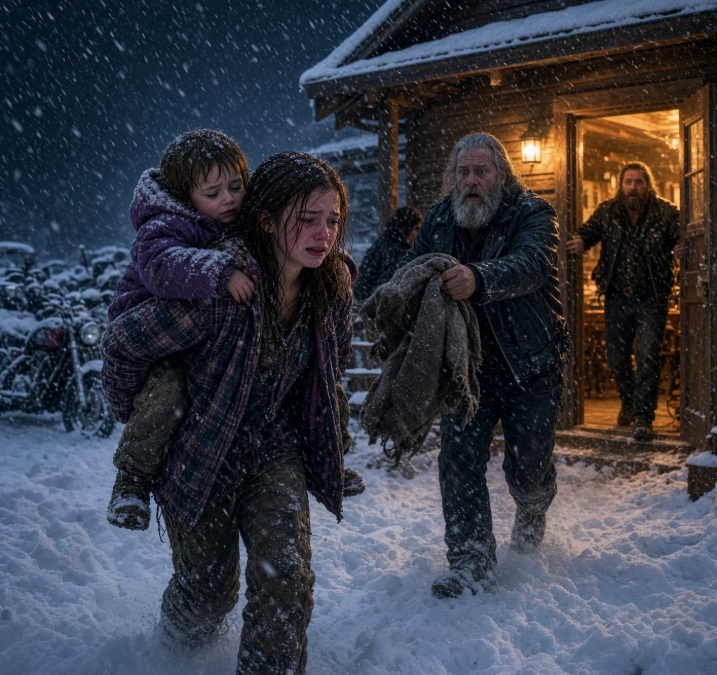
PART3:
An old camp table held their food.
Everything they owned fit inside a space smaller than most people’s bedrooms.
It had not always been that way.
Ivy remembered an apartment on Lenora Street.
A refrigerator humming at night.
A bathroom door that locked.
A chipped yellow cereal bowl with her name written on the bottom in permanent marker.
And her father.
Holden Coulter.
Smoke jumper.
Wildland firefighter.
Idiot storyteller.
Terrible singer.
Best pancake maker in Idaho, according to himself.
He used to come home smelling like pine sap, diesel, smoke, and whatever soap the base bought in bulk.
When Ivy was small, she thought every father knew the wind.
Holden did.
He could stand in an open field, wet one finger, look at treetops, and tell her what the weather intended to do before the radio caught up.
He taught her because teaching was how he loved.
“Wind tells on everything,” he once said.
She had been eight, sitting beside him on the tailgate of his truck.
“What does that mean?”
“Means fire can lie to your eyes. Clouds can lie too. But wind always tells you where the trouble wants to go.”
She had rolled her eyes.
“I’m never fighting fires.”
“Doesn’t matter.”
“Why?”
He had tapped her forehead.
“Because you’re gonna walk through a lot more than fires in your life.”
At thirteen, she hated remembering that sentence.
Because he had been right.
Holden died when she was eleven.
A wind shift.
A falling snag.
A rescue operation that turned into another rescue operation.
There were official words for what happened.
Ivy never used them.
The insurance settlement disappeared into hospital bills, old debts, and the kind of financial confusion grief creates when nobody can think straight enough to notice what is happening.
Dela fell behind on rent.
Then further.
Then lost the apartment.
They slept in a borrowed van.
Then a shelter.
Then another shelter.
Dela found work.
Lost work.
Found two jobs.
Lost one.
The van died.
Winter came.
And somehow, almost without Ivy understanding when it happened, the tent became home.
Not because Dela gave up.
That part mattered to Ivy.
Her mother had not abandoned her.
Had not chosen this.
Dela worked constantly.
She cleaned hotel rooms.
Office bathrooms.
Vacation cabins.
Sometimes private houses.
She washed other people’s floors so thoroughly they could see their reflections while her own daughter melted snow to wash her hair.
That contradiction had become the shape of their life.
Ivy checked the rabbit snares.
Empty.
Again.
“Great.”
She stood, rubbed her hands together, and began walking toward town.
Her father’s old habits guided the route.
Stay below the ridge in wind.
Avoid deep drifts.
Use trees as cover.
Never walk directly beside the highway if visibility is bad.
That morning, visibility was still decent.
But the sky bothered her.
It had the wrong color.
A gray-green heaviness pressed over the mountains.
She smelled snow before she saw any.
And underneath it, something metallic and wet.
Trouble weather.
As she came closer to the road, she heard engines.
Motorcycles.
Lots of them.
Ivy stopped at the edge of the trees.
Across Warren Wagon Road stood the Ponderosa.
Everybody in town knew the place.
Low timber building.
Tin roof.
Wide gravel lot.
String lights along the porch.
A carved wooden sign above the entrance.
It was technically a roadhouse and clubhouse.
What most people called it depended on how frightened they were of motorcycle clubs.
Some called the men there bikers.
Others whispered Hells Angels whether every rider actually wore that patch or not.
Ivy had learned something important about adult rumors.
Accuracy mattered less than fear.
Mrs. Mavis Corbett, who ran Corbett’s Grocery, said the men were criminals.
Deputy Prince called them “a pain in my paperwork.”
A teacher Ivy had once had called motorcycle clubs “complicated.”
Ivy herself had never spoken to any of them.
She knew only three things.
Their motorcycles were loud.
They tipped well at diners.
And on freezing nights, the windows of the Ponderosa glowed amber from across the road.
Warm.
That morning the parking lot was full.
More bikes than Ivy had ever seen there.
Men in leather and heavy canvas carried cardboard boxes from a trailer.
A woman with gray braids stood in the truck bed passing packages down.
Ivy watched.
At first she assumed liquor.
Then one box tore open.
Bright fabric spilled out.
Children’s coats.
Dozens of them.
New.
Still wrapped in plastic.
A biker with a beard grabbed one and stuffed it back inside.
“Elementary school gets the small sizes,” somebody yelled.
“Middle school’s got the rest!”
Ivy stared.
Coats.
They were collecting coats.
She looked down at her enormous brown sleeves.
For half a second, something hot and ugly rose in her throat.
Not anger at them.
Just the strange pain of standing close to something you needed while knowing it belonged to somebody else.
She turned away.
“Ivy Coulter.”
Her body froze.
Mavis Corbett stood beside the grocery’s delivery entrance across the street.
Ivy had not seen her come outside.
Mavis wore a thick red parka and held a flattened cardboard box against one hip.
Her narrow eyes moved from Ivy to the Ponderosa and back.
“What are you doing?”
“Walking.”
“You always seem to be walking around places where things disappear.”
Ivy’s jaw tightened.
Six months earlier, Mavis had caught her with crackers tucked under her coat.
Ivy had taken them.
She had also put them back.
Not because she suddenly became moral.
Because Mavis had grabbed her wrist and said, loud enough for two customers to hear, “I know exactly what kind of girl you are.”
The phrase never left.
What kind.
As if poverty were a species.
“I didn’t take anything.”
“Didn’t say you did.”
“You meant it.”
Mavis’s expression hardened.
“You in school?”
Ivy looked away.
That was another dangerous question.
Dela had tried homeschooling paperwork after they lost their address.
Then school attendance became inconsistent.
Then complicated.
Ivy still read.
Still worked through old math books.
But complicated was another adult word that usually meant somebody could take control of your life.
“I asked you something.”
“And I didn’t answer.”
Mavis took a step toward her.
“You watch that mouth.”
Ivy gave her a flat look.
Mavis’s eyes dropped to the coat.
“Where’d you get that?”
“Church.”
“Which church?”
Ivy laughed once.
“Why? You gonna call them and check?”
Mavis flushed.
“I’m trying to help you.”
“No, you’re not.”
The words escaped before Ivy could stop them.
For a second, Mavis looked genuinely surprised.
Then offended.
“You think you know so much.”
“I know what helping looks like.”
“And?”
Ivy glanced toward the Ponderosa, where rough-looking men were loading children’s coats into trucks.
“It doesn’t usually sound like this.”
She walked away before Mavis could answer.
That moment would return to both of them later.
For very different reasons.
By noon, the temperature had dropped almost fifteen degrees.
By one, snow began.
By two, the ridge disappeared.
Inside the Ponderosa, Everett Broom stood at the window watching the storm arrive.
He was sixty-eight.
Gray beard.
Broad shoulders.
Quiet eyes.
People assumed he was intimidating because of the leather vest and old patches.
People who knew him understood the silence was the more dangerous part.
Everett rarely spoke without deciding first whether words improved anything.
He had been with the club for more than forty years.
Road captain once.
Chapter president for a time.
Now mostly the man everybody looked at when plans fell apart.
Behind him, chaos filled the room.
Boxes of coats.
Coffee.
Weather radios.
Motorcycle gear.
People arguing over whether the charity run should be postponed.
Deputy Odell Prince entered stamping snow from his boots.
“Pass closes at six.”
Nobody answered.
“I’m serious.”
A biker named Griffin Pace looked over from behind the bar.
“You’re always serious.”
“That’s why they gave me the shiny badge.”
Griffin snorted.
Deputy Prince pointed toward the windows.
“Storm accelerated. County’s pulling plows off the summit road at five-thirty if visibility keeps dropping.”
Everett nodded.
“We take trucks.”
“That’d be smarter.”
“Didn’t ask.”
Prince sighed.
This was his relationship with Everett.
Mutual irritation wrapped around mutual respect.
Across the room, Everett’s son Rowan tried to stack boxes while keeping one eye on his five-year-old son.
Levi.
Small.
Loud.
Endless energy.
Levi wore one of the donated coats—a ridiculous purple puffer jacket at least three sizes too large—and ran behind Diesel, the club’s aging yellow mutt.
“Levi,” Rowan called.
The boy ignored him.
“Levi.”
Nothing.
“Don’t make me use your full name.”
Levi stopped.
“What is it?”
Rowan blinked.
“What?”
“My full name.”
A dozen bikers laughed.
Rowan pointed.
“Go sit beside Grandpa.”
“I’m helping Diesel.”
“Diesel doesn’t need help.”
The dog sneezed.
Levi crouched beside him.
“He said he does.”
Everett hid a smile.
Griffin looked toward the window.
“Storm ain’t that bad.”
Everett’s expression changed.
“Don’t say that.”
“What?”
“Never tell weather what it isn’t.”
Griffin rolled his eyes.
“You and the weather.”
Everett stared outside.
Snow crossed the parking lot sideways.
Something old tightened behind his ribs.
Nobody there knew the full story.
Years before the club, before Idaho, before gray hair and grandchildren, Everett had been an Army medic.
Cold-weather training.
Search operations.
Places with names he rarely said.
Once, long ago, he had watched a young soldier insist he could walk another half mile.
The man stopped shivering ten minutes later.
Everett had never forgotten what that meant.
He checked the sky because memory had taught him that nature did not care how experienced you believed yourself to be.
“Get the kids inside,” he said.
Griffin glanced at Levi.
“He is inside.”
“I mean keep them inside.”
Rowan nodded.
But storms create confusion.
Boxes had to be reloaded.
Motorcycles secured.
Trucks moved.
Doors opened.
People shouted.
At 3:17 p.m., a tailgate slammed.
Diesel panicked.
The old dog bolted through a temporary gap beside the fence.
Straight into the snow.
Levi saw him.
“Diesel!”
Nobody heard.
The boy ran after the dog.
Purple coat disappearing beyond the tree line.
Ninety seconds later, Rowan looked around.
“Where’s Levi?”
Nobody answered.
His voice rose.
“Where is Levi?”
Everett turned.
The room changed.
Instantly.
Levi’s purple coat was nowhere.
Rowan ran outside.
“LEVI!”
Wind swallowed the name.
Diesel’s paw prints crossed the fresh snow near the fence.
Beside them were small boot prints.
Everett went pale.
“No.”
Rowan saw them.
“Oh God.”
Then every person moved.
This was not the chaotic panic strangers expected from bikers.
It was organized.
Fast.
Radios.
Flashlights.
Search lines.
Vehicles positioned along the road.
Deputy Prince called dispatch.
Rowan ran toward the trees.
Everett caught his arm.
“Grid.”
“That’s my son.”
“I know.”
“Let go of me.”
“You run blind, we lose you too.”
Rowan ripped free.
“I said that is my son!”
Everett stepped directly in front of him.
“And that is my grandson.”
Their eyes locked.
Everett’s voice dropped.
“So you will listen.”
Rowan’s breath shook.
Then he nodded.
The search began.
At first, they found prints.
Then drifting snow erased them.
At 3:45, visibility fell below one hundred yards.
At four, below fifty.
Wind screamed between the pines.
Men who had ridden motorcycles through hail, desert heat, mountain rain, and midnight black ice began losing sight of one another twenty feet apart.
Deputy Prince radioed state search-and-rescue.
Response delayed.
Road conditions.
Another vehicle accident south of Cascade.
The words felt obscene.
Delayed.
A child was outside.
How could help be delayed?
Rowan kept calling.
“LEVI!”
Everett walked beside him.
“Listen between calls.”
“For what?”
“Dog.”
They stopped.
Nothing.
Only wind.
Then a branch cracked somewhere unseen.
Rowan started moving again.
By 4:20, Everett made the decision everybody hated him for.
“Back to the perimeter.”
Rowan stared.
“No.”
“We regroup.”
“No.”
“Visibility’s gone.”
“My son is out there.”
“I know.”
“You want me to stand by a fence?”
“I want you alive when we find him.”
Rowan shoved him.
Several heads turned.
Everett didn’t move.
“You don’t stop looking for your grandson.”
“I’m not.”
“You’re quitting.”
Everett’s face changed.
Pain.
Brief.
Ancient.
“No.”
He stepped closer.
“I am refusing to lose two people instead of one.”
The word two landed strangely.
Rowan stopped.
Everett rarely mentioned his military years.
Never mentioned the dead.
Now something in his eyes told Rowan he was not talking only about Levi.
Deputy Prince approached.
“He’s right.”
Rowan rounded on him.
“Don’t.”
“I’ve got search teams coming.”
“When?”
No answer.
“When?”
“Soon as roads allow.”
Rowan laughed bitterly.
“The roads.”
His knees nearly buckled.
Everett grabbed him.
For the first time in decades, father and son held one another in public without embarrassment.
“I should’ve watched him.”
Rowan’s voice broke.
“I should’ve—”
“No.”
“I was right there.”
“No.”
“He’s five.”
“I know.”
“I looked away.”
Everett tightened his grip.
“We find him first.”
Then, quieter:
“You punish yourself later if you still need to.”
Two miles away, Ivy Coulter stood outside her tent and heard the storm change.
She had returned before the worst of it.
Dela had left for an evening cleaning shift despite Ivy begging her not to.
“I need the hours.”
“You’ll get stuck.”
“I’ll get a ride.”
“The road’s getting bad.”
“We need kerosene.”
“We have wood.”
“We need food too.”
Dela had kissed her forehead.
“I’ll be back.”
Ivy hated that sentence.
I’ll be back.
Her father had said it before the final fire assignment.
She never told Dela that.
Now Ivy carried kindling from the covered stack toward the tent.
The wind suddenly dropped.
Not stopped.
Dropped.
A hollow pause.
The forest inhaled.
Holden’s voice returned in memory.
When wind goes quiet before it isn’t quiet anymore, pay attention.
Ivy froze.
Then she heard it.
Bark.
Faint.
Three short barks.
She turned.
Nothing.
“Diesel?”
She didn’t know the dog’s name yet.
Another bark.
Weak.
Somewhere northeast.
The sensible thing was to go inside.
A thirteen-year-old homeless girl had no business walking into a whiteout looking for a strange dog.
Her mother would panic if she returned and Ivy was gone.
Authorities might find the camp.
She might freeze.
All true.
Then the dog barked again.
And Ivy moved.
She took a rope.
Flashlight.
Wool mittens.
Her father’s old compass.
Then entered the trees.
“Come on,” she muttered.
“Bark again.”
Nothing.
She walked.
Wind returned harder.
Snow stung her face.
“Come on.”
A bark.
Closer.
She changed direction.
Her flashlight caught trees, blowing powder, then yellow fur.
The dog lay in a hollow beneath a fallen spruce.
“Hey.”
Diesel lifted his head.
He didn’t run.
That scared her.
Dogs that still had strength usually decided whether they trusted you.
This one simply leaned toward her hands.
“Easy.”
She crouched.
“Where’d you come from?”
Then she saw the purple.
At first it looked like fabric caught under snow.
Then a boot.
A tiny boot.
Ivy crawled around the trunk.
A boy lay against the drift.
Still.
Too still.
Her whole body went cold in a way that had nothing to do with weather.
“Hey.”
She touched his shoulder.
No response.
“Hey!”
She pulled him upright.
His face was pale.
Lips bluish.
Eyes half closed.
His hands had curled inward.
Ivy put her face near his mouth.
Breathing.
Shallow.
“Okay.”
Panic tried to rise.
She shoved it down.
Her father.
Think.
Warm core.
Protect from wind.
No sudden rough movement.
Stay awake.
She shook the boy gently.
“Look at me.”
His eyelids fluttered.
“Come on.”
Nothing.
She remembered another lesson.
When somebody in the cold stops shivering, don’t celebrate.
That isn’t warm.
That’s empty.
The boy wasn’t shivering.
“Oh no.”
Ivy tore off her coat.
She wrapped it around the purple puffer.
Then pulled off her outer sweater.
Cold struck through her flannel instantly.
She wrapped the sweater around his chest.
The boy murmured.
“What?”
She leaned close.
“Diesel.”
Ivy looked at the yellow dog.
“Diesel?”
The boy’s eyes opened slightly.
“Don’t… leave him.”
“I won’t.”
“What’s your name?”
No answer.
“Hey.”
She touched his cheek.
“Your name.”
“Levi.”
“Okay, Levi.”
She forced brightness into her voice.
“I’m Ivy.”
His eyes closed.
“Nope.”
She tapped his shoulder.
“No sleeping.”
“Tired.”
“Too bad.”
He made the faintest irritated sound.
Good.
Anger meant something inside still worked.
“You got parents?”
“Dad.”
“Where?”
He lifted one hand weakly and pointed in no useful direction.
“The bikers?”
His eyes opened.
“Grandpa.”
Ivy’s stomach dropped.
The Ponderosa.
He had come from there.
Nearly two miles through the trees.
She calculated.
Her camp was closer.
But it had almost no heat.
No phone.
No vehicle.
Dela wasn’t there.
The Ponderosa had adults.
Phones.
Vehicles.
Probably medical supplies.
It also had cops searching by now.
Which meant questions.
Who are you?
Where do you live?
Why are you not in school?
Where is your mother?
Once they found the tent, everything might be over.
Child services.
Shelter.
Separation.
Dela crying.
Ivy pictured her mother returning to an empty camp and police lights.
She looked at Levi.
His head sagged against her arm.
“Hey.”
No response.
“Levi.”
His eyelids twitched.
Ivy closed her eyes.
Four seconds.
That was all she allowed herself.
Then she turned around.
“Arms around my neck.”
He barely moved.
“Come on.”
She pulled him onto her back.
His weight settled across her shoulders.
He was small.
Maybe forty pounds.
Forty pounds did not sound like much.
It would become the heaviest thing Ivy had ever carried.
She tied the rope loosely around them to keep him from sliding.
“Diesel.”
The dog stood shakily.
“Follow.”
Ivy faced the storm.
Then started walking.
The first hundred yards were manageable.
She knew the land.
The drainage ditch.
The fence line.
The slight uphill rise.
She kept talking.
“Levi?”
“Mmm.”
“What’s your favorite food?”
No answer.
“Mine’s steak.”
That was a lie.
She could barely remember steak.
“Your favorite food.”
“Pancakes.”
“Good.”
She stepped over a buried branch.
“What kind?”
“Blueberry.”
“Wrong answer.”
A faint sound near her ear.
“What?”
“Chocolate chip is better.”
“No.”
“Yes.”
“Blueberry.”
“Fine.”
Her legs sank thigh-deep into a drift.
She almost fell.
Levi slipped.
She caught his knee.
“Stay with me.”
“Cold.”
“I know.”
“My feet hurt.”
Ivy swallowed.
“That’s okay.”
It wasn’t.
“Why?”
“Means you can feel them.”
She did not know whether that was medically correct.
It sounded hopeful.
She needed hope more than accuracy.
Wind pushed her sideways.
She corrected.
Her father’s compass bounced against her chest.
She could no longer see the tree line.
Straight lines are for people who can see where they’re going.
Trust the ground.
Holden’s voice again.
Ivy stopped fighting for a visual landmark.
She felt slope.
Fence.
Drainage.
Follow terrain.
Levi went quiet.
“Hey.”
Nothing.
“Levi.”
She bounced him slightly.
“Talk.”
“Tired.”
“I know.”
“Can I sleep?”
“No.”
“Why?”
“Because I said.”
“You’re not my mom.”
Despite herself, Ivy laughed.
“No.”
“Then you can’t tell me.”
“Apparently I can because I’m carrying you.”
Silence.
“Levi?”
“You’re mean.”
“Good.”
She smiled through frozen lips.
“Stay mad.”
Half a mile.
Maybe.
Her thighs burned.
No gloves now—hers were on Levi’s hands.
Her fingers ached, then gradually hurt less.
That frightened her.
She flexed them.
Keep moving.
At some point Diesel fell behind.
Ivy turned.
The dog stood ten yards back.
“Come on!”
He stared.
“Diesel!”
He moved.
Good.
She walked.
Another quarter mile.
Wind.
Snow.
Darkness.
The storm erased time.
Ivy began counting steps.
One hundred.
Stop three breaths.
Another hundred.
At one point she heard an engine.
She screamed.
“HEY!”
Nothing.
Again.
“HELP!”
Wind carried her voice away.
Levi’s weight sagged.
She checked his breath against her cheek.
Still there.
“Your dad’s waiting.”
No answer.
“He’s gonna be so mad.”
Levi whispered, “Grandpa worse.”
Ivy laughed.
“Perfect.”
Then her left foot slipped.
She went down.
Hard.
One knee vanished into snow.
Levi slid halfway off her back.
Ivy caught him.
Pain shot through her hip.
For several seconds she stayed there.
Kneeling.
Breathing.
The snow felt strangely soft.
Her body suggested an idea.
Sit.
Just sit for a minute.
Rest.
Warmth almost seemed to rise from the drift around her legs.
The thought was incredibly reasonable.
Five minutes.
Maybe two.
Her eyelids felt heavy.
Then Levi moved.
A tiny helpless shift.
His forehead hit her shoulder.
And Ivy heard her father as clearly as if he stood beside her.
You get sleepy in cold like this, kiddo, the cold isn’t getting kinder.
It’s stealing your argument.
Ivy’s eyes snapped open.
“No.”
She didn’t know whether she was speaking to herself or death.
“No.”
She forced one foot under her.
Her leg shook.
“Get up.”
She stood.
Anger saved her.
Anger at the storm.
At poverty.
At a world where a five-year-old could vanish while surrounded by adults and a thirteen-year-old could vanish every day without anybody searching.
Anger at Mavis Corbett.
At every teacher who asked for an address before asking if she was hungry.
At people who passed the hidden camp without ever knowing it existed.
At her father for dying.
At herself for missing him.
She walked faster.
“You don’t get him,” she told the storm.
Levi murmured something.
“What?”
“Who?”
“Nobody.”
“Okay.”
“Your name Ivy?”
“Yeah.”
“Like plant?”
“Yeah.”
“My teacher has ivy.”
“Fantastic.”
“It grows on wall.”
“I know.”
“It doesn’t fall.”
Her throat tightened.
“No.”
She adjusted him higher.
“It holds on.”
Far ahead, a glow appeared.
Ivy stopped.
Was it real?
Orange light.
Then gone.
Then visible again.
Porch lights.
The Ponderosa.
Her knees almost failed from relief.
“Levi.”
No answer.
“We’re close.”
Nothing.
“Levi.”
She turned her face.
Breathing.
Still.
“Don’t you dare.”
She pushed forward.
Inside the Ponderosa, 6:47 glowed red on the clock.
Rowan stood near the door.
Thirty minutes earlier, search crews had been forced back.
He looked destroyed.
Everett sat beside a radio, saying almost nothing.
Griffin stared through the fogged window.
Nobody drank.
Nobody joked.
Every sound seemed disrespectful.
Then Griffin saw movement.
A figure at the edge of the lot.
Bent forward.
Staggering.
His first reaction was irritation.
Some idiot stranded motorist.
He yanked open the door.
“Hey! You can’t—”
The porch light hit Ivy’s face.
Then the purple coat on her back.
Griffin stopped breathing.
“Jesus.”
Rowan looked.
For one heartbeat, nobody understood.
Then he screamed.
“LEVI!”
He ran.
Ivy made it three more steps.
“He’s cold.”
Rowan reached them.
“My baby.”
“Careful.”
Ivy’s voice sounded drunk from cold.
“Don’t… don’t rub his hands.”
Everett was already there.
His face changed when he saw Levi.
Training took over.
“Inside.”
Rowan lifted his son.
Levi’s head lolled.
“Dad?”
The word was barely audible.
Rowan sobbed.
“I’m here.”
Ivy smiled.
Then her legs gave out.
Griffin caught her before her head struck the porch.
“Whoa.”
“I’m fine.”
“You are absolutely not fine.”
“Dog.”
“What?”
“Diesel.”
The yellow dog appeared through snow thirty feet away.
Somebody ran for him.
Everett took control.
“Warm core first.”
Blankets appeared.
“Not hands.”
Someone reached for Levi.
Everett slapped the hand away.
“Do not rub cold extremities.”
Rowan stared at him.
Everett’s voice sharpened.
“Chest. Neck. Groin. Warm slowly.”
“How do you—”
“Later.”
Griffin wrapped Ivy in blankets.
She protested.
“Levi first.”
“He has six people.”
“I’m okay.”
“You’re blue.”
“I’m not.”
“You are.”
Deputy Prince burst through the door seconds later.
“What happened?”
Then he saw Levi.
His face drained.
“Found him.”
Rowan looked up.
“She did.”
Every eye turned to Ivy.
She hated it immediately.
Too many people.
Too much attention.
Deputy Prince approached.
“Sweetheart, what’s your name?”
She stared at him.
“Ivy.”
“Ivy what?”
She hesitated.
That hesitation changed his expression.
Not suspicion yet.
Procedure.
“Ivy Coulter.”
“Where’d you find him?”
“Near a fallen spruce.”
“How far?”
“Maybe two miles.”
“You carried him?”
She nodded.
“By yourself?”
Another nod.
Prince looked at Griffin as if seeking confirmation of something impossible.
Griffin said, “Look at her.”
Ivy shivered violently now.
Good.
She remembered enough to know shivering was better than not shivering.
Prince crouched.
“Where do you live, Ivy?”
There it was.
The question.
She looked away.
“Nearby.”
“Where?”
“Near the highway.”
“House?”
Silence.
Prince’s eyes moved to her clothes.
Flannel.
No coat.
No sweater.
Wet jeans.
He misunderstood.
“Why were you outside dressed like this?”
Griffin turned.
The same man who had looked through a window minutes earlier and assumed Ivy was some drunk wandered off the highway suddenly heard the question differently.
“She gave him her clothes.”
Prince looked back.
“What?”
“Her coat.”
Griffin pointed to Levi.
“That brown coat over the purple one? Hers.”
Ivy stared at him.
Griffin continued.
“Sweater too, looks like.”
Prince’s tone softened.
“I’m not accusing her.”
“Sounded like it.”
“I’m doing my job.”
“Do it tomorrow.”
“Griffin.”
“Kid carried another kid two miles through a blizzard.”
Griffin stepped between Ivy and the deputy without consciously deciding to.
“Whatever question you think matters more than warming her up can wait.”
Prince stood.
For a second, tension snapped through the room.
Then Everett spoke.
“He’s right.”
Everyone looked at him.
Everett knelt beside Levi.
“He’s breathing.”
Rowan clutched his son’s hand.
Everett looked at Ivy.
“And he is breathing because of her.”
The ambulance took forty minutes.
It felt like four hours.
During that time, Levi’s eyes opened.
His gaze wandered around the room.
Rowan leaned close.
“Levi?”
The boy looked past him.
Past Everett.
Toward Ivy.
She sat wrapped in blankets with a mug between shaking hands.
“Ivy.”
Everybody went quiet.
She leaned forward.
“Hey.”
“Cold.”
“I know.”
“You said… no sleep.”
“Rule changed.”
She smiled.
“You can sleep now.”
Levi lifted one hand.
Ivy reached.
His small fingers closed around hers.
Rowan watched.
Something in his face broke completely.
His son had been lost in darkness.
Terrified.
Freezing.
And for the worst stretch of his young life, the person who had become safety was a homeless girl nobody in town even knew existed.
When paramedics finally arrived, they loaded Levi first.
Then insisted Ivy go too.
“I can walk.”
One paramedic shook his head.
“No, you can’t.”
“My mom—”
“Where is she?”
“At work.”
“Phone number?”
Ivy hesitated.
“Phone’s dead.”
“Address?”
Another silence.
Deputy Prince heard.
The secret was opening.
There would be no closing it again.
Ivy stared at the Ponderosa doorway.
Three hours earlier, she had been terrified of these men.
Now Rowan stood beside the ambulance.
He removed his heavy black riding jacket.
Not his insulated winter coat.
His club leather.
He held it out.
“For when you get out.”
Ivy stared.
“I can’t take that.”
“You’re not taking it.”
He placed it over the blanket around her.
“You’re borrowing it.”
She touched the leather.
Heavy.
Warm.
“You brought me my son.”
His voice broke.
“If you asked me for every thing I own right now, I’d start unloading my pockets.”
Ivy looked away.
She couldn’t handle gratitude.
Gratitude felt too close to pity.
“I just found him.”
Rowan shook his head.
“No.”
“You carried him.”
The ambulance doors closed.
As it pulled away, half the parking lot climbed into trucks.
Everett stayed behind.
He stood on the porch beside Griffin watching red lights disappear through the storm.
After a long silence, Griffin said, “She’s homeless.”
Everett nodded.
“How’d you know?”
“No address. Clothes. The way she watches questions.”
Griffin looked toward the highway.
“What happens now?”
Everett’s jaw tightened.
“Depends whether the adults around her are smart enough not to punish a child for surviving.”
Griffin thought about the way he had opened the door.
His first assumption.
Problem.
Drunk.
Trouble.
Then he remembered Ivy collapsing under Levi’s weight.
“I thought she was somebody trying to get inside.”
Everett looked at him.
“She was.”
Griffin frowned.
Everett’s eyes returned to the road.
“Everybody’s trying to get inside somewhere.”
At Cascade Medical Center, Levi’s core temperature frightened the emergency physician.
Dr. Hannah Cole spoke quickly while nurses worked.
“Severe hypothermia.”
Rowan went white.
“Is he going to live?”
“We are doing everything correctly.”
“That isn’t what I asked.”
She looked him directly in the eye.
“He has a very good chance.”
“Very good?”
“If that girl found him twenty minutes later, this conversation would be different.”
Rowan sat down.
His face disappeared into his hands.
Everett had arrived twenty minutes behind the ambulance.
He placed one hand on his son’s shoulder.
Neither spoke.
Across the hall, Ivy resisted everybody.
“I don’t need a room.”
“You have frostbite.”
“My fingers just feel weird.”
“That is exactly why you need a room.”
“I can’t pay.”
Nurse Priscilla Lund stopped.
There it was.
Not I don’t want treatment.
I can’t pay.
“You’re thirteen.”
Ivy looked suspicious.
“So?”
“So billing is not tonight’s emergency.”
“It will be somebody’s.”
Priscilla studied her.
“Who taught you to talk like that?”
“My mom.”
“Your mother sounds practical.”
“She is.”
“Where is she?”
“Working.”
“We need to reach her.”
Ivy’s jaw tightened.
Priscilla did not push immediately.
She brought warm broth.
Ivy stared at it.
“For me?”
“Yes.”
“Why?”
Priscilla smiled.
“Because soup is generally more useful inside patients than outside them.”
Ivy took one sip.
Then another.
Then drank too quickly.
Priscilla gently lowered the cup.
“Slow.”
“I’m fine.”
“I’m noticing a theme.”
An hour later, Dela arrived.
Somebody from the motel had driven her.
She entered the emergency department with snow in her hair and terror in her face.
“Ivy!”
Ivy sat up.
“Mom.”
Dela crossed the room and grabbed her daughter.
Then she pulled back.
“What happened?”
“I’m okay.”
“You’re in a hospital.”
“I’m okay.”
“Where’s your coat?”
Ivy looked toward the hallway.
“On a five-year-old.”
Dela stared.
The story came out in pieces.
Lost boy.
Snow.
Two miles.
Bikers.
Ambulance.
Dela listened.
Then slapped one hand over her mouth and began crying.
“You could have died.”
“But I didn’t.”
“You could have died.”
“He would’ve.”
“You are my child.”
“So was he.”
Dela stopped.
The room went quiet.
Ivy’s eyes filled.
“I couldn’t leave him.”
Dela folded around her.
“I know.”
Her voice broke.
“That’s what scares me.”
Later, Deputy Prince came.
He removed his hat before entering.
Dela stiffened instantly.
“Why are you here?”
“I need to ask some questions.”
“About Levi?”
“And about Ivy.”
“She saved him.”
“I know.”
“Then what questions?”
Prince looked tired.
“Where are you staying?”
Silence.
Dela’s face changed.
Ivy looked down.
The moment they had feared for two years had arrived.
Dela stood.
“My daughter almost froze saving somebody else’s child.”
“I understand.”
“You’re going to take her because we don’t have a house?”
“I didn’t say that.”
“That’s what happens.”
“Not automatically.”
Dela laughed bitterly.
“You ever been homeless, Deputy?”
“No.”
“Then don’t use words like automatically.”
Prince accepted the hit.
Fairly.
“I need to know she’s safe.”
“She is.”
“She sleeps in a tent.”
“How do you know?”
Prince glanced at Ivy.
Dela turned.
“Ivy?”
“I didn’t tell him exactly.”
“You told them enough.”
“I’m sorry.”
Dela closed her eyes.
Immediately, Ivy’s breathing changed.
“I’m sorry.”
Dela heard it.
The fear.
She opened her eyes.
“No.”
She went to Ivy.
“No, baby.”
“I shouldn’t have—”
“You carried a little boy out of a blizzard.”
“But now they know.”
“That is not your fault.”
Dela looked at the deputy.
“She hears me say sorry too much.”
Prince said nothing.
“She thinks everything that goes wrong is something she caused.”
Dela wiped her face.
“That’s my failure, not hers.”
The deputy sat.
His voice softened.
“Nobody came here tonight to separate you.”
Dela stared.
“I’ve heard that kind of thing before.”
“I can’t promise what every agency does.”
“Then don’t promise.”
“I can promise what I’m doing.”
He took out his notebook.
“I’m documenting an emergency housing situation.”
Dela blinked.
“Not neglect?”
“You work.”
“Yes.”
“You provide what you can.”
“Yes.”
“Ivy says you leave her alone sometimes when you work overnight.”
Dela’s face fell.
“I don’t have anyone.”
Prince nodded.
“That has to change.”
There it was.
Not cruelty.
Not judgment.
Truth.
Dela sat down.
“I know.”
The words came out tiny.
“I know.”
For the first time in years, she stopped defending survival long enough to admit it was not enough.
Levi spent two nights in the hospital.
Ivy spent one.
Her fingertips escaped permanent damage.
The physician called her lucky.
Ivy hated the word.
Lucky felt insulting.
Nothing about the walk felt lucky.
Before Levi left the hospital, he insisted on seeing Ivy.
Rowan brought him.
He wore pajamas and hospital socks.
Ivy sat beside the window.
Levi stopped in the doorway.
“Hey.”
She smiled.
“Hey.”
“You look different.”
“So do you.”
“You don’t have snow on you.”
“Neither do you.”
He considered this.
Then hugged her.
No warning.
His arms went around her waist.
Ivy froze.
Then slowly rested one hand on his back.
“You came back.”
She swallowed.
“I said I would.”
“You didn’t.”
“What?”
“You said we were close.”
Ivy laughed.
“I was kind of busy.”
Levi looked serious again.
“Dad said you saved me.”
Ivy glanced at Rowan.
“He says dramatic things.”
Rowan’s eyes watered.
“No.”
He stepped closer.
“I say accurate things.”
Ivy became uncomfortable.
“You all would’ve found him.”
Everett stood behind Rowan.
“No.”
Everybody turned.
He continued.
“Search had pulled back.”
His voice was steady.
“We would have gone again.”
A pause.
“But time matters in cold.”
Ivy looked down.
Everett approached.
“I have seen grown men die from less exposure than you walked through.”
Dela stiffened.
Everett noticed.
He removed his club cap.
A small gesture.
Respect.
“Ma’am.”
“Dela.”
“Everett.”
“I know.”
He almost smiled.
“Suppose people talk.”
“They do.”
He looked at Ivy.
“Your daughter is remarkable.”
Dela’s jaw trembled.
“I know.”
That answer pleased him.
No false modesty.
No lowering her child to make strangers comfortable.
Levi climbed onto Ivy’s bed.
“Can she come to my house?”
Rowan laughed through his nose.
“Buddy.”
“We have rooms.”
Ivy looked at him.
“How many?”
“Three.”
“Three bedrooms?”
Levi nodded.
Ivy stared at the floor.
Three bedrooms.
One family.
The idea felt absurd.
Dela noticed.
So did Everett.
Something passed across his expression.
A decision beginning.
Two days after the storm, Everett Broom drove to the hidden camp.
Deputy Prince gave directions only after Dela consented.
Everett went alone.
No motorcycle.
Pickup truck.
No club procession.
No spectacle.
He parked near the highway and walked the rest.
When he saw the tent, he stopped.
Blue tarp.
Coffee-can chimney.
Snow packed around the entrance.
A stack of carefully split wood.
Rabbit snares hung from nails.
Children’s books sealed inside plastic grocery bags.
He had expected poverty.
What shocked him was the order.
Everything had been maintained with precision.
This was not a chaotic camp.
It was a tiny home built by people fighting constantly against the fact that it was a tent.
Dela stood outside.
Arms crossed.
Chin lifted.
“You’re Levi’s grandfather.”
“Yes.”
“If you came to thank Ivy again, she’s not here.”
“School paperwork.”
Everett nodded.
Good.
Somebody was helping re-enroll her properly.
“I came to talk to you.”
“About?”
“Work.”
Dela frowned.
Everett continued.
“My books are a mess.”
“What?”
“Ponderosa’s finances.”
She stared.
“You rode out here to offer me bookkeeping?”
“You know bookkeeping?”
“I did payroll for a construction company before…”
She stopped.
Before Holden died.
Before everything.
Everett nodded.
“Deputy said.”
Her face sharpened.
“He told you my employment history?”
“With permission from the county outreach woman.”
Dela looked unimpressed.
“Everybody sure knows a lot about us now.”
Everett accepted that.
“Yes.”
“I don’t like it.”
“I wouldn’t either.”
That answer disarmed her slightly.
He glanced at the tent.
“I also have a travel trailer.”
“No.”
He looked back.
“I haven’t explained.”
“I don’t want charity.”
“Good.”
“Good?”
“I’m terrible at charity.”
Dela almost laughed.
Everett continued.
“Trailer needs somebody in it or pipes freeze.”
“That’s convenient.”
“I thought so.”
“You expect me to believe you just happen to have an empty heated trailer after my daughter saved your grandson?”
“No.”
He met her eyes.
“I expect you to believe I’m grateful.”
Dela looked away.
“That’s charity.”
“No.”
“Then what is it?”
Everett thought.
“A debt I know I can’t repay.”
“We don’t want people owing us.”
“Neither do I.”
“Then stop making it a debt.”
He nodded slowly.
“Fair.”
He took off his hat.
“What if I call it an offer?”
Dela didn’t answer.
“Trailer parked behind the Ponderosa for thirty days while you work my books.”
“What happens after thirty?”
“If we both hate each other, you leave with thirty days of wages.”
“And if we don’t?”
“Then you keep working.”
“The trailer?”
“We figure rent.”
She narrowed her eyes.
“You charge us.”
“Yes.”
“How much?”
“Whatever the employee trailer rate should be.”
“You don’t have an employee trailer rate.”
“No.”
“Then you’re making this up.”
“Yes.”
For the first time, Dela laughed.
It surprised her.
Everett smiled.
Then his expression became serious.
“I am not trying to rescue you.”
“Good.”
“I suspect you hate that.”
“I do.”
“I’m offering a job.”
“Why me?”
“Because I asked three people yesterday what you did before life went sideways.”
Dela flinched at the phrase but let him continue.
“Two said you were good with numbers.”
“And the third?”
“Said you’re mean when people waste money.”
Dela folded her arms tighter.
“Who said that?”
“Woman named Cheryl at the motel.”
“She’s right.”
Everett nodded.
“I need that.”
Dela looked at the camp.
Then toward the trees where Ivy had carried Levi into the storm.
“What does Ivy think?”
“Haven’t asked.”
“Then you don’t have an answer.”
Everett smiled.
“I like you.”
“Don’t.”
The trailer moved three days later.
Not because Dela stopped being proud.
Because Ivy walked inside it.
She saw a bed.
A heater.
A tiny kitchen.
A bathroom.
She turned on the faucet.
Water came out.
Hot after thirty seconds.
Ivy stood there staring.
Dela watched from the doorway.
That decided everything.
The first night, Ivy could not sleep.
The trailer was too warm.
Too quiet.
Too safe.
Rain tapped the metal roof and every instinct told her to check the tarp.
There was no tarp.
At 2:00 a.m., Dela found her sitting at the little table.
“You okay?”
“Yeah.”
“You hate it?”
“No.”
“Then what?”
Ivy stared at the heater vent.
“What if they change their minds?”
Dela sat.
“Then we deal with that.”
“What if you lose the job?”
“Then we deal with that.”
“What if—”
“Ivy.”
Her daughter stopped.
Dela reached across the table.
“I have taught you how to survive every disaster before it happens.”
Ivy stared.
“I’m sorry.”
“No.”
Dela squeezed her hand.
“I’m the one who’s sorry.”
“For what?”
“For making tomorrow your job.”
Ivy’s eyes filled.
Dela continued.
“You’re thirteen.”
“I know.”
“No.”
She smiled sadly.
“You know the number.”
“That isn’t the same thing.”
For years, Ivy had been wood gatherer.
Weather watcher.
Food stretcher.
Mother protector.
Secret keeper.
Problem solver.
Dela’s voice trembled.
“You should get to be bad at something.”
Ivy laughed through tears.
“What?”
“You should get to forget homework.”
“I do that.”
“Good.”
“Mom.”
“You should complain about dinner.”
“I already do.”
“You should waste hot water.”
“Absolutely not.”
Dela laughed.
Then cried.
Ivy moved around the table and hugged her.
They stayed there a long time.
Things did not become perfect.
That mattered.
Dela’s first week at the Ponderosa was awful.
The club’s bookkeeping really was a disaster.
Receipts in cigar boxes.
Fuel expenses mixed with charity funds.
Cash donations written on napkins.
Griffin once handed her a grocery bag full of records.
She stared at him.
“What is this?”
“December.”
“December what?”
“Everything.”
Dela closed her eyes.
“Get out.”
He smiled.
“You work here now. You can’t throw me out.”
“Watch me.”
By the end of the month, Griffin feared her more than Everett.
Ivy returned to school.
That was harder.
Kids knew the story.
Some called her Hero Girl.
She hated that.
Some asked whether the bikers bought her a house.
They had not.
Some whispered that she lived behind a biker bar.
Technically true.
One boy asked if her mother was in jail.
Ivy punched him.
That part was less ideal.
The principal suspended her for a day.
Dela did not defend the punch.
But she did ask exactly what had been said.
Then the principal called the boy’s parents.
Justice, Ivy discovered, was usually less satisfying than throwing a punch.
Levi visited constantly.
He followed Ivy everywhere.
He wanted to learn knots.
Wanted to identify wind direction.
Wanted to know whether he could become a smoke jumper.
“No,” Rowan said instantly.
Levi frowned.
“I didn’t ask you.”
“You are five.”
“I’ll get older.”
Everett nearly choked on coffee.
Diesel slept outside the trailer most afternoons.
Griffin began bringing dog treats.
At first, he left them without speaking.
One Saturday Ivy caught him.
“You don’t have to keep buying those.”
Griffin shrugged.
“Dog needs snacks.”
“He’s fat.”
“He almost died.”
“So?”
“I’m processing trauma through bacon-flavored biscuits.”
Ivy laughed.
Griffin smiled.
Then his expression turned awkward.
“I owe you an apology.”
“For dog treats?”
“For the door.”
Ivy knew immediately.
The night of the storm.
“You thought I was a drunk.”
His face tightened.
“You heard?”
“You were loud.”
“Yeah.”
He shoved both hands into his jacket pockets.
“I saw somebody coming through the snow and decided what they were before I saw their face.”
Ivy looked at him.
“You changed your mind.”
“After you carried a kid two miles.”
He shook his head.
“Shouldn’t take that.”
“What?”
“Somebody shouldn’t have to do something heroic before I decide they deserve basic respect.”
Ivy did not know what to say.
Griffin looked toward the parking lot.
“I’m trying to get better at the four seconds before I decide who somebody is.”
That stayed with her.
Because Ivy had done it too.
To bikers.
To deputies.
To social workers.
To anyone in clean clothes who asked where she lived.
Survival had made her suspicious.
Sometimes correctly.
Sometimes not.
The biggest apology came from Mavis Corbett.
She arrived on a Saturday carrying a box.
Ivy was outside helping Rowan repair a fence.
Mavis stopped twenty feet away.
“Ivy.”
Every muscle in Ivy tightened.
Mavis looked uncomfortable.
That was new.
“What?”
“I brought something.”
“Okay.”
Mavis opened the box.
Crackers.
Sleeves and sleeves of them.
The exact brand Ivy had once tried to steal.
Ivy’s expression hardened.
“Is this a joke?”
“No.”
“Then why crackers?”
Mavis’s eyes filled.
“Because I’m ashamed.”
Ivy said nothing.
Mavis set the box down.
“That day in my store, I saw a child taking food.”
“You saw a thief.”
“Yes.”
The honesty surprised Ivy.
Mavis continued.
“I told myself being hard would teach you something.”
Ivy folded her arms.
“What?”
Mavis swallowed.
“I suppose I thought it would teach you consequences.”
“It taught me not to get caught.”
Mavis flinched.
“I know that now.”
“You didn’t ask if I was hungry.”
“No.”
“You didn’t ask anything.”
“No.”
“You said you knew my kind.”
Mavis’s face crumpled.
“I remember.”
“So do I.”
“I am sorry.”
The words hung between them.
Ivy had imagined this apology before.
In the tent.
On hungry nights.
She had imagined saying something devastating.
Something that would make Mavis feel exactly as small as she had made Ivy feel.
Now that the moment existed, revenge felt strangely tiring.
“You didn’t make us homeless.”
“No.”
“You didn’t kill my dad.”
“No.”
“You didn’t make Mom lose the apartment.”
“No.”
Ivy looked at the crackers.
“But you made one bad day worse.”
Mavis cried.
“Yes.”
“That mattered.”
“I know.”
Ivy picked up one sleeve.
Then another.
“Levi likes these.”
Mavis laughed weakly.
“So did my boys.”
“You have kids?”
“Three.”
“Did they ever steal food?”
“No.”
“Then you don’t know my kind.”
Mavis nodded.
“No.”
Ivy took the box.
“But you can bring more crackers sometime.”
Mavis smiled through tears.
“I can do that.”
The story traveled.
Of course it did.
By the following weekend, it had reached Boise.
Twin Falls.
Coeur d’Alene.
Motorcycle chapters Ivy had never heard of.
The details grew.
Some versions said she carried Levi five miles.
Others said she fought off wolves.
One version included an avalanche that had never happened.
Griffin found that especially funny.
“By Tuesday you’ll have killed a bear.”
“Can I at least get a knife?”
“Probably a sword.”
Everett heard the rumors and called several chapter presidents.
His goal was to correct the exaggerations.
Instead, he accidentally organized something.
That Saturday morning, Ivy woke to engines.
One.
Then ten.
Then fifty.
Then so many the sound became physical.
The trailer windows vibrated.
Dela opened the curtain.
Her mouth fell open.
“What in God’s name?”
Ivy looked.
Motorcycles covered the access road.
Black.
Chrome.
Red.
Blue.
Riders poured up Highway 55.
Dozens.
Then hundreds.
Ivy stepped outside.
Everett stood near the Ponderosa porch.
He looked almost annoyed.
“You did this?” Ivy shouted.
“Not exactly.”
“Everett.”
“I may have told some people the truth.”
“How many?”
He looked toward the road.
“Approximately three hundred.”
Ivy stared.
Three hundred motorcycles.
Three hundred riders.
Some wore Hells Angels colors.
Others belonged to affiliated or friendly clubs.
Veterans.
Mechanics.
Truck drivers.
Nurses.
Construction workers.
Women with braids and leather.
Old men with gray beards.
Young riders barely past twenty.
They arrived carrying lumber.
Groceries.
Insulation.
Tools.
Gift cards.
Boots.
One hauled a replacement generator.
Another brought a stack of school supplies.
A contractor inspected the trailer skirting.
A plumber fixed a pipe Everett had been ignoring.
Someone installed better steps.
Ivy stood frozen.
She felt exposed.
Too seen.
Then Levi ran through the crowd.
“Ivy!”
He slammed into her.
She caught him.
“What is this?”
“Grandpa said everybody came because of you.”
Everett heard.
“No.”
He approached.
“They came because they heard what happened.”
“Same thing.”
“No.”
He lowered his voice.
“Be careful with that.”
“With what?”
“Thinking people are here to worship you.”
“I don’t.”
“Good.”
He gestured toward the riders.
“They’re here because sometimes people need to be reminded what they claim to believe.”
Ivy frowned.
Everett continued.
“A lot of men wear patches about loyalty.”
He looked at Levi.
“You showed them loyalty without wearing anything.”
Ivy’s face warmed.
Everett smiled slightly.
“Made some of us uncomfortable.”
By noon, the trailer yard looked like a construction site.
By afternoon, it looked like a family reunion nobody had expected.
Dela cooked chili in enormous pots with women from two clubs.
Griffin burned cornbread and blamed the oven.
Deputy Prince arrived off duty.
Nobody arrested him.
Mavis brought more crackers.
Levi followed Ivy relentlessly.
At one point he asked:
“Are you my sister now?”
Ivy almost dropped the box she carried.
“What?”
“You saved me.”
“That does not make people siblings.”
“Why?”
“Because that isn’t how families work.”
Levi considered.
“Grandpa says family is who shows up.”
Everett, ten feet away, suddenly became deeply interested in a toolbox.
Ivy looked at Levi.
He waited.
“Something like a sister.”
His face lit.
“Okay.”
“Don’t make it weird.”
“I’m telling everybody.”
“Levi.”
He ran.
“I HAVE A SISTER!”
Ivy closed her eyes.
Griffin laughed so hard he nearly fell off the porch.
Late afternoon, many riders began leaving.
The sun finally broke through.
Golden light spread across snow.
Payette Lake in the distance looked like hammered metal.
Ivy sat on the trailer steps.
Diesel’s head rested in her lap.
Griffin sat beside her.
For a while, they watched motorcycles pull away.
“Three hundred,” Ivy said.
“Give or take.”
“That’s stupid.”
“Very.”
“All because I carried one kid.”
Griffin shook his head.
“No.”
“What then?”
“Because people found out a thirteen-year-old lived in a tent three hundred yards from a highway everybody drives.”
Ivy looked at him.
He continued.
“And none of us knew.”
“That’s not their fault.”
“No.”
He scratched Diesel behind one ear.
“But once people know, what they do next is their fault.”
Ivy looked toward Dela.
Her mother stood laughing with Linda, one of the women from the Boise chapter.
She looked younger.
Not because life had suddenly become easy.
Because for once she was not carrying everything alone.
Griffin nudged Ivy’s boot.
“Those don’t fit.”
“They’re fine.”
“They’re two sizes big.”
“They’re warm.”
“I’ll bring boots Tuesday.”
“I don’t need—”
“What size?”
“Griffin.”
“What size?”
She sighed.
“Seven.”
He took out a pen.
Wrote 7 on his hand.
Ivy stared.
“You could remember one number.”
“Absolutely not.”
“Why?”
“I’m old.”
“You’re thirty-four.”
“Ancient.”
She laughed.
It was such a small moment.
Boot size.
Pen on skin.
Promise for Tuesday.
But years later, when people asked Ivy when she finally believed the help might last, she never said three hundred motorcycles.
She never said the trailer.
She never said the hospital.
She said:
“When a man asked my shoe size and told me what day he’d come back.”
Because survival had taught Ivy something people with stable homes rarely understood.
Grand gestures could happen once.
A news camera could show up once.
A stranger could hand you money once.
A person who came back Tuesday was different.
Tuesday meant memory.
Tuesday meant intention.
Tuesday meant you still mattered after the dramatic part ended.
Griffin came Tuesday.
With snow boots.
Size seven.
He also brought socks.
Ivy complained.
She wore them anyway.
Spring arrived.
Then summer.
Dela kept the bookkeeping job.
Within six months, she knew the Ponderosa’s finances better than Everett did.
Within a year, she had enough saved for a modest apartment.
She hesitated before moving.
The trailer had become safe.
Ivy had friends nearby.
Levi would hate them leaving.
Everett solved it the way he solved most emotional problems.
Poorly but effectively.
“You’re moving seven minutes away.”
Dela blinked.
“Yes.”
“Why are we acting like Canada?”
She laughed.
They moved.
Their new apartment had two bedrooms.
The first night, Ivy opened the refrigerator repeatedly.
Just because she could.
Dela caught her.
“What are you doing?”
“Checking something.”
“What?”
“That it’s still here.”
Dela stared.
Then crossed the kitchen and hugged her.
They both cried.
The second night, it rained.
Ivy woke at 2:00 a.m.
She listened for drops hitting tarp.
Instead she heard rain against a window.
She got out of bed.
Walked to Dela’s room.
Her mother was awake too.
Neither spoke.
Dela lifted the blanket.
Ivy climbed in beside her like she had when she was small.
“You hear it?” Dela whispered.
“Yeah.”
“No leaks.”
Ivy laughed quietly.
“No leaks.”
For a long time, that was enough.
Years passed.
Not quickly.
Never as neatly as stories make them sound.
Ivy grew.
Levi grew.
Diesel got slower.
Everett got grayer.
Griffin pretended his knees didn’t hurt.
Dela built a life that no longer depended on sleeping bags or borrowed shifts.
Ivy graduated high school.
At the ceremony, Dela screamed louder than anybody.
Rowan embarrassed Levi by crying.
Everett wore a button-down shirt nobody believed he owned.
Griffin arrived holding the same brown man’s coat Ivy had worn the night of the storm.
She stared.
“Where did you get that?”
“Storage.”
“I thought it was gone.”
“Rowan had it cleaned.”
Ivy touched the sleeve.
The coat was too small for the young woman she had become.
Or perhaps she had simply grown into the world around it.
Griffin handed it over.
“Figured it belongs to you.”
She held it against her chest.
For a moment she was thirteen.
Hungry.
Cold.
Terrified.
A five-year-old boy breathing against her neck.
“You okay?”
She nodded.
“Yeah.”
“Liar.”
“I’m graduating. I’m allowed one emotional breakdown.”
“Schedule it after cake.”
She laughed.
Ivy attended college on scholarships.
Studied emergency management and social work.
Everyone expected forestry.
Or medicine.
She chose something harder to explain.
When Everett asked why, she told him:
“Because disasters don’t create every problem.”
He waited.
“They reveal the problems that were already there.”
Everett nodded slowly.
“Your dad would like that.”
Ivy’s eyes filled.
“You didn’t know him.”
“No.”
“Then how do you know?”
Everett looked at her.
“Because a man who taught a little girl how to read wind gave the world somebody who carried my grandson through one.”
That was the first time Ivy let herself cry in front of him about Holden.
Everett did not hug her immediately.
He asked.
“You want one?”
She laughed through tears.
“That’s weird.”
“Good answer.”
Then she hugged him.
Dela eventually bought a small townhouse.
Nothing impressive.
Two bedrooms.
Tiny yard.
Mortgage terrifying enough to make her sick.
On moving day, Everett arrived with a toolbox.
Griffin carried boxes.
Rowan brought pizza.
Levi, now a teenager, complained about everything while doing most of the heavy lifting.
Mavis Corbett arrived with crackers.
The joke had lasted for years.
That evening, Dela stood in the kitchen holding the keys.
Ivy walked in.
“You okay?”
Dela nodded.
Then shook her head.
Then laughed.
“I don’t know.”
She put the keys on the counter.
“We have a mortgage.”
“Terrifying.”
“I owe a bank more money than I’ve ever seen.”
“Very American.”
Dela laughed.
Then her eyes filled.
“Your father wanted to buy a house.”
Ivy went still.
“He used to show me listings.”
“I didn’t know.”
“He wanted a garage.”
“Of course.”
“And a backyard for you.”
Ivy looked toward the tiny patch of grass outside.
“Mom.”
Dela covered her mouth.
“I’m sorry it took so long.”
Ivy crossed the room.
“For what?”
“To give you a home.”
Ivy’s face changed.
“Don’t.”
“Ivy—”
“No.”
She took her mother’s hands.
“You gave me a home.”
Dela cried.
“No, baby. I gave you a tent.”
“You were in it.”
That broke her.
Dela collapsed against her daughter.
Ivy held her.
“You were there.”
Dela sobbed.
“I was supposed to do better.”
“You kept me alive.”
“That shouldn’t have been enough.”
“It wasn’t.”
Ivy pulled back.
“That’s why we kept going.”
Dela looked at her.
Ivy smiled through tears.
“You didn’t stop at enough.”
Outside, motorcycles arrived.
Everett’s old bike first.
Then Griffin.
Then Rowan.
Then Levi in a car because he still wasn’t old enough to ride the motorcycle he wanted.
Dela looked out the window.
“Oh God.”
Ivy laughed.
“They found our tent again.”
Years after the blizzard, people still told the story.
Most told it wrong.
They focused on the dramatic parts.
Thirteen-year-old girl.
Five-year-old boy.
Two miles.
Blizzard.
Three hundred bikers.
Those details sounded good.
What people missed were the quieter things.
A mother admitting survival was not the same as safety.
A deputy choosing help before punishment.
A biker realizing prejudice could fit inside four seconds.
A grocery-store owner showing up with crackers and shame.
A little boy asking whether rescue made somebody family.
A pair of boots arriving on Tuesday.
Ivy understood eventually that the walk through the storm had not been the hardest thing she ever did.
The harder thing was accepting help afterward.
Cold had rules.
Keep moving.
Stay awake.
Protect the core.
Trust the ground.
People were messier.
Help could become control.
Gratitude could become debt.
Pity could become humiliation.
Promises could disappear.
It took years for Ivy to believe kindness without waiting for its hidden price.
Everett never demanded repayment.
Neither did Rowan.
Neither did Griffin.
That mattered.
When Levi turned eighteen, he asked Ivy to meet him at the Ponderosa.
She arrived to find the old purple coat hanging above the fireplace.
Cleaned.
Framed.
Beside it was her brown coat.
Also framed.
Ivy stared.
“You have got to be kidding.”
Levi grinned.
“What?”
“You turned our clothes into a museum?”
“Grandpa’s idea.”
Everett raised one hand.
“I deny responsibility.”
“You paid for the frames,” Griffin said.
“Traitor.”
Ivy walked closer.
Underneath the coats was a small brass plaque.
THE NIGHT TWO KIDS REFUSED TO LET THE OTHER ONE FREEZE.
Ivy read it twice.
Then looked at Levi.
“You were unconscious for half of it.”
“I contributed emotionally.”
“You weighed forty pounds.”
“Exactly.”
She laughed.
Then noticed a second line.
No one survives alone.
Her smile faded.
Everett stood behind her.
“That okay?”
Ivy touched the edge of the frame.
“Yeah.”
Her voice shook.
“Yeah.”
Levi became a paramedic.
Nobody was surprised.
On his first winter rescue call, he phoned Ivy afterward.
“It was a guy in a truck.”
“Okay.”
“Slid off the road.”
“He okay?”
“Yeah.”
Pause.
“I heard your voice.”
Ivy smiled.
“What did I say?”
“Don’t sit down.”
She closed her eyes.
Snow.
Darkness.
His little arms around her neck.
“That was Dad’s voice first.”
“I know.”
Another pause.
“Guess it keeps moving.”
“What?”
“The stuff people teach you.”
Ivy swallowed.
“Yeah.”
“I gotta go.”
“Be safe.”
“You too.”
He hung up.
Everett died at eighty-one.
Not dramatically.
Not in a storm.
Not on a motorcycle.
In his sleep.
The funeral procession stretched nearly two miles.
Ivy noticed the distance.
Of course she did.
Two miles.
Again.
Hundreds of motorcycles rolled behind the hearse.
Dela sat beside Ivy.
Levi stood near the family.
Griffin looked suddenly old.
During the service, Rowan asked Ivy to speak.
She refused.
Then stood anyway.
She walked to the microphone.
Looked at the crowd.
Leather.
Gray hair.
Tattoos.
Uniforms.
Families.
People who had arrived from three states.
Ivy took a breath.
“When I was thirteen, Everett Broom told people I was homeless but not helpless.”
Silence.
“I hated that sentence.”
A few surprised smiles.
“I thought he was trying to make me sound strong because adults like strong homeless kids.”
The room stayed still.
“We’re easier to admire that way.”
Dela lowered her head.
Ivy continued.
“But I understand him differently now.”
She looked toward Everett’s photograph.
“He wasn’t saying I didn’t need help.”
Her voice trembled.
“He was saying needing help wasn’t the same as having nothing to offer.”
Griffin wiped his face.
Ivy smiled through tears.
“Everett understood something I was too young to understand.”
She looked at Levi.
“The night I carried Levi, everybody called me the rescuer.”
Levi’s eyes filled.
“But the years afterward, these people rescued us too.”
Dela began crying.
“Not by making us smaller.”
Ivy looked around the room.
“By making room.”
She stepped away from the microphone.
Then stopped.
“One more thing.”
A few people laughed softly.
Ivy smiled.
“He worried about weather more than any human being I ever met.”
Bigger laughter.
“And I hope wherever he is, somebody finally told him the forecast is fine.”
Even Rowan laughed through tears.
After the funeral, Levi found Ivy outside.
Snow had begun falling.
Lightly.
Nothing dangerous.
He stood beside her.
“You know what Grandpa kept?”
“What?”
Levi handed her an envelope.
Inside was an old photograph.
Ivy at thirteen.
Sitting on the trailer steps.
Diesel’s head in her lap.
Oversized boots.
Wild hair.
Suspicious eyes.
Behind her, motorcycles filled the yard.
Three hundred riders.
On the back, Everett had written something.
Ivy read it.
She thought we came because she saved one of ours.
Below it:
Truth is, she reminded us who we wanted to be.
Ivy covered her mouth.
Levi put one arm around her shoulders.
For a minute, they stood without speaking.
Then he said:
“You still my sister?”
Ivy laughed.
“You’re almost thirty.”
“That wasn’t the question.”
She leaned against him.
“Something like that.”
He smiled.
“Good.”
Years later, Ivy returned to the place where the tent had been.
The forest had changed.
Trees taller.
Fence repaired.
Highway busier.
She had to search before she found the shallow depression where their stove once sat.
Dela came with her.
So did Levi.
Griffin too, walking slower now.
Nobody talked much.
Ivy stood in the exact place where she used to wake counting breaths.
She looked toward Highway 55.
Cars passed.
Nobody slowed.
Just like before.
“It was so close,” Levi said.
Ivy nodded.
“What?”
“The road.”
He looked stunned.
“All those people driving past.”
“Yeah.”
“And nobody knew you were here.”
“No.”
Griffin shoved his hands into his coat.
“That still bothers me.”
Ivy looked at him.
“It shouldn’t.”
“Why not?”
“Because you know now.”
He frowned.
“That doesn’t change then.”
“No.”
She smiled gently.
“But then changed you.”
Griffin looked away.
Dela walked to where the tent entrance had been.
She stood there for a long time.
“I hated this place.”
Ivy joined her.
“I know.”
“I prayed every night we’d leave.”
“I know.”
Dela looked around.
“Now I almost miss it.”
“You miss us.”
Dela turned.
Ivy continued.
“You miss Dad being closer in memory.”
Tears filled Dela’s eyes.
“You were so little.”
“I didn’t feel little.”
“That’s what hurts.”
Ivy hugged her.
For several minutes, mother and daughter stood where their sleeping bags used to lie.
Then Levi called from near the trees.
“I found something.”
They approached.
Half buried beneath pine needles was a rusted metal coffee can.
The chimney.
Dela laughed.
“No way.”
Griffin pulled it free.
“Artifact.”
“Do not frame that,” Ivy warned.
Levi grinned.
“Too late.”
“Levi.”
“Purple coat, brown coat, coffee can.”
“I hate this family.”
Dela laughed so hard she had to sit on a log.
Ivy laughed too.
And suddenly the place no longer felt haunted.
It was simply ground.
Cold ground.
Old ground.
Ground they had survived.
Before leaving, Ivy stood alone for a minute.
Wind moved through the pines.
She closed her eyes.
For just a second, she could almost hear Holden.
Trust the ground.
She smiled.
“I did, Dad.”
The wind moved on.
That winter, the Ponderosa began something new.
Not a charity run exactly.
Something more practical.
Emergency weather trailers.
Temporary housing.
Fuel cards.
Hotel vouchers.
Winter gear.
They called it the Coulter-Broom Emergency Fund.
Ivy objected to her name.
Everybody ignored her.
The first person the fund helped was a twenty-year-old mother sleeping in a minivan with two children after leaving an abusive boyfriend.
The second was an elderly veteran whose furnace failed.
The third was a teenager couch-surfing after his grandmother died.
No motorcycles surrounded them.
No speeches.
No photographs.
That was Ivy’s rule.
Help should not require performance.
One freezing December night, long after the original storm had become local legend, Ivy volunteered at the Ponderosa’s winter outreach table.
A girl walked in.
Maybe fourteen.
Thin coat.
Dirty sneakers.
Eyes watching exits.
Ivy recognized the posture immediately.
The girl approached the food table but did not take anything.
“You hungry?” Ivy asked.
The girl shrugged.
“No.”
Ivy remembered herself.
“Okay.”
She picked up two sandwiches.
“I am.”
She sat.
The girl stared.
After a minute, Ivy pushed one sandwich across the table without comment.
The girl looked at it.
“Do I have to give you my name?”
“No.”
“Address?”
“No.”
“You gonna call somebody?”
“Not because you ate a sandwich.”
The girl sat.
Slowly.
She opened the wrapper.
Ate one bite.
Then much faster.
Ivy looked away deliberately.
Give dignity somewhere to stand.
Afterward, the girl whispered:
“Can I take another?”
Ivy nodded.
“As many as you need.”
The girl shoved two into her backpack.
Then paused.
“Why?”
Ivy smiled.
“Somebody once asked my shoe size.”
The girl looked confused.
“That doesn’t make any sense.”
“No.”
Ivy laughed softly.
“It probably won’t for a while.”
Outside, engines arrived.
Not three hundred.
Only six.
Levi entered in paramedic uniform after finishing a shift.
He saw Ivy.
Saw the girl.
Understood enough not to ask questions.
He went behind the counter and heated cocoa.
The girl watched him.
“You a biker?”
Levi looked offended.
“Not according to my dad.”
Ivy laughed.
“He says you need another ten thousand miles before you can call yourself one.”
“Gatekeeping.”
Levi handed the girl cocoa.
She stared at his uniform.
“You a cop?”
“Paramedic.”
“Oh.”
“Worse.”
A tiny smile.
Ivy saw it.
The first crack in fear.
The girl stayed until closing.
They found her a safe place that night.
Not because she carried anyone through a blizzard.
Not because she had earned a rescue.
Because she needed one.
That distinction became the most important lesson Ivy ever carried forward.
For years, strangers told her she deserved help because she had saved Levi.
Eventually, she began correcting them.
No.
She deserved help before that.
She deserved food the day she stole crackers.
She deserved shelter before the storm.
She deserved boots before Griffin learned her name.
She deserved school.
Safety.
Warmth.
A childhood.
So did every kid.
Heroism had only forced people to notice.
It had not created her worth.
One Christmas Eve, many years after the storm, Ivy sat at a long table inside the Ponderosa.
Dela beside her.
Griffin across from them.
Rowan complaining about something.
Levi’s little daughter running around with Diesel’s successor, a yellow mutt named Gus.
The walls were covered with photographs.
Club rides.
Coat drives.
Everett.
The framed purple coat.
The brown coat.
And near the bar, a photograph of three hundred motorcycles surrounding a trailer.
Levi’s daughter climbed into Ivy’s lap.
“Aunt Ivy?”
“Yes?”
“Daddy says you carried him in snow.”
“I did.”
“He was little?”
“Very.”
“Was he heavy?”
Ivy looked at Levi.
He narrowed his eyes.
“Choose carefully.”
She smiled.
“Extremely.”
“I was five!”
“Felt like carrying a refrigerator.”
Everybody laughed.
The little girl looked fascinated.
“Were you scared?”
The room quieted slightly.
Children ask questions adults learn not to.
Ivy thought.
“Yes.”
“Why’d you do it?”
She looked around the room.
At Dela.
At Griffin.
At Rowan.
At Levi.
At Everett’s photograph.
Then back at the child.
“Because he needed somebody.”
The girl considered.
“That’s it?”
Ivy smiled.
“That’s usually enough.”
Later that night, after dinner, snow began falling.
Big soft flakes.
Levi stepped outside.
Ivy followed.
They stood on the porch.
Same porch.
Different lifetime.
The parking lot glowed under string lights.
“You remember coming up there?” Levi asked.
He pointed toward the tree line.
“Every step.”
“I remember almost nothing.”
“Good.”
“I remember your voice.”
Ivy looked at him.
“What part?”
“You kept asking me stupid questions.”
“Those questions saved your life.”
“You said chocolate-chip pancakes were better.”
“They are.”
“Still wrong.”
She smiled.
Levi’s expression became serious.
“I spent years thinking I owed you.”
Ivy turned.
“You don’t.”
“I know.”
“When’d you figure that out?”
“Grandpa.”
Of course.
“He said if I spent my life trying to pay you back, I’d turn what you did into a transaction.”
Ivy’s throat tightened.
“That sounds like him.”
“He said the better thing was to carry somebody else when my turn came.”
Snow landed on Levi’s shoulders.
He looked toward the road.
“So I became a paramedic.”
“You could’ve picked something with better hours.”
“Probably.”
They laughed.
Then Levi turned.
“You ever think about what would’ve happened if you went inside that night?”
“Yes.”
“Me too.”
“Don’t.”
“Why?”
Ivy stared into the snow.
“Because I almost did.”
Levi waited.
“I almost stayed at the tent.”
Her voice was quiet.
“I was scared of the police finding us.”
He said nothing.
“I thought about Mom.”
Her eyes filled.
“I thought about losing everything.”
“You were thirteen.”
“I know.”
“Ivy.”
She looked at him.
“You still came.”
“Yes.”
“That’s the part that happened.”
She nodded.
He put an arm around her.
They watched the snow.
After a while, Ivy whispered:
“You know what almost stopped me halfway?”
“What?”
“I sat down.”
Levi looked at her.
“In the snow.”
“For how long?”
“Five seconds.”
His face went pale even decades later.
“I got sleepy.”
He swallowed.
“What made you get up?”
“You moved.”
“That’s it?”
“You almost slipped off my back.”
Levi laughed shakily.
“So I saved you.”
Ivy looked at him.
For years, nobody had framed it that way.
She smiled slowly.
“Yeah.”
His eyes filled.
“I guess you did.”
Levi laughed.
Then cried.
Ivy hugged him.
Two children had gone into that storm.
Everybody remembered only one being carried.
But the truth was more complicated.
Levi’s weight had kept Ivy standing.
His breathing had given her something to walk toward.
His helpless trust had dragged her out of a snowbank when her own exhausted mind wanted to sleep.
Neither had survived alone.
That was always the real story.
Not a homeless girl saving a biker’s son.
Not three hundred riders saving a homeless family.
It was people carrying one another in different directions at different times.
Sometimes literally.
Sometimes with a job.
Sometimes with an apology.
Sometimes with a hot meal.
Sometimes with a pair of boots delivered on Tuesday.
Sometimes simply by remembering to come back.
Before they went inside, Levi looked toward the framed coats through the window.
“Grandpa was right.”
“About what?”
“Family is who shows up.”
Ivy smiled.
Then shook her head.
“Not quite.”
“What?”
“Family is who keeps showing up.”
Levi thought about that.
Then nodded.
“Yeah.”
Behind them, the door opened.
Dela stuck her head out.
“You two planning to freeze yourselves for nostalgia?”
Ivy laughed.
“No, Mom.”
“Inside.”
“Yes, ma’am.”
Levi whispered, “Still scary.”
“Very.”
They went in.
Warmth hit Ivy’s face.
Voices.
Food.
Laughter.
A child chasing a dog.
Griffin complaining that somebody had moved his chair.
Rowan insisting nobody owned chairs.
Dela telling both of them to shut up.
Life.
Ordinary, noisy, imperfect life.
Ivy stopped just inside the door.
For one second, she saw herself at thirteen.
Standing outside in snow.
Levi on her back.
Too afraid to believe she belonged anywhere warm.
Then the image disappeared.
Her mother called her name.
Levi’s daughter waved.
Somebody pushed a plate toward her.
There was an empty chair at the table.
Her chair.
Ivy sat down.
Outside, snow covered the highway where three hundred motorcycles had once climbed the mountain toward a hidden tent.
Most people who passed that stretch of road today would never know what happened there.
They would never know a thirteen-year-old girl once slept beneath blue tarp among the trees.
They would never know she walked into a blizzard believing the world had already decided what someone like her was worth.
They would never know a five-year-old boy nearly died there.
Or that his tiny arms around her neck helped keep her alive too.
And they certainly would never know that the loudest part of the story—the motorcycles, the riders, the storm—was not the part Ivy remembered most clearly.
She remembered warmth.
A stranger standing between her and a deputy when questions became too much.
Her mother admitting she needed help.
Everett removing his hat before offering work.
Mavis bringing crackers.
Griffin writing the number seven on his hand.
A little boy asking if she could be his sister.
And a promise made on a Saturday that actually returned on Tuesday.
Those were the things that changed her life.
Not pity.
Not hero worship.
Not charity delivered from above.
People simply deciding that once they saw another human being struggling under too much weight, they would take hold of part of it.
Ivy had carried Levi for nearly two miles.
For years afterward, people told her that made her extraordinary.
Maybe it did.
But if you asked Ivy, she would tell you something else.
The most extraordinary thing was what happened after she finally put him down.
Someone picked her up too.
And then someone picked up her mother.
And someone else helped the next person.
And the next.
Until an act born in the middle of a blizzard became a chain that outlived the storm, the tent, the motorcycles, and even some of the people who began it.
That was Everett Broom’s real legacy.
It was Holden Coulter’s too.
It became Ivy’s.
And Levi’s.
On the wall of the Ponderosa, beneath the two old winter coats, the brass plaque remained.
Most visitors read the first line.
THE NIGHT TWO KIDS REFUSED TO LET THE OTHER ONE FREEZE.
Fewer noticed the smaller words underneath.
But Ivy always did.
Whenever she walked past, she touched one finger to them.
NO ONE SURVIVES ALONE.
Then she would look around at the people arguing, laughing, cooking, repairing motorcycles, collecting winter coats, answering emergency calls, and saving seats at crowded tables.
And she would remember a freezing night when she thought she had nowhere in the world to go.
She had been wrong.
Home had been waiting two miles away.
She just had to carry someone else through the storm to find it.








