A Half-Tailed Stray Cat Showed Up the Morning I Was Ready to Walk Away From My Life—Then a 10-Year-Old Girl Told Me Why He Had Chosen My Door
PART3:
Hair like she’d brushed it with her fingers and decided effort had limits.
She lived downstairs, I knew that much. I’d seen her before in the hallway or by the mailboxes, always moving quietly, always watching more than talking.
“Rocket?” I said.
She nodded.
“That’s what I call him.”
The cat lifted his head from the bowl.
“Because his tail looks like the end got left somewhere else,” she explained.
I laughed.
A real laugh.
First one in longer than I wanted to admit.
The girl stepped closer, careful not to scare him.
“He sleeps behind the dumpster when it rains,” she said. “Sometimes I leave him crackers, but my mom says cats aren’t supposed to eat crackers.”
“Your mom’s right.”
“Yeah.” She crouched a few feet away. “But he still eats them.”
“Most of us eat things we shouldn’t when life gets rough.”
She looked at me like she was filing that away.
“What’s your name?” I asked.
“Maya.”
“I’m Sam.”
“I know.”
That made me smile.
“Should I be concerned by that?”
She shrugged.
“My mom says you’re the quiet guy upstairs who looks like he’s always doing math in his head.”
“She said that?”
“No. I did.”
“That sounds more accurate.”
Rocket returned to the tuna.
Maya watched him with a seriousness that didn’t belong on a child’s face.
“People say he’s ugly.”
Rocket glanced up like he had heard worse.
Maya’s voice got softer.
“I don’t think he is.”
“Me neither.”
“He’s just… missing some pieces.”
I looked at her.
Kids have a way of saying simple things that open doors adults spend years trying to keep shut.
Maya scratched the step with one sneaker.
“I think he comes here because he knows you’re sad.”
I almost told her she was wrong.
Reflex.
Adult pride.
The ridiculous desire to protect your image in front of a ten-year-old who probably already sees through you.
Instead I asked, “Why do you say that?”
She shrugged.
“Because he only sits by sad people.”
I looked at Rocket.
“He used to sit by Mr. Lenny before the ambulance came,” Maya added.
I didn’t know what to do with that.
So I nodded like it hadn’t just landed somewhere tender.
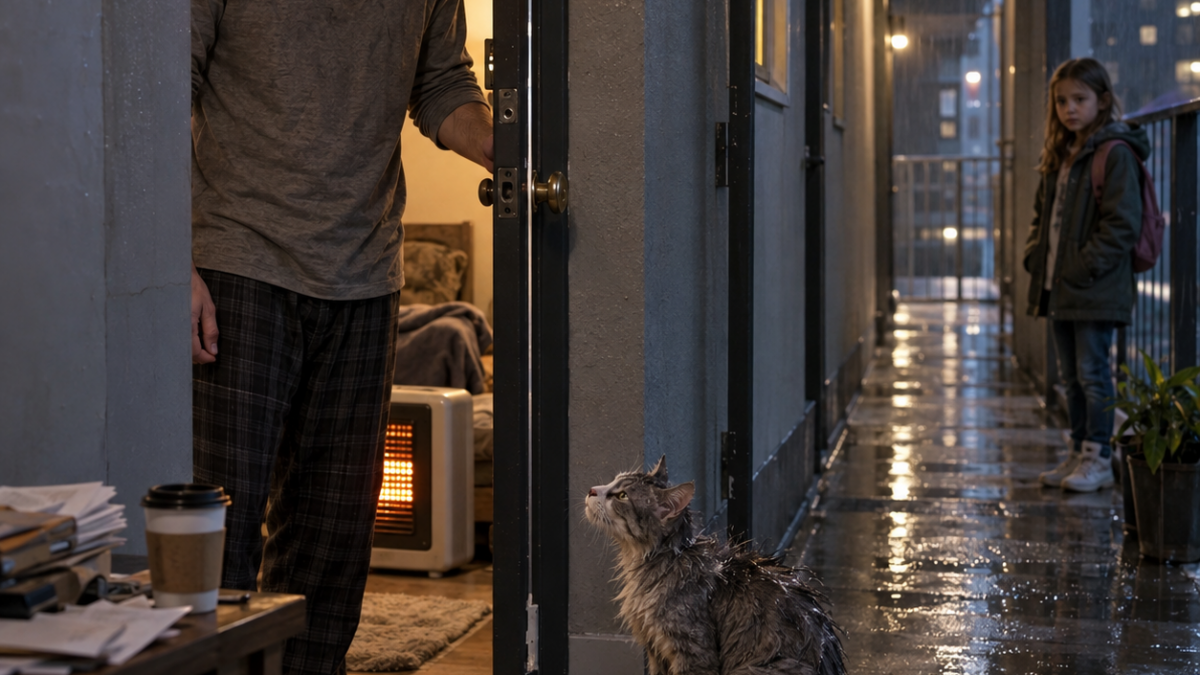
That night, it rained hard.
Not a clean summer rain, but a cold spring rain that slapped the windows and made the whole building smell like wet carpet and old concrete. I told myself I was only checking outside because I didn’t want the cereal bowl stolen.
That was a lie.
I opened the door.
Rocket was curled against it.
Soaked through.
Shivering so hard his little body barely looked real.
For one second, we both froze.
Me in the doorway.
Him on the mat.
Two creatures embarrassed by need.
Then I stepped back.
He walked in like he had been waiting all day for me to stop being stubborn.
He didn’t explore much.
Didn’t knock anything over.
Didn’t run wild.
He limped to the old bath mat by the heater, circled twice, and dropped down with a tired grunt like a retired man complaining about taxes.
I found an old towel and dried him as best I could.
He tolerated it for thirty seconds before swatting me with one half-hearted paw.
“Fine,” I said. “Die damp.”
He sneezed.
A few minutes later, someone knocked.
Maya stood there in pajama pants under her coat.
“I just wanted to see if he was okay.”
“He is now.”
She looked past me.
Rocket had already claimed the bath mat like ancestral property.
Maya smiled.
It made her look younger for once.
“Good.”
For the next week, Rocket stayed.
Not like a pet at first.
More like a suspicious tenant.
He ate fast.
Slept light.
Flinched if I moved too quickly.
Never turned his back on the front door.
If I opened a cabinet too loud, his ears flattened.
If somebody walked heavily in the hall, he disappeared under the couch.
I understood that.
Trust is harder when survival has been your full-time job.
Every morning, he sat near the door while I drank coffee. Every afternoon, Maya came up after school to check on him before her mother got home from work.
The apartment changed.
Not magically.
The bills stayed on the counter.
I still had to apply for jobs.
I still had days where my stomach tightened before I checked my email.
But the place wasn’t empty anymore.
There was a bowl on the floor.
A towel near the heater.
A girl at my table doing homework sometimes.
A cat judging my life choices from the arm of the couch.
It wasn’t happiness exactly.
But it was movement.
And I had been still for a long time.
A week later, I got another interview.
I almost canceled.
I was halfway through building a list of excuses when Rocket jumped onto the couch, looked me dead in the eye, and knocked my folder onto the floor with one paw.
Maya laughed so hard she snorted.
“Even he knows you need to go.”
“He also licked a grocery bag for ten minutes yesterday.”
“He’s complicated.”
“So am I.”
“You still need to go.”
So I went.
I didn’t get a dream job.
I got something smaller.
Warehouse work on the edge of town.
Inventory.
Loading.
Checking shipments.
Cleaning up mistakes nobody wanted to claim.
The pay wasn’t great, but the hours were steady.
And when you’ve been living on uncertainty, steady feels like love.
That evening I came home with a bag of decent cat food and a cheap toy mouse from the discount bin.
Rocket sniffed both.
Then he sniffed me.
Then he leaned against my ankle like he was trying not to make a big deal out of the fact that I had returned.
Maya grinned from the chair.
“See? He picked you.”
Maybe he did.
Or maybe two beat-up creatures and one lonely kid had found each other in a world that makes it too easy to look away.
Rocket came to my door missing part of his tail.
What I didn’t know then was that he still had enough heart left to help put mine back together.
The week after Rocket chose me, someone tried to throw him away again.
I found the note taped to my door on a Tuesday morning.
No envelope.
No name.
One sheet of paper folded in half like it was trying to be polite about something ugly.
NO PETS.
GET RID OF THE CAT OR WE’LL REPORT IT.
SOME OF US DON’T WANT FILTH IN THE BUILDING.
I read it twice.
Then a third time.
Rocket sat beside my shoe the whole time, tail stump twitching once like even he was unimpressed.
I wish I could say I tore the note up right away.
I wish I could say I was brave enough to laugh.
But when you’ve spent enough time barely keeping your life together, even a cheap piece of paper can feel like a threat.
Especially when home is the one thing you can’t afford to lose.
I looked down the hallway.
Nothing.
Just old carpet, weak light, somebody’s television buzzing through a wall, and the smell of laundry soap from downstairs.
Rocket rubbed against my leg.
I bent and scratched behind his ear.
“You’re expensive for a guy who showed up with nothing,” I muttered.
He blinked slowly.
No guilt at all.
That afternoon, Maya came upstairs after school, dropped her backpack by the chair, and saw the note still sitting on my counter.
Her whole face changed.
“Who wrote that?”
“No idea.”
She read it silently.
Then said, very softly, “People always act brave when they don’t sign their name.”
I looked at her.
Kids were supposed to talk about cartoons and snacks and whether sneakers made them faster.
Maya talked like she had spent her childhood studying disappointment.
Rocket jumped onto the couch beside her.
She laid one hand on his back.
“Are they gonna make him leave?”
“I don’t know yet.”
She was quiet.
Then she said, “My mom says people only call something dirty when they’ve already decided not to care if it hurts.”
I leaned against the counter and stared at her.
“You and your mom talk about a lot of heavy stuff?”
She gave a small shrug.
“My mom works nights. We mostly talk when she’s too tired to pretend.”
That stayed with me.
A lot of what Maya said stayed with me.
I made grilled cheese that evening.
Nothing fancy.
Cheap bread.
The last slices of cheese.
A can of tomato soup split into two bowls because stretching things had become second nature.
Maya sat at my tiny table and ate like she was trying to be careful not to enjoy it too much.
That bothered me more than it should have.
Kids should never eat like they’re apologizing for being hungry.
Rocket sat between us, staring at both sandwiches with criminal intent.
“You got another interview?” Maya asked.
“I already got the job.”
“I know. But grown-ups with bills always need another something.”
“That is painfully accurate.”
She dipped her sandwich in soup.
“Are you going to keep looking?”
“Probably.”
“No probably.”
I raised an eyebrow.
She pointed her sandwich at me.
“You’re not allowed to sink just because one thing got better.”
I almost smiled.
“Yes, ma’am.”
She nodded once like she had fixed something important.
Then she looked at the note again.
“If they make you get rid of Rocket, what happens?”
I looked at the cat.
He looked back.
And I realized I had never really let myself think all the way through that question.
“He stays,” I said.
The words came out before fear could edit them.
Maya’s shoulders lowered.
Not a big reaction.
Just the relief of a child who had been bracing for disappointment and didn’t get it.
Two days later, I met the person who wrote the note.
Or I’m pretty sure I did.
I was coming back from taking out the trash when a woman from the second floor stopped in the parking lot and stared through my half-open apartment door at Rocket.
She had a polished, tight face that might have looked tired instead of mean if her mouth had stayed closed.
“That stray yours?”
“He lives with me.”
“That’s not what I asked.”
Rocket stepped into view behind me.
The woman wrinkled her nose.
“That thing has been all over the property. Under cars. By the dumpster. Around the stairwell. It looks diseased.”
“He’s been to a clinic,” I lied.
I hadn’t had the money yet, but I was working on it.
“He’s not diseased.”
She folded her arms.
“Some of us don’t want animals in a building full of children.”
That almost made me laugh.
Because people who are most eager to speak for children are usually the least interested in what children actually need.
“The kid downstairs loves him,” I said.
Her face went flat.
“That child needs supervision, not a stray cat.”
Then she turned and walked off.
No goodbye.
No pretending.
Just that.
I stood there longer than I should have, keys in my hand, anger moving around inside me with nowhere to go.
Rocket sat in the doorway and yawned.
Like he had lived long enough to know exactly what kind of person she was.
A few nights later, Maya’s mother knocked on my door for the first time.
I had seen her before in passing.
Always moving fast.
Always tired.
Hair shoved up.
Work shoes on.
Face set in that expression people wear when they’ve had to solve too many problems alone.
She looked from me to the apartment and back again.
“I’m Elena,” she said. “Maya’s mom.”
So the girl had a mother with a name.
It fit her.
“I’m Sam.”
“I know.”
That made me laugh a little.
She didn’t.
“I heard my daughter’s been up here a lot.”
There it was.
Not rude.
Not warm either.
Careful.
“She has,” I said. “Mostly to see Rocket.”
Elena looked past me.
Rocket was on the couch, pretending not to notice any of us.
Maya stood near the kitchen doorway like she might disappear if the conversation turned wrong.
Elena sighed.
“I’m not here to cause trouble. I just…”
She rubbed one temple.
“I work late. Sometimes double shifts. Sometimes more. If she’s bothering you—”
“She’s not.”
Elena glanced at Maya, then back at me.
“She shouldn’t be in anybody’s way.”
Something in my chest tightened.
No good mother says a sentence like that unless life has trained her to expect people to agree.
“She isn’t in the way,” I said.
I kept my voice gentle.
“She helps. More than she knows.”
Maya looked down fast.
Hearing kindness in front of someone you love can feel more embarrassing than insult.
Elena stayed quiet.
Then nodded once.
“All right.”
She took a breath.
“Thank you for feeding her after school.”
“She feeds Rocket more than I do.”
That got the smallest smile out of Elena.
It changed her whole face.
Made her look younger.
Like somebody who used to laugh before life got expensive.
She didn’t stay long.
But after she left, Maya sat on the floor beside Rocket and whispered, “That means she trusts you.”
“Does it?”
Maya nodded.
“My mom doesn’t hand trust out unless she has to.”
The next week, I got my first full paycheck.
Not a fortune.
But enough.
Enough to pay rent without holding my breath.
Enough to buy groceries without standing in the aisle calculating which hunger could wait.
Enough to take Rocket to the low-cost clinic and make my earlier lie true.
He hated every second of it.
The vet said he was older than I thought, maybe five or six.
His tail had been damaged a long time ago, likely from an accident or cruelty nobody could prove. His paw had healed badly. He had scars beneath his fur. He needed shots, flea treatment, better food, rest.
“He’s tough,” the vet said.
Rocket hissed from inside the carrier.
“He’s rude,” I said.
The vet smiled.
“Sometimes that’s how tough introduces itself.”
I brought home cat food, eggs, sandwich meat, real coffee, and a cheap bag of apples.
Maya threw both arms in the air like I had won the lottery.
“You got paid!”
“I got paid.”
“You can say it like you mean it.”
I sat on the couch, suddenly exhausted by relief.
“I got paid,” I said again.
This time, I meant it.
Rocket climbed into my lap for the first time that night.
He did it awkwardly.
Like he hated needing anything.
Like trust was embarrassing.
But he settled there.
Warm.
Solid.
Real.
And something in me loosened.
Not all at once.
Just enough to breathe deeper.
That should have been the start of the easy part.
It wasn’t.
Surviving one crisis does not mean the world stops sending more.
Three days into the new job, I came home to find Maya sitting alone on the stairwell with her backpack and a paper grocery sack.
No jacket.
No expression.
Rocket pressed against her side.
“Hey,” I said.
She looked up too quickly, like she had been trying not to cry.
“My mom’s late.”
That by itself wasn’t unusual.
But the way she said it made me sit beside her.
“How late?”
She shrugged.
“Late enough.”
I checked the time.
Almost eight.
The hallway was cold.
She had no phone in her hand.
No homework out.
No bored impatience.
Just that quiet kids get when worry has been sitting with them too long.
“Did she text?”
Maya nodded.
“Said her bus got messed up after work.”
I looked at the paper sack.
A bruised apple.
Crackers.
A water bottle.
Like Elena had packed a delay.
Like this had happened before.
“You eaten?”
Another shrug.
That answer was starting to get on my nerves.
Not because of her.
Because of everything behind it.
I took her upstairs and made scrambled eggs and toast.
She ate at my table in silence.
Rocket stayed under her chair.
At nine-thirty, Elena finally knocked.
The second Maya opened the door, Elena’s whole face crumpled in relief.
She hugged Maya hard.
Too hard for someone who had spent the whole day pretending she wasn’t scared.
“I’m sorry,” she kept saying. “I’m so sorry.”
Maya hugged her back and said, “It’s okay,” in that way kids do when they learn too early how to comfort adults.
I stood back and looked away.
Some things feel too private to witness even when they happen right in front of you.
Elena straightened and wiped her face like she was angry at it for showing too much.
“There was a problem at work,” she said.
No details.
Just that.
“I appreciate you keeping her.”
“Of course.”
She nodded.
But she didn’t leave.
Then she said very quietly, “Do you know what’s funny?”
I wasn’t sure funny was the word I’d choose for anything happening right then, but I let her continue.
“I can work twelve hours straight. Deal with families yelling at me. Clean up things most people can’t look at. Smile through all of it. Ride two buses home.”
Her voice broke slightly.
“And still, the thing that makes me feel like a failure is my kid sitting on the stairs with a grocery bag.”
Nobody said anything.
Rocket rubbed against her ankle.
Elena looked down.
Then she laughed once, broken and tired.
“This cat keeps showing up around everybody holding it together by a thread.”
Maya said, “That’s because he knows.”
Elena didn’t argue.
After that, things changed in small ways.
Maya started doing homework at my table most afternoons.
Elena sometimes came up for ten minutes before work, drank half a cup of coffee standing at the counter, and told me one ordinary story from her day like she had been saving a human sentence for a place it might land safely.
I learned she worked at a nursing home during the day and cleaned offices some nights.
I learned Maya liked drawing animals with human faces.
I learned Elena had once wanted to study radiology but got pregnant at nineteen and never found the path back.
I learned Rocket hated the vacuum, tolerated exactly two brands of cat food, and would smack your hand if you stopped petting him before he was done.
The apartment wasn’t quiet anymore.
It had pencil marks.
Soup on the stove.
A kid laughing from the floor.
A tired woman leaning against the counter with her eyes closed for sixty seconds because that was all the rest she had time for.
It felt alive.
And that scared me.
When you have been lonely long enough, company feels like something you could lose.
Then the flyer appeared.
Not on my door this time.
Taped by the mailboxes downstairs where everybody could see it.
COMMUNITY CLEANUP SATURDAY.
LET’S TAKE BACK OUR BUILDING.
REMOVE TRASH, FEEDING SPOTS, AND OTHER HEALTH HAZARDS.
No name.
No direct mention of Rocket.
But everybody knew.
Maya saw it before I did.
She marched upstairs carrying the flyer like evidence in a courtroom.
“They mean him.”
I read it.
Rocket was asleep in the chair, one paw over his face, deeply unconcerned with local politics.
“They’re not taking him,” I said.
Maya’s chin lifted.
“Good.”
But she still looked scared.
Saturday morning, the parking lot filled with the kind of fake community spirit people put on when they want to be cruel in groups.
Trash bags.
Rubber gloves.
Brooms.
A few neighbors who probably thought they were helping.
A few who just wanted to feel superior to something smaller than themselves.
And the woman from the second floor directing everybody like mayor of a kingdom built on rent checks and resentment.
I stayed upstairs with Rocket.
Elena had gone to work.
Maya sat cross-legged on my floor drawing Rocket with a superhero cape and a stitched-up heart on his chest.
Around noon, somebody pounded on my door.
Not knocked.
Pounded.
I opened it halfway.
The second-floor woman stood there with two other tenants behind her.
One older man from down the hall.
One younger guy holding a trash bag like a prop.
“We’re trying to clean up around here,” she said.
I looked at the bag.
“Congratulations.”
Her mouth tightened.
“That animal has been attracting fleas, mess, and complaints.”
“He stays inside.”
“He used to be outside.”
“So did I. Then I went in.”
The younger guy almost smiled, then caught himself.
The woman didn’t.
“There are rules.”
I leaned one arm against the doorframe.
“And somehow the rules never show up when kids sit alone on the stairs waiting for their parents.”
Her face changed.
Not guilty.
Offended.
Because people like that can hear about suffering all day and only react when it inconveniences their self-image.
“That has nothing to do with this.”
“It has everything to do with this.”
She opened her mouth, but Maya stepped into view behind me before she could speak.
Rocket followed and sat right at Maya’s feet.
The woman looked from one to the other with obvious disgust.
“There,” she said. “That’s exactly what I’m talking about. A child attached to a filthy animal like it’s normal.”
Maya went still.
Too still.
I knew that kind of still.
The kind people get when shame is coming toward them fast.
“No,” I said.
My voice surprised even me.
“What’s not normal is grown adults standing in a hallway trying to take away the one gentle thing a kid looks forward to after school.”
Nobody moved.
The older man shifted his weight.
The younger guy looked embarrassed now.
The woman laughed sharply.
“Gentle? Look at it. It’s ugly. Half wild. It belongs outside.”
Rocket looked up at her with one torn ear and that blunt survivor’s face.
Something in me snapped clean in two.
“No,” I said again.
“This is what you really mean: you only like things that look easy to love.”
That landed.
I could tell.
Truth makes certain people angry in a very specific way.
Her face flushed.
“You don’t know me.”
“I know enough. You don’t want mess. You don’t want struggle. You don’t want reminders that life hits some things harder than others. So you call it trash and pretend you’re cleaning.”
The younger guy stepped back.
The older man looked at the floor.
Maya stood behind me so quietly I could feel her listening.
The woman pointed toward the stairs.
“You think you’re some hero because you took in a broken cat?”
“No,” I said. “I think I got lucky because something broken trusted me.”
For one second, nobody said anything.
Then the older man cleared his throat.
“He ain’t bothering nobody.”
The woman turned on him.
“Frank—”
“He ain’t,” Frank said again, louder this time.
The younger guy shrugged.
“I mean, I haven’t seen any problem.”
The woman stared at them like betrayal was the only unforgivable sin.
Then she looked back at me.
“This building is going downhill.”
“No,” I said. “People are just getting harder.”
She turned and walked off fast, like staying another second might force her to hear herself.
The other two left after her.
I shut the door and stood there with my hand on the knob because my whole body had started shaking after the fact.
Adrenaline always arrives dressed like bravery and leaves you with weak knees.
Maya looked up at me.
“You said ugly things are still easy to love.”
“I said some people only like things that look easy to love.”
She nodded like she was storing it somewhere.
Then she sat on the floor and pulled Rocket into her lap.
“You know what I think?”
“What?”
“I think ugly is a word people use when they want permission not to care.”
I sat down across from her.
“Yeah,” I said quietly. “I think that too.”
That evening, Elena came up after work and heard the whole story.
Not from me.
From Maya.
Fast, animated, indignant Maya, who reenacted the hallway like it had been a courtroom drama and I was an underpaid lawyer defending justice with cat hair on my shirt.
Elena listened without interrupting.
Then she looked at me.
“You stood up to her?”
“Seemed like somebody should.”
Elena let out a breath.
“I usually keep my head down in this building.”
“So do I.”
She gave me a tired smile.
“Maybe that’s why it means something when people like us finally don’t.”
After Maya went downstairs to shower, Elena stayed.
The room was dim except for the stove light.
Rocket sat on the windowsill.
The sink was full.
It was the kind of hour when honest things slip out easier.
“She got made fun of at school last month,” Elena said.
“Because of Rocket?”
“Not just him. Her clothes. Her lunch sometimes.”
Elena folded her arms like she was cold.
“One girl asked if we were poor in front of the whole table.”
I leaned against the counter and felt anger bloom again, slower this time.
“What did Maya say?”
Elena laughed once without humor.
“She said, ‘We’re tired, not contagious.’”
I closed my eyes.
Of course she did.
Elena’s face softened.
“She acts tough. But she hears everything.”
“I know.”
“She came home that day and asked if poor people are harder to look at.”
That one hit low.
Because the ugliest things people say are often the ones kids remember forever.
“What did you tell her?”
Elena looked down at her hands.
“I told her some people confuse comfort with character. They think if they’ve never had to struggle, it means they’ve done everything right. And if someone else is struggling, that person must have done everything wrong.”
She swallowed.
“Then I went in the bathroom and cried where she couldn’t see me.”
The room stayed quiet.
Then I said, “For what it’s worth, I think she sees more good in the world because of you than most adults ever do.”
Elena looked at me.
Really looked.
Not neighbor to neighbor.
Not polite.
Direct.
No one had said anything like that to her in a long time.
I could tell.
“Don’t do that,” she said softly.
“Do what?”
“Say kind things when I’m too tired to protect myself from them.”
That made me smile.
“Sorry.”
“No, you’re not.”
She was right.
I wasn’t.
The trouble came back at the end of the month.
Because peace never stays unchallenged for long in buildings like ours.
I got a notice slipped under my door from management.
Not eviction.
Worse in some ways.
One of those vague warnings written in cold, careful language that lets people threaten you without having to sound human.
Unauthorized animal.
Multiple resident complaints.
Resolve immediately.
No signature.
No conversation.
Just policy.
That cheap religion people hide behind when empathy would cost them something.
I sat at the table reading it while Rocket cleaned his paw and Maya worked on math.
She saw my face.
“What?”
I handed her the paper.
She read slowly.
Then said one word.
“Cowards.”
I almost choked laughing.
“Where do you get this stuff?”
She shrugged.
“You and my mom.”
Elena came up later and read it too.
Her whole body went tense.
“They can’t do this.”
“They can try.”
Maya stood so fast her chair scraped.
“He stays.”
Elena put a hand on her shoulder.
“I know, baby.”
“No.” Maya’s voice shook. “I mean it. He stays.”
I looked at both of them.
At the panic already moving through that little room.
And I realized something important.
This was no longer just about a cat.
It was about whether things that are poor or scarred or inconvenient get to belong anywhere.
It was about whether love only counts when it’s easy.
It was about how many times the world gets to tell you that what saved you is still disposable.
I said, “Then we fight it.”
Elena looked at me.
“How?”
I held up the notice.
“By making them say out loud that this building can ignore lonely kids, overworked parents, and tenants barely hanging on, but suddenly turns into a rulebook when one harmless cat gives people comfort.”
She stared.
Then smiled slowly.
Dangerously.
“Oh,” she said. “You’re mad.”
“Very.”
“Good.”
We started small.
Not dramatic.
Just honest.
Frank from down the hall wrote a note saying Rocket had never bothered him and that Maya visiting the cat made more warmth in the building than any cleanup ever had.
The younger guy from the hallway signed too. His name was Derrick. He admitted Rocket had once followed him to his car after a night shift and sat there until he stopped crying over a breakup he didn’t want to talk about.
The couple on the first floor signed.
The lady in 1B, who complained about absolutely everything, admitted Rocket had once sat with her outside after her sister died and “did less harm than most people.”
Turns out kindness leaves witnesses.
More than cruelty expects.
The second-floor woman refused, of course.
She said animals carried disease and sentiment made people stupid.
I said, “Noted.”
What I wanted to say was worse.
A lot worse.
But some victories get lost the second you give the other person proof you’re unstable.
So I kept my mouth clean and my anger useful.
We took the letters to the office the next day.
A tired manager with a loose tie and bad fluorescent lighting accepted them like we were handing him a problem nobody had trained him to solve.
He skimmed the top page.
Then looked at Rocket in Maya’s arms.
Then at the three of us standing there together.
“He’s not on a lease,” he said.
“No,” I said. “He’s on a couch.”
The manager rubbed his temple.
“There are policies.”
Elena stepped forward.
“So is there a policy for children being left alone because their parents can’t afford not to work? A policy for residents needing community? A policy for the fact that people in this building are hanging on by their fingernails and this cat has done more emotional good than half the notices you tape to our doors?”
The manager blinked.
Probably not used to tenants who were both polite and furious.
“He’s vaccinated now,” I added.
That part, at least, was finally true.
The manager looked down at the paperwork again.
Then at Maya.
“How old are you?”
Maya drew herself up.
“Old enough to know he matters.”
He almost smiled.
Almost.
Then he sat back.
“I can’t rewrite pet policy because residents got attached to a stray.”
That sentence sat in the room like a brick.
Because there it was.
The cold machinery of modern life.
If care doesn’t fit the form, it doesn’t count.
If need isn’t convenient, it’s a violation.
If something saves you quietly, privately, imperfectly, the system still wants paperwork.
Elena’s jaw tightened.
I felt my own anger rising.
But before either of us spoke, Maya did.
Her voice was small.
Steady.
Too steady.
“When grown-ups say community matters, do they only mean when it’s decorative?”
The manager looked at her.
So did I.
So did Elena.
Maya held Rocket closer.
“He helped me when I was lonely. He helped Sam when he was sad. He helped my mom when she was tired. He helped people talk to each other. If this place wants to get rid of the one thing that made everybody a little nicer, then maybe the cat isn’t the problem.”
Nobody moved.
There are moments when a child says the thing every adult in the room was too tangled up to make plain.
That was one of them.
The manager leaned back slowly.
He looked tired in a different way now.
Not annoyed.
Thinking.
Finally he said, “Leave the letters.”
That wasn’t a yes.
But it wasn’t the no he had walked in ready to give us.
We left.
For three days, we heard nothing.
Those were long days.
Every sound in the hallway made me tense.
Every envelope near the door made my stomach drop.
Rocket, meanwhile, lived with the calm of someone who had already survived worse.
He slept in sun patches.
Stole lunch meat.
Sat on Maya’s workbook like literacy was his enemy.
On the third night, I came home and found Elena standing outside my door holding a fresh notice.
Her face gave nothing away.
For half a second, I thought, That’s it.
Then she handed it to me.
Conditional exception approved.
That was the phrase.
Cold, official, a little ridiculous.
Like compassion had been dragged into the building through a side entrance and reluctantly stamped.
Rocket could stay.
Indoor only.
Vaccines current.
Any complaints to be revisited.
I read it twice.
Then looked at Elena.
She laughed.
I laughed too.
Maya came flying up the stairs two seconds later because apparently joy travels faster than sound.
“He stays?”
“He stays.”
She shouted so loud somebody opened a door downstairs.
Rocket jumped, then strutted into the hallway like he had won the case personally.
That night, the three of us ate pancakes for dinner because it was all I had and suddenly it felt like celebration food.
Maya made Rocket a paper crown.
Elena rolled her eyes but didn’t stop her.
I stood at the stove flipping pancakes while the apartment filled with cheap syrup, warmth, and laughter.
Somewhere between the second batch and the third, it hit me.
How close I had come to missing all of this.
Not because I was cruel.
Not because I didn’t care.
Just because I was tired.
That’s what gets so many of us.
Not evil.
Exhaustion.
A world built to keep people so wrung out they stop noticing what’s hurting beside them.
A lonely man.
A burned-out mother.
A little girl learning too early how easily people mock what they should protect.
A half-tailed cat on the hood of a car.
Nothing about Rocket made sense on paper.
He cost money I didn’t have.
Broke rules I couldn’t afford to break.
Brought conflict to a life I had been trying to keep small and manageable.
And still, loving him was one of the smartest things I ever did.
Because he didn’t just need saving.
He exposed who around him still knew how to care.
That was the real miracle.
Not that he found us.
That he made us visible to each other.
Spring moved toward summer.
The air got thicker.
The asphalt smelled hot by noon.
Kids stayed out later.
People opened windows.
The building was still the building.
Bills came.
Cars broke down.
Schedules changed.
The world did not suddenly become fair because one cat got to keep a couch.
But something had changed.
Neighbors said hello more.
Frank started carrying popsicles in a cooler for the kids.
Derrick helped Elena bring groceries upstairs one evening and fixed my bathroom sink two weeks later.
Even the lady in 1B began leaving Rocket suspiciously expensive treats “by accident.”
Not everybody softened.
The second-floor woman stayed exactly who she was.
Some people would rather choke on pride than admit kindness got there first.
Fine.
Let her.
The rest of us were busy building something she wouldn’t understand anyway.
One evening in June, Maya sat on the floor drawing while Elena and I drank coffee and watched Rocket attack a shoelace like it had insulted his ancestors.
Maya held up her picture.
It was the three of us.
And Rocket.
She had drawn me taller than I am, Elena prettier than she’d allow, herself with brave eyebrows she had not yet grown into, and Rocket with a giant stitched heart glowing in the middle of his chest.
At the top she had written in crooked block letters:
FOUND THINGS STILL COUNT.
I stared at it for a long time.
Then I looked at her.
“Did you come up with that?”
She nodded.
“I was thinking about how people act like something only matters if they bought it or planned it or if it came wrapped up nice.”
Elena put a hand over her mouth.
I looked back at the drawing because suddenly my eyes were doing that stupid hot thing I hate.
Maya kept talking.
“But found things count too. Found people. Found family. Found cats.”
Nobody spoke.
Not for a few seconds.
Then Elena reached over and touched Maya’s hair.
And I realized that was it.
That was the whole story.
Not just ours.
A lot of people’s.
Some of the best things in life do not arrive on schedule.
They don’t show up polished.
They don’t ask permission.
Sometimes they limp toward your apartment steps with one ear torn and part of their tail missing.
Sometimes they are a kid from downstairs with too much wisdom and not enough childhood.
Sometimes they are a tired woman who forgot that being strong and being alone are not the same thing.
Sometimes they are the version of yourself you only meet after you finally stop walking past what hurts.
By the end of that summer, Rocket had routines.
He slept by my heater even when it wasn’t on.
He waited near the door at three-thirty because Maya’s school bus came around then.
He sat in Elena’s lap only when she was too tired to ask for comfort.
He acted like he hated every person in the building while quietly keeping track of all of us.
One evening, I found Frank sitting outside on the steps with Rocket beside him.
Frank’s hands were clasped over his cane.
His eyes were wet.
I started to turn around.
He cleared his throat.
“No need.”
I stopped.
“Everything okay?”
He looked down at Rocket.
“My wife died six years ago today.”
I sat on the step below him.
“Sorry.”
“Yeah.”
He scratched Rocket behind the ear.
“Don’t much like talking about it.”
“I get that.”
“Cat don’t ask questions.”
“No. He judges silently.”
Frank laughed.
A wet, surprised laugh.
“He does.”
We sat there until the sun lowered behind the buildings.
Nobody said much.
Sometimes that is the best help anyone can give.
A place where grief doesn’t have to perform.
Later, I told Elena.
She nodded.
“Rocket keeps finding the sore spots.”
“That sounds painful.”
“It is.”
She smiled faintly.
“Usually means healing’s trying to happen.”
At some point, without anyone saying it, my apartment became the place people knocked when they needed something small.
A cup of sugar.
A screwdriver.
Someone to sit with a kid for twenty minutes.
Help reading a confusing notice.
Coffee after a night shift.
A place to stand when the hallway felt too lonely.
I pretended to complain.
I didn’t mean it.
Because the truth was, every knock pulled me further from the man who had sat on the steps with cold coffee and no future.
The job got better.
Not glamorous.
But I learned the routines.
Got promoted to shift lead after six months because apparently showing up on time and not yelling at people made me management material.
The bar was lower than I expected.
With the raise, I bought a better couch.
Rocket hated it for three days out of loyalty to the old one.
Then he claimed the center cushion.
Maya entered fifth grade.
She grew two inches and became more dangerous with opinions.
Elena cut back one cleaning shift after getting a small raise at the nursing home.
The first Friday she didn’t work late, she came upstairs with takeout in a paper bag.
“I didn’t cook,” she announced.
“Congratulations.”
“I didn’t clean either.”
“Now you’re just showing off.”
Maya set the table.
Rocket tried to climb into the bag.
Elena swatted him gently.
We ate lo mein out of cartons and watched a movie none of us followed because Maya kept pausing to explain why the plot made no sense.
At some point, Elena laughed so hard she leaned against my shoulder.
Then realized it.
Then didn’t move away.
Neither did I.
It was not some sudden cinematic moment.
No music swelled.
No one confessed love.
Rocket threw up a hairball ten minutes later and ruined the mood completely.
Real life is good at that.
But something settled between Elena and me after that.
Trust first.
Then friendship.
Then the kind of quiet affection that grows without asking permission because it is too busy helping with groceries, school projects, sick days, late buses, and bills.
Months later, she kissed me in my kitchen after we fixed Maya’s science project at midnight using tape, cardboard, and desperation.
“I’m too tired for complicated,” she said afterward.
“Good,” I said. “I’m bad at it.”
She laughed against my chest.
Rocket watched from the chair, unimpressed.
The second-floor woman moved out the following spring.
No dramatic exit.
No apology.
No softened heart.
Just a moving truck and several loud complaints about stairwells.
Maya watched from my window.
“Do you think she’ll miss Rocket?”
“No.”
“Do you think Rocket will miss her?”
Rocket was licking his paw.
“No.”
Maya nodded.
“Good.”
After she left, the building did not turn into paradise.
But it did feel lighter.
The new tenant was a college student who played guitar badly but smiled at everyone and once bought Rocket a tiny bow tie.
Rocket hated him immediately.
We liked him.
Two years after Rocket first sat on my car, Maya brought home an art assignment.
Draw your family.
She sat at my table for hours.
Colored pencils spread everywhere.
Elena made dinner.
I fixed a loose chair leg.
Rocket supervised badly.
When Maya finally showed us the picture, none of us spoke right away.
There was Elena.
Me.
Maya.
Rocket.
Frank.
Derrick.
The lady in 1B.
Even the guitar kid.
All standing in front of the building under a huge yellow sun.
At the bottom, Maya had written:
FAMILY IS WHO NOTICES WHEN YOU’RE MISSING.
Elena cried.
I pretended not to.
Maya rolled her eyes.
“You two are embarrassing.”
“Yes,” Elena said, pulling her into a hug. “And you’re stuck with us.”
Rocket lived four more years.
That may sound sad.
It was.
But it was also more time than anyone expected when he first limped into my apartment.
Four years of stolen lunch meat.
Four years of smacking hands that stopped petting too early.
Four years of sleeping by the heater.
Four years of Maya reading out loud to him when homework felt hard.
Four years of Elena saying, “Don’t let him on the clean laundry,” while making no real attempt to stop him.
Four years of me waking up to his heavy little body pressed against my side like he had decided, against all evidence, that I was worth guarding.
He got slower near the end.
His limp worsened.
His hearing faded.
The vet said words gently.
Kidney failure.
Age.
Comfort.
Time.
Maya was fourteen then.
Tall.
Still sharp.
Still tender beneath it.
When we brought Rocket home from that appointment, she sat on the floor with him and cried into his fur.
“He can’t go,” she said.
Elena sat beside her.
“I know.”
“No, you don’t. He can’t.”
I sat across from them.
Rocket lay in the center like the old king he was.
“Maya,” I said softly.
She looked at me with angry wet eyes.
“He stayed as long as he could.”
“That’s not enough.”
“No.”
I swallowed.
“It never is.”
Rocket died on a rainy Thursday night.
The same kind of cold rain that had brought him inside years earlier.
He was on the bath mat by the heater.
His spot.
Maya lay beside him under a blanket.
Elena sat behind her, one hand on Maya’s hair.
I sat on the floor with my back against the couch.
Rocket lifted his head once.
Looked at all of us.
Then set it down.
And left as quietly as he had entered.
For a long time, nobody moved.
Then Maya whispered, “He found us.”
Elena nodded.
“He did.”
I looked at the half-tailed gray cat who had saved my life by inconveniencing it.
“He kept us,” I said.
We buried him beneath the small tree behind the building after getting permission from the manager, who had changed by then and cried harder than any of us expected.
Frank made a little wooden marker.
Derrick dug the hole.
The lady in 1B brought flowers.
Maya placed Rocket’s paper crown in a sealed plastic bag and buried it with him.
The marker read:
ROCKET.
FOUND THINGS STILL COUNT.
For weeks, the apartment felt wrong.
Too quiet in the old way.
The bad way.
I kept looking for him in sun patches.
Maya still came upstairs, but sometimes she stopped at the door and swallowed before coming in.
Elena cried while folding laundry one night because no one was trying to sit on the towels.
Grief does that.
It turns inconvenience into treasure.
Three months later, Maya came home from school carrying a cardboard box.
“No,” I said immediately.
She had not even opened it.
“You don’t know what’s in it.”
“Something alive.”
Elena appeared behind her.
“Before you say anything—”
“No.”
Maya opened the box.
Inside was a tiny black kitten with one white paw and the angriest face I had ever seen.
Someone had found it behind the school gym.
Skinny.
Dirty.
Furious.
Maya looked at me.
“She needs a place.”
I looked at Elena.
She lifted both hands.
“I tried being the responsible adult. It didn’t take.”
The kitten hissed.
I closed my eyes.
Somewhere in my memory, Rocket sat on the hood of my car with half a tail and an expression that said, Go ahead. Tell me your day is worse than mine.
“What’s her name?” I asked.
Maya smiled.
“Nova.”
Of course it was.
Nova grew into a menace.
She climbed curtains.
Stole socks.
Bullied spiders.
Slept in Rocket’s old sun patches like she had inherited not just the apartment, but the duty of keeping us emotionally supervised.
She was not Rocket.
That mattered.
We didn’t need her to be.
Love is not a replacement system.
It is a house that somehow keeps adding rooms.
Years later, when Maya left for college on a scholarship for art education, she packed three framed drawings.
The first was Rocket with the stitched heart.
The second was the family picture.
The third was a small sketch of him sitting on my car.
She had drawn it from imagination, because no one had taken a photo that first morning.
In the drawing, he looked exactly right.
Scruffy.
Judgmental.
Unimpressed.
Maya hugged Elena first.
Then me.
Then Nova, who tried to bite her sleeve.
Then she touched Rocket’s marker behind the building before getting into the car.
At the dorm, when we helped carry boxes upstairs, Maya taped FOUND THINGS STILL COUNT above her desk.
Her roommate asked what it meant.
Maya looked at me.
Then Elena.
Then the old drawing in her hand.
“It means sometimes family doesn’t show up the way people expect.”
The roommate nodded like that made perfect sense.
Maybe it did.
On the drive home, Elena held my hand across the console.
Neither of us talked much.
When we got back to the apartment, Nova screamed at us like we had abandoned her for war.
I fed her.
Elena leaned against the counter.
“You ever think about that morning?”
“Which morning?”
She gave me a look.
“The morning he sat on your car.”
I smiled.
“Every day.”
“If you’d gone to that interview…”
“I’d probably have missed all this.”
“You got a different job.”
“Yeah.”
“You still would’ve survived.”
I thought about that.
Maybe she was right.
Maybe I would have found work, paid bills, kept breathing, kept my head down, kept my heart shut, and called that survival.
A lot of people do.
No judgment.
The world trains you to.
But survival and life are not the same thing.
Rocket taught me that.
Not by being sweet.
He was frequently not sweet.
Not by being easy.
He was expensive, stubborn, inconvenient, messy, and rude.
He broke rules I couldn’t afford to break.
He brought conflict into a life I was trying to keep small.
He needed things from me when I had convinced myself I had nothing to give.
And somehow, because of him, I met Maya.
Because of Maya, I met Elena.
Because of Elena, I learned that being strong and being alone are not the same thing.
Because of all of them, the building became less cold.
Because one half-tailed cat refused to move off my car, a life I was ready to abandon turned around and looked back at me.
I don’t think the ugliest thing in our story was ever Rocket.
I think it was how quickly grown adults were ready to throw away something harmless because it didn’t look nice enough to deserve tenderness.
I think it was how normal it felt for a child to wait alone with a grocery bag.
How ordinary it seemed for a mother to work herself sick.
How easy it was for neighbors to sneer at struggle as long as it smelled like someone else’s life.
People love rescue stories as long as they stay pretty.
They love community as long as it doesn’t ask them to be inconvenienced.
They say kindness matters until kindness comes with cat hair, rent problems, exhaustion, awkward silence, cheap soup, and a broken creature sleeping by the heater.
But mercy is rarely polished.
Sometimes it limps.
Sometimes it smells like rain.
Sometimes it sits on your car when you are already late and dares you to keep pretending you don’t care.
Rocket still belongs to this apartment.
I don’t mean his body.
I mean his interruption.
His stubborn, inconvenient, holy interruption.
He is in the way Maya talks to lonely kids now.
In the way Elena lets people help her before she collapses.
In the way Frank leaves food outside for strays but also checks on the people feeding them.
In the way I no longer believe that a quiet life is automatically a safe one.
His marker is still under the tree.
Nova sleeps in his old places.
Maya calls every Sunday.
Elena still works too much, but not alone.
And me?
I still think about the man I was that morning.
The man standing in a parking lot with bad coffee and ten dollars, telling a half-tailed cat to move because I had somewhere to be.
I thought the cat was in my way.
I was wrong.
He was the way back.
Sometimes the thing that saves you is the thing everyone else calls a burden.
Sometimes the “ugly” thing is the most honest thing in the room.
Sometimes mercy looks messy.
Sometimes family is whoever stays.
And sometimes a half-tailed cat shows up at the exact moment you have run out of reasons to hope and says, without saying a word:
Try again.
So I did.
We did.
And maybe that is the part worth remembering.
Not whether Rocket belonged.
But why it is so hard for this world to believe broken things belong anywhere at all.








