A Grieving Officer Came to Visit His Wife’s Grave—Then an Abandoned German Shepherd Waiting by the Cemetery Gate Did Something That Made Him Stop and Turn Back
PART2:
A station wagon pulled to the curb beside the cemetery under the glare of the streetlamp. A bundled figure stepped out, face hidden by a hooded coat. The person opened the rear door.
The German Shepherd climbed out slowly.
His tail moved once.
That was the part that got me.
Just once.
A small, tired wag, as if he believed he was being taken somewhere familiar, somewhere safe, somewhere with a reason.
The person guided him to the maple tree.
Then returned to the car.
The dog stood beside the roots.
The car door closed.
The station wagon pulled away.
For several seconds, the shepherd watched.
Then he took a few uncertain steps after it.
Stopped at the curb.
And stood there as the taillights vanished.
Barbara paused the video.
Neither of us spoke.
There are things you see in police work that harden you if you are not careful. Theft. violence. neglect. lies so casual they almost sound ordinary. I had seen people abandon responsibility in a thousand forms.
But an old dog watching the car that left him?
That went somewhere deeper.
“He’s been waiting for them to come back,” Barbara said.
I looked across the street again.
The shepherd lay beneath the maple, facing the road.
Still waiting.
My first impulse was to help.
My second was shamefully human.
He is old.
That thought rose before I could stop it.
Old meant pain. Medication. Vet bills. Lifting him when his back legs failed. Watching him decline. Watching him trust me. Watching him leave.
Old meant goodbye.
And I already knew too much about goodbye.
Barbara finished wrapping the flowers.
She did not push me.
That made it worse.
I paid, tucked the chrysanthemums into the crook of my arm, and stepped back outside.
Cold air slipped beneath my scarf.
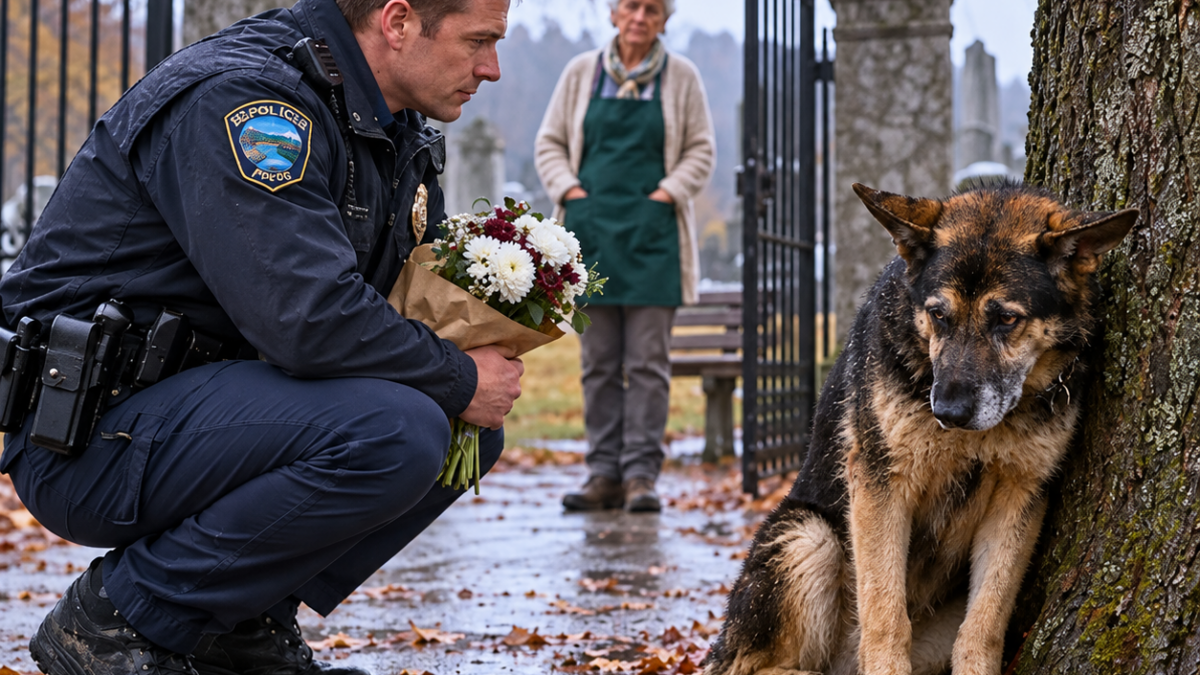
The cemetery gate stood across the street.
Sarah’s grave lay farther uphill beyond a bend I could have found blindfolded. I had come prepared for that sadness. It was familiar. It had edges I knew how to touch.
The dog was just inside the entrance.
As I approached, he lifted his head.
His eyes met mine.
Not hopeful.
Not friendly.
Simply aware.
Tired amber eyes set in a silver face.
I stopped.
Up close, he looked worse. Damp leaves clung to the fur beneath his collar. His front paws were crossed neatly, almost politely, as if he had settled down for a short wait and never understood why it became a week. His rear legs lay awkwardly to one side.
I thought of Shadow.
My Shadow.
Strong shoulders.
Dark muzzle.
The way he used to glance up at me for direction.
I had not said his name aloud in months.
But standing there beside the cemetery gate, with the chrysanthemums trembling slightly in my hand, it came out before I could stop it.
“Shadow.”
The old shepherd’s ears lifted.
His head came up fully.
For the first time since I had seen him, his attention left the road.
He looked at me.
Not past me.
At me.
Then he planted both front paws beneath his chest and tried to stand.
His rear legs shook violently. His body trembled with the effort. He pushed once, failed, tried again, and nearly collapsed before I took one small step back.
“Easy,” I said. “Easy.”
He froze.
I did not move closer.
A frightened animal will often forgive distance before it forgives kindness.
Behind me, Barbara stood outside her shop, one hand holding her cardigan closed against the wind.
“Call Joseph again,” I said without taking my eyes off the dog. “Tell him the dog’s letting me closer.”
Barbara nodded and hurried inside.
I placed Sarah’s flowers on the bench near the gate.
Then I lowered myself to the cold ground several feet from the maple, turning my body slightly sideways so I did not face the shepherd directly. My knees complained. My uniform trousers immediately soaked up the chill from the earth.
I loosened my blue wool scarf from my neck.
Sarah had given it to me the winter before she got sick. She said my old scarf made me look like “a man waiting outside a hardware store for bad news.”
This one was soft, dark blue, and warmer than it looked.
I folded it once and laid it beside my knee, one end extending toward the tree.
Then I rested my hands where the dog could see them.
No reaching.
No coaxing.
No sudden praise.
Just presence.
Cars passed.
Every time, the shepherd looked toward the road.
Every time, the car continued.
Every time, something in him seemed to lower.
Barbara brought water and set the bowl within my reach.
I slid it a little closer to the tree, then left it alone.
Minutes passed.
My phone vibrated.
I ignored it.
Then answered only long enough to arrange leave for the afternoon.
The dog watched every movement.
After a while, he stretched his neck toward the scarf.
Paused.
Drew back.
Tried again.
His nose touched the wool.
The scarf still held warmth from my neck.
He breathed it in carefully.
My chest tightened.
“You can take your time,” I said.
He lowered his chin near the folded edge.
That was all.
A tiny movement.
But it brought him farther from the tree than anything I had done standing over him.
Joseph Wilson arrived twenty minutes later in a rescue van.
He was forty-five, sturdy, sandy-haired, with a short beard and a canvas jacket worn pale at the elbows. He carried a folded blanket and moved like a man who understood that urgency did not always mean speed.
He watched from across the street before approaching.
I told him what I had seen.
“Old, weak rear legs, afraid of vehicles, responds to my voice. He touched the scarf.”
Joseph nodded.
“Good. Keep talking to him.”
They let the dog smell the harness before bringing it close. Every step took time. We moved the scarf onto the blanket. The shepherd followed its scent with his nose. When we finally supported his body, he stiffened but did not fight.
He was lighter than he should have been.
That made me angry.
Not the loud kind.
The cold kind.
We lifted him into the padded crate.
I rode beside him in the rescue van while Joseph drove.
Through the crate bars, the shepherd watched the cemetery disappear.
His nose stayed pressed against my blue scarf.
At the clinic, Dr. Susan Davis met us in a quiet exam room.
She was tall and slender, auburn hair tied back, glasses slipping down her nose as she bent. She sat on the floor near the dog before touching him, letting him smell her sleeve, her stethoscope, the back of her hand.
“He’s exhausted,” she said softly.
The examination took time.
She checked his mouth, listened to his chest, tested his joints, looked beneath the collar, felt along the spine and hips. He flinched when she manipulated his back legs but did not snap.
“About eleven,” she said. “Underweight. Dehydrated, but not critically. Arthritis in the hips and knees. Possibly some old injury or degenerative weakness in the hind end. He needs warmth, rest, medication, careful feeding, and monitoring.”
“Can he recover?”
She looked at me carefully.
“He can improve. He is old, Thomas.”
“I can see that.”
“I know. But I need to say it.”
I nodded.
“He needs somewhere quiet. Returning him to that roadside is not an option.”
Joseph explained the rescue would handle the abandonment report, scan for identification, file notices, check lost-pet databases, and begin arranging foster care.
The shepherd lay on the exam mat, watching me.
Every time I shifted toward the door, his eyes followed.
I felt that look like a hand closing around my sleeve.
“I can foster him,” I said.
Joseph looked at me.
“For now.”
Susan glanced at me, then at the dog.
“You understand what that means? Medication. Mobility help. Possible accidents. Slow trust. He may not settle immediately.”
“I understand.”
That was partly true.
Joseph brought out the temporary placement form.
When he asked what name to put on the clinic record, I hesitated.
The old dog watched me.
“Shadow,” I said.
The name scraped coming out.
This dog was not my K9.
Different face. Different body. Different life.
But the name had lifted his ears beneath the maple.
Maybe it meant nothing.
Maybe it meant everything.
That evening, Shadow stood uncertainly on the mat inside my front door while the heating vents whispered beneath the windows.
My house had been too quiet for years.
Not silent exactly.
The refrigerator hummed. Pipes ticked. Wind touched the eaves. My boots crossed the floor. The radio sometimes spoke from the kitchen, more habit than company.
But there had been no second breathing presence.
No nails on wood.
No body deciding where to lie.
No need outside my own.
I placed water nearby and arranged a thick dog bed on the living room floor away from the draft.
Shadow sniffed its edge.
Then walked away.
Slowly.
Painfully.
He moved along the wall, stopping whenever his rear legs needed rest, until he reached the front door.
There he lowered himself.
Facing the seam beneath it.
Waiting.
The expensive new bed remained untouched.
I laid the blue scarf beside it, hoping the scent might draw him over.
Shadow looked toward the scarf.
Then back at the door.
I sat in a chair nearby.
“You don’t have to wait there,” I said.
He did not look at me.
That first night, I learned that bringing a dog inside is not the same as bringing him home.
Waiting had followed him through my door.
The next morning, I picked up my keys from the counter.
Behind me, claws scraped against the floor.
Shadow was trying to rise.
His front legs pushed hard. His hindquarters trembled. He collapsed, breathing fast, eyes fixed on the keys.
I froze.
“I’m just taking out the trash.”
He did not understand the words.
He understood keys.
Movement.
Departure.
I set the keys down.
Waited.
Only when his breathing slowed did I carry the trash outside through the side door.
When I returned less than a minute later, he had dragged himself toward that entrance, leaving a crooked line in the runner.
I sat down on the kitchen chair and stayed there until he stopped trembling.
That was when I understood.
Coming back had to become something Shadow experienced again and again before it could mean anything.
So I built our days out of repetition.
Kettle.
Breakfast.
Medication.
Short trip outside.
Rest.
Water bowl.
Quiet voice.
Same door.
Same return.
I wrote everything down because memory lies when worry gets involved.
Ate half.
Drank while I stood nearby.
Stiff after morning outing.
Rested on rug twenty minutes.
Startled by delivery truck.
The first victory came three days in.
I was rinsing a mug when I heard water behind me.
I did not turn.
I barely breathed.
Shadow stood at the bowl drinking while I was still in the room.
Such a small thing.
A dog drinking water.
But I gripped that mug like it was holy.
That evening, I wrote one sentence beneath the care notes.
Drank with me nearby.
Barbara brought Sarah’s flowers to my house because I had not made it to the grave.
“I kept them fresh,” she said.
She stayed with Shadow while I went to the cemetery.
When I returned, she was sitting in the chair by the door, coat across her knees. Shadow watched her from a distance but had not retreated.
“You didn’t have to do this,” I said.
“Yes,” Barbara replied, “I did.”
That was all.
A few days later, I stopped by the flower shop to return a bowl she had left behind.
Barbara was behind the counter sorting order slips beside a thick old ledger with a cracked spine. Ribbons marked different sections. Her reading glasses were pushed into her hair, and she looked tired in a way she tried to hide.
“How are you managing?” I asked.
“Oh, fine.”
“Barbara.”
She sighed.
“Knee’s bad. Cemetery paths are worse. People still call for flowers placed at graves. I’ve had to turn some away.”
She turned a page in the ledger.
A loose sheet caught beneath her thumb.
I reached to keep it from folding.
Then my hand stopped.
The handwriting on the page hit me before the meaning did.
A long underline beneath a date.
Careful letters.
The slight upward curve at the end of certain words.
Sarah.
I had seen that handwriting on grocery lists, birthday cards, sticky notes beside my coffee.
Barbara followed my gaze.
Her face softened.
“She helped me for years,” she said.
I could not speak.
“She’d stop in after work or on free mornings and ask if anything needed carrying across. Some of my older customers couldn’t manage the paths. Sarah remembered which vases leaked, which graves caught wind, which families wanted ribbons tied extra tight.”
I touched the edge of the paper.
Not covering a single word.
“She never told me.”
Barbara smiled sadly.
“She didn’t think kindness needed announcements.”
I pictured Sarah coming through that door with her coat half buttoned, carrying flowers across the road in the rain, then coming home with damp shoes and saying nothing because it had simply needed doing.
The grief shifted.
Not less.
Different.
For three years, I had remembered Sarah mostly through what illness took.
Her weakness.
Her hospital bed.
The silence after.
But here was proof of her life moving in directions I had never seen. Proof that she had left kindness tucked into a ledger, still useful after she was gone.
Several flower orders waited on the counter.
I looked at Barbara’s knee.
Then at the map.
“Which graves are closest to the gate?”
She hesitated.
“Thomas, you don’t need—”
“Show me.”
That afternoon, with Joseph watching Shadow at my house, I carried three arrangements across the cemetery.
At the last grave, I steadied a vase tilted by frost and pressed earth around its base. The card read only, With love as always.
I thought of Sarah.
Then Shadow.
Then all the living things we keep loving even when keeping them hurts.
My leave ended the next morning.
I set out my uniform the night before and felt the house change around me.
Shadow noticed too.
He watched each piece of me disappear into duty.
Boots.
Belt.
Jacket.
Keys.
“I’ll come back,” I told him at the door.
I meant it.
But promises are made in seconds. Waiting is endured in hours.
Barbara visited midmorning and left me a message.
He’s lying across the entry mat. Hasn’t eaten much. Water barely touched. He keeps watching the handle.
I returned during an authorized break.
Shadow struggled upright before I had closed the door. His tail made one small uncertain movement. He drank with me beside him and ate several mouthfuls, then leaned against my shin.
When I had to leave again, he followed me to the threshold.
I closed the door carefully.
Too carefully.
The next days followed that pattern.
I came home whenever duty allowed.
Barbara filled gaps between flower orders.
Nothing was destroyed. No barking complaints. No accidents worth mentioning.
But Shadow ate less on workdays.
Rested lighter.
Saved all his strength for listening to the door.
Joseph called with a possible arrangement.
A family experienced with senior dogs. Someone home most of the day. No stairs. Non-slip floors. Quiet room. They could follow Susan’s care plan.
It sounded ideal.
That was the problem.
I asked practical questions.
Entrance steps?
Flooring?
Other animals?
Medication experience?
Emergency vet distance?
Joseph answered them all.
“What do you think?” he asked.
I looked at Shadow asleep on the ugly dining room rug he had chosen over the expensive bed.
“Let me consider it.”
That night, a gust of wind caught the outer porch door before its latch engaged.
It slammed against the frame with a hollow crack.
Shadow scrambled backward into the corner beside the cabinet.
I stopped in the hallway.
But I was no longer in the hallway.
For a moment, I heard another crash.
Radio static.
My own voice calling Shadow.
The pause afterward.
The unbearable pause in which I had waited for my partner to move and he did not.
My hand clenched so tightly my nails pressed into my palm.
I could see the lamp.
The sofa.
The kitchen doorway.
But my breathing belonged to another place.
Then I heard a careful step.
Shadow had left the corner.
He moved toward me slowly, trembling so hard I could see it along his shoulders.
One step.
Stop.
Another.
Stop.
He lowered his head and touched his muzzle to my closed fist.
His breath warmed my knuckles.
I opened my fingers beneath his silver chin.
The weight of his head settled into my palm.
Tentative.
Real.
And I came back to the room.
The lamp was beside the sofa.
The wind was outside.
The old shepherd stood close enough for me to feel him shaking.
“I’m here with you,” I managed.
But the truth was larger.
He was there with me.
For the first time, Shadow had crossed the room not for food, not for a scarf, not because I called him.
He came because I had gone still.
He came because he understood panic.
He came because broken creatures sometimes recognize each other before anyone else does.
The next morning, I packed his travel bag.
Care instructions.
Medication.
Blanket.
Food.
Blue scarf.
I folded the scarf last.
My hands moved slowly.
Every reason to let him go was real.
My work hours.
His age.
His medical needs.
His fear of being alone.
The family Joseph found might give him steadier days than I could.
I told myself love meant choosing what was best for him, even if that meant not me.
At 9:04, the rescue van turned into my driveway.
Shadow heard the tires on gravel.
His head lifted.
By the time Joseph stepped out, Shadow had gathered his legs beneath him.
I opened the inner door but kept the storm door closed.
Joseph retrieved the portable ramp and support harness.
The van’s side door slid open with a soft mechanical sound.
Shadow stared past me.
At the open van.
At the crate inside.
His body tightened.
Then he turned away from the entrance and moved into the hallway with uneven urgency, rear paws slipping once on the runner. He disappeared around the corner and stopped where the wall hid the vehicle from view.
His chest rose quickly.
The open van had completed a pattern he knew too well.
A vehicle.
A ride.
A strange place.
Someone leaving.
Joseph stepped onto the porch but did not enter.
“We have time,” he said.
I looked at the packed bag.
Every efficient part of me wanted to complete the plan.
The family expected him.
The equipment was ready.
A careful transfer now might spare confusion later.
But then I remembered the station wagon on Barbara’s recording.
Someone had once decided where Shadow would be left, guided him from a vehicle, and driven away before he understood that his life had been discarded.
I would not answer that wound by pulling him toward another open van.
I lowered myself near the entrance, turning slightly away from the hallway.
I spoke quietly.
Not commands.
Not his name over and over.
Just words.
About the rain.
My coffee going cold.
His ridiculous devotion to the ugly rug.
Minutes passed.
Joseph closed the van door gently, hiding the waiting crate, and sat on the porch step.
From the hallway came the faint sound of fabric sliding over wood.
Then the uneven placement of aging paws.
I turned only when Shadow came around the corner.
The blue wool scarf hung from his mouth.
One end dragged between his front feet.
He had taken it from the old rug.
The scarf that first carried my warmth across the distance beneath the maple.
The scarf that rode with him to the clinic.
The scarf I had packed to send away with him.
Trembling, he crossed the room.
He released it beside my knee.
Then he turned carefully, lowered himself with a tired exhale, and placed his chin across my boot.
The weight was slight.
I felt it more clearly than the packed bag beside the door.
Shadow did not retreat.
His eyes stayed fixed on me.
Not the entrance.
Not the road.
Me.
I rested one hand along his silver muzzle.
All week, I had been measuring what might go wrong.
Work hours.
Medicine.
Difficult mornings.
Future grief.
Every concern was real.
But suddenly I recognized the decision hidden beneath my reasoning.
I had been preparing to surrender the present because the future might hurt.
Shadow was trusting me with today.
“You came back for this,” I whispered, touching the scarf. “Or maybe you came back for me.”
His ear shifted beneath my hand.
I opened the door and stepped onto the porch.
Shadow stayed inside where he could see me.
Joseph rose.
“I want to continue the placement,” I said. “And begin adoption.”
Joseph studied my face.
“Is this a decision you can support after the emotion of this morning passes?”
“I’m still afraid of losing him,” I said. “I was using that fear to leave first.”
Joseph nodded once.
Then he returned the ramp to the van and brought in empty forms instead of the harness.
That day, we built a plan.
A real one.
Not just feelings.
Barbara would clear a warm corner behind the flower shop counter for two of my longer shifts each week. Joseph would arrange rescue volunteers for midday visits if police work kept me away. Susan would continue medical care. I would track eating, stiffness, pain, and anxiety. I wrote emergency numbers on the refrigerator calendar.
Asking for help felt unfamiliar.
But it no longer felt like failure.
It felt like the difference between making a promise and building a home capable of keeping it.
Months passed.
Winter loosened.
Snow withdrew from the fields around Bellows Falls, leaving wet earth and flattened grass beneath a pale spring sky.
Shadow gained weight slowly.
The sharp lines along his ribs softened. His arthritis remained, but medication, runners on the floors, gentle movement, and careful rest helped him rise with less effort. He still measured every step, but standing no longer consumed all his strength.
He spent long-shift mornings at Barbara’s shop, resting behind the counter on a non-slip mat near a side window. Barbara kept approved treats in a jar. I had to write the daily limit on the lid after learning her definition of one treat was generous enough to require legal oversight.
At first, Shadow watched every customer.
Then he learned the doorbell did not announce abandonment.
Some days, Patricia Johnson came in, a retired bookkeeper who remembered Sarah tying extra ribbon around windy-day arrangements. Others told stories too.
Sarah replacing a rain-soaked card.
Sarah remembering a birthday someone had forgotten to write down.
Sarah carrying two bouquets through a summer downpour and laughing that the flowers were drier than she was.
Those stories did not bring Sarah back.
But they made her life larger than its ending.
The cemetery deliveries continued differently.
Barbara accepted fewer.
I carried some on days off.
Patricia and a few others volunteered for nearby sections.
A list appeared beside the register.
Names.
Routes.
Dates.
People helping people remember.
Sarah’s kindness had become a map the living still followed.
Shadow changed in quiet ways.
He began eating whether I stood beside him or moved through another room. Some mornings, when I lifted my keys, he raised his head but did not force himself to stand. When I said, “I’ll come back,” the promise meant something because I had repeated it and returned enough times to give the words weight.
In early March, Joseph returned with final adoption papers.
Shadow slept on the old rug while I signed.
Joseph checked the new ID tag and emergency contacts.
“He’s officially yours,” he said.
The change felt quiet.
Ordinary.
But I understood its weight.
Shadow would no longer be listed as a temporary guest awaiting another home.
This address, this rug, and this man now belonged in his record.
I looked toward him.
One silvered ear lifted at the sound of his name.
Then settled again.
“I think he decided before I did,” I said.
One spring morning, I stopped at Miller’s Flowers before visiting Sarah’s grave.
Barbara wrapped white chrysanthemums in brown paper and fastened the stems with extra ribbon the way Sarah used to do for windy days.
Shadow rested behind the counter while she worked.
When I lifted the bouquet, he rose without being called and approached the leash hanging beside the back door.
Barbara looked over her glasses.
“Seems he has plans.”
I helped him into the car using Joseph’s portable ramp.
This time, I did not put him in a crate.
I secured him with the supportive harness Susan had approved, and we drove the short distance to the cemetery parking area.
Morning sunlight spread across the wet paths.
I chose the gentlest route.
Shadow set the pace.
We stopped twice before reaching Sarah’s grave, not because he failed, but because I had learned rest belonged inside the journey, not at the point where strength ran out.
I placed the chrysanthemums in the vase.
Tied the ribbon.
Checked the card.
Shadow sniffed the grass, then lowered himself carefully near the stone.
I sat on the bench and rested one hand along his shoulder.
For three years, I had spoken to Sarah mostly about what was absent.
Her voice in the kitchen.
The children we never had.
The years illness stole.
That morning, I told her about what had arrived.
I told her about the old shepherd beneath the maple, and how her scarf had become his bridge. I told her about the expensive bed he rejected, the ugly rug he claimed, Barbara’s criminal treat distribution, and the adoption papers on the kitchen table.
Then I told her about the ledger.
About her flower deliveries.
About the people who remembered her not only for how she died, but for how she had lived when nobody was watching.
“I thought remembering you meant keeping everything where you left it,” I said quietly. “I think I was wrong.”
The words did not close my grief.
They gave it somewhere to stand beside the life that continued.
On the way back to the gate, Shadow stopped beneath the bare maple.
New leaves tipped its branches.
A pickup passed.
Then a dark sedan.
Shadow watched both vehicles disappear around the bend.
His ears remained forward, but his body did not pull toward the curb.
For a long moment, he studied the empty road where he had once expected someone to return.
Then he turned his head toward me.
No command.
No tightened leash.
I walked toward the car.
Lowered the ramp.
Opened the rear door.
Shadow glanced once more at the maple.
Then he placed one front paw on the ramp, gathered his hind legs, and climbed at his careful pace.
At the top, he stepped into the car and turned toward me as if waiting for me to follow.
That night, rain began softly against the roof.
I prepared his medication, completed his care notes, and placed my police keys on the counter.
Shadow noticed the sound but remained near the stairs.
When I went upstairs, he followed.
Slowly.
Carefully.
Pausing at the landing.
The bed beside mine was no longer new and no longer empty. The blanket lay over it. The blue scarf rested across one corner, worn softer now from use.
Shadow circled once and settled down.
I sat on the edge of my bed and placed a hand along his back.
Beneath my palm, I felt the steady rhythm of breathing that no promise could make permanent and no fear could make less precious.
The house that had once seemed too quiet now held the small sounds of an old dog sleeping nearby.
Tomorrow would bring work, medicine, flower deliveries, stiff joints, phone calls, and whatever worries came with loving something that could not stay forever.
But tonight, we were both home.
And neither of us was waiting for someone who had already chosen to leave.








