A Grieving Navy SEAL Walked Into a Salon Asking for Help With His Silent Daughter—Then One Gentle Act Made Her Finally Say the Words He Never Expected
PART3:
“Kiara,” she said softly, lowering herself onto the rolling stool so she was eye level with the child, “I’m Sarah. I’m not going to yank your hair. I’m not going to cut anything without telling you. And if you want me to stop, you can lift your hand like this.”
She raised one hand.
Kiara watched.
Did not copy her.
Did not speak.
Titan shifted, pressing his body closer to the little girl’s legs.
Dustin’s voice cracked.
“Stand down, Titan.”
The dog did not sit.
He simply leaned his head against Kiara’s knee.
The man’s face changed.
Sarah had seen fathers cry before. Usually, their faces collapsed. Dustin’s did not. His pain moved inward, so violently contained that the room seemed to tighten around him.
“I don’t know how to do it,” he said.
Sarah looked up.
“Her hair,” Dustin added, as if the explanation was necessary. “Rachel always did it. She knew the right brushes. The sprays. The order. I tried a comb last week, and Kiara screamed so hard I thought I’d hurt her. I haven’t touched it since.”
He swallowed.
“Her school called this morning. The counselor said if she comes in looking neglected again, they have to file a welfare report.”
The word neglected nearly broke him.
Sarah saw it.
The shame.
The humiliation.
The rage at himself.
This was a man who had likely memorized weapon systems, battlefield routes, medical procedures, escape plans, signals, codes, and contingencies most people could not imagine. He could probably move blindfolded through a hostile building and come out alive.
But his daughter’s hair had defeated him because it belonged to a world where Rachel should still have been standing.
Sarah stood slowly.
“We’re not going to solve grief in one appointment,” she said. “But we can solve this part. And sometimes this part matters.”
Dustin nodded once.
Too fast.
Too grateful.
As if a practical task had given him permission to breathe.
“Okay,” Sarah said to Kiara. “Let’s get you in the chair.”
Kiara did not move until Titan moved.
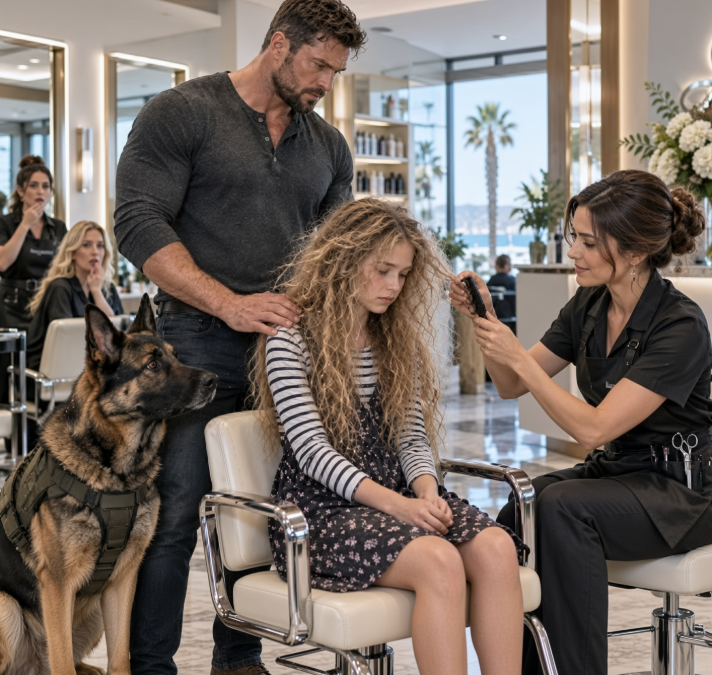
Dustin guided them both carefully. The little girl climbed into the salon chair, knees together, hands locked around Titan’s collar. Titan sat immediately beside the chair, leaning his large head against her dangling sneakers.
Sarah draped a small cape over Kiara’s shoulders.
“Is this okay?”
No answer.
Sarah lifted the cape slightly.
“Too tight?”
No answer.
Titan’s ear flicked.
Sarah loosened it anyway.
Dustin stood near the mirrors, arms crossed, eyes moving to the window whenever a car passed. Hypervigilance. Sarah knew it before she named it. The body’s refusal to believe safety was real.
“You can sit down, Dad,” she said through the mirror.
“I’m fine.”
“I didn’t ask if you were fine. I said you can sit.”
His eyes met hers in the mirror.
For one second, Sarah thought he might resist out of habit.
Then he sat in the waiting area chair closest to Kiara.
He did not take his eyes off his daughter.
Sarah rolled her station cart closer.
“I’m going to show you everything before I use it,” she told Kiara. “This is detangling spray. Smells like coconut. This is a wide-tooth comb. This is not for pulling. This is a clip. It looks mean but has no personality.”
No reaction.
“That was my best clip joke.”
Still nothing.
Sarah smiled softly and misted the first section of Kiara’s hair.
Dustin flinched.
Kiara did not.
“That’s good,” Sarah said quietly. “You’re doing really well.”
Dustin looked down.
“I’m failing her.”
The words were blunt.
Sarah kept her fingers gentle in the outer layer of curls.
“Grief doesn’t have a schedule.”
“She won’t eat unless Titan sits beside her. She won’t sleep unless he’s on the bed. She hasn’t said one word since the funeral. Not to me. Not to the therapist. Not to her teacher.” Dustin’s voice dropped. “I don’t know if she still knows I’m her dad.”
Sarah paused, then resumed.
“She knows.”
He looked up sharply.
Sarah did not turn.
“She wouldn’t have let you bring her here if she didn’t.”
For a while, the only sounds were rain against the storefront windows, the hum of the small refrigerator in the back, the soft click of scissors being moved aside, and Sarah’s quiet instructions before every touch.
With severe matting, you did not begin at the root.
You did not force the comb through.
You did not pretend speed was kindness.
You started at the ends, held the hair above the knot to protect the scalp, teased loose one small strand at a time, and understood that patience was not passive. Patience was work.
Sarah treated Kiara’s hair like that.
And, without saying so, she treated Kiara’s grief the same way.
Bottom up.
One small knot at a time.
Whenever Kiara’s breathing hitched, Titan nudged her knee. Whenever her fingers tightened around his collar, he leaned heavier against her leg. When Sarah reached the worst mat behind Kiara’s ear, the little girl’s shoulders rose to her chin.
Sarah stopped immediately.
“Break.”
Dustin half rose.
“Is she hurt?”
“No,” Sarah said calmly. “She’s telling us she needs a break.”
Kiara’s eyes flicked toward her in the mirror.
Sarah saw it.
Good.
A child who had stopped speaking still communicated.
Adults just had to be quiet enough to notice.
Sarah pulled a small wrapped peppermint from a drawer and placed it on the counter.
“For later if you want it. Or not. Peppermints are optional citizens here.”
A faint movement crossed Kiara’s mouth.
Not a smile.
Almost.
Dustin saw it too.
He gripped the arms of the waiting chair so hard his knuckles whitened.
Sarah turned to another section.
“Titan is a good boy,” she said softly.
Dustin answered because Kiara did not.
“He belonged to my teammate Mark.”
Sarah glanced at him through the mirror.
“Mark was killed two years ago,” Dustin continued. “I adopted Titan after. He was… different after Mark. Quiet. Like he kept waiting for the wrong door to open.” Dustin looked at the dog. “When Rachel died, Titan just attached himself to Kiara. Wouldn’t leave her room. Wouldn’t eat unless she was near him. It was like he knew she was the one hurting the most.”
Sarah’s throat tightened.
She knew something about military loss too.
Her brother had been an Army Ranger who came home from Iraq with all his limbs, all his medals, and wounds nobody could point to when asking why he could not sleep, why fireworks made him shake, why one quiet Tuesday afternoon he parked behind a grocery store and decided he was too tired to keep fighting himself.
Sarah had learned after that that some people survived combat but not return.
She also learned that love often arrived as small, ordinary care no one applauded.
A meal.
A ride.
A chair pulled close.
A hand gentle enough not to make pain worse.
“Let’s go to the sink,” Sarah said. “Warm water is going to help.”
Dustin stood immediately.
Sarah held up one hand.
“Let her do it.”
He stopped.
Kiara looked at her father.
Then at Titan.
Then slid down from the chair.
Titan moved with her, perfectly synchronized. Sarah guided them toward the washing station. Kiara climbed onto the booster seat, leaned back into the ceramic bowl, and kept one hand on Titan’s collar. The dog stood beside the sink, tall enough that his head rested near her elbow.
Sarah tested the water against her wrist.
“Warm, not hot.”
She let the water flow slowly through Kiara’s curls.
At first, Kiara’s body stayed rigid.
Then the warmth reached her scalp.
Dirt, sweat, old tears, and weeks of fear began loosening under Sarah’s hands.
Something changed in the child’s face.
Not happiness.
Release.
Sarah worked in deep conditioner and massaged carefully around the tender matted areas. Maternal touch was not always about being a mother. Sometimes it was simply the kind of touch that told the body, You are not in trouble. You are not disgusting. You are not too broken to care for.
A single tear slipped from the corner of Kiara’s eye.
Dustin turned away.
The movement was small but sharp.
Sarah saw it in the mirror.
He could face men with weapons. He could survive classified places and unspoken things. But his daughter crying under warm water shattered him.
Sarah leaned close and wrapped a towel gently around Kiara’s hair.
“It’s okay,” she whispered. “Tears are allowed here.”
Kiara stared up at her.
The child’s blue eyes were wide and terrified, but not empty.
Her small hands twisted in Titan’s collar.
Sarah reached for another towel.
Then heard it.
So soft she almost missed it.
A raspy whisper, thin as dry leaves across pavement.
“She didn’t fall.”
Sarah froze.
The towel hovered in her hands.
Dustin was still turned toward the window, jaw locked, trying not to break.
Sarah lowered her voice until it was barely louder than the rain.
“What was that, sweetheart?”
Kiara’s lips trembled.
Her eyes darted toward her father.
Sarah did not call him over.
Not yet.
She understood fragile moments. Too many adults could crush them with urgency.
Sarah knelt beside the sink so she was close enough for Kiara to see only her and Titan.
“You’re safe,” Sarah whispered. “You can tell me one tiny piece. Just one.”
Kiara swallowed.
“The police said a truck hit Mommy.”
Sarah kept her face still.
“But it wasn’t the truck first.”
The salon seemed to shrink around them.
Sarah heard the rain.
The refrigerator.
Titan’s low breath.
Her own pulse.
“What happened first?”
Kiara’s eyes filled.
“Mommy was buckling me in. There was a black Jeep behind us. A man got out.”
Sarah’s fingers tightened around the towel.
“He pushed her.”
The words came out in a rush, as if the sentence had been trapped inside Kiara’s body for ninety days and had finally found one crack wide enough to escape.
“He pushed Mommy into the street when the big truck came.”
Sarah did not move.
Did not gasp.
Did not say, “Are you sure?”
Children heard disbelief even when adults tried to hide it.
Instead, she whispered, “You saw him?”
Kiara nodded, trembling.
“He looked at me through the window.”
Titan let out a low growl.
Kiara buried one wet cheek against his head.
Sarah forced herself to breathe slowly.
“Did you know him?”
Kiara shook her head.
“Did he have anything that made him look different?”
Kiara’s hand lifted to the right side of her own neck, just below the jaw.
“A snake,” she whispered. “A big green snake.”
Sarah’s blood went cold.
The official report had said Rachel Gibson was struck by a utility truck that lost control. Kiara had been found in the back seat, screaming. No one had suggested the child witnessed anything other than the impact. No one had known there was a man.
A black Jeep.
A green snake tattoo.
A push.
Not an accident.
Murder.
Sarah stood slowly.
The salon suddenly felt full of glass.
Dustin was still staring out the front window, drowning in the belief that the universe had randomly taken his wife on a sunny afternoon while he was thousands of miles away.
Sarah dried her hands.
Then walked to him with a comb in one hand, because she needed to look as if she was still doing the job he had brought her to do.
“Dustin,” she said.
He turned immediately.
“Is she okay? Is it too much?”
“She’s doing incredibly well,” Sarah said. “Her hair is going to be fine. But I need you to listen to me very carefully.”
Something in her voice changed him.
The grieving father disappeared behind something colder, sharper, trained.
“What is it?”
“Do not react. Do not look at her differently. Do not move fast.”
His posture altered by degrees. Shoulders level. Eyes focused. Breath controlled.
Sarah pretended to reorganize clips on the station tray.
“Kiara just spoke to me.”
Dustin stopped breathing.
“She said Rachel’s death was not an accident. She said a man got out of a black Jeep and pushed Rachel into the street.”
The muscles in Dustin’s jaw feathered.
Sarah continued quietly.
“She said he had a large green snake tattoo on the right side of his neck.”
For several seconds, Dustin did not move.
Then he closed his eyes.
When he opened them, Sarah saw a terrifying transformation and, beneath it, something even more frightening.
Not rage.
Purpose.
He looked toward the sink where Kiara clung to Titan.
His voice was almost soundless.
“She saw it.”
“Yes.”
“And she carried that alone for three months.”
Sarah swallowed.
“Yes.”
Dustin turned away, but not toward the door.
He walked to his daughter.
Slowly.
Carefully.
Like approaching a wounded animal whose trust mattered more than his own need to hold her.
Kiara watched him.
Dustin crouched beside the shampoo bowl.
“Baby,” he whispered.
Her lower lip trembled.
He did not ask her to repeat it.
He did not demand details.
He did not ask why she had not told him sooner.
He only placed his hand near hers on Titan’s collar.
“I believe you.”
Kiara broke.
A sound came out of her that was not quite a sob and not quite a word. She reached for him with both arms, and Dustin lifted her out of the booster seat, towel and wet hair and all, pulling her against his chest like she was the only thing still holding him on earth.
For the first time since they entered the salon, Titan stepped back.
Only one step.
Enough to let father and daughter fit together.
Dustin buried his face in Kiara’s wet curls.
“I’m sorry,” he whispered. “I’m so sorry, baby.”
Kiara sobbed into his neck.
No words.
She did not need them.
Sarah stood behind them, one hand over her own mouth.
She had thought she was helping with hair.
But sometimes hair was only the door grief used when it finally decided to open.
Dustin stayed like that until Kiara’s body stopped shaking.
Then he looked at Sarah.
“I need to make a call.”
Sarah nodded.
“In my office. Door locks.”
He carried Kiara there.
Titan followed.
Dustin made three calls.
Sarah heard only fragments through the office wall. Not enough to understand everything, but enough to know he was not calling random friends or acting from blind rage.
He called someone named Hutch.
Then someone he addressed as Commander.
Then, after a long pause, he called a detective.
His voice stayed controlled.
“My daughter just disclosed new witness information in Rachel Gibson’s death… Yes, recorded? No. She is seven. I’m not putting a phone in her face… She needs a child advocate present… I’m telling you now because if this department buries what she said, I will bring federal attention before sunset.”
Silence.
“No, that is not a threat. That is a promise to follow process with witnesses.”
Another pause.
“The identifier is a green snake tattoo on the right side of the neck. Black Jeep. Male suspect. She saw him push Rachel.”
Sarah closed her eyes.
Good.
He was angry enough to destroy the world, but he was still choosing the one thing Kiara needed most.
A path that would not take her father away too.
When Dustin came out, his face was pale but steady.
“A child forensic interviewer is meeting us at the advocacy center. My former commander is sending a lawyer. The detective who handled Rachel’s case is on his way there.”
Sarah nodded.
“That’s the right first step.”
Dustin looked at her.
“I wanted to find him.”
“I know.”
His eyes moved toward the office where Kiara sat with Titan.
“If I do this wrong, she loses me too.”
Sarah said nothing.
He already knew.
Dustin looked down at the $100 bill he had placed on the counter earlier.
Sarah pushed it back toward him.
“We didn’t finish.”
He stared at her.
“We’ll be back,” he said.
“I know.”
Then Sarah added, “Dustin?”
He paused.
“Bring her before school tomorrow if they let you. Early. No cameras. No questions. We’ll finish gently.”
His face shifted.
For the first time, she saw the man beneath the soldier.
“Thank you.”
The bell rang when they left.
The salon felt too quiet afterward.
Sarah locked the door.
Not because Dustin told her to.
Because her hands would not stop shaking.
That afternoon, Kiara spoke to a child forensic interviewer in a room painted soft blue, with a camera hidden behind dark glass and a woman trained not to lead, push, or frighten. Dustin sat in a separate observation room because the interviewer explained that children sometimes tell more when they are not trying to protect the parent from pain.
That nearly undid him.
Protect him.
His seven-year-old had kept a murder inside her body for ninety days because the last time she saw her mother alive, a stranger looked through the car window at her.
Dustin watched through glass as Kiara held Titan’s collar in one hand and used crayons to draw the street.
Rachel’s car.
The sidewalk.
The utility truck.
The black Jeep.
The man.
The green snake.
She did not speak continuously. Sometimes she nodded. Sometimes she pointed. Sometimes she whispered so softly the interviewer had to wait. But piece by piece, the story emerged.
Rachel had been buckling Kiara into the back seat after stopping near a small shop.
A black Jeep parked behind them.
A man got out.
Rachel turned, startled.
The man said something Kiara could not hear.
Rachel tried to step between him and the open car door.
The man shoved her hard, both hands.
Rachel stumbled backward into the street just as the utility truck swerved through rainwater and glare.
The driver panicked and fled.
But the truck had not started the event.
The man had.
And before getting back into the Jeep, he looked directly at Kiara.
Finger to lips.
Quiet.
Then he drove away.
Dustin sat behind the glass and did not move.
His former commander, Thomas Hutchins, stood beside him. Hutchins was retired now, silver-haired and broad through the chest, with the steady presence of a man who had seen rage ruin good men when grief was sharper than discipline.
“Breathe,” Hutchins said quietly.
“I am.”
“No, you’re calculating.”
Dustin’s eyes stayed on Kiara.
“She’s seven.”
“I know.”
“She thought silence kept us safe.”
“She survived the only way she knew how.”
Dustin’s hands curled.
“I should have been here.”
Hutchins did not soften the truth.
“You weren’t.”
Dustin’s face twitched.
Then Hutchins added, “You’re here now. Make that matter.”
The detective assigned to the original case, Marisol Vega, looked sick when the interview concluded.
Not defensive.
Sick.
She had believed she was investigating a hit-and-run with a traumatized child witness too overwhelmed to speak. The truck driver had later been identified and arrested for fleeing the scene, but he had insisted he lost control only after seeing “someone jump or fall” in front of him. No one believed him. His statement had been dismissed as self-serving.
Now it looked different.
Vega reopened the case that day.
This time, she did not work it alone.
Within twenty-four hours, NCIS became involved because Rachel Gibson had been a forensic auditor for a maritime logistics company with defense contracts connected to Naval installations. Rachel had spent her final weeks reviewing shipping discrepancies—missing equipment, falsified container weights, routing irregularities through Norfolk.
Two weeks before her death, she had told Dustin on a choppy overseas call that something at work “felt wrong.”
He remembered because he had been tired.
Because the call had been short.
Because she had sounded distracted, and he had said, “Write it down and walk it up the chain.”
She had said, “I am.”
He had said, “Good.”
That was all.
He hated himself for that too.
Investigators found Rachel’s home office locked.
Dustin had not entered since she died. He could barely pass the door without feeling the absence behind it. But now he unlocked it with hands that stayed steady because shaking would come later.
The room still smelled faintly of Rachel’s lotion.
Her sweater hung over the chair.
A mug sat beside the keyboard, washed but stained with tea.
On the corkboard were school reminders, grocery lists, Kiara’s drawing of Titan wearing a crown, and three printed shipping manifests with yellow notes attached.
Detective Vega photographed everything.
NCIS analysts took the computer.
A digital forensics team recovered deleted files Rachel had backed up under a mislabeled folder named “Kiara Art Archive,” because Rachel had been smart enough to hide evidence where criminals looking for audit files might not look.
Inside were container numbers.
Emails.
A spreadsheet showing discrepancies tied to a network of shell vendors.
Photographs Rachel had taken of sealed cargo units.
And one security still, enhanced just enough to show a black Jeep entering a restricted-adjacent warehouse lot at 2:14 a.m. six days before Rachel died.
The driver’s neck was turned toward the gate camera.
A green serpent tattoo curled beneath his jaw.
Wyatt Dixon.
Dishonorably discharged Marine. Enforcer. Known associate of the Oannon crime network, a syndicate tied to stolen military hardware moving through commercial docks under forged paperwork.
Rachel had found the trail.
Dixon had silenced her.
Or tried to.
He had not counted on the little girl in the back seat.
He had not counted on Titan keeping that little girl alive long enough to speak.
He had not counted on a salon owner who understood that gentleness could be stronger than pressure.
And he had not counted on Dustin Gibson choosing patience when every broken part of him wanted war.
That choice did not come easily.
For three nights, Dustin did not sleep.
He stayed with Kiara until she fell asleep, Titan stretched across the foot of her bed, then sat in the hallway outside her door because he could not make himself go farther. He read every update from Vega and NCIS. He answered questions. He identified names Rachel had mentioned. He handed over devices. He signed statements.
And each night, the same thought returned.
I could find him faster.
Hutchins knew.
On the fourth evening, he came to Dustin’s house and found him in the garage, staring at a locked equipment case he had not opened since Rachel died.
Hutchins stood in the doorway.
“You open that, and you’re not thinking like a father.”
Dustin did not turn.
“I’m thinking like her husband.”
“No,” Hutchins said. “You’re thinking like a weapon with grief attached.”
Dustin’s jaw clenched.
“He looked at my daughter.”
“I know.”
“He put his finger to his mouth and told her to stay quiet.”
“I know.”
Dustin turned then.
“She stopped speaking because of him.”
Hutchins stepped closer.
“And if you go after him outside the law, she spends the rest of her life knowing the truth cost her father too.”
The words hit harder than any order.
Dustin looked toward the house.
Through the garage wall, he could almost feel where Kiara slept.
The equipment case remained closed.
“What do I do with this?” Dustin asked, voice low.
“With what?”
Dustin tapped his chest.
“This.”
Hutchins looked at him for a long moment.
“Point it in the right direction. Sit in every interview. Sign every statement. Protect the evidence chain. Hold your daughter when she shakes. Let the people whose job this is do it clean enough that Dixon never walks free.”
Dustin’s mouth tightened.
“And if they miss?”
“They won’t.”
“You don’t know that.”
“No,” Hutchins said. “But I know you. And I know if you cross that line, you won’t come back the same man Kiara needs.”
The garage stayed silent.
Then Dustin stepped away from the case.
It was the hardest tactical decision he had ever made.
Do nothing violent.
Do everything right.
The arrest came ten days later.
Not at night.
Not in some cinematic raid that satisfied Dustin’s rage.
It happened in the gray morning outside a warehouse office near the Elizabeth River. Federal agents and local detectives executed warrants simultaneously across three properties. Wyatt Dixon was taken into custody without a shot fired. Declan Oannon, the man accused of ordering Rachel’s murder to protect stolen weapons shipments, was arrested in his waterfront home while trying to destroy a phone.
The evidence held.
Rachel’s files.
Kiara’s statement.
Traffic camera recovery.
Warehouse records.
Financial transfers.
A partial fingerprint lifted from Rachel’s car door frame that had been dismissed earlier because investigators believed the primary event happened in the street.
And then, finally, Dixon’s own words.
Not beaten out of him.
Not forced.
Captured legally after he tried to bargain through an intermediary who was already cooperating with federal authorities.
He admitted Rachel had been targeted.
He admitted she had found container numbers tied to stolen military equipment.
He admitted he pushed her into traffic because “it would look like bad timing.”
Bad timing.
That was what he called it.
A wife dead.
A child silenced.
A father shattered.
Bad timing.
When Detective Vega told Dustin the confession was on record, he sat at the kitchen table for a long time.
Kiara was in the living room with Sarah, who had come by after closing the salon because some people enter a crisis as strangers and leave as family. Titan lay with his head across Kiara’s lap.
Sarah was helping Kiara brush a doll’s hair.
“Bottom first,” Sarah said. “Remember?”
Kiara nodded.
Dustin listened from the kitchen.
Detective Vega sat across from him.
“We got him,” she said.
Dustin did not react.
Not at first.
Then his hands covered his face.
Vega looked away, giving him the dignity of not being watched.
For ninety days, Dustin had grieved a random tragedy.
Then he had burned with the need for justice.
Now justice had begun, and beneath it all was something heavier.
Rachel was still gone.
No arrest changed that.
No confession put her back in the kitchen singing off-key while making pancakes with Kiara.
No indictment restored the mornings Dustin missed, the phone call he cut short, the way he had told Rachel to walk the concern up the chain without hearing the fear beneath her voice.
Vega seemed to understand.
“Rachel did her job,” she said quietly. “She left enough for us to finish it.”
Dustin lowered his hands.
“She was always better at paperwork than me.”
Vega smiled faintly.
“Apparently she was exceptional.”
Dustin looked toward the living room.
Kiara laughed once, a tiny sound, fragile but real.
Sarah said something softly.
Titan’s tail thumped.
Dustin closed his eyes.
The war inside him did not end that day.
But something in it shifted.
A week after the arrests, Sarah opened the salon early.
Rain had cleared overnight, leaving Virginia Beach washed bright beneath a pale sun. The windows of Harbor Light Salon glowed gold. Sarah swept the floor twice though it did not need sweeping. She set out the coconut detangling spray, a wide-tooth comb, a soft brush, leave-in conditioner, and small butterfly clips in three colors.
At 8:03, the bell rang.
Dustin walked in wearing jeans and a plain T-shirt. He looked thinner than the first time but less hollow. The dark circles under his eyes had faded. His shoulders still carried tension, but not the same despair.
Beside him walked Kiara.
The mismatched outfit was gone. She wore a denim jacket over a bright yellow dress, white socks, and sneakers tied in clumsy but determined bows. Her blonde hair, no longer matted, had dried into soft curls that still needed shaping. She held Titan’s leash, though everyone knew the dog needed no leash to stay at her side.
Sarah smiled.
“Well, look who came back to finish.”
Kiara stepped closer to Dustin.
Then looked at the chair.
Titan nudged her hand.
She climbed up without being asked.
Sarah draped the cape around her shoulders.
“Still okay?”
Kiara nodded.
Sarah’s hands froze for half a heartbeat.
A nod was not a word.
But it was permission.
And permission mattered.
Dustin sat in the waiting chair this time without being told.
Titan took his post beside Kiara, head resting near her sneaker.
Sarah picked up the comb.
“Same rule as before. You lift your hand if you need me to stop.”
Kiara looked at her in the mirror.
Then, in a voice soft but clear, she said, “Okay.”
Dustin turned his face toward the window.
Sarah pretended not to see.
She trimmed only what needed trimming. No dramatic transformation. No cutting away grief as if hair could be a metaphor simple enough to save them. She shaped the curls carefully, explaining each step before she took it.
A little moisture.
A little conditioner.
A gentle comb.
A small snip.
A pause.
A check.
“You have your mom’s curl pattern,” Sarah said before she could stop herself.
The room stilled.
Dustin looked at Kiara in the mirror.
Kiara looked down at Titan.
Sarah felt immediate regret.
“I’m sorry,” she began.
Kiara shook her head.
Then whispered, “Mommy used the purple brush.”
Dustin’s breath caught.
Sarah smiled gently.
“Did she?”
“And she sang.”
Dustin pressed one hand over his mouth.
“What did she sing?” Sarah asked.
Kiara thought for a moment.
Then hummed three notes.
Tiny.
Uneven.
But Dustin knew them.
He laughed once, broken and aching.
“She made that song up when you were a baby,” he said. “It was about ducks in pajamas.”
Kiara’s eyes met his in the mirror.
“That’s silly.”
“She was silly.”
Kiara looked at her own reflection for a long moment.
“She was pretty.”
Dustin leaned forward.
“She was beautiful.”
Kiara touched one damp curl near her cheek.
“I want it pretty like Mommy’s.”
Sarah swallowed the lump in her throat.
“Then that’s exactly what we’ll do.”
When Sarah finished, she turned the chair slowly toward the mirror.
Kiara stared.
Her curls framed her face in soft, clean spirals. The severe knot behind her ear was gone. A small yellow butterfly clip held back one side, chosen because it matched her dress. She looked younger somehow. Not because grief had left her, but because neglect no longer disguised her as a child carrying too much.
Sarah handed her a small mirror so she could see the back.
Kiara examined herself seriously.
Then smiled.
A real smile.
Radiant.
Startling.
The kind that changed the air in the room.
Dustin stood.
For a second, he seemed afraid to move closer, as if the smile might disappear.
Kiara turned in the chair.
“Daddy?”
The word hit him harder than any confession, any arrest, any courtroom ever could.
He crossed the room in two steps and crouched before her.
“Yes, baby?”
Kiara touched the butterfly clip.
“Can we show Mommy?”
Dustin’s face broke.
He nodded.
“Yeah,” he whispered. “We can.”
That afternoon, Dustin took Kiara to Rachel’s grave.
Sarah did not go. That moment belonged to them.
But later, Dustin told her.
Kiara stood beside the stone holding Titan’s leash. For a while, she said nothing. Then she touched her curls and told Rachel about Sarah, the coconut spray, the butterfly clip, and how Titan had sneezed in the car. She told her she was sorry she got quiet. Dustin nearly interrupted to tell her she had nothing to be sorry for, but he stopped himself.
Kiara was speaking.
He would not correct her grief before it trusted its own voice.
When she finished, Dustin knelt beside her.
“I’m sorry too,” he said.
Kiara looked at him.
“For what?”
“For not knowing how to help sooner.”
Kiara leaned against him.
“You brought me to Sarah.”
That was forgiveness, or the beginning of it.
Not grand.
Not complete.
But enough for that day.
The months that followed were not easy.
People like to imagine that once justice arrives, healing unfolds in a straight line.
It doesn’t.
Kiara still had nightmares.
Sometimes she woke screaming that the Jeep was behind them. Sometimes she stopped speaking for hours when a loud engine passed. Sometimes she refused to sit in the back seat until Titan climbed in first.
Dustin went to therapy with her.
At first, he hated it.
Not because he disrespected therapy, but because sitting still in a room and naming feelings felt more vulnerable than any mission he had ever completed. His instinct was to solve, secure, eliminate, prevent. Grief did not respond to those commands.
One afternoon, after Kiara drew the accident again and again until the paper tore, the therapist asked Dustin what he felt in his body when Kiara cried.
He almost said, “Nothing.”
A trained answer.
A false answer.
Then he looked at Kiara, who was watching him closely.
“My chest gets tight,” he said.
The therapist nodded.
“What else?”
Dustin’s hands curled.
“I feel like I’m back overseas and someone is calling for extraction and I can’t reach them.”
Kiara’s crayon stopped moving.
Dustin looked at his daughter.
“And I feel angry,” he said carefully. “Not at you. Never at you. Angry that I wasn’t there. Angry that your mom was alone. Angry that you had to see it.”
Kiara whispered, “I thought you’d be mad I didn’t tell.”
Dustin slid from his chair to the floor in front of her.
“No,” he said. “Baby, no. You were scared. The grown-ups were supposed to make it safe enough for you to tell. That was never your job.”
Kiara began crying.
This time, Dustin did not turn away.
He stayed.
Titan moved closer and pressed his body against them both.
At the salon, Sarah became part of their routine.
Every other Saturday morning, before the regular appointments began, Kiara came in for what Sarah called “curl maintenance and gossip,” though Kiara rarely provided much gossip beyond school lunch complaints and updates about Titan’s unacceptable habit of stealing toast.
Sarah taught Dustin how to care for Kiara’s hair.
He arrived the first time with a notebook.
Sarah stared at him.
“You brought a notebook?”
“I don’t intend to fail the same task twice.”
“It’s hair, Dustin. Not a tactical aircraft.”
“Then the instructions should be easier.”
She laughed.
He did not.
So she taught him properly.
Satin pillowcase.
Wide-tooth comb.
Never dry-brush tight curls.
Detangling spray.
Start at the ends.
Hold the section above the tangle.
Gentle does not mean uncertain.
Kiara sat in the chair watching through the mirror as her father learned.
At first, his hands were awkward. Too careful in some places, too stiff in others. He apologized every time Kiara flinched, even when it did not hurt.
Eventually, Kiara reached up and guided his hand.
“Like Sarah,” she said.
Dustin nodded solemnly.
“Like Sarah.”
Sarah watched from beside them, arms folded, pretending her eyes did not burn.
The first morning Dustin successfully brushed and styled Kiara’s hair for school, he texted Sarah a photograph.
The part was crooked.
One clip sat higher than the other.
But Kiara was smiling.
Sarah replied: Promote him to assistant stylist.
Dustin wrote back: Too much pressure.
Kiara sent a voice message later.
“He did okay.”
Sarah saved it.
The trials took longer than anyone wanted.
Wyatt Dixon accepted a plea to avoid the harshest possible sentence, but his cooperation helped dismantle a network that had used commercial docks to move stolen weapons and equipment for years. Declan Oannon fought the charges. Federal prosecutors built the case through ledgers, recovered drives, Rachel’s audit trail, financial transfers, and Dixon’s testimony.
Dustin testified only to what he knew.
Rachel’s work.
Her final weeks.
The call where she sounded worried.
The way his daughter changed after the funeral.
Kiara did not testify in open court. Her recorded forensic interview and supporting evidence were used in a way that spared her from facing the man who had stared through the car window and stolen her voice.
When the convictions came, people called it closure.
Dustin hated that word.
Closure sounded like a door shutting neatly.
There was nothing neat about learning to cook for two when Rachel’s recipes were still written for three. Nothing neat about Kiara asking whether heaven had birthdays. Nothing neat about sleeping on Rachel’s side of the bed because his side felt too far from the door and her side smelled less like her every month.
But there was accountability.
There was safety.
There was the knowledge that Rachel had not died because the world was random and cruel in that particular way.
She had died because she found something corrupt and tried to expose it.
That mattered.
Not enough.
But it mattered.
One year after Rachel’s death, Dustin, Kiara, Titan, Sarah, and Hutchins gathered at the beach just after sunrise.
No cameras.
No ceremony.
No speeches.
Kiara wore a blue dress because Rachel had loved blue. Her curls were brushed and shining, held back with a small clip Sarah had given her. Dustin carried a paper lantern, but after checking local rules and deciding open flame near the dunes was a bad idea, Kiara declared they would use flowers instead.
“She would say, ‘Good safety choice,’” Dustin said.
Kiara nodded seriously.
“She would.”
They walked to the waterline.
Titan left paw prints in the wet sand.
Kiara held three white flowers.
One for Rachel.
One for Megan, whose loss had made Sarah quietly reach for Kiara’s hand when she learned the whole family history.
One for Mark, because Titan had loved him first.
Kiara placed the flowers into the edge of the surf.
The waves took them slowly.
Dustin stood behind her, close but not crowding.
After a while, Kiara said, “I miss Mommy’s singing.”
Dustin swallowed.
“Me too.”
“I don’t remember all the duck song.”
“I do.”
Kiara turned.
“You do?”
He nodded.
She waited.
Dustin looked deeply uncomfortable.
Sarah raised an eyebrow.
Hutchins stared at the horizon, already pretending not to listen.
Dustin sighed.
Then, in a low voice rough with embarrassment and grief, he sang a ridiculous song about ducks in pajamas marching through a grocery store.
Kiara stared.
Then laughed.
Not a polite laugh.
Not a fragile one.
A full, bright laugh that startled a gull off the sand.
Dustin forgot the words halfway through.
Kiara made up new ones.
Sarah cried openly.
Hutchins wiped his eye and blamed the wind.
Titan barked once, which Kiara declared was part of the chorus.
And for one small morning, grief did not leave them.
But it stepped back far enough to let joy stand near the water.
Years later, Sarah would still tell people that the most important appointment of her career was not a bridal party, not a celebrity client passing through town, not the mayor’s wife before a televised fundraiser.
It was a rainy Tuesday morning when a Navy SEAL walked in with hollow eyes, a silent daughter, and a German Shepherd who refused to leave the child’s side.
People always expected the dramatic part to be the murder case.
The tattoo.
The arrest.
The stolen weapons.
The courtroom.
But Sarah knew the real turning point had been smaller.
A chair.
A towel.
Warm water.
A father willing to admit he did not know how to help.
A little girl brave enough to whisper.
A dog steady enough to stay.
And a simple sentence spoken without judgment:
Then we start with her.
Because that was where healing had to begin.
Not with revenge.
Not with answers.
Not with the massive machinery of justice.
With Kiara.
With the child whose hair had become tangled because grief made brushing hurt too much.
With the father who thought failing at curls meant failing at love.
With the truth trapped behind a seven-year-old’s teeth until gentleness made enough room for it to come out.
Sarah kept the yellow butterfly clip in a small dish at her station after Kiara outgrew it. Not because Kiara was gone—she still came in, taller every year, curls darker now, voice stronger—but because Sarah liked remembering that healing often arrived disguised as an ordinary task.
Comb the ends first.
Hold the hair so it doesn’t pull.
Pause when it hurts.
Do not rush the knot.
Do not cut away what can still be saved.
Dustin learned that lesson too.
He learned it in therapy rooms, in school pickup lines, in the kitchen while burning grilled cheese, in the hallway outside Kiara’s bedroom when nightmares came, in the salon mirror as Sarah corrected his grip on a wide-tooth comb.
He learned that being a protector was not only standing between his family and danger.
Sometimes it was sitting still while his daughter cried.
Sometimes it was letting professionals do their jobs.
Sometimes it was telling the truth about his own pain instead of hiding it behind competence.
Sometimes it was brushing curls gently on a school morning while Titan supervised from the doorway.
And Kiara learned something even more important.
She learned that her voice could return.
That the bad man had not kept it forever.
That telling the truth did not destroy what was left of her family.
It helped save it.
One Saturday, nearly two years after the first salon appointment, Kiara climbed into Sarah’s chair and announced she wanted her hair trimmed “but not too much because Dad still panics.”
From the waiting area, Dustin said, “I do not panic.”
Kiara looked at Sarah in the mirror.
“He breathes weird.”
Sarah nodded seriously.
“That’s salon panic.”
Titan, older now, sighed from his place beside the chair.
Dustin leaned back, arms crossed, trying and failing to look offended.
Kiara smiled at him.
The smile still had Rachel in it.
That would always hurt.
But now it also healed.
Sarah lifted a curl and asked, “Ready?”
Kiara looked at her father.
Then at Titan.
Then back at herself.
“Yes,” she said clearly. “I’m ready.”
Dustin did not turn away this time.
He watched.
And when Sarah began trimming the ends, careful and gentle, Dustin Gibson understood that coming home was not one heroic act.
It was this.
Showing up again and again for the small things grief tried to steal.
Hair.
Breakfast.
School.
Songs.
Laughter.
Truth.
A yellow dress.
A dog’s steady breathing.
A daughter’s voice.
A life after the worst day.
And somewhere in that ordinary, impossible work, the war inside him grew quieter.
Not gone.
Never entirely gone.
But quieter.
Because Rachel’s memory no longer lived only in the violence of how she died.
It lived in Kiara’s curls.
In the duck song.
In every evening basket Sarah helped deliver from the salon charity drive Rachel’s story inspired.
In the way Dustin learned to say, “I need help,” without hearing failure in the words.
And in the little girl who once sat silent beneath a tangled crown of grief, then found her voice because someone gentle knew where to begin.








