A Grieving Navy SEAL Opened His Truck Door to a Soaking German Shepherd and Her Two Puppies—Then Their Arrival Began Changing the Life He Thought He’d Lost Forever
PART3:
Not wide.
Just a hairline fracture.
The kind that lets in a little light before you can stop it.
“All right,” I whispered. “Let’s get you out of here.”
I carried the puppies first.
The dark one came into my arms with a weak protest, then curled against my chest beneath my jacket. He weighed almost nothing. I climbed the embankment carefully, boots slipping in wet leaves, and placed him on Dana’s folded hiking coat on the passenger seat.
He curled into the canvas immediately, as if the smell of it was familiar.
The sandy puppy trembled without stopping when I carried him next. His tiny legs worked against some dream or instinct I could not name.
I tucked him beside his brother on the jacket.
Then I went back for the mother.
I expected to carry her too.
Instead, she stood.
Slowly.
Unsteadily.
With the dignity of something that had decided to try one more time.
She climbed the embankment on legs that shook so badly I moved beside her in case she fell. She did not. She reached the open truck door and stopped, looking at me.
I stepped back.
Gave her room.
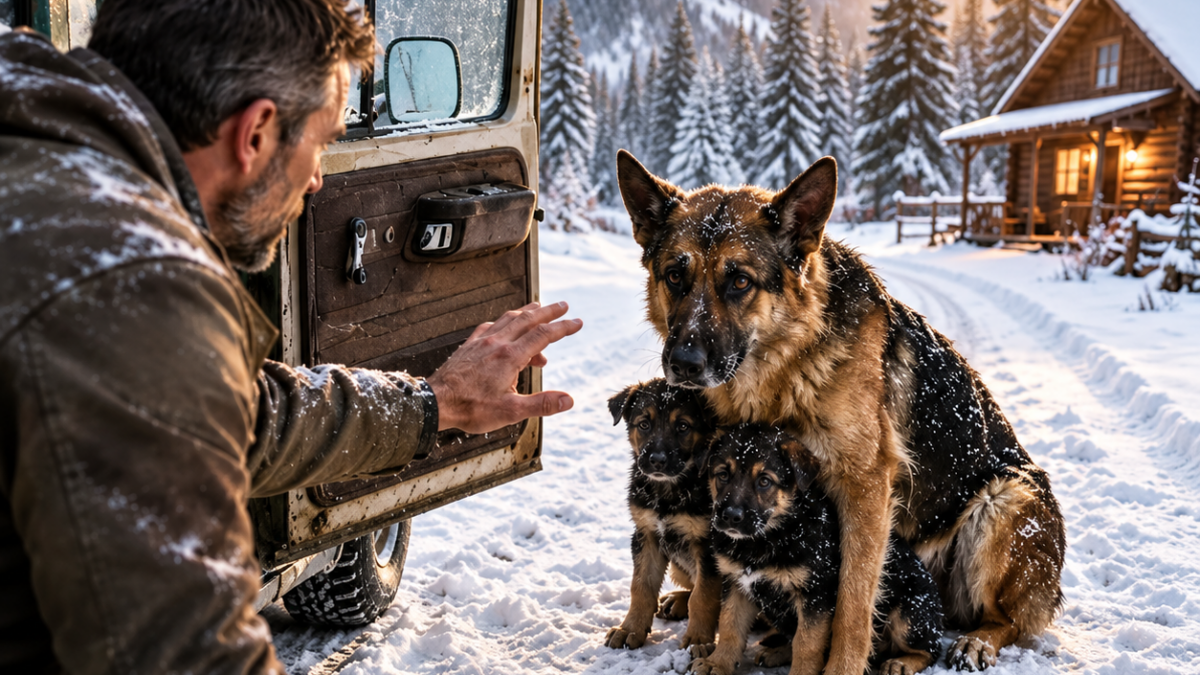
She climbed into the truck and folded herself into the back footwell without a sound.
I closed the door gently.
Then I stood in the rain, one hand on the handle, suddenly aware that I had not touched another living creature with tenderness in a long time.
“Okay,” I said to nobody.
Then I got behind the wheel and drove toward the cabin.
It was twelve miles.
I checked the rearview mirror every thirty seconds.
The mother dog stayed low in the back footwell, eyes open, body curved toward the puppies on the passenger seat. The dark puppy had his nose buried in Dana’s jacket. The sandy one still trembled. Every few minutes, I reached over to feel whether he was breathing.
“Stay with me,” I muttered.
The wipers beat hard.
Rain flowed across the road in black sheets.
The cabin sat at the end of a gravel track where tulip poplar and white oak crowded the edges like they were trying to reclaim the place. I pulled close to the porch and left the truck running with the heater on while I carried the puppies inside.
The cabin was cold.
I had not heated it properly in days. I had been living on crackers, canned soup, and coffee that tasted like punishment. Going to bed early just to make the hours pass faster. The kind of half-life that looks functional from a distance if nobody stands close enough.
I lined a wooden crate with towels and one old flannel shirt, then nested the puppies inside.
The dark one burrowed immediately.
The sandy one made a weak sound and pressed into him.
Then I went back for the mother.
She was standing in the rain beside the truck.
She had followed me out.
When I turned, she was simply there watching me, rain running down her muzzle, making no sound.
I crouched in the downpour and looked at her directly.
In the teams, I learned that direct eye contact with a frightened creature—animal or human—could be the most dangerous thing you did or the only honest one.
I gambled on honest.
“I know you don’t know me,” I said. “I’m not sure I know me either lately. But those two are inside where it’s dry, and I’d like you to come in too.”
She walked past me and through the open door.
I stood in the rain for another moment alone, listening to water move through the trees.
Then I went inside and built a fire.
Pine kindling first.
Two split logs of red oak.
A match.
The flame caught slowly, then grew.
The light changed the room.
Shadows that had felt permanent softened against the walls.
The mother dog settled on the braided rug with her chin between her front paws, amber eyes tracking every movement I made. I heated water, soaked a clean cloth, and wiped mud from her coat as gently as I could.
When I worked too close to the crate, her lip lifted once.
Not a threat.
A reminder.
I stopped immediately and lowered my eyes.
“Fair enough,” I said. “I’m a stranger.”
She watched me a second longer, then lowered her head again.
The name came to me while I sat back on my heels watching her breathe.
Cleo.
I do not know why.
Some names arrive complete.
I looked at the dark puppy stretching one paw sideways in sleep.
Stone.
The sandy one nosed against the flannel and settled.
Birch.
I did not say the names aloud.
Naming felt like a commitment.
And I had spent two years avoiding those.
Still, they were there in my head before midnight.
Cleo.
Stone.
Birch.
The rain kept falling.
I stayed awake by the fire with one hand resting near the crate, not touching, just near. Cleo did not sleep deeply. Neither did I. Every time one puppy stirred, she lifted her head. Every time the wind rattled the window, her ears shifted. She was exhausted, starving, chilled, probably feverish, and still keeping watch.
I knew something about that.
At some point before dawn, I opened my eyes and realized I had slept sitting upright with my back against the couch.
Cleo was looking at me.
Not afraid now.
Not relaxed either.
Just measuring.
“Morning,” I said.
Her ear twitched.
A knock came at the door at exactly seven.
Cleo rose so fast I did too.
The sound that came from her throat was low, deep, and full of history.
“Easy,” I said.
I opened the door and found Nadine O’Reilly standing on my porch with a paper bag in one hand and an expression that made clear she had already decided how the rest of my day would go.
Nadine was sixty-eight, small and spare, with silver hair cut short and practical. Her eyes were pale green, like old sea glass. She had been born in these mountains and intended to die in them. Between those two points, she had buried a husband and a son and emerged not harder exactly, but more distilled, as if grief had burned off everything unnecessary and left only what was useful.
Her son Danny had been twenty-three when his vehicle hit an IED outside Kandahar.
Army, not Navy.
But I recognized the shape of her loss.
The way she moved through a room. The way she paused sometimes mid-sentence, checking the weight of a word before giving it away. The way she did not waste comfort on people who needed action first.
We had been neighbors for two years without becoming friends.
Proximity is not intimacy.
And I had not been in the business of intimacy since Dana died.
Nadine pushed past me without waiting for an invitation.
“Saw your truck lights on half the night,” she said. “And you were pulled off on Route 7 in the storm yesterday.”
“Good morning to you too.”
“Don’t be cute. Where are they?”
“Who said there were they?”
She looked at the mud on my boots, the dog hair on my sleeve, and the tired fire behind me.
“Beck Sawyer, I was a veterinary technician for twelve years. I know the look of a man who has accidentally acquired animals.”
I stepped aside.
Cleo stood between Nadine and the crate.
Nadine stopped, lowered her eyes slightly, and let the room settle around her.
“Well,” she said softly. “Aren’t you something.”
Cleo watched her.
Nadine crouched slowly, not too close.
“She’s running a temperature.”
“You can tell from there?”
“I can tell from across the county if I need to.”
She glanced at the crate.
“Puppies?”
“Two.”
“Eating?”
“Not much.”
“You got food?”
“Canned soup.”
“For you or them?”
“Both, apparently.”
She gave me a look of such disappointment that under different circumstances I might have laughed.
“Good thing I came.”
From the paper bag, she produced broth, gauze, puppy formula, a thermometer, clean cloths, and a small brown bottle of antibiotics.
“I don’t have antibiotics,” I said.
“I do.”
“Should I ask?”
“No.”
Fair enough.
We worked through the morning in the easy parallel rhythm that sometimes develops between people who have had a lot of practice caring for things in distress.
Nadine crushed a tablet into warm broth and guided it to Cleo in small amounts. I kept the fire high and warmed towels on the hearth for the puppies. Stone, the dark one, accepted food first, suspicious but interested. Birch struggled more. His little body felt too light in my hands, and every swallow seemed to take effort.
Nadine watched me with him.
“You were a medic?”
“Not officially.”
“But you know how to keep hands steady.”
“I know how to follow instructions.”
“That’ll do.”
I showed her the faded dog tag I had found knotted in Cleo’s matted fur. It was stamped with her name—Cleo, which made my throat tighten in a way I did not appreciate—and a phone number. I had tried the number twice before dawn.
Disconnected.
Nadine turned the tag over in her fingers.
“Someone loved her once,” she said.
“Or owned her.”
“Sometimes both. Sometimes neither. People lose their situations. Doesn’t always mean they meant to lose what came with them.”
I did not answer.
Around noon, Birch discovered his tail.
He spun three complete circles before losing his balance and sitting down with the stunned expression of a creature encountering philosophy for the first time.
A sound came out of me.
Brief.
Rusty.
Unplanned.
I stopped immediately.
Cleo’s ears swiveled toward me.
Nadine did not look up from the pot on the stove, but the corner of her mouth shifted.
“There it is,” she said.
“There what is?”
“Nothing.” She stirred the broth. “Nothing at all.”
For three days, the rain continued.
In those three days, the cabin became something it had not been since Dana was alive.
It smelled of wood smoke, warm broth, damp dog, and the particular aliveness that comes when creatures need tending and someone agrees to do the tending. Towels hung over chairs. The woodpile shrank fast. Nadine came each morning and left each evening. I learned how much formula Birch would take before he turned his head away. I learned Stone liked to sleep with one paw over his brother’s neck. I learned Cleo would accept food from Nadine only if I stood where she could see me.
Her fever broke on the second night.
I was asleep against the couch with one hand resting near her head when she lifted her chin and placed her muzzle across my wrist.
I woke to that weight.
Warm now.
Not burning.
Steady.
I sat very still in the dark, listening to the rain, the fire, and the breathing of three dogs.
Something had shifted in the room’s arithmetic.
Not grief leaving.
Grief does not leave because a dog touches your wrist.
But grief had made space.
The way a river makes space around a stone.
It does not remove the stone.
It flows differently because of it.
Nadine told me about Danny the same way she did everything—unsentimental, direct, precise. Not how he died. Who he had been. A boy who brought stray animals home. A boy who fixed broken things compulsively. A young man who volunteered for a third deployment because he believed he was good at his job and believed the people beside him needed someone good at it.
“He would have built something out here,” she said one afternoon, watching Stone and Birch investigate a knotted rope I found in the storage shed. “He was that kind of person.”
I was quiet a moment.
“Dana was the building kind too.”
It was the first time I had said her name aloud to another person in months.
The weight of it moved through the room and settled.
Nadine did not offer condolence.
She did not soften her face.
She let the name take up its proper space.
“Then you know what that kind is worth,” she said. “And you know it doesn’t stop being worth something just because the person isn’t here to see it happen.”
I stared into the fire.
“I don’t know what I’m building.”
Nadine looked at the three dogs. Stone had fallen asleep on top of Birch. Cleo watched me with half-lidded amber eyes, and her tail moved once against the rug.
For the first time.
“I think,” Nadine said, “you might be further along than you realize.”
On the fourth morning, I was shaving at the kitchen window when the county vehicle turned up the gravel drive.
Cleo heard it first.
She rose from the braided rug and positioned herself between the door and the crate where Stone and Birch still slept. The low sound from her throat was not aggression.
It was memory.
The man who knocked was about my age, lean and weathered, wearing the tan uniform of the county animal welfare office. His name tag read MABRY. He had the look of someone who had held a hard job for a long time without becoming cruel, but without becoming soft either.
A quality I recognized.
“Mr. Sawyer,” he said. “Cord Mabry, County Animal Welfare. Had a report of an unregistered shepherd-type female with pups on this property.”
I looked at him steadily.
“I pulled them out of a ditch in a rainstorm. They didn’t come with paperwork.”
“I understand that. But I still need documentation. Proof they’re domestic. Vaccination records if they exist. Evidence of prior ownership.”
“I don’t own her. I found her.”
“Which is why I’m here.”
Mabry looked past me at Cleo.
She stood perfectly still, amber eyes fixed on him with the focused calm of a dog who had already made her decision.
He narrowed his eyes.
“She’s got working carriage.”
I said nothing.
“High drive. Somebody trained that animal.”
“Maybe.”
Mabry pulled a notebook from his breast pocket.
“Seventy-two hours,” he said. “Get her to a vet. Scan for a chip. Find any record of prior ownership. If she’s domestic and healthy, this ends simply.”
“And if I can’t manage that in seventy-two hours?”
His jaw shifted.
He looked from Cleo to Stone and Birch, who had woken in the crate and were watching with the combined gravity of creatures who did not understand what was happening but could feel the shape of it.
“County facility,” he said. “Assessment. Possibly separated.”
The word landed in the room like something dropped from a height.
Separated.
Cleo made the sound again, low and cellular.
I moved my hand quietly to her neck.
Beneath my palm, she trembled.
I thought of her in the mud under the limestone ledge, body curved around two dying puppies, refusing to move even when the world had given her every reason to quit.
Trust, once extended by something that has been broken, is not a small thing.
It is the bravest thing.
“I’ll find what I need,” I said.
My voice was even.
I had used that voice in rooms where evenness was the only thing standing between a situation and its worst version.
Mabry held my gaze.
“You serve?”
“Navy. Twenty-two years.”
“SEAL?”
I paused.
“Yeah.”
Something moved in his face.
“Army,” he said. “Two tours.”
He looked at Cleo again.
“Get her scanned before you do anything else. If she was working K9, the chip will tell you her history.”
He turned and walked back to his truck through the cold morning.
I closed the door and stood with my back against it.
Cleo turned and walked back to the crate, settling beside it as if she had decided whatever was coming, she would not face it standing alone.
The chip behind Cleo’s left shoulder confirmed everything.
Five years with a private K9 security contractor out of Raleigh.
The company had dissolved eighteen months earlier. Assets liquidated. Contracts terminated. Operations manager’s forwarding address: a P.O. box in Wilmington that had been closed since spring. The contact number on the chip matched the dead number on her tag.
Cleo had been passed along.
Then passed along again.
Then left at the edge of a mountain road in October rain with two six-week-old puppies and whatever remained inside her that was capable of keeping them alive.
The vet, Dr. Park, printed the chip record and handed it across the counter.
She was a quiet woman with the gentle efficiency of someone who had stopped being surprised by what people do to animals but had not stopped caring.
“Whoever worked with her knew exactly what they were doing,” she said.
Then she looked over her glasses.
“And whoever abandoned her should be embarrassed.”
I folded the paper and placed it in my jacket pocket.
From the parking lot, I called Mabry.
He answered on the second ring.
“Chip puts her as former contractor K9,” I said. “Company dissolved. Contact information dead. I’ve got the printout from the vet.”
A pause.
“Bring it to the office by tomorrow noon,” he said. “I’ll walk it through personally.”
Another pause.
“She was working K9?”
“Five years.”
“Then she deserves better than a county kennel.”
His voice carried a different quality now.
Not soft.
Honest.
“I’ll have the paperwork ready when you come in.”
I stood in the parking lot under a gray October sky.
“Mabry.”
“Yeah?”
“Thank you.”
“Don’t thank me. Get her squared away.”
The first real snow came three weeks later.
A light early-November dusting covered the gravel track, woodpile, and bare branches of the oaks in a thin white layer the morning sun would burn off before noon. I stood on the back porch with coffee while Stone and Birch met snow for the first time.
Stone stepped into it, stopped, lifted one paw, put it down, lifted another, then looked at me with an expression of profound personal betrayal.
Birch ate some.
Then sneezed for forty-five seconds straight.
Cleo watched them from the doorway with the patient expression of a mother who had made her peace with being surrounded by small persons of limited judgment.
I laughed.
Not a rusty almost-laugh this time.
A real one.
It came out before I could stop it.
Cleo looked back at me.
Stone forgot his betrayal long enough to pounce on Birch.
Birch sneezed again and attacked the snow as if it had insulted him.
I stood there with coffee cooling in my hand and realized I had woken up that morning without immediately wishing the day were over.
That frightened me.
Happiness after loss can feel like betrayal when it first returns.
Nadine arrived at nine with eggs from her chickens and news in her eyes.
“I spoke to Percy Vance,” she said, stepping into the kitchen like I had asked.
I had not.
“Good morning.”
“He runs a nonprofit in Asheville.”
“Does he know you announce people by last name before coffee?”
“He places retired military dogs with veterans struggling with isolation.”
That got my attention.
I poured coffee into a second mug because arguing with Nadine before caffeine was bad strategy.
“He’s been looking for a place to run a residency program,” she continued. “Somewhere with space. Away from the city. Someone who understands what the men and women are carrying.”
I said nothing.
“This property has twelve acres.”
“Nadine.”
“The shed out back is halfway to a kennel already.”
“It is full of rusted tools and a dead lawn mower.”
“Halfway, like I said.”
I looked out the window.
Stone was conducting a thorough investigation of a dead leaf. Cleo had moved off the porch and watched him with ears up, ready to intervene if the leaf became a threat.
“You’ve been working with Cleo for three weeks,” Nadine said. “And she is, not to overstate this, a different dog.”
She was right.
Cleo still checked doorways. Still tracked every person crossing the threshold. Still slept lightly. Still placed herself between the puppies and visitors. But there were stretches now, especially in the evenings when the fire was going and Stone and Birch were piled against her, when her eyes half closed and her breathing deepened.
She was not on duty.
She was resting.
That felt holy.
“I don’t know anything about running a program,” I said.
“You know what these people need.”
She did not say it as a compliment.
She said it as a fact.
Flat.
Transferable.
“I know what I needed,” I said.
“Good place to start.”
I looked at her.
“Nadine, I was barely keeping myself alive before these dogs.”
“And yet you kept them alive.”
“That’s different.”
“Yes,” she said. “Sometimes different is the only way back.”
I stared into my coffee.
“I need to think.”
“You’ve been thinking since the day I met you,” she said, placing a plate of eggs in front of me. “At some point, thinking becomes another word for waiting.”
I called Percy Vance that afternoon.
He had a deep voice, slow and warm, and asked better questions than most people did. Not about property first. Not money. Not logistics. People.
“You willing to have veterans on your land?” he asked.
“I lived with worse.”
“That’s not the same thing.”
“No,” I admitted. “It’s not.”
“You willing to let them be quiet?”
“Yes.”
“You willing to not fix them?”
That one made me pause.
Percy waited.
“I can learn,” I said.
“Good. Dogs hate men who think they’re repairmen for souls.”
I looked down at Cleo, who was watching me from the rug.
“Yeah,” I said. “I’ve noticed.”
By December, we had cleared the old shed.
Mabry showed up two Saturdays in a row with a post driver and no explanation beyond the fact that he had a free weekend. Nadine organized supplies with the systematic efficiency of a woman who had once managed a twenty-animal practice and was deeply glad to have a large project again. Percy visited twice, walked the land, talked to me, talked to Nadine, watched Cleo work, and finally stood beside the creek with his hands in his coat pockets.
“This could be something,” he said.
“What?”
“A place where nobody has to explain why they don’t sleep.”
By New Year’s, we had framed four kennels.
By February, we had a name.
Dana’s Ridge Veterans K9 Rest.
I almost refused when Nadine suggested Dana’s name.
I told her it felt like using her.
Nadine gave me the kind of look that could strip paint.
“Beck, honoring is not using.”
I did not answer.
She softened, slightly.
“Was she the building kind or not?”
“She was.”
“Then build.”
The first veteran arrived in March with a retired Belgian Malinois named Ranger and the look of a man who had forgotten stillness could be a choice instead of a symptom.
His name was Eli Turner.
He was thirty-two, former Marine, though he introduced himself only as “Eli” and stared past my shoulder when he said it. Ranger had been with him six months. The dog was trained, attentive, and exhausted by the task of holding a man together alone.
Eli sat on the porch for three hours the first afternoon while Ranger lay beside his boot.
He watched me work with Cleo in the yard.
He did not speak.
I did not ask him to.
On the second evening, I overheard him tell Nadine that he had not sat outside for more than ten minutes in two years.
Nadine said, “Mountains don’t ask questions.”
Eli said nothing.
But he stayed outside until dark.
Progress sometimes does not need applause.
Cleo taught me that.
Some kinds of progress you acknowledge by simply continuing to show up.
More veterans came after Eli.
Not many at first.
One at a time.
Then two.
Never more than the land could hold.
Some brought retired working dogs. Some came hoping to be matched with one. Some came because a spouse begged. Some came because a therapist recommended it. Some came because they had run out of reasons not to.
They came with different wars inside them.
Different uniforms.
Different scars.
Different ways of saying nothing.
At Dana’s Ridge, nobody was required to tell their story.
They were required to help with chores.
Feed dogs.
Stack wood.
Walk trails.
Repair fences.
Sit by the creek.
Show up for breakfast.
Learn the dogs’ signals.
Respect boundaries.
Their own and the animals’.
That last part mattered most.
Cleo became the unofficial ruler of the place.
She was not young, but she had presence. Veterans trusted her because she did not give affection cheaply. She watched. Measured. Approached when she chose. Stone grew into a broad, steady dog with a serious face and a habit of leaning his weight against people who looked like they might float away. Birch stayed lighter, quicker, full of mischief and surprising sensitivity. He could sense panic before anyone spoke and would place his sandy head on a boot, knee, or hand with solemn urgency.
I sometimes wondered what Dana would think of all this.
The kennels.
The veterans.
The dogs.
Nadine moving through my kitchen like she had always owned one drawer.
Mabry appearing randomly with county paperwork, donated crates, or fence hardware.
Percy calling me “Director” just to irritate me.
Stone stealing gloves.
Birch eating snow every chance he got and apparently learning nothing from the consequences.
Cleo sleeping near the fireplace, finally, fully, deeply.
I thought Dana would have approved.
I also thought she would have made better lists.
Spring came slowly to the Smokies that year.
When the redbuds bloomed along the creek, I walked out to the tree line behind the cabin where I had buried a tin box.
Inside were pieces of Dana I had not known where to put.
Her last grocery list.
A button from the green hiking jacket.
A photograph of us on the half-finished back porch, both of us squinting into sun.
The folded paper where she had sketched ideas for the garden she never planted.
I sat beside the buried box for a while.
I did not talk.
There was nothing that needed words.
After a while, Cleo came and sat beside me, shoulder against my knee. Stone and Birch were somewhere behind us arguing over a stick in the way they argued about everything—briefly, physically, and with complete forgiveness a moment later.
I put my hand on Cleo’s back.
The sun moved through new leaves.
Down near the creek, a kingfisher made its rattling cry.
I thought about Dana telling me the mountains were the only place she felt proportional to the world.
“Not small,” she had said once, standing on the ridge with her hair whipping across her face. “Not big either. Just right-sized.”
I had not understood then.
I was beginning to.
I thought about how she would have handled the nonprofit paperwork with terrifying efficiency. How she would have known immediately that Stone needed confidence-building more than discipline and Birch needed a job before he invented one involving destruction. How she would have seen through Eli’s silence in ten seconds and made him soup without asking if he was hungry.
I thought she would have loved the work.
I did not think it would be this hard to carry.
And I did not think it would be this possible either.
The carrying.
The continuing.
The daily ordinary fact of still being here with something worth tending.
That evening, I opened the kitchen drawer and took out Dana’s old harmonica.
It had been untouched for two years.
She used to play badly but happily, mostly folk songs and one simple tune she hummed whenever she painted, cooked, or drove with the windows down. Three verses. Nothing complicated. The kind of song that sounded like it belonged outdoors.
I sat on the porch in the spring dark.
The creek was running.
Tree frogs had begun their first conversations in the hollow below.
Cleo sat at my feet with her eyes half closed.
Stone leaned against my left boot.
Birch put his chin on Stone’s back and fell asleep before the second verse.
I played.
The first notes came out rough.
Then steadier.
The tune went into the dark, and the tree frogs answered, and the creek ran.
I played all the way through to the end without stopping.
When the last note faded, I sat quietly in the company of three dogs and whatever remains when the people we love are gone.
The shape of their goodness.
Still present.
Still working in the world through whatever we decide to build in their name.
I had not known that rainy October night that I was driving toward something.
I thought I was driving away from pain.
I thought I was just moving because stillness hurt.
But some roads know more than the people on them.
Sometimes they carry you to the exact place where something helpless is waiting.
Sometimes they stop you beside a broken guardrail in a storm and ask whether you are still capable of opening a door.
I opened mine for a soaking dog family in the rain.
Cleo stepped in.
Stone and Birch curled into Dana’s old jacket.
And somehow, without saying a word, they opened a door for me too.
I still miss Dana.
Every day.
That did not change when the dogs came.
It did not change when the kennels were built, or when veterans began arriving, or when the porch filled with muddy boots and quiet conversations, or when spring light touched the cabin windows in a way I no longer dreaded.
Missing her is part of loving her.
But grief no longer has the whole house to itself.
There is barking now.
Wood smoke.
Coffee.
Nadine arguing with Percy about storage labels.
Mabry’s truck in the drive.
Eli splitting kindling with Ranger sleeping nearby.
Stone leaning against someone who needs weight.
Birch chasing leaves like they insulted his family.
Cleo watching it all with amber eyes that have seen abandonment, rain, hunger, duty, and the long road back to trust.
And sometimes, when evening comes down blue over the ridge, I sit on the porch with Dana’s harmonica in my hand.
Cleo lowers herself beside me.
Stone and Birch settle near my boots.
The creek keeps moving.
The mountains become right-sized around us.
And I understand what Dana meant.
You cannot just survive a place.
You have to live in it.
I am trying.
Every day, I am trying.
And every day, because one starving mother dog touched her nose to my gloved hand in the rain, I have a reason to open the door again.








