A Girl Gave Her Only Umbrella to a Stranded Biker—She Never Asked Who He Was, and Never Imagined How Far Her Kindness Would Travel
PART3:
And when she recognized that stillness in the biker on Montford Avenue, every warning I had ever given her loosened its grip.
She crossed toward him instead of away.
“Sir?”
Her voice came out smaller than she wanted.
The man lifted his head slowly.
For a second, she was afraid again.
His eyes were red-rimmed and raw in a way rain could not explain. His face looked carved down by something recent. Something heavy. For all his size, he looked breakable.
“Are you okay?” she asked.
He stared at her like he had forgotten children existed.
Then he said, “Bike’s dead. Battery, probably. I’m fine.”
Hannah told me she almost laughed, not because it was funny, but because it was such an obvious lie.
He was not fine.
Even at eleven, she knew the difference between I am fine and please do not ask me to explain why I am not.
“You’re going to get sick standing out here,” she said.
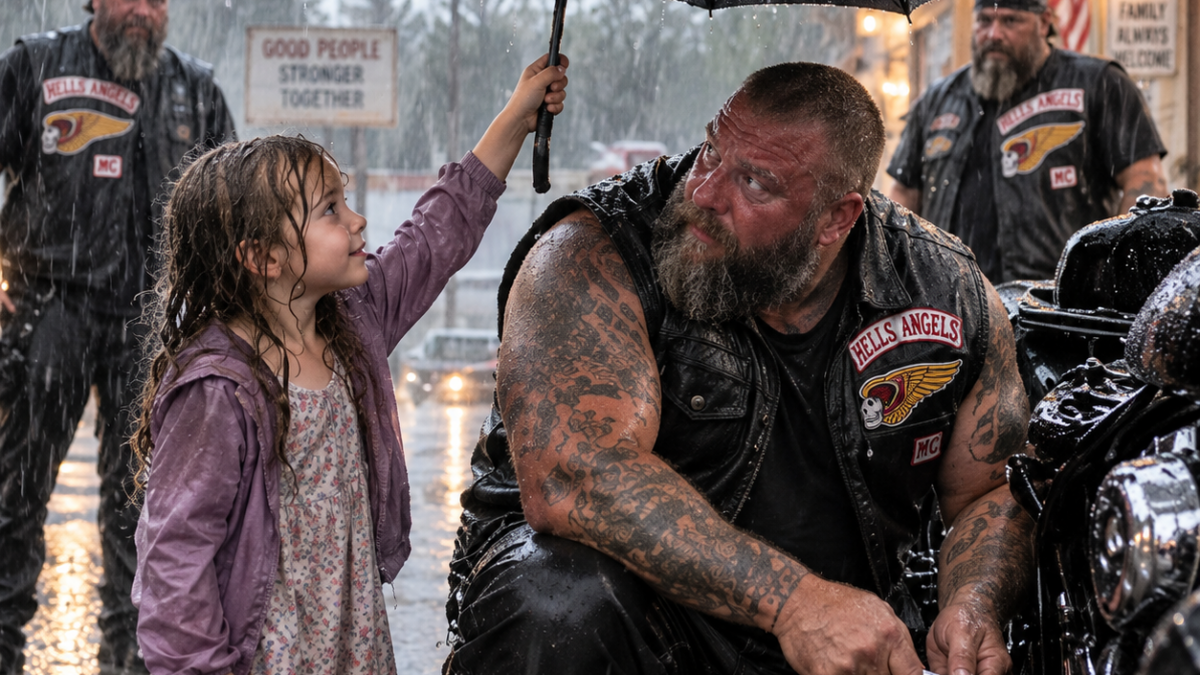
Before she could talk herself out of it, she unzipped her backpack, pulled out the yellow sunflower umbrella, and popped it open.
Then she stepped closer and held it up.
The image still catches me sometimes.
My small daughter in the pouring Asheville rain, arm stretched as high as she could reach, trying to hold an umbrella over a man nearly two feet taller than she was. The umbrella barely reached his shoulders. Rain still ran down his vest, his beard, his arms.
But she held it anyway.
The man looked down at her.
Something in his face cracked.
“Kid,” he said. “You don’t need to do that.”
“I know,” Hannah answered. “But you looked like you needed it more than me.”
He did not speak for a long moment.
Water ran down his face, but not all of it was rain.
“What’s your name?” he asked finally.
“Hannah.”
“Thomas,” he said. “Thomas Callahan.”
She pushed the umbrella handle into his hand.
“Take it. I only live a few blocks that way. I’ll be fine.”
He looked horrified.
“I can’t take a kid’s umbrella.”
“You can if I’m giving it to you.”
She said it with my voice.
That is what mothers never fully understand. Our children borrow our authority long before they borrow our car keys.
Apparently, the corner of his mouth almost smiled.
The first almost-smile he had managed in days, though Hannah did not know that yet.
He took the umbrella.
His fingers brushed hers, cold as the rain.
“I’ll get this back to you,” he said. “I promise.”
Hannah shrugged and started backing away, already soaked.
“It’s okay if you don’t. It’s just an umbrella.”
But Thomas Callahan did not look like a man who took the word just lightly.
Not about anything.
She jogged the rest of the way home without seeing him watch her go. She did not see him look down at the small yellow umbrella in his huge scarred hand. She did not see his jaw tighten against a grief that had nothing to do with weather.
When she came through our front door, dripping water all over the mat, I was not home yet.
Our neighbor Mrs. Hollis saw her through the window and called me before Hannah had even changed clothes.
“Rachel, honey, Hannah walked home in the rain without an umbrella.”
I sighed into the phone, pinching the bridge of my nose.
“She lost it?”
“No. She gave it to a man.”
That got my attention.
“What man?”
“A biker, I think. Big fella. On Montford. I didn’t see the whole thing, just saw her come down the block soaked.”
By the time I got home, Hannah had changed into sweatpants and one of my old shirts, made herself toast, and left a wet backpack dripping in the bathtub like that solved everything.
I stood in the kitchen doorway.
“Where is your umbrella?”
She looked up from her toast.
“I gave it to somebody.”
“To a stranger?”
“Yes.”
“A grown man?”
“Yes.”
“In the rain?”
“That’s why he needed it.”
“Hannah.”
That was the voice.
The mother voice.
The voice that means a child has stepped too close to the edge of what fear will tolerate.
She set down the toast.
“He was crying.”
“You don’t know that.”
“I know what crying looks like when someone is trying not to.”
That stopped me.
I wish I could tell you I responded with grace.
I didn’t.
I was tired. I was scared. I was a single mother with two children, a long shift behind me, groceries still in the trunk, and an image in my mind of my daughter walking toward a large unknown man in a leather vest on a rainy street.
So I said, “You cannot do that. You cannot walk up to strange men just because they look sad.”
Her face changed.
Not defiant.
Disappointed.
That was worse.
“I didn’t just walk up because he looked sad,” she said quietly. “I walked up because everyone else walked past.”
I had no answer that would not make me sound like the kind of adult she was beginning to mistrust.
So I fell back on safety.
“We are going to talk about this later.”
She nodded.
But I knew, even then, that she did not regret it.
I, on the other hand, spent half the night angry at a man I had not met because anger felt easier than admitting my daughter might have seen something true and responded better than I would have.
What Hannah did not know, what none of us knew, was that Thomas Callahan had buried his wife three days earlier.
Her name was Maria.
She had been fifty-two.
Cancer.
The long kind.
The kind that does not take a person all at once, but room by room, until the person you love is still there and already leaving.
Thomas and Maria had ridden that stretch of Montford for years. Not because it was scenic in the obvious postcard way, but because there was a curve near an old gas station where, if the weather was clear, the mountains seemed to open for just a second between buildings. They used to stop there on Sunday rides. Coffee in paper cups. Rain or shine. Maria would complain about the cold and then refuse to go home.
After the funeral, Thomas could not sit in their kitchen.
He could not look at her mug by the sink.
He could not sleep in the bed where one side had become impossibly empty.
So he rode.
He rode without destination until he found himself at the old stop on Montford Avenue, where the rain came down and the battery died and some part of him decided that was fair.
He could have called for help.
He had friends.
He had a club.
The Blue Ridge Riders had been his family for nineteen years.
But grief had told him a lie, and for a while he believed it.
You do not deserve help.
So he stood in the rain beside a dead motorcycle and let the cold enter him because cold was at least something he could feel.
Then my daughter walked up and handed him a yellow umbrella.
By Saturday, the story had already outgrown Hannah’s understanding of it.
She had not told anyone at school. She had barely told me. To her, it was simple. A person needed shelter. She had shelter. The math solved itself.
But Thomas told the story to Kevin Marsh, who ran the garage on Haywood Road, where the bike was towed the morning after.
Kevin listened while replacing the battery.
When Thomas got to the part about Hannah holding up the umbrella, Kevin stopped working.
“She wasn’t scared of you?”
Thomas looked at the floor.
“She should’ve been. I looked like hell.”
“Doesn’t sound like it mattered to her.”
Thomas did not answer.
The yellow umbrella leaned against the garage wall, still damp, sunflowers bright against gray cinder block.
He had meant to return it that evening.
He didn’t.
Some part of him was not ready to let go of the one object that had made him feel, even briefly, like someone worth being kind to.
On Sunday, he told the story again at the Blue Ridge Riders’ weekly gathering.
He did not mean to.
A man named James Delgado asked why he looked steadier, and the story came out before Thomas could stop it.
The room went quiet.
I know people imagine motorcycle clubs as constant noise. Engines, laughter, profanity, beer bottles, boots scraping concrete. And maybe sometimes they are. But rooms full of men who have buried people know how to go silent with reverence.
Andrew Pierce, the club’s oldest member, spoke first.
He was sixty-three, had buried two wives, and carried sorrow without showing it off.
“You know where she lives?”
“Roughly,” Thomas said. “Chestnut Street near Montford.”
Andrew nodded.
“We’re getting that umbrella back to her properly.”
Thomas did not know what properly meant until the following Thursday.
Hannah was walking home from school with Caleb, who had spent the entire day angry because his class had run out of chocolate milk before he reached the front of the lunch line.
They turned onto Chestnut Street and stopped dead.
Four hundred motorcycles lined our quiet street.
Not forty.
Not a dozen.
Four hundred.
They stretched farther than Hannah could see, chrome and leather and engines idling low, a sound like thunder being held politely in place. Neighbors stood on porches, behind curtains, at open doors, phones in hand, eyes wide.
Caleb grabbed Hannah’s sleeve.
“Hannah,” he whispered. “Are we in trouble?”
She did not answer because she did not know.
Her first instinct was fear.
This time, I do not blame her.
Four hundred bikers on your street will do that.
Then she saw Thomas.
He stood at the front of the crowd, dry now, beard trimmed, vest clean, eyes clearer than they had been in the rain though still shadowed. In his hands was the yellow sunflower umbrella.
“Hannah Whitfield,” he called, his voice carrying across the street. “I believe this is yours.”
She walked toward him slowly.
I was not there yet.
That fact still bothers me, though no harm came of it.
I was at work when Mrs. Hollis called in hysterics.
“Rachel, there are motorcycles everywhere. Everywhere. And Hannah is walking toward them.”
I do not remember hanging up.
I remember grabbing my keys.
I remember the drive home feeling impossible, every red light a personal attack.
By the time I turned onto Chestnut, the street looked like something from a dream I did not know whether to call nightmare or parade.
Bikes lined both sides.
Men and women in leather stood beside them.
No one moved toward my children.
No one shouted.
No one blocked my car.
They parted enough for me to pull halfway onto the curb.
And there, in the middle of the street, was my daughter hugging the largest man I had ever seen.
For one full second, all the warnings I had ever heard screamed inside me.
Then Andrew Pierce stepped toward me, palms open.
“Mrs. Whitfield?”
“Where is my daughter?”
“She’s safe. I promise. This is about the umbrella.”
“That sentence does not help as much as you think it does.”
He actually smiled.
Fair.
Then he explained quickly, gently, while I watched Hannah pull back from Thomas and wipe her face like she had not expected tears and found them inconvenient.
Thomas had crouched to her level before giving back the umbrella. That detail mattered to me later. Enormous men who understand how to make themselves smaller around children are rarely careless.
He had held the umbrella out with both hands.
“You gave this to a stranger in the rain,” he told her. “Didn’t ask my name first. Didn’t ask if I was safe. You just saw somebody who needed help, and you helped him.”
Hannah said, “It was just an umbrella.”
He shook his head.
“It wasn’t. Not to me. Not that day.”
Then, in front of four hundred riders and half our neighborhood, Thomas Callahan told my daughter that he had buried his wife three days before he met her. That he had been standing on Montford Avenue because it was where he and Maria used to stop on rides. That he had not cared if the rain made him sick. That for a little while, he had not cared about much of anything.
“And then this kid,” he said, voice rough, “walks up and hands me her umbrella like I mattered.”
Hannah did not know what to say.
She was eleven.
Nobody had taught her the vocabulary for standing in the center of four hundred motorcycles while a grieving man explained that her kindness had reached him at the edge of despair.
So she hugged him.
That was what I saw.
My daughter’s arms around worn leather. Thomas frozen at first, then carefully hugging her back like she was something fragile and holy.
And around them, four hundred engines idling in respectful silence.
When I understood, pride hit first.
Then fear.
Then something more complicated.
Because I had judged him too.
For half a second when I arrived, before Andrew spoke, before I knew, before the story became safe enough for me to accept, I saw a huge tattooed man holding my daughter and assumed danger.
That half second stayed with me.
It still does.
Andrew told me, “We wanted to do this right. Your daughter did something most adults wouldn’t have had the nerve to do. We wanted her to know it mattered.”
I looked at Hannah.
She was holding the umbrella, cheeks flushed, entirely unafraid.
Then I looked at Thomas.
He stood a few feet away now, hands loose at his sides, giving me space to decide who he was.
That may have been the first thing I truly noticed about him.
He did not demand trust.
He made room for it.
“Thank you for bringing it back,” I said.
It was inadequate.
It was all I had.
Thomas nodded.
“Thank you for raising her.”
I almost cried then.
Not because the words were grand, but because he meant them.
The story might have ended there as a sweet local moment, the kind that gets passed around on social media with heart emojis and comments about restored faith in humanity.
For a little while, that was exactly what happened.
Someone posted a photo of Hannah hugging Thomas under the headline:
Local Girl’s Kindness Brings Out Hundreds of Motorcyclists
People shared it.
Most comments were kind.
Some were not.
The trouble started two weeks later with my former mother-in-law, Diane Whitfield.
Diane had been mostly absent from our lives since my husband left. She was not cruel exactly. Cruelty suggests warmth turned sour. Diane was colder than that, a woman who believed concern gave her the right to control any room she entered.
She saw the photo online.
She did not see kindness.
She saw danger.
She called me that evening.
“You let Hannah walk up to some biker gang?”
“They’re not a gang, Diane. It’s a motorcycle club.”
“Oh, is there a difference?”
“Yes.”
“Have you met these people?”
To my surprise, I had.
In the two weeks since Chestnut Street, Andrew Pierce had taken me for coffee because he wanted to make sure Hannah was all right after the attention. I had learned that many of the Blue Ridge Riders were veterans. That they organized a toy drive every December for the children’s hospital. That Thomas worked as a machinist. That before Maria’s illness became too consuming, he volunteered Saturdays at a downtown shelter.
None of that fit Diane’s picture.
I told her so.
It did not help.
She called the school.
She insisted a known motorcycle gang had surrounded a minor without adult supervision. She demanded to know whether Hannah was safe at home. She used phrases like troubling judgment and exposure to dangerous individuals. The principal, who was kind but bound by procedure, called me in for a meeting that left me furious and humiliated.
Then the comment sections turned uglier.
People who had never met Thomas speculated about his criminal history.
His intentions.
My parenting.
Hannah’s innocence.
The danger supposedly represented by a man’s size, tattoos, leather vest, and grief.
Thomas felt it.
I know because he began pulling back.
The Sunday coffee invitation he had accepted became a polite excuse. He stopped texting Andrew when he passed our neighborhood. He left the repaired umbrella on our porch after fixing one bent spoke rather than knocking.
He had spent nineteen years building a life where the leather and tattoos were not a costume or a warning, just part of who he was.
Machinist.
Widower.
Rider.
Friend.
Man who loved his wife.
Man who carried grief badly some days and better on others.
The comments reminded him that some people would always see the leather first.
Hannah found out because children always do.
I tried to tell her gently in the kitchen after dinner.
“Grandma Diane is worried.”
Hannah looked up from peeling an orange.
“About what?”
“About Thomas. About the motorcycles. Some people online are saying unkind things.”
“Is Thomas in trouble?”
“No, sweetheart.”
“Did he do something wrong?”
“No.”
“Then why is everyone acting like he did?”
I had no answer that made moral sense.
Because the honest one was ugly.
Because people looked at him and decided.
Because fear feels responsible when it points at the right costume.
Because it is easier to keep being afraid than to admit you were wrong.
The following weekend, Hannah asked me to drive her to the garage on Haywood Road.
I hesitated.
Not because I feared Thomas anymore.
Because I feared the world around him. The noise. The accusation. The way kindness can become complicated once adults touch it.
But Hannah stood in the kitchen holding that yellow umbrella, now dry and carefully folded, and said, “If people are being mean because of me, I should go.”
“People are not being mean because of you.”
“They are being mean because I didn’t cross the street.”
That sentence ended the argument.
We drove to the garage.
Thomas was under a car when we arrived, only his boots visible. The place smelled like motor oil, rubber, coffee, and metal. A radio played low somewhere in the back.
Hannah waited until he rolled out on a creeper, wiping grease from his hands with a rag that looked older than my marriage.
“Hey, kid,” he said.
His smile did not reach his eyes.
“Everything okay?”
“I heard people are saying mean things,” Hannah said.
I stood behind her, letting her speak because she had asked me to.
Thomas’s jaw tightened.
“Some people are going to think what they think.”
“That’s not an answer,” she said.
He looked at me.
I lifted both hands slightly.
She was not wrong.
“Not much I can do about it,” he said.
“Yes, there is.”
“What?”
“You can stop coming around. That’s what they want. But that’s not the same as them being right.”
Thomas went still.
There are moments when a child says something so cleanly that adults have to decide whether to pretend not to understand.
Thomas understood.
“When did you get so smart?” he asked.
“I’m not smart. I just remember what it felt like to almost cross the street.”
His face changed.
“I didn’t because something told me not to,” she continued. “But I could have. And if I had, you’d have just been alone in the rain. And everyone who’s scared of you now would never know any different.”
For a long moment, Thomas said nothing.
When he finally spoke, his voice was thick.
“Your grandmother isn’t wrong to worry, you know. The world has real dangers in it.”
“I know. But careful and scared aren’t the same thing.”
He looked at her like she had opened a door he had forgotten existed.
“You taught me that,” she said.
“I don’t think I did.”
“You did.”
Children assign lessons where they need them.
Sometimes they are right.
Thomas looked at me then.
“I’ll be at the club meeting Sunday. I’d like it if you and the kids came by. Not to prove anything. Just because I’d like you there.”
I should have needed more time.
Instead, I heard myself say, “We’ll come.”
Diane stopped speaking to me for almost a month when she found out.
It was one of the more peaceful months of my adult life.
Then came the river.
Late November in Asheville can turn cruel without warning. A week of rain had swollen the French Broad River until it ran fast and brown, carrying branches and foam along the banks. The ground stayed soft. Ditches overflowed. Every parent received the usual reminders from school about wet playground rules and proper pickup.
Caleb was seven, which meant warnings entered him as information and left him as suggestions.
That Tuesday, during afternoon recess, a stray dog appeared beyond the school fence.
According to the teacher on duty, Caleb saw it through a gap near the back corner of the playground. He loved dogs with the full-body urgency of a child who had never been allowed to own one. He followed it.
Not far at first.
Then farther.
Three blocks.
By the time he lost sight of the dog, he was turned around, scared, and too embarrassed to knock on a stranger’s door. He wandered toward the edge of the French Broad where the bank dropped steeply behind an old service road slick with mud.
He tried to climb back up.
His foot slipped.
Thomas was two blocks away delivering a machined part to a customer’s shop when he heard the scream.
A child’s scream cuts through the world differently.
He ran.
No thought.
No plan.
Just boots pounding pavement toward the sound.
He reached the riverbank in time to see a small figure in the water, arms flailing, being pulled by a current that had already carried him ten feet from where he had fallen.
Thomas did not hesitate.
He went in fully clothed.
Boots.
Jeans.
Work shirt.
Wallet.
Phone.
Everything.
The cold hit him like a wall. The current fought him for every foot. He was strong—nineteen years of hauling engines and steel had built strength that did not quit easily—but rivers do not care how strong a man is.
Above him, people gathered and shouted.
Someone called 911.
Someone screamed for a rope.
Thomas reached Caleb and got one arm around his chest.
Caleb was coughing, panicking, clawing at him with the blind terror of a drowning child.
Thomas turned him, locked him against his body, and fought for the bank.
It took almost three minutes.
Three minutes is nothing until someone you love is inside them.
Then it becomes a country.
When Thomas finally dragged himself and Caleb onto the muddy grass, both were coughing, shaking, alive. He stripped off his leather jacket with numb fingers and wrapped it around the boy before the paramedics even arrived.
Only then did he look down and recognize him.
“Caleb?”
My son blinked up through wet hair, teeth chattering.
“Thomas.”
I received the phone call every parent dreads.
There has been an incident.
Your son is safe.
He is being taken to Mission Hospital.
Safe does not matter at first.
The body hears hospital and child and fills in every possible horror.
I do not remember driving there.
I remember running through the sliding doors.
I remember a nurse saying my name.
I remember seeing Caleb sitting up in a hospital bed, pale and exhausted but unharmed.
And beside him, wrapped in a hospital blanket over clothes he had refused to change out of until he knew Caleb was all right, sat Thomas Callahan.
I crossed the room and grabbed my son.
I checked his face, his hands, his feet, his breathing. I touched him everywhere because mothers do not trust doctors until their own hands confirm the miracle.
Then I turned to Thomas.
“You went into the river.”
He looked uncomfortable.
“Wasn’t going to let a kid drown two blocks from me.”
“You could have died.”
“Could have.”
He shrugged slightly.
“Didn’t.”
I sat down hard in the chair beside the bed.
Adrenaline drained out of me so fast I felt hollow.
Gratitude came first.
Then shame.
Not the shallow shame of being embarrassed.
The deeper kind.
I thought of every cautious look I had given him before knowing him. Every time I had told myself I was more open-minded than other people while still feeling relief when he stood a few extra feet away from my children. Every second I had allowed Diane’s fear to make me doubt what I had seen with my own eyes.
A man who looked like danger had just dragged my son out of a swollen river.
“Thank you,” I said.
It was too small.
He knew it.
I knew it.
But some words are small because they have to pass through a throat that is barely working.
“Thank your daughter,” he said.
I stared at him.
“She’s the one who taught me it was worth showing up for people. I was ready to disappear after Maria, after all that ugliness online. Hannah’s the reason I was even in this part of town today. I was dropping off a part for a shop she told me about.”
He looked at Caleb, who had already fallen asleep against the pillow.
“Funny how that works out.”
The news traveled faster than the umbrella story ever had.
By evening, local stations were running footage from the riverbank.
Tattooed biker rescues seven-year-old from French Broad River.
This time, the story did not come wrapped in suspicion. There was no ambiguity people could easily twist. A man had risked his life for a child he had no obligation to save.
Diane saw the segment.
She saw Caleb’s face.
She saw Thomas wrapped in a blanket, soaked, grimacing away from the camera.
She called that night.
Her voice was smaller than I had heard it in years.
“I was wrong,” she said.
I closed my eyes.
“Yes.”
“I judged him before I knew him.”
“Yes.”
“I’m sorry.”
It was not a grand reconciliation.
Those rarely come all at once.
But it was a beginning, and I was too exhausted and grateful to refuse a beginning.
By spring, Thomas had become part of our life in the quiet, unremarkable way real belonging happens.
Not through declarations.
Through showing up.
A kitchen chair stopped wobbling because Thomas fixed the leg.
A bookshelf no longer leaned because he reinforced it.
Caleb’s bike chain, which had been coming off every third ride, suddenly worked perfectly.
Our porch light, dead for six months, came back to life on a Sunday afternoon after Thomas stood on a ladder and muttered insults at the wiring.
He came to dinner most Sundays. At first, he brought tools or repaired objects as justification. Then one week he brought nothing but bread from a bakery Maria had loved, and we all pretended not to notice that he was learning he did not need an excuse.
Caleb developed hero worship so intense it bordered on religious.
Hannah, at her insistence, began learning basic engine maintenance from him.
She approached engines the way she approached people: directly, without flinching, asking questions until the answer stopped skipping steps.
“What does this do?”
“Alternator.”
“Why?”
“Charges the battery while the engine runs.”
“How?”
Thomas looked at me once and whispered, “She asks like a prosecutor.”
“You encouraged this.”
He sighed.
“I know.”
He still grieved Maria.
That did not stop.
Grief does not vanish because a child hands you an umbrella or a family makes room at the table. It changes temperature. It becomes less sealed. It stops being a locked room and becomes weather—still capable of storms, but no longer the whole house.
Sometimes I saw him drift during dinner when someone said a phrase Maria used to say. Sometimes he touched the ring on his right hand without realizing it. Sometimes, after washing dishes, he stood on the porch for a few minutes before coming back inside.
We let him.
That was one thing Hannah taught us too.
Not every sadness needs interruption.
The Blue Ridge Riders’ annual toy drive that December raised more than it ever had.
Partly because of the news coverage.
Partly because the town had been forced to look again.
People who once crossed streets now brought toys. Teachers volunteered to sort donations. Neighbors who had posted suspicious comments online arrived with checks and awkward apologies. Diane came with three bags of stuffed animals and stood in line for fifteen minutes before walking up to Thomas.
I watched from across the room.
She held out her hand.
He took it.
I do not know what she said.
I know he nodded.
Sometimes that is enough.
Hannah gave a short speech at the toy drive.
She stood on a folding chair because she was too short to be seen over the crowd. The same yellow sunflower umbrella, now repaired after one spoke bent in a windy afternoon, leaned against the chair.
Her voice was steady.
“Everybody always tells you not to judge a book by its cover,” she said. “But I don’t think most people actually believe that. I think they say it and then do the opposite the second they’re scared.”
A ripple moved through the crowd.
She continued.
“I was scared too, for like two seconds, when I saw Thomas on the street. But I decided to find out if I was right to be scared instead of just believing it.”
Thomas stood near the back in his cleaned and mended leather vest, arms folded, eyes fixed on the floor.
“I wasn’t right,” Hannah said. “He was just sad and cold and needed somebody to notice him.”
She paused, looking out at bikers, neighbors, teachers, nurses, my family, Diane standing stiff and teary near the back.
“I think if more people actually found out instead of just assuming, a lot fewer people would be standing alone in the rain.”
Thomas had to turn away.
So did I.
Later, after toys had been loaded into vans bound for the children’s hospital and the crowd had thinned to the Whitfields and a handful of riders finishing coffee in paper cups, Thomas found Hannah sitting on the curb with the umbrella across her knees.
“You still carry that thing everywhere,” he said, lowering himself beside her with the careful discomfort of a large man negotiating a curb.
“It’s a good umbrella.”
“It is.”
“Besides, you gave it back. Feels wrong to leave it in a closet.”
Thomas looked out at the string lights the club had hung for the drive.
“You know,” he said, “I used to think the world was simple.”
Hannah looked at him.
“You look a certain way. People decide who you are before you say a word. I stopped expecting anything different.”
He rubbed a hand over his beard.
“Now I think maybe the world’s simple in a different way.”
“How?”
“Maybe some people stop at the first look. And some people keep looking until they actually see something true.”
Hannah considered that.
Rain began to fall then.
Light.
Unhurried.
The kind Asheville sees a hundred times a year.
Thomas glanced at the umbrella.
“You going to open that?”
Hannah looked at the sky, then at him.
“No.”
So they sat together, umbrella closed across her knees, letting the rain fall.
Not because shelter did not matter.
Because for once, neither of them was alone in it.
I stood near the toy van watching them, and I understood something I had been slow to learn.
Safety is not the absence of strangers.
It is the presence of judgment good enough to tell the difference between threat and sorrow.
Kindness is not recklessness.
Fear is not wisdom.
And sometimes the person your child sees most clearly is the one you were prepared to misunderstand.
Years have passed since that umbrella.
Hannah is older now, taller, sharper in ways that both thrill and frighten me. Caleb still tells the river story with too much enthusiasm and not enough appreciation for how many years it took off my life. Diane is still Diane, but softer around the edges where Thomas is concerned. She brings him pound cake every Christmas and pretends it is for everyone.
The yellow umbrella still hangs by our front door.
Its sunflowers are faded now. One spoke is newer than the others. The handle has a scratch from being dropped on the garage floor. It is still, somehow, a good umbrella.
Hannah carries it when rain threatens.
Not always.
But often.
Thomas still comes Sundays.
Sometimes with grease under his nails.
Sometimes with flowers for our table because Maria used to say houses needed living things in jars.
Sometimes quiet.
Sometimes laughing.
Always seen.
That is the gift my daughter gave him before any of us understood it.
Not shelter from rain.
Recognition.
A small hand reaching across the distance adults had built and saying, You are a person before you are a warning.
I used to think I had to teach Hannah how to move through the world.
I did.
But she taught me how to look at it.
She taught me that the first story fear tells is not always the truest one.
She taught me that a man can look like every warning and still be the one who runs toward your drowning child.
She taught me that an umbrella can be just an umbrella, and also not just an umbrella at all.
Because one rainy Thursday in Asheville, an eleven-year-old girl stood on a sidewalk and made a calculation adults around her had failed to make.
He is wet.
I have shelter.
He is alone.
I can cross the street.
And from that simple math came four hundred motorcycles, one returned umbrella, one rescued boy, one changed grandmother, one healed family, one toy drive that fed a whole season of generosity, and a grieving man who learned he still mattered.
People ask me if I would want her to do it again.
That is the question that keeps mothers awake.
Would I want my daughter to approach a strange man in the rain?
No.
Yes.
I don’t know.
I want her safe.
I want her wise.
I want the world to be simple enough that those two desires never fight each other.
But the world is not simple.
So I teach her caution.
And she teaches me courage.
Between the two, maybe we are both learning how to see.
The last time it rained hard, I found Thomas and Hannah on the porch steps. Caleb was inside, pretending to do homework while actually feeding crackers to the dog we eventually adopted because Caleb never stopped asking.
The umbrella leaned unopened beside Hannah.
Rain silvered the street.
Thomas looked up as I opened the door.
“She says we don’t need it,” he said.
Hannah shrugged.
“We’re under the porch.”
“That is technically true.”
Thomas smiled.
A real smile now.
Not healed.
Not unscarred.
Real.
I sat beside them.
For a while, none of us spoke.
Across the street, Mrs. Hollis’s porch light came on. A car passed slowly through the rain. Somewhere farther off, a motorcycle engine moved through the wet evening, low and fading.
No one crossed the street.
No one needed to.
And the umbrella stayed closed.








