A Giant Biker Walked Into a Children’s Cancer Ward Wearing a Rainbow Wig—Then Everyone Learned Why He Had Changed His Hair Every Morning for 200 Days
PART3:
Some become impossible because fear needs somewhere to go and hospital staff are nearby.
Rachel became watchful.
She watched Lily’s breathing.
Watched her temperature.
Watched the IV pump.
Watched the faces of doctors entering the room, trying to read news before anyone said it.
She watched Caleb too.
Because for all his size, all his tattoos, all his heavy boots and road-hardened silence, Rachel knew what the rest of us would learn later.
Caleb was not stone.
He was a father whose whole world fit inside one hospital bed.
Then came the hair.
Everyone had warned them it might happen.
Warnings do not prepare you for your child holding strands of herself in both hands.
It started on a Tuesday morning.
Lily woke up and saw hair on her pillow.
Rachel went still.
Caleb stood behind her, unable to move.
Lily touched the pillow, then her head, then looked at her father with terror that had nothing to do with vanity.
It was proof.
That was what made it unbearable.
The illness had become visible.
For days, they tried softness.
Gentle brushing.
Loose hats.
Headbands.
Changing pillowcases before Lily saw too much.
Making jokes that did not quite survive the room.
But the hair kept coming.
In the bathroom sink.
On the couch.
On Rachel’s sleeves.
On Caleb’s shirt when Lily hugged him.
Every strand felt like a tiny announcement the family had never agreed to make.
Finally, Lily asked to shave the rest.
Rachel did it.
Caleb sat on the closed toilet seat and held Lily’s hand while the clippers buzzed. He watched brown curls fall onto a towel and felt something inside him beg for a trade no universe offered.
Take mine.
Take all of mine.
Leave hers.
When it was done, Lily touched her bare head and stared at the mirror for less than one second before looking away.
“I look like cancer,” she whispered.
Rachel cried then.
Caleb did not.
Not in front of Lily.
He kissed the top of her head and said, “You look like my daughter.”
Lily did not believe him.
That night, after Lily fell asleep, Caleb stood in the garage beside his Harley and understood something terrible and simple.
He could not give Lily her hair back.
He could not take the chemo for her.
He could not bargain with the scans.
He could not threaten the cancer into leaving, though I believe if cancer had been a man standing in front of Caleb Mercer, it would have reconsidered its choices.
But maybe he could give Lily something else.
Maybe he could give her laughter.
The next morning, Caleb went shopping for the loudest color he could find.
The party store clerk tried not to stare.
I know because Caleb told me the story later, and even after everything, he still looked embarrassed about it.
He stood under fluorescent lights with his tattooed arms, heavy boots, huge beard, and biker shoulders, filling a shopping basket with wigs nobody expected him to touch.
Pink curls.
Blue bob.
Purple waves.
Green spikes.
A rainbow wig with bangs so aggressive they looked like they had opinions.
He added glitter clips, plastic flowers, a tiara, a leopard-print headband, and one wig stand because even a joke deserved maintenance.
The clerk was a young Latina American woman with tan skin, dark hair in a ponytail, silver hoop earrings, and a name tag Caleb admitted he had been too overwhelmed to read.
She looked at him.
Then at the basket.
Then back at him.
“Costume party?” she asked carefully.
Caleb swallowed.
“Hospital.”
Her expression changed.
“My kid,” he added.
The clerk stopped scanning.
Then she picked up the pink wig and placed it gently in the bag as if it had become something breakable.
“Good luck,” she said.
Caleb nodded because more words would have broken him.
At home, he put the pink wig on in the bathroom and immediately regretted owning mirrors.
The thing sat too high on his head.
His beard made it worse.
The tiara made it criminal.
He looked like a biker who had lost a fight with a cotton-candy machine.
Rachel walked in, froze, and made the first real laugh their house had heard in weeks.
Then the laugh turned into tears.
Most good laughs did that now.
“Caleb,” she whispered.
He turned toward her, pink curls bouncing.
“Too much?”
Rachel looked at him for a long time.
“Not enough.”
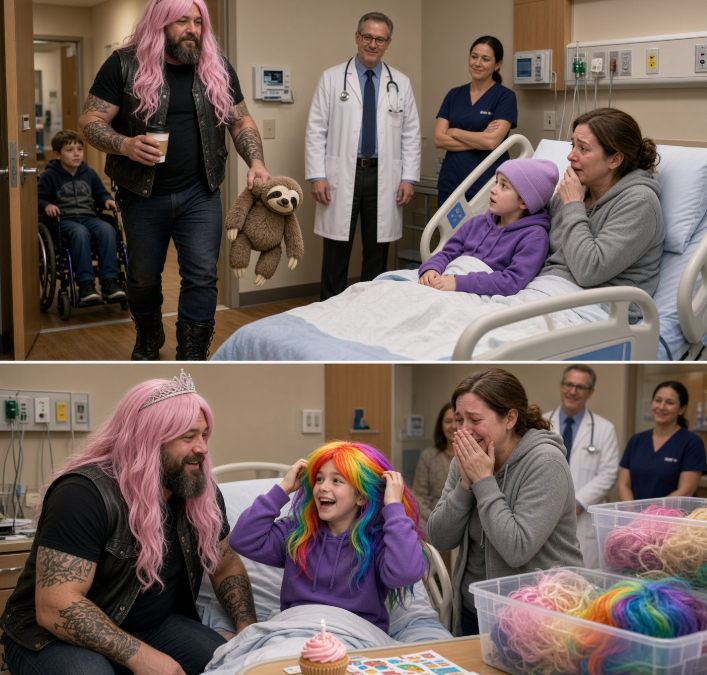
So he wore it to the hospital.
That morning, I was at the nurses’ station reviewing medication notes when the elevator opened.
Three people in the hallway stepped back.
A father carrying coffee stopped mid-step.
A grandmother lowered her phone.
A little Black American boy named Jonah, who used a wheelchair and had more comedic timing than half the adults I knew, whispered, “Is he a biker princess?”
Caleb heard him.
Without slowing down, he said, “Only on Wednesdays.”
The boy laughed.
So did half the hallway.
Caleb did not stop.
He was not there for the hallway.
He was there for room 417.
Dr. Anika Patel passed him near the elevator. She was a forty-five-year-old Indian American pediatric oncologist with light brown skin, black hair tied back, glasses, and the calm voice of someone who could explain terrifying things without making people feel abandoned inside them.
She looked at Caleb’s wig.
Then the tiara.
Then his boots.
“Bold clinical choice,” she said.
Caleb answered, “Experimental.”
Dr. Patel nodded.
“Continue treatment.”
I almost dropped the chart laughing.
Then Caleb reached room 417 and forgot how to breathe.
Lily was turned toward the window.
Her purple knit cap was pulled down so far it nearly covered her eyebrows. A breakfast tray sat untouched. Rachel sat beside her, one hand resting on Lily’s yellow blanket, watching Caleb with eyes that asked him to be careful.
He stepped inside.
“Morning, Bug.”
Lily did not turn.
“I’m not hungry.”
“Good,” Caleb said. “This wig ate most of my dignity, so breakfast may be unsafe.”
Lily’s shoulder moved.
Just barely.
Caleb walked to the foot of the bed.
Rachel bit her lip.
Lily finally turned.
Her eyes widened.
For one long second, nobody spoke.
I was standing just outside the door, pretending to check supplies because nurses learn the art of being nearby without intruding.
Caleb’s tiara slipped down his forehead.
Lily made a sound.
Small.
Confused.
Then another.
Then laughter burst out of her like air escaping a room that had been locked too long.
She laughed until she coughed.
Caleb panicked for half a second, but Rachel shook her head while crying and laughing at the same time.
“It’s okay,” Rachel said. “She’s laughing.”
Lily pointed at him.
“You look ridiculous.”
Caleb bowed with great dignity.
“Thank you. I trained for years.”
“Why?”
He sat carefully in the chair beside her bed.
“Because you got special hair now.”
Lily touched her cap.
“I don’t have hair.”
“Exactly,” Caleb said. “Very rare. Very advanced.”
She stared at him.
He tapped the pink curls.
“So I got special hair too.”
Lily’s smile faded into something more fragile.
“So I’m not the only one?”
His voice softened.
“Never.”
That was the beginning.
Not of healing.
Not exactly.
Healing is too clean a word for what families go through on pediatric oncology floors.
It was the beginning of together.
After that, the wigs became a calendar.
Not an official one.
Hospitals already have enough calendars with dates nobody wants circled.
Chemo day.
Scan day.
Bloodwork day.
Admission day.
Procedure day.
Caleb’s wigs became the calendar Lily preferred.
Pink day.
Blue day.
Orange day.
Purple braid day.
Silver grandma day.
Green spike day.
Rainbow hurricane day.
Red disaster day.
And one unforgettable morning when Caleb arrived wearing a blond wig so smooth and shiny that a toddler in the hallway asked if he was a motorcycle mermaid.
Lily rated each one.
Pink got eight stars.
Blue got ten because it matched her popsicle.
Green spikes got six because they looked itchy.
Rainbow got infinity.
The red wig received what Lily called “emergency zero” because Caleb paired it with heart-shaped sunglasses and Rachel said he looked like someone’s angry aunt arriving late to bingo.
Caleb wrote the ratings in his notebook.
Beside temperature logs and medication questions, there were now wig reviews.
Day 12: Purple waves. Lily smiled before breakfast.
Day 29: Blue bob. Asked Maya for stickers again.
Day 51: Rainbow. Bad nausea day. Still laughed once. Worth it.
Day 88: Yellow curls. She said I looked like a confused sunflower. Good day.
The hospital staff joined in carefully.
I brought tiny bows.
Dr. Patel pretended to evaluate the wigs during rounds.
Jordan Brooks, our child life specialist, twenty-nine, Black American, deep brown skin, short locs, warm smile, and bright sneakers, created a paper chart where Lily could put stickers next to her favorites.
No photos were posted.
No videos were shared for sympathy.
Rachel was firm about that.
She did not want Lily’s treatment turned into public entertainment.
Caleb respected it.
He did not post Lily’s face.
He did not livestream hallway laughs.
He did not use his daughter’s illness to make himself look heroic online.
But word spread inside the hospital because kindness has its own hallway.
Other children began waiting for him.
Mateo Reyes, a six-year-old Latino American boy with tan skin, brown eyes, superhero socks, and a mask covered in tiny rockets, asked if he could pick Tuesday’s wig.
Aaliyah Carter, a ten-year-old Black American girl with deep brown skin, a shaved head, fierce eyes, and a pink hoodie, told Caleb the purple wig needed more attitude.
Noah Kim, an eight-year-old Asian American boy with light tan skin, glasses, a dinosaur blanket, and hair thinning from treatment, requested “space alien hair.”
Caleb delivered.
The next day, he wore a neon green wig with silver pipe cleaners sticking out like antennas.
Lily laughed so hard she had to cover her mouth.
But not every day was funny.
That is important.
People like stories where love turns pain into laughter so neatly that everyone can clap.
Real love does not work that way.
Some days Lily was too sick to laugh.
Caleb still wore the wig.
Some days she slept through his visit.
Caleb sat beside her, ridiculous hair under fluorescent lights, holding her hand while monitors blinked softly.
Some days she cried because food tasted wrong.
Some days she became angry for reasons nobody tried to correct because anger was one of the few things cancer had not taken from her.
Some days Rachel cried in the shower in the family bathroom.
Some days Caleb cried in the stairwell where Lily could not hear him.
I saw him there once.
Day 73.
Blue curls.
I had gone down the back stairwell to avoid a crowded elevator. Caleb sat three steps below the landing, elbows on knees, both palms pressed against his eyes.
He did not hear me at first.
His shoulders shook once.
Just once.
For a man that large, the movement looked like a building trying not to collapse.
I almost backed away.
Then Rachel came through the door behind me and saw him.
She moved past me without speaking and sat beside him on the step.
Caleb did not look up.
“I can’t fix it,” he whispered.
Rachel leaned her head against his shoulder.
“No.”
“I’m her dad.”
“I know.”
“I’m supposed to fix things.”
Rachel took one of his hands away from his face.
“Then fix the lonely part.”
He looked at her.
His eyes were red.
She squeezed his fingers.
“That part, you can fight.”
So he did.
Day after day.
Color after color.
He could not fix cancer.
He could fight isolation.
And somehow, that became a kind of strength none of us had known how to name.
Day 126 was the day Caleb almost missed.
His truck broke down before sunrise, which would have been funny if it had not happened during a week when money, sleep, and emotional patience were all running on fumes.
The Harley was at the shop for scheduled maintenance because Rachel had finally snapped and told him that if he was going to ride between home, work, and hospital, the machine had better be safer than his stubbornness.
The hospital was thirty-two miles away.
Rachel was already there with Lily.
Caleb stood in the driveway wearing a bright turquoise wig and a hoodie, staring at the dead truck like it had personally betrayed fatherhood.
He called three people.
No answer.
He considered a rideshare, saw the price, cursed softly, then opened the garage and found Lily’s old bicycle leaning against the wall.
No.
Absolutely not.
Then his phone buzzed.
A message from Rachel.
What color today?
Caleb looked at the bicycle.
Twenty minutes later, a neighbor named Marcus Hill opened his front door.
Marcus was forty-four, Black American, deep brown skin, close-cropped hair, work boots, and the kind of man who had long ago stopped being surprised by Caleb Mercer’s emergencies.
Still, even Marcus needed a second.
Because Caleb stood on his porch in a turquoise wig, pointing at a small bicycle.
“I need a ride.”
Marcus stared.
“To where?”
“Hospital.”
“On that?”
“No. In your car. The bike was Plan D.”
Marcus did not ask what Plans A through C were.
He grabbed his keys.
Caleb made it to the hospital late, sweating, embarrassed, and still wearing turquoise hair.
Lily was in bed, arms crossed, trying to look angry and failing because relief kept showing through.
“You’re late,” she said.
“I know.”
“You almost missed turquoise.”
“Unforgivable.”
“Why didn’t you take off the wig in the car?”
Caleb looked offended.
“And arrive bald? In this economy?”
Lily laughed.
Then she grew serious.
“You don’t have to come every day.”
The sentence hit him harder than she knew.
Rachel looked down.
I was adjusting Lily’s IV tubing near the other side of the bed and felt the whole room change.
Caleb sat beside Lily.
“Yes, I do.”
“What if you’re tired?”
“I’m tired.”
“What if people laugh?”
“They do.”
“What if you don’t want to?”
He answered honestly.
“Some mornings, I don’t.”
Lily blinked.
“Really?”
“Really.”
“Then why?”
Caleb touched the edge of the turquoise wig.
“Because love is not only what you feel like doing. Sometimes love is what you promised when someone needed you.”
Lily looked at him for a long time.
Then she whispered, “Did you promise me?”
Caleb’s voice dropped.
“The day you were born.”
That day, Lily asked him to take a photo.
Not for the internet.
For her.
Rachel took it.
Caleb in turquoise hair.
Lily in her purple cap.
Both making serious faces like two executives at a very strange business meeting.
Lily taped the photo beside her bed.
From then on, we called Day 126 the Turquoise Emergency.
Caleb called it the day he learned his daughter was watching not only the joke, but the faithfulness beneath it.
By Day 200, the wigs had taken over an entire corner of the Mercer house.
Rachel bought plastic bins.
Caleb labeled them badly.
Lily corrected the labels with stickers.
There were short wigs, long wigs, curly wigs, shiny wigs, cheap wigs, donated wigs, homemade wig hats, one knitted rainbow cap from a grandmother on the ward, and a terrible silver wig nobody liked but everyone respected because it had survived three accidental trips through the laundry.
Day 200 came on a cold morning in March.
Lily was not finished with treatment forever.
Nobody pretended certainty where doctors had not offered it.
That is another thing hospitals teach you.
Never steal hope.
Never sell guarantees.
Lily still had checkups ahead. More bloodwork. More waiting. More days when Rachel would study Dr. Patel’s face before anyone said a word.
But Day 200 mattered.
It was a milestone.
A mountain marker.
Two hundred days of showing up.
Two hundred days of refusing to let baldness become loneliness.
Two hundred days of special hair.
Caleb chose the rainbow wig.
The original one had worn out, so Rachel helped him buy a better version: thick rainbow waves, bright but soft, with a small row of butterfly clips Lily had arranged herself.
Caleb wore his plain black leather vest, clean jeans, polished boots, and a dark shirt.
He looked in the mirror that morning and saw every day behind him.
Pink.
Blue.
Green.
Turquoise.
Purple.
Silver.
Tears.
Laughter.
Fear.
Love.
At the hospital, the nurses had quietly prepared a small celebration.
Nothing overwhelming.
A few paper decorations.
Stickers.
A cupcake Lily might or might not feel like eating.
The children on the floor knew Caleb was coming in rainbow hair, and even Dr. Patel adjusted her schedule to pass room 417 at the right time.
Lily looked stronger than she had months earlier, though still fragile in ways strangers might not understand.
Her face had more color.
Her smile came faster.
Her head was still mostly bare, soft and beautiful, with tiny signs of new growth beginning in places she checked every morning.
Caleb stepped into the room.
Lily grinned.
“Rainbow again.”
“Classic never dies.”
“You wore it on purpose.”
“I am a man of tradition.”
She studied him.
Then her expression changed.
“Dad?”
“Yeah, Bug?”
“Were you embarrassed?”
He almost answered too quickly.
Almost protected her from the truth because parents do that without thinking.
Then he stopped.
Lily deserved honesty.
She had lived through too much to be given easy answers.
“Yes,” he said.
Rachel looked at him.
I paused near the doorway.
Lily nodded slowly.
“Every day?”
“Not every day. But some days, yeah.”
“Because people stared?”
“Yes.”
“Because you looked silly?”
“Deeply silly.”
“Then why did you keep doing it?”
Caleb sat beside her bed.
He took off the rainbow wig and held it in both hands.
For the first time, Lily saw his shaved head fully under the hospital lights.
Not hiding.
Not performing.
Just present.
“Because when your hair fell out,” he said, “everybody could see something hard was happening to you.”
Lily’s eyes filled.
“And I hated that you had to be the only one with a head people noticed.”
He placed the wig gently on his knee.
“So I made mine noticeable too.”
Rachel began crying.
I looked away toward the hallway because nurses have limits, even when we pretend we do not.
Caleb continued, voice rough.
“You lost your hair, so I wore every crazy color I could find. Pink. Blue. Green. Rainbow. All of it.”
He touched Lily’s hand.
“So we could both have special hair.”
Lily wiped her cheek.
“Even when I was sleeping?”
“Especially then.”
“Why?”
“Because you were still my girl when you couldn’t laugh.”
Lily reached for the wig.
Caleb handed it to her.
She placed it on her own head, crooked, rainbow hair falling over one eye.
Then she smiled.
“Now I have special hair again.”
Caleb laughed and cried at the same time.
“Yes, ma’am.”
She reached up and placed the tiara on his shaved head.
“And you still do.”
That was the picture Rachel took.
The one that would hang in their hallway years later.
A giant tattooed biker with a tiara on his bare head, sitting beside a seven-year-old girl in a hospital bed wearing a crooked rainbow wig, both of them smiling like they had won something cancer could not touch.
Lily kept the rainbow wig.
Not because she needed it every day.
Because it held proof.
Years later, when people asked about the photos in the Mercer hallway, they noticed the strangest one first.
Caleb in rainbow hair beside Lily.
Caleb in pink curls.
Caleb in green spikes.
Caleb in purple braids.
Caleb in silver disco hair.
Caleb in a wig so orange it made every nurse question reality.
Lily survived treatment.
That sentence is simple.
It should not be.
Survival did not mean the story ended neatly.
There were checkups.
Late fears.
Body memories.
Scars.
Birthdays that felt bigger than birthdays.
Ordinary arguments about homework, curfews, and whether a father had the right to wear socks with sandals.
Caleb said yes.
Lily said no.
Rachel refused to mediate.
As Lily grew older, the wigs moved from hospital to home, then from home to charity.
When Lily was twelve, she asked if they could donate most of them to the child life department.
“But only if kids can choose them,” she said.
Caleb nodded.
“And nobody has to be cheerful to wear one.”
That made Rachel stop folding laundry.
Lily shrugged.
“You don’t have to be happy to deserve color.”
When they brought the bins to Mercy Ridge, I cried.
I admit it.
I had earned the right.
Dr. Patel pretended she had allergies.
The rainbow wig stayed with Lily.
At sixteen, she wore it to a childhood cancer fundraiser and gave a short speech.
Caleb stood at the back of the room in his plain leather vest, gray in his beard now, arms folded, trying not to look like he was falling apart.
Lily stepped to the microphone with rainbow hair, clear eyes, and a voice steadier than her father’s hands.
“My dad wore a wig every day I was bald,” she said. “Not because hair matters most, but because loneliness does.”
The room went silent.
“He could not take chemo for me. He could not make the fear leave. But he could make sure I wasn’t the only person in the room being stared at.”
Caleb lowered his head.
Lily smiled toward him.
“So if you love someone going through something hard, don’t only tell them they’re not alone. Find a way to stand where they can see you.”
That line traveled farther than any photo ever did.
Years later, Lily became a nurse.
Of course she did.
Not because every child who survives hospitals has to return to them.
Many do not.
Many should not have to.
But Lily understood the sacred power of people who stay.
On her first day working pediatric oncology, she carried the rainbow wig in her bag.
She did not wear it immediately.
She waited.
Three weeks in, a little girl cried because she did not want to remove her hat.
Lily sat beside her.
“I know something about special hair,” she said.
The girl looked at her suspiciously.
Lily pulled out the rainbow wig.
The girl blinked.
Then laughed.
Somewhere inside that laugh, Caleb’s two hundred days kept living.
When Lily told him later, he sat on the porch and cried so openly that Rachel handed him tissues without comment.
“You started a thing,” Lily said.
Caleb shook his head.
“You did.”
“No, Dad.”
She touched his tattooed arm.
“You chose to look ridiculous so I could feel normal.”
Caleb smiled.
“Worth it.”
Lily leaned against his shoulder.
“Every day?”
He looked at the sunset, remembering room 417, the pink wig, the Turquoise Emergency, Day 200, Rachel crying in hospital light, Maya pretending not to cry at the door, and his little girl laughing when the world had given her so many reasons not to.
“Every day,” he said.
Because that was fatherhood as Caleb understood it now.
Not fixing everything.
Not being fearless.
Not looking strong.
Sometimes fatherhood is walking into a children’s hospital covered in ink, boots loud on the floor, beard full of glitter, wearing the worst wig in the state, and saying without saying it:
I will be strange with you.
I will be stared at with you.
I will carry color into the room until you remember laughter still knows your name.
Lily lost her hair.
Caleb wore two hundred colors.
And together, they turned baldness into special hair.








