A German Shepherd Stayed Silent for 8 Months After His Handler Died—Then a 68-Year-Old Waitress Sang the One Cadence He Still Remembered 8.
PART3:
She had worked in animal welfare for nineteen years and knew better than to fill nervous silence just because humans disliked it.
So she waited.
Duke looked past her.
Not at her.
Past.
The technician clipped a long lead to his collar.
No reaction.
A gentle pull.
Nothing.
Another.
Duke finally stood.
Stepped down.
Walked into the intake room.
No sniffing.
No scanning.
No pulling.
No curiosity.
He moved like an animal completing instructions that no longer meant anything.
Mara had seen shutdown dogs before.
Dogs from hoarding cases.
Dogs after severe neglect.
Dogs surrendered after losing the only owner they had ever known.
But Duke did not look terrified.
He did not crouch.
Shake.
Hide.
Lunge.
He simply seemed absent while still physically present.
Veterinarian Dr. Priya Nandakumar examined him that afternoon.
Heart.
Lungs.
Eyes.
Ears.
Teeth.
Joints.
Neurological response.
Duke tolerated everything.
No warning.
No affection.
When Priya touched the scar beneath his ear, Duke’s eyes moved toward her hand for less than a second.
That was the strongest response Mara saw all day.
“Could something be wrong with his voice?” Mara asked.
Priya looked toward Duke.
“Possible.”
They examined his throat.
Later, more complete veterinary evaluation ruled out obvious laryngeal paralysis or physical damage that would explain absolute silence.
His hearing worked.
That was easy to establish.
A tray dropped accidentally outside the exam room.
Duke’s ears moved.
A high whistle from the corridor.
Same.
He heard.
He simply did not answer.
His records were thin.
Far thinner than Mara expected for a dog who had lived most of his life in structured working programs.
NAME: DUKE.
BREED: GERMAN SHEPHERD DOG.
AGE: ESTIMATED 9 YEARS.
SEX: MALE, NEUTERED.
FORMER MILITARY WORKING DOG.
SPECIALTY: EXPLOSIVE DETECTION / PATROL SUPPORT.
RETIRED TO HANDLER.
HANDLER/OWNER: AARON MERCER.
OWNER DECEASED.
No complete deployment history.
No previous handler.
No detailed behavioral notes.
No familiar command list beyond common obedience cues.
No explanation for scars.
No retirement evaluation.
Nothing about what Duke liked.
Nothing about what frightened him.
Nothing about what he had lost before Aaron Mercer died.
For the first week, the staff moved carefully.
Same kennel.
Same feeding times.
Same two handlers.
No parade of volunteers trying to “cheer him up.”
Mara hated that phrase when it came to animals.
Dogs did not need strangers demanding visible gratitude because someone used a happy voice.
Duke ate.
But only when the kennel corridor was empty.
He drank.
He eliminated outside when led.
He walked in a straight line.
Returned.
He obeyed “sit.”
Sometimes.
“Down.”
Usually.
“Come.”
Only if there was gentle leash pressure.
His obedience felt procedural.
Not engaged.
When someone sat outside his kennel reading, Duke turned his body away.
When volunteers offered chicken, he waited until they left.
When another dog barked at him, Duke did not even look over.
Mara tried a tennis ball.
Nothing.
Tug.
Nothing.
Squeaker.
Nothing.
Blanket scented with home from Aaron’s sister.
Duke sniffed once.
Lay down.
No vocalization.
Aaron’s sister, Leah Mercer, visited during the second week.
She stood outside the kennel crying.
Duke looked at her.
Then lowered his head.
Leah covered her mouth.
“He knows me.”
“Probably,” Mara said gently.
“Then why won’t he come over?”
Mara did not pretend to know.
Leah had been the one to surrender him.
Not because she did not care.
That mattered.
Her landlord prohibited large dogs.
Her husband traveled for work.
Their daughter was eighteen months old.
And Duke, while not aggressive, was still a powerful retired working German Shepherd whose history they barely understood.
Leah had tried.
For seventeen days.
Duke barely moved from the room where Aaron’s boots had been kept.
“He wouldn’t eat if I was standing there,” she said.
“He slept beside the front door every night.”
She wiped her face.
“I thought he was waiting for Aaron.”
Mara looked through the kennel door.
“Maybe he was.”
Leah whispered:
“I feel like I abandoned him.”
Mara did not give her the empty reassurance people often expected.
Instead:
“You brought him somewhere that can assess what he needs.”
Leah nodded.
“I should know more about him.”
“You know what your brother told you.”
“Not much.”
“Was Aaron private?”
She laughed through tears.
“Painfully.”
“How long did he have Duke?”
“Six years? Maybe seven.”
“Did he ever mention another handler?”
“No.”
“Military unit?”
“Some.”
“Other people Duke worked with?”
“A few names.”
“Any records?”
“Not that I found.”
Leah stared at Duke.
“Aaron said Duke saved his life.”
“When?”
“He never explained.”
That sentence stayed with Mara.
Duke saved his life.
People say that about dogs loosely.
Sometimes emotionally.
Sometimes literally.
With a military working dog, it could mean anything.
Finding explosives.
Warning to a person.
Locating something.
Giving a struggling veteran a reason to get out of bed after retirement.
Mara made a note.
Then weeks became months.
March.
April.
May.
Duke’s physical health remained stable.
His coat improved.
He learned the shelter routine.
He accepted Mara and senior technician Ben Ortiz clipping his leash.
But he remained emotionally distant.
No barking.
No whining.
Not even when thunder rolled.
The kennel around him could erupt at feeding time and Duke would lie with his head between his paws.
Priya referred them to canine behavior consultant Dr. Elise Warren.
Elise watched video.
Observed in person.
Reviewed medical findings.
Her answer disappointed everyone because it was careful.
“I don’t think we should treat silence itself as the disorder.”
“What do you mean?” Mara asked.
“He is functioning.”
“Barely.”
“He eats. Walks. Sleeps. Orients to sound. Follows some cues.”
“He doesn’t engage.”
“I agree.”
Elise watched Duke through the glass.
“There may be grief.”
“May?”
“We have to be precise.”
Mara understood.
“Okay.”
“We cannot know what narrative he has in his head.”
“Right.”
“He may be experiencing stress associated with loss of attachment, environmental change, disrupted routines, aging, previous working history, or all of that.”
“So what do we do?”
“Lower pressure.”
“We already have.”
“Lower it more.”
Mara almost smiled.
Elise continued.
“Predictability. Choice. Familiar sensory cues if we can find them. Stop testing him every day to see whether today is the day he becomes the dog people want.”
That sentence changed the shelter’s approach.
No more toys pushed toward him.
No more volunteers waiting for eye contact.
No more emotional experiments.
They let Duke exist.
His kennel became quieter.
A visual barrier was placed along one side.
He had a raised cot.
A covered retreat area.
Walks happened at consistent hours.
Mara began sitting ten feet away twice a week doing paperwork.
Not looking at him.
Sometimes Duke looked at her.
She pretended not to notice.
In June, he voluntarily walked to the front of the kennel while she sat outside.
He did not touch her.
But he came.
Mara wrote the date down.
June 14.
Tiny progress mattered when progress moved that slowly.
By July, Cedar Valley had received an offer from a working-dog retirement sanctuary in Nebraska.
Good place.
Large acreage.
Experienced handlers.
Structured routines.
Not a dumping ground.
Mara visited virtually.
Spoke to director.
Asked too many questions.
The sanctuary could take Duke in September.
Part of her felt relieved.
Part felt as if she had failed.
Elise told her not to make Duke’s visible affection the metric.
“A good placement doesn’t require him to perform recovery for you.”
Mara knew.
Still hurt.
August came brutally hot.
The shelter received three industrial fans from a local hardware store and twenty donated cooling mats.
And every second Tuesday of the month, June Holloway arrived with blankets.
June had been donating to Cedar Valley for seven years.
Not because she was wealthy.
She was not.
She worked breakfast shift at the Blue Star Diner on Highway 17.
Five mornings a week.
Sometimes six.
She collected old fleece blankets customers left after church donation drives.
Towels from the motel whose manager ate lunch at the diner.
Small cash donations in a coffee can.
She brought everything herself in a twelve-year-old Buick.
June was sixty-eight.
Short.
Strong forearms from carrying plates.
Gray hair cut at her jaw.
Red reading glasses usually hanging from a chain around her neck.
She knew the names of half the shelter staff and remembered who took cream in coffee.
She had never asked to see Duke.
That was partly because she usually dropped donations at the laundry room, not kennels.
On September 6, she arrived with three black garbage bags full of fleece blankets.
“Where do you want these?”
“Laundry room,” Ben said.
“The clean side?”
“Yes, ma’am.”
June frowned.
“Stop calling me ma’am.”
“Yes, ma’am.”
She swatted his shoulder.
Ben laughed.
The shelter was understaffed that morning.
A kennel attendant had called sick.
Mara was covering intake.
June started sorting blankets herself.
Nobody asked.
She simply did.
She pulled one from the bag.
Gray.
Fold.
Blue.
Fold.
Red plaid.
Fold.
She hummed.
June always hummed.
Old country songs.
Church hymns.
Things nobody under forty recognized.
Then the humming changed.
It became rhythmic.
Almost spoken.
Left.
Left.
Left, right, left.
Mara barely noticed from the hallway.
June sang softly while shaking out a wool blanket.
“Keep your eyes ahead, boys, keep your boots in line…”
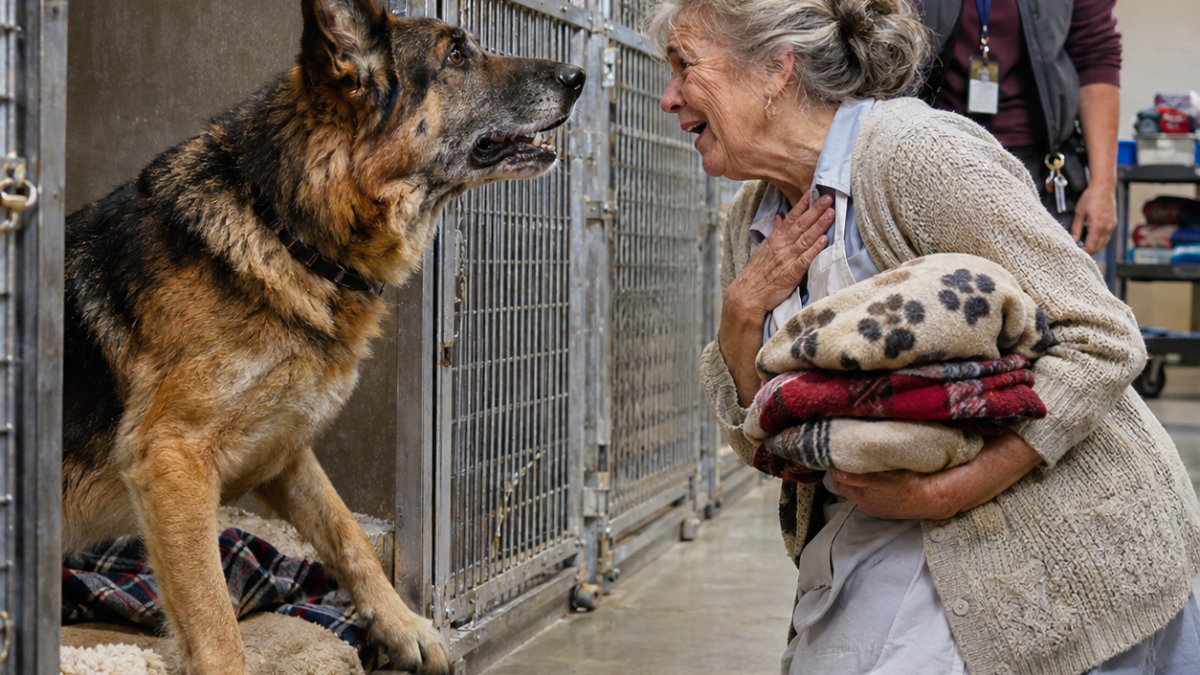
Inside Kennel Twelve, Duke’s head came up.
Mara stopped walking.
June continued.
“Road gets long, but we move on time…”
Duke stood.
Fast.
His hind leg hit the stainless-steel bowl.
It flipped.
Food scattered.
Metal clanged across concrete.
June stopped singing.
The entire corridor seemed to freeze.
Mara turned.
Duke was at the kennel door.
Not near it.
Against it.
Ears forward.
Body rigid.
Eyes locked down the hallway.
Mara’s heart started pounding.
“June.”
The waitress looked up.
“What?”
“Sing that again.”
“What?”
“The thing you were singing.”
June laughed nervously.
“That old nonsense?”
“Yes.”
“Why?”
“Please.”
Something in Mara’s voice changed June’s expression.
She wiped her hands on her apron.
Then began again.
Quieter.
“Left, left…”
Duke stepped closer to the bars.
“Left, right, left…”
His nostrils moved.
“Keep your eyes ahead, boys…”
Duke’s mouth opened.
Just slightly.
Mara had not seen him do that except panting after walks.
June continued.
“Keep your boots in line…”
A sound came from Duke.
Small.
Low.
Rough from disuse.
Not a bark.
A whine.
Mara felt tears hit her eyes before she understood they were there.
Ben froze in the doorway.
June stopped.
Duke pushed his nose through the gap beside the kennel door.
Then made the sound again.
June’s face lost color.
She took one step forward.
Mara raised a hand.
“Slowly.”
June nodded.
She approached until she was about six feet away.
Duke stared.
Then June said:
“Danny?”
Mara looked at her.
“What?”
June covered her mouth.
“No.”
She stared at Duke’s left ear.
The scar.
Her breathing changed.
“Oh, sweetheart.”
Mara moved closer.
“June, what is it?”
June pointed with a trembling hand.
“That scar.”
“What about it?”
“My son sent me a picture.”
Mara felt a cold sensation run across her shoulders.
“What son?”
“Daniel.”
June’s eyes never left Duke.
“Daniel Holloway.”
She whispered:
“He had a shepherd overseas.”
Mara looked at Duke.
Then back at June.
“What was the dog’s name?”
June answered immediately.
“Duke.”
No one spoke.
June reached for the wall.
Mara pulled a chair beneath her.
“Sit.”
“I’m fine.”
“Sit.”
June sat.
Duke remained at the kennel door.
He had not taken his eyes off her.
Mara crouched nearby.
“Tell me about Daniel.”
June looked down at her hands.
“My son was Army.”
“When?”
“He enlisted in 2008.”
“What did he do?”
“Military police first. Then working dogs.”
Mara’s pulse quickened.
“Was he a dog handler?”
“Yes.”
“What happened to him?”
June swallowed.
“Killed in Afghanistan.”
“When?”
“Eleven years ago.”
Mara looked toward Duke.
The age could fit.
Barely.
If Duke was nine, no.
But shelter age was estimate based on paperwork.
Military records might show older.
“How old would Duke have been?”
June shook her head.
“I don’t know. Young.”
“Did you meet him?”
“Once.”
Mara stared.
“You met Duke?”
“At Fort Leonard Wood.”
Duke made another sound.
Not exactly a whine this time.
A breathy, broken vocalization.
June closed her eyes.
“We weren’t supposed to pet him when he was working.”
She smiled through tears.
“Danny told me that about a hundred times.”
“What cadence were you singing?”
June looked almost embarrassed.
“That?”
“Yes.”
“Daniel made it up.”
Mara frowned.
“Made it up?”
“Mostly.”
June wiped beneath one eye.
“He hated the marching cadences they used in training because he said they all sounded like somebody was trying too hard.”
Despite herself, Mara smiled.
“So he made one?”
“A stupid one.”
“What were the rest of the words?”
June laughed shakily.
“I don’t remember all of them.”
“Try.”
June looked at Duke.
Then quietly:
“Left, left, left, right, left.
Keep your eyes ahead, boys, keep your boots in line.
Road gets long, but we move on time.
Rain comes down, sun comes through.
Keep on walking, me and Duke.”
Mara’s chest tightened.
June continued:
“He used to sing it when he called home.”
“Why Duke?”
“He said Duke got restless riding in the transport vehicle.”
“So Daniel sang to him?”
“Yes.”
June looked at the kennel.
“He said the dog settled when he heard his voice.”
Mara asked:
“Why isn’t Daniel anywhere in Duke’s file?”
June laughed once.
There was no humor in it.
“Military paperwork.”
Mara understood the frustration, but not enough.
“What happened to Duke after Daniel died?”
“I don’t know.”
“You never found out?”
“I tried.”
June looked down.
“They told me the dog belonged to the government.”
That was true.
A military working dog is not a deceased handler’s personal property simply because they were bonded.
June continued.
“I wrote letters.”
“To who?”
“Anybody I could find.”
“What did they tell you?”
“That he was alive.”
She took a breath.
“That was about it.”
“Did you know Aaron Mercer?”
June’s face changed.
“Yes.”
Mara’s skin prickled.
“How?”
“He served with Danny.”
Duke shifted.
June saw it.
“Aaron came to the funeral.”
Mara sat beside her.
“June.”
“What?”
“Aaron Mercer was Duke’s owner.”
June looked at her.
“No.”
“He adopted Duke after retirement.”
June stared.
“No.”
Mara nodded.
“Aaron had him for years.”
June stood too quickly.
The chair scraped.
“Aaron had Duke?”
“Yes.”
“He never told me.”
Mara said nothing.
June’s expression became complicated.
Not simply grief.
Something like betrayal.
“Aaron sat in my diner.”
“What?”
“After he came home.”
“How often?”
“Every few months at first.”
She looked at Duke.
“Then maybe once a year.”
“And he never told you he had Daniel’s dog?”
“No.”
Mara asked carefully:
“Are you sure he knew this was the same Duke?”
June almost snapped.
“Of course he knew.”
Then she stopped.
She did not actually know.
Mara could see her realizing it.
“I need records,” Mara said.
June sat again.
“I need to know exactly who Duke worked with.”
June looked at her.
“So do I.”
Mara called the sanctuary that afternoon.
The transfer scheduled for Friday was paused.
Not cancelled.
Paused.
She explained they had potentially identified prior handler history.
The sanctuary director agreed immediately.
“Follow it.”
Then Mara called Leah Mercer.
Aaron’s sister arrived that evening.
June was still there.
The two women had never met.
Leah entered the conference room.
Mara introduced them.
“This is June Holloway.”
Leah stopped walking.
“Holloway?”
June stood.
“Daniel was my son.”
Leah’s eyes widened.
“Oh.”
That one syllable carried recognition.
“You know his name?”
Leah sat slowly.
“My brother talked about Danny.”
June’s face tightened.
“Did he tell you he had Danny’s dog?”
Leah shook her head.
“No.”
“Never?”
“He said Duke had worked before they were paired.”
“That’s all?”
“Yes.”
June looked away.
Leah continued:
“Aaron didn’t talk about deployments much.”
“Neither did Daniel.”
“I’m sorry.”
June nodded.
They sat in silence.
Then Leah said:
“Wait.”
She pulled out her phone.
Scrolled.
“Aaron had boxes.”
“What boxes?”
“Storage.”
Mara leaned forward.
“His military stuff?”
“Some. Photos. Papers. I haven’t gone through everything.”
“Where?”
“My garage.”
June looked at her.
Leah said:
“I’ll bring them tomorrow.”
The boxes arrived at nine.
Three plastic totes.
One duffel.
A sealed ammo can that contained no ammunition.
Photographs.
Uniform patches.
Certificates.
Old dog leads.
A leather collar.
Deployment notebooks.
Nothing organized.
Aaron had apparently stored his military life the way many people store things they do not know how to revisit.
Closed containers.
Mara did not rummage freely.
Leah was legal owner of Aaron’s effects.
She sorted.
June watched.
The first photograph appeared after twenty minutes.
Three soldiers beside a tan vehicle.
One kneeling.
German Shepherd between them.
On back:
DANNY + DUKE — 2014.
June made a sound and sat down.
Her son looked twenty-seven.
Lean.
Sunburned.
Smiling.
Duke was younger.
Dark face.
Ears enormous.
No gray.
June touched the edge.
“That’s him.”
Leah whispered:
“That’s Duke.”
Another photograph.
Daniel.
Duke.
Aaron standing beside them.
Aaron younger too.
Arm around Daniel’s shoulder.
Then another.
Duke alone wearing working harness.
Then a folded page.
Veterinary summary.
Military working dog Duke.
Date of birth.
He was older than the shelter file estimated.
Eleven.
Not nine.
Previous handler information abbreviated.
But one name remained.
SSG D. HOLLOWAY.
June covered her face.
Mara closed her eyes.
There it was.
Not imagination.
Not coincidence.
Not a similar-looking dog.
Duke had been Daniel’s partner.
Leah found an envelope.
No stamp.
Written on front:
MRS. HOLLOWAY.
June stared.
“That’s me.”
Leah held it out.
“It’s Aaron’s handwriting.”
June did not take it immediately.
Mara said:
“You don’t have to read that here.”
June finally accepted.
Her hands shook opening it.
Inside were four handwritten pages.
She read silently.
Then stopped halfway.
Tears ran down her face.
Leah looked terrified.
“What does it say?”
June could not speak.
She handed the pages to Mara.
Mara hesitated.
June nodded.
Read.
Aaron had written the letter three years after Daniel’s death.
He never mailed it.
It explained the missing history.
Duke had survived the incident that killed Daniel.
He had been injured.
Shrapnel.
Hearing temporarily affected.
Scar beneath left ear.
He spent months in rehabilitation.
Aaron had visited whenever possible.
Not because he expected Duke to become his.
Because Duke had been the last living thing from that patrol who had been beside Daniel at the exact moment everything changed.
Later, Duke returned to working status.
A new handler was assigned.
The pairing failed.
Not because Duke was dangerous.
The fit did not work.
Then Aaron requested the opportunity.
He knew Duke.
Duke knew him.
They trained.
Slowly.
Eventually passed certification.
The letter said:
I don’t know whether this was fair to him or fair to me. Maybe we were both trying to keep one piece of Danny close.
June stopped Mara.
“Read that again.”
Mara did.
June cried quietly.
The letter continued.
Aaron and Duke deployed together later.
Duke detected explosive material near a vehicle before a convoy moved into the area.
Aaron believed the warning prevented casualties.
That was what Leah had heard as:
Duke saved my life.
Years afterward, when Duke retired, Aaron adopted him.
Officially.
He had intended to tell June.
He came to the Blue Star Diner three times with that purpose.
Each time he failed.
Why?
The next line answered.
Every time I see you, I become twenty-four again standing at Danny’s funeral trying to explain why I came home and he didn’t.
June closed her eyes.
Leah began crying too.
Aaron had carried survivor guilt for years.
He feared bringing Duke into June’s life would reopen something she had learned to survive.
He convinced himself silence was kindness.
Then time passed.
Silence became harder to break.
The letter ended:
Duke still responds to Danny’s ridiculous marching song. I catch myself singing it when storms roll in. I think he remembers the routine, maybe the sound pattern, maybe just that it means somebody is close. I don’t pretend to know what dogs remember the way we do. But it settles him.
Then:
If I ever get brave enough, I’ll bring him to the diner.
He never did.
June held the letter against her chest.
For a long time, nobody spoke.
Finally:
“That idiot.”
Leah laughed through tears.
“My brother?”
“Yes.”
“Fair.”
“He thought seeing Duke would hurt me?”
“Yes.”
June wiped her face.
“Not knowing hurt me.”
No one argued.
That evening, Mara called Elise.
The behavior consultant arrived next morning.
They showed records.
Explained cadence.
Elise listened.
Then gave the answer Mara had expected.
“This is meaningful.”
June looked at her.
“But?”
“But we need to be careful about what we claim.”
June frowned.
Elise continued.
“Duke may have a strong learned association with that rhythm or phrase.”
“With Daniel.”
“Possibly.”
June’s face tightened.
“I’m not saying Daniel meant nothing.”
“I know.”
“We cannot know whether Duke is remembering a person in the narrative way you are.”
June looked toward kennel.
“So when he stood up?”
“He recognized something familiar.”
“The cadence.”
“Likely.”
“And that matters?”
“Very much.”
That was enough for June.
She did not need anyone to tell her Duke carried a ghost.
She needed the reaction to be real.
It was.
They did not let June walk straight into Duke’s kennel.
That would have made a better video.
It would not necessarily have been good handling.
Instead, they started outside.
Distance.
Choice.
June sat.
Sang quietly once.
Then stopped.
Duke came to front.
June did not reach.
He sniffed air.
Mara gave her a worn leather lead from Aaron’s box.
Not yet for use.
Just scent.
Duke sniffed it through bars.
Then looked at June.
She whispered:
“Hey, handsome.”
Duke’s ears moved.
No miracle.
He did not collapse into her arms.
No dramatic recognition scene.
He did not suddenly become affectionate.
He stood there.
Present.
That itself was more than Mara had seen in eight months.
The next day June returned.
No singing initially.
She sat outside the kennel reading a diner menu because it was the only paper in her purse.
After twenty minutes, Duke lay near the door instead of at the back.
Day four, Mara opened the kennel into the small private meet-and-greet yard.
Duke walked out on lead.
June stood sideways.
No direct stare.
Elise had coached her.
“Let him choose.”
June muttered:
“I’ve spent forty years waiting on customers. I can wait on a dog.”
Duke circled.
Sniffed fence.
Sniffed grass.
Stopped ten feet from her.
June softly tapped her fingers against her thigh in marching rhythm.
Left.
Left.
Left-right-left.
Duke approached.
Slowly.
Stopped beside her chair.
June did not touch him.
For nearly a minute, nothing happened.
Then Duke lowered his nose to her shoe.
Sniffed.
Moved to her apron.
The diner smell.
Coffee.
Bacon grease no washing machine completely defeated.
Vanilla creamer.
Maybe hundreds of other odors.
Duke stood.
June’s eyes filled.
“Danny used to say I smelled like breakfast.”
Mara swallowed hard.
Duke nudged June’s knee.
Small.
June looked toward Elise.
“Can I?”
Elise nodded.
“One touch. Shoulder, not head.”
June placed two fingers against Duke’s shoulder.
He stayed.
She moved her hand once.
Then stopped.
Duke leaned.
Barely.
Enough.
June’s mouth trembled.
She did not speak again until he stepped away.
That was the beginning.
Not the ending.
Duke did not transform overnight.
The following morning, he returned to the back of the kennel.
June worried she had ruined it.
Elise said:
“Progress isn’t a staircase.”
June frowned.
“What is it?”
“More like Missouri weather.”
June laughed.
“I understand that.”
Some days Duke engaged.
Some days he didn’t.
But changes accumulated.
He began eating with Mara sitting twenty feet away.
Then ten.
He sniffed Ben’s pocket before a walk.
Once, when a Labrador barked at a vacuum cleaner, Duke gave a short huff.
Ben ran into Mara’s office.
“He made a noise.”
Mara looked up.
“What?”
“A huff.”
“You ran across the building for a huff?”
“Eight months.”
Fair.
June visited three times a week.
Before work sometimes.
After lunch shift.
She never demanded performance.
She talked.
Not baby talk.
Just diner gossip.
“Frank put pancakes in the warmer again and then acted surprised when they dried out.”
Duke lay nearby.
“Mrs. Carter tipped me forty cents on fourteen dollars.”
Duke blinked.
“That’s not a tip, that’s math abuse.”
Mara listened from doorway once.
Duke seemed calmer with June’s constant ordinary voice than with volunteers trying to soothe him.
Maybe because June wasn’t waiting for a visible emotional response.
She had spent eleven years talking to a dead son in her own head.
She knew how to speak without requiring an answer.
After three weeks, Duke barked.
One bark.
It happened at 6:12 in the morning.
June entered through staff door carrying a paper bag.
Duke heard her voice in hallway.
She said:
“I brought biscuits, and if Ben eats all four before Mara gets here, I’m telling his mother.”
Duke stood.
June rounded corner.
He barked once.
Deep.
Sudden.
Everyone froze.
June dropped the biscuit bag.
Duke barked again.
Then made a low whining sound.
June covered her mouth.
Mara felt her own eyes fill.
Ben whispered:
“Holy hell.”
Mara elbowed him.
June laughed and cried at same time.
“Hi, Duke.”
He wagged his tail.
Not wildly.
Three slow movements.
It was the first wag Mara had seen.
The shelter posted no video.
Not yet.
They wanted Duke’s recovery to belong to Duke before it belonged to the internet.
But word spread among volunteers.
The silent shepherd had barked.
People began asking whether June would adopt him.
June asked too.
Not immediately.
She waited until week four.
Mara was in her office.
June sat across.
“I’m taking him.”
Mara looked up.
“No.”
June blinked.
“Excuse me?”
“You’re not taking him.”
“I knew you’d say I’m too old.”
“I did not say that.”
“You were thinking it.”
“No.”
“You looked at my knees.”
“I look at everyone’s knees.”
“What does that even mean?”
Mara smiled.
“June, Duke is an eleven-year-old retired military working dog with arthritis, complicated attachment history, and unknown responses in a home after eight months in shelter.”
“I have a home.”
“I know.”
“Fenced yard.”
“I know.”
“Retired husband.”
“Frank isn’t retired.”
“He does nothing professionally.”
“June.”
“He’s seventy-one and has made reorganizing the garage a six-year career.”
Mara laughed despite herself.
Then became serious.
“I am not saying no because you’re sixty-eight.”
“What are you saying?”
“I’m saying we’re not giving Duke to anyone because it makes a beautiful story.”
June went quiet.
Good.
Mara continued.
“We evaluate the placement exactly like any other.”
“Fine.”
“Home visit.”
“Fine.”
“Behavior assessment.”
“Fine.”
“Veterinary plan.”
“Fine.”
“Financial plan for senior-dog care.”
June hesitated.
“I can afford a dog.”
“Senior shepherds can get expensive.”
June nodded.
“What else?”
“Backup caregiver.”
“Frank.”
“What if both of you can’t?”
June thought.
“My daughter Ellen.”
“Does she agree?”
“I’ll ask.”
“Work schedule.”
“Breakfast shift. Home by two.”
“Exercise?”
“I walk.”
“How much?”
“Enough.”
Mara gave her a look.
June sighed.
“Not enough.”
“Duke may not need miles, but he needs structure.”
“I can do structure.”
That was true.
No diner survives thirty years without structure.
Mara leaned forward.
“And there is another issue.”
“What?”
“Duke’s relationship with you may be tied partly to Daniel and the cadence.”
June’s face softened.
“Okay.”
“I don’t want you adopting him because you think he is Daniel.”
June looked almost offended.
“He isn’t.”
“Good.”
“He’s Duke.”
“Good.”
“And I don’t think Daniel came back as a dog, if that’s what you’re asking.”
“I wasn’t.”
“You were.”
Mara smiled.
“Maybe a little.”
June leaned back.
“I know what grief can make people do.”
Mara waited.
June continued.
“For years, every young soldier who walked into the diner made me look twice.”
Her voice became quieter.
“Not because I thought Daniel would walk through the door.”
She looked down.
“Because part of me wanted one more second where it was possible.”
Mara said nothing.
June looked up.
“I don’t want Duke because he’s Daniel.”
“Why do you want him?”
June smiled.
“Because he’s eleven and grumpy and he snores.”
Mara laughed.
“And?”
“He likes the diner cadence.”
“And?”
“He needs somewhere quiet.”
Another pause.
“And maybe I do too.”
That was a better answer.
The home visit went surprisingly well.
June and her husband Frank lived in a small ranch house twelve minutes from the shelter.
Chain-link backyard.
Six-foot privacy fence along alley.
Three steps to porch.
Hardwood floors, but June agreed to runners for Duke’s traction.
Frank had built a ramp before anyone asked.
Mara stared.
“You said no rushing.”
Frank shrugged.
“I had plywood.”
He was seventy-one.
Former city-bus mechanic.
Large hands.
White mustache.
Quiet in a way that balanced June.
He had met Daniel’s Duke once at Fort Leonard Wood too.
Mara asked:
“You’re sure about this?”
Frank looked toward June.
“She hasn’t stopped talking about that dog for a month.”
“That isn’t what I asked.”
He nodded.
“I know.”
Then:
“Yes.”
“Why?”
Frank thought.
“Because June knows what she wants.”
Mara waited.
“And?”
“And I liked Duke before he was famous.”
“He isn’t famous.”
“He will be. That woman can’t keep her mouth shut.”
June shouted from kitchen:
“I heard that.”
Frank smiled.
The practical plan developed.
Two-week foster first.
Shelter retained adoption hold.
Elise visited.
Priya reviewed arthritis management.
Duke had mild hip degeneration.
Nothing unusual for age and work history.
Medication as needed.
Weight control.
Moderate walks.
No forced stairs.
They fitted rugs.
Placed water in two locations.
Built quiet area beside June’s chair.
First foster night, Duke did not sleep.
He paced from front door to hallway.
Again.
Again.
June sat on couch until three in morning.
She did not sing.
Did not coax.
At 3:17, Duke lay on rug.
June slept sitting up.
Second night, pacing lasted forty minutes.
Third, ten.
On day four, he stole half a piece of toast from Frank’s plate.
Frank called Mara.
“He committed a crime.”
Mara said:
“Good.”
“What?”
“Normal dog behavior.”
“Can I press charges?”
“No.”
Day six, Duke discovered diner.
Not inside.
Blue Star did not allow pets except service animals.
June did not pretend retired working status made him a public-access service dog.
That distinction mattered.
Instead, Frank brought Duke around back after breakfast shift.
Employees came outside one at a time.
No crowding.
Duke sniffed dumpster.
June apologized.
“I wanted you to experience the glamour.”
Duke marked a tire.
Frank said:
“He’s impressed.”
A cook named Miguel brought plain scrambled egg.
Mara had approved small amount.
Duke ate from June’s hand.
First time.
She cried.
Then got angry at herself for crying.
“It’s egg.”
Frank said:
“You cried because a dog ate egg.”
“Shut up.”
Duke looked between them.
Then barked.
Frank laughed.
“Even he agrees.”
At two weeks, foster extended.
At four, adoption became official.
Forty-dollar senior adoption fee.
June insisted on paying.
Mara tried waiving.
June refused.
“I am not taking charity.”
“It’s not charity.”
“Then take my forty dollars.”
Mara did.
On adoption form:
Duke Holloway?
June stared.
“No.”
“What last name?”
“Dogs don’t need last names.”
The software required one.
June sighed.
“Fine. Holloway.”
Frank whispered:
“Mercer-Holloway.”
June elbowed him.
Duke went home.
That could have been where story ended.
It wasn’t.
Because two months later, Leah found another notebook.
Aaron’s.
She brought it to June.
Inside were short notes.
Not diary.
Working-dog observations.
Weather.
Medications.
Training.
Dates.
Then one page after Daniel died.
DUKE — REHAB.
NO RESPONSE TO BALL.
EATS WHEN KENNEL EMPTY.
ORIENTS TO CADENCE.
SETTLES AFTER SECOND VERSE.
June stared.
Same pattern.
Years earlier.
After losing Daniel, Duke had withdrawn.
Not identically.
But enough.
Then Aaron had written:
SANG DANNY’S STUPID SONG. FIRST TIME HE LOOKED AT ME FOR MORE THAN A SECOND.
June put the notebook down.
She cried harder than she had at shelter.
Because now she understood something painful.
Aaron had once stood where Mara stood.
Trying to reach a dog who had lost Daniel.
And years later Mara had been trying to reach the same dog after he lost Aaron.
Duke had survived two versions of the same absence.
June called Mara.
“I found something.”
She read page.
Mara went quiet.
“That explains a lot.”
“Does it?”
“It gives context.”
June smiled.
“You and Elise would make grief sound like a research paper.”
“Occupational hazard.”
June looked at Duke asleep by her chair.
“Do you think he knew Aaron was gone?”
Mara answered carefully.
“I think he knew Aaron stopped coming back.”
June nodded.
That was enough.
No need to claim more.
Then local reporter found story.
Not through shelter.
Through diner customer.
Someone had heard about Duke.
A reporter called Mara.
She refused at first.
June refused harder.
“No.”
“June—”
“No.”
“What if it helps retired working dogs get adopted?”
June paused.
That was unfairly effective.
She agreed under conditions.
No dramatic recreation.
No asking Duke to perform cadence repeatedly.
No implying he “spoke.”
No saying he magically recognized Daniel through June.
Reporter surprised.
“You don’t want the emotional version?”
June said:
“The true version is emotional enough.”
Story ran Sunday.
RETIRED MILITARY DOG RESPONDS TO SONG FROM FIRST HANDLER’S MOTHER.
It went viral locally.
Then beyond.
People simplified headline.
Dog recognizes fallen soldier’s mother.
June hated that.
“He did not recognize me,” she told anyone who asked.
“He recognized a song.”
Elise corrected:
“Likely associated pattern.”
June glared.
“See what I live with?”
But the attention did something useful.
Veterans began contacting Cedar Valley.
Working-dog handlers.
Families.
People who had inherited retired service dogs.
Some asked how to prepare records.
One retired kennel master named Marcus Reed contacted Mara.
“I knew Duke.”
Mara nearly dropped phone.
“You did?”
“Yes.”
“Daniel Holloway?”
“Danny.”
“Aaron Mercer?”
“Both.”
Marcus lived in Texas.
Retired Army.
He agreed to video call.
June joined.
Leah too.
Marcus confirmed history.
Daniel and Duke had been paired young.
Daniel talked to Duke constantly.
Not standard practice in the strictest working sense, but handlers develop individual habits.
The cadence became one.
During transport.
Waiting.
Storms.
After Daniel died, Duke was medically evacuated.
The injury under his ear came from debris.
He recovered.
Returned stateside.
The military attempted re-pairing later.
Difficult.
Aaron, who had worked closely with Daniel, advocated to work with Duke.
Marcus said:
“It wasn’t sentimental decision.”
June appreciated that.
“He had to qualify.”
“He did.”
“Duke?”
“Also.”
“Did Aaron get special treatment?”
“No.”
“Good.”
Marcus smiled.
“You sound like Danny.”
June wiped her eyes.
Marcus continued.
“Aaron sang the cadence.”
“You heard him?”
“Everybody heard him. It was terrible.”
June laughed.
“Daniel couldn’t carry a tune either.”
That conversation filled holes.
Not all.
Some records gone.
Some details private.
Some memories conflicting.
That was normal.
June stopped needing perfect timeline.
She had Duke now.
What mattered most was current life.
Duke became a diner celebrity without entering dining room.
Customers bought him treats June refused to give because Priya had him on weight plan.
Someone mailed military-style dog bed.
He ignored it and slept on cheap rug.
A veteran drove four hours hoping to meet him.
June said no.
“Duke is not a museum exhibit.”
The man apologized.
June later invited him to walk with Frank when Duke was comfortable.
Boundaries.
Always.
At home, Duke developed preferences.
Hated rain.
Odd considering career.
Would stand under porch roof and look at June as if weather was personal insult.
Loved scrambled eggs.
Disliked bananas.
Slept beside front door for first three months.
Then gradually moved closer to bedroom.
At six months, he slept beside June’s bed.
One morning she woke to his head on her foot.
She did not move for twenty minutes.
Frank said:
“You know your leg is asleep.”
“Yes.”
“Need help?”
“No.”
“Coffee?”
“Yes.”
He brought it.
Marriage.
One year after adoption, June and Frank drove Duke to Daniel’s grave.
They debated whether this was good idea.
Not for Duke.
For June.
She had never taken any animal there.
It felt dangerously symbolic.
Elise said:
“If you want to go, go for yourself. Don’t expect Duke to understand the cemetery.”
That advice freed her.
They went.
Duke sniffed grass.
Tried to investigate a squirrel.
Urinated on a bush twenty yards from Daniel.
June laughed.
“Your partner has no respect.”
Frank said:
“He’s a dog.”
Exactly.
June sat beside headstone.
Duke lay in shade.
She told Daniel:
“He’s old.”
Wind.
“Still bossy.”
Duke yawned.
“Aaron took care of him.”
That one was harder.
“I was angry at Aaron.”
She touched stone.
“I’m trying not to be.”
Duke shifted closer to her shoe.
Maybe because shade moved.
Maybe because June was familiar.
It did not need interpretation.
She placed one hand on his back.
“He got him home.”
That was the truth.
Aaron had not told her.
But he had loved Duke.
Had given him retirement.
Walks.
A house.
A couch, according to Leah.
Too many hamburgers.
Christmas bandanas.
Six years after Daniel.
That mattered.
June later wrote Leah a letter.
Not accusation.
Thank you.
She thanked Aaron too.
Not because silence was right.
Because care was real even when grief made people cowardly.
Leah kept the letter beside her brother’s photograph.
The shelter changed its intake practices after Duke.
Not a dramatic policy named after him.
Mara refused that.
But for former working animals, they began asking deeper questions.
Previous handlers.
Units.
Training commands.
Known routines.
Retirement documentation.
Sensory cues.
Songs.
Vehicle habits.
Familiar equipment.
Not because every dog had hidden war story.
Because history affects behavior.
A thin owner-surrender form can erase years.
Duke taught them to ask what was missing.
Three years after adoption, June retired from the diner.
Officially.
Then worked Saturdays because she hated retirement.
Frank said:
“That isn’t retirement.”
June said:
“It’s reduced insubordination.”
Duke was fourteen.
His hips weaker.
Hearing slightly diminished.
Still vocal now.
Not constantly.
He was never a barking dog.
But he barked when Frank opened refrigerator.
Whined when June took too long putting on shoes.
Once howled at a tornado siren test, startling all three of them.
June called Mara immediately.
“He’s broken.”
Mara said:
“Congratulations.”
His kidney values began changing.
Priya monitored.
Then arthritis worsened.
They added medication.
Rugs multiplied.
Ramp replaced steps entirely.
June understood where this road went.
That did not make her ready.
No one is ready because they understand.
At fifteen, Duke had a bad winter.
Weight loss.
Less appetite.
More sleeping.
He stopped wanting longer walks.
Then shorter.
One morning he refused scrambled egg.
June called Priya.
Tests.
Kidney disease progression.
Pain management.
Quality-of-life discussion.
June hated the phrase.
Quality of life.
It sounded like a form deciding whether love continued.
Priya explained patiently.
Food.
Hydration.
Mobility.
Comfort.
Interest.
Rest.
Good days.
Bad.
Not one score.
Pattern.
June kept notebook.
Like Aaron.
Not intentionally at first.
Then she realized.
Tuesday:
ate half breakfast.
walked to mailbox.
barked at Frank.
good.
Wednesday:
stiff.
slept.
ate chicken.
neutral.
Thursday:
would not rise until noon.
bad.
She did not sing cadence to make him eat.
Did not use memory like lever.
That mattered to her.
The song was not medicine.
It had opened one door years earlier.
Duke did not owe her repeated demonstrations.
His final week came quietly.
No crisis.
That was a mercy.
He still drank.
Still knew where June was.
But rising hurt.
He stopped following her room to room.
One night, June sat beside his bed.
Frank on floor opposite.
Duke slept between them.
June said:
“I’m supposed to know.”
Frank looked at her.
“Know what?”
“When.”
He swallowed.
“I think you do.”
“I don’t.”
“I think you don’t want to.”
She cried then.
Not loudly.
Duke opened his eyes.
June wiped her face immediately.
“Sorry.”
Frank said:
“He doesn’t care if you cry.”
“I do.”
Next morning, Priya came to house.
Mara came too only because June asked.
Leah joined by video from another state.
Marcus Reed sent message.
June did not make ceremony.
No flag.
No uniform.
No viral post.
She sat on floor.
Duke’s head in her lap.
Frank beside her.
Mara near wall.
Priya prepared medication.
June stroked the scar beneath Duke’s ear.
The scar she had recognized before she knew why she recognized it.
She whispered:
“You had a long road, didn’t you?”
Duke breathed slowly.
June smiled through tears.
Then she sang.
Not loudly.
“Left, left…”
Duke’s ear moved.
“Left, right, left…”
His eyes opened slightly.
“Keep your eyes ahead, boys…”
June’s voice broke.
She stopped.
Mara reached toward her.
June shook her head.
Started again.
“Keep your boots in line…”
Duke exhaled.
“Road gets long…”
Frank covered his face.
“But we move on time…”
Priya gave first medication.
Duke relaxed.
“Rain comes down…”
June stroked his shoulder.
“Sun comes through…”
Her last line was barely audible.
“Keep on walking…”
She stopped before “me and Duke.”
Could not say it.
Duke was asleep.
Priya waited.
Then completed injection.
His breathing slowed.
Stopped.
June sat with her hand on him for a long time.
No one rushed.
Eventually she whispered:
“He lost both of them.”
Mara knew who she meant.
Daniel.
Aaron.
Then June looked at Duke.
“And then he found us.”
Mara said:
“Yes.”
June shook her head.
“No.”
She corrected herself.
“We found each other.”
That felt more accurate.
Months later, June brought blankets to Cedar Valley.
First time since Duke died.
Three black bags.
Ben saw her.
Stopped.
Then hugged her.
June complained he was crushing her ribs.
Mara came from office.
For a moment they just looked at each other.
Then June said:
“Where do these go?”
“Same place.”
She carried them to laundry.
Began folding.
No humming.
Not at first.
Then a kennel down hall barked.
Another answered.
June smiled.
She pulled a blue blanket from bag.
Folded it.
Mara stood in doorway.
“You okay?”
“No.”
“Fair.”
June folded another.
“Doesn’t mean I shouldn’t be here.”
Mara nodded.
A young German Shepherd in intake kennel watched June through glass.
Not Duke.
Different face.
Different history.
June noticed.
“No.”
Mara laughed.
“I didn’t say anything.”
“You were thinking it.”
“I was absolutely not.”
“You looked at me.”
“June.”
“No more shepherds.”
“Okay.”
“I’m serious.”
“Okay.”
Three weeks later, June agreed to foster an eleven-year-old beagle named Walter for four days.
Frank laughed until he coughed.
Walter stayed six years.
But that was another story.
Duke’s photograph remained in June’s house.
Not alone.
Daniel beside him.
Aaron beside him.
One old photograph showed Daniel kneeling with young Duke.
Another showed Aaron years later with gray beginning around Duke’s muzzle.
Then one from June’s porch.
Duke asleep in sunlight, old and safe, no vest, no working harness, nothing expected of him.
Under that photograph, June eventually placed Aaron’s unsent letter.
Not displayed.
Folded in drawer.
Some things did not need an audience.
Cedar Valley kept a copy of Duke’s corrected history in archive.
Not as legend.
As complete record.
Military working dog.
First documented handler:
Daniel Holloway.
Later handler and adopter:
Aaron Mercer.
Final home:
June and Frank Holloway.
When Mara trained new staff, she sometimes told them about Duke.
Not as a miracle.
She was careful.
She would say:
“Eight months into his stay, someone accidentally reproduced a familiar auditory cue associated with his early working history.”
New staff always looked disappointed by the clinical language.
Then Mara smiled.
“An old waitress started singing.”
That was better.
She explained what happened.
But she always ended with warning.
“Do not assume every withdrawn dog has one secret sound that unlocks them.”
No magic word.
No perfect song.
No guarantee.
Duke’s response did not mean all grief can be reversed.
It did not mean he suddenly became the dog he had been before Aaron died.
He never did.
Loss changes behavior.
Age changes behavior.
Time changes behavior.
Recovery is not restoration to an earlier version.
It is learning another version can still exist.
That was Duke’s real story.
He had been Daniel Holloway’s partner.
Then Daniel died.
He shut down.
Aaron Mercer entered that silence carrying Daniel’s ridiculous cadence.
Eventually Duke worked again.
Then retired.
Then Aaron died.
Duke shut down again.
This time a shelter received only the last chapter.
They did not know the first loss.
They did not know the song.
They did not know why the scar under his ear made a sixty-eight-year-old waitress stop breathing.
They saw a silent German Shepherd and assumed his story began with Aaron Mercer.
It did not.
June’s song did not resurrect Daniel.
It did not make Duke understand death.
It did not prove dogs remember people exactly as humans do.
It did something simpler.
A familiar rhythm survived eleven years.
A pattern associated with transport vans, military boots, one young handler’s voice, another handler who carried the same words forward, and routines Duke had known before his world changed twice.
When June sang it, something familiar entered a place where almost nothing was familiar anymore.
Duke stood.
Then he whined.
Then, weeks later, he barked.
Then he stole toast.
Then he learned June’s house.
Then the cheap rug.
The back porch.
The diner parking lot.
Frank’s refrigerator.
Scrambled eggs.
A new bedtime.
A new home.
That was enough.
June never called herself Duke’s rescuer.
She hated when people did.
“Daniel worked him,” she would say.
“Aaron brought him home.”
“The shelter kept him safe.”
“Mara figured out what we were looking at.”
“Priya kept him comfortable.”
“Frank built the ramp.”
“What did you do?” people asked.
June usually shrugged.
“I sang badly.”
But Frank knew better.
After Duke died, somebody at diner once told June:
“He must have been waiting for you.”
June shook her head.
“No.”
The customer looked disappointed.
June continued:
“I think he was waiting for something familiar.”
That was different.
“And I happened to know the song.”
Then she refilled the coffee cup.
Because that was June.
No prophecy.
No spiritual claim.
No dramatic certainty.
Just an old cadence.
A long-lived dog.
Two dead handlers.
One waitress who had spent eleven years believing the last living piece of her son’s working life had disappeared somewhere into a system too large for her to follow.
And one morning in a county shelter, while she folded donated blankets and sang without thinking, Duke stood up so quickly his food bowl rolled across the floor.
For the first time in eight months, he made a sound.
Not because grief had ended.
Not because the past had returned.
Because, for a few seconds, the past had become familiar enough for him to answer.








