A German Shepherd Brought Five Orphaned Puppies to My Cabin One by One—Then I Found the Search-and-Rescue Tag That Led Me to Her Missing Handler
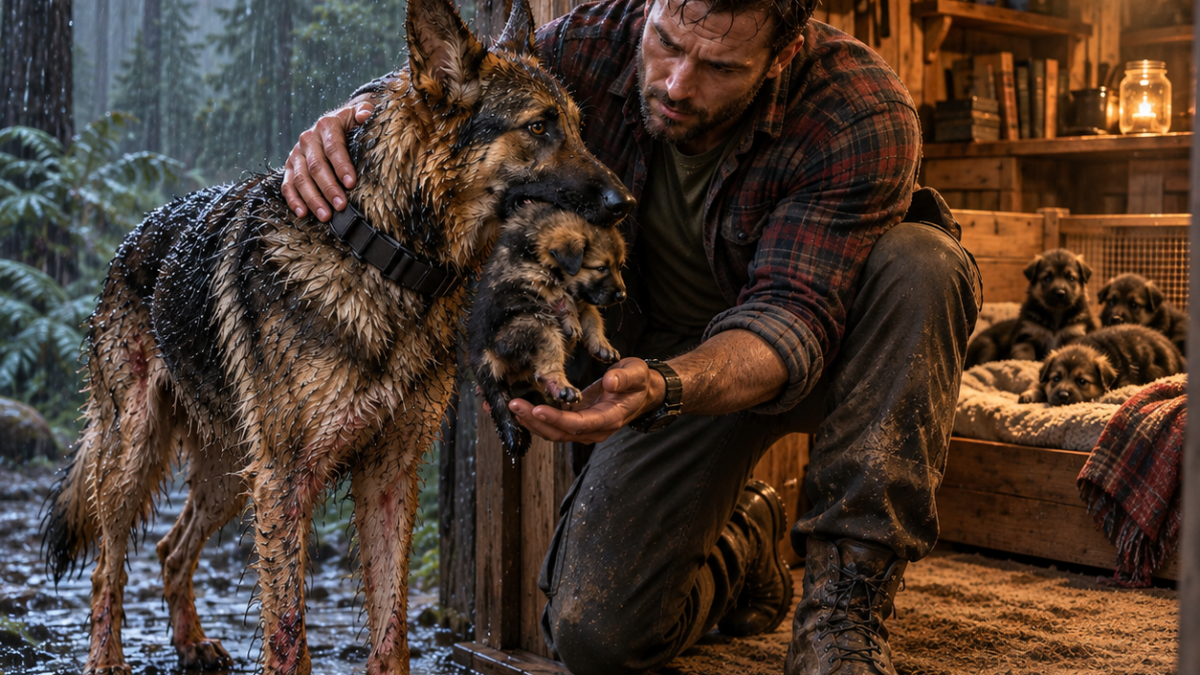
A German Shepherd Brought Five Orphaned Puppies to My Cabin One by One—Then I Found the Search-and-Rescue Tag That Led Me to Her Missing Handler.
The German Shepherd crossed miles of flooded Washington forest five separate times, carrying one orphaned puppy to Caleb Mercer’s cabin on every trip, and by the fifth journey her legs were trembling so badly she collapsed against his door.
When the veterinarian cleaned the mud from beneath the dog’s collar, they found a search-and-rescue identification tag bearing the name FREYA—and learned that her missing handler, a former Army rescuer named Cole Whitaker, had vanished two nights earlier somewhere beyond the washed-out logging roads.
Then Freya dragged herself back toward the trees, and Caleb realized the exhausted dog had not been abandoning the puppies at all—she had been moving them to safety one by one so she could keep returning to the injured man she refused to leave behind.
The fifth puppy arrived just before sunrise.
Caleb Mercer heard the scratching before he saw the dog.
Soft.
Three slow strokes against the wood of the front door.
Then silence.
Rain hammered the metal roof of the cabin.
Wind moved through the cedars surrounding Bell Creek, bending the highest branches and filling the darkness with the low rushing sound that had become background noise to Caleb’s life.
He had been awake anyway.
He slept poorly whenever storms came through.
Too much noise.
Too many abrupt shifts in pressure.
Too many sounds that resembled other places when heard before dawn.
Caleb sat up on the narrow couch where he had fallen asleep with a blanket across his legs.
For a second he did nothing.
Then another scratch came.
Weak.
He stood.
His right shoulder protested immediately.
Old damage.
Permanent.
He ignored it.
When he opened the door, the German Shepherd stood on the welcome mat.
Barely.
Her sable coat was plastered against her ribs.
Water streamed from her muzzle.
Mud covered her legs nearly to the belly.
One hind leg trembled.
The other was not doing much better.
And in her mouth hung a puppy.
Tiny.
Gray-brown.
Silent.
The shepherd lowered her head.
Carefully.
So carefully that Caleb stopped breathing.
She set the puppy on the mat between his boots.
Then nudged it once.
PART2:
The puppy rolled weakly onto its side.
No cry.
No protest.
Caleb dropped to his knees.
“Come on.”
He picked the puppy up.
Cold.
Too cold.
For three years, Caleb had spoken more words to his woodstove than to most people.
Now he was begging something smaller than his palm to stay alive.
“Come on, little one.”
He tucked the puppy against his chest.
“You didn’t make it this far to quit.”
The mother—if she was the mother—watched him.
Her eyes never left his hands.
Caleb looked at her.
“You too.”
The dog swayed.
He reached out.
She flinched.
Not away.
Down.
Her front legs folded.
Caleb caught her under the chest before her head hit the porch.
“Easy.”
She tried to rise.
Failed.
Still she turned her head toward the forest.
PART3:
Toward the same black tree line she had disappeared into after delivering each of the other puppies.
Caleb followed her gaze.
Nothing.
Rain.
Cedars.
Darkness.
But something about the way she looked made the hair on the back of his neck rise.
She was not looking toward escape.
She was looking toward someone.
Three days earlier, Caleb had believed his life had finally become small enough to survive.
He lived alone at the end of an abandoned logging road in western Washington.
The cabin had once belonged to a timber foreman.
One bedroom.
Woodstove.
Tin roof.
Generator.
Well.
A porch leaning slightly downhill because Caleb had intended to fix it for two summers and had somehow never reached the correct emotional state for porch repair.
The nearest paved road was miles away.
His sister called every Sunday.
He usually let it ring.
Former teammates texted occasionally.
He read the first line in the notification window.
Almost never opened the rest.
How are you doing?
People liked that question.
Caleb disliked the answer.
At thirty-eight, he had a medical retirement from the Navy, a reconstructed shoulder, one bad knee, and enough disability pay plus careful savings to keep himself fed without explaining much to anyone.
He had once been a Navy corpsman assigned to a SEAL team.
People hearing that usually imagined competence.
Action.
Brotherhood.
Things Caleb no longer wanted to discuss.
They did not imagine three years alone in a wet cabin.
They did not imagine someone lowering the volume on the radio because certain voices sounded too similar.
They did not imagine a man who sometimes stood in a grocery aisle unable to remember why he had gone there because a dropped pallet in the next aisle had turned Washington into somewhere else for five seconds.
The cabin never asked him what happened.
That was its best quality.
Then, on Thursday afternoon, while he was splitting firewood, the German Shepherd appeared beneath the cedars.
Caleb had raised the maul.
Paused.
The dog stood thirty yards away.
Sable coat.
Dark face.
Wet already from steady rain.
Her ears upright.
Something metallic beneath the fur at her throat.
She favored one hind leg.
But what Caleb noticed first was her attention.
She watched his hands.
Not the wood.
Not the ground.
His hands.
Caleb slowly lowered the maul.
He had worked around military dogs overseas.
He knew the difference between a hungry stray looking for food and a trained animal waiting for information.
He turned slightly sideways.
Reduced his profile.
Set the maul against the chopping block.
“Easy.”
The shepherd did not move.
Caleb went inside.
Filled a stainless bowl with water.
Then reconsidered.
Metal could make noise.
He poured the water into an old plastic mixing bowl instead.
Placed it at the porch edge.
Backed away.
From inside, he watched through the window.
The shepherd waited almost a full minute.
Then approached.
Drank.
Long.
Desperate.
Backed away.
Disappeared.
Caleb stared at the trees after she was gone.
“Good.”
The word sounded strange in the empty kitchen.
An hour later, the door scratched.
Caleb opened it.
The shepherd stood there holding a puppy.
The animal hanging from her mouth looked impossibly small.
She placed it at his feet.
Caleb stared.
The puppy shook violently.
Wet.
Eyes partially open.
Young enough that the ears still folded against the skull.
“No.”
The shepherd looked at him.
Caleb pointed toward the woods.
“I don’t do this.”
No response.
“You found the wrong house.”
The shepherd backed off the porch.
“Take it with you.”
She turned.
Caleb looked down.
The puppy made a faint squeak.
He swore.
“Damn it.”
He picked it up.
Tucked it inside his shirt.
By the time he looked up, the shepherd had disappeared.
Caleb stood in the doorway with a shivering life pressed against his chest.
Furious.
Not at the puppy.
At the dog.
At himself.
At the universe for somehow identifying the exact form of helplessness he could not walk away from.
The cabin had one place where his phone occasionally received service.
Beside the kitchen window.
One bar if he held it near the glass.
He searched veterinary clinic.
Called the nearest town.
A woman answered.
“Bell Creek Veterinary. Dr. Bennett.”
“I have a puppy.”
Pause.
“All right.”
“It’s cold.”
“How cold?”
“I don’t have a thermometer in it.”
“How old?”
“I don’t know.”
“Eyes open?”
“Partly.”
“Teeth?”
Caleb checked.
“Barely.”
“Breathing?”
“Yes.”
“Responsive?”
“Some.”
Her voice changed.
Calm.
Specific.
“Tell me exactly what you’re seeing.”
He did.
She walked him through warming.
Not too fast.
Dry towel.
Blanket.
Controlled warmth.
No feeding until body temperature improved.
Check gum color.
Breathing.
Caleb followed every instruction.
Something about the process steadied him.
Assess.
Prioritize.
Do not invent problems.
Do not skip steps.
He could do steps.
The woman asked:
“What’s your name?”
He almost hung up.
Instead:
“Caleb Mercer.”
Pause.
“Mercer? Old Bell Creek logging road?”
“Yes.”
“That road is half gone.”
“I know.”
“I can meet you at the lower gate with supplies.”
“You’re not getting up here in this weather.”
“I own a truck, Mr. Mercer.”
He looked at the puppy.
“I’m not driving this thing down that road.”
“Then I’m coming up.”
Forty minutes later, headlights moved through the clearing.
Dr. Hannah Bennett climbed from a muddy pickup wearing green scrubs under a rain shell and rubber boots.
Perhaps forty.
Brown hair pulled back.
Tired eyes.
Hands that did not waste motion.
She entered the cabin.
Stopped.
Looked at Caleb.
Then the puppy.
“You called in time.”
Caleb folded his arms.
“The mother left it.”
“Where is she?”
“Gone.”
“May return.”
“She can take it.”
Hannah looked around.
At the warmed towels.
The box Caleb had placed beside the woodstove.
The chair pulled close.
His jacket rolled into a barrier so the puppy could not crawl toward the heat.
“Obviously.”
Caleb ignored the sarcasm.
Hannah examined the puppy.
Checked hydration.
Reflexes.
Breathing.
Temperature.
“You may need to bottle-feed.”
“No.”
“We’ll see.”
“No, I mean I’m not keeping it.”
“I understood.”
She wrote instructions on a yellow pad.
Then gave him a small bag of supplies.
“My personal number.”
“I have the clinic number.”
“The clinic closes at six.”
Caleb looked at her.
“You do this for everybody?”
“No.”
“Why me?”
“Because you live at the top of a washed-out logging road holding a neonatal puppy like unexploded ordnance.”
That was almost funny.
He disliked her slightly less.
After Hannah left, Caleb sat beside the box.
At midnight, the puppy made a thin angry noise.
Caleb leaned closer.
“Well.”
Another squeak.
“That’s better.”
The second puppy arrived the next morning.
The dog placed it on the porch.
Waited until Caleb picked it up.
Then left again.
“Seriously?”
Gone.
By noon, the third arrived.
This time Caleb was ready.
He had moved the warming box closer to the kitchen.
He had supplies.
He knew enough to know how little he knew.
After settling the puppy, he grabbed his coat.
“Not again.”
The shepherd had already turned toward the trees.
Caleb followed.
She moved fast despite the limp.
He kept her in sight for perhaps two hundred yards.
Then she disappeared down into a drainage choked with storm-fallen timber.
Caleb climbed over the first trunk.
Under the second.
The shoulder complained.
The knee joined.
By the time he found an alternate route around the tangle, the dog was gone.
Rain erased tracks almost immediately.
Caleb stood beneath the cedars.
“Great.”
He returned to the cabin.
The first puppy slept on its back.
Paws folded toward the chest.
Caleb stopped in the doorway.
He knew that position.
Ranger used to sleep that way.
Years earlier.
Overseas.
Beside a bunk whenever rules and circumstances allowed.
Ranger had belonged to Petty Officer Daniel Price.
Daniel had been Caleb’s closest friend.
Ranger had been the team dog.
The memories arrived together because they always did.
Daniel laughing.
Ranger asleep.
Daniel throwing a protein bar at Caleb.
Ranger stealing half of it.
Then dust.
Noise.
The operation.
The blast.
Caleb’s shoulder.
Daniel six feet away.
Ranger somewhere he could no longer see.
Two names carried home with him.
One human.
One dog.
Neither came back.
Caleb closed his eyes.
“Don’t.”
The command did nothing.
Memory did not take orders.
By evening, a fourth puppy occupied the box.
Caleb called Hannah.
“How many?”
“Four.”
“The mother staying?”
“No.”
“Eating?”
“She drank.”
“Any food?”
“Some.”
“Condition?”
“Worse.”
Hannah became quiet.
Then:
“Something is keeping her out there.”
Caleb looked toward the dark window.
“What?”
“I don’t know.”
At dawn, the fifth puppy came.
The one that did not cry.
Caleb warmed it.
Called Hannah with shaking fingers.
She talked him through the first few minutes.
Then:
“I’m coming.”
The shepherd tried to rise.
Her legs folded.
Caleb carried the puppy inside.
Returned.
The dog flinched when his arms went beneath her.
“I know.”
He lifted carefully.
Her head dropped against his shoulder.
She was lighter than she should have been.
Too much bone beneath wet fur.
For the first time, she allowed Caleb to carry her.
Hannah arrived to find him sitting on the kitchen floor.
Back against a cupboard.
The shepherd stretched beside him.
Five puppies under blankets near the stove.
The smallest one had started making faint noises.
Caleb looked up.
“That means something, right?”
“It does.”
Hannah examined the litter first.
Then the shepherd.
Temperature.
Hydration.
Leg.
Paw pads.
Scratches.
Bruising.
Nothing immediately explaining everything.
Caleb asked:
“She going to make it?”
“I’m concerned.”
Hannah adjusted the blanket.
“But she has a chance.”
The dog lifted her head when Hannah touched the collar.
Beneath mud and thick fur was a narrow metal plate.
Hannah wiped it clean.
FREYA.
One ear moved.
Caleb leaned closer.
Below the name:
Telephone number.
Small emblem.
Mountain inside a circle.
Hannah looked at it.
“Search and rescue.”
Caleb stared at the dog.
That explained the discipline.
The environmental confidence.
The way she watched hands.
It did not explain the puppies.
Hannah dialed the number.
No answer.
Again.
Nothing.
She left a message.
Photographed the plate.
Freya suddenly tried to stand.
Caleb caught the support harness Hannah had improvised.
“Easy.”
Freya stared at the door.
Whined.
Caleb said:
“She does that.”
“What?”
“Every time she arrived.”
He looked toward the forest.
“Always looked behind her.”
Hannah went outside for better signal.
When she returned, her face had changed.
“What?”
“There’s a missing handler.”
Caleb stood.
“Who?”
“Cole Whitaker.”
“Age?”
“Twenty-nine.”
“Search and rescue?”
“Volunteer.”
Hannah looked at Freya.
“Former Army.”
Caleb felt something settle in his stomach.
“How long missing?”
“Two nights.”
“The puppies his?”
“No.”
Caleb frowned.
“They aren’t hers?”
“No.”
Hannah explained.
The puppies belonged to a foster dog transported by a rescue organization.
Their mother had died after emergency surgery the previous week.
Cole had volunteered to bottle-feed and transport the litter to another foster home.
Storm closed the eastern road.
His truck was later found near a washout.
Search teams started from there.
Caleb looked at Freya.
Five puppies.
Five trips.
Through cold rain.
With an injured leg.
And they were not even her puppies.
“Where’s the truck?”
“North of here.”
“Show me.”
Caleb pulled down the wall map.
Old forestry map.
Bell Creek.
Decommissioned logging spurs.
Drainages.
Ridge lines.
Washouts.
Hannah showed him the location from the search bulletin.
Caleb put one finger against the paper.
“They’re looking on the wrong side of this ridge.”
“You know that?”
“No.”
He looked at Freya.
“But she might.”
Freya pushed herself upright.
Limped to the door.
Caleb remained beside the map.
For one second, the cabin disappeared.
Dust.
Concrete.
Radio static.
Daniel calling his name.
Then the blast.
Caleb gripped the table edge.
Hannah noticed.
“Caleb.”
“I’m fine.”
She waited.
He hated people who waited.
Waiting made lies harder.
“I can give the team a starting point.”
“Yes.”
“I know the ground.”
“Yes.”
“You don’t have to agree with everything I say.”
“I’m agreeing with what’s true.”
His phone buzzed.
Search coordinator.
Deputy Luis Ortega.
Caleb described the dog.
The puppies.
The direction Freya repeatedly traveled.
Ortega asked for coordinates.
Caleb transmitted them.
“I’m diverting a team.”
“How long?”
“Hour to your road.”
“That optimistic?”
“No.”
“Aircraft?”
“Grounded by weather.”
Caleb looked at Freya.
She swayed.
“I can follow her.”
Silence.
Ortega asked:
“What’s your experience?”
“Former Navy corpsman.”
Pause.
“Assigned to SEAL teams.”
“Wilderness?”
“Yes.”
“Navigation?”
“Yes.”
“Satellite communicator?”
“Yes.”
Ortega’s tone hardened.
“Listen carefully.”
Caleb waited.
“This is a search.”
“Understood.”
“Not a solo extraction.”
Caleb looked at the map.
“Understood.”
“Transmit position continuously.”
“Yes.”
“Do not enter unstable terrain.”
Caleb almost promised instantly.
Instead, he looked again at the washout.
“Understood.”
After the call, Hannah said:
“Freya needs rest.”
“I know.”
“You’ll need help if you find him.”
“I know.”
The second admission surprised Caleb.
For three years, help had felt like an accusation.
He had survived by treating independence as virtue.
Now saying I need help sounded different.
Operational.
True.
He pulled a pack from the cupboard.
Emergency shelter.
Medical kit.
Headlamp.
Water.
Dry layers.
Satellite communicator.
Batteries checked twice.
From the bedroom closet, he removed an old orange rescue harness.
He had volunteered briefly with a county team after leaving active service.
Before everything became too loud.
Dust rose from the harness.
Hannah fitted Freya with a support harness from her truck.
“I’m staying with the puppies.”
Caleb nodded.
“Luis knows.”
“Good.”
“Another volunteer is bringing supplies.”
“Good.”
At the door, Caleb looked back.
Five puppies.
Pressed together.
The smallest opened its mouth.
Produced an outraged squeak.
Caleb smiled.
Barely.
Hannah saw it.
“What?”
“Nothing.”
“Good.”
Freya stepped onto the porch.
Stopped.
Looked back toward the puppies.
Hannah said:
“They’re safe.”
Freya remained still.
Then turned toward the trees.
Caleb followed.
Fifty yards into the forest, she looked over her shoulder.
Checking.
Caleb adjusted the pack.
“I’m here.”
She continued.
Behind them, the cabin light became smaller.
For three years, Caleb had measured safety by distance.
Distance from people.
Distance from questions.
Distance from anywhere somebody might need something emotionally complicated.
Now he walked away from the one place he felt safest because somewhere beyond the ridge a stranger might still be alive.
His shoulder hurt.
His mouth went dry.
Old memories moved under the surface.
But beneath all of it was something he had not felt in a long time.
Purpose.
Not destiny.
Not redemption.
A job.
Freya followed Bell Creek upstream.
Slowly.
She stopped at places Caleb would have passed.
Orange fabric snagged on a branch.
Mud beneath an uprooted cedar.
A small protected hollow.
She sniffed.
Caleb crouched.
Scrap of fleece.
Indentations in leaves.
Small ones.
Puppies.
“This is where you kept them.”
Freya looked toward the ridge.
Caleb reconstructed it.
Cole’s truck trapped near the washout.
He carried or moved the puppies away from danger.
Something happened.
Injury.
Fall.
Freya sheltered the litter in the hollow.
Then left.
Found Caleb.
Carried one puppy.
Returned.
Again.
Again.
Again.
Five trips.
And perhaps between each one, she went back toward Cole.
Caleb transmitted.
FOUND TEMPORARY SHELTER. CONTINUING NORTHEAST. DOG FOLLOWING ESTABLISHED ROUTE.
Ortega replied:
TEAM APPROACHING CABIN. KEEP TRANSMITTING.
They climbed.
Sword ferns soaked Caleb’s trousers.
Rain struck his hood.
His bad knee tightened.
Freya stumbled.
Caleb caught the support handle.
She looked back.
“Slow.”
She tried to continue.
“No.”
He guided her beneath a leaning cedar.
“Rest.”
His communicator chimed.
Ortega wanted status.
Caleb typed coordinates.
Then stopped.
His thumb hovered.
He hated the next line.
DOG EXHAUSTED. I AM HAVING DIFFICULTY MAINTAINING PACE.
He sent it.
The answer came quickly.
STOP IF NEEDED. HELP IS COMING.
Caleb stared at the words.
Three years earlier he would have interpreted slowing down as weakness.
Before that, in the teams, there had always been someone beside him.
Someone watching.
Someone carrying part of the load.
After Daniel died, Caleb slowly rewrote the meaning of survival.
Need nobody.
Depend on nobody.
Fail nobody.
Now Freya lay panting beside him.
She had carried five puppies through a storm because she did not understand quitting.
That did not mean exhaustion was strength.
Caleb drank.
Let her rest ten minutes.
Then she stood.
They continued.
At the ridge crest, the forest opened.
Fresh landslide.
Earth torn away.
Roots exposed.
Below:
A narrow ravine.
Bell Creek swollen and violent.
Freya barked.
Not the soft whining from the cabin.
A working bark.
Sharp.
Caleb dropped to his knees well back from the edge.
“Cole!”
Water answered.
He moved his light across the ravine.
Mud.
Branches.
Rocks.
Then orange.
Sleeve.
Under a fallen tree.
Face.
“Cole!”
Something moved.
Caleb’s heart slammed.
He activated the communicator.
LIVE SUBJECT FOUND. RAVINE. SERIOUS INJURY. RISING WATER.
Coordinates.
Terrain.
Access.
Then he shouted:
“My name’s Caleb!”
The face below turned.
“Freya brought me!”
The change in Cole was visible even from above.
“Freya?”
“She’s here!”
Freya strained toward the edge.
Caleb gripped the harness.
“Stay with me.”
He studied the slope.
Direct route unstable.
Upstream, a narrow bench ran down through exposed roots.
He transmitted his intended route.
Then descended carefully.
Freya followed partway.
At the last steep section, Caleb stopped her on a broad patch beneath a cedar.
She whined.
“I can’t carry you and help him.”
She stepped forward.
Caleb put one hand against her chest.
“Wait.”
Freya stared at him.
For the first time, the trained dog looked unwilling to obey.
Caleb pressed his forehead briefly against hers.
“Please.”
She stayed.
Below, Cole lay pinned beneath a heavy limb.
Trousers torn.
Face gray.
Eyes open.
Caleb knelt.
“Hey.”
Cole tried to speak.
“Don’t.”
Caleb opened his medical kit.
“Help is coming.”
Cole whispered:
“Dogs.”
“All five.”
Cole blinked.
“At my cabin.”
His lips trembled.
“Five?”
“Five.”
His eyes closed.
Caleb touched his shoulder.
“Stay with me.”
The sentence destroyed the ravine.
For one instant, Cole was Daniel.
Bell Creek became radio static.
Rain became dust.
Caleb’s hands froze.
Daniel’s hand around his wrist.
Stay with me.
Stay with me.
Stay—
Freya barked above.
Sharp.
Caleb looked up.
She stood under the cedar.
Watching him.
Caleb put one hand on the ground.
Cold mud.
Stone.
Water.
Present.
Then his other hand returned to Cole.
Living.
Breathing.
“Cole.”
Eyes opened.
“There you are.”
Caleb assessed.
Hypothermia.
Possible lower-limb injury.
Entrapment.
No obvious uncontrolled hemorrhage.
He insulated what he could.
Reported.
Did not attempt to move the heavy limb.
Could not safely free Cole alone.
Three years earlier, that sentence might have tasted like failure.
Now it sounded like fact.
A faint whistle came from the ridge.
Caleb looked up.
Two orange helmets appeared.
“Down here!”
A rescuer knelt.
“We see you!”
Caleb looked at Cole.
“You hear that?”
Weak nod.
“Good.”
He adjusted the blanket.
“You don’t have to do the rest alone.”
Above them, Freya barked.
Cole managed a broken smile.
“She never listens when I tell her to go home.”
Caleb looked up at the exhausted shepherd.
“No.”
He said.
“I noticed.”
The rescue took another ninety minutes.
Nobody rushed the limb removal.
A technical team stabilized the area.
Rigging came down.
Cole received warmed fluids.
Pain control.
Additional insulation.
Caleb gave report.
Then stepped back.
Not his extraction.
He accepted that.
Freya was lowered separately after rescuers secured a safer route.
The moment Cole saw her, he began crying.
Not dramatic.
Tears simply appeared.
Freya pulled toward him.
A rescuer loosened the line enough for her to reach his shoulder.
She pressed her nose against his neck.
Cole whispered:
“You got them out.”
Freya leaned harder.
“All five?”
Caleb answered:
“All five.”
Cole looked at him.
“You have them?”
“Veterinarian does.”
“You bottle-feeding?”
Caleb almost objected.
Then:
“Apparently.”
Cole laughed once.
Immediately regretted it because something hurt.
Caleb smiled despite himself.
By afternoon, they had Cole on a litter.
The weather began clearing enough for a staged evacuation to the road.
Freya refused to move far from him.
Search team allowed her alongside when terrain permitted.
Caleb walked behind.
Not because anyone needed him to.
Because leaving suddenly felt wrong.
At one point Ortega came beside him.
“You Mercer?”
“Yes.”
“Luis Ortega.”
“I guessed.”
“You did good.”
Caleb looked forward.
“Dog did.”
“She did.”
Luis waited.
“So did you.”
Caleb did not answer.
Compliments had become difficult.
They sounded like expectations.
Luis did not repeat it.
That helped.
When they reached the cabin, Hannah stood on the porch.
Five puppies were warm inside.
Freya heard them before entering.
She stopped.
Looked at Cole’s litter.
Then at the door.
Hannah understood.
“They’re here.”
Freya went inside.
The puppies began squeaking.
Every one.
Hannah had them arranged in a large box.
Freya approached.
Sniffed.
Licked the nearest puppy.
Then lay down beside the box.
Not mothering exactly.
Not lactating.
Not physically able to provide what they needed.
But guarding.
Cole, waiting to be transported to the hospital, watched from the doorway.
His face broke.
Caleb looked away.
Hannah touched Caleb’s arm.
He flinched.
She removed her hand.
“Sorry.”
“No.”
He rubbed the shoulder.
“Old habit.”
Cole called:
“Mercer.”
Caleb looked back.
“Thank you.”
Caleb wanted to say:
Anybody would have done it.
He knew that was not true.
He also knew the truth did not make him special.
So he said:
“You’re welcome.”
That was enough.
Cole had a fractured tibia.
Three cracked ribs.
Severe dehydration.
Hypothermia.
Concussion.
Nothing immediately life-ending once treated.
He spent four days in the hospital.
Freya spent two nights at Hannah’s clinic.
Exhaustion.
Paw abrasions.
Muscle strain.
Dehydration.
A deep cut near one hock.
No fracture.
The puppies went to an experienced neonatal foster once roads reopened.
Caleb told himself that ended his involvement.
On the fifth day, Hannah drove to the cabin.
Without calling.
Caleb opened the door.
“Phone exists.”
“You don’t answer it.”
“Effective system.”
She held out a paper bag.
“What?”
“Food.”
“I have food.”
“Food people have cooked.”
“I cook.”
“You heat soup.”
“That is cooking adjacent.”
Hannah stepped inside.
Caleb allowed it because arguing required more energy.
She put the bag on the counter.
“Cole wants to see you.”
“No.”
“Okay.”
Caleb stared.
“That’s it?”
“Yes.”
“You came all the way here to ask once?”
“No.”
“What else?”
She took out her phone.
Showed him a photograph.
Five puppies.
Clean.
Dry.
Rounder.
Caleb stared longer than intended.
“The small one?”
“Eating well.”
“Weight?”
Hannah told him.
He nodded.
Then another photo.
Freya lying beside Cole’s hospital bed.
Technically, Freya was not supposed to be there.
Caleb raised an eyebrow.
“Rules?”
“Accommodated.”
“How diplomatic.”
“Veterinarian.”
“Same thing.”
Hannah sat at the table.
“You know Freya’s history now.”
Caleb looked at her.
“What history?”
“She wasn’t originally Cole’s.”
He waited.
Hannah had obtained records through the rescue coordinator and Freya’s identification.
Freya had begun life in a military working-dog development program.
Not deployed as a combat dog.
Not a classified super-animal.
She washed out of one specific military track because of an orthopedic concern while young.
Later transferred through an approved working-dog placement.
Retrained for civilian wilderness search and rescue.
Cole began working with her after leaving the Army.
Caleb looked toward the rain.
“So the tag?”
“Her current tag is SAR.”
“Yeah.”
“But there’s an older microchip record linked to the military program.”
That explained something Caleb had felt immediately.
Her hands focus.
Neutral environmental behavior.
Movement discipline.
Training layers.
“Who trained her?”
“Several people.”
“Cole?”
“Eventually.”
Caleb nodded.
Hannah watched him.
“You thought the metal plate was military.”
“I thought she moved like a dog that had worked around military people.”
“Close enough.”
He looked at the puppy photo again.
“She carried them because of training?”
Hannah shook her head.
“Training can explain behavior patterns.”
“Not five trips?”
“No.”
“Then what?”
She shrugged.
“Dogs don’t submit written explanations.”
Caleb almost smiled.
A week later, Cole arrived at the cabin in a borrowed SUV.
His right leg casted.
Crutches.
Freya beside him.
Caleb came onto the porch.
“You’re not supposed to be driving.”
“I’m not.”
A woman climbed from the driver’s side.
Cole introduced her.
“Maya.”
Search-team coordinator.
She waved.
Cole looked toward the cabin.
“You going to make me stand?”
“You’re on crutches.”
“Exactly.”
Caleb opened the door.
Freya entered first.
Stopped.
Remembered.
She went immediately to the corner where the puppy box had been.
Empty now.
She sniffed.
Then looked at Caleb.
“They’re gone.”
Her ears moved.
“Good foster.”
She sat.
Cole lowered himself carefully into a chair.
“I owe you.”
“No.”
“You kept them alive.”
“Hannah did most of it.”
“You followed her.”
“She led.”
“You found me.”
“Freya found you.”
Cole frowned.
“You’re difficult.”
“So I’ve heard.”
They sat.
Maya eventually went outside to answer a phone call.
Cole looked around the cabin.
“You military?”
Caleb’s eyes shifted.
“Was.”
“Navy?”
“Yes.”
“Corpsman?”
Caleb looked at him.
“Luis?”
“Search people talk.”
Caleb nodded.
Cole rubbed one hand over Freya’s neck.
“Army.”
“I heard.”
“Medic.”
That changed something.
Caleb looked at him more closely.
Cole noticed.
“Yeah.”
Silence.
Then Cole said:
“She kept coming back.”
Caleb waited.
“After the truck went.”
He looked down.
“I got the puppies out.”
“What happened?”
“Road edge collapsed.”
“Truck?”
“Went partly over.”
“You?”
“Got clear.”
“Then?”
Cole described it.
He had five orphaned puppies in transport crates.
Freya.
Storm worsening.
Road gone behind him.
He started toward an old forestry shelter he knew should exist farther west.
Carried two puppies.
Returned for the others.
Moved in stages.
Then the hillside gave beneath him.
He fell into the ravine.
Tree limb came down.
Pinned the leg.
Freya stayed.
He tried sending her away.
She returned.
Again.
At some point she left longer.
Came back wet.
Then left again.
Cole did not know what she was doing.
“I thought she was searching.”
Caleb looked at her.
“She was.”
“For you?”
“For help.”
Cole’s eyes filled.
“She moved the puppies first.”
“Looks that way.”
“How did she know your cabin was there?”
“No idea.”
“Smelled smoke?”
“Maybe.”
“Heard splitting?”
“Maybe.”
Cole rubbed Freya’s ears.
“She’d return to me.”
His voice broke.
“Then leave.”
Caleb pictured it.
A dog making decisions no person had instructed.
Puppies vulnerable.
Handler trapped.
Find another human.
Move litter.
Return.
Repeat.
Cole said:
“The worst part?”
Caleb waited.
“I kept telling her to stay away.”
“Why?”
“I thought if I died…”
His jaw tightened.
“…I didn’t want her staying beside me until she died too.”
Caleb looked toward the woodstove.
Daniel had said something similar once.
Different place.
Different circumstances.
If it goes bad, you move.
Caleb had not moved fast enough.
Or maybe he had.
Memory changed the mathematics daily.
Cole continued:
“She ignored me.”
Caleb looked at Freya.
“Good dog.”
Cole laughed.
“Terrible obedience.”
“Excellent judgment.”
That afternoon, Freya fell asleep beside Caleb’s stove.
On her back.
Paws crooked.
Caleb had to leave the room.
He walked onto the porch.
Rain had stopped.
The forest smelled washed clean.
Behind him, the door opened.
Cole did not come out.
Crutches.
Difficult.
Maya did.
“You okay?”
Caleb nodded.
She leaned against the porch rail.
“Cole said you lost someone.”
Caleb’s shoulders tightened.
“He shouldn’t.”
“He didn’t give details.”
“Still.”
Maya nodded.
“Fair.”
They stood.
Finally she said:
“Freya recognized something in you.”
Caleb looked at her.
“Don’t.”
“What?”
“Turn this into fate.”
“I wasn’t.”
“Good.”
“She found a cabin.”
“Yes.”
“You helped.”
“Yes.”
“That can be enough.”
Caleb looked at her.
It could.
That was harder to accept than destiny.
Destiny absolved people.
Ordinary choice did not.
Freya found his door.
Caleb opened it.
Then again.
Then again.
Five times.
When she needed someone to follow, he chose to follow.
Nothing supernatural required.
Two months passed.
Caleb began answering Hannah’s calls.
Not all.
Enough.
He drove into town for the puppies’ adoption event.
He told himself he was there to return supplies.
Hannah ignored the lie.
Five puppies occupied separate pens.
Larger now.
Awkward legs.
Sharp teeth.
Renamed by fosters.
Caleb objected privately to two names.
One family adopted the smallest puppy.
A teacher and her husband.
Caleb watched them listen carefully to feeding instructions.
The puppy climbed into the man’s lap.
Caleb’s chest hurt.
Hannah stood nearby.
“You all right?”
“No.”
“Want to leave?”
“No.”
That answer surprised him.
Cole attended using a cane.
Freya beside him.
Children wanted to pet her.
Cole controlled every interaction.
One at a time.
Ask first.
Approach correctly.
Freya tolerated them with professional patience.
A boy asked:
“Is she the puppies’ mom?”
Cole looked at Caleb.
Then answered:
“No.”
The boy frowned.
“Then why did she save them?”
Cole considered.
“Because they needed saving.”
The boy accepted that immediately.
Adults usually required more complicated explanations.
All five puppies were adopted within three weeks.
Caleb wrote down each family’s contact information.
Then pretended he had done it for Hannah.
Hannah did not challenge him.
Spring came.
Bell Creek dropped.
The landslide scar remained.
Caleb avoided the ridge for months.
Then one morning Cole called.
“Walk?”
Caleb nearly said no.
“Where?”
“You know.”
“No.”
“Okay.”
Again with people accepting his no too easily.
Caleb stared at the phone.
“What time?”
Cole came with Freya.
His leg had healed enough for moderate hiking.
Caleb’s shoulder remained what it was.
They followed the route.
Not all the way at first.
Temporary puppy shelter.
Orange fabric no longer there.
Creek lower.
At the cedar where Freya had rested, Caleb stopped.
Cole did too.
“You don’t have to go farther.”
“I know.”
They continued.
At the ridge, Caleb’s breathing changed.
He could hear the old explosion beneath the creek.
Freya walked back to him.
Not trained to do so.
Maybe responding to body language.
She stood against his leg.
Caleb put a hand on her shoulder.
Cold ground.
Trees.
Cole.
Freya.
Washington.
Not overseas.
He breathed.
Then reached the ravine.
The tree was gone.
Rescue crews had removed part of it.
Water moved below.
Cole stood at the edge.
“That’s where?”
“Yeah.”
He looked at Caleb.
“You came down there?”
“Upstream.”
“You’re insane.”
“I was following procedure.”
“Sure.”
Caleb almost laughed.
Cole pointed.
“Freya stayed there?”
“Under that cedar.”
The dog sniffed the ground.
Then sat.
No drama.
No recognition anyone could prove.
Just a dog on a ridge.
Cole said:
“I thought I was dying.”
Caleb looked toward him.
“So did I.”
Not about Cole.
Cole understood.
They stood quietly.
Then Caleb said something he had not said aloud in three years.
“Daniel Price.”
Cole waited.
“Friend.”
Caleb swallowed.
“And Ranger.”
“Dog?”
“Yes.”
“What happened?”
“Same operation.”
Cole did not ask for more.
That was why Caleb continued.
“I was six feet away.”
Nothing.
“I kept thinking six feet was something I should have been able to fix.”
Cole looked at the ravine.
“Distance lies.”
Caleb frowned.
“What?”
“When I was pinned down there, Freya was maybe forty feet away.”
Cole pointed toward the cedar.
“Couldn’t reach me.”
Caleb listened.
“You were miles away at the cabin.”
“You did.”
“That doesn’t mean I—”
“I know.”
Cole looked at him.
“I’m not saying you should’ve saved your friend.”
Caleb stiffened.
“I’m saying distance isn’t the same thing as control.”
The sentence stayed with him.
On Sunday, his sister called.
Caleb answered.
Silence.
Then:
“Caleb?”
“Yeah.”
Another silence.
“Are you okay?”
Normally, that would have ended the call.
Instead:
“No.”
His sister inhaled.
“Okay.”
He sat at the kitchen table.
“But I’m here.”
Her voice broke slightly.
“I know.”
They talked eleven minutes.
Nothing solved.
Next Sunday, he answered again.
Months became a year.
Caleb did not return to the Navy.
Did not become a full-time rescuer.
Did not discover that saving Cole had repaired every damaged part of himself.
He still slept poorly.
Still avoided crowds.
Still had days when the phone felt impossible.
But he began volunteering with the county search team again.
Limited role.
Medical support.
Navigation.
Training.
No heroics.
Luis Ortega made that clear.
“We do not need you proving anything.”
“I know.”
“You have a bad shoulder.”
“I know.”
“Bad knee.”
“Yes.”
“Psychological history?”
Caleb looked at him.
Luis waited.
“Working on it.”
“Good enough for today.”
Hannah referred Caleb to someone who worked with veterans.
He nearly refused because recommendations felt invasive.
Then he remembered typing:
I AM HAVING DIFFICULTY MAINTAINING PACE.
The hardest sentence on the ridge.
He called.
Freya continued working.
Not forever.
Another two years.
Then arthritis.
Cole retired her from active search work.
Her final operational find was not dramatic.
An elderly man with dementia who wandered from a campground.
Freya found him sitting beneath a fir tree eating crackers from his coat pocket.
The man told rescuers:
“This dog has been bothering me for twenty minutes.”
Cole called Caleb afterward.
“Heroic.”
“Did she get a cracker?”
“Three.”
“Corruption.”
“Absolutely.”
When Freya retired, Cole brought her to Caleb’s cabin.
She entered.
Checked the corner where the puppies once slept.
Then went to the stove.
Turned three times.
Lay down.
Caleb said:
“You remember this place?”
Cole answered:
“Don’t anthropomorphize.”
“You literally talk to her like she’s your coworker.”
“She is.”
Freya slept.
Several years after the storm, one of the puppy adopters sent Hannah a picture.
Large shepherd mix.
Healthy.
Standing beside a child.
Hannah forwarded it to Caleb.
Then four more.
All five.
Caleb printed them.
He told himself he was going to give them to Cole.
Instead, they stayed on his refrigerator for six months.
Eventually Cole noticed.
“You stole my puppy photos.”
“You never asked.”
“They were my foster puppies.”
“Freya delivered them.”
“To you.”
“Exactly.”
They argued for ten minutes.
Nobody won.
The old metal tag remained on Freya’s collar.
FREYA.
Phone number eventually updated.
Mountain in a circle.
Search and rescue.
The mark beneath her fur that had turned an exhausted dog into a lead.
People later called it a military tag because Freya’s early history involved a military working-dog development program and because Cole had served in the Army.
Caleb corrected them.
“Search-and-rescue tag.”
Some were disappointed.
People preferred hidden military secrets.
The real story was better.
A dog trained across multiple environments.
A former Army medic who became a volunteer rescuer.
Five orphaned puppies whose mother had died.
A storm.
A washed-out road.
A man trapped in a ravine.
A German Shepherd deciding that protecting one life did not require abandoning five others.
A Navy veteran living alone at the edge of nowhere.
A door.
A scratch.
Then a choice.
Again.
Again.
Again.
Five times.
That was enough.
Freya eventually stopped making the trip to the cabin because age made the old logging road difficult.
So Caleb went to her.
On her final visit to Hannah’s clinic, she was nearly fourteen.
Gray face.
Slow hips.
Still watching hands.
Caleb sat on the floor beside her.
Cole sat on the other side.
Hannah gave them time.
Freya slept with her head against Cole’s boot.
Caleb touched the old tag beneath her fur.
The same metal plate Hannah had wiped clean years earlier.
Cole said:
“She found you.”
Caleb shook his head.
“She found a cabin.”
“Same thing.”
“No.”
Cole looked at him.
Caleb smiled faintly.
“She found an unlocked door.”
Freya died peacefully later that winter.
At home with Cole.
Caleb drove over the next morning.
They buried the old search harness beneath a cedar on Cole’s property.
Not Freya.
Cole had chosen cremation.
The harness.
Orange webbing.
Scratches.
Mud stains that never fully washed out.
They stood beside the tree.
Cole said:
“I keep thinking about the puppies.”
“Me too.”
“She could’ve stayed with me.”
“Yes.”
“She could’ve stayed with them.”
“Yes.”
“She didn’t.”
Caleb looked toward the mountains.
“No.”
“She kept moving between what needed her.”
Caleb nodded.
Cole looked at him.
“You did too.”
Caleb did not argue.
That surprised both of them.
Years earlier, Caleb had believed survival meant reducing life until nothing remained capable of hurting him.
Cabin.
Woodstove.
No visitors.
No questions.
Then a wet German Shepherd arrived carrying a puppy.
She did not ask whether Caleb was ready.
The second did not ask either.
Nor the third.
Fourth.
Fifth.
Freya showed him something he had once understood professionally and forgotten personally.
You do not need to feel ready to take the next useful step.
You need to know what is in front of you.
Cold puppy.
Warm it.
Exhausted dog.
Support her.
Missing man.
Call the search team.
Find the route.
Report your limits.
Wait for help.
Keep the patient alive until somebody with more equipment arrives.
Small actions.
No promise they fix the past.
They do not have to.
On the sixth anniversary of the storm, Caleb stood outside his cabin splitting firewood.
The porch still leaned slightly.
He had finally admitted it probably always would.
A truck came up the logging road.
Hannah.
She climbed out carrying a cardboard box.
“No.”
She smiled.
“I haven’t shown you what’s inside.”
“I know you.”
“You barely answer my calls.”
“Evidence of wisdom.”
The box moved.
Caleb stared.
“Hannah.”
“Rescue transfer.”
“No.”
“Temporary.”
“Absolutely not.”
“Twenty-four hours.”
“No.”
A small shepherd-mix head appeared over the edge.
Caleb closed his eyes.
“You drove all the way up here because every foster in town said no.”
“Correct.”
“And you knew I’d say yes.”
“I hoped.”
“That is manipulation.”
“Veterinary outreach.”
The puppy sneezed.
Caleb looked at it.
Then at Hannah.
“Twenty-four hours.”
“Of course.”
“Not forty-eight.”
“Absolutely.”
“No adoption speeches.”
“Wouldn’t dream of it.”
He took the box.
Hannah smiled.
Caleb pointed at her.
“Do not.”
“I didn’t say anything.”
He carried the puppy inside.
At the threshold, he paused.
For just a second, he could see another morning.
Rain.
Freya shaking on the porch.
A silent fifth puppy between his boots.
The forest behind her.
A man alive somewhere beyond the ridge.
Caleb looked down at the new puppy.
Then opened the door wider.
“Come on.”
The puppy wriggled.
“You didn’t make it this far to quit.”
And for the first time, the words did not feel like something he was saying only to the animal.








