A German Shepherd Blocked My Patrol Cruiser in a Blizzard—Then Led Me to a Cabin That Changed Everything
PART3:
My breath burned in my lungs. My fingers numbed inside my gloves. Twice, I slipped and caught myself against trees. The medical kit banged against my leg. The radio gave me nothing but static when I tried it again.
“Dispatch, this is Sullivan,” I said, pushing through snow. “Possible emergency off Highway 2. Following canine toward structure. Radio reception poor.”
Static.
Nothing.
Duke barked ahead.
I pushed on.
After maybe ten minutes, my flashlight caught the outline of a cabin.
Small.
Weathered.
Half-buried in snow.
No lights in the windows.
No smoke from the chimney.
Duke rushed to the porch, pawed at the door, then turned to me with a sound that was no longer a bark.
A plea.
I climbed the steps and pushed the door open.
The cold inside was almost as bad as the cold outside.
My beam swept over a cramped room: dying embers in the hearth, shelves with a few jars of beans and cornmeal, a kettle near the ashes, boots by the door, a rocking chair with a quilt thrown over it.
Then I heard the cry.
A woman’s voice.
Raw.
Weak.
Desperate.
I moved toward the bed.
Clara Whitmore lay on a worn mattress beneath a threadbare quilt, her face pale, hair damp against her cheeks, both hands clutching her swollen belly. Her nightdress was soaked with sweat. Her breathing came fast and shallow.
She was in labor.
Alone.
In a freezing cabin.
In a blizzard.
“Clara,” I said, dropping to one knee beside her. “I’m Deputy Mark Sullivan. I’m here to help.”
Her eyes fluttered open.
For a second, she looked at me without understanding.
Then pain took her again.
Her body arched. A cry tore out of her and faded into a broken gasp.
Duke pressed himself against the bed, whining, licking her hand, then looking back at me as if to say, Do something.
I checked her pulse.
Fast.
Weak.
Her skin was hot and damp.
There was no clean setup for birth. No one helping. No phone within reach. No sign anyone else had been there recently.
I tried the radio.
“Dispatch, Sullivan. I have a female in active labor at the Whitmore cabin off Highway 2. Condition critical. Request immediate medical response.”
Static.
I moved toward the window and tried again.
“Dispatch, do you copy? Urgent medical assistance needed. Pregnant female, active labor, possible dehydration and exposure.”
For half a second, I thought I heard a voice.
Then the storm ate it.
Clara moaned behind me.
Duke barked once.
I looked at her.
Then at the door.
Waiting would kill her.
I knew it with the same terrible certainty I had known, years before, when the call came about Emily and every minute after that felt stolen.
Not again.
I grabbed the wool blanket from the chair, wrapped it around Clara, and leaned close.
“Clara, I can’t wait for an ambulance,” I said. “I’m taking you to the hospital.”
She did not answer.
But her hand found my sleeve and held on with what little strength she had.
That was permission enough.
I lifted her carefully. She was lighter than she should have been, all exhaustion and hunger and pain beneath the blanket. Duke ran ahead to the door, then back, frantic but focused.
The walk to the SUV felt twice as long as the walk in.
Snow blinded me the moment we stepped outside. Clara whimpered with each step. Duke stayed close, barking into the wind as if he could hold the storm back by force of will.
I got her into the back seat, propped her as safely as I could, and opened the other door.
Duke jumped in without hesitation.
He pressed his body against her side, lowering his head onto her arm.
A guard.
A partner.
A promise in fur.
I climbed behind the wheel and drove.
The first mile was chaos.
The road had nearly disappeared. Snow blew sideways across the windshield. The wipers screamed against ice. My tires slipped twice before finding grip. Every curve felt like a test. Every dip in the road made Clara cry out from the back seat.
I drove carefully because reckless speed kills people faster than delay.
But I drove with every piece of myself focused on keeping that SUV moving.
“Hang on,” I said, though I did not know if Clara could hear me. “You’re not dying out here. Neither of you.”
Duke whined, then licked Clara’s hand.
In the rearview mirror, I could see him watching me.
There was trust in his eyes.
That almost broke me.
A dog had pulled me from the road, led me through the storm, brought me to a woman who would have died alone, and now he was asking me to finish the job.
“I won’t fail her,” I told him.
The radio crackled.
“Sul—van… copy… storm… delay…”
“Dispatch, Sullivan en route to Kovville County with critical patient. Notify ER. Active labor, possible maternal distress.”
Static.
No confirmation.
I kept driving.
The storm thinned only when we descended toward town. The hospital appeared through the snow like a ship at sea, squat and brick and glowing amber at the edges.
I swung into the emergency entrance and hit the horn twice.
The sliding doors opened.
A doctor and two nurses rushed out with a gurney.
“Patient status?” the doctor called.
“Clara Whitmore, late-term pregnancy, active labor, severely exhausted, possible dehydration, exposure risk. Found alone in a cabin. Radio failed.”
The doctor’s face tightened, but her voice stayed calm.
“I’m Dr. Melissa Grant. We’ve got her.”
They lifted Clara from the back seat.
Her hand slid away from Duke’s fur.
Duke jumped out and tried to follow the gurney, but I caught his collar gently.
“Not yet, boy.”
He strained once, then stopped.
Together, we watched Clara disappear through the doors.
The hospital lobby was warm, bright, and painfully ordinary after the mountain. Beige tile. Vending machine. Reception desk. Bad coffee somewhere down the hall. My jacket dripped melting snow onto the floor.
Duke lowered himself beside my chair and stared at the double doors.
He did not sleep.
I did not either.
Minutes stretched.
Then an hour.
Then more.
I gave my statement to the nurse at the desk. Called dispatch from a landline. Reported the cabin, the failed radio contact, the emergency transport. I asked for someone to check the road behind me and secure Clara’s cabin when conditions allowed.
Through it all, Duke stayed fixed on those doors.
“You brought me there,” I said quietly.
His ears flicked.
“You saved her.”
He did not look at me.
He was still waiting for Clara.
Sometime after five, Duke growled.
Low.
Deep.
Wrong for the quiet room.
I looked up.
A man stood at the far end of the hallway.
Tall. Dark overcoat. Hood low. Hands in his pockets.
He was not moving like a lost visitor.
He was moving like a man who knew exactly where he intended to go and did not want to be noticed getting there.
Toward maternity.
I stood.
“Sir,” I called. “Visiting hours are over. Can I help you?”
He did not answer.
Kept walking.
Duke’s growl became a bark, sharp enough to make the receptionist flinch.
The man froze for half a second.
Then continued.
My hand moved toward my holster.
“Stop right there.”
Duke lunged forward, barking furiously.
The man’s face turned toward the light.
I caught only pieces.
Pale skin.
Sharp jaw.
Dark eyes.
Recognition.
Fear.
Then he ran.
“Hey!”
I chased him down the hallway, Duke at my side. The man slammed through an exit door into the storm. By the time we reached the parking lot, he was already sprinting toward a black truck idling near the street.
Oversized tires.
Rust along the rear panel.
Washington plate, first three characters: B7K.
I repeated them in my head until they burned there.
The truck fishtailed out of the lot and vanished into snow.
Duke barked after it.
I stood in the cold, breath steaming, anger waking under my ribs.
Whoever that man was, he had not come to visit a mother and newborn.
He had come for Clara.
Maybe for something she knew.
Maybe for something he thought she had.
When we returned to the lobby, the receptionist stared at me.
“Everything okay, Deputy?”
“Not yet,” I said.
A few hours later, a baby cried.
One fragile, fierce sound cut through the waiting room, through the storm, through all the years I had carried Emily’s silence after that road.
Duke leapt to his feet.
I stood too.
The cry came again.
Alive.
Dr. Grant appeared through the double doors, exhausted but smiling.
“She made it,” she said. “Healthy baby girl. Clara is weak, but stable.”
I exhaled so hard it almost became a laugh.
Duke barked once, then pressed himself against my leg.
“You hear that?” I whispered. “They made it.”
Dr. Grant looked down at Duke.
“I take it this is the dog who found you?”
“He found all of us.”
She nodded like she understood.
When they finally let me see Clara, Duke walked beside me down the hall. The room was warm and dim. Clara lay propped against pillows, pale but alive, her newborn bundled in her arms.
Her eyes filled when she saw Duke.
He went straight to the bed and placed his head near her hand.
“Duke,” she whispered.
Her fingers trembled through his fur.
Then she looked at me.
“She’s safe because of you.”
I shook my head.
“Because of him.”
Clara looked down at the dog.
“I told David he was more loyal than most people.”
At the mention of her husband, something crossed her face.
Fear.
Grief.
A secret too heavy to carry one more minute.
Two days later, Clara and the baby were stable enough to leave the hospital, but returning her to that cabin was out of the question. Not after the stranger in the hallway. Not after the storm. Not with a newborn.
I took her to Frank Holloway’s farmhouse.
Frank was a retired deputy, seventy-one, widowed, stubborn, and the closest thing I had to family left in Stevens County. He had trained me when I first joined the sheriff’s office and had never stopped acting like I might still need supervision.
When I called and said I needed a safe place for a mother, a newborn, and a German Shepherd, he did not ask ten questions.
He said, “Bring them.”
His farmhouse sat at the end of a gravel road, smoke rising from the chimney, porch light glowing gold against the snow. Frank met us at the door in flannel and boots, took one look at Clara’s exhausted face, and softened completely.
“You’re safe here, ma’am,” he said. “Anybody comes bothering you, they’ll have to get through me, the deputy, and that dog. That’s a poor life choice for anyone.”
Clara almost smiled.
Inside, Frank made tea while Duke inspected every room like a security contractor.
The baby slept against Clara’s chest.
Her name was Hope.
Clara told me that after Frank left us alone by the fire.
“David chose it,” she said. “Before he died.”
I sat across from her at the kitchen table.
Duke lay at her feet.
“There’s something you need to know,” Clara said.
I waited.
“David’s death wasn’t an accident.”
The fire popped in the hearth.
I leaned forward.
“Why do you say that?”
“They said he lost control on black ice. But David was careful. Too careful. He had snow tires put on that week. He knew those roads.”
“What was he working on?”
Her eyes moved to the baby.
“A case. Organized crime, public contracts, money laundering. He said he found proof tying Vincent Carrow to half the county’s corruption.”
The name made my jaw tighten.
Vincent Carrow was a construction magnate with polished shoes, charity plaques, and too many friends in rooms where permits and contracts got approved. Law enforcement had circled him for years. Nothing stuck.
“Did David tell you where the proof was?”
“No. He said if anything happened, I should trust Duke.”
Duke lifted his head.
Clara looked down at him.
“I thought he meant the dog would protect me. And he did. But maybe…”
She stopped.
I finished the thought.
“Maybe Duke knows where David hid it.”
The next morning, I drove back to the cabin with Duke.
The storm had passed, leaving the mountains eerily still. Snow clung to the pines. The cabin looked smaller in daylight, more fragile. No smoke. No warmth. Just a place that had almost become a grave and then a beginning.
Inside, Duke went to work immediately.
He sniffed the floor.
The bed.
The chair.
The hearth.
Then he stopped near the corner where the floorboards met the stone fireplace.
His body stiffened.
He scratched once.
Then again.
Harder.
I crouched beside him.
“This it?”
He looked at me, then dug at the boards with growing urgency.
I pulled out my multi-tool and pried at the first plank. It resisted, then lifted with a groan.
Beneath it was a hollow space.
Inside sat a wooden box.
Plain.
Dusty.
Heavy with purpose.
I placed it on the table and opened it.
Folded documents.
Bank records.
Photos.
Printed emails.
A USB drive wrapped in cloth.
And David Whitmore’s handwriting across page after page, connecting names, shell companies, bribes, zoning approvals, construction contracts, law enforcement leaks, and money transfers.
At the center of it all was Vincent Carrow.
“David,” I whispered, “you clever bastard.”
Duke sat beside me, eyes fixed on the box.
He had guarded Clara.
Guarded Hope.
Now he guarded the truth David died protecting.
I did not take the evidence to the county sheriff’s office.
That is not an accusation against every person there. Most were good. Some were friends. But corruption does not survive alone, and David’s documents suggested Carrow’s reach had touched places too close to home.
So I called Samuel Price.
Sam worked for the Washington State Bureau of Investigation. We had served together years earlier, before our paths split. He was stubborn, careful, and allergic to political pressure, which made him the right man for dangerous paper.
We met in a quiet office above the courthouse.
Duke lay at my feet.
Sam read for nearly an hour without speaking.
Finally, he looked up.
“This is dynamite.”
“I figured.”
“You understand what you brought me?”
“Enough to know David died for it.”
Sam’s expression darkened.
“And enough to know Clara and the baby are still targets.”
Within forty-eight hours, warrants were signed.
Real ones.
Clean ones.
State-level.
Teams moved before Carrow’s people could bury evidence.
Warehouses.
Offices.
Homes.
Accounting firms.
Construction sites.
A private airstrip hangar.
The arrests came fast, but not reckless. Drivers. Enforcers. Accountants. A county contractor. Two officials whose names made the local news anchors go pale. Each arrest pulled another thread until the whole net began to tear.
Vincent Carrow was arrested outside his estate under a gray spring sky.
He wore a charcoal overcoat and looked more insulted than afraid as agents placed him in cuffs.
When he saw me standing beside Sam, his eyes narrowed.
“You have no idea what you’ve stepped into.”
Duke barked once.
Sharp.
Carrow flinched before he could stop himself.
I looked at him and said, “We already stepped out the other side.”
The trial took months.
Clara testified briefly. Her voice shook, but she did not break. She spoke about David’s fear, his warning, the cabin, the man at the hospital, and Duke.
I testified about the storm, the dog in the road, the cabin, the hidden box, and the chain of custody.
Sam laid out the evidence David had gathered.
By then, enough people had turned on Carrow to save themselves that the empire he built began collapsing under its own weight.
The verdict came back guilty.
Not on everything.
Justice is rarely as complete as grief demands.
But enough.
Enough that Carrow was led away in handcuffs.
Enough that Clara no longer had to live like a shadow.
Enough that David Whitmore’s work did not die in a snowy ditch.
Afterward, outside the courthouse, Clara stood with baby Hope in her arms and Duke pressed against her leg.
She looked at me.
“I don’t know how to thank you.”
“You don’t have to.”
“Yes, I do.”
I looked down at Duke.
“Thank him by listening to him next time before he blocks traffic.”
For the first time since I had known her, Clara laughed.
A real laugh.
Small, but real.
Spring came slowly to the mountains.
Snow melted from cabin roofs.
Creeks swelled.
The pines shook off winter.
Clara decided to return to the cabin—not because she had nowhere else to go, but because she wanted the place that nearly became an ending to become something else.
Frank helped with repairs.
So did I.
We replaced broken boards, sealed gaps, fixed the stove, cleared the trail, reinforced the porch, and installed a radio system that actually reached the county road. Duke supervised all of it with the seriousness of a foreman who believed humans were naturally incompetent.
Hope grew.
Tiny hands.
Dark eyes.
A fierce cry.
Duke never let her out of his sight.
If Clara carried the baby to the porch, Duke followed. If Hope fussed in her basket, Duke stood and looked at the nearest human until someone responded. If I visited, he greeted me at the door, inspected my boots, then permitted entry.
One afternoon, months after the trial, I stood on the cabin porch beside Clara while Hope slept against her shoulder.
Duke lay at our feet, tail moving lazily.
The mountains stretched in front of us, green and bright beneath a sky so clear it seemed impossible that the storm had ever existed.
Clara said, “For a long time, I thought this cabin was where I came to disappear.”
I looked at her.
“And now?”
She touched Hope’s blanket.
“Now I think it’s where Duke brought us back.”
I did not answer right away.
The wind moved through the trees.
Duke lifted his head, then settled again.
“I thought I was following a dog that night,” I said.
Clara smiled faintly.
“You weren’t?”
“No. I think I was following the part of myself that still believed I could get there in time.”
She looked at me softly.
“Did you?”
I watched Duke.
I thought of Emily.
Of snow.
Of helpless waiting.
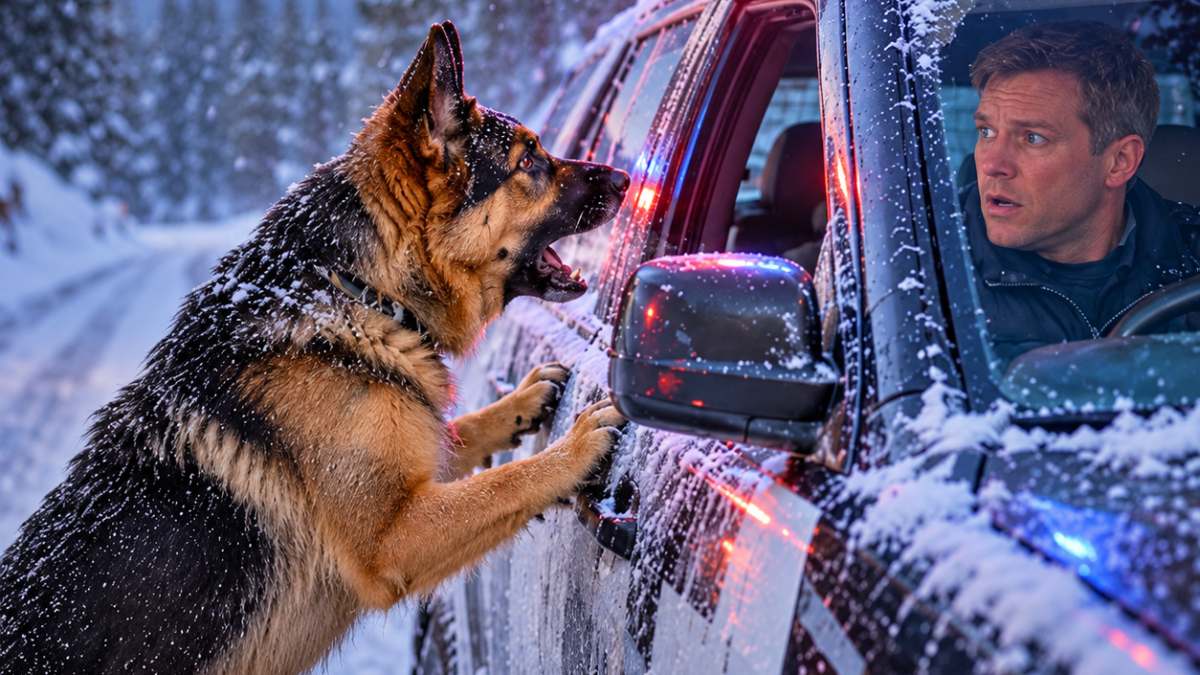
Of a German Shepherd standing in my headlights, refusing to let me drive past the life hidden in the storm.
“Yes,” I said. “This time, I did.”
Not every wound heals because life offers a second chance.
Some losses remain losses.
Emily did not come back because Clara lived.
My grief did not vanish because Hope was born.
But something inside me changed that night.
For years, I had carried my sister’s death like a verdict.
Too late.
Too late.
Too late.
Duke gave me a different sentence.
Follow.
So I did.
I followed him off the road.
Into the trees.
Through the storm.
To Clara.
To Hope.
To David’s truth.
To justice.
To a family I never expected to find standing on the other side of duty.
People still talk about that night in Stevens County.
They talk about the dog who blocked a patrol cruiser.
The deputy who followed him.
The woman rescued from a cabin.
The baby born in a blizzard.
The hidden evidence that brought down Vincent Carrow.
But when people call Duke a hero, Clara always corrects them gently.
“He was already a hero,” she says. “That night, someone finally listened.”
She is right.
Duke had probably tried to get help before I came along. Maybe he barked at the cabin door. Maybe he ran the trail. Maybe he stood at the edge of the highway waiting for headlights and praying in the only way dogs can pray—with loyalty, motion, and refusal.
He did not understand corruption.
He did not understand evidence or warrants or trials.
He did not know the name Vincent Carrow.
He knew Clara was in danger.
He knew Hope was coming.
He knew David had trusted him.
And he knew he had to find someone.
That was enough.
Sometimes I think about how close I came to making the safe choice.
To staying in the cruiser.
To calling him a stray.
To telling myself no reasonable officer follows a dog into the woods during a blizzard with no backup and unreliable radio contact.
Procedure matters.
Training matters.
Caution matters.
But sometimes life steps into your headlights with snow on its back and desperation in its eyes, and all your rules have to make room for the oldest law there is.
Someone needs help.
Go.
Duke is older now.
Gray around the muzzle.
A little slower on cold mornings.
Still watchful.
Still stubborn.
Still convinced every vehicle that enters Clara’s drive requires personal inspection.
Hope is a toddler with curls, laughter, and a habit of feeding him pieces of toast when Clara pretends not to see. Duke accepts them as tribute. Clara says he has earned every crumb.
I still visit the cabin.
More than I need to for official reasons.
Less than I want to if I am being honest.
The porch steps are solid now. The firewood stays stacked. The radio works. The hidden compartment by the hearth remains empty, but Clara keeps the old wooden box on a shelf. Not as a shrine. As a reminder.
David loved enough to hide the truth.
Duke loved enough to find help.
Clara loved enough to survive.
Hope exists because all of that love kept moving through a storm.
And me?
I was lucky enough to follow.
On the anniversary of that night, I drove Highway 2 just after dusk.
No storm.
No emergency.
Just memory.
I stopped near the place Duke had blocked my cruiser. Snow lined the shoulder in thin patches. The pines stood dark and quiet. The road curved ahead, disappearing into the mountains.
I stood there for a while with my hands in my jacket pockets.
Then I heard something behind me.
A bark.
I turned.
Clara had pulled up in her old truck. Duke stood in the passenger seat, nose against the cracked window, tail thumping.
Hope waved from her car seat.
Clara stepped out, smiling.
“He knew where you were going,” she said.
I looked at Duke.
“Of course he did.”
Duke jumped down carefully, stretched his aging legs, and walked to the center of the road as if remembering exactly where he had stood.
Then he came back to me and leaned against my leg.
I rested my hand on his head.
The mountains were quiet.
For once, they did not feel like witnesses to loss.
They felt like witnesses to what had been saved.
I looked down at Duke and thought of that first moment: headlights, snow, amber eyes, a dog refusing to move.
Back then, I thought he was blocking my way.
I know better now.
He was opening it.
He was showing me that fate does not always arrive as a miracle we recognize.
Sometimes it arrives as a German Shepherd in a blizzard, barking at a patrol cruiser, asking one wounded man to trust him long enough to find a woman, a child, and the truth buried beneath the floorboards.
I followed him.
And because I did, Clara lived.
Hope cried.
David’s killers faced judgment.
Duke came home.
And the road that once reminded me only of who I lost became the road where I finally arrived in time.








