A Garbage Truck Was Seconds From Crushing an Abandoned Couch—Then the Golden Retriever I Was Walking Dragged Me Toward It
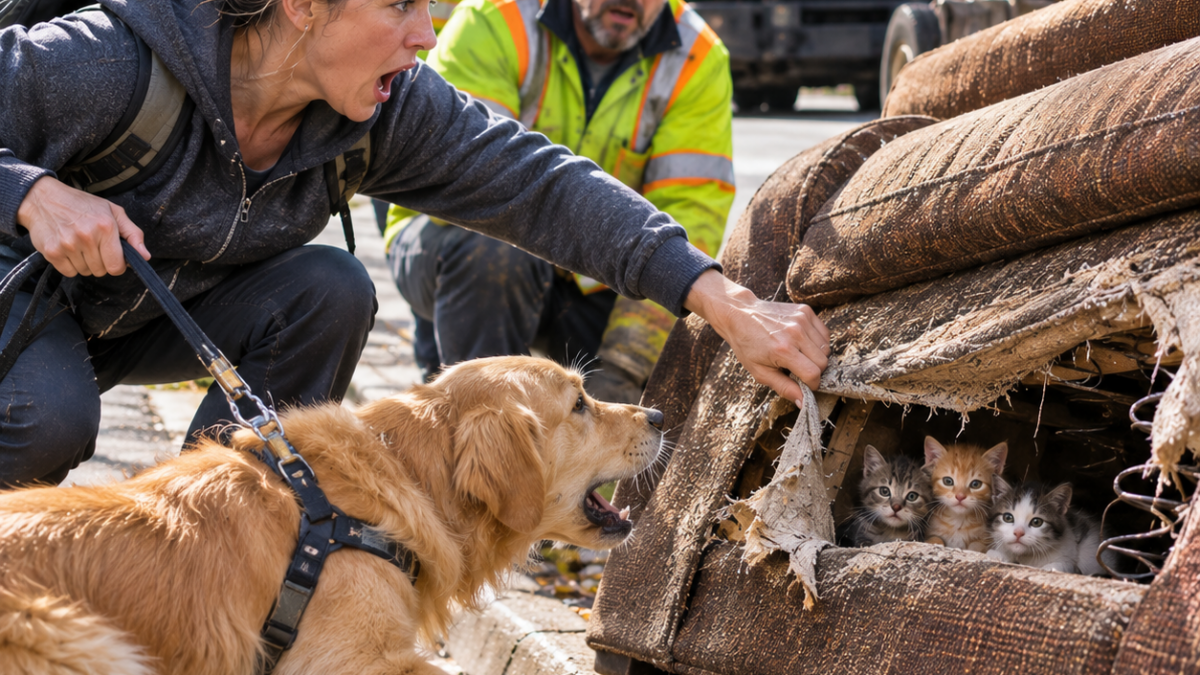
A Garbage Truck Was Seconds From Crushing an Abandoned Couch—Then the Golden Retriever I Was Walking Dragged Me Toward It.
The garbage truck was already backing toward the abandoned couch when the golden retriever on my leash suddenly planted his paws, dragged me toward the curb, and refused to move on.
I thought he had smelled food or a squirrel until I heard the faintest cry from inside the torn underside of the couch—and saw two tiny eyes staring back at me from between the springs.
But when the driver stopped the truck and we opened the furniture, what we found inside made me realize those few seconds had interrupted a story that had begun long before either the dog or I reached that street.
I walk dogs for a living.
That sentence sounds simpler than the job actually is.
People hear “dog walker” and imagine sunshine, happy animals, cute leashes, maybe a coffee in one hand while six perfectly behaved dogs trot beside me like an advertisement for suburban happiness.
My mornings are usually nothing like that.
They are keys.
Garage codes.
Medication notes taped to refrigerators.
Dogs who refuse rain.
Dogs who love rain so much they try to drag me into drainage ditches.
Dogs who eat things they absolutely should not eat.
Dogs who know exactly where every squirrel in a six-block radius lives.
Dogs whose owners say, “He never pulls,” immediately before the animal nearly removes my shoulder because a plastic grocery bag moved in the wind.
I have been doing it for seven years.
My name is Megan Foster.
I am thirty-six.
I work mostly in a residential neighborhood outside Columbus, Ohio, where the streets are lined with maples, brick ranch houses, newer townhomes, small front lawns, and the kind of sidewalks that look peaceful until you are responsible for someone else’s seventy-pound Labrador who has just discovered a rabbit.
Most mornings, I walk six dogs.
Not together.
I value my joints too much for that.
Different clients.
Different routes.
Mostly between six-thirty and eleven.
Tuesday mornings belonged to Charlie.
Charlie was a six-year-old golden retriever who lived with a couple named Mark and Ellen Wallace.
He was one of my easiest dogs.
Sweet.
Predictable.
A little overweight.
Deeply committed to smelling the same three bushes every single morning as though their contents might have changed dramatically overnight.
He did not pull.
Almost ever.
If he saw a squirrel, he might lean.
PART2:
If another dog barked at him, he usually looked at me as if asking whether we really needed to involve ourselves.
His greatest personality flaw was that he believed every person holding food had prepared it specifically for him.
That was Charlie.
Easy.
Gentle.
Unhurried.
Which is why I noticed immediately when he changed.
It was 8:03 on a Tuesday morning.
I remember the time because I had checked my phone after answering a message from my next client.
The weather was cool enough for a sweatshirt.
The sky was pale gray.
Garbage collection was happening along several streets, and large-item pickup had been scheduled for that neighborhood.
That meant old mattresses.
Broken chairs.
Bed frames.
Boxes.
An exercise bike with no seat.
And, on the curb in front of a small blue house on Ridgemont Avenue, an old brown couch.
There was nothing unusual about it.
It looked terrible.
The cushions were gone.
One arm was torn.
The upholstery was stained.
The bottom fabric hung loose beneath it.
Exactly the kind of furniture people drag to the curb and forget.
I barely looked at it.
Charlie did.
PART3:
We were walking along the opposite edge of the sidewalk when his head turned sharply.
He stopped.
“Come on.”
He didn’t.
I gave the leash a gentle tug.
Charlie leaned toward the couch.
“Leave it.”
Normally, that was enough.
Not this time.
He pulled.
Hard.
I almost lost my grip.
“Charlie!”
He lowered his body and pulled again.
There was no aggression.
No barking.
Just determination.
I looked toward the couch.
Nothing.
“What do you smell?”
Charlie dragged me another step.
The garbage truck was already on the street.
Not a normal rear-loading truck.
This one handled bulk items.
Large mechanical arm.
Metal grabber.
The kind that picks up furniture and drops it into the truck.
It was maybe thirty feet away.
Backing toward us.
Beep.
Beep.
Beep.
Charlie pulled again.
“Okay.”
I walked toward the couch.
Mostly because arguing with a golden retriever in public eventually becomes more embarrassing than allowing him to investigate.
We reached the curb.
Charlie shoved his nose beneath the front edge.
Then jerked backward.
His ears went up.
He whined.
That sound changed everything.
Charlie almost never whined outside.
I crouched.
“What?”
He pushed toward the underside again.
I smelled old fabric.
Damp foam.
Dust.
Nothing else.
Then I heard it.
So faint that at first I thought I had imagined it.
A sound from inside the couch.
Not from underneath.
Inside.
A tiny, broken:
“Mew.”
I froze.
Charlie looked at me.
Another sound.
“Mew.”
My stomach dropped.
The garbage truck was closer now.
Maybe twenty feet.
Beep.
Beep.
Beep.
I moved around the couch.
The black fabric stretched across the bottom had been torn open.
There was a hole about eight inches wide.
I got down on one knee.
Charlie pushed beside me.
I used my phone flashlight.
At first I saw dust.
Wood.
Metal springs.
Then two eyes reflected the light.
Tiny.
Round.
Blue-gray.
Watching me from the darkness.
“Oh my God.”
A kitten.
Inside the couch.
Not underneath it.
Inside the frame.
The truck kept backing.
I stood so quickly I dropped Charlie’s leash.
Thankfully, Charlie stayed exactly where he was.
I ran into the street waving both arms.
“STOP!”
The truck continued.
“STOP!”
I screamed louder.
The brakes hissed.
The truck stopped.
Maybe fifteen feet from the couch.
The driver leaned out his window.
“What?”
“There’s a cat!”
He stared at me.
“What?”
“There’s a cat inside the couch!”
The man looked at the couch.
Then at me.
I pointed wildly.
“Do not pick it up!”
He shut off the arm and climbed down.
He was probably in his fifties.
Heavy work gloves.
Fluorescent orange vest.
His name patch said RAY.
He approached with the expression of a man expecting either a misunderstanding or a woman having an unusually dramatic morning.
I pointed under the couch.
“I heard it.”
Ray crouched.
For several seconds, nothing.
Then:
“Mew.”
His face changed.
“Oh, man.”
Exactly those words.
He got lower.
Charlie sniffed beside him.
Ray looked through the torn fabric.
“I see one.”
“I saw one too.”
Then another cry came from farther inside.
Ray frowned.
“That’s not the same place.”
I lowered myself again.
My phone light moved across springs and splintered wood.
One kitten.
Then movement beside it.
Another face.
I whispered, “There are two.”
Ray called toward the truck.
“Darnell!”
Another sanitation worker climbed down from the passenger side.
“What?”
Ray pointed.
“Cats.”
Darnell stopped.
“In the couch?”
“Apparently.”
The three of us crouched around an abandoned sofa at eight in the morning while a golden retriever stood beside us wagging his tail as if he had organized the meeting.
Darnell got his flashlight.
He looked through the opening.
One second.
Two.
Then:
“There’s another one.”
I turned.
“What?”
“Back there.”
He shifted the beam.
I saw a third shape.
Three kittens.
Three tiny bodies curled inside the skeleton of that couch.
I sat back on my heels.
“You’ve got to be kidding me.”
Ray looked toward the house.
“Anybody home?”
I glanced at the driveway.
No car.
Curtains closed.
“I don’t know.”
Darnell stood.
“We need to move this thing.”
“Carefully.”
He gave me a look.
“Yes.”
“I know. Sorry.”
Charlie sat beside me.
Perfectly calm now.
Mission accomplished, apparently.
Ray walked around the couch.
“The bottom’s already ripped.”
“We can open it more.”
Darnell shook his head.
“Better tip it first. Make sure they don’t fall.”
That was the first moment I thought about the mother.
“Wait.”
Both men looked at me.
“There could be an adult cat.”
Ray scanned beneath the porch.
Darnell checked under the parked SUV next door.
I looked toward the shrubs.
Nothing.
No movement.
No adult cat watching.
No sound.
Just three kittens inside furniture scheduled to be crushed.
A woman across the street stepped onto her porch.
She had a coffee mug in one hand.
“Everything okay?”
Ray called, “Cats in the couch.”
She blinked.
“What?”
I almost laughed.
Apparently nobody could hear that sentence correctly the first time.
The woman crossed halfway down her driveway.
“How many?”
“Three.”
She put one hand over her mouth.
“Oh, no.”
Ray and Darnell positioned themselves on either side of the couch.
I held Charlie farther back.
They slowly tipped the furniture onto one side.
The torn underside became fully visible.
The black fabric had ripped away in several places.
Ray used a utility knife carefully.
Not near the kittens.
He cut the cloth open.
Then peeled it back.
The inside of an old couch is uglier than people realize.
Dust.
Foam.
Webbing.
Staples.
Metal springs.
Wooden beams.
Little caves between structural pieces.
And there, tucked into one of those spaces, were three kittens.
They had made a nest.
Or their mother had.
A piece of yellow insulation or stuffing had been pulled into a soft mound between two springs.
The kittens were pressed together.
One gray tabby.
One mostly black with white feet.
One orange-and-white.
Tiny.
Maybe four weeks old.
Their eyes were open.
Their ears upright.
They stared at us.
The gray one hissed.
It was possibly the smallest hiss I had ever heard.
Ray laughed softly.
“Oh, you’re terrifying.”
Darnell removed one glove.
“Can we reach them?”
“I think so.”
I knelt.
The kittens were not wedged tightly.
They had room.
That made me realize something else.
They had probably been entering and leaving the cavity.
Or their mother had.
This was not a kitten accidentally trapped overnight.
This was a home.
A terrible home from a human perspective.
But a protected one.
Covered.
Dry.
Hidden from dogs.
Hidden from people.
A place where a mother cat could leave babies while searching for food.
And someone had dragged the entire nursery to the curb.
My chest tightened.
“Who put the couch out?”
The woman across the street answered.
“The renters moved last weekend.”
I looked at her.
“The house is empty?”
“I think so.”
“Did they have cats?”
She frowned.
“I saw a black cat around sometimes. But I thought it was stray.”
That mattered.
“Adult?”
“Yes.”
“Female?”
“No idea.”
We all looked toward the shrubs again.
Nothing.
Ray said, “Let’s get these babies out first.”
He was right.
The truck still stood in the street.
Mechanical arm raised.
Had Charlie not pulled—
I stopped the thought.
Not yet.
We had work to do.
The gray kitten was closest.
I reached inside.
She backed away.
A four-week-old kitten does not have many defenses.
Hissing.
Tiny claws.
The confidence of someone with no understanding of scale.
I slid one hand beneath her.
She fit in my palm.
Warm.
Lighter than expected.
She hissed again.
Then gripped my thumb.
“You’re okay.”
I lifted her out.
Charlie stood.
His whole body leaned forward.
“Stay.”
He sat again.
I held the kitten near my chest.
Her heart was racing.
The orange kitten came next.
Ray took him.
He held the tiny animal inside two enormous gloved hands and looked absurdly nervous.
“How do I hold this?”
“Support everything.”
“This is everything.”
“He’s six ounces.”
“Exactly.”
The third kitten was black and white.
Darnell reached.
The kitten backed deeper into the frame.
“Come on, baby.”
Another hiss.
Then Darnell smiled.
“Got you.”
He lifted her out.
Three kittens.
Alive.
Standing on a suburban curb.
Ray holding one.
Darnell holding another.
Me with the third.
Charlie sitting beside us.
The couch tipped over.
The garbage truck idling in the road.
The woman across the street staring.
It was ridiculous.
Beautiful.
Terrifying.
I remember thinking:
Ten seconds.
Maybe less.
If Charlie had not pulled.
If I had corrected him and kept walking.
If the truck had already reached the couch.
If Ray had activated the mechanical arm.
The grabber would have lifted the sofa.
Compressed it.
Dropped it into the truck.
No one would have known.
Not us.
Not the sanitation crew.
Not the people who had moved.
Not whoever eventually noticed a mother cat searching.
Three lives would have disappeared inside ordinary garbage collection.
The gray kitten meowed.
Charlie’s ears went forward.
I looked down at him.
“You did this.”
He wagged.
He had no idea.
Or maybe he had every idea that mattered.
The woman from across the street came closer.
“My name’s Linda.”
“Megan.”
She looked at the kittens.
“Oh, my goodness.”
“Do you know if anyone feeds cats around here?”
“There’s a lady two houses down.”
“Can you get her?”
Linda immediately crossed the street.
I called my next client.
“Hi, it’s Megan.”
“Everything okay?”
“Yes. Sort of.”
Charlie’s next appointment was in twenty minutes.
I was going to be late.
“How late?”
“I found three kittens inside a couch that was about to be picked up by a garbage truck.”
Silence.
Then:
“You found what?”
There it was again.
I explained.
My client said, “Take your time.”
Then:
“Do you need anything?”
I looked at the kittens.
“A box.”
“I have one.”
She lived five minutes away.
She said she would bring it.
Darnell asked, “What now?”
“Animal rescue.”
“You know one?”
“I know about fourteen.”
Dog walkers accumulate animal contacts.
Rescues.
Shelters.
Veterinarians.
Foster volunteers.
Pet sitters.
The woman who traps feral cats behind the grocery store.
The retired man who transports animals across county lines.
Once you work around pets long enough, you learn that there is an informal network of people who answer phones when normal systems say they are full.
I called Sarah Kim from Heartland Paws Rescue.
She answered on the second ring.
“Megan?”
“I have kittens.”
“Of course you do.”
“Three.”
“How old?”
“Maybe four weeks.”
“Mom?”
“Missing.”
“Where?”
I looked at the couch.
“That is a complicated question.”
Ten minutes later, Sarah understood.
“Do not take them far yet.”
“Why?”
“The mother may come back.”
I knew that.
Still, hearing it made the urgency change.
“We can’t leave them in the couch.”
“No.”
“The truck is waiting.”
“Move the couch off pickup if you can. Put kittens in a secure carrier nearby. Watch for mom.”
Ray overheard.
“We can skip this stop.”
I covered the phone.
“You can?”
“Sure.”
Darnell nodded.
“We’ll mark it.”
“What happens to the couch?”
“Property owner can call again later.”
Ray looked at the destroyed underside.
“After the cats are sorted.”
I almost hugged him.
Did not.
We barely knew each other.
My next client arrived with a cardboard pet carrier.
She also brought towels.
And kitten formula.
And coffee.
Because apparently this was now a community event.
Her name was Priya.
She looked at Ray holding the orange kitten.
“I thought Megan was exaggerating.”
Ray said, “So did I.”
We lined the carrier.
Placed all three kittens inside.
Immediately they pressed together.
The gray one climbed halfway on top of the black-and-white one.
The orange kitten started crying.
A tiny repeated sound.
“Mew. Mew. Mew.”
We all went silent.
Somewhere, if their mother was close, she might hear.
Nothing answered.
Sarah arrived twenty-five minutes later with a humane trap.
She examined the kittens.
Teeth.
Eyes.
Bellies.
Gums.
“They look good.”
I exhaled.
“How good?”
“Surprisingly good.”
“No dehydration?”
“Not severe.”
She felt each stomach.
“Full.”
That was important.
“If their stomachs are full, mom may have fed them recently.”
Sarah looked toward the house.
“She could be nearby.”
We set the carrier beside the overturned couch.
Covered most of it with a towel.
Kept enough opening for scent and sound.
Sarah baited the humane trap with sardines.
Ray checked his watch.
“We should go.”
I looked at the truck.
“You’ve been here almost forty minutes.”
“Dispatch already asked.”
“What did you tell them?”
Darnell smiled.
“Cat emergency.”
“And?”
“They stopped asking.”
Ray looked at the kittens.
Then at Charlie.
“That dog gets credit.”
“He deserves all of it.”
Charlie wagged when he heard his name.
Ray crouched and scratched his neck.
“Good job, buddy.”
Charlie leaned against him.
The large-item crew drove away without the couch.
The neighborhood became quiet again.
Too quiet.
The entire event had felt enormous while the truck was there.
Now it looked almost ordinary.
Overturned furniture.
Pet carrier.
Dog.
Three women near the curb.
Anyone driving past might have assumed we were cleaning something.
I finished Charlie’s walk late.
I did not want to leave.
Sarah promised she would stay.
Linda promised to watch from her porch.
Priya volunteered too.
I walked Charlie back to his house.
Ellen Wallace opened the door before I knocked.
She had already heard.
Priya had texted her.
“I knew he was special.”
I laughed.
“You say that when he steals socks.”
“He is special when he steals socks.”
Charlie walked inside.
Then immediately turned toward the door again.
“He wants to go back.”
“I think he does.”
Ellen crouched.
“You saved babies?”
Charlie licked her face.
She started crying.
That surprised both of us.
“Megan.”
“I know.”
“What if you hadn’t listened?”
“I know.”
I did not want to think about it.
But the thought followed me all morning.
I walked my next dog.
Then another.
Every time I heard a truck reversing, I felt my chest tighten.
At 10:17, Sarah texted.
NO MOM YET.
At 11:02:
ONE ADULT BLACK CAT SEEN AT END OF STREET. WOULD NOT APPROACH.
At 11:28:
SHE CAME NEAR COUCH.
I stopped walking in the middle of the sidewalk.
My client’s beagle looked up at me.
I typed:
MOM???
Sarah:
PROBABLY. BLACK FEMALE. NURSING.
My entire body relaxed.
Then another message:
TRYING TO TRAP HER.
I finished the walk and drove back.
The couch was still there.
The kittens had been moved into a larger crate with bedding.
The humane trap sat ten feet away.
Sarah was inside her SUV watching.
Linda stood behind her curtains.
Priya had gone home.
I parked half a block away and approached quietly.
Sarah lowered her window.
“She’s been here twice.”
“You saw her?”
“Yeah.”
“What does she look like?”
“Black. Small. Thin but not terrible.”
“Did she go to the kittens?”
“She heard them.”
“What happened?”
“Came to the hedge. Saw us. Left.”
I looked at the crate.
The kittens were asleep.
“So we wait.”
“We wait.”
Dog walking teaches patience.
Cat rescue requires a different species of patience entirely.
We waited.
Noon.
12:30.
One.
I canceled my afternoon visits.
Clients understood.
At 1:17, something moved behind the house.
Sarah touched my arm.
“Don’t move.”
Black cat.
Small.
Low to the ground.
She appeared beneath a hedge.
Stopped.
Watched.
Her ears were forward.
Her body tense.
The kittens were awake now.
One cried.
The adult cat’s head snapped toward the sound.
My throat tightened.
“That’s her.”
Sarah whispered, “Probably.”
The black cat moved closer.
Five feet.
Then ten.
She smelled the sardines.
Ignored them.
Went toward the kitten crate.
Mother.
No question now.
She crouched beside the carrier.
The kittens erupted.
Tiny bodies pushing toward the side.
Crying.
The mother touched her nose to the bars.
I covered my mouth.
“She’s their mom.”
Sarah nodded.
Now came the problem.
We could not simply open the crate.
Not beside a street.
Not with moving vehicles.
The mother was frightened enough that she might bolt.
Sarah had placed the trap so the kitten crate sat beyond it.
The mother would need to enter the trap to reach them directly.
She paced around it.
Once.
Twice.
Would not enter.
For forty minutes she circled.
Every time a vehicle passed, she vanished into the hedge.
Then returned.
She wanted her babies.
She feared the metal trap.
I thought about the couch.
The dark cavity.
How safe it must have felt compared with this open sidewalk.
Whoever had abandoned the furniture had unknowingly removed her home while she was away.
I suddenly felt angry.
Not necessarily at the people.
They may truly not have known.
But at the casual way human decisions change animal worlds.
Move furniture.
Cut shrubs.
Seal a crawlspace.
Demolish a shed.
Throw away a couch.
To us, debris.
To an animal, home.
At 2:04, the mother finally stepped into the trap.
One paw.
Stopped.
Backed out.
Sarah whispered, “Come on.”
Again.
Two paws.
Three.
Then all the way.
The trap door closed.
The cat exploded.
She spun.
Threw herself against metal.
I jumped.
Sarah immediately covered the trap with a blanket.
Darkness.
The cat stopped.
“Is she okay?”
“Yes.”
My heart was racing.
“She looked terrified.”
“She is.”
Sarah touched the covered trap gently.
“But she’s safe.”
We loaded mother and kittens into Sarah’s SUV.
The kittens cried.
The mother answered from beneath her blanket.
The sound was different from the babies’ cries.
Low.
Urgent.
Sarah smiled.
“She knows.”
“Can they be together?”
“Once we get somewhere secure.”
We drove to one of Heartland Paws’ foster homes.
The foster volunteer was named Denise Morgan.
She had converted a spare bedroom into a nursery for cats.
Vinyl floor.
Washable blankets.
Low hiding boxes.
Food.
Water.
Litter.
A baby monitor.
She had fostered more than sixty litters.
“Let Mom out first,” Denise said.
We placed the trap inside the room.
Closed the door.
Then opened it.
The black cat shot beneath a small table.
Denise did not approach.
We placed the kittens in an open carrier.
The moment they cried, the mother emerged.
Slowly.
She walked toward them.
Sniffed.
Then climbed halfway into the carrier.
The kittens buried themselves against her.
One immediately tried to nurse.
The gray kitten climbed over her shoulder.
The mother started cleaning him.
That was it.
Family restored.
Denise looked at me.
“You okay?”
I was crying.
Embarrassing.
I laughed.
“Yes.”
“No, you’re not.”
“No.”
I sat on the floor.
“I keep thinking about the truck.”
Denise nodded.
“Don’t.”
“How?”
“You’ll make yourself crazy.”
“Ten seconds.”
“I know.”
“Maybe less.”
“I know.”
“The arm was right there.”
Denise sat beside me.
“Then think about Charlie instead.”
I looked at her.
“The dog.”
“I know who Charlie is.”
She smiled.
“Think about what went right.”
That became harder than I expected.
Because danger creates a strange addiction in the mind.
We replay disasters avoided.
If I had walked faster.
If Charlie had pulled two seconds later.
If the driver had not heard me.
If the truck window had been closed.
If the kittens had stayed silent.
If the mother had been inside.
If.
If.
If.
You can build an entire nightmare out of things that did not happen.
Denise was right.
Something else happened.
Charlie stopped.
I listened.
Ray stopped the truck.
Darnell helped open the couch.
Sarah answered her phone.
Linda watched the street.
Priya brought supplies.
The mother came back.
Three kittens lived.
So did she.
That was the actual story.
The mother needed a name for foster records.
Denise asked me.
“You found the family.”
“Charlie did.”
“Charlie already has a name.”
I looked at the black cat.
She was staring at us from inside the carrier.
Green eyes.
Small white patch beneath her chin I had not noticed before.
“Cora.”
Why Cora?
I do not know.
It just came.
Denise nodded.
“Cora.”
The kittens became Snap, Crackle, and Pop because Denise said nobody should name foster kittens seriously until at least the second week.
The names stuck.
Snap was gray.
Crackle orange.
Pop black-and-white.
Cora tolerated the names with the expression of a mother who had already survived worse decisions by humans.
For the first three days, she would not let Denise touch her.
She ate only when nobody watched.
She nursed.
Cleaned the kittens.
Moved them twice between nesting boxes.
Every evening, Denise texted updates.
CORA ATE.
BABIES GAINING.
ALL GOOD.
On day four:
CORA LET ME SIT THREE FEET AWAY.
Day six:
SHE TOOK CHICKEN OFF FORK.
Day nine:
SHE SNIFFED MY HAND.
That was rescue.
Not dramatic.
Inches.
Trust measured in feet.
Then inches.
Then one nose touching one finger.
Charlie returned to his usual walks.
The first time we passed Ridgemont Avenue after the rescue, I was nervous.
The couch was gone.
The sanitation crew had collected it two days later after we confirmed the cats were safely removed.
The sidewalk looked empty.
Ordinary.
Charlie slowed near the spot.
Sniffed.
Then kept walking.
That bothered me almost as much as if he had reacted.
Nothing remained.
No sign.
No marker.
No evidence that three kittens had almost disappeared there.
The world is full of places where something almost happened.
We walk past them without knowing.
A week later, Ellen asked if Charlie could visit the kittens.
I laughed.
“Probably not yet.”
“He saved them.”
“He also weighs seventy-two pounds.”
“He is gentle.”
“He is still seventy-two pounds.”
Denise eventually agreed to a carefully controlled introduction once the kittens were older and vaccinated.
But that came later.
First, we had to figure out how the cats ended up in the couch.
The answer was less dramatic than people wanted.
And somehow sadder.
The tenants who moved from the blue house were a young couple named Jordan and Alyssa.
The property manager reached them after Linda contacted him.
The couch had belonged to them.
No, they had not known kittens were inside.
No, Cora was not technically their cat.
But she had been coming into their yard for months.
Alyssa had been feeding her.
Then Cora disappeared for several days.
When she returned, she was thinner.
Alyssa suspected she had kittens somewhere.
She searched beneath the porch.
Garage.
Shrubs.
Never found them.
The week before moving, the couple left the couch on the back patio while sorting furniture.
Its underside fabric was already torn.
At some point, Cora apparently moved her kittens inside.
The couple dragged the couch to the curb Monday evening.
No kittens cried.
No cat appeared.
They moved out.
The next morning, bulk pickup came.
Nobody had intentionally abandoned the kittens.
Nobody had knowingly left them to die.
It was an accident made from several ordinary decisions.
That truth disappointed some people when the story later spread.
People prefer villains.
Villains make danger feel preventable.
If only bad people do bad things, good people feel safe.
But sometimes nobody is cruel.
Sometimes nobody checks.
Sometimes a mother cat chooses a hidden space humans cannot see.
Sometimes furniture moves.
Sometimes trucks arrive.
Sometimes ten seconds matter anyway.
Alyssa cried when I spoke with her.
“I should’ve checked.”
“You didn’t know.”
“I fed her every day.”
“I know.”
“I knew she had babies.”
“You didn’t know where.”
“I should’ve checked the couch.”
I heard myself repeating what Denise had told me.
“You’ll make yourself crazy.”
Alyssa cried harder.
“Can I help?”
“Yes.”
That mattered more.
She paid for Cora’s first veterinary exam.
Jordan bought kitten food.
When the family moved into their new apartment, they asked if Cora could eventually come with them.
That complicated everything.
Cora was not technically theirs.
But she knew Alyssa.
When Alyssa visited the foster room, the change was immediate.
Cora was beneath the table.
Alyssa sat on the floor.
“Hey, Mama.”
Cora’s head lifted.
Alyssa started crying.
“She knows me.”
Cora emerged.
Slowly.
She walked toward Alyssa.
Sniffed her knee.
Then rubbed her face against Alyssa’s hand.
Denise looked at me.
“Well.”
Alyssa covered her mouth.
“I thought she hated me.”
Apparently not.
That created a possibility.
Not immediately.
Cora needed spaying after the kittens were weaned.
The new apartment had to approve pets.
But maybe Cora already had a home waiting.
The kittens continued growing.
By five weeks, they were chaos.
Snap climbed everything.
Crackle believed food should be delivered faster.
Pop followed Cora constantly and occasionally fell asleep halfway across the room.
Denise sent videos.
I showed them to Charlie’s owners.
Charlie watched one video on Ellen’s phone.
Or seemed to.
Then licked the screen.
“Emotional reunion,” I said.
At seven weeks, we arranged the visit.
Denise’s backyard had a screened porch.
The kittens stayed inside a large playpen.
Charlie entered on leash.
At first, the kittens froze.
Charlie froze too.
I crouched beside him.
“Easy.”
His tail moved.
Snap approached the side of the pen.
Charlie lowered his nose.
The kitten arched.
Hissed.
Charlie jumped backward.
Everyone laughed.
The heroic rescuer had been defeated by a two-pound cat.
Charlie looked at me as though betrayed.
“It’s okay.”
Crackle came next.
No hiss.
Just sniffing.
Charlie lay down.
Pop climbed over his siblings.
Cora watched from several feet away.
Alert.
Not panicked.
When Charlie looked toward her, she held his gaze.
Then blinked.
I have no idea what either animal understood.
I did not need to turn it into a conversation.
It was enough to see them alive in the same place.
The dog who had noticed.
The mother who had hidden them.
The kittens who had been ten seconds from disappearing.
Alive.
That was enough.
The story became public because of Linda.
She had taken photographs from across the street.
Not during the dangerous part.
After.
Ray holding two kittens against his fluorescent vest.
Me holding the gray one.
Charlie sitting beside us.
Overturned couch in the background.
Garbage truck waiting.
Linda posted one photo in a neighborhood Facebook group.
Her caption was simple:
PLEASE CHECK DISCARDED FURNITURE. These babies were inside a couch scheduled for bulk pickup this morning. Dog walker’s golden retriever alerted her seconds before the truck lifted it.
By evening, hundreds of people had shared it.
Then a local reporter called.
I almost said no.
I dislike cameras.
I dislike hearing my own recorded voice even more.
But Sarah said visibility might help Cora and the kittens get adopted.
So I agreed.
The reporter wanted a dramatic version.
“How close was the truck?”
“Maybe fifteen feet when it stopped.”
“How many seconds?”
“I don’t know.”
“Would you say ten?”
“Approximately.”
“And the dog saved them?”
“He alerted me.”
“But essentially saved them.”
“He noticed them.”
“What would have happened?”
I looked toward the couch’s old location.
“I think we know.”
That was enough for television.
The segment aired that evening.
Charlie became locally famous.
Ellen received messages from people asking what breed he was.
Golden retriever.
Nothing exotic.
A pet-food company offered to send him treats.
Mark said fame had gone to Charlie’s head.
Charlie continued eating mulch.
Success had not changed him.
The sanitation department interviewed Ray.
He hated it more than I did.
On camera, a reporter asked how he felt about stopping.
Ray said, “Glad I heard her.”
“Do you consider yourself part of the rescue?”
“I hit the brake.”
“That saved them.”
Ray shrugged.
“Sometimes that’s the job.”
That sentence stayed with me.
Sometimes that’s the job.
Stop.
Look.
Listen.
Not every rescue requires running into a burning building.
Sometimes it requires not doing the next thing yet.
The story brought another unexpected consequence.
People began checking discarded furniture.
Not just for kittens.
Snakes.
Raccoons.
Possums.
Other small animals.
Heartland Paws posted a reminder:
Before moving or discarding outdoor furniture, inspect underneath and inside torn fabric cavities.
A week later, a woman messaged the rescue.
She had checked an old recliner before curb pickup because of our story.
Inside were four newborn mice.
Not glamorous.
Not kittens.
Still lives.
She moved the chair into her shed and waited until the mother relocated them.
Another person found a sleeping opossum inside a box spring.
A sanitation worker found a cat hiding beneath a mattress.
Small things.
But repeated.
One event teaching people to pause.
That may have been the part I liked most.
Not Charlie being called a hero.
The pause.
Cora’s kittens reached adoption age.
Snap went first.
A family with two teenagers.
They renamed her Juniper.
Crackle went to a retired couple who had recently lost an orange cat.
They kept the name Crackle because apparently adults can make poor naming decisions too.
Pop was adopted by Denise’s sister.
He remained Pop.
Cora was spayed.
Alyssa’s apartment approved her.
The day Cora left foster care, I visited.
Alyssa brought a new carrier.
Blanket.
Food.
A little black collar.
She sat on the floor while Denise completed paperwork.
Cora wandered around the room.
For weeks, the room had been her territory.
Then Alyssa opened the carrier.
Cora walked toward it.
Sniffed.
Paused.
Then looked at Alyssa.
I held my breath.
Cora stepped inside.
No force.
No chasing.
No trap.
A choice.
Alyssa cried immediately.
“She remembers me.”
Denise smiled.
“Looks like it.”
Cora went home.
Not to the blue house.
That chapter was over.
To a second-floor apartment with windows overlooking trees.
No abandoned couch.
No hidden nursery.
Alyssa sent us a photograph that evening.
Cora asleep on the back of a sofa.
A new sofa.
Gray.
Clean.
Entirely intact.
The irony was almost too perfect.
I sent it to Ray.
We had exchanged numbers after the rescue.
He replied:
CHECK INSIDE FIRST.
I laughed.
Charlie remained Charlie.
Still slow.
Still gentle.
Still obsessed with three bushes.
But I paid more attention to him after that.
To all the dogs.
Not because I suddenly believed animals possessed supernatural knowledge.
They don’t need supernatural abilities.
Their normal senses are extraordinary enough.
Smell.
Hearing.
Attention to movement.
Dogs experience the environment differently.
Charlie probably smelled the kittens.
Or heard them before I did.
Maybe both.
What mattered was that he communicated in the only way available.
He pulled.
And I listened.
That sounds simple.
It was not always something I was good at.
Before becoming a dog walker, I worked in corporate event planning.
Seven years.
Good salary.
Health insurance.
Office downtown.
I hated it.
Not dramatically.
I simply became tired in a way sleep did not fix.
Every Sunday night, my stomach hurt.
Every Monday, I put on clothes I disliked and sat under fluorescent lights planning expensive events for people who used words like “brand activation” without irony.
I complained.
For years.
My sister finally said, “Then quit.”
I told her adults could not simply quit jobs.
Six months later, I did.
Everyone thought I had lost my mind.
Dog walking started as temporary work.
Then I discovered something.
I liked mornings.
I liked being outside.
I liked animals.
I liked work where a successful day could mean a nervous dog finally accepted a leash.
Or an old dog made it around the block without pain.
Or a client came home to a calm animal instead of an anxious one.
Less money.
More life.
Charlie’s couch made me think about that too.
Signals.
Pulls.
Tiny warnings.
How often do we ignore them because we already decided the route?
Charlie had decided the route needed to change.
For ten seconds, I followed.
Three kittens lived.
I am not saying every detour changes a life.
Usually Charlie pulls because somebody dropped a french fry.
But sometimes listening matters.
Months later, I walked Charlie past the same house.
New tenants had moved in.
The porch had flower pots.
A child’s bicycle leaned against the garage.
No couch.
No sign.
Charlie stopped at the curb.
Sniffed.
Looked toward me.
I smiled.
“Nothing there.”
He walked on.
I looked back once.
An ordinary sidewalk.
That still gets me.
So many extraordinary things happen in ordinary places.
A parking lot.
A ditch.
A front porch.
Inside an old couch.
We imagine life-changing moments announcing themselves.
They usually do not.
Sometimes they sound like a kitten too faint to hear over a reversing truck.
Sometimes they feel like a leash tightening unexpectedly in your hand.
Sometimes they look like a dog refusing to continue the walk you planned.
One year after the rescue, Linda organized a ridiculous reunion.
I say ridiculous affectionately.
She invited everyone.
Ray.
Darnell.
Sarah.
Denise.
Alyssa.
The three kitten adopters.
Me.
Charlie and his owners.
Even Priya, who had brought the cardboard carrier.
We met in a fenced backyard.
Cora came in a secure harness.
The kittens were adult cats now.
Not kittens.
Snap—now Juniper—was elegant.
Crackle was enormous.
Pop looked almost exactly like Cora except for his white feet.
Whether they recognized one another, I cannot say.
There was sniffing.
Some hissing.
A lot of human emotion that the cats did not share.
Charlie arrived last.
Everyone cheered.
He looked concerned.
Ellen removed his leash inside the fenced yard.
Charlie walked toward me.
Then toward Ray.
Then smelled a picnic table.
Priorities.
Alyssa held Cora.
“Want to see your hero?”
Cora looked unimpressed.
Charlie approached.
They sniffed.
Cora tapped him on the nose.
Not hard.
Charlie backed away.
The yard erupted in laughter.
Ray said, “Same as last time.”
Someone took a photograph.
All of us.
Humans.
Dog.
Cats.
Not well composed.
Half the animals looking away.
Darnell blinking.
Ray holding Crackle incorrectly.
Charlie’s tongue out.
Cora trying to escape Alyssa’s arms.
It is one of my favorite photographs.
Not because everyone looks good.
Because everyone is there.
That is the entire miracle.
Everyone is there.
Sometimes I still wake remembering the truck.
Beep.
Beep.
Beep.
Closer.
The mechanical arm.
The couch.
Those eyes.
I used to replay what almost happened.
Now I try to replay what did.
Charlie pulled.
I stopped.
A kitten cried.
I looked.
I screamed.
Ray braked.
Darnell helped.
Linda noticed.
Sarah answered.
Cora returned.
That is the version worth remembering.
People sometimes tell me Charlie “knew exactly what was happening.”
I smile.
Maybe.
Maybe not.
He knew something was inside that couch.
That is enough.
They also tell me I saved the kittens.
I correct them.
Charlie noticed first.
Ray stopped the machine.
Everyone did a piece.
That is often how rescue works.
Not one hero.
A chain of people making the next useful decision.
Pause.
Look.
Move carefully.
Make the call.
Stay.
The kittens did not survive because fate had some plan for them.
They survived because several ordinary beings paid attention at the right moments.
A dog.
A dog walker.
Two sanitation workers.
A neighbor.
A rescue volunteer.
A foster.
A mother cat who came back.
There is something more comforting to me about that than destiny.
Because destiny asks us to trust that things will work out.
Attention asks us to participate.
Charlie is older now.
Eight.
His muzzle has started whitening.
He walks a little slower.
Still the same route.
Still the same bushes.
Still barely pulls.
Except occasionally.
Every time he does, I stop.
Most of the time it is nothing.
A squirrel.
A sandwich wrapper.
Another dog.
Once, embarrassingly, a discarded diaper.
I stop anyway.
Ellen laughs when I tell her.
“He trained you.”
“He absolutely did.”
The original photo from that morning is still on my phone.
Ray’s fluorescent vest.
His gloved hands.
Three tiny faces.
The overturned couch behind him.
The truck farther back.
Charlie visible at the bottom edge of the frame.
Most people who see it look at the kittens.
I look at the distance behind them.
The truck to the couch.
The few yards that remained.
A distance measured less in feet than seconds.
Ten, maybe.
Perhaps twelve.
Not many.
Enough.
That morning taught me something I have never been able to unlearn.
We talk about saving lives as though it always requires courage.
Sometimes it does.
But sometimes it requires interruption.
One routine interrupted by a dog pulling left.
One truck interrupted before lifting a couch.
One worker interrupting his schedule.
One person interrupting the assumption that an abandoned object is empty.
The world runs on momentum.
Routes.
Schedules.
Pickups.
Deadlines.
People moving automatically from one task to the next.
Most of the time that is necessary.
But occasionally something living is hidden inside the thing we are about to throw away.
Then the most important thing anyone can do is stop.
Today I walked Charlie down Ridgemont again.
The weather was almost exactly like that morning.
Cool.
Gray.
Garbage truck somewhere in the distance.
The house has changed owners again.
There was an old armchair on the curb.
I laughed when I saw it.
Charlie immediately went toward it.
My heart jumped.
“No way.”
He sniffed one side.
Then the other.
I crouched and checked underneath.
Nothing.
Empty.
Charlie looked at me.
“You created this problem.”
He wagged.
We continued walking.
Twenty yards later, he stopped to smell one of his three bushes.
For almost a full minute.
Normal again.
I stood there holding the leash and looking back at the abandoned chair.
Empty.
Safe.
Ordinary.
And I realized I was grateful even for the false alarms.
Because that is what attention costs.
A few extra seconds.
A stopped walk.
A moment of looking foolish.
Sometimes nothing is there.
Sometimes three kittens are.
I will take the inconvenience.
Every time.
Because one Tuesday morning, at eight o’clock, a golden retriever pulled left when our route went straight.
I listened.
A garbage-truck driver hit the brake.
And three tiny lives hidden inside an old brown couch got to grow up.
One leash.
One faint cry.
One shouted word.
Stop.
Sometimes that is all the distance there is between almost and afterward.








