A Freezing German Shepherd Guarded a Bundle in Snow—What the Officer Found Inside Left Him Stunned
PART2:
“Possible child. I’m approaching.”
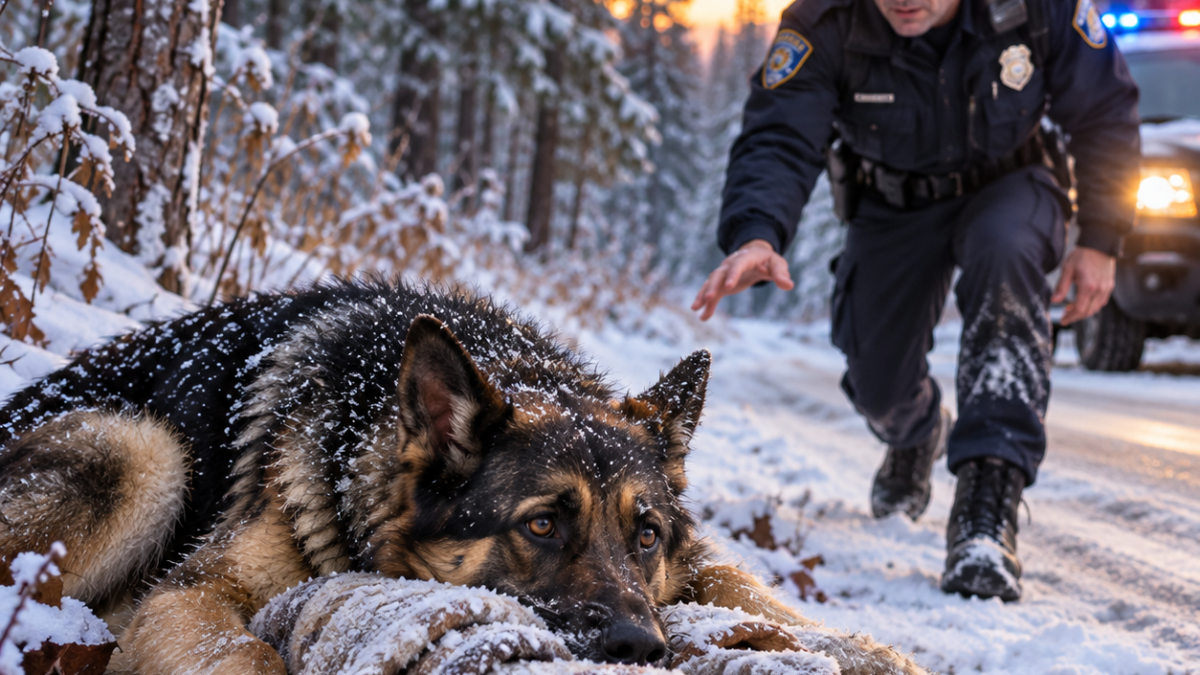
Clark moved only a few inches closer, slow enough that the dog could track him. The shepherd leaned toward him, sniffed the back of his bare hand, then shuddered. His lips tightened once, but he did not growl again.
“I’m going to look,” Clark whispered. “You understand? I’m going to help.”
The dog did not move away.
But he stopped blocking Clark’s hand.
Clark reached toward the edge of the blanket.
The shepherd’s whole body tightened.
Clark paused.
“I know,” he said. “I know.”
He pulled one corner of the fabric aside.
A newborn baby’s face appeared beneath the layers.
For one heartbeat, Clark froze.
The world narrowed to a tiny cheek, pale with cold, a small mouth moving faintly beneath a knitted cap, and one little hand curled near the blanket edge.
Then training took over.
He opened the blankets only enough to assess without letting more cold inside. The baby was wrapped in two additional layers, one cream-colored and one faded pink. A knitted cap had been pulled down over fine brown hair. Only the face and one hand were exposed.
Clark touched her cheek.
Cold.
Too cold.
But there was movement around her mouth.
Her chest rose faintly.
She was breathing.
“Dispatch,” Clark said, his voice controlled only because panic would not help her. “Confirmed living newborn. Female infant, cold exposure. I’m closer to Berlin General than waiting for EMS. I’m transporting now. Notify ER.”
“Copy. ER notified. EMS still en route.”
“Advise them to continue to this location and check the area. Unknown circumstances.”
Clark looked around quickly.
Snow.
Trees.
No vehicle visible.
No footprints he could trust from where he crouched because the dog’s movements had disturbed the area around the bundle.
Beneath the layers, he found a small plastic bottle with a little milk inside, already cold. Beside it was a neatly folded white cloth embroidered with a single capital letter.
A.
Nothing about the arrangement looked careless.
That realization hit Clark harder than the cold.
Someone had wrapped this child carefully.
Someone had tried to protect her.
Someone had placed food beside her.
This did not feel like a baby thrown away in panic.
It felt like a desperate plan made by someone running out of options.
The shepherd lowered himself against the outer edge of the bundle, pressing his body close as though he had been sharing whatever warmth remained in his exhausted frame.
Clark looked at the dog.
Without him, the dark bundle might have disappeared into the snowy shoulder until it was too late.
“You kept her alive,” Clark said softly.
The shepherd blinked once, but his eyes stayed on the baby.
Clark removed his heavy patrol jacket and wrapped it around the blankets, creating another barrier against the cold. Then he carefully lifted the infant into his arms.
The dog rose at once.
His legs nearly buckled.
PART3:
Clark steadied the bundle against his chest.
“Easy. Come on.”
The shepherd followed so closely that his shoulder brushed Clark’s leg as they crossed the snow toward the patrol SUV.
Clark opened the rear door, placed the infant carefully on the seat, and pulled emergency blankets from the kit stored behind the cage partition. He made sure her face remained uncovered, her airway clear, her body insulated. He moved with the precise care of a man who understood that a newborn was both impossibly fragile and urgently alive.
When he turned to close the door, the German Shepherd stood directly behind him.
Clark’s first thought was to leave the dog where responding officers or animal control could collect him. The infant needed the hospital immediately. The dog needed care too, but the baby came first.
Then the shepherd looked past him toward the infant and tried to step forward.
The movement was not confused.
It was not aggressive.
It was insistence.
Clark hesitated for half a second.
Then he opened the door wider.
The shepherd climbed inside without hesitation and positioned himself beside the bundled child. He stood braced on trembling legs, nose close to the blankets, eyes fixed on the baby’s face.
Clark closed the door.
“Dispatch, I have the dog in the vehicle with the infant. He appears protective, not aggressive. I’m en route to Berlin General.”
The patrol SUV pulled away with the heater turned high.
Clark drove quickly but carefully over the snow-covered road, aware that a sudden stop could be dangerous for the tiny passenger behind him. He kept one eye on the road and one on the rearview mirror.
The shepherd never relaxed.
He stood with his front paws braced near the edge of the seat, body angled around the child, nose close to the blankets. Once, the baby made a faint sound.
The dog lowered his head immediately until his muzzle almost touched the outer layer of Clark’s jacket.
The sight stayed with Clark.
He had seen trained working dogs demonstrate remarkable discipline. He had seen search dogs, K9 units, and farm dogs that understood more about duty than half the people who claimed the word. But this shepherd wore no police harness, no service vest, no military patch.
No handler had given him a command.
Whatever bond existed between the dog and the infant had been strong enough to keep him beside her through a freezing night.
The first buildings of Berlin appeared ahead.
The hospital emergency entrance came into view several minutes later.
Two nurses and a doctor were already waiting beneath the covered driveway.
Clark parked at an angle near the doors, stepped out, and opened the rear passenger door.
The German Shepherd shifted closer to the infant as unfamiliar people approached.
“Careful,” Clark warned. “He’s protective.”
The doctor, Meredith Sloan, stopped two steps back.
She was forty-six, medium height, lean, with dark brown hair pulled back and gray eyes that seemed to sharpen when a room became tense. She did not rush toward the dog. She took in the infant, the blankets, Clark’s face, the dog’s position, and made one decision at a time.
“We’ll take the baby,” she said. “Slowly.”
Clark reached down, intending to steady the shepherd by the collar.
His fingers found thick, damp fur.
Then something hard beneath it.
A metal tag, small and scratched from years of use, partly turned backward against the leather collar.
Clark rotated it toward the hospital lights.
One word had been engraved deeply enough that even age and weather had not erased it.
Hartwell.
Clark looked at the name.
Then at the newborn lying beside the dog.
Whatever had placed them on that frozen roadside, their story had begun somewhere else.
“Tag says Hartwell,” he said.
Meredith’s eyes flicked toward him.
“Family name?”
“Maybe.”
The shepherd watched the exchange with full attention, as though every word mattered.
Clark carefully lifted the infant again and carried her through the emergency doors. Warm air washed over them. The baby made another faint sound, small enough that only those closest heard it, but the shepherd heard too. He pushed forward until Clark held one hand low in warning.
“Stay,” Clark said.
The dog did not know Clark.
He had no reason to obey him.
But he stopped just outside the treatment room door, planted himself beside the wall, and watched as the medical team took the baby inside.
The emergency department moved quickly.
Warm blankets replaced the snow-damp layers. A nurse checked temperature. Another checked blood sugar. Meredith listened to the baby’s breathing, examined her skin, her color, her reflexes, her tiny limbs. Someone called for pediatric support. Someone asked Clark questions he answered in clipped, precise sentences because each detail might matter later.
Found at 5:40.
North County Road.
Beside dark blue bundle.
German Shepherd guarding.
Bottle inside blanket.
Embroidered cloth with letter A.
No adults visible.
No vehicle visible.
Dog tag: Hartwell.
Clark remained several steps away with the German Shepherd beside him.
The dog had been offered a bowl of water by one of the nurses. He drank deeply, almost desperately, then abandoned it when the baby made a weak cry from inside the treatment room. He moved back to the door and sat down. Snow melted beneath him, leaving dark patches on the polished floor.
Twenty minutes later, Meredith stepped away from the bassinet.
Clark straightened.
“She’s dangerously cold and mildly dehydrated,” Meredith said. “But you found her early enough. Her breathing is strong. Temperature is coming up. No obvious injuries.”
Clark felt pressure ease in his chest for the first time since he had pulled back the blanket.
“And the dog?”
Meredith looked down.
The shepherd sat with his head lifted toward the treatment room door, ears raised at every small sound.
“He may have made the difference,” she said. “The layers helped. His body heat probably helped more.”
The German Shepherd had no interest in being praised.
Once the baby disappeared deeper into the treatment area, he lowered himself beside the closed door and refused to move more than a few feet away.
A nurse brought food.
He ate several hurried mouthfuls, then abandoned the bowl while half the food remained.
Clark noticed.
A stray that thin and hungry should have stayed near food.
This dog treated eating like an interruption.
He crouched beside him and turned the metal tag again under the hospital light.
Hartwell on one side.
On the other, a phone number and a second word scratched below it.
Huck.
Clark said it quietly.
“Huck.”
The shepherd reacted instantly.
One ear tipped toward him.
His tail moved once against the floor.
There was no doubt.
Huck knew his name.
Clark stood and called dispatch.
“Run a phone number for me. Possible owner connected to recovered infant.”
Within minutes, the answer came back.
The dog belonged to Mason and Elise Hartwell, residents of a rural neighborhood approximately eight miles from where Clark had found the baby. The Hartwell household was also connected through recent local records to a newborn daughter.
Anna Hartwell.
The embroidered A no longer felt mysterious.
Clark looked through the glass toward the warmed bassinet.
Anna.
The name made her more real somehow.
Not a newborn.
Not an infant.
Anna Hartwell.
Someone’s daughter.
Someone’s entire future wrapped in blankets and left beneath the guard of a freezing dog.
Before leaving the hospital, Clark confirmed that Anna would remain under observation. He asked whether Huck could stay nearby.
Meredith studied the dog.
“As long as he stays outside the treatment area and doesn’t interfere.”
“He won’t.”
“You sound sure.”
Clark looked at Huck.
“He’s the only one here who’s been sure of anything all morning.”
Meredith gave the faintest nod.
Huck returned to the door, curled his body against the wall, and rested his chin on his paws while keeping his eyes open.
Clark drove toward the Hartwell address as morning light spread across Berlin.
The storm clouds had started breaking above the surrounding hills, but fresh snow still softened rooftops, mailboxes, and the black lines of bare branches. It would have been beautiful under different circumstances. That morning, Clark saw only places a vehicle could slide, shoulders where tire tracks might be buried, driveways with no movement.
The Hartwell house stood at the end of a short driveway, a modest single-story home with dark shutters, a fenced backyard, and a small porch partly buried beneath drifting snow.
Clark parked, approached the front door, and knocked.
“Police department. Elise Hartwell? Mason Hartwell?”
No answer.
He knocked again.
The door was locked.
The windows showed no movement. From outside, nothing appeared obviously disturbed. No broken glass. No forced entry. No overturned furniture visible through the front window. But several details made Clark’s concern deepen.
Two days of mail remained in the mailbox.
A delivery package sat beneath the porch roof with snow dusted along one edge.
The attached garage was empty.
He was walking back toward the driveway when the neighboring door opened.
A woman stepped onto the porch, pulling a maroon quilted coat tight over her clothes. She was short, slightly rounded through the shoulders, with silver-streaked brown hair cut just below her ears and rectangular glasses that made her concerned expression even more noticeable.
“Officer?” she called.
Clark turned.
“Ma’am. Do you know the Hartwells?”
“I’m Lorraine Bishop. I live next door.”
“How well do you know them?”
“Well enough to know a police car in their driveway is wrong.”
Clark crossed toward her porch.
“When did you last see Elise Hartwell?”
Lorraine’s face tightened.
“I…” She looked toward the Hartwell house. “Not in nearly a week, I suppose. I heard Anna crying once. Maybe four days ago. But seeing Elise? Not since early Tuesday.”
Clark kept his voice even.
“Tell me about Tuesday.”
Lorraine rubbed her gloved hands together.
“It was early. I was getting ready for work. I saw her loading the Subaru.”
“What kind of Subaru?”
“Dark gray Outback. Mason always kept it clean. She had Anna in the infant carrier. Huck jumped in too.”
“Huck is the dog?”
Lorraine’s eyes widened.
“You’ve found Huck?”
“Yes.”
“Is Elise hurt?”
“We’re trying to determine where she is. Where did Elise go?”
Lorraine’s face changed at the question. Not fear exactly. Something closer to regret arriving before the facts.
“I don’t know. North, I think. Toward the mountain roads. I remember thinking she was foolish to take the baby out with snow predicted, but…” She stopped.
“But what?”
“She’d been so tired since Anna came home. I thought maybe she was visiting family. Or maybe going to that cabin.”
“What cabin?”
Lorraine folded her arms tightly.
“Mason’s family had a place up off one of the old service roads. Not much of a cabin, from what Elise said. They used to go there before he deployed. Quiet weekends. She said once it was where she could breathe.”
Clark wrote that down.
“Has Elise seemed unusual lately?”
Lorraine did not answer immediately.
That told Clark enough to wait.
“She had Anna a few weeks ago,” Lorraine said finally. “New mothers are tired.”
“That’s not what I asked.”
Lorraine looked at the Hartwell porch.
“She stopped inviting me in. I brought soup after Mason shipped out. She thanked me through the door. Said the baby was sleeping. Another time, I heard Anna crying for a long time, and I almost knocked, but then it stopped.”
Her voice dropped.
“I told myself I was respecting her privacy.”
Clark knew that sentence. Not those exact words, but the shape of them. People said things like that when they were already beginning to fear a different choice might have mattered.
“Did she mention struggling?”
“She said she was tired but fine. Always fine.” Lorraine swallowed. “Mason’s overseas. Army. Staff Sergeant Mason Hartwell. He’s been gone for months.”
Clark looked again at the quiet house.
Elise had left with Anna and Huck three days earlier.
Now Anna and Huck had appeared together beside a forest road.
Elise and the Subaru were missing.
This was no longer a child abandonment call.
It was a missing mother.
Clark documented the condition of the house, contacted dispatch to circulate the vehicle information, and asked for checks of road reports, tow calls, and any recent reports involving a dark gray Subaru Outback north of town.
Before he left, Lorraine stepped down one porch step.
“Officer?”
Clark turned.
“Is Anna alive?”
He paused.
He had to be careful.
But not cruel.
“She’s safe and receiving medical care.”
Lorraine pressed one hand to her mouth.
Relief passed across her face so sharply it almost looked like pain.
Then came the question she did not have to say aloud.
If Anna was safe, where was Elise?
By the time Clark returned to the hospital, the morning had fully brightened. Sunlight glared off the snow, harsh and clean. He expected Huck to be asleep after food, warmth, and hours of exhaustion.
Instead, the German Shepherd lifted his head the instant Clark entered the corridor.
He rose from beside Anna’s door and stared directly at him.
For several seconds, neither moved.
Then Huck walked toward the hospital entrance.
He stopped near the glass doors, turned, and looked back at Clark.
When Clark remained where he was, Huck returned several steps, gave a low, impatient whine, and headed toward the exit again.
Clark’s pulse changed.
“Huck?”
The dog turned.
His body was angled toward the doors.
His eyes were fixed.
Clark no longer saw a restless animal wanting air.
Huck was trying to lead him somewhere.
Meredith stepped into the hall, following Clark’s gaze.
“What is he doing?”
“I think he knows where Elise is.”
“Based on what?”
“Based on the fact that since I found him, he hasn’t done one random thing.”
Meredith looked at Huck.
The dog whined once.
“Anna is stable,” she said. “If he’s right…”
Clark was already moving.
He clipped a temporary leash to Huck’s collar and led him outside. The late morning sky over Berlin had cleared enough for pale sunlight to shine across the snow, though the mountain roads beyond town remained quiet and partially covered.
Clark did not attempt to command Huck.
He did not tell him to track.
He simply placed the dog in the rear of the patrol SUV and began driving north along the route Lorraine had described.
For the first few miles, Huck remained alert but still.
Then, at a fork where one road continued toward a populated area and another climbed toward the mountains, the shepherd suddenly stood, pressed closer to the front barrier, and gave a low whine.
Clark slowed.
The dog stared toward the mountain road.
Clark turned.
Huck settled almost immediately.
The same pattern repeated twice more.
At one intersection, Clark deliberately began moving in the wrong direction. Within seconds, Huck became restless, shifting his paws against the floor and staring hard toward the opposite road.
Clark corrected course.
The dog became quiet.
It was not proof in the way a witness statement or license plate hit would have been proof.
But it was enough to keep following.
“Dispatch, Dawson. I’m northbound past Mile Marker 12, following probable route connected to missing Hartwell vehicle. Dog is reacting consistently to direction changes. Request backup toward my location and advise county search and rescue to stand by.”
The road narrowed as they climbed.
Houses disappeared.
Snowbanks grew taller.
Pine trees closed in on both sides until the patrol SUV seemed to move through a white corridor. Cell service weakened with every mile. Clark kept his speed low, scanning shoulders for tire marks or anything the storm might have hidden.
Huck barked once from the rear compartment.
Sharp.
Urgent.
Clark followed the dog’s gaze and saw a narrow service road branching away from the main route, nearly hidden by fresh snow and overhanging branches. Two old tire tracks disappeared into it. They were faint, but visible where compressed snow had hardened beneath the storm.
Clark stopped long enough to check them on foot.
They were real.
Not fresh from that morning.
Older.
Covered partly by new snow.
He returned to the SUV and eased onto the unplowed track.
The road was rough and barely wide enough for the vehicle in several places. Fallen branches scraped the sides. Deep drifts forced Clark to slow almost to walking speed. Twice, the tires spun before catching. Once, he had to reverse and try a different line around a frozen rut.
Huck stood the whole time.
After nearly two miles, a dark shape appeared between the trees.
A gray Subaru Outback sat crookedly near the edge of the road, its right wheels buried in packed snow. Snow covered the hood and windshield, making it clear the vehicle had been there through the storm.
Clark stopped several yards behind it.
“Dispatch, I have located a gray Subaru Outback off an unplowed service road approximately two miles east of North Ridge cutoff. Plate to follow.”
Static answered, then dispatch confirmed.
Clark stepped out.
The air felt even colder up here.
There was no major collision damage. The front tire had pushed into a drift, the bumper resting lightly against frozen brush. The vehicle looked less wrecked than defeated.
Huck became intensely alert the moment he saw it.
Clark checked the area before opening the Subaru.
Driver’s door unlocked.
Inside, he found a baby bag on the rear floor containing diapers, wipes, spare clothing, and formula containers. Two bottles of water lay beneath the passenger seat. A folded infant blanket rested in the back. A small pharmacy bag sat in the center console, labeled with Elise Hartwell’s name.
Clark did not examine the medication beyond confirming ownership. That could wait.
The fuel gauge sat on empty.
The wheels were trapped deeply enough that Elise would not have been able to free the vehicle without help.
Nothing suggested violence.
No blood.
No broken glass.
No sign of another person.
The scene looked like a trip that had gone badly wrong.
Outside, Clark studied the snow around the driver’s side. Most tracks had been erased by the storm, but beneath the shelter of nearby trees, fragments remained.
Footprints.
Several compressed impressions leading away from the vehicle.
Some deeper on one side, as though the person had been carrying weight.
Beside them were older dog tracks.
Huck pulled against the leash immediately when Clark stepped toward the tree line.
Clark reported the vehicle’s location and requested rescue support before moving farther from the road.
Then he let Huck lead.
The shepherd moved quickly through the snow, but never disappeared ahead. Every thirty or forty yards, he stopped and turned to make sure Clark was still following. When Clark fell behind on a steep section, Huck waited beside a pine tree until he caught up, then continued.
The behavior removed any remaining doubt.
Huck knew exactly where he was going.
The route was not a marked hiking trail, though signs of occasional human use appeared beneath the snow. An old cut branch. A weathered post. A narrow gap between trees too regular to be natural. Clark pulled bright survey tape from his emergency kit and marked the path back while keeping track of distance on his phone.
The forest swallowed sound.
His breathing grew louder inside his own head. Snow dropped from pine branches in soft collapses. The cold tightened around his face. Somewhere far behind him, a radio transmission cracked and broke apart in static.
Nearly a mile passed before the forest began to open.
A small cabin appeared between the trees.
Weathered logs darkened by years of snow and rain.
A roof carrying a heavy white layer.
One shutter hanging slightly crooked.
A stack of firewood beneath a lean-to on the side.
At first glance, it looked unused.
But not abandoned.
A narrow path near the porch had been disturbed.
Huck saw the cabin and surged forward so suddenly that Clark released the leash rather than pull him backward.
The German Shepherd ran across the clearing, bounded onto the porch, and began scratching urgently at the front door.
Clark reached the steps a few seconds later.
He tried the handle.
Locked.
“Police department!” he called. “Elise Hartwell, are you inside?”
No answer.
Huck continued pawing at the door, whining now, high and desperate.
Clark called again, louder.
Still nothing.
He stepped off the porch and circled the cabin.
The windows were clouded with frost. Heavy curtains blocked most of the view. There were no obvious signs of forced entry or damage.
Then something above the roof caught his attention.
A thin ribbon of smoke drifted from the chimney.
Faint.
Almost transparent against the pale sky.
But there.
Someone had used the stove recently.
Clark returned quickly to the front door.
Huck had stopped scratching.
That was what made Clark go still.
The dog stood with his nose close to the gap beneath the door, entire body rigid, ears pointed forward.
Clark listened.
For several seconds, there was only the soft movement of wind through the trees.
Then a weak sound came from somewhere inside.
Not loud enough to identify.
But human.
Clark placed one hand against the door and leaned closer.
“Elise? This is Officer Dawson with Berlin PD. Anna is safe. If you can hear me, make a sound.”
No clear answer followed.
Huck whined and pressed his nose harder beneath the door.
Clark moved along the porch until he found a side window whose wooden frame had warped with age. He forced it upward far enough to reach the latch, then climbed carefully inside.
The cabin smelled of cold smoke, formula, damp wool, and human exhaustion.
He crossed the small room and opened the front door.
Huck rushed past him at once.
Clark followed, expecting the worst and finding something more complicated.
The cabin did not look like violence.
Nothing was overturned.
No broken furniture.
No blood.
No sign that another person had harmed anyone there.
Instead, the room looked like someone had tried to build order while falling apart.
A small portable bassinet had been positioned near the wood stove, close enough for warmth but not dangerously near the embers. Clean diapers were stacked on a table. Bottles had been washed and arranged beside a metal bowl. Baby clothes were folded into small piles. Several formula containers stood together near the kitchen counter.
The fire had burned down to a weak bed of embers.
The room was cold.
But everything around the empty bassinet showed effort.
Care.
Planning.
The dining table revealed more.
Scraps of paper covered much of its surface, each carrying short reminders written in increasingly uneven handwriting.
Feed Anna 2:00.
Change diaper.
Drink water.
Take medication.
Wash bottles.
Sleep when Anna sleeps.
Eat something.
Call Lorraine?
Check fire.
You only have to get through the next hour.
Clark stood over that last note longer than the others.
You only have to get through the next hour.
The cabin was answering part of the question without anyone speaking.
Anna had not been forgotten.
Every corner of the room showed preparation and the growing exhaustion of a woman breaking each day into pieces because the whole of it had become too heavy.
Huck moved toward the back of the cabin and began whining.
Clark followed him around the edge of an old couch.
Elise Hartwell lay on the floor near the wall.
She was thirty-two, slender beneath an oversized gray sweater, with long chestnut hair tangled around her shoulders and a face sharpened by dehydration and days without real rest. An overturned cup lay near one hand. A blanket had slipped partly from her shoulders.
Her eyes opened when Huck pressed his nose against her arm.
It took several moments before she focused on Clark.
“Elise,” he said, lowering himself to one knee nearby. “My name is Officer Dawson. You’re safe. Anna is safe.”
Her lips moved.
No sound came at first.
Then, barely, “Anna?”
“She’s alive. She’s at the hospital. She’s warm. Doctors are with her.”
The effect was immediate.
Elise closed her eyes.
Some of the tension left her face, as if she had been holding herself together for only that answer.
Clark radioed for a rescue team capable of reaching the cabin and reported that the missing woman had been found alive, suffering from exposure, dehydration, and severe exhaustion.
Then he offered small amounts of water rather than letting her drink too quickly.
Huck lay beside her, pressing his body near enough to touch her arm while still watching Clark.
Even now, the dog was working.
Elise’s fingers moved weakly into the fur along his neck.
“Huck,” she whispered.
The dog’s tail moved once.
Not excitement.
Confirmation.
Over the next several minutes, while they waited for rescuers, Elise began explaining in fragments.
She had come to the cabin because it had once been one of the happiest places she shared with Mason. Before his deployment, they had spent quiet weekends there, walking the trails, cooking simple meals, and sitting near the stove while Huck slept by the door.
After Anna was born, Elise had found herself increasingly unable to sleep even when the baby slept.
Ordinary tasks began requiring written reminders.
She forgot meals.
Lost track of time.
Checked Anna’s breathing again and again until her own hands shook.
When relatives or neighbors asked if she needed help, she told them she was tired but fine.
Fine.
That word had nearly killed all three of them.
She believed the cabin might give her quiet. Enough quiet to recover her sense of control. Enough quiet to stop feeling watched by every unanswered text, every neighbor’s knock, every cheerful question from people who thought a new mother should be glowing instead of terrified.
So she packed formula, diapers, blankets, water, medication, and supplies for Anna before driving into the mountains.
The trip went wrong before she reached the cabin.
The Subaru became trapped on the unplowed service road. The fuel ran low after Elise repeatedly tried to free it. With no reliable phone signal, she eventually carried Anna toward the cabin while Huck followed.
The walk through snow took much longer than she expected.
By the time they arrived, she was already exhausted.
Her phone died soon afterward.
Still, she managed to light the wood stove.
Prepare bottles.
Change diapers.
Keep Anna warm.
Write everything down.
The notes on the table became a way of making sure nothing important slipped past her. She wrote down every feeding because she no longer trusted her memory. She wrote reminders to drink because she would realize hours had passed without water. She wrote instructions for things she already knew because having them on paper made the next task feel possible.
Clark listened without judgment.
The disorder around Elise was not indifference.
It was the remains of a system she had built to keep going after her strength began failing.
Eventually, Elise realized the cabin had become unsafe for Anna. No one knew where she was. The firewood was running low. Her phone no longer worked. She could feel herself becoming weaker.
Her fear was not that she wanted to leave her daughter.
It was that she might become unable to do what Anna needed.
During one of the few moments when her thinking felt clear, she decided the baby had to reach a place where someone could find her.
She wrapped Anna in several layers, placed the bottle and embroidered cloth beneath the blankets, settled the infant into a soft canvas carrier with sturdy handles, and started back through the woods with Huck beside her.
She had hoped to remain at the roadside until help came.
But the walk destroyed what little strength she had left.
Once she reached the road, she understood that if no vehicle appeared quickly, she might not make it back with Anna in her arms. She could barely stand. Her thoughts were slipping. The cold made everything feel distant and slow.
Huck, however, was still alert.
He would not leave Anna’s side.
Elise remembered kneeling beside him in the snow and putting one hand against his neck.
She had trusted Huck around Anna from the day the baby came home. He slept near the bassinet. He followed Elise during nighttime feedings. He appeared whenever Anna cried. He watched strangers with steady attention but never alarmed Elise.
On that frozen roadside, Elise placed her last confidence in the one member of the family who still seemed strong enough to stay there.
She gave him one instruction.
“Stay with her.”
Huck had done exactly that.
Elise intended to return to the cabin only long enough to get a flashlight, more water, and another blanket before trying to reach help by another route.
She made it back through the forest.
Then her body finally stopped cooperating.
She remembered sitting near the couch.
Then waking later on the floor.
Time became difficult after that.
The fire weakened.
Her water ran low.
Several times, she tried to stand and failed.
By the time Huck returned with Clark, Elise no longer knew whether hours or an entire day had passed.
The rescue team arrived through the woods roughly forty minutes after Clark’s call.
The lead paramedic, Dana Mercer, was forty-three, sturdy, short-haired, and calm in a way that made fragile situations feel less likely to shatter. She and two other responders checked Elise’s temperature, pulse, and blood pressure, started warming measures, and prepared her for transport on a collapsible stretcher.
Huck remained beside the couch until they lifted Elise.
Then he tried to follow.
Clark kept him close while the team carried her toward the door.
The danger had not disappeared.
But the cabin no longer felt like a place where someone had vanished.
It had become the place where the truth was finally visible.
Elise had tried to protect Anna until her own strength ran out.
Huck had carried that responsibility the rest of the way.
As the stretcher reached the doorway, Elise turned her head toward Clark.
Her voice was weak.
“Anna?”
Clark stepped close enough that she would not need to strain.
“She’s safe. She’s waiting for you to come back.”
Elise closed her eyes.
For the first time since Clark entered the cabin, something resembling relief settled across her exhausted face.
By the following afternoon, Berlin General had settled into a quieter rhythm.
Anna was warm, feeding normally, and showing none of the complications the medical team had feared when Clark first carried her through the emergency doors. Her color had improved. Her small hands moved beneath the blanket. When she cried, the sound was stronger, still tiny, but no longer frighteningly weak.
Elise was physically stronger too, though her recovery would move along a different path.
She could sit up for longer periods. Drink without assistance. Hold a conversation without losing track of what she was saying. But exhaustion still clung to her, not just in the body, but deeper, in the places sleep alone could not reach.
Dr. Meredith Sloan explained to Clark that Elise would need more than fluids, food, and rest.
The crisis in the cabin had not come from a lack of love for Anna.
Everything they had seen suggested the opposite.
Elise had been trying so hard to function that she hid how badly she was struggling until she could no longer manage safely. Meredith wanted the situation understood as a health crisis requiring treatment, structure, and support, not as proof that Elise had intentionally endangered her child.
Clark understood the distinction more clearly now.
The cabin had been filled with evidence of effort, not neglect.
Feeding notes.
Clean bottles.
Folded clothes.
Reminders written by a woman trying to hold herself together one hour at a time.
While the hospital arranged additional care for Elise, the Berlin Police Department worked with military channels to locate Mason Hartwell.
The process took longer than Clark expected.
Mason was serving overseas, and the request had to move through several layers before anyone could guarantee a direct call. Clark spent much of the day finishing reports, answering questions from medical staff, and checking on Huck, who remained near Anna whenever the hospital allowed it.
Late in the afternoon, Clark’s phone displayed an unfamiliar international number.
He stepped into an empty consultation room and answered.
“This is Officer Dawson.”
The man on the other end introduced himself as Staff Sergeant Mason Hartwell.
His voice was controlled in the way men sounded when they were bracing for the worst sentence of their lives.
Clark did not make him wait.
“Staff Sergeant Hartwell, your wife and daughter are alive.”
For several seconds, there was no response.
Clark could hear only distant static and Mason breathing.
When Mason finally spoke, his voice was lower and less controlled.
“Say that again.”
“Anna is safe in the hospital. Elise has been found alive at your family cabin. She is receiving treatment. The situation was serious, but we reached both of them in time.”
Another silence.
Then a sound that might have been breath leaving a man after days of holding it.
Mason began asking questions in a careful, organized way. Clark recognized the rhythm. People trained for crisis sometimes needed facts arranged in order before emotion destroyed the room.
Clark explained the basic sequence without overwhelming him.
Elise had driven toward the mountains with Anna and Huck.
The Subaru became trapped in snow and ran out of fuel.
At the cabin, Elise’s physical and mental state deteriorated until she realized Anna needed help beyond what she could provide.
She carried the baby back toward the road, wrapped her carefully, and left Huck with her while trying to return for more supplies.
Huck stayed with Anna until Clark found them.
When Clark mentioned the notes in the cabin, the silence returned.
“She never told me,” Mason said.
“She may not have known how.”
Their calls had been short because of the time difference and demands of his assignment. Elise always told him she was tired but managing. During video calls, she angled the phone toward Anna’s bassinet instead of herself. Mason would see the baby sleeping under a blanket and Huck stretched beside the crib, keeping watch.
If he asked whether Elise needed help, she changed the subject.
Everything is fine.
We’re okay.
You focus on your job.
Anna misses you.
Huck is being Huck.
Clark could hear the realization forming in Mason’s voice.
Elise had been protecting him too.
She knew he was deployed and did not want him distracted by problems he could not solve from thousands of miles away.
Mason sounded more affected by that than by anything else Clark had told him.
“She always does that,” Mason said quietly. “Carries things and calls it strength.”
Clark did not tell him he should have noticed sooner.
There was no value in turning uncertainty into blame.
Instead, he said, “Your family is surrounded by people who know the situation now. The hospital is building a plan so Elise won’t have to manage this alone again.”
After the call ended, Clark remained in the consultation room for several minutes.
He had expected relief once Mason knew the truth.
Instead, the conversation left him thinking about how easily a family could appear stable from the outside while one person quietly absorbed all the pressure.
Mason had seen Anna sleeping and Huck guarding the crib.
Lorraine had seen mail gathering and a door that remained closed.
Clark had seen only a dog beside a roadside bundle.
Everyone had possessed one piece of the story.
Nobody had understood the whole picture until the crisis forced those pieces together.
That evening, Lorraine Bishop arrived at the police station.
She had changed out of her postal uniform and wore a cream-colored sweater beneath the same maroon winter coat. Her hair was slightly damp from falling snow, and she held her gloves tightly between both hands.
Clark brought her into a small interview room.
It became clear quickly that she was not there because she had remembered new evidence.
She had come because guilt would not leave her alone.
“I noticed more than I said,” she admitted.
Clark waited.
“The mail. The door. Anna crying. Once, I stood on my porch with a casserole in my hands, and I almost knocked again. But Elise sounded embarrassed the last time. I thought maybe I was making her feel judged.”
“You didn’t know about the cabin.”
“No.” Lorraine’s eyes filled. “But I knew something felt wrong.”
Clark leaned back in his chair.
Regret often searched for a single moment where a different choice might have changed everything. Sometimes it found one. Sometimes it did not. More often, it found something harder: a chain of small hesitations that seemed understandable at the time.
“You saw signs that could have meant a lot of things,” Clark said.
“But next time?”
He met her eyes.
“Next time, knock one more time.”
Lorraine nodded slowly.
The sentence seemed to give her something useful to do with guilt instead of simply carrying it.
The next morning, Lorraine began doing exactly that.
She called two neighbors who knew the Hartwells well and asked for help preparing the house before Elise eventually returned. One man cleared the driveway and walkway. Another, who worked in heating repair, checked the furnace and replaced a worn component before it could become another winter problem. Lorraine collected groceries, replaced food that had spoiled, washed sheets, set easy meals in the freezer, and arranged diapers and formula where Elise would not have to search for them.
No one decorated the house.
No balloons.
No banners.
No public display.
The goal was not to pretend nothing had happened.
They were preparing a home that required less effort from the people entering it.
A stocked refrigerator.
A cleared path.
Clean laundry.
A warm room.
A neighbor close enough to hear when the silence changed.
At the hospital, Huck’s recovery moved at his own stubborn pace.
Because he had spent several days exposed to freezing temperatures and appeared noticeably thin beneath his coat, Meredith arranged for a local veterinarian to examine him. Dr. Aaron Pike arrived that morning from a small clinic outside town, wearing wire-framed glasses, snow boots, and the patient manner of a man used to being judged by frightened animals before being trusted by them.
Huck tolerated the examination only because Anna remained within sight through the open doorway.
Aaron checked his heart, lungs, paws, teeth, hydration, and the shallow scratches along his legs from moving through dense brush.
“He’s exhausted,” Aaron said. “Underfed. Sore. Paw pads need time. But no serious injury that I can find.”
Clark stood nearby with his arms folded.
“Can he recover fully?”
“With food, water, warmth, and rest? Yes.”
Clark looked at Huck.
“Rest might be the one treatment he refuses.”
Huck proved him right almost immediately.
Later that morning, a nurse began wheeling Anna’s bassinet down the hallway for a routine pediatric examination.
Huck had been asleep beside the wall, head flat between his paws, but the soft movement of the wheels brought him upright before anyone called his name.
He followed the bassinet at once.
His legs were stiff, but his purpose was clear. He stayed close enough that his nose occasionally brushed the hanging edge of Anna’s blanket.
When the nurse passed through a set of doors where Huck was not permitted to follow, he stopped directly in front of them and waited.
He did not bark.
He did not scratch.
He simply sat facing the narrow glass panel until Anna returned.
The same thing happened again during another check later in the day.
By then, the nurses had stopped trying to redirect him.
Huck had created his own routine.
Eat when food appeared close enough.
Drink when water appeared.
Sleep when Anna slept.
Stand whenever her bassinet moved.
Someone from the hospital staff eventually brought him a large orthopedic dog bed donated by a local pet store. It was thick, clean, and soft enough that even Clark thought it looked more comfortable than some motel mattresses he had encountered during winter road assignments.
The bed was placed in the corner of Anna’s room, several feet from the bassinet.
Huck walked over, sniffed it carefully, stepped onto it with his front paws, and considered the offer.
Then he turned around, crossed the room, and lowered himself back onto the hard floor beside Anna.
Clark watched from the doorway.
“Looks like he didn’t read the catalog.”
Meredith smiled.
One of the nurses laughed quietly.
The moment was small, but it mattered.
For the first time since the roadside rescue, laughter entered the story without immediately being followed by another emergency.
Elise’s recovery was less visible, but no less important.
She began meeting regularly with a mental health specialist and a hospital social worker, and the staff were careful not to rush her simply because her physical condition had improved. By the third afternoon, she could walk short distances with assistance and sit near the window for longer conversations without becoming overwhelmed.
Her long chestnut hair had been brushed and tied loosely behind her neck. Some color had returned to her face, though exhaustion still showed around her eyes.
Clark visited after checking on Anna and found Elise holding a cup of tea with both hands while snow melted slowly from the hospital roof outside.
She no longer spoke in the broken fragments he had heard in the cabin.
For the first time, she could describe clearly what had frightened her most.
“I never wanted to leave Anna,” she said.
Clark sat in the chair near the wall.
“I know.”
“I need you to understand that.”
“I do.”
Her fingers tightened around the cup.
“I used to hear stories like this and think, how could a mother ever put her baby down and walk away?” Her voice shook. “Then I became someone standing beside a road in the snow, looking at my daughter and thinking the only way to save her was to trust the dog more than myself.”
Clark did not interrupt.
“What terrified me wasn’t that I didn’t love her,” Elise continued. “It was that I loved her so much and still couldn’t trust my own mind. I would feed her and then ten minutes later panic because I couldn’t remember whether I’d done it or only thought about doing it. I checked her breathing until I made myself dizzy. I would realize at three in the afternoon that I hadn’t eaten since the day before. I kept telling people I was tired because tired sounded normal.”
She looked toward the bassinet through the open door.
“The notes weren’t casual reminders. They were the only way I knew how to keep us safe. At first, writing things down helped. Then even following the list got hard.”
“The cabin seemed like quiet,” Clark said.
Elise nodded.
“I thought if I could get away from everyone asking if I was okay, maybe I could become okay before anyone noticed I wasn’t.”
That sentence stayed with him.
It was the kind of logic that made sense only when a person was already in danger.
Isolation pretending to be control.
Silence pretending to be strength.
By the time she decided to take Anna toward the road, Elise knew she was running out of strength. She intended to remain beside the carrier until someone passed. But every step through the snow had taken more from her. Huck kept circling between her and Anna, waiting whenever Elise stopped, pressing his body near the baby as if he already understood the shape of the task.
When they finally reached the roadside, Elise realized Huck was more capable of staying alert than she was.
“In that moment,” she whispered, “he was the only one of us I trusted.”
Nothing in Elise’s explanation erased the danger Anna had faced.
But it gave the danger a different meaning.
Elise had not chosen distance from her child.
She had recognized, however imperfectly and desperately, that her daughter needed help beyond what she could provide in that moment.
The decision had nearly broken her.
It had also saved Anna’s life because Huck obeyed.
Before Clark left the room, Meredith entered with an update from the military family liaison. Mason’s command had approved emergency arrangements allowing him to begin returning home earlier than planned. Travel still required coordination, but for the first time, Mason was no longer simply waiting overseas for news about a family he could not reach.
Elise covered her face for several seconds.
The relief was quiet rather than dramatic, but Clark could see how much weight left her shoulders.
That evening, Clark stopped once more outside Anna’s room before finishing his shift.
The expensive dog bed remained untouched in the corner.
Anna slept beneath a light blanket, breathing evenly.
Huck lay on the floor beside her with his head resting near the wheels of the bassinet. His eyes were closed, but one ear remained slightly raised.
The dog had been fed, warmed, examined, and declared safe.
Anna was surrounded by nurses and doctors.
There was no roadside anymore.
No falling snow.
No need for Huck to stand between the child and the world.
He guarded her anyway.
Elise had trusted Huck when she had nothing else left to trust, and the German Shepherd had carried that responsibility farther than anyone could reasonably have expected.
Mason Hartwell returned to New Hampshire three days later.
He arrived in Berlin beneath a pale winter sky, with the mountains still carrying the white remains of the storm that had nearly taken his family from him. He came directly from the airport in uniform, traveling with little more than a duffel bag and the exhaustion of a man who had crossed several time zones while sleeping only in fragments.
At thirty-five, Mason was tall and lean, with close-cut dark hair, strong features, and the disciplined posture of someone who had spent years in the Army learning how to keep moving no matter how tired he felt.
But when he stepped through the hospital entrance that afternoon, there was none of the calm confidence Clark had seen in the family photograph at the Hartwell house.
Mason paused beneath the fluorescent lights as though the building itself required courage to enter.
He had spent the entire journey imagining Elise in the cabin, Anna beside the frozen road, and Huck standing between the infant and the winter.
Facts delivered through phones had not silenced the fear.
Clark met him near the nurse’s station and led him down the hallway without filling the walk with unnecessary conversation.
Mason asked only two questions.
“Is Elise awake?”
“Yes.”
“Anna still doing well?”
“Yes.”
When they reached Elise’s room, Mason stopped outside the door.
Through the narrow window, he saw his wife sitting upright beside Anna’s bassinet. Elise looked stronger than she had in the cabin, though visible weariness remained in her face. Anna slept nearby, wrapped comfortably beneath a light blanket.
For several seconds, Mason did not move.
Then Elise looked toward the door.
Whatever words either of them might have prepared disappeared.
Mason entered the room, set his duffel bag against the wall, and crossed the distance between them without hesitation.
Elise stood carefully.
He wrapped both arms around her.
The embrace lasted long enough that Clark quietly stepped farther into the hallway to give them privacy.
Mason did not demand explanations.
He did not ask why she had hidden the truth.
He did not begin listing everything that could have gone differently.
He simply held his wife while the fear of the previous days finally had somewhere to go.
When Mason eventually pulled back, he looked at Elise as if making certain she was truly in front of him.
Guilt had been building in both of them from opposite directions.
Elise believed she had failed because she had needed help.
Mason believed he had failed because he had been too far away to notice.
Neither version was useful.
Mason seemed to understand that before anyone needed to explain it.
He sat beside her and listened while Elise spoke about the weeks after Anna’s birth, the sleepless nights, the growing confusion, and the way she kept turning the camera toward the baby during their calls because she did not want him worrying during deployment.
She admitted that telling him everything was fine had eventually become easier than trying to explain something she could not understand herself.
Mason listened without correcting her or turning the conversation into blame.
When Elise finally said she was sorry, he took her hand.
“No,” he said quietly. “Next time we don’t try to be strong by ourselves.”
Elise lowered her head against his shoulder.
For the first time since Clark had found her in the cabin, she looked less like someone recovering from a crisis and more like someone beginning to believe she had a future beyond it.
Mason then crossed to Anna’s bassinet.
He had seen his daughter through a phone screen many times, usually sleeping, while Elise carefully kept the camera centered on the peaceful parts of their home. Seeing Anna in front of him was different.
He stood quietly beside the bassinet, one hand resting near the edge without disturbing her, studying the tiny movements of her face as though he needed to memorize proof that she was safe.
Anna stirred, opened her mouth in a small sleepy expression, and settled again.
Mason’s shoulders dropped.
The rigid military posture disappeared completely.
In that moment, he was not a staff sergeant returning from deployment.
He was simply a father who had nearly lost the chance to watch his daughter grow.
Huck discovered Mason only a few minutes later.
The German Shepherd had been resting farther down the hall after accompanying Anna back from another routine check. His weight was slowly returning. The shallow scratches along his legs were healing beneath cleaner fur.
When Mason stepped into the corridor, Huck raised his head.
For several seconds, the dog remained perfectly still, staring at the familiar figure as though distance and exhaustion had confused his memory.
Then recognition arrived all at once.
Huck rose so quickly his paws slipped against the polished floor. He recovered and hurried toward Mason with a low series of excited whines.
He pressed his entire body against Mason’s legs, tail moving with more energy than anyone at the hospital had yet seen from him.
Mason immediately dropped to one knee and wrapped both arms around the shepherd’s neck.
Huck leaned into him with such force that Mason nearly lost his balance.
No one needed to explain what the dog had done.
Mason already knew.
How Huck had stayed with Anna beside the road.
How he had followed her into the hospital.
How he had led Clark back toward the mountains.
How he had refused to stop guarding her even after she was safe.
Mason buried one hand in the thick fur along Huck’s neck and pressed his forehead against the dog.
“I wasn’t there,” he whispered.
Huck whined and pushed closer.
“I know,” Mason said, voice breaking. “You were.”
Clark turned away.
So did Meredith.
Some moments deserved privacy even when they happened in hospital corridors.
While the Hartwells reunited, Lorraine Bishop and several neighbors were finishing work at the house. What had begun as a simple effort to stock the refrigerator expanded into a quiet community project. A neighbor repaired the furnace. Another salted the steps. Lorraine filled the fridge with easy meals and arranged diapers, formula, bottles, and clean clothes where Elise would not have to search for them.
Someone brought a sturdy wooden rocking chair and placed it beside Anna’s bassinet in the bedroom.
No one decorated the house as though the family were returning from a celebration.
They were not erasing what had happened.
They were preparing a home that required less effort from a mother who had already carried too much.
Lorraine stood in the living room after everyone else had finished, looking at the rocking chair through the open bedroom door.
Her regret had not disappeared completely.
She still remembered the unopened door, the accumulating mail, and the moments when she had wondered whether Elise needed more than privacy.
But she had stopped asking herself whether she should somehow have known everything.
Instead, she had begun asking a better question.
What could she do now?
The answer turned out to be ordinary things.
Bring dinner.
Check the heat.
Knock on the door.
Sit for twenty minutes while a tired mother took a shower.
Notice when a neighbor had not been seen in several days.
None of those actions required knowing every private detail of someone’s life.
Back at the hospital, Clark watched Mason sitting between Elise and Anna while Huck lay at his boots.
The family was not magically repaired by the reunion.
Elise still had treatment ahead.
Mason would have to learn how to support her without treating every difficult day like another emergency.
They would need help, patience, and probably more uncomfortable conversations than either could yet imagine.
But something important had changed.
The Heartwells were no longer a mother struggling alone, a father watching from another continent, a baby unable to ask for help, and a dog carrying more responsibility than any animal should have needed to carry.
They were together again.
Around them stood doctors, neighbors, friends, and a community finally close enough to notice.
Sometimes people believed helping required understanding another person’s entire story first.
Berlin learned something simpler.
A community did not need access to every secret inside a home before recognizing that someone might need a hand.
Sometimes compassion began with a knock at the door, a cleared walkway, a warm meal, or the decision to remain nearby until the person inside was ready to answer.
By spring, the snowbanks along the roads had collapsed into gray patches beneath warmer sun, and the pine-covered hills had begun showing color again.
Several months had passed since Clark Dawson stopped beside a trembling German Shepherd on a frozen roadside.
Yet there were still mornings when the memory returned with uncomfortable clarity.
The dark blue bundle in the snow.
Huck refusing to move away.
The tiny face that appeared when Clark pulled back the blanket.
The Hartwell family had changed considerably since then.
Elise continued treatment and followed the recovery plan created with her doctors, counselor, and social worker. She was no longer expected to carry every responsibility simply because she was capable of appearing strong. Mason eventually returned to his unit, but the family no longer depended on hurried calls and hopeful assumptions. Their routine included regular appointments, scheduled check-ins, neighbors who knew when to stop by, and friends who understood that sometimes helping meant bringing dinner without waiting to be asked.
Lorraine became particularly reliable.
She respected the family’s privacy, but she no longer confused privacy with distance.
Anna grew into a healthy, alert baby who had discovered the remarkable power of smiling at adults and making them forget whatever they had been doing. Her cheeks filled out. Her eyes followed movement around the room. She seemed especially fascinated by Huck’s ears.
Whenever the German Shepherd appeared beside her bassinet, Anna’s hands moved excitedly and a wide smile spread across her face.
Huck recovered just as noticeably.
Regular meals filled out the lean frame Clark remembered from the roadside. His black-and-tan coat became thick and glossy again. The scratches along his legs disappeared beneath healthy fur. His paw pads healed. His strength returned.
He could run across the Hartwells’ backyard with the speed and confidence of a dog who had never spent a freezing night guarding a child in the snow.
Yet one habit remained untouched by time.
Wherever Anna went, Huck found a position nearby.
Clark visited the Hartwell house on a mild Saturday afternoon near the end of April. He was off duty, wearing jeans, a work jacket, and boots instead of his police uniform. Huck recognized his truck before Clark had fully stopped in the driveway.
The shepherd appeared behind the front fence, tail moving steadily, then trotted toward the gate with far more energy than he had shown at the hospital.
The house looked different too.
The winter silence that had surrounded it when Clark first arrived was gone. One window stood open to the spring air. A planter of early flowers sat on the porch railing. The wooden rocking chair the neighbors had provided during the crisis had been moved outside for the warmer weather.
Elise sat beside that chair with a book resting open in her lap.
She looked healthier than Clark had ever seen her, her long chestnut hair gathered loosely behind her shoulders, her expression calmer without seeming artificially cheerful.
Recovery had not transformed her into someone who never had difficult days.
She had simply stopped treating those days as something that needed to remain hidden.
Anna rested nearby in a portable bassinet beneath the shaded portion of the porch, awake and content, while one small hand moved above the blanket.
Huck lay directly beneath the bassinet, front paws stretched forward, head positioned where he could see both Anna and the yard.
Mason was repairing a section of fence near the side gate. He had returned home on scheduled leave and wore an old gray T-shirt, work jeans, and a baseball cap instead of his uniform. A toolbox sat on the grass beside him. Huck occasionally monitored the project from a distance, apparently unconvinced that fence repair ranked above guarding Anna.
When Clark approached, Mason set down the hammer and greeted him warmly.
There was an ease in the yard that had been absent during the hospital reunion.
No one behaved as if the family had forgotten what happened.
They had simply learned how to live beyond it.
Clark spent the next hour on the porch while Elise described the small improvements that mattered more than dramatic milestones.
She had learned to call someone when she felt overwhelmed instead of waiting until she could solve everything herself. Lorraine came by twice a week, usually pretending she had accidentally cooked too much food. Mason’s brother helped with errands when Mason was away. Medical appointments had gradually become less frequent as Elise stabilized, though she continued treatment and intended to keep doing so as long as needed.
Mason had also changed the way he called home from the unit.
He no longer accepted a quick answer that everything was fine simply because Elise smiled at the camera. They had learned to ask better questions and tolerate honest answers.
Not just, “Are you okay?”
But, “Did you eat today?”
“Did you sleep?”
“Did you get scared?”
“Who came by?”
“What feels hard right now?”
Anna made a small sound from the bassinet.
Huck’s head rose immediately.
Clark noticed.
Mason noticed Clark noticing.
Some things did not require comment.
A few minutes later, Mason went inside and returned carrying a rectangular frame wrapped in brown paper.
He handed it to Clark without ceremony.
Inside was a photograph taken shortly after Anna and Huck had both left the hospital.
Anna was sleeping in her bassinet beneath a light blanket, and Huck lay beside her with his head resting near the lower frame, exactly as he had done through those first difficult days. His coat was still thin in the photograph. Exhaustion remained visible in the set of his body.
But his eyes were open and fixed on Anna.
Beneath the photograph, Mason had written one line.
He held the line until help came.
Clark looked at the picture for a long moment.
There was nothing complicated about the sentence.
That was probably why it fit Huck so well.
The following Monday, Clark placed the frame on a shelf in his office at the Berlin Police Department. It stood among ordinary objects accumulated through years of police work: commendations, an old department photograph, a coffee mug someone had given him as a joke, and a few thank-you cards from people whose names he no longer remembered clearly.
The photograph of Huck and Anna was different.
Whenever Clark looked at it, he remembered how easily he might have driven past that morning if the dog had been farther inside the trees or if the snow had been falling harder.
At first, Clark had believed he had found a lost German Shepherd guarding an abandoned bundle.
Huck had never been lost.
He had been exactly where he intended to be.
He had chosen the edge of a road where vehicles sometimes passed after storms because that was where Elise had left Anna and where help had the best chance of seeing them.
Huck could not call 911.
He could not explain that a mother was lying helpless inside a cabin nearly a mile through the woods.
He could not tell anyone Anna’s father was serving thousands of miles away and did not know his family was in danger.
He could not describe the stranded Subaru, the dead phone, the empty fuel tank, or the notes scattered across the cabin table.
He could only stay.
So he stayed.
He stayed beside Anna while the temperature fell.
He used his body to block the cold.
He refused food when moving too far from her felt dangerous.
He stood between the bundle and the first stranger who approached.
Then, when Anna was safe, he found a way to lead that stranger back toward the person still missing.
Months later, Huck still slept beneath Anna’s bassinet whenever she rested on the porch.
Same position.
Same guard.
The Heartwells had survived because many things went right at the moment they most needed to.
A police officer noticed something unusual and stopped.
Doctors recognized the emergency.
A dog understood one simple instruction and refused to abandon it.
Neighbors learned that concern did not have to become intrusion.
And a family learned that strength was not measured by how long someone could struggle without asking for help.
Sometimes people imagined rescue as a great dramatic event, something announced by sirens or extraordinary acts of courage.
Clark had learned that rescue could be much quieter.
Sometimes a family was saved because a tired dog refused to leave his post.
Because one person stopped instead of continuing down the road.
Because several others decided that bringing someone home mattered more than asking why they had needed help in the first place.
On warm afternoons in Berlin, Anna would eventually fall asleep beneath the porch shade while Elise read nearby and Mason worked somewhere around the house. Huck would settle beneath the bassinet, place his head between his paws, and watch the yard until his eyes slowly closed.
His mission had ended months earlier.
No one had managed to convince him of that.
At the heart of the story was a simple truth.
Real strength did not always mean carrying everything alone.
Sometimes strength meant knowing when someone needed help.
Sometimes it meant stopping when others might keep driving.
Sometimes it meant staying beside the vulnerable until they were safe.
Huck could not speak.
He could not explain what happened in that lonely cabin.
But he understood one thing perfectly.
Anna needed him.
So he stayed.
Clark understood something just as important.
When something felt wrong, he stopped long enough to care.
Elise’s journey reminded everyone around her that loving and responsible people could still become overwhelmed, and compassion could be far more powerful than judgment.
A family was saved not by one person alone, but by a chain of people who chose to notice, listen, help, and remain close when they were needed most.
And if anyone in Berlin forgot that lesson, all they had to do was look at the photograph in Clark Dawson’s office.
A newborn asleep in a bassinet.
A German Shepherd lying beside her, exhausted but watchful.
And one handwritten sentence beneath the frame.
He held the line until help came.








