A Former Navy SEAL Went to the Shelter for a Quiet, Easy Dog—Then a Trembling Worker Begged Him to Meet a 90-Pound German Shepherd Scheduled to Die at Midnight.
PART3:
“Navy,” I said. “A long time ago. Like I said, I’d like to see the Labrador.”
Emily did not move toward the main kennel door.
Her hands gripped the desk edge until her knuckles went white.
“Mr. Evans, I know you said you wanted a simple dog. And Buster deserves a home. He really does. But…”
She looked back at the steel door again.
“There is a dog in the back.”
“No.”
“You haven’t heard—”
“I came here for simple.”
“He’s scheduled to be euthanized at midnight.”
That stopped me.
Emily came around the desk, lowering her voice.
“He’s a German Shepherd. Former K9. He was brought here three weeks ago by a private contractor firm after an incident overseas. They said his handler was killed. They said he went rogue afterward. Aggressive. Untrainable. Too dangerous to place.”
I exhaled slowly.
“Ma’am, I came here for peace and quiet. I’ve had enough war. I don’t want a broken war dog.”
“Please,” she whispered.
The word came out raw enough that I looked at her again.
“He hasn’t made a single sound since he got here. He hasn’t barked. He hasn’t eaten in five days. The behaviorists can’t get near him. He lunges at anyone who opens the kennel. But he’s not vicious. He’s grieving. I know he is.”
She swallowed hard.
“The vet refuses to go in tonight. Animal control is coming with a catch pole. They’re going to drag him out like a rabid animal.”
Her eyes filled.
“He served somebody, Mr. Evans. I know he did. Please don’t let him die like that without at least seeing him.”
I looked past her toward that locked wing.
A veteran dying alone.
Surrounded by strangers.
Treated like equipment that had become inconvenient.
I closed my eyes.
In the dark behind my lids, I saw too many men abandoned by systems that had once called them essential.
“I’m not making promises,” I said.
Emily’s whole body changed with relief.
“But I’ll look at him.”
“Thank you.”
“I said look.”
“I know. Just please follow my instructions exactly. Do not make direct eye contact. Do not put your fingers through the chain link. Do not approach the gate unless I tell you it’s safe.”
That almost made me smile.
Almost.
Emily led me through the steel door.
The noise from the main shelter died behind us.
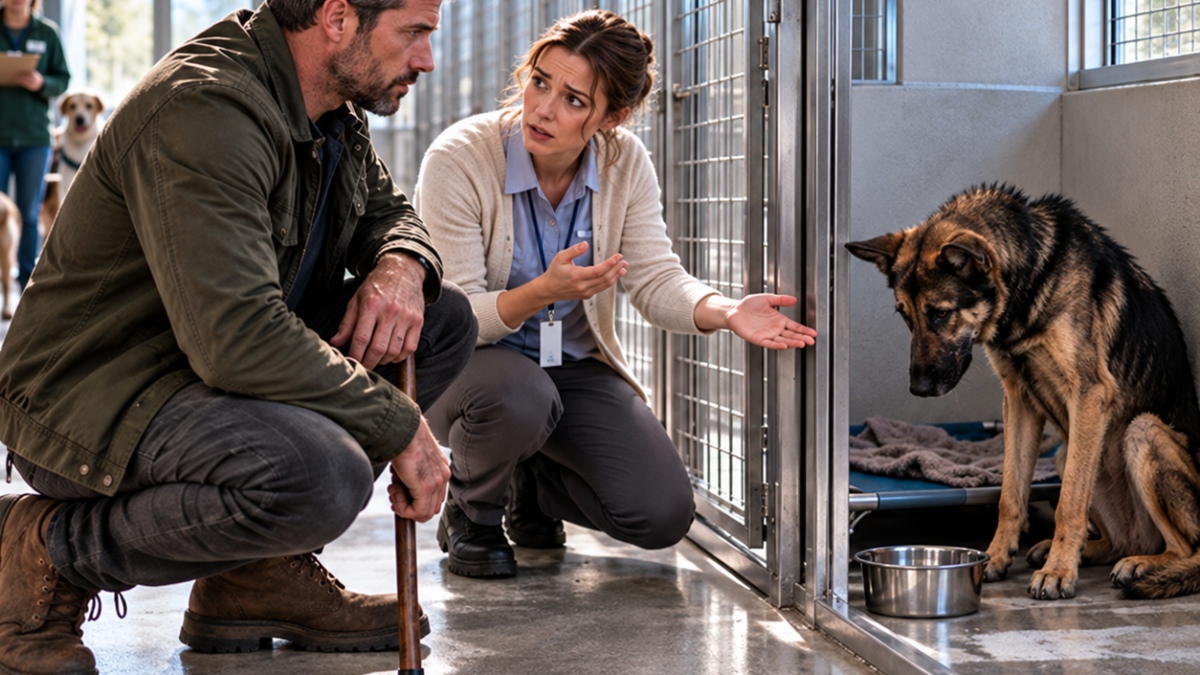
The quarantine wing was colder. Quieter. Stale air. Concrete walls. Fluorescent lights that hummed overhead. A few sick strays huddled under heat lamps in isolated kennels.
At the very end of the corridor sat kennel 42.
The dog inside was not pacing.
He was not barking.
He was not throwing himself against the gate.
He was sitting perfectly still in the center of the concrete floor.
Massive.
Ninety pounds at least.
His coat was nearly black, with deep mahogany along his legs and chest. His left ear had been torn halfway through. A thick jagged scar ran diagonally across his muzzle. Around his neck was a heavy tactical leather collar with a worn metal cobra buckle.
But it was his eyes that stopped me.
Amber.
Hollow.
No light.
No curiosity.
No fear.
Just the empty patience of a soldier who had accepted that he was already dead and was waiting for the world to catch up.
I knew that look.
I saw it in the mirror every morning.
“His paperwork says his name is Atlas,” Emily whispered from several feet behind me. “When the behaviorist tried to enter yesterday, Atlas nearly took his arm off. Please stay back.”
I stepped closer.
Atlas did not move.
But something changed in the air.
His muscles tightened beneath his coat.
A low vibration started deep in his chest. Not a bark. Not even a growl exactly. A warning that seemed to come from somewhere older than language.
“Mr. Evans,” Emily hissed. “Step back.”
I handed her my cane.
“What are you doing?”
“Close the hallway door behind you.”
“What?”
“Close it. Lock it from the outside. Do not come back in until I tell you.”
“He’ll kill you.”
“Lock the door, Emily.”
Training does something to a voice.
So does certainty.
Emily stepped back, trembling, and hit the release bar on the heavy door. It shut with a metallic boom.
I was alone in the corridor with the dog.
Atlas’s growl deepened.
I looked at the kennel latch.
Padlocked.
Key hanging from a hook beside it.
I took the key, unlocked the padlock, and slid the latch open.
Atlas lowered his head.
His lips curled back.
Perfect white teeth caught the pale light.
I opened the gate and stepped inside.
I did not close it behind me.
If this went wrong, I needed an exit, though I knew the truth. If Atlas decided to take me, I would never reach it.
His paws shifted.
Hind legs anchoring.
Shoulders coiling.
He was ready to launch.
I did not offer my hand. That was civilian nonsense, and a good way to lose fingers with a trained bite dog. I did not turn sideways. I did not speak in a soft baby voice. I did not pretend he was a pet.
Atlas was not a pet.
Not yet.
Maybe not ever.
He was a weapon with a broken heart.
I took one deliberate step forward.
Then I dropped heavily onto my right knee.
Pain spiked through my bad left leg, bright enough to bring sweat to my forehead. I ignored it. I made myself low, grounded, and still.
I slowed my breathing.
Flattened my pulse.
Pushed fear down until all that remained was quiet.
Elite K9s read what most humans miss.
Heart rate.
Micro-movements.
Breath.
Intent.
I gave Atlas nothing frantic to read.
Then I spoke one sharp command in Czech, the language I had heard from tactical dog handlers on joint operations years earlier.
“Klid.”
Calm.
Atlas froze.
The growl cut off.
Both ears, torn and intact, shifted forward.
Something flickered in his eyes.
Not softness.
Recognition.
I followed with a second command.
“Sedni.”
Sit.
Atlas stared at me.
For ten long seconds, neither of us moved.
Then his body changed.
The lethal tension did not vanish, but it loosened one degree.
Then another.
He took one step forward.
Then another.
His scarred muzzle came within inches of my face. I felt his breath against my cheek. One wrong flinch, one spike of panic, and he could end me before Emily got the door open.
I whispered, “Good boy.”
Atlas leaned in.
Not fast.
Not weak.
He pressed his heavy head into the crook of my neck and let out a long, shuddering sigh.
It sounded like years of carrying a weight no living thing should have to carry.
His whole body went slack against me.
I lifted one hand slowly and buried my fingers into the thick fur behind his torn ear.
My vision blurred before I could stop it.
“I got you, buddy,” I murmured. “I got you.”
Three hours later, my old Bronco bounced up the rutted dirt road to my cabin.
Atlas sat in the passenger seat.
Silent.
Watchful.
He had refused to leave my side through the adoption paperwork. Emily cried when she signed the final page. I did not blame her. I almost did too.
The sun was dropping behind the jagged peaks of the Bitterroots when we entered the cabin.
I lit a fire in the wood stove. Pine smoke and heat filled the small room. Atlas immediately took position facing the front door, chin on his paws, eyes on the entry.
“You don’t have to work anymore,” I said quietly. “You’re off the clock.”
He looked at me.
I set down a bowl of food and fresh water.
He looked at the bowl.
Then back at me.
He did not eat.
I knew enough not to push.
He was filthy from the shelter and transport. Dust clung to his coat. Dried mud hardened near his legs. The heavy collar around his neck smelled of leather, metal, and old sweat.
I knelt beside him with a warm damp towel.
“Easy,” I said.
Atlas allowed it.
Not relaxed.
Allowed.
There is a difference.
I wiped his shoulders, his chest, the thick fur around his neck. When my fingers brushed the inside of his tactical collar, I felt something hard beneath the lining.
I stopped.
Atlas’s eyes moved to my hand.
“What’s this?”
The object was too large to be a microchip. Too flat to be a buckle. It felt like a matchbook hidden under the padded seam.
Every dormant instinct I had came awake at once.
I unbuckled the collar slowly.
Atlas did not resist.
I carried it to the kitchen table, took a folding knife from the drawer, and cut along the inner stitching.
The thread split.
The leather opened.
Two objects fell onto the wood.
A tarnished military dog tag.
And a microSD card sealed inside a waterproof sleeve.
For a moment, the cabin went completely silent.
Even the fire seemed to lower its voice.
I picked up the dog tag first.
Dried blood darkened the metal. I rubbed it with my thumb until the name emerged.
PIKE, CHRISTOPHER
My throat tightened.
I knew that name.
Christopher Pike was not a normal K9 handler.
He was a ghost. CIA, deep cover, off-book intelligence work in places where paperwork disappeared as quickly as bodies. Three years earlier, Pike had vanished during a classified extraction in Fallujah. My SEAL team had provided overwatch on that operation.
The official report said Pike was captured and executed by insurgents.
No body recovered.
Files sealed.
Questions discouraged.
Yet here was his dog tag, bloodstained and hidden inside the collar of a German Shepherd scheduled to be quietly destroyed in rural Montana.
I looked at Atlas.
He was sitting upright now, staring at the microSD card with intense, unblinking focus.
“Who did you belong to?” I whispered. “And what did you bring into my house?”
I pulled an old air-gapped Panasonic Toughbook from a locked case beneath my desk. No network. No wireless. No outside access. A relic from a life I was supposed to have left behind.
The microSD card loaded.
A blue prompt appeared.
Encrypted.
Of course.
I stared at Pike’s dog tag beside the keyboard.
A man like Pike would not use a random string. Not if the drive was meant to be found by someone who knew the world he came from.
I typed his service number.
Then the grid coordinates of the Fallujah ambush that had supposedly killed him.
The screen flashed green.
ACCESS GRANTED.
A folder opened.
Video files.
Audio transcripts.
Financial manifests.
Shipment records.
Names.
Dates.
Companies.
I opened the newest video.
The footage was grainy, shot from a body-worn camera inside what looked like a shipping container.
Christopher Pike stood in the frame.
Bruised.
Bloodied.
Alive.
The timestamp was four months old.
Three years after he was officially dead.
Across from him stood a man in a tailored three-piece suit.
I recognized him immediately.
Anthony Drake.
CEO of Vanguard Global Dynamics, one of the largest private defense contractors in the country.
On the recording, Drake smiled like a man who had never once worried about consequences.
“You should have stayed in the sand, Christopher,” he said. “You were supposed to be a casualty of war.”
Pike’s voice came rough through the speaker.
“You’re trafficking missile systems through military supply channels. You staged the Fallujah ambush to cover missing weapons. You sacrificed my team.”
Drake leaned closer.
“Nobody will believe you. The Department of Defense considers you a ghost, and ghosts don’t testify.”
The video cut to black.
A text file appeared next.
Pike’s report.
He had survived the ambush. Escaped captivity. Spent years tracking Vanguard’s arms pipeline through military supply chains, private contractors, shell companies, and foreign buyers. He had gathered enough proof to burn the whole operation to the ground.
Then Vanguard found him.
His final note was short.
Atlas knows the route. If I do not make it, he carries the truth.
I sat back.
My blood had gone cold.
Atlas had not been sent to the shelter because he was broken.
He had been dumped there because someone wanted him erased.
A grieving dog was easier to kill than a witness.
Then Atlas’s head snapped toward the north-facing window.
His ears flattened.
His body locked.
The hollow deadness in his eyes disappeared, replaced by something razor sharp.
Active.
Working.
I shut the Toughbook, pulled the microSD card, and slid it into my pocket.
Down at the base of the long dirt driveway, two sets of headlights turned off the mountain road.
Then went dark.
Black SUVs rolled slowly through the pines.
No running lights.
No hesitation.
Vanguard had found us.
Maybe through shelter adoption records. Maybe through a tracker hidden somewhere I had not yet checked. Maybe because the world had never been as big as people hoped when powerful men wanted something buried.
I crossed the cabin, opened the gun safe, and pulled out my old SIG pistol and a Remington 870 shotgun.
Atlas stood beside me.
Silent.
Ready.
I looked down at him.
“Looks like we’re back in the fight.”
Atlas let out one sharp breath and lowered into a tactical crouch.
Two broken veterans in a mountain cabin.
One more night of war.
I flipped the breaker, killing the lights.
The cabin dropped into darkness.
Outside, four men in black tactical gear moved through the trees in a wedge formation. Night vision. Suppressed rifles. Professional spacing.
Not thieves.
Not local trouble.
A cleanup team.
They reached the porch.
A charge blew the front lock inward.
The door slammed open.
The first man stepped inside.
I gave Atlas one command.
“Ber.”
Take.
He launched through the darkness like a thunderbolt.
Ninety pounds of muscle hit the lead man square in the chest and drove him to the floor before he fired. The second man swung toward the movement, but I fired twice from behind the stone fireplace and forced him back through the doorway.
Gunfire tore through the cabin.
Glass shattered.
Wood splintered.
Rounds ripped through cabinets above my head as I rolled behind the kitchen island, my bad knee screaming under me.
I fired low.
Moved.
Reloaded.
Kept them outside.
Atlas moved like a shadow that knew the room better than the men invading it. When one tried to come through the side window, Atlas met him before both boots cleared the frame. The man went backward into the snow with a shout that ended fast.
The team leader retreated off the porch, dragging a radio from his vest.
“Vanguard main, this is—”
I stepped out with the shotgun leveled at his chest.
Atlas stood beside me, breath steaming in the cold, eyes fixed on the man’s throat.
“Drop it,” I said.
The leader froze.
“You have no idea what you’re interfering with.”
“Pretty sure I do.”
“Vanguard owns people you can’t touch. Politicians. Judges. Generals.”
“Maybe.”
I took one step closer.
“But you’re going to jail first.”
Two hours later, my quiet mountain property flashed red and blue under federal lights.
I had not called local law enforcement first.
I called Alan Prescott.
FBI special agent.
Former intelligence officer.
A man I had trusted once in Afghanistan when trust was the only thing between our team and a bad extraction.
Prescott arrived with federal vehicles, tactical agents, evidence techs, and the grim expression of someone who understood history had just kicked open his door.
He stood in my cabin watching Pike’s video on the Toughbook.
His face hardened.
“This is enough to take down Vanguard’s executive board,” he said.
“It’s enough if it survives.”
“It will.”
He looked at Atlas, who sat beside me while I cleaned a shallow graze along his shoulder.
“That dog saved Pike’s evidence.”
“He did more than that.”
Prescott nodded.
“Vanguard listed him as dangerous property to be destroyed.”
Atlas looked up at the word destroyed.
My hand tightened in his fur.
Prescott’s voice changed.
“As far as the Bureau is concerned, Atlas is a retired war hero and protected federal evidence until this case is complete.”
“Evidence?”
“For tonight.” Prescott looked at me. “After that, he’s yours.”
“He already is.”
By dawn, the mercenaries were gone in federal custody. The evidence was duplicated, sealed, transported, and backed up through channels Prescott trusted more than the official ones.
I stood on the porch with a mug of coffee warming my hands.
The mountains brightened under the first pale light.
Snow glowed along the ridges.
For the first time in years, the ringing in my head did not feel like war.
It was still there.
But it was behind something else now.
Breathing.
Heavy, steady breathing.
Atlas stepped out through the broken doorway and leaned his scarred head against my hip.
I lowered my hand into his fur.
Neither of us was fixed.
That is not how damage works.
The knee still hurt.
The ghosts were still there.
Pike was still dead.
Caleb Foster, Ray Monroe, Danny Keene, and the other men I had lost in the sand were still names I carried in places no one could see.
Atlas still woke at small sounds.
Still watched doors.
Still refused to eat unless I stayed in the room.
Still dreamed sometimes, paws twitching, throat making low sounds that pulled me out of bed before I knew I was moving.
But something had changed.
Before Atlas, my cabin had been a place where memories came to hunt me.
After Atlas, it became a place we guarded together.
Weeks passed.
Then months.
Anthony Drake was arrested in a private airport hangar before boarding a flight to Switzerland. Vanguard’s board collapsed under indictments, hearings, frozen accounts, and men suddenly eager to testify against one another. Christopher Pike’s name was quietly restored in classified circles and, later, publicly cleared with language too careful to tell the whole truth.
Prescott called after the first arrests.
“Pike’s evidence held,” he said.
I looked at Atlas sleeping near the stove.
“He made sure it would.”
“There will be hearings.”
“Good.”
“There may be people who want to talk to you.”
“No.”
Prescott sighed.
“You haven’t changed.”
“I adopted a dog.”
“That’s not change?”
I looked at Atlas again.
His torn ear twitched in his sleep.
“Maybe.”
After the case broke, Emily from the shelter drove up to visit.
She cried before she reached the porch.
Atlas walked out beside me and sat at my left leg. Emily stopped at the bottom step, hands over her mouth.
“He looks different,” she whispered.
“He eats now.”
“I mean his eyes.”
I looked down.
She was right.
The hollowness was not gone completely.
But it was no longer empty.
There was awareness there.
Suspicion.
Loyalty.
A quiet demand that the world not try him again.
Emily knelt slowly.
Atlas watched.
I gave him no command.
After a long moment, he walked down the steps and pressed his nose once into her palm.
Emily broke.
She put her forehead against his fur and sobbed.
“I knew you were grieving,” she whispered. “I knew you weren’t bad.”
Atlas stood there, patient and still, letting her cry.
I looked away toward the trees.
Some moments are private even when they happen in front of you.
That winter, the cabin changed.
I repaired the front door.
Then the windows.
Then the cabinets.
Then the porch rail I had ignored for two years.
Not because any of it mattered much.
Because Atlas needed the perimeter secure.
That was what I told myself.
The truth was simpler.
I had started caring whether the place held together.
Every morning, Atlas and I walked the tree line. At first, he moved like we were clearing hostile terrain. Slow. Silent. Strategic. Nose working. Ears scanning.
Eventually, he learned the difference between danger and deer.
Mostly.
He never trusted squirrels.
I could respect that.
At night, he slept between my bed and the door.
I tried once to coax him onto the rug by the stove.
He looked at me like I had insulted his rank.
“Fine,” I said. “Door it is.”
He huffed.
That was the first sound he made that was not a warning, command response, or nightmare.
A huff.
Small thing.
Huge thing.
By spring, he barked once.
Just once.
A delivery driver came too far up the driveway without stopping at the lower gate. Atlas stood on the porch and released one deep bark that sent the man backward into his own truck door.
I signed for the package at the bottom of the steps.
“Friendly dog?” the driver asked.
“No.”
Atlas huffed again.
I almost smiled.
Dr. Aris met him in June.
The VA office had a strict policy about animals, but Dr. Aris came outside and sat with us on a bench under a cottonwood tree.
Atlas watched him for five full minutes.
Dr. Aris watched him back.
Finally, he said, “That is not a basset hound.”
“No.”
“Not a golden retriever either.”
“No.”
“I believe my instructions were simple dog.”
“He’s simple enough.”
Dr. Aris raised an eyebrow.
“He was carrying evidence of an international arms trafficking conspiracy in his collar.”
“Only when I got him.”
The doctor laughed.
I had not heard many people laugh around me without sounding careful.
Atlas rested his head on my boot.
Dr. Aris saw it.
His face softened.
“You look better, Matthew.”
“I sleep sometimes.”
“That counts.”
“He wakes me when the dreams get bad.”
“How?”
“Puts his whole head on my chest until I come back.”
The doctor nodded slowly.
“And you?”
“What about me?”
“What do you do for him?”
I looked down at Atlas.
His scarred muzzle.
Torn ear.
Steady amber eyes.
“I stay.”
Dr. Aris did not speak for a while.
Then he said, “That counts too.”
One year after I walked into Valley Hope Animal Rescue looking for a lazy companion, Emily invited us back.
The shelter was holding a fundraiser for medical care and behavioral rehabilitation. She asked if I would speak.
I said no.
She asked if Atlas could attend.
I said maybe.
That was how I ended up standing beside a folding table in the same shelter parking lot while people whispered about the former SEAL and the war dog from the news.
Atlas wore no tactical collar.
Never again.
He wore a plain leather one I had made by hand, soft and dark brown, with a simple brass tag.
ATLAS
RETIRED
HOME
Kids wanted to pet him.
Most were told no.
One little boy in a dinosaur shirt stood six feet away and asked, “Was he really a hero?”
I looked at Atlas.
Atlas looked bored.
“Yes,” I said.
“Did he save people?”
“Yes.”
“Did you save him?”
I thought about kennel 42.
Emily crying.
Atlas’s head against my neck.
The microSD card.
The cabin.
The porch at dawn.
“No,” I said finally. “We saved each other.”
The boy accepted this with the seriousness children reserve for important information.
Then he asked if Atlas liked snacks.
Atlas’s ears moved.
Traitor.
Emily found me later near the side fence.
“Thank you for coming.”
“I didn’t speak.”
“You came. That matters.”
Across the yard, Atlas sat in the shade, watching everything.
Not afraid.
Not dead-eyed.
Working, yes.
Always working a little.
But present.
Emily folded her arms.
“I still think about that night. If you hadn’t come in…”
“I almost didn’t.”
“But you did.”
I nodded.
“Yeah.”
I watched Atlas tilt his head as a shelter volunteer dropped a treat bag.
“I wanted a simple dog,” I said.
Emily smiled.
“You got Atlas.”
The fundraiser raised enough money to build a rehabilitation wing for dogs considered too damaged for the regular adoption floor. They named it Pike House.
I did not attend the dedication.
Atlas and I visited after, when it was quiet.
Inside the new wing, the kennels were warmer. Wider. Softer. No flickering lights. No cold corridor. No death row atmosphere pretending to be procedure.
A bronze plaque near the entrance read:
For the ones who served, suffered, and still deserve to come home.
I stood there a long time.
Atlas leaned against my leg.
“Yeah,” I said quietly. “That’s right.”
Years pass differently when you stop only surviving them.
The cabin became less of a bunker.
More of a home.
I planted tomatoes in raised beds beside the porch because Emily said growing something might be good for me and Dr. Aris agreed too quickly, which made me suspicious but not enough to refuse.
Atlas hated the watering can.
Loved the hose.
Despised thunder.
Ignored fireworks.
Trusted Emily.
Tolerated Dr. Aris.
Accepted Agent Prescott only after Prescott started bringing dried liver treats in his coat pocket.
“Bribery,” I said.
“Relationship building,” Prescott replied.
Atlas took the treat.
No loyalty whatsoever.
The nightmares did not vanish.
People like to tell stories as if healing is a door you walk through once. It is not. It is a road you choose over and over, sometimes hourly, sometimes minute by minute, sometimes with a hundred-pound German Shepherd lying across your legs so you cannot run from sleep.
Some nights, I woke reaching for a rifle that was not there.
Some nights, Atlas woke growling at ghosts only he could see.
On those nights, I sat on the floor beside him, one hand in his fur, and spoke softly until both of us remembered where we were.
Montana.
Cabin.
Pines.
Wood smoke.
Home.
Not Fallujah.
Not Kandahar.
Not kennel 42.
Not anymore.
One October morning, almost exactly a year after the adoption, snow dusted the ridge before sunrise. I made coffee and opened the door.
Atlas stepped onto the porch.
Frost silvered his muzzle more than before.
Mine too, probably.
We watched the mountains brighten.
For once, my mind was quiet.
Not empty.
Quiet.
There is a difference.
Atlas pressed his shoulder against my leg.
I lowered my hand and scratched behind his torn ear.
“You know,” I said, “I asked for a lazy dog.”
Atlas huffed.
“I know. I’m disappointed too.”
He leaned heavier against me.
Below the porch, the first light touched the pine tops and turned them gold. Somewhere far off, a hawk called. The air smelled clean enough to hurt.
I thought about Pike.
About Emily.
About Dr. Aris.
About all the men who never made it home.
About a German Shepherd scheduled to die at midnight because someone powerful thought the truth could be buried in a collar and killed in a cage.
They were wrong.
Atlas had carried the truth.
Then he carried me.
I used to think peace would arrive quietly, like snow.
I was wrong.
Sometimes peace comes limping through a shelter door.
Sometimes it has scars across its muzzle.
Sometimes it growls before it trusts.
Sometimes it rides home in the passenger seat and takes up guard duty by your front door because neither of you knows how to stop watching the dark yet.
And sometimes, if you are lucky, peace looks at you with amber eyes and decides you are worth staying for.
Atlas and I stood together until the sun cleared the ridge.
Two broken veterans.
Still scarred.
Still watchful.
Still here.
And for the first time in longer than I could remember, that was enough.