A Former Marine Came to Adopt a Labrador—Then a Scarred German Shepherd Behind Three Locked Doors Heard His Voice
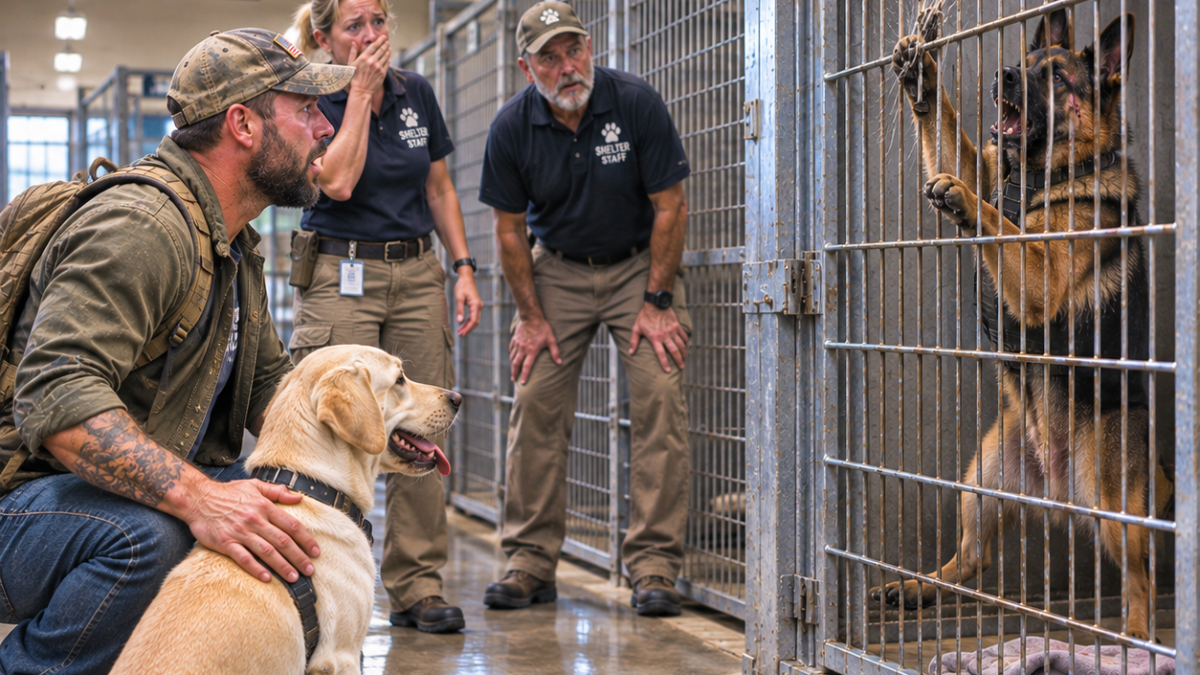
A Former Marine Came to Adopt a Labrador—Then a Scarred German Shepherd Behind Three Locked Doors Heard His Voice
Daniel Mercer had come to the shelter for a quiet Labrador his daughter could sleep beside, but the moment he spoke one ordinary sentence near the front desk, something enormous slammed into a steel door deep inside a restricted wing nobody had mentioned to him.
Behind three locked barriers was a scarred German Shepherd classified as too unpredictable to adopt, yet the instant Daniel spoke again, the dog stopped snarling, faced the wall, and performed a military recognition routine Daniel had not seen since the worst night of his deployment in Afghanistan.
Then Daniel noticed the damaged brass tag hanging from the shepherd’s collar, and one scratched number beneath the dog’s new shelter name dragged a memory out of him that he had spent eleven years trying to bury.
Daniel Mercer had practiced the sentence in the truck.
He felt stupid doing it.
But he practiced anyway.
“We’re just looking today.”
Then again.
“We’re only looking.”
One more time.
“We are not taking home the first dog that looks sad.”
His nine-year-old daughter, Ellie, sat in the passenger seat listening to him rehearse and smiling in the particular way children smiled when they knew an adult was lying to himself.
“You’re going to pick the first one.”
“No.”
“Yes.”
“I’m a disciplined person.”
“You bought a kayak because it was on sale.”
“That was different.”
“You’ve used it twice.”
“Three times.”
“It still has the price sticker on it.”
Daniel looked at her.
Ellie grinned.
For the first time that morning, he laughed.
That was why they were there.
Not specifically because of the laugh.
Because there had not been enough of them lately.
Daniel was forty-one.
Former Marine.
Former construction supervisor.
Current owner of a small residential repair company outside Raleigh, North Carolina.
Divorced.
Father of one.
Bad sleeper.
Excellent at pretending he was fine.
Two years earlier, Ellie’s mother had moved to Colorado after remarrying.
The arrangement was civil.
Daniel hated the word civil.
Civil meant nobody threw dishes.
Nobody screamed.
Nobody committed the kind of betrayal people could point to when explaining why a family had changed shape.
Instead, life simply reorganized itself.
Ellie lived with Daniel during the school year and spent summers and alternating holidays with her mother.
The divorce had not destroyed Daniel.
That would have been simpler.
PART2:
It had merely hollowed out parts of the house.
The guest room stayed closed.
The dining table became too large.
The backyard went unused.
And Ellie started asking for a dog.
At first Daniel said no.
Then she asked again.
Then she made a spreadsheet.
Breed.
Age.
Shelter distance.
Exercise needs.
She ranked candidates.
Daniel was both horrified and impressed.
The Labrador named Sunny had won.
Four years old.
Yellow coat.
House-trained.
Good with children.
Quiet.
According to the shelter website, he had been surrendered after his elderly owner entered assisted living.
Exactly what Daniel wanted.
PART3:
No surprises.
No complicated behavior.
No working-dog intensity.
No shepherd.
Definitely no shepherd.
Daniel had learned a long time ago that some things carried too much memory.
He parked outside Wake County Haven Animal Center at 10:07 on Saturday morning.
The shelter sat on eight wooded acres beside an old veterinary complex.
The main building was newer than Daniel expected.
Bright brick.
Large windows.
A cheerful mural of dogs and cats near the entrance.
Ellie opened her door.
Daniel pointed at her.
“What did I say?”
“We’re just looking.”
“And?”
“We are not taking the first dog that looks sad.”
“Good.”
Ellie got out.
Daniel muttered, “I’m serious.”
She closed the door.
“I know.”
She absolutely did not.
Inside, the lobby smelled of disinfectant, dog fur, coffee, and something sweet from an air freshener near reception.
Dogs barked from somewhere behind swinging doors.
A gray tabby slept in a glass enclosure near the entrance.
Ellie stopped immediately.
Daniel touched her shoulder.
“We’re here for a dog.”
“I know.”
“Keep moving.”
The woman behind the front desk looked up.
Early thirties.
Red hair.
Green shelter polo.
Name badge: MARA.
“Morning.”
Daniel nodded.
“We called about Sunny.”
Mara smiled.
“The Labrador?”
Ellie stepped forward.
“Yes.”
Mara looked at Daniel.
“Family adoption?”
“Potentially.”
Ellie corrected him.
“Yes.”
Daniel gave her a look.
Mara laughed.
“I know exactly which one of you is running this.”
“That makes two of us.”
Mara opened a folder.
“Sunny’s still available. We had one application yesterday, but they have two cats and we’re not sure he’s cat-safe.”
“No cats,” Daniel said.
“Other dogs?”
“No.”
“Fenced yard?”
“Six-foot privacy fence.”
“Someone home during the day?”
“I work for myself.”
Mara nodded.
“Sounds promising.”
Ellie leaned toward the counter.
“Can we meet him?”
“Absolutely.”
Mara stood.
“I’ll get Lena. She handles adoption introductions.”
She disappeared through a door.
Daniel looked around.
A bulletin board displayed photographs of recently adopted animals.
Happy families.
Dogs with bandanas.
Children hugging pit bulls.
An elderly man asleep in a recliner with a beagle across his chest.
Ellie pointed.
“That could be you.”
Daniel frowned.
“The old man?”
“The sleeping-with-a-dog part.”
“Great clarification.”
She smiled.
A volunteer carried a basket of towels past them.
Daniel moved aside.
“Excuse me.”
The volunteer smiled.
“No problem.”
Daniel turned toward Ellie.
“You know, whichever dog we get, you’re still doing morning walks.”
“I know.”
“Even when it’s raining.”
“I know.”
“Even when it’s thirty degrees.”
“I know.”
“No suddenly developing allergies at six in the morning.”
Ellie rolled her eyes.
“Dad.”
“I’m just saying. Dogs are work.”
“I know.”
“They’re not stuffed animals.”
“I know.”
“They need routines.”
“I know.”
Daniel was about to continue when something crashed.
Not a bark.
Not a dropped bowl.
A deep metallic impact from somewhere far inside the building.
The front-desk computer monitor rattled.
Ellie jumped.
Daniel turned instantly toward the hallway.
Every old instinct he disliked having returned before conscious thought.
Distance.
Direction.
Weight.
Metal door.
Something heavy moving fast.
A dog began barking.
One.
Not several.
Deep.
Explosive.
Then another impact.
Mara came through the door quickly.
Her face had changed.
“What happened?” Daniel asked.
“Nothing.”
“That wasn’t nothing.”
“It’s okay.”
Another crash sounded.
Closer only because Daniel was listening now.
A male voice shouted from behind the inner doors.
“Easy! Back!”
The barking stopped.
Daniel’s shoulders tightened.
Then came a sound that made him forget the Labrador.
Three sharp barks.
Pause.
Two.
Pause.
One.
Daniel went cold.
Ellie looked up.
“Dad?”
He did not answer.
Three.
Two.
One.
Again.
Daniel stared toward the restricted hallway.
Mara noticed.
“You okay?”
“What dog is that?”
She hesitated.
“Not an adoption dog.”
“What dog?”
Mara crossed her arms.
“His name’s Bishop.”
Daniel’s expression shifted.
“Breed?”
“German Shepherd.”
“How old?”
“Maybe ten.”
“Maybe?”
“We don’t have a reliable history.”
The dog barked again.
Three.
Two.
One.
Daniel’s mouth went dry.
Ellie asked, “Why is he doing that?”
Daniel whispered, “I don’t know.”
But he did.
Or at least he knew what it sounded like.
Recognition sequence.
Not an official military command.
Not something taught at every kennel.
Something one team had done in Afghanistan eleven years earlier when radios became unreliable.
Three.
Two.
One.
Team count.
Three alive.
Two moving.
One waiting.
It had been stupid.
Improvised.
Born from exhaustion and gallows humor.
Daniel had not heard it since 2015.
He turned to Mara.
“Take me to him.”
“No.”
The answer came instantly.
Daniel stared.
“Why?”
“Because he’s restricted.”
“I’m not asking to touch him.”
“You’re not going back there.”
Another man entered from the hallway.
Mid-fifties.
Broad.
Gray beard.
Khaki work shirt with the shelter logo.
He carried a catch pole but was not using it.
His name badge read FRANK.
He looked at Daniel.
Then Mara.
“What happened?”
Mara nodded toward Daniel.
“Bishop reacted when he spoke.”
Frank’s eyes narrowed.
“What did you say?”
Daniel looked at him.
“What?”
“What exact words?”
Daniel thought back.
He had been talking to Ellie.
Dogs need routines.
Maybe that.
No.
Before the crash.
“Whichever dog we get, you’re still doing morning walks.”
Frank shook his head.
“Earlier.”
Daniel tried again.
He remembered speaking to the volunteer.
Excuse me.
No.
Then to Mara.
“No cats. No other dogs. Six-foot fence.”
Frank stared.
“Before the first impact.”
Daniel’s mind replayed.
Then he remembered.
Mara had asked whether someone was home during the day.
Daniel had said:
“I work for myself.”
Ordinary sentence.
Nothing.
Frank looked skeptical.
“Say it again.”
Mara said, “Frank.”
He ignored her.
Daniel looked toward the hallway.
“I work for myself.”
The reaction was immediate.
Three barks.
Two.
One.
Then silence.
Frank’s face changed.
Daniel felt his heart pound.
“What is that dog?”
Mara said quietly, “We don’t know.”
“That’s not true.”
“We know what came with him.”
“Which was?”
Frank answered this time.
“Picked up from a private boarding facility outside Fayetteville eight months ago after the owner died.”
“What owner?”
“Records listed a man named Calvin Brooks.”
Daniel frowned.
Never heard of him.
“Military?”
“No idea.”
“Chip?”
“Dead.”
“Tattoo?”
“No.”
“Training?”
Frank gave him a long look.
“Advanced.”
“How advanced?”
“Doors.”
Daniel waited.
“Vehicle search.”
Another pause.
“Hand signals.”
Daniel’s chest tightened.
Frank continued.
“He responds to German commands, English commands, and several things we haven’t identified.”
“Protection work?”
“Yes.”
“Detection?”
“We think so.”
“What odor?”
“Don’t know.”
Daniel looked toward the hall.
“Why restricted?”
Mara answered.
“Because he put a trainer in the hospital.”
Ellie moved closer to Daniel.
He looked down at her.
“Bad?”
Mara chose her words carefully.
“Serious bite.”
Daniel turned back.
“Provoked?”
Frank’s expression shifted.
“That depends who you ask.”
“Who do you ask?”
“I’d ask the dog if I could.”
Daniel almost smiled.
Frank continued.
“Trainer tried removing a worn harness from his kennel.”
“And?”
“Bishop warned him.”
“Growl?”
“Freeze first.”
Daniel nodded.
Classic escalation.
“Trainer ignored it?”
“Yes.”
“Then the dog bit.”
“Forearm.”
“Single bite?”
Frank looked surprised.
“Single.”
“Release?”
“Immediate.”
Daniel exhaled.
“That wasn’t an attack.”
Mara frowned.
“You don’t know that.”
“It was a correction.”
“You weren’t there.”
“No.”
Daniel looked toward the hallway.
“But I know that pattern.”
Frank studied him.
“You handled dogs?”
Daniel said nothing.
Ellie looked at him.
Mara asked, “Military?”
Daniel’s jaw tightened.
“Marine Corps.”
“What specialty?”
“Infantry.”
Frank did not buy the incomplete answer.
“Dog handler?”
“No.”
“But?”
Daniel looked at the floor.
Eleven years.
He had not spoken about Rook in years.
Not even to Ellie.
Especially not to Ellie.
“I worked with one.”
Frank waited.
Daniel continued.
“Afghanistan.”
Mara looked toward the restricted wing.
“Do you think Bishop was there?”
“No.”
Too fast.
Daniel heard himself.
Frank did too.
“Why not?”
Daniel looked at him.
“Because that dog died.”
Silence.
Ellie looked up.
“You had a dog?”
Daniel closed his eyes briefly.
“Not mine.”
“But you knew him?”
“Yes.”
“What was his name?”
Daniel did not answer.
From behind the doors came one bark.
Only one.
Daniel’s entire body stiffened.
Frank noticed.
“Say the name.”
Daniel looked toward him.
“What?”
“The dog you knew.”
Daniel’s voice dropped.
“No.”
“Why?”
“Because this is ridiculous.”
Frank leaned the catch pole against the wall.
“Probably.”
He folded his arms.
“But I’ve spent six months trying to understand that shepherd.”
Daniel stared.
“He doesn’t react to men your size.”
“He doesn’t react to military uniforms.”
“He doesn’t react to recordings.”
“Half the time he barely reacts to his own name.”
Frank pointed toward the hallway.
“You say one sentence and he tries to come through a steel door.”
Mara said softly, “Daniel.”
He looked at her.
“Just say the name.”
His throat tightened.
He hated that it still had power.
“Rook.”
Behind the doors, something hit the floor.
Not the wall.
A body dropping.
Then silence.
Frank’s face went pale.
Mara whispered, “What happened?”
Daniel already knew.
“Down position.”
“How do you know?”
“Because that was his name.”
Frank moved toward the hallway.
Daniel caught his arm.
“Don’t.”
Frank stopped.
“If he’s down, that’s good.”
“No.”
Daniel shook his head.
“That command isn’t down.”
“What is it?”
Daniel swallowed.
“Rook was the dog.”
Frank stared.
Daniel looked toward the hidden kennel.
“When we said his name in that tone, he was supposed to freeze and wait for contact identification.”
Mara whispered, “Recognition routine.”
Daniel looked at her.
“Yes.”
Another silence.
Then from inside the restricted wing came a soft whining sound.
Ellie gripped Daniel’s sleeve.
He had never heard that exact sound from another dog.
His stomach turned.
Eleven years collapsed.
Dust.
Burned rubber.
Blood.
A dry riverbed.
Staff Sergeant Marcus Hale shouting through smoke.
Rook bleeding from the shoulder.
Daniel pressing both hands against the dog’s vest because he had no idea where Hale was.
A helicopter he barely remembered boarding.
Then the report.
Rook missing after extraction.
Presumed dead.
Daniel walked away from the front desk.
Mara said, “Where are you going?”
“Outside.”
“Daniel—”
“I need air.”
Ellie followed.
He stopped near the automatic doors.
“Stay with Mara.”
“No.”
“Ellie.”
“You’re shaking.”
Daniel looked at his hands.
She was right.
He shoved them into his jacket pockets.
“I’m fine.”
Ellie gave him the same look her mother used to give him.
He hated that look.
“No, you’re not.”
Daniel exhaled.
Frank approached slowly.
“No one’s taking you back there.”
Daniel nodded.
Frank continued.
“But I need to show you something.”
He held a tablet.
A photograph filled the screen.
Bishop.
Standing inside his kennel.
Scarred.
Thin.
One ear partly torn.
Dark sable coat rather than classic black-and-tan.
Daniel stared.
“No.”
Frank zoomed in.
A pale scar across the left shoulder.
Daniel stopped breathing.
The scar was not distinctive enough.
Lots of working dogs had scars.
But beneath the dog’s chin was a tiny white patch.
Rook had one.
Daniel shook his head.
“No.”
Frank swiped.
Another photograph.
Side profile.
Right rear leg.
A notch in the fur where an old surgical incision ran above the hock.
Daniel remembered that too.
Rook had torn a tendon during training before deployment.
“No.”
Ellie whispered, “Dad?”
Daniel looked at Frank.
“Open the records.”
“We don’t have much.”
“Everything.”
Frank brought them into a private office.
Ellie sat beside Daniel.
Mara closed the door.
The folder was thin.
Bishop had arrived under emergency intake from a private boarding kennel called Pine Ridge Canine Lodge.
Owner of the facility, Calvin Brooks, died suddenly from a stroke.
Twenty-three dogs were transferred.
Twenty-two had ordinary veterinary histories.
Bishop did not.
No breeder.
No prior owner.
No reliable vaccine documents before 2021.
No functioning chip.
Age estimated between nine and twelve.
The boarding facility staff claimed Brooks had kept the dog personally in a locked rear run for years.
Nobody knew where he came from.
Daniel read the intake notes.
Aggressive with direct approach.
Strong environmental confidence.
Responds to search cues.
Extreme fixation on olive-drab canvas equipment.
Sleeps facing doorway.
Will not tolerate anyone removing old leather collar.
Daniel stopped.
“Collar?”
Frank nodded.
“It’s still on him.”
“Why?”
“He won’t let us take it off.”
“Tag?”
“Damaged brass plate.”
“What does it say?”
Frank turned the page.
The shelter transcription read:
BISHOP
K-?17
M.H.
Daniel’s hand froze.
“What?”
Frank looked at him.
Daniel read it again.
K-?17.
M.H.
His mouth went dry.
Marcus Hale.
Rook’s handler.
Staff Sergeant Marcus Hale.
Daniel whispered, “No.”
Mara asked, “What?”
Daniel pointed.
“M.H.”
“What about it?”
“His handler.”
Frank leaned forward.
“Who?”
“Marcus Hale.”
Ellie looked between them.
Daniel stood so quickly the chair scraped backward.
“Let me see the collar.”
Frank’s expression became cautious.
“Photograph only.”
“Fine.”
He found one on the tablet.
Bishop facing the camera.
Collar visible.
Brass plate worn almost smooth.
Daniel zoomed.
The shelter had misread the number.
Not K-?17.
K417.
Daniel sat.
He remembered because Hale used to joke that Rook was government property down to the serial number.
K417.
Daniel covered his mouth.
Ellie whispered, “Dad?”
He looked at her.
His eyes were wet.
“That dog died.”
Frank said quietly, “Maybe he didn’t.”
Daniel stared at the photograph.
Eleven years.
If this was Rook, he was at least thirteen.
Maybe fourteen.
Old.
Scarred.
Hidden behind three locked doors in a county shelter.
“How?”
Nobody had an answer.
Frank broke the silence.
“There’s something else.”
Daniel looked up.
“When he first came in, we called him different names.”
“Why?”
“Trying to find one he recognized.”
“Any response?”
“Not exactly.”
Frank opened a video.
Security footage.
Bishop inside the restricted run.
A volunteer stood outside reading random names from a list.
Max.
Thor.
Ranger.
Duke.
Bear.
Nothing.
Then:
Rook.
The dog stopped.
Daniel watched.
Bishop turned toward the camera.
Three barks.
Two.
One.
The volunteer laughed nervously and moved on.
Daniel stared at Frank.
“You had this?”
“We didn’t know what it meant.”
“You never checked military working-dog records?”
“We tried.”
“And?”
“No match.”
Daniel’s anger rose.
“Then you didn’t try hard enough.”
Mara stiffened.
Frank remained calm.
“You think shelters have access to classified military K9 databases?”
Daniel looked away.
Frank continued.
“We called Fort Liberty.”
“Local police K9 units.”
“State veterinary registry.”
“Working-dog rescues.”
“Everybody told us no record.”
Daniel’s anger collapsed into shame.
Frank added, “We’ve been trying to save him.”
Daniel nodded.
“I know.”
Ellie touched his hand.
“Can we see him?”
Daniel said, “No.”
Frank said, “Maybe.”
Daniel turned sharply.
“Absolutely not.”
“I’m not taking her inside.”
Frank looked at Daniel.
“I’m asking whether you want to see him.”
Daniel stood.
Every instinct told him to leave.
Go home.
Adopt Sunny.
Forget this.
That was why he had come.
A quiet dog.
A normal dog.
A normal house.
A normal life.
Not Afghanistan waiting behind three steel doors.
Ellie whispered, “Dad.”
He looked down.
She said, “He heard you.”
Daniel closed his eyes.
He hated how simple children could make impossible things.
Frank took them to the observation corridor.
Ellie stayed behind two locked glass partitions with Mara.
Daniel went farther with Frank.
First door.
Electronic badge.
Second door.
Mechanical key.
Third door.
Steel security barrier.
Beyond it was a small concrete kennel room with an attached outdoor run.
Bishop stood at the back.
Daniel saw him.
And knew.
Not because of the scars.
Not because of the collar.
Not because of the white chin patch.
Because of the eyes.
Rook had always watched people differently.
Most dogs looked at faces.
Rook looked at shoulders.
Hands.
Feet.
He read intention through the whole body.
The shepherd stared at Daniel’s posture.
Daniel stopped twenty feet away.
His legs felt weak.
“Rook.”
The dog’s ears rose.
Frank whispered, “Jesus.”
Daniel could barely breathe.
Rook moved forward.
One step.
Then stopped.
Daniel remembered the old routine.
Hale had invented it after a night patrol where Rook almost followed the wrong Marine through smoke.
Voice recognition first.
Then hand.
Then scent.
Daniel spoke the phrase.
“Blue sky.”
Rook sat.
Frank stared.
Daniel raised his right hand.
Closed fist against his chest.
Rook lowered his head.
Daniel whispered the response.
“Red dirt.”
The dog stood.
Three barks.
Two.
One.
Daniel’s eyes filled.
Frank said nothing.
Daniel slowly lowered himself to the floor.
Rook came toward the inner gate.
Not fast.
He was old.
One rear leg dragged slightly.
But he came.
Daniel held out no hand.
He knew better.
Rook reached the bars.
Sniffed.
Daniel’s jaw trembled.
“Hey, brother.”
The dog’s nose pushed through.
Daniel moved closer.
Rook sniffed his sleeve.
His wrist.
His palm.
Then suddenly turned away.
Daniel froze.
Rook walked toward the back wall.
Sat facing it.
Frank whispered, “What does that mean?”
Daniel’s blood went cold.
“Contact missing.”
“What?”
“He used to do that when he recognized one team member but not the handler.”
Frank looked at the dog.
“So he’s asking for Marcus?”
Daniel nodded.
His throat tightened.
“Hale.”
Rook looked over his shoulder at the name.
Then back at the wall.
Daniel whispered, “He’s waiting for Hale.”
Frank asked, “Where is he?”
Daniel did not answer.
He had spent eleven years avoiding that answer too.
Marcus Hale had never come home.
Officially, Staff Sergeant Marcus Hale was killed in action on August 19, 2015.
Daniel had been there.
At least, he thought he had.
The patrol had entered a narrow village corridor after intelligence suggested an insurgent bomb-maker was moving explosives through the district.
Rook alerted near a mud wall.
Then chaos.
A blast.
Small-arms fire.
Smoke.
Daniel remembered being thrown.
Remembered Hale shouting.
Remembered Rook barking.
Remembered finding the dog wounded.
Remembered no Hale.
The after-action report said Hale died when a secondary explosion collapsed part of the compound.
Remains were never recovered.
Rook disappeared during extraction.
That had always bothered Daniel.
He had loaded the dog onto a helicopter himself.
He remembered that.
Hands on the vest.
Blood on his sleeves.
Then somewhere between the medevac and the field hospital, Rook vanished from the paperwork.
Daniel was told the dog died.
He never saw the body.
He had been too wounded himself to investigate.
Shrapnel in the thigh.
Concussion.
Two broken ribs.
Then home.
Then years of pretending questions no longer mattered.
Frank asked again.
“Where is Hale?”
Daniel looked at Rook.
“Dead.”
The dog whined.
Daniel’s eyes filled.
“Yeah.”
Rook pressed his head against the bars.
Daniel moved close enough for contact.
The dog touched his forehead to Daniel’s.
Eleven years disappeared.
Daniel cried.
Not loudly.
Not dramatically.
He simply folded.
Forehead against metal.
One hand finally through the bars.
Rook licked his fingers.
Daniel whispered, “I’m sorry.”
Frank stepped away.
On the other side of the glass, Ellie watched her father cry for the first time in her life.
Later, she would say that was the moment she understood war had followed him home.
Not in uniforms.
Not in medals.
Not in the stories adults told on Veterans Day.
In locked rooms inside people.
Rooms children could grow up beside without ever knowing existed.
Daniel stayed with Rook for forty-seven minutes.
The dog never growled.
Never snapped.
Eventually he lay down beside the gate.
Daniel sat on the other side.
Frank brought water.
Daniel did not drink.
Finally Frank said, “I need to ask you something.”
Daniel looked over.
“If this dog is Rook, why is he here?”
“I don’t know.”
“Who would?”
Daniel thought.
Marine Corps records.
Army veterinary channels.
Hale’s old unit.
Contract handlers.
The private kennel.
Calvin Brooks.
“Start with Brooks.”
Frank nodded.
“We did.”
“And?”
“Former military.”
Daniel looked up sharply.
“What branch?”
“Army.”
“Job?”
“Couldn’t confirm.”
Daniel frowned.
Frank continued.
“His obituary says veterinary support specialist.”
Daniel’s pulse quickened.
“Where stationed?”
“Fort Bragg for part of his career.”
Daniel stood.
“Show me everything.”
Calvin Brooks had served twenty-two years.
Retired in 2017.
Opened Pine Ridge Canine Lodge in 2019.
Never married.
No children.
Quiet.
Paid cash for the property.
Kept one private dog nobody was allowed to handle.
That dog arrived with him when the kennel opened.
The timeline fit.
Daniel asked, “Any storage?”
Frank nodded.
“The county took possession after his death.”
“Personal effects?”
“Probably.”
“Who handles estate?”
“Sister in Tennessee.”
Daniel found her number through public records.
He called.
A woman named Ruth answered.
Daniel identified himself carefully.
Former Marine.
Asking about Calvin.
Long silence.
Then:
“You’re calling about the dog.”
Daniel froze.
“Yes.”
Ruth sighed.
“I wondered when someone would.”
“Why?”
“Cal said eventually somebody would recognize him.”
Daniel looked at Frank.
“What did he tell you?”
“Very little.”
“Did he call the dog Bishop?”
“No.”
Daniel’s hand tightened around the phone.
“What did he call him?”
Ruth answered:
“Rook.”
Daniel closed his eyes.
Frank swore softly.
Ruth continued.
“Cal said the dog belonged to a Marine.”
“Which Marine?”
“He never said.”
“Why did he have him?”
Another pause.
“Because he stole him.”
Daniel’s eyes opened.
“What?”
“Not from the Marine.”
Ruth’s voice sharpened.
“From people who were going to kill him.”
The room went silent.
Daniel sat slowly.
“Who?”
“I don’t know.”
“Ruth, please.”
“I’m telling you what Cal told me.”
“When?”
“About a year before he died.”
“Why then?”
“He had cancer.”
Daniel looked at Frank.
The official death record listed stroke.
Maybe wrong.
Ruth continued.
“He thought he was dying sooner.”
“He said if something happened, I was supposed to give a box to whoever came asking about Rook.”
Daniel’s heart started pounding.
“Where’s the box?”
“With me.”
“What’s in it?”
“I never opened it.”
“Can you?”
“No.”
Daniel stood.
“Why not?”
“Because my brother made me promise.”
Daniel looked toward the kennel.
Rook was lying near the gate.
“Ruth.”
His voice changed.
“This dog recognized me from Afghanistan.”
Silence.
“He’s been hidden for eleven years.”
“His handler died on the mission where he disappeared.”
Another silence.
Then Ruth whispered, “Cal said the handler might not be dead.”
Daniel stopped breathing.
“What?”
“I told you, he didn’t explain.”
“Say that again.”
“He said the Marine everyone thought died might have survived.”
Daniel gripped the table.
Frank stepped closer.
“Where are you?”
Ruth hesitated.
“Knoxville.”
Daniel said, “I’m coming.”
The trip had to wait until morning because Daniel had Ellie.
He called his sister.
She agreed to take Ellie overnight.
Ellie refused.
“No.”
Daniel stared.
“What do you mean no?”
“I’m coming.”
“You’re nine.”
“I know.”
“This isn’t a road trip.”
“I know.”
“Ellie.”
“You said we came here for a dog.”
“We did.”
“And now the dog knows you.”
“That doesn’t mean—”
“And he’s been waiting.”
Daniel’s chest tightened.
Ellie looked through the glass toward Rook.
“You’re going to leave him here?”
Daniel said nothing.
She had inherited his stubbornness.
Possibly weaponized it.
Frank intervened.
“Let her stay tonight.”
Daniel looked at him.
“Shelter closes at six.”
“I know.”
“You’re offering?”
“I’ve got a staff room.”
Daniel frowned.
Frank shrugged.
“Dog hasn’t been calm like this since he arrived.”
He looked at Rook.
“I don’t want you walking out yet either.”
That night, Daniel slept in a chair outside the restricted kennel.
Ellie slept on a cot behind the glass partition where it was safe.
Rook slept against the bars nearest Daniel.
At 2:11 a.m., Daniel woke to whining.
Rook stood.
Staring toward the hallway.
Daniel listened.
Nothing.
Then he heard it.
Footsteps.
Frank.
The kennel master appeared carrying two coffees.
“You sleep?”
“No.”
“Good.”
Daniel accepted one.
Frank sat.
“Tell me about Hale.”
Daniel stared into the cup.
“I don’t really talk about it.”
“I gathered.”
Silence.
Frank waited.
Daniel eventually said, “He was annoying.”
Frank smiled.
“Strong opening.”
Daniel looked at Rook.
“Hale could sleep anywhere.”
“Vehicle.”
“Concrete.”
“Helicopter.”
“Once during a sandstorm.”
“He had three daughters.”
Frank’s expression softened.
“Wife?”
“Beth.”
“Still alive?”
“I think so.”
“You haven’t spoken?”
“Not since the funeral.”
Frank looked surprised.
Daniel shrugged.
“I didn’t know what to say.”
“You were with him.”
“Exactly.”
He stared at the dog.
“I felt like I should’ve known more.”
“About how he died?”
“About everything.”
Daniel rubbed his forehead.
“The official report never matched my memory.”
Frank waited.
Daniel continued.
“I remember loading Rook onto the bird.”
“Clearly?”
“Yes.”
“And Hale?”
“No.”
“Why not?”
“Concussion.”
“Smoke.”
“Too much happening.”
Daniel looked toward the floor.
“But I remember hearing Hale on the radio after the report says he died.”
Frank sat straighter.
“What did he say?”
“I don’t know.”
“Daniel.”
“I don’t.”
Daniel’s voice sharpened.
“I remember his call sign.”
“Then static.”
“Maybe it happened before the blast.”
“Maybe my memory reordered things.”
Frank said, “Maybe.”
Daniel looked at him.
Frank continued.
“Or maybe the report was wrong.”
Daniel did not sleep again.
At dawn, Frank arranged temporary access so Daniel could enter the outer run under controlled conditions.
No touching at first.
Rook ignored Frank.
He watched Daniel.
Daniel stepped inside.
The dog stood.
Daniel used the old recognition routine.
“Blue sky.”
Rook sat.
“Red dirt.”
Rook came forward.
Daniel knelt.
The German Shepherd stopped inches away.
Sniffed his face.
Then something remarkable happened.
Rook lifted his right paw.
Placed it against Daniel’s chest.
Daniel stopped breathing.
Hale had taught him that.
Not a formal behavior.
Whenever a team member returned after being separated, Hale would tap his own chest and say:
“Count ’em.”
Rook would put a paw against the person.
Physical confirmation.
One teammate recovered.
Daniel whispered, “Count ’em.”
Rook pressed harder.
Daniel broke again.
He wrapped both arms around the dog.
Frank tensed for half a second.
Rook leaned into Daniel.
No bite.
No growl.
Just eleven years.
Ellie watched through the glass.
She wiped her eyes.
At 8:30, Daniel called Hale’s widow.
The number had changed.
He found her through social media and a veterans’ network.
Elizabeth Hale answered cautiously.
“Hello?”
Daniel’s mouth went dry.
“Beth?”
Pause.
“Yes?”
“It’s Daniel Mercer.”
Silence.
Then:
“Oh my God.”
He closed his eyes.
“Hi.”
“Daniel?”
“Yeah.”
“I haven’t heard your voice in…”
“I know.”
“Are you okay?”
He looked at Rook.
“No.”
Beth’s tone changed immediately.
“What happened?”
Daniel swallowed.
“I found Rook.”
Nothing.
No response.
Then a sound.
Phone moving.
Maybe she sat down.
“Beth?”
Her voice returned much smaller.
“Don’t.”
Daniel frowned.
“What?”
“Do not do this to me.”
“I’m not.”
“Rook died.”
“That’s what we were told.”
“Daniel.”
“I’m looking at him.”
“No.”
“I’m looking at him.”
Beth began crying.
“No.”
Daniel put the call on speaker.
He stood near the kennel.
“Beth, say his name.”
She breathed shakily.
“Rook?”
The dog’s head snapped toward the phone.
His ears lifted.
Beth gasped.
Daniel whispered, “Again.”
“Rook.”
The shepherd ran to the gate.
Whined.
Pawed at Daniel.
Beth sobbed.
“Oh God.”
Daniel held the phone closer.
“Hey, baby.”
Rook licked the speaker.
Beth cried harder.
“My God, you’re alive.”
Daniel had to turn away.
Then Beth said something that changed the direction of everything.
“Daniel.”
“Yeah?”
“Marcus knew.”
Daniel froze.
“Knew what?”
“That Rook was alive.”
“What are you talking about?”
Beth breathed slowly.
“Three months after the funeral, I got a letter.”
Daniel stared.
“What letter?”
“From Marcus.”
The room went silent.
Daniel whispered, “Hale sent you a letter after he died?”
“Yes.”
“Why didn’t you tell anyone?”
“I did.”
Her voice sharpened.
“I told the Marines.”
“I told casualty affairs.”
“I told NCIS.”
“They said it was fake.”
Daniel’s heart pounded.
“What did the letter say?”
Beth started crying again.
“Not much.”
“He said he was alive.”
“He said he couldn’t come home.”
“And he said Rook was safe with a man named Cal.”
Daniel looked at Frank.
Calvin.
Cal.
Frank mouthed, Jesus.
Daniel said, “Do you still have it?”
“Yes.”
“Beth.”
“I kept everything.”
“Can I see it?”
“Come here.”
Daniel looked at the clock.
Knoxville could wait.
Beth lived in Virginia Beach.
Three hours east.
Ruth in Tennessee was farther.
The shortest path was Beth.
Daniel turned to Frank.
“I need Rook.”
Frank shook his head immediately.
“No.”
Daniel expected it.
“Why?”
“Because he is still shelter property under behavioral restriction.”
“He belongs to the military.”
“Maybe.”
“He belongs to Hale.”
“Maybe.”
Daniel stepped closer.
“He’s evidence.”
Frank’s face changed.
That argument landed.
Daniel continued.
“If Hale survived and someone hid this dog, Rook’s chain of custody matters.”
Frank stared.
Then sighed.
“You really know how to ruin a Saturday.”
They contacted county animal control, legal counsel, and eventually a sheriff’s lieutenant.
By noon, Rook was placed on temporary protective hold rather than adoption status.
Daniel could accompany him only under shelter supervision.
Frank volunteered.
Ellie went to Daniel’s sister.
She was furious.
Before leaving, she crouched outside Rook’s gate.
“Dad’s coming back.”
Rook looked at her.
Ellie pointed at Daniel.
“You make sure.”
Daniel smiled despite himself.
“Apparently everyone’s in charge of me.”
Ellie hugged him.
“Pretty much.”
They drove to Virginia Beach.
Rook rode in a secured crate in the rear.
He hated it.
Daniel sat beside him rather than up front.
Frank drove.
The dog eventually settled with Daniel’s fingers resting through the crate bars.
Beth Hale lived in a small blue house near Chesapeake Bay.
Three daughters had become adults.
Two lived elsewhere.
The youngest, Sophie, twenty-one, was home when they arrived.
Beth opened the door.
She was fifty now.
Gray in her brown hair.
Daniel remembered her at thirty-nine.
Holding a folded flag.
Three little girls beside her.
She looked at him.
Then at the transport vehicle.
Her hands flew to her mouth.
“Where is he?”
Frank opened the rear doors.
Rook stood.
Beth made a sound Daniel would remember forever.
Not a word.
A grief sound.
Eleven years delayed.
She walked forward.
Rook heard her.
His entire body changed.
Tail low but moving.
Ears forward.
Beth whispered, “Rook.”
Frank opened the crate but held the leash.
The dog came down.
Beth knelt.
Daniel expected Rook to inspect her cautiously.
He did not.
He went directly to her.
Pressed his face against her chest.
Beth wrapped both arms around him.
Sophie started crying.
“That’s him?”
Beth could not answer.
Rook licked her face.
Sophie approached slowly.
She had been ten when her father died.
Rook looked at her.
Sniffed.
Then sat.
Sophie whispered, “He remembers?”
Daniel answered.
“Probably your scent through your mom.”
Beth shook her head.
“No.”
She looked at Sophie.
“Marcus used to bring her training shirts.”
Daniel frowned.
“What?”
Beth laughed through tears.
“He said Rook needed to learn the girls.”
Sophie cried harder.
Rook lifted a paw.
Placed it on her knee.
Count ’em.
Daniel turned away.
Frank pretended to check his phone.
Inside, Beth brought out a fireproof document box.
She had kept every letter.
Every notification.
Every report.
Every medal citation.
The strange letter came in a plastic sleeve.
No return address.
Postmarked Alexandria, Virginia.
Three months after Hale’s reported death.
Daniel recognized the handwriting instantly.
Beth—
I’m alive.
Do not answer this.
Do not tell the girls yet.
Rook survived.
Cal has him.
Trust Cal.
Something happened on the mission that I did not understand until afterward.
People inside the system are involved.
If anyone tells you I died in that compound, they are repeating what they were told.
Do not believe the report.
I am trying to get home.
I love you.
Count them every night.
M.
Daniel read it twice.
Then again.
His hands shook.
“Why didn’t they believe you?”
Beth laughed bitterly.
“They said grief makes people vulnerable to scams.”
Daniel looked up.
“You showed them the handwriting?”
“Yes.”
“Details?”
“Yes.”
“They said details could have leaked.”
“DNA?”
“There was nothing.”
“Fingerprints?”
“Nothing.”
Daniel pointed to the phrase.
Count them every night.
“That was private.”
Beth stared at him.
“Yes.”
Hale used to say that about his daughters.
Count them every night.
Three girls.
One wife.
Four reasons to come home.
No scammer would know.
Daniel sat.
“He lived.”
Beth’s face hardened.
“For at least three months.”
Daniel whispered, “Maybe longer.”
She looked at him.
“Find out.”
Not please.
Not if you can.
Find out.
They called Ruth from Beth’s kitchen.
This time Ruth opened the box while they remained on the phone.
Inside were four items.
Calvin Brooks’s handwritten journal.
A military veterinary badge.
A small encrypted flash drive.
And a photograph.
Ruth went silent when she saw it.
“What?”
Daniel asked.
She sent the photograph.
It arrived seconds later.
Daniel opened it.
Hale.
Alive.
Thin.
Bearded.
Sitting on the floor beside Rook.
Date printed in the corner.
January 2016.
Five months after his reported death.
Beth nearly collapsed.
Sophie caught her.
Daniel stared.
Hale’s left arm was in a sling.
Bandage around his abdomen.
But alive.
Rook beside him.
Calvin Brooks visible in a mirror behind them holding the camera.
Frank whispered, “What the hell happened?”
The journal began answering.
Ruth photographed pages and sent them one by one.
Calvin Brooks had been assigned veterinary support during a classified transfer operation in Afghanistan.
According to his notes, Hale was recovered alive by a contractor-led unit after the compound collapse.
Rook was recovered separately.
Both were transported to a temporary medical site.
Brooks treated the dog.
Then something went wrong.
Hale told Brooks the attack had been staged.
Not the insurgent attack itself.
The intelligence directing Hale’s team into the compound.
Hale claimed they had accidentally discovered evidence that military equipment was being diverted through a private logistics network.
A familiar pattern in too many of Daniel’s nightmares.
Brooks did not believe him at first.
Then two men arrived.
Not military physicians.
Contractors.
They demanded Hale’s operational camera and Rook’s harness.
Brooks noted that one of them ordered Rook euthanized due to “uncontrolled aggression.”
But Rook was not aggressive.
He was wounded.
He growled when they approached Hale.
Brooks refused.
The next day, Hale disappeared from the medical site.
Official paperwork listed him dead.
Brooks panicked.
He falsified Rook’s death.
Moved the dog into a veterinary transport crate.
Got him out.
“Cal stole him,” Ruth whispered.
Daniel looked toward Rook.
“No.”
He shook his head.
“He rescued him.”
Brooks returned to the United States months later.
He kept Rook hidden.
Hale contacted him twice through intermediaries.
The second contact produced the photograph.
Then nothing.
Daniel asked, “What’s on the drive?”
Ruth tried opening it.
Password protected.
Beth looked at Hale’s letter.
“Count them every night.”
Daniel typed possibilities.
Four.
Girls’ names.
Birthdays.
Nothing.
Sophie said, “What did Dad call us?”
Beth looked at her.
“What?”
“The three of us.”
Beth’s expression changed.
“Stars.”
Daniel tried THREE STARS.
Rejected.
Beth whispered, “And me?”
Sophie smiled through tears.
“North.”
Daniel typed NORTHSTAR3.
Rejected.
Then Daniel remembered a tattoo on Hale’s forearm.
Three small stars around a compass.
Underneath:
4 HOME.
He entered 4HOME.
The drive opened.
Inside were video files.
Emails.
Photographs.
And one audio recording.
Daniel hesitated.
Beth said, “Play it.”
Hale’s voice filled the kitchen.
Weak.
But unmistakable.
“Cal, if you’re hearing this, either I didn’t make it or I finally got smart.”
Beth covered her mouth.
Hale continued.
“The compound wasn’t what intel said.”
“We found American radios, optics, explosives, everything marked destroyed months ago.”
“There were payment ledgers.”
“I copied them.”
“Daniel Mercer saw part of it.”
Daniel froze.
Frank looked at him.
Daniel whispered, “I did?”
Memory moved.
A room.
Metal cases.
Hale shouting for photographs.
Then blast.
He had forgotten.
Or buried it.
Hale’s recording continued.
“If Mercer is alive, find him.”
“He may remember the numbers.”
Daniel’s pulse quickened.
“What numbers?”
Beth looked at him.
He shook his head.
Hale continued.
“The network uses five-digit shipment identifiers.”
“Daniel read three aloud before contact.”
“If he remembers them, they can match the ledger.”
Daniel closed his eyes.
Dust.
A crate.
Stencil.
Hale saying, “Mercer, read that.”
Daniel responding automatically.
Numbers.
He could almost hear himself.
Forty…
No.
Twenty-seven…
Something.
His head started hurting.
Frank said, “Don’t force it.”
Daniel snapped, “I’m not.”
Hale’s recording went on.
“Rook has one copy.”
Daniel opened his eyes.
Beth whispered, “What?”
“Rook has one copy,” Hale repeated.
“I put it where nobody checks unless they know.”
The recording ended.
Everyone stared at the dog.
Daniel crouched.
Rook wore the damaged brass collar.
Frank said, “We scanned it.”
“Maybe not collar.”
Daniel looked at old scars.
The harness had vanished.
The dog arrived with almost nothing.
Then he noticed the brass tag.
K417.
M.H.
“Take it off.”
Frank tensed.
“He doesn’t let anyone.”
Daniel looked at Rook.
“Then I’ll ask.”
He used the recognition routine.
Blue sky.
Red dirt.
Rook came.
Daniel touched the collar.
The dog stiffened.
He stopped.
“Easy.”
Rook watched him.
Daniel tapped his own chest.
“Count ’em.”
Rook lifted a paw.
Daniel held it.
Then touched the buckle.
“Let me.”
The dog trembled.
Beth whispered, “Rook.”
The dog looked toward her.
Sophie touched her mother’s shoulder.
Rook relaxed slightly.
Daniel unclipped the collar.
First time in years.
Nothing happened.
Rook stayed.
Daniel held the collar.
Heavy leather.
Old.
Hand-stitched reinforcement near the tag.
Frank noticed too.
“Different seam.”
Daniel used a pocketknife.
Cut two stitches.
A narrow plastic strip slid out.
Inside:
A microSD card.
Beth sat down.
Sophie whispered, “Dad hid it on him.”
Daniel stared at Rook.
Eleven years carrying evidence.
Through handlers.
Through hiding.
Through a boarding kennel.
Through a shelter.
Nobody knew.
The card contained photographs of ledgers, shipment manifests, and names.
One name mattered immediately.
Colonel Victor Dane.
Daniel knew it.
Everyone who had served under that command knew it.
Dane had overseen logistics coordination during the deployment.
Decorated.
Respected.
Later promoted.
Retired as a general.
Now sat on boards of two defense companies.
Frank whispered, “You know him.”
Daniel nodded.
The photographs showed payments routed through a contractor called Meridian Tactical Supply.
Equipment marked destroyed in combat was being diverted and sold through private channels.
Weapons.
Encrypted radios.
Medical equipment.
Even explosive components.
Hale’s team had stumbled onto the storage point.
The mission intelligence that sent them there had supposedly targeted an insurgent bomb-maker.
Instead they found American corruption.
Daniel whispered, “He knew we found it.”
Beth looked at him.
“Dane?”
“Yes.”
Daniel’s memory sharpened.
After the blast, he remembered a voice over radio ordering immediate extraction.
Not Hale.
Dane’s operations liaison.
They had been told the compound contained secondary explosives.
Leave everything.
Do not recover bodies.
Daniel had obeyed because he was wounded and disoriented.
Hale had stayed.
Or been taken.
“What happened to Marcus?” Beth asked.
Nobody knew.
The drive contained no information after January 2016.
Ruth flew to North Carolina the next day with Calvin’s full journal.
The final entries were darker.
March 2016.
M called from unknown number. Says he is moving. Says he has identified two men involved. Says not to search.
May 2016.
No contact.
August 2016.
Man came asking about dog. Claimed DoD. No identification. Rook reacted before I opened the outer gate. Man left.
November 2016.
Moved dog again.
February 2017.
Someone entered house while I was out. Nothing taken. Rook’s old harness moved.
April 2017.
I think M is dead.
Then one final entry years later.
October 2023.
Rook getting old. If I die first, someone needs to know. Mercer may be alive. Hale family deserves truth. I should have spoken years ago. Fear makes cowards out of people who once thought themselves brave.
Daniel closed the journal.
He understood Calvin.
Too much.
Fear did not always look like hiding under a bed.
Sometimes it looked like going to work.
Paying bills.
Keeping routines.
Telling yourself silence protected people.
Until years passed.
Daniel had done his own version.
He had never questioned Rook’s reported death.
Never called Beth after the funeral.
Never investigated why the after-action report felt wrong.
He had accepted the version handed to him because he wanted survival to stop demanding anything else.
Now an old dog had heard his voice from behind three locked doors and dragged the past back into daylight.
The investigation began carefully.
Daniel did not trust normal channels.
Neither did Beth.
Frank contacted a retired federal investigator he knew through a rescue network.
That man connected them to Rachel Monroe, a Department of Defense Inspector General investigator with experience in historical procurement fraud.
Rachel came to the shelter personally.
She spent four hours verifying the chain of custody of the collar and storage card.
She interviewed Daniel.
Beth.
Ruth.
Frank.
Then she asked to see Rook.
Daniel took her to the observation area.
Rachel watched the scarred dog sleeping beside the inner gate.
“He carried this for eleven years?”
Daniel nodded.
“Apparently.”
Rachel looked at him.
“That’s almost too perfect.”
Daniel’s expression hardened.
“You think we planted it?”
“I think evidence that survives eleven years deserves more scrutiny, not less.”
He respected that.
“Fair.”
Rachel studied the dog.
“Why did he react to your voice?”
“Recognition routine.”
“You were in his unit?”
“Attached team.”
“Were you close to Hale?”
Daniel looked away.
“Close enough.”
“Why aren’t you in contact with his family?”
“That relevant?”
“Maybe.”
He stared through the glass.
“Because I was ashamed.”
Rachel waited.
“I came home.”
“Hale didn’t.”
“I didn’t know what to say to Beth.”
“So you said nothing.”
“Yes.”
Rachel nodded.
“People underestimate how much silence can grow.”
Daniel looked at her.
She was not judging.
That made it worse.
The first break came from the shipment numbers.
Daniel could not remember them consciously.
Rachel suggested recreating context.
Not hypnosis.
Not forcing memory.
Photographs.
Maps.
Equipment photographs from the deployment.
Daniel refused at first.
Then Beth said something simple:
“Marcus thought you could.”
So he tried.
A week later, sitting at a conference table with old photographs spread before him, Daniel saw a stencil.
Green ammunition container.
Five digits.
His stomach tightened.
He heard Hale’s voice.
Mercer, read that.
Daniel whispered:
“27146.”
Rachel looked up.
“What?”
He stared at the photograph.
“That was one.”
She searched the recovered ledger.
27146 appeared.
Shipment marked destroyed after convoy attack.
But the corresponding inventory later transferred through Meridian.
Daniel’s hands began shaking.
Another number came.
“31809.”
Match.
Then:
“27151.”
Match.
Three shipment identifiers.
Exactly as Hale’s recording claimed.
Daniel leaned back.
Sweat across his forehead.
Rachel said, “That corroborates his statement.”
Daniel closed his eyes.
“No.”
“What?”
“It corroborates mine.”
For eleven years Daniel had doubted his own memory.
That mattered more than he expected.
The investigation widened.
Meridian Tactical Supply had dissolved in 2018.
Its executives moved into other companies.
Victor Dane denied involvement.
His attorney called the allegations “unsubstantiated claims derived from damaged records and traumatized former personnel.”
Daniel saw the statement on television.
He shut it off.
Ellie was doing homework at the table.
She looked up.
“Is that the bad man?”
Daniel sighed.
“We don’t know yet.”
“You think he is.”
“I think evidence matters.”
She considered that.
“Can evidence lie?”
“People can.”
“Dogs?”
Daniel looked toward Rook.
The shelter had allowed temporary foster placement with Daniel under strict conditions after the investigation began.
Sunny, the Labrador, had been adopted by another family.
Ellie had cried for fifteen minutes.
Then Rook came into the house.
She forgot to be upset.
At first, Rook stayed in the laundry room with the door open.
Daniel placed his old crate there.
No pressure.
No reaching.
Ellie followed rules better than most adults.
She sat ten feet away and read books.
On the fourth day, Rook crossed the room.
Lay beside her.
Daniel stood in the hallway trying not to react.
Ellie whispered, “Can I touch him?”
“Let him choose.”
Rook placed his head on her sock.
Ellie smiled.
“He chose.”
Daniel turned away before she saw his face.
Rook’s presence changed the house.
Not magically.
He was difficult.
Night pacing.
Door guarding.
Startle reactions.
He hated men wearing baseball caps.
He once barked for twenty minutes at a vacuum cleaner.
Daniel joked that elite military training had not prepared him for a Dyson.
Ellie laughed.
Rook learned her school-bus schedule within four days.
Every afternoon at 3:26, he stood at the front window.
The first time Ellie saw him waiting, she ran inside.
Daniel called, “Slow!”
Too late.
Rook’s tail moved.
Ellie dropped her backpack.
“He waited for me.”
Daniel smiled.
“Yeah.”
She knelt without touching.
Rook came to her.
Daniel watched.
Something in him hurt and healed at once.
He had wanted a quiet Labrador.
Instead he got a living piece of the life he had spent years trying to forget.
The federal investigation uncovered a hidden warehouse lease connected to Meridian.
Records had been partially destroyed.
Not all.
A former accountant named Jeremy Sloan agreed to cooperate after agents confronted him with recovered manifests.
He identified Dane.
Not as the mastermind.
As protector.
The network involved contractor executives and military logistics personnel who diverted equipment, falsified battlefield losses, and resold material through foreign intermediaries.
Dane had discovered it early.
Instead of stopping it, he took payment.
When Hale’s team found the storage compound, Dane’s office manipulated extraction orders.
But the attack itself had not been ordered by Dane.
At least not directly.
The compound was already under surveillance by insurgents.
Dane simply knew the team was walking into danger and failed to warn them.
Then after Hale survived, contractors connected to Meridian intercepted him during medical evacuation.
Rachel sat across from Daniel when she explained.
“He was taken.”
Daniel’s jaw tightened.
“By Americans?”
“Contract personnel.”
“For how long?”
“We don’t know.”
“Where?”
“Multiple sites.”
“Why?”
“To recover copies of the evidence.”
Daniel looked at Rook.
“And they wanted the dog killed because?”
“Rook guarded Hale.”
Rachel opened a file.
A former medic had come forward.
He remembered Hale.
Wounded but conscious.
He remembered the German Shepherd refusing to let two civilian security men enter Hale’s treatment room.
One man wanted the dog sedated.
The other demanded euthanasia.
Calvin Brooks intervened.
Then faked Rook’s death and moved him.
Daniel whispered, “Cal saved him.”
“Yes.”
“What happened to Hale?”
Rachel hesitated.
“Daniel.”
His stomach dropped.
“What?”
“We found a record.”
Beth was called.
She arrived the next day.
They met at Daniel’s house because she refused a government office.
Rook lay between her and Ellie.
Rachel placed a folder on the dining table.
Hale survived until at least February 2017.
Nearly eighteen months after his reported death.
Beth stared.
“Where?”
“Eastern Europe.”
Her face went pale.
“What was he doing there?”
“We think he was being moved between contractor-controlled medical and detention sites.”
“Detention?”
Rachel’s voice softened.
“There’s evidence he was held without lawful status.”
Beth stood.
“No.”
Daniel reached toward her.
She pulled away.
“Don’t.”
Rachel waited.
Beth paced.
“My husband was an American Marine.”
“Yes.”
“He was wounded serving his country.”
“Yes.”
“And Americans imprisoned him?”
“We believe contractors did, with help from officials who falsified his status.”
Beth stared at her.
“Where is he?”
Rachel did not answer immediately.
Beth’s voice broke.
“Where is my husband?”
“We don’t know.”
Daniel closed his eyes.
Not dead.
Not alive.
Unknown.
Again.
Beth sat slowly.
Rook stood.
Walked to her.
Put one paw on her knee.
Count ’em.
She broke.
She wrapped her arms around the dog.
“Where is he?”
Rook leaned against her.
No answer.
Weeks became months.
The case dominated Daniel’s life.
He almost lost clients.
Forgot invoices.
Missed two parent-teacher messages.
Ellie finally put a sticky note on his laptop:
I STILL LIVE HERE.
Daniel found it.
Felt terrible.
That evening he closed the files.
Made grilled cheese.
Burned one.
Ellie ate it anyway.
“I’m sorry.”
She shrugged.
“You’re doing important stuff.”
“You’re important stuff.”
She smiled.
“Stuff?”
“You know what I mean.”
Rook lay beneath the table.
Ellie fed him a piece of crust.
Daniel pretended not to see.
She asked, “Is Mr. Hale alive?”
Daniel looked at her.
“I don’t know.”
“Do you think Rook thinks he is?”
Daniel stared at the dog.
“That’s harder.”
“Why?”
“Dogs don’t understand missing like we do.”
Ellie frowned.
“Maybe we don’t understand it either.”
Daniel smiled sadly.
“Maybe.”
The biggest break came from a photograph.
Not government evidence.
A charity website.
Rachel’s team used facial-recognition review on archived humanitarian medical photographs from Eastern Europe.
One image from 2018 showed a rehabilitation clinic in Romania.
Patients in the background.
One man partly turned away.
Bearded.
Thin.
Scar on left cheek.
Beth identified him immediately.
“Marcus.”
The photograph was taken three years after his official death.
Daniel stared.
Alive.
Again.
The clinic had since closed.
Records transferred.
Most lost.
But one doctor remembered the American patient.
No real name.
Called himself “Mark.”
Severe trauma.
Abdominal injuries.
Left-hand nerve damage.
Nightmares.
Fear of phones.
He stayed four months.
Then left with a woman from a veterans’ aid group.
The aid group was real.
The woman, Elena Petrescu, was found in Bucharest.
She remembered him.
He told her he could not contact his family because people would track him through them.
She tried to convince him to go to the U.S. embassy.
He refused.
Then one day he disappeared.
Before leaving, he gave her an envelope.
She still had it.
Inside was a photograph of Beth and the girls.
And a note:
If I die before I fix this, tell them I kept trying.
Beth read the scanned line and collapsed against Daniel.
He held her.
For the first time since the funeral eleven years earlier.
No hesitation.
No shame.
Just grief shared at the correct time, finally.
Rook stood beside them.
Ellie watched from the hallway.
Later she asked Daniel:
“Did Mr. Hale love them?”
“Yes.”
“Then why didn’t he come home?”
Daniel struggled.
“Sometimes loving people makes scared people think staying away protects them.”
Ellie considered.
“Does it?”
“Usually not.”
“Did you do that?”
Daniel looked at her.
Children.
Terrible.
Precise.
“Yes.”
“With Mrs. Hale?”
“Yes.”
“Why?”
“Because I was scared.”
“Of her?”
“No.”
“Of what?”
Daniel looked down.
“Of being reminded that I survived.”
Ellie moved closer.
“Is surviving bad?”
“No.”
“Then why?”
He sat on the couch.
Rook lay nearby.
“Because sometimes your feelings don’t care what makes sense.”
Ellie nodded.
“I hate fractions even though they make sense.”
Daniel laughed.
“Exactly like that.”
She smiled.
Then hugged him.
The search for Hale went public after someone leaked the investigation.
Daniel hated the media frenzy.
Headlines called Hale “The Marine Who Died Twice.”
Beth despised that one.
Cable networks speculated.
Conspiracy channels invented stories.
Some claimed Hale had defected.
Others claimed he was hiding voluntarily after committing crimes.
Dane’s attorneys used the chaos.
They suggested Hale was unstable.
Unreliable.
Potentially criminal.
Daniel went on television once.
Only once.
He sat under bright studio lights while a host asked whether Hale’s behavior after the mission showed he might have chosen disappearance.
Daniel stared at her.
“No.”
She asked, “How can you know?”
“Because I knew him.”
“But people change under trauma.”
“Yes.”
“Then isn’t it possible—”
Daniel cut her off.
“Possible is a lazy word.”
The host blinked.
Daniel continued.
“It’s possible you’ll leave this studio and become an astronaut.”
Silence.
“What matters is evidence.”
He leaned forward.
“Evidence shows Marcus Hale survived an operation where his death was falsely reported.”
“Evidence shows contractors involved in a criminal logistics network intercepted his evacuation.”
“Evidence shows he spent years afraid that contacting his family would expose them.”
“And evidence shows powerful people benefited from everyone treating a wounded Marine as a dead man.”
He paused.
“So no.”
“I’m not interested in using the word possible to make the victim sound suspicious.”
The clip went viral.
Daniel regretted doing the interview.
Beth did not.
“Marcus would’ve loved that.”
Daniel smiled.
“He would’ve said I talked too much.”
“He would’ve been right.”
The case against Victor Dane strengthened.
Emails.
Payments.
Witnesses.
He was arrested on conspiracy, obstruction, fraud, and unlawful detention-related charges.
Several contractors followed.
But Daniel cared less about Dane than everyone assumed.
Justice mattered.
Hale mattered more.
Then, nine months after Daniel walked into the shelter for a Labrador, Rachel called at 4:11 in the morning.
Daniel answered on the second ring.
“What?”
“We found him.”
Daniel sat up.
Rook raised his head from the floor.
“What did you say?”
Rachel’s voice shook.
“We found Marcus.”
Daniel stopped breathing.
“Alive?”
Pause.
“Yes.”
Daniel covered his face.
Rook stood.
The dog sensed everything.
“Where?”
“New Mexico.”
Daniel stared.
“New Mexico?”
“A veterans’ outreach clinic outside Las Cruces.”
“Under what name?”
“Mark Harlan.”
“How?”
“Fingerprint match from a medical intake.”
“Does he know?”
“Not yet.”
“Know what?”
“That we found Beth.”
Daniel almost laughed.
“He thinks Beth is missing?”
“No.”
Rachel paused.
“He thinks she moved on and wants nothing to do with him.”
Daniel’s face hardened.
“Who told him that?”
“We don’t know.”
Of course.
Another lie.
Daniel stood.
Rook followed.
“I’m calling Beth.”
“Wait.”
“No.”
“Daniel.”
“What?”
“Hale is medically fragile.”
“What does that mean?”
“Chronic injuries.”
“Severe PTSD.”
“Periods of homelessness.”
“Possible cognitive issues.”
Daniel closed his eyes.
Rachel continued.
“He may not respond the way you expect.”
Daniel looked at Rook.
“Neither did he.”
Beth flew to New Mexico.
Daniel went with her.
Rook too, after veterinary clearance.
Ellie stayed with Daniel’s sister.
She made him promise to video call.
The clinic sat outside Las Cruces in a low adobe building beneath an enormous blue sky.
Daniel hated the irony.
Blue sky.
The first half of Rook’s recognition routine.
Beth stood in the parking lot.
Could not move.
Daniel touched her shoulder.
“You don’t have to do this fast.”
She laughed bitterly.
“It’s been twelve years.”
“Then five more minutes won’t matter.”
She looked at him.
“Why are you calm?”
“I’m not.”
Rook stood beside them.
His gray muzzle lifted into the desert wind.
Then the dog froze.
Daniel felt it before he understood.
Rook’s ears rose.
He sniffed.
Hard.
Then pulled.
The leash tightened.
Daniel’s heart stopped.
“Rook?”
The dog pulled toward the clinic.
Beth began crying.
“He knows.”
Daniel whispered, “Maybe.”
Rook pulled harder.
Inside, staff prepared them.
Marcus Hale was in a private courtyard.
Fifty now.
Older than Daniel remembered.
Far older than fifty should look.
Thin.
White in his beard.
Walking with a cane.
One hand partially curled from nerve damage.
Scars across his neck.
He sat beneath a shade structure drinking coffee.
He looked up when the door opened.
Saw Daniel first.
Nothing.
Confusion.
Then recognition.
The cup fell.
Coffee spilled across concrete.
“Mercer?”
Daniel’s throat closed.
“Hale.”
Marcus stood too fast.
Nearly fell.
A nurse caught his arm.
Then Beth entered.
Marcus stopped.
Every part of him went still.
He whispered her name.
“Beth.”
She covered her mouth.
He stepped backward.
“No.”
Beth cried.
“Marcus.”
“No.”
“It’s me.”
He shook his head violently.
“No.”
Daniel moved closer.
“Hale.”
Marcus looked at him.
“They said she remarried.”
Beth stared.
“What?”
“They said you had a husband.”
“No.”
“They showed me pictures.”
Beth laughed through tears.
“Pictures of what?”
“A man at the house.”
“My brother?”
Marcus stared.
Beth sobbed.
“My brother moved in for six months after you died.”
Marcus’s face collapsed.
“They said the girls didn’t want…”
“No.”
He began backing away.
“I can’t.”
Beth moved toward him.
He raised a hand.
“Please.”
She stopped.
Daniel understood.
Too much.
Too fast.
Then Rook whined.
Marcus froze.
He looked toward the sound.
Daniel stepped aside.
The German Shepherd stood in the doorway.
Marcus’s face changed so completely that even Beth turned.
“No.”
Rook pulled.
Daniel let the leash go.
The dog ran.
Old legs.
Stiff hips.
Scarred body.
But ran.
Marcus dropped the cane.
Rook hit him at the waist.
Marcus collapsed to his knees.
He wrapped both arms around the dog.
“No.”
Rook screamed that same impossible dog sound.
Marcus buried his face in the shepherd’s neck.
“You’re dead.”
Rook pawed him.
“You’re dead.”
Daniel cried.
Beth cried.
The nurses cried.
Marcus looked at the collar.
Saw the brass plate.
K417.
M.H.
He touched it.
“You kept it.”
Rook licked his face.
Marcus laughed through tears.
“Count ’em.”
Rook lifted a paw.
Pressed it against Marcus’s chest.
Marcus sobbed.
“One.”
Then he looked at Daniel.
“Two.”
Then Beth.
He could not speak.
Beth knelt slowly.
Marcus stared at her.
She touched his face.
He flinched.
Then stopped himself.
“I’m sorry.”
Beth shook her head.
“No.”
“I tried.”
“I know.”
“They told me…”
“I know.”
“I should’ve come.”
“I know.”
“I was scared.”
“I know.”
He started crying harder.
Beth pressed her forehead to his.
“You’re here now.”
Marcus closed his eyes.
Rook stayed between them.
For twelve years, people had lied.
Reports had been altered.
Records sealed.
Messages intercepted.
A family convinced a husband was dead.
A wounded Marine convinced his family no longer wanted him.
A dog hidden because his survival threatened people who needed a clean story.
And in the end, the first member of that broken team to ignore every official version was the one who could not read any of them.
Rook.
Marcus returned to North Carolina slowly.
Not immediately.
Reintegration took months.
He met his daughters one at a time.
The eldest, Grace, was twenty-seven.
She slapped him.
Then hugged him.
The middle daughter, Hannah, could not speak for almost an hour.
Sophie brought the childhood photo albums.
Marcus cried over birthdays he missed.
Graduations.
Christmas mornings.
Prom dresses.
Driver’s licenses.
A granddaughter he had never met.
Nobody pretended love erased the damage.
Beth did not immediately resume the marriage.
That surprised outsiders.
It did not surprise Daniel.
Twelve years was not an intermission.
Beth had become someone else.
Marcus had too.
They started with coffee.
Then walks.
Then dinner.
Therapy.
Arguments.
Silence.
Some nights Marcus slept in the guest room at Daniel’s house because he could not tolerate being under the same roof as the life he had lost.
Rook slept outside his door.
Daniel understood.
One evening Marcus sat on the back steps.
Ellie beside him.
Rook between them.
Ellie asked, “Were you dead?”
Marcus looked at Daniel.
Daniel shrugged.
Good luck.
Marcus answered carefully.
“People thought I was.”
“But you weren’t.”
“No.”
“Did you think you were?”
Marcus stared into the yard.
“Sometimes.”
Ellie nodded.
“Rook didn’t.”
Marcus’s eyes filled.
“No.”
Ellie scratched behind Rook’s ear.
“He’s smarter than paperwork.”
Marcus laughed so hard he nearly cried.
“That should be on a shirt.”
Daniel called from the kitchen.
“Absolutely not.”
Ellie shouted back.
“I’m making one.”
She did.
The federal cases ended over the next two years.
Victor Dane was convicted on multiple charges related to conspiracy, obstruction, fraud, and unlawful detention.
Other officials and contractors received prison sentences or plea agreements.
Several civil suits followed.
Marine Corps records were corrected.
Marcus Hale’s status changed from killed in action to recovered service member.
Daniel hated the bureaucratic phrase.
Marcus laughed when he saw it.
“Recovered.”
“Like somebody found me under a couch.”
Daniel said, “Technically Rook did most of the recovery.”
Marcus looked at the dog.
“Again.”
Calvin Brooks received a posthumous commendation from a military working-dog organization.
Not from the government.
His sister Ruth preferred it that way.
At the small ceremony, Daniel spoke.
He hated speeches.
But he owed Calvin.
“He broke rules,” Daniel said.
People shifted.
“He falsified paperwork.”
More shifting.
“He removed government property from a military medical site.”
Someone coughed.
Daniel smiled.
“And because he did, Rook lived long enough to find all of us.”
He paused.
“Sometimes systems create rules to protect people.”
“Sometimes people use systems to protect lies.”
“Calvin Brooks knew the difference when it mattered.”
Ruth cried.
Frank attended.
So did Mara.
The shelter received enough donations after Rook’s story became public to build a new behavioral rehabilitation wing.
Frank insisted on one thing.
No kennel would have three locked doors.
“Security without isolation,” he said.
Daniel approved.
Sunny the Labrador returned briefly to the story when his adoptive family sent a Christmas card.
Ellie put it on the refrigerator.
Daniel stared.
“That could’ve been our dog.”
Ellie looked at Rook.
The old shepherd was asleep across Daniel’s slippers.
“No.”
“What?”
“Sunny was never our dog.”
Daniel smiled.
“How do you know?”
“Because Rook heard you first.”
Three years after the shelter day, Rook’s health began failing.
He was nearly fifteen.
Maybe older.
Nobody trusted his official birth record anymore.
Arthritis.
Kidneys.
Degenerative spine disease.
Marcus hated every veterinary appointment.
Daniel did too.
Ellie was twelve.
Old enough to understand what the veterinarian meant by comfort care.
Young enough to resent it.
“Can’t they fix him?”
Daniel sat beside her in the clinic hallway.
“No.”
“They fixed his infections.”
“Yes.”
“They fixed his leg.”
“Somewhat.”
“So why not this?”
Daniel looked at her.
“Because some things aren’t injuries.”
“What are they?”
“Time.”
Ellie hated that answer.
So did he.
Rook’s last months were good.
That mattered.
He lived partly with Daniel.
Partly with Marcus and Beth, who had eventually decided not to remarry because technically they had never divorced.
Their relationship was not restored.
It was rebuilt.
Different architecture.
Same foundation.
Rook moved between houses.
Nobody argued over ownership.
He belonged to the team.
Marcus joked the dog finally achieved the rank required to ignore everyone.
Rook spent afternoons in Daniel’s backyard watching Ellie do homework.
He attended one of Marcus’s daughters’ weddings.
There was a special mat for him near the first row.
When Marcus walked Grace down the aisle, Rook tried to follow.
Everyone laughed.
Grace stopped.
Turned.
“Let him.”
So the old military shepherd walked beside them.
Slowly.
Gray muzzle.
Scarred shoulder.
Guests cried before the bride reached the altar.
Rook did not care.
At the reception, he stole half a dinner roll.
Daniel saw it.
Said nothing.
Months later, on a rainy October morning, Rook could not stand.
Daniel found him beside the front door.
The same place he waited for Ellie every afternoon.
He tried lifting his head.
Daniel knelt.
“Hey.”
Rook’s tail tapped once.
Daniel knew.
He called Marcus.
Then Beth.
Then Ellie’s school.
The secretary said Ellie could not leave without a medical reason.
Daniel said:
“Family emergency.”
That was enough.
They gathered at Daniel’s house.
Frank came too.
He brought the old shelter photograph.
Rook behind the bars.
Scarred.
Angry.
Alone.
Mara came with flowers.
Ruth called by video.
Marcus sat on the floor.
Rook’s head in his lap.
Beth beside him.
Daniel on the other side.
Ellie lay near Rook’s front paws.
The veterinarian explained the process.
Nobody listened.
They already understood.
Marcus looked at Daniel.
“Recognition?”
Daniel nodded.
One last time.
He sat up.
Rook’s eyes were cloudy but alert.
Daniel spoke softly.
“Blue sky.”
Rook’s ears moved.
Marcus whispered:
“Red dirt.”
The dog tried to lift his head.
Could not.
Daniel raised his fist to his chest.
Marcus did the same.
Then Beth.
Then Ellie.
Even Frank.
Rook’s breathing slowed.
Daniel whispered, “Count ’em.”
The dog’s paw moved.
Barely.
Marcus put his hand beneath it.
“One.”
Daniel touched the paw.
“Two.”
Beth.
“Three.”
Ellie whispered:
“Four.”
Daniel looked around.
Frank.
Mara.
The family.
All the people Rook had somehow pulled into one room.
Marcus smiled through tears.
“Whole team.”
Rook exhaled.
The veterinarian administered the sedative.
Daniel stroked the old scar along his shoulder.
The scar from Afghanistan.
The scar that had first made him doubt the shelter photograph.
“You were supposed to be dead.”
Marcus laughed softly through tears.
“So was I.”
Rook’s breathing became slower.
Ellie leaned close.
“You found him.”
The dog’s ear moved.
“You found Dad too.”
Daniel looked at her.
She meant something larger than physical location.
Rook had found the part of Daniel that went missing after Afghanistan.
The part that believed silence was strength.
The part that thought survival meant keeping every locked room closed forever.
Marcus pressed his forehead against the dog.
“You can stand down.”
Rook breathed once.
Twice.
Then stopped.
Nobody moved.
Rain tapped the windows.
The house was quiet.
Daniel looked at the front door.
For three years, Rook had waited there every afternoon for Ellie.
Before that, he had waited behind three locked shelter doors for a voice he remembered.
Before that, eleven years inside Calvin Brooks’s protection.
Before that, Afghanistan.
Before that, Hale.
A lifetime of waiting for people.
Daniel finally understood something about the dog.
Rook had never been trying to return to the past.
He had been checking whether his people were still there.
Count ’em.
That was all.
Rook’s ashes were divided.
Marcus kept some.
Daniel kept some.
Beth buried a portion beneath an oak tree near the family home.
Ellie put a tiny amount inside a memorial pendant she was technically too young to wear to school but did anyway.
The damaged brass tag stayed with Daniel.
K417.
M.H.
He mounted it inside a shadow box.
Not with medals.
With a photograph.
Rook between Marcus and Daniel.
Ellie kneeling in front.
Beth laughing beside them.
On a small metal plate beneath it were four words.
COUNT THEM EVERY NIGHT.
Years later, Daniel still volunteered at the shelter.
Not because he became a dog expert.
He did not.
Frank never allowed him to claim that.
Daniel specialized in veterans who came looking for dogs.
Especially the quiet ones.
The men and women who said:
“I just want something easy.”
Daniel understood that phrase.
Easy often meant:
I cannot survive another complicated thing.
Sometimes they adopted Labradors.
Sometimes beagles.
Sometimes old pit bulls.
Sometimes nobody.
Daniel never pushed.
One afternoon, a former Army medic stood at the adoption desk staring at a shy shepherd mix.
The woman said:
“I don’t know if I’m ready.”
Daniel nodded.
“You don’t have to be.”
“What if I mess him up?”
“He’s already a dog.”
She laughed.
Daniel smiled.
Then heard barking from the new rehabilitation wing.
Three barks.
Not the old pattern.
Just a dog.
His chest tightened anyway.
Some memories never stopped echoing.
Frank, older now, walked past carrying towels.
“You okay?”
Daniel nodded.
“Yeah.”
Frank looked at him.
“You’re a terrible liar.”
“So I’ve been told.”
At home that evening, Ellie—now sixteen—was filling out college-prep forms at the kitchen table.
Daniel made dinner.
Burned garlic bread.
She complained.
He ignored her.
The house had changed since Rook.
There were photographs now.
People over more often.
Marcus and Beth came for Sunday meals twice a month.
Grace brought her children.
Hannah brought terrible wine.
Sophie brought better wine and mocked her sister.
Ruth visited once a year.
Frank sometimes came when he wanted free home repairs.
Daniel complained but fixed things anyway.
Life had become crowded.
Rook would have hated half the noise.
Probably loved all the people.
Ellie looked up from her paperwork.
“Dad?”
“Yeah?”
“Do you ever think about what would’ve happened if we adopted Sunny?”
Daniel smiled.
“All the time.”
“Really?”
“No.”
She threw an eraser at him.
He caught it.
Then looked toward the shadow box on the wall.
Damaged brass tag.
Old photograph.
Four words.
Count them every night.
“I think we would’ve had a good dog.”
Ellie nodded.
“But?”
Daniel looked at her.
“But Rook needed us.”
She smiled.
“I think you needed him more.”
Daniel did not argue.
Because that was the part people always got wrong when they retold the story.
They said a former Marine went to adopt a Labrador and accidentally rescued a military dog.
Daniel never believed that.
Rook was the one who broke through three locked doors.
Rook was the one who recognized a voice everyone else considered ordinary.
Rook was the one who refused the false version of Marcus Hale’s death.
Rook carried evidence nobody knew existed.
Rook connected a widow to a husband still alive.
A Marine to the memories he had buried.
A daughter to a father who finally learned how to speak about war.
A dead man’s family to the truth.
The shelter had labeled him dangerous because nobody understood what he was waiting for.
Daniel had labeled himself healed because nobody could see what he had locked away.
They were both wrong.
And all those years later, Daniel still remembered the exact sentence he had spoken near the shelter desk before the first steel door shook.
“I work for myself.”
Ordinary words.
Meaningless words.
But Rook had heard the rhythm.
The voice.
The man underneath eleven years.
And somewhere behind three locked doors, an old German Shepherd who had lost his handler, his unit, his identity, and nearly his life had recognized one surviving member of his team.
Three barks.
Two.
One.
Count them.
Someone was still here.








