A Former Marine Came to Adopt a Calm Shelter Dog—Then a Scarred K9 Heard His Voice and Gave a Secret Marine Signal
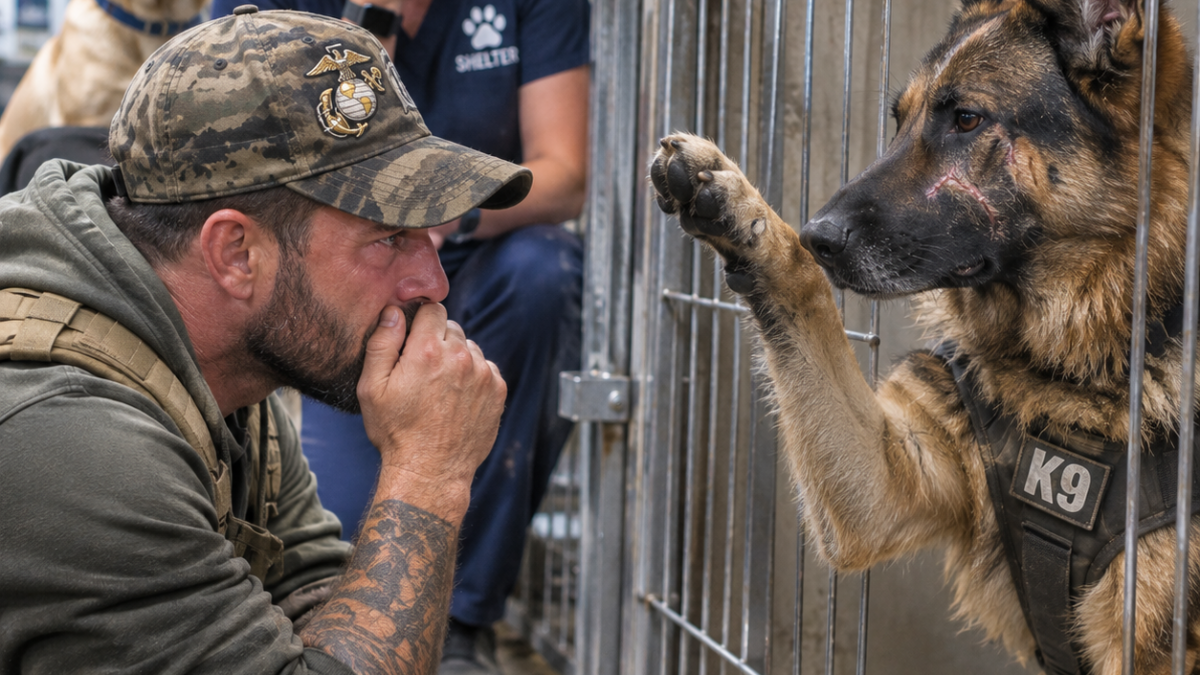
A Former Marine Came to Adopt a Calm Shelter Dog—Then a Scarred K9 Heard His Voice and Gave a Secret Marine Signal.
Eric Dawson had promised himself he would never own another working dog after Afghanistan, so when he finally walked into a Missouri shelter twelve years later, he deliberately chose the sleepiest Labrador in the building—a gray-faced dog whose greatest ambition seemed to be finding a softer place to nap.
He was halfway through signing the adoption papers when a scarred German Shepherd in the restricted wing suddenly began slamming his body against three locked kennel gates, not snarling or trying to attack, but making a desperate sound the shelter director had never heard from him before.
Then Eric stepped into the hallway, spoke four ordinary words, and the Shepherd immediately lowered his head, touched his right paw to his chest, and turned once to Eric’s left—the exact recognition sequence used by one Marine dog team overseas, a signal that had not appeared in any shelter record because everyone who knew why the dog had learned it was supposed to be dead.
Eric Dawson had spent twelve years learning how not to look at German Shepherds.
He did not cross streets to avoid them.
That would have been obvious.
He simply became very good at noticing everything else.
If a Shepherd stood beside a veteran outside the grocery store, Eric looked at the carts.
If one appeared in a television commercial, he checked his phone.
If he heard nails clicking across tile in an airport, he kept his eyes on the departure board.
Belgian Malinois were worse.
Working harnesses worse still.
But German Shepherds had been the beginning.
That was why Eric had chosen a Labrador.
The dog’s shelter name was Gus.
Ten years old.
Yellow coat fading toward cream.
Soft brown eyes.
Forty pounds overweight according to the shelter technician, although Gus himself appeared unconcerned by the accusation.
When Eric first walked past his kennel, Gus lifted his head from the blanket, looked at him once, sighed, and went back to sleep.
Eric stopped.
“That one.”
The volunteer beside him laughed.
“You haven’t even met him.”
“I like his attitude.”
“His attitude is mostly horizontal.”
“Perfect.”
The volunteer’s name was Kayla.
Twenty-six.
Green shelter T-shirt.
Hair pulled through the back of a baseball cap.
She opened Gus’s kennel and clipped on a leash.
The Labrador stood reluctantly, stretched with magnificent laziness, then walked into the meet-and-greet room as though every step had been negotiated by a union.
Eric sat in a plastic chair.
Gus sniffed one boot.
Then the other.
Then placed his head on Eric’s knee.
No intensity.
No scanning.
No expectation.
Eric rested a hand between the dog’s ears.
Something in his chest loosened.
Not much.
Enough.
PART2:
“You’re not going to make me run obstacle courses, are you?”
Gus closed his eyes.
“Good.”
Kayla smiled from the doorway.
“He’s been here seven weeks.”
“Why?”
“Owner passed away.”
Eric’s hand stopped.
Kayla noticed.
“He lived with an older gentleman.”
“Family?”
“None who could take him.”
Eric nodded.
He understood more than he wanted to.
“How is he with people?”
“Everyone.”
“Dogs?”
“Mostly indifferent.”
“Cats?”
“Terrified.”
Eric looked down.
Gus snored.
“He’s afraid of cats?”
“Deeply.”
“Smart dog.”
That almost became the entire story.
PART3:
A former Marine who had spent twelve years refusing to own another dog finally adopted an old Labrador because the Labrador asked nothing from him.
Simple.
Good.
Safe.
Eric needed safe.
He was forty-four years old.
Worked as a refrigeration technician for grocery stores and commercial kitchens around Springfield.
He owned a small house on three acres outside town.
Divorced.
No children.
His sister Megan lived twenty minutes away with her husband and two teenagers.
Eric saw them on Sundays when he felt social enough.
Sometimes more.
Sometimes not.
He did not describe himself as broken.
He hated when people did that to veterans.
He worked.
Paid taxes.
Fixed equipment.
Remembered birthdays if Megan texted reminders.
He slept badly sometimes.
Avoided fireworks whenever possible.
Had not been inside a crowded sports stadium since returning from Afghanistan.
None of that made him a tragedy.
It made him Eric.
Dogs were different.
Before Afghanistan, Eric loved them.
His father raised bird dogs.
Eric grew up with mud on the kitchen floor and dog hair on every jacket he owned.
When he joined the Marines at twenty, he assumed there would always be another dog eventually.
Then Afghanistan happened.
And there had been Ranger.
Not a pet.
Not technically Eric’s dog.
Ranger belonged to a military working-dog program supporting Marine operations in Helmand Province.
Large German Shepherd.
Dark sable coat.
Black face.
Too intelligent for his own good.
Officially Ranger worked with Staff Sergeant Lucas Keene.
Unofficially, the entire eight-man patrol team learned Ranger’s moods because ignoring a working dog in that environment was foolish.
Ranger had detected explosive material.
Hidden weapons.
Once a tunnel entrance nobody else had noticed.
Eric learned the dog’s body language.
So did everyone.
Then one afternoon Ranger alerted near a mud wall outside a compound.
That warning saved Eric’s life.
It did not save everyone.
Afterward, Eric stopped talking about dogs.
He especially stopped talking about Ranger.
The shelter had no idea.
Why would it?
On the adoption application, under:
PREVIOUS DOG EXPERIENCE
Eric had written:
Family dogs growing up.
That was true.
Incomplete.
But true.
He had not written:
Spent eight months overseas trusting a German Shepherd’s nose more than my own eyes.
He had not written:
Still dreams about one barking before the explosion.
And he certainly had not written:
I have spent twelve years wondering what happened to him.
Because Ranger was dead.
That was what Eric had been told.
Maybe not directly.
But enough.
After the blast, Eric woke in Germany.
Then Maryland.
Then months of rehabilitation for a shoulder injury, hearing damage, and burns that looked worse than they eventually healed.
By the time he asked about Ranger, someone said the dog had been evacuated after injuries.
Later, another Marine told him Ranger had not made it.
Eric never saw paperwork.
He never asked again.
Some questions hurt less if you accept the first answer.
That was what he had told himself.
Now he was signing a form for Gus.
Shelter director Melissa Grant sat across from him.
Fifty.
Reading glasses.
The type of person who could explain a euthanasia decision and a plumbing problem in the same calm tone because shelter work required strange emotional range.
“Fenced yard?”
“Three sides.”
Melissa looked up.
“What’s on the fourth?”
“Tree line.”
“That is not a fence.”
“I know.”
“Gus isn’t exactly an Olympic sprinter.”
Eric looked toward the Labrador sleeping under the table.
“I’d noticed.”
“But county requires us to discuss containment.”
“I’ll put up the fourth side.”
Melissa nodded.
“Veterinarian?”
“My sister uses Dr. Harlan.”
“Fine.”
“Gus takes carprofen for arthritis. We’ll send enough for ten days.”
“Okay.”
“He needs to lose weight.”
Gus opened one eye.
Eric said:
“You hear that?”
The dog shut it.
Melissa smiled.
Then something slammed against metal somewhere beyond the lobby.
One impact.
Then another.
Eric’s hand stopped over the form.
The sound came from deeper inside the building.
Not regular shelter barking.
Metal.
Heavy body.
Then a bark.
One.
Sharp.
Low.
Eric’s back straightened before he meant it to.
Melissa looked toward the hallway.
“That’s unusual.”
Another impact.
Kayla appeared in the doorway.
“Melissa?”
“What?”
“It’s Rook.”
Melissa immediately stood.
Eric looked down.
The name meant nothing.
But the sound did.
Not aggression.
He had heard aggressive working dogs.
This was different.
The bark came again.
Then a rapid whine.
High enough to sound almost painful.
Melissa told Eric:
“I’ll be right back.”
He nodded.
She hurried out with Kayla.
Eric stared at the half-finished adoption form.
Gus continued sleeping.
Metal crashed again.
Eric tried not to listen.
Then came three barks.
Pause.
One bark.
Pause.
Two.
Eric’s pen slipped from his fingers.
No.
He sat still.
Another sequence.
Three.
One.
Two.
His mouth went dry.
That was not random.
It could be.
Of course it could.
Dogs bark in patterns constantly.
Humans find meaning because humans are built to find meaning.
Eric knew that.
Still, his pulse had changed.
He stood.
Gus looked up.
“Stay.”
The old Labrador ignored him professionally.
Eric stepped into the hallway.
Melissa was twenty yards away beside a locked door marked:
AUTHORIZED STAFF ONLY.
Behind it came another thud.
She saw Eric.
“Everything’s fine.”
“What dog is that?”
“Restricted intake.”
“What does that mean?”
“Behavioral hold.”
Another whine.
Eric took one step.
Melissa raised her hand.
“Mr. Dawson.”
He stopped.
“This isn’t part of public kennels.”
“I understand.”
The dog barked again.
Eric felt the hair rise on his forearms.
Then he did something he had not done in twelve years.
He spoke in the voice he used overseas.
Not louder.
Different.
Flat.
Controlled.
“Easy. Hold your place.”
Silence.
Immediate.
Absolute.
Melissa slowly turned toward the door.
Kayla looked at Eric.
“What did you say?”
Eric did not answer.
Something moved behind the restricted door.
A chain rattled once.
Then nothing.
Melissa unlocked the first door.
Not for Eric.
To look.
He saw only part of corridor.
Concrete.
Another gate.
Then a third beyond it.
Three controlled barriers between public area and final kennel.
A large German Shepherd stood at the far end.
Scarred muzzle.
Dark sable coat gone gray at the cheeks.
One torn ear.
Body lean.
Powerful even with age.
The dog was staring directly at Eric.
Eric stopped breathing.
Not Ranger.
Could not be.
Twelve years.
The dog would be ancient.
This Shepherd looked maybe nine.
Maybe ten.
And Ranger was dead.
The dog lowered his head.
Then did something small.
So small Kayla nearly missed it.
He lifted his right front paw.
Touched it once to the center of his chest.
Set it down.
Then turned his body clockwise until he stood angled toward Eric’s left.
Eric grabbed the wall.
Melissa looked at him.
“You know that?”
Eric whispered:
“No.”
The Shepherd repeated it.
Paw.
Chest.
Turn.
Then sat.
Eric’s vision blurred.
Melissa stepped closer.
“Mr. Dawson?”
Eric said:
“Open the next gate.”
“I can’t.”
“Please.”
“I need to understand what’s happening.”
Eric stared at the dog.
“That signal.”
“What about it?”
“We used it overseas.”
“Who is we?”
Eric swallowed.
“My unit.”
Melissa looked toward the Shepherd.
“That’s impossible.”
“Maybe.”
“What does it mean?”
Eric’s voice changed.
“We used it for recognition.”
Kayla frowned.
“Like a command?”
“No.”
“How?”
Eric rubbed his face.
“It wasn’t official.”
He looked at the dog.
“It was something Lucas taught Ranger.”
“Who’s Lucas?”
“His handler.”
The Shepherd whined.
Eric closed his eyes.
Melissa saw it.
“Say that name again.”
“Lucas.”
The dog stood.
Not violent.
Not frantic.
He pressed his chest against the kennel gate.
Eric’s knees felt weak.
Melissa said:
“What was the dog’s name?”
Eric answered:
“Ranger.”
The Shepherd made a sound that stopped every person in the corridor.
A low, broken howl.
Not long.
Not loud.
One note.
Then he began pawing once against the floor.
Right paw.
Pause.
Right paw.
Eric backed into the wall.
“No.”
Melissa said softly:
“What?”
Eric shook his head.
“No.”
The shelter called him Rook.
He had arrived five weeks earlier from a contracted holding facility after an animal-control seizure involving an abandoned rural property.
No owner present.
No reliable microchip registration.
A faded military-style tattoo inside one ear.
Old working-dog scars.
Extreme handling sensitivity.
The first facility classified him as potentially dangerous after he bit through a catch pole during transfer.
He had not bitten a person.
But he had lunged at barriers, resisted restraint, and reacted strongly to men in uniforms.
So Cedar Valley housed him in the restricted wing while waiting for a specialized placement.
Melissa had contacted former working-dog rescues.
Two were full.
One wanted more records.
There were no records.
“He doesn’t respond to Rook,” Kayla said.
Eric stared.
“What does he respond to?”
“Mostly nothing.”
“Commands?”
“Sit sometimes.”
“In English?”
“Yes.”
“What words?”
Kayla listed.
“Sit. Down. Kennel. Come.”
Eric shook his head.
“Try German?”
“We did.”
“Dutch?”
“We did.”
“Hand signals?”
“Some.”
Melissa asked:
“Why do you think the thing he did was recognition?”
Eric leaned against the wall.
Because in Afghanistan, Ranger sometimes became overstimulated after helicopter insertions.
Lucas Keene developed a routine.
Not standard command.
A check.
Eric had teased him about it.
Lucas would tap two fingers to his chest and pivot left.
Ranger mirrored with one paw and turned toward Lucas’s left side.
It became a game at first.
Then a patrol-team signal.
When noise made verbal communication difficult, Lucas could identify himself visually from a distance.
Ranger would mirror and move into position.
Other Marines learned it.
Eric included.
Not because they were supposed to handle Ranger independently.
Because war encourages redundancy.
If Lucas went down, someone else needed to move the dog.
Eric had used that sequence twice.
Once during training.
Once after Lucas was wounded.
Nobody outside their small team should have known it.
Unless the dog knew it.
Melissa unlocked the second gate.
“Stay there.”
Eric nodded.
She walked closer to the kennel.
The Shepherd did not look at her.
“Rook.”
Nothing.
“Ranger.”
The dog’s ears moved.
Eric gripped the railing.
Melissa tried again.
“Ranger.”
The Shepherd looked toward Eric.
Not Melissa.
Eric whispered:
“Ranger. Check.”
The dog raised his right paw.
Chest.
Turn.
Perfect.
Eric sank into a chair Kayla pushed beneath him.
Twelve years disappeared badly.
Not beautifully.
Not like movies.
His shoulder hurt where scar tissue had not hurt in years.
He smelled dust that was not there.
Diesel.
Hot metal.
Burned cloth.
He heard Lucas shouting.
Ranger barking.
Then the explosion.
Melissa crouched several feet away.
“Eric.”
He noticed she had stopped calling him Mr. Dawson.
“What happened to your dog?”
“He wasn’t mine.”
“What happened to Ranger?”
“I was told he died.”
“When?”
“2014.”
Melissa looked at the Shepherd.
“If this dog is Ranger…”
“He can’t be.”
“How old was Ranger?”
“Two and a half.”
She calculated.
“He’d be fourteen.”
Eric looked again.
Gray muzzle.
Thinness.
Old dog carrying muscle memory.
Fourteen was possible.
Unlikely for a hard-working Shepherd.
But possible.
“He looks younger.”
“Shelter ages are estimates.”
Eric stood again.
“Do you have his teeth chart?”
Melissa nodded.
“Veterinarian estimated ten to twelve, maybe older.”
“Microchip?”
“Chip is damaged. Partial read.”
“What number?”
Melissa hesitated.
Privacy procedures mattered even now.
Then:
“I can pull the intake record.”
She did.
Partial chip string.
Eric did not recognize it.
Why would he?
Military records had never been his.
He called the one person whose number he still had.
Staff Sergeant Lucas Keene had not died in Afghanistan.
That was important.
He had survived.
Barely.
The blast that injured Eric also shattered Lucas’s pelvis and caused a traumatic brain injury.
Eric remembered him being evacuated.
They exchanged messages during recovery.
Then less.
Then none.
Last Eric heard, Lucas lived in Montana.
He found an old contact.
Disconnected.
Facebook account inactive.
Megan helped search.
Found obituary.
Eric stared at the screen.
Lucas Keene.
Died 2023.
Forty-one.
Complications after a stroke.
Eric sat in the shelter conference room.
Ranger—if he was Ranger—remained behind three locked gates.
Another person gone.
Melissa asked:
“Family?”
Obituary listed mother.
Sister.
No spouse.
Eric found sister’s number through public listing after obtaining permission to contact through shelter channels.
Her name was Hannah Keene.
She answered cautiously.
“Yes?”
“My name is Eric Dawson.”
Silence.
Then:
“Eric from Lucas’s unit?”
He closed his eyes.
“Yes.”
Her voice softened.
“Oh my God.”
“I’m sorry to call like this.”
“It’s okay.”
“Did Lucas ever have Ranger after the Marines?”
Hannah went quiet.
“Ranger?”
“Yes.”
“He talked about him.”
“Did he own him?”
“No.”
“You’re sure?”
“I think so.”
“Did he know what happened?”
“Eric…”
“What?”
“Lucas spent years trying to find that dog.”
Eric sat straighter.
“What?”
“He thought Ranger survived.”
The room changed.
Hannah explained.
After evacuation, Lucas received conflicting information.
Ranger had been injured.
Transferred out.
Then reassigned.
Then possibly returned stateside.
Records incomplete.
Lucas tried tracking him.
At one point, he believed Ranger entered federal contractor program after military retirement.
Another lead suggested law enforcement.
Nothing confirmed.
“He never stopped looking?”
“Not really.”
Eric looked through conference-room glass toward restricted hallway.
“Did he ever say Ranger had a mark?”
“Scar?”
“Anything.”
Hannah thought.
“He lost the tip of one ear.”
Eric looked at Melissa.
She nodded slowly.
Right ear.
Missing a small triangular piece.
Hannah continued.
“And there was something on his front leg.”
“Where?”
“Inside right foreleg. Lucas called it his little white comet.”
Eric’s heart hammered.
Melissa retrieved intake photographs.
Inside the Shepherd’s right foreleg, hidden beneath darker fur, was a thin white streak curving upward.
Eric turned away.
Hannah whispered:
“Did you find him?”
Eric could not answer immediately.
“I found a dog.”
He looked at Ranger.
“And I think he found me first.”
The shelter did not hand him the dog.
That mattered.
Recognition did not erase procedure.
The dog had a bite-risk notation.
Age uncertain.
Medical status incomplete.
Ownership needed clarification.
If he was a retired military or government dog, legal records mattered.
Melissa contacted a nonprofit specializing in retired working-dog record recovery.
They contacted military veterinary archives and federal microchip databases.
Partial numbers.
Old handler names.
Photographs.
Scar patterns.
Dental records where available.
The process took days.
Eric visited every day.
Gus’s adoption was paused.
That made Eric feel terrible.
He sat beside the old Labrador.
“You picked a bad applicant.”
Gus rested his head on Eric’s boot.
Kayla said:
“You can still adopt Gus.”
Eric looked at her.
“I don’t know what I’m doing.”
“Neither does he.”
She pointed toward restricted wing.
“Probably.”
Eric laughed weakly.
Ranger was calmer now.
Not calm.
Different.
When Eric entered the corridor, the Shepherd watched every movement.
If Eric said:
“Easy.”
Ranger’s ears lowered.
If he used one old phrase:
“Check left.”
Ranger shifted automatically.
Some commands still lived in him.
Others had changed.
Eric did not test too much.
He did not want to turn reunion into performance.
On the fourth visit, Melissa allowed Eric inside the second barrier with a trainer present.
Still one gate between them.
Ranger approached.
Eric sat sideways on a chair.
No direct reach.
For twenty minutes, nothing.
Then Eric quietly said:
“Hell of a way to say hello.”
Ranger’s tail moved once.
One slow sweep.
Eric stared.
Another.
The first time Ranger had wagged for anyone at Cedar Valley.
Eric’s eyes filled.
He hated crying in public.
Ranger had never cared about his preferences.
The records came back one week later.
Military Working Dog R-317.
Call name:
Ranger.
German Shepherd.
Born January 2012.
Explosives detection.
Initial handler:
Staff Sergeant Lucas Keene.
Supported Marine unit in Afghanistan.
Injured 2014.
Recovered.
Returned to stateside service.
Later transferred into an interagency detection program.
Retired at age nine.
Adopted by a private contractor handler named Matthew Voss.
Matthew died three years later.
Ranger then passed informally to a former coworker.
That man developed serious health problems.
Property eventually abandoned during hospitalization.
Animal control found Ranger there.
No one knew his history because his adoption paperwork and old records were not at the property.
He had gone from military dog to government contractor dog to retired companion to an unidentified old Shepherd behind three locked gates.
Eric read the report twice.
“Fourteen.”
Melissa nodded.
“He’s fourteen.”
“He shouldn’t look this good.”
“Some dogs age rudely.”
Eric smiled.
Then stopped at one line.
2014 injury:
Blast-related lacerations. Shrapnel removal. Thoracic bruising.
Same blast.
Eric put the page down.
Ranger had survived.
All those years.
Lucas had survived.
Eric had survived.
Their lives simply moved apart before anyone managed to put the pieces back together.
Melissa asked:
“Do you want to meet him without the gate?”
Eric stared.
“Yes.”
The first direct meeting happened outside in a secure exercise yard.
Two staff members.
Behavior specialist.
Long line.
No crowd.
Ranger entered first.
Sniffed.
Urinated on three separate fence posts with the thoroughness of an inspector.
Eric laughed.
“That part hasn’t changed.”
Melissa opened Eric’s gate.
He entered.
Stopped fifteen feet away.
Ranger turned.
They looked at each other.
Eric did not call.
He raised two fingers to his chest.
Not the same recognition signal Ranger performed.
The human half.
Ranger’s ears snapped forward.
Eric turned slightly right—the way Lucas had trained the dog to approach the protected side.
Ranger walked.
Not ran.
Walked directly to him.
Stopped.
Then performed his half.
Paw to chest.
Clockwise turn.
Sit at Eric’s left leg.
Eric stopped holding himself together.
He knelt.
Ranger pressed his head beneath Eric’s chin.
Eric wrapped both arms around him.
The old Shepherd made that broken whine again.
Eric whispered:
“I thought you were dead.”
Ranger breathed against his neck.
“I’m sorry.”
Melissa looked away.
The behavior specialist did too.
Not because professionals are unaffected.
Because some moments deserve less observation.
Eric stayed on the ground.
His hand found the scar along Ranger’s shoulder.
He remembered blood there.
He remembered Lucas pressing gauze.
He remembered trying to drag another Marine behind a wall.
He remembered Ranger circling back despite injury.
The memory came too fast.
Eric’s breathing changed.
Ranger immediately pulled away.
Looked at him.
Then did something Eric remembered from Afghanistan.
The Shepherd pressed his nose hard against Eric’s sternum.
Not trained medical alert.
Not therapy magic.
Just an old behavior Ranger used when the patrol team sat too long without moving.
A push.
Pay attention.
Eric laughed while crying.
“You’re still rude.”
Ranger pushed again.
That was the moment Eric understood something.
He had not avoided working dogs because they reminded him of Afghanistan.
Not exactly.
He avoided them because they reminded him that some of what he loved existed there too.
Lucas.
Ranger.
The team.
Trust.
Competence.
The strange ordinary routines inside terrible places.
If he let himself remember Ranger as more than the dog who barked before the blast, he had to remember everything around the blast.
Including people he missed.
Including himself before it happened.
Avoidance had simplified the story.
Afghanistan bad.
Dogs connected to Afghanistan.
Therefore dogs bad to remember.
Ranger had returned and complicated it.
Eric did not know whether he wanted that.
He only knew he could not walk away.
Melissa knew what question came next.
“So.”
Eric sat across her desk.
Gus lay under table again.
Ranger was back in restricted wing.
“You want to adopt Ranger.”
Eric looked at Gus.
“Yes.”
Melissa waited.
“And Gus.”
She blinked.
“What?”
Eric scratched the Labrador’s head.
“I already promised this idiot a yard.”
Gus sighed.
Melissa laughed.
“You haven’t finished one adoption and now you want a fourteen-year-old restricted working dog too?”
“Yes.”
“No.”
Eric stared.
“No?”
“Not today.”
He leaned back.
“Fair.”
Melissa appreciated that.
“Ranger has been through multiple working environments. He’s old. He has arthritis, partial hearing loss, chronic dental issues, and a behavioral history we need to understand.”
“I know.”
“You live alone.”
“Yes.”
“Two dogs may or may not work.”
“Gus barely qualifies as movement.”
Gus opened one eye.
Melissa ignored him.
“Ranger needs decompression.”
“Yes.”
“Containment.”
“I’ll finish fence.”
“Veterinary budget.”
“Fine.”
“Handling plan.”
“Fine.”
“Backup.”
“Megan.”
“Does Megan know?”
“No.”
“Then Megan isn’t backup.”
Eric nodded.
“Fair.”
“Most importantly, you’re emotionally connected to what Ranger represents.”
Eric looked away.
Melissa continued gently.
“That doesn’t automatically mean you’re the right retirement home.”
He looked back.
“I know.”
“Do you?”
“Yes.”
“How?”
Eric took time.
“Because I spent twelve years making decisions based on what he represented.”
Melissa said nothing.
“I don’t want to do that again.”
That was the right answer.
Not enough by itself.
But right.
They began with Gus.
Eric took him home first.
The Labrador slept through the entire drive.
At Eric’s house, Gus walked around the kitchen, found the coldest patch of floor, and collapsed.
Eric stared.
“That’s the inspection?”
Gus snored.
The fourth fence side went up two days later.
Then Ranger came for supervised home visit.
Eric expected recognition to solve everything.
It did not.
Ranger walked into house and immediately began searching.
Every room.
Every doorway.
Behind curtains.
Under table.
Garage entrance.
Perimeter.
Old working pattern.
He checked Gus.
Gus wagged once and lay down.
Ranger stared at him like he had never encountered an animal with so little professional ambition.
Then Ranger began pacing.
Window.
Door.
Hall.
Window.
Door.
Hall.
Eric tried:
“Settle.”
Nothing.
Old hand signal.
Ranger paused.
Then resumed.
Behavior specialist told Eric:
“Don’t keep reaching backward.”
“What?”
“Those signals help communication. They can’t become the only way you interact.”
Eric nodded.
Ranger needed a new routine.
Not constant reminders of old one.
That was harder than reunion.
Reunion had taken minutes.
Retirement took months.
Ranger woke at 4:30.
Every day.
Eric did not.
Ranger solved that.
He stood beside the bed and stared until Eric opened his eyes.
“You have no job.”
Ranger stared.
“Retired.”
Stare.
“At ease.”
Nothing.
Eric got up.
Morning perimeter walk.
Breakfast.
Then Gus lumbered outside around seven-thirty like a man arriving late to work he had never applied for.
The dogs became strangely compatible.
Ranger inspected.
Gus ignored.
Ranger reacted to trucks.
Gus slept.
Ranger paced during thunderstorms.
Gus snored louder.
Sometimes Ranger eventually lay beside him as if the Labrador’s indifference proved the world was not ending.
Eric began sleeping better.
Not because Ranger cured anything.
Some nights worsened.
A dog pacing in the dark could trigger memories.
Once Ranger barked sharply from hallway at 2:16 a.m.
Eric woke on floor beside bed before he understood how he got there.
Ranger stood ten feet away.
Eric’s heart hammered.
He did not touch him.
He counted.
Floor.
Wall.
Window.
Lamp.
Dog.
Missouri.
Home.
Not Afghanistan.
When his breathing slowed, Ranger approached.
Eric whispered:
“Not your fault.”
It was nobody’s fault.
The next day Eric called the VA therapist whose number had been sitting unused in his phone for two years.
Not because Ranger needed him to.
Because Eric realized avoiding memory had stopped being the same thing as managing it.
That mattered.
He never called Ranger a service dog.
Never put a vest on him.
Never took him into stores pretending military history granted access.
Ranger was retired.
Old.
Sometimes stiff.
Occasionally unreasonable.
He did not owe Eric therapy.
Eric owed him a retirement.
That distinction kept their relationship honest.
Hannah Keene came to visit three months later.
Lucas’s sister.
She stood in Eric’s driveway and cried before Ranger even reached her.
The Shepherd approached slowly.
Sniffed.
No dramatic signal.
No miraculous recognition.
Hannah knelt.
“Hi.”
Ranger sniffed her coat.
Then walked away to inspect a tree.
Hannah laughed through tears.
“I guess I’m not Lucas.”
Eric said:
“No.”
She smiled.
“Good.”
She brought a box.
Lucas’s things.
One old photograph showed Lucas kneeling beside Ranger overseas.
Eric stood behind them.
Younger.
Thinner.
Smiling.
He had forgotten the photograph existed.
Hannah handed it over.
“I think you should have this.”
Eric shook his head.
“You keep it.”
“I have copies.”
He looked.
Lucas.
Ranger.
Himself.
Before everything.
He accepted.
Another item was a nylon collar.
Ranger’s name handwritten inside by Lucas.
Eric held it.
“Where’d you get this?”
“Lucas kept it.”
Ranger sniffed the collar.
Tail moved.
Then he lay down beside Gus.
Hannah watched.
“Lucas would’ve lost his mind.”
Eric smiled.
“Probably.”
She looked toward Ranger.
“He spent years believing he failed him.”
Eric’s expression changed.
“Why?”
“Because he couldn’t bring him home.”
Eric sat.
“So did I.”
Hannah looked at him.
“You weren’t his handler.”
“No.”
“I thought he died.”
“That isn’t failure.”
Eric stared at the photograph.
“It felt easier to believe.”
“What?”
“That there was nothing I could have done because he was gone.”
He looked at Ranger.
“Turns out he was alive the whole time.”
Hannah said softly:
“You were alive too.”
Eric did not answer.
Some sentences need time.
Ranger’s identity eventually became public through a local veterans organization.
Eric resisted.
Melissa insisted on privacy boundaries.
No surprise visits.
No strangers showing up at house.
No viral “reunion” events.
But a short article was published to help former working-dog programs improve record continuity.
The headline exaggerated anyway.
MARINE REUNITED WITH K9 AFTER 12 YEARS.
Eric hated it.
“We weren’t partners.”
Melissa said:
“You’re missing point.”
“I don’t like inaccurate.”
“Then tell accurate version.”
He did.
Ranger belonged to Lucas.
Eric served on same team.
Ranger recognized old unit signal.
Records were recovered.
Dog retired to Eric after assessment.
Simple.
People asked:
“How did Ranger remember after twelve years?”
Eric answered:
“I don’t know what he remembered.”
That disappointed them.
He continued:
“He remembered the behavior.”
That was enough.
Animal memory does not need to become human autobiography to be profound.
A dog can remember scent.
Movement.
Sequences.
Reinforcement histories.
People.
Places.
Emotional associations.
No one needed to claim Ranger spent twelve years thinking:
One day Eric will walk into a Missouri shelter.
He didn’t.
Life happened.
Handlers changed.
Programs changed.
Owners died.
Records vanished.
Then one familiar voice reached a kennel.
Ranger answered using the language he had left.
Two years passed.
Gus lost twenty-one pounds.
He remained offended.
Ranger turned sixteen.
Very old for his history.
His back legs weakened.
Eric built ramps.
Added rugs.
Stopped long walks.
Ranger still wanted perimeter inspections every morning.
Eric shortened perimeter.
Ranger pretended not to notice.
One morning he stopped at mailbox.
Looked toward Eric.
Eric raised two fingers.
Ranger touched paw weakly to his chest.
Turned halfway.
Sat.
Eric smiled.
“Good check.”
That signal had changed meaning.
In Afghanistan:
Identify.
Focus.
Take position.
At shelter:
I know that.
I know you.
At home:
Still here.
Still together.
Eric kept therapy appointments.
Not every week forever.
Enough.
He began speaking at small veteran peer group occasionally.
Not about heroism.
Mostly about ordinary reintegration.
Work.
Divorce.
Sleep.
Isolation.
Dogs only sometimes.
Someone asked:
“Did getting Ranger fix your PTSD?”
Eric nearly walked out.
Instead:
“No.”
The man looked surprised.
“Then what did he do?”
Eric thought.
“He made avoiding certain memories inconvenient.”
People laughed.
He did too.
Then:
“And he reminded me some of those memories were good.”
That was closer.
At seventeen, Ranger’s kidneys began failing.
Slowly.
Then not slowly.
Dr. Harlan laid out choices.
Medication.
Fluids.
Diet.
Monitoring.
Comfort.
Eric listened.
Asked technical questions.
Refrigeration technician brain.
Numbers helped.
Until numbers stopped helping.
Ranger lost appetite.
More bad mornings.
Still interested in Eric.
Still watched Gus.
Still wanted outside.
Then one night he fell and could not rise.
Eric helped.
Ranger hated the sling.
Bit it twice.
Eric laughed through tears.
“Still working?”
Ranger glared.
The final decision came two weeks later.
Home euthanasia.
Megan came.
Melissa too.
Hannah joined by video.
Gus slept three feet away, because Gus considered solemnity optional.
Eric sat on floor with Ranger’s head in his lap.
Old Shepherd’s face almost entirely gray now.
Right ear still missing its little corner.
White comet visible inside foreleg.
Scar along shoulder.
History written on body.
Eric whispered:
“I should’ve looked for you.”
Ranger breathed.
Eric corrected himself.
“No.”
He stroked the dog’s cheek.
“I should’ve been willing to know.”
That felt truer.
The veterinarian administered sedative.
Ranger relaxed.
Eric lifted two fingers to his chest.
Ranger’s eyes followed.
For one moment, his right paw shifted.
Not enough to lift fully.
Eric put his hand beneath it.
Guided nothing.
Just held.
“You don’t have to.”
Ranger exhaled.
Eric whispered:
“Check complete.”
Then Ranger slept.
And stopped.
Gus woke.
Walked over.
Sniffed Ranger once.
Lay down nearby.
Eric stayed on floor.
No speech.
No military ceremony.
No flag over dog.
No need.
Ranger had worked enough.
After cremation, Eric kept no elaborate shrine.
Lucas’s old collar hung beside a photograph.
Ranger’s retirement collar beside it.
One small wooden box.
Gus continued living another eighteen months.
He died at twelve and a half after a life distinguished largely by naps and food crimes.
Eric adopted again eventually.
Not a working dog.
Not because he was afraid anymore.
Because the county shelter had a mutt named Penny who looked at him exactly once and stole his glove.
Melissa called.
“You sure?”
Eric said:
“No.”
“That hasn’t stopped you before.”
Penny went home.
Years later, a new Cedar Valley employee found an old photo in staff archive.
Eric kneeling in exercise yard.
Ranger pressed against him.
She asked Melissa:
“Is this the dog who went crazy when he heard his old Marine?”
Melissa frowned.
“He didn’t go crazy.”
“That’s what everybody says.”
“He became highly aroused.”
“That sounds less exciting.”
“It is more accurate.”
“What happened?”
Melissa looked at picture.
“A man came in to adopt a Labrador.”
“And?”
“A dog behind three locked gates heard him speak.”
“That’s it?”
“No.”
Melissa smiled.
“The dog answered.”
The employee expected something supernatural.
Melissa gave her records instead.
Working-dog ID.
Handlers.
Transfers.
Behavior notes.
Recognition sequence.
Everything.
Because that was the point.
Ranger’s story became extraordinary because his history had disappeared.
Once history returned, his behavior made sense.
The desperate kennel reaction was not madness.
The paw-to-chest movement was not a mystical sign from another life.
It was learned communication.
A piece of training built by Lucas Keene, reinforced by a small Marine team, preserved through years of service and retirement.
And when Eric’s voice entered the shelter hallway, Ranger reached for the oldest language he still trusted.
That was why Eric never said Ranger recognized “his soul” or remembered every detail of Afghanistan.
He said something simpler.
“He knew the team.”
Maybe scent.
Maybe voice.
Maybe posture.
Maybe the phrase.
Probably all of it layered together.
No one could ask Ranger.
But Eric knew the signal.
That had been enough.
He had walked into Cedar Valley wanting the calmest animal in the building because calm meant no reminders.
He almost left with nothing more complicated than an overweight Labrador afraid of cats.
Instead, a scarred old Shepherd behind three locked gates forced him to look directly at a part of his life he had spent twelve years treating as if it had died overseas.
Ranger had not died there.
Neither had Eric.
Not completely.
The dog did not give him back the Marine he had been at thirty-two.
Eric did not want that.
He gave Ranger something simpler.
A yard.
A ramp.
A quiet retirement.
Morning walks.
A ridiculous Labrador roommate.
A place where no one asked him to search vehicles, climb walls, or prove he could still work.
And Ranger gave Eric something equally ordinary.
Evidence that memory could hurt without being dangerous.
That he could remember Lucas laughing and not only Lucas bleeding.
That he could remember Ranger alerting before the blast and also Ranger stealing beef jerky from a pack.
That the past contained more than the worst five minutes of it.
Years after Ranger died, Eric kept the old recognition signal.
Not publicly.
Not ceremonially.
Sometimes when he passed the wooden box holding Ranger’s ashes, he would raise two fingers briefly to his chest.
No turn.
No command.
No expectation.
Just recognition.
I see you.
I remember.
Then he would continue with his day.
Because that was what the signal had always meant at its core.
Not stay in the past.
Know who is beside you.
And move.








