A Firefighter Pulled an 8-Year-Old Cat From a Burning House With No Heartbeat—Four Minutes Later, She Breathed Again, and This Photo Was Taken 90 Seconds After
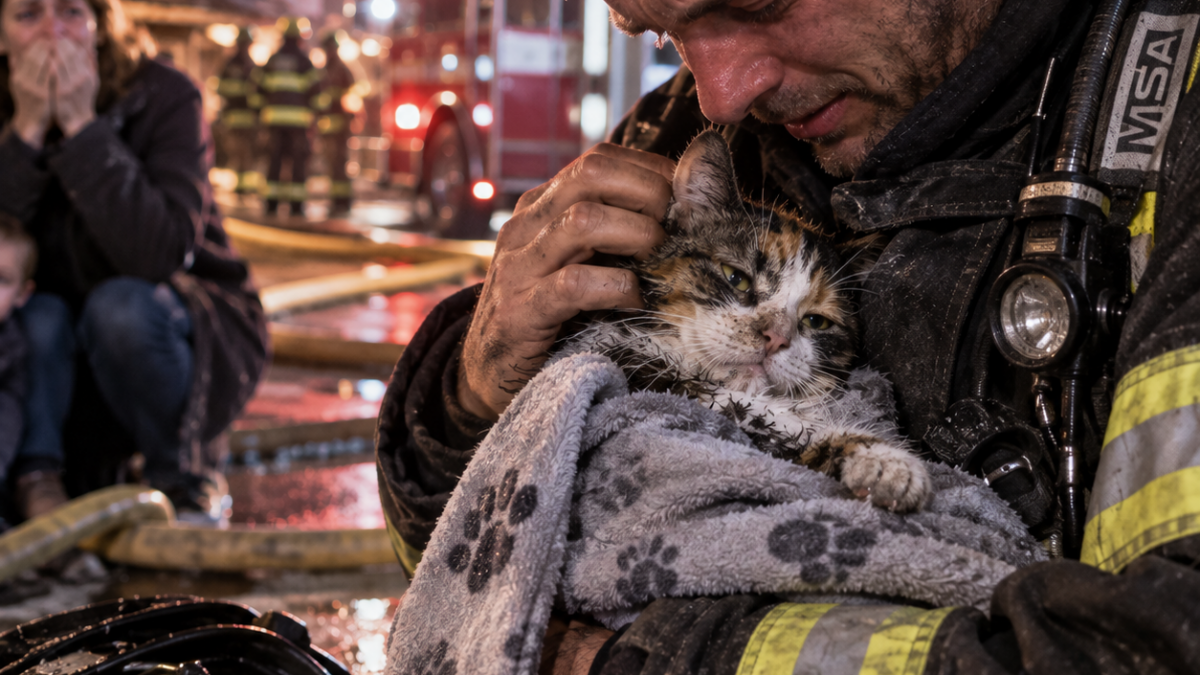
A Firefighter Pulled an 8-Year-Old Cat From a Burning House With No Heartbeat—Four Minutes Later, She Breathed Again, and This Photo Was Taken 90 Seconds After.
The family was already outside when the mother grabbed my turnout coat and screamed that her eight-year-old cat was still somewhere inside a house whose entire first floor was on fire.
Eleven minutes later, command ordered us out, but I went back alone and found the little tortoiseshell-and-white cat wedged beneath a bathtub with no breath, no pulse, and enough smoke in her lungs that every reasonable part of me knew I was carrying out a body.
Four minutes after I started breathing for her on the front lawn, she suddenly dragged in one broken breath—and ninety seconds later, somebody took a photograph of her soot-covered face looking up at me as if neither of us quite understood why she was still alive.
My name is Michael Harris.
I had been a firefighter for twenty-three years when I met a cat named Callie.
I had pulled children out of cars.
Carried unconscious adults down ladders.
Crawled through rooms so hot the paint blistered above my helmet.
I had watched houses burn to foundations and people stand on sidewalks looking at the remains of everything they owned.
After enough years, you develop routines.
Not because you stop caring.
Because caring without structure gets people killed.
Gear.
Air.
Entry.
Search.
Communication.
Exit.
You trust the routine when the world around you has stopped making sense.
At 2:17 in the morning on February 9, our tones dropped.
Residential structure fire.
Possible electrical origin.
Family believed evacuated.
Smoke visible.
By the time Engine 7 turned onto the street, orange light was already moving behind the front windows.
You could see flame through the living room.
Not smoke.
Flame.
That tells you the fire has already built a head start.
I was riding officer that night.
Captain Daniel Brooks was incident command.
Two engines.
One ladder company.
EMS.
Police en route.
Cold outside.
Maybe twenty-nine degrees.
The kind of winter night where steam rises off wet turnout gear and freezes on pavement.
The house was a two-story colonial at the end of a quiet suburban street.
White siding.
Attached garage.
Family photos probably still on walls nobody could see anymore.
The father was barefoot in pajama pants.
The mother had a blanket wrapped around her shoulders.
Two children stood near the ambulance.
Boy maybe ten.
Girl maybe six.
Everyone coughing.
Everyone alive.
That should have been the best possible thing.
Then the mother saw us.
She broke away from the paramedic.
Ran straight toward me.
“My cat.”
I thought I misheard through my mask and helmet.
“What?”
“My cat is inside.”
She grabbed the sleeve of my turnout coat.
“Callie.”
Her voice cracked.
“She sleeps in the living room.”
I looked at the house.
Living room was where the fire was strongest.
“Ma’am, stay back.”
“Please.”
“We’re searching.”
“No, you don’t understand.”
PART2:
She pointed toward the burning front window.
“She hides when she’s scared.”
That I understood.
Cats in fires rarely run toward rescuers.
They go low.
Dark.
Enclosed.
Under furniture.
Inside cabinets.
Places where frightened animals disappear even in safe houses.
I looked toward Brooks.
He had already heard.
“Primary search.”
He pointed at Nolan and Ruiz.
“Take the right side.”
Then at me and Ellis.
“Left.”
We went in.
The front door had already failed partly from heat.
Smoke came down immediately.
Thick.
Black.
Zero visibility within steps.
The floor felt wrong under my boots.
Not collapse-level wrong yet.
Hot.
Wet from hose line.
Debris.
The fire had started near the living room wall, later determined to be an electrical fault.
By the time we entered, the room was not survivable for anything exposed.
We moved low.
Wall contact.
Thermal imaging camera ahead.
“Firefighter Harris entering left.”
Radio crackled.
“Copy.”
We searched the downstairs first.
Kitchen.
Dining area.
PART3:
Behind furniture.
Under table.
No cat.
Smoke banked down to floor level in places.
Heat intensified.
Fire crews pushed from the front.
Water hit flame.
Steam built.
A structural fire at night has a particular sound.
Wood snapping.
Water hissing.
Glass breaking.
Radios.
Low roar.
And your own breathing inside the mask.
Inhale.
Regulator.
Exhale.
Repeat.
People imagine firefighters hear screams constantly.
Most interior searches are mostly mechanical sound.
That can be worse.
Because silence gives you nothing to follow.
Ellis checked beneath a chair.
“Nothing.”
I moved along the hallway.
Bathroom door closed.
I put a glove against it.
Hot.
Not extreme.
Opened carefully.
Smoke poured out.
No visible flame.
Thermal camera.
Sink.
Toilet.
Tub.
Nothing obvious.
I crawled lower.
Shined a light.
Still nothing.
We continued.
Upstairs search team checked bedrooms.
Family confirmed everyone human was out.
That changes risk calculations.
It has to.
Firefighters do not get to die for property.
I know that sounds cold.
It is not.
It is one of the rules that keeps us from creating more victims.
An animal complicates that rule.
Not because animals are worth less.
Because operationally, a known trapped child and a possible trapped pet are not assessed identically when structural collapse risk rises.
People hate hearing that.
Fire does not care what people hate hearing.
We searched eleven minutes.
That is longer than it sounds inside a hot building on air.
Callie did not appear.
Command radioed:
“Interior, conditions deteriorating. Back out.”
We acknowledged.
Nolan’s team was already moving toward the exit.
Ellis and I followed.
Then something stayed in my head.
Closed bathroom door.
The mother had said:
“She hides.”
The bathroom had been one of the few rooms partially protected because the door was shut.
I could not explain it beyond that.
Not instinct.
Not magic.
A calculation.
If a cat survived anywhere on the first floor long enough to still be recoverable, a closed room away from direct flame was one of the more plausible places.
Outside, Brooks checked accountability.
“All crews out?”
“Affirmative.”
Then he looked at me.
I was staring at the doorway.
“No.”
His tone changed.
“Mike.”
“Bathroom.”
“We checked it.”
“I want thirty seconds.”
“No.”
“Door was closed.”
“House is moving.”
He meant structural conditions.
Heat weakening framing.
Fire extension.
Roof involvement beginning.
He was right.
“Thirty seconds.”
“Harris.”
I looked at him.
“I’m checking extension.”
He knew I was lying.
Not completely.
Checking fire spread is real work.
But both of us knew what I intended.
He swore.
“Air?”
I checked.
Enough for a rapid entry and exit.
“Three minutes.”
“Not three.”
“Understood.”
I went back in.
Alone.
People later turned that into something heroic.
It did not feel heroic.
It felt like unfinished work.
The first floor looked worse.
Water had pushed fire but smoke remained thick.
Thermal conditions changing.
I moved faster.
Hand on wall.
Bathroom.
Door partly open from our first search.
I entered.
Dropped flat.
The tub was old.
Built-in.
Small access gap near the plumbing side where trim had broken away.
My light caught something.
Not fur at first.
A paw.
Still.
I pulled myself closer.
“Callie?”
Ridiculous.
As if she might answer.
Nothing.
I reached under.
Could barely fit my gloved hand.
Touched fur.
Soft.
Hot.
No movement.
“Got her.”
No one was beside me.
I said it anyway.
I had to remove one glove.
Dangerous.
Necessary for grip.
I reached deeper.
Found the cat’s body.
Wedged tight.
She must have crawled beneath the tub as smoke entered.
I pulled carefully.
Nothing.
Again.
Her fur caught on something.
I shifted angle.
Pulled.
She slid free.
Small tortoiseshell-and-white female.
Maybe nine pounds.
Soot darkened the white fur.
Body completely limp.
I put two fingers near her chest.
Could not feel a heartbeat.
No visible breathing.
Eyes partly open.
For a second, I knew.
Dead.
That word enters very clearly after enough emergencies.
I tucked her against my chest with one arm.
Regloved as best I could.
Then moved.
The hallway was hotter.
A loud crack came from somewhere above.
Radio:
“Harris, OUT.”
“Coming.”
I crawled.
Then stood lower than full height where visibility allowed.
Front door ahead.
White light.
Cold air.
I crossed the threshold.
Brooks grabbed my shoulder.
“What the hell—”
Then saw the cat.
His anger disappeared.
“She alive?”
“No.”
I dropped to one knee.
Removed mask.
Put Callie on the wet grass.
The mother screamed.
Not a horror-movie scream.
Worse.
Recognition.
“Oh God.”
Her daughter started crying.
A paramedic approached.
“Give me room.”
I checked again.
No pulse I could find.
No breath.
Animals are different anatomically.
You cannot use adult human CPR technique on a small cat.
I had taken an animal rescue course about eighteen months earlier.
Voluntary.
Weekend training.
Some guys joked about it.
Pet oxygen masks.
Basic canine and feline CPR.
Airway positioning.
Pulse points.
Compression techniques.
Nobody required it.
I signed up because we went to enough house fires involving pets that I got tired of improvising.
That morning, the instructor’s voice came back.
Airway.
Extend neck carefully.
Clear mouth.
Seal over nose and mouth depending size.
Gentle breaths.
Avoid overinflation.
Compressions appropriate to chest size.
I started.
Small breath.
Wait.
Another.
Then compressions.
Two fingers and thumb technique, adjusting to body size.
Her chest felt frighteningly fragile.
“Come on.”
I do not know why firefighters say that.
We say it to cars.
Doors.
Hose couplings.
People.
Animals.
Anything refusing to cooperate with survival.
“Come on, girl.”
Breath.
Compressions.
Breath.
The mother was sobbing several yards away.
Someone had moved the children toward the ambulance.
Good.
I did not want the little girl watching too closely.
Thirty seconds.
Nothing.
One minute.
Nothing.
An EMT knelt beside me.
“Want me to take over?”
“No.”
Not because I was better.
Because I had the rhythm.
He checked for pulse.
Shook his head.
We continued.
Two minutes.
No response.
Smoke drifted over the yard.
Water ran down the driveway.
House still burning behind us.
It felt absurd.
A full structure fire.
Dozens of things happening.
And my entire world had narrowed to nine pounds of wet, soot-covered cat beneath my hands.
Three minutes.
Nothing.
I remember thinking:
This is over.
Then continuing anyway.
That contradiction defines emergency work.
You know.
And you continue.
Three minutes thirty.
Breath.
Compression.
Breath.
The EMT checked again.
“Nothing.”
Four minutes.
I nearly stopped.
Then Callie moved.
Tiny.
So small I thought my hand slipped.
I paused.
“Wait.”
Her body jerked.
Then a sound.
Not a meow.
A sudden wet gasp.
One breath.
Everyone around us froze.
“Pulse.”
The EMT checked.
“Hold.”
Callie’s mouth opened.
Second breath.
Weak.
Irregular.
“Pulse?”
“I got something.”
I stared at him.
“You sure?”
“Yes.”
“Weak.”
Then stronger:
“I have it.”
Callie breathed again.
Her chest rose on its own.
I sat back slightly.
“What the hell.”
The EMT laughed.
I think.
Or cried.
Hard to tell.
“Pet oxygen.”
Someone brought the mask.
We placed it over her face.
Callie’s eyelids moved.
The mother stepped closer.
“Callie?”
One eye opened.
Barely.
Soot around it.
Clouded by irritation.
But open.
The little girl saw.
“Mom!”
Callie tried lifting her head.
Could not.
I put one hand under her chest.
“You stay down.”
Ninety seconds or so after the first spontaneous breath, somebody took the photograph.
I did not know until later.
The picture shows me kneeling on blackened winter grass.
Turnout pants soaked.
Helmet pushed back.
Face streaked with soot.
Callie wrapped partly in a towel.
Her little oxygen mask nearby.
Her head upright against my glove.
Eyes barely open.
Behind us, smoke and emergency lights.
People later told me it looked like she was staring directly at me.
Maybe.
At the time, I was checking whether she was still breathing.
We transported her immediately to a twenty-four-hour veterinary emergency hospital.
The family followed.
I stayed at the fire scene.
That surprised people later.
“What do you mean you didn’t go?”
There was still a house on fire.
My job did not end because one rescue turned emotional.
I put my mask back on.
Changed bottle.
Returned to operations.
That is the strange part about emergency work.
You can bring a life back.
Then five minutes later somebody tells you to overhaul a wall.
Hours passed.
Fire controlled.
Hot spots checked.
Electrical origin suspected.
Red Cross contacted.
Family had somewhere temporary to stay.
At around six-thirty, I finally removed my gear fully.
My phone showed three missed calls from an unknown number.
Then one voicemail.
The mother.
Her name was Laura Mitchell.
“Firefighter Harris…”
Her voice trembled.
“Callie’s alive.”
I sat on the back step of the engine.
Listened twice.
Then called.
“She stable?”
“They say critical.”
“Smoke inhalation.”
“Airway burns.”
“She’s on oxygen.”
I closed my eyes.
“But alive?”
“Yes.”
Then Laura started crying.
“Thank you.”
I looked toward the burned house.
Windows black.
Roof steaming.
“Don’t thank me yet.”
“I’m thanking you now.”
I had no answer.
Callie spent nine days at the veterinary clinic.
I learned details gradually.
Severe smoke inhalation.
Inflamed trachea.
Thermal injury to upper airways.
Dangerously low blood oxygen.
Eye damage from heat and smoke.
Burned whiskers.
Burned paw pads.
Singed ear.
The right ear would scar permanently.
Veterinarians initially worried about partial vision loss.
The first twenty-four hours were the most uncertain.
Smoke inhalation injury can worsen after exposure.
Inflammation increases.
Fluid accumulation.
Respiratory distress.
I knew that from humans.
Animals follow some of the same ugly physiology.
I called the clinic the next afternoon.
Not the family.
The clinic.
I felt strange calling Laura directly.
The receptionist said:
“Are you the firefighter?”
I paused.
“How many firefighters are calling about the cat?”
She laughed.
“Three.”
Apparently Nolan and Ruiz had also called.
That made me happy.
“Still critical but stable.”
Day two:
Still on oxygen.
Day three:
Slight improvement.
Day four:
Eating voluntarily.
That update spread through the station like sports news.
Nolan walked into the kitchen.
“Cat ate.”
Everybody cheered.
Ridiculous.
Completely sincere.
Day seven was the first family visit allowed with more direct contact.
Callie had improved enough.
Laura sent me a video.
Her youngest daughter, Emma, sitting carefully beside the recovery enclosure.
Callie wrapped in a towel.
Emma touched one finger to her forehead.
Callie started purring.
Soft.
Broken almost by the respiratory wheeze.
But unmistakable.
Laura’s message said:
First purr since the fire.
I watched the video four times.
Day nine:
Home.
Not the burned house.
They were staying with Laura’s sister while repairs and insurance decisions happened.
Callie went with them.
Medication.
Eye drops.
Restricted activity.
Follow-up visits.
I thought that was the end of my involvement.
It should have been.
Then three weeks later, Engine 7 received a box.
Cookies.
Handwritten card from the children.
And a photograph.
The photograph.
Me kneeling.
Callie alive again.
On the back, Laura had written:
90 seconds after her heart started beating again.
I stared at it longer than I expected.
Captain Brooks came behind me.
“That better not encourage you.”
“What?”
“You disobeyed an evacuation order.”
“There it is.”
“I’m serious.”
“I know.”
He stood beside me.
Looked at the photo.
Then:
“Good save.”
From Brooks, that was practically a speech.
I nodded.
“Thanks.”
Then he added:
“Do that again and I’ll personally kill you.”
“Mixed messaging.”
“Very clear messaging.”
He was right.
That matters too.
Stories like this become dangerous when they romanticize unnecessary risk.
I did go back.
I found Callie.
She survived.
That does not mean every firefighter should ignore command for every missing pet.
Fireground decisions depend on structure, conditions, staffing, air, collapse potential, known location, and timing.
I had information.
A closed bathroom.
Sufficient air.
A route I understood.
A narrow window.
Even then, the decision carried risk.
Brooks had every right to be furious.
I never argued otherwise.
A month after the fire, Laura invited me to visit.
I almost declined.
I am not good at reunions built around gratitude.
You never know where to put your hands when somebody tells you that you changed their life.
But Emma had apparently been asking.
“Will the firefighter see Callie?”
So I went.
They were living in Laura’s sister’s house.
Callie was in the living room.
I barely recognized her.
Clean fur.
Still thin.
Right ear scarred along the edge.
Whiskers missing unevenly on one side.
Right eye slightly cloudy.
Breathing made a soft whistle when she moved quickly.
But alive.
Very alive.
I stood near the doorway.
“Hey, trouble.”
Callie looked at me.
No dramatic movement.
Then she came over.
Slow.
Sniffed my boot.
Then sat.
Laura smiled.
“She remembers.”
“Maybe.”
I never claim animal memory too confidently.
Smell.
Voice.
Uniform residue.
Who knows.
I crouched.
Callie stepped closer.
Then climbed onto my thigh.
That surprised me.
She circled once.
Lay down.
I froze.
Emma laughed.
“She likes you.”
Laura looked almost offended.
“She doesn’t do that with me anymore.”
“Good taste.”
Callie closed her eyes.
Within minutes she was asleep.
On my lap.
I stayed forty-five minutes longer than planned because I could not bring myself to move her.
That became tradition.
Every year around February, I visited.
Not always exactly on the anniversary.
Sometimes schedules changed.
But yearly.
Callie came to me.
Every time.
If she was on the couch, she got down.
If in another room, Laura called her.
Sometimes she walked right past everybody else.
Climbed onto my lap.
Settled.
Slept.
Laura insisted:
“She only does this with you.”
I told her:
“You probably feed her too well.”
She did not accept that explanation.
Neither did Emma.
The children got older.
Emma lost front teeth.
Then grew them back.
Her brother hit middle school.
Then high school.
The burned house was repaired.
Same footprint.
Different living room.
Callie returned.
At first she avoided the room where the fire had started.
According to Laura, she slept upstairs for weeks.
Eventually she reclaimed the window.
Cats are practical about territory.
Her whiskers grew back.
Shorter on one side.
A little curled.
The right ear remained scarred.
Eye stayed slightly cloudy but functional.
The wheeze never completely disappeared.
You could hear it after she ran.
She stopped running much as she aged anyway.
The photograph went viral locally after the fire department posted it with permission.
Then farther.
People sent messages.
Some called me a hero.
Again, I disliked the word.
The photographer had captured an emotional instant.
But dozens of people were involved.
The family escaped because smoke alarms worked.
Neighbors called quickly.
Dispatch moved resources.
Engine crews attacked the fire.
Search teams cleared rooms.
EMS supported resuscitation.
Veterinary staff kept Callie alive for nine days.
A rescue is rarely one person.
People prefer one face.
Stories fit better that way.
Reality is usually a chain.
One weak link and the ending changes.
The animal rescue training became part of the story too.
Reporters loved that I had taken it voluntarily.
“Why?”
They asked.
Because I had seen pets die before.
That was the real answer.
Years earlier, we pulled a Labrador from a basement fire.
Breathing stopped outside.
Nobody on scene knew pet CPR well enough to act confidently.
We tried.
Dog died.
Maybe nothing would have changed.
Maybe it was already too late.
But uncertainty bothered me.
So when a regional animal emergency group offered a weekend class, I signed up.
Pet oxygen masks.
Airway management.
Canine and feline compressions.
Heat injury.
Smoke inhalation.
Handling frightened animals.
I paid the fee myself.
The department did not require it.
I thought I would never use most of it.
Then Callie stopped breathing in my hands.
Training does not guarantee success.
It gives you something to do while hope is uncertain.
That matters.
After Callie, our department purchased additional pet oxygen mask kits.
More firefighters attended the course.
Not because command suddenly believed every pet rescue justified dangerous interior operations.
Because once an animal was outside, there was no reason not to be better prepared.
Over the following years, crews used those kits on dogs, cats, even one rabbit.
Not every animal survived.
That must be said.
But some did.
Callie’s rescue changed procedures.
That felt more meaningful than the photograph.
One winter, a rookie named Carter asked me about the fire.
We were washing the engine.
He said:
“Is it true you went back after evacuation?”
“Yes.”
“That’s insane.”
“Yes.”
“Would you do it again?”
I stopped.
“No.”
He looked surprised.
“But the cat lived.”
“That doesn’t make the decision automatically correct.”
“You regret it?”
“No.”
“Then?”
I set the hose down.
“Outcome and decision quality aren’t the same thing.”
He frowned.
I explained.
“If you drive drunk and make it home, getting home doesn’t prove driving drunk was smart.”
“This wasn’t that.”
“No.”
“But same concept.”
“Risk has to be justified by what you know at the time, not by the happy ending afterward.”
He nodded.
“So why’d you go?”
“Because I believed there was a survivable pocket I had not fully checked.”
“And because of the cat.”
“Yes.”
“Mostly because of the cat?”
I smiled.
“Yes.”
He laughed.
That was the honest version.
Callie turned nine.
Then ten.
Then eleven.
Every year I expected Laura to tell me age was catching up.
Instead she kept going.
At ten, her right eye clouded more.
At eleven, thyroid medication.
At twelve, kidney values started changing.
Normal aging.
The fire had left marks but not defined every later problem.
That mattered.
She got to become an old cat for ordinary reasons.
I liked that.
The scar on her ear became less noticeable as years passed.
Not gone.
Just part of her.
The wheeze stayed.
Emma called it Callie’s whistle.
“She whistles when she’s excited.”
I told her:
“That’s not medically accurate.”
She answered:
“It’s emotionally accurate.”
Hard to argue with a teenager.
On my twenty-seventh year with the department, I seriously considered retirement.
The job had changed.
My knees.
Back.
Shoulder.
Sleep.
Too many names in my memory.
Firefighters accumulate ghosts.
Not literally.
Faces.
Addresses.
Calls you remember at random while buying groceries.
You learn to live with them.
Some years are heavier.
The year before I met Callie, we lost a child in a house fire.
No connection to this family.
Different neighborhood.
Different circumstances.
But when Laura grabbed my coat screaming about her cat, part of me was still carrying that other call.
I never told reporters.
Did not want anyone turning Callie into a symbol of redemption for a child we could not save.
Lives are not interchangeable.
Saving one does not repair losing another.
But emotionally, I think that history affected me.
When Brooks ordered us out, I heard the mother.
“My cat.”
And something inside me could not tolerate one more living thing left in smoke if there was still a reasonable chance.
Not heroic.
Human.
Maybe flawed.
Definitely personal.
Years later, I told Brooks.
He had retired by then.
We were having coffee.
He listened.
Then said:
“I knew.”
“You knew what?”
“That you weren’t checking extension.”
“No.”
“I mean I knew something else was going on.”
“Why didn’t you stop me?”
“I tried.”
“Physically.”
He looked at me.
“You were already moving.”
Fair.
Then:
“You carrying that kid?”
I knew who he meant.
“Yes.”
“Still?”
“Yes.”
Brooks nodded.
“So am I.”
We sat quietly.
That is how firefighters discuss grief when they are trying.
Callie’s annual visits became strange therapy.
I never called them that.
I would sit.
She would climb onto my lap.
Sleep.
No questions.
No memories required.
No need to explain why some nights I woke hearing alarms.
She just breathed.
Soft whistle.
Warm body.
I could feel her heartbeat through my hand.
That detail never stopped affecting me.
Heartbeat.
Because I remembered the absence.
Four minutes.
No pulse.
Then there it was.
Years later, steady.
Small.
Normal.
I sometimes rested two fingers against her side simply to feel it.
Laura noticed once.
“You checking?”
I smiled.
“Habit.”
She understood.
At thirteen, Callie stopped jumping onto my lap herself.
Arthritis.
So I lifted her.
She allowed me.
The first time I picked her up, she settled instantly.
Emma said:
“She trusts you.”
I said:
“She’s lazy.”
Callie slept.
At fourteen, she was diagnosed with early kidney disease.
Laura called me.
Not because it was an emergency.
Because she knew.
“She’s okay.”
Laura started the conversation like that.
I knew what followed.
“Just getting old.”
“That’s allowed.”
“I know.”
Pause.
“I hate it.”
“Also allowed.”
I visited more that year.
Not because I believed death was immediate.
Because twenty-three years in emergency work had taught me something obvious and inconvenient.
If you want to see someone, go.
Do not wait for the symbolic date.
Go.
Callie spent another year mostly comfortable.
Then one winter her appetite declined.
Fluids.
Medication.
Good days.
Bad.
At fifteen, Laura called again.
This time she did not say she was okay.
I knew.
“Today?”
“If you can.”
I went.
Callie was on a blanket near the window.
Thinner.
Eyes tired.
Whiskers still crooked on the right.
Scarred ear.
Soft whistle.
I sat on the floor.
“Hey, trouble.”
Her head lifted.
Slow.
She stood.
Tried walking toward me.
Could not manage the distance well.
I moved closer.
Picked her up.
Placed her on my lap.
Callie settled.
Same as the first visit.
Same as every year.
She began purring.
I looked at Laura.
“Still only does this with me?”
Laura smiled through tears.
“Pretty much.”
“Good.”
Emma was twenty by then.
Home from college.
She sat beside us.
“You saved her when I was six.”
“I helped.”
“You always say that.”
“Because it’s true.”
She touched Callie’s ear.
“I don’t remember the fire much.”
“That’s probably good.”
“I remember the picture.”
Everyone did.
The photograph had become larger than the actual moment.
But for Emma, it was part of childhood.
Proof that the cat she remembered growing up beside had once nearly disappeared.
The veterinarian came to the house that evening.
Kidney failure.
Age.
Callie no longer comfortable enough to justify chasing more days.
Laura had decided.
Emma agreed.
Her brother came too.
The family sat around.
I felt like an intruder.
I started to stand.
Laura stopped me.
“No.”
“You’re family in this story.”
So I stayed.
Callie on my lap.
The veterinarian administered sedation.
Callie relaxed.
Her purr faded.
I placed one hand over her side.
Heartbeat.
Still there.
Slower.
Then slower.
I did not think about the fire until the final seconds.
Maybe impossible not to.
Fifteen years earlier—
wet grass.
Soot.
No pulse.
My hands compressing.
Come on.
Come on.
Come on.
Then breath.
Heart.
Return.
Now my fingers felt the heart slowing naturally.
Not stolen by smoke.
Not stopped in violence.
Old.
Tired.
Finished.
One beat.
Pause.
Another.
Then none.
The veterinarian listened.
Looked at Laura.
“She’s gone.”
Nobody spoke.
I kept my hand there.
For a strange second, my body wanted to start compressions.
Training.
Memory.
Muscle.
Then I understood.
Not this time.
This was not an emergency.
There is a profound difference between a heart that stops too soon and one that has completed its work.
I removed my hand.
Emma cried.
Laura leaned against her husband.
I looked down at Callie.
Fifteen years after the fire.
Thirteen more than anyone standing on that lawn had expected.
Her whole life after that night had been extra time.
Not borrowed.
Not bonus.
Hers.
That mattered.
The family gave me one thing before I left.
A copy of the original photograph.
Not digital.
Printed.
Framed.
On the back, Emma had written:
90 seconds after you gave her back to us.
I stood in their driveway holding it.
Could not speak.
Laura hugged me.
“Thank you.”
Again.
All those years later.
I finally stopped correcting her.
“You’re welcome.”
Sometimes receiving gratitude is its own act of kindness.
I retired the following spring.
Twenty-eight years.
No dramatic farewell.
Cake at the station.
Plaque.
Bad jokes.
Brooks came.
Carter was now a lieutenant.
The department had pet oxygen kits on every engine.
New firefighters learned animal resuscitation during continuing education.
Someone displayed Callie’s photograph at my retirement table.
I almost removed it.
Then left it.
Not because it was my greatest rescue.
I would never rank lives that way.
Because it represented something simple about the job.
You go back when there is a life you reasonably believe you can still reach.
Sometimes that life is a child.
Sometimes an adult.
Sometimes another firefighter.
And sometimes, under very particular circumstances, it is nine pounds of soot-covered cat wedged under a bathtub.
A reporter once asked me why I had risked my life for “just a cat.”
I remember disliking the phrase immediately.
Just.
There is no such thing as “just” the thing somebody loves.
I thought for a long time before answering.
Then said:
“I went back because I heard a mother screaming the way people scream when their children are still inside.”
The reporter waited.
“And?”
“And there was still a life to save.”
That was the answer.
Not because a cat equals a child.
Not because risk limits disappear for animals.
Because in that moment, under those conditions, I believed one more life might still be reachable.
That is the job.
Assess.
Decide.
Act.
Then live with the decision.
Callie lived.
I was lucky.
She was lucky.
The family was lucky.
And sometimes luck is part of every rescue no matter how much skill we want to credit.
Years later, the photograph still circulates.
People see the soot.
The helmet.
The tiny cat.
They do not see the parts outside the frame.
Brooks checking my air.
Ellis searching the first floor.
Ruiz and Nolan clearing bedrooms.
The hose team holding fire back.
The EMT finding a pulse.
The veterinarian staying awake all night monitoring oxygen.
Laura administering medications at home.
Emma sitting beside Callie until she purred again.
Rescue is rarely the person in the picture.
The picture simply chooses one second.
The truth is a network.
I keep the framed photograph in my study now.
Beside it is a later photo.
Callie at twelve.
Older.
Healthy enough.
Sitting on my lap during one of my visits.
Scar on ear.
Cloudy right eye.
Whiskers uneven.
Eyes closed.
Sleeping.
I like the second photo more.
The first proves survival.
The second proves life.
That difference matters.
Survival is dramatic.
Life is breakfast.
Sunlight.
Medication.
Children growing up.
Birthday years.
A cat choosing the same lap over and over.
The fire lasted hours.
Callie’s recovery lasted days.
Her life afterward lasted years.
We always remember the dramatic part because cameras arrive for emergencies.
Nobody photographs every ordinary Tuesday that follows.
But those Tuesdays are the whole reason you rescue anyone in the first place.
Not for the photograph.
For the ordinary days they might still get.
Callie got thousands.
That is what warms me now.
Not the moment her heart restarted.
The mornings after.
The years after.
The little girl growing into a woman while her cat remained beside her.
The family rebuilding the house.
The cat reclaiming the window.
The scar becoming just part of an ear.
The wheeze becoming a familiar sound instead of evidence of catastrophe.
A body turning trauma into history.
That is recovery.
Not erasing what happened.
Living long enough for it to become only one part of the story.
When I tell young firefighters about Callie, I always include one warning.
Do not copy the heroics.
Copy the preparation.
Learn.
Train.
Carry the right equipment.
Know animal CPR if your department allows it.
Understand pet oxygen systems.
And above all, follow fireground command and risk assessment.
I got a good outcome from a dangerous decision.
Those are not identical things.
What I want them to remember is the reason the resuscitation worked at all.
I knew what to do.
Because I had learned before I needed it.
Training looks unnecessary right up until the second it is not.
That may be Callie’s real professional legacy.
For the family, her legacy is different.
Emma once sent me a message after Callie died.
She wrote:
I used to think you gave us our cat back. Now I think you gave me most of my childhood back too.
That one broke me.
Because she was six that night.
Callie lived until she was twenty-one.
A child can build a whole life around an animal in fifteen years.
School mornings.
Bad grades.
First dance.
Driver’s license.
College acceptance.
Breakups.
Homecomings.
Callie witnessed it.
Without that four-minute resuscitation, all of those later memories disappear.
Not just a cat.
A timeline.
That is the part nobody understands when they ask:
“Why risk anything for an animal?”
Because lives create other lives around them.
Because grief radiates.
So does survival.
I do not claim every animal should justify firefighter risk.
Again, operations matter.
But neither do I accept the phrase:
“Just a cat.”
Callie was not just anything to Laura.
Or Emma.
Or her brother.
Eventually, not to me either.
She was a small life inside a terrible night.
Then a heartbeat under my hand.
Then a photograph.
Then a patient.
Then a survivor.
Then an old cat with crooked whiskers who climbed onto my lap every year and went to sleep.
That is a lot for nine pounds.
Sometimes, when I look at the original photo, I remember the exact feeling beneath my fingers when the first heartbeat returned.
Weak.
Fast.
Barely there.
I had spent four minutes believing nothing was happening.
Then life announced itself with almost no drama.
A gasp.
A pulse.
One eye opening.
That is how survival often begins.
Quietly.
Much smaller than the emergency around it.
If you had shown me the later photograph that night—Callie asleep on my lap thirteen years later—I would not have believed you.
Firefighters learn not to trust outcomes before they happen.
We work the problem in front of us.
That night the problem was:
No breath.
No pulse.
Smoke inhalation.
So I breathed for her.
Pressed her chest.
Again.
Again.
Again.
Until suddenly I did not have to.
That is the memory I keep.
Not because I brought something dead back to life.
Those words sound too large.
Too certain.
I keep it because for four minutes, stopping would have been understandable.
And continuing made room for one more breath.
Then another.
Then years.
Callie never knew what happened on that lawn.
She did not know the photograph became famous.
Did not know reporters asked about her.
Did not know our department changed equipment and training afterward.
Did not know people shared her story online.
She knew simpler things.
Warmth.
Food.
Home.
Laura’s voice.
Emma’s hands.
Sunlight.
And apparently my lap.
That was enough.
It should be enough for us too.
I went back into a burning house looking for one small life everybody else reasonably feared was already gone.
I found her under a bathtub.
Carried her into cold night air.
For four minutes, she gave me nothing back.
No breath.
No heartbeat.
No movement.
Then she inhaled.
And the world changed by the width of one tiny chest rising.
Ninety seconds later, someone took a picture.
People still look at that picture and ask what I was thinking.
The truth?
Nothing heroic.
Nothing profound.
I was watching her breathe.
That was all I wanted.
One breath.
Then another.
And eventually—
a whole life after the fire.








