A Feral Cat Slept on My Doorstep for Five Nights—Then I Realized He Wasn’t Waiting for Food
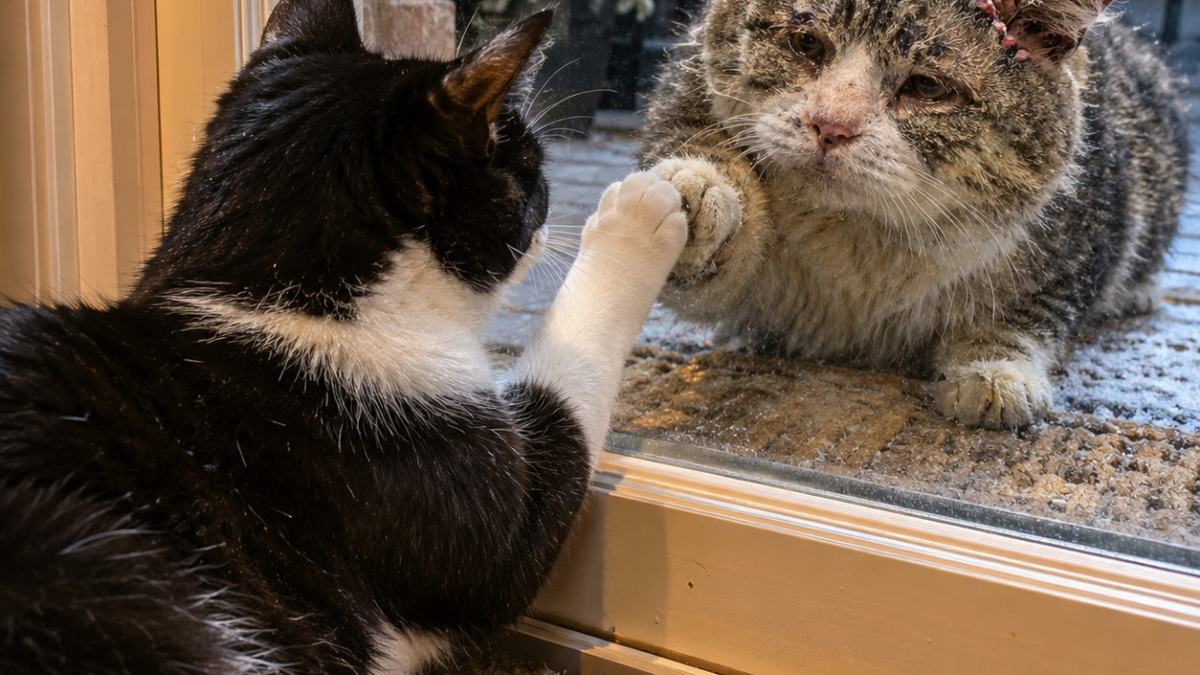
A Feral Cat Slept on My Doorstep for Five Nights—Then I Realized He Wasn’t Waiting for Food.
For five nights in a row, an aging feral tomcat with enormous jowls, a chipped tooth, and a respiratory infection returned to the exact same spot on my doorstep and slept there for hours, even though raccoons and other outdoor cats passed through the yard and there were safer places he could have hidden.
At first I thought Charles was coming because he had learned where I left food, but then I noticed my former feral rescue Dennis sleeping on the opposite side of the closed door at the very same time, and I began wondering whether Charles could smell another cat from his old neighborhood living peacefully inside.
On the fifth night Charles walked into a trap almost as if he had already made his decision, and less than three months later the cat who had barely made a sound outside looked directly at Dennis, began chirping for the first time I had ever heard him vocalize, and showed me that maybe he had not been asking for food at my door at all—maybe he had been asking whether there was room for him too.
The first time I noticed Charles, I did not know his name.
He was simply another cat on my camera.
That was how most of the outdoor cats in my neighborhood entered my life.
Not dramatically.
A shape moving across the screen at night.
Eyes reflecting infrared light.
A tail disappearing behind a planter.
A shadow near the food bowls.
I had cameras outside because I regularly fed several community cats, and checking the footage had become part habit, part responsibility, and part obsession.
You learn quickly that feeding outdoor cats means wondering about them when you cannot see them.
Did everybody eat?
Who came first?
Did somebody new appear?
Was that limp there yesterday?
Did the raccoon chase anyone away?
Was the bowl empty because the cats ate it or because something else did?
Sometimes I would sit with my phone scrolling through clips that probably looked identical to anybody else.
Cat walks by.
Cat eats.
Cat leaves.
But I knew enough of the regulars by then that small differences stood out.
Charles stood out immediately.
He had a face you noticed.
Huge cheeks.
Ginormous jowls.
The unmistakable face of an adult unneutered male who had spent years outside.
His head looked almost too big for the rest of him.
There was something both tough and tired about him.
He was not sleek like some of the younger ferals.
He looked weathered.
His coat was rough.
His eyes looked tired.
He seemed congested.
Even through the camera, I could tell he was not doing particularly well.
He also clearly was not young.
I had seen enough younger cats to know the difference.
There is a way older outdoor tomcats carry themselves.
Heavy.
Deliberate.
They have survived too many territorial fights, too many winters, too many nights where getting food depended on being stronger or smarter than whatever else was hungry.
Charles looked like that.
A survivor.
But not an invincible one.
I first noticed him sometime in May.
At first I assumed he was passing through.
That happened.
PART2:
A new cat would discover the feeding spot, eat for a night or two, then disappear.
Sometimes I would see them again weeks later.
Sometimes never.
So I watched Charles.
He ate.
Then something unusual happened.
He stayed.
Not just near the bowls.
Near my house.
Near the door.
The first night I really paid attention, I checked the camera and saw Charles lying directly on my doorstep.
Not moving.
Not waiting over the food bowl.
Sleeping.
I looked at the timestamp.
He had been there for almost an hour.
I kept scrolling.
There he was.
Still there.
Curled up.
Resting.
Then eventually a raccoon came through and Charles moved away.
That alone felt strange.
Community cats know how exposed a doorstep can be.
There are other animals.
Other cats.
People.
Sounds from inside.
Doors opening unexpectedly.
PART3:
Outdoor cats usually find cover.
Under porches.
Behind sheds.
Inside brush.
Somewhere with multiple escape routes.
Charles was sleeping in one of the most obvious places possible.
Right against my door.
I thought about it, then told myself I was overanalyzing.
Maybe the concrete held warmth.
Maybe the porch blocked wind.
Maybe he had eaten and simply felt tired.
Then the second night came.
Charles returned.
Same spot.
Doorstep.
Again.
I watched the footage longer this time.
He settled down.
His body relaxed.
He slept.
The third night?
Again.
By then, it had my attention.
“Why are you doing that?”
I said it to a video recording like Charles could answer.
He could have chosen so many places.
Instead, he kept returning to the door.
There were other feral cats in the neighborhood.
There were raccoons.
There were all the normal dangers of outside life.
Yet apparently, of all places, my doorstep felt safe to him.
That was when another detail began bothering me.
Inside the house, directly on the other side of that door, Dennis often slept.
Dennis had been a neighborhood feral too.
I had rescued him the year before.
His story had not happened overnight.
Nothing about feral-cat trust usually does.
Dennis was a tuxedo cat.
For months, I had put food outside for him while feeding the others.
At first, he kept distance.
Then routine took over.
He learned when I fed.
Eventually he began arriving before the food was even outside.
I would look out and there he was.
Waiting.
That is one of the first victories with a feral cat.
Not touching.
Not trapping.
Predictability.
The cat begins believing:
Food appears here.
This person appears here.
Nothing terrible happens.
For Dennis, that process took months.
Three or four before we finally trapped him.
Then came another kind of patience.
Indoor integration.
Medical care.
Isolation.
Scent swapping.
Introductions.
Time.
My two resident cats, Donna and Doris, had their own opinions about suddenly being asked to share their home with a former neighborhood feral.
Cats do not care that you have written a beautiful rescue narrative.
They care that a strange cat smells wrong and is now behind a door.
So we went slowly.
Dennis adjusted.
Donna and Doris adjusted.
Eventually the cat who had once lived outside became part of the house.
He slept indoors.
Ate indoors.
Relaxed.
Found routines.
Found favorite spots.
Became family.
And now, months later, I was watching another feral cat sleep on the other side of the same door.
Sometimes Dennis would be lying inside almost exactly where Charles was lying outside.
Door between them.
Two cats from the same neighborhood.
One rescued.
One still feral.
I started wondering whether they knew each other.
Not in the human sense.
I had no way to know whether they had been friends outside.
Maybe they had crossed paths.
Maybe shared territory.
Maybe fought once.
Maybe ignored each other.
Maybe they were complete strangers who simply smelled familiar because they had lived in the same environment.
But cats understand scent in a way we never will.
Dennis’s scent would have been around that doorway.
Inside air moves.
Scent travels.
And Charles kept sleeping there.
I began imagining the possibility that Charles could smell him.
Dennis.
A neighborhood cat.
Alive.
Calm.
Indoors.
I know how easy it is to create a story in your head about animals.
I try to be careful about that.
Charles never told me:
I smell Dennis and now I know indoor life is possible.
Maybe the doorstep was simply comfortable.
Maybe the food drew him.
Maybe my interpretation was wrong.
But night after night, the same pattern continued.
Charles outside.
Dennis inside.
Resting near each other through the door.
And I could not stop thinking:
Does Charles know?
Does he understand that the cat on the other side used to live the same kind of life he does?
Can he smell safety?
That thought destroyed me emotionally more than I expected.
Night four was especially cold.
I checked the camera.
Charles was there again.
Curled against the door.
I remember looking at him and crying.
Actually crying.
Because once you have brought an outdoor cat inside, your perception changes.
Before Dennis, I could look at an outdoor cat and think:
They survive.
They know what they’re doing.
They have fur.
They have shelter somewhere.
After Dennis, I knew what one of those cats looked like on a couch.
Warm.
Sleeping deeply.
Not listening for predators.
Not defending food.
Not calculating whether a human hand was safe.
Once you see that transformation, it becomes harder to look at another cat freezing outside and tell yourself that survival is enough.
Charles looked tired.
Cold.
Sick.
Old enough that he had probably spent years doing this.
Another winter.
Another summer.
Another fight.
Another night.
And now, for four nights, he had come to my doorstep.
That fourth night I remember thinking:
He needs help.
Not someday.
Now.
We had trapped feral cats before.
That gave me confidence, but not certainty.
Some cats will enter a trap within minutes.
Others seem to recognize a trap from another dimension and will avoid it with supernatural intelligence.
Charles was older.
Experienced.
I expected him to be difficult.
On night four, we put the trap outside without setting it for him.
Just there.
Let him see it.
Smell it.
Get used to a new object near the place he had started calling his nighttime rest area.
He came.
Inspected.
Stayed nearby.
The next night, night five, we put food inside.
Then we waited.
Ten minutes.
Maybe around that.
Charles showed up.
He sniffed around.
He did not panic.
He did not disappear.
He circled.
Investigated.
Then walked inside.
Almost easily.
When the trap closed, I had that strange mix of relief and guilt that anyone who traps feral cats knows.
Even when you are trapping them to help them, the sound is awful emotionally.
The door closes.
The cat panics.
They do not understand that you have a plan.
They understand only:
I am contained.
With Charles, though, there was also this overwhelming feeling:
You were ready.
I don’t know if he was.
Not intellectually.
Not in the way humans make life decisions.
But he had been returning to the door for five nights.
Then walked into the trap.
I could not shake the feeling that the hardest part had already happened before we ever set it.
He had decided the house was worth approaching.
Now we just had to make good on that decision.
The next morning we took him to the vet.
His physical condition confirmed what the camera had suggested.
Upper respiratory infection.
He needed antibiotics.
He was dewormed.
Vaccinated for rabies.
They examined his mouth and found a chipped tooth.
Then came the age estimate.
Around seven to nine years old.
Seven to nine.
For an outdoor cat, that number hit differently.
It meant Charles had likely lived through years of exposure.
Years of unneutered tomcat life.
Fights.
Mating.
Disease risk.
Weather.
Searching for food.
Whatever had happened to create those huge cheeks and that exhausted expression.
This was not a young feral who had spent six months outside.
Charles had history.
A lot of it.
History I would never know.
I looked at him and wondered how many nights he had slept outdoors before choosing my doorstep.
Thousands?
How many winters?
How many injuries?
How many times had he been chased away from food?
How many people had seen him and assumed he belonged outside?
There is no way to answer.
I had to stop myself from inventing suffering simply because his life had been hard.
The facts were enough.
He was older.
Sick.
Unneutered.
Living outside.
Now he was indoors.
That was the part I could affect.
When we first brought him home, we placed him in a spare bathroom.
Small.
Quiet.
Controlled.
I had learned from Dennis that too much space can be frightening.
People think giving a rescued cat the whole house is freedom.
Sometimes it is just overwhelming.
A bathroom gives boundaries.
Food here.
Water here.
Litter there.
Hiding spot.
Door.
Predictable sounds.
Charles needed predictability more than he needed square footage.
At first, he was extremely skittish.
That did not surprise me.
He had spent seven to nine years learning that distance kept him alive.
Why would a few nights on my doorstep erase that?
Sometimes he would come out enough to let me watch him eat.
That felt huge.
Other times he stayed hidden.
If I moved too close, he hissed.
The first hiss could have scared someone who did not understand feral behavior.
But Charles was not aggressive.
There was a difference.
He did not charge.
Did not attack.
Did not lunge.
Did not seek confrontation.
He was saying:
Too close.
That’s all.
A hiss is communication.
With a cat like Charles, I wanted to respect that.
“Okay.”
I would back up.
“Who’s a good boy, Charles?”
He would stare at me as though the answer was certainly not me.
I talked anyway.
Quiet voice.
Same phrases.
Same feeding routine.
No pressure.
No hands reaching into his hiding spot.
I wanted him to learn that I could enter the room without anything bad happening.
That is one of the most important pieces of socializing fearful cats.
Presence without demand.
Humans are impatient.
We like visible progress.
Come closer.
Take a treat from my hand.
Let me pet you.
Purr.
Give me something that proves this is working.
Charles did not owe me a performance.
He had already given up the world he understood.
Outside might have been hard, but it was familiar.
Now every sound was different.
Walls.
Fan.
Plumbing.
Footsteps.
Doors.
Human movement.
Scents of three resident cats.
My voice.
The entire universe had changed overnight.
So I kept my expectations low.
He ate.
Good.
Used the litter box.
Good.
Rested.
Good.
Did not throw himself at the door trying to escape.
Very good.
That surprised me.
Charles never showed me a strong desire to go back outside.
I had prepared emotionally for that possibility.
A truly feral cat may be miserable in confinement.
TNR is sometimes the correct outcome.
Not every outdoor cat should automatically become an indoor pet.
I watched Charles carefully.
Was he terrified?
Yes.
Was he aggressive?
No.
Was he constantly trying to escape?
No.
Was he showing that indoor life itself was intolerable?
Not really.
Mostly, he was afraid of me.
That distinction mattered.
The room was not the enemy.
Human proximity was the scary part.
That could change.
Maybe.
With time.
A couple of months passed.
Charles was neutered.
His medical care continued.
He became healthier.
But his progress with me remained slow.
Very slow.
Sometimes so slow I wondered whether I was imagining improvement.
One fewer hiss.
A few seconds longer before hiding.
Eating while I stayed in the room.
Looking at me without immediately retreating.
Those were the milestones.
Tiny.
Nobody would make a dramatic rescue video around them.
But those are the moments real trust is built from.
Eventually, we moved him from the bathroom into another spare room.
Larger.
A window.
More stimulation.
More room to choose where he wanted to be.
I worried moving him might reset everything.
New smells.
New territory.
But he adjusted.
And almost immediately, Charles found his place.
Under my workout bench.
Of course.
I had put a blanket over it, creating something like a little tent.
Dark underneath.
Protected on several sides.
Charles claimed it.
That became his safe spot.
Every fearful cat needs one.
A place where nobody reaches in.
Nobody drags you out.
Nobody decides that hiding is a behavior that must be “fixed.”
If Charles went under the bench, that was his.
I would sit nearby.
Talk.
Feed.
Spend time.
But I respected the tent.
Over time, the room became more than a hiding place.
He had a window.
He could look outside.
Watch birds.
See daylight change.
Hear neighborhood sounds from safety.
There was something emotional about watching an outdoor cat sit inside looking out a window.
I wondered what he thought.
Did he miss being out there?
Did the sounds trigger instinct?
Did he understand he was protected from the cold now?
Again, no way to know.
What I did know was that he was not trying to break out.
He watched.
Then turned away.
Ate.
Rested.
Used his safe space.
He had a great appetite.
Very good appetite.
He also drank a lot of water.
That got my attention.
With an older cat, drinking patterns matter.
I was already worried his health might be slowing down the socialization process.
If a cat feels physically unwell, they are not going to devote energy to learning that a human is safe.
Pain and illness change behavior.
I kept veterinary care in the picture.
But behaviorally, Charles still seemed mostly scared.
Not angry.
Not miserable.
Scared.
And fear takes as long as fear takes.
There were days when I felt discouraged.
I would sit in the room, talk quietly, offer food, maybe try a toy.
Charles would stay under the bench.
I would leave thinking:
Are we moving forward?
Should he be doing more by now?
Then I would catch myself.
More according to whom?
Me?
The internet?
A rescue story where a feral cat becomes a lap cat in two weeks?
Charles was seven to nine years old.
If he had spent most or all of that time outside, a few months was nothing.
Imagine asking someone to unlearn almost a decade of survival instincts because your spare bedroom has a nice blanket.
So I stopped measuring him against other cats.
Dennis had progressed one way.
Charles could progress another.
My job was consistency.
Same person.
Same voice.
Same food.
Same boundaries.
No surprises.
No punishment for hissing.
No forcing touch.
I wanted Charles to learn one thing first:
I am safe.
Everything else could come later.
Then Dennis started changing the equation.
Even before Charles met my resident cats face to face, there had been interaction through the door.
Dennis knew somebody was in that room.
He was interested.
Very interested.
He would sit outside.
Sniff.
Listen.
Charles came to the other side.
I noticed paws moving beneath the gap.
Then play.
At first, I almost did not believe what I was seeing.
Charles played.
This older, shy, withdrawn cat who spent so much time under a bench was engaging another cat through the crack beneath the door.
A paw slid underneath.
Another paw responded.
Back and forth.
I stood there trying not to make a sound.
I was so happy.
Play is vulnerable.
Not as vulnerable as sleep, maybe, but close.
A cat in constant survival mode does not spend energy on games.
Charles playing meant something inside him was loosening.
And Dennis seemed to be the key.
He had been the cat on the other side of the front door when Charles slept outside.
Now he was the cat on the other side of the spare-room door.
That symmetry affected me more than it probably should have.
Door again.
Charles on one side.
Dennis on the other.
Except this time, Charles was inside too.
Maybe that mattered.
Maybe not to them.
To me, it felt enormous.
Dennis became increasingly eager to meet whoever lived behind that door.
Charles seemed curious too.
The hissing toward me decreased.
Not gone.
Less.
Some days he let me remain closer.
Other days we seemed to move backward.
That is another thing people need to understand about fearful cats.
Progress is not a straight line.
One good day does not mean fear is over.
A cat may come forward on Monday and hide Tuesday.
May play Wednesday and hiss Thursday.
That is not failure.
Stress changes.
Energy changes.
Health changes.
Sounds change.
Trust accumulates even when behavior fluctuates.
I had to learn not to panic at every setback.
There were moments when Charles seemed stuck.
Weeks where nothing dramatic happened.
I worried his physical health was part of it.
I worried perhaps indoor life was simply too stressful.
I worried I had misread his five nights on the doorstep.
Maybe he had wanted food and warmth, not domestication.
Maybe I had projected too much onto him.
Those thoughts can become dangerous because rescuers can turn uncertainty into guilt.
I tried to return to evidence.
Charles ate well.
Drank.
Used the litter.
Rested.
Played through the door.
Was not aggressive.
Did not desperately attempt escape.
Hissed less.
Curious about other cats.
Those facts mattered more than my impatience.
So I kept going.
Every day.
Food.
Clean room.
Conversation.
Quiet presence.
Sometimes I sat on the floor scrolling on my phone, intentionally ignoring him.
That can be helpful with fearful cats.
Humans staring directly at you are intense.
So I would exist nearby without making Charles the center of attention.
He could watch me.
Learn my movements.
Hear my voice.
Nothing happened.
Over and over.
Nothing bad happened.
That repetition is how safety becomes believable.
I wish safety could be explained once.
“You’re okay now.”
Done.
Animals do not work that way.
Neither do people.
Safety becomes real through experience.
Charles needed hundreds of neutral moments.
Door opens.
Person enters.
Food arrives.
Person leaves.
No harm.
Again.
Again.
Again.
Eventually the body begins believing what the mind cannot be told.
Dennis accelerated something I could not.
Because Dennis spoke cat.
I could offer food.
Space.
Routine.
But I was still a human.
Huge.
Unfamiliar.
Potentially dangerous.
Dennis walked up to the door with feline confidence.
Charles could smell him.
Hear him.
Play with him.
A cat who behaved as though this house was normal.
Safe.
His.
I started wondering again about those nights on the doorstep.
Had Dennis been teaching Charles this lesson before I even knew?
Could Charles smell him inside and think:
That cat is here every night.
That cat sleeps.
That cat isn’t afraid.
Maybe.
I will never know.
But I started thinking Dennis might become the bridge.
Eventually we reached the point where I believed Charles could meet my resident cats safely.
That was not a decision I took lightly.
Charles had shown no signs of aggression.
His body language around the door interactions looked curious rather than hostile.
He had been neutered.
He had had time indoors.
We could control the meeting.
Dennis, obviously, went first.
Of all the cats, he was the one most desperate to know who was inside.
I opened the opportunity.
Dennis walked in confidently.
No hesitation.
His body language said:
Finally.
Charles saw him.
And then something happened I had never heard before.
Charles made a sound.
A chirp.
I froze.
Until that moment, I had barely heard Charles vocalize at all.
Hissing, yes.
But conversational sound?
No.
Not really.
Now he looked at Dennis and chirped.
Not once.
Again.
I felt like I was meeting a new cat.
“Charles?”
He chirped.
It was almost as though the sight of another cat unlocked a voice he had been keeping hidden.
That moment filled me with hope in a way months of small progress had not.
Because suddenly I was seeing personality.
Not simply fear decreasing.
Something positive emerging.
Charles wanted communication.
He was interested.
Engaged.
Dennis moved closer.
They sniffed.
Eventually, nose to nose.
First day.
No fight.
No explosion.
No aggressive posturing.
Just two former neighborhood cats meeting inside a house.
I almost cried.
Maybe I did.
At this point, I cry about cats often enough that the distinction is not important.
Dennis did not want to leave Charles’s room.
That was the part that really got me.
He lingered.
Walked around.
Settled near Charles.
Charles laid down too.
Two cats relaxed in the same room.
The entire image felt impossible compared with where each had started.
Dennis, once an outdoor feral.
Charles, a tomcat who had slept on my doorstep.
Now inside.
Together.
Maybe old acquaintances.
Maybe new friends.
It did not matter.
They accepted each other.
That was enough.
Donna came in too.
Donna is the alpha.
She carries herself like she has documentation proving ownership of the house.
I was more nervous about her reaction.
She walked into Charles’s room and did exactly what Donna does.
Inspected everything.
Sniffed.
Moved around like a building manager checking an apartment.
Charles chirped at her too.
Donna mostly ignored him.
Honestly, that was probably the best possible outcome.
No confrontation.
No challenge.
Charles:
Hello?
Donna:
I have more important matters.
He even chirped at Doris.
Doris is skittish herself.
She entered more cautiously.
Moved slowly.
No hissing.
No aggression.
Then quietly retreated.
Again, success.
Not every introduction needs cuddling.
Peaceful coexistence is wonderful.
Charles seemed fascinated by all of them.
That was when I realized:
The cats bring out a completely different side of him.
With me, Charles had spent months cautious.
Evaluating.
Slow.
With Dennis, Donna, Doris?
Chirping.
Watching.
Interested.
More alive.
It was almost like seeing a shy child who barely speaks around adults suddenly start talking around other kids.
Again, I try not to anthropomorphize too much.
But the difference was obvious.
His body language changed.
The other cats made his environment understandable.
They demonstrated how to live here.
Where to walk.
How to rest.
How to interact.
Most importantly, they demonstrated me.
Dennis could approach me without fear.
Donna could exist around me.
Doris, though nervous by nature, knew the household.
Charles could watch.
Cats learn socially.
Maybe not exactly the way humans do, but observation matters.
Every time one of my cats walked past me without danger, Charles received information.
This person is part of the environment.
This person is not attacking us.
This person brings food.
This person belongs here.
That was something I could never prove to him with words.
Dennis could prove it simply by living.
After those introductions, we began reaching the point where Charles’s door could stay open.
That was huge.
Not thrown open and forgotten.
Carefully.
Monitored.
But open.
Charles now had the option to experience more of the house.
He still liked his safe room.
Still liked the tent under the workout bench.
That was fine.
Safety does not become obsolete because confidence grows.
I wanted him to have a home base.
But the door no longer had to represent protection from everything outside.
The outside of his room contained cats he liked.
Humans he was slowly learning.
Windows.
Rooms.
Possibilities.
Charles could choose.
That choice matters enormously.
An animal with no control becomes stressed.
An animal who can retreat, approach, observe, and explore on their own terms develops confidence differently.
Charles began doing more.
Not suddenly.
No montage where he runs into my lap.
Just more.
Watching.
Playing.
Chirping.
Being present.
Hissing less.
Sometimes a yawn after seeing another cat.
That yawn made me laugh.
Charles would chirp.
Look around.
Then huge yawn.
Relaxed enough to yawn in the middle of something new.
I treasured every little sign.
I had been waiting to meet his personality.
Now pieces were appearing.
The funny thing is that I do not know what the final version of Charles will look like.
Maybe there is no final version.
Maybe he will always be changing.
He may never become a cuddly lap cat.
I say that honestly.
Rescue stories often make affection the ultimate proof of success.
Cat sits on human.
Therefore rescue complete.
I do not believe that anymore.
If Charles never sleeps on my chest, he can still be happy.
If he never wants to be picked up, that is fine.
If he prefers affection from cats more than people, that is fine too.
My goal is not to turn him into the kind of pet that photographs well.
My goal is for Charles to feel safe enough to live comfortably.
To eat without fear.
Sleep deeply.
Play.
Interact.
Receive medical care.
Enjoy windows.
Have cat companionship.
Know warmth.
Not freeze on a doorstep.
If human touch comes later, beautiful.
If not, he still deserves all of that.
That realization removed pressure from both of us.
I stopped imagining a specific ending.
Charles curled in my lap.
Charles purring in my arms.
Those images would be lovely.
But they are my desires.
His life belongs to him.
What does Charles want?
Right now, he seems to want other cats.
Food.
Safe hiding places.
Windows.
Predictability.
Some distance from me.
Increasingly less distance.
That is enough information for today.
I am proud of him.
So proud.
Less than three months earlier, he was sleeping outside my door.
Sick.
Cold.
Unneutered.
Older.
Unknown.
Now he has a room.
Medical treatment.
A safe spot.
A full stomach.
Resident cats he chirps at.
Dennis beside him.
An open door.
That is extraordinary even if he never becomes “domesticated” in the stereotypical sense.
Although I think he already is adapting more than he knows.
There are moments when I look at him and think about his first life.
Not because I know it.
Because I don’t.
Seven to nine years is a lot of missing time.
Where did he sleep?
Was there ever another person feeding him?
Had someone once owned him?
Was he born outside?
Had he known Dennis before?
Were those jowls evidence of years of fighting?
How many kittens might he have fathered?
What happened to the tooth?
There are endless questions.
None of them change what he needs now.
That is one of the hardest lessons in rescue.
Curiosity about the past can become obsession.
Sometimes no answer exists.
You have to build the future without understanding the beginning.
Charles does not need a complete biography to be loved.
His present is enough.
One day, I sat in his room and watched him near the window.
Sunlight came through.
He looked outside.
Dennis was nearby.
For a while, nobody moved.
I thought about the camera footage from May.
Charles on the doorstep.
Cold concrete.
Raccoon arriving.
Now he was looking at the same outside world through glass.
Protected.
He could smell air through the window edges.
Hear birds.
Watch movement.
But nothing could chase him away.
No raccoon could take his sleeping place.
No strange tomcat could force him off food.
No freezing rain could soak him.
That contrast made me emotional.
I wanted to tell him:
You don’t have to go back.
But I also understood that maybe some part of him would always be shaped by outside.
That is okay.
Home does not have to erase your history.
It only needs to make the next night different.
The next night Charles slept indoors.
Then another.
Then another.
That accumulation matters.
Five nights on the doorstep had been enough to convince me something was happening.
Now dozens of nights indoors were teaching Charles something too.
Warmth is consistent.
Food arrives.
The room remains.
Dennis returns.
Nothing attacks.
The person comes in.
The person leaves.
The person comes back.
Safety repeated until safety becomes ordinary.
That is the dream.
Not for Charles to wake up every morning thinking:
I have been rescued.
For him to stop thinking about danger at all.
Ordinary is the goal.
One of my favorite things about Dennis’s transformation was how normal he became.
At first, every indoor behavior felt monumental.
He used the bed!
He let me closer!
He slept out in the open!
Then eventually:
Dennis is asleep.
That’s it.
No celebration.
Because safety had become routine.
I want that for Charles.
I want the day when I stop interpreting every yawn.
Every chirp.
Every step.
When Charles being relaxed stops feeling like evidence and simply becomes Charles.
We are not there yet.
That is okay.
Some days he still hides.
Some movements still scare him.
Unexpected sounds can send him back toward safety.
If I move too quickly, I can see old instincts activate.
He is still learning me.
I am still learning him.
Trust is happening in both directions.
I learn where his boundaries are.
He learns whether I respect them.
That is a relationship.
Not one side “taming” the other.
Two beings gathering information.
I want him to discover that I listen.
Hiss?
I back up.
Hide?
I don’t pull him out.
Come closer?
I stay calm.
Play?
I let him play.
Look at me?
I blink.
No drama.
Consistency.
That is how Dennis learned.
That is how Charles will learn if he chooses to.
The most emotional moments still involve the cats.
Especially Dennis.
Sometimes I see Dennis in Charles’s room and feel the entire story fold over itself.
Dennis once lived outside.
I trapped him.
Integrated him.
He became family.
Then Charles appeared outside.
Maybe smelled Dennis.
Slept by the door.
Now Dennis is helping Charles understand the thing Dennis once had to learn himself.
Again, I know animals do not tell rescue stories to each other.
Dennis is not sitting Charles down and explaining:
I used to be feral, but this human is safe.
But his presence performs the message.
His body communicates it.
Dennis enters the room without fear.
Lies down.
Sniffs Charles.
Plays.
Does not leave immediately.
That normal behavior tells Charles more than I can.
There is something beautiful about one rescued animal becoming part of another animal’s rescue simply by being comfortable.
Dennis does not know he is helping.
That might make it more beautiful.
He is simply living his life.
And his life is evidence.
A cat from outside can belong here.
If Charles did recognize Dennis’s scent through the front door all those nights, then the story becomes almost too perfect.
But even if he didn’t, the outcome is real.
They found each other inside.
That is enough.
Donna has adapted in her own Donna way.
She is still the alpha.
Still more interested in inspecting Charles’s room than making emotional gestures.
Charles chirps.
Donna walks.
I laugh.
Doris takes longer.
That is who Doris is.
She is skittish.
Charles and Doris almost mirror each other in that way.
Sometimes I wonder whether seeing another nervous cat survive ordinary household interactions helps Charles too.
Not everybody in the house is Dennis-level confident.
Safety does not require confidence.
Doris can be nervous and still safe.
Maybe that is useful information too.
Charles now exists among different models of cat behavior.
Dennis:
Confident social ambassador.
Donna:
Management.
Doris:
Nervous but functional.
Charles:
Figuring it out.
The household has become a little social classroom.
No formal lesson.
Just observation.
His first chirp remains my favorite milestone.
I keep returning to it because vocalization made him feel suddenly present.
Before, Charles communicated mostly through distance.
Hide.
Hiss.
Approach food.
Retreat.
Then Dennis walked in and Charles made this bright little sound.
Where had that been?
Seven to nine years old and I had never heard him do it.
Maybe he had chirped outside hundreds of times.
Maybe other cats knew that voice.
I didn’t.
It was new to me.
It felt like he had handed me one small piece of himself.
Not because I earned it.
Because another cat unlocked the moment.
That gave me hope that there is still so much of Charles I have not met.
Maybe he plays more than I know.
Maybe he is funny.
Maybe he likes certain toys.
Maybe he will eventually decide that petting is excellent.
Maybe he will become a couch cat.
Maybe he will sit at the doorway and chirp at everybody who walks by.
Maybe he will always prefer his tent and cat friends.
Every possibility is okay.
The point is that fear is no longer the only thing I can see.
Personality is beginning to share the frame.
That is progress.
One evening, I left his door open while everything was calm.
Dennis wandered in.
Charles watched.
I stayed at a distance.
Dennis lay down.
Charles remained in his safe spot.
Minutes passed.
Then Charles came out farther.
Not much.
Farther.
He looked around.
Then settled.
No dramatic interaction.
Nobody touched noses.
Nobody chirped.
They simply occupied the same room.
I remember feeling almost more emotional about that than the first introduction.
Because normal coexistence is a deeper form of acceptance.
First meetings can be exciting.
Staying relaxed is harder.
Charles was learning that good things do not disappear after one moment.
Dennis does not visit once and vanish forever.
The door can open again.
That continuity is what I want Charles to understand about me too.
I come back.
Food comes back.
Safety comes back.
Nothing good is temporary here.
At least not intentionally.
That sentence is difficult because animals’ lives are always temporary.
Ours too.
But within the scale Charles understands:
Tonight.
Tomorrow.
Next meal.
Next nap.
I can make things reliable.
I think about him freezing on the porch and feel guilty sometimes, even though guilt makes no logical sense.
He had probably been outside for years before I noticed him.
Why does my brain focus on those five nights?
Because those are the nights I knew.
Once suffering becomes visible, every hour feels personal.
I watched him sleeping there and did not trap him immediately.
We waited.
Got him used to the trap.
Did it responsibly.
Still, part of me thinks:
Could I have brought him in on night one?
Maybe.
Could I have scared him off permanently by rushing?
Also maybe.
You have to forgive yourself for using the information you had at the time.
Charles came back.
We trapped him.
He got treatment.
He is here.
That is what matters.
His upper respiratory infection improved with care.
His body had a chance to recover.
Neutering removed some of the hormonal pressure that had shaped his outdoor life.
His coat began looking better.
He ate well.
Rested.
Physical stability gave behavioral progress somewhere to grow.
Health and trust are connected.
A sick animal has less capacity for curiosity.
I reminded myself of that whenever progress felt slow.
We were not only asking:
Will Charles trust me?
We were asking his body to recover from years of outdoor survival.
That takes energy.
I became more patient.
Not perfectly.
Some days I still wished he would let me touch him.
I would see Dennis purring under my hand and imagine Charles doing the same.
Then I would stop.
Wanting affection is human.
Respecting refusal is care.
I do not want Charles to learn that being indoors means humans override him.
I want the opposite.
This is the first place where maybe his boundaries consistently matter.
If I can give him that, affection—if it comes—will be real.
Chosen.
Not endured.
There is a world of difference.
I think back to Dennis because he took months too.
At the beginning, I did not know whether Dennis would ever fully integrate.
Then he did.
Months feel long while you are living them.
Short once you look back.
Charles has been inside less than three months.
Less than three.
When I say that aloud, his progress feels enormous.
He went from doorstep to trap.
Trap to vet.
Vet to bathroom.
Bathroom to spare room.
Hiding to playing.
Hissing to chirping.
Closed door to introductions.
No cat contact to nose touch with Dennis.
Door closed to door open.
All in under three months.
That is not slow.
That is Charles’s pace.
And his pace is working.
I am proud of him.
Not because he is becoming what I want.
Because he is expanding his world despite fear.
That takes courage.
A feral cat does not know “domestication.”
He knows safe and unsafe.
Close and far.
Food and hunger.
Warm and cold.
Threat and rest.
Charles keeps choosing slightly more of the safe side.
A little farther from the bench.
A little closer to another cat.
A little less hissing.
A little more play.
A chirp.
A yawn.
A door left open.
Those are his decisions.
I just provide the environment where he can make them.
That understanding changed how I thought about the title people might give his story:
Feral cat decides he’s ready to be domesticated.
It is cute.
And maybe there is truth in it.
But I do not imagine Charles sitting outside thinking:
I have completed my feral era. I would now like central heating.
What I imagine is simpler.
He found a place that felt safe enough to return to.
Then returned again.
And again.
Five nights.
That is how change often begins.
Not a grand decision.
Repetition.
Maybe the first night was about food.
Second about shelter.
Third because the previous night had been okay.
Fourth because Dennis’s scent was familiar.
Fifth because by then the doorstep had become part of his map of safe places.
Then a trap appeared with food.
He entered.
One safe place led into another.
Sometimes I watch him now and wonder whether he would recognize the front doorstep if he explored the whole house someday.
Would he smell it and know?
Would he pause?
Would Dennis lie there again?
Maybe one day Charles will be the cat inside while another outdoor cat rests beyond the door.
That thought feels almost too much.
Because I know exactly what I would do.
I would check the camera.
I would look at Charles.
And I would wonder whether the cycle was beginning again.
Rescue has a way of expanding.
You help one cat.
Then that cat changes what you notice.
Dennis changed what I noticed about Charles.
Charles will probably change what I notice next.
You cannot unlearn empathy.
Once you know what a feral cat can become indoors, every outdoor face carries possibility.
That does not mean trapping every cat indiscriminately.
Responsible community-cat care still matters.
TNR matters.
Individual assessment matters.
But possibility becomes visible.
The old tomcat with giant jowls is not only “a feral.”
He might be Charles.
A cat who chirps at Dennis.
A cat with a favorite tent.
A cat who likes windows.
A cat who is terrified of me but curious about other cats.
A cat with a chipped tooth and a strong appetite.
A cat with seven to nine years of unknown history and maybe many more years ahead.
Names change perception.
Once I called him Charles, he became harder to think of as a background animal.
Names do that.
Not because animals need human names to matter.
Because humans sometimes need names to remember they are individuals.
Charles.
Dennis.
Donna.
Doris.
Different cats.
Different histories.
Different needs.
The house feels full of stories now.
Dennis’s story intersects Charles’s in ways I could never have planned.
I did not rescue Dennis last year because another feral cat might someday smell him through the door.
I rescued Dennis because Dennis needed help.
Then that act became part of Charles’s environment.
That is how kindness behaves sometimes.
The result extends beyond the original recipient.
You feed one cat.
Another learns the feeding schedule.
You rescue one.
Another sees them safe.
You build trust with one neighborhood animal.
Future animals inherit some of that safer environment.
Good actions echo.
Not magically.
Practically.
Dennis’s scent was on the house.
Dennis was at the door.
Dennis played through the gap.
Dennis entered Charles’s room.
Those are practical echoes of his own rescue.
I love that.
Charles is still not cuddly.
I want to be clear.
If someone expects a dramatic ending where three months later he sleeps on my pillow, that is not our story.
Our story is still happening.
He remains cautious with me.
Sometimes very cautious.
There are moments he reminds me exactly how feral he once was.
And yet I can see the difference.
The door is open.
That image alone feels symbolic enough.
At the beginning, I needed a closed bathroom door because the world was too much.
Now Charles can tolerate the possibility of more.
He does not rush out.
He does not need to.
The point is that he can.
Choice.
Again.
Choice changes everything.
When Dennis enters, Charles gets to stay or retreat.
When Donna walks around, he watches.
When Doris appears nervously, Charles chirps.
He participates.
He is not trapped in fear the way he was at the start.
I hope someday he chooses to explore the hallway.
Maybe he already will by the time I finish telling this story.
Maybe he will take one step out.
Then back.
Just like so many fearful cats begin.
Forward.
Back.
Forward again.
That pattern reminds me of all rescue.
Trust rarely leaps.
It tests.
A cat reaches.
Retreats.
Returns.
Charles tested my doorstep for five nights.
Then tested indoor life.
He is still testing.
My job is to make sure the answer remains the same.
Safe.
Every time.
There are days I sit near him and talk about absolutely nothing.
“Hey, Charles.”
He watches.
“What are you doing?”
Nothing.
“You hungry?”
Always.
“Dennis was looking for you.”
Maybe a chirp if I am lucky.
I tell him about the weather.
The other cats.
Whatever.
The words themselves do not matter.
Tone matters.
Routine.
Presence.
I want my voice to become boring.
Boring means safe.
If one day Charles hears me and does not immediately evaluate whether he should hide, that will be a victory.
Maybe he already does that sometimes.
It is hard to know where instinct ends and personality begins.
Maybe Charles is naturally shy even without trauma.
Doris is.
Not every cautious behavior requires a tragic explanation.
That is something I keep reminding myself.
I do not want to build an identity around what I think happened to him outside.
Charles gets to be shy because he is shy.
Not because somebody necessarily hurt him.
He gets to prefer cats.
He gets to dislike sudden movement.
He gets to take time.
A safe home should make room for temperament, not erase it.
The best part of his progress is seeing behavior unrelated to fear.
Play.
Chirping.
Curiosity.
Yawning.
Those are glimpses of temperament.
Those are the things I want more of.
Not because fear must disappear completely.
Because Charles deserves a life where fear is not the loudest emotion.
Dennis helps with that.
I think Dennis enjoys having him too.
He keeps wanting into Charles’s room.
Lingers.
Lies near him.
I sometimes have to convince Dennis to leave.
That makes me laugh.
The former feral resident is now the welcome committee.
Donna remains quality control.
Doris provides cautious moral support.
It works.
I have no idea whether this household arrangement makes sense to anyone else.
It makes sense to us.
Animals build families in strange ways.
Not necessarily genetic.
Not necessarily planned.
Shared space.
Shared routine.
Repeated safety.
That can become family.
Charles is not fully integrated yet.
Still, he is already part of the house’s emotional geography.
I think about him when I wake up.
Check his food.
Check water.
Wonder where he is.
Watch Dennis go toward the door.
Notice whether Charles chirps.
He belongs to the routine now.
That is how family starts before anyone declares it.
One day you realize you are no longer temporarily caring for “the feral cat.”
You are checking on Charles.
Specific.
Personal.
Expected.
I do not know what the future holds for him.
Veterinary needs may change as he ages.
Seven to nine is not ancient, but he is no kitten.
Years outdoors may have left health issues we still need to monitor.
We will.
He may develop confidence faster now that he has met the cats.
Or he may plateau for months.
Fine.
Maybe he eventually chooses a favorite couch.
Maybe the workout bench tent remains headquarters forever.
Fine.
Maybe Dennis becomes his closest companion.
Maybe Donna unexpectedly claims him one day.
Anything is possible in a house with cats.
What I know is that Charles does not have to sleep outside tonight.
That fact alone can carry me through uncertainty.
When the temperature drops, I no longer open the camera and see him curled on the porch freezing.
He is inside.
When raccoons come through, Charles is not competing with them at the door.
When weather gets bad, I do not wonder whether he found somewhere dry.
When he feels sick, I can notice.
When he eats, I know.
When he drinks, I can monitor.
When he plays, I see it.
These are ordinary privileges of having a pet.
With Charles, they feel enormous.
Because for years nobody may have had that information.
Nobody knew whether he ate.
Nobody knew where he slept.
Nobody knew when he got sick.
Now somebody does.
Being known is a form of safety.
I did not understand that until rescue.
Outdoor cats can live entire lives almost invisible.
People see them.
But nobody knows them.
There is a difference.
Charles had probably been seen by many people.
Big-cheeked tomcat crossing a yard.
Another feral.
Now I know him.
I know his favorite hiding place.
His appetite.
His hissing threshold.
His new chirp.
His relationship with Dennis.
That knowledge creates responsibility.
Once I know, I cannot return him to invisibility emotionally.
He matters specifically.
That is why those five nights affected me so deeply.
Charles was becoming specific before I ever touched him.
The doorstep made him impossible to dismiss.
Night one.
There again.
Night two.
Again.
Night three.
Why?
Night four.
Crying.
Night five.
Trap.
Sometimes rescue is simply the point where repeated observation turns into responsibility.
I saw him long enough that “someone should help him” became “I need to help him.”
That transition can happen quietly.
Then your house contains another cat.
I still watch the outdoor cameras.
Of course.
Other ferals still come.
Raccoons too.
The doorstep remains part of the outside world.
Sometimes I scroll through footage and see an empty porch where Charles used to sleep.
I feel something strange.
Absence.
But a good kind.
He is not there because he is upstairs.
Warm.
Probably under the workout bench.
Maybe Dennis is outside his room.
The empty doorstep is evidence of rescue.
I never thought an empty camera frame could make me happy.
It does.
I can walk past Charles’s room and know where he is.
That is still extraordinary to me.
Sometimes I think about the first vet appointment.
Rabies shot.
Antibiotics.
Deworming.
Upper respiratory infection.
Chipped tooth.
Age estimate.
All those clinical facts.
Necessary.
But none captured who Charles would become.
Medical stabilization gave him a chance to reveal it.
That is why rescue medicine matters so much.
A sick cat’s behavior is not the whole cat.
Pain suppresses personality.
Congestion.
Fatigue.
Parasites.
Hormones.
All of those influence what you see.
Treat the body, then give the mind time.
Charles needed both.
He still does.
When progress feels slow, I remember:
Healing is not only emotional.
His body has been through years of life outside.
I cannot demand he transform on my preferred timeline.
He has earned patience.
I think every older rescue animal has.
Young animals often adjust more quickly because their experience is shorter.
Older ones arrive carrying routines that worked.
You should respect that those routines kept them alive.
Hiding saved Charles.
Hissing protected distance.
Suspicion prevented dangerous approaches.
Those behaviors are not flaws.
They are skills.
Now the environment has changed.
He does not need every skill as often.
But bodies do not discard survival simply because a door locks.
Time.
That is all.
Time and consistent evidence.
Dennis is evidence.
Every meal is evidence.
Every peaceful night.
Every time I enter and leave.
Every time Donna ignores him instead of attacking.
Every time Doris passes without drama.
Every time the door opens and nothing terrible happens.
Evidence.
Charles is building a new model of the world.
I am privileged to watch.
I am even more privileged that I do not need to control the result.
I used to think rescue success meant visible affection.
Now I think success can be quieter.
A cat no longer freezing.
A cat playing.
A cat vocalizing.
A cat sleeping near another cat.
A cat choosing to stay inside when a door is available.
A cat whose fear has space around it now.
Charles already has those things.
That means the story is already a success.
Anything else is extra.
If he lets me pet him one day?
Amazing.
If he purrs?
I will probably cry.
If he becomes a lap cat?
I will become unbearable.
But none of those are required for me to believe bringing him inside was right.
The biggest question was whether Charles wanted a life here.
He keeps answering by staying.
Eating.
Resting.
Engaging.
Not trying to return outside.
That answer is enough.
One day, Dennis walked into the room and lay down near Charles.
Charles settled too.
I sat outside their comfortable distance.
Nobody was doing anything.
No dramatic interaction.
No chirping even.
Just two cats lying down.
I thought about the front door again.
Dennis inside.
Charles outside.
Then:
Charles inside one room.
Dennis outside the room.
Now:
Both inside.
No door between them.
That progression almost felt like a diagram.
Outside.
Barrier.
Inside.
Barrier.
Together.
Maybe that is Charles’s whole journey so far.
Not from feral to domesticated.
From barriers to choices.
The exterior door once separated him from the house.
Then the trap closed.
Then a bathroom door protected him.
Then the spare-room door separated him from resident cats.
Then paws played underneath it.
Then the door opened.
Each barrier served a purpose.
Safety first.
Then gradually less necessary.
That is thoughtful integration.
Not forcing.
Not throwing everybody together.
Use barriers until trust can replace them.
Maybe one day the barrier between Charles and me will shrink too.
No physical door.
Just the emotional distance he needs.
That can change slowly.
I am okay waiting.
Charles waited outside for who knows how many years before I understood what he needed.
I can give him a few months.
Or more.
Sometimes I sit in his room and remind myself:
There is nowhere else I need him to be.
That sentence helps.
He is safe today.
I do not need tomorrow’s milestone today.
Rescue culture can accidentally create pressure through transformation stories.
Day one versus day thirty.
Before and after.
Fearful then cuddling.
Thin then healthy.
Outside then couch.
Those stories inspire people, and that is good.
But they can distort expectations.
Not every animal transforms on camera schedule.
Charles’s story is beautiful because it is incomplete.
He is still becoming.
That is more honest.
I hope people can see hope in slow progress too.
The first play session.
Less hissing.
First chirp.
Nose touch.
Open door.
Those are big.
If you only celebrate lap cuddles, you miss almost everything.
I have learned to celebrate inches.
Charles came two feet closer.
Good.
Charles stayed visible while I changed water.
Good.
Charles played with Dennis.
Huge.
Charles chirped.
Enormous.
Charles yawned around Donna.
I may have emotionally celebrated a yawn.
That is where my life is now.
I am okay with it.
My phone contains too many cat videos.
Camera clips.
Screenshots.
Charles on the porch.
Dennis inside.
Charles in his room.
Cats meeting.
To anyone else, probably repetitive.
To me, a timeline.
Evidence of change.
I scroll backward sometimes.
The original Charles looks rough.
Huge cheeks.
Sick eyes.
Cold porch.
Then current Charles.
Healthier.
Indoor fur.
Relaxed enough to lie down with Dennis nearby.
I can see the difference even when daily progress feels invisible.
That is another reason documentation helps.
Trust changes slowly enough that memory adjusts with it.
You forget how scared they were.
Then you watch an old clip.
Oh.
We have come far.
Charles has come far.
Under three months.
I cannot say that enough.
He does not need to hurry.
His progress already deserves respect.
If the next three months bring only a little more comfort, that’s enough.
If they bring huge breakthroughs, wonderful.
I want him to choose the speed.
I think he has spent enough of his life responding to circumstances he could not control.
Indoors, I can give some control back.
That is part of safety too.
Which bed?
Which hiding spot?
Stay in room?
Approach door?
Meet Dennis?
Retreat?
Watch me?
Ignore me?
Cats may not understand “agency” as a word.
They understand choice.
Charles deserves it.
I sometimes wonder whether one reason he kept returning to my doorstep was choice.
Nobody trapped him there.
He approached.
Rested.
Left.
Returned.
The relationship began on his terms.
Maybe maintaining that spirit indoors is why he has continued progressing.
I do not need to force what he already demonstrated he can do voluntarily.
Charles comes when he is ready.
He always has.
Night one.
Night two.
Night three.
Night four.
Night five.
Trap.
Then bathroom.
Then spare room.
Then door.
Then cats.
He keeps coming forward.
Slowly.
That is enough.
The story people see from outside might be:
Feral cat decides he’s ready to be domesticated.
The story I feel is:
An old outdoor cat kept asking the same quiet question until someone finally understood enough to answer.
Is this safe?
The first night, maybe he asked with his body curled on the step.
The second night, again.
Dennis answered from the other side without knowing.
I answered with food.
The trap was another answer.
The vet.
The bathroom.
The tent under the bench.
The open door.
Every day since:
Yes.
It is safe.
Or at least safer.
Safe enough to rest.
Safe enough to eat.
Safe enough to chirp.
Safe enough to play.
That is all domestication really needs to mean for Charles right now.
Not obedience.
Not cuddling.
Safety.
Maybe someday he will walk up to me and push his head into my hand.
Maybe I will reach down and he will stay.
I have imagined it.
Of course I have.
If it happens, I know I will think about the first hiss.
The distance.
The bench.
All those days of sitting nearby.
I will probably be afraid to move.
But I do not want to live waiting only for that moment.
I want to appreciate this one.
Charles is alive.
Healthy enough to progress.
Inside.
Dennis is his friend.
Maybe old friend.
Maybe new.
Charles has found his voice around the cats.
The door can remain open.
He is not freezing.
That is already more than I knew to hope for when I first saw him on camera.
Back then, I did not even know whether he would return.
Then he returned five nights in a row.
I think about how close I could have come to missing the pattern.
If I had not checked the camera.
If I had assumed he was just eating.
If I had not noticed the hour-long naps.
If Dennis had not been lying on the other side.
Maybe someone else eventually would have helped him.
Maybe Charles would have survived another year.
Maybe not.
You can make yourself crazy with alternate histories.
I try not to.
The history we have is enough.
I noticed.
He returned.
We trapped.
He got help.
Now I get to watch his future instead of wondering where he disappeared.
That is the gift.
I still sometimes apologize to him.
“Sorry, buddy.”
For what?
No idea.
For being afraid.
For taking him to the vet.
For interrupting his nap.
For humans in general.
He gives me the same Charles stare.
Then maybe chirps when Dennis appears.
Apparently my apology is less important than cat company.
Fair.
Dennis deserves most of the credit anyway.
If Charles ever becomes fully comfortable with me, I suspect Dennis will be the reason.
Not because I did nothing.
Consistency matters.
But another cat can reach places human patience cannot.
Dennis gives Charles social proof.
I give Charles infrastructure.
Food.
Vet care.
Clean litter.
Safe room.
Dennis gives him:
This place is normal.
That division of labor works.
Donna contributes governance.
Doris contributes relatable anxiety.
Everyone has a role.
I laugh thinking about it, but there is truth.
Rescue becomes easier when you stop imagining yourself as the only healer.
Animals help each other.
Environment helps.
Routine helps.
Health helps.
Time helps.
You create conditions.
Then let the animal use them.
Charles is using them.
That is what matters.
There are nights now when I look at the outdoor camera and another cat passes through.
Sometimes one stops near the door.
I automatically look toward Charles’s room.
The world feels connected in a way it did not before.
Outside and inside are not separate categories anymore.
They are points on a possible path.
Dennis took it.
Charles took it.
Others may never need or want to.
Each cat different.
But possibility exists.
That knowledge has made me more compassionate toward every outdoor cat I see.
Not because every one secretly wants a couch.
Because every one has individual needs that deserve to be considered.
The giant-jowled tomcat may be older and sick.
The skittish tuxedo may eventually integrate beautifully.
The cat sleeping on a doorstep may be trying to tell you something through behavior before you ever understand what.
Pay attention.
That is perhaps the biggest lesson.
Charles never spoke to me on those nights.
His behavior was the message.
Same place.
Same door.
Repeated rest.
No frantic escape from the house.
He was communicating without knowing it.
Animals do that constantly.
We just need to learn their language well enough to notice patterns.
I did not fully understand Charles at first.
I still don’t.
But I am listening better.
Sometimes listening means not doing.
That is difficult for humans.
We want to fix.
Reach.
Pet.
Advance.
With Charles, some of my most productive time has been sitting quietly.
Doing nothing.
Letting him watch.
That feels passive.
It isn’t.
I am teaching through predictability.
He is gathering data.
That invisible work becomes visible later when a cat stays instead of hiding.
Progress often happens before you can see it.
Charles may spend weeks deciding I am slightly less dangerous before his body shows me.
Trust is internal first.
Behavior follows.
That helps me stay patient.
I do not need immediate proof.
He is allowed to process privately.
He has lived privately his whole life.
I am honored he lets me see as much as he does.
His favorite bench tent remains.
I keep the blanket positioned because he likes it.
No reason to remove a successful coping tool just because I want him more visible.
I know some people think hiding should be discouraged.
I think safe hiding can create confidence because the cat knows escape is available.
A cat who cannot retreat may stay hypervigilant.
Charles relaxes because the tent exists.
Maybe one day he stops using it.
Maybe not.
I do not care.
Humans have bedrooms.
We close doors.
We want private spaces.
Charles gets one too.
That respect is part of domestication, if we are going to use that word.
Home should not mean loss of control.
It should mean more safe choices.
I hope he understands that someday.
Maybe he already does.
The fact that he does not try to bolt outside suggests something.
Again, I avoid making definitive claims about his thoughts.
But behavior matters.
The outside world is accessible only through barriers, yet he is not constantly demanding it.
He seems increasingly invested in what is inside.
Especially the cats.
That gives me hope.
The first time I leave his door open and see him choose to remain relaxed rather than hide feels like a milestone.
The first time he eventually steps into the hall will be another.
No rush.
The hallway will be there tomorrow.
That is the beauty of permanence.
Nothing must happen today because the opportunity is not disappearing.
Charles can take months.
The house is still here.
Dennis is still here.
I am still here.
That message might be the most healing thing I can offer an animal who has survived outside.
You do not need to seize every resource immediately.
Food will come again.
Warmth will still be here tonight.
The safe place will still exist after you sleep.
You do not have to hurry.
Outdoor survival rewards urgency.
Eat while food exists.
Leave before danger comes.
Find shelter before weather changes.
Indoor life can teach abundance of time.
Tomorrow.
That might be the greatest luxury Charles has now.
Tomorrow is predictable.
I hope one day he understands that deeply enough to sleep anywhere in the house.
Not because the bench is wrong.
Because he knows safety follows him.
Maybe Dennis will teach him.
Dennis already sleeps wherever he wants.
He has become so fully resident that sometimes I forget what it took.
That gives me perspective.
There was a time Dennis was the project.
Now he is the mentor.
Perhaps one day Charles becomes the settled cat on the inside of a door.
I cannot know.
I just like imagining it.
Not as destiny.
As possibility.
Three months ago, I would not have imagined him chirping.
So I am careful about predicting limits.
Charles may surprise me.
He already has.
He surprised me by returning.
By entering the trap.
By adapting to the room.
By playing.
By wanting Dennis.
By chirping.
By accepting an open door.
Every surprise has been quiet.
That seems appropriate for him.
No dramatic leap.
A series of soft changes.
He came into my life through nighttime camera footage.
Maybe quiet transformation is simply his style.
I am learning to appreciate it.
I do not need a before-and-after moment.
I get a thousand in-between moments.
Those are more real anyway.
Today Charles may sit six feet away.
Next month four.
Maybe next year beside me.
The distance itself can become a timeline.
I will take every inch.
Not because I need closeness.
Because each inch means his fear required slightly less space.
That is worth celebrating.
If there is one thing I hope people take from Charles’s story, it is patience.
Not the passive kind where you do nothing and hope.
Active patience.
Medical care.
Neutering.
Proper introduction.
Safe room.
Enrichment.
Routine.
Observation.
Consistency.
Then waiting.
Patience supported by action.
Charles did not simply “come around.”
He received conditions that allowed coming around to become possible.
That matters.
Love is not enough without structure.
Good intentions do not replace veterinary care.
Affection does not replace respecting feral behavior.
You need both compassion and process.
Dennis taught me that.
Charles is teaching me again.
I am grateful for every person who helped me learn before him.
Rescue is communal even when the work happens inside your own house.
Veterinarians.
TNR advocates.
Other caregivers.
People sharing experience.
Every bit of knowledge helps another cat.
That is how Dennis’s rescue indirectly helped Charles.
Knowledge carried forward.
I knew to use a small room.
Knew not to rush.
Knew hissing was fear communication.
Knew introductions should be gradual.
Knew health could affect behavior.
That previous experience made Charles’s transition safer.
One rescue improves the next.
Another echo.
Sometimes I wonder what Charles would say if he could tell me his version.
Maybe my entire emotional narrative would embarrass him.
“Five nights? I liked your porch.”
“Dennis? Never met him.”
“Trap? Food smelled good.”
“Chirping? I was asking him to leave.”
Possible.
Cats are humbling.
The truth is I do not need my interpretation to be perfect.
My actions can still be kind.
He needed medical care.
He needed neutering.
He appears comfortable indoors.
He enjoys cat companionship.
Those facts stand.
The rest can remain mystery.
Mystery is part of loving animals.
They never give us full access.
Even the cuddliest pet has an interior world we cannot translate.
Charles has more mystery than most.
I like that about him.
Every new behavior feels like a page turning.
His first play.
First chirp.
First nose sniff with Dennis.
What is next?
I do not know.
That uncertainty used to scare me.
Now it excites me.
Not because I expect a dramatic breakthrough.
Because I finally believe Charles has a future worth being curious about.
That is a huge change.
When I saw him outside, my curiosity was worried:
Will he survive?
Now it is hopeful:
Who will he become?
Those are very different questions.
I prefer the second.
He deserves the chance to answer it slowly.
Sometimes I go into his room before bed.
Check water.
Food.
Make sure everything is okay.
Dennis may follow.
Charles is usually somewhere he feels safe.
I say:
“Good night, Charles.”
He watches me.
Maybe no reaction.
Maybe a blink.
Maybe if Dennis is around, a chirp.
Then I leave.
Close the house for the night.
Outside, the temperature can drop.
Raccoons can cross the porch.
Other cats can eat at the feeding station.
Charles is inside.
That knowledge still brings relief every single night.
One less cat I have to imagine freezing.
One less old tomcat fighting for food.
One less animal reproducing outside.
One more warm body in the house.
That matters.
I never expected Dennis’s story to lead here.
I never expected Charles’s doorstep habit to become another rescue.
But rescue does not follow a script.
You notice what happens.
Then respond.
The cats write most of the plot themselves.
Dennis showed up for food.
Charles showed up to sleep.
Both ended up inside.
Donna and Doris did not ask for either development.
They adapted.
I apparently continue collecting complicated cats.
That might be my role now.
There are worse things.
If Charles eventually becomes fully integrated, the house will have four resident cats.
That sentence makes me laugh.
I did not plan that.
No rescuer ever says that convincingly.
But Charles feels like he belongs increasingly.
Not because I force the concept.
Because the other cats treat his room like part of their territory.
Dennis especially.
If Dennis votes yes, that matters.
He knows something I don’t.
Perhaps he recognizes Charles.
Perhaps he simply likes him.
Either possibility makes me happy.
There was one moment after an introduction when Dennis lay near Charles and neither cat did anything.
I remember looking at them and thinking:
Maybe this is what Charles wanted on the doorstep.
Not food.
Not even necessarily shelter.
Company.
A sign that another cat was near.
Again, speculation.
But beautiful speculation.
Outdoor tomcats are often portrayed as solitary fighters.
Charles’s behavior indoors suggests he values feline social connection.
Maybe he had companions outside.
Maybe losing them made him search.
Maybe Dennis was familiar.
Maybe none of that.
What I know is that cat companionship unlocked something.
That is enough to guide his care.
Sometimes an animal tells you what they need through who they become around others.
Charles around me:
Cautious.
Charles around Dennis:
Curious.
Vocal.
Playful.
That is useful information.
So I use it.
Dennis visits.
Carefully managed.
Positive.
No forcing.
And Charles keeps showing me more.
That is how we will continue.
Not chasing a lap-cat ending.
Following his signals.
I think Charles has already made one major decision.
He is not asking to return to the life he had.
He may not yet know how to fully embrace this one.
That is okay.
There is room between survival and belonging.
He is somewhere in that space.
Maybe domestication is not a switch.
Maybe it is exactly this.
A feral cat learns a room.
Then a window.
Then another cat.
Then a human voice.
Then an open door.
Then, maybe, a couch.
One safe thing added to another until the word “feral” no longer describes the whole life.
Charles may always carry some feral behavior.
So does Dennis.
That does not make them less family.
It makes them themselves.
I do not want to erase the outdoor cat Charles was.
That cat survived long enough to find my doorstep.
He deserves respect.
Those instincts kept him alive until help became available.
Now we can give him other skills.
Play.
Indoor routine.
Cat social life without territorial survival.
Rest.
Maybe affection.
The goal is not to replace Charles.
It is to expand his options.
He can be the same cat somewhere safer.
That is the version of rescue I believe in.
Not transformation as proof of worth.
Worth first.
Transformation if it comes.
Charles deserved help even while hissing.
He deserved warmth before he chirped.
He deserved medical care before he trusted me.
Affection is not payment for rescue.
I never want to forget that.
Some people would have seen his slow progress and decided he was ungrateful or unadoptable.
Those words make me angry.
Charles did not ask to be trapped.
He cannot understand the investment.
He owes nothing.
Everything he gives—play, chirps, tolerance—is a gift.
That mindset makes every small moment sweeter.
I do not take it for granted.
When he chirps at Donna, I listen.
When he plays through the door, I smile.
When he chooses not to hiss, I notice.
When he hisses anyway, I listen to that too.
Communication either way.
He is telling me where the line is.
Respect the line.
Maybe tomorrow it moves.
Maybe not.
I think the reason Charles’s story has affected me so much is that he seems to exist between two worlds.
Not feral enough to reject indoor life.
Not socialized enough to immediately embrace humans.
He is in the middle.
Cats in the middle can be easy to overlook.
Too shy for many adopters.
Too friendly or vulnerable for comfortable outdoor return.
They require patience.
Resources.
Time.
But they also contain enormous possibility.
Charles is showing me that possibility in real time.
I hope his story makes people think twice about older feral cats.
Seven to nine years sounds established.
Too old to change.
Charles disagrees.
He is changing.
Slowly.
Not becoming a kitten.
Not forgetting his history.
Adapting.
Older animals can learn safety.
That is an important distinction.
They may take longer.
They may never become what humans imagine as ideal pets.
But improved quality of life does not require personality replacement.
Charles is proof.
He is safer now than he was in May.
That alone justifies patience.
Maybe one day somebody will watch a video of him curled beside Dennis and assume he was always easy.
I will know.
I will remember the porch.
The giant cheeks in the camera.
The cold nights.
The hiss.
The bench.
That history will make the ordinary moment more meaningful.
Not because suffering improves happiness.
Because contrast reveals change.
Charles should never have had to struggle outside for years.
But he did.
Now he doesn’t have to.
That is what matters.
No romanticizing.
No “everything happens for a reason.”
I do not believe his illness happened so I would learn compassion.
I do not believe freezing on a porch was part of some plan.
Bad conditions are simply bad.
The meaningful part is response.
We noticed.
We acted.
Now Charles has another possibility.
That is enough.
If somebody asked me when the rescue truly began, I would not say the moment the trap closed.
I think it began the first night he slept by the door.
I just did not know it yet.
Maybe Charles did not either.
That night established a pattern.
He chose proximity.
Then chose it again.
By the fifth night, when he walked into the trap, the relationship already had history.
Five nights is not much to humans.
To a cautious outdoor cat, repeating a location five times means something.
At minimum:
This place works.
That was enough.
Now my job is to keep making it work.
The irony is that Charles may have thought the doorstep was the destination.
He had no idea what was on the other side.
Dennis did.
Maybe that’s why I cannot stop thinking about the two of them sleeping inches apart through the door.
One cat had already crossed the boundary Charles did not know could open.
Then Charles followed.
Not because Dennis led him physically.
But the image feels like a promise.
There is another side.
That is what rescue offers.
Not certainty.
Another side.
Outside to inside.
Sick to treated.
Unknown to known.
Alone to connected.
Fearful to maybe less fearful.
Charles is still crossing.
I will not rush him.
He spent years surviving one way.
He can spend months learning another.
There is no deadline.
That might be the most domesticated thing I can give him.
No deadline.
Food tomorrow.
Bed tomorrow.
Dennis tomorrow.
Me tomorrow.
We will keep repeating safety until Charles either believes it or simply gets so used to it that belief no longer matters.
I hope someday he sleeps near the front door from the inside.
I imagine checking the camera and seeing some outdoor cat resting beyond it while Charles lies inside.
Maybe he will smell them.
Maybe he will remember something.
Probably not in a narrative way.
But maybe he’ll stay.
And I will know.
The door can separate two lives by less than an inch.
Charles spent five nights on one side.
Now he is on the other.
That alone feels like the whole story.
But it isn’t finished.
Not yet.
There are still firsts waiting.
First time he explores farther.
First time he accepts a touch, if he does.
First time he chooses a bed outside the bench.
First time he sleeps fully exposed.
First time he decides my presence is boring enough to ignore.
I am looking forward to all of them.
And if some never happen?
We will adjust the story.
Because the goal is not to force the ending I imagined when I opened the trap.
The goal is Charles.
Whatever makes Charles comfortable.
Whatever gives him dignity.
Whatever lets the old tomcat with the giant jowls finally stop fighting the world every day.
He deserves that.
Dennis deserved it.
Every outdoor cat does, in whatever form is appropriate for them.
I do not know whether Charles consciously decided he was ready to be domesticated.
I do know he chose my doorstep five nights in a row.
I know he slept there despite raccoons.
I know Dennis rested behind the door.
I know Charles entered the trap without the battle I expected.
I know he accepted indoor life even while fearing me.
I know he played with Dennis through the crack.
I know he chirped when they finally met.
I know he lay down near him.
I know the door can stay open now.
Those facts tell their own story.
Maybe Charles was ready before I was ready to understand him.
Maybe he had been waiting for something he could not name.
Warmth.
Company.
Relief.
A quieter life.
Maybe he just wanted a predictable place to sleep.
Whatever brought him back, I am grateful it did.
Because if he had come once and disappeared, I might remember him only as that older tomcat with the huge cheeks.
Instead, he has a name.
Charles.
A room.
A window.
A favorite spot beneath my workout bench.
A former feral friend named Dennis who does not want to leave his side.
Two cautious feline housemates named Donna and Doris.
A person who probably talks to him too much.
And time.
Most importantly, time.
Time to heal.
Time to watch.
Time to play.
Time to decide how close he wants to come.
Time he might not have had if he had stayed sick outside.
I am proud of him.
Not because he has become easy.
Because he is trying.
Maybe “trying” is another human interpretation.
But from where I stand, every chirp feels like effort.
Every relaxed posture.
Every decision not to hide.
Every moment near another cat.
A little life expanding.
I cannot wait to see what comes next.
But I am not rushing to get there.
Tonight, Charles is inside.
That is enough.
Dennis can visit.
Charles can chirp.
The bench tent is waiting if he needs it.
Food is available.
The window gives him a view of the neighborhood he once had to survive in.
And the front doorstep where he slept for five nights is empty.
Exactly the way I want it.
Because Charles is finally on the other side of the door.








