A Fearless Biker Collapsed in a Crowded Park—But Only Two Five-Year-Old Girls in Worn-Out Shoes Stopped, and What Happened Next Changed All Three Lives Forever
PART3:
Maybe they thought nothing at all because indifference often wears the face of being busy.
At rallies, hundreds of people shouted my name.
On highways, bikers stopped for strangers because a stranded rider was family until proven otherwise.
But there was no motorcycle beside me.
No leather vest.
No roaring engines.
No crowd.
No fearless Ethan Caldwell.
Just a man on the sidewalk, chest burning, mouth opening around air he could not catch.
Then I heard tiny footsteps.
Two pairs.
Quick, uneven, hesitant.
A small voice said, “Mister?”
Another voice, softer, said, “Maybe he’s sleeping.”
I forced my eyes open.
Two little girls stood over me.
They could not have been older than five.
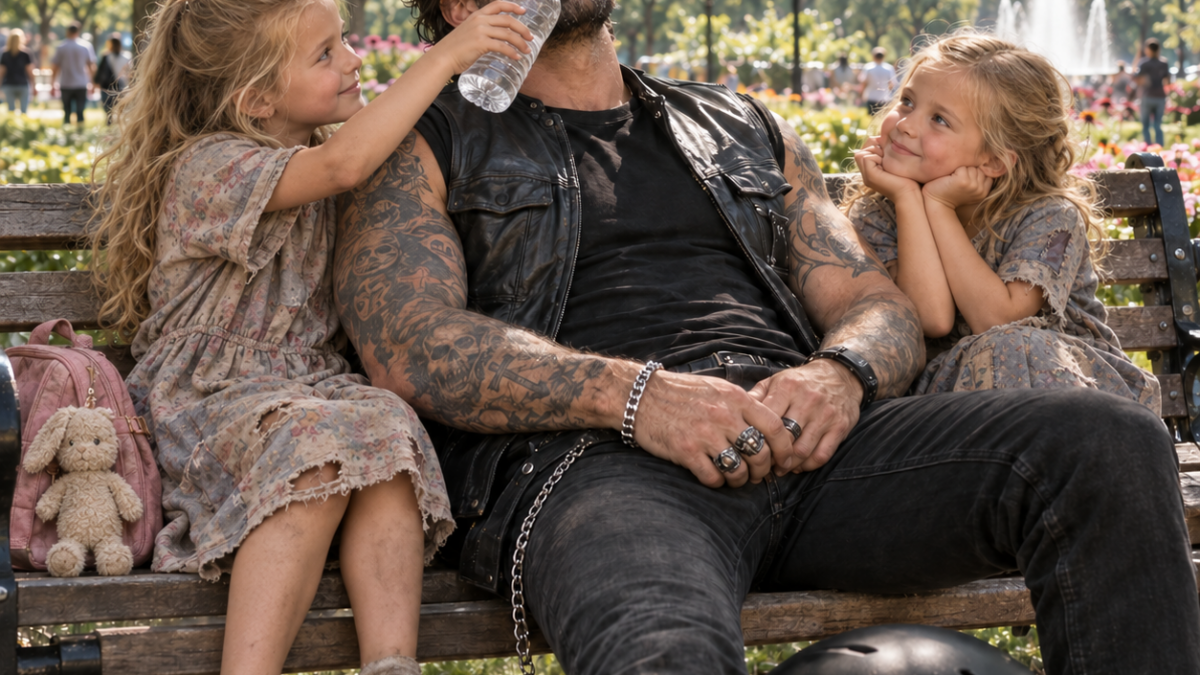
One had dark curls tied unevenly with a purple ribbon. Her shoes were pink once, maybe, but the toes had been scuffed pale and one sole was beginning to peel away. She wore a yellow sweater with a missing button and held the hand of the other girl so tightly their knuckles pressed white.
The second girl had lighter brown hair cut just below her chin, serious gray eyes, and a faded pink backpack nearly too large for her shoulders. Her sneakers were held together at the sides with silver tape.
They looked like children who had learned early that things did not get replaced simply because they wore out.
The darker-haired girl crouched near my head.
“Mister,” she whispered, “are you sleeping?”
I tried to answer.
Nothing.
Her face changed.
Fear came into it, but so did something sharper.
Recognition that this was not a game.
The girl with the backpack dropped it.
“He can’t breathe,” she said.
I would later learn her name was Lily.
The other was Emma.
At that moment, they were just two small faces above me while my vision darkened at the edges.
For one terrible second, I thought they would run.
I would not have blamed them.
They were five.
The world was large.
I was a strange man on the ground.
Instead, Lily stood, turned toward the crowded park, and filled her tiny lungs with air.
“HELP!”
People looked.
Not enough.
So she screamed again.
“He can’t breathe! Somebody help him!”
That did it.
Her voice cut through the park like a siren made of childhood and terror.
A woman on a nearby bench finally stood.
A jogger stopped.
The man in the suit turned.
Lily pointed at me with her whole arm shaking.
“He’s dying!”
Everything changed at once.
A woman dropped to her knees beside me and shouted for someone to call 911. A jogger pressed two fingers to my neck. Another man loosened the collar of my shirt. Someone kept saying, “Sir, can you hear me? Sir?”
I could hear them.
I could not answer.
Emma sat down on the pavement beside my head and took my hand in both of hers.
Her hands were tiny.
Warm.
Sticky from something sweet.
“Don’t go to sleep, mister,” she whispered.
I remember that more clearly than the sirens.
Not the pain.
Not the faces.
Not the paramedic cutting open my shirt.
Emma’s little voice.
Don’t go to sleep, mister.
I held on to that sentence like a rope.
The ambulance came fast, though it felt far away. Paramedics moved with practiced urgency. Electrodes. Oxygen. Questions I could not answer. A blood pressure cuff squeezing my arm. A voice saying, “Possible cardiac event.” Another saying, “We need to move.”
As they lifted me onto the stretcher, Lily tried to follow.
“Is he going to die?”
One paramedic crouched in front of her.
He had a kind face.
“Not if we can help it.”
Emma still held my fingers until they had to pull her hand away.
“Bye, mister,” she said.
I wanted to tell her thank you.
I wanted to tell Lily she had screamed loud enough to drag me back from the edge.
But the oxygen mask covered my mouth, and the world broke into pieces of light.
At the hospital, I became a body full of numbers.
Blood pressure.
Pulse.
Oxygen.
Troponins.
EKG lines.
Words came through the fog.
Severe blockage.
Left anterior descending artery.
Emergency intervention.
Lucky.
That was the word one doctor used.
Lucky.
I would come to hate it before I learned to accept it.
When I woke after surgery, the room smelled like antiseptic and plastic. My chest ached. My mouth felt dry. Wires ran from me to machines that beeped with insulting calm, as though my body had not recently tried to stage a mutiny.
My riding crew filled the room before visiting hours allowed it.
Of course they did.
No hospital policy ever survived bikers who believed one of their own was down.
Big Ron stood near the window, arms crossed, eyes red. He was six-foot-four, bald, and looked like he could bench-press a vending machine, but he cried at dog rescue videos and weddings.
Mack leaned in the corner with his hat in his hands. Gloria “Glo” Ramirez, who rode a red Indian Scout and terrified men twice her size with eyebrow movements alone, sat in the chair beside my bed like she had personally been assigned to keep death from returning.
And Hank Mercer stood at the foot of the bed.
Seventy-one.
White beard.
Old Marine.
Old rider.
The man who had taught me that engine trouble was not an emergency unless fire was visible or whiskey was unavailable.
He looked older than he had the week before.
That scared me.
“You look like garbage,” Hank said.
I tried to smile.
“You always say the sweetest things.”
Glo leaned forward.
“You had a heart attack, you idiot.”
“Technically,” I rasped, “I collapsed dramatically in public.”
“Technically,” Ron said, “you almost died while taking a walk like a retired accountant.”
That should have made me laugh.
It did not.
Something about waking in that bed without my boots on, without my bike, without control of my own breathing, had stripped me down past humor.
“My phone?” I asked.
Mack handed it over.
It was full of messages.
Hundreds already.
News travels fast in the riding community. Faster than weather, slower only than gossip about who dropped a bike in a parking lot and pretended it was “a controlled lay-down.”
Riders from Ohio, Kentucky, Pennsylvania, Texas, California. Hospital staff. Rally organizers. Families we had helped. People I barely remembered and people I would never forget.
Praying for you, brother.
Hang in there.
You got this.
Can’t lose you yet.
Legend.
Warrior.
Fearless.
I set the phone down.
“Where are the girls?”
The room went quiet.
Hank frowned.
“What girls?”
“The little girls. In the park.”
Glo’s face softened.
“The ones who found you?”
“They didn’t find me. They saved me.”
Mack shifted.
“We don’t know, brother. Paramedics said two kids got attention. Their guardian took them before police got full names.”
“No.”
The word came out harder than I expected.
Glo touched my arm.
“Ethan, you just came out of surgery.”
“Find them.”
“We will.”
“No,” I said. “Not later. Find them.”
They exchanged looks.
People who love strong men often struggle when those men give orders from hospital beds. They want to obey and argue at the same time.
Hank finally nodded.
“I’ll ask around.”
“Promise.”
His gaze sharpened.
“I said I’ll ask.”
“Hank.”
He sighed.
“Fine. I promise.”
Three days later, I checked myself out earlier than the doctor preferred.
That is not medical advice.
That is a confession of stubbornness.
Glo threatened to handcuff me to the bed. Ron called me “cardiac dumbass” for six straight hours. Mack quietly brought my clothes because Mack understood that a man can recover better in denim than paper shorts. Hank said nothing, which meant he disapproved but knew stopping me would require hurting me, and I was already hurt enough.
I did not ride.
That was the doctor’s one victory.
Ron drove me to Maplewood Park in his pickup.
“Ten minutes,” he said.
“I’m not a child.”
“You collapsed like a folding chair three days ago. Ten minutes.”
The park looked the same.
That offended me.
The chess tables were full. Mothers talked. Children played. The pond glittered. People walked the same path where I had lain unable to breathe while shoes moved past my face.
I scanned every bench.
Nothing.
Then Ron touched my shoulder.
“There.”
Beneath a sycamore near the playground, two little girls sat on the grass sharing a sandwich from a faded pink backpack.
Lily and Emma.
My chest tightened for a reason no cardiologist could fix.
They were alone.
Not completely—an older woman in a janitor’s uniform sat nearby on a bench, head bowed, one hand pressed to her temple like exhaustion had finally collected its debt. But the girls sat slightly away from her, whispering together, taking alternating bites of the sandwich with the disciplined fairness of children used to making food last.
Emma saw me first.
Her whole face lit up.
“You didn’t die!”
She sprang to her feet and ran straight at me.
Ron made a panicked noise like I might crumble from impact, but Emma wrapped both arms around my leg instead of my chest.
“You didn’t go to sleep forever!”
I swallowed hard.
“No, ma’am. I didn’t.”
Lily approached more slowly.
She held the backpack strap with one hand.
“You look different standing up.”
“I feel different standing up.”
“You had a ambulance.”
“I did.”
“Did it go woo-woo?”
“It did.”
Emma looked delighted.
“I heard it.”
“I bet everyone heard it. You screamed louder, though.”
Lily’s cheeks colored.
“I had to.”
“You did.”
I crouched carefully, ignoring Ron’s hovering.
“You saved my life.”
Lily shook her head immediately.
“We just yelled.”
“Sometimes yelling is enough.”
Emma looked at my chest.
“Did the doctors fix your breathing?”
“Working on it.”
“Did they use glue?”
“Not this time.”
She nodded like this was disappointing but acceptable.
The older woman stood and hurried toward us.
She was thin, probably in her late sixties, though the kind of work she did had added years to her shoulders. Her gray hair was pulled back. Her hands were rough and red around the knuckles. Her uniform shirt had a patch from a downtown cleaning company.
“Girls,” she said, worry sharp in her voice. “Come here.”
“They know me,” I said quickly. “I’m Ethan Caldwell.”
Her expression changed.
Recognition flickered.
“You’re the man from the ambulance.”
“Yes, ma’am.”
The girls moved to her sides.
“I’m not here to frighten anyone. I just wanted to thank them.”
Her face softened, but only slightly.
“Lily told me they helped someone. I didn’t realize it was you.”
“You know me?”
“My husband used to follow your charity rides before he passed. Watched videos on that old tablet until the sound stopped working.”
“I’m sorry for your loss.”
She nodded once, the way people do when loss is old enough to be familiar but not gone.
“I’m Ruth Bennett. These are my granddaughters.”
“Lily and Emma.”
Emma grinned.
“He remembered.”
“I owe them remembering.”
Lily looked down at her shoes.
That was when I noticed the tape.
Silver duct tape wrapped around the toe of one sneaker. The other shoe had a hole near the side. Emma’s shoes were not much better. Their socks did not match. Their sweaters were clean but worn thin. The backpack had been patched at the bottom with blue thread.
Ruth saw me noticing.
Pride stiffened her shoulders.
I looked away immediately.
People deserve dignity more than they need pity.
But the truth had already found me.
“Do you come here often?” I asked.
Ruth hesitated.
“After kindergarten. Their school lets out at noon this term. I clean offices nights, and my neighbor watches them when she can, but sometimes we come here between things.”
“Where’s their mother?”
The question changed the air.
Ruth’s face tightened.
Lily looked at the ground.
Emma pressed against her grandmother’s leg.
“She passed last year,” Ruth said.
“I’m sorry.”
Her eyes moved to the girls.
“So are we.”
No one spoke for a moment.
Then Emma said, “Mommy used to sing in the car.”
Lily added, “And she made pancakes shaped like hearts but mostly they looked like potatoes.”
I smiled because they needed me to.
“She sounds wonderful.”
“She was,” Ruth said.
Her voice caught.
Then she straightened.
“We should go.”
I wanted to ask more.
I did not.
Trust does not grow where curiosity tramples.
Instead, I said, “Would it be okay if I brought them something? A thank-you.”
Ruth shook her head.
“That isn’t necessary.”
“I know.”
“We don’t take charity.”
“I’m not offering charity.”
Her eyes sharpened.
“What are you offering?”
I looked down at the girls.
“A debt I can’t repay properly.”
Lily frowned.
“Grandma says debts are trouble.”
“Your grandma is right.”
Emma whispered loudly, “But he didn’t die.”
Ruth closed her eyes like patience had become a physical labor.
I stood slowly.
“How about this,” I said. “No money today. No fuss. But I run a motorcycle shop on Mercer Street. If you ever need anything—ride, repair, help carrying groceries, someone to call—I’d be honored.”
Ruth gave me the kind of look proud people give when they want to refuse but cannot quite hate the offer.
“We’ll keep that in mind.”
I pulled a business card from my wallet and handed it to her.
She took it reluctantly.
Lily looked at it.
“Do you fix motorcycles?”
“Yes.”
“Can motorcycles get sick?”
“All the time.”
“Do they need medicine?”
“Oil mostly.”
Emma nodded seriously.
“And glue.”
“Sometimes glue.”
Ruth almost smiled.
As they walked away, Ron stood beside me.
“You’re thinking.”
“Yes.”
“That worries me.”
“It should.”
The following weekend, I organized what I told everyone was a small thank-you ride.
I should have known better.
Bikers do not understand small when children are involved.
Especially not children who saved one of their own.
I made three calls.
By Friday night, those three calls had become thirty. By Saturday morning, riders were coming from four counties. By noon, the street outside Maplewood Park sounded like thunder rolling on chrome.
Nearly eight hundred motorcycles arrived.
Cruisers.
Baggers.
Trikes.
Sport bikes.
Veterans’ clubs.
Women’s riding groups.
Weekend riders.
Old heads with gray beards.
Young riders with new patches.
People I knew.
People I had never met.
All carrying something.
School supplies.
Shoes.
Coats.
Groceries.
Gift cards.
Dolls.
Books.
A child’s helmet painted with pink flames because somebody named Spider had misunderstood “practical gift” in the most beautiful possible way.
I had warned Ruth only that “a few riders” wanted to thank the girls.
When she arrived with Lily and Emma and saw blocks of motorcycles lining the street, she stopped dead.
“Oh no,” she said.
Emma’s mouth fell open.
Lily whispered, “That’s a lot of thunder.”
I walked toward them before Ruth could retreat.
“I know,” I said. “It got away from me.”
Ruth stared at me.
“You think?”
“Some of them are hard of hearing. They misheard small.”
Her eyes were wet already, though she fought it.
The riders formed a path without being asked.
No one shouted.
No one crowded the girls.
For all the noise we carried into the world, bikers can be gentle when it matters.
Glo knelt first.
She held out two brand-new pairs of shoes.
“Heroes need good tires,” she said.
Emma giggled.
Lily touched the shoe box like it might vanish.
Big Ron brought backpacks filled with crayons, notebooks, and snacks.
Mack brought a grocery card.
Spider brought the helmet.
A retired teacher named Joan brought books and asked the girls what they liked to read. Emma said ducks. Lily said “stories where nobody’s mom dies,” and the whole line of bikers went quiet for a second before Joan nodded and said, “I know exactly the shelf.”
Ruth lasted until the fourth person hugged her.
Then she began crying.
“I can’t take all this,” she kept saying.
“You can,” Glo said.
“I can’t pay it back.”
“Good,” Ron said. “Because we don’t want payments. We want those kids wearing shoes without tape.”
Ruth laughed through tears despite herself.
Then I handed her the envelope.
She looked at it but did not take it.
“What is that?”
“Something practical.”
Her eyes narrowed.
“Ethan.”
“Ruth.”
“I said no charity.”
“And I said debt.”
“You almost died. They yelled. That isn’t—”
“That is exactly what happened.”
She looked down at the envelope.
“What is it?”
“A lease.”
She went still.
I continued before pride could slam the door.
“There’s a small apartment above the old bookstore on Chandler. Two bedrooms. Safe building. Good landlord. Close to the school. Paid for one year.”
Her hand flew to her mouth.
“No.”
“Yes.”
“No, I cannot accept that.”
“You can.”
“I have worked my whole life. I raised my daughter. I’m raising her babies. I don’t need—”
“You need a door that locks right. You need stairs with lights. You need heat that works. You need to sleep before cleaning offices all night. And those girls need a room where their shoes can sit by the bed instead of in a shelter bag.”
Ruth’s face broke.
That told me I had guessed too close to something true.
She whispered, “Who told you?”
“No one.”
Her hand shook as she took the envelope.
Around us, eight hundred bikers fell silent.
That kind of silence has weight.
Ruth opened the envelope, read the lease, and pressed it to her chest.
“I don’t know what to say.”
Emma tugged her sleeve.
“Grandma, do we get a home?”
Ruth made a sound I had heard only once before, from a mother at a burn benefit whose medical debt had just been paid.
“Yes,” she whispered. “Baby, yes.”
Lily did not cheer.
She looked at me with old eyes in a child’s face.
“Can Grandma sleep there too?”
The question cut me.
I crouched.
“Especially Grandma.”
Lily nodded.
Then, slowly, she hugged me.
Very carefully, as if she remembered I had broken somehow.
I closed my eyes and let that tiny hug rearrange something inside me.
That should have been the happy ending.
A sick man saved.
Two little girls thanked.
A grandmother helped.
A street full of bikers reminded that kindness can sound like thunder.
But life rarely ends where it would be most convenient.
Hank Mercer was standing a few feet away, staring at Lily and Emma.
At first, I thought he was emotional.
Everyone was.
Then I saw his face.
Pale.
Not touched.
Not moved.
Shocked.
“Hank?” I said.
He did not answer.
His eyes moved from Lily to Emma, then back again.
His mouth opened slightly.
I stepped closer.
“What is it?”
He swallowed.
“Ethan.”
His voice was barely audible over the idling bikes.
“You need to ask who their mother was.”
A cold thread slid down my spine.
“What?”
“The girls.” He nodded toward them. “Ask Ruth their mother’s name.”
“Why?”
Hank looked at me then, and I saw something I had never seen in his eyes.
Fear.
“Because I think I knew her.”
Ruth heard enough to turn.
Her face changed at the sight of Hank.
Not recognition.
Guarded confusion.
“Ma’am,” Hank said, removing his cap, “what was your daughter’s name?”
Ruth’s hand tightened around the lease envelope.
“Why?”
“Please.”
I had known Hank twenty years. He had been sarcastic in hospitals, calm at funerals, steady during road emergencies, and once stitched his own forearm with fishing line while insulting the quality of the needle.
I had never heard him say please like that.
Ruth looked from him to me.
“My daughter’s name was Sarah,” she said quietly. “Sarah Bennett.”
Hank closed his eyes.
I felt something coming.
Something large and old and awful.
“What was her birthday?” he asked.
Ruth stiffened.
“That is a strange question.”
“I know.”
“You knew my daughter?”
“I need to know if I did.”
Ruth studied him.
“June 14th, 1994.”
Hank took a step back like someone had struck him.
“God.”
“Hank,” I said.
He turned to me.
His face had gone gray.
“Sarah Bennett wasn’t her birth name.”
Ruth’s expression hardened instantly.
“You need to leave.”
“Ma’am—”
“No. I don’t know what game this is, but my daughter is dead, and these girls have had enough men appearing with surprises.”
“I’m not trying to hurt you.”
“Then stop talking.”
Lily and Emma watched with frightened eyes.
That ended it for me.
“Hank,” I said quietly. “Not here.”
He nodded, but he looked shattered.
The ride ended with smiles because children needed it to.
Photos were taken. Shoes were tried on. Emma wore the pink-flamed helmet backward until Glo fixed it. Lily held three books against her chest. Ruth thanked people until her voice gave out.
But under everything, Hank’s words waited.
Sarah Bennett wasn’t her birth name.
That evening, after the bikes were gone and the girls were at Ruth’s apartment packing their few things, Hank came to my shop.
I was in the back office, staring at nothing.
He walked in without knocking.
Old riders do that.
He carried a photograph in his hand.
“I should’ve told you years ago,” he said.
That is how you know the past has arrived with a knife.
It begins with a sentence like that.
I said nothing.
He placed the photograph on my desk.
It was old, curled at the corners.
A young woman stood beside a motorcycle in a gas station parking lot. Dark hair. Gray eyes. A half smile like she was deciding whether the camera had earned it.
I knew the face.
Not exactly.
But enough.
Lily’s mouth.
Emma’s eyes.
“What is this?”
“Her name was Melissa Ray when I knew her.”
“Sarah’s birth mother?”
He shook his head.
“No. Sarah.”
The room seemed to narrow.
“She was nineteen when she came through a rally outside Dayton,” Hank said. “Pregnant. Scared. Traveling with a man named Dale Vickers.”
The name meant nothing to me.
Hank’s face said it should.
“He was bad news. Not loud bad. Smooth bad. The kind who smiled while checking where your wallet was.”
“What does this have to do with me?”
Hank looked down.
“You were on the West Coast that year. Charity run after Danny died. You weren’t taking calls.”
My brother’s name turned the air colder.
“You remember Karen?” he asked.
Of course I remembered Karen.
Karen Miles.
The woman I had almost married before grief and pride made cowards of both of us. She had been fierce, funny, impatient with my silences, and the only person besides Danny who could call me out without needing to soften the blow.
She left while I was gone on a ride.
Or that was the story I had accepted because accepting it hurt less than asking why.
My hand gripped the desk.
“What about Karen?”
Hank’s eyes were full of regret.
“She came looking for you.”
“When?”
“After you left for California.”
“No.”
“Yes.”
“She didn’t.”
“She did.”
“You told me she packed and walked away.”
“That’s what I thought at first.”
The room pulsed with my heartbeat.
Hank continued carefully, like a man walking across thin ice with dynamite in his pockets.
“She was pregnant, Ethan.”
The words did not enter me all at once.
They stopped in front of me, impossible.
“No.”
“I’m sorry.”
“No.”
“She came to the old clubhouse. You were gone. Danny had just died, and you were halfway across the country trying not to drown in it. She said she needed to talk to you. She was crying. I’d never seen Karen cry.”
I stood so fast the chair hit the wall.
“You knew?”
“I knew she was pregnant. I didn’t know what happened after.”
“You didn’t call me?”
“I tried.”
“Not hard enough.”
The words came out like a fist.
Hank accepted them.
“I know.”
“What happened?”
“She said she’d come back the next day. She didn’t. A week later, Dale Vickers came through saying Karen had changed her mind, said she didn’t want you involved, said she was leaving the state.”
“And you believed him?”
“I was a fool.”
“You were more than that.”
His face tightened, but he did not defend himself.
“I know.”
My chest hurt—not like the heart attack, but close enough to scare me.
I sat back down.
Hank waited.
“Years later,” he said, “I heard rumors Vickers had been moving women through fake adoption arrangements. Pregnant women. Runaways. Addicts. Girls with no families. He’d sell babies to couples who didn’t want questions asked.”
My stomach turned.
“Karen?”
“I don’t know everything. I know she disappeared. I know a baby girl was placed privately with Ruth Bennett and her husband that winter. A girl named Sarah.”
The shop went very quiet.
My daughter.
The words formed somewhere deep and terrible.
Sarah.
Dead now.
Mother of Lily and Emma.
The two little girls who saved my life.
“No,” I whispered.
Hank’s eyes shone.
“I saw Lily today. Then Emma. Ethan, those eyes…”
“My eyes?”
“Karen’s. Yours. Both.”
I stared at the photograph.
Karen stood frozen in old paper, young and alive and unaware that the man taking the picture would fail her.
Or maybe I had taken that picture.
I could not remember.
Memory is cruel that way. It keeps the pain and blurs the proof.
“You should have told me,” I said.
“Yes.”
“I would have come back.”
“I know.”
“I would have found her.”
“I know.”
“Do you?”
Hank looked at me then.
“I was trying to protect you after Danny died. You were wrecked. I thought if Karen wanted you, she’d come back. I thought Vickers was just another liar passing through. I thought wrong about everything that mattered.”
Anger rose in me, enormous and useless.
I wanted to hit him.
I wanted to collapse.
I wanted to ride until the road erased me.
But my body was still stitched together by doctors and two little girls’ screams.
So I sat there shaking.
“What do I do?” I asked.
Hank closed his eyes.
“Ask Ruth.”
The next day, I went alone.
No bikes.
No crew.
No Hank.
I found Ruth at the new apartment, surrounded by cardboard boxes and donated furniture. Lily and Emma were in their room arranging books on a low shelf with the seriousness of librarians managing national archives.
Ruth opened the door and knew immediately.
“You found something.”
“Yes.”
Her face hardened.
“I don’t want trouble.”
“Neither do I.”
“That is what people say before bringing it.”
Fair.
I stood in the hallway holding the old photograph.
“Can we talk?”
She let me in.
We sat at the kitchen table while the girls argued softly over whether ducks belonged before dinosaurs alphabetically.
I placed the photograph between us.
Ruth looked at it.
Her face changed.
Not shock.
Pain.
“You know her,” I said.
She touched the edge of the photo.
“That’s my Sarah.”
“She was born Melissa Ray.”
Ruth closed her eyes.
“Who told you?”
“Hank.”
Her mouth tightened.
“The old biker.”
“Yes.”
“I wondered if someone like him would come one day.”
“Ruth.”
She looked at me, and in her eyes I saw a grandmother ready to defend the dead and the living with the same tired body.
“My husband and I adopted Sarah privately. We were told her mother died after signing papers. We were told there was no father listed.”
“Who told you?”
“A lawyer in Dayton. Mr. Pritchard. He handled everything. We were younger then. We wanted a child more than we wanted to ask hard questions.”
“Did you know it was illegal?”
Her face crumpled.
“No. Not then. Later, I wondered. By then Sarah was ours in every way that mattered, and I was afraid if I pulled the wrong thread, someone would take her.”
I understood fear making silence look like shelter.
I hated that understanding.
“Did Sarah know?”
“When she was sixteen, she found the papers. Not all of them. Enough.”
“What did she do?”
“Asked questions. I told her what I knew. She looked for her birth mother for years, but the name Melissa Ray led nowhere. Then she got sick.”
Ruth’s voice broke.
“Breast cancer. Fast. Too fast. She had those girls, no husband worth naming, and pain she tried to hide until hiding became impossible.”
My eyes moved toward the bedroom.
Lily was helping Emma line up shoes by color.
“She died not knowing?”
Ruth nodded.
“Not knowing where she came from. Not knowing whether anyone had wanted her.”
I gripped the table edge.
“I did.”
Ruth stared.
“I didn’t know she existed.”
Her face went still.
I took a breath that hurt.
“Karen Miles was my fiancée. She disappeared while I was gone after my brother died. Hank thinks Dale Vickers lied to everyone and arranged the adoption. Maybe worse.”
Ruth covered her mouth.
“Oh, Lord.”
“I need to know if Sarah was mine.”
Ruth’s eyes filled.
“And if she was?”
I looked toward the girls.
That was the question.
Blood is not a permission slip.
Grief is not ownership.
Need is not love.
“I don’t know,” I said honestly. “But those girls saved my life before I knew any of this. Whatever a test says, I won’t hurt them. I won’t take them from you. I won’t turn their lives into a courtroom fight to make myself feel less guilty.”
Ruth began crying silently.
“I’m so tired,” she whispered.
“I know.”
“I can’t lose them.”
“You won’t.”
“You can promise that?”
This time, I knew better than easy promises.
“I can promise I won’t be the reason.”
We did the DNA test quietly.
Not because I was ashamed.
Because Lily and Emma deserved a childhood not immediately swallowed by adult revelation, biker gossip, and social media headlines.
The results took nine days.
Those were the longest days of my life.
I dreamed of Karen every night.
In some dreams, she was angry. In others, she stood at the edge of a road holding a baby I could not see. Once, she simply asked, “Why didn’t you come home?”
I woke with my hand pressed to my chest, listening to the repaired machinery inside me beat like it was trying to prove something.
During the day, I spent time with the girls.
Carefully.
With Ruth’s permission.
We visited the park. I taught Lily how to check tire pressure on a bicycle. Emma asked if motorcycles had grandmas. I said old motorcycles did, and she accepted this completely. Glo took them shopping for clothes and came back looking like she had fought a war in a glitter factory. Ron assembled bunk beds while cursing instructions written by “a committee of drunk raccoons.”
Hank stayed away.
I had not forgiven him.
He did not ask me to.
The results came on a Thursday.
Ruth sat beside me at my kitchen table when I opened the envelope.
My hands shook.
Hers did too.
Probability of grandparent relationship: 99.98%.
Sarah Bennett had been my daughter.
Lily and Emma were my granddaughters.
I did not cry at first.
People think the body knows what to do with grief.
It does not always.
Sometimes the truth is too large to feel immediately. It stands in the room like a mountain, and all you can do is stare.
Ruth whispered, “Ethan?”
“I had a daughter.”
“Yes.”
“She died.”
“Yes.”
“I never held her.”
Ruth reached across the table and took my hand.
“She was loved.”
That broke me.
Not gently.
I folded forward over the paper and cried for a woman I had never met and had somehow lost twice. I cried for Karen. For Sarah. For the birthdays I missed. First steps. School pictures. Fevers. Teenage fights. Graduation. Her children being born. Her illness. Her fear. Her questions. Her death.
I cried because two little girls had saved the life of a grandfather they did not know they had.
And because the world had twisted so cruelly that their scream in a park was the thing that finally brought us back to one another.
We told the girls slowly.
Not all at once.
Children deserve truth in pieces they can carry.
First, we told them that Mommy had another family she had not known how to find.
Then that I had known their Mommy’s first mother a long time ago.
Then, after Ruth and a child counselor helped us find the words, we told them I was their grandfather.
Emma looked at me for a long time.
“Like Grandma Ruth?”
“Kind of.”
“You’re Grandpa Motorcycle?”
I laughed and cried at the same time.
“If you want.”
Lily was quiet.
Too quiet.
She went to the window and looked outside.
Ruth started to follow, but I shook my head and went instead.
I stopped a few feet away.
“Big news,” I said.
She nodded.
“Too big?”
Another nod.
“We can take it slow.”
She looked at me.
“Did you not want Mommy?”
The question hit me harder than any accusation an adult could make.
“I would have wanted her every day of her life if I had known,” I said. “I didn’t know. That doesn’t make it hurt less. But it is the truth.”
Lily studied my face.
“Mommy used to cry on her birthday.”
Ruth made a sound behind us.
Lily continued.
“She said she wondered if her other family remembered her.”
I crouched slowly.
“I didn’t remember because I didn’t know. But I will remember now. Every birthday. Hers. Yours. Emma’s. All of them.”
Lily’s chin trembled.
“You promise?”
“Yes.”
This time, I could promise.
She stepped into my arms.
I held her carefully, like a second chance made of glass and bone.
The investigation into Sarah’s adoption became harder and uglier than I expected.
Dale Vickers was still alive.
Of course he was.
Men like that often outlive the damage they make.
He was living in Florida under another name, running a “family placement consulting” business with language polished enough to hide the rot beneath. Mr. Pritchard, the lawyer, had died years earlier, but his old files had not been destroyed. Ruth found a box in her storage unit she had been too afraid to open after Sarah died. Inside were copies of paperwork, receipts, and letters.
One letter had Karen’s signature.
But it was wrong.
I knew it immediately.
Karen wrote her K like a blade. The signature on the relinquishment form had a soft loop she would have hated.
A handwriting expert later confirmed it was forged.
Another document listed Karen Ray as deceased from childbirth complications.
She had not died then.
At least not according to what Nora Jensen, a private investigator hired by the club, found after three weeks of digging.
Karen Miles had been admitted to a county hospital under a different name six months after Sarah’s birth. Malnourished. Beaten. Recovering from infection. She discharged herself before social services could complete intake.
Then she vanished for almost twenty years.
We found her grave in eastern Kentucky.
Unmarked except for a small metal tag.
Jane Doe, later identified through dental records as Karen Miles.
Cause: pneumonia complicated by untreated illness.
Year: four years before I learned I had a daughter.
I went alone first.
Then with Hank.
He stood beside me at the edge of that neglected cemetery, hat in his hands.
“I’m sorry,” he said.
“I know.”
“I failed you.”
“Yes.”
“I failed her.”
“Yes.”
The wind moved through dry grass.
For a long time, neither of us spoke.
Then he said, “I thought protecting a grieving man meant keeping pain away from him.”
I looked at the grave.
“Pain came anyway.”
“It always does.”
I wanted to hate him forever.
Part of me still did.
But Lily and Emma had taught me something in that park without meaning to.
Sometimes the thing that saves a life is not strength.
It is the courage to make noise when everyone else keeps walking.
Hank had stayed silent when he should have yelled.
He knew it.
He would carry that.
I did not need to sharpen it every day.
“I’m not ready to forgive you,” I said.
He nodded.
“But I don’t want to bury another person without saying what’s true.”
His eyes filled.
“I loved you like a son.”
“I know.”
“I was wrong.”
“I know that too.”
We stood there until the sun lowered.
Before we left, I placed three things on Karen’s grave.
A photograph of Sarah.
A photograph of Lily and Emma.
And one of my old ride patches.
“Found them,” I whispered. “Too late for too much. But I found them.”
Dale Vickers was arrested eight months later.
Not only for Karen and Sarah.
For decades of illegal placements, forged documents, coercion, fraud, and worse things that made my hands shake when I read the reports. Families came forward. Women who had been told their babies died. Children who had grown into adults with sealed lies where their origins should have been. Adoptive parents who had suspected something was wrong and buried that suspicion under fear, shame, or longing.
The trial was brutal.
Vickers looked smaller than I expected.
Men who haunt your life should look like monsters. It feels unfair when they simply look old.
He wore a gray suit and leaned on a cane, presenting himself as a misunderstood facilitator who had helped desperate women and loving families.
Then the prosecutor played recordings.
Showed forged signatures.
Presented bank deposits.
Read letters.
Called survivors.
Ruth testified.
Her voice shook, but she did not break.
“I loved my daughter,” she said. “But love does not make a lie clean. If I had known another mother was searching, I would have wanted to know. Sarah deserved truth. So did Karen. So did Ethan. So do these children.”
I testified too.
Vickers’s attorney tried to make me look like a violent biker seeking someone to blame for grief.
Maybe I was.
But I had truth on my side, and for once, truth had paperwork.
The attorney asked, “Mr. Caldwell, is it possible your memory of Karen Miles is colored by regret?”
“Yes,” I said.
He paused, surprised.
“Then you admit—”
“My memory of loving her is mine,” I said. “The forged signature is not a memory. The false death record is not a memory. The money your client received is not a memory. My daughter’s stolen identity is not a memory.”
The courtroom went quiet.
Vickers did not look at me.
He was convicted on enough counts to ensure he would die in prison.
Not enough for every life he damaged.
No sentence could be.
But enough that he never again sat across from a frightened pregnant woman and called exploitation help.
After the verdict, Lily asked what happened.
We had protected the girls from the worst details, but children feel storms even when adults close the curtains.
“A bad man lied a long time ago,” I told her.
“Did he say sorry?”
“No.”
“Do bad people have to say sorry before they get punished?”
I thought about Vickers.
Weller.
Every man I had known who hurt others and expected time to sand away consequence.
“No,” I said. “Sometimes justice comes even when they aren’t sorry.”
She nodded.
“Good.”
Emma asked, “Can Grandpa Motorcycle come to school family day?”
That was the first time she called me that outside a joke.
I said yes before she finished the question.
Family day nearly killed me in a different way.
There were paper flowers, tiny chairs, juice boxes, and a classroom full of children explaining their families with brutal honesty.
“This is my mom and my bonus mom.”
“This is my dad and my dad’s girlfriend who is not mean.”
“This is my grandma because my mom works.”
“This is my Grandpa Motorcycle,” Emma announced, dragging me forward by two fingers. “He had a broken heart but doctors fixed it after we yelled.”
The teacher looked startled.
Lily added, “Also he fixes bikes.”
A little boy asked if my beard was real.
Another asked if I had ever fought a bear.
Emma said, “He would win.”
I said, “I would absolutely not fight a bear.”
She patted my hand.
“You’re scared?”
“Yes.”
She smiled triumphantly.
“He tells the truth now.”
That became the better reputation.
Not fearless.
Honest.
I sold the old clubhouse property the following year and used the money to start the Sarah Bennett Foundation, built around emergency childcare, safe housing, and family reunification support for parents in crisis. Not because money fixes everything. It does not. But money can buy time, and sometimes time is the difference between a child waiting safely indoors and a child sitting alone in a park hoping the world remembers to come back.
We funded daycare scholarships.
Emergency rent.
Transportation.
Legal help for adoption record searches.
Heart screenings at biker rallies because Glo said if I was going to nearly die in public, I might as well become useful about it.
The first annual ride for Sarah brought more than twelve hundred motorcycles to Maplewood Park.
Lily and Emma wore matching helmets.
Ruth rode in a sidecar with Ron driving so slowly cyclists passed them.
Hank rode at the back.
That was his choice.
Not exile.
Not punishment.
Respect.
After the ride, he approached me near the pond.
“I’ve been going to meetings,” he said.
“For what?”
“Grief. Guilt. Old men who kept their mouths shut when they shouldn’t have.”
“That a real group?”
“No. But it should be.”
I almost smiled.
He looked toward Lily and Emma chasing bubbles near the grass.
“I wrote them letters. For when they’re older. Explaining what I did and didn’t do. I gave copies to Ruth.”
I nodded.
“Good.”
“I don’t expect forgiveness.”
“I know.”
He started to turn.
“Hank.”
He stopped.
“You can come to dinner Sunday.”
His shoulders sagged.
Only slightly.
The kind of relief old men allow themselves when they do not want anyone to see.
“What time?”
“Six.”
“Want me to bring anything?”
“Pie.”
“I don’t bake.”
“Then buy pie.”
He nodded.
“Six.”
Forgiveness did not arrive all at once.
It came like old engines starting in cold weather.
Reluctant.
Ugly noises.
Several failed turns.
Then, eventually, motion.
Ruth and I became family in the way people do when blood arrives late and love has already been doing the work.
She never stopped being the girls’ grandmother.
Their first safe place.
Their bedtime story reader.
Their keeper of Sarah’s recipes, school drawings, favorite songs, and the way she used to dance while folding laundry.
I did not replace anyone.
I added.
That was enough.
The girls grew.
Lily stayed serious but learned to laugh more easily. She loved books, especially ones where lost things were found but not magically. She wanted explanations for everything. At seven, she asked me what cholesterol was and then told me I was not allowed to eat “motorcycle bacon” anymore, which I still do not understand but respect.
Emma remained sunshine with opinions. She named my Harley Beatrice and claimed Beatrice liked pink, which resulted in temporary pink streamers on my handlebars for one humiliating charity event. Photos exist. I have threatened lawsuits.
They both kept worn-out shoes in a shadow box Ruth made.
The shoes from the day they found me.
Pink and taped.
Small.
Proof that heroes do not always arrive wearing armor.
Sometimes they arrive in sneakers held together with duct tape, carrying a faded backpack and enough courage to scream when adults forget how.
My health changed too.
I went to cardiac rehab.
Glo attended the first session to make sure I did not “lie to medical professionals for sport.” Ron started walking with me twice a week and pretended it was for my benefit, though he lost twenty pounds and stopped breathing like a freight train on stairs. Mack quit smoking after Lily made him a drawing of black lungs, which was both medically questionable and emotionally devastating.
I rode again eventually.
The first time, I cried under my helmet.
Wind hit my face.
The engine rumbled beneath me.
The road opened.
But I was not the same man who had walked into Maplewood Park believing quiet meant being alone.
I was slower now.
Not weaker.
Slower in the way a man becomes when he understands there are things worth noticing.
A child sitting too still.
A woman counting coins at a gas pump.
An old man holding his chest but pretending to stretch.
A teenager asleep in a bus station with a backpack hugged to his body.
The world is full of people collapsing quietly.
Not all of them fall to pavement.
On Sarah’s birthday, we gather at the park.
Every year.
Ruth brings flowers. Lily brings a book she thinks her mother would have liked. Emma brings drawings. Hank brings pie because he still cannot bake but has learned where the best bakery is. The crew comes and behaves almost normally.
We sit near the path where I fell.
There is a bench there now with a small plaque.
For Sarah Bennett.
For Karen Miles.
For the children who notice.
For the strangers who stop.
The city approved the plaque after Glo attended one council meeting and explained, with terrifying politeness, that “public memory is a civic responsibility.” No one argued.
One year, Lily traced the words with her finger and asked, “Do you think Mommy knows we found you?”
Ruth looked at me.
I looked at the pond.
“I think,” I said carefully, “that love has a way of leaving directions even when people don’t know they’re following them.”
Lily considered that.
“So Mommy sent us?”
“I don’t know.”
“Grandpa.”
I looked at her.
She smiled gently.
Sometimes children know when adults are hiding behind caution.
“Maybe,” I said.
She nodded, satisfied.
Emma threw a crumb toward Herbert the duck’s apparent grandson.
Ruth scolded her.
Emma said, “It was tiny.”
The duck disagreed loudly.
Life went on.
That is both the miracle and the insult.
After every loss, bills still come. Breakfast still needs making. Children outgrow shoes. Engines need oil. Hearts need checkups. People fight, forgive, forget appointments, burn toast, laugh at wrong times, and find new ways to keep the dead close without climbing into the grave beside them.
I never met my daughter.
That truth will always hurt.
But I know her now through stories.
Sarah sang in the car even with a bad voice because the girls laughed. She put cinnamon in pancakes. She cried on birthdays but still bought herself a cupcake. She worked double shifts and wrote notes in lunch bags. She once fixed a leaking sink with a butter knife and prayer. She loved sunflowers, old country songs, and the smell of rain on hot sidewalks. She wanted to know where she came from.
Now her daughters do.
They came from Ruth’s steady hands.
From Karen’s stolen courage.
From my blood, late but real.
From Sarah’s love.
From their own brave little hearts.
And from one crowded park where everyone else walked around a dying man until two children decided his life was their business.
People still call me fearless sometimes.
At rides, on flyers, in old articles that refuse to die.
I do not argue loudly.
But when someone says it in front of Lily, she corrects them.
“He’s not fearless,” she says. “He stops now.”
That is better.
That is truer.
I would rather be a man who stops than a man who fears nothing.
Fearlessness can be ego.
Stopping is love with shoes on.
The morning I collapsed, I thought my life was ending.
In a way, it was.
The life where I rode past pain because someone else would handle it ended on that pavement.
The life where I mistook reputation for strength ended when Emma held my hand and told me not to sleep.
The life where my past could remain buried ended when Hank saw two little girls and recognized the face of a woman we had all failed in different ways.
What began with a heart attack became an inheritance I did not deserve and a responsibility I will spend the rest of my life honoring.
Two little girls saved me before they knew who I was.
Before I knew who they were.
Before blood, before truth, before justice, before the foundation, before the rides and plaques and courtrooms and family dinners.
They saw a man on the ground.
They noticed.
They screamed.
They stayed.
That was enough to bring help.
Enough to bring me back.
Enough to change everything.
So every April, when the weather turns soft and the park fills with children chasing soccer balls, I walk that same path again.
Not fast.
Not like a man trying to prove something.
I walk slowly.
I breathe deep.
I watch.
And when I pass the place where I fell, I stop for a moment.
I remember the pavement against my cheek.
The shoes walking by.
The tiny hands holding mine.
Lily’s scream.
Emma’s whisper.
Don’t go to sleep, mister.
I did not.
Because of them, I woke up.
Not just in a hospital bed.
In my own life.
And when the girls run ahead of me now, laughing beneath the trees in good shoes that fit, with Ruth calling after them and my crew pretending not to cry at ordinary happiness, I understand something thousands of miles on a motorcycle never taught me.
The open road can make a man feel free.
But being found when you are helpless, being forgiven when you failed, and being loved by children who owe you nothing at all?
That is what finally brings a man home.








