A Family Moved 280 Miles Away and Left Their 14-Year-Old Cat Beside a Broken Suitcase—19 Days Later, a Stranger Came Back for Her
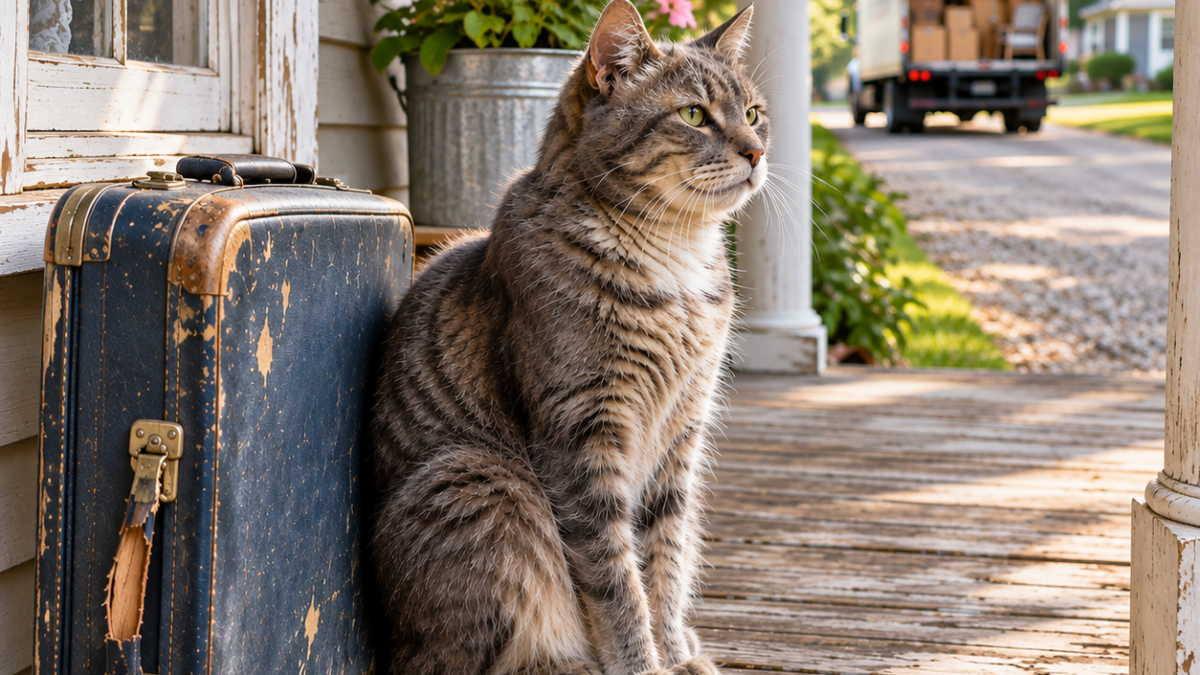
A Family Moved 280 Miles Away and Left Their 14-Year-Old Cat Beside a Broken Suitcase—19 Days Later, a Stranger Came Back for Her.
For nineteen days, the old gray tabby returned to the same patch of porch beside a battered blue suitcase, watching the driveway from sunrise to sunset as though the next car might finally bring her family home.
Her owners had moved 280 miles away and told the neighbor she was too old to handle the trip, but nobody had explained to the fourteen-year-old cat why the people she had loved since kittenhood had disappeared without her.
Then, on the nineteenth morning, a woman who had never met her drove nearly five hours across Kansas, sat quietly beside the suitcase without reaching for her, and waited until the cat finally made a choice of her own.
The moving truck pulled away at 8:17 on a Tuesday morning.
Harold Bennett remembered the time because he had been standing at his kitchen window with a mug of coffee in his hand, watching the family across the street finish loading the last of their belongings.
It was not unusual.
People moved.
The rental house had been listed for weeks.
A SOLD sign had already appeared beside the mailbox.
Harold knew only a little about the family.
The father worked in construction management.
The mother drove a white SUV.
They had two teenage boys who rarely looked up from their phones.
And they had a gray tabby cat named Mabel.
Harold knew the cat better than he knew any of the humans.
Mabel had lived across the street for years.
She was fourteen.
Gray coat streaked with lighter silver.
White chin.
Green eyes.
A small notch in her left ear from some childhood injury Harold had never learned about.
Most afternoons, she sat in the front window.
Warm days brought her onto the porch.
She never wandered far.
Sometimes she walked as far as Harold’s hedge, sniffed the grass, then returned home with the slow confidence of an animal who had long ago decided where she belonged.
That morning, Harold watched the father close the truck door.
The mother checked the porch.
One son climbed into the SUV.
The other carried a cardboard box toward the truck.
Then everybody got in.
Harold lifted his coffee in a half-wave from behind the glass even though nobody was looking.
The truck rolled down the driveway.
The SUV followed.
Within thirty seconds, both disappeared around the corner.
Harold turned away.
Then stopped.
Something remained on the porch.
Two things.
A blue hard-shell suitcase with a broken handle.
And Mabel.
The cat sat beside it.
Perfectly upright.
Facing the driveway.
Harold frowned.
Maybe one of the boys had forgotten something.
Maybe they were coming back.
PART2:
The suitcase looked old enough to be discarded.
Its plastic shell was scratched white along the corners.
One wheel was missing.
A strip of gray duct tape crossed one side.
Mabel sat so close to it that her shoulder touched the case.
Harold watched another minute.
Then went to refill his coffee.
At 9:30, Mabel was still there.
At 11:00, still there.
Around noon, Harold walked across the street.
“Hey, old girl.”
Mabel looked at him.
Did not move.
The porch had been swept nearly empty.
No chairs.
No flowerpots.
No welcome mat.
Only suitcase and cat.
Harold crouched.
“You waiting on them?”
PART3:
Mabel blinked slowly.
Harold looked through the front window.
Bare rooms.
Empty walls.
No lamps.
No furniture.
The place had that strange look houses acquire immediately after people leave them.
Not abandoned.
Just erased.
Mabel returned her attention to the road.
Harold scratched the side of his face.
“Well.”
He did not know what else to say.
He walked home.
At three that afternoon, the cat was still there.
That was when Harold took the photograph.
He stood behind his front window and used his phone.
Mabel.
Blue suitcase.
Empty porch.
He posted it in the town’s community Facebook group.
Looks like someone forgot their travel buddy.
It was meant as a joke.
Within ten minutes, people began commenting.
Maybe they’re coming back.
Did anyone check whether the family left food?
That’s Mabel. They wouldn’t leave her.
Somebody should call them.
Harold read the comments.
Then looked through his window again.
The joke no longer felt funny.
At 5:40, he carried a small bowl of water across the road.
Mabel stood when he approached.
For a second, Harold expected her to run.
Instead she stepped backward, watching him.
“I’m not taking you anywhere.”
He placed the bowl near the suitcase.
Then a small plate with tuna.
Mabel waited until he crossed the yard.
Then ate.
Afterward, she walked back to the suitcase.
Sat.
Faced the driveway.
That night, Harold slept badly.
At 6:15 the next morning, he looked across the street before making coffee.
Mabel was there.
Curled against the suitcase.
The temperature had dropped overnight.
Her body pressed into the hard plastic shell as though it provided warmth.
Harold put on a jacket.
Carried more food.
Mabel stood.
Ate.
Drank.
Then returned to the same spot.
“Okay.”
Harold looked down the driveway.
“Where the hell are they?”
By noon, he had spoken with the landlord.
The answer made his stomach tighten.
The family had completed the move.
They were gone.
Permanently.
New city.
New job.
New house.
Approximately 280 miles west.
Harold asked:
“What about the cat?”
The landlord paused.
“I assumed they took her.”
“They didn’t.”
Another pause.
“You sure?”
“She’s sitting on the porch.”
The landlord sounded genuinely surprised.
“I don’t know what to tell you.”
Harold did.
“Give me their number.”
The landlord refused initially.
Privacy.
Harold called again.
Then again.
By the second evening, the community post had hundreds of shares.
Somebody added the family’s last name.
Someone else found a social-media account.
Messages were sent.
Most went unanswered.
Meanwhile, Mabel kept waiting.
Every morning she ate the food Harold provided.
Every morning she returned to the suitcase.
Every evening she sat in the same place until darkness.
At night, Harold’s porch camera caught her moving.
Slow circles.
Stretch.
Drink.
Walk to the edge of the porch.
Look down the driveway.
Return.
Sometimes she slept beside the suitcase.
Sometimes partly behind it when wind increased.
On the third day, rain came.
Harold carried a cardboard box across the road and placed it beneath the covered section of the porch.
Inside:
Old towel.
Fleece blanket.
He expected Mabel to use it.
She sniffed the box.
Walked inside once.
Then returned to the suitcase.
Rain blew beneath the porch roof.
Mabel tucked her paws under herself beside the battered case.
Harold stood across the street behind his window.
“You stubborn old thing.”
But he understood.
The suitcase belonged to them.
It smelled like them.
Maybe clothes had once been stored inside.
Maybe it had sat in a closet for years absorbing the scent of the house.
Maybe one of the boys had used it for trips.
Whatever it represented to Mabel, it was the only familiar object left.
So Harold moved the blanket.
He placed it beneath the suitcase instead.
That night, Mabel slept on the blanket with her back touching the blue plastic.
The photograph spread beyond town.
A rescue page shared it.
Then another.
Thousands of people who had never heard of the little Kansas town began asking:
Did the family return?
Harold stopped answering that question.
Because the answer was always the same.
No.
On the fourth day, a woman named Denise from a local rescue came.
She brought a carrier.
Treats.
Gloves.
A towel.
She sat at the end of the porch.
Mabel stared.
“She’s old.”
Harold nodded.
“Fourteen.”
“Friendly?”
“She used to be.”
“Used to be?”
“Before this.”
Denise placed food near herself.
Mabel stayed beside the suitcase.
After twenty minutes, Denise moved slightly closer.
Mabel backed away.
Not down the street.
Under the porch.
“See?”
Harold whispered.
“She’ll hide if you push.”
They waited.
Five minutes.
Ten.
Mabel crawled out.
Walked directly back to the suitcase.
Denise sighed.
“She’s attached to the location.”
“Or that thing.”
Harold nodded toward the suitcase.
Denise looked.
“Could put it inside a trap.”
Harold shook his head.
“Not yet.”
“She can’t stay out here forever.”
“I know.”
But he did not want Mabel’s last connection to home turned into bait before they understood whether someone was still coming.
On the fifth day, Harold finally reached the family.
The mother answered.
He introduced himself.
“Across the street.”
“Oh.”
“You left Mabel.”
Silence.
Not surprise.
Recognition.
Harold gripped the phone tighter.
“She’s been sitting on the porch since Tuesday.”
The woman sighed.
“We couldn’t take her.”
Harold looked through his window.
Mabel sat beside the suitcase.
“Why?”
“She’s fourteen.”
“So?”
“The move would’ve been too much.”
Harold did not answer.
The woman continued.
“We’re in a smaller place.”
“New neighborhood.”
“She doesn’t adjust well.”
Harold felt something hot move through his chest.
“So you left her on an empty porch?”
“We thought she’d stay around the property.”
“The property you sold.”
Silence.
“She knows the area.”
“She knows your family.”
The woman’s voice tightened.
“Mr. Bennett, you don’t understand everything.”
“Probably not.”
“We had to move quickly.”
“You had enough time to pack a moving truck.”
Another silence.
Harold forced himself to stay calm.
“Do you want her back?”
The answer took too long.
Then:
“No.”
Harold closed his eyes.
The woman added:
“She wouldn’t handle the drive.”
He looked at Mabel again.
Thin shoulders.
Gray fur.
Green eyes facing the road.
“She’s handling the porch.”
The woman said:
“Excuse me?”
“Nineteen? No, at that point five days. She’s been out there five days.”
“Cold nights.”
“Rain.”
“Waiting for you.”
“Don’t make me feel guilty.”
Harold almost laughed.
“I don’t have that kind of power.”
“You’ve already posted about us online.”
“I posted a cat sitting beside a suitcase.”
“People are harassing my family.”
“Then come get the cat.”
“We can’t.”
“Won’t.”
The call ended.
Harold stood in his kitchen for a long time.
Then walked across the road.
Mabel looked up.
“They’re not coming.”
His voice sounded foolish.
She was a cat.
She did not understand sentences the way people did.
Still, Harold sat on the porch step.
“They aren’t.”
Mabel stared toward the driveway.
Harold lowered his head.
“I’m sorry.”
That evening, he deleted the original joke from his post.
Replaced it with:
Update: I spoke with the former owners. They will not be returning for Mabel. She is safe for tonight and being fed. Local rescue volunteers are helping us figure out next steps. Please do not contact or harass anyone. Focus on helping the cat.
The story spread faster.
Some people became angry.
Harold disliked most of the comments.
People called the family monsters.
Cruel.
Evil.
Some threatened them.
Harold reported those comments.
He did not know everything that had happened inside the family.
He knew one thing.
Mabel was still on the porch.
That was enough to deal with.
Days passed.
Six.
Seven.
Eight.
Mabel established a routine.
At dawn, she stretched.
Water.
Food.
Brief walk into the front yard.
Then suitcase.
Around noon, she moved into shade.
Late afternoon, driveway.
After dark, sleep.
Always beside the suitcase.
Harold installed a small security camera aimed toward the porch.
He told himself it was practical.
He was seventy-one.
Retired postal worker.
Could not stare through the window twenty-four hours a day.
The camera let him know if Mabel wandered, became injured, or if someone approached.
The footage broke his heart anyway.
At 1:12 one morning, Mabel woke.
Raised her head.
A car had turned onto the street.
She stood.
Walked to the edge of the porch.
The car passed without slowing.
Mabel remained there almost a minute.
Then returned to the suitcase.
Another evening, headlights appeared.
Mabel ran.
Not fast.
She was fourteen.
But faster than Harold had seen her move since the family left.
She reached the end of the walkway.
The vehicle belonged to a food-delivery driver.
Mabel stopped.
Watched him enter another house.
Then walked back.
Harold stopped checking the camera at night after that.
On day nine, Denise returned with a humane trap.
“We need a plan.”
“I know.”
“The weather is changing.”
“I know.”
“Her age worries me.”
“I know.”
Harold rubbed his face.
They placed the trap near the suitcase.
Food inside.
Mabel approached.
Sniffed.
Walked around it.
Sat.
Denise tried tuna.
Chicken.
Sardines.
Mabel ate only when the food was outside the trap.
“Smart.”
Harold said.
“Or terrified.”
They removed it.
A veterinarian following the story online offered to examine Mabel for free if they could catch her.
An elderly-cats rescue two counties away offered placement.
A woman in Wichita offered to foster.
People donated food.
A local hardware store donated a heated outdoor shelter.
Harold placed it beside the porch.
Mabel ignored that too.
The old blue suitcase remained enough.
On day eleven, Harold sat near her.
Not close.
Six feet away.
Mabel stayed.
Progress.
“You know.”
He looked toward her.
“I carried mail for thirty-eight years.”
Mabel blinked.
“Everybody thinks postal workers know everybody’s business.”
He smiled.
“We do.”
Mabel licked one paw.
“I watched three generations live in that yellow house on Maple.”
“No idea what half their names were.”
“But I knew who got divorce papers.”
“Who got college acceptance letters.”
“Who got medical bills.”
He looked at the cat.
“People reveal a lot through what arrives at the door.”
Mabel closed her eyes.
Harold continued.
“You got left at yours.”
No reaction.
He sighed.
“I guess that’s why this bothers me.”
His wife had died eight years earlier.
Louise.
Cancer.
After the funeral, Harold continued setting two coffee cups out for almost a week.
Habit.
Memory.
Refusal.
He would reach into the cabinet.
Two mugs.
Then remember.
Loss was strange.
The body often learned last.
Maybe Mabel was not reasoning:
They promised to return.
Maybe she was simply following a routine that no longer produced the expected people.
Driveway.
Door.
Suitcase.
Home.
Maybe that was enough to explain nineteen days.
On day twelve, Mabel allowed Harold to touch her.
One finger.
Side of her face.
She recoiled immediately.
Then returned.
Harold tried again.
This time she stayed.
“That’s something.”
Her fur felt rougher than he remembered.
He began brushing her gently each evening.
Only a few strokes.
Then more.
Mabel started waiting for him around five.
Food.
Water.
Brush.
Driveway.
Suitcase.
The community page followed every update.
Harold did not post dramatic language.
Day 13. Ate well. Let me brush her for about five minutes. Still staying near suitcase.
Day 14. Rainy. She used the blanket but not the shelter.
Day 15. Local vet says we need her indoors soon, especially due to age. Working on trust.
People became invested.
One woman more than most.
Her name was Margaret Ellis.
She lived outside Hays, nearly 280 miles away.
Sixty-five.
Retired elementary-school librarian.
Widowed.
One adult daughter in Denver.
Two cats had shared Margaret’s home for years.
The last, Simon, died at seventeen the previous spring.
Margaret had told everyone she was done.
No more pets.
Too painful.
Too many vet appointments.
Too difficult worrying what would happen to an animal if something happened to her.
Then she saw Mabel’s photograph.
Gray cat.
Blue suitcase.
Empty porch.
Margaret read the first post.
Then every update.
Day six.
Day seven.
Day ten.
Day fifteen.
She tried not to become attached to a cat she had never met.
Failed.
On day sixteen, Margaret called Harold.
“I know this is strange.”
“Lady, nothing about this week is normal.”
She laughed nervously.
“I want to come meet her.”
“You’re where?”
“Hays.”
Harold paused.
“That’s nearly five hours.”
“I know.”
“There are cats in Hays.”
“I know.”
“You could adopt one there.”
“I know.”
Harold waited.
Margaret said:
“But this one is waiting for somebody.”
He looked across the street.
“Yes.”
“She has rescue placement?”
“Technically.”
“Will she leave the porch?”
“Not willingly.”
“Can I try?”
Harold had received dozens of messages from people claiming they wanted Mabel.
Most disappeared when he explained adoption requirements.
Veterinary care.
Transport.
Indoor home.
Slow introductions.
No impulsive pickup.
Margaret sounded different.
“What animals have you had?”
“Cats most of my life.”
“Current pets?”
“None.”
“Indoor?”
“Always.”
“Vet?”
“Dr. Collins at Prairie View.”
“Can I call?”
“Yes.”
“Homeowner?”
“Yes.”
“Anyone else living there?”
“No.”
“You understand she’s fourteen?”
“Yes.”
“Senior bloodwork.”
“Yes.”
“Possible kidney disease.”
“Yes.”
“Dental issues.”
“Yes.”
“Could cost money.”
“I know.”
“She may hide from you for three months.”
“I know.”
“She may never become a lap cat.”
Margaret paused.
“I’m not driving 280 miles because I need a lap cat.”
Harold liked that answer.
“What do you need?”
“I think I need to know she doesn’t spend another night believing nobody came.”
Harold looked away.
“Come Saturday.”
Day nineteen.
Saturday.
Mabel was sitting beside the suitcase at 8:03 in the morning.
Harold fed her.
Brushed her.
“Someone’s coming today.”
Mabel purred faintly.
He had heard it only twice before.
Margaret left home before dawn.
She packed too much.
Carrier.
Blankets.
Water.
Food.
Disposable litter box.
Cleaning wipes.
Paper towels.
A fleece throw.
A small first-aid kit.
She stopped twice during the drive because her hands were shaking.
She almost turned around once.
What if Mabel wanted nothing to do with her?
What if the trip made everything worse?
What if she had built an emotional fantasy from a photograph?
Then she remembered Harold’s latest video.
Mabel standing when headlights passed.
Waiting.
Margaret kept driving.
She arrived shortly after ten.
Harold met her near his driveway.
Margaret was shorter than he expected.
Gray hair cut to her chin.
Jeans.
Brown cardigan.
No dramatic rescue energy.
She did not rush toward the cat.
“That’s her?”
Harold nodded.
Mabel was watching them.
Margaret’s eyes filled immediately.
“Oh.”
Harold said:
“Don’t cry yet.”
“Bossy.”
“She doesn’t like people coming straight at her.”
Margaret wiped her eyes.
“Understood.”
“What’s your plan?”
“Sit.”
“That’s it?”
“For now.”
Margaret crossed the street slowly.
Mabel stood.
Her body tightened.
Margaret stopped.
Waited.
Then moved sideways rather than directly toward her.
She reached the porch.
Sat on the top step.
Five feet from the suitcase.
Mabel stared.
Margaret placed both hands in her lap.
“Hi.”
Nothing.
“My name is Margaret.”
Mabel looked toward the driveway.
Margaret followed her gaze.
“I know.”
Harold stood across the street pretending not to watch.
Twenty minutes passed.
Mabel sat.
Margaret sat.
A truck passed.
Mabel’s head lifted.
Then lowered.
Margaret did not reach.
Did not offer food.
Did not call her repeatedly.
After forty minutes, Mabel stood.
Harold straightened.
She walked toward Margaret.
Stopped three feet away.
Sniffed.
Margaret remained still.
Mabel looked at the suitcase.
Then at Margaret.
One step.
Another.
Her nose touched Margaret’s shoe.
Margaret whispered:
“Hello.”
Mabel smelled her jeans.
Her hand.
Then walked away.
She returned to the suitcase.
Margaret smiled.
Harold crossed over.
“That was good.”
“She left.”
“She came first.”
Margaret looked at him.
“Is that unusual?”
“For Mabel now?”
“Yes.”
They waited another hour.
Margaret ate a sandwich.
Harold drank coffee.
Mabel dozed beside the suitcase.
At noon, Margaret sat closer.
Three feet.
At one, two feet.
Mabel tolerated it.
At 1:37, Margaret slowly lowered one hand onto the porch boards.
Palm down.
Not reaching.
Mabel looked.
Walked forward.
Sniffed.
Then rubbed the side of her face against Margaret’s knuckles.
Margaret stopped breathing.
Harold whispered:
“Don’t move.”
“I wasn’t planning to.”
Mabel rubbed again.
Then turned.
Her flank brushed Margaret’s knee.
Margaret’s chin trembled.
“You’re okay.”
Mabel looked up.
Then did the thing Harold later replayed in his mind dozens of times.
She climbed.
One front paw onto Margaret’s leg.
Then another.
Margaret did not grab her.
Mabel shifted her weight.
Slowly.
Carefully.
Until the fourteen-year-old tabby was standing across both thighs.
Margaret whispered:
“Oh, sweetheart.”
Mabel circled once.
Then lay down.
Harold turned away.
Margaret’s hands hovered above the cat.
“Can I?”
Harold laughed through tears.
“Ask her.”
Margaret touched one finger to Mabel’s back.
No reaction.
Then a palm.
Mabel leaned.
Margaret began crying.
Quietly.
For nearly twenty minutes, neither moved.
The cat who had refused carriers.
Refused traps.
Refused to leave the porch.
Slept in the lap of a stranger.
Harold finally said:
“I think she chose.”
Margaret looked down.
“I think so too.”
Getting Mabel into the car still required patience.
Margaret placed the open carrier near her.
Blanket inside.
Mabel refused.
Of course.
Harold looked at the suitcase.
Then at Margaret.
“What if…”
She understood.
They opened the suitcase.
Mostly empty.
Inside were two old towels and a faded T-shirt.
That explained the smell.
Home.
Margaret removed the T-shirt.
Placed it inside the carrier.
Mabel smelled it immediately.
She walked forward.
Entered halfway.
Stopped.
Margaret waited.
Mabel continued.
Carrier door closed.
No panic.
Harold exhaled.
“That’s it.”
Margaret looked toward the blue suitcase.
Then lifted it.
Harold frowned.
“You don’t have to take that.”
“Yes.”
“It’s broken.”
“I know.”
“One wheel is gone.”
“I know.”
“You paid attention to the story?”
Margaret looked at him.
“I’m not separating them.”
Harold’s throat tightened.
They loaded the suitcase behind the passenger seat.
Before leaving, Margaret stood beside Harold.
“You kept her alive.”
“I fed a cat.”
“For nineteen days.”
“She would’ve waited anyway.”
“That’s why it mattered.”
He looked toward the carrier.
Mabel sat quietly.
Green eyes watching.
Harold touched the carrier door.
“Okay, old girl.”
“You’re going somewhere.”
His voice cracked.
“This time you’re invited.”
The drive took longer than 280 miles normally required.
Margaret stopped often.
Checked Mabel.
Offered water.
Spoke constantly.
Not baby talk.
Ordinary conversation.
She told Mabel about Hays.
The house.
The screened back porch.
The sunny front room.
The maple tree.
The neighbor’s irritating wind chimes.
The grocery store.
Her late husband, Thomas.
Simon, the cat who had died.
“I’m not replacing him.”
Mabel blinked.
“You don’t need to replace anybody either.”
At the veterinarian’s office the next morning, Mabel weighed less than expected.
Dehydrated.
Mildly underweight.
Arthritis.
Dental disease.
Early kidney changes that required monitoring.
Fleas.
Nothing immediately catastrophic.
The veterinarian looked at Margaret.
“Fourteen is old.”
“I know.”
“She may need medication.”
“Okay.”
“Senior bloodwork regularly.”
“Okay.”
“She may have only a few years.”
Margaret smiled sadly.
“So do most of my friends.”
The veterinarian laughed.
Mabel spent her first two days in Margaret’s spare bedroom.
Door closed.
Food.
Water.
Litter.
Carrier open.
And the blue suitcase.
Margaret placed it near the wall.
Did not clean it.
Not yet.
Did not remove the old shirt.
She simply opened the lid.
Put one soft blanket inside.
That first night, Mabel ignored the cat bed Margaret had bought.
Walked into the suitcase.
Turned three times.
Slept.
Margaret found her there the next morning.
For weeks, the suitcase remained Mabel’s safest place.
Loud noise?
Suitcase.
Visitor?
Suitcase.
Vacuum cleaner?
Suitcase.
Thunder?
Suitcase.
But slowly, other places became safe too.
Windowsill.
Sofa arm.
Patch of sunlight beneath the dining-room window.
Margaret’s lap.
By Christmas, Mabel no longer ran into the suitcase every time the doorbell rang.
She still slept there most nights.
Margaret washed the old T-shirt only after consulting Harold.
“Do you think it’ll ruin it?”
Harold laughed.
“It’s laundry, Margaret.”
“It smells like her old house.”
“It probably smells like nineteen days of porch now.”
She washed it gently.
Mabel survived.
The suitcase stayed.
Margaret repaired nothing.
Broken handle remained.
Missing wheel remained.
Scratches remained.
She lined it with blankets.
That was all.
Harold visited six months later.
Mabel recognized him before he reached the living room.
At least Harold believed she did.
She walked toward him.
Sniffed his pants.
Rubbed his leg.
Then returned to Margaret’s chair.
Harold smiled.
“Well.”
Margaret looked nervous.
“What?”
“She doesn’t need me.”
“Harold.”
“That’s a good thing.”
He sat.
Mabel climbed onto Margaret’s lap.
The blue suitcase remained open beside the window.
Harold looked at it.
“She still sleep there?”
“Every night.”
“You know, I almost threw that thing away on day two.”
Margaret stared.
“You wouldn’t have.”
“I considered it.”
“Monster.”
He laughed.
Mabel closed her eyes.
The online community continued asking for updates.
Margaret allowed Harold to post occasionally.
Mabel is doing well. Kidney values stable. Still sleeps in suitcase. Has learned that Margaret’s lap is apparently acceptable furniture.
Photos spread.
But Margaret never allowed the story to become too sentimental.
When people wrote:
She knew her true mom was coming!
Margaret corrected gently.
“No.”
She did not believe Mabel had been waiting specifically for her.
Mabel had been waiting for the people who left.
That truth mattered.
Margaret did not want to rewrite the cat’s loss into destiny.
Someone had abandoned her.
She had grieved in the only way she knew.
Then someone else offered safety.
Both things could be true.
One did not erase the other.
A year after adoption, Mabel stopped watching cars.
That was the change Margaret noticed most.
At first, every engine outside made the cat wake.
Every door slam drew her to the window.
Every vehicle slowing near the house caused her ears to lift.
Sometimes she walked toward the front door.
Waited.
Then returned.
Over months, that behavior faded.
The mail truck came.
No reaction.
Neighbor arrived.
Mabel slept.
Margaret’s daughter visited from Denver.
Mabel stared once, then returned to her blanket.
One evening, Margaret realized three cars had passed and Mabel had not moved from her lap.
She cried.
Not because the old family had finally been forgotten.
Nobody could know that.
She cried because Mabel no longer seemed to believe every passing car might change her world again.
Routine had become safe.
Morning medication.
Breakfast.
Sun.
Nap.
Margaret.
Suitcase.
Dinner.
Bed.
No disappearing family.
No empty house.
No porch.
The second year, Mabel’s kidneys worsened.
Medication changed.
Special diet.
More veterinary visits.
Margaret never complained.
The cat gained a heated bed.
Ignored it.
Another blanket went into the suitcase.
The veterinarian asked:
“Do you ever plan to replace that thing?”
Margaret looked offended.
“It came with the cat.”
Mabel lived to seventeen.
Three years after the porch.
Three years nobody expected her to have.
Her final winter was gentle.
More sleeping.
Less jumping.
Margaret placed small steps beside the sofa.
Mabel used them.
Mostly.
Sometimes she demanded to be lifted by simply staring at Margaret until service occurred.
One January night, Margaret found Mabel standing in front of the suitcase.
Not climbing in.
Just standing.
She bent down.
“You need help?”
Mabel looked up.
Margaret lifted her.
Placed her gently inside.
The old cat turned once.
Lowered herself.
Margaret sat beside the suitcase on the floor.
Her knees protested.
She stayed anyway.
Mabel’s breathing had changed over the previous week.
Veterinarian had warned her.
Kidneys.
Age.
The body slowing.
Margaret stroked her head.
“You don’t have to wait for anybody anymore.”
Mabel’s eyes half closed.
“I’m right here.”
That became the last sentence Margaret said before Mabel fell asleep.
The next morning, they went to the veterinary clinic.
Harold knew beforehand.
Margaret called him.
He drove partway and joined by video because weather made the full trip unsafe.
Mabel rested on her blanket.
Margaret’s hand beneath her head.
Harold appeared on the phone.
“Hey, old girl.”
One ear moved.
He laughed through tears.
“You gave everybody enough trouble.”
Margaret cried.
Harold continued:
“No more porches.”
Mabel died peacefully with Margaret holding her.
The suitcase went home empty.
For several weeks, Margaret could not move it.
It remained open beside the window.
Blanket inside.
Gray hairs clinging to the fabric.
Her daughter eventually asked:
“What are you going to do with it?”
Margaret looked at the broken handle.
“I don’t know.”
She considered storing it.
Throwing it away felt impossible.
Keeping it forever felt strange.
Then Harold suggested something.
A local rescue near Margaret’s home ran a senior-cat foster program.
Older cats.
Owners entering nursing homes.
Medical surrenders.
Animals nobody wanted because adopters feared short goodbyes.
Margaret donated money.
Then volunteered.
Eventually, she fostered a sixteen-year-old orange cat named Walter.
Walter arrived terrified.
He hid beneath the bed.
Refused the cat bed.
Ignored food until nobody watched.
Margaret sat on the floor.
Waited.
Then she remembered.
She dragged the blue suitcase from the closet.
Opened it.
Placed a blanket inside.
Walter approached.
Sniffed.
Climbed in.
Slept.
Margaret laughed until she cried.
The suitcase became a foster bed.
Not always.
Some cats ignored it.
One urinated in it.
Margaret nearly ended the tradition that day.
But most old cats seemed to appreciate the low sides and soft blanket.
Over the years, four senior fosters slept inside the same battered suitcase.
Each eventually found a home.
Margaret never pretended the suitcase carried magic.
It carried a story.
A reminder.
Old animals were not burdens simply because their futures were shorter.
Fourteen was not too old to move.
Too old to bond.
Too old to begin again.
Mabel had proven that.
Harold kept the original photograph.
Gray tabby.
Blue suitcase.
Empty porch.
For years, people online continued sharing versions of it.
Some details grew exaggerated.
That happens to stories.
People said Mabel had survived alone nineteen days without food.
Not true.
Harold fed her.
They said she had walked 280 miles.
Not true.
Margaret drove them.
They said Mabel instantly knew Margaret was her new owner.
Nobody could know that.
The real story needed none of those additions.
The facts were strong enough.
A family moved.
An elderly cat remained.
She waited beside one familiar object for nineteen days.
A neighbor noticed.
He stayed involved.
Rescuers tried.
A stranger saw the story.
She drove 280 miles.
She sat.
She waited.
The cat climbed into her lap.
Margaret took the suitcase too.
That was enough.
Years later, Harold was asked what part he remembered most.
He did not choose the photograph.
Not the phone call with the family.
Not Mabel walking into Margaret’s lap.
He remembered a smaller moment.
Day two.
Early morning.
He had brought food across the street.
Mabel ate.
Then walked away from him.
Back to the suitcase.
Sat.
Faced the driveway.
Harold remembered standing behind her and realizing:
She still believed something would happen if she waited long enough.
That was the hardest part.
Because waiting only looks patient from the outside.
Sometimes waiting is grief that has not yet learned the truth.
Margaret remembered something different.
The nineteenth day.
Her hands flat in her lap.
Mabel standing three feet away.
The cat looked at Margaret.
Then at the driveway.
Then at the suitcase.
For one second, Margaret later said, it felt like Mabel was standing between two worlds.
One was the world she understood.
People who were supposed to return.
A house that had been home.
A suitcase that smelled familiar.
The other was nothing yet.
A strange woman.
A strange car.
A strange town 280 miles away.
No promises Mabel could understand.
No evidence that this stranger would be different.
Then Mabel stepped forward.
One paw onto Margaret’s leg.
Then another.
That was the moment Margaret remembered.
Not because she believed Mabel had forgotten her first family.
She had not.
Not because Margaret had somehow replaced fourteen years of history in an afternoon.
She could not.
It mattered because an old animal who had every reason to distrust the next change still chose contact.
Still tried again.
Mabel’s story was never really about a suitcase.
The suitcase simply remained when everything else disappeared.
For nineteen days, it was familiar enough to stay beside.
Then someone new arrived and understood that rescue did not always mean taking the familiar thing away.
Sometimes rescue meant saying:
Bring it too.
So Margaret did.
She took the old cat.
The broken suitcase.
The remaining smell of another home.
The fear.
The habits.
The history.
All of it.
She did not ask Mabel to begin again with nothing.
She let her bring the past.
Then slowly gave her enough new memories that the old suitcase stopped meaning only abandonment.
It became a bed.
Then a safe place.
Then simply part of home.
The people Mabel waited for never returned.
That remained true.
But someone else came.
Someone who owed her nothing.
Someone who had never held her as a kitten.
Never watched her grow old.
Never promised she would always belong.
A stranger drove nearly five hours because a photograph of an elderly cat beside a broken suitcase would not leave her mind.
And when Margaret finally reached that empty Kansas porch, she did not drag Mabel away from the place where she had been waiting.
She sat beside her.
That was all.
She sat.
She waited.
And this time, when the old cat decided to trust someone, the person beside her stayed.








