A Fallen SEAL’s Daughter Walked Into a Retired K9 Auction Alone—Then She Spoke Her Father’s Name, and Every Combat Dog in the Room Suddenly Fell Silent
PART3:
But when he stood in the yard with Havoc, everything changed.
“Havoc.”
One word.
Deep.
Controlled.
Absolute.
The Malinois would stop whatever he was doing and snap to attention. Ears up. Body still. Eyes locked on Timothy as if the rest of the world had disappeared.
“At ease.”
Havoc would sit.
“Watch.”
Havoc would scan.
“Home.”
Havoc would return to Timothy’s left side, shoulder pressed to his leg.
Clara used to imitate him when her father was not looking.
“Havoc,” she would say in her deepest voice.
The dog would glance at her, unimpressed, then look back at Timothy as if reporting that the child was attempting stolen authority.
Her father would laugh.
“He knows rank, baby.”
“I’m your daughter. That outranks everybody.”
“That may be legally true in this house.”
Then, three years ago, the stories stopped.
It was night when the officers came.
Clara remembered that too clearly.
The knock.
Her mother’s face going pale.
The sound of a mug shattering in the kitchen.
Words came in pieces after that.
Classified operation.
Helmand Province.
Ambush.
Held position.
Covered withdrawal.
Did not make extraction.
Her father had ordered his squad to fall back while he stayed behind to cover them.
That was the version they were allowed to have.
The rest came buried in redactions, silence, and men who could not meet Clara’s eyes at the funeral.
The only survivor found at Timothy Grant’s final position was Havoc.
He had taken shrapnel to the shoulder. Half his right ear was torn. Blood soaked his coat. He was standing over Timothy’s body, refusing to let anyone near until one of Timothy’s own men approached speaking the right commands through tears.
Clara had begged the Navy to let her take him.
At the funeral, while people shook her hand and said things she could not remember, she watched for the dog.
He was there briefly, handled by a man she did not know. His shoulder was bandaged. His eyes moved constantly. When the folded flag was handed to Clara’s mother, Havoc let out a low sound that made every person in the front row look down.
Clara tried to go to him.
A uniformed handler stopped her gently.
“Not now, miss.”
“He knows me.”
“I’m sorry.”
“He’s my dad’s dog.”
The man’s face softened, but his hand stayed in front of her.
“He belongs to the military.”
That sentence had stayed with Clara for three years.
He belongs to the military.
Not to the man he guarded.
Not to the family he knew.
Not to the porch where he once slept with his head in Clara’s lap.
Not to grief.
Not to love.
To the military.
A highly trained asset.
A million-dollar dog.
Property with a service record.
Havoc recovered.
Then he was reassigned.
Then reassigned again.
Marine Force Recon.
Border Patrol Tactical.
Federal contract work Clara only heard about through whispers.
He was never the same.
Reports eventually leaked through unofficial channels, all because of one man: David Brooks, her father’s old squadmate, a retired sniper who had called Clara from numbers she did not recognize and told her things he probably was not supposed to say.
“Havoc’s not doing well,” David told her the first time.
“What does that mean?”
A pause.
“He won’t bond.”
“With who?”
“Anyone.”
Another pause.
“He bit a handler last month.”
Clara sat on her bed with one hand pressed against her mouth.
“That doesn’t sound like him.”
“It is him,” David said quietly. “And it isn’t.”
Over the next year, the calls grew worse.
Havoc had night terrors.
Havoc attacked restraints.
Havoc refused food after transfers.
Havoc snapped at two handlers.
Havoc was classified as high-risk.
Havoc was labeled unfit for further service.
Then came the call that made Clara’s blood go cold.
“They’re liquidating him,” David said.
She was in the alley behind the diner, still wearing her apron, a trash bag in one hand.
“What does that mean?”
“It means a private auction. Contractors. Security firms. Anyone with clearance and money.”
“No.”
“I’m sorry, Clara.”
“No. They can’t.”
“They can.”
“He’s not equipment.”
David did not answer.
She knew why.
Because in the system, maybe he was.
Lot 42.
Retired military working dog.
Belgian Malinois.
Male.
Seven years old.
High reactivity.
Severe behavioral instability.
Recommended for secure perimeter deployment only.
Not suitable for civilian adoption.
Clara went to Fort Rosecrans National Cemetery the day after David told her.
She took two buses and walked the last half mile because she could not afford a rideshare. She stood at her father’s headstone with the Pacific wind pulling at her braid, and for a long time, she could not speak.
Then she crouched and placed her palm against the stone.
“I’ll bring him home,” she whispered.
It was an impossible promise.
But grief does not always care what is possible.
Sometimes it only knows what must be attempted.
Now, standing inside the Carlsbad Auction House, Clara wondered if she had mistaken courage for foolishness.
A dog went for ten thousand.
Another for thirteen.
A man in a black vest joked that the K9 would be cheaper than upgrading cameras at his estate.
Laughter moved through the room.
Clara felt sick.
The auctioneer was a man named Hank Riordan, a retired K9 handler with a voice like gravel and shoulders like an old refrigerator. He had tattoos crawling up both forearms and a scar along his jaw. Clara did not know whether to trust him.
He moved fast through the lots.
Professional.
Efficient.
A little theatrical.
“Lot 39. Female Dutch Shepherd. Explosive detection. Strong drive. Clean medical. Opening bid five thousand.”
Bids flew.
Hammer fell.
Dog gone.
“Lot 40. German Shepherd. Dual-purpose. High obedience. Minor hip note. Opening bid three thousand.”
More bids.
Hammer.
Gone.
Clara’s hands began to sweat against the folder.
Lot 41 passed in a blur.
Then the side door to the staging area clanged open.
The sound cracked across the warehouse.
Clara stopped breathing.
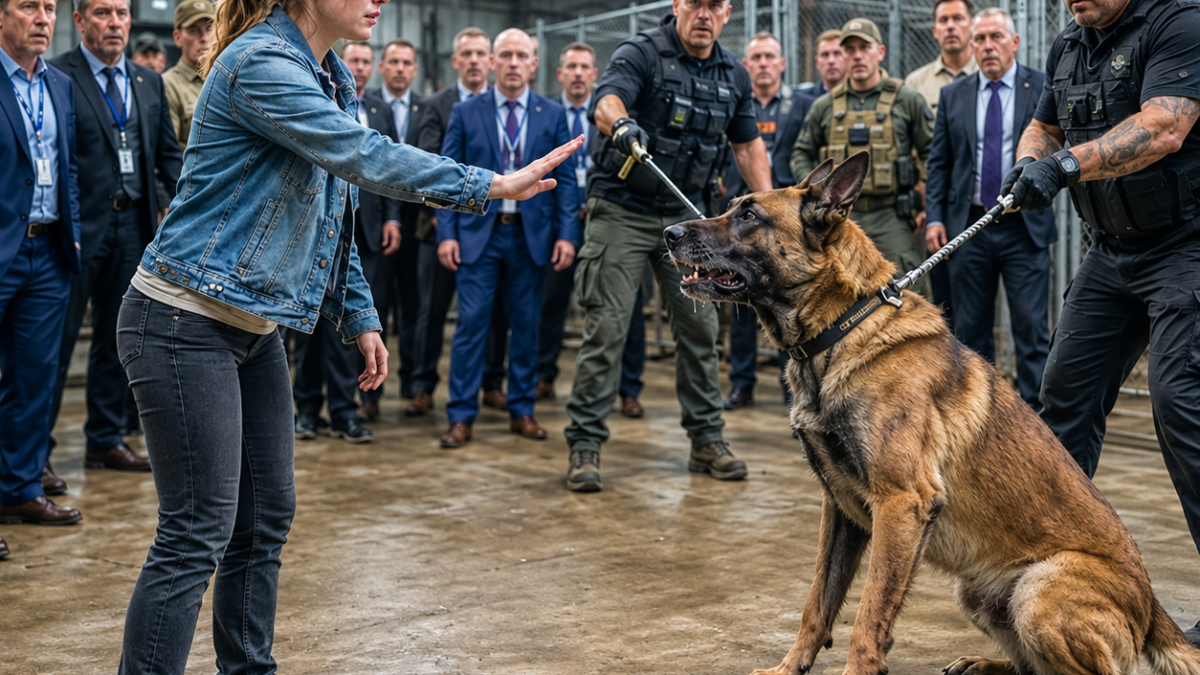
Two handlers emerged, both large men wearing bite sleeves and heavy gloves. They leaned backward with their full weight against two catch poles attached to the dog between them.
Lot 42.
Havoc.
Clara pressed both hands over her mouth to keep from making a sound.
The dog on the stage looked nothing like the dog in her memories.
His tan coat was dull, matted in places along the flank. A jagged pink scar ran down the left side of his muzzle. A piece of his right ear was missing. The old shrapnel wound had healed into a thick, uneven ridge near his shoulder. His eyes were wild, dark, and unfocused. A thick leather agitation muzzle covered his jaws, but the low growl vibrating through him still seemed to shake the air.
He lunged at one handler.
The handler cursed and braced hard.
Havoc’s paws scraped against the concrete as he fought the poles. His chest heaved. His body was all muscle and terror, rage and memory, a weapon pointed at everything because everything had become the war.
Someone behind Clara muttered, “That one’s a nightmare.”
Another said, “Cheap, though.”
Clara wanted to turn and scream at them.
That is not a nightmare.
That is Havoc.
That is the dog who guarded my father.
That is the dog who used to fall asleep on my lap.
But her mouth would not work.
Hank Riordan lifted the microphone.
“Settle down. Settle down.”
The room quieted, though the handlers were still struggling.
“Ladies and gentlemen, lot 42. Belgian Malinois, male, seven years old. Three combat deployments. Prior military working dog, later attached to federal tactical operations. Highly decorated record.”
He glanced at the paperwork.
His expression darkened.
“Full disclosure on this one. File notes severe PTSD, high reactivity, handler aggression. Bites recorded in two of his last three placements. He is not a patrol dog, not a search-and-rescue dog, not a family placement. Recommended only for solitary perimeter work at a secure facility.”
A murmur moved through the buyers.
Hank continued.
“You put him behind a tall fence, nobody is getting in. Opening bid, one thousand dollars.”
For one second, nobody spoke.
The buyers studied Havoc.
Even they saw the risk.
A dog that could not trust handlers was dangerous, even to dangerous men.
Clara’s heart slammed against her ribs.
This was the moment.
She raised her paddle.
“One thousand.”
Her voice cracked.
It sounded too young in the huge warehouse.
Several men turned to look at her.
Hank paused.
His eyebrows lifted slightly.
“One thousand to the young lady in front.”
Clara kept her paddle up because if she lowered it, her hand might not rise again.
A smooth voice called from the back.
“Two thousand.”
Clara turned.
The man leaning against a concrete pillar wore a charcoal suit, polished shoes, and an expression that suggested boredom was his favorite form of cruelty. He was maybe forty-five, perfectly groomed, scrolling his phone with one thumb.
Richard Hayes.
Clara recognized the name from the bidder list David had managed to get her.
Logistics director for a major overseas security company.
Depots.
Convoys.
Private contracts in places where laws became negotiable.
Hayes barely looked at Havoc.
He was not bidding on a dog.
He was buying a deterrent.
Clara’s mouth went dry.
She had two thousand four hundred fifteen dollars.
If she bid everything, she would have nothing left for transport, food, a crate, veterinary care, rent, or survival.
But if she stopped, Havoc was gone.
She raised her paddle.
“Twenty-four hundred.”
This time her voice did not crack.
It shook.
But it held.
Hayes looked up from his phone.
His eyes moved over her faded jacket, worn sneakers, white knuckles, desperate face.
A slow smile appeared.
Not amused.
Cruel.
He did not need Havoc.
Not really.
But he had found something smaller than himself to crush.
“Five thousand,” Hayes said lazily.
The room murmured.
Clara froze.
Five thousand.
Her paddle lowered without her telling it to.
Hank glanced at her.
Something flickered across his face.
Pity, maybe.
Or recognition.
But auctions do not stop for pity.
“Five thousand on the floor.”
Clara looked at Havoc.
He was still thrashing at the end of the catch poles, growling through the muzzle, eyes black with fear.
If Hayes won, Havoc would spend the rest of his life behind chain-link somewhere hot and lonely, pacing a fence line, treated as a liability until he finally broke past usefulness.
Five thousand dollars.
That was the price of her failure.
“Five thousand going once,” Hank called.
Clara’s heart hammered.
No.
“Five thousand going twice.”
No.
Her father’s voice moved through memory.
Havoc. At ease.
Before her mind caught up with her body, Clara ducked under the velvet rope.
“Hey!” someone shouted.
“Miss, you can’t—”
A security guard moved toward her.
The handlers saw her enter the marked zone and panicked.
“Get back!” one screamed. “Get the hell back!”
Havoc saw her movement.
His head snapped toward her.
The entire room seemed to inhale.
He lunged.
The catch poles jerked tight with a metallic crack. Both handlers slid backward half a step, boots scraping concrete. Havoc’s eyes locked on Clara. His ears pinned. Every muscle in his body gathered for violence.
One handler unholstered a yellow taser.
Clara heard the click.
She stopped six feet from Havoc.
Not close enough to touch.
Close enough to die if the poles failed.
Her body trembled so hard she could feel it in her teeth.
But she did not step back.
She looked into the eyes of the dog who had once slept with his head in her lap and saw, beneath the rage, something more terrible than aggression.
Recognition trying to fight through trauma.
“Havoc!”
Her voice cracked across the warehouse.
Not her voice.
Not exactly.
She reached down into the oldest place of memory, into porch evenings and yard commands, into the deep baritone of the father she had lost, and pulled up his cadence with everything she had.
“Havoc!”
The Malinois stopped for half a second.
His ears twitched.
The handlers froze.
Clara stepped forward once.
People shouted behind her.
She did not hear them clearly.
Her whole world had narrowed to Havoc’s eyes.
She squared her shoulders exactly the way Timothy Grant used to stand when giving command.
Then she said the words she had practiced in whispers for three years without knowing why.
“At ease for Chief Tommy Grant.”
The effect was immediate.
Havoc stopped moving.
Not slowed.
Stopped.
The growl died in his throat.
The tension drained from his frame so suddenly that the handlers, still leaning backward with all their strength, stumbled forward.
For one impossible moment, Havoc stood utterly still.
Then the silence spread.
Behind the stage, more than thirty military and police K9s filled the holding pens. For the past hour, their barking, pacing, whining, and chain-rattling had formed the constant background noise of the auction.
Now, one by one, they quieted.
A German Shepherd stopped barking mid-growl.
A Dutch Shepherd froze with one paw lifted.
A black Malinois at the back of the pen lowered his head.
Within five seconds, the warehouse went silent.
No barking.
No whining.
No chains.
Only the fluorescent hum overhead, the ragged breathing of the handlers, and Clara’s heart beating so hard she thought it might break open.
Richard Hayes lowered his phone.
The security guard stopped in the aisle, hands halfway raised.
Hank Riordan lowered his gavel.
On stage, Havoc stared at Clara.
His eyes changed.
Not completely.
Not magically.
Trauma does not vanish because someone says the right name.
But something in him cleared.
He sniffed the air.
Clara had worn her father’s denim jacket on purpose.
It had been sealed in a plastic garment bag at the back of her mother’s closet for three years. Her mother did not know Clara had taken it that morning. It barely smelled like him anymore to her.
But to Havoc, maybe memory lived deeper than fabric.
His nostrils flared.
His ears lifted.
Slowly, deliberately, the seventy-five-pound combat dog lowered his hindquarters to the concrete.
He sat.
Perfect attention.
Then he made a sound.
A low, high-pitched whine.
The sound of recognition.
The sound of grief.
The sound of an animal who had been lost in a war inside his own body and had just heard a voice from home.
Clara’s tears spilled over.
She did not wipe them away.
Hank cleared his throat.
In the silence, the sound was enormous.
“Miss,” he said, and his voice had lost its auctioneer boom. “Who are you?”
Clara did not look away from Havoc.
“I’m Clara Grant,” she said.
Her voice shook, but it did not break.
“Chief Petty Officer Timothy Grant was my father.”
She swallowed.
“And that is his dog.”
The room remained silent.
Fifty hardened men stared at the nineteen-year-old girl in the faded denim jacket and the scarred Malinois sitting at attention in front of her.
Then Richard Hayes laughed.
It was a small sound.
Cold.
Impatient.
“Touching,” he said, stepping forward. “Really. Very cinematic. But this is a liquidation auction, not a family reunion.”
Several heads turned toward him.
Hayes did not seem to notice the temperature of the room changing.
“My bid of five thousand is on the floor,” he continued. “Ring it up so we can move on.”
Clara turned to him.
“He is not an asset.”
Hayes smiled.
“Sweetheart, he is a liability who bites his handlers. I’m doing everyone a favor by taking him off their hands.”
“He protected my father when no one else was left.”
“Then your father should be proud. The dog will keep protecting property. That’s what he was built for.”
Clara’s hands clenched.
“He was not built. He served.”
Hayes rolled his eyes.
Someone in the back moved.
A metal folding chair scraped violently against the floor.
The sound made several dogs lift their heads again.
A man stepped out of the shadows near the last row.
Tall.
Broad-shouldered.
Faded black canvas jacket.
Tactical boots.
Gray in his beard.
A jagged white scar cutting from his cheekbone through the beard at his jaw.
The crowd parted before Clara understood why.
Men who had ignored everything else suddenly stood straighter. Even Hayes’s expression shifted, just slightly.
The man walked down the center aisle and stopped beside the velvet rope near Clara.
He did not look at Hayes.
He looked at Havoc.
The Malinois watched him with sharp, intelligent eyes, still sitting at attention.
“I was on the QRF chopper that night,” the man said.
His voice was low, rough, and carried without effort.
Clara stopped breathing.
The man looked at her.
“My name is Jackson Ford.”
She knew that name.
Not from official reports.
From whispers.
From David Brooks once saying, “If you ever hear Jackson Ford talk about your father, listen. He saw things they didn’t put in the file.”
Ford kept his eyes on Clara.
“When we finally broke through the ambush line, it was zero dark thirty. Smoke everywhere. Tracers cutting over the ridge. We couldn’t see Tommy at first.”
His jaw tightened.
“But we heard the dog.”
Havoc’s ears moved.
Ford’s gaze shifted to him.
“He had taken shrapnel to the shoulder. Lost part of his ear. Bleeding like hell. And he was still standing over your father.”
Clara pressed both hands against the folder in her arms.
Ford continued.
“Three hostiles tried to flank the position after Tommy went down. Havoc stopped all three. He held that perimeter for forty-five minutes until we got there.”
A murmur moved through the room.
Not the earlier kind.
This one was different.
Heavier.
The men there understood what forty-five minutes meant.
They understood what it meant for a wounded dog to hold ground around a fallen handler while the world burned around him.
Ford finally turned toward Hayes.
“You want to put Tommy Grant’s point man on a chain to guard shipping containers?”
Hayes’s face flushed.
“It’s an open auction, Ford. I have the high bid. If you want the dog, bid for it.”
Ford did not blink.
“Ten thousand.”
Clara gasped.
Her first feeling was relief.
Then devastation.
Because Havoc was saved from Hayes.
But not for her.
Ten thousand dollars.
She could not compete with men like Ford any more than she could compete with the ocean.
Hayes’s mouth tightened.
“Twelve.”
“Fifteen,” called another voice.
Clara turned.
A burly man with a prosthetic leg leaned against the wall, arms crossed.
“Seventeen,” someone else shouted.
“Twenty thousand,” Ford said.
Hayes snapped, “This is ridiculous. You’re driving up the price of a defective animal out of sentimentality.”
Ford’s expression did not change.
Hayes looked around the room, saw no ally there, and swore under his breath.
“I’m out.”
He shoved through the crowd toward the exit.
No one stepped aside quickly for him this time.
Ford looked at Hank.
“Twenty thousand. Bring the hammer down.”
Hank Riordan stared at him, then at Clara, then at Havoc.
“Twenty thousand going once.”
Clara’s vision blurred.
“Going twice.”
No.
“Sold.”
The gavel cracked down.
The sound echoed through the warehouse like a gunshot.
Clara covered her face.
A sob tore out before she could stop it.
She had failed.
Not completely.
Not in the worst possible way.
But still.
Havoc would not go to Hayes.
He would not guard containers in the desert.
But he would go with Ford.
Another operator.
Another private firm.
Another life of service when he had already given everything.
She felt someone step close.
When she lowered her hands, Ford stood in front of her with a black checkbook open in one large hand.
He wrote quickly.
Tore the check free.
Held it out.
Clara stared at it.
It was made out to the Carlsbad K9 Auction House.
Twenty thousand dollars.
The memo line read:
For Tommy.
“I don’t understand,” Clara whispered.
Ford’s face softened.
“I didn’t buy the dog, kid.”
She looked up at him.
“You did.”
She shook her head.
“No. I can’t. I only have—”
“I’m covering the difference.”
“I can’t pay you back.”
“I didn’t ask you to.”
“Mr. Ford—”
“Tommy Grant saved my life in Fallujah in 2012,” Ford said quietly. “Pulled me out of a burning Humvee under fire. I’ve owed him a debt for a long time.”
His eyes moved to Havoc.
“Today, my ledger is clean.”
Clara could not speak.
Ford placed the check in her hand.
“Take your boy home.”
The room stayed silent as Clara walked to the auction table.
Her knees shook so badly that she nearly stumbled. She placed her crumpled folder and Ford’s check on the metal surface.
Hank Riordan looked at the cashier’s check for two thousand four hundred fifteen dollars.
Then at the twenty-thousand-dollar check.
Then at Clara.
His face had changed.
Not soft exactly.
But human.
He stamped the paperwork.
The heavy thud sounded final.
“Lot 42 transferred to civilian custody,” Hank announced into the microphone.
His voice carried across the warehouse.
“Bring him down.”
The handlers hesitated.
Havoc was calm now, but nobody trusted calm from a dog with a bite history and war in his blood.
They guided him down the ramp carefully, catch poles still attached, bodies tense. Havoc moved stiffly. Controlled. Eyes locked on Clara.
When he reached the floor five feet away from her, one handler stopped.
“Miss, we need to load him into reinforced transport. He’s still wearing a level four agitation muzzle, but if he snaps out of this, he could take your arm off.”
“Let him go,” Clara said.
This time, she did not imitate her father.
Her voice was her own.
Young.
Shaking.
Steady.
The handler stared at her.
“I can’t do that.”
“Drop the poles,” Ford said behind her.
The handler looked at Hank.
Hank gave one slow nod.
The clasps opened.
The catch poles fell away, clattering on the concrete.
Every armed man in the room held his breath.
Clara lowered herself to her knees.
The floor was filthy.
She did not care.
She made herself small, just as her father had taught her when she was a child meeting working dogs.
Never rush a dog carrying a job.
Never grab the head.
Let him choose the last step.
She held out both hands, palms up.
Havoc stood frozen.
Then he took one step.
Another.
His nails clicked softly against the concrete.
He stopped inches from her face.
Clara could smell him now.
Leather.
Dust.
Stress.
Old fur.
A faint medicinal smell under all of it.
He lowered his scarred head and sniffed her hands.
Then her wrists.
Then the sleeves of the denim jacket.
His body shuddered violently.
He pressed his nose against her chest.
The jacket.
Timothy’s jacket.
Havoc let out a long, ragged exhale.
It sounded almost human.
Then the terrifying Malinois, the dog who had fought handlers and lunged at restraints and survived firefights, pushed his heavy head into the crook of Clara’s neck.
All seventy-five pounds of him leaned into her as if his legs could no longer hold up three years of grief.
Clara wrapped her arms around him.
His fur was coarse beneath her hands.
His body trembled.
“I’ve got you,” she whispered into his damaged ear. “I’ve got you, buddy. You’re done fighting. You’re coming home.”
Havoc whined.
Soft.
Rhythmic.
Broken.
Clara felt for the buckle behind his head.
“Clara, wait,” one handler warned.
Ford lifted one hand.
The man stopped.
Clara unfastened the heavy leather muzzle.
The straps loosened.
She pulled it away.
The room tensed.
Havoc did not bare his teeth.
He did not snap.
He lifted his scarred face and dragged his tongue across Clara’s cheek.
A few men looked away.
Hank Riordan removed his glasses and rubbed one hand over his eyes.
Clara laughed through tears.
“There you are,” she whispered.
Not, there he is.
There you are.
As if some part of him had finally come back from the mountains.
She clipped a simple nylon leash to his collar.
“Heel,” she said softly.
Havoc moved instantly to her left side, shoulder pressed against her thigh, perfect disciplined alignment.
Not because he was a weapon.
Because he remembered.
Clara stood.
The path to the doors opened before her.
Contractors, executives, handlers, veterans—men who had spent careers refusing to step back from anything—moved aside.
Some nodded.
Some lowered their eyes.
One man put two fingers to his brow in a quiet salute.
Clara walked down the center aisle with Havoc at heel.
Ford watched from behind.
Hank stood by the podium, silent.
As Clara reached the door, Havoc paused.
He looked back once.
Not at the auction block.
Not at the pens.
At the other dogs.
Thirty war dogs watched him leave.
For one moment, no one moved.
Then the black Malinois in the back pen gave one low bark.
Not frantic.
Not aggressive.
A single sound.
Havoc’s ears lifted.
He did not turn away from Clara.
But Clara heard it.
So did everyone.
A goodbye.
Or a warning.
Or a prayer.
Outside, the late afternoon sun hit them hard.
Clara sucked in air as if she had been underwater for years.
Havoc stepped beside her, close enough that his shoulder brushed her leg with every movement.
She had no crate.
No plan.
No money left beyond what was in her backpack.
No idea how to safely transport a traumatized military K9 to San Diego.
For the first time all day, reality rushed back.
Ford came through the door behind her.
“You got transport?”
Clara shook her head.
“I thought…” She laughed once, raw and embarrassed. “I don’t know what I thought.”
Ford nodded like that was the answer he expected.
“I’ve got a reinforced crate in my truck. Not because he needs to be caged from you,” he added when Havoc’s body stiffened, “but because California highways are not where we test miracles.”
Clara looked down at Havoc.
He watched Ford carefully.
“Can he ride with me?”
Ford studied the dog.
“He should see you. Smell you. Stay connected. We’ll set the crate so you can sit next to him.”
“I don’t have money for gas back.”
“I figured.”
“I don’t like owing people.”
Ford’s expression softened.
“Then don’t think of it as owing. Think of it as letting old debts finish their circle.”
She wanted to argue.
She was too tired.
“Thank you,” she whispered.
Ford looked uncomfortable with gratitude.
“Thank me by not pretending this is going to be easy.”
Clara looked down at Havoc.
The dog’s scarred muzzle rested briefly against her hip.
“I know.”
“No,” Ford said. “You don’t. Not yet.”
His voice was not cruel.
It was honest.
“He’s going to have nightmares. Triggers. Startle responses. He may regress. He may panic in small rooms, around men, around certain sounds. He may never be safe around strangers. Love won’t fix him by itself.”
Clara swallowed.
“I know love isn’t treatment.”
Ford nodded.
“Good. Because he needs both.”
That was how Clara’s life with Havoc began.
Not with a perfect ride into the sunset.
With a reinforced crate in the back of Jackson Ford’s truck, two emergency numbers written on a receipt, and Clara sitting beside Havoc for two hours while he alternated between trembling, staring, and pressing his nose to the sleeve of Timothy Grant’s denim jacket.
The first night, she did not take him to her apartment.
Ford insisted on stopping at a veterinary clinic owned by a former military veterinarian named Dr. Hannah Cross, who opened after hours when Ford called.
Havoc tolerated the exam only because Clara stood where he could see her.
The vet moved slowly.
No sudden hands.
No crowding.
No approaching from behind.
She examined the old scars, checked his teeth, his shoulder, his ear, his paws. She scanned for chips, reviewed the transfer paperwork, and looked at Clara over the top of her glasses with the expression of a woman about to ruin optimism for its own good.
“He’s underweight,” Dr. Cross said. “Stress shedding. Dental wear. Old shrapnel scarring. His shoulder has chronic stiffness. He’ll need a full behavioral plan. Not obedience. Trauma rehabilitation.”
Clara nodded.
“I can do that.”
Dr. Cross gave her a long look.
“You can learn to do that.”
Clara accepted the correction.
“Yes.”
“Do you have family support?”
“My mom.”
“Does your mom know you spent your entire savings at a K9 liquidation auction?”
Clara hesitated.
Dr. Cross sighed.
“Call her before you bring him home.”
That call was worse than the auction.
Her mother answered on the first ring.
“Clara? Where are you? Your shift manager called. You missed work.”
Clara closed her eyes.
“I found Havoc.”
Silence.
Then, very quietly, “What?”
“I found him. The auction was today.”
Her mother’s breathing changed.
“Clara.”
“I got him.”
“You what?”
“I got him, Mom.”
For several seconds, there was only silence.
Then her mother began to cry.
Not softly.
Not prettily.
The kind of crying Clara had heard only twice before—when the officers came and when the funeral ended.
“You should have told me,” her mother said.
“I knew you’d say no.”
“Because I would have gone with you.”
Clara’s throat tightened.
She had expected anger.
Not that.
“I thought you wanted to forget him.”
Her mother made a wounded sound.
“Your father?”
“No. Havoc.”
“Oh, baby.”
The softness in her voice nearly undid Clara.
“I couldn’t talk about him because I couldn’t save him,” her mother said. “Not because I didn’t love him.”
Clara sat down hard on the clinic bench.
Havoc watched her through the kennel bars, ears forward.
Her mother inhaled shakily.
“Bring him home.”
The apartment was small.
Too small, maybe, for a seventy-five-pound traumatized military dog, one nineteen-year-old student, and a widow who had spent three years trying to survive by keeping certain doors closed.
But when Havoc entered, he did not explore.
He walked directly to the hallway closet.
The one where Timothy’s old boots sat in a plastic bin.
Clara’s mother, Rebecca Grant, stood in the living room with one hand over her mouth.
Havoc sniffed the closet door.
Then sat.
Perfect attention.
Rebecca broke.
She crossed the room slowly and knelt several feet away.
“Havoc,” she whispered.
The dog’s head turned.
For a moment, his eyes were uncertain.
Then he sniffed.
Recognition moved through him like pain.
He lowered his head and whined.
Rebecca covered her face.
“I’m sorry,” she sobbed. “I’m so sorry we couldn’t get you.”
Havoc stood, took two careful steps, and pressed his head against her shoulder.
That night, he slept outside Clara’s bedroom door.
Not inside.
Not yet.
He positioned himself in the hallway facing the apartment entrance, body stretched across the narrow space like a barrier.
Clara woke three times.
Each time, he was awake.
Watching.
At 3:17 a.m., he began to growl in his sleep.
Then twitch.
Then thrash.
His paws scraped the floor. His breathing turned harsh. A low bark tore from him.
Clara opened her door.
“Havoc?”
He jerked awake.
For one terrible second, he did not know where he was.
His eyes were black.
His lips lifted.
Clara froze.
Then she remembered Ford’s warning.
Love alone is not treatment.
She did not reach for him.
She lowered herself slowly to the floor.
“Home,” she whispered.
His ears twitched.
“Home, Havoc.”
He stared at her.
She reached for the denim jacket draped over a chair beside her door and pulled it into her lap.
The dog’s breathing hitched.
“Home,” she said again.
His body trembled.
Then he crawled to her.
Not walked.
Crawled.
He pressed his head into the jacket and shook.
Clara sat beside him until sunrise.
The next weeks were not beautiful in the way people like stories to be beautiful.
They were hard.
Havoc could not handle crowds.
He could not be touched by strangers.
He reacted to fireworks, construction noise, men in heavy boots, helicopters, metal clanging, certain radio static, and once to a pressure cooker at a neighbor’s apartment.
He refused to enter elevators.
He paced at night.
He guarded doors obsessively.
He woke from nightmares ready for war.
Clara arranged her life around healing with the seriousness of someone building a bridge over a canyon.
Dr. Cross connected her with a military working dog rehabilitation specialist named Aaron Voss, a former handler who spoke little and observed everything.
During the first session, he sat twenty feet away from Havoc and did not look directly at him.
“Good,” he said after ten minutes.
Clara frowned.
“He hasn’t done anything.”
“Exactly.”
Aaron taught her decompression routines.
Choice-based handling.
Safe distance.
Muzzle conditioning without force.
Body language.
Trigger logs.
How to recognize when Havoc was responding to the present and when he had fallen into the past.
“Don’t correct fear like disobedience,” Aaron told her. “You’ll only teach him you’re not safe.”
“He knows commands,” Clara said.
“Commands kept him alive. They will not heal him.”
That sentence stayed with her.
Havoc needed more than at ease.
He needed peace.
Peace came slowly.
In inches.
The first time he slept two hours without waking.
The first time he ate with his back turned to the door.
The first time he allowed Rebecca to brush the scarred side of his muzzle.
The first time he walked past a construction site and chose to look at Clara instead of lunging.
The first time he dreamed and did not wake growling.
Clara returned to work at the diner after missing three shifts and nearly losing the job.
Her manager, Gina, stared at her from behind the counter.
“You look like hell.”
“I know.”
“You owe me three shifts.”
“I know.”
“You got the dog?”
Clara blinked.
David Brooks had apparently told half the military-adjacent community before she could.
“Yes.”
Gina threw an apron at her.
“Then get to work. And after closing, you can show me pictures.”
Clara laughed for the first time in days.
School became harder.
She studied at the kitchen table with Havoc at her feet, one paw resting against her shoe. She highlighted biology chapters while he scanned the window. She wrote essays while he slept with his nose on Timothy’s jacket. She learned to budget dog food, vet bills, rent, and textbooks with math that often made her cry.
Ford checked in every Sunday.
Not warmly at first.
Efficiently.
“How’s he eating?”
“Better.”
“Nightmares?”
“Still.”
“Triggers?”
“Helicopters. Metal carts. The neighbor upstairs dropping weights.”
“She lifting weights or bodies?”
“That’s what I want to know.”
Over time, the calls changed.
Ford told her more about her father.
Not the polished version.
The real one.
“Tommy snored like a chainsaw.”
“He once ate tuna from a pouch while walking and got it on his boot.”
“He hated being called heroic.”
“He loved you so much it made him stupid.”
Clara wrote the stories down.
For years, her father had been frozen in the last image the Navy gave them: brave, fallen, folded into ceremony.
Ford gave him back with bad jokes, terrible coffee habits, and humanity.
David Brooks visited in March.
He stood outside the apartment door for ten minutes before knocking.
Clara saw him through the peephole, tall and thin, with a ball cap pulled low and grief sitting on his shoulders like weight.
When she opened the door, Havoc was behind her.
The dog froze.
David froze too.
“Hey, Hav,” David whispered.
Havoc sniffed.
One second.
Two.
Then he made a sound Clara had never heard before.
Not a growl.
Not a whine.
Something between recognition and apology.
David sank to his knees.
Havoc crossed the room and pressed his forehead against the retired sniper’s chest.
David put both hands over the dog’s shoulders and bowed his head.
“I’m sorry I couldn’t get to him faster,” he whispered.
Havoc leaned into him.
Clara looked away because some grief belonged to those who had shared the battlefield.
After that, David came once a week.
He helped with repairs.
Taught Clara how to reinforce the apartment door.
Brought donated dog food from men who did not want to intrude but wanted to help.
He took Rebecca to appointments when Clara had exams.
He never called it charity.
“Logistics,” he said.
By summer, Havoc had become a fixture on the apartment porch.
Not the open front area.
That was too much.
But the tiny back balcony where Clara had placed a worn outdoor rug, two chairs, and a water bowl. From there, he could smell the Pacific air drifting inland, hear gulls, and watch the alley below.
One afternoon, a seagull landed on the dumpster behind the building.
Havoc lifted his head.
His ears rose.
Clara watched.
For one heartbeat, he looked younger.
The gull flapped away.
Havoc’s paws twitched.
Clara smiled.
“You remember?”
He looked at her.
“Beach terrorist,” she whispered, using her father’s old nickname for gulls.
Havoc gave one soft huff.
The next week, Dr. Cross approved a controlled beach visit.
Early morning.
Empty stretch.
Long line.
Muzzle on but conditioned positively.
Clara was terrified.
So was Havoc, at first.
The ocean wind hit them as they stepped onto the sand.
Havoc froze.
Clara stood beside him.
No pulling.
No coaxing.
No pressure.
The water rolled in silver under the dawn light.
Havoc sniffed.
His body trembled.
Then a gull cried overhead.
He looked up.
For a moment, Clara saw the pup from Coronado.
Not fully.
Time does not return like that.
But enough.
Havoc took one step forward.
Then another.
By the waterline, he lowered his nose to the wet sand and inhaled deeply.
Clara cried quietly behind him.
He turned, saw her tears, and came back to press his shoulder against her leg.
“I’m okay,” she said.
He did not believe her.
He stayed pressed there anyway.
One year after the auction, Clara returned to Fort Rosecrans with Havoc.
She wore the denim jacket.
Havoc wore a simple black working harness with patches Aaron had helped design.
RETIRED MWD
DO NOT APPROACH
Under it, smaller:
HAVOC
TIMOTHY GRANT’S PARTNER
Rebecca came with them.
So did Ford, David, Aaron, and Dr. Cross.
They did not make it a ceremony.
Clara did not want flags or speeches.
She wanted her father to see that she had kept her promise.
They walked to Timothy Grant’s headstone in the clean morning light.
Havoc slowed before they reached it.
His nose lowered.
Then lifted.
His ears moved.
Clara unclipped the leash from the harness handle but left it attached.
“Go on,” she whispered.
Havoc approached the stone.
He sniffed the grass.
The carved name.
The base of the marker.
Then he sat.
Perfect attention.
Just as he had in the auction house.
For a long time, nobody spoke.
Rebecca leaned into David’s arm and cried silently.
Ford stood with his jaw clenched, eyes fixed on the horizon.
Clara knelt beside Havoc.
“Hi, Dad,” she whispered.
The wind moved across the cemetery.
“I brought him home.”
Havoc lowered himself slowly onto the grass beside the headstone and rested his scarred muzzle near the carved name.
Not on it.
Near it.
As if guarding without disturbing.
Clara placed her hand on his back.
“He’s done fighting now.”
Her voice broke.
“We both are trying to be.”
That was the day Clara understood that healing was not a return to who they had been before.
Havoc would never again be the carefree dog chasing seagulls as if the world had no darkness.
Clara would never again be the girl waiting on the porch for her father’s boots on the steps.
Rebecca would never again be the woman who believed deployment endings could be survived by sheer hope.
But they were alive.
Together.
And love, though changed, had not been destroyed.
The story of the auction spread eventually.
Not because Clara posted it.
She didn’t.
Someone in the room had filmed the moment Havoc froze at her father’s name. The video made its way through veteran networks first, then local news, then everywhere.
Headlines called her brave.
Called Havoc a hero.
Called the moment miraculous.
Clara hated most of the coverage.
Reporters wanted a clean story.
A girl saves dog.
Dog heals.
War trauma conquered by love.
That was not the truth.
The truth was medication schedules.
Training plans.
Tears over bills.
Panic at fireworks.
Small victories.
Setbacks.
A dog who still slept facing doors.
A daughter who still woke some nights from dreams of steel doors closing.
But some good came from the attention.
A nonprofit offered to cover Havoc’s lifetime medical care.
A veterans’ group started a fund for retired working dogs with handler-family placement needs.
Hank Riordan called Clara three months after the video spread.
She almost did not answer.
When she did, his voice sounded older than she remembered.
“I changed the auction policy,” he said.
Clara sat down.
“What?”
“No more high-risk retired military or law enforcement K9 transfers without handler-family notification review.”
Her throat tightened.
“You can do that?”
“I own enough of the process to make it difficult for people who don’t like it.”
“That sounds like a yes.”
“It’s a start.”
Silence.
Then Hank said, “I should have stopped the bidding when you stepped forward.”
Clara looked at Havoc asleep near the balcony door.
“Yes,” she said.
“I’m sorry.”
She closed her eyes.
“Thank you for saying that.”
A year became two.
Then three.
Havoc’s muzzle grayed.
Clara finished college more slowly than planned, because life had become complicated and expensive and full of appointments. She did not become a veterinarian, as some viral posts later claimed. She became a trauma counselor specializing in military families, because she had learned that grief left untreated could turn even love into a locked room.
Havoc came to her office sometimes once he was stable enough.
Never with clients at first.
Only after hours.
Then, eventually, with veterans who understood boundaries and silence.
He did not perform therapy.
Clara refused to make him work again.
But sometimes, when a client sat frozen in a chair, unable to speak, Havoc would lift his head from his mat.
If Clara gave permission and the client agreed, he would walk over slowly and sit nearby.
Not touching unless invited.
Just present.
A scarred old dog saying without words:
I know something about surviving what your body still remembers.
Ford retired fully after a health scare and moved closer to San Diego.
He and Rebecca became friends in a way Clara pretended not to notice at first because she was not emotionally prepared for her mother laughing with a man who owned three identical black jackets and spoke like every sentence had been classified.
David Brooks opened a small repair shop and hired veterans who needed patient work and quiet structure.
Aaron Voss expanded his K9 rehabilitation program.
Dr. Cross became Havoc’s favorite person outside the family because she carried liver treats and never lied to him about shots.
Life grew around the wound.
Not over it.
Around it.
That distinction mattered.
On Havoc’s tenth birthday—estimated, because military paperwork did not care about cake—Clara took him to the beach at sunrise.
Rebecca came.
Ford came with coffee.
David brought a ridiculous party hat Havoc refused to wear.
They walked slowly along the wet sand.
Havoc no longer chased gulls.
His shoulder was too stiff, and he preferred dignity now.
But when one gull landed too close, he lifted his head and gave it a look so severe that Clara burst out laughing.
“There he is,” Ford said.
Havoc looked offended by the laughter.
Clara crouched beside him and pressed her forehead to his.
“You grumpy old hero,” she whispered.
He licked her chin once.
Only once.
As if affection had a quota.
In the final years of Havoc’s life, he slept in Clara’s room.
Not outside the door anymore.
Inside.
At first on a mat near the entrance.
Then beside her bed.
Then, when arthritis made the floor harder, on a low orthopedic bed Rebecca bought after reading too many reviews and muttering, “Your father would say this dog has better bedding than we do.”
Havoc still woke from dreams sometimes.
But less often.
When he did, Clara would say, “Home.”
And he would find her.
The last time Clara took him to Fort Rosecrans, he moved slowly.
Very slowly.
His muzzle was white.
His scars had faded to pale lines.
His missing ear gave him a permanently lopsided silhouette. His eyes were cloudier now, but still sharp when he wanted them to be.
They reached Timothy’s grave near sunset.
Havoc lowered himself onto the grass with effort.
Clara sat beside him.
“I don’t know how to do goodbye twice,” she whispered.
Havoc rested his head on her knee.
The Pacific wind moved over the stones.
Her father’s name sat carved in front of them.
Timothy Grant.
Chief Petty Officer.
Beloved husband and father.
Clara touched the letters.
“I was so angry at you,” she admitted softly.
Not to Havoc.
To the stone.
“For leaving. For being brave in a way that took you away from us. For making me proud and destroyed at the same time.”
Her throat closed.
“Havoc was angry too, I think.”
The dog sighed.
“I thought bringing him home would give me you back.”
The wind moved through the grass.
“It didn’t.”
She looked down at Havoc.
“But it gave me someone who missed you the same way.”
Havoc’s eyes half closed.
“And maybe that was enough.”
Havoc died on a quiet morning in Clara’s apartment.
Not in a clinic.
Not surrounded by alarms.
Dr. Cross came to them.
Rebecca sat on one side.
Clara on the other.
Ford stood near the door because that was where he always stood when something hurt. David sat on the floor with his head bowed. Aaron waited in the hallway until Clara asked him in.
Havoc lay on Timothy’s denim jacket.
The same one Clara had worn to the auction.
The fabric was faded almost soft as cloth now, but Havoc still knew it.
Clara held his scarred head in her lap.
“You did good,” she whispered.
His cloudy eyes lifted to hers.
“You protected him. You protected me. You can rest now.”
Rebecca sobbed quietly.
Ford looked away.
Clara leaned close to Havoc’s damaged ear and gave the final command in her father’s cadence, though her voice broke halfway through.
“At ease for Chief Tommy Grant.”
Havoc exhaled.
Long.
Slow.
Peaceful.
Then he was gone.
The silence after was not like the auction house.
It was not tense.
Not fearful.
Not waiting for violence.
It was the silence after a soldier finally lays down his post.
Clara buried Havoc’s ashes beside a small memorial stone in her mother’s garden, where sunlight reached in the afternoon and the ocean could be smelled faintly when the wind was right.
The stone read:
HAVOC
TIMOTHY GRANT’S PARTNER
CLARA’S GUARDIAN
FINALLY HOME
Years later, people still sent Clara messages about the video.
Some said it made them cry.
Some said it helped them understand military working dogs differently.
Some asked how Havoc was doing, not realizing time had moved on.
Clara answered when she could.
She told the truth.
He was loved.
He healed as much as he could.
He had good years.
He slept in sunlight.
He chased gulls in his dreams.
He died at home.
That was not the ending people wanted from a viral story.
They wanted forever.
Everyone wants forever from love.
But forever is not what living creatures can give.
What they can give is presence.
Duty.
Memory.
A body beside yours while grief moves through the room.
A scarred head pressed into your chest in a warehouse full of men who finally understand they are looking at something sacred.
Clara kept the auction paddle.
She kept the transfer paperwork.
She kept Havoc’s old muzzle too, though she hated it. Not as a trophy, but as evidence of what people had believed about him before they understood.
Next to it, in a shadow box, she placed his simple black harness.
And beneath that, a photo.
Havoc on the porch one year after the auction, sun on his coat, head resting against Clara’s knee while her textbook lay open in her lap.
He looked old.
Scarred.
Tired.
Peaceful.
On the back, Clara wrote:
He was never a monster. He was grief with teeth until love gave him somewhere safe to put them down.
Sometimes Clara returned in memory to that moment at the auction house.
Not the bidding.
Not Hayes.
Not even Ford’s check.
She remembered the silence.
Thirty war dogs going still.
A room full of men realizing, all at once, that the girl in front of them had not come to buy an animal.
She had come to retrieve a family member from a system that had forgotten he had one.
She remembered Havoc sitting at attention when she said her father’s name.
She remembered the way his eyes cleared.
She remembered thinking, Dad, he heard you.
But later, she understood something deeper.
Havoc had not only heard Timothy Grant in her voice.
He had heard permission.
To stop fighting.
To come home.
To belong to love again.
And maybe that was what Clara had needed too.
Not to stop grieving.
Not to stop missing her father.
Not to pretend war had not taken too much.
But to stop standing outside the closed door of loss, believing everything she loved had been locked on the other side.
Havoc opened that door.
With scars.
With nightmares.
With a missing ear.
With a loyalty so fierce it frightened people who did not know its source.
That was why Clara told his story.
Not because it was easy.
Not because it was neat.
But because somewhere, there would always be another living creature labeled too broken, too dangerous, too much trouble, too expensive, too far gone.
And somewhere, there would be someone who knew their real name.
Someone who could step into the silence, speak with love and authority, and remind the world:
He is not surplus.
He is not broken equipment.
He is not a failed weapon.
He served.
He loved.
He remembered.
And when the daughter of the man he loved came for him, every dog in that warehouse knew before the humans did.
Havoc was going home.








