A Fallen Navy SEAL’s Daughter Raised Her Last $20 for His Broken K9—Then Every Military Dog in the Auction Turned Toward Her and Fell Completely Silent
PART2:
PART3:
Titan did not come home.
At Arlington, Hannah had stood beneath a slate-gray sky while rifles cracked twenty-one times in the distance. The folded flag felt too heavy in her arms. Grown men in uniform cried without sound. Her mother shook beside her.
Hannah waited the whole time for Titan.
Even after the service ended.
Even after people touched her shoulder and said things that made no sense.
Even after the car door opened.
She kept looking for the huge German Shepherd who should have walked up and nudged her hand.
He never came.
Evelyn applied to adopt him immediately.
Everyone told her it was routine.
The families of fallen handlers were often given the chance to take in the dog, especially when the bond was known and documented. Wyatt’s teammates wrote letters. A former handler called the base. Evelyn filled out every form they sent.
Then the letters changed.
Titan had not returned from the mountains as the same dog.
He refused food.
He snapped at kennel masters.
He threw himself against chain-link when uniforms approached.
He snarled until his gums bled.
The veterinarian called it traumatic instability.
The commanding officer called it unmanageable.
The paperwork called him condition red.
Hannah called him grieving.
Nobody listened to Hannah.
The denial letter came on a Monday.
Evelyn opened it at the kitchen table and read it twice before her hands began to shake.
Hannah stood behind her.
The words blurred at first, but some were dark enough to cut through everything.
ADOPTION REQUEST DENIED.
DANGER TO CIVILIANS.
SPECIALIZED ASSET DISPOSAL.
TACTICAL SURPLUS AUCTION.
Auction.
That was the word that made Hannah speak.
“They can’t sell him,” she whispered.
Evelyn lowered the letter.
Her face had gone white.
“I tried, baby.”
“He’s Dad’s.”
“I know.”
“That means he’s ours.”
Evelyn covered her mouth.
“They say he isn’t safe.”
“He was safe with us.”
“He isn’t the same.”
Hannah stared at the paper.
Then she turned and walked upstairs.
“Hannah?”
She did not answer.
In her bedroom, beneath her mattress, sat a cracked porcelain piggy bank shaped like a pig wearing a sailor hat. Her father had bought it for her at a boardwalk shop years ago because he thought it was ridiculous and Hannah had laughed so hard she hiccupped.
She did not shake it.
She did not try to open it.
She smashed it on the floor.
Coins scattered across the hardwood.
Pennies.
Nickels.
Dimes.
A few quarters.
And one crisp twenty-dollar bill folded in half.
Her birthday ace.
She picked it up carefully, smoothed it against her knee, and placed it in the breast pocket of her father’s jacket.
She did not have thousands of dollars.
She did not own a security company.
She did not understand surplus property laws or military classifications or why adults could make something wrong sound official just by printing it on letterhead.
But she was a Mitchell.
And Titan was pack.
So now, sitting in the car outside Hangar Four, Hannah looked at her mother and said, “I’m bidding.”
Evelyn closed her eyes.
“Hannah, they won’t let you.”
“I have money.”
“Honey, twenty dollars won’t—”
“It’s emergency money.”
Evelyn’s face broke.
For one terrible moment, she looked like she might fall apart completely.
Then she reached across the console and took Hannah’s small hand.
“I am trying to protect you.”
Hannah looked down.
“I know.”
“If you see him and he doesn’t remember you—”
“He will.”
“If he scares you—”
“He won’t.”
“If we can’t bring him home—”
Hannah pulled her hand away gently.
“Then at least he’ll know we came.”
Evelyn stared at her daughter.
In that moment, Hannah looked so much like Wyatt that Evelyn had to turn toward the windshield just to breathe.
The same stubborn jaw.
The same stillness before action.
The same terrifying belief that loyalty was not negotiable.
Finally, Evelyn nodded.
“All right,” she whispered. “We go in together.”
Hangar Four smelled like motor oil, damp concrete, metal, and wet wool.
The space was enormous, echoing every footstep, every cough, every bark from the reinforced kennels along the far western wall. Rows of surplus vehicles sat under harsh overhead lights. Crates of decommissioned gear were stacked beside forklifts. Steel barricades separated the auction floor from the buyers.
The buyers made Hannah feel smaller than she already was.
They were mostly men.
Large men.
Some in uniforms from police departments. Some in tactical polos. Some in suits too expensive for the cold hangar and watches that flashed when they lifted their bidder placards. A few looked bored. A few looked excited. Most looked at the dogs like numbers attached to teeth.
Evelyn kept one hand on Hannah’s shoulder.
“Stay with me,” she said.
Hannah nodded.
But her eyes went straight to the kennels.
There were dogs everywhere.
Belgian Malinois.
Dutch Shepherds.
Labradors.
German Shepherds.
Some barked sharply at the crowd. Some paced. Some slammed against crate doors. Some sat rigidly, eyes fixed forward, as if still waiting for commands from men who might never return.
Hannah wondered if any of them had daughters.
Not dog daughters.
Human daughters who missed the handlers who used to bring them home.
At the front, an auctioneer named Garrett stood on a raised wooden platform. He was broad, red-faced, and loud, with a gavel in one hand and a microphone in the other. His voice rolled through the PA system with practiced speed.
“Lot Thirty-Seven, decommissioned patrol vehicle, low mileage, reinforced panels, bidding starts at fifteen thousand—do I hear fifteen?”
Men raised numbers.
Garrett talked fast.
The gavel fell.
Items became property.
Hannah barely heard.
Beside the podium stood a man who looked different from the others.
He was tall, lean, and sharply dressed in a dark suit beneath a tactical-cut wool coat. His hair was silver at the temples. His shoes were polished. His expression was not bored exactly, but controlled in a way that made him look colder than the weather.
A badge clipped to his coat read:
ELIAS FROST
VANGUARD TACTICAL
He did not bid on the vehicles.
He did not bid on crates of equipment.
He sipped black coffee from a paper cup and waited.
Evelyn noticed Hannah looking.
“That’s one of the big contractors,” she whispered.
“What does that mean?”
“It means he has money.”
Hannah touched the twenty in her pocket.
“Not more than me.”
Evelyn made a sound that might have been a laugh if it had not broken halfway through.
Then Garrett’s voice changed.
“All right, ladies and gentlemen, moving now to specialized K9 assets.”
The hangar shifted.
People stepped closer.
Hannah felt her mother’s fingers tighten.
“Lot Forty-Two,” Garrett announced. “German Shepherd, male, MWD Titan. Dual-purpose explosive detection and patrol trained. Prior Tier One operational attachment. Combat injury to left shoulder, healed. Current behavioral classification: highly aggressive.”
A murmur moved through the room.
Frost lowered his coffee.
Garrett continued.
“Full disclosure, gentlemen, this animal is not a family pet. He is not suitable for general civilian handling. He will require firm management, professional containment, and extensive retraining. Opening bid starts at two thousand dollars.”
Evelyn whispered, “Don’t look, baby.”
But Hannah was already moving her mother’s hand off her shoulder.
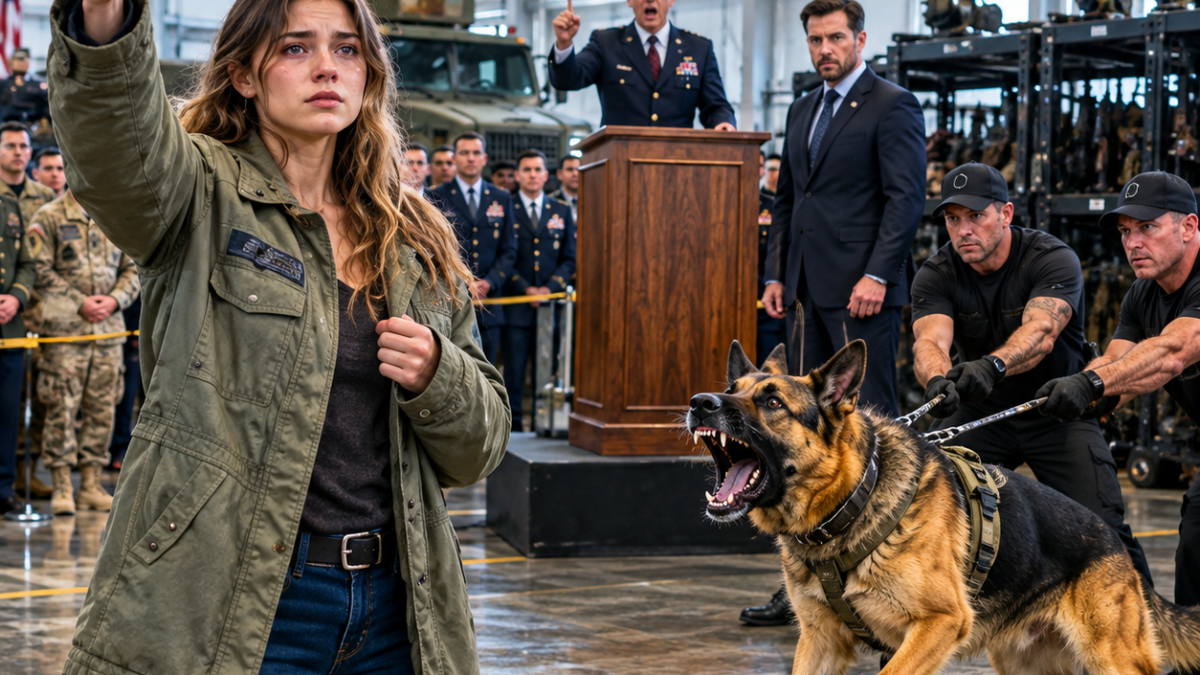
Two kennel masters emerged through the double doors.
They were not walking Titan on a leash.
They were controlling him with dual titanium catch poles attached to a heavy leather harness. The dog between them thrashed with such violent force that both men leaned back with their full weight just to keep him centered.
For one second, Hannah’s mind refused to recognize him.
Titan had been sleek once.
Proud.
Alert.
A dog who moved like he understood the world better than most people.
This animal looked like grief had become flesh.
He wore a heavy leather muzzle strapped tight around his snout. His coat was dull. His eyes were bloodshot and wild. His scarred left shoulder showed a strip of hair that had grown back unevenly. Muscles rippled beneath his fur as he lunged against the poles. His claws scraped the concrete hard enough to send sparks.
A deep, guttural snarl filled the hangar.
Men stepped back.
Even the men who had come to buy dangerous dogs.
“That’s a weapon,” someone muttered.
Frost stepped forward.
His eyes narrowed with interest.
Hannah felt something inside her go cold.
He did not see Titan.
He saw a challenge.
A thing to break.
Garrett raised his hand.
“Opening bid two thousand.”
A police chief lifted his placard.
“Two.”
“Two thousand, do I hear three?”
Frost raised his placard without looking away from Titan.
“Three.”
Titan lunged toward him.
The kennel masters cursed and dragged him back.
Frost smiled faintly.
“Four?” Garrett called.
“Four,” someone shouted from the rear.
“Five thousand,” Frost said immediately.
Evelyn pulled Hannah back.
“Hannah, no.”
But Hannah was already slipping beneath the velvet rope.
At first, nobody noticed her.
She was too small among the men.
Then one contractor stepped aside and looked down.
“What the—”
Another turned.
Then another.
The murmurs spread in a ripple.
A little girl in an oversized olive-drab jacket walked straight down the center aisle of Hangar Four.
Her heart pounded so hard she felt it in her throat, but her steps did not slow.
She did not look at Frost.
Did not look at Garrett.
Did not look at the men who laughed, frowned, or moved out of her way.
She looked only at Titan.
The dog thrashed harder as she came closer.
One kennel master shouted, “Get that kid back! If he breaks loose, he’ll tear her apart!”
“Hannah!” Evelyn screamed.
Hannah stopped three feet from the auction block.
Close enough to smell wet fur, leather, fear, and rage.
Close enough to see foam at the edge of Titan’s muzzle.
Close enough to die if the men lost control.
The hangar fell into stunned silence except for Titan’s snarling.
Hannah reached into the breast pocket of her father’s jacket.
Her fingers shook.
She pulled out the twenty-dollar bill and held it high.
“I bid twenty dollars.”
For a second, nobody moved.
Then Frost laughed.
It was sharp and ugly.
“Is this a joke?”
Hannah did not lower her arm.
Garrett stared down at her, gavel hanging loosely in his hand.
“Little girl, you can’t—”
“I bid twenty dollars,” Hannah repeated.
Her voice cracked.
But it did not disappear.
“This is a military auction,” Frost said, annoyance sharpening his tone. “Not a bake sale.”
Hannah finally looked at him.
Her eyes were wet now, but the tears had not fallen.
“He’s not an asset,” she said. “He’s my dad’s partner.”
The room changed.
Not dramatically.
Not yet.
Just a shift.
“He’s Chief Petty Officer Wyatt Mitchell’s partner,” Hannah said, louder this time. “And he’s all I have left.”
At the name Wyatt Mitchell, Titan froze.
Not slowed.
Not calmed.
Froze.
The two kennel masters nearly stumbled forward because the force they had been fighting suddenly vanished.
Titan’s paws planted on the concrete.
His ears, pinned flat in rage, slowly moved forward.
The snarl died in his throat.
A soft sound replaced it.
A whine.
Tiny.
Broken.
Impossible from an animal so large.
Hannah lowered her arm.
Titan’s nose lifted beneath the muzzle.
He sniffed.
Once.
Twice.
The hangar disappeared for him.
No contractors.
No auctioneer.
No catch poles.
No steel.
There was only scent.
Peppermint chapstick.
Gun oil.
Salt air.
Cotton worn soft at the collar.
The jacket.
Wyatt.
Titan’s legs trembled.
Then the dog who had been called unmanageable, dangerous, and beyond civilian contact sank to his belly on the cold concrete.
A gasp moved through the room.
Titan lowered his massive head.
His bloodshot eyes locked on Hannah.
Then he began to crawl.
The catch poles went slack.
The kennel masters did not know what to do.
Hannah dropped to her knees.
“Hannah!” Evelyn cried, but her voice broke before she could say anything else.
Titan dragged himself forward, belly scraping concrete, muzzle pressed low, whining like his heart had been torn open again. When he reached her, he pushed his muzzled snout into the center of her chest, right over the name tape.
Right over MITCHELL.
Hannah wrapped both arms around his thick neck.
“I know,” she whispered.
Titan shuddered.
“I know he’s gone.”
His body shook harder.
Hannah buried her face in his fur.
“But I’m still here. We’re still a pack.”
That was when the other dogs stopped barking.
No one noticed at first.
The room was too focused on the child and the massive dog trembling against her.
But then the silence spread.
Along the western wall, thirty-four military dogs in reinforced transport crates stopped pacing.
One by one, Belgian Malinois, Dutch Shepherds, Labradors, and German Shepherds turned toward the center aisle.
They sat.
Perfectly straight.
Ears forward.
Chests lifted.
Eyes fixed on Hannah Mitchell in her father’s jacket.
The silence in Hangar Four became absolute.
No barking.
No chains rattling.
No men speaking.
Even Garrett’s mouth hung open.
Thirty-five dogs of war faced the little girl who had spoken a fallen SEAL’s name.
It was not a trick.
It was not logic.
It was not training anyone in that room had ordered.
It was recognition.
Of scent.
Of grief.
Of pack.
Of something older than paperwork and louder than a gavel.
Frost no longer smiled.
His coffee cup hung forgotten in his hand.
Garrett lowered the microphone.
No one moved.
Hannah held Titan while the dogs kept silent watch.
For a moment, Wyatt Mitchell was in the room.
Not as a ghost anyone could see.
As memory.
As loyalty.
As the shape left behind when love refuses to disappear.
Then the spell broke under the crack of boots.
Commander Harrison strode through the barricade.
He was the base commanding officer, the man who had signed the order allowing Titan to be sent to auction. His uniform was immaculate. His jaw was clenched. His face had gone pale beneath military control.
“Auctioneer,” he barked. “Suspend bidding on Lot Forty-Two immediately.”
Garrett blinked like a man waking from underwater.
“Commander, the active bid is five thousand to Vanguard Tactical.”
“Withdraw the animal.”
“I can’t legally suspend an active surplus auction without formal withdrawal documentation.”
Harrison’s eyes snapped toward the kennel masters.
“Secure that dog. Remove the child.”
Titan’s head lifted.
A low growl vibrated through him.
Hannah held tighter.
“No,” Evelyn screamed, shoving past a security guard. “Don’t touch her!”
Harrison pointed.
“That animal is experiencing a temporary lapse in aggression. I will not have a civilian child mauled on my base because people are sentimental.”
Before the kennel masters could move, Elias Frost stepped forward.
“Hold your ground.”
His voice was not loud.
But it cut through the room.
The kennel masters stopped.
Harrison turned on him.
“Mr. Frost, this is a military safety matter.”
Frost did not look at him.
He looked at Hannah.
Then at the name tape on her jacket.
Then at Titan.
Something had changed in his face.
The cold calculation was gone.
In its place was a memory he had not expected to survive.
Frost reached into his coat and removed a sleek leather checkbook.
The click of his pen sounded huge in the silent hangar.
“The bid was five thousand,” Frost said.
Garrett stared.
Frost wrote quickly.
“I am raising my bid.”
Harrison stiffened.
“Mr. Frost—”
“Vanguard Tactical bids fifty thousand dollars for Lot Forty-Two.”
The room erupted in stunned murmurs.
Fifty thousand dollars for a traumatized military dog was absurd.
Financially irrational.
Professionally reckless.
Borderline insane.
Frost tore the check free and placed it on Garrett’s podium.
“Drop the hammer.”
Harrison stepped forward.
“You cannot possibly intend—”
“I said drop the hammer.”
“The animal is a liability.”
Frost finally turned toward the commander.
“No, Commander. What happened here is a liability.”
Harrison’s face tightened.
Frost’s voice hardened.
“I have purchased far more expensive assets from far less competent rooms. The bid is legal. The funds are verified. Unless you would like me to call my attorneys, the Department of the Navy, and three members of the Senate Armed Services Committee from this hangar floor, I suggest we complete the transaction.”
Garrett looked from the check to Frost.
Then to Hannah.
Then to the dogs still sitting in impossible silence.
The old auctioneer’s eyes shone.
He raised the gavel.
“Fifty thousand going once.”
No one countered.
“Fifty thousand going twice.”
Frost did not blink.
“Sold to Vanguard Tactical.”
The gavel cracked against wood.
Titan flinched.
Hannah held him.
“It’s okay,” she whispered. “It’s okay.”
Harrison’s face went rigid with defeat.
Legally, Titan now belonged to Frost’s company.
The worst possible buyer had won.
That was what Evelyn thought for one terrible second.
Then Frost stepped down from the podium and walked toward the center of the floor.
Titan’s eyes followed him.
The kennel masters tensed.
Frost stopped several feet away and lowered himself to one knee.
He did not reach for the dog.
Smart man.
Instead, he placed the bill of sale on the concrete and slid it toward Hannah.
The paper stopped beside her knee.
Hannah looked at it, confused.
Frost’s voice, when he spoke, was quieter than anyone expected.
“When I was a young Marine in Fallujah, a SEAL pulled me off a rooftop after a mortar strike. He carried me through fire while I was bleeding into my lungs.”
Hannah stared at him.
Frost pointed gently toward the name tape.
“His name was Mitchell.”
Evelyn covered her mouth.
Frost swallowed.
“I never got to thank him. By the time I woke up in the field hospital, he had rotated out. Years later, I heard he had a daughter.”
His eyes moved to Titan.
“I did not know he had a dog.”
Titan’s growl faded.
Frost reached slowly into his coat and removed a second document, already folded.
“I came here to buy a perimeter asset for a contract overseas,” he said. “That was before I watched thirty-five war dogs remember what the rest of us forgot.”
He pushed the folded paper toward Hannah too.
“Vanguard Tactical transfers ownership of MWD Titan to the Mitchell family. Effective immediately.”
Hannah did not understand at first.
Then she did.
Her face crumpled.
Frost nodded toward the twenty-dollar bill still clutched in her hand.
“Your bid is good, kid. But keep the twenty.”
His mouth trembled into something like a sad smile.
“A Mitchell always keeps an ace in the hole.”
Evelyn broke down.
Garrett turned away, wiping his eyes with the back of one hand.
The cheering began at the far end of the hangar.
Not from everyone at once.
One contractor clapped first.
Then a police chief.
Then another.
Soon the sound thundered through Hangar Four — men pounding barricades, shouting, clapping, some laughing through tears they pretended not to shed.
Through it all, the thirty-four dogs remained seated at attention.
Titan stayed pressed against Hannah.
His whole body trembled as she held him.
The muzzle was removed only after the base veterinarian arrived and Hannah was safely seated beside her mother on a folded blanket near the edge of the hangar.
Everyone expected violence.
It did not come.
The vet unbuckled the straps carefully while Frost, Evelyn, and two handlers stood ready.
Titan’s jaws came free.
He panted once.
Twice.
Then turned and licked Hannah’s chin.
The whole hangar went quiet again.
Hannah laughed and sobbed at the same time.
“Hi, Titan,” she whispered.
His tail did not wag.
Not yet.
But his eyes, still haunted, were no longer empty.
Paperwork took six hours.
Hannah did not leave Titan’s sight.
Titan did not leave hers.
Commander Harrison tried twice to object. Frost’s attorneys handled the first objection. Evelyn handled the second with a voice so cold that Hannah had never heard it before.
“My husband gave his life on a mountain,” Evelyn told the commander, “and his dog was almost sold because no one in this chain of command could tell grief from aggression. If you want to argue more, do it in writing. My daughter is taking her father’s dog home.”
Harrison said nothing after that.
At dusk, Titan climbed into the back of Evelyn’s SUV.
Not easily.
He was too tense, too wounded, too unsure.
But Hannah got in first and sat with her father’s jacket spread across her lap.
“Come on,” she said softly.
Titan looked at the vehicle.
Then at the hangar.
Then at her.
He stepped inside.
Evelyn closed the door and leaned against it for a moment, shaking.
Frost stood nearby.
He had removed his sunglasses.
“You saved us,” Evelyn said.
Frost looked toward Hannah and Titan through the glass.
“No,” he said. “Your daughter did.”
Then he looked at the twenty-dollar bill in Hannah’s hand.
“And maybe your husband did too.”
The ride home was silent.
Titan lay across the back seat with his head on Hannah’s lap, too large for the space, too exhausted to stay alert, too afraid to sleep.
Hannah kept one hand on his neck.
Evelyn drove with tears slipping silently down her face.
At home, Titan refused to enter the house.
Evelyn had expected that.
Feared it, too.
He stood at the threshold, muscles locked, staring into the living room where he had once slept at the foot of Hannah’s bed.
The hallway held too many ghosts.
Wyatt’s boots were no longer by the door.
His voice did not call from the kitchen.
His keys did not sit in the ceramic bowl.
Titan backed away and went to the patio.
That first night, he slept outside on the cold concrete.
Hannah slept inside beside the sliding glass door, wrapped in her father’s jacket.
Evelyn found her there at two in the morning.
“Hannah, baby, you’ll freeze.”
“He’s colder.”
Evelyn looked through the glass.
Titan lay curled against the brick wall, eyes open, scanning the tree line as if enemies might cross their small Virginia backyard.
“He needs time,” Evelyn whispered.
Hannah nodded sleepily.
“I know.”
Time did not move quickly.
Titan’s first weeks at the Mitchell house were difficult.
He paced the yard for hours, always along the fence, always checking the gate, always returning to the back patio where he could see both the house and the street.
He refused to eat from a bowl unless Hannah placed the bowl near the jacket.
He flinched when cars backfired.
He growled at the mailman.
He nearly broke the screen door when two uniformed sailors came to deliver corrected paperwork.
Evelyn sometimes watched him from the kitchen window with fear twisting in her stomach.
Not fear of Titan exactly.
Fear of being wrong.
Fear that love was not enough.
Fear that bringing home a war dog had placed her daughter beside another kind of danger.
But Hannah never rushed him.
Every night, she took her schoolbooks outside and sat cross-legged on the patio, a careful six feet away.
Sometimes she read aloud.
Sometimes she hummed the terrible country songs Wyatt used to sing off-key in his pickup truck.
Sometimes she said nothing.
Titan watched.
The first night, he kept his back to her.
The second, he turned halfway.
By the seventh, his eyes began closing while she read.
By the fourteenth, he rested his chin on his paws.
On the seventeenth night, the storm came.
A hard coastal thunderstorm rolled off the Atlantic, slamming rain against the windows and shaking the house with thunder that sounded too much like artillery.
Titan panicked.
He flattened himself against the patio door, shaking so violently the glass rattled. His eyes went wide. His breath came in harsh bursts. He clawed at the ground as if trying to dig into it.
“Hannah, stay back!” Evelyn shouted.
But Hannah was already moving.
She grabbed Wyatt’s jacket from the chair, slid open the door, and stepped into the storm.
Rain soaked her hair instantly.
Titan whined, lost in a place that was not the backyard anymore.
Hannah threw the oversized jacket across his trembling back and wrapped both arms around his neck.
“I’ve got you,” she whispered.
Thunder cracked overhead.
Titan flinched so hard Hannah nearly fell.
She held on.
“I’m right here. Dad says hold the line.”
Her voice shook.
But she kept saying it.
“We hold the line, Titan. We hold the line.”
Slowly, painfully, the shaking changed.
Not stopped.
Changed.
Titan’s breathing slowed enough for him to hear her.
He lifted his head and looked at the little girl shielding him from a storm she could not control.
Then he stood.
Hannah backed toward the open sliding door.
“Come on,” she whispered. “Come inside.”
For the first time, Titan crossed the threshold.
He walked through the living room without stopping.
Past the couch.
Past Wyatt’s empty chair.
Past the framed flag on the mantel.
Down the hall.
Into Hannah’s bedroom.
He circled twice at the foot of her bed and lay down.
Evelyn stood in the doorway, one hand over her mouth.
Hannah climbed into bed slowly.
Titan placed his head on the floor facing the door.
Guarding.
Home.
From that night forward, Titan became Hannah’s shadow.
He walked her to the bus stop every morning, sitting like a stone statue until she climbed aboard. At three-fifteen, he was waiting in the exact same place when the bus returned, ears forward, eyes scanning every child until he found her.
If Hannah did homework, Titan’s chin rested on her feet.
If she ate dinner, Titan lay beneath the table.
If she cried quietly into her pillow, Titan climbed halfway onto the bed even though he was too large and rested his head beside hers.
He never became easy.
He hated fireworks.
He distrusted uniforms.
He did not allow strangers to touch him.
He sometimes woke growling at memories no one else could see.
But he never once hurt Hannah.
And piece by piece, Evelyn stopped seeing a weapon.
She saw a soldier who had lost his handler.
A guardian trying to complete one final mission.
Six months after the auction, on the anniversary of Wyatt Mitchell’s death, Evelyn drove Hannah to Arlington National Cemetery.
Titan came with them by special clearance.
He wore a service harness and moved with solemn precision through the endless white rows of headstones. The sky was brilliantly blue that day, almost cruelly beautiful.
Hannah held his leash.
She wore the olive-drab jacket despite the mild weather.
The twenty-dollar bill was still in the breast pocket.
Not spent.
Never spent.
As they neared Wyatt’s section, Titan suddenly pulled ahead.
Not hard enough to drag Hannah.
But with purpose.
“Hannah,” Evelyn said.
“I’ve got him.”
Titan moved between rows of white marble as if following a map only he could see.
Then he stopped.
Not at Wyatt’s grave.
Three rows away.
He sat sharply at attention in front of a different headstone and let out a low whine.
Hannah frowned and stepped beside him.
Evelyn read the name.
SERGEANT DANIEL MILLER
COMBAT MEDIC
UNITED STATES ARMY
Her breath caught.
“Oh my God.”
“Mom?”
Evelyn touched the headstone with shaking fingers.
“This was the medic.”
“What medic?”
“The man your father held the line for. The man they loaded onto the helicopter. He survived the mountain, but…”
She swallowed.
“He died two weeks later in Germany.”
Titan raised one paw and placed it gently against the base of the stone.
Hannah knelt beside him.
“He remembers him,” she whispered.
Titan stared at the name.
Not frantic.
Not broken.
Honoring.
“He remembers the pack.”
Evelyn cried then.
Not loudly.
But fully.
Hannah leaned against Titan’s shoulder.
“Dad saved him, didn’t he?”
“Yes,” Evelyn whispered. “He tried.”
Titan lowered his paw.
After a long moment, he stood and led them three rows over.
To Wyatt.
When they reached the headstone, Titan did not howl.
He did not panic.
He lay down in the grass beside the marker and rested his chin on the ground.
Quiet.
Peaceful.
Hannah sat beside him and leaned against his warm side.
For a while, neither mother nor daughter spoke.
There was nothing to say that the dog had not already said by finding both graves.
Wyatt Mitchell was gone.
Sergeant Miller was gone.
But Titan remembered.
And because he remembered, Hannah understood something she had not before.
Her father had not died alone.
He had died with his pack around him.
And his pack had not ended on that mountain.
It had come home to her.
Years later, people would tell the story of Hannah’s twenty-dollar bid.
Some told it like a miracle.
Some like a military scandal.
Some like a story about a child changing the heart of a ruthless contractor.
All of that was true.
But Hannah remembered smaller things.
The smell of the hangar.
The weight of her father’s jacket.
The sound Titan made when he recognized Wyatt’s name.
The way thirty-four dogs turned toward her.
The feel of Titan’s muzzle pressing against her chest.
The words she said before she even understood their full meaning.
We’re still a pack.
Titan lived the rest of his years as part of the Mitchell family.
Not as property.
Not as an asset.
Not as a weapon.
As a guardian.
As memory.
As the living bridge between a little girl and the father she had lost.
He grew older. His muzzle whitened. His shoulder ached in winter. He slept more. He still walked Hannah to the bus stop until she was too old to need walking, and then he walked her anyway because need had nothing to do with it.
When Hannah turned sixteen, she still kept the twenty-dollar bill.
By then, it was worn, creased, and soft from being carried in her wallet. She could have framed it. Evelyn suggested it once.
Hannah refused.
“Dad said to keep it for an emergency,” she said.
Evelyn smiled sadly.
“And if another emergency comes?”
Hannah looked down at Titan, asleep at her feet.
“Then I’ll have it.”
Titan’s tail thumped once.
As if he approved.
On quiet evenings, Hannah sometimes sat on the back porch with Titan’s head in her lap, listening to the ocean wind move through the neighborhood trees. She would run her fingers over the scar on his shoulder and think about all the things adults had been wrong about.
They were wrong that grief made Titan dangerous beyond love.
Wrong that a child had no place in a room full of powerful men.
Wrong that money decided worth.
Wrong that a dog trained for war could not understand family.
Wrong that her father was gone from everything.
Wyatt Mitchell was in the jacket.
In the dog.
In the twenty-dollar bill.
In the way Hannah stood when something mattered.
In the way Titan still lifted his head whenever someone said pack.
One autumn evening, years after the auction, Titan did not rise when Hannah came home from school.
He wagged his tail.
But he did not rise.
Evelyn was already sitting beside him on the living room floor, one hand resting gently on his ribs.
Hannah knew.
You always think you will not know, and then you do.
She dropped her backpack.
“No,” she whispered.
Titan’s eyes moved toward her.
Still dark.
Still loyal.
Still searching for his girl.
Hannah lay down beside him, wrapping both arms around his neck the way she had in Hangar Four and during the thunderstorm and on countless nights when nightmares found them both.
“I’m right here,” she whispered.
Evelyn cried silently.
The veterinarian came to the house.
Titan did not like clinics, and Evelyn refused to make his last memory smell like disinfectant and fear. He lay on Wyatt’s jacket at the foot of Hannah’s bed, exactly where he had finally chosen to sleep years before.
Hannah kept the twenty-dollar bill in her hand.
Not because money mattered.
Because memory did.
She pressed her forehead to Titan’s.
“You brought him back to me,” she whispered. “You know that?”
Titan breathed out softly.
“You brought Dad back.”
His tail shifted once.
Barely.
Enough.
Hannah’s voice broke.
“Rest now, Titan. We held the line.”
Titan’s eyes closed.
He was not afraid.
Not this time.
When he let go, he was warm, safe, and surrounded by his pack.
They buried him in the backyard beneath the dogwood tree Wyatt had planted when Hannah was born.
Elias Frost came to the small memorial.
So did three of Wyatt’s former teammates.
So did Garrett, the auctioneer, older and quieter now, holding his hat in both hands.
Frost placed a folded document beside Titan’s marker.
Hannah recognized it.
The transfer of ownership.
The paper that had given Titan back to them.
“I thought you might want it,” Frost said.
Hannah looked at the paper.
Then at the grave.
“No,” she said softly. “He was never owned.”
Frost lowered his eyes.
“You’re right.”
She folded the paper once and handed it back to him.
“Keep it. So you remember.”
Frost took it like a medal.
The marker was simple.
TITAN
PARTNER. GUARDIAN. PACK.
HE FOUND HIS WAY HOME.
Hannah stood there long after everyone else went inside.
The twenty-dollar bill remained in her pocket.
The wind moved through the dogwood branches.
For a moment, she thought she heard the echo of dogs sitting at attention in a cavernous hangar.
Maybe memory.
Maybe imagination.
Maybe loyalty has a sound only the grieving can hear.
Years passed.
Hannah grew into a young woman with her father’s stubborn jaw, her mother’s steady hands, and Titan’s deep suspicion of people who called living beings assets.
She studied veterinary medicine first, then specialized in working dog rehabilitation. She became known for taking the cases other people described as too damaged, too aggressive, too shut down, too hard.
Whenever someone told her a dog was impossible, she asked, “Who taught him he had to be?”
In her office, she kept three things on the wall.
A photograph of Chief Petty Officer Wyatt Mitchell kneeling beside Titan and a much younger Hannah.
A framed patch from Titan’s service harness.
And a small shadow box containing a faded twenty-dollar bill.
People asked about it sometimes.
She would smile.
“That was my first bid.”
If they asked whether she won, she always looked toward the rehab yard, where frightened dogs learned slowly that hands could be gentle, doors could open, and not every uniform meant goodbye.
“Yes,” she would say. “But not because I had enough money.”
The truth was simpler and larger than that.
A fallen SEAL’s daughter walked into a room full of men who thought everything had a price.
She raised her last twenty dollars.
She spoke her father’s name.
And every military dog turned toward her because some bonds do not die when the handler falls.
Some loyalties wait.
Some griefs can still recognize home.
And sometimes, the smallest person in the room is the only one brave enough to remind everyone else what a hero is worth.








