A Dying Man Brought His Cat to Our Shelter—And Left Four Pages Teaching a Stranger How to Love Her
PART3:
He was telling me the plainest fact in the world with the voice of someone who had already had every other choice removed.
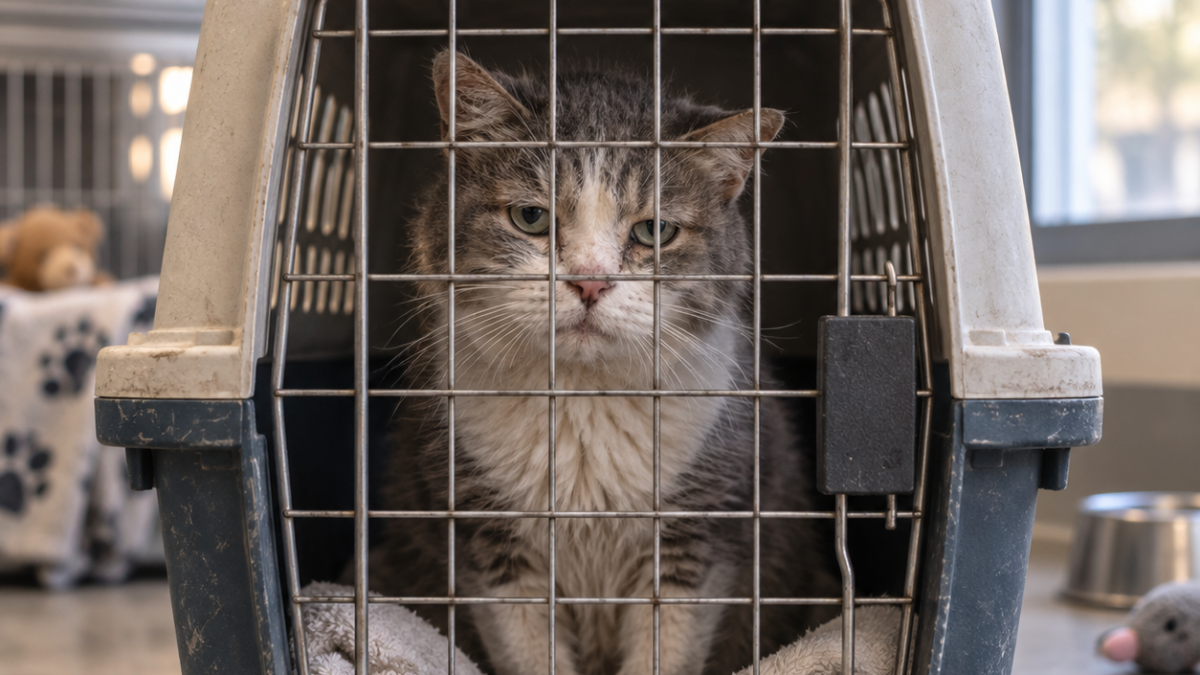
I looked at Bea’s carrier.
Inside, one green eye reflected through the bars.
“I’m very sorry,” I said.
He nodded as if he had heard those words enough that they had lost shape.
“Her records are in the folder.”
He touched the kraft paper with two fingers.
“Everything someone would need to know.”
I carefully removed the folder from the side of the carrier.
It was thicker than most adoption packets.
Much thicker.
“Would you like to sit while we go through the form?”
He looked toward the lobby chairs.
Then at Bea.
“I don’t know if I can do it sitting down again.”
So we stood together at the counter.
His name was Arthur Bell.
He wrote it slowly on the intake form, his hand shaking slightly. His address. Phone number. Emergency contact. Veterinarian. Bea’s age. Spayed. Indoor only. Medical conditions: mild arthritis, early kidney changes, sensitive stomach.
Reason for surrender.
He paused there for a long time.
The pen hovered.
Then he wrote:
Owner entering end-of-life care. No family able to take her.
No family able to take her.
I read that line upside down from my side of the counter and felt something in me ache.
“Do you have anyone we should contact about updates?” I asked.
“My neighbor, Mrs. Alvarez, will answer for another day or two,” he said. “After that…”
He did not finish.
He did not need to.
I forced myself into the steady voice shelter work requires.
“We’ll take good care of her.”
His mouth moved.
Not quite a smile.
Not relief either.
Hope, maybe, but hope hurt too much to show fully.
“She doesn’t know I’m sick,” he said.
I looked at him.
“She knows I’ve been coughing. She knows I sleep more. She sits beside me. But she doesn’t understand why I’m leaving her.”
His fingers pressed harder into the carrier top.
“She thinks I’m bringing her here for an appointment. Or maybe she thinks I’m moving her somewhere strange and coming back. I don’t know what cats understand.”
His voice broke on the last word.
I did not tell him cats live in the moment.
People say that when they want grief to be smaller than it is.
Maybe animals do not understand death the way we do.
But they understand absence.
They understand the door that never opens again.
They understand the bed that smells like someone fading.
They understand routines breaking.
They understand being left.
Arthur looked at me with sudden urgency.
“She’s not difficult,” he said.
“I believe you.”
“She hides when she’s scared, but she’s not mean. She does this little chirping sound when she wants attention, but if she makes a low sound, you leave her alone. She sleeps on the left side. She likes the radio. Not television. Radio. Soft talking. Baseball is fine. Classical music is fine. She does not like coughing.”
He stopped, embarrassed by the speed of his own words.
“I wrote it down.”
“I’ll read it,” I said.
He held my gaze.
“All of it?”
“Yes.”
“Will the adopter read it?”
“Yes.”
I could not promise many things in that job.
I could not promise every animal would find a home.
I could not promise no one would ever fail them again.
I could not promise time.
But I could promise that the letter would be read.
Arthur exhaled slowly.
“She’s never slept alone,” he said.
That sentence nearly undid me.
For a moment, the lobby sounds faded.
The phone.
The printer.
The barking from the kennel hallway.
All I could hear was this dying man standing at my counter, trying to solve the one heartbreak still under his control.
“What would you like us to know right now?” I asked.
He looked down at the carrier.
Bea had moved closer to the door.
Gray tabby.
Soft face.
Green eyes.
White around her mouth like she had dipped her chin in milk.
“She likes being talked to,” he said. “But not fussed over. She needs someone patient enough not to make her prove she’s grateful.”
I wrote that down.
Patient. Talk to her. Do not force affection.
He watched my pen move.
That seemed to help.
“She’ll hide three days,” he said. “Maybe under a bed if there is one. Don’t pull her out. She’ll come out on the fourth day if the room is quiet.”
“Okay.”
“She eats wet food in the morning. Half can, warmed with a spoonful of water. Dry food at night, but not too much. She’ll overeat if nervous.”
“Okay.”
“She likes to sit near windows, but not in direct sun. She gets too warm.”
“Okay.”
“She hates plastic bags.”
I nodded.
“And vacuum cleaners. And loud coughing.”
“I saw that in the folder.”
He looked down at his wrist.
“Yes.”
Then he whispered, “I can’t help the coughing anymore.”
I had worked at Pine Hollow for seven years.
I had seen dogs arrive covered in mange.
Kittens left in sealed boxes.
Senior animals surrendered because their care became expensive.
Families weeping.
Children screaming.
Old men pretending not to cry.
I thought I had built enough armor to stay useful.
But that sentence went through everything.
I can’t help the coughing anymore.
As if he were apologizing to the cat for a symptom of dying.
I pushed a tissue box across the counter.
Not to him.
Closer to both of us.
He took one.
“Can I say goodbye in one of your rooms?” he asked.
“Of course.”
I led him to our small meet-and-greet room at the back of the adoption hallway. It had two chairs, a washable rug, a cat tree, and a window looking out over the staff parking lot. The walls were painted pale yellow years earlier by volunteers who believed color could soften institutional sorrow. Sometimes it did.
I placed the carrier on the floor.
“I’ll give you privacy.”
He nodded.
I closed the door behind me.
Through the little window in the top half of the door, I saw him lower himself carefully to the floor beside the carrier. It took effort. His hand shook when he opened the metal latch.
Bea did not come out immediately.
Arthur lay one hand flat on the rug.
He spoke to her.
I could not hear the words.
I am grateful for that.
Some goodbyes should not become anyone else’s memory.
I walked away.
Twenty minutes passed.
Then thirty.
Then forty-five.
No one interrupted.
When I checked through the small window again, Bea was out of the carrier. She sat pressed against Arthur’s thigh, her tail wrapped over his wrist. His hand rested on her back, moving slowly from shoulders to hips in a rhythm that looked practiced by years.
His lips moved.
Bea blinked up at him.
I stepped back before I became an intruder.
After an hour, the door opened.
Arthur stood in the doorway with the empty look of a man who had just cut his own heart out carefully because it needed somewhere safer to go.
Bea was back in the carrier.
He had latched it.
The kraft folder sat on top.
“I can’t look back when I leave,” he said.
“You don’t have to.”
“If she cries—”
“We’ll stay with her.”
His face twisted.
“She might not. She’s polite when she’s scared.”
I could not speak for a second.
Then I said, “We’ll still stay.”
He nodded.
At the front door, he stopped.
His back was to me.
For one terrible moment, I thought he might turn around after all.
He did not.
He pressed his hand once against his chest, over his heart, then walked out into the gray afternoon.
He never looked back at the carrier.
People sometimes think not looking back means coldness.
They are wrong.
Sometimes it means the person has only enough strength to leave once.
The lobby door closed behind him.
Bea made no sound.
Not one.
That hurt more than crying would have.
I took her into our quiet intake room myself.
She remained in the back of the carrier, body tucked tight, eyes open. I opened the door and placed the carrier inside a large kennel already prepared with a covered bed, litter box, water, and the green towel Arthur had left with her. I did not reach in.
“Hi, Bea,” I said softly. “My name is Claire. I’m going to read your instructions.”
Her eyes stayed on me.
I sat on a stool beside the kennel and opened the kraft folder.
The first section was her veterinary record.
Eleven years of care.
Vaccines.
Spay certificate.
Dental cleanings.
Bloodwork.
Urinalysis.
Arthritis notes.
Kidney values tracked carefully in Arthur’s handwriting beside the printed labs.
Every appointment kept.
Every prescription noted.
Every recommendation followed as far as I could tell.
Some cats arrive with no history at all.
Bea arrived with proof of being loved in receipts, lab reports, and careful margins.
The next page was typed.
BEA’S FOOD SCHEDULE.
Wet food: 7:00 a.m., half can, warmed slightly, add one tablespoon warm water.
Dry food: 6:00 p.m., one-quarter cup.
Treats: two after brushing, no more or she vomits.
Water: wide ceramic bowl. She does not like stainless steel.
Then a handwritten page.
Things that frighten Bea:
Vacuum cleaners.
Plastic grocery bags.
Loud coughing.
Men wearing boots indoors.
Thunder.
Being picked up.
Hands reaching too quickly over her head.
Children running.
The page after that:
Things Bea likes:
The space between couch cushions.
The radio.
Evening brushing.
Sitting near a window, but never in direct sunlight.
Warm laundry.
Cardboard boxes with one side open.
Being spoken to in the morning before food.
Baseball games on the radio.
The left side of the bed.
I stared at that last line.
The left side of the bed.
Then I opened the letter.
It was handwritten on lined notebook paper, four pages front and back, folded once. His handwriting started carefully, then grew shakier, as if fatigue had entered halfway through and he had kept writing anyway.
At the top, he had written:
To the person who takes Bea home.
I will not share the whole letter.
Even now, after everything, it does not feel like mine to give away.
But I can tell you what it was.
It was not dramatic.
That made it worse.
Arthur did not write a grand speech about love. He did not beg. He did not flatter. He did not make himself the hero of Bea’s life. He simply explained her.
The sound she made when she wanted attention.
The different sound she made when she wanted to be left alone.
How she hid when frightened but went completely still when sick.
How she slept curled against his left side because, eleven years earlier, she had been a kitten who fit between his ribs and elbow, and then she simply never moved.
How she liked him to say “good morning, little bee” before breakfast.
How she did not enjoy being carried, but if there was thunder, she would allow it for exactly as long as the storm lasted.
How she hated the smell of oranges.
How she would pretend not to like brushing, then lean into the brush by the third stroke.
How she might refuse food the first day in a new place, but if she refused past the second morning, call the vet.
How grief might look like illness and illness might look like grief, and please be careful with both.
Then near the end, the handwriting changed.
The lines slanted downward.
The ink pressed harder.
He wrote:
I know there are younger cats. I know there are easier cats. I know she is not a kitten and she will not give you many years. But the years she gave me were the best ones I had after my wife died. She made the house less empty. She made mornings happen. She made me speak out loud when I might have gone whole days without using my voice.
I covered my mouth with one hand.
In shelter work, you learn not to cry over every story because if you do, you will have nothing left for the animals in front of you.
But some stories are not every story.
Arthur’s letter ended with one sentence I have never forgotten.
She does not know I am sick. Please do not let her believe I left because I wanted to.
I sat beside Bea’s kennel and cried quietly.
She watched me from the carrier.
Then, very slowly, she blinked.
Not forgiveness.
Not comfort.
Just presence.
Sometimes that is enough.
Bea stayed in her carrier for the first hour after Arthur left.
Just as he had written, she made no sound.
When I opened the kennel later and removed the top half of the carrier so she could come out without being pulled, she stood slowly, stepped onto the green towel, looked around the room, and then walked directly into the covered bed in the back corner.
She hid for three days.
Exactly as Arthur said she would.
On the first day, she did not eat.
We warmed her food anyway.
Talked softly.
Kept the lights low.
Placed a radio outside the intake room door playing an oldies station because we did not have baseball that afternoon.
On the second day, she ate two bites when no one watched.
On the third, she used the litter box, drank water from the wide ceramic bowl our kennel lead bought on her lunch break, and hissed once when a volunteer forgot and rustled a plastic trash bag too close to the door.
“Plastic bags,” I said.
The volunteer froze.
Then whispered, “Arthur was right.”
Arthur was right about everything.
On the fourth day, Bea came out.
Not dramatically.
No swelling music.
No leap into anyone’s arms.
At 9:20 in the morning, I walked into the quiet room with her warmed food and found her sitting at the front of the kennel, paws tucked neatly beneath her, green eyes waiting.
I stopped.
“Good morning, little bee,” I said, because that was what Arthur had written.
Her ears moved.
I placed the food down.
She stepped forward and ate.
I had to turn away.
By then, everyone on staff knew about Bea.
Not because I posted her story online.
I did not.
Arthur’s grief was not shelter marketing.
People forget that sometimes. They think every heartbreaking thing needs to become a fundraiser, a viral post, a caption with crying emojis and a call to action. But Arthur had entrusted us with Bea, not with his final hours as content.
So we told only the people who needed to know.
Our manager, Denise.
Our kennel lead, Marco.
The medical team.
A few trusted volunteers.
And every person who met Bea had to read the instruction pages before handling her.
Not skim.
Read.
Marco, who looked like he had been built out of lumber and sarcasm, stood in the hallway after reading the letter and wiped his eyes with his sleeve.
“Allergies,” he said.
“To paper?” I asked.
“Shut up, Claire.”
Bea’s adoption profile was simple.
Gray tabby, female, eleven years old.
Quiet senior cat.
Needs patient home.
No young children.
No dogs.
Indoor only.
Loves radio, windows, brushing, and calm routines.
Comes with detailed care notes from previous owner.
That last line did more work than I expected.
People paused at it.
Some smiled.
Some asked what it meant.
A few read the letter and left quickly, unable to hold the weight of it.
I did not blame them.
Love near death is not something everyone can volunteer to inherit.
On day five, a woman named Ellen Whitcomb came in.
I remember her because she did not walk first to the kittens.
Almost everyone walks to the kittens first.
It is human nature. Kittens are unfair little miracles. They climb, tumble, squeak, sleep in piles, and make people forget their own practical limits.
Ellen entered alone, wearing a navy coat and carrying reading glasses on a chain around her neck. She was in her early seventies, with silver hair cut neatly at her jaw and eyes that looked tired but kind.
“I’m looking for an older cat,” she said.
“How old?”
“Old enough that nobody else is looking for her.”
I stood a little straighter.
We had senior cats.
We always had senior cats.
Beautiful old souls waiting while kittens flew out the door like confetti.
I showed her two first.
Marmalade, a twelve-year-old orange male who loved everyone and drooled when happy.
Tessa, a ten-year-old tortoiseshell with thyroid medication and the moral certainty of a retired judge.
Ellen was gentle with both.
Then she stopped in front of Bea’s kennel.
Bea sat near the back, not hiding exactly, but not inviting anything either.
Ellen read the card.
“Detailed care notes from previous owner,” she said softly.
“Yes.”
“May I read them?”
I hesitated.
Not because I did not want her to.
Because handing over Arthur’s words felt sacred.
Then I remembered his question.
Will the adopter read it?
“Yes,” I said.
I brought her to the lobby bench and handed her the kraft folder.
She read the typed food schedule first.
Then the fear list.
Then the likes.
When she reached the letter, she adjusted her glasses.
By the second page, tears were running down her face.
She did not wipe them at first.
She just kept reading.
At the last sentence, she pressed the paper to her chest and closed her eyes.
I sat behind the counter pretending to organize microchip forms.
Finally, Ellen looked up.
“My husband died last spring,” she said.
I turned toward her.
“I’m sorry.”
“Thank you.”
She folded the letter along its original crease with great care.
“The house is too quiet. Everyone keeps telling me to get a kitten. Something cheerful. Something playful. But I don’t need cheerful. I need someone who understands quiet.”
I said nothing.
She looked toward Bea’s room.
“Does she sleep on the left side?”
“That’s what he wrote.”
“My husband slept on the right,” she said.
Then she laughed once, very softly.
“Maybe we’ll get along.”
When Ellen met Bea, she did everything right.
She did not reach in.
Did not coo too loudly.
Did not try to make Bea perform affection so Ellen could feel chosen.
She sat on the floor outside the open kennel with one hand resting palm-up on her knee and spoke in a low voice about nothing in particular.
The weather.
The drive.
The fact that her house had three good windows, one of which got morning light but not direct sun.
Bea watched.
Five minutes passed.
Ten.
Then Bea stepped forward.
She sniffed Ellen’s fingertips.
Ellen did not move.
Bea blinked.
Then retreated two steps.
Ellen smiled through tears.
“That’s more than enough for today,” she said.
That is when I knew.
Not because Bea leaped into her lap.
Because Ellen did not need her to.
We finalized the adoption two days later.
Ellen used the time to prepare the house. She bought the same food. A ceramic water bowl. A soft brush. A radio for the bedroom. She moved a small table near the window but slightly out of direct sun. She placed an open cardboard box beside the couch.
“I hope I’m not being ridiculous,” she said when she came to pick Bea up.
“You’re being exactly right.”
Bea entered the carrier reluctantly but calmly. The green towel went with her. So did the food, the vet records, the fear list, the likes list, and Arthur’s letter in the kraft folder.
Before Ellen left, she held the folder against her chest.
“Do you know if he’s still alive?”
I had wondered too.
Mrs. Alvarez had called that morning.
Arthur had passed away at 4:12 a.m.
I told Ellen gently.
She closed her eyes.
Then looked down at Bea’s carrier.
“I’ll tell her,” she said.
That sentence stayed with me.
Not “I’ll tell her he died.”
Not “I’ll explain.”
Just:
I’ll tell her.
As if Bea deserved the truth in whatever way she could receive it.
Ellen sent the first update three days later.
No photo.
Only a message.
She is still hiding under the bed. Food is being eaten at night. Radio is on. I am leaving her alone. Arthur was right.
On the fourth day, she sent a picture.
Bea sat half under a floral armchair, one paw visible, green eyes glowing in the shadows.
Caption:
She came out at 8:40 this morning.
Arthur was right.
A week later:
She slept on the left side.
Two weeks later:
She likes the baseball station.
One month later, Ellen came to the shelter in person with a donation check and a small envelope.
Inside was a photograph.
Bea curled on the left side of a bed beneath a blue quilt. A radio sat on the nightstand. The curtains were open near a window where light touched the floor but not the bed. Bea’s eyes were half-closed, her body relaxed in the boneless way of a cat who has decided, cautiously, that the world may be survivable.
On the back, Ellen had written:
Home.
I pinned the photo inside my locker, not on the public board.
Some stories belong partly to the world.
This one still felt like it belonged to Arthur, Ellen, and Bea.
Months passed.
Bea became, according to Ellen, “a polite dictator.”
She demanded brushing every evening at 7:30. She refused treats if they were placed in the wrong dish. She sat near the window but never in direct sun. She left the room when Ellen’s neighbor visited wearing heavy boots. She hid during thunderstorms but emerged if Ellen turned the radio up slightly.
Arthur remained right.
About almost everything.
But Ellen discovered new things too.
Bea liked the smell of lavender hand cream.
She disliked flute music.
She preferred quilts to fleece.
She would sit on Ellen’s lap only if Ellen was reading and not paying direct attention.
She had a particular chirp reserved for the moment Ellen turned off the bedside lamp, as if saying goodnight after pretending all day not to care.
“She is becoming mine,” Ellen told me once, then quickly added, “Not instead of his.”
“I understand,” I said.
And I did.
That is one of the strange truths of adopting an animal after loss.
Love does not transfer like paperwork.
It expands.
Bea did not stop being Arthur’s cat when she became Ellen’s. Walter did not stop being Elaine’s cat when Daniel took him home. Mabel did not stop being Emily’s first comfort when Oliver came later. Animals carry every person who loved them properly. They become living archives of hands, voices, routines, rooms, and names.
Ellen was not replacing Arthur.
She was continuing the sentence he could not finish.
A year after Arthur brought Bea to us, Ellen invited me to visit.
I do not usually visit adopted animals. Boundaries matter in rescue work, not just for adopters but for staff. If we followed every animal home emotionally, we would never survive.
But Bea was different.
Or maybe Arthur was.
Or maybe I needed to see that the letter had reached the future he wrote it for.
Ellen lived in a small white house at the end of a quiet street lined with sycamore trees. There were wind chimes on the porch and a clay pot of herbs by the door. When she let me in, the house smelled faintly of tea, old books, and lemon polish.
“Don’t expect a greeting,” she whispered. “She has standards.”
Bea was in the living room, sitting near a window but not in the sun.
Exactly as promised.
She looked older than when I last saw her. Softer around the face. A little rounder. Her gray tabby fur had deepened in winter thickness, and her green eyes remained sharp.
“Hi, Bea,” I said.
Her ears moved.
That was all.
Ellen seemed delighted.
“She remembers you.”
“I think she remembers that I come with paperwork.”
We sat on the couch.
Bea watched from the rug.
After twenty minutes, she stood, stretched, and walked slowly to Ellen. She stepped onto the couch, tested the cushion beside her, then curled between the cushions with a satisfied little grunt.
Ellen’s face softened.
“That’s one of Arthur’s things,” she said. “The space between the cushions.”
On the side table sat the kraft folder.
Still intact.
Not hidden away.
Not displayed like a shrine.
Available.
Respected.
Ellen saw me looking.
“I read the letter every month,” she said.
“You still do?”
“Yes. Less because I need instructions now. More because I think someone should keep reading what love made him write.”
I looked at Bea.
She had closed her eyes.
The radio played softly in the kitchen.
Baseball.
I thought of Arthur’s thin hand on the carrier.
His voice saying, She’s never slept alone.
His last sentence.
Please do not let her believe I left because I wanted to.
“I think you did what he asked,” I said.
Ellen touched Bea’s back with two fingers.
“I hope so.”
That visit stayed with me more than I expected.
When I went back to the shelter the next day, the lobby looked the same.
Same counter.
Same donation jar.
Same bulletin board.
Same scuffed floor.
Same endless need.
But I found myself watching the people more carefully.
A young couple surrendering a dog because their baby was allergic.
A college student crying over two rats she could not bring into campus housing.
An older man bringing in his late sister’s parakeet with its cage covered by a towel.
I thought of Arthur.
I thought of how easy it would have been to see only the surrender.
To file Bea as another cat given up.
To mark the reason, process the form, move on.
The paperwork never tells the whole truth.
Sometimes “owner surrender” means abandonment.
Sometimes it means love failed.
Sometimes it means love ran out of time.
Arthur’s four pages changed the way I read every intake after that.
Not because everyone is Arthur.
They are not.
But because every animal arriving at our counter has a life behind them that cannot fit in a checkbox.
Favorite sleeping place.
Fear of plastic bags.
Sound they make when lonely.
Window they loved.
Person they are waiting for.
The last time I saw Bea, she was thirteen.
Ellen brought her to our low-cost clinic for bloodwork, and I recognized the carrier before I recognized either of them. Same blue carrier. Same green towel, though faded and thinner from washing.
Bea looked older.
So did Ellen.
So did I, probably.
Time is not subtle in shelter work.
“She still sleeps left?” I asked.
Ellen smiled.
“Every night.”
“Radio?”
“Every day.”
“Still hates plastic bags?”
“With moral conviction.”
Bea blinked at me from the carrier.
I reached one finger toward the door.
She sniffed it.
Then gave the tiniest chirp.
I had read Arthur’s description of that sound years earlier.
Attention, but dignified.
I laughed softly.
“Good girl.”
Ellen’s eyes filled.
“She’s slowing down.”
“I’m sorry.”
“She’s not suffering. Dr. Patel says we’re watching comfort now.”
I nodded.
Comfort.
That word becomes sacred when time gets short.
Ellen looked down at the carrier.
“I was afraid to take her because I knew I’d lose her soon.”
I did not answer too quickly.
She continued, “But soon has been two years. Two whole years of someone meeting me at the bedroom door and complaining about the radio station.”
Her smile trembled.
“I would have missed all of that if I had protected myself from the ending.”
That is the argument for loving senior animals.
Not that it will not hurt.
It will.
Not that time becomes generous because you are kind.
Sometimes it does not.
The argument is that love is not measured only in length.
It is measured in presence.
In keeping the radio on.
In warming the food.
In leaving the bed’s left side open because someone who is gone once mattered there.
In reading four pages written by a dying man and deciding they deserve to become a routine instead of a relic.
Bea passed away quietly the following spring.
Ellen called me herself.
“She went in her sleep,” she said. “On the left side.”
I sat down behind the shelter counter.
The lobby was full that morning.
A man waiting with a stray dog.
A mother filling out a foster application.
Two kittens crying from a carrier.
The world did not stop.
It almost never does.
But for a second, I let myself be still.
“Was the radio on?” I asked.
Ellen’s breath caught.
“Yes.”
“Good.”
“She wasn’t alone.”
“I know.”
“No,” Ellen said softly. “I mean Arthur asked for that. And she wasn’t. Not once.”
I looked toward the intake room where Bea had hidden for three days exactly as he predicted.
“No,” I said. “Not once.”
A week later, Ellen came by with the kraft folder.
I thought she was returning it for our records.
Instead, she handed me a copy.
“I kept the original,” she said. “I hope that’s all right.”
“Of course.”
“I thought maybe the shelter should have a copy. Not to show everyone. Just to remember.”
Inside were photocopies of the food schedule, the fear list, the likes list, and Arthur’s letter. Ellen had added one page of her own.
Things I learned about Bea after Arthur:
She liked lavender hand cream.
She disliked flute music.
She pretended not to like quilts, then stole mine.
She chirped goodnight.
She missed him, I think.
She loved again anyway.
I read that last line three times.
She loved again anyway.
That, to me, is Bea’s story.
Not just the dying man.
Not just the shelter.
Not just the letter.
Bea lost the person who had been her whole world, hid for three days, came out on the fourth, and let herself be loved by someone new.
That is not small.
Animals are braver than we deserve sometimes.
They survive our disappearances without understanding our explanations. They enter new rooms carrying old smells. They trust new hands because the alternative is to stop living before life has actually ended.
Bea loved again.
So did Ellen.
And because Arthur wrote four pages when he had almost no time left, that second love had a map.
I keep the copy of the letter in our staff room now, in a plain folder labeled READ WHEN YOU FORGET WHY THIS WORK MATTERS.
Not everyone reads it.
Some people do.
New volunteers sometimes find it after a hard shift. Staff read it after a difficult surrender, after an adoption falls through, after someone says, “It’s just a cat,” and we need to remember how false that sentence can be.
The last line still breaks everyone.
She does not know I am sick. Please do not let her believe I left because I wanted to.
There are days I think shelter work is impossible.
Days when every kennel is full.
Days when the phone never stops.
Days when people are careless, cruel, impatient, or so broken themselves that they break animals on the way down.
Then I think of Arthur.
A man with three days left, using some of his final hours not to write about himself, not to complain, not to rage at the unfairness of leaving, but to explain to a stranger how to warm half a can of cat food with a spoonful of water.
How to tell the difference between Bea’s attention chirp and her leave-me-alone sound.
How to know when hiding was fear and when stillness meant illness.
How to love her specifically.
That is the part people misunderstand about love.
They think love is only the big declaration.
The rescue.
The sacrifice.
The tears.
Sometimes love is four pages of instructions.
A vet record folder.
A food schedule.
A list of fears.
A note about the left side of the bed.
A dying man’s hand resting on a carrier because he cannot hold on to life, but he can still hold on to responsibility for one more afternoon.
Arthur could not stay.
Ellen could.
That was the bridge.
And Bea crossed it.
I have processed thousands of intakes.
I remember many.
But I remember Arthur Bell standing at my counter more clearly than almost anyone.
The brown cardigan.
The hospice bracelet.
The way he did not look back because looking back would have broken the last piece of strength he needed to leave.
The carrier with Bea’s name written carefully across the folder.
The silence after the door closed.
The cat who hid for three days.
The woman who cried before finishing the second page.
The first update: Arthur was right.
The final one: She went in her sleep, on the left side, with the radio on.
That is what eleven years of love looked like when written down.
Not perfect.
Not dramatic.
Not enough to stop death.
But enough to guide a stranger.
Enough to keep a cat from sleeping alone.
Enough to turn surrender into continuity instead of abandonment.
Enough to make sure Bea never believed she was left because she was unwanted.
She was wanted.
Desperately.
Tenderly.
Carefully.
To the very end of one life, and then into the beginning of another.
So when people ask me how I keep doing this job, I think of a gray tabby named Bea.
I think of Arthur’s letter.
I think of Ellen leaving the left side of the bed open.
And I think that maybe rescue is not always about saving a life from death.
Sometimes it is about saving love from being misunderstood after someone is gone.
Bea is home now.
Arthur made sure of it.
Ellen made sure of it.
And for a little while, our shelter got to be the place where one man’s final act of love found the person willing to read every word and follow them.








