A Disabled Veteran Nurse Was Humiliated on a Lonely Highway—Then a Police K9 Suddenly Recognized Him, and What Happened Next Forced Everyone to See the Truth
PART2:
When blood pooled under a gurney, Abram moved faster than anyone.
When new nurses panicked, they looked for him.
Dr. Emily Larson, the attending physician on most nights, once told him, “You’re the calmest person in this building.”
Abram had smiled.
“That’s because everybody here usually has all their limbs attached.”
She had thrown a pen at him.
He liked Emily.
She understood gallows humor and did not treat him like glass.
Most people at Oak Creek respected him.
Patients loved him.
Families trusted him.
Nurses leaned on him.
Doctors listened when he spoke.
Only one man seemed to consider Abram’s calm a personal insult.
Officer Greg Harrison.
Harrison was the kind of cop who entered the ER as if doors existed to announce him. Broad-shouldered, buzz cut, square jaw, chest puffed beneath a uniform that was always too tight across the arms. He wore his badge like a crown, not a responsibility.
Most officers who came through Oak Creek knew how to behave in a medical environment. They gave space when asked. They understood that injured suspects were still patients. They waited for doctors to clear people before forcing questions through pain.
Harrison did none of that.
He crowded.
He barked.
He threatened.
He treated nurses like obstacles and patients like evidence bags.
The feud between him and Abram began three weeks before the storm.
It was a Saturday night.
The ER was packed.
PART3:
Flu season had arrived early, two college students had collided with a guardrail, and a toddler had shoved a bead so far up her nose that three adults were emotionally involved in its recovery.
Abram was documenting vitals when the ambulance bay doors opened and Harrison dragged in a nineteen-year-old named Tyler Jenkins.
The kid was handcuffed.
His face was badly bruised.
Blood ran from a laceration above his eyebrow. His pupils were sluggish. He looked like he might vomit or pass out, possibly both.
Harrison shoved him into a plastic triage chair.
“Draw his blood,” the officer snapped.
Abram looked up from the charting tablet.
“Excuse me?”
“He’s under arrest for suspicion of DUI. I need blood tox. Now.”
Tyler blinked slowly, swaying in the chair.
Abram set the tablet down.
He moved toward the teenager first, not Harrison.
“Tyler, can you hear me?”
The boy groaned.
“Head hurts.”
“I bet it does.” Abram lifted a penlight and checked his pupils. “Do you know where you are?”
“Hospital?”
“Good. Do you know what day it is?”
Tyler’s eyes drifted.
“Saturday?”
It was Sunday by then.
Abram’s jaw tightened.
Harrison stepped closer.
“Blood draw, Wells.”
Abram did not look at him yet.
He checked Tyler’s pulse, blood pressure, pupil response, and level of consciousness. Then he turned.
“Does he consent to the blood draw?”
Harrison’s face hardened.
“He doesn’t need to consent. He’s in custody.”
Abram’s voice stayed low.
“Do you have a warrant?”
“I have probable cause.”
“That wasn’t my question.”
The officer stepped into Abram’s personal space, one hand resting casually on his utility belt.
A little intimidation.
A little theater.
A little reminder of gun, cuffs, baton, taser.
It might have worked on someone who had never watched nineteen-year-olds bleed into Afghan dust.
Abram only looked at him.
“Unless you have a signed warrant or the patient gives explicit verbal consent, drawing his blood is assault,” Abram said. “And right now, he’s showing signs of traumatic brain injury. He is not medically capable of informed consent even if he wanted to give it.”
Harrison’s face flushed dark red.
“You obstructing my investigation?”
“I’m treating my patient.”
“He’s a suspect.”
“He is a patient.”
The triage area had gone quiet.
Dr. Larson stepped out of Trauma Bay Two, arms folded.
Nurses paused at medication carts.
A respiratory therapist looked up from a chart.
Harrison noticed the audience.
That was the worst thing that could have happened to his ego.
“You think because you’ve got that piece of metal for a leg, you’re untouchable?” Harrison said, voice dropping. “You’re a glorified pill pusher, Wells. Don’t play lawyer with me.”
Abram felt the room shift.
He could have gotten angry.
He did not.
He stepped directly between Harrison and Tyler Jenkins.
“I’m playing patient advocate. When you get a warrant, I’ll get a needle. Until then, step out of my triage area so I can treat his head wound.”
Harrison stared at him.
The ER waited.
Then Dr. Larson said, very calmly, “Officer, I need space to assess a possible concussion. Please move.”
Harrison looked at her.
Then at Abram.
Humiliation twisted his face.
“This isn’t over, Wells.”
Abram picked up a gauze pack.
“Tyler, I’m going to clean this cut.”
Harrison stormed out into the Oregon night.
Abram assumed that was the end.
A bruised ego.
An empty threat.
The ER had bigger problems.
Tyler Jenkins did have a concussion. The CT showed no bleed, thank God, but enough swelling to justify monitoring. When Judge Higgins signed a warrant hours later, blood was drawn properly.
Procedure followed.
Patient protected.
Investigation preserved.
That should have been the end.
It was not.
Harrison began showing up everywhere.
At first, Abram told himself it was coincidence.
A cruiser parked across from his driveway when he left for morning shift.
Harrison at the gas station, leaning against his car, watching Abram fuel his truck.
A patrol unit lingering near the hospital employee lot.
Then came the traffic stops.
First, a broken taillight.
Abram stepped out after Harrison left and checked.
The taillight worked.
Second, failing to signal one hundred feet before a turn.
Third, “rolling through” a stop sign Abram knew he had stopped at because his prosthetic had clicked painfully when he pressed the brake.
Each time, Harrison approached with the same smug smile.
License.
Registration.
Insurance.
Where are you headed tonight, Wells?
Long shift?
You look tired.
You sure you’re safe to drive?
Twenty minutes of rain, irritation, and controlled humiliation before he let Abram go with a warning.
Abram documented everything.
Dates.
Times.
Locations.
Officer number.
Dashcam angles if visible.
He filed a complaint with Chief Thomas Keller.
No response.
He followed up.
Nothing.
He sent an email with attachments.
Silence.
Small town departments protect their own with a stubbornness that can feel like a wall.
Abram had survived a war zone.
He knew what it felt like when danger wore an enemy uniform.
He was beginning to understand that danger could wear a familiar one too.
The night everything happened started badly and got worse.
Rain fell across Bend, Oregon, in violent sheets, hammering rooftops and flooding gutters. By dusk, Route 99 was slick and black. By midnight, the police scanner in the ER buzzed nonstop with accidents.
A multi-car pileup on the interstate sent six patients to Oak Creek at once.
Abram moved on instinct.
Tourniquet.
IV.
Pressure.
Monitor.
Medication.
Chest compressions.
Family update.
Chart.
Repeat.
The stump of his left leg began aching halfway through hour nine.
By hour eleven, the prosthetic socket had rubbed the sensitive skin raw. By hour thirteen, every step sent bright, nauseating pain up his thigh.
He did not stop.
You stopped after the bleeding did.
After the airway was secure.
After the kid stopped seizing.
After the mother in the waiting room heard that her husband would live.
After the body was covered.
After someone else took over.
At 2:15 a.m., Abram finally clocked out.
His hands shook slightly from fatigue as he pulled on his jacket. Dr. Larson saw him near the staff exit.
“You should call someone to drive you.”
He gave her a tired smile.
“You offering?”
“I worked sixteen hours. I shouldn’t drive me.”
“I’ll be fine.”
She looked at him with the kind of directness he hated because it landed too close to care.
“You’re limping.”
“I’m always limping.”
“More than usual.”
“Socket’s angry. I’ll get home, take it off, and apologize to it.”
“Abram.”
He softened.
“I’m good, Em.”
She did not believe him.
But she let him go.
Rain hit him the second he stepped into the parking lot. He hunched his shoulders, crossed toward his beat-up 2012 Ford F-150, and climbed in with a hiss of pain when his prosthetic knee bumped the doorframe.
The truck smelled like old coffee, rain-damp scrubs, and the peppermint gum he chewed when trying not to smoke.
He turned the heater high.
For a moment, he sat without moving.
The cab was dark except for dashboard lights.
His left leg throbbed.
His shoulder ached from compressions.
His eyes felt full of sand.
All he wanted was home.
Unstrap the prosthetic.
Clean the skin.
Elevate the leg.
Sleep.
No dreams, if mercy existed.
He pulled out of the hospital lot and turned onto Route 99.
The road was almost empty.
No streetlights.
No houses.
Just thick pines on either side and rain silvering in the headlights.
Ten minutes into the drive, headlights flared behind him.
Abram glanced at the rearview mirror.
A vehicle pulled from a hidden turnout and accelerated quickly, closing the gap.
His stomach tightened.
“Don’t,” he muttered.
The car came closer.
Too close.
Tailgating.
Abram tapped the brakes lightly, hoping whoever it was would pass.
The vehicle stayed behind him.
Then the cabin filled with red and blue light.
Abram exhaled slowly.
He pulled onto the muddy shoulder, shifted into park, turned off the engine, and placed both hands on the steering wheel.
Rain thundered on the roof.
In the side mirror, the cruiser door opened.
A tall figure stepped into the storm.
Even before the man reached the truck, Abram knew.
The stride.
The shoulders.
The arrogance.
Officer Greg Harrison.
Harrison stopped at the driver’s window and shone a tactical flashlight directly into Abram’s eyes.
“License, registration, insurance.”
Abram squinted against the glare.
“What’s the reason for the stop, Officer Harrison?”
“I gave you an order.”
Abram moved slowly, narrating his actions because old military habits and new survival instincts agreed on that much.
“I’m reaching for my registration in the glove compartment.”
He handed over the documents.
Rain blew through the open window and soaked his scrub sleeve.
Harrison leaned closer.
His uniform smelled of wet wool and stale coffee.
“Truck was swerving.”
“No, it wasn’t.”
“And I smell alcohol.”
Abram’s jaw tightened.
“I just came off a fourteen-hour trauma shift. I haven’t touched alcohol.”
“You expect me to take your word for it?”
“I expect you to tell the truth.”
Harrison smiled.
It was not a normal smile.
It was the smile of a man who had been waiting for a private place.
“Step out of the vehicle.”
Abram went very still.
“In this storm?”
“Field sobriety test.”
“I am not intoxicated. You know I’m not intoxicated.”
“Step out.”
Abram looked at the rain-slick shoulder.
The uneven gravel.
His locked prosthetic knee.
The raw skin already burning beneath the socket.
“Officer, my prosthetic knee joint is locked for driving. I need to release it manually before standing or my leg may buckle. Give me ten seconds.”
Harrison’s expression sharpened.
There it was.
Opportunity.
Abram recognized it too late.
“I am complying,” Abram said loudly, turning his face slightly toward Harrison’s body camera. “I need ten seconds to unlock the mechanical knee joint on my prosthetic leg.”
He moved his left hand slowly toward his thigh.
Harrison shouted, “He’s reaching for a weapon!”
Abram’s blood turned cold.
Before he could raise both hands again, Harrison yanked the truck door open.
“Stop resisting!”
“I’m not resisting—”
Harrison grabbed a fistful of Abram’s scrub top and hauled him sideways out of the cab.
Abram fell wrong.
Because the prosthetic knee was still locked, he could not brace or pivot. His body hit the wet asphalt hard, right shoulder first. Pain exploded white behind his eyes. His breath punched out of him.
Harrison dropped onto his back with all his weight.
“Hands behind your back!”
“I can’t—my shoulder—”
“Stop resisting!”
Abram’s face pressed into muddy gravel. Rain filled his ear. His right arm burned with a sickening, deep joint pain.
Dislocated.
He knew the feeling clinically before his mind accepted it personally.
Harrison’s knee drove between his shoulder blades.
A taser muzzle pressed against the base of his neck.
“I will tase you.”
Abram fought for air.
“I am not resisting. My shoulder is dislocated. My prosthetic knee is locked. I cannot move the way you are ordering.”
“Stop resisting!”
Harrison yelled it for the camera.
For the report.
For the narrative.
Combative suspect.
Possible DUI.
Reached for waistband.
Refused commands.
Officer feared for safety.
Abram understood exactly what was happening.
The storm, the empty road, the body camera audio, the disabled body beneath him—Harrison was building a story in real time.
And Abram was pinned beneath it.
Then another siren tore through the rain.
A second cruiser—larger, heavier—rounded the bend fast, tires sliding slightly before it stopped behind Harrison’s patrol car.
K9 Interceptor.
The doors flew open.
Sergeant Drayden Hunter stepped out into the storm.
Twenty years on the force. Lead K9 handler. A man Abram knew by sight from the hospital and from community demonstrations, though they had never spoken more than a few words.
“Harrison!” Hunter shouted over the rain. “What the hell is going on?”
Harrison did not let up.
Combative suspect!” he yelled. “Reached for a weapon. I need cuffs. Deploy your dog!”
Abram’s stomach dropped.
“No,” he managed.
Harrison’s voice rose, frantic and theatrical.
“He’s fighting me! Deploy the K9!”
Hunter trusted the call.
That was procedure.
That was the danger.
When an officer said combative suspect, another officer did not pause to hold a debate in the rain.
Hunter hit the remote release on his belt.
The rear door of the Interceptor sprang open.
Brutus erupted from the vehicle like a dark missile.
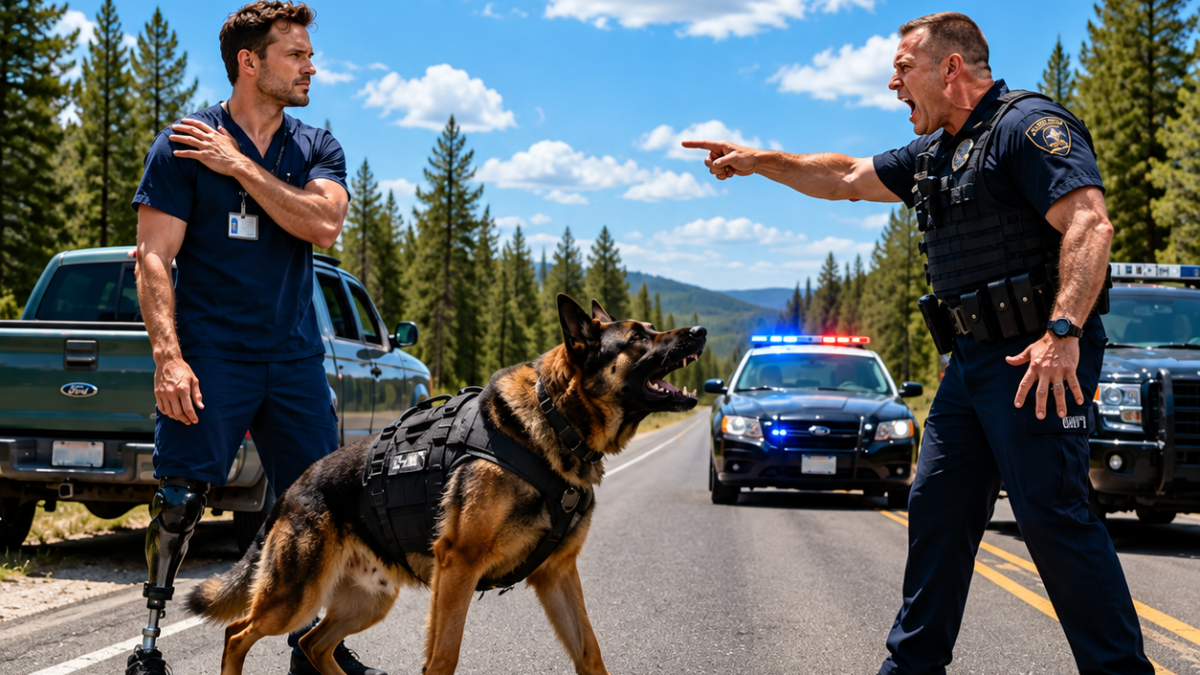
Eighty pounds of German Shepherd muscle, teeth, and training hit the wet pavement at a dead run. His bark cut through thunder. His body was low, powerful, locked onto the chaotic scene in front of him.
Abram could not lift his head.
Could barely breathe.
He heard claws on asphalt.
He heard Harrison’s breath change with excitement.
“Hit him!” Harrison shouted. “Bite!”
Abram closed his eyes.
He had been bitten by working dogs in training before, once accidentally, once because a handler messed up. He knew what was coming. The impact. The pressure. The crushing pain.
He thought, absurdly, of Dr. Larson telling him not to drive.
Then Brutus slid to a stop.
Not yards away.
Inches from Abram’s face.
Abram opened his eyes.
The German Shepherd stood over him, breathing hard, rain running off his muzzle. His ears flattened. His nose worked furiously, drawing in scent through the storm.
Then the dog whined.
High.
Sharp.
Heartbroken.
Abram stared.
A notch missing from the left ear.
A silver scar across the bridge of the snout.
Dark eyes that had once looked at him through desert smoke.
The world shifted.
Rain became dust.
Asphalt became sand.
The storm became rotor wash.
“Bear,” Abram choked.
The dog froze.
Abram swallowed blood and rain.
“Big Bear.”
Brutus exploded into sound.
Not aggression.
Joy.
Recognition.
He shoved his wet snout under Abram’s chin, nudging his face out of the mud, whining frantically, licking his bruised cheek.
Abram made a sound that was almost a laugh and almost a sob.
“Hey, buddy,” he gasped. “Hey, I know. I know.”
Five years vanished.
Afghanistan returned in fragments.
Tactical Explosive Detection Dog Alpha Seven.
Call sign: Bear.
A massive German Shepherd attached to a Ranger element in the Arghandab River Valley. Too smart. Too serious. Obsessed with stealing socks from the medic tent. Abram had patched his paws after long patrols, pulled burrs from his coat, shared pieces of protein bar when nobody was looking.
Then the IED.
Abram remembered Bear screaming.
Not barking.
Screaming.
Shrapnel in the dog’s hind leg. Blood pumping bright. Men yelling for extraction. Abram’s own left leg shredded beyond saving, but his hands still worked, so he had used them. Tourniquet for himself. Pressure bandage for Bear. Morphine? No. Not enough. Pack wound. Wrap. Keep him breathing.
Evac wanted Abram first.
He refused until Bear was loaded.
“Dog goes,” he had said.
Someone shouted that he was losing too much blood.
Abram remembered grabbing a vest strap and snarling, “Dog goes.”
Then nothing.
He had woken in Germany without a leg and with no idea what happened to Alpha Seven.
Now the answer stood over him in the Oregon rain, wearing a police K9 collar and licking mud from his face.
“What is this stupid mutt doing?” Harrison roared.
His setup was falling apart.
The dog he had ordered to attack the disabled nurse was protecting him.
“Get out of the way!”
Harrison made the worst decision of his life.
He raised his heavy flashlight and swung it toward Brutus’s skull.
The dog changed instantly.
The joyous whining vanished.
A guttural growl ripped through the rain.
Before the flashlight landed, Brutus lunged.
He did not go for a lethal bite.
He took Harrison’s tactical jacket sleeve at the forearm, clamped down hard, and wrenched backward with a violent snap of his neck.
Harrison screamed.
His weight lifted off Abram.
Air rushed into Abram’s lungs so painfully he nearly blacked out.
Brutus yanked the officer away, then released and planted himself over Abram’s fallen body, teeth bared, hackles raised in a black ridge down his spine.
The message was clear in every language.
Touch him again and lose the arm.
Hunter arrived at a run, weapon drawn but angled down.
He saw Harrison in the mud.
Abram face-down and injured.
Brutus standing guard over the supposed suspect.
The sergeant’s expression changed.
A good K9 handler knows his dog.
A great one trusts him when the world stops making sense.
“Brutus!” Hunter commanded in German.
The dog’s ears twitched.
He backed half a step.
But he did not leave Abram’s side.
“Shoot the damn dog!” Harrison screamed. “He’s gone rabid!”
Hunter ignored him.
His eyes stayed on Brutus.
Then on Abram.
Then on the carbon-fiber prosthetic visible beneath Abram’s soaked scrub pants.
He holstered his weapon slowly.
“Stay down, Harrison,” he ordered.
“I said shoot him!”
Hunter turned.
“Shut your mouth.”
The storm seemed to pause around those words.
Hunter knelt beside Abram.
“Sir, are you injured?”
Abram tried to roll. Pain tore through his shoulder.
Brutus pressed against his side, steadying him.
“My shoulder’s dislocated,” Abram hissed. “Prosthetic knee locked. I told him I needed to release it before standing.”
Hunter looked at Harrison.
Then back at Abram.
“He knows you.”
Abram rested his shaking right hand on Brutus’s wet head.
“Military designation Alpha Seven. We called him Bear. I was his combat medic.”
Hunter stared at him.
“Where?”
“Arghandab River Valley. 75th Ranger Regiment.”
The sergeant’s face went still.
“He never breaks protocol,” Hunter said quietly. “Never. If he defended you from a uniformed officer, then something is very wrong.”
Harrison tried to stand.
“That’s garbage. He assaulted me. Wells resisted. The dog malfunctioned.”
Hunter rose slowly.
Rain dripped from the brim of his hat.
“My body camera has been rolling since I left my cruiser,” he said.
Harrison froze.
Hunter tapped the center of his chest, where a green light blinked beneath rainwater.
“Yours too. I heard him state he needed to unlock his prosthetic knee. I saw you rip a compliant disabled veteran from his vehicle. I saw you pin him in the mud. I saw you attempt to strike my K9 with a flashlight.”
Harrison’s face drained.
“Dave—”
“Do not call me Dave.”
“Hear me out.”
“Turn around and put your hands behind your back.”
“You don’t understand. This guy made me look—”
Hunter drew his taser and pointed it at Harrison’s chest.
“Turn around now.”
Harrison looked from Hunter to Brutus to Abram.
For the first time since Abram had known him, Officer Greg Harrison looked small.
Not physically.
Morally.
Stripped of performance, stripped of control, stripped of the narrative he thought he had built.
He turned around.
Hunter cuffed him in the rain.
“You are under arrest for assault under color of law, aggravated battery, and filing a false report.”
“You’re making a mistake,” Harrison spat.
Hunter tightened the cuffs.
“No. I’m correcting one.”
Backup arrived within minutes.
Then an ambulance.
Then Chief Keller himself, face pale under the flashing lights, looking like a man who had just realized the complaint file he ignored had become a criminal case.
Abram lay on a stretcher while paramedics stabilized his shoulder.
Brutus tried to climb into the ambulance.
Hunter held his collar gently.
“Brutus, stay.”
The dog ignored him.
Hunter looked at Abram.
Abram, pale and shaking under a thermal blanket, managed a weak smile.
“He never was great with stay.”
Brutus whined.
Hunter sighed.
“Fine.”
The eighty-pound police K9 rode to Oak Creek Memorial sitting rigidly beside the stretcher, his head resting near Abram’s hand.
Nobody argued.
The emergency department erupted when they rolled in.
Dr. Larson came running.
She took one look at Abram’s face, his shoulder, the mud, the blood, the dog, and Hunter behind them.
“What happened?”
Abram tried to answer.
Brutus licked his hand.
Dr. Larson looked at the dog.
Then at Abram.
“Of course,” she said. “Of course you collect dramatic animals in the middle of a police brutality incident.”
Abram laughed, then groaned because laughing hurt.
“Good to see you too.”
Her eyes were wet.
She turned all business before anyone could notice.
“Trauma Two. X-ray shoulder. Check prosthetic socket damage. Pain control. And somebody get that dog a towel before he floods my ER.”
Brutus refused to leave Abram’s bay.
Hunter tried commands.
German.
English.
Hand signals.
Brutus obeyed all of them technically, then returned to Abram’s side as soon as released.
Finally, Hunter stood beside the bed and watched the German Shepherd press his shoulder against Abram’s good leg.
“He really knows you.”
Abram’s jaw tightened.
“I thought he died.”
“Brutus?”
“Bear.”
Hunter looked down at the dog.
“He came to us three years ago through a military-to-police transfer. File said he had prior combat service. Handler trauma history classified. He was difficult at first. Not aggressive. Just… distant.”
Abram rubbed the dog’s ear, stopping at the notch.
“He hated helicopters.”
Hunter’s head snapped up.
“Yes.”
“Wouldn’t eat if people argued near him.”
Hunter stared.
“Yes.”
“Loved peanut butter. Stole socks. Pretended he didn’t understand commands if the handler annoyed him.”
For the first time that night, Hunter smiled faintly.
“That explains a lot.”
Abram closed his eyes.
His shoulder throbbed. His residual limb burned. Pain medication blurred the edges of the room.
But beneath his fingers, Brutus was warm.
Real.
Alive.
“You made it,” Abram whispered.
Brutus sighed.
The aftermath did not unfold quietly.
By morning, body camera footage had reached internal affairs, the district attorney, and someone at the local news who owed a nurse in the ER a favor.
Abram’s calm voice destroyed Harrison’s story.
I am complying.
My prosthetic leg is highly inflamed.
I need to unlock the mechanical knee joint.
Give me ten seconds.
Then Harrison’s shout.
He’s reaching for a weapon!
Then the door ripping open.
The violent pull.
Abram hitting the ground.
Stop resisting yelled over a man who could not physically comply.
Then Brutus stopping.
Recognizing.
Protecting.
By 8:00 a.m., Greg Harrison was suspended.
By noon, he was stripped of badge and weapon.
By evening, protesters stood outside the precinct holding signs.
PROTECT PATIENTS, NOT EGOS.
JUSTICE FOR ABRAM WELLS.
BODY CAMS DO NOT LIE.
The town split for about twelve hours.
Some people tried to defend Harrison.
Good cop having a bad night.
Split-second decision.
Dangerous job.
But then more footage surfaced.
Prior stops.
Abram’s complaints.
Hospital witnesses from the Tyler Jenkins incident.
The story became impossible to bury.
Chief Keller stood behind a podium the next day looking like he had aged ten years.
He used phrases like unacceptable conduct, breach of public trust, and ongoing investigation.
Dr. Larson watched the press conference from Abram’s hospital room and snorted.
“Coward language.”
Abram, arm in a sling, stump bandaged where the socket damage had torn the skin, raised an eyebrow.
“You’re angrier than I am.”
“No, I’m externally angrier than you. You are internally volcanic.”
Brutus, lying beside the bed with special permission and a towel under him, lifted his head.
Dr. Larson pointed at him.
“And you. You are the only member of law enforcement I currently trust.”
Hunter, standing near the door, said, “Fair.”
Abram looked at him.
“You don’t have to stay.”
Hunter crossed his arms.
“My dog disagrees.”
Brutus put his head back down.
Hunter’s voice softened.
“Also, I owe you.”
“You didn’t do anything wrong.”
“I almost deployed him on you.”
“You trusted your officer.”
“I trusted wrong.”
Abram did not answer immediately.
He understood guilt.
He understood the kind that arrived after surviving, after deciding, after acting with limited information and replaying it later until every second became a courtroom.
“You listened when your dog told you the truth,” Abram said finally. “That matters.”
Hunter looked at Brutus.
“He knew before I did.”
“Dogs are good at that.”
“So are combat medics, I hear.”
Abram smiled faintly.
“Only the annoying ones.”
The trial was brief.
Harrison pleaded guilty after the footage became public and several old complaints resurfaced. Former detainees came forward. A teenager named Tyler Jenkins testified that Abram had protected him when he could not protect himself.
Abram did not want to testify.
But he did.
He wore a dark suit, his prosthetic adjusted after two months of painful refitting, his shoulder still stiff from physical therapy. Brutus was not allowed in the courtroom, though Hunter joked about filing an amicus bark.
On the stand, Abram described the traffic stop without embellishment.
No dramatic language.
No rage.
Just facts.
The rain.
The request for ten seconds.
The false weapon claim.
The fall.
The knee in his back.
The taser at his neck.
The dog stopping.
Recognition.
Protection.
The prosecutor asked, “Mr. Wells, why did Officer Harrison target you?”
Abram looked at Harrison.
The former officer stared at the table.
“Because I told him no when he wanted me to violate a patient’s rights.”
The courtroom went still.
The judge sentenced Harrison to seven years in federal prison, with permanent decertification from law enforcement.
Abram felt no triumph.
That surprised people.
They expected relief, maybe satisfaction, maybe some grand sense of justice.
But what he felt was tired.
Justice did not unbruise ribs.
It did not erase the moment he heard a K9 coming and thought teeth were the last thing he would feel.
It did not give back sleep easily.
It mattered.
Of course it mattered.
But it was not healing by itself.
Healing came slower.
Physical therapy.
Shoulder exercises.
Prosthetic adjustments.
Skin graft care when the socket wound worsened.
Counseling, because Dr. Larson threatened to drag him there herself.
Returning to work on light duty.
Facing patrol officers in the ER without flinching.
Learning that vulnerability after trauma feels like weakness only to people who worship denial.
Brutus visited twice during those months.
Officially, Sergeant Hunter brought him as part of community outreach to hospital staff.
Unofficially, everyone knew he came because Abram smiled more when the dog was there.
The first visit, Brutus entered the ER wearing his K9 vest, walking in perfect heel beside Hunter.
The emergency department stopped.
Nurses smiled.
Patients stared.
Someone whispered, “That’s the dog.”
Abram was at the nurse’s station, one arm still stiff but functional, charting vitals.
He heard claws on linoleum and looked up.
Brutus saw him.
Protocol lasted approximately one second.
The German Shepherd broke heel and trotted across the ER, ignoring Hunter’s resigned, “Brutus.”
He pressed himself against Abram’s good leg and huffed.
Abram laughed.
“You’re on duty, Bear.”
Brutus sneezed.
Hunter walked over.
“He has opinions about duty.”
“So did he always.”
A little boy waiting with his mother in triage pointed.
“Is that a police dog?”
Hunter smiled.
“Yes.”
The boy looked at Abram.
“Is he your dog?”
Abram’s smile faltered.
“No,” he said softly. “He’s an old friend.”
Brutus leaned harder against him.
Four months after the storm, Hunter came to Oak Creek in dress uniform.
Not patrol uniform.
Dress blues.
Formal shoes.
Hair trimmed.
Badge polished.
Abram noticed immediately.
Beside him walked Brutus, also looking unusually dignified, though he ruined the effect by sniffing a trash can near the automatic doors.
Dr. Larson appeared beside Abram.
“Why do I sense emotional ambush?”
Abram frowned.
“What?”
“You’ll see.”
Hunter approached the nurse’s station with a manila envelope stamped with the Bend Police Department seal.
Abram stood carefully.
“Sergeant.”
“Abram.”
“Everything okay?”
Hunter looked down at Brutus.
“Everything is perfect.”
Abram glanced at the envelope.
“That sounds suspicious.”
“It is.” Hunter cleared his throat. “Brutus turned eight last week.”
Abram looked at the dog.
The German Shepherd’s muzzle had more gray than Abram remembered from the rain. The scar across his nose seemed silver under hospital lights.
“Mandatory retirement age,” Hunter continued. “Department policy.”
Abram’s chest tightened.
“I’m sorry.”
Hunter nodded.
“I’ve been trying to decide what to do next.”
“Standard protocol is handler adoption, right?”
“It is.”
Abram forced a smile.
“He’ll have a good home with you.”
Hunter’s jaw worked.
“Yes. He would.”
Would.
Abram heard it.
Hunter opened the envelope and removed transfer documents.
“But I know a combat bond when I see one,” he said quietly. “I’ve seen how he looks at you. I’ve seen how you look at him. He served the city with me. He served overseas with you. He saved both our futures on that highway.”
Abram could not speak.
Hunter held out the papers.
“He belongs with you now.”
The ER went silent in a way Abram had not heard since the night he stood down Harrison in triage.
Dr. Larson pressed a hand to her mouth.
Abram looked at Brutus.
The dog was already looking up at him, tail thumping slowly against the linoleum.
“Drayden,” Abram said, voice rough. “He’s been your partner for years.”
Hunter nodded.
“And handing him over is going to hurt like hell.”
“Then why—”
“Because loving a working dog means knowing when his work is done.” Hunter swallowed. “And because he has spent every visit trying to leave with you.”
Abram tried to laugh.
It came out broken.
“I live alone.”
“Good. He snores.”
“I work long shifts.”
“He knows hospitals.”
“I have bad nights.”
Hunter’s eyes softened.
“So does he.”
Abram looked down.
Brutus stepped forward and pressed his head under Abram’s hand.
The movement answered the question before Abram did.
His hand shook as he signed the transfer documents.
Hunter unclipped the heavy police leash from Brutus’s collar.
For a moment, the sergeant held it tight.
Then he crouched in front of the dog.
Brutus sat, ears forward.
Hunter placed both hands on either side of the German Shepherd’s face.
“You did good,” he whispered. “You hear me? You did real good.”
Brutus licked his chin once.
Hunter laughed and wiped his face quickly.
Then he stood and handed the leash to Abram.
“Free dog, Brutus,” he said softly.
The final release order of the dog’s career.
Brutus turned.
He stepped into Abram’s space, leaned his full weight against Abram’s good leg, and let out a long, deep sigh.
Like a soldier setting down a pack after years of marching.
Abram dropped to one knee.
His prosthetic clicked under him.
He wrapped both arms around Brutus’s neck and buried his face in wet fur.
He had saved the dog in a desert half a world away.
The dog had saved him on a storm-dark highway in Oregon.
Now, somehow, they had found each other again.
The first night Brutus slept in Abram’s house, neither of them slept much.
Abram had prepared.
Dog bed.
Food.
Water bowls.
Medications for arthritis Hunter had sent along.
A box of toys Brutus ignored.
A folded blanket near the couch.
Brutus inspected every room with professional seriousness, sniffed the front door, the back door, the bedroom window, and the bathroom as if bathrooms were known tactical vulnerabilities.
Then he settled across the hallway, positioned where he could see both the front entrance and Abram’s bedroom.
Abram stood in the doorway.
“You don’t have to work.”
Brutus looked at him.
“I mean it.”
Brutus put his head down.
His eyes stayed open.
Abram understood.
Some habits keep you alive long after danger is gone.
He went to bed.
At 3:12 a.m., he woke from a dream of rain and gravel.
His heart pounded.
His sheets were twisted.
For a second, he was back on Route 99, face in the mud, taser at his neck.
Then he heard a soft whine.
Brutus stood beside the bed.
Not alarmed.
Concerned.
Abram sat up, breathing hard.
“I’m okay.”
Brutus did not believe him.
The dog placed his head on Abram’s thigh, careful near the prosthetic socket.
Abram rested a hand on his head.
The room settled.
His breathing slowed.
For the first time in years, Abram said aloud what he usually swallowed.
“I was scared.”
Brutus stayed.
So Abram kept going.
“I’ve been scared a lot.”
The dog leaned into his hand.
“I thought coming home meant the war was over.”
Brutus sighed.
Abram laughed softly, wiping at his eyes.
“Yeah. You too, huh?”
After that, they built a life.
Not a dramatic one.
A good one.
Mornings began with coffee and Brutus staring judgmentally until Abram added the correct amount of food to his bowl. Walks around the block took forever because Brutus had opinions about every tree. On bad pain days, Brutus slowed automatically, matching Abram’s uneven gait without command.
When Abram removed his prosthetic at night, Brutus lay near the recliner, watching with steady calm. The first time Abram let the residual limb remain uncovered around him, he felt strangely exposed. Vulnerable in a way even hospital gowns had not made him feel.
Brutus sniffed once, gently.
Then rested his chin beside the socket liner.
No pity.
No flinch.
No discomfort.
Just acceptance.
Abram had not realized how badly he needed a creature who did not see his missing leg as tragedy, inspiration, or awkward conversation.
To Brutus, it was simply part of the man he knew.
The man who had saved him.
The man he had found again.
At work, Abram changed too.
Not loudly.
He still did his job.
Still advocated for patients.
Still stood calmly when officers brought suspects in, though now the department sent different officers, and they treated him with a respect that bordered on nervousness.
One night, a young officer began pushing too hard for a statement from a teenager with a broken jaw.
Abram stepped between them.
The officer stiffened.
Abram said quietly, “Medical care first.”
The officer looked at him.
Then backed up.
No argument.
No posturing.
Dr. Larson watched from the nurses’ station.
“Look at that,” she said later. “A miracle. Procedure.”
Abram smiled.
But the old fear did not vanish completely.
Sometimes a cruiser behind him made his hands tighten on the wheel.
Sometimes rain on the windshield dragged him back.
Sometimes he woke with his shoulder aching as if Harrison’s weight were still there.
Brutus helped.
Therapy helped.
Time helped.
Justice helped, but less than people assumed.
Community helped more.
Patients sent cards.
Veterans came by the ER to shake his hand.
A mother of a former patient brought homemade soup because she said, “You cared for my boy. Let someone care for you.”
Abram did not know what to do with care at first.
He had built his adult life around being useful.
Useful in war.
Useful in trauma bays.
Useful in crisis.
Being cared for felt inefficient.
Brutus disagreed.
He demanded routine, food, walks, rest, and emotional honesty with the stubbornness of a creature who had once survived both war and police work.
If Abram worked too long at the kitchen table, Brutus placed his head on the laptop.
If Abram skipped dinner, Brutus stared at the refrigerator until shame did what hunger did not.
If Abram tried to push through a bad pain day, Brutus blocked the hallway.
“You are not medically qualified,” Abram told him once.
Brutus sneezed.
“You are retired.”
Brutus wagged his tail.
“Retirement has made you bossy.”
The tail thumped harder.
Six months after Brutus came home, Abram returned to the Arghandab in memory.
Not physically.
He had no desire to stand on that soil again.
But he opened the box.
The one in the back of his closet.
Photos.
Unit patches.
A cracked watch.
A field notebook with dust still caught in the binding.
A folded photo of him and Bear beside a helicopter, both younger, both whole in ways neither had remained.
He sat on the floor with the box open.
Brutus lay beside him.
Abram lifted the photo.
“You were ugly even then.”
Brutus huffed.
The photo showed Abram kneeling beside Alpha Seven, one arm slung over the dog’s shoulders. Both were looking away from the camera at something off-frame.
He remembered the day.
Hot.
Loud.
Bear had stolen a sock from a lieutenant and refused to return it.
Everyone had laughed.
A good day.
Not all days had been horror.
That was the part trauma stole first.
It flattened everything into danger.
But there had been laughter.
There had been bad coffee.
There had been card games.
There had been Bear trying to crawl into Abram’s lap during a sandstorm despite being too large and far too proud.
Abram touched the photo.
“I forgot the good parts,” he whispered.
Brutus rested his head on Abram’s knee.
They stayed there until evening.
A year after the storm, the Bend Police Department held a retirement ceremony for Brutus.
Abram almost refused.
Hunter asked once.
Abram said no.
Hunter accepted it.
Then Abram changed his mind three days later because Brutus deserved honors that were not only whispered in a living room.
The ceremony was held outside the precinct on a clear afternoon.
Not too large.
Not too theatrical.
Hunter spoke first.
He talked about Brutus’s years of service, his successful tracks, his narcotics finds, the missing child he once located near the river, the officers he protected.
Then he paused.
“And on a night when truth was almost buried under a bad badge, Brutus reminded all of us that loyalty does not mean blind obedience. It means protecting what is right.”
Abram stood at the side with Brutus beside him.
The dog wore no working vest.
Just a simple collar.
When Hunter finished, he looked at Abram.
Abram did not plan to speak.
Then he did.
“I knew him before he was Brutus,” he said.
The crowd quieted.
“In Afghanistan, we called him Bear. He was stubborn, brilliant, and deeply committed to stealing socks. I saved his life once because that was my job. Years later, he saved mine because that was who he is.”
He looked down at the dog.
Brutus looked back.
“I used to think survival meant making it out alive,” Abram continued. “I know better now. Survival is what you do after. It is learning to trust again. It is letting people help you. It is telling the truth when silence would be easier. And sometimes, it is a dog recognizing you in the rain when you have almost forgotten how to recognize yourself.”
Hunter bowed his head.
Dr. Larson wiped her eyes without shame.
Chief Keller stood in the back, face tight with regret.
Afterward, a young officer approached Abram.
“I just wanted to say,” he began, awkward and nervous, “what Harrison did… it made a lot of us look at things. Reports. Stops. How we talk to people. How we protect each other when maybe we shouldn’t.”
Abram studied him.
The officer looked barely older than twenty-five.
“What’s your name?”
“Officer Daniel Price, sir.”
“Don’t call me sir.”
“Yes, sir. Sorry.”
Abram almost smiled.
Price swallowed.
“I became a cop because my dad was one. He was a good one. I think somewhere along the way, I started thinking loyalty meant never questioning another officer.”
“And now?”
“Now I think maybe loyalty means not letting someone dishonor the badge while wearing it.”
Abram nodded once.
“That’s a better place to start.”
Not everything broken can be fixed by one incident.
Abram knew that.
Systems did not change because one bad officer went to prison and one good dog made the news.
But some cracks let light in.
Sometimes that mattered.
Years passed.
Harrison’s name faded from headlines.
Abram’s shoulder healed, though it ached before storms. His prosthetic was refitted properly. He moved from full-time trauma shifts into a hybrid role: ER nurse, patient advocate, and hospital liaison for law enforcement interactions.
It was Dr. Larson’s idea.
“You already do the job,” she said. “We might as well make the hospital pay you for it.”
He trained staff on consent, custody, warrants, and de-escalation.
He trained officers on medical boundaries.
He told them plainly, “A person in custody is still a patient. If that sentence makes you defensive, sit with that.”
Some did.
Some did not.
Abram learned to keep speaking anyway.
Brutus aged.
Gray spread across his muzzle.
His hips stiffened.
He slept more.
He still placed himself between Abram and the door, though sometimes he fell asleep while guarding and snored so loudly Abram accused him of psychological warfare.
On quiet evenings, they sat on the porch.
Abram with coffee.
Brutus with his head on Abram’s boot.
Rain no longer always triggered panic.
Sometimes it was just rain.
That felt like a miracle too ordinary for other people to understand.
One winter night, years after the traffic stop, Abram woke to Brutus whining softly.
Not nightmare whining.
Pain.
He turned on the lamp.
The dog was trying to stand and could not.
Abram was out of bed in seconds.
“Bear?”
Brutus looked at him, embarrassed in the way old dogs can look when their bodies betray them.
“No, no. Don’t you do that.” Abram lowered himself beside him. “You have carried enough.”
The vet called it degenerative spinal disease.
Progressive.
Manageable for a while.
Not curable.
Abram listened with one hand on Brutus’s head and the other gripping the chair hard enough to whiten his knuckles.
He had faced this before.
Different forms.
Different rooms.
The moment when care became comfort instead of rescue.
He hated it every time.
Brutus still had good months.
Then good weeks.
Then good days.
Abram made them count.
Short walks.
Soft beds.
Medication hidden in peanut butter.
Visits from Hunter, who always pretended allergies caused his red eyes.
Dr. Larson brought Brutus a hospital blanket and said, “This is absolutely not stolen.”
Chief Keller, long retired, came once and stood awkwardly in Abram’s living room.
“I should have answered your complaint,” he said.
Abram looked at the older man.
“Yes,” he said.
Keller nodded.
“I am sorry.”
Abram accepted the apology without making it smaller for the man’s comfort.
“Thank you.”
Brutus sniffed Keller’s shoes and then lost interest.
That seemed judgment enough.
On Brutus’s last morning, rain fell softly against the windows.
Not a storm.
A gentle rain.
Abram sat on the living room floor with the old dog’s head in his lap. Hunter sat nearby, one hand covering his mouth. Dr. Larson had come not as a doctor, but as family. The veterinarian moved quietly.
Abram had imagined he might say something profound.
He did not.
When the time came, he bent low and whispered, “You found me twice.”
Brutus’s cloudy eyes lifted.
Abram’s voice broke.
“You can rest now, Bear. I’ve got it from here.”
The dog’s tail moved once.
Barely.
A thump against the blanket.
Then he was gone.
The silence afterward was enormous.
Abram pressed his face into the thick fur and wept without restraint.
No battlefield restraint.
No hospital calm.
No veteran stoicism.
Just grief.
Hunter cried too.
Dr. Larson held Abram’s shoulder.
Outside, rain kept falling.
Abram buried Brutus’s ashes beneath the maple tree in his backyard, where the dog used to lie in summer shade. He placed no grand statue there.
Just a small stone.
ALPHA SEVEN “BEAR” / BRUTUS
SOLDIER. OFFICER. BROTHER.
HE KNEW THE TRUTH.
After Brutus died, Abram thought the house would become unbearable.
For a while, it did.
He still woke at 3:00 a.m. expecting claws in the hallway. He still looked toward the door when thunder rolled. He still saved the last bite of toast before remembering there was no one to give it to.
But grief, he had learned, did not only mean absence.
It also meant evidence.
Something had been there.
Someone had mattered.
The ache was proof.
Months later, Abram returned to work full time.
On the first day he taught a new class of police recruits at the hospital, he brought a photo of Brutus.
Not the formal K9 portrait.
A photo of the dog asleep upside down on Abram’s couch, paws in the air, dignity completely abandoned.
The recruits laughed.
Abram smiled.
“This,” he said, tapping the photo, “is Brutus. Before he was Brutus, I knew him as Bear. He saved my life because he recognized something was wrong when a human in authority lied.”
The room went quiet.
“Your badge will give you power,” Abram said. “Power will tempt you to protect yourself, your pride, and your people even when they are wrong. Don’t. A dog understood that loyalty without truth is just obedience. I expect at least as much from you.”
No one laughed then.
Good.
Years later, people still told the story of Route 99.
They told it in pieces.
The disabled veteran nurse.
The bad cop.
The K9 who refused an attack command.
The reunion in the rain.
The arrest.
The retirement.
The adoption.
Some versions grew more dramatic with time. Some made Abram sound fearless. He always corrected that when he could.
“I was terrified,” he would say. “Bravery had nothing to do with not being scared.”
“What was it then?” someone once asked.
Abram thought of the ER.
The desert.
The highway.
Brutus standing over him in the mud.
“It was telling the truth while scared,” he said.
That was the legacy Brutus left him.
Not just protection.
Not just companionship.
Truth.
The truth that a badge could be dishonored by the person wearing it.
The truth that a dog could recognize loyalty better than a man blinded by ego.
The truth that surviving war did not make Abram immune to being hurt at home.
The truth that needing help did not make him weak.
And the truth that sometimes the life you saved comes back years later, in the middle of a storm, to save you in return.
Abram never stopped missing Brutus.
But he also never stopped feeling found by him.
On rainy nights, when Route 99 disappeared under sheets of water and distant sirens moved through Bend, Abram sometimes stood on his porch with one hand resting on the wooden rail.
The maple tree shifted in the yard.
The stone beneath it darkened in the rain.
And Abram would remember the moment Brutus slid to a stop inches from his face.
The mud.
The pain.
The amber eyes.
The whine of recognition.
Big Bear.
That was the moment Harrison lost.
Not when Hunter cuffed him.
Not when the court sentenced him.
Not when the town turned.
He lost when the dog he thought would be a weapon became a witness.
A witness to truth.
A witness to history.
A witness to the bond between a combat medic and the life he once refused to leave behind.
Abram had spent years thinking he returned from war incomplete.
Brutus taught him something different.
He had returned carrying invisible threads, connections he could not see yet, acts of mercy that had not finished echoing.
A tourniquet tied in dust.
A wounded dog loaded before evacuation.
A name spoken in the rain.
A life saved.
A life returned.
That was not incompletion.
That was a circle.
And though Abram would always hear the faint click of carbon fiber when he walked, though scars and phantom pain would always remind him of what the war had taken, he no longer heard only loss in that rhythm.
Some days, he heard footsteps beside him.
Paws on wet asphalt.
Claws on hospital linoleum.
A tail thumping once against his living room floor.
The sound of a loyal heart choosing him again.
And when young nurses asked why he still stood between vulnerable patients and anyone who tried to bully them, Abram gave the same answer every time.
“Because someone has to.”
He did not add the rest.
That once, when he could not stand for himself, an old war dog stood for him.
That once, in a storm, justice arrived on four paws.
That once, a command to attack became a reunion.
That once, the future of a disabled veteran nurse, a police sergeant, and a German Shepherd named Brutus changed forever because the dog remembered what humans had forgotten.
You do not bite the man who saved you.
You protect him.
And Brutus did.








