A Disabled Cat Dragged Himself Toward the Sun Every Morning—Then the Lonely Woman Who Adopted Him Realized He Was Teaching Her How to Keep Going Too
PART3:
Don’t do it, buddy. Don’t make me watch you work this hard.
But Louie kept coming.
Inch by inch.
No drama.
No complaint.
Just that stubborn little body pulling itself across a floor that had never once made anything easy for him.
When he finally reached me, he leaned his whole weight against my leg and looked up like he had accomplished exactly what he meant to do.
That was when something in me gave out.
I cried with my face in my hands while this crooked little cat sat beside me like a steady old friend.
He did not try to fix me.
He did not need me to explain.
He just stayed.
There are days when staying is the kindest thing any living creature can do.
Not long after that, I made a mistake.
I left the back door cracked while bringing in groceries.
It was a small mistake, the kind that happens when you are balancing too many bags, too many worries, too many thoughts about whether eggs were cheaper last week. I turned from the counter and saw Louie halfway across the threshold.
My heart jumped into my throat.
The step outside was not high, but it was high enough. One slip, one bad landing, one wrong twist, and he could be hurt. I dropped a grocery bag so hard a can of soup rolled across the floor and rushed toward him.
Then I stopped.
Louie was sitting in the open doorway.
Sunlight covered his face.
Fresh air moved his whiskers.
His ears tilted forward.
He looked proud.
Not confused.
Not reckless.
Proud.
Like the world had been calling his name, and for once he had answered it.
I picked him up carefully and held him against my chest. He started purring so hard his whole body shook.
Standing there in my cluttered kitchen, holding a cat who would never run, I finally understood something I should have known already.
Louie did not spend one second feeling sorry for himself.
That had been my job.
I was the one looking at him and seeing what was missing.
Louie saw what was still his.
Warm sun.
Birds beyond the glass.
My voice calling him a good boy.
A safe home.
Another morning.
He did not know he was broken, so he was not.
At least not in the way I had been using that word on him.
And on myself.
After that, I opened the curtain wider.
I moved his bed near the back door.
I put down a softer rug so his front paws could grip better.
Every morning, I made coffee and sat on the floor beside him while the light slowly entered the room. I stopped rushing him. Stopped hovering. Stopped apologizing to him in my own head for the life he had.
He did not need my pity.
He needed traction.
He needed softness.
He needed water nearby.
He needed the door safe.
He needed love practical enough to rearrange the room.
I did not know then how many people would someday argue about him.
It began with my daughter.
She called one Tuesday morning and said, “Mom, put the camera on Louie.”
I turned the phone.
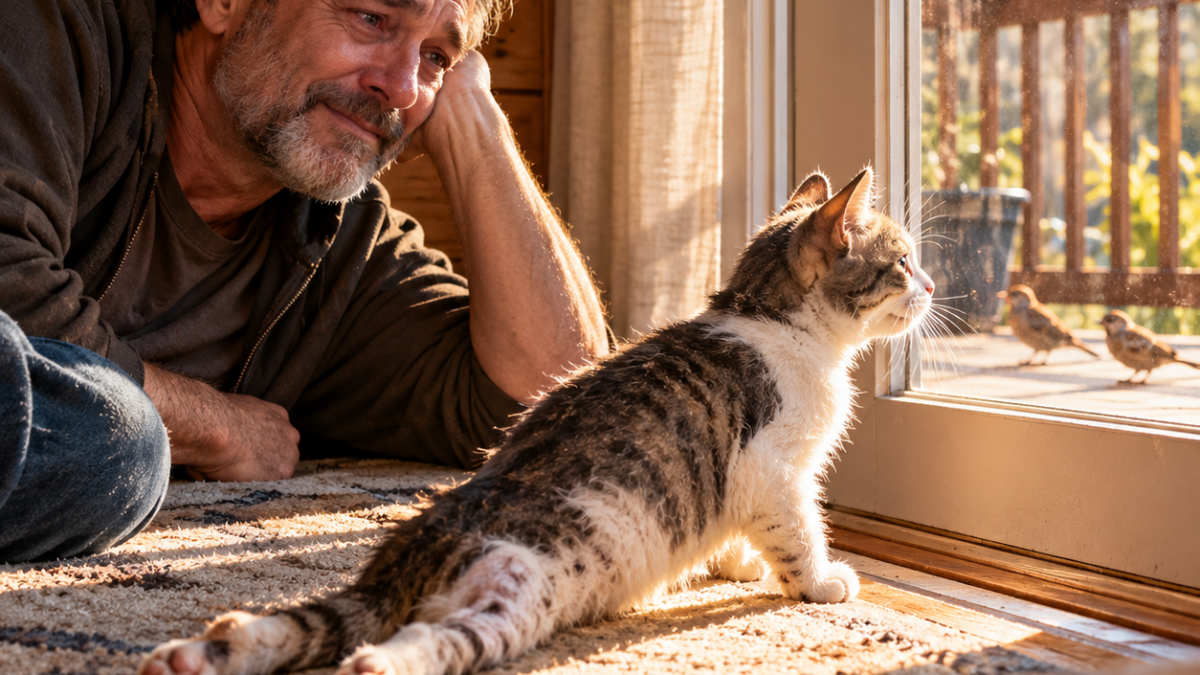
Louie was in his usual spot, front paws planted, body stretched long, staring at a bird on the fence like he was preparing for war.
My daughter laughed softly.
“Oh, Louie,” she said. “He always looks like he’s got a full-time job.”
I smiled for the first time that day.
Then she got quiet.
“Mom,” she said, “you look tired.”
I almost said I’m fine.
That is what women my age are trained to say, isn’t it?
We say we are fine when rent climbs, when hours get cut, when our backs ache, when the grocery total makes our chest tighten, when our children live far away, when we are one small inconvenience away from crying in the canned soup aisle.
Instead, I said, “I am tired.”
My daughter nodded like she had known that already.
Then she said, “You should post Louie.”
I laughed.
“Post him where?”
“Online. Anywhere. People would love him.”
I looked over at Louie.
“Nobody wants to see a disabled middle-aged cat drag himself across a dirty apartment.”
My daughter did not laugh.
“See?” she said. “That right there is why you should do it. You still think his story is what he can’t do.”
I wanted to argue.
I did not.
Because she was right.
A week later, she drove down for the weekend.
Not because life got easier.
Because she moved things around, drove late, slept less, and made it happen.
That mattered more than if she had come comfortably.
She brought groceries I told her not to buy.
She brought a soft little cat bed shaped like a cloud.
And she brought a small phone stand.
I said, “Absolutely not.”
She said, “Too late.”
That Saturday morning, she filmed Louie making his daily trip to the light.
No sad music.
No fake tears.
No dramatic captions.
Just Louie moving from the bedroom toward the back door with the same determined look on his face, as if the sunrise had personally invited him.
At the end, he reached the warm patch by the curtain, lowered himself into it, and closed his eyes.
My daughter posted it with one sentence:
He doesn’t know he’s limited, so every morning he still reports for duty.
That was all.
By dinner, strangers were sharing it.
By the next morning, there were more comments than I could read.
By Monday, I had people from all over the country writing things like:
I needed this today.
Tell Louie I’m trying too.
He looks like my brother after rehab.
He looks like my mom after chemo.
He looks like me getting out of bed every morning.
That last one hit hardest.
Because that was it.
That was why people saw themselves in him.
Not because he was broken.
Because he kept showing up.
For a few days, the internet felt almost holy.
People wrote about grief, disability, debt, divorce, addiction, loneliness, job loss, illness, and the strange private exhaustion of surviving quietly.
A widower told me he had not opened his curtains in three months, but after seeing Louie drag himself into the sun, he opened them that morning.
A nurse wrote that she sat in her car after a night shift and cried before going home because Louie reminded her that survival is still a kind of beauty.
A young man said he had been ashamed of needing a cane at twenty-eight until he saw a cat move across a kitchen floor with more dignity than most people carry into boardrooms.
I read every message.
I cried over too many of them.
Then the other comments came.
At first, they sounded concerned.
Does he suffer?
Did a vet say this is humane?
Why keep him alive like that?
Then people got bolder.
That cat has no quality of life.
This is selfish.
You’re keeping him alive for attention.
Mercy would be kinder.
One woman wrote three paragraphs about how “real love lets go.”
A man I had never met called me cruel.
Another person said I had turned disability into “inspiration content.”
Then someone wrote what a lot of them were really thinking:
Some lives are not worth forcing.
I read that one twice.
Then a third time.
Louie was asleep at my feet while I stood in the kitchen holding my phone like it had become heavier than it was supposed to be.
Some lives are not worth forcing.
I looked down at him.
At his bent back legs.
At the little scar near his tail.
At the way his paws twitched in sleep, as if he was dreaming of birds he would never catch and somehow had never stopped pursuing.
And I thought:
Funny how quickly people decide which lives count.
That sentence stayed with me.
Not just because of Louie.
Because of all of it.
People say things online they would never say in a room with fluorescent lights, a folding chair, and a person trying not to fall apart.
They say, let them go.
What they often mean is, this makes me uncomfortable.
They say, quality of life.
What they sometimes mean is, quality according to me.
Fast enough.
Pretty enough.
Productive enough.
Normal enough.
Easy enough to look at without being reminded that bodies fail, life gets unfair, and love does not always arrive in attractive packaging.
I wish I could say I handled it with grace.
I did not.
I sat at my kitchen table at midnight and typed a reply so sharp it could have drawn blood.
Then I deleted it.
I typed another one.
Deleted that too.
My daughter called and said, “Mom, don’t do this to yourself.”
But I could not let it go.
Because the more I read, the less it felt like people were talking about a cat.
It felt like they were talking about anyone who moves through the world slower than others want them to.
Anyone who needs help.
Anyone whose body tells the truth a culture is trying to outrun.
A few days later, I took Louie to the vet for a checkup.
His left front paw looked a little irritated from dragging against the floor, nothing dramatic, just something I wanted checked. The waiting room was crowded with a trembling shepherd mix, a rabbit in a carrier, and a woman holding a very old orange cat wrapped in a blanket.
Two seats away from me, a man about my age kept staring at Louie.
If you have ever loved an animal who looks different, you know that stare.
It is not always cruelty.
Sometimes it is curiosity.
Sometimes pity.
Sometimes calculation.
The cold little measurement people make before they realize they are doing it.
“What happened to him?” the man asked.
“Born that way.”
“Can he use the litter box?”
“Yes.”
“Is he in pain?”
“Not usually.”
“How long do cats like that live?”
“I don’t know.”
The man nodded slowly.
Then he said, “I probably would’ve put him down.”
Just like that.
Like he was commenting on road construction.
I looked at Louie.
Louie looked at absolutely nobody.
He was busy trying to smell the rabbit.
I said, “Good thing he wasn’t waiting on your vote.”
The man blinked.
Then he laughed awkwardly, as if he could not tell whether I was joking.
I was not.
I am done treating every ugly opinion like it deserves a soft landing.
That is another thing Louie taught me.
If you spend your whole life dragging yourself toward what keeps you alive, you stop wasting energy making other people comfortable about it.
The vet checked Louie and said what she always said.
“He is stable. He is alert. His heart sounds good. His lungs are good. He is curious. He shows no signs of chronic distress. He adapts.”
Then she added, “Honestly, if I only looked at his legs, I’d miss the actual cat.”
I asked what she meant.
She smiled.
“A lot of people see limitations first. But quality of life is not a photograph. It is behavior. Appetite. Interest. Bonding. Curiosity. Engagement. Louie has all of that.”
I nearly cried right there on the exam-room stool.
Because there it was.
What I had been trying to say and failing to say.
Quality of life is not a beauty contest.
It is not a race.
It is not whether a body performs in a way that makes onlookers comfortable.
It is whether joy still enters the room when the sun does.
It is whether there is still interest.
Still appetite.
Still attachment.
Still some stubborn little yes in the soul.
On the way home, I bought Louie a softer floor runner for the kitchen.
I probably should have spent that money on the electric bill or better coffee or one of the other things I kept telling myself were more practical.
But I bought the runner.
Because his paw mattered.
Because comfort matters.
Because caring for a small life is not wasteful just because the world cannot monetize it.
That sentence would make some people angry.
Good.
Some people should be angry.
We live in a culture that spends more time cheering performance than protecting vulnerability. A culture that calls care “too much” if there is no profit hiding behind it. A culture that says everybody matters right up until somebody becomes inconvenient, expensive, disabled, old, mentally unwell, visibly scarred, grieving, addicted, poor, slow, or difficult to fit into a schedule.
Then suddenly the language changes.
Then suddenly people start talking about burden.
I know some people hate hearing that.
I know some people will say I am making too much out of a cat story.
But tell me how a person speaks about small, dependent lives, and I will tell you what kind of world they are helping build.
Louie, meanwhile, did not know he had become a debate.
He knew three things:
Morning light.
Dinner.
My lap when I tucked a blanket over my knees.
That week, a neighbor knocked on my door.
Her name was Tessa.
She lived two units down, mid-thirties, always rushing, always on the phone in the parking lot, always dressed in expensive workout clothes that somehow made exhaustion look organized. We had lived in the same building nearly a year and had never said more than hello.
She stood there with a casserole dish in one hand and an expression like she regretted being human.
“I know this is weird,” she said.
“That usually means it is.”
She smiled tiredly.
“I saw your cat online.”
I blinked.
“You did?”
Her sister had shared Louie’s video. Then a coworker had shared it. Then Tessa’s teenage son, who had not willingly discussed feelings in months, sent it to her with the message:
This cat is stronger than half the men on my football team.
I laughed.
Then Tessa’s eyes filled.
“I need to ask you something,” she said.
I stepped aside and let her in.
She sat at my tiny kitchen table like someone who had been standing for too long. The casserole dish sat untouched between us.
Finally, she said, “My mother had a stroke last year.”
I stayed quiet.
“She can still talk some,” Tessa said. “She knows who we are. She laughs at the weather guy every night because she says his hair looks like it lost a fight. She loves strawberry yogurt, old murder shows, and my youngest daughter’s singing voice.”
She swallowed.
“But she needs help with almost everything now. My brother says she’s not really living. He wants to move her somewhere cheaper and visit less. Says dragging it out is selfish. Says she would hate being seen like this.”
Tessa looked up at me.
“I saw what people said about Louie, and all I could think was… is that what they’d say about my mother too?”
I did not answer right away.
Because the true answer was yes.
Some people already would.
Some people already do.
There are people who look at dependency and see only humiliation.
There are people who cannot imagine dignity unless it is wrapped in independence, youth, control, and the ability to perform normalcy for others.
There are people who think needing help is the worst thing that can happen to you.
I think becoming the kind of person who believes that is worse.
So I said, “Your mother still laughs?”
Tessa nodded.
“She still has favorite foods?”
“Yes.”
“She still knows love when it comes into the room?”
That was when Tessa started crying.
Because that was the question, wasn’t it?
Not can she drive.
Not can she host Thanksgiving.
Not can she fold fitted sheets or walk up stairs or remember every birthday.
Can she still feel love when it comes into the room?
If yes, then you do not get to talk about her like she is already gone just because her old life no longer fits your current schedule.
Tessa came over three times that month.
The first time, to return the dish.
The second time, with cat treats Louie could not eat because of his stomach, though the intention was sweet.
The third time, just to sit on my floor and watch Louie pull himself toward the sun.
“Look at him,” she whispered.
“Yeah,” I said. “He’s busy.”
We laughed.
Then she said, “I moved my mother’s chair by the window yesterday.”
I looked at her.
“She sat there for an hour,” Tessa said. “Didn’t say much. Just watched people coming in and out of the building. Then she told me the red-haired mailman walks like a duck.”
We laughed so hard Louie startled awake.
After that, the messages changed.
Not all of them.
There were still cruel ones.
There are always people who expose themselves in public and call it honesty.
But more stories came now.
A father posted a picture of his son’s wheelchair and wrote, He asked if he could still go to the lake this summer. The answer is yes.
A woman in her sixties posted a photo of the scar along her chest after surgery and wrote, I have been calling myself ruined. I am trying a new word now: alive.
A young veteran with a prosthetic leg wrote, Anybody who says a limited body means a limited life has never met people who rebuild one inch at a time.
A hospice worker wrote, Thank you for saying dignity is more than independence. Some of the most beautiful moments I have ever witnessed happened in rooms where someone needed help doing everything.
That one stayed with me.
Because I had spent years absorbing a lie that sounded like wisdom.
The lie was this:
If you cannot do it alone, it barely counts.
What a brutal thing to teach people.
What a profitable thing too.
We praise independence so hard in this country that people apologize for having needs. Apologize for aging. Apologize for illness. Apologize for grief. Apologize for not bouncing back shinier and more marketable than before.
We worship resilience, but mostly when it is photogenic.
We clap for survival, but mostly when it does not slow anyone else down.
Louie had no interest in any of that.
He needed help sometimes.
He needed rugs for traction.
Extra blankets in winter.
His water bowl moved closer.
Fur trimmed carefully around his back legs.
Time.
Patience.
The door cracked just enough to smell the morning without tumbling into danger.
Not one bit of that made him less worthy of joy.
A local reporter eventually reached out.
Not from a national outlet. Just a neighborhood publication that usually covered school events, zoning disputes, and occasional feel-good stories when there was room. She wanted to write about Louie.
My first instinct was no.
My second instinct was absolutely not.
My third instinct arrived around two in the morning while Louie snored beside my knee.
Maybe.
Because the comments had made something clear.
People were not arguing about an animal.
They were arguing about value.
About whether needing care reduces worth.
About whether a damaged body can still hold a full life.
And I was tired of letting the harshest people dominate the conversation simply because they spoke ugly things with confidence.
So I said yes.
The reporter came on a Thursday.
She wore sensible shoes and immediately crouched to Louie’s level, which I appreciated.
She asked what Louie liked.
Morning sun.
Tuna water.
The sound of broom bristles.
My shoelaces.
Judging delivery workers through the curtain.
She asked what care looked like.
Small adjustments.
Daily observation.
A willingness to learn who he is instead of grieving who he is not.
She asked what Louie changed in me.
I answered before I could make it pretty.
“He embarrassed my self-pity.”
She smiled and wrote that down.
Then I kept going.
“Not because my life was easy and his was hard. That is not it. It is that he never acted like love owed him perfection first. He took what was here and met it with his whole self. I realized I had been withholding my own life from myself because it did not arrive in the shape I wanted.”
The reporter looked up.
“What do you say to people who argue his life is not fair?”
That took me a minute.
Finally, I said, “Life is not fair. That is the least original thing about it. The question is not whether a life is fair. The question is whether it is still capable of connection, comfort, interest, and love. Louie has all of that. A lot of healthy-looking people do not.”
That made the article.
So did another line I did not plan.
The reporter asked what I wished people understood.
I said, “Stop confusing inconvenience with suffering.”
That was the sentence people passed around.
People quoted it, argued with it, stitched it into long posts, used it to talk about disability, elder care, postpartum depression, poverty, special needs parenting, chronic illness, burnout, caregiving, marriage, and grief.
Stop confusing inconvenience with suffering.
A sentence like that makes enemies.
Because a lot of modern life is built on that confusion.
If helping someone disrupts a schedule, people call it impossible.
If loving someone costs money, time, sleep, or freedom, people start using clinical language to disguise impatience.
If a body cannot keep up with the pace of the market, people begin talking like accountants at the edge of a grave.
That sounds harsh.
Maybe it is.
But spend enough time in waiting rooms, rehab centers, nursing homes, low-income clinics, animal rescues, or family meetings where everyone is tired, and tell me I am wrong.
The article brought more letters.
Actual handwritten letters.
One from a middle school teacher who asked if she could read Louie’s story to her students because half of them already believed being “behind” meant being done.
One from a man in Arizona whose wife had developed a neurological condition, saying the article made him ashamed of how often he had talked around her instead of to her.
One from a sixteen-year-old girl with a facial difference who said Louie looked “unbothered in the most spiritual way possible,” and she wanted to live like that.
I pinned that one to the fridge.
Then came a package.
No return address.
Inside was a handmade quilt, poorly sewn but full of effort, with little yellow sunbursts stitched all over it.
The note said:
For Louie, who still shows up. And for you, because caregivers need warmth too.
I sat with that quilt in my lap and cried so hard Louie crawled onto it like he knew it belonged to him.
Maybe it did.
Then, because life cannot resist kicking the table when something sweet is happening, I got a notice from the landlord.
Inspection.
Repairs.
Possible rent adjustment.
The kind of letter that sounds boring and threatening at the same time.
I stood in the kitchen reading it three times, already doing math I did not want to do.
If rent went up, I could maybe manage for a month or two.
After that, I did not know.
I hate how quickly money strips poetry off a person.
One moment, you are moved by hand-stitched kindness.
The next, you are calculating canned beans against cat litter and pretending not to panic.
My daughter called that night.
I told her about the letter.
She said, “You can move in with me.”
I said, “No.”
She said, “That wasn’t a question.”
I said, “Still no.”
Not because I did not love her.
Because I know what it costs to begin again in someone else’s space when you are old enough to have built rhythms around loss. Because I know how quickly help can turn into resentment when no one means for it to. Because independence still mattered to me, even if I no longer worshiped it.
And because I had started to understand something important:
Needing help sometimes is not the same as wanting to surrender your whole life.
People confuse those too.
What I needed was not rescue.
I needed room.
Room to keep being a person.
Room to be tired without being erased.
Room to be supported without being folded up and stored away for my own good.
That week, Tessa showed up again.
This time, she had a legal pad.
“I made a list,” she said.
“Of what?”
“People who care about you more than you realize.”
I laughed.
She did not.
On that list were names from the building.
The retired bus driver upstairs who had been leaving coupons by my mailbox.
The college kid in unit four who always carried heavy things for older tenants.
The woman with twins across the lot who once asked if Louie was “the internet cat.”
And Tessa.
Especially Tessa.
“I am not starting a charity project,” I said.
She crossed her arms.
“Then don’t. Start a community.”
I wanted to reject that on principle.
But the word community made my throat tighten.
Maybe because people print it on banners more often than they practice it.
Tessa’s idea was simple.
A building swap board in the laundry room.
Nothing fancy.
Who can drive someone to an appointment.
Who can pick up prescriptions.
Who has a ladder.
Who can sit with an elder for an hour.
Who can help carry groceries.
Who has extra canned food.
Who can pet-sit.
Who knows how to patch drywall.
Who is good at paperwork.
Who can teach a teenager how to cook three cheap meals that are not terrible.
It sounded too simple to matter.
Which is exactly why it mattered.
The board went up the following Sunday.
A corkboard.
Handwritten index cards.
No app.
No branding.
No self-congratulating slogan.
Just names and offers.
By the end of the week, every space was full.
Turns out people are starving for permission to be useful in ordinary ways.
Turns out a lot of folks want to help but are waiting for a formal invitation, as if compassion requires software now.
And yes, Louie became the unofficial mascot.
Tessa printed his picture and put it under the heading:
SHOW UP ANYWAY.
I laughed so hard I spilled coffee on my sleeve.
The rent did go up.
Not as much as I feared, but enough.
And here is where some people would prefer a heroic ending where I overcame everything through grit, optimism, and homemade soup.
That is not this kind of story.
What happened was less cinematic and more true.
People helped.
Not strangers far away this time.
Neighbors.
My daughter sent what she could.
Tessa dropped off dinner once a week and pretended her family had made too much.
The bus driver upstairs fixed my broken kitchen drawer.
The college kid found a secondhand threshold strip so Louie could get better traction near the back door.
The woman with twins started bringing spare newspapers because Louie liked sitting on them in the sun like a retired businessman reading terrible headlines.
Did I become comfortable receiving help?
No.
I hated it at first.
It made my skin itch.
It made me feel exposed.
It made me realize how addicted I was to appearing manageable.
That might be the most American addiction of all.
Appearing manageable.
But Louie helped with that too.
Because every morning, he accepted help from the rugs I laid down, the bed I moved, the water bowl I kept close, the hands that lifted him when he got stuck behind a chair.
Not once did he act ashamed.
What if receiving care without humiliation is a kind of wisdom?
What if we have been teaching the opposite because shame makes better workers?
Go ahead and argue about that.
But answer honestly.
How many people do you know who are drowning quietly because they would rather collapse in private than be seen needing something?
How many women call themselves burdens for getting sick?
How many men would rather destroy their backs than ask for help carrying a couch?
How many elderly parents get talked about like scheduling problems instead of people?
How many disabled kids are praised only when they perform inspiration on command for healthy adults?
How many caregivers disappear in plain sight because the culture loves sacrifice but hates the sacrificial?
We say everybody matters.
Then we design a society that punishes dependence so hard people start apologizing for still being here.
That is not compassion.
That is public relations.
One cold morning in November, I woke before dawn and could not find Louie.
My heart leaped straight into disaster.
I checked under the bed.
Behind the couch.
In the bathroom.
Under the kitchen table.
Nothing.
Then I heard a tiny scratch.
He was at the back door.
Not in his bed.
Not in his blanket nest.
At the door itself.
Waiting.
The room was still dark.
There was no sun yet.
Just the faint blue shape of morning about to happen.
Louie had dragged himself there early.
Before the light.
As if he trusted it would come.
I stood there in my robe with my hand over my mouth.
Because that was it, wasn’t it?
That was the faith.
Not a church kind, though maybe that too.
A daily kind.
A body-level kind.
The kind that gets up before evidence arrives.
The kind that waits at the door because light has come before, and maybe, if you stay long enough, it will come again.
I sat beside him.
The apartment was cold. The pipes made their usual complaining noises. Somewhere outside, a truck reversed with that awful beep-beep-beep.
Louie leaned into my thigh.
Together, we waited for the room to brighten.
When the first stripe of sun finally spilled across the floor, I cried again.
Not the broken kind.
The grateful kind.
The kind that makes no sound.
The kind that feels like your heart getting wider and sadder and stronger all at once.
My daughter visited again a few weeks later.
She found me pinning another note to the fridge.
“What’s this one?”
“It’s from a woman in Ohio,” I said. “She stopped calling her son lazy after reading about Louie. Turns out he was depressed.”
My daughter went still.
“That’s a big sentence, Mom.”
Yes.
It was.
Because sometimes what looks like laziness is pain.
Sometimes what looks like weakness is adaptation.
Sometimes what looks like failure is someone spending all their strength on things you cannot see.
And sometimes what looks like a useless little cat dragging himself across a floor is actually a living rebuke to everyone who thinks speed is the same as worth.
My daughter sat on the couch and watched Louie begin his morning crawl.
Then she said, “Do you know what I think people are really reacting to?”
“No.”
“He doesn’t perform shame.”
That landed hard.
Because she was right.
People are used to seeing limitation wrapped in apology.
Used to people explaining themselves, minimizing themselves, making themselves easier to digest.
Louie never did that.
He entered every room like he had every right to be there.
Because he did.
Maybe that is what unsettled some people most.
A disabled body without visible self-hatred.
A dependent life without embarrassment.
A creature who never got the memo that he was supposed to feel less than.
That winter was not easy.
There were bills.
There was fatigue.
There were mornings my joints hurt so badly I could barely get up from the couch.
There were nights I worried about the future until worry felt like chewing broken glass.
But there was also this:
Routine.
The curtain opening.
Coffee brewing.
Louie pulling himself toward the door one determined inch at a time.
Me meeting him there.
Sometimes healing does not look like transformation.
Sometimes it looks like repetition made holy.
Same floor.
Same light.
Same small life choosing again.
Maybe enough is a radical word in a culture that keeps trying to sell us more.
More convenience.
More productivity.
More youth.
More proof that we are winning.
Louie never won anything.
He never ran.
Never jumped to the windowsill.
Never became sleek, wild, and effortless.
He became something else.
He became a measure.
Now, when I hear someone dismiss a life because it looks limited, I know what I am hearing.
Fear.
Impatience.
Or a poverty of imagination so severe it mistakes one shape of living for the only shape worth having.
I used to think heartbreak was the worst thing Louie would bring me.
I was wrong.
The worst thing he brought me was clarity.
Clarity about how many people have decided that if a life needs too much care, then the life itself is the problem.
Clarity about how often we confuse polish with health.
Clarity about how cruelly this country treats slowness.
Clarity about how many beautiful things only become visible when you stop measuring worth in speed, money, ease, or output.
And the best thing he brought me?
A different definition of strength.
Not the kind that dominates.
Not the kind that never needs help.
Not the kind that powers through until people clap.
This kind:
The kind that keeps moving toward warmth.
The kind that forms attachment after pain.
The kind that accepts care without surrendering spirit.
The kind that shows up to a life that did not turn out fair and says, quietly, stubbornly:
Still mine.
This morning, Louie made his trip to the door like always.
The winter sun was thin.
The room was cold.
His left paw slipped once on the runner.
He paused.
Caught himself.
Kept going.
When he reached the patch of light, he lowered himself into it with that same old look of satisfaction, like he had made it somewhere important.
Maybe he had.
I sat down beside him with my coffee, my aching knees, my unpaid worries, and my still-tender heart.
Outside, a bird landed on the railing.
Louie leaned forward.
For one ridiculous, beautiful second, he looked like he believed he could still catch it.
And maybe that is not the sad part.
Maybe that is the whole point.
Not that he cannot.
Not that he never will.
But that something inside him still rises to meet the day as if wonder is reason enough.
As if trying still counts.
As if reaching toward light is its own kind of victory.
I think a lot of us needed permission to live like that.
To stop calling ourselves broken because our lives do not look athletic enough, efficient enough, successful enough, young enough, admired enough, or easy enough.
To stop waiting until we are fixed before treating ourselves like we belong here.
To stop assuming the slow life is the lesser life.
It is not.
Sometimes it is the truest one.
So that is the rest of the story.
Louie still cannot run.
I still have hard days.
The rent is still too high.
The future is still uncertain.
The world is still full of people who think mercy means removing whatever makes them uncomfortable.
But every morning, before the headlines, bills, fear, and noise get their turn, there is a crooked little cat dragging himself across an old floor toward a strip of sun.
And every morning, he reminds me:
A life does not have to be easy to be good.
A body does not have to be perfect to be worthy.
A person does not have to be independent to be dignified.
And love is not proven by how quickly you let go of difficult things.
Sometimes love is proven by how faithfully you help them reach the light.
If this story stirs something in you, I hope it is not pity.
I hope it is recognition.
I hope you think of the person in your life everyone now calls difficult because they need help.
The relative people talk around.
The child who moves at a different pace.
The neighbor who stopped coming outside.
The friend whose grief has lasted longer than everyone’s patience.
The version of yourself you have been calling useless because it cannot perform the old life anymore.
Move the chair by the window.
Open the curtain wider.
Put the bed by the door.
Make room for a life that still wants to feel morning.
That counts.
It has always counted.
Louie is sleeping beside me as I finish this.
His paws twitch.
Maybe he is dreaming of birds.
Maybe of sun.
Maybe of some great impossible run his body has never done and his spirit never stopped rehearsing.
I am done calling that tragic.
Now I call it holy.








