A Desperate Father Carried His Feverish Daughter Across the Wyoming Prairie—Then a Lonely Widow Opened Her Door and Made an Offer He Never Saw Coming
PART3:
The wind moved over the prairie, hot as breath from an oven.
He smelled the ranch before he saw it.
Cattle.
Woodsmoke.
Watered earth.
That last scent nearly brought him to his knees.
Then, over a low rise, the world changed.
A fence line strung tight and proper.
A windmill turning steadily.
A solid timber house standing square against the sky.
A barn recently repaired.
A water trough beneath shade.
Not wealth exactly.
But order.
Life.
A place where things had been fought for and kept.
The front door opened before he reached it.
The woman on the porch was not what he had pictured.
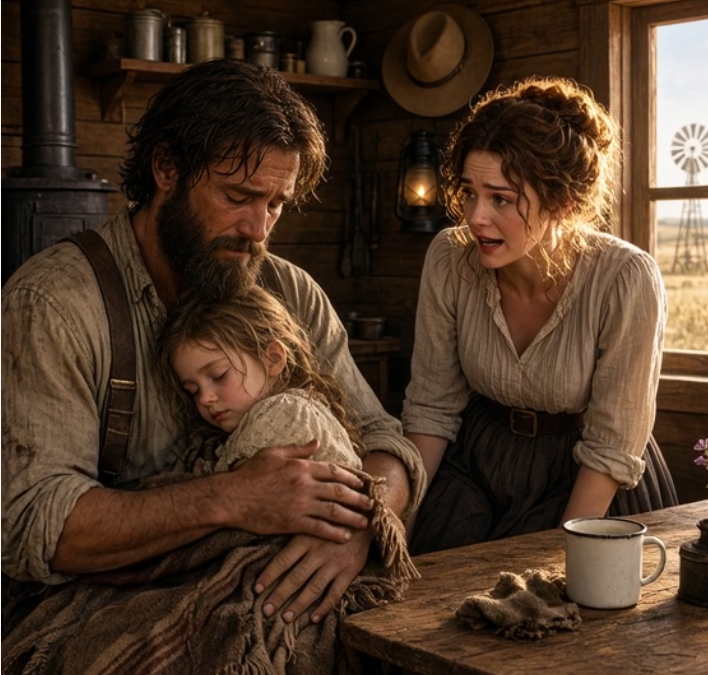
Eleanor Cross was tall, with dark auburn hair pulled back practically, somewhere in her mid-thirties—younger than he had expected. She wore a plain dark skirt and a work shirt rolled at the sleeves, and she held a rifle the easy way a person holds a tool picked up out of habit.
Not aimed.
Just present.
Her expression gave him nothing to work with.
No welcome.
No fear.
No immediate anger.
Only assessment.
“Ma’am,” Garrick said.
His voice came out rough.
He had not spoken to anyone in two days.
Her eyes went straight past him to the bundle in his arms.
“What’s wrong with the child?”
Flat.
Direct.
No warmth.
No cruelty either.
“Fever. Going on eleven days.”
Eleanor came down one step.
“Cough?”
“Some.”
“Vomiting?”
“No.”
“Rash?”
“No.”
“She drinking?”
“Less today.”
“How old?”
“Four.”
Her eyes moved over Lydia’s face, then Garrick’s.
“She needs water and milk if you’ve got it,” he said quickly. “Proper nutrition. I can work.”
His throat tightened.
He had almost said, I’ve got money.
That would have been a lie, and something about this woman made him reluctant to start with one.
“I’ve got nothing to pay you with,” he said. “But I can work. Whatever needs doing. I’m not asking for charity. I’m asking for work.”
Eleanor looked at him—not at Lydia, at him—the way a person looks at something they are trying to accurately assess.
“How long since she ate?”
“Yesterday morning. Small amount.”
“How long since you ate?”
He had not expected that.
“That’s not the concern right now.”
“I didn’t ask what the concern was.”
His jaw tightened.
“Day before yesterday.”
Something shifted, almost imperceptibly, in her face.
Not pity.
More like recalculation.
“Come inside,” she said, and turned back toward the door without waiting to see if he would follow.
Garrick took one step.
Then another.
The porch boards were swept clean.
A clay pot of basil sat near the window.
Beside the door hung a horseshoe, rusted but polished from being touched often.
The inside of the house smelled of woodsmoke, coffee, dried lavender, and something baking.
Bread, maybe.
The scent made Garrick’s stomach twist so violently he nearly stumbled.
Eleanor noticed.
She did not comment.
“Put her here.”
She pointed to a settle near the stove, then seemed to change her mind.
“No. Bedroom.”
She led him down a short hallway to a small room with a narrow bed, a washstand, and curtains faded by sun. The room was plain but clean. A quilt folded at the foot of the bed looked too carefully kept to be ordinary.
Garrick hesitated.
“She’s dirty.”
“So is fever.”
Eleanor pulled the quilt aside.
“Lay her down.”
Garrick lowered Lydia gently.
She made a faint sound when her head touched the pillow.
It was not a word.
But it was sound.
His knees nearly gave out.
Eleanor moved quickly.
She brought water.
Not to him.
To Lydia.
She crouched beside the bed and held a cup to the child’s lips with surprising gentleness.
“Little sips,” she said. “That’s it. Don’t hurry.”
Lydia’s eyes opened halfway.
She looked at Eleanor without recognition.
“Mama?”
The word barely existed.
Garrick flinched.
Eleanor’s hand stilled for the smallest fraction of a second.
Then she said, “No, sweetheart. Just someone with water.”
Lydia swallowed.
Once.
Twice.
Eleanor handed Garrick a cloth.
“Wet that.”
He moved to the washbasin.
His hands shook so badly he spilled water on the floor.
Eleanor did not scold him.
She warmed milk with honey at the stove, then asked his name, where he was from, what had happened to his farm.
He told her quickly, without decoration, because drawing it out never made it easier.
“Garrick Hale. Came from near the Platte. Had eighty acres leased. Lost the corn first. Then two cows. My wife Ruth died in February. Fever after childbirth that didn’t end in a child.”
He stopped.
Eleanor’s eyes flicked to him.
He continued.
“The bank called the note early. Man named Silas Crowe bought it out before I could make arrangements. Said I could stay as hired labor on what used to be mine.”
A muscle jumped in Eleanor’s jaw.
Garrick noticed.
“You know him?”
“Everyone knows Silas Crowe.”
That was not an answer, but it was enough of one.
“He took the farm,” Garrick said. “Then he offered me work driving cattle north. I took it because Lydia needed food. She started coughing two weeks after. I left the drive near Rawlins, tried finding doctoring. Been moving west since.”
“And came here because someone told you I’d give work?”
“They said you might.”
“Who?”
“A teamster with a missing thumb.”
The corner of Eleanor’s mouth shifted.
“Benson.”
“I didn’t get his name.”
“Benson.”
She set the warm milk aside to cool and walked to the window.
For a long moment she looked out toward the barn.
Garrick stood beside the bed and watched Lydia breathe.
Every breath was a counting.
One.
Two.
Still here.
Three.
Still here.
Eleanor turned back.
“I have work that needs doing,” she said. “Fence on the north section. Hayloft repair. A pump that sticks whenever it feels like reminding me men built it badly. Standard wages—barely enough to get you to the next place, if I’m honest. Room and board for you both. A proper bed for the girl.”
Garrick closed his eyes briefly.
“Ma’am—”
“I’m not finished.”
He opened them.
She had the look of someone turning a thought over and arriving somewhere that surprised even her.
“And I’d like to propose something else,” she said. “Something you’re free to refuse without it affecting anything I just offered.”
“All right,” he said carefully.
“I want to be her mother.”
The kitchen went very quiet.
The stove ticked.
Outside, a hen made a brief indignant sound.
Garrick stared at her.
“What?”
Eleanor did not look away.
“I said I want to be her mother.”
His body went cold in a way the prairie heat had not managed.
“You think I walked across half of Wyoming so some stranger could take my daughter?”
“No.”
“Then what in God’s name do you mean?”
Her face remained steady, but something behind her eyes tightened.
“I mean your girl is sick. You are half-starved. You have no home. No money. No family nearby, I assume?”
“That doesn’t give you claim to her.”
“I am not making a claim.”
“You just said—”
“I said what I mean. Not what you fear.”
Garrick took one step toward her.
“I fear people with land and food thinking grief makes poor men easy to rob.”
The words came out harsher than he intended.
Eleanor absorbed them without flinching.
“Yes,” she said. “That is a reasonable fear.”
That stopped him more effectively than denial would have.
She continued.
“Six years ago, when my husband died, three men came to my porch in the first week offering advice. Two offered marriage before the dirt settled on Samuel’s grave. One suggested I sell because ranching was no life for a woman alone.”
Garrick said nothing.
“Silas Crowe offered to buy this ranch three times,” she said. “The third time he brought a lawyer. Claimed a woman could not maintain debt, stock, land, and labor without male oversight. That was his phrase. Male oversight.”
Her mouth hardened.
“I have spent six years keeping what was mine from men who smiled while measuring where to put their hands.”
Her gaze moved to the bedroom door.
“So no, Mr. Hale. I am not offering to take your daughter. I am offering something I wanted once and lost.”
“Which is?”
“To stand beside a child and have that child know I chose her.”
Garrick’s anger faltered, though suspicion remained.
“I don’t understand.”
Eleanor’s face changed then.
Just slightly.
But enough.
“I had a daughter,” she said.
The room seemed to still around the words.
“Clara. She lived nine months. Fever took her in late summer. Same year Samuel died. I buried them nine weeks apart.”
Garrick’s hand closed around the back of a chair.
Eleanor looked down.
“When your girl called me Mama, something in me answered before sense could stop it. That is not your burden. It is mine. I know that.”
Her voice remained controlled.
But control, Garrick had learned, did not mean a thing did not hurt.
“I am offering to help raise her,” Eleanor said. “Not to remove you. Not to erase her mother. Not today, not by force, not with papers hidden in a drawer. I am saying if she lives, and if you stay, and if time proves this house safe for all of us, I would like Lydia to have more than one person standing between her and the world.”
Garrick looked toward the small bedroom.
Lydia lay still beneath the sheet, her hair damp against her forehead.
“She has a mother.”
“Yes.”
“Ruth.”
“I know.”
“You don’t know her.”
“No.”
“She sang when she made biscuits. Badly. Never knew the right words. Lydia still asks if angels know songs wrong.”
Eleanor’s eyes softened.
“Then we will tell her they do.”
We.
The word moved through him with dangerous warmth.
He looked away.
“I don’t know you.”
“No.”
“I don’t trust you.”
“You shouldn’t yet.”
“I could leave tomorrow.”
“You could.”
“If she gets well.”
“Yes.”
“And you’d let us?”
Eleanor held his gaze.
“I opened my door, Mr. Hale. I did not lock it behind you.”
Something inside him cracked.
Not enough to collapse.
Enough to hurt.
“I can work,” he said again, but weaker.
“I know.”
“I won’t take charity.”
“You will take supper.”
“That isn’t—”
“It is. And you will take it anyway because pride is a poor meal for a sick child.”
He almost smiled.
Almost.
But exhaustion swallowed it.
Eleanor motioned to a chair.
“Sit before you fall.”
“I need to—”
“You need to sit.”
His knees obeyed before his pride could object.
The chair caught him.
For a moment, he thought he might faint.
Eleanor placed a bowl in front of him.
Stew.
Bread.
A mug of water.
Garrick stared at it like it was something dangerous.
“Eat slowly,” she said.
He picked up the spoon.
His hand shook.
The first bite nearly undid him.
Beef.
Onion.
Salt.
A richness his body had forgotten.
He tried not to eat like a starving man.
Failed.
Eleanor pretended not to notice.
Then she rose and went into the bedroom.
He heard her speak quietly to Lydia.
Not sweetly.
Not the way people performed tenderness.
Plainly.
“You need another sip. I know. I’m unreasonable.”
A pause.
“There. Good.”
Garrick lowered his head over the bowl.
For the first time in months, he ate while someone else kept watch.
That night, fever ruled the house.
Lydia burned.
Then shook.
Then burned again.
Eleanor knew more than she had said.
She cooled the child with damp cloths, changed bedding, warmed broth, measured time between sips, and forced Garrick to sleep in a chair for twenty minutes at a stretch.
He argued the first time.
She handed him a cup of coffee and said, “If you collapse, I have two patients and no patience for either.”
He slept.
Woke ashamed.
Then slept again.
Near dawn, Lydia began murmuring.
Not words at first.
Sounds.
Then one clear whisper.
“Papa.”
Garrick was at her side instantly.
“I’m here.”
Her eyes opened.
Not fully.
But enough.
“Thirsty.”
He almost wept.
Eleanor closed her eyes.
Only for a second.
Then she turned away and reached for the cup.
By the third day, Lydia’s fever broke.
Not completely.
It retreated like an enemy that might return if not watched carefully.
Her skin cooled.
Her breathing eased.
She drank milk.
Ate two spoonfuls of broth.
Then demanded, in a voice still thin but unmistakably hers, “Is there bread with jam?”
Garrick laughed so suddenly he startled himself.
Eleanor stood at the stove.
“No jam until your stomach proves it has manners.”
Lydia frowned.
“What are manners?”
“Not throwing up on my quilt.”
“Oh.”
She considered this.
“Then bread without jam.”
Garrick pressed his hand over his mouth.
Eleanor turned away, but not before he saw the smile she tried to hide.
On the fifth day, Lydia sat on the porch wrapped in the faded quilt Eleanor insisted was too worn to matter and watched chickens scratch in the yard.
“What are their names?” she asked.
“They don’t have names,” Eleanor said.
Lydia looked horrified.
“How do they know who they are?”
“They are chickens. Their ambitions are limited.”
“That one is Margaret.”
Eleanor looked at the hen.
“Margaret is a terrible name for a chicken.”
“She likes it.”
“How do you know?”
“She told me with her eyes.”
Garrick, repairing a loose porch step, stopped hammering.
Eleanor glanced at him.
He looked down quickly.
Lydia pointed.
“That one is Mr. Biscuit.”
Eleanor folded her arms.
“That one is a rooster.”
“Then he especially needs a good name.”
By evening, every chicken had a name.
By the following morning, Eleanor was using them.
“Margaret, get out of the herb bed.”
Garrick looked up from the pump.
Eleanor met his eyes.
“If you laugh, I’ll reduce your wages.”
He went back to work.
He did not laugh until he was behind the barn.
A week became two.
Lydia grew stronger.
Garrick worked.
At first Eleanor gave him lighter tasks than he wanted.
He noticed.
“Fence is harder work than that pump,” he said one morning.
“You nearly died on my porch ten days ago.”
“Not nearly.”
“You sat down like a man considering it.”
“I can mend fence.”
“You can mend fence when I say you can mend fence.”
“You always this pleasant with hired hands?”
“You always this argumentative with employers?”
He looked at her.
“Only the bossy ones.”
“Then I suppose we’ll both be busy.”
Work became a language between them.
Garrick repaired the pump.
Mended two gates.
Cut and stacked wood.
Repaired the hayloft.
Eleanor worked beside him more often than he expected.
She did not stand back and direct like a woman playing at labor.
She lifted.
Hauled.
Counted cattle.
Checked hooves.
Knew which boards in the barn roof would need replacing before winter and which could be trusted.
The ranch hands came twice a week from neighboring spreads when needed, but most of the daily work was hers.
People had not exaggerated Eleanor Cross.
They had misunderstood her.
Hard, yes.
But not because she lacked softness.
Because softness had become expensive.
Garrick recognized that.
Some evenings they sat on the porch after Lydia slept.
At first, they spoke only of weather, work, and whether the fever might return.
Then, gradually, other things entered.
Ruth.
Samuel.
Clara.
Danville, where Garrick had been born.
The first horse Eleanor ever broke.
How Lydia had once tried to feed a frog biscuit dough.
How Samuel had believed he could build a smokehouse without instructions and nearly burned down a shed.
They laughed carefully at first.
As if laughter might disrespect the dead.
Then less carefully.
One night Lydia woke crying.
Garrick reached her first.
“What is it?”
“I dreamed Mama left again.”
He sat on the bed.
Eleanor stood in the doorway, candle in hand.
Lydia saw her.
“Mrs. Cross?”
“Yes?”
“If I call you Eleanor, will Mama mind?”
The question struck the room silent.
Garrick could not breathe.
Eleanor’s hand tightened around the candleholder.
“I don’t know,” she said.
Lydia’s lip trembled.
“I don’t want Mama to be lonely.”
Garrick closed his eyes.
Eleanor came into the room and sat on the opposite side of the bed.
“Your mama has you loving her still. That is not lonely.”
Lydia thought about this.
“Can I love you too?”
Eleanor looked at Garrick.
Not for permission exactly.
For honesty.
His throat worked.
He nodded once.
Eleanor’s eyes shone in the candlelight.
“Yes,” she said. “If you want to.”
Lydia reached for her hand.
Eleanor took it.
“But I don’t want to forget Mama.”
“You won’t.”
“How do you know?”
“Because people we love don’t disappear just because we love someone else.”
Lydia studied her.
“Did you love someone else?”
“Yes.”
“Your baby?”
Eleanor inhaled.
“Yes.”
“Did she disappear?”
“No.”
“Where is she?”
Eleanor looked toward the window.
“In me, mostly.”
Lydia placed a small hand against Eleanor’s chest.
“There?”
“Yes.”
Lydia nodded solemnly.
“Then Mama is in Papa.”
Garrick covered his eyes.
Eleanor leaned forward and kissed Lydia’s hair.
Only once.
Almost afraid of the gesture.
Lydia accepted it as naturally as breathing.
After that, something shifted.
Not into a complete family.
Not so quickly.
But into possibility.
Possibility is dangerous to wounded people.
It invites hope before safety has fully arrived.
And hope, Garrick had learned, could be another way for life to hurt you.
He began watching for reasons to leave.
Not because he wanted to.
Because staying felt like tempting punishment.
The ranch was too orderly.
Lydia was too happy.
Eleanor’s presence was too steady.
Every evening Garrick looked at his daughter with more color in her face, more words in her mouth, and felt gratitude edged with terror.
Then Silas Crowe arrived.
He came on a Saturday afternoon in a black carriage that did not belong on a cattle road, drawn by two matched bays and driven by a young man who looked afraid to breathe incorrectly.
Garrick saw dust first.
Eleanor saw the carriage and stopped mid-sentence.
Her face changed.
Not fear.
Not exactly.
But readiness.
“Lydia,” she said, “go inside.”
Lydia looked up from the porch where she was teaching Mr. Biscuit the rooster to appreciate poetry.
“Why?”
“Now.”
The tone did it.
Lydia gathered her papers and went inside.
Garrick set down the harness he had been mending.
“Crowe?”
“Yes.”
The carriage stopped.
Silas Crowe stepped down as if the dirt personally insulted his boots.
He was a broad man in his fifties, with a silver-trimmed beard, a cream waistcoat, and a watch chain that flashed in the sun. His face was handsome in the way carved furniture could be handsome—expensive, polished, and without warmth.
“Mrs. Cross.”
“Mr. Crowe.”
His eyes moved to Garrick.
“Well.”
The word carried recognition.
Garrick’s stomach tightened.
“Hale, isn’t it?”
Garrick did not answer.
Crowe smiled.
“I thought so. Last I heard, you’d abandoned a cattle drive and wandered off with a sick child.”
Eleanor stepped down from the porch.
“State your business.”
Crowe’s eyes returned to her.
“My business is always clear. I’ve come to discuss the northern water rights.”
“No.”
“You haven’t heard my offer.”
“I heard three previous ones.”
“This is improved.”
“No.”
Crowe smiled wider.
“Still pretending sentiment can run a ranch?”
“Sentiment doesn’t. Water does. Which is why you want mine.”
A flicker crossed his face.
Then vanished.
“You always did have a sharp tongue.”
“And you always did mistake refusal for negotiation.”
Crowe glanced again at Garrick.
“I see you’ve hired new help.”
“Yes.”
“Unwise.”
“Good day, Mr. Crowe.”
He ignored that.
“You know this man lost his farm?”
“I know.”
“Do you know why?”
Garrick moved forward.
Eleanor lifted one hand slightly.
Not to stop him like a child.
To say: wait.
Crowe continued.
“Mismanagement. Debt. Poor judgment. Then, as I said, he abandoned contracted work.”
“You called my note early,” Garrick said.
Crowe turned toward him.
“I enforced a legal debt.”
“You bought it first.”
“That is business.”
“You offered to let me work the land I buried my wife on.”
“Generous, considering your position.”
Garrick’s hands curled.
Eleanor’s voice cut cleanly through the air.
“Mr. Crowe, if you came to insult my hired man, your afternoon must be emptier than mine.”
Crowe’s expression hardened.
“Hired man?”
“Yes.”
“Is that what he is?”
The way he said it made the porch seem smaller.
Eleanor’s face did not change.
“You will be careful in my yard.”
Crowe chuckled.
“Your yard. Your ranch. Your rules. Always the widow queen.”
Garrick stepped forward.
Eleanor did not stop him this time.
Crowe looked amused.
“Careful, Hale. Men in your circumstances cannot afford temper.”
“My circumstances improved when I stopped working for you.”
Crowe’s eyes chilled.
“Have they?”
He looked toward the house.
A curtain shifted.
Lydia.
Garrick’s blood went cold.
Crowe saw it.
Of course he did.
“A father with no legal residence,” Crowe said mildly. “No property. No savings. A child recently near death. Working under the roof of a widow with disputed water rights. People might ask questions.”
Eleanor took one step closer.
“My water rights are not disputed.”
“They may become so.”
“They are recorded.”
“Records are interpreted by men.”
“Not all men are yours.”
“Enough are.”
Silence.
There it was.
The truth without ornament.
Eleanor’s hand hung near the rifle leaning inside the porch door.
Crowe saw that too and smiled.
“No need for theatrics. I am merely advising caution. Wyoming is no place for sentimental arrangements.”
Garrick’s voice came low.
“If you speak about my daughter again—”
Crowe turned on him.
“What? You’ll strike me? In front of witnesses? I would enjoy seeing how that improves your fatherly standing.”
Garrick froze.
Eleanor said, “Leave.”
Crowe placed his hat back on his head.
“I’ll return with papers. For the water. Perhaps other matters.”
He looked at the house again.
“Good day, Mrs. Cross.”
He climbed back into the carriage.
The driver snapped the reins.
Dust swallowed them.
Only when the carriage disappeared beyond the rise did Garrick realize his hands were shaking.
Eleanor stood very still.
Lydia burst through the door.
“Papa?”
He turned.
She ran to him.
He lifted her, though his arms still trembled.
“Everything’s all right.”
It was the first lie he had told her since arriving at Cross Ranch.
Eleanor watched the road long after Crowe was gone.
That evening, she brought out a wooden box from beneath her bed.
Inside were deeds, old letters, tax receipts, water filings, and legal documents tied in ribbon.
Garrick stood at the table.
“You expected this?”
“I expected something.”
“Because of me?”
“No.”
“Because of Lydia?”
“No.”
“Eleanor.”
She looked up.
“Crowe has wanted this ranch since Samuel died. You did not bring the wolf. You only gave him a new path to the door.”
Garrick sat.
“I can leave.”
“No.”
“You heard him.”
“I heard a man testing fences.”
“If I stay, he may use Lydia.”
“If you leave, he may still use Lydia.”
Garrick rubbed both hands over his face.
“He could claim I’m unfit.”
“Yes.”
“He could try to take her.”
“Yes.”
The word struck like a blow.
Eleanor did not soften it.
“How do I stop him?”
“By becoming harder to move.”
“I have nothing.”
“You have work. Witnesses. A place. A child improving under care. And me.”
He looked at her.
She opened another paper.
“I also have something Crowe does not know I have.”
“What?”
“Samuel’s final purchase contract.”
She turned it toward him.
“He paid off the northern water parcel before he died. The county copy vanished years ago when Crowe’s cousin served as clerk. I kept ours.”
Garrick stared.
“Then why hasn’t Crowe stopped?”
“Because a paper hidden in a box does not frighten a man accustomed to owning the men who read papers.”
“So what does?”
Eleanor’s eyes lifted.
“Enough witnesses.”
The next morning, she hitched the wagon.
“We’re going to town.”
Garrick frowned.
“For what?”
“To make you visible.”
“I don’t follow.”
“Crowe works in shadows and offices. Men like him prefer people isolated. Widow alone. Drifter father. Sick child. Missing documents. Quiet pressure.”
She tied down the document box.
“So we stop being quiet.”
Town was called Mercy Crossing, though Garrick saw very little mercy in it when they arrived.
A single main street.
General store.
Blacksmith.
Church.
Land office.
A bank with polished windows.
Crowe’s name appeared more times than was decent.
On the bank sign.
On a grain warehouse.
On a notice board.
Eleanor walked into town as if she owned her spine and meant to keep it.
Lydia held her hand.
Not Garrick’s.
Eleanor’s.
People noticed.
Of course they did.
Garrick felt every stare.
The widow Cross with a child.
The ruined Hale.
The little girl who had appeared half-dead and now walked in a blue dress Eleanor had altered from old cloth.
Their first stop was the church.
Reverend Amos Bell was thin, white-haired, and had eyes that missed less than politeness required.
Eleanor told him plainly that Garrick and Lydia were staying at her ranch, that Garrick was employed properly, that the child had been ill and was recovering, and that Silas Crowe had made threatening remarks.
The reverend folded his hands.
“Do you wish me to speak with him?”
“No,” Eleanor said. “I wish you to know.”
His eyes warmed.
“Then I know.”
Next, the doctor.
Dr. Mercy Vale had sharp elbows, sharper eyes, and no visible patience for men who confused opinion with fact. She examined Lydia while Garrick stood by uselessly.
“She needs weight,” Dr. Vale said. “Rest. Food. No more prairie crossings.”
“I object to those too,” Lydia said solemnly.
Dr. Vale looked at Garrick.
“She was worse?”
“Yes.”
“How much?”
He told her.
The doctor’s expression tightened.
Then she wrote a statement confirming the child was receiving proper care at Cross Ranch.
“Use that if anyone decides gossip is medicine.”
At the land office, Eleanor filed copies of Samuel’s water purchase contract.
The clerk, a young man with nervous hands, went pale when he saw it.
“I don’t know if—”
Eleanor leaned forward.
“You will record it.”
“Mrs. Cross, Mr. Crowe has—”
“Mr. Crowe does not sit in that chair.”
The clerk swallowed.
“No, ma’am.”
Garrick watched the stamp come down on the copy.
A small sound.
A massive one.
Then Eleanor did something Garrick did not expect.
She walked into the bank.
Crowe’s bank.
The room quieted immediately.
Silas Crowe stood near the back speaking with a man in a gray suit.
His face changed when he saw them.
Eleanor did not approach him.
She walked to a desk where a notary sat.
“I need this statement witnessed,” she said.
The notary glanced toward Crowe.
Eleanor placed money on the desk.
“Your posted fee.”
The notary looked at the coins.
Then at Crowe.
Then at the gathered customers watching.
Publicness did its work.
He dipped his pen.
“What statement?”
Eleanor unfolded a document.
“I, Eleanor Cross, widow of Samuel Cross, state that Garrick Hale is employed by me at standard wage, housed by agreement, and that his minor daughter Lydia Hale resides at Cross Ranch under the care and knowledge of her father. No claim of abandonment, vagrancy, or neglect applies.”
Garrick’s breath caught.
Crowe stepped forward.
“This is unnecessary.”
Eleanor looked at him.
“Then it should not trouble you.”
“Mrs. Cross—”
“Mr. Crowe, are you interfering with a notarized statement?”
People watched.
Crowe stopped.
The notary signed.
So did Eleanor.
Then Garrick.
His hand shook only slightly.
Outside, he said, “You planned all that.”
“Yes.”
“You used us.”
Eleanor turned sharply.
“No.”
“You used our situation.”
“Yes.”
He stared.
She did not apologize.
“So did Crowe,” she said. “The difference is I used it to build a wall around your child instead of a trap.”
Garrick wanted to argue.
Could not.
Lydia tugged Eleanor’s sleeve.
“Did we win?”
Eleanor looked down at her.
“For today.”
Lydia nodded.
“Good. I’m hungry.”
For the first time that day, Eleanor smiled.
“Then today’s victory includes biscuits.”
For several weeks, Crowe did nothing.
That made Eleanor more uneasy, not less.
Garrick learned her rhythms.
When she checked the same gate twice, she was worried.
When she sharpened knives she had already sharpened, she was angry.
When she stood at the north pasture looking at nothing, she was thinking about Samuel.
Lydia continued recovering.
Her cheeks filled out.
Her hair regained shine.
She followed Eleanor constantly.
Not always.
Not instead of Garrick.
But in ways that hurt and healed at once.
She learned to gather eggs.
Learned which herbs Eleanor used for tea.
Learned not to chase chickens unless she wanted to be pecked by Margaret, who had turned out to be poorly named but accurately temperamental.
One evening Garrick found Lydia and Eleanor sitting near the kitchen table.
Eleanor was showing her how to stitch.
Lydia’s tongue poked from the corner of her mouth in concentration.
“No,” Eleanor said. “Smaller stitches.”
“These are small.”
“These are ambitious.”
“What does ambitious mean?”
“Too large but confident.”
“Oh.”
Garrick watched from the doorway.
Lydia looked up.
“Papa, Eleanor says I can make a handkerchief.”
“That so?”
“For you. But don’t use it for your nose because it will be fancy.”
“I’ll treasure it uselessly.”
“That’s right.”
Eleanor did not look up from the cloth, but he saw her smile.
Later, after Lydia slept, Garrick found Eleanor in the barn.
She was brushing a mare, long strokes along the animal’s neck.
“She loves you,” he said.
The brush paused.
Then continued.
“She is four.”
“She knows her mind.”
“She named a rooster Mr. Biscuit.”
“She’s young, not foolish.”
Eleanor leaned her forehead briefly against the mare’s neck.
“You don’t have to be kind about it.”
“I’m not.”
She looked at him then.
Her face was tired.
Vulnerable in a way he rarely saw.
“If she starts calling me mother, what happens to Ruth?”
The question hit him quietly.
“Nothing.”
“How do you know?”
“Because I still love Ruth.”
Eleanor’s eyes lowered.
“And?”
“And I think I am beginning to love you.”
The barn went still.
The mare flicked an ear.
Eleanor did not move.
Garrick had not planned to say it.
He had not even allowed himself to think it clearly.
But there it was.
Plain.
Terrifying.
True.
Eleanor set the brush down.
“Do not say that because you are grateful.”
“I know the difference.”
“Do you?”
“Yes.”
“Your wife died this year.”
“I know.”
“You came here starving and desperate.”
“I know.”
“I gave your child a bed.”
“Yes.”
“That can confuse a man.”
Garrick stepped closer, but not too close.
“Eleanor, I have been hungry enough to mistake broth for grace. I have been frightened enough to mistake any open door for salvation. This isn’t that.”
She looked at him.
He continued.
“I loved Ruth. I still do. I think I will always carry her. But my heart did not die with her, much as I sometimes wished it had.”
Her eyes shone.
“I don’t know how to do this again.”
“Neither do I.”
“I am not soft.”
“I noticed.”
“I am difficult.”
“Also noticed.”
“I will not be some gentle ranch wife who waits with ribbons in her hair.”
“Good. I’d worry you’d been replaced.”
She laughed once.
It broke into something close to a sob.
Garrick stopped.
“I won’t ask anything from you.”
“You already did.”
“When?”
“When you told me.”
She turned toward the barn door.
Outside, the sky had gone purple over the prairie.
“I need time.”
“You have it.”
“If I never—”
“You still have it.”
She looked back at him.
“You make promises too easily.”
“No,” he said. “I make very few. That’s why I remember them.”
The next day, Crowe struck.
Not with a gun.
With paper.
A deputy arrived from Mercy Crossing carrying a folded notice and the discomfort of a man who hated his task but intended to do it anyway.
Eleanor read the paper once.
Then again.
Garrick watched her face close.
“What is it?”
She handed it to him.
Petition for review of minor child welfare.
Petition for debt reassessment.
Notice of disputed water access.
Crowe had filed all three.
The first claimed Lydia Hale was being housed in “improper and morally ambiguous conditions” with an unrelated widow and a penniless father whose employment was “unverified in durability.”
The second claimed Garrick owed remaining debt from his former farm note, now held by Crowe.
The third challenged Eleanor’s water rights based on “irregular documentation.”
All at once.
All meant to exhaust them.
Eleanor folded the paper.
“When?”
The deputy swallowed.
“Hearing Monday.”
“That’s four days.”
“I know.”
“Judge?”
“Whitcomb.”
Eleanor’s mouth tightened.
Garrick asked, “Crowe’s man?”
The deputy looked at him.
“I didn’t say that.”
“But?”
“I didn’t say that either.”
After the deputy left, Garrick hit the porch post hard enough to split skin across his knuckles.
Eleanor grabbed his wrist.
“Stop.”
“He’s going after Lydia.”
“Yes.”
“I’ll kill him.”
“No.”
“He thinks he can take my child.”
“And if you kill him, he may succeed.”
Garrick’s chest heaved.
Eleanor’s voice sharpened.
“Look at me.”
He did.
“You do not give him your temper. That is what he wants. He wants you wild, poor, violent, and easy to name unfit.”
Garrick shook.
Eleanor tightened her grip.
“You want to protect Lydia? Stand still when every bone in you wants to strike.”
He closed his eyes.
The hardest order any person had ever given him.
“All right,” he said.
By Sunday night, the house was full.
Not with furniture.
With people.
Reverend Bell came.
Dr. Vale came.
Benson the teamster arrived with two other men who had known Garrick before Crowe bought his note.
The nervous land clerk came after dark, pale and sweating, carrying copies of county record books he claimed to have “borrowed by accident.”
Rachel Donnelly, a seamstress whose husband had once worked for Eleanor, brought food and testimony that Lydia was cared for.
Even the deputy returned, off duty, with a quiet statement about Crowe’s pressure tactics in prior land disputes.
Eleanor stood in the kitchen looking at them all.
“You understand what this means?”
Dr. Vale snorted.
“It means the town bully finally bored us.”
The land clerk whispered, “It may cost me my position.”
Eleanor softened.
“Yes.”
He looked at Lydia asleep on a pallet near the stove because she had refused to go upstairs while “important whispering” happened.
Then he said, “I know.”
Garrick watched it unfold with disbelief.
He had thought Eleanor alone.
She was not.
Not exactly.
She had been isolated by pride, grief, and the town’s assumption that she preferred distance.
But respect is not always loud.
Sometimes it waits until called.
The hearing took place in the church because the town hall was being repaired.
Crowe arrived confident.
Of course he did.
He wore a dark suit, a silver watch, and an expression of patient regret, as if the entire affair pained him deeply.
Judge Whitcomb sat at the front.
Garrick sat beside Eleanor.
Lydia sat between them.
Her small hand held his left hand and Eleanor’s right.
Crowe noticed.
His eyes narrowed.
The proceedings began with the matter of Lydia.
Crowe’s lawyer spoke smoothly.
A vulnerable minor child.
A transient father.
Questionable domestic arrangement.
No legal wife present.
Improper household.
Potential moral hazard.
Garrick felt every word like grit beneath skin.
He did not move.
Eleanor’s hand, the one Lydia did not hold, rested flat on her knee.
Motionless.
When their turn came, Dr. Vale stood.
She described Lydia’s condition upon arrival.
The fever.
The malnutrition.
The improvement.
Then she looked at Crowe.
“In my medical opinion, removing that child from Cross Ranch would be the most dangerous thing anyone in this room could do to her.”
Crowe’s lawyer objected.
Judge Whitcomb allowed the statement to stand.
Reverend Bell followed.
“Is it morally improper,” Crowe’s lawyer asked, “for an unrelated man and widow to reside under the same roof?”
The reverend blinked mildly.
“Did they?”
The lawyer frowned.
“Excuse me?”
“Mr. Hale sleeps in the bunkroom off the barn with two ranch hands when they are present and alone when they are not. The child sleeps in the house under Mrs. Cross’s care. If you intend to imply sin, you may wish to locate some first.”
A murmur moved through the church.
Eleanor looked down.
Garrick nearly smiled.
Then came the debt.
Crowe claimed Garrick still owed fees tied to abandonment of contract.
Benson stood.
“The cattle drive contract allowed departure for family medical emergency,” he said.
Crowe’s lawyer frowned.
“You read it?”
“Signed as witness.”
“You can produce this contract?”
Benson smiled without humor.
“Didn’t think I needed to until Mr. Crowe got forgetful.”
He produced it.
Crowe’s face darkened.
Then the land clerk stood.
His voice shook badly at first.
Then steadied.
He explained irregularities in the county books.
Missing copies.
Altered dates.
Water filings recorded improperly or removed.
Judge Whitcomb leaned forward.
“Are you accusing Mr. Crowe?”
The clerk swallowed.
“I am saying the county records do not match original copies held by Mrs. Cross.”
Eleanor handed over Samuel’s purchase contract.
The judge read it.
Crowe’s expression changed for the first time.
Not anger.
Alarm.
The final blow came from the deputy.
He testified that Crowe had repeatedly used legal petitions as leverage to pressure landowners, particularly widows and debtors.
Crowe stood.
“This is slander.”
Dr. Vale said loudly, “Sit down, Silas.”
People gasped.
The judge banged his gavel.
But something had shifted.
Fear was contagious.
So was defiance.
Crowe’s lawyer tried to regain control.
He questioned Garrick hard.
Why had he lost his farm?
Why had he traveled with a sick child?
Why had he not sought relatives?
Why had he entered the household of a widow?
Garrick answered each plainly.
No embellishment.
No begging.
No anger.
Then the lawyer said, “Would you agree, Mr. Hale, that your daughter has lacked a proper mother?”
The room went silent.
Garrick felt Lydia’s hand tighten.
He looked down.
Her eyes were wide.
Then Eleanor stood.
The lawyer turned.
“I did not ask you—”
“No,” she said. “You did not.”
Judge Whitcomb frowned.
“Mrs. Cross—”
Eleanor faced the room.
“This child has a mother. Her name was Ruth Hale. She died. Death does not revoke motherhood.”
No one moved.
Eleanor continued.
“But if the question is whether Lydia lacks women willing to love, guard, feed, teach, and stand beside her, then no. She does not.”
Her voice did not break.
“I have asked her father for the honor of helping raise her. Not to replace Ruth. Not to possess Lydia. To serve the child’s life. If this court finds that improper, then perhaps this court should examine why it trusts a greedy man with paper more than a household where a sick girl became well.”
Crowe’s face flushed.
Judge Whitcomb said, “Mrs. Cross, you will restrain your accusations.”
Eleanor turned toward him.
“I have restrained them for six years.”
The church erupted.
The gavel struck.
Once.
Twice.
Three times.
Lydia stood suddenly on the bench.
Small.
Pale.
Furious.
“Don’t take me from Papa.”
The room froze.
Garrick reached for her.
She stepped down before he could stop her and walked toward the front.
Her braids were uneven.
Her dress, one Eleanor had altered, hung slightly loose.
She looked at the judge.
“I was hot and couldn’t wake up right,” she said. “Papa carried me. Eleanor gave me milk. Papa sings bad. Eleanor sews good. Mama is in heaven and she knows I love her.”
Her little chin lifted.
“I want to stay.”
No law book in the territory could have matched that.
Judge Whitcomb looked at Lydia.
Then at Garrick.
Then at Eleanor.
Then, finally, at Crowe.
The decision did not come all at once.
Men like Whitcomb preferred caution.
But public rooms limit cowardice.
The petition regarding Lydia was dismissed.
The claim against Garrick was denied pending contract review, which everyone present understood meant dead.
Eleanor’s water rights were upheld subject to investigation into county record irregularities.
That last part mattered most.
Because an investigation meant Crowe’s papers would be touched by hands he did not own.
By the time they left the church, the town had changed.
Not completely.
Towns do not transform in an afternoon.
But something had cracked.
People who had lowered their eyes when Crowe passed now watched him openly.
The seamstress refused his wife’s order the next week.
The land clerk resigned before he could be fired and took a position two counties east, carrying copies of suspicious records with him.
Benson spread the story along every freight line he traveled.
Dr. Vale told anyone who asked that Silas Crowe had tried to frighten a sick child to steal water.
That version stuck.
Powerful men survive many things.
Ridicule is not always one of them.
Crowe did not disappear immediately.
But loans once easy to call became dangerous to touch.
Witnesses came forward.
A territorial examiner arrived in Mercy Crossing in October.
By winter, Silas Crowe’s bank faced review.
By spring, two lawsuits had followed.
He sold the grain warehouse first.
Then his carriage.
By the following August, he left town in a wagon smaller than the one he had once used to threaten widows.
Lydia watched from Eleanor’s porch as he passed.
“Is that the mean man?”
“Yes,” Garrick said.
“Where’s he going?”
“Elsewhere.”
“Good.”
Eleanor, sitting beside them shelling peas, said, “That is not charitable.”
Lydia considered this.
“May God improve him elsewhere.”
Garrick coughed into his hand.
Eleanor looked at him.
“Do not encourage her.”
“I wouldn’t dare.”
The year turned.
Then another.
Garrick did not leave.
At first, he told himself he stayed because Lydia needed stability.
Then because the ranch needed work.
Then because winter travel was foolish.
Then because spring planting had begun.
Eventually, he stopped lying to himself.
He stayed because Cross Ranch had become home.
Not the home he had lost.
A different one.
That distinction mattered.
He still dreamed of Ruth.
Sometimes he woke reaching for her.
On those mornings, Eleanor gave him quiet.
Not offense.
Not jealousy.
Quiet.
Eleanor still visited Samuel and Clara’s graves every month.
Sometimes Lydia went with her.
Sometimes Garrick did.
The first time he stood beside Eleanor at those graves, she said, “I don’t know how to belong to the living without betraying them.”
Garrick answered, “Maybe we bring them with us.”
She looked at the stones.
“And if it hurts?”
“It will.”
“That is not comforting.”
“No.”
She laughed softly.
“Honest, at least.”
In the third year, Lydia began calling Eleanor “Mama Nell.”
No one planned it.
It happened after a storm when Lydia woke frightened and ran into Eleanor’s room.
By breakfast, the name had settled as if it had been there always.
Garrick heard it and looked at Eleanor.
Her eyes were wet.
Lydia, unaware of the earthquake she had caused, demanded syrup.
Eleanor gave it to her.
Too much.
Garrick said nothing.
In the fourth year, Garrick asked Eleanor to marry him.
He did it badly.
He had planned words.
Lost them.
They were in the north pasture checking a fence line after heavy rain.
The sky was blue.
Eleanor’s skirt was muddy.
Her hair had escaped its pins.
Lydia, now eight, was chasing grasshoppers with a jar and a level of determination suggesting warfare.
Garrick held out a ring.
It had belonged to Ruth.
He had written to Ruth’s sister months earlier, asking if it would be wrong.
Her answer had come back short.
Ruth loved practical use. Let the ring work.
Eleanor stared at it.
“That was hers.”
“Yes.”
“I can’t wear her life.”
“I’m not asking you to. I’m asking you to carry a piece of the love that taught me how to recognize this one.”
Eleanor looked away.
The wind moved across the grass.
“You are too good with words when you remember them.”
“I forgot most of them.”
She held out her hand.
He slid the ring onto her finger.
It fit badly.
Too loose.
Eleanor laughed through tears.
“Of course.”
“We’ll have it sized.”
“Good.”
Lydia ran over with a jar full of one unfortunate grasshopper.
“Are you married now?”
“Not yet,” Eleanor said.
“When?”
“Soon.”
“Can Margaret come?”
“No chickens.”
“Mr. Biscuit?”
“No chickens.”
“But he’s important.”
“No chickens.”
The wedding took place on the porch in late September.
No flowers except wild ones Lydia picked.
No grand meal, though Helene Cross—Eleanor’s mother-in-law, who had softened considerably with age and biscuits—sent preserves.
Reverend Bell officiated.
Dr. Vale cried and threatened anyone who mentioned it.
Benson brought a mule as a gift, which Eleanor called deeply impractical until the mule proved excellent.
Lydia stood between Garrick and Eleanor.
When the reverend asked who gave the bride, Lydia whispered loudly, “She gives herself.”
Eleanor smiled.
“Yes,” she said. “I do.”
Years passed.
The ranch grew.
Not rich.
Never easy.
But steady.
Lydia grew tall, then taller.
She learned horses from Eleanor and carpentry from Garrick. She learned numbers from account books and justice from watching adults finally refuse a powerful man.
At twelve, she announced she wanted to be a doctor.
Dr. Vale, hearing this, said, “Good. This territory needs more women with sharp knives and sharper tongues.”
At fourteen, Lydia could outride most boys and outargue all of them.
At sixteen, she stood in the same church where Crowe had tried to have her taken and gave testimony for another widow whose grazing access was being challenged by a speculator.
Garrick sat in the back beside Eleanor.
“That child is terrifying,” he whispered.
Eleanor’s eyes shone.
“Yes.”
“You made her that way.”
“We did.”
He took her hand.
“We did.”
Not all endings were clean.
Ruth remained gone.
Samuel remained gone.
Clara remained gone.
The farm Garrick lost never returned.
Some wounds do not close just because life grows around them.
But life did grow.
That was the part Garrick had not known when he crossed the prairie with Lydia burning in his arms.
He had thought survival meant reaching one more door.
One more day.
One more cup of water.
He had not understood that sometimes survival was only the first mercy.
The second was being allowed to build something afterward.
The summer Lydia turned eighteen, she received a letter accepting her as an apprentice to Dr. Vale before formal medical study in Cheyenne.
She read it three times.
Then ran to the barn.
“Papa!”
Garrick came out holding a bridle.
“What?”
“I’m going.”
He stared at the paper.
Then at her.
Pride rose first.
Then fear.
Then the old grief of fathers everywhere.
Children grow because they are supposed to.
And it still feels like loss.
Eleanor joined them.
Lydia handed her the letter.
Eleanor read it.
Her face remained composed until the end.
Then she folded it carefully.
“You’ll need proper boots.”
Lydia laughed.
“That’s what you say?”
“And a better coat. Cheyenne winters are rude.”
“Mama Nell.”
Eleanor’s lips trembled.
“I am very proud of you.”
Lydia hugged her.
Garrick looked away.
Then Lydia grabbed him too.
The three of them stood in the barn doorway, holding on like people who knew holding could not stop leaving but did it anyway.
That evening, Lydia went to the old trunk where childhood things were kept.
She found the cloth she had sewn years earlier under Eleanor’s instruction.
The handkerchief for Garrick.
Uneven stitches.
Ambitious ones.
He had never used it.
Of course he had not.
She handed it to him.
“You kept it?”
He looked offended.
“It’s fancy.”
She laughed.
Then she grew serious.
“Do you remember carrying me here?”
Garrick’s hand closed around the cloth.
“Yes.”
“I don’t remember much.”
“Good.”
“I remember heat.”
He swallowed.
“And your heart.”
“What?”
“I remember hearing your heart. And then cool cloth. And milk. And someone saying chickens had limited ambitions.”
Eleanor, sitting nearby, looked up.
Lydia smiled at her.
“I remember that.”
Eleanor’s eyes filled.
“I’m sorry that was your first impression of me.”
“It was accurate.”
Garrick laughed.
Lydia sat between them.
“I used to think this house saved me.”
“It did,” Garrick said.
She shook her head.
“No. You did. Both of you. The house only held still long enough.”
Eleanor looked at Garrick.
He knew exactly what she was feeling.
The ache.
The gratitude.
The terror of how close they had come to never knowing this young woman.
Lydia leaned her head on Eleanor’s shoulder.
“I had one mother who gave me life,” she said softly. “And one who helped me keep it.”
Eleanor closed her eyes.
Garrick looked out toward the prairie.
The same prairie that had nearly taken his child.
Golden now in the evening light.
Not gentle.
Never gentle.
But beautiful in a way hard things sometimes are after you survive them.
Years later, people in Mercy Crossing still told the story of Garrick Hale carrying his daughter across the prairie.
Stories change with telling.
Some said he walked thirty miles without water.
He did not.
Some said Eleanor Cross aimed a rifle at his heart before opening the door.
She did not.
Some said Lydia was dead in his arms and revived by miracle.
Not true.
She was alive.
Barely.
But alive.
The truth was less tidy and more powerful.
A desperate father knocked.
A guarded widow opened.
A sick child survived.
A greedy man misjudged the courage of people he thought were alone.
And three wounded lives became one family—not because the past disappeared, but because love made room for both memory and future.
Garrick lived long enough to see Lydia become Dr. Lydia Hale-Cross, though she insisted the order of the names depended on which parent had annoyed her most recently.
Eleanor said that was fair.
Garrick disagreed when he was first in the order.
The red hen named Margaret lived to an unreasonable age and terrorized two generations of ranch dogs.
Mr. Biscuit the rooster died nobly, according to Lydia, defending the herb bed from a snake.
Eleanor maintained he had simply been in the wrong place screaming.
Years softened some things.
Not all.
Every August, Garrick remembered the heat.
Every time Lydia fell ill, even as an adult, some part of him returned to that prairie.
Every time Eleanor heard a child cry “Mama,” she remembered Clara before she remembered anything else.
But grief learned its place.
It no longer ruled the house.
It sat at the table when needed.
It walked with them sometimes.
It never again locked the door.
On the last evening of Garrick’s life, many years after the crossing, he sat on the porch with Eleanor.
He was old by then.
His hands stiff.
His beard white.
The ranch had passed mostly into Lydia’s capable control, though Eleanor still gave orders no one dared ignore.
The windmill turned.
Cattle shifted in the distance.
The prairie rolled gold under sunset.
Eleanor sat beside him, hair silver now, back still straight.
“You’re looking at that road,” she said.
“Yes.”
“You thinking about the first day?”
He smiled faintly.
“I was thinking you looked mean.”
She laughed.
“You looked dead.”
“Nearly.”
“You argued anyway.”
“Did I?”
“You told me you weren’t asking charity.”
“I wasn’t.”
“You were.”
He turned toward her.
“Thank you for giving it a different name.”
She took his hand.
For a while they listened to the evening.
Then he said, “Do you regret it?”
“What?”
“Opening the door.”
Eleanor looked at him as if he had said something deeply foolish.
Even after all those years, that look remained wonderfully sharp.
“Garrick Hale, I have regretted many things in my life. Marrying you is sometimes among them before breakfast.”
He smiled.
“But opening that door?”
The prairie wind moved over the porch.
“No,” she said. “Never.”
He closed his eyes.
Somewhere inside the house, Lydia laughed with one of her own children.
A high, bright sound.
Life continuing.
Garrick thought of Ruth.
Of Samuel.
Of Clara.
Of the child in his arms.
Of a widow with a rifle.
Of milk with honey.
Of Silas Crowe riding away smaller than he arrived.
Of a kitchen going quiet after impossible words.
I want to be her mother.
At the time, he had heard danger in them.
Theft.
Loss.
Replacement.
Years taught him what Eleanor had truly been offering.
Not to take.
To stand.
That was all any family was, in the end.
People who stood near enough to share the weather.
People who did not run when fever came.
People who remembered the dead without making the living apologize for continuing.
Garrick squeezed Eleanor’s hand.
“You did save her,” he whispered.
Eleanor leaned closer.
“No,” she said. “We did.”
He smiled.
That was the last thing he heard clearly.
Not the prairie.
Not the windmill.
Not the cattle lowing in the distance.
Eleanor’s voice.
Still practical.
Still correcting him.
Still there.
And in the final quiet, Garrick Hale understood that the longest journey of his life had not been across the scorched Wyoming prairie.
It had been from believing he had nothing left to offer except labor and grief, to learning that broken people could still build a home strong enough to shelter the future.
All because, at the end of a road, a woman with every reason to keep her door closed looked at a dying child, put down fear, and let them in.








