A Deputy Targeted a Disabled Veteran Nurse Over Missing Drugs—Then a Police K9 Broke Formation, Ran to Her, and Refused to Leave Her Side
PART2:
“Max likes everyone.”
“Scout likes you.”
“Scout is sedated.”
“Technicality.”
Naomi shook her head.
“You know you’re allowed to ask for help.”
“I do.”
“You don’t.”
“That is different.”
Naomi was preparing a response when a frightened German Shepherd puppy began barking from treatment.
High.
Fast.
Panicked.
The owner looked mortified.
“I’m sorry. He’s never like this.”
Harper walked over.
Then stopped several feet away.
She did not reach.
Did not crouch directly over him.
Did not say:
It’s okay.
Good boy.
Come here.
PART3:
Instead she lowered herself slowly to the floor.
Sideways.
Hands resting loosely on her knees.
The puppy barked again.
Harper waited.
Another bark.
Then two.
Then silence.
His ears moved.
He looked at her.
Harper looked slightly away.
The puppy took one step.
Stopped.
Another.
Finally came close enough to smell her shoe.
Harper remained still.
A minute later, he leaned against her knee.
The owner stared.
“How did you do that?”
Harper smiled.
“I let him decide I was safe.”
Naomi watched from across the room.
She had worked beside Harper for two years and still sometimes forgot how unusual that answer was.
Most people wanted to make frightened animals trust faster.
Harper seemed to understand that speed was often the problem.
Animals trusted her.
Veterans did too.
People less consistently.
Harper had once worn different scrubs.
Years earlier, she had served as a military trauma nurse attached to humanitarian medical teams overseas.
She almost never discussed it.
When clients asked about the brace, she usually answered:
“Life happened.”
Then smiled.
Most people understood the conversation was over.
At 10:07 that morning, the clinic’s front doors opened.
Deputy Mason Briggs entered in county sheriff’s uniform.
Forty-one.
Broad shoulders.
Close-cropped hair.
Leather folder under one arm.
Another deputy followed carrying evidence bags.
The waiting room changed immediately.
Conversations lowered.
One owner stopped filling out a form.
Naomi came from treatment.
“Can I help you?”
Briggs showed identification.
“We’re conducting inspections at several regional veterinary clinics.”
“For what?”
“Controlled medication discrepancies.”
Naomi’s expression sharpened.
“What kind of discrepancies?”
“Inventory counts.”
“Missing medication?”
“Potentially.”
She nodded.
“All right.”
“We’ll cooperate.”
“I need access to the automated dispensing records, controlled-medication logs, physical inventory, and whoever manages narcotics documentation.”
Naomi turned.
“Harper.”
Harper walked over.
“This is Nurse Harper Ellis. She manages most of our medication documentation.”
Briggs’s eyes moved over her.
Scrubs.
Badge.
Then the brace.
“You oversee the controlled cabinet?”
“Yes.”
“Show me.”
Harper led them to the medication room.
She entered her code.
Unlocked the secondary cabinet.
Reached for the lower binder.
Her brace caught.
Pain shot through the leg.
Harper stopped for half a second.
Adjusted her foot.
Continued.
Briggs noticed.
“You all right?”
“I’m fine.”
“You hesitated.”
“My brace locked.”
He studied her.
“You seem nervous.”
Harper looked at him.
“I’m uncomfortable.”
“Because?”
“My leg hurts.”
“That’s different.”
Briggs did not sound convinced.
He had spent nearly eighteen years watching suspects.
Hands.
Eyes.
Breathing.
Weight shifts.
Tiny pauses.
He believed in body language.
It had helped him before.
Harper placed several binders on the counter.
“When was the last physical count?” he asked.
“Yesterday evening.”
“Who completed it?”
“I did.”
“You signed alone?”
“Dr. Foster verified electronically.”
He turned pages.
Stopped.
“These entries don’t match.”
Harper leaned beside him.
“Yes.”
“You knew?”
“We reported it.”
Briggs looked up.
“To whom?”
“Dispensing-software manufacturer.”
“Anyone else?”
“Our medication supplier.”
Pause.
“State veterinary board.”
She reached toward another folder.
Briggs stepped in front of her.
“I’ll take those.”
Harper looked at him.
“They include patient records.”
“I need supporting documents.”
“I can make copies.”
“I’ll keep originals.”
Naomi appeared in the doorway.
“No.”
Briggs turned.
“No?”
“We will cooperate fully.”
She pointed to the records.
“But original patient files stay here unless you provide the proper documentation for removing them.”
Briggs considered.
Then nodded.
“Fine.”
“We review them here.”
The clinic had become aware of the investigation.
Technicians glanced toward medication.
Clients whispered.
Harper organized files.
Her hands trembled.
Just slightly.
Briggs noticed.
“Something bothering you?”
“My leg.”
“Or the records?”
Harper’s face remained calm.
“My leg.”
“I’ve answered your questions.”
A deputy at the computer suddenly called:
“Sir.”
Briggs walked over.
“I’ve got multiple duplicate withdrawals.”
Harper came behind him.
“There.”
She pointed.
“That’s exactly the error.”
Briggs examined timestamps.
Two identical transactions.
Seconds apart.
Another.
Another.
He folded his arms.
“Convenient.”
Naomi’s expression changed.
“It isn’t convenient.”
“We have technicians from the manufacturer working on it.”
Briggs kept writing.
“We’ll determine that.”
Harper said:
“The duplicate transactions occur when the network drops during synchronization.”
“You’re certain?”
“No.”
Briggs looked at her.
Harper continued:
“That’s what we reported as the suspected cause.”
The difference mattered to her.
Suspicion was not proof.
Briggs did not acknowledge it.
An hour passed.
Harper stood longer than she should have.
Her left leg stiffened.
The brace began transferring pressure into the hip.
She shifted.
Briggs watched.
Every shift became another data point inside a conclusion he had already begun building.
Evasive.
Uncomfortable.
Trembling.
Possibly deceptive.
He did not yet know he was reading pain as guilt.
Just after eleven, the front doors opened again.
Two sheriff’s patrol vehicles stopped outside.
Then a dark SUV.
COUNTY SHERIFF K9 UNIT.
Chief Evan Torres entered carrying a limping Belgian Malinois puppy.
Behind him came two handlers with several working dogs.
The unit had been training nearby when one younger dog injured a shoulder.
Naomi saw them.
“What happened?”
“Training field.”
Torres nodded toward the Malinois.
“Possible ligament injury.”
“Bring him back.”
Harper immediately moved toward a stretcher.
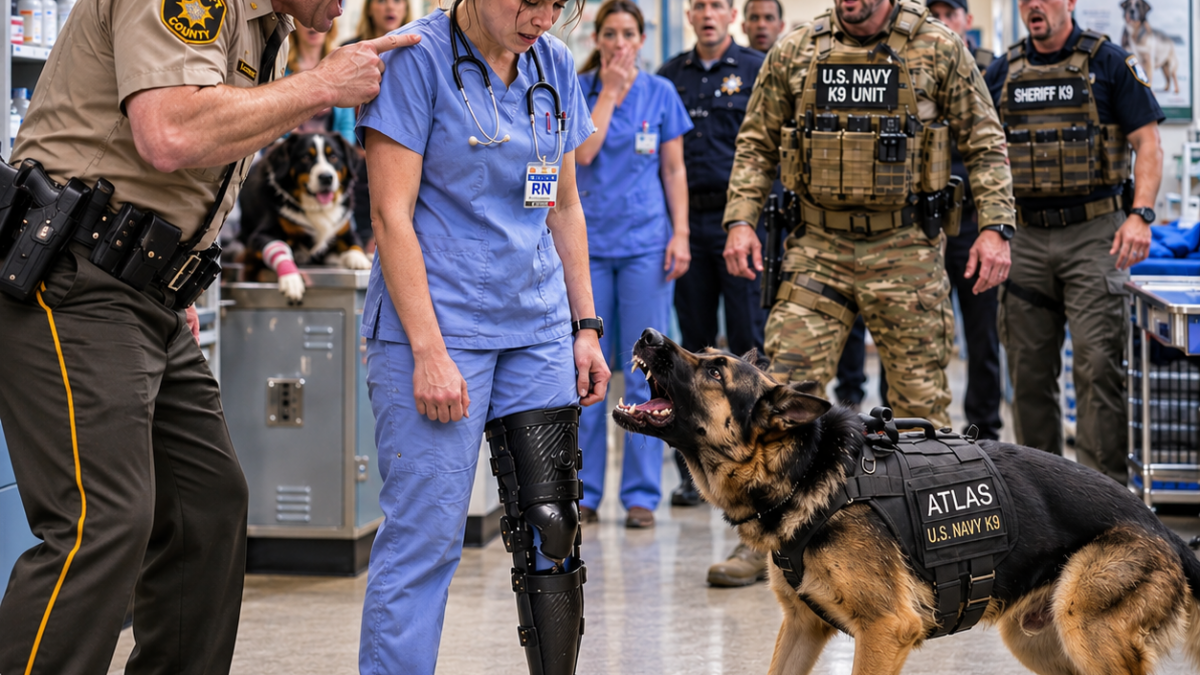
That was when Atlas stopped.
The German Shepherd had been walking beside his handler.
Large.
Black-and-tan.
Older now.
One of the county’s most disciplined K9s.
His entire body became still.
Torres glanced back.
“Atlas.”
Nothing.
“Atlas. Heel.”
No response.
The dog’s ears had risen.
His eyes locked across the clinic.
Directly on Harper.
Torres tried again.
“Atlas.”
The German Shepherd broke formation.
His handler caught the leash too late.
Atlas sprinted.
Someone in the waiting room gasped.
Briggs turned sharply.
“Watch out!”
Harper looked up.
The dog came directly toward her.
Then slowed.
One step.
Two.
And gently pressed his shoulder against her injured left leg.
Harper’s face changed.
Completely.
Her hands went to his head.
Not cautiously.
Familiar.
Behind the left ear.
Exact spot.
Atlas closed his eyes.
A low sound left him.
Harper whispered:
“Easy, Atlas.”
Then:
“You’re safe now.”
Chief Torres froze.
Color drained from his face.
“Only one person ever said that to him.”
Briggs stared.
The dog he had watched refuse two commands was now standing completely relaxed against the nurse he had spent the morning treating like a suspect.
No one moved.
Atlas leaned harder.
Harper scratched beneath the collar.
Her fingers found a patch of scar tissue.
The dog’s eyes closed.
Torres whispered:
“He only lets one person touch that scar.”
Harper smiled faintly.
“I remember when he got it.”
Briggs finally spoke.
“You know this dog?”
Harper nodded.
“A long time ago.”
Torres stepped closer.
“Where?”
Harper did not answer.
Torres looked at the brace.
Then at her face.
“Harper Ellis.”
She met his eyes.
Something in his expression said the memory had connected.
“Humanitarian medical unit.”
Harper’s shoulders tightened.
Torres said one word.
“Kosovo.”
The room seemed to disappear around her.
She looked away.
“You know?”
“My predecessor trained Atlas.”
Harper said nothing.
“He kept files.”
More silence.
“He talked about a nurse.”
Torres almost smiled.
“They called her the Steady One.”
Harper looked embarrassed.
“That was never important.”
“It was to the people who came home.”
Years earlier, a NATO humanitarian field hospital had operated outside a damaged village in Kosovo.
The war had officially ended.
Emergencies had not.
Collapsed buildings.
Unexploded ordnance.
Vehicle accidents.
Old mines.
Families displaced.
Rescue teams still entered unstable structures looking for civilians.
Harper had been twenty-six.
Young enough to be underestimated.
Quiet enough to make it easy.
Until casualties arrived.
Then doctors learned what everyone else eventually learned.
She did not freeze.
She did not shout.
She did not become dramatic.
The worse the room became, the more deliberate Harper became.
Someone once asked how she stayed calm.
Her answer:
“If I panic, they panic.”
The nickname followed.
The Steady One.
Harper hated it.
She felt fear constantly.
She simply believed fear was not something a patient needed added to the room.
Atlas entered her life during a winter rescue.
Eighteen months old.
Young German Shepherd.
His handler, Corporal Daniel Rhodes, had been trapped beneath concrete after a partial building collapse.
Atlas refused to leave him.
Rescuers finally brought both to the field hospital.
Daniel had crush injuries.
Atlas had a torn shoulder.
One paw bleeding heavily.
The dog growled at anyone who approached.
Not aggression.
Terror.
Harper recognized that.
She entered the veterinary treatment tent.
Sat on the floor.
Several feet away.
Did nothing.
Five minutes.
Ten.
Fifteen.
Atlas watched.
Harper did not reach.
Finally the dog stood.
Walked to her.
Lowered his head onto her knee.
Only then did Harper whisper:
“You’re safe now.”
His trembling eased.
The veterinary team treated Atlas while surgeons treated Daniel.
Neither died that night.
Torres had read that report.
Harper wished it ended there.
It did not.
Three weeks later, a humanitarian convoy entered an abandoned industrial district.
Explosion.
Then structural collapse.
Dozens injured.
Radio communications failed.
The field hospital filled.
Harper worked nearly eighteen hours.
Children.
Rescue workers.
Soldiers.
Working dogs.
All arriving together.
Near midnight another convoy came in.
Daniel Rhodes.
Critically injured while protecting civilians during a secondary collapse.
Atlas beside him.
Refusing food.
Refusing rest.
Harper moved between them.
Daniel.
Atlas.
Another casualty.
Another.
Then a second explosion hit near the hospital perimeter.
Windows blew inward.
Metal fragments crossed the treatment tents.
Harper saw Daniel and Atlas directly in the blast path.
She ran.
No order.
No time.
She threw herself across both.
The blast lifted them.
Threw all three.
When dust settled:
Daniel alive.
Atlas alive.
Harper unconscious.
Her left leg had taken the worst of the fragments.
Multiple fractures.
Nerve damage.
Soft-tissue destruction.
Surgeries followed.
Months.
Rehabilitation.
The doctors saved the leg.
Not all function.
Torres looked toward the carbon brace.
“That was the day?”
Harper nodded.
Briggs said:
“And you stayed?”
She looked at him.
“After?”
“Yes.”
“Until the patients were evacuated.”
“Why?”
Harper seemed confused by the question.
“There were patients.”
Briggs said nothing.
Atlas nudged the brace.
Harper’s hand moved automatically to his ear.
The clinic computer chimed.
A technician hurried from the medication room carrying printouts.
“Dr. Foster.”
Naomi turned.
“I think we found it.”
“What?”
“The inventory error.”
She handed the sheets to Briggs.
“Network synchronization logs.”
He compared them with medication records.
Duplicate withdrawal.
Network disconnect.
Reconnect.
Duplicate entry.
Again.
Again.
Every discrepancy aligned with software failure.
Not missing drugs.
Not theft.
The system was recording the same event twice whenever synchronization failed.
Naomi placed another folder down.
“These are Harper’s reports.”
Briggs read.
First report:
software duplication suspected.
Second:
urgent vendor inspection requested.
Third:
repeat discrepancy after network failure.
Each submitted weeks earlier.
Each documented.
Each forwarded.
Harper had identified the pattern before law enforcement arrived.
Briggs lowered the documents.
“You reported all three.”
“Yes.”
“Before today.”
“Yes.”
“And the manufacturer did not fix it.”
“They were working on it.”
Briggs looked at her trembling hands.
Then at the brace.
He understood.
“You thought I believed your shaking meant guilt.”
Harper’s voice remained calm.
“Yes.”
He exhaled.
“I did.”
“My leg locks when I stand too long.”
“I wasn’t hiding anything.”
“I was hurting.”
Naomi crossed her arms.
“I tried telling you.”
Briggs nodded.
“You did.”
He closed the notebook.
Then looked directly at Harper.
“I owe you an apology.”
She said nothing.
“I judged your behavior before I understood your circumstances.”
Harper looked toward Atlas.
“That happens more than people realize.”
Torres smiled faintly.
“Atlas didn’t confuse the two.”
Atlas remained against her brace.
Briggs glanced at the dog.
“No.”
“He didn’t.”
Briggs extended his hand.
“I can’t change how I treated you this morning.”
Harper looked at it.
Then shook.
“Promise me something.”
“What?”
“Next time somebody looks nervous…”
She paused.
“…ask yourself whether you’re seeing fear.”
“Or?”
“Pain.”
Briggs nodded.
“I will.”
Several people in the waiting room had been watching.
One elderly woman began clapping.
Harper looked horrified.
Then another person joined.
Then another.
Not loud.
Not theatrical.
Harper raised one hand.
“Please don’t.”
That made Naomi laugh.
The applause stopped.
Mostly.
Atlas remained exactly where he wanted.
Beside her.
The clinic grew quieter once the investigation closed.
Briggs’s deputies packed their documents.
The software records were preserved.
No medication theft had occurred at Blue Ridge.
Other clinics still needed review.
Briggs did not leave immediately.
He stood in the lobby holding the warrant folder.
It felt heavier now.
Across the treatment room, Harper helped rebandage Atlas’s old shoulder after a small skin irritation discovered during the K9 unit visit.
“You’ve healed nicely.”
Atlas looked at her.
Tail tapped.
Torres smiled.
“I haven’t seen him this relaxed in years.”
Harper scratched behind the ear.
“He always liked pretending he was tougher than he was.”
“Still does.”
Briggs approached.
“I’ve been thinking.”
Harper glanced up.
“That can be dangerous.”
He almost smiled.
“I’ve interviewed hundreds of people.”
“Yes.”
“I believed reading body language made me better at the job.”
Harper waited.
“Today I confused pain with deception.”
“It happens.”
“It shouldn’t.”
“No.”
She leaned against the table.
“But assumptions happen before facts all the time.”
“That sounds like forgiveness.”
“It isn’t.”
Briggs looked surprised.
“It’s an explanation.”
He nodded.
Fair.
“Apologies matter less if nothing changes afterward.”
That made Harper look at him differently.
Before she could answer, Torres reached into his backpack.
Weathered folder.
He handed it to Briggs.
ATLAS REHABILITATION FILE.
Inside:
old veterinary notes.
Behavior evaluations.
Recovery photographs.
Training summaries.
One phrase appeared repeatedly.
PATIENT CALMS WITH NURSE HARPER ELLIS PRESENT.
Another:
RESPONDS TO PHRASE: YOU’RE SAFE NOW.
Briggs looked up.
“That’s why he ran to her.”
Harper nodded.
“He wasn’t remembering the explosion.”
Torres asked:
“What was he remembering?”
Harper touched Atlas’s head.
“Recovery.”
That distinction mattered.
People like dramatic stories about dogs remembering war.
But Atlas had not broken formation because Harper reminded him of violence.
He remembered the person who sat on the floor and waited until he could approach.
The person whose voice had meant treatment stopped being frightening.
Dogs did not remember her rank.
They remembered what happened when she was near.
The next afternoon, a pickup truck with disabled-veteran plates entered the lot.
A tall man stepped out using a walking stick.
Atlas saw him through the window.
Barked.
Once.
Then again.
Harper turned.
Her face went still.
“No.”
The man smiled through the glass.
She whispered:
“Daniel.”
Corporal Daniel Rhodes.
Atlas’s original military handler.
Older.
Gray beginning at his temples.
Permanent damage to one leg and shoulder.
Alive.
He entered.
For several seconds, he and Harper stared at each other.
Then Daniel opened his arms.
“Hello, Harper.”
She stepped forward.
He hugged her.
Not carefully.
Like somebody who had spent years believing he might never get the chance.
“I’ve been trying to find you.”
Harper pulled back.
“I wasn’t hiding.”
“You disappeared.”
“I started over.”
“That is hiding with paperwork.”
Atlas shoved between them.
Daniel laughed.
“Some things never change.”
Naomi watched.
“You served together?”
Daniel looked at Harper.
“She never told you?”
“Almost nothing.”
“That sounds like her.”
Harper pointed at him.
“Careful.”
Daniel smiled.
Then looked at the brace.
Something in his face changed.
“I’m sorry.”
Harper’s expression hardened.
“No.”
“Harper—”
“No.”
“You saved me.”
“I made a decision.”
“You got hurt because of it.”
“Yes.”
“I should’ve—”
“Daniel.”
He stopped.
“You were unconscious.”
“I know.”
“You were not responsible for where the shrapnel went.”
“I know.”
“No, you don’t.”
Silence.
Atlas looked between them.
Harper softened.
“I spent years trying not to let that day define me.”
Daniel lowered his eyes.
“So did I.”
That was enough.
Briggs heard part of the conversation from the hallway.
It stayed with him.
He had thought visible injury told him something about weakness.
Then thought pain told him something about guilt.
Both times he had been wrong.
He began asking different questions.
Not because Harper had delivered a speech.
Because he hated discovering a flaw in himself he had once considered a strength.
Several weeks later, Briggs requested a meeting with Torres.
“I want to change our training.”
Torres leaned back.
“How?”
“Interview behavior.”
“Too broad.”
“Invisible disability.”
Torres listened.
“Veterans.”
“Pain responses.”
“Trauma.”
“And?”
Briggs hesitated.
“Assumptions.”
Torres smiled slightly.
“That one may take longer.”
“I know.”
They invited Harper.
She almost refused.
“I’m a veterinary nurse.”
“You’re also a medically retired veteran.”
“I don’t want to be the example.”
“You don’t have to be.”
Briggs said:
“I want you to help make sure we don’t build training around one story.”
That changed her mind.
They designed something practical.
Not:
Never question disabled people.
Not:
Every nervous behavior is pain.
Not:
Police should ignore inconsistencies.
The opposite.
Ask better questions.
Separate observation from interpretation.
A shaking hand means a hand is shaking.
It does not automatically mean guilt.
A person avoiding eye contact may be afraid.
In pain.
Neurodivergent.
Traumatized.
Or deceptive.
Context decides.
Evidence decides.
Not one behavior.
Harper liked that.
Briggs liked it more.
The sheriff’s office called it trauma-informed communication and invisible-disability awareness.
Harper insisted on adding:
“Don’t make it sound like a sympathy seminar.”
Briggs looked offended.
“I wasn’t.”
“You were.”
Torres laughed.
Atlas became part of several demonstrations.
Not because dogs could diagnose hidden injuries.
They could not.
But handlers could show how working animals responded to stress, tone, body posture, familiar cues, and trust.
Briggs introduced him once:
“This is my best instructor.”
Atlas yawned.
The class laughed.
Harper stood in the back.
She preferred it there.
Six months after the clinic investigation, Blue Ridge opened a rehabilitation garden.
Accessible walking paths.
Low-impact exercise stations.
Quiet fountain.
Benches beneath flowering trees.
A space designed for injured veterans, retired K9s, first responders, and rehabilitation animals to move without the pressure of a crowded clinic.
The plaque near the entrance read:
HEALING BELONGS TO EVERYONE.
SEEN WOUNDS.
UNSEEN WOUNDS.
EVERY LIFE DESERVES DIGNITY.
Hospital leadership asked Harper to cut the ribbon.
“No.”
Naomi stared.
“You helped build this.”
“No.”
“Why?”
“I hate ribbon cuttings.”
“That is not a reason.”
“It is to me.”
Harper chose someone else.
Olivia Chen.
Twenty-three.
Nursing student.
Carbon-fiber brace on her right leg after a car accident.
Olivia looked horrified.
“I can’t.”
“Yes, you can.”
“I don’t belong up there.”
Harper smiled.
“I used to think that.”
“That doesn’t help.”
“Good.”
They cut it together.
Applause.
Harper tolerated it.
Barely.
Afterward, Briggs approached.
“I wanted to thank you.”
“For?”
“You could’ve demanded disciplinary action.”
“Against you?”
“Yes.”
“You apologized.”
“That doesn’t erase it.”
“No.”
“You gave us education instead.”
Harper looked around.
Veterans speaking with officers.
Children petting retired K9s.
Nurses comparing notes with handlers.
Olivia laughing beside Naomi.
“People usually learn better when they’re invited than when they’re shamed.”
Briggs nodded.
“I’m still sorry.”
“I know.”
“Good.”
Atlas walked toward Harper.
Age had slowed him.
He leaned against the carbon brace.
Same spot.
Harper put a hand on his head.
“We’re both still standing.”
Torres came beside them.
“And both still serving.”
Harper rolled her eyes.
“That sounds like a recruitment poster.”
Daniel, standing nearby, laughed.
“It does.”
“Thank you.”
Olivia approached later.
“Can I ask something?”
Harper looked at her.
“Sure.”
“Were you afraid your injury would define you?”
Harper glanced at the brace.
Then Atlas.
She thought before answering.
“Yes.”
Olivia looked surprised.
The source story people told later often changed that answer.
They liked:
No.
I was never afraid.
That sounded stronger.
It was less true.
“Yes,” Harper repeated.
“For a while.”
“What changed?”
“I realized definition and limitation aren’t the same thing.”
Olivia waited.
“My leg limits things.”
“Running.”
“Standing too long.”
“Some days.”
Harper looked toward the clinic.
“But it doesn’t get to explain everything about me.”
Olivia glanced at her own brace.
“That takes time.”
“Yes.”
“How much?”
Harper smiled.
“I hate that question.”
“Why?”
“Because everybody wants a deadline.”
She looked at Atlas.
“Bodies don’t care about deadlines.”
Neither did fear.
Neither did trust.
Neither did recovery.
A year after the investigation, Mason Briggs returned to Blue Ridge.
Not for a warrant.
He carried a Labrador.
Seventy pounds.
Older.
Shaking.
Harper looked up.
“What happened?”
“Found near a highway.”
“County dog?”
“No chip.”
“Owner?”
“Searching.”
She took the stretcher.
Briggs said:
“He kept shaking in the patrol car.”
“Pain?”
“I don’t know.”
Harper stopped.
Looked at him.
Briggs smiled faintly.
“I said I don’t know.”
“Yes.”
“I learned.”
“Apparently.”
He followed the dog inside.
The Labrador had a fractured pelvis.
The shaking had been pain.
Briggs remained until the veterinary team stabilized him.
Before leaving, he said:
“A year ago, I would’ve thought fear.”
Harper shook her head.
“Maybe.”
“Or guilt.”
“Dogs rarely commit controlled-substance theft.”
“That was a joke.”
“I know.”
He smiled.
Then became serious.
“I’m better at asking now.”
“That matters.”
It did.
Not because one changed officer rewrote policing.
Not because one nurse transformed a department.
Those claims would have been too large.
But Briggs changed.
Then training changed.
Then a few other deputies changed how they approached certain encounters.
Small changes.
Real ones.
Atlas retired fully not long afterward.
Torres adopted him.
He brought the German Shepherd to Blue Ridge occasionally.
Atlas always searched for Harper first.
Every time.
He would enter.
Ignore Naomi.
Ignore Briggs if he happened to be there.
Ignore treats for several seconds.
Find Harper.
Press against the brace.
Harper would say:
“You are embarrassingly predictable.”
Tail wag.
One afternoon Daniel watched.
“He never did that with me.”
Harper looked at him.
“He loved you.”
“I know.”
“He trusted you differently.”
Daniel nodded.
“That’s the thing people don’t understand.”
“What?”
“You saved his life once.”
“No.”
“Veterinary team did most—”
“Harper.”
She stopped.
Daniel smiled.
“You can let one sentence exist without correcting it.”
“Fine.”
“You saved his life once.”
She sighed.
“He saved mine later.”
“How?”
Daniel looked toward Atlas.
“When I thought I had lost everything from that part of my life, he still remembered something good.”
Harper understood.
That might have been what Atlas gave her too.
For years, Kosovo existed in her memory as damage.
The explosion.
Surgery.
Medical retirement.
Loss.
Pain.
Then Atlas ran across a veterinary clinic and reminded her there had been another part.
Treatment tents.
Patience.
A frightened young dog resting his head on her knee.
Daniel surviving.
People helped.
Animals stabilized.
Lives continued.
The past was not only the thing that injured her.
It also contained the work she had done before the injury.
That mattered more than she expected.
Years later, Harper still worked at Blue Ridge.
Fewer twelve-day stretches.
Naomi finally forced that issue.
“You are not twenty-six.”
“I know.”
“Your leg knows before you do.”
“Rude.”
“Correct.”
Harper taught younger veterinary nurses.
Her favorite lesson had nothing to do with medication.
A nervous dog would come in.
A student would immediately reach.
Harper stopped them.
“Why are you touching him?”
“To calm him.”
“Did he ask?”
“No.”
“Then wait.”
Sometimes the dog came closer.
Sometimes not.
Both outcomes accepted.
One student once asked:
“How do you make animals trust you?”
Harper smiled.
“You don’t.”
The student frowned.
“You give them enough evidence to decide.”
That was the same lesson Atlas had taught an entire clinic without knowing it.
And the same lesson Briggs eventually learned about people.
You observe.
You ask.
You gather evidence.
You do not turn the first behavior you notice into the whole story.
Harper’s trembling hands meant pain.
Not guilt.
Atlas breaking formation meant recognition.
Not disobedience without context.
A person with a brace was not fragile.
A police officer who made one serious mistake was not automatically incapable of changing.
One incident did not define everything.
Neither did one wound.
Years after the day they reunited, Atlas’s health declined.
Age.
Arthritis.
Nothing dramatic.
Torres called Harper.
“He’s slowing down.”
“I know.”
“He still wants to work.”
“He’s a German Shepherd.”
“That isn’t medical advice.”
“It should be.”
Torres laughed.
Then:
“Can you come by?”
Harper went.
Atlas was lying beneath a maple tree in Torres’s yard.
He lifted his head when he heard her.
Tail moved once.
Harper lowered herself carefully beside him.
The leg brace clicked.
Atlas watched.
Then shifted his body.
Pressed lightly against it.
Same place.
Harper put both hands around his face.
“You always do that.”
Atlas breathed.
She scratched the scar behind the ear.
“You remember everything, don’t you?”
Probably not.
Dogs do not store life like human biographies.
But he remembered enough.
Voice.
Smell.
Touch.
Safety.
That was enough.
Harper whispered:
“You’re safe now.”
Atlas closed his eyes.
A week later, Torres called.
Atlas was gone.
Harper sat in her car outside Blue Ridge for almost twenty minutes before going inside.
Naomi found her.
No questions.
She simply sat in the passenger seat.
After a while Harper said:
“He remembered me.”
Naomi nodded.
“For years.”
“I thought I’d forgotten that version of myself.”
“What version?”
“The one before the brace.”
Naomi looked at her.
“Maybe he didn’t.”
Harper smiled through tears.
“That sounds sentimental.”
“It is.”
“I hate it.”
“I know.”
They sat.
Then Harper wiped her face.
Went inside.
There were patients.
There always were.
A frightened dog was waiting in exam three.
Young.
Trembling.
Pressed against the wall.
The student nurse had already prepared treats.
Harper entered.
The dog growled.
The student looked nervous.
“What do we do?”
Harper sat several feet away.
Turned one shoulder.
Hands still.
“We wait.”
The student sat beside her.
Minutes passed.
The dog’s breathing changed.
Head lifted.
One step.
Then another.
Harper did not reach.
Eventually the dog came close enough to smell her brace.
The student whispered:
“Now?”
Harper shook her head.
“Let him decide.”
The dog moved forward.
Rested his head against her knee.
Harper closed her eyes for one second.
Then opened them.
“Good.”
No applause.
No police investigation.
No dramatic revelation.
Just a frightened animal deciding a person was safe.
That was the work.
The day Mason Briggs entered Blue Ridge, he believed he was reading Harper Ellis correctly.
Trembling.
Hesitation.
Pain.
He saw behavior and immediately gave it meaning.
Then Atlas arrived.
A dog with no interest in rank, suspicion, disability, or reputation.
He knew only what Harper had once meant to him.
Calm.
Treatment.
Recovery.
Safety.
And when he crossed that clinic and pressed himself against the brace everyone else had been staring at, he did not prove Harper innocent.
The records did that.
The software logs did that.
Her reports did that.
What Atlas changed was something harder.
He forced everyone in that room to look again.
At Harper.
At pain.
At assumption.
At the difference between what a body does and what we decide it means.
That morning began with an officer believing a disabled nurse was hiding a crime.
It ended with him closing his notebook, admitting he had confused suffering with deception, and choosing to change the way he worked afterward.
And Harper never became famous for it.
She did not want to.
She kept showing up before sunrise.
Checking chest tubes.
Reading medication logs.
Sitting on floors beside frightened animals.
Adjusting the carbon-fiber brace when it locked.
Doing the same thing she had done long before anyone called her brave.
Helping whoever was in front of her stand again.
Sometimes a veteran.
Sometimes a dog.
Sometimes, without intending to, a deputy who finally learned that the most dangerous mistake is not failing to notice what someone is carrying.
It is deciding you already know what it means.








