A Decorated K9 Attacked Every Handler Who Came Near—Then a Military Nurse Whispered One Forgotten Word, and the Dog Suddenly Lay Down as the Entire Base Fell Silent
PART2:
The bark came again, and every hair on the back of my neck lifted.
A senior sergeant standing near the walkway noticed me staring toward the kennel compound.
“That’s Rex,” he said.
I took a sip of coffee.
“The famous one?”
He laughed, but there was no humor in it.
“Depends who you ask.”
“What does that mean?”
He looked toward the kennels.
“Half the base thinks he’s a hero.”
“And the other half?”
“A lawsuit waiting to happen.”
I continued toward the clinic, but Rex’s bark stayed with me all morning.
I saw routine cases.
A sprained ankle.
A shoulder strain.
A dehydrated recruit who thought three energy drinks counted as hydration.
A young specialist who insisted he was fine while nearly fainting into a chair.
Ordinary work.
Still, around noon, I found myself staring through the clinic window toward the K9 compound.
That bark had not sounded like rage to me.
It had sounded desperate.
There is a difference.
People miss that difference all the time.
Especially with dogs.
Especially with soldiers.
Especially with anyone whose pain comes out sharp enough to frighten the room.
By late afternoon, curiosity won.
The kennel compound sat behind two security gates and a chain-link perimeter fence. Rows of military working dog enclosures lined the property. Most dogs barked, paced, or jumped when someone approached.
Rex did not.
He sat motionless in the far corner kennel, away from the others, larger enclosure, heavier lock, extra reinforcement on the gate.
The message was clear.
This one is different.
This one is dangerous.
I approached slowly.
The moment he saw me, Rex stood.
He was magnificent.
A five-year-old Belgian Malinois, black-and-tan coat, lean muscle, deep chest, alert ears, amber eyes fixed on me with a focus so intense it almost felt physical. He looked like a weapon someone had forgotten was alive.
But what struck me was not aggression.
It was exhaustion.
I had seen that look before.
Not in dogs.
In men.
In operators after missions nobody wanted to discuss.
In soldiers who sat too still in waiting rooms.
In widows at memorial services.
In anyone who had lost something so important the world no longer felt safe afterward.
A young handler hurried up behind me.
“Ma’am, you shouldn’t get too close.”
I did not turn away from Rex.
“Why?”
“He attacks.”
“Does he?”
The handler frowned.
“Respectfully, ma’am, that’s not really a debate.”
Rex had not barked.
Had not growled.
Had not lunged.
He simply watched me.
Carefully.
Intensely.
As if evaluating a threat.
Or searching for something.
“What’s his story?” I asked.
The handler shifted uncomfortably.
“Combat certified. Explosive detection. Multiple deployments. Used to be one of the best dogs in the program.”
“Used to be?”
“Then his handler died.”
There it was.
The sentence nobody wanted to hold.
“Who was the handler?”
The young man hesitated.
“Senior Chief Mason Reed.”
I knew the name.
Anyone who had spent time around special operations knew the name. Mason Reed was the kind of man other hard men spoke about carefully. Decorated. Respected. Quiet until he was not. The sort of operator whose stories became half legend and half warning.
“What happened?”
“Classified mission,” the handler said. “Lots of rumors.”
“And Rex was there?”
He nodded.
“Rex came home. Reed didn’t.”
I looked back at the dog.
Rex’s eyes were still fixed on mine.
“How many incidents?” I asked.
The handler’s jaw tightened.
“Six serious attacks. One handler needed thirty-seven stitches. One shattered wrist. Another requested transfer papers the same day. Seventh report just hit command.”
“And now?”
“Now they’re talking about putting him down.”
The words sat between us.
Rex, the decorated dog.
Rex, the explosives specialist.
Rex, the animal who had found buried devices no machine caught.
Rex, the dog who once dragged a wounded operator out by the straps of his vest.
Rex, alone in a kennel while a committee decided whether grief had made him too dangerous to live.
I crouched.
Not near enough to touch the fence.
Just low enough to bring myself closer to his eye level.
The handler stiffened.
“Ma’am—”
“Quiet.”
Rex did not move.
For several seconds, neither of us did.
Then something small happened.
His head lowered.
Not surrender.
Not submission.
Recognition.
Something flickered between us.
Then a truck backfired somewhere across the compound.
The crack split the air.
Rex exploded.
His body slammed against the kennel door so hard the metal rattled. Teeth bared. Barking. Snarling. Violent force from nose to tail. The young handler jumped backward.
“See?”
But I was not looking at his teeth.
I was looking at the trigger.
The sudden noise.
The instant switch.
The panic hidden inside the violence.
“Interesting,” I said.
The handler stared at me like I had lost my mind.
Maybe I had.
That evening, I requested access to Rex’s behavioral file.
The clerk in records laughed when I asked.
“You enjoy punishment?”
“I enjoy answers.”
He dropped a stack of reports in front of me.
There were dozens.
Incident reports.
Behavioral evaluations.
Training assessments.
Veterinary notes.
Psychological consultations.
Command summaries.
I carried them home.
By midnight, I had read every page.
One thing was immediately obvious.
Nobody agreed on what was wrong with Rex.
Dominance.
Territorial aggression.
Generalized aggression.
Handler rejection.
Neurological trauma.
Combat stress response.
Poor socialization after handler loss.
The diagnosis changed from page to page.
The attacks did not.
Every report focused on what Rex had done.
Almost none focused on why.
That bothered me.
The next morning, I requested training footage.
Hours of it.
Failure after failure.
Handler after handler.
Men trying to assert control. Men using sharper commands. Men grabbing collars too quickly. Men leaning over him. Men stepping into his space with the brittle confidence of people who believed dominance could replace trust.
I watched every attack.
Then I watched them again.
A pattern began to emerge.
Rex never attacked immediately.
There was always a sequence.
Trigger.
Reaction.
Escalation.
One handler shouted a command near his left side.
Rex stiffened.
Another grabbed the collar unexpectedly.
Rex twisted.
Another initiated a transfer drill.
Rex’s body went rigid before anyone touched him.
I rewound the footage.
Again.
Again.
The same kind of command appeared before several incidents.
Not always.
Often enough.
Transfer language.
Handler transition language.
Commands used when one handler handed control to another.
The problem was not obedience.
The problem was not dominance.
The problem might be grief.
Over the next four days, I chased ghosts.
I spoke with trainers, handlers, medics, and anyone who had known Mason Reed. Most conversations ended the same way. The moment Mason’s final mission came up, faces tightened. Voices lowered. Memories became selective.
Nobody wanted to talk.
That told me the answer was there.
People do not hide boring pain.
They hide the kind that still burns.
A retired administrative officer finally took pity on me.
“Off the record?” he asked.
“Off the record.”
He glanced toward the door before speaking.
“Mason and Rex were closer than any pair I’ve ever seen.”
“Close how?”
The old officer leaned back.
“Rex wasn’t just assigned to him. Rex was his shadow. Slept outside his quarters when allowed. Ate only after Mason gave permission. Worked like he was reading the man’s mind. I saw that dog walk through live fire because Mason told him to search.”
“What happened on the mission?”
The officer’s face closed.
“Team came home short one man.”
“Mason.”
He nodded.
“And Rex?”
“He was there.”
The room went quiet.
Suddenly, everything made more sense.
Not all of it.
Enough.
A dog does not wake up one morning and decide to attack everyone who tries to help.
Something happens first.
Something breaks.
Some wound nobody can see.
Before the old officer left, he paused by the door.
“One more thing.”
I looked up.
“Mason talked to that dog differently.”
“How?”
The officer smiled sadly.
“Like Rex was the only one who knew what he had seen.”
That sent me back to the footage.
Not the incident footage this time.
Old footage.
Deployment footage.
Training footage.
Ceremonies.
Transport clips.
Body-cam fragments pulled from archives no one had reviewed in years because everyone had already decided what Rex was.
Dangerous.
Failed.
Lost.
I watched Mason Reed with Rex for hours.
At first, I saw what everyone else saw.
A handler and his dog.
Then I started noticing what the old officer meant.
Mason used commands when commands mattered.
Sit.
Stay.
Search.
Track.
Release.
But outside operations, he talked to Rex like someone talks to a trusted friend after surviving hell together.
Low voice.
Short sentences.
No performance.
No audience.
Then I heard it.
One word.
Guardian.
The first time, Mason said it after a live-fire exercise. Rex had been panting hard, adrenaline high, eyes sharp. Mason placed one gloved hand on his neck and said, “Easy, Guardian.”
Rex relaxed.
Not obeyed.
Relaxed.
The second time was during helicopter transport. Rotor noise thundered overhead. Rex was tense, braced against Mason’s knee. Mason leaned down and said, “Still with me, Guardian?”
Rex pressed closer and settled.
The third time came after a mission. Grainy footage. Low light. Men moving fast. Rex trembling with leftover adrenaline. Mason crouched and whispered, “Good boy, Guardian. You did good.”
Rex lowered his head into Mason’s chest.
I replayed the clips again.
Then again.
Then ten more times.
Guardian was not a command.
It was personal.
A promise.
A reassurance.
A private bridge between a man and the dog who trusted him more than life.
The next morning, I requested a meeting with Commander Douglas Mercer.
Mercer oversaw the military working dog program and had the face of a man who had been arguing with regulations longer than I had been alive. He listened while I explained the footage, the triggers, the transfer drills, the word, the grief pattern.
When I finished, he rubbed his forehead.
“You want me to authorize direct contact with the most dangerous dog on this installation because you heard a word in old videos.”
“It is not the word,” I said. “It is what the word represents.”
“That sounds like something that will look terrible in an incident report.”
“It will not go wrong.”
He laughed once.
“That is what everyone says before something goes wrong.”
“Then let’s hope I’m the exception.”
He studied me for a long moment.
“You understand what happens if he charges.”
“Yes.”
“You understand handlers will intervene.”
“Yes.”
“You understand he could kill you.”
“I understand he does not want to.”
Mercer’s expression hardened.
“You do not know that.”
“No,” I said. “But neither does anyone else. They only know what he does after they trigger him.”
Silence.
Finally, the commander leaned back.
“One attempt.”
I nodded.
“One.”
“If he escalates, we stop it immediately.”
“If he escalates,” I said.
Mercer sighed.
“You are impossible.”
“I’ve been told.”
The attempt was scheduled for the following afternoon.
News spread across the base faster than any official briefing ever could.
The nurse was going to try.
Some expected disaster.
Some expected an ambulance.
A few expected the end of Rex’s career to become official by sundown.
Nobody expected success.
At exactly 1400 hours, I entered the training yard.
The sky was gray, heavy with rain that had not yet fallen. Wind swept across the field. A dozen handlers stood behind safety barriers. Veterinarians watched from observation windows. Commander Mercer stood near the fence with his arms folded.
Nobody spoke.
Rex emerged from the far kennel.
His reaction was immediate.
Body stiff.
Ears forward.
Eyes locked.
Tension moved through him like electricity.
The handlers shifted uneasily.
I kept walking.
Slow.
No sudden movements.
No challenge.
No fear.
Thirty yards.
Twenty.
Fifteen.
Rex began pacing.
A low growl vibrated through the yard.
Someone behind the barrier muttered, “Here we go.”
I stopped.
Rex froze.
For several seconds, nothing moved except the wind.
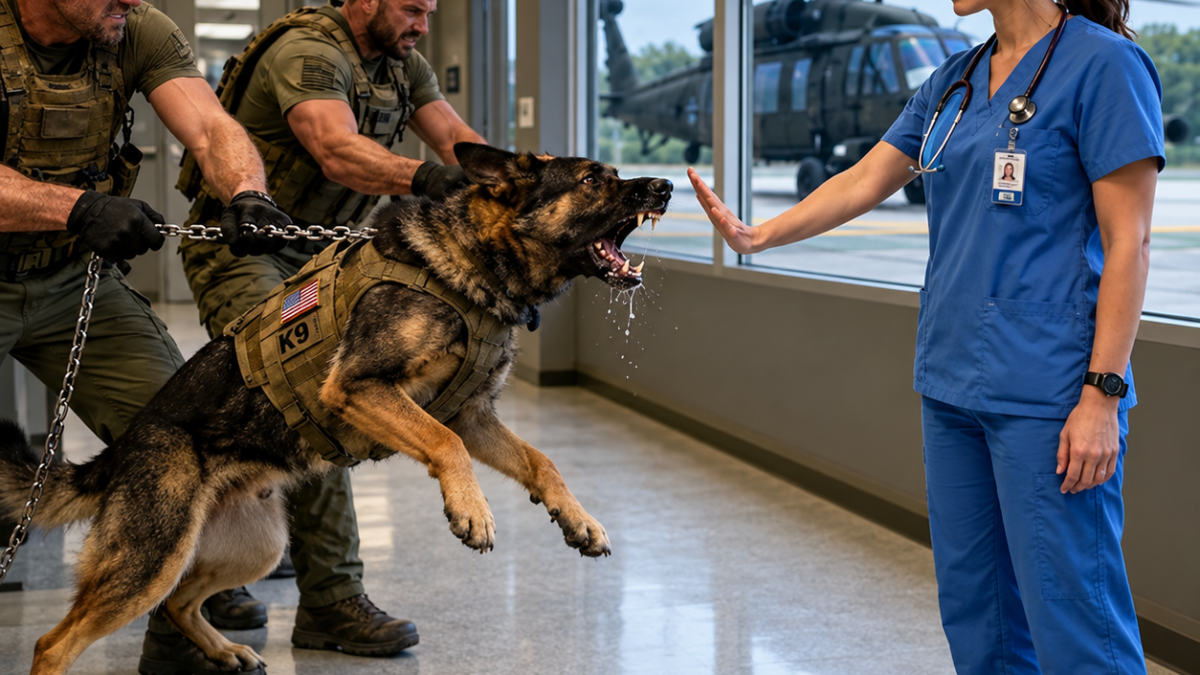
Then he lunged.
The chain snapped tight.
Handlers grabbed restraints.
Rex barked with terrifying force, teeth flashing, body surging forward like every buried thing inside him had decided to come out at once.
Commander Mercer stepped forward.
Ready to end it.
I spoke.
Not loudly.
Not dramatically.
Almost gently.
“Guardian.”
Everything stopped.
The barking vanished.
Rex froze mid-motion.
His ears twitched.
His head tilted.
For one long second, he looked confused.
Then the most dangerous dog on the installation slowly lowered himself onto the ground.
Not because he had been ordered.
Because he remembered.
The entire yard stood motionless.
One handler took off his sunglasses and rubbed his eyes.
Commander Mercer stared like the world had briefly stopped obeying its own rules.
I crouched.
Still at a safe distance.
Rex did not prepare to attack.
For the first time in years, he was listening.
That was the beginning.
Not the ending.
People like clean stories.
One word.
One miracle.
The violent dog becomes gentle.
But healing does not work like that.
Not for people.
Not for animals.
Not for anyone carrying a loss the world mishandled.
The next week, I did not try to become Rex’s handler.
That distinction mattered.
Everyone else had approached him as a training problem.
I approached him as a relationship problem.
Those are not the same thing.
Each day, I spent time near him.
No demands.
No drills.
No dominance exercises.
No proving authority.
Sometimes I sat outside his enclosure and read medical journals. Sometimes I talked about my day. Sometimes I said nothing at all.
Rex watched me at first like a threat.
Then like a puzzle.
Then like someone whose arrival mattered.
One morning, a handler arrived before me.
Rex stayed withdrawn in the back of the kennel.
An hour later, I walked up carrying coffee.
His tail moved once.
Just once.
Everyone saw it.
Three weeks later, he accepted food from my hand.
Two weeks after that, he allowed me to touch his shoulder.
The K9 unit celebrated like we had won a war.
I stayed cautious.
Because even with the progress, the question remained:
What really happened to Mason Reed?
The answer came on a rainy Tuesday.
Rex and I were walking through an old storage building used for archived equipment and personal property awaiting disposition. It was not supposed to be interesting. Dusty shelves. Labeled containers. Old uniforms. Broken gear. Forgotten boxes.
Rex disagreed.
He stopped suddenly.
His ears lifted.
Then he turned sharply down one aisle.
I followed.
He moved past several shelves, turned again, then stopped in front of a dusty metal rack. Rows of storage containers sat untouched.
Rex sat.
Then looked at me.
I checked the labels.
One made my pulse quicken.
Mason Reed.
Within an hour, the container sat on a conference table surrounded by military personnel.
Nobody knew what to expect.
A folded uniform.
Photos.
Letters.
Patches.
Personal effects.
Inside were all of those things.
A watch.
A notebook.
Family photographs.
Mission patches.
Then we found the digital voice recorder.
The room went silent.
Commander Mercer stared at it.
“Was this reviewed?”
No one answered.
That was answer enough.
There was one audio file.
One.
The timestamp matched the week before Mason’s final deployment.
Mercer pressed play.
Static crackled.
Then a voice filled the room.
Strong.
Calm.
Familiar to everyone who had known him.
Mason Reed.
Rex’s ears rose.
His entire body went still.
“Hey, buddy,” Mason’s voice said.
A soft laugh followed.
“If somebody’s playing this, things didn’t go according to plan.”
No one moved.
“First things first,” Mason continued. “You’re a good dog.”
My throat tightened.
Rex took one step toward the recorder.
Mason’s voice continued.
“You did your job. No matter what happened, none of it was your fault.”
Across the room, one of the older handlers wiped his eyes.
No one pretended not to notice.
“If I’m not there anymore,” Mason said, “I need you to keep protecting people. You hear me, Guardian?”
At the word, Rex lifted his head.
His tail moved.
Slowly.
Tentatively.
For the first time since Mason’s death, something inside him seemed to loosen.
Not completely.
Enough.
The recording continued, Mason speaking not to command, not to train, but to release.
To forgive.
To give the dog permission to stop waiting.
By the time the file ended, nobody spoke.
The conference room was silent except for the hum of the ventilation system.
Rex sat beside me, eyes fixed on the recorder.
And everyone in that room finally understood.
Rex had never been angry in the way they thought.
He had been waiting.
Waiting for a handler who would never return.
Waiting inside a grief no one had translated correctly.
Every failed handler had unknowingly touched the wound.
Every transition drill had reminded him Mason was gone.
For years, the military had tried to solve a behavioral problem.
The real problem had always been grief.
I reached down and rested my hand against Rex’s shoulder.
For the first time since I met him, he leaned into the touch without hesitation.
Not because he was healed.
Not yet.
Because something had finally been acknowledged.
The truth.
And sometimes truth is where healing begins.
Over the next month, the transformation became impossible to deny.
Rex never became an ordinary military dog.
He never would.
But the violent incidents stopped.
No lunges.
No attacks.
No explosive reactions.
Handlers who once avoided his kennel began stopping to greet him.
Veterinarians who had approached him like a live wire now scratched behind his ears.
People no longer whispered about euthanasia.
They started asking what came next.
That was when Ethan Walker entered the story.
Ethan was nineteen.
Army specialist.
Two deployments.
One roadside explosion.
His body had mostly healed.
His mind had not.
For nearly four months, he refused treatment. Barely spoke. Ignored counselors. Avoided visitors. Rejected therapy. Specialists described him as emotionally unreachable, which was the kind of phrase people use when they have run out of patience but want to sound clinical.
I met him on a rainy Wednesday afternoon.
He sat beside a hospital window, staring at a gray parking lot.
I introduced myself.
No response.
Asked how he felt.
Nothing.
Tried discussing recovery goals.
Nothing.
After fifteen minutes, I left.
But something about him stayed with me.
That evening, I sat beside Rex’s enclosure while he rested at my feet.
The thought arrived quietly.
Ridiculous.
Impossible.
Against every sensible policy.
Yet I could not let it go.
The next morning, I brought the idea to Commander Mercer.
He listened.
Then shook his head.
“Absolutely not.”
“I thought you might say that.”
“You want to bring the former most dangerous dog on the installation into a military hospital.”
“Former is the important word.”
Mercer laughed despite himself.
“You really are impossible.”
“So you’ve mentioned.”
Every regulation said no.
Every risk assessment screamed no.
Every reasonable person would have refused.
But the impossible had started happening around Rex, and Mercer had seen enough to wonder if reason might not have the whole story.
Three days later, approval came.
Limited access.
Controlled environment.
Medical supervision.
One trial visit.
Nothing more.
Ethan sat in the same chair beside the same window when we entered.
He did not look up.
Not at first.
Then Rex stepped through the doorway.
Ethan’s eyes moved.
Not dramatically.
Just enough.
It was the first meaningful response anyone had seen in weeks.
Rex paused, studied the room, then walked directly toward him.
No hesitation.
No uncertainty.
He stopped beside Ethan’s chair and sat.
Nothing happened for several seconds.
Then Ethan slowly lowered one hand.
Rex rested his head beneath it.
The room went silent.
Ethan closed his eyes.
And for the first time since arriving at the hospital, he smiled.
Barely.
But it was there.
That small smile changed everything.
The visits continued.
Day after day.
Week after week.
Progress therapists had not reached in months began appearing in fragments.
A sentence.
A question.
A story.
A memory.
A fear spoken out loud.
Every time Rex entered the room, Ethan came a little farther back.
Maybe because Rex did not ask him to explain.
Maybe because wounded creatures recognize one another.
Maybe because some pain does not need translation.
Word spread through the base.
The dog once scheduled for euthanasia was helping wounded soldiers recover.
People who had never met Rex knew his name.
He was not feared anymore.
He was respected.
Then came the emergency that cemented his legacy.
It happened on a cold winter morning when a maintenance failure triggered a partial power outage in one section of the hospital. Backup systems activated, but confusion spread quickly. Patients were moved. Staff hurried between wings. Alarms chirped. Intercoms cracked. Families gathered in hallways.
Most situations resolved quickly.
One did not.
A seven-year-old boy visiting his recovering father became separated during the evacuation.
Nobody realized at first.
By the time staff noticed, valuable minutes had passed.
Security teams searched waiting rooms, hallways, stairwells, therapy rooms, storage areas.
Nothing.
The hospital was not enormous, but it was large enough to hide a frightened child.
Rex was visiting Ethan when the announcement came over the intercom.
He stood immediately.
Alert.
Focused.
Listening.
I saw the shift.
“What is it?” I asked.
Rex moved toward the hallway.
He was not confused.
Not curious.
He was tracking.
With security’s permission, Rex began searching.
The entire hospital seemed to hold its breath.
Doctors stepped aside.
Nurses cleared paths.
Families watched anxiously.
Rex moved with certainty.
Down one corridor.
Up a stairwell.
Across another wing.
Then he stopped outside a rarely used maintenance area.
A locked utility room.
Security opened the door.
Inside sat the missing child.
Scared.
Crying.
Alone.
Safe.
The boy threw both arms around Rex’s neck.
The hallway erupted in applause.
Nurses cried openly.
The father arrived moments later and embraced his son so tightly neither one seemed willing to let go.
Rex stood calmly between them, tail moving once, as if finding lost people was simply what he did.
By spring, military leadership approved a formal recognition ceremony.
It took place beneath a bright blue sky at Fort Sentinel’s parade grounds. Hundreds attended—handlers, hospital staff, soldiers, veterans, families, commanders, people whose lives had been touched by a dog most of them had once written off.
Commander Mercer spoke first.
Then hospital leadership.
Then several service members who had worked with Rex during recovery.
Finally, I approached the podium.
The applause lasted nearly a minute.
I waited.
When it faded, I looked at Rex standing calmly near the front row.
“They keep asking me how I saved Rex,” I said.
The crowd listened.
“I didn’t.”
Silence.
“I simply listened.”
A few people nodded.
Some looked down.
Because by then, most of them understood.
The truth had never been hidden.
People just had not known where to look.
The ceremony restored recognition that years of fear had buried. Rex stood throughout it all, older now, steadier, exactly where he belonged.
Afterward, an elderly couple approached slowly.
I recognized them from photographs.
Mason Reed’s parents.
The crowd seemed to part instinctively.
Neither parent spoke at first.
They simply looked at Rex.
Rex looked back.
Then, as if recognizing something familiar in their faces, he walked forward and rested his head gently in Mrs. Reed’s lap.
She broke down instantly.
Years of grief released through one quiet touch.
Her husband placed a shaking hand on Rex’s shoulder, tears filling his eyes too.
Nobody nearby remained unaffected.
Even Commander Mercer turned away.
Some moments are too personal to witness directly.
The sun began setting behind the parade grounds.
People slowly dispersed.
I stayed behind.
Rex sat beside me, peaceful in a way I had never seen during those first weeks. Not cured. Not erased. Peaceful.
There is a difference.
He looked toward the horizon.
Then toward me.
I smiled.
One word escaped softly into the evening air.
“Guardian.”
Rex lowered himself onto the grass, just as he had that first day.
Not because he was commanded.
Not because he was trained.
Because he remembered.
Because some bonds survive death, distance, time, and all the grief people misunderstand.
The last light stretched across Fort Sentinel as the old K9 rested beside me.
And for the first time since Mason Reed’s death, Rex was not waiting anymore.
He was home.








