A Cruel Warden Locked a 70-Year-Old Woman With Vicious K9s—Then Her Navy SEAL Medals Silenced the Entire Prison
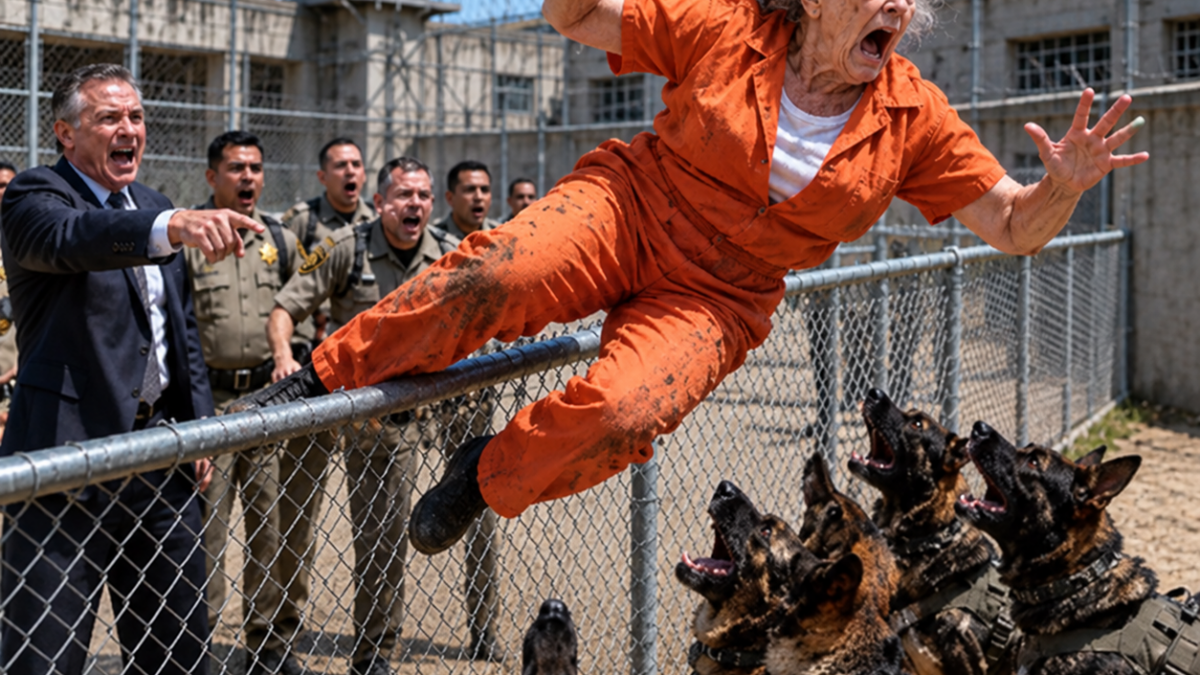
PART3:
“Deputy, may I ask why I’ve been stopped?”
His hand clamped around my upper arm.
Hard.
Too hard.
“I said hands on the hood.”
Every old instinct in my body woke up at once.
Not anger.
Not fear.
A map.
His thumb position.
His balance.
His holster angle.
The distance to the ditch.
The weight of the baton on his belt.
How long it would take to disarm him.
How likely the dashcam was working.
How badly his shoulder would tear if I turned left instead of right.
One point four seconds.
Maybe less.
I let out one slow breath.
Then I placed my palms on the warm hood of the Bronco.
Because discipline is not doing what you can.
Discipline is deciding what you will not do, even when every part of you knows you could.
He patted me down like he wanted to humiliate me. Rough hands. Petty force. A shove between my shoulder blades just because he could. I stared at the road ahead and counted fence posts until he was finished.
“What’s in the bag?” he asked.
“My personal belongings.”
“I’m going to take a look.”
“No, you are not.”
He paused.
I could feel him behind me.
“You got something to hide, Grandma?”
I turned my head slightly.
“That bag contains private property. You do not have my consent to search it.”
He laughed once.
A short, ugly sound.
“Funny thing. I smell contraband.”
“No, you don’t.”
That was all it took.
He yanked my wrists behind my back and slapped cuffs on me so tight that the metal bit into skin. I felt a thin line of warmth where one edge broke the surface.
“Eleanor Whitaker, you’re under arrest for suspicion of transporting contraband and resisting a lawful order.”
I looked over my shoulder at him.
His face had gone red.
Mine had not changed.
That bothered him more than any insult I could have spoken.
He shoved me into the back of his cruiser and threw my duffel bag into the trunk.
As we pulled away, I watched my Bronco shrink in the rear window.
I was not worried about jail.
I had slept in worse places than local cells.
I was worried about the box.
Some things can be replaced.
Some things cannot.
Oakridge County Correctional Facility sat on a low rise outside town, a concrete block surrounded by razor wire, dry weeds, and a flag that snapped in the hot wind like it was trying to escape the pole. It looked less like a public institution and more like a place where secrets went to rot.
Inside, the air smelled of bleach, sweat, old fear, and microwaved food.
Deputy Collins walked me through booking with his fingers still digging into my arm, as if a seventy-year-old woman in handcuffs might suddenly overpower the whole building.
He was not entirely wrong.
But I behaved myself.
A young officer behind the desk looked at my license, then at me.
“Seventy?” he said before he could stop himself.
“Every morning,” I said.
He almost smiled.
Collins shot him a look, and the smile vanished.
Then a man in a gray suit stepped out of an office with glass walls.
Warden Arthur Pendleton.
I knew his kind before he opened his mouth.
Tall and thin, polished shoes, pale hands, expensive watch, and eyes that moved across people as if they were objects he might choose to use, ignore, or destroy. He carried himself like the building belonged to him personally, not to the county, not to the taxpayers, not to the law.
“What’s this?” he asked.
“Out-of-state driver,” Collins said. “Refused a lawful search. Claims she’s just passing through.”
Pendleton looked me up and down.
His gaze lingered on my gray braid, my lined face, my loose cotton shirt, my old jeans, and the bruise already forming where Collins had grabbed me.
“Well,” he said softly, “don’t you look harmless.”
I said nothing.
He smiled.
That smile had practiced cruelty in it.
“What were you transporting, Mrs. Whitaker?”
“Nothing illegal.”
“Open her bag.”
“No,” I said.
The room went quiet.
Pendleton turned his head toward me slowly.
“Excuse me?”
“I said no.”
He blinked, almost amused.
“You don’t give orders here.”
“Neither do you over federal materials.”
That interested him.
“Federal materials?”
I met his eyes.
“The mahogany box in that bag is not yours. The documents sealed with it are not yours. Opening them would be a mistake.”
Collins snorted.
“Documents. She thinks she’s in a spy movie.”
Pendleton held out a hand.
Collins placed my duffel bag on the booking table.
I felt something inside me grow still.
There is a stillness that comes from age.
There is another that comes from training.
Mine came from both.
Pendleton unzipped the bag and rummaged through it carelessly. He tossed my clean shirt aside. He opened my Bible and shook it by the spine as if money might fall out. Then he found the scarf.
His fingers closed around the mahogany box.
“Pretty,” he said.
“That belongs to me.”
“Not anymore.”
“There is nothing inside that can help you.”
“Then you won’t mind if I look.”
I did not move.
“Warden, I am advising you not to open that box.”
He laughed, delighted now.
“Advising me?”
He placed the box on the table, picked up a screwdriver from a drawer, and wedged the tip beneath the latch.
Something in my chest pulled tight.
I had been shot at.
I had buried friends.
I had held dying men while calling for helicopters that would not arrive in time.
But watching that man pry open the box my husband had carried behind my casket plans for twenty-seven years made my throat burn.
The latch snapped.
The lid opened.
Inside, the medals sat against black velvet, bright under the fluorescent lights.
Pendleton looked disappointed.
“That’s it?”
He lifted one ribbon with a finger.
“Old lady trophies?”
The young officer behind the desk inhaled sharply. Maybe he recognized one of them. Maybe he had enough sense to know not all metal weighs the same.
Collins leaned closer.
“What are those? Military?”
“Costume pieces, probably,” Pendleton said.
I stared at him.
He tossed the box back onto the table.
The Silver Star shifted in its velvet groove.
The Navy Cross caught the light.
The SEAL Trident gleamed cold and gold.
Pendleton didn’t know what any of it meant.
That was his first mistake.
He thought ignorance protected him.
That was his second.
“Put her in holding,” he said. “Maybe concrete will teach her some manners.”
They took my belt.
My shoelaces.
My watch.
They left me with my thoughts, my aching knees, and a cell colder than it needed to be.
For the first day, they expected tears.
For the second, they expected begging.
By the third, Warden Pendleton began to understand that I was not going to give him either.
I sat on the floor with my back against the wall and breathed the way I had learned to breathe in places where panic got people killed. Four counts in. Hold. Six counts out. Slow the pulse. Lower the shoulders. Listen.
Prisons are loud even when nobody is talking.
Pipes knock.
Fluorescent lights hum.
Boots drag differently depending on who is wearing them.
A confident guard walks heel first.
A nervous guard walks toe first.
A cruel guard pauses outside a cell just long enough to imagine what he could do if nobody stopped him.
I listened to all of it.
They banged batons on my bars.
I did not flinch.
They slid food trays in and kicked them hard enough to spill half the contents.
I ate what I needed.
They turned the temperature down at night until the cold bit into my joints.
I tucked my hands beneath my arms and slept anyway.
Once, Collins stopped outside my cell and crouched.
“You know,” he said, “all you had to do was be polite.”
I opened my eyes.
“All you had to do was be lawful.”
His face darkened.
“You think you’re tough?”
“No.”
That confused him.
I leaned my head back against the wall.
“I think I’m tired.”
He stood there for a moment, waiting for more.
There was no more.
Men like him hate nothing more than being denied a performance.
By the afternoon of the third day, Pendleton came down himself.
His suit was darker than before, his tie perfectly straight. He stood outside the bars with Collins beside him and another guard I had not yet seen.
This one had a scar across his chin and a nervous tremor in his right hand.
“Mrs. Whitaker,” Pendleton said, “you’ve created quite an inconvenience.”
“I imagine that happens when a warden commits crimes on camera.”
He smiled without warmth.
“There are no cameras where you’re going.”
The nervous guard looked down.
That told me enough.
Pendleton continued, “We have a special unit for inmates who refuse to adjust.”
“I’m not an inmate. I have not been arraigned.”
“In this building,” he said, stepping closer, “you are whatever I say you are.”
I stood slowly.
My knees protested.
My back tightened.
I let the old woman show.
Not all the way.
Just enough.
Pendleton’s eyes flicked to my hands.
Arthritis had bent two fingers slightly over the years. Cold mornings made them stiff. My wrists were bruised from Collins’s cuffs.
Pendleton saw age.
He did not see grip strength built from rope ladders, helicopter skids, and decades of refusing to let go.
“Move her,” he said.
They cuffed me again, behind my back this time, and marched me down a corridor that sloped lower into the building. The air changed as we descended. Less bleach. More mildew. Wet concrete. Rust.
The basement.
Every bad facility has a place like it.
A place where official rules get blurry.
A place where men who crave power go when they want no witnesses.
We stopped in front of a heavy steel door.
Behind it, something growled.
Not barked.
Growled.
Deep.
Animal.
Wrong.
A dog trained properly has control inside the sound.
This growl had pain in it.
Fear dressed up as violence.
Pendleton leaned close to my ear.
“You ever deal with dogs, Mrs. Whitaker?”
I stared at the door.
“A few.”
“Good,” he said. “Then you’ll understand what’s about to happen.”
The nervous guard swallowed.
“Warden, maybe we should—”
“Open the outer door.”
“Sir, Brutus and Cain haven’t been run today. They’re agitated.”
“Then she’ll learn faster.”
Two dogs.
Not one.
I heard the scrape of claws against concrete.
The rattling of chains.
Heavy breathing.
A handler’s leash creaked under strain.
Pendleton stepped back, smiling now. Collins watched with open excitement. The nervous guard—Miller, according to his badge—kept his eyes on the floor.
The first door opened.
They shoved me inside.
The cell was larger than the others, windowless, all concrete and shadow, with a barred inner gate separating me from the animals. A single bulb flickered above, throwing more darkness than light.
On the other side of the bars stood two German Shepherds.
Both large.
Both powerful.
Both ruined by men.
Brutus was black and tan, nearly one hundred ten pounds, thick neck, wide chest, scar under one eye, ears pinned forward with frantic intensity. Cain was smaller but quicker-looking, sable-coated, ribs faintly visible beneath dense fur, eyes burning amber in the dim light.
Neither was evil.
No dog is born evil.
They were confused.
Overworked.
Mishandled.
Rewarded for aggression.
Punished for hesitation.
Turned into weapons by men too cowardly to use their own hands.
My heart hurt before my pulse moved.
Pendleton’s voice came through the bars.
“These are our compliance tools.”
“Those are abused dogs,” I said.
His smile thinned.
“You always this sentimental?”
“No.”
I looked from Brutus to Cain.
“I’m usually less angry.”
Collins chuckled.
“Open the gate.”
Miller gripped the latch.
His hand shook.
“Warden, she’s cuffed.”
“So?”
“She’s seventy.”
Pendleton’s voice sharpened.
“She assaulted a deputy and threatened federal authority. We are deploying K9s to subdue a violent detainee.”
He had rehearsed the lie.
That made it worse.
A spontaneous cruelty is dangerous.
A planned cruelty is a system.
Miller looked at me then.
For one second, I saw apology in his face.
Too weak to stop it.
Too aware not to know.
I gave him the smallest nod.
Not forgiveness.
Permission to remember.
Then he opened the gate.
Brutus came first.
A black blur of muscle and teeth, launching straight for my upper body.
Cain circled wide, trained or conditioned to flank.
I had no room.
No weapon.
Hands cuffed.
Old knees.
Concrete floor.
Two dogs.
Three cruel men watching.
I stepped toward Brutus.
Not away.
Away invites pursuit.
Fear feeds the chase.
I turned my left side into him and dropped my shoulder at the exact moment he lunged. His jaws clamped onto the thick fabric of my sleeve near the forearm. Pain flashed white-hot through old nerves.
I did not scream.
I moved into the bite.
That matters.
People pull away from teeth. Pulling tears flesh and excites the dog. Pressure confuses the mouth. It makes the bite uncomfortable. It interrupts the rhythm.
Brutus growled harder, but his balance shifted.
Cain came low toward my leg.
I pivoted, using Brutus’s weight as the anchor, and drove one command into the concrete room with a voice I had not used in years.
“Platz!”
The word cracked like a rifle shot.
Both dogs hesitated.
Not because of magic.
Because dogs understand certainty.
They hear it before humans do.
Cain froze mid-step.
Brutus’s grip loosened.
I dropped my weight, twisted my cuffed hands beneath me, and brought my knee down beside Brutus’s shoulder, not on him, never on him, just close enough to control space. I leaned toward his ear and snapped the second command.
“Aus.”
Release.
Brutus whined.
His jaw opened.
I pulled my arm free and immediately turned my face away, lowering my chin, denying him direct challenge while keeping my posture dominant. Cain barked twice, uncertain now, looking from me to the men beyond the bars.
The handlers had never spoken to these dogs with discipline.
Only volume.
Only punishment.
Only panic.
So I gave them what they had been missing.
Structure.
“Nein,” I said, low and sharp.
Cain stopped.
I pointed to the floor.
“Down.”
He didn’t move.
I shifted my eyes to him.
“Down.”
His front legs bent.
Slowly.
Confused.
Then his belly touched concrete.
Brutus panted hard beside me, saliva dripping from his jaws, his whole body trembling with adrenaline. I could feel his pain now. Not physical injury, though there was plenty of that in him. The deeper pain.
A working dog without trust is a loaded weapon with a cracked barrel.
I softened my voice.
“Good boy.”
Brutus blinked.
Just once.
Then he lowered his head.
Behind the bars, no one spoke.
I could hear Collins breathing.
I could hear Miller whisper something that sounded like a prayer.
Pendleton’s silence was the loudest thing in the room.
I eased myself down until I was sitting on the cold floor. My hip complained. My bitten arm throbbed. My shoulder felt like someone had driven a nail into it.
Still, I kept my voice steady.
“Brutus,” I said softly, testing the name.
His ears flicked.
“Here.”
He crawled toward me one inch.
Then another.
Cain watched him.
Dogs are honest about leadership. Cruelty can dominate for a while, but calm authority changes the air.
Brutus stopped beside my knee.
I did not reach over his head. Never do that to a dog who has been hit. I turned my cuffed hands as far as I could and let him sniff my bruised knuckles.
He smelled age.
Blood.
Coffee.
Road dust.
And perhaps, buried beneath all of that, the memory of every working dog I had ever trusted with my life.
His head lowered onto my thigh.
Cain stood, uncertain.
I looked at him.
“Stay.”
He stayed.
Pendleton finally found his voice.
“What the hell are you?”
I looked through the bars at him.
“Old.”
His face had gone pale.
I smiled then.
Not kindly.
“Which is what fools mistake for harmless.”
He slammed the outer steel door shut.
The cell fell into darkness.
For a long time, there was only breathing.
Mine.
Brutus’s.
Cain’s.
Three old soldiers in a hole.
I leaned back against the wall and let the pain settle where pain goes when you don’t have time to entertain it. Brutus stayed pressed to my left side. Cain paced for ten minutes, then finally came closer and lay near my boots.
I thought about my husband, Thomas.
He would have laughed himself sick if he could have seen it.
“Ellie,” he used to say, “one of these days, you’re going to end up in trouble because you can’t leave wounded things alone.”
He was right.
He had been right about many things.
Tom had been a Navy corpsman when we met. I was twenty-three, stubborn, faster than most of the men in my training class, and already angry at every door that had been shut in my face. Official records said a lot of things back then. Policies said women could not do certain jobs. Men with clean desks and soft hands said many things were impossible.
But governments have always had shadows.
Wars have always had exceptions.
And sometimes, when no one wants a thing admitted publicly, they still use it privately.
I learned languages.
I learned weapons.
I learned medicine.
I learned how to fall from heights, stay awake for days, disappear in cities, and read a room before opening a door. I learned that the human body can continue after the mind insists it cannot, and that fear is not an enemy unless you obey it.
Years later, when the Navy gave me medals, they used careful language.
Classified operation.
Extraordinary valor.
Uncommon courage under fire.
They never wrote the names of the people we lost.
They never wrote the sound a mother makes when you carry her child out of a building seconds before it collapses.
They never wrote how cold the ocean is at night when extraction is late and your radio dies.
They just pinned metal to cloth and expected it to hold the weight of memory.
It never did.
In the darkness of that basement cell, Brutus whimpered in his sleep.
I shifted closer so he could feel that someone remained.
Near midnight, footsteps came down the hall.
Brutus lifted his head.
Cain rose silently.
“Easy,” I whispered.
Both dogs stilled.
The outer door opened a crack. Light cut across the floor.
It was Miller.
He stood outside the bars, pale, sweating, holding a water bottle and two sandwiches wrapped in plastic.
“You alive?” he whispered.
“That disappoints people regularly.”
He let out a shaky breath.
“I shouldn’t be here.”
“No.”
“I brought food.”
“For me or the dogs?”
He hesitated.
“All of you.”
That was something.
Not courage yet, but the seed of it.
He slid the water bottle through a narrow gap first. Then the sandwiches. His hands shook so badly the second one almost fell.
Brutus watched him.
Miller flinched.
“He won’t hurt you if you stop acting like prey,” I said.
Miller swallowed.
“I never liked what they did to them.”
“Liking it was never the question.”
He looked ashamed.
Good.
Shame can become useful if a person stops running from it.
“What are you?” he whispered.
I took a slow drink of water.
“A woman whose property your warden stole.”
“No, I mean…” He glanced toward the hall. “The dogs. The way you spoke. The way they listened.”
I looked down at Brutus.
The dog’s scarred ear rested against my knee.
“I worked with better handlers than you have here.”
Miller closed his eyes.
“You need a doctor.”
“Yes.”
“You need a lawyer.”
“Yes.”
“You need—”
“For someone with a key to decide what kind of man he wants to be before morning.”
His eyes opened.
He understood.
Not fully.
But enough.
Miller backed away and disappeared into the hall.
I did not know then that he would spend the next twenty minutes staring at his phone in the staff locker room, shaking so hard he could barely type.
I did not know he would send three photographs to an old friend in the state police.
My bruised wrist.
My booking record.
The broken mahogany medal box sitting on Pendleton’s desk.
I did not know that the old friend would zoom in on the medals, sit upright in his kitchen, and say out loud, “Oh no.”
I only knew that help, if it came, would come because somebody finally chose not to look away.
Morning arrived without sunlight.
Pendleton did not feed us.
He did not open the door.
He did not send medical care.
He left an elderly woman cuffed in a concrete cell with two exhausted dogs and convinced himself that silence would erase what he had done.
But there are two kinds of silence.
The kind that hides a crime.
And the kind that gathers force before impact.
By noon, that force had already begun moving.
At Naval Station Norfolk, a retired admiral named Joseph Harlan was drinking coffee in his office when his secure line rang. He was eighty-one, officially out of the chain of command, unofficially still respected by people who understood that some names are not retired just because paperwork says so.
He listened for thirty seconds.
Then he stood so fast his chair hit the wall.
“Say that name again,” he ordered.
A pause.
His face hardened.
“Eleanor Whitaker?”
Another pause.
“No. You listen to me. If that is the Eleanor Whitaker I know, you do not have a routine civil rights issue. You have a decorated Naval Special Warfare veteran illegally detained, denied communication, and possibly assaulted by local authorities.”
He hung up and made four calls.
The first went to the Judge Advocate General’s Corps.
The second went to a federal prosecutor.
The third went to someone whose title was too long and whose patience was too short.
The fourth went to my daughter.
I found out later that Claire was in her classroom teaching seventh-grade history when her phone rang. She almost ignored it because she never answered unknown numbers during class.
Then she saw “U.S. Navy” on the caller ID.
She stepped into the hallway.
By the time the substitute teacher arrived, Claire was already crying and driving toward the airport.
Back in Oakridge, Pendleton’s confidence began to crack around 1:30 in the afternoon when his office phone would not stop ringing.
County administrator.
Sheriff.
State police liaison.
Then a number with a Washington, D.C. area code.
He ignored the first calls.
Then he unplugged the phone.
Then his personal cell rang.
He threw it into a drawer.
Men like Pendleton do not fear wrongdoing. They fear records. Witnesses. Jurisdiction. Outside eyes.
By 2:15, he was shredding intake documents.
By 2:30, he had ordered Collins to delete patrol footage from the traffic stop.
By 2:40, Deputy Collins discovered that deleting evidence is more difficult when the system has already been remotely locked by a federal preservation order.
By 3:05, the first helicopter passed low over Oakridge County Correctional Facility.
I heard it through concrete.
Not clearly.
But enough.
The deep, rhythmic chop of rotors carries differently than traffic, differently than generators, differently than storms.
Brutus heard it too. His ears rose.
Cain stood.
I closed my eyes.
For the first time since the traffic stop, I allowed myself one small smile.
“About time,” I whispered.
The building shook ten minutes later.
Not from an explosion.
From authority arriving all at once.
Boots thundered overhead.
Orders shouted.
Radios crackled.
Somewhere above us, a man screamed, “You can’t come in here!”
That man was wrong.
The door at the end of the basement corridor slammed open.
Multiple footsteps.
Disciplined pace.
Not prison guards.
Tactical team.
I sat up straighter.
Brutus moved in front of me.
Cain stood beside him.
“Stand down,” I told them softly.
They did.
Outside the cell, voices overlapped.
“Cell four.”
“Watch the animals.”
“Medical ready.”
“Get the bolt cutters.”
Then Pendleton’s voice, thin with panic.
“You don’t understand. The dogs are in there. They’ll kill whoever opens it.”
A man answered him.
Calm.
Cold.
Familiar in the way command voices are familiar even when you have never heard that exact one before.
“Then I suggest you step aside.”
The lock turned.
The outer door opened.
Bright white light flooded the cell.
Several rifles lifted toward Brutus and Cain.
I raised my voice before fear could pull a trigger.
“Do not shoot my dogs.”
Every weapon froze.
The flashlight beam steadied.
A man in a Navy dress uniform stood behind the tactical team, gray-haired, square-jawed, ribbons across his chest. I did not know him, but I knew the look in his eyes. He had expected to find a victim.
Instead, he found an old woman sitting on concrete with two so-called vicious K9s guarding her like loyal sentries.
He stared.
Then his mouth twitched.
“Master Chief Whitaker?”
I lifted one cuffed hand as far as the chain allowed.
“Depends who’s asking.”
“Captain Daniel Hayes, ma’am. Admiral Harlan sends his regards.”
I leaned my head back against the wall.
“That old shark still alive?”
“Yes, ma’am.”
“Tell him he’s late.”
Captain Hayes smiled despite himself.
“Yes, ma’am.”
An FBI agent stepped forward, eyes moving from the bruises on my wrist to the dogs, then to the torn sleeve where Brutus had bitten fabric but not flesh.
“Ma’am, can you control the animals?”
I looked at Brutus.
“Heel.”
Brutus rose and moved to my left side.
“Cain.”
The sable shepherd approached slowly and sat to my right.
The FBI agent lowered his weapon first.
The rest followed.
Pendleton stood behind them, pale as paper, wrists already cuffed. Collins was beside him with bloodshot eyes and the expression of a bully who had discovered consequences.
Miller stood farther back.
He would not look at me.
But he was there.
That mattered.
A medic entered and cut off my cuffs.
The moment the metal fell away, pain shot through my hands. My fingers were swollen, purple at the joints, skin torn where the cuffs had dug into me.
The medic muttered something under his breath.
I recognized the tone.
The professional anger of someone trained to help, looking at injuries caused by people trained to control.
“Can you stand?” he asked.
“Unfortunately.”
He offered an arm.
I accepted.
Not because I needed it.
Because sometimes letting people help is a form of mercy.
When I stepped into the corridor, Brutus and Cain followed.
A young tactical officer shifted nervously.
I gave him a look.
He stopped shifting.
We walked upstairs into a prison that had transformed in less than an hour. Federal agents filled the lobby. Computers were being boxed. Filing cabinets stood open. Deputies sat zip-tied along one wall. A woman from the U.S. Attorney’s office spoke into a phone with the brisk tone of someone building charges in real time.
And there, on the booking table, sat my mahogany box.
Broken latch.
Blue scarf tossed beside it.
Medals disturbed but still inside.
I stopped walking.
Everything in the lobby seemed to slow.
Captain Hayes followed my gaze.
He picked up the box with both hands.
Not casually.
Not like evidence.
Like something that deserved respect.
“Ma’am,” he said quietly, “I believe this belongs to you.”
I took it.
My fingers trembled then.
Only then.
Not in the cell.
Not with the dogs.
Not under Pendleton’s smile.
But with that broken box in my hands, I felt the years rise up behind my ribs. The names. The missions. The cold ocean. The men who did not come home. Tom standing in the kitchen, polishing the brass latch because he said history deserved to open smoothly.
I turned toward Pendleton.
He was cuffed to a steel bench now, his perfect suit wrinkled, his face shining with sweat.
He still tried to look angry.
Men like him cling to contempt until fear pulls their fingers loose.
“You had no right,” I said.
His mouth opened.
No sound came out.
“You took my property. You broke my box. You put me in a hole with animals you abused and called it discipline.”
He swallowed.
“I didn’t know who you were.”
The lobby went quiet.
That sentence hung there.
Weak.
Rotten.
Familiar.
I looked at him for a long moment.
“That is the problem, Warden.”
I opened the box.
The fluorescent lights struck the medals, and suddenly all the cheap noise of the room fell away.
The Navy Cross lay first.
Beside it, the Silver Star.
A Purple Heart.
A Bronze Star with valor.
And the Trident.
Gold.
Heavy.
Unmistakable.
Several agents straightened without thinking. Captain Hayes removed his cover. A young FBI operator stared as if he had just seen a ghost step out of history.
Pendleton stared too.
But he did not see history.
He saw the size of his mistake.
He saw that the woman he had mocked, cuffed, starved, and thrown into darkness was not a helpless old lady passing through his little kingdom.
He saw the machinery now moving around him.
Federal charges.
Civil rights violations.
Assault.
Obstruction.
Evidence tampering.
Kidnapping under color of authority.
His face collapsed.
“I didn’t know,” he whispered again.
I closed the lid gently.
This time, I did not let the broken latch snap.
“You should not need a medal to recognize a human being.”
No one spoke.
Even Brutus seemed still beside me.
I stepped closer to Pendleton, not because I wanted to frighten him, but because I wanted him to hear every word.
“You thought power meant having the keys. You thought strength meant making people afraid in rooms with no cameras. You thought age made me weak, silence made me beaten, and kindness made those dogs useless.”
My voice dropped.
“You were wrong about every single thing.”
Collins began crying then.
Quietly at first.
Then harder.
No one comforted him.
I turned away.
There is a kind of justice that arrives loud, with helicopters and warrants and men in armor.
There is another kind that arrives quietly, when a cruel man realizes the story he told himself about his own power has ended.
I preferred the second.
Outside, the late afternoon sun hit my face as if the world had been scrubbed clean. The air smelled of pine, hot asphalt, and freedom.
My Bronco had been brought to the front lot. Someone had parked it carefully away from the tactical vehicles, as if the old truck were part of the rescue operation and deserved its dignity.
Claire arrived just as the medic finished wrapping my wrists.
She ran across the lot in a way I had not seen since she was a little girl.
“Mom!”
For a second, I was not Master Chief Whitaker. Not an operator. Not a woman with medals. Not the old ghost some admiral had dragged out of classified memory.
I was just a mother whose daughter had been frightened.
Claire wrapped her arms around me and shook.
I held her with one good arm.
“I’m all right,” I said.
“No, you are not.”
I almost smiled.
She had my tone.
“I’m alive.”
“That is not the same thing.”
No.
It wasn’t.
Brutus pressed his head against Claire’s hip.
She stiffened.
Then looked down.
“Mom,” she said slowly, “why is there a giant police dog leaning on me?”
“He’s not police anymore.”
Cain sat beside my left boot.
Claire stared at both of them.
“Of course,” she whispered. “Of course you got arrested and adopted two attack dogs.”
“They were unemployed.”
She laughed then, but it broke halfway into a sob.
Captain Hayes approached carefully.
“Ma’am, about the dogs.”
I looked at him.
He cleared his throat.
“The county may attempt to claim them as property.”
“No.”
One word.
He nodded as if he had expected it.
“I’ve already contacted federal asset forfeiture and a military working dog rehabilitation nonprofit. Given their use in civil rights violations, we can secure emergency transfer.”
“Good.”
He hesitated.
“Do you intend to keep them both?”
Brutus looked up at me.
Cain leaned against my leg, still uncertain, still waiting for the next bad thing to happen because bad things had been the only pattern he knew.
I looked toward the prison.
Through the glass doors, I could see Pendleton being led away.
“No,” I said softly. “I intend to give them a choice.”
Captain Hayes studied me.
Then nodded once.
The investigation lasted months.
The fallout lasted longer.
Oakridge County Correctional Facility became a headline first, then a scandal, then a federal case study in how small-town corruption survives when everyone is afraid, tired, or convinced someone else will speak up.
Pendleton’s office safe contained cash, falsified incident reports, deleted complaint logs, and medical records for detainees injured by Brutus and Cain over three years. Several deputies resigned before they could be fired. Deputy Collins tried to claim he had followed procedure, but his dashcam, body mic, and booking room footage told a different story.
Officer Miller testified.
His voice shook on the stand.
But he told the truth.
That mattered too.
People often think courage looks like charging into gunfire.
Sometimes it looks like a frightened man admitting he was part of something wrong and choosing, finally, to stop protecting it.
As for me, I spent three days in a hospital because Claire insisted and because the medic took her side, which I considered unfair but strategically sound. My wrists healed. My arm bruised from Brutus’s bite turned purple, then green, then yellow, then disappeared. My knees remained seventy years old and deeply unimpressed by federal intervention.
Brutus and Cain went first to a rehabilitation facility run by a former military working dog handler named Luis Ortega. I visited every week.
At first, Brutus would not enter rooms unless I went in first.
Cain hid under tables during thunderstorms.
Neither trusted men in uniform.
Healing, in dogs and people, is not a straight road.
It is a series of small permissions.
Permission to sleep.
Permission to eat without guarding the bowl.
Permission to hear a raised voice and not expect pain.
Permission to be touched gently.
Permission to fail without punishment.
Three months later, Brutus climbed into the passenger seat of my Bronco and refused to get out.
Luis stood in my driveway with his arms folded.
“Well,” he said, “looks like he made his choice.”
Cain took two more weeks.
He was slower to trust, quicker to watch exits, harder to convince that peace was not a trick. But one rainy morning, he walked through my front door, circled my living room twice, lay down beside my old rocking chair, and sighed like a tired soldier finally allowed to remove his boots.
So I kept them both.
Claire said my house looked like a retirement home for classified assets.
She was not wrong.
Brutus slept by the front door.
Cain slept beside my bed.
The mahogany box stayed on the mantel, repaired by a local woodworker who refused payment after he learned what it was. He replaced the latch with brass and polished the wood until the old scratches shone like part of the grain.
I still did not open it often.
I did not need to.
A person should not live inside their medals.
But some days, when the light hit the mantel just right, I would look at that box and think about Oakridge. About a warden who believed darkness belonged to him. About two dogs who had been turned into weapons and still remembered how to become companions. About all the people who only acted once the proof was impossible to ignore.
And about how close cruelty always lives to ordinary roads.
Six months after the arrest, I was invited to speak at a ceremony honoring the federal team and whistleblowers involved in the case. I nearly refused. I disliked ceremonies. I disliked microphones. I disliked being called inspirational by people who had never seen what inspiration costs.
Claire told me to go.
“You don’t have to talk about the missions,” she said. “Talk about the dogs.”
So I went.
The hall was full of uniforms, reporters, local families, civil rights attorneys, and a few former detainees whose complaints had finally been believed. Officer Miller sat in the third row, hands clasped so tightly his knuckles were white.
Brutus and Cain lay beside my chair wearing blue service vests.
When they called my name, people stood.
I hated that part.
I walked to the podium slowly, because at seventy you can either pretend not to hurt or save your energy for things that matter. The room quieted.
I looked out at all those faces.
Then I said the truth.
“I was not saved because I was strong.”
The room stayed still.
“I was saved because someone finally told the truth. I was saved because records were preserved. I was saved because one frightened officer decided silence was no longer the safest place to hide. I was saved because people with authority used it correctly after people with authority had used it cruelly.”
I looked down at Brutus.
He looked up at me.
“I have been called brave in my life. Usually by people who arrived after the worst part was over. But I have learned something about bravery. It is rarely clean. It is rarely loud. And it is almost never comfortable.”
My hands rested on the sides of the podium.
The scars across my knuckles had faded, but they were still there.
“Sometimes bravery is a seventy-year-old woman not striking back when she could. Sometimes it is a young guard sending a photograph. Sometimes it is a dog lowering his head because someone finally spoke to him without hate.”
Miller covered his face.
I let him.
“Power is not proven by what you can hurt. It is proven by what you choose to protect.”
That was all I had meant to say.
But then I saw a little girl in the front row, maybe eight years old, sitting beside her mother. She was staring at the dogs with wide eyes, not afraid, just amazed.
So I added one more thing.
“And never mistake age for surrender. Some of us are not fragile. We are simply finished wasting movement.”
The room went silent for half a second.
Then applause rose like weather.
Brutus stood because he thought noise required supervision. Cain leaned against my leg.
I placed one hand on each of their heads.
That was how the photographers captured us.
An old woman with silver hair.
Two former attack dogs standing calmly at her sides.
And behind us, on a screen someone had designed for the event, a photograph of the medal box Pendleton had broken.
People later said that image went viral.
I never watched the video.
I did not need to see myself turned into a symbol.
I had dishes to wash.
Dogs to feed.
A Bronco to keep running.
A daughter who called every morning even though I told her she did not have to.
A life, still mine, still moving west in its own stubborn way.
On the first anniversary of Oakridge, I drove back.
Not to the prison.
That place had been shut down pending restructuring and federal oversight. The razor wire was gone. The sign had been removed. Grass had started growing through cracks in the parking lot.
I drove to the hill above it and parked beneath a maple tree just beginning to turn red.
Brutus sat in the passenger seat.
Cain stood with his paws on the back bench, looking out the window.
I opened the repaired mahogany box.
The medals caught the morning light.
For once, they did not feel heavy.
I thought of Tom.
I thought of the young sailor at his funeral.
I thought of Pendleton whispering, I didn’t know.
Then I closed the box and looked at the silent building below.
“You never needed to know who I was,” I said softly. “You only needed to know I was human.”
The dogs waited.
The wind moved through the maple leaves.
Somewhere far off, a truck rolled down the highway, heading west.
I started the Bronco.
Brutus leaned his head out the window.
Cain settled behind me.
And as Oakridge disappeared in the mirror, I felt the old road open ahead again, bright and wide and unfinished.
People like Warden Pendleton believe darkness belongs to them because they use it to hide what they are.
They forget that some of us spent our lives walking through darkness on purpose.
And we learned a long time ago that the dark is not powerful.
It is only waiting for someone disciplined enough to turn on the light.








