A Cowboy Burst Into a Bride’s Wedding With a Wanted Poster—Then Asked, “Do You Know Who You’re Marrying?” and Exposed the Groom’s Plan to Rob Her Father’s Bank
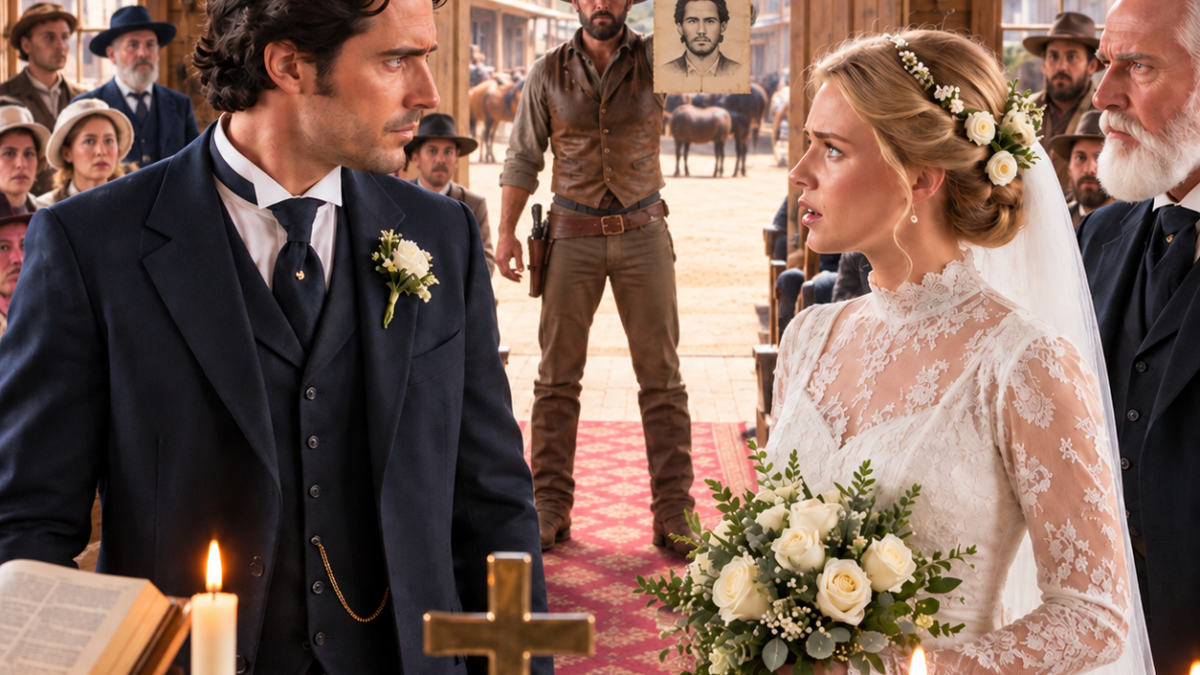
A Cowboy Burst Into a Bride’s Wedding With a Wanted Poster—Then Asked, “Do You Know Who You’re Marrying?” and Exposed the Groom’s Plan to Rob Her Father’s Bank.
I was standing at the altar in front of nearly every respectable family in our Texas county, one breath away from promising my life to Adrien Vale, when the church doors slammed open and Jonah Creed appeared covered in two days of road dust with an old wanted poster clenched in his fist.
My father rose in fury, my fiancé turned white, and Jonah ignored both of them as he looked straight at me and asked, “Lillian, do you know who you’re marrying?”
Before that afternoon ended, I would discover that the man who remembered how I took my coffee, brought me books I mentioned only once, and swore he loved me had spent months studying me for one reason—and the quiet cowboy my father had dismissed as beneath us had risked everything not to make my choice for me, but to make sure I finally had the truth before I made it.
My name is Lillian Ashford.
In 1887, most people in our part of Texas knew my name before they knew me.
That was one of the disadvantages of being Horus Ashford’s only daughter.
My father was president of Ashford National Bank, owned interests in two cattle operations, financed half the merchants on our main street, and somehow knew which families were behind on loans without ever appearing rude enough to mention it at church.
People called him respectable.
Successful.
Disciplined.
Depending on how much money they owed him, sometimes they called him other things when he could not hear.
I loved him.
I should say that before anything else.
He was not a cruel father.
He was not cold.
He had simply lost my mother when I was fourteen and responded by deciding nothing else would ever be allowed to hurt me if he could prevent it.
The problem was that Father’s definition of preventing hurt eventually expanded until it included preventing me from making almost any decision he considered risky.
Especially decisions involving men.
By the time I was twenty-six, I had lost count of how many prospective suitors had been quietly discouraged.
Father had not.
Seven.
He could recite each man and the flaw that disqualified him.
Sheriff Bell’s nephew?
“Unsteady hours.”
“He works with the sheriff.”
“Exactly. Trouble keeps unsteady hours.”
Thomas Greene, the attorney?
“Laughs too loudly at his own jokes.”
“He was nervous.”
“A man who needs that much encouragement from himself will eventually become exhausting to everybody else.”
Samuel Porter, whose family owned three thousand acres north of ours?
“He wore his hat at supper.”
“Once.”
“Once was sufficient.”
I stared at Father across our dining table after that particular rejection.
“The hat?”
“A man who forgets his manners the first evening will forget them entirely by the second month.”
“Father, someday you may actually have to trust me to judge a man’s character myself.”
“You’ll thank me eventually.”
“I’d thank you sooner if you let me make a mistake without reviewing it like a bank loan.”
He did not appreciate that.
I did.
Our arguments rarely lasted.
I had inherited enough of his stubbornness that neither of us could truly win, and enough of my mother’s affection for him that I never wanted victory badly enough to wound him.
So we continued.
He protected.
I resisted.
PART2:
And somewhere in the middle, years passed.
Jonah Creed had already worked for Ashford Holdings four years by then.
I knew him the way one knows a gate one rides through every morning.
Familiar.
Reliable.
Usually silent.
He moved cattle between our ranch holdings, delivered documents and occasionally bank deposits to town, repaired almost anything involving leather or wood, and somehow managed to work near my father for years without ever becoming tangled in his opinions.
Father liked Jonah for precisely that reason.
“He knows his position.”
Father once said.
I disliked the phrase.
Jonah probably would not have bothered objecting.
He was around thirty, perhaps a little older.
Sun-browned.
Dark hair he usually needed cut several weeks before he actually cut it.
Gray eyes.
Lean rather than large.
The kind of man whose competence was easy to overlook because nothing around him seemed to go wrong often enough for anyone to notice who had prevented it.
Most ranch hands became louder together.
Jonah became quieter.
At supper, the men teased him.
“Creed could go a week without giving you a complete sentence.”
One of them said.
Jonah took another bite of stew.
“Saves trouble.”
That was apparently enough conversation for him.
For years, I thought that was all there was.
PART3:
Then one spring morning, I fought with a saddle strap for nearly five minutes while Jonah watched from a fence.
I knew he was watching.
That irritated me more than the strap.
I tugged.
Adjusted.
Tried another hole.
Finally Jonah said:
“Wrong buckle.”
I turned.
He leaned against the fence.
Perfectly calm.
“You knew that?”
“Yes.”
“How long?”
“Most of the time you’ve been fighting it.”
“You might have mentioned it sooner.”
“You looked determined.”
“To embarrass myself?”
“To discover it.”
“And how long were you planning to enjoy the spectacle?”
Jonah considered.
“Another minute.”
I stared at him.
Then laughed despite myself.
“You are considerably more amusing than your reputation suggests, Mr. Creed.”
“Don’t tell the men.”
“Why?”
“Reputation took years.”
He walked over, corrected the strap in seconds, and stepped back.
That conversation should have disappeared from my memory.
It did not.
After that, I noticed him more.
Not romantically.
Not at first.
I noticed things.
Jonah listened.
People confuse silence with absence.
Jonah’s silence was attention.
Once, during an inspection with Father, I complained that the water trough near the second pasture made no sense where it stood.
The hands lost time moving animals farther than necessary.
Nobody responded.
I had not expected them to.
I was the banker’s daughter.
My opinions about cattle operations were generally treated as pleasant noises unless Father repeated them.
Two weeks later, the trough had moved.
I found Jonah repairing fence nearby.
“Did Father order this?”
“No.”
“You?”
“Seemed sensible.”
“I mentioned it once.”
Jonah drove another nail.
“Once was enough.”
He offered nothing more.
Yet I thought about it the rest of the day.
Adrien Vale arrived that same season.
Where Jonah entered rooms without anyone noticing, Adrien seemed constructed to make every entrance feel deliberate.
He came from Boston.
Or so he said.
Thirty-two years old.
Educated.
Elegant without appearing soft.
His coats were better fitted than anything most Texas men owned, but he rode well enough that nobody could mock him for Eastern delicacy.
He understood railroads.
Bond markets.
Land speculation.
Banking.
More importantly, he understood my father.
Their first conversation lasted two hours.
By supper, Father was smiling in a way I had not seen around a potential suitor in years.
Adrien drank one glass of wine.
One.
Father noticed.
Adrien discussed investment conservatively.
Father noticed.
Adrien asked intelligent questions and waited for answers without interrupting.
Father practically began planning the wedding before dessert.
I should have resisted for that reason alone.
Instead, I liked Adrien.
That remains one of the most difficult things to admit.
Because people want betrayal stories to become simple afterward.
They want the deceived person to discover the clues were obvious.
They want to say:
I always felt something was wrong.
I did not.
Adrien was good to me.
Or he performed goodness so skillfully that the distinction became impossible until too late.
He remembered things.
Not expensive things.
Small things.
I once mentioned over breakfast that I had enjoyed a novel my mother owned but had lost our copy.
Three weeks later, Adrien returned from Dallas and handed me another edition.
“I saw it.”
He said.
“You remembered?”
“Of course.”
My father had spent years listening to my words primarily to detect danger.
Adrien listened as though my words interested him.
That difference was intoxicating.
He asked my opinion about bank matters.
Not simply whether Father would approve.
Mine.
Once, walking through our garden, I said:
“You actually listen.”
Adrien smiled.
“Should I not?”
“Most men listen only long enough to prepare whatever they intend to say next.”
“Perhaps most men are wasting useful information.”
At the time, I thought that answer clever.
Later, I would hear something else inside it.
Information.
He proposed in autumn.
Garden.
Lanterns.
A ring he said had belonged to his grandmother.
I had waited years to be trusted with my own decision.
Father approved.
Adrien appeared loving.
I said yes before he finished asking.
For several weeks, I believed I had finally achieved the perfect combination.
A man I had chosen.
A man Father respected.
Freedom without conflict.
It felt almost suspiciously easy.
Jonah congratulated me near the stable.
“Miss Ashford.”
“Yes?”
“Heard the news.”
“I imagine the whole county has.”
“Likely.”
He adjusted a saddle strap.
“Congratulations.”
“Thank you.”
That was all.
Something about the way he said it felt closed.
Not angry.
Not jealous.
Just closed.
I told myself I imagined it.
Wedding preparations swallowed everything.
Fabric.
Guests.
Church.
Flowers.
Father acted as though a military campaign depended on seating arrangements.
Adrien remained patient.
Attentive.
Perfect.
And then Jonah heard him lose his temper.
It happened in our stable months into the engagement.
I learned the details only later.
A supplier arrived late with equipment.
Adrien met him outside.
Some disagreement developed.
Adrien’s polished voice sharpened.
“I don’t care what excuse you’ve got.”
He snapped.
“Same as I told you the first time. I want it settled before sundown.”
Jonah was mending harness nearby.
Those words alone meant nothing.
But memory is sometimes hidden until sound unlocks it.
Five years earlier, Jonah had been working a railroad payroll route in New Mexico Territory.
He had rarely spoken about those years.
Once I asked why.
“Hard country.”
He said.
“What happened?”
“Something I’d rather not carry into a pleasant afternoon.”
I respected the boundary.
What I did not know was that Jonah had been part of a small escort transporting payroll money through isolated country when riders ambushed them.
Two guards died.
Men Jonah knew.
Men who had sat by the fire with him the night before.
The payroll disappeared.
The leader escaped.
Jonah had seen his face only briefly during the chaos.
But he remembered the voice shouting orders.
He remembered one phrase.
Same as I told you the first time.
And he remembered the man’s left hand.
Held slightly curled.
Favoring an old injury.
Adrien had that same hand.
That same cadence.
That same voice.
Jonah did not come to me.
That bothered me when I first learned it.
Later I understood.
He went to Father.
He believed accusations like that required proof before they were placed in front of a bride.
Father responded exactly as I might have predicted.
“You are accusing a man far above your station of murder and robbery on the strength of a voice and an injured hand?”
Jonah remained calm.
“I’m telling you I believe I’ve seen him under another name.”
“Believe?”
“Yes, sir.”
“Then keep your belief to yourself until you possess something more useful.”
Jonah pushed.
Father became furious.
“I’ll thank you not to spread wild accusations about my daughter’s future husband.”
Then came the threat.
Not explicit dismissal.
Something sharper.
“Before they cost you a position you can plainly not afford to lose.”
I happened to pass Father’s office near the end of that argument.
I heard Jonah’s name.
“Accusation.”
Father’s raised voice.
Then the door closed.
I asked Father later.
“What was that?”
“Ranch matter.”
“You were discussing Adrien.”
“Nothing you need concern yourself with.”
The answer angered me.
“It concerned my fiancé.”
“Lillian.”
He gave me that fatherly tone I hated.
“It has been handled.”
What I should have asked was:
Handled how?
Instead, I allowed wedding preparations to distract me.
Adrien apparently realized Jonah suspected him.
Within days, records Jonah hoped might help disappeared.
A bank ledger burned in a small unexplained office fire.
Documents vanished.
Adrien remained charming.
Nothing reached me.
Then Jonah went to the telegraph office.
He happened to be there when Adrien sent a message.
The clerk read part of it aloud for confirmation.
“Be ready the morning after the wedding. I’ll send the final hour once I’m inside Ashford’s private office.”
Jonah heard.
The destination office printed on the slip gave him somewhere to start.
From that point, pieces aligned.
Father had scheduled a major transfer shortly after my wedding.
Gold.
Negotiable bonds.
Large enough to attract dangerous attention.
Only Father knew the final transfer hour and current vault combination.
He kept both inside his private office until the morning of any movement.
Adrien could not simply walk inside.
But Horus Ashford’s son-in-law?
Different matter.
A husband was family.
Family was trusted.
I was not the prize.
I was the key.
Jonah still needed proof of identity.
So he rode.
I saw him leaving.
Two saddlebags.
Extra gear.
Far more than an ordinary ranch errand required.
“Going somewhere?”
I asked.
“Yes.”
“Father send you?”
“No, ma’am.”
“Adrien?”
His pause bothered me.
“Not exactly.”
“Is this about the wedding?”
Another silence.
“Jonah?”
He looked at me for a moment.
There was something in his expression I had never seen.
Urgency.
And fear.
Not for himself.
“I need to settle something.”
That was all.
He rode away.
I watched until he disappeared.
An unease settled over me.
I nearly told Adrien.
I did not.
Two days later, I put on my wedding dress.
The church filled.
Merchants.
Ranchers.
Bank employees.
Families who had known me since childhood.
Father wore his best black coat.
He looked proud enough to burst.
My mother’s absence hurt that morning.
I wore one of her pins beneath the lace near my collar.
Adrien waited at the altar.
Handsome.
Composed.
When I reached him, he smiled.
“You’re beautiful.”
I believed the tenderness in his voice.
That is the cruelest part.
Maybe some of it was real.
Perhaps all of it felt real to him in the moment.
The preacher began.
Words about covenant.
Trust.
Truth.
How strange that truth was already galloping toward us.
The preacher asked Adrien his intention.
Then turned toward me.
I remember inhaling.
Preparing to answer.
Then the church doors slammed open.
Every head turned.
Jonah Creed stood in the doorway.
Dust covered him from hat to boots.
His horse outside looked half dead from hard riding.
Jonah held a folded paper.
Father rose immediately.
“Creed.”
The name cracked through the church.
Adrien looked toward the doors.
Color drained from his face.
That was the first thing I noticed.
Not annoyance.
Not confusion.
Fear.
Jonah looked at me.
Not Father.
Not Adrien.
Me.
“Lillian.”
People murmured.
Jonah almost never used my first name.
“Do you know who you’re marrying?”
I felt something inside my body go cold.
Father stepped into the aisle.
“This is neither the time nor the place.”
Jonah did not move.
“It’s precisely the time.”
His voice remained steady.
“Before the vows.”
“Not after.”
Adrien recovered enough to laugh.
“This is absurd.”
He turned toward the congregation.
“The man has apparently decided spectacle suits him.”
Then to Father:
“Have him removed.”
Nobody moved.
Not yet.
Jonah started down the aisle.
Dust fell from his boots onto the church floor.
People leaned outward from pews.
He carried the paper where everyone could see.
“His name isn’t Adrien Vale.”
Silence.
Adrien’s jaw tightened.
Jonah stopped several yards from us.
He unfolded the poster.
The paper was old.
Yellowed.
Wanted notice.
Sketch.
A younger man.
No beard.
Different hair.
But the face—
My eyes went from the page to Adrien.
Same jaw.
Same nose.
Same eyes.
And beside the written description:
Old injury to left hand.
Frequently holds fingers partially curled.
Jonah said the name.
“Silas Ror.”
Adrien stopped smiling.
Father took the poster.
Read.
Then looked at Adrien.
“This is nonsense.”
Adrien said.
But his voice had changed.
Not the smooth man from Boston.
Something sharper underneath.
Jonah removed another paper from his coat.
“The telegraph message.”
Adrien’s eyes went to it.
That reaction destroyed whatever doubt remained.
Father took the copy.
His hands shook.
My father’s hands never shook.
He read aloud.
“Be ready the morning after the wedding.”
His voice faltered.
Then:
“I’ll send the final hour once I’m inside Ashford’s private office.”
People gasped.
Father stared at Adrien.
My mind moved faster than my emotions.
Private office.
Transfer.
Vault.
All the months Adrien had spent listening to Father talk business.
All the questions.
All the curiosity.
All the conversations with me.
My stomach turned.
“You asked me when Father worked alone.”
I said.
Adrien looked at me.
“You asked which mornings he reviewed transfer documents.”
“Lillian—”
“You asked whether Father ever changed the vault procedure.”
“I asked ordinary questions.”
“No.”
I could hear my own heartbeat.
“You asked me because I trusted you.”
Adrien’s face changed.
For perhaps the first time since I had known him, he stopped performing.
He looked tired.
Cornered.
Almost angry.
Then strangely sad.
“I came for the bank.”
He said.
Gasps moved through the church.
Father made a sound like he had been struck.
Adrien continued.
“I won’t insult you by denying it now.”
My bouquet felt heavy.
My fingers had gone numb.
“You came for the money.”
“Yes.”
“And me?”
He looked directly at me.
“That changed.”
I laughed once.
There was no humor in it.
“What changed?”
“I did.”
“No.”
“Lillian.”
“I came here planning to use your father.”
He said.
“The marriage gave me access.”
“I won’t lie about that.”
“Too late for concern about lying.”
His face tightened.
“But I did not plan to care for you.”
That almost hurt worse.
“I didn’t.”
He continued.
“Somewhere along the way, what I felt became real.”
The church disappeared.
I saw only him.
Every remembered kindness returned at once.
The book.
Coffee.
The garden.
Questions.
His hand over mine.
His proposal.
Each memory became evidence and doubt simultaneously.
Maybe that was the true theft.
Not money.
Certainty.
I would never know which smile belonged to Adrien and which to Silas.
Which question was affection and which was reconnaissance.
Which touch meant love and which moved him closer to Father’s office.
I reached for the ring.
My fingers trembled only after I removed it.
“Maybe some of it was real.”
Adrien’s eyes changed.
Hope.
Small.
Desperate.
I destroyed it.
“But you made certain I could never know which part.”
I placed the ring on the altar rail.
Not in his hand.
“That isn’t love.”
My voice steadied.
“That’s a very patient kind of theft.”
Adrien looked toward the side door.
Jonah saw it too.
“Don’t.”
Adrien ran.
Everything broke at once.
Women screamed.
Men stood.
Pews shifted.
Adrien shoved through the side exit.
Jonah followed.
Father shouted for bank guards.
Someone yelled that two men were outside.
I stayed at the altar for perhaps three seconds.
Still wearing white.
Still holding flowers.
Then I dropped the bouquet.
Ran after them.
By the time I reached the churchyard, Adrien was climbing the back fence.
Jonah caught him before he cleared it.
They hit the ground.
No gunfire.
Thank God.
Adrien fought hard.
Not elegantly.
Jonah held him until other men arrived.
Two accomplices waiting farther down the street attempted to flee when the alarm spread.
Father had already sent guards toward the bank.
The sheriff arrived within minutes.
By afternoon, all three men were in custody.
Silas Ror.
That was the name entered in the jail record.
The name of the man I had almost married disappeared with shocking speed.
I returned home in my wedding dress.
Still unmarried.
I remember standing in my bedroom while a maid named Clara tried to help remove the buttons.
Her hands were shaking more than mine.
“Miss Lillian…”
“Please don’t.”
She stopped.
“Don’t what?”
“Tell me I was lucky.”
Her eyes filled.
I regretted it immediately.
“I’m sorry.”
“No.”
She whispered.
“I understand.”
I did not feel lucky.
I knew logically Jonah had arrived before the vows.
The bank had been protected.
No one died.
I had escaped a disastrous marriage.
People called that lucky.
Emotionally, I felt humiliated.
Our whole town had watched.
The man I loved had admitted at my wedding altar that he had selected me partly as a path to money.
For several days, I barely left the house.
Not because I missed him.
That surprised people.
I did not sit at windows longing for Adrien.
I sat replaying myself.
How did I not know?
Which clue had I missed?
Was the book too perfect?
The questions?
His arrival?
Why had I believed him?
Those thoughts became crueler each day.
Father finally found me in the library.
I was holding the novel Adrien had once bought.
I had not opened it.
“I should burn this.”
I said.
Father sat opposite me.
“Would it help?”
“No.”
“Then don’t.”
I looked at him.
“I should have seen something.”
Father’s face softened.
A rare thing.
“Perhaps I should have.”
“You liked him more than I did at first.”
“Yes.”
He almost smiled bitterly.
“He drank exactly one glass of wine.”
Despite everything, I laughed.
Then covered my face.
Father leaned forward.
“Lillian.”
I looked up.
“You judged the man he deliberately showed you.”
He said.
“That is not failure of your character.”
“He deceived everybody.”
“Especially me.”
Father looked toward the window.
“I believed wealth and manners revealed character.”
“Jonah had neither in the form I valued.”
“And I nearly dismissed the only man willing to tell me something I did not want to hear.”
That admission cost him.
I could tell.
“Father.”
“No.”
He raised one hand.
“I have spent twelve years calling control protection.”
I stared.
“I told myself I knew better because losing your mother frightened me.”
“You did what you thought—”
“Yes.”
“And sometimes what a person thinks is best still causes harm.”
I had never heard Horus Ashford speak that way.
He looked older.
“I nearly gave approval to a criminal because he fit every standard I designed.”
“And I dismissed Jonah because he did not.”
Then he looked directly at me.
“You were right.”
“About what?”
“I should have trusted you to judge.”
I almost laughed at the irony.
“My judgment nearly married Silas Ror.”
“Your judgment ended the marriage the instant you had the truth.”
That silenced me.
“The deception belongs to him.”
Father said.
“Not to you.”
Healing did not happen because my father gave me one wise sentence.
But that sentence created the first opening.
Jonah received a reward weeks later.
I learned he sent half to the families of the two guards killed during the New Mexico robbery.
That sounded like him.
Quietly doing something important and hoping nobody discussed it afterward.
He resumed work.
Or tried to.
Father offered him a better position.
Jonah refused at first.
Father insisted.
Apparently their argument lasted fifteen minutes and contained more words from Jonah than some men had heard from him in four years.
I avoided him.
Not intentionally.
That was another lie I told myself.
I simply did not know what to say.
Thank you seemed absurd.
You stopped my wedding.
You exposed my fiancé as an outlaw.
You rode two days to bring me proof.
Thank you.
There was also another question I did not want to admit mattered.
Why?
Father was the bank president.
Jonah could have brought evidence to him.
The sheriff.
Anybody.
Why ride himself nearly to exhaustion to arrive before my vows?
A month later, I found him near the stables.
Or perhaps I went there because I knew he would be there.
I had started walking near the stables often.
Father noticed.
Of course he did.
That morning Jonah was repairing tack.
He saw me.
Straightened.
“Miss Ashford.”
“Lillian.”
He paused.
“Lillian.”
Strangely intimate from him.
I stood near the fence.
“Why did you ride two days?”
“To get the poster.”
“That isn’t my question.”
Jonah went quiet.
The habit.
I waited.
He returned to the leather strap.
I became irritated.
“Do not disappear into silence now.”
He looked up.
“I’m not.”
“You are.”
“I’m thinking.”
“You think long enough to avoid speaking.”
That surprised him.
Good.
I moved closer.
“Why did you do it?”
“Because you deserved to know.”
“That answer is respectable.”
“It’s true.”
“Not complete.”
Jonah stared at me.
I had learned to recognize the difference between his quietness and evasion.
This was evasion.
“You could have sent word.”
“I didn’t trust it would reach in time.”
“You could have gone directly to Father.”
“I had.”
“I mean with the proof.”
“I intended to.”
“But you came into the church looking at me.”
“Yes.”
“Why?”
His jaw shifted.
For a man who had wrestled an outlaw into dirt, emotional honesty appeared to present the greater danger.
Finally:
“Because it was your life.”
The anger left me.
Jonah continued.
“Your father needed to know for the bank.”
“The sheriff needed to know for the law.”
“But you needed to know before saying yes.”
“I had already said yes.”
“Before saying it where it became harder to undo.”
I looked down.
“You trusted me to choose.”
“Yes.”
“Even after I chose Adrien?”
A pause.
“Yes.”
That hurt unexpectedly.
“You thought I loved him.”
“Yes.”
“And you would have let me marry him if he had been who he claimed?”
Jonah looked away.
“If that was what you wanted.”
I studied him.
For years Father had called control love.
Adrien had called manipulation love.
Jonah had loved—if that was indeed what this was—by putting truth in front of me and stepping back.
But there was a problem.
“You trust me to choose for myself.”
I said.
Jonah looked at me.
“I’ve noticed that.”
“All right.”
“What I have not noticed in four years is you trusting me enough to tell me what you want.”
His expression went still.
I continued.
“You move troughs because I make a suggestion once.”
“You listen when I talk.”
“You remember things.”
“You rode halfway across Texas and back to stop me marrying a criminal.”
“Then you stand there as if none of that has anything to do with you.”
Jonah looked trapped.
I almost enjoyed it.
“What do you want, Jonah?”
He opened his mouth.
Closed it.
I waited.
Finally he said:
“I suppose I spent a long time believing silence was respect.”
“Sometimes it is.”
“Yes.”
“And sometimes?”
He exhaled.
“Sometimes respect and honesty are not the same thing.”
That was the beginning.
Not romance.
Practice.
Jonah began learning to say things.
Poorly.
Awkwardly.
Honestly.
A few days later:
“I’d rather you rode with me tomorrow than went into town.”
He said.
I looked up from my book.
Jonah immediately seemed uncomfortable.
“That was direct.”
“Trying something.”
“Why would you rather I ride?”
Another visible struggle.
“Because I like your company.”
I smiled.
“Remarkable progress.”
“Don’t make it worse.”
“I wouldn’t dream of it.”
I went.
Another week:
“I missed you at supper.”
I nearly dropped my fork.
“What?”
“You weren’t there.”
“I ate with Mrs. Langley.”
“I know.”
“And?”
“I missed you.”
I leaned back.
“Who are you and where is Jonah Creed?”
He sighed.
“This is why men keep thoughts private.”
“No.”
I laughed.
“Keep practicing.”
He did.
Sometimes badly.
Once he told me:
“I like the way you laugh at things that aren’t particularly funny.”
I stared.
“That is not a compliment.”
“Wasn’t trying for one.”
“What were you trying for?”
“Honest.”
I laughed.
He pointed at me.
“That.”
Father noticed everything.
At supper one evening:
“You’ve developed an extraordinary interest in horses.”
He said.
I drank tea.
“I have always liked horses.”
“You complained about their smell from age nine until approximately six weeks ago.”
“People mature.”
“Apparently through repeated visits to the stable.”
I hid my smile.
Father pretended to read the newspaper.
He had learned something too.
He did not ask Jonah’s intentions.
Did not summon me for warnings.
Did not make lists.
He watched.
Trusted.
It was perhaps the hardest adjustment of his life.
Months passed.
The scandal faded.
People found newer subjects.
Silas Ror was transferred back toward New Mexico Territory to answer for the old robbery and deaths.
I never visited.
He sent one letter.
I burned it unopened.
Not because I feared being persuaded.
Because I no longer owed him access to me.
That distinction felt important.
Jonah traveled periodically for cattle deliveries.
Before, he would simply leave.
Now he told me.
“County seat tomorrow.”
“How long?”
“Four days.”
“You expect trouble?”
“No.”
“You’ll return Friday?”
“Friday.”
“Good.”
One trip would take nearly two weeks.
I found him saddling.
“When you come back…”
He stopped.
“Yes?”
“Do you intend to stay awhile?”
Jonah looked at me.
“On the ranch?”
I raised an eyebrow.
“If you prefer to pretend you don’t understand, I can leave.”
“I understand.”
“Then answer.”
He rested one hand on the saddle.
“Depends.”
“On?”
“Whether someone’s waiting.”
My heart stumbled.
I kept my voice calm.
“I might find myself waiting.”
Jonah’s expression changed.
“Provided you’re not gone unnecessarily long.”
“No.”
“And provided you tell me plainly when you return instead of making me guess.”
“I can manage that.”
“Good.”
He rode away.
For once, I did wait.
Not by accident.
Not while pretending to read on the porch.
I counted days.
He returned exactly when promised.
Late afternoon.
Dusty.
Tired.
I stood on the porch.
Father sat inside with a newspaper held high enough to fool nobody.
Jonah dismounted.
Looked at me.
“Planning to stay this time?”
I asked.
He walked toward the steps.
“If the offer still stands.”
“It wasn’t an offer.”
“What was it?”
“A request.”
Jonah considered.
Then smiled.
“I like that better.”
We went inside.
The dining table was set for three.
Father did not look up immediately.
“I assume Mr. Creed is staying for supper.”
“Yes.”
I said.
Jonah removed his hat.
“If that’s agreeable.”
Father finally lowered the paper.
“Jonah.”
“Yes, sir?”
“I have spent twelve years making my daughter’s personal life far too much my business.”
Jonah froze.
Father continued:
“I intend to stop.”
I smiled.
Father lifted one finger.
“But if you hurt her, I reserve the right to reconsider my philosophy.”
“Father.”
Jonah almost smiled.
“Fair.”
“Not fair.”
I said.
“Quiet.”
Father replied.
It was strangely perfect.
Jonah did not propose soon.
I was grateful.
People expected it.
Of course.
Town gossip had already rewritten our lives into a simple story.
Cowboy secretly loves banker’s daughter.
Saves her at altar.
Wins her.
I despised that version.
Jonah had not won me.
I was not a prize transferred from bad man to good.
He understood that instinctively.
Months became a year.
We learned each other without crisis.
That mattered.
I saw Jonah impatient.
Tired.
Sick.
Angry.
I learned he could become so focused on work he forgot meals.
He learned I hated being protected from information more than I hated bad news.
I learned he snored slightly when exhausted.
He denied it.
I learned he still had nightmares about New Mexico.
He rarely spoke afterward.
But he stopped pretending nothing happened.
He told me about the two guards.
Samuel Beckett and Warren Cole.
Names.
Not abstractions.
He had carried guilt because he survived.
“Why?”
I asked.
“Didn’t stop them.”
“You were one man.”
“So were they.”
“That doesn’t answer.”
“No.”
He stared at the fire.
“Some questions don’t improve because you know they’re unreasonable.”
I understood that.
I told him about Mother.
How after she died, Father removed almost everything from her room within a month.
Not because he did not care.
Because seeing the objects hurt too much.
How I had resented him.
Then learned years later he kept her hairbrush in a locked desk drawer.
People grieve strangely.
Jonah listened.
Always.
Eventually, he spoke too.
That was the difference now.
One evening we sat near the stable where our first real conversation had happened.
Same fence.
Different year.
I struggled deliberately with a saddle strap.
Jonah watched.
“You know that’s the wrong buckle.”
I looked up.
“How long were you planning to wait?”
“Another minute.”
I laughed.
“Some things don’t improve.”
“Wasn’t intending them to.”
He grew serious.
“Lillian.”
“Yes?”
“I have something to say.”
“That remains alarming.”
“I’m trying.”
I turned fully toward him.
Jonah removed his hat.
Not dramatic.
Habit when speaking seriously.
“I don’t want you because I saved you.”
“You didn’t save me.”
“I know.”
Good answer.
“I don’t want gratitude.”
“Excellent, because I have already thanked you.”
“Once.”
“That was sufficient.”
He almost smiled.
Then:
“I want a life with you.”
Simple.
My chest tightened.
Jonah continued.
“I know what your father’s money is.”
“I know what people think.”
“I know what happened last time somebody asked.”
“I don’t want the bank.”
“Or the ranch.”
“I have work.”
“I can build my own place.”
“I want you.”
He breathed.
Then, because Jonah Creed had finally learned honesty sometimes required complete sentences:
“I love you.”
I had waited so long to hear him say something plainly that I almost laughed.
Instead:
“You took your time.”
“Four years.”
“More.”
“Had to be certain.”
“Of what?”
“That I wasn’t confusing wanting you with believing I had some claim.”
I reached for his hand.
“You never had a claim.”
“I know.”
“And now?”
“I’m asking.”
There it was.
Choice.
Again.
Always.
“Yes.”
Jonah blinked.
“I hadn’t asked the full question.”
“I learned from Adrien that waiting for men to finish proposals is occasionally inefficient.”
He laughed.
Really laughed.
Loud enough Father later asked what happened.
We married quietly.
Not in the same church.
That surprised everyone.
I could have reclaimed it.
Perhaps some people would have called that symbolic.
I did not want symbolism.
I wanted a small ceremony at the ranch.
Father.
A few friends.
Ranch hands.
The sheriff.
No spectacle.
No doors slamming open.
No wanted posters.
When the preacher asked whether I took Jonah Creed as my husband, I looked at Jonah.
He looked nervous.
More nervous than facing Silas Ror.
I smiled.
“I do.”
Nothing interrupted.
That was beautiful enough.
Years later, people still occasionally told the story of my first wedding.
They embellished.
Jonah galloped into church at the last second.
He shot a gun into the ceiling.
False.
He challenged Adrien to a duel.
False.
I fainted.
Absolutely false.
Father nearly killed somebody.
Possible emotionally, but false.
Stories love spectacle.
What I remember is quieter.
Jonah looking at me.
Do you know who you’re marrying?
That question changed my life because it was not:
Don’t marry him.
Not:
Choose me.
Not:
Trust me instead.
It was:
Do you know?
Truth first.
Choice second.
That was the opposite of every man who had tried to decide my life.
Father loved me and controlled.
Adrien courted me and manipulated.
Jonah loved me and informed.
Then waited.
That difference became the foundation of our marriage.
Not perfection.
We argued.
Of course.
Jonah’s old silence did not disappear because romance required communication.
Sometimes he withdrew.
I would say:
“Where did you go?”
“Nowhere.”
“Incorrect.”
Then he would try again.
I had habits too.
After Adrien, I sometimes questioned kindness.
If Jonah brought something home:
“Why?”
“Because I saw it.”
“Why?”
“Because you mentioned needing it.”
“Why?”
Eventually he would say:
“Lillian, not every remembered detail is a conspiracy.”
He was right.
Trust had to regrow.
Slowly.
He never complained that my fear insulted him.
He understood who had planted it.
Father changed in ways I never expected.
He stopped interrogating every decision.
Not immediately.
He occasionally forgot.
One afternoon, when Jonah and I considered buying land, Father began:
“That property is overpriced and—”
I looked at him.
He stopped.
Breathed.
Then:
“Would you like my opinion?”
I smiled.
“Yes.”
His expression brightened.
He then gave twenty minutes of opinion.
Progress does not mean personality disappears.
Father eventually admitted Jonah was the first man he trusted more after disagreement than before.
“Why?”
I asked.
“He told me I was wrong before he needed anything from me.”
Father replied.
“Rare quality.”
Jonah sent part of the reward money from Silas’s capture to the families of Samuel and Warren.
He kept enough to buy cattle.
That became the beginning of our own ranch interests.
Not Father’s money.
Ours.
I insisted.
Jonah did too.
We lived comfortably but not extravagantly.
I continued helping with bank affairs because I had spent years developing more knowledge than Father realized.
Eventually he stopped treating my involvement as charming and made it official.
“About time.”
I told him.
“I was preparing you.”
“For fifteen years?”
“Thorough preparation.”
Jonah supported it.
Not because he understood banking as well as I did.
Because he trusted competence when he saw it.
Years passed.
We had children.
A daughter first.
Then a son.
I learned being a mother made me understand Father differently without agreeing with everything he had done.
Fear enters love easily.
The first time our daughter fell from a horse, I wanted to forbid riding forever.
Jonah stopped me.
“You want her safe.”
“Yes.”
“She wants to ride.”
“She nearly broke her neck.”
“She bruised her shoulder.”
“Same family of concern.”
He smiled.
I glared.
Then remembered my father.
Control wears convincing clothes when fear dresses it.
So our daughter rode again.
With better instruction.
Better saddle.
Her choice.
That became a principle in our home.
Not absolute freedom.
Children require guidance.
But explanations.
Information.
Choice appropriate to age.
Truth.
Always truth.
When our son asked how his parents met, Jonah said:
“Your mother was marrying somebody else.”
I threw a napkin at him.
Our daughter stared.
“What?”
Jonah continued.
“Then I interrupted.”
“You make it sound worse each sentence.”
“It was worse.”
Father, older now, laughed from across the table.
I told the proper version.
Not all details at first.
As the children grew, more.
Eventually they saw the old wanted poster.
Father kept it.
Of course.
Horus Ashford preserved paperwork the way priests preserve scripture.
Our daughter looked at the sketch.
“He looks like Mr. Vale in the portrait.”
There was no portrait.
We had destroyed every photograph associated with Adrien.
But newspapers carried sketches.
“Did you love him?”
She asked.
Children ask the same dangerous questions across every generation.
“I believed I did.”
“Was that embarrassing?”
“No.”
I answered.
Then corrected:
“It was for a long time.”
“Why not now?”
“Because trusting someone who lies well is not the same thing as being foolish.”
Jonah looked at me.
Father looked down.
We all knew where that sentence came from.
“And Dad loved you then?”
She asked.
I looked at Jonah.
“Yes.”
“Why didn’t he say?”
Jonah groaned.
“Your father had confused silence with respect.”
I said.
Our son laughed.
“That sounds stupid.”
“It was.”
Jonah said.
Good.
We let them see our mistakes.
Perhaps that was another form of honesty.
Silas Ror never returned to our lives.
I heard he was convicted.
The details mattered less with time.
People asked if I ever wondered whether he truly loved me.
For years, yes.
That question tormented me.
Perhaps he did.
Perhaps a criminal can manipulate someone and also develop real feeling.
Human beings are inconveniently capable of contradictory truths.
Eventually I stopped needing the answer.
Whether Adrien loved me was no longer the important question.
He had denied me informed choice.
He had built intimacy upon concealment designed to exploit my family.
Love, if present, did not erase that.
That understanding freed me.
You do not have to determine whether someone “really loved you” before deciding deception made the relationship unsafe.
Maybe some of it was real.
As I told him at the altar.
He made sure I could never know.
That uncertainty belonged to his choices.
Not mine.
Jonah understood something about that from the beginning.
Years into our marriage, I asked:
“When you rode for that poster, did you think I would believe you?”
“No.”
The answer surprised me.
“You rode four days total without knowing?”
“Two out.”
“Two back.”
“Yes.”
“What did you think would happen?”
“You might tell me to leave.”
“That was a possibility?”
“Strong one.”
“Father nearly did.”
“Yes.”
“So why?”
Jonah looked almost confused.
“You still needed the truth.”
There it was again.
No guarantee of reward.
No expectation of being chosen.
Truth was not a bargaining chip.
I loved him more in that moment than perhaps any romantic gesture could have managed.
My father died many years later.
Old.
Still opinionated.
Still convinced most people managed money poorly.
In his final months, we spoke about Adrien only once.
“I nearly made you marry him.”
He said.
“No.”
“You didn’t.”
“I approved.”
“So did I.”
“I should have listened to Jonah.”
“Yes.”
Father looked offended.
“You might comfort a dying man.”
“You raised me not to lie.”
That got a weak smile.
Then he grew serious.
“I thought protecting you meant choosing well for you.”
“I know.”
“I was wrong.”
“I know that too.”
He closed his eyes.
“Did I do enough afterward?”
I took his hand.
“Yes.”
Because he had.
People should be allowed to become better than their worst habit.
Father learned.
Slowly.
Imperfectly.
But genuinely.
At his funeral, Jonah stood beside me.
No attempt to fill silence.
Some silences remained respectful.
He had learned the difference.
That may be the simplest way to describe our life together.
Jonah learned when to speak.
I learned when silence was not concealment.
We met in the middle.
When Jonah grew older, his left knee bothered him in cold weather.
Mine too, though I denied it longer.
He still rode.
Still worked.
Still occasionally tried disappearing into his thoughts.
I still noticed.
One evening, decades after the church, we sat on our porch watching the sun disappear.
He had been quiet nearly ten minutes.
“What?”
I asked.
“Nothing.”
“Jonah.”
He smiled.
“Old habits.”
“What are you thinking?”
He looked across the pasture.
“About the day I moved that water trough.”
I laughed.
“Why?”
“Didn’t think you noticed me before that.”
“I noticed.”
“When?”
“The saddle buckle.”
“You were angry.”
“I was fascinated.”
“That is not how I remember it.”
“You have a cowboy’s memory.”
“Meaning?”
“Selective.”
He took my hand.
“I almost never said anything.”
“I know.”
“Could’ve saved us years.”
“Possibly.”
Then:
“Would you have chosen me?”
I considered.
“At twenty-two?”
“Yes.”
“No.”
He looked wounded.
I laughed.
“You barely spoke.”
“I spoke.”
“You communicated in weather reports.”
“Concise man.”
“You needed improvement.”
“Apparently.”
He squeezed my hand.
“So timing matters.”
“Very much.”
That pleased him.
Jonah had always understood roads and timing.
Perhaps people are like that too.
Right person does not always mean right moment.
We had to become people capable of choosing each other honestly.
That took time.
The old wanted poster remained in our family papers after Father died.
I nearly threw it away once.
Jonah stopped me.
“Keep it.”
“Why?”
“History.”
“Terrible history.”
“Still yours.”
So I kept it.
Not as a trophy.
Evidence.
There was a version of my life in which that paper arrived one hour later.
I sometimes thought about her.
The Lillian who completed the vows.
Who became Mrs. Vale.
Who perhaps woke the next morning to discover Father’s bank robbed and husband gone.
Or worse.
I did not dwell.
Imaginary lives can become another kind of prison.
Mine was the one I lived.
Church doors opened in time.
That was enough.
When our granddaughter became engaged, she came to me privately.
“Grandmother.”
“Yes?”
“How do you know?”
“Know what?”
“If you know who you’re marrying.”
The question took me back sixty years.
I almost laughed at the cruelty of time.
“You don’t.”
She frowned.
“That is terrible advice.”
“It is honest advice.”
I took her hand.
“You can never know another person completely.”
“Then what do you look for?”
I thought of Adrien.
Father.
Jonah.
“Pay attention to what a man does when truth costs him something.”
She listened.
“Pay attention to whether he wants your agreement or your understanding.”
“Whether he respects your choice only when it matches his wishes.”
“Whether he can admit what he wants without pretending his desire is your obligation.”
“And?”
I smiled.
“Whether he listens the first time you mention where the water trough ought to go.”
She had no idea what that meant.
I explained.
She married a good man.
Not perfect.
Good.
There is a difference.
I think about the church sometimes.
Not often.
The flowers.
Father standing.
Adrien pale.
Jonah dusty in the doorway.
What if Jonah had shouted:
“Don’t marry him!”
Perhaps I would have become defensive.
What if he had said:
“I love you!”
I might have thought jealousy drove everything.
Instead he asked the only question that respected me.
“Do you know who you’re marrying?”
No.
I did not.
So he showed me.
Then let me decide.
That is why I never tell this as a story about a cowboy stopping a wedding.
That happened.
But it is not the heart of it.
The heart is choice.
My father spent years believing love gave him authority over mine.
Adrien believed intimacy gave him access to things that were not his.
Jonah showed me another form of love.
Tell the truth.
State what you want.
Do not hide important things under the name of protection.
Do not manipulate.
And when the other person has everything they need to decide—
let them.
Years after Jonah died, I found one of his old saddlebags in storage.
Inside were receipts.
A broken buckle.
Letters.
And a folded scrap of paper.
My handwriting.
I recognized it.
A note from before we married.
Something trivial.
Jonah—Father wants the western herd moved Thursday. Also, the second trough is leaking again. —Lillian
I laughed.
He had kept it.
Underneath, in his handwriting:
Once was enough.
I sat there holding that paper for a long time.
Jonah had never become poetic.
Thank God.
He remained himself.
But he learned honesty.
And I learned that sometimes the quietest person in the room is not the one with the least to say.
Sometimes he is simply waiting until what he says matters.
On my first wedding day, Jonah rode two days without proper rest because he believed I deserved one thing before I made the biggest decision of my life.
Not him.
Not rescue.
Not a command.
Truth.
Everything that came after grew from that.
The scandal.
The broken engagement.
My father’s change.
Jonah learning to speak.
Me learning to trust again.
Our marriage.
Children.
Years.
A porch where someone waited when he rode home.
If Jonah had wanted a reward, perhaps none of it would have worked.
But he did not burst into that church saying:
“Choose me.”
He asked:
“Do you know?”
And once I did—
the choice was mine.








