A Corrupt Cop Poured Beer on a Navy SEAL and Mocked His K9—Then the Shootout Began and the Man He Humiliated Saved His Life
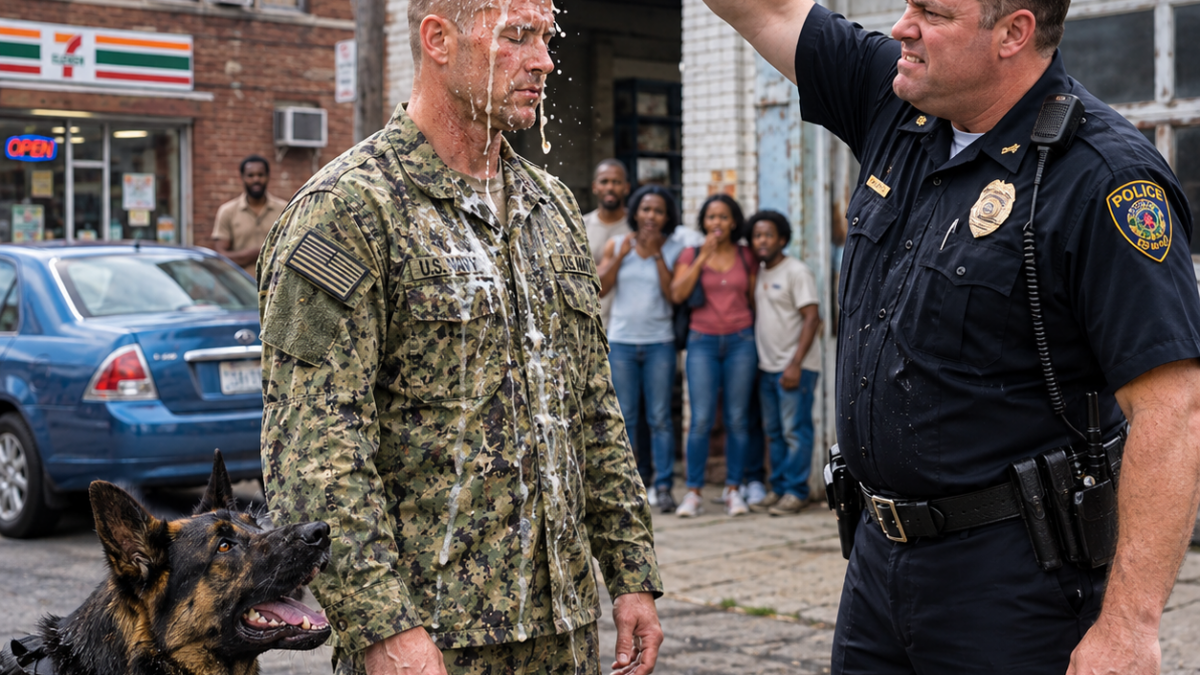
A Corrupt Cop Poured Beer on a Navy SEAL and Mocked His K9—Then the Shootout Began and the Man He Humiliated Saved His Life.
Officer Thomas Miller poured a bottle of beer over Bruce’s head in front of half the block, called the former Navy SEAL a coward, and threatened to shoot his German Shepherd when Bruce refused to give him the violent reaction he wanted.
Less than twenty-four hours later, automatic gunfire turned their Detroit street into a war zone, Miller abandoned frightened civilians and ran into a condemned apartment building—only to discover that the quiet mechanic he had humiliated was the one man capable of getting them out alive.
But while Bruce crawled through smoke and gunfire to save the corrupt officer anyway, his adopted daughter Elise uncovered the reason Miller had been protecting the gangs for months: offshore payments, smuggled military-grade weapons, and recorded deals that would bring federal agents down on the neighborhood before the shooting stopped.
The first thing Bruce heard every morning was the garage door.
Metal rollers.
Chain.
A heavy mechanical rattle that lasted just under seven seconds.
Then Detroit appeared.
Gray sky.
Cracked pavement.
Boarded windows.
The grocery store across the street.
Mr. Henderson sweeping his sidewalk before anyone else was awake.
And the smell of oil, dust, wet concrete, and yesterday’s rain.
Bruce liked those sounds.
Machines were honest.
If a bearing failed, there was a reason.
If a brake line leaked, the fluid told you where.
If an engine knocked, something inside needed attention.
People were harder.
People could smile while lying.
Wear uniforms while behaving like criminals.
Carry badges while protecting the men everyone else feared.
Bruce had spent enough years around violence to know that.
That was why he fixed cars now.
He was forty-three, broad through the shoulders, with rough hands and a scar along the left side of his neck that disappeared beneath most shirts.
Most people around the neighborhood knew he had been Navy.
Some knew he had been a SEAL.
Bruce rarely spoke about either.
He did not hang photographs in the waiting area.
No framed medals.
No unit flags.
No challenge coins displayed beside the register.
He kept exactly one photograph inside a drawer.
Three men.
Dusty uniforms.
Bad haircuts.
A dog sitting in front.
Years earlier.
Another life.
That life stayed in the drawer.
PART2:
His current life consisted of an aging repair shop, an adopted daughter who believed every electrical system in the building was an insult to modern engineering, and a German Shepherd who considered himself management.
Bruce was underneath a blue sedan when the Shepherd nudged a socket tray toward him.
“Half-inch.”
The dog pushed again.
Bruce reached out without looking.
His fingers found the correct socket.
“Good.”
The Shepherd huffed.
Bruce smiled.
The side door opened.
“Morning, old man.”
Elise came in carrying two coffees and a textbook heavy enough to qualify as defensive equipment.
She was twenty.
Brown hair piled into a loose bun.
Large glasses.
Green hoodie.
Backpack hanging from one shoulder.
Bruce rolled out from beneath the car.
“You were awake at three.”
“I have a project.”
PART3:
“You always have a project.”
“I’m in college.”
“That seems like poor planning.”
She handed him coffee.
“Black. No sugar. Because apparently happiness is weakness.”
Bruce took it.
“Thank you.”
Elise crouched beside the dog.
“And good morning to the actual responsible adult.”
The German Shepherd leaned his entire weight into her.
Bruce stared.
“You know I pay for his food.”
“He knows who gives him cheese.”
“I told you not to.”
“You tell me lots of things.”
That was their routine.
It had taken years to build.
Bruce found Elise when she was seventeen and sleeping wherever someone would let her.
Sometimes a friend’s sofa.
Sometimes the back room of a twenty-four-hour laundromat.
Once inside a bus station.
She was brilliant.
Angry.
Suspicious of everyone.
She had a laptop held together with tape and knew more about networks than most grown engineers Bruce had met.
He gave her a place to sleep.
At first for one night.
Then a week.
Then long enough that the spare room became her room.
Nobody had formally planned on becoming family.
It simply happened.
Elise started leaving coffee by his toolbox.
Bruce started asking about grades.
She started referring to the Shepherd as “our dog.”
Bruce pretended not to notice.
Then one day a college acceptance letter arrived.
Elise screamed.
Bruce read it twice.
The Shepherd barked because everyone else was making noise.
That was family.
Small.
Improvised.
Real.
Bruce protected it fiercely.
Which was why, when the trouble started on their street, he did nothing at first.
He noticed the new graffiti.
The dark SUVs.
Young men standing too long on corners.
Teenagers walking home in groups.
Businesses closing earlier.
He watched.
Cataloged.
Avoided involvement.
He had spent his youth running toward problems.
Now he understood the cost of bringing one home.
That afternoon, three local teenagers walked back from the grocery store carrying plastic bags.
Bruce was adjusting a brake caliper.
The Shepherd raised his head.
Ears forward.
Low growl.
Bruce stopped.
A dark SUV turned the corner too fast.
Stopped sideways.
Four men got out.
Red bandanas.
Heavy jackets.
One teenager tried turning away.
A gang member grabbed him by the collar and shoved him against a brick wall.
Groceries hit the pavement.
Cans rolled.
Bread tore open.
Elise stood.
“Bruce.”
“I see.”
“Call the police.”
He looked toward the intersection.
“They’ll be gone.”
“That doesn’t mean we don’t call.”
She reached for her phone.
Bruce did not stop her.
He also did not step outside.
The Shepherd stood beside him.
Every muscle tense.
Bruce placed a hand on the dog’s neck.
“Stay.”
One gang member took a wallet.
Another grabbed cash.
A third kicked a grocery bag.
The teenagers were shoved down.
Then the SUV left.
Fast.
Gone before anyone in uniform appeared.
Elise looked at Bruce.
“You could have stopped them.”
Bruce stared at the street.
“Yes.”
“Then why didn’t you?”
He looked at her.
“Because stopping four idiots for sixty seconds might bring forty back tomorrow.”
She understood.
Didn’t like it.
Neither did he.
Twenty minutes later a police cruiser arrived.
Too late.
Officer Thomas Miller stepped out holding a half-empty bottle of beer.
That alone told Bruce almost everything he needed to know.
Miller was known on the block.
Late forties.
Large.
Red-faced.
Thick mustache.
A uniform worn like armor for an ego rather than responsibility.
Shop owners complained privately that he demanded favors.
Street gamblers paid him.
Drug crews knew when patrols were coming.
Small businesses avoided reporting theft because Miller might invent a violation while standing in their doorway.
No one had proven enough to remove him.
Everyone knew enough not to trust him.
Miller ignored the teenagers.
He walked directly toward Mr. Henderson.
The old man was sweeping debris outside his convenience store.
“Making a mess?”
Mr. Henderson looked up.
“Cleaning.”
Miller stepped on the neat pile of dirt.
Spread it across the sidewalk.
“Looks like illegal dumping.”
Mr. Henderson’s hands tightened around the broom.
“What?”
“Could be five hundred dollars.”
“Officer, please.”
Miller took a drink from the beer.
Bruce’s jaw tightened.
Elise whispered:
“He’s drinking.”
“I know.”
Miller kicked the broom from Mr. Henderson’s hands.
The wooden handle struck the curb.
“Pick it up.”
Mr. Henderson bent.
Miller smiled.
“No.”
The old man froze.
“Get on your knees.”
Bruce put down his wrench.
Elise looked at him.
“Bruce.”
“Stay inside.”
He walked out.
The Shepherd followed.
Not because Bruce called him.
Because that was where he belonged.
Bruce stopped between Miller and Mr. Henderson.
Hands visible.
Voice calm.
“He’s sweeping his sidewalk.”
Miller turned.
“Who asked you?”
“No one.”
“Then go back to your garage.”
“Let him work.”
Miller looked Bruce up and down.
Grease-stained shirt.
Faded jeans.
Scar.
Dog.
A few neighbors had come outside.
That changed Miller.
Bullies become more theatrical when they have an audience.
He stepped close enough Bruce could smell stale beer.
“You think you’re some kind of hero?”
“No.”
“I know about you.”
Bruce said nothing.
“Washed-up military guy.”
Still nothing.
“Playing mechanic.”
Nothing.
Miller smiled.
“You wore a uniform once, so now you think you can tell me how to wear mine?”
Bruce’s voice remained even.
“I think an old man should be allowed to sweep his sidewalk.”
That answer made Miller angrier than an insult would have.
Because Bruce would not accept the frame.
Would not compete.
Would not perform.
Miller lifted the bottle.
“You want peace?”
Bruce looked at him.
“Yes.”
“Then learn your place.”
He poured the beer over Bruce’s head.
Cold liquid ran down his hair.
Across his face.
Into his collar.
The entire street went silent.
Elise stepped toward the garage opening.
The Shepherd lunged.
A sharp bark.
Teeth exposed.
Bruce snapped his fingers.
“No.”
The dog stopped instantly.
Still growling.
Miller flinched.
Then recovered.
“Keep that thing on a leash or I’ll shoot it.”
Bruce wiped beer from his eyes.
His hands were clenched.
Every instinct he had spent years mastering came alive.
Distance.
Balance.
Miller’s weight distribution.
Service pistol position.
Open angle near the cruiser.
Three ways to put him on the ground before anyone understood what happened.
Bruce did none of them.
Because Elise was watching.
Because Mr. Henderson was seventy-eight.
Because striking a police officer would give Miller exactly what he wanted.
A reason.
A report.
A cage.
A closed garage.
Elise alone.
So Bruce stood there.
Miller laughed.
“That’s what I thought.”
He leaned closer.
“Coward.”
Then walked back to his cruiser.
Bruce watched him leave.
Mr. Henderson picked up the broom.
“You didn’t have to do that.”
Bruce looked at him.
“Yes.”
“Why didn’t you hit him?”
Bruce stared down the empty street.
“Because I could.”
Mr. Henderson did not understand immediately.
Elise did.
Back inside, she handed Bruce a towel.
Her hands trembled.
“Are you okay?”
“It’s beer.”
“He humiliated you.”
“It washes off.”
“He threatened the dog.”
The Shepherd paced near the entrance.
“He’s still here.”
Elise stared at Bruce.
“You always do that.”
“Do what?”
“Act like nothing hurts you.”
Bruce looked down at the towel.
“That’s not what I’m doing.”
“It is.”
“No.”
“Then what?”
“Choosing what deserves a reaction.”
He turned back toward the blue sedan.
Elise sat at her desk.
She opened her laptop.
Bruce assumed she returned to homework.
She did not.
The source story described Elise as having a dangerous technical past and secretly breaking into police systems. In this retelling, what mattered was not a step-by-step intrusion but what she discovered after using the digital skills she had promised Bruce she would leave behind.
Miller’s public records were already suspicious.
Complaint patterns.
Repeated disciplinary rumors.
Associations with businesses tied to gang figures.
Elise followed the trail much farther than she should have.
By evening she had assembled material suggesting Miller’s corruption went far beyond petty bribes.
Large hidden payments.
Connections to shell companies.
Shipment records associated with illegal weapons.
Then a recording.
Miller’s voice.
Confident.
Relaxed.
Telling someone patrol units would be rerouted.
The other voice talked about a shipment arriving that night.
Weapons.
Red Serpents.
Payment.
Elise stopped the audio.
Her hands were cold.
She stared toward Bruce.
He was underneath another car.
The Shepherd beside him.
Quiet life.
Everything he wanted.
And she had just discovered proof that one corrupt officer had been helping flood their neighborhood with weapons capable of turning a gang fight into a battlefield.
She copied the evidence onto an encrypted drive.
Not because she had a complete plan.
Because she was afraid the files would disappear.
Then she hid the drive beneath her hoodie.
Bruce looked up.
“You okay?”
“Yes.”
“You’re pale.”
“Database project.”
“Databases shouldn’t scare you.”
“This one does.”
He studied her.
She smiled too quickly.
Bruce knew she was lying.
He chose not to push.
That was his mistake.
The next morning, Detroit felt wrong.
Too still.
Heat hung over the street.
Mr. Henderson arranged fruit outside his shop.
A delivery van unloaded bread.
The Shepherd paced.
Elise had not slept.
Bruce noticed.
“Coffee?”
“No.”
That got his attention.
“You’re sick.”
“I’m fine.”
“You refused coffee.”
“I’m evolving.”
“No one evolves that fast.”
She almost told him.
Then saw Miller.
He stood beside his cruiser half a block down.
Talking to a street vendor.
The vendor slipped him an envelope.
Miller pocketed it.
Then laughed.
A second later, three black SUVs came screaming around the corner.
The Shepherd barked.
Bruce turned.
Doors opened before the vehicles stopped.
Men in red bandanas stepped out carrying rifles.
At the opposite end of the street, another group emerged from an alley.
Iron Kings.
Rival gang.
Also armed.
Elise recognized the weapons immediately.
The same type listed in the records she had found.
“Bruce.”
The first gunshot cracked through the block.
Then everything broke.
Automatic fire.
Glass exploding.
Cars struck.
Brick dust.
People screaming.
A hydrant burst after a round struck metal, throwing water into the street.
The grocery sign dropped.
A bicycle disappeared beneath it.
Bruce grabbed Elise.
“Back room.”
“No.”
“Elise.”
“They’re using the weapons—”
“Back room.”
“Bruce, listen—”
He pushed her toward the reinforced storage room.
“Lock it.”
“You can’t go out there.”
“There are people outside.”
“You don’t have gear.”
“Lock the door.”
The Shepherd moved beside Bruce.
Elise grabbed his arm.
“Please.”
Bruce looked at her.
Everything hardened except his eyes.
“I need you safe.”
She swallowed.
Then went in.
The heavy door locked.
Bruce turned.
The street looked nothing like Detroit anymore.
It looked familiar.
Too familiar.
Smoke.
Controlled bursts.
People moving between vehicles.
Screaming.
The kind of sound that makes time split into useful pieces.
Miller was the first police officer present.
And he did exactly nothing.
He crouched behind a trash container.
Dropped his radio.
Looked around.
Then ran.
Not toward civilians.
Away from the gunfire.
Mr. Henderson and two young women were caught between parked cars.
Miller shoved past them.
Knocked one woman down.
Then disappeared into an abandoned apartment building.
The civilians followed because the building was the only cover nearby.
Bruce saw them go in.
He saw several gang members shifting toward the same building.
Higher floors.
Good shooting position.
The Shepherd growled.
Bruce opened the locked cabinet in the garage.
He had no intention of becoming what he had been overseas again.
But intention has limits when civilians are trapped.
He took emergency equipment.
A heavy pry bar.
A flare launcher.
A knife he had kept from service.
Nothing that made him invincible.
Nothing that made the situation sensible.
Then he looked at the Shepherd.
“Heel.”
The dog came close.
Bruce moved.
Not charging into the street.
Waiting.
Watching.
Using smoke and abandoned vehicles as cover.
He crossed only when the firing shifted away.
The German Shepherd stayed glued to him.
They reached the apartment building.
Inside, the sound changed.
Distant.
Muffled.
More dangerous because direction became difficult to judge.
Bruce heard footsteps.
Voices.
Gang members had already entered.
He moved carefully.
His goal was not to hunt anyone.
It was to reach the civilians.
Two armed men appeared near the lower hall.
The encounter was fast.
Confused.
Close.
Bruce used surprise, the building’s broken interior, and the Shepherd’s training to get past them without turning the scene into a prolonged fight.
One man lost control of his rifle.
Bruce secured it.
That changed the balance.
He hated that it changed the balance.
He had spent years trying not to hold a weapon like that again.
Now he checked it automatically.
The body remembers what the mind tries to leave behind.
Upstairs, he heard someone crying.
Then Miller’s voice.
Breathing too fast.
Panicked.
Bruce reached the room.
Mr. Henderson was on the floor.
Two young women huddled beside a concrete interior wall.
Miller stood in the center holding his pistol with shaking hands.
He swung toward Bruce.
“Put that down.”
Miller stared.
It took him a second.
Then recognition hit.
The mechanic.
Beer.
Dog.
Yesterday.
Now holding the rifle Miller had been too terrified to face.
“You.”
Bruce looked at his pistol.
“Point that at the floor before you shoot one of them.”
Miller’s mouth opened.
Then closed.
Footsteps sounded in the hallway.
More gang members.
Bruce gave Miller a direct order.
“Move them behind that wall.”
Miller did not move.
Bruce stepped closer.
“Now.”
This time Miller obeyed.
Mr. Henderson looked at Bruce.
“I knew you’d come.”
Bruce didn’t answer.
He moved furniture.
Created whatever protection the ruined room could offer.
The Shepherd crouched beside him.
The gunfire outside grew louder.
Then men came down the hall.
Bruce had spent years being trained for situations people should never see.
He knew the difference between aggression and defense.
Between shooting because you can and shooting because someone is about to kill the people behind you.
The line mattered.
He held it.
The first assault on the room ended quickly.
The second lasted longer.
Walls splintered.
Plaster dust filled the air.
The Shepherd stopped one gunman trying to enter from the side.
Bruce dragged the dog back before he could be hurt.
Miller stayed behind the wall with the civilians.
For once, he followed instructions.
Then the shooting stopped.
Too suddenly.
Bruce knew silence like that.
Something had changed.
A metallic sound bounced in the hallway.
Small.
Heavy.
Rolling.
Bruce saw the grenade.
Everything inside him moved before thought caught up.
“Down!”
The grenade rolled toward the civilians.
Miller froze.
Bruce did not.
He kicked it back toward the hall.
Then threw himself between the doorway and the people behind him.
The blast came almost instantly.
Light.
Pressure.
Noise.
The room vanished.
Bruce hit the floor.
For several seconds, sound became a high ringing tone.
The Shepherd crawled toward him.
Bruce could not feel his left arm properly.
Warm blood ran down his shoulder.
He forced his eyes open.
Mr. Henderson moved.
Alive.
Both women alive.
Miller alive.
The Shepherd pressed his muzzle against Bruce’s cheek.
Bruce managed:
“Good boy.”
Miller stared.
His face looked empty.
Yesterday this man had poured beer on Bruce because he wanted to prove he could humiliate him publicly.
Now Bruce had put his body between Miller and an explosion.
Miller looked at the blood.
“Why?”
Bruce barely heard him.
“What?”
“Why did you…”
Bruce understood.
He pushed himself against the wall.
“Because they were behind me.”
Miller stared.
“That’s it?”
Bruce looked at Mr. Henderson.
The women.
Then Miller.
“You were too.”
The answer crushed him more than anger would have.
Back at the garage, Elise sat locked in darkness.
A bullet had taken out power to the block.
The laptop ran on battery.
She had heard the explosion.
For several seconds she thought Bruce was dead.
She covered her mouth.
Cried once.
Then forced herself back to the screen.
The evidence around her neck mattered now.
Miller’s accounts.
Weapons shipments.
Recorded conversations.
The gangs outside were fighting with the exact weapons connected to those records.
She could not trust simply handing it to the local precinct.
Miller’s influence was too deep.
So she did what she knew how to do.
She packaged the evidence and transmitted it through a secure reporting route meant to get the material beyond the people Miller could control.
The connection was poor.
Power gone.
Signal weak.
The upload stalled repeatedly.
Elise held her phone near the only place where reception was usable and watched the progress crawl forward.
Outside, automatic fire echoed.
Her arm went numb.
She refused to lower it.
She thought of Bruce.
Seventeen.
Cold.
No home.
Bruce had opened a door.
Given her a bed.
Never asked what she could repay.
When she woke from nightmares, he never forced questions.
When she got accepted to college, he pretended his eyes were watering because of brake cleaner.
Now he was somewhere outside risking his life for people who could never repay him either.
The progress bar reached one hundred.
Transmission complete.
Elise collapsed onto the floor.
She had no idea whether anyone would respond in time.
Then the street changed.
Sirens.
More than one.
More than local patrol.
Helicopter rotors.
Armored vehicles.
Commands over loudspeakers.
Federal and regional tactical teams arrived as the gang fight began collapsing.
The Red Serpents and Iron Kings had expected a neighborhood where police response was delayed and compromised.
They had not expected that much force.
Weapons hit the pavement.
Hands went up.
Some ran.
Most did not get far.
Inside the apartment, Bruce heard the response.
Miller heard it too.
And something ugly returned to his face.
Relief became arrogance.
He straightened his uniform.
Holstered his pistol.
Looked at Bruce bleeding against the wall.
“My backup.”
Bruce stared at him.
Miller stood.
“Stay here.”
Bruce almost laughed.
Miller walked downstairs.
Out into the flashing lights.
He raised his badge.
“Officer Miller. Detroit Police.”
A federal agent approached.
“Thomas Miller?”
Miller nodded.
“Who’s in charge?”
The agent’s expression did not change.
“Turn around.”
Miller blinked.
“What?”
“Hands behind your back.”
“I’m police.”
“Yes.”
Two agents stepped in.
Miller’s face drained.
“There’s been a mistake.”
The lead agent identified the corruption investigation and the evidence that had just been received.
Financial transfers.
Communications.
Weapons links.
Recorded cooperation with the Red Serpents.
Miller stopped speaking.
For once, the badge on his chest could not create authority.
Because the people in front of him already knew what it had been used to hide.
They cuffed him.
Mr. Henderson reached the stairwell in time to see it.
One of the young women helped him.
He watched Miller being led away.
Then looked back inside.
“Bruce.”
No answer.
“Bruce!”
Paramedics entered.
The Shepherd refused to leave Bruce.
One medic tried coaxing him aside.
The dog growled.
Bruce lifted his good hand.
“It’s okay.”
The Shepherd backed off enough.
The medics worked.
Shrapnel wounds.
Blood loss.
Concussion.
Shoulder injury.
Pain.
Nothing cinematic about that part.
Heroism looks much less impressive when someone is cutting away your shirt while you’re trying not to vomit.
Bruce was placed on a stretcher.
As they carried him outside, Elise broke through the barricade.
“Bruce!”
She reached him.
Stopped herself before touching the injured shoulder.
Then wrapped her arms around his good side.
“I sent it.”
Bruce looked at her.
“What?”
“The files.”
He was dazed.
“What files?”
She began crying.
“Miller.”
That cleared his head slightly.
“What did you do?”
“Later.”
“Elise.”
“I found everything.”
Bruce closed his eyes.
Of course she had.
He should have known.
She held up the flash drive.
“Payments. Weapons. Calls.”
Bruce opened his eyes again.
“You went back into that world.”
She looked down.
“Yes.”
He wanted to be angry.
He was.
Also proud.
Also terrified.
None of those feelings fit cleanly together.
The Shepherd pushed against the stretcher.
Bruce reached down.
“Good boy.”
Elise touched the dog’s neck.
“He wouldn’t leave you.”
“Neither would you.”
She looked at him.
“No.”
The ambulance doors closed.
The neighborhood remained filled with federal vehicles until after dark.
Weapons recovered.
Gang members arrested.
Witnesses interviewed.
Businesses searched under proper authority.
Miller’s cruiser was impounded as evidence.
The corruption case expanded.
The shootout had not created Miller’s crimes.
It exposed how dangerous they had already become.
He had rerouted patrols.
Protected shipments.
Taken money.
Used fear to dominate people who had no reason to trust the system he represented.
The beer incident became almost trivial by comparison.
Almost.
For Bruce, it still mattered.
Because Miller had not poured beer over him because he was drunk.
He had done it because he wanted submission.
The neighborhood had watched.
If Bruce hit him, Miller won.
If Bruce begged, Miller won.
If the Shepherd attacked, Miller won.
Bruce had chosen a fourth option.
Stand there.
Take it.
Go home.
People called that weakness for about twenty-four hours.
Then they watched Miller come out of a condemned building alive because the “coward” had saved him.
The hospital kept Bruce for several days.
Elise spent most of that time pretending she was not worried.
She brought schoolwork.
Coffee.
Chargers.
The Shepherd was not allowed on the ward initially.
That became the first major conflict of Bruce’s recovery.
Elise argued.
Bruce argued less because pain medication had made him philosophical.
Finally an arrangement was made for a visit in an appropriate area.
The German Shepherd entered.
Saw Bruce.
Stopped.
Then walked carefully toward him.
No jumping.
No barking.
He rested his head beside Bruce’s uninjured hand.
Bruce scratched behind his ear.
“You scared me.”
The dog closed his eyes.
Elise stood nearby.
“You scared him.”
Bruce looked at her.
“You scared me.”
She knew immediately what he meant.
The files.
The old habits.
The risky digital world she had promised to leave.
“I know.”
“You could have gotten hurt.”
“You went into a shootout with a crowbar.”
“That’s different.”
“How?”
Bruce opened his mouth.
Closed it.
Elise crossed her arms.
“Exactly.”
He hated when she did that.
She sat.
“I’m sorry.”
Bruce looked at her.
“For?”
“Lying.”
“Yes.”
“For going too far.”
“Yes.”
“For finding the evidence?”
Bruce thought.
“No.”
She looked surprised.
“You did good.”
Then:
“But next time we use lawful reporting channels before you become a one-woman intelligence agency.”
“Deal.”
“You’re not allowed to smile.”
“I’m not.”
“You are.”
She smiled wider.
Bruce shook his head.
The Shepherd sighed.
The story reached the news quickly.
Former Navy SEAL saves civilians.
Corrupt officer arrested.
Gang weapons seizure.
Federal corruption investigation.
Bruce hated every headline.
Especially the ones calling him “deadly.”
He had not gone into the building to prove he could kill anyone.
He had gone because Mr. Henderson and two women were trapped.
Miller happened to be there.
One reporter asked:
“Did you hesitate before saving Officer Miller?”
Bruce looked at him.
“No.”
“Even after what he did to you?”
“Yes.”
“Why?”
Bruce thought about the blast.
The people behind him.
The answer stayed simple.
“He was in the room.”
The reporter waited for more.
Bruce gave none.
Another asked:
“Do you forgive him?”
“That’s different.”
“Different from saving him?”
“Yes.”
That became one of the more important distinctions.
Saving a life does not erase accountability.
Bruce could protect Miller from bullets and still testify about the humiliation.
Could put his body between Miller and a grenade while also supporting prosecution for corruption.
Mercy and consequences were not opposites.
Elise understood that before many adults did.
Miller’s federal case took months.
Financial records.
Witnesses.
Digital evidence.
Gang testimony.
Weapon shipments.
Communications.
The recording Elise found became part of a much larger evidentiary picture.
Prosecutors did not rely on one dramatic file.
They corroborated.
That mattered.
A story may pivot on one discovery.
A real case requires more.
Several Red Serpents members cooperated.
Business owners finally came forward about bribes.
Street gamblers provided payment records.
A vendor described Miller taking weekly cash.
Other officers testified about patrol changes that never made sense.
Piece by piece, the image of a corrupt bully became a documented system of protection and payment.
The neighborhood was furious.
Some wanted to condemn the entire department.
Bruce did not.
“Corrupt officer isn’t every officer.”
Mr. Henderson asked:
“How do we know?”
“We don’t.”
“That’s comforting.”
Bruce smiled slightly.
“No.”
Then:
“You build trust by checking.”
That was what Elise had done.
What federal investigators did.
What internal investigators eventually did.
The precinct came under intense review.
Supervision changed.
Officers connected to Miller were investigated.
Some cleared.
Some disciplined.
Not everyone became guilty because Miller was.
Bruce insisted on that.
Specific responsibility.
Same principle he had lived by overseas.
Do not confuse the uniform with the person wearing it.
That lesson ran both ways.
Miller wore a badge and betrayed it.
Other officers wore one and helped dismantle what he built.
Bruce had worn a uniform once too.
That had not made him automatically good.
Actions did.
One afternoon after Bruce returned to the garage, Mr. Henderson walked over carrying a new broom.
Bruce was sitting outside.
His shoulder still stiff.
The Shepherd asleep beside him.
Mr. Henderson set down a six-pack of soda.
Bruce looked.
“Beer would’ve been funnier.”
The old man stared.
Then laughed.
“Too soon?”
“Probably.”
He sat.
“You know what everybody says?”
“I try not to.”
“They say you could’ve killed Miller yesterday.”
Bruce looked at him.
“The day he poured beer?”
“Yes.”
“Probably.”
“Why didn’t you?”
“Elise.”
“What about her?”
“She needed me to come home.”
Mr. Henderson nodded slowly.
“That’s it?”
“That’s enough.”
The old man looked across the street.
For years, survival had meant keeping your head down.
Miller exploited that.
The gangs exploited it.
Bruce had spent his career being trained to confront danger.
Yet his most difficult act may have been standing still while Miller poured beer over him.
Restraint was invisible strength.
People understood that now.
Elise returned to college.
The hacking incident became an uncomfortable conversation.
She was intelligent enough to know that finding wrongdoing did not automatically make every method acceptable.
Bruce pushed her toward legitimate cybersecurity work.
“Use it where people pay you to break things.”
“That exists?”
“Yes.”
“That’s literally my dream.”
“Good.”
She changed focus.
Security testing.
Digital forensics.
Incident response.
The skills that once kept her alive became a career.
Not overnight.
Not because one dramatic day fixed everything.
She still carried habits from the years before Bruce found her.
Trust issues.
A tendency to work alone.
The belief that asking permission was something people with safe lives invented.
Bruce challenged that.
She challenged him too.
He believed protecting someone sometimes meant withholding things.
She hated that.
“You don’t get to decide what I can handle.”
“I decide what danger comes through my door.”
“Our door.”
Bruce paused.
“Fine.”
“Our door.”
That mattered.
The Shepherd recovered fastest.
He had only minor injuries.
Within weeks he was back pushing socket trays across the garage.
One morning, Bruce said:
“Half-inch.”
The dog nudged the correct tray.
Elise looked up from her laptop.
“You know this is why he thinks he works here.”
“He does work here.”
“Payroll?”
“Food.”
“Benefits?”
“Cheese.”
Bruce looked at her.
“You’re still giving him cheese?”
“No.”
The Shepherd stared at her pocket.
Bruce sighed.
The neighborhood changed slowly.
Not magically.
The Red Serpents did not vanish because of one raid.
The Iron Kings did not become peaceful.
Poverty remained.
Buildings remained broken.
But a major weapons route had been disrupted.
Miller’s protection network was gone.
Patrols became less predictable to gangs because they were being managed by people not on the payroll.
Businesses began reporting crimes again.
Mr. Henderson stopped hiding cash beneath his freezer because he trusted the bank route more.
Parents let teenagers walk farther.
Not everywhere.
Farther.
Small changes.
The garage became a strange gathering point.
People brought cars.
Then coffee.
Then stories.
Bruce hated the stories at first.
“You saved my niece.”
“You saved Henderson.”
“You saved that cop.”
He corrected everyone.
“I got people out.”
Same thing.
Not to them.
A neighborhood that had watched men with guns define power now had another example.
Someone strong enough to hurt people choosing not to unless there was no other way to protect someone.
That mattered.
One teenage boy came in months later.
Same one from the grocery robbery.
He stood near the workbench.
“Mr. Bruce?”
“Bruce.”
“Can you teach me cars?”
“Why?”
“I need a job.”
“You know tools?”
“No.”
“Show up Saturday.”
The boy did.
Then every Saturday.
His first job was sweeping.
He hated it.
Mr. Henderson walked in one afternoon.
Saw him.
“Careful. Sweeping is illegal around here.”
The boy did not understand.
Bruce laughed for almost a minute.
That was another sign of healing.
The beer humiliation became joke only after Miller no longer had power.
Before that it had been danger.
Timing matters.
Bruce kept no resentment toward Mr. Henderson for watching.
Or the neighbors.
Nobody intervened because Miller wore a gun and a badge.
Bruce understood fear.
He had felt it too.
Not fear of Miller physically.
Fear of losing what he had built.
Garage.
Elise.
Dog.
Peace.
Courage does not mean lacking something to lose.
Often it exists because you know exactly what you might lose and choose anyway.
Miller eventually entered a guilty plea on major corruption-related charges after evidence accumulated.
Additional defendants faced their own proceedings.
Some gang members were convicted.
Others negotiated.
The weapons network expanded beyond Detroit.
Investigators followed money through shell companies.
Bruce stayed out of those details unless asked to testify.
He had no desire to become part-time vigilante or celebrity witness.
When court summoned him, he went.
When not, he fixed cars.
Elise asked once:
“You really don’t want to know what sentence he gets?”
“I’ll hear.”
“What if it’s not enough?”
“Enough for who?”
She thought.
Bruce continued.
“I don’t need the judge to fix how he made me feel.”
That surprised her.
“What does?”
Bruce looked around the garage.
“You being here.”
The Shepherd.
The open door.
Mr. Henderson sweeping outside without anyone kicking his broom.
“This.”
Elise looked down.
Sometimes Bruce said something so simple she had no defense against it.
Miller’s apology came indirectly.
A letter through his attorney.
Bruce almost threw it away.
Elise asked:
“Read it?”
“No.”
“Why?”
“Doesn’t change anything.”
“That’s not why people apologize.”
“Sometimes it is.”
She picked up the envelope.
“Want me to read?”
“No.”
“Then what?”
Bruce thought.
“Put it in drawer.”
Months later he opened it.
Miller wrote that seeing Bruce take the blast had forced him to confront the kind of man he had become.
He admitted humiliation.
Bribes.
Fear.
Cowardice.
Not every crime.
Lawyers rarely allow poetry.
But enough.
Bruce finished.
Folded it.
Put it back.
Elise asked:
“Forgive him?”
Bruce stared at the drawer.
“I don’t know.”
“That’s honest.”
“Yes.”
“Do you have to?”
“No.”
That was freeing.
Mercy does not require pretending injury never happened.
Bruce had saved Miller because he was there.
Forgiveness was another question.
It could take longer.
Or never arrive.
Either way, Miller still had consequences.
One year after the shootout, Mr. Henderson organized a block barbecue.
Bruce tried refusing.
Elise volunteered the garage parking lot.
“You volunteered my property?”
“Our property.”
“We had this conversation.”
“Exactly.”
So the garage closed early Saturday.
Tables.
Food.
Music.
Kids.
The Shepherd wore a red bandana somebody tied around his neck.
Bruce hated it.
The dog looked magnificent.
Elise hung a small sign beside the toolbox:
NO BEER NEAR BRUCE
He removed it.
She put it back.
Mr. Henderson gave a speech.
Bruce stood immediately.
“No.”
“You haven’t heard it.”
“No speeches.”
“Too bad.”
The old man climbed onto a chair.
“I just want to say—”
Bruce covered his face.
People laughed.
Mr. Henderson continued.
“Some of us thought being strong meant being the loudest person on the street.”
He looked around.
“We were wrong.”
Bruce lowered his hands.
Mr. Henderson looked at him.
“Strong is being able to hurt somebody and choosing not to.”
Then:
“And when the time comes, being willing to get hurt for people who didn’t deserve it.”
Bruce’s expression changed.
Mr. Henderson pointed.
“Even Miller.”
Someone muttered:
“He definitely didn’t deserve it.”
Laughter.
Bruce smiled.
Mr. Henderson raised his soda.
“To Bruce.”
People raised cups.
Elise leaned toward Bruce.
“You hate this.”
“Deeply.”
“You’re crying.”
“Smoke.”
“No smoke.”
“Grill.”
She smiled.
The Shepherd leaned against Bruce.
He scratched his neck.
That evening, after everyone left, Bruce and Elise sat outside.
Detroit sunset turned the broken windows across the street orange.
Elise asked:
“Do you miss it?”
“What?”
“Being a SEAL.”
Bruce thought.
“Parts.”
“The action?”
“No.”
“What parts?”
“The people.”
“Purpose?”
“Sometimes.”
She looked at the Shepherd.
“You had purpose that day.”
Bruce nodded.
“I had people.”
“That’s different?”
“Yes.”
He looked at her.
“Purpose is dangerous when you start needing danger to feel useful.”
Elise stayed quiet.
Bruce had known men like that.
People who came home and could not live without conflict because conflict had once made everything clear.
He refused to become one.
That was why the garage mattered.
A brake job could be enough.
A cup of coffee.
Teaching a teenager to replace a battery.
Walking the Shepherd.
Getting Elise to class.
Ordinary life was not what came after heroism.
Ordinary life was the thing heroism was supposed to protect.
The Shepherd grew older.
His muzzle turned gray.
He stopped jumping into the truck without help.
Bruce built a small ramp.
Elise mocked the engineering.
“This angle is terrible.”
“He uses it.”
“He deserves aerospace standards.”
“He’s a dog.”
The Shepherd looked offended.
Elise crouched.
“Don’t listen to him.”
Bruce smiled.
Years passed.
Elise graduated.
Bruce wore a clean shirt.
She insisted.
Mr. Henderson attended.
The Shepherd wore another bandana.
This time blue.
When Elise’s name was called, Bruce stood before anyone else.
Clapped once.
Then kept clapping.
Elise found him afterward.
“You made a scene.”
“You survived.”
“That’s your excuse for everything.”
“Good excuse.”
She hugged him.
“You saved me, you know.”
Bruce looked at her.
“No.”
“You did.”
“I opened a door.”
“That was saving.”
He shook his head.
“You walked through.”
The Shepherd pressed between them.
Elise laughed.
“And he stole credit.”
“Always.”
She found work in cybersecurity.
Legitimate.
Boring enough to be safe most days.
Interesting enough to make her happy.
She sometimes investigated fraud.
Sometimes helped companies find intrusions before criminals did.
Bruce liked that.
Her gift had direction.
Rules.
Permission.
She complained about paperwork.
Bruce said:
“Paperwork keeps smart people from becoming stupid people with access.”
She hated that line.
Then started repeating it.
Bruce’s shoulder never became completely normal.
Cold mornings hurt.
He could not lift quite the same way.
He adapted.
Used tools differently.
Asked for help more often.
That last part was hardest.
One afternoon the teenage apprentice—now a young mechanic—saw Bruce struggling with a transmission part.
“I got it.”
Bruce started:
“I can—”
The young man raised an eyebrow.
Bruce stopped.
“Fine.”
He handed it over.
Growth.
Mr. Henderson died several years later.
Quietly.
His store closed for three days.
The funeral filled.
Bruce sat near the back.
Elise beside him.
The Shepherd no longer with them by then.
That loss had been its own kind of silence.
Bruce kept the collar in the same drawer as the old team photograph.
After the funeral, Mr. Henderson’s granddaughter reopened the store.
First morning, Bruce walked past.
She was sweeping.
He stopped.
She looked up.
“What?”
“Nothing.”
He smiled.
“Just be careful.”
“Why?”
“Long story.”
She laughed.
The block had changed enough that the story sounded unbelievable.
That was good.
No corrupt officer stepping on the dirt.
No gunfire.
No gang SUV.
Just a broom.
That was what success looked like.
One night Elise visited the garage after work.
Bruce was older.
More gray.
Still working.
She found him sitting at the desk.
The old beer incident had become one of those stories people online repeated incorrectly.
Some versions said Miller hit Bruce.
He hadn’t.
Others said Bruce threatened him.
He hadn’t.
Some said the Shepherd attacked him.
He didn’t.
Some said Bruce left Miller to die for several minutes before changing his mind.
Never happened.
Elise read one version aloud.
“‘The SEAL smiled and said, Now you’ll learn what fear is.’”
Bruce stared.
“I said that?”
“Apparently.”
“That’s terrible.”
“It gets worse.”
“Stop.”
She laughed.
Bruce shook his head.
“People need everything to be revenge.”
“It’s satisfying.”
“Not really.”
“Why?”
“Because if I went into that building to get even with Miller, I wouldn’t have gone in.”
Elise stopped smiling.
Bruce continued.
“The whole point is I didn’t choose who deserved saving.”
She nodded slowly.
“That’s the story.”
“Yes.”
She closed the article.
“Less catchy.”
“I’m okay with that.”
But it was not less powerful.
The day before the shootout, Miller had believed power meant humiliation.
He had a badge.
A gun.
An audience.
Bruce had grease on his shirt and beer running down his face.
Miller thought that made him superior.
Then gunfire started.
All the symbols changed.
The badge did not give Miller courage.
The uniform did not make him useful.
The mechanic’s shirt did not make Bruce weak.
The dog everyone thought was just a pet became disciplined under gunfire.
The student everyone thought was just a quiet girl in glasses became the person who pushed evidence outside Miller’s reach.
And the man Miller called a coward became the wall between him and death.
There was no poetic justice in the grenade.
Bruce did not enjoy being wounded.
Miller did not deserve to die.
That was exactly why the moment mattered.
True strength does not wait until the person behind you has earned protection.
It protects because that is what strength is for.
Bruce never forgot the beer.
He also never built his life around it.
Years later, when someone at the garage asked if the story was true, he usually answered:
“Which part?”
“The cop.”
“Yes.”
“He really poured beer on you?”
“Yes.”
“And threatened your dog?”
“Yes.”
“And the next day you saved him?”
Bruce would pause.
Then:
“There were civilians.”
“But you saved him too.”
“He was there.”
People always wanted something larger.
A speech.
A lesson.
Bruce rarely gave one.
Elise did.
If she happened to be nearby, she would say:
“That’s why Miller lost before anybody arrested him.”
The customer would look confused.
Elise would point toward Bruce.
“He wanted proof that kindness was weakness.”
Then she would smile.
“Wrong mechanic.”
Bruce hated when she said it.
Mostly because he could not argue.
One evening, long after the shooting had faded from the news, Bruce closed the garage.
Same seven-second metal rattle.
Same street.
Better windows now.
Fresh paint on Mr. Henderson’s old store.
No boarded apartment building—it had finally been demolished.
Elise pulled up in her car.
Newer than anything Bruce would have bought.
She got out carrying coffee.
“You still drink this garbage?”
“Yes.”
She handed it over.
“Black. No sugar. Because happiness is weakness.”
Bruce smiled.
“You’re repetitive.”
“You raised me.”
They sat outside.
No Shepherd beside them now.
Only the old collar looped around the handle of Bruce’s toolbox inside.
Elise looked toward the corner where Miller had once stood.
“You ever wish you hit him?”
Bruce took a sip.
“Sometimes.”
She laughed.
“Finally.”
He looked at her.
“Want to know why I didn’t?”
“I know.”
“Say it.”
“Because you could.”
Bruce nodded.
“And because of me.”
“Yes.”
She leaned back.
“And why did you go into the building?”
Bruce looked down the street.
Because Mr. Henderson was inside.
Two women.
A cowardly cop.
Because training had given him abilities he hoped never to need again.
Because refusing violence when it was unnecessary did not mean refusing responsibility when people were about to die.
Because the strength to fight and the wisdom not to are supposed to belong to the same person.
He could have said all of that.
Instead:
“People needed help.”
Elise smiled.
“Still repetitive.”
Bruce looked at her.
“You asked.”
The city moved around them.
A bus.
Children on bicycles.
Someone arguing about parking.
Normal.
Beautifully normal.
Years earlier Bruce had believed quiet life meant getting far enough from war that war could no longer find him.
He had been wrong.
Violence can reach almost any street.
What mattered was what followed.
Would fear turn ordinary people cruel?
Would power become abuse?
Would humiliation become revenge?
Or could somebody who had every reason to hate the man beside him still choose to keep him alive?
Bruce never considered himself heroic for that.
He considered it a debt.
Not to Miller.
To the life he had fought to build.
To Elise.
To the Shepherd.
To Mr. Henderson.
To every ordinary morning when the garage door opened and nobody was shooting.
The day Miller poured beer over his head, Bruce walked back inside believing he had protected his family by doing nothing.
The next day, he protected them by doing everything he still knew how to do.
Those choices looked opposite.
They came from the same place.
Control.
Miller had a badge and no control.
Bruce had power and control.
That was the difference.
Miller eventually learned it in handcuffs.
Bruce had learned it years earlier in places he rarely talked about.
And Elise learned it watching him stand in the street with beer dripping from his face while his German Shepherd waited for a single word that never came.
That moment had looked like humiliation.
It was not.
It was restraint.
The shootout simply gave everyone else enough noise to finally understand the difference.








