A Cop Tore the Stars Off a Black Woman’s Uniform and Arrested Her for “Impersonating a General”—Nine Minutes Later, His Cruiser Radio Came Alive.
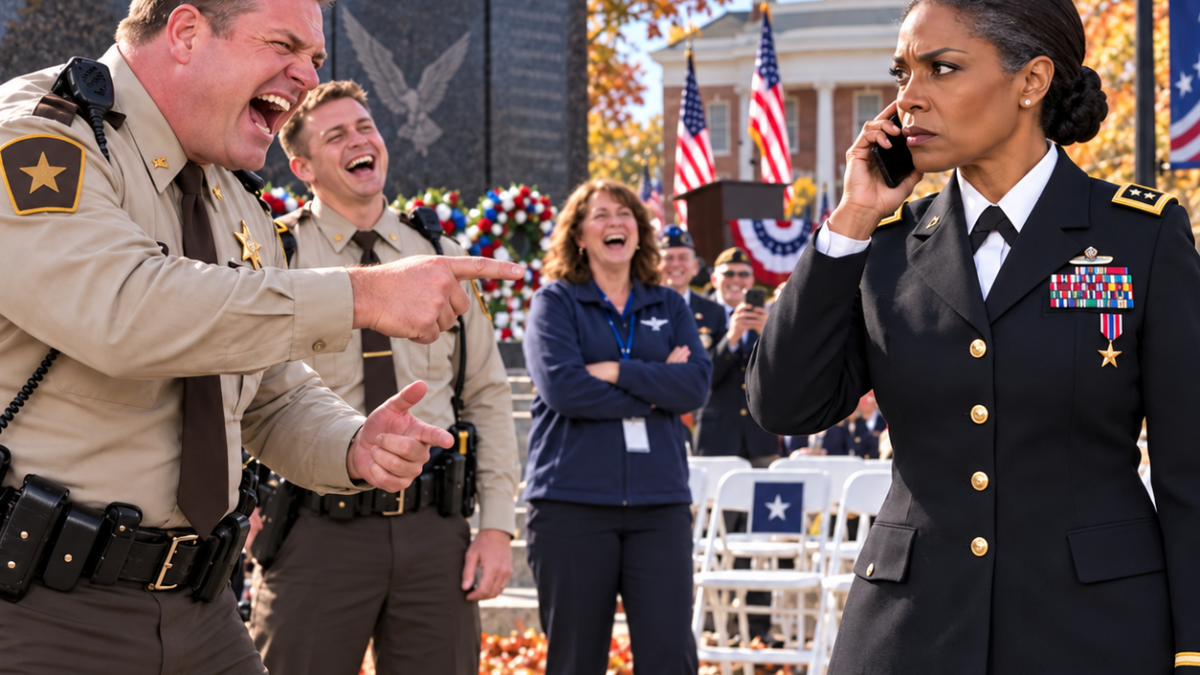
A Cop Tore the Stars Off a Black Woman’s Uniform and Arrested Her for “Impersonating a General”—Nine Minutes Later, His Cruiser Radio Came Alive.
He tore the silver stars from my shoulders like my rank was a costume.
He threw my Bronze Star into the dirt at a Veterans Day ceremony and told the crowd there was no way a Black woman like me could be a real general.
Then my Pentagon phone went dark, I missed my mandatory security check-in, and the call that came through his own cruiser radio ended his career before he even understood what he had done.
My name is Grace Monroe.
Major General Grace Elaine Monroe, United States Army.
For thirty years, I had worn the uniform through deserts, hearings, command rooms, combat zones, and places where silence could be more dangerous than gunfire. I had briefed presidents. I had commanded fifteen thousand soldiers. I had overseen a multibillion-dollar defense infrastructure project that kept bases running across three continents.
But on that November morning in Warrington, Virginia, none of that was what mattered to me.
I was there for my father.
Staff Sergeant Earl Monroe.
Twenty-Fifth Infantry Division.
Vietnam.
His name was carved into the Veterans Memorial Wall in front of the Fauquier County courthouse, cut into cold stone beneath an American flag that snapped sharply in the early morning wind.
I arrived at 8:45 a.m.
The ceremony was not scheduled to begin until ten, but I had come early every year for the same reason. Before the speeches, before the folding chairs filled, before the mayor shook my hand and the organizers worried about microphones, I always stood at that wall and found my father’s name.
The square smelled like damp leaves, fresh coffee, and wood polish from the temporary stage. Volunteers were setting up under the oak trees. A high school JROTC color guard rehearsed near the parking lot. Small flags lined both sides of the sidewalk.
It was the kind of morning that looked clean from a distance.
Horse country. Old brick. Courthouse columns. White tents. Veterans in caps arriving slowly with folded programs tucked under their arms.
But I knew that places can look clean and still carry old dirt beneath the surface.
Fauquier County sat about sixty miles southwest of Washington, D.C., close enough to power to benefit from it, far enough away to pretend it had nothing to answer for. Old families. Old money. Old monuments that had only recently been removed. Old assumptions that did not need statues to survive.
I had seen those assumptions my entire life.
In conference rooms.
In command briefings.
At checkpoints.
On promotion boards.
In the slight pause before someone said ma’am because they had expected me to be an assistant, not the commanding officer.
So when a few early arrivals watched me cross the square, I noticed their eyes without letting them touch me.
A Black woman in a Class A uniform.
Two silver stars on each shoulder board.
A Bronze Star pinned to my chest.
PART2:
A keynote speaker walking toward the memorial wall like she belonged there.
I did belong there.
My father had taught me that long before the Army ever pinned anything to my uniform.
He had served in a war that did not want him, then came home to a country that barely saw him. After Vietnam, he worked at the post office for thirty-one years. Same route. Same Chevrolet. Same lunch pail. He never missed work unless fever physically held him down.
He never complained.
Not once.
When I was a little girl, I once asked him why he still stood straight when men who had never been to war called him “boy” at the hardware store.
He looked at me and said, “Grace, dignity is not something they give you. That means they can’t take it.”
I pressed my fingertips against his name that morning.
The engraved letters were cold beneath my skin.
For a moment, I was not Major General Monroe.
I was Earl Monroe’s daughter.
Then Officer Dwight Perkins stepped between me and the wall.
He positioned himself close enough that I could smell coffee and mint gum on his breath. His cruiser was parked by the VIP lot. His thumbs hooked into his duty belt. His jaw worked slowly, like he was chewing on something tougher than gum.
“Ma’am,” he said, “this area is restricted to VIPs and event personnel. I’m going to need to see some identification.”
I turned from the wall.
“I’m Major General Grace Monroe. I’m the keynote speaker for today’s ceremony.”
The sun caught the stars on my shoulders.
Perkins looked at them.
Then at my ribbons.
Then at my face.
His lip curled.
“Keynote speaker,” he repeated. “In that costume?”
PART3:
The word landed hard enough that a volunteer at the coffee table stopped pouring midcup.
Costume.
Thirty years of service.
Six deployments.
A Bronze Star earned under fire.
A uniform pressed before dawn in a hotel room because my father had taught me you do not step in front of veterans looking careless.
And this man called it a costume.
My face did not change.
That was training.
It was also inheritance.
“My military ID is in my pocket,” I said. “If you would like to verify with the organizers, they are by the stage.”
That was the first exit ramp.
Clean.
Simple.
A twenty-yard walk, one question, and the rest of his life could have remained intact.
Perkins did not take it.
“I don’t need to ask anyone,” he said. “I need to see your ID now.”
I reached slowly into my uniform pocket and removed my Common Access Card.
Department of Defense.
Photograph.
Name.
Rank.
Major General Grace E. Monroe.
Perkins took it.
He looked at the photo.
Then at me.
Then at the rank.
Everything on that card confirmed exactly what I had told him.
He handed it back.
But he did not step away.
He did not apologize.
He did not lower his voice.
His jaw tightened in the familiar way a man’s jaw tightens when evidence has contradicted him and pride refuses to retreat.
“I don’t know where you got that ID,” he said, “or that uniform, but I’ve been in this county my whole life. I know every officer who comes through here.”
I kept my eyes on his hands.
He stepped closer.
“You’re not a general.”
I said nothing.
There are moments when speech becomes wasted ammunition.
This was one of them.
His right hand moved suddenly.
He grabbed the silver stars on my right shoulder board and snatched them off with one hard yank.
The fabric tore.
The sound cut through the square like paper ripping inside a chapel.
For one second, he held the stars between his fingers like counterfeit jewelry.
Then he threw them into the dirt.
The square went still.
He grabbed the left shoulder board next.
Another tear.
Another pair of silver stars on the ground.
Then his hand went to my chest.
I saw it coming, and every instinct I had developed over thirty years of service ordered my body not to move.
He yanked the Bronze Star from my uniform and hurled it into the gravel near a bench.
The medal bounced once.
Settled face down.
My Bronze Star.
A decoration I had earned under fire in Afghanistan.
A medal my father had touched once with two fingers and said, “Your mother would be proud.”
Officer Dwight Perkins threw it into the dirt.
“No way you’re a real general,” he said.
My jaw tightened.
My hands stayed at my sides.
“Those are federal property,” I said. “You have no idea what you just did.”
He laughed.
Not because anything was funny.
Because men like him mistake restraint for weakness and warning for fear.
By then, a small crowd had gathered.
Fifteen people.
Maybe twenty.
Phones were up.
Faces tight.
Mouths slightly open.
That expression people wear when they know they are witnessing something wrong but are still trying to decide whether wrong has enough authority to become acceptable.
Perkins unclipped his radio.
“Dispatch, this is Unit Fourteen. I’ve got a female at the town square, possible impersonation of a military officer. Need assistance.”
Female.
Not general.
Not speaker.
Not officer.
Female.
I watched him make the false report after seeing my valid military ID, after refusing to verify with organizers, after tearing federal property off my uniform.
A second cruiser arrived within minutes.
Officer Scott Fielding stepped out.
Young.
Twenty-six, maybe.
Still on probation, if I had to guess by his posture and the way he looked to Perkins before looking at me.
He saw the stars in the dirt.
He saw the medal in the gravel.
He saw my torn shoulder boards.
He saw my military ID in my hand.
He saw a calm Black woman in a general officer’s uniform standing at a Veterans Day ceremony while a white senior officer inflated with certainty in front of her.
And he chose silence.
That is how systems survive.
Not only through men like Perkins.
Through men like Fielding, who see enough to know better and say nothing because better might cost them something.
Perkins pointed at me.
“Ma’am, I’m placing you under arrest for impersonating a military officer. That’s a federal crime.”
The crowd had grown.
Thirty people now.
Maybe more.
Phones formed a wall of glass between them and responsibility.
“Officer,” I said quietly, “you are making a very serious mistake.”
He heard defiance.
I had stated a fact.
“Turn around. Hands behind your back.”
I turned slowly.
Measured.
Controlled.
I placed my hands behind my back.
My fingers were steady.
My breathing even.
I had commanded convoys through ambush zones. I had made decisions under mortar fire. I had stood in rooms where one wrong word could send soldiers into places they might not return from.
A courthouse square in Virginia was not a battlefield.
But discipline is discipline wherever it is tested.
The handcuffs clicked around my wrists.
That sound carried across the square.
Metal on metal.
Past the coffee stalls.
Past the folding chairs.
Past the stage where a podium waited for a keynote speaker now being arrested in front of the ceremony she had been invited to lead.
A teenage girl in a JROTC uniform froze beside the color guard.
Her flag dipped slightly.
An elderly man in a VFW cap stood halfway from his chair, then stopped.
Perkins reached into my uniform pocket and removed my phone.
It was vibrating.
A scheduled alert flashed across the lock screen.
Mandatory status check-in.
He did not read it.
He did not know what it meant.
He silenced the phone, then held down the power button until the screen went black.
My blood chilled more at that than it had at the cuffs.
That phone was connected to the Pentagon Operations Center.
As a two-star general with top secret SCI clearance, I was required to maintain active contact during public appearances. My location, my arrival, my status, my security check-in—none of it was ceremonial.
And Officer Perkins, assigned to parking and perimeter at a county Veterans Day event, had just powered it off and set it on the hood of his cruiser.
He grabbed my upper arm through the torn fabric.
Not my elbow.
My arm.
Hard.
Then he began pulling me toward the car.
Not escorting.
Pulling.
Dragging.
My polished shoes scraped against the brick pavement. My jacket bunched beneath his grip. I stumbled once on an uneven brick, caught myself, and kept walking.
I did not resist.
I did not speak.
Perkins interpreted that as defeat.
Fielding watched my face.
I saw confusion start to work at him.
People caught in lies do not usually look like I looked. They talk too much. They fidget. They protest in circles. They search for witnesses.
I stood beside that cruiser, wrists cuffed behind me, uniform torn, medal in the dirt, and waited.
An older man in a VFW cap finally called out.
“That woman is supposed to be our keynote speaker.”
His voice was steady.
Loud enough for the crowd.
Loud enough for every phone recording.
Loud enough for Perkins.
Perkins did not even turn his head.
He was too far inside his own certainty.
A valid military ID had not cracked it.
Two stars had not cracked it.
My Bronze Star had not cracked it.
A veteran’s testimony would not crack it.
It would take a voice from the Pentagon coming through his own cruiser radio to blow the whole structure apart.
What Perkins did not know was that I had now missed my mandatory security check-in.
What he did not know was that my phone had not simply gone silent.
It had gone dark.
Offline.
Unreachable.
Two conditions had been met at once.
Missed check-in.
Device offline.
That triggered an alert at the Pentagon Operations Center in Washington, D.C.
Not an email.
Not a voicemail.
An alert.
The kind that makes people in uniform stand up from their desks and begin making calls with voices that do not ask twice.
They traced my last known GPS location to Warrington Town Square.
They attempted to reach the device.
Nothing.
They escalated.
A duty officer contacted Fauquier County dispatch.
Dispatch identified the officer assigned to the ceremony.
Unit Fourteen.
Dwight Perkins.
Nine minutes passed between the moment Perkins powered off my phone and the moment his cruiser radio cracked open the rest of his life.
Nine minutes.
He spent all of them standing beside me, gum moving in his jaw, one hand still near my arm, fully convinced that his badge made him right.
Then the radio spoke.
“Unit Fourteen, this is dispatch. We are patching through a priority call from the Pentagon Operations Center, Washington, D.C. Stand by.”
Perkins stopped reading my rights.
He stared at the radio.
Static.
Then a new voice came through.
Deep.
Clipped.
Calm.
The kind of authority that does not introduce itself loudly because it has never needed volume.
“Officer Perkins, this is Lieutenant General Holloway, Pentagon Operations Center. You are currently detaining Major General Grace Monroe, Deputy Commanding General of the United States Army Corps of Engineers. She holds top secret SCI clearance and has missed a mandatory security check-in. Her phone is offline. You will release her immediately. Confirm.”
The words carried through the cruiser speaker.
Every syllable clear.
Every person in the square heard them.
The crowd went silent.
Not quiet.
Silent.
Perkins froze.
His mouth opened slightly.
His hand went slack.
Fielding’s face turned the color of paper.
Perkins keyed the radio.
“Say again?”
The voice returned colder.
“Major General Grace Monroe. Two-star. Deputy Commanding General. United States Army Corps of Engineers. You are holding her in handcuffs. Release her now. Colonel Hugh Barrett is en route to your location with military police. Estimated time of arrival five minutes. Do not leave the scene. Confirm receipt.”
Perkins looked at me.
I looked back.
I did not smile.
I did not gloat.
I did not say, “I told you.”
He looked down at the shoulder boards in the dirt.
The medal near the bench.
The torn fabric.
The ID card he had dismissed.
Every piece of evidence had been in front of him.
He had thrown it all away because it did not match the picture in his head.
His hands shook as he uncuffed me.
The cuffs came off with the same click they had made going on.
Going on, the sound had meant authority.
Coming off, it sounded like the end of a career.
Five minutes later, a black Chevrolet Suburban with United States government plates pulled into the square.
The doors opened before the engine died.
Colonel Hugh Barrett stepped out in full dress uniform, oak leaves on his shoulders, two military police officers in combat uniforms flanking him.
Barrett took in the scene in three seconds.
My torn uniform.
The stars in the dirt.
My medal on the gravel.
Perkins pale beside his cruiser.
Fielding staring at the ground.
The crowd recording every breath.
“Officer,” Barrett said, “I am Colonel Hugh Barrett, United States Army, Chief of Staff to Major General Monroe. My military police will secure this scene. You and your partner will remain here.”
He turned to me.
A look passed between us.
Four years of service together did not require many words.
I nodded.
He nodded back.
One MP picked up the Bronze Star and brushed off the dirt.
The other collected the silver stars.
They brought them to me.
I took the Bronze Star first.
Virginia dirt still marked the edges.
I closed my fingers around it.
“Colonel Barrett,” I said, speaking for the first time since the radio call, “please note the time and the names of both officers. I’ll need them for the report.”
That was all.
No speech.
No anger.
No dramatic confrontation.
Just documentation.
Barrett turned to the MPs.
“Detain both officers.”
Perkins stumbled backward.
“You can’t. I’m law enforcement.”
The MPs did not ask permission.
They handcuffed him with the same model of cuffs he had placed on me minutes earlier.
Fielding offered his wrists without resistance.
His face showed what Perkins’s did not.
Shame.
Real shame.
The kind that starts in the stomach and climbs into the throat until silence becomes heavier than speech.
The crowd erupted.
Applause.
Shouts.
The old man in the VFW cap was crying while he clapped.
The JROTC girl stood at attention, flag upright again.
Perkins sat on the curb in handcuffs, staring at the pavement between his shoes.
For twelve years, the badge had stood between him and consequences.
Now consequences stood in front of him in combat boots.
He started talking.
Guilty people often do when silence gets too heavy.
“I was just doing my job. She could have been anyone. I had no way of knowing.”
Barrett cut him off.
“She showed you her military ID. She told you to verify with the event organizers. You chose not to.”
Perkins opened his mouth.
Nothing came out.
Barrett looked toward the ground where my stars had been.
“You tore two silver stars and a Bronze Star with a V device off a major general’s uniform at a Veterans Day ceremony.”
He paused.
“You had every way of knowing. You chose not to know.”
The ceremony organizer rushed toward me in a navy blazer, eyes red, hands shaking.
“General Monroe, I am so sorry. I am so, so sorry. We can postpone. We can cancel. We can—”
I looked toward the podium.
The flags.
The folding chairs now filled with veterans and families.
The color guard.
The memorial wall behind me where my father’s name waited in stone.
“I came here to honor veterans,” I said. “That has not changed.”
I walked to the podium alone.
My uniform was torn.
The stars were missing from my shoulders.
The Bronze Star was still in my right hand instead of pinned where it belonged.
Four hundred people watched me climb the stage steps.
Some had seen everything.
Some had only heard whispers.
All of them stood inside the weight of what had just happened.
I stepped to the microphone.
I did not mention Perkins.
Not once.
Not the handcuffs.
Not the torn shoulder boards.
Not the medal in the dirt.
I talked about my father.
Staff Sergeant Earl Monroe.
I talked about service.
About what it means to wear a uniform when your country does not always see you clearly.
About dignity.
About duty.
About the quiet courage of people who keep showing up even after they have been told in a thousand ways that they do not belong.
Near the end, I looked toward the memorial wall.
“My father taught me that dignity is not something anyone can take from you,” I said. “It is only something you can give away.”
The crowd was on its feet before my final sentence ended.
Behind the stage, Perkins sat handcuffed on the curb.
Every clap reached him.
Every clap said what the crowd had failed to say earlier.
Stop.
You were wrong.
She belongs here.
Within forty-eight hours, the footage was everywhere.
A retired schoolteacher in the front row had recorded eight minutes and forty seconds from the perfect angle.
Perkins calling my uniform a costume.
The stars torn off my shoulders.
The Bronze Star thrown in the dirt.
My arrest.
My phone being turned off.
The Pentagon call.
Perkins’s face when Lieutenant General Holloway said my name through his own radio.
The MPs handcuffing him.
No statement could outrun that footage.
No union representative.
No family legacy.
No father, grandfather, or county badge could make millions of people unsee it.
On Monday morning, I filed two documents before lunch.
The first was a formal complaint with the Fauquier County Sheriff’s Office.
The second was a referral to the United States Department of Justice Civil Rights Division.
That one would not be buried.
By the end of the week, investigators found what people in that county had whispered about for years.
Fourteen prior complaints against Officer Dwight Perkins.
Every complainant a person of color.
Every complaint dismissed by the same supervisor with the same four words.
No policy violation found.
Four words.
Fourteen times.
Eight years.
The words had become a shovel.
One that buried pain neatly and efficiently until my uniform tore open the ground.
Perkins was terminated.
Then charged under federal law for deprivation of civil rights under color of law, destruction of federal property, assault on a federal officer, and filing a false report.
The false report charge mattered.
He had reported possible impersonation after seeing my valid military ID.
That was not confusion.
That was a choice.
Fielding was terminated too.
He cooperated fully with investigators and admitted under oath that Perkins had no probable cause. He said he stayed silent because he feared professional retaliation.
His cooperation reduced his penalty.
It did not erase his complicity.
The supervisor who had signed off on those fourteen complaints was suspended, then fired.
The sheriff lost reelection.
For the first time in its long history, Fauquier County elected a Black sheriff, a former state trooper named Clarence Webb.
The department entered a consent decree.
Body cameras with tamper-proof upload.
Independent civilian review board.
Complaint tracking.
Bias recognition training.
New hiring requirements.
The first three Black deputies in department history were hired within eighteen months.
Change did not come because the system discovered a conscience.
It came because the system was caught on camera and cornered by federal authority.
I wish that were not how justice often begins.
But wishing does not change facts.
Four months after the incident, Perkins stood trial in federal court in Alexandria.
I testified.
Calmly.
Precisely.
The way my father had taught me to stand.
The defense argued reasonable suspicion and procedure.
The prosecutor answered with the truth.
I showed him a valid military ID.
I told him to verify with organizers.
He tore the stars off my uniform instead.
The jury returned a guilty verdict in under three hours.
Thirty months in federal prison.
A permanent ban from law enforcement.
Mandatory racial bias intervention.
When Perkins was led from the courtroom in handcuffs, photographers captured the click.
Same model of cuffs.
Different wrists.
Different meaning.
I gave no interviews.
I did not write a book.
I did not start a speaking tour.
I returned to work the Monday after the verdict because work remained, and my father had never taught me that dignity required applause.
Six months later, I was promoted.
Not because of the incident.
Not because of the footage.
Because the infrastructure project I had led came in under budget and ahead of schedule, saving the Department of Defense eighty million dollars.
When the third star was pinned to my shoulder, I thought of my father sorting mail before sunrise.
I thought of his hands.
His Chevrolet.
His silence.
His way of refusing to let bitterness become his name.
I did one public thing.
I established the Earl Monroe Veterans Scholarship Fund, providing full tuition to children of enlisted veterans from underserved communities.
At the announcement ceremony, I held up my father’s Purple Heart.
“My father served this country in a war that did not want him,” I said, “and came home to a country that did not see him. He never complained. He simply went to work and taught his daughter that dignity is not something anyone can take from you.”
The room went silent.
Then stood.
One year after that morning in Warrington, I returned to the same town square.
Same courthouse.
Same flags.
Same oak trees.
Same memorial wall.
The folding chairs were full.
The coffee stalls steamed in the cool air.
This time, my uniform was new and perfectly pressed.
The Bronze Star was back on my chest.
And on each shoulder board, where two stars had once been torn away, there were now three.
I stood at the memorial wall before the ceremony began.
My fingertips found my father’s name.
Staff Sergeant Earl Monroe.
Vietnam.
Cold stone.
Rough letters.
I closed my eyes.
“I kept my dignity, Daddy,” I whispered.
Then I turned, walked to the podium, and delivered the keynote address for the second year in a row.
No one questioned whether I belonged.
But I did not mistake that silence for victory.
Because somewhere, in another town, another Black woman in uniform would be doubted before she spoke.
Somewhere, a young officer would see wrong happening and decide whether silence felt safer than truth.
Somewhere, a badge would protect ego instead of the public.
Somewhere, a person who had earned every inch of their place would be asked to prove what others were allowed to assume.
No Pentagon call comes for everyone.
No viral video saves every victim.
No crowd always gathers.
That is why what happened to me mattered less as a spectacle and more as a warning.
The truth does not always raise its voice.
Sometimes it waits in a military ID.
In a torn uniform.
In a medal lying in the dirt.
In a missed security check-in.
In a radio call that arrives nine minutes too late to prevent humiliation but just in time to expose it.
Officer Perkins thought rank should look a certain way.
He thought authority belonged to him because of the badge on his chest and the generations behind his name.
He looked at me and saw a costume.
The Pentagon looked at me and said my title.
Major General Grace Monroe.
But long before either man decided what I was, my father had already given me the only rank that mattered.
His daughter.
A woman taught to stand straight.
A soldier taught to document facts.
A leader taught that power without discipline is just arrogance wearing a uniform.
And a Black woman who learned, before she ever wore stars, that belonging is not granted by people who cannot recognize it.
It is lived.
It is earned.
And sometimes, when necessary, it is proven while standing in a torn uniform with dirt on your medal and silence sharper than any shout.








