A Cocky Recruit Put His Muddy Boots on the Quiet Old Man’s Desk—Then the Base Commander Walked In
PART3:
Ed grinned.
“How long?”
“Long enough to run the dosing checklist twice.”
Burl smiled but didn’t say anything.
New didn’t react.
He set his bag beside the workbench.
Unlocked the drawer.
Took out the brass gauge.
Cody leaned against New’s desk.
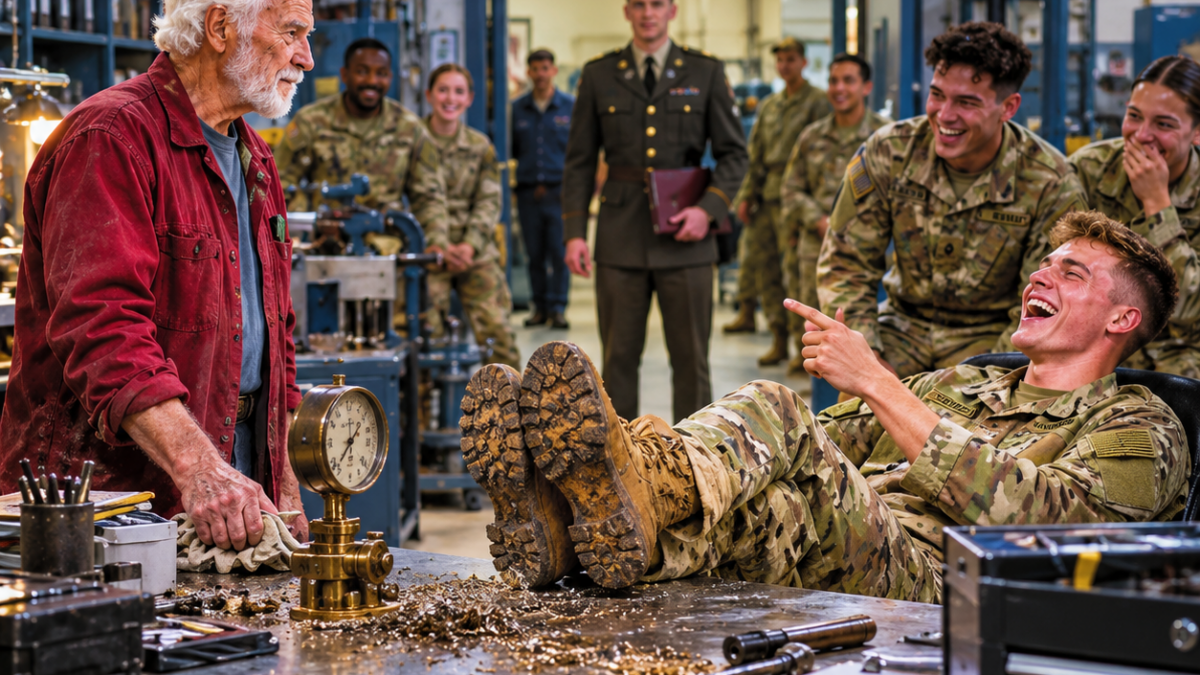
Then put one boot on the corner.
Mud smeared across a stack of maintenance logs.
He looked at us.
I smiled.
I wish I could tell you I stopped him.
I didn’t.
Cody put the second boot up.
Leaned back in New’s chair.
“Look at this.”
He tapped one of the paper logs.
“Pencil.”
Ed laughed.
“Seriously?”
“Man probably doesn’t trust ink.”
New set the brass gauge down.
Carefully.
He looked toward the desk.
Not at Cody’s face.
At the mud.
Cody grinned wider.
“This desk’s seen more dirt than water pressure.”
New walked over.
Slowly.
He took a rag from his coverall pocket.
Cody stayed in the chair.
That is the part I remember most.
New didn’t ask him to move.
Didn’t stare him down.
Didn’t humiliate him.
He simply waited until Cody lowered one foot enough to reach the corner.
Then New wiped the mud.
One pass.
Another.
Silent.
Cody looked at Ed.
“This is what I’m saying. Guy doesn’t care.”
New folded the rag.
“Care about what?”
It might have been the longest sentence he’d spoken to Cody all week.
Cody laughed.
“Anything.”
New looked at him.
Not angry.
Not hurt.
Just measuring.
Then a shadow filled the doorway.
A captain stood there carrying a leather folio.
Colonel Havermier’s aide.
Captain Marcus Dune.
I’d seen him twice.
Everyone straightened around officers from installation command.
Captain Dune did not say good morning.
His eyes moved to Cody.
Then the boots.
Then the mud.
Then Newell Pickins.
He stopped.
Completely.
Cody noticed.
His boots hit the floor so quickly the chair nearly tipped over.
The captain said four words.
“That’s Pickins’s desk.”
Not a question.
Not loud.
But there was something underneath it.
Weight.
History.
Warning.
The annex went silent.
I looked at New.
New looked at the mud.
Captain Dune stared at Cody another second.
Then moved on.
Nobody explained.
Cody waited until the footsteps disappeared.
“What the hell was that?”
Ed shrugged.
Burl didn’t.
Burl looked at New differently.
I did too.
For maybe five minutes.
Then the day continued.
That’s how easy it is to ignore clues when your first judgment is comfortable.
Three days later, Cody saved us from a real problem.
A chlorine residual reading came back slightly low on second shift.
Still inside tolerance.
Most people would have let the automated system log it.
Cody didn’t.
He cross-checked the dosing pump calibration against the technician’s morning entry.
Caught a decimal transposition.
Tiny error.
If it had continued for hours, chlorine feed would have drifted enough to cause a genuine issue.
He corrected it.
Properly.
By procedure.
I watched him work.
Fast.
Focused.
Competent.
When he finished, he held up that laminated card.
“Regulation 41-17.”
I knew the number by then.
“Secondary verification after dosing recalibration.”
“Exactly.”
He grinned.
“Manual catches what lazy people miss.”
New was cleaning a fitting ten feet away.
Cody saw him.
Pride wanted an audience.
“That’s the difference.”
New didn’t look up.
Cody tapped the card.
“I go by what’s written.”
No response.
“Pickins goes by whatever he feels in his bones.”
Ed laughed.
I didn’t.
Not this time.
Maybe because I still remembered Captain Dune.
Cody continued.
“Remember the desk? Guy didn’t even say anything.”
New finished cleaning the fitting.
Folded the rag.
Then turned his whole body because of the bad shoulder.
“Regulation’s only as good as the gauge reading it.”
Cody frowned.
“What?”
New looked at the card.
“Card tells you whether you followed the card.”
Then he pointed toward the pipe.
“Doesn’t tell you if the water agrees.”
Cody opened his mouth.
Nothing came.
New went back to work.
That sentence stayed with me.
A week later, I saw what he meant.
There was a check valve on line three.
Old copper transition.
Newer housing.
Nothing special.
During routine work, I saw New kneel beside it.
He put two fingers against the pipe.
Closed his eyes halfway.
Waited.
Ten seconds.
Maybe eleven.
Then stood.
“Valve’s fine.”
I stared.
“You didn’t open it.”
“No.”
“How do you know?”
He looked at the pipe.
“Water talks different when it’s got room.”
I laughed because I thought he was joking.
He wasn’t.
“What does that even mean?”
“That one isn’t complaining.”
I waited.
“Isn’t singing either.”
“New.”
He picked up his bucket.
“Just talking.”
Then he walked away.
Forty minutes later, scheduled inspection tested the valve.
Normal.
Exactly as he’d said.
That was when I started watching him.
Really watching.
New never checked systems randomly.
He had an order.
Gauge.
Valves.
Pumps.
Log.
Always.
He touched housings.
Listened.
Watched condensation.
Smelled water samples before testing them.
Not instead of testing.
Before.
That difference mattered.
He trusted instruments.
He just didn’t worship them.
Over the next week, I noticed another thing.
The digital turbidity reading on the main panel was drifting.
Tiny amounts.
0.1.
Back.
Then up 0.2.
Still within allowable range.
I showed Cody.
He checked the card.
“Doesn’t trigger until half a unit.”
“I know.”
“So?”
“It’s moving.”
“Numbers move.”
New passed behind us carrying test vials.
He didn’t stop.
“Half a unit’s a lot.”
Cody looked at him.
“Not according to spec.”
New continued walking.
“System wasn’t built on that spec.”
I turned.
“What?”
He was already across the floor.
Cody laughed.
“See? Vibes.”
But I looked at the turbidity screen again.
For the first time, a number inside tolerance made me nervous.
The failure came Tuesday.
2:37 p.m.
I remember the exact minute because the alarm printed it.
A two-tone scream tore across the annex.
Red bar.
High turbidity.
At first, I thought sensor fault.
Then I looked through the discharge sight glass.
The water was visibly cloudier.
Not muddy.
Not catastrophic.
But wrong.
Cody reached the main panel first.
“Coagulant feed?”
“Normal!” Ed shouted.
“Chlorine?”
“Stable.”
“Pump pressure?”
“Within range.”
Cody called manufacturer support.
Video link.
The representative appeared on a tablet.
Clean shirt.
Office background.
Confident voice.
He had sensor diagnostics.
Remote data.
Specifications.
Everything modern engineering taught us to trust.
“The array is reading correctly,” he said.
“Spike likely upstream.”
Cody repeated:
“Check coagulant feed.”
“I did.”
“Do it again.”
I did.
Normal.
“Backwash cycle?”
Normal.
Filter differential?
Normal.
Every screen insisted the system should be working.
The water disagreed.
Newell Pickins stood away from the panel.
At line three.
One hand flat against the discharge pipe.
Eyes half closed.
Alarm shrieking.
People shouting.
Manufacturer speaking through the tablet.
New listening to water.
I watched him.
Thirty seconds.
Forty.
Maybe a minute.
Then he said:
“Number three discharge valve.”
Not loud.
Cody barely heard.
“What?”
“Seat’s worn past true.”
The manufacturer responded instantly.
“Valve seat failure would present in differential pressure.”
New looked toward the tablet.
“Not on this pipe run.”
“We have system data.”
New’s face did not change.
“System data’s looking for the old pressure signature.”
The representative frowned.
“I have the engineering specification in front of me.”
“Which year?”
Silence.
“What?”
New repeated.
“Which year?”
The rep checked.
“Current contract specification.”
“That isn’t a year.”
Cody stepped between them.
“New, what exactly are you saying?”
“Valve’s been bleeding fines around the backside every third cycle.”
“Why every third?”
“Wear pattern.”
“You haven’t opened it.”
“No.”
The manufacturer’s voice sharpened.
“There’s no evidence supporting that diagnosis.”
New looked at line three.
“Pipe changed in ninety-one.”
I looked at Cody.
New continued.
“Sensor calibration model didn’t.”
The rep said, “That’s incorrect.”
New finally looked at us.
“Then opening the valve costs four minutes.”
That was the argument.
Not ego.
Not authority.
Four minutes.
Cody hesitated.
His card told him to follow manufacturer diagnostic sequence.
His pride told him New was guessing.
The water told us something else.
I grabbed the wrench.
“I’m opening it.”
Cody looked at me.
“Harlo.”
“Four minutes.”
He cursed.
Then came with me.
The housing bolts fought.
Old corrosion.
Burl stabilized the pipe.
Cody held the flashlight.
I broke the final bolt free.
Removed the housing.
And there it was.
The seat had worn into an uneven crescent.
Thin groove.
Fines were bypassing the filter bed.
Exactly where New said.
Exactly how he said.
Nobody spoke.
Even the manufacturer.
Cody’s flashlight shook slightly.
Not much.
Enough for me to see.
I looked toward New.
He didn’t smile.
Didn’t say I told you so.
Didn’t even look at Cody.
He started gathering repair material.
As if being right mattered less than clean water.
The manufacturer recovered first.
People like that often do.
“If the valve failed, this is a maintenance issue.”
His tone had changed.
Defensive.
Sharp.
“I’d want documentation showing who was responsible for routine inspection.”
The whole room looked at New.
His name was on maintenance.
There it was.
One minute he saved us.
The next, the same failure could destroy him.
By evening, base command had the preliminary incident summary.
Certification was scheduled in four days.
That deadline could not move.
A resupply convoy was already committed.
If we failed certification, the annex’s civilian operating contract automatically entered outsourcing review.
Twelve civilian jobs.
New’s included.
So were several people with mortgages.
Kids.
Medical bills.
People I had eaten lunch beside for months.
The next morning, I learned they were drafting an operator-error memo.
Newell Pickins.
Routine maintenance failure.
I found him cleaning the valve housing.
Again.
“Your name’s on the draft.”
He nodded.
“You knew?”
“Harlow told me.”
Harlow was our shift supervisor.
“What are you going to do?”
“Fix line three.”
“No. About the report.”
“Line three matters more.”
“That report could cost you your job.”
He ran the rag around the housing.
“Jobs come and go.”
“That is an insane thing to say when twelve people could get outsourced.”
That made him look at me.
“Exactly.”
I understood.
If he fought only for himself, they would call it defensiveness.
If he fixed the system, maybe everyone survived.
But I was angry.
“You can’t just stand there and let them blame you.”
He folded the rag.
“You got proof they shouldn’t?”
“No.”
“Then don’t bring me outrage. Bring me proof.”
So I went looking.
Unauthorized.
Stupidly.
I entered the records room and started pulling maintenance logs predating our digital archive.
Second box.
That was as far as I got.
The records clerk caught me without access authorization.
Formal note.
Pending review.
I made everything worse.
I found New sitting beside line three.
“I screwed up.”
He didn’t ask how.
He already knew.
“Unauthorized access.”
“Yep.”
“I was trying to help.”
“I know.”
“I just made another problem.”
He touched the cleaned valve housing.
“You made it visible.”
“What?”
“Different thing.”
He looked at me.
“Visible is uncomfortable.”
Then the pipe.
“Worse is when nobody looks.”
It didn’t feel like comfort.
It felt true.
The proof came from somewhere nobody expected.
Not the old logs.
Not New’s memory.
Not my unauthorized search.
A junior logistics clerk named Noah Bell was asked to pull the manufacturer’s specification so contracting could determine whether the valve maintenance had violated service terms.
He found the current document.
Then the previous one.
Then another.
Three years earlier, during a contract renewal, the turbidity tolerance used for alarm modeling had changed.
Not dramatically.
A small margin.
Enough to reduce equipment and recalibration requirements.
The sensors were correct.
The manufacturer was correct.
Cody had been correct when he said the reading was within current specification.
That was the problem.
The specification had been loosened.
Quietly.
Administrative language.
Cost optimization.
Updated allowable performance range.
A contracting officer named Maddox Radcliffe had signed it.
The old standard would have flagged gradual deterioration years earlier.
The new one didn’t.
The system had faithfully measured the wrong expectation.
Noah brought the documents into the annex.
Cody read them.
Then again.
“The sensors aren’t broken.”
“No,” I said.
“They’re doing exactly what they’re supposed to.”
“Yes.”
He stared at the paper.
“Then New was right.”
From the workbench, New said nothing.
I looked at him.
“You knew.”
He kept working.
“New.”
Nothing.
Cody turned.
“Did you know they changed the spec?”
New stopped.
“Yes.”
The word hit harder than I expected.
“You knew for three years?”
“Yes.”
“Why didn’t you say anything?”
“I did.”
Cody stared.
“What?”
“Filed an assessment.”
“When?”
“When the contract changed.”
“Where?”
New shrugged.
“Where reports go.”
That angered Cody.
“What does that mean?”
“Means I wrote it.”
“And then?”
“Somebody didn’t read it.”
The annex door opened.
Colonel Darcy Havermier walked in.
Installation commander.
Full bird colonel.
I had never seen her in person.
She was smaller than I expected.
Maybe fifty-five.
Silver beginning at the temples.
No entourage except Captain Dune.
No inspection team.
No announcement.
No clipboard.
Cody straightened so fast his laminated card fell from his pocket.
He didn’t notice.
Colonel Havermier crossed the floor.
Past the panel.
Past Cody.
Past me.
Straight to New.
She carried something in one hand.
A brass pipe fitting.
Old.
Corroded.
Clean but unpolished.
She set it on his workbench.
Newell Pickins looked down.
For the first time since I’d known him, his face broke.
Not much.
His lips parted.
His left hand tightened against the bench.
Colonel Havermier said:
“Thirty-four years.”
Nobody moved.
She touched the fitting.
“Thirty-four years since Lieutenant Havermier was stupid enough to trust a map instead of a field test.”
New looked at her.
“You were twenty-three.”
“Which is another word for stupid.”
Cody looked at me.
I couldn’t breathe.
The colonel continued.
“Field exercise. Contaminated runoff. I drank from a supply point that should’ve been safe.”
She turned toward the room.
“It wasn’t.”
Then back to New.
“By the time we realized, half my team was already sick.”
She touched the brass fitting.
“This came from the purification line Sergeant Pickins rebuilt in the dark because the original system had failed.”
Sergeant.
Not custodian.
Not maintenance man.
Sergeant Pickins.
Colonel Havermier’s voice softened.
“He kept water moving for thirty-six hours.”
New said, “Wasn’t alone.”
“No.”
“Three engineers.”
“Two engineers.”
“Three.”
“One left with heat exhaustion.”
“Still worked six hours.”
The colonel smiled.
“Still correcting my reports.”
New’s eyes moved to the fitting.
I looked at his bad shoulder.
Suddenly I wanted to know.
The colonel saw me.
She followed my gaze.
“That shoulder?”
New gave her a warning look.
She ignored it.
“Pipe collapse.”
Nobody spoke.
New’s mouth tightened.
“Colonel.”
“You don’t get to disappear inside your own story forever.”
He looked away.
Havermier turned to us.
“An emergency bypass failed during that field operation. Pickins held a temporary line in place while we braced it.”
She looked at his shoulder.
“Coupling released.”
I imagined metal.
Pressure.
Impact.
“He finished the repair before allowing medical evacuation.”
New muttered, “Wasn’t that dramatic.”
The colonel stared at him.
“You couldn’t lift your arm.”
“Had another one.”
Cody sat down without realizing.
The colonel looked toward the brass gauge on New’s desk.
“You still have it?”
New nodded.
He unlocked the drawer.
Removed the gauge.
Placed it beside the old fitting.
They matched.
Same era.
Same worn brass.
Havermier touched the gauge.
“That calibrated the line.”
I looked at New.
The object that plugged into nothing.
The joke.
The morning ritual.
It wasn’t nostalgia for obsolete equipment.
It was a piece of the system that had kept people alive.
New said quietly, “It was accurate.”
The colonel laughed.
“Of course that’s what you remember.”
Then her expression changed.
“We found your assessment.”
The room sharpened.
New did not react.
Cody did.
“Where?”
Colonel Havermier looked at him.
“Archived under contract engineering support.”
“Under whose name?”
“Radcliffe.”
Cody frowned.
“The contracting officer?”
“Yes.”
I looked at New.
“You filed it and someone else’s name ended up on it?”
New shrugged.
“Office paperwork.”
The colonel did not shrug.
“Your assessment warned that widening the tolerance would mask mechanical degradation as the system aged.”
“Yes.”
“Specifically valve-seat wear.”
“Yes.”
“Specifically on the ninety-one pipe replacement.”
“Yes.”
“You predicted this exact failure.”
New’s eyes lowered.
“Shape of it.”
“Three years ago.”
“Yes.”
I felt anger rise.
“Why didn’t you make them listen?”
New turned toward me.
“I thought writing it was making them listen.”
The answer surprised me.
He continued.
“Report went forward. Water stayed clean. Figured name on top didn’t matter.”
Cody stared.
“Someone else took credit.”
New looked at him.
“Wasn’t credit.”
“What was it?”
“Paper moving.”
“But your warning got buried.”
New’s jaw tightened.
“That part matters.”
Colonel Havermier said, “And that’s the part we’re correcting.”
She opened a folder.
Inside was the old assessment.
New’s original notes.
Handwritten.
Precise.
Pages of calculations.
Failure predictions.
Recommended narrower tolerances.
A routing sheet showed the document had been attached to contract renewal.
Then summarized.
Then reduced to one paragraph.
Then ignored.
Colonel Havermier looked at New.
“Why didn’t you push?”
He was quiet for a long time.
Then something changed.
The man who spoke three words at a time gave us almost a paragraph.
“I’d been out long enough that nobody knew Sergeant Pickins.”
He looked at his coveralls.
“They knew maintenance.”
He pointed toward the report.
“Young engineer’s name carried it further.”
His voice stayed calm.
“So I let that happen.”
The colonel waited.
New continued.
“Water doesn’t care who gets credit.”
Nobody breathed.
“Thought truth worked the same way.”
He looked around.
“I was wrong.”
That was one of the strongest things I ever heard him say.
Not that everyone else failed.
Not that bureaucracy buried him.
Not that young people were arrogant.
He took responsibility for the one part actually his.
“I should’ve made sure somebody carried it.”
Colonel Havermier nodded.
Not forgiveness.
Respect.
She signed an order.
Right there.
Restoring the original filtration tolerance under installation command authority.
Ordering immediate independent recalibration.
Suspending the operator-error finding.
Directing review of the contract modification.
And preserving our certification schedule.
Cody stared at the signature.
“What about tomorrow’s inspection?”
“We certify under the corrected standard.”
“Can we pass?”
Everyone looked at New.
He considered line three.
“After we seat the replacement valve.”
“How long?”
“Six hours.”
Cody checked the wall clock.
We had eleven.
“Then let’s do it.”
That was the first thing he had said all day that sounded like the Cody I respected.
We worked until after midnight.
All of us.
Cody removed his laminated card from his pocket.
Set it on the bench.
Still used it.
But he stopped holding it like a shield.
New directed the valve replacement.
Not by ordering.
By asking.
“What does that gasket tell you?”
I inspected.
“Uneven compression.”
“Why?”
“Old flange.”
“Good.”
Cody checked the replacement seat.
“Tolerance on this is—”
New interrupted.
“What does the surface say?”
Cody looked annoyed.
Then looked.
Really looked.
“There’s scoring.”
“Yep.”
“Reject it?”
“What do you think?”
Cody set it aside.
“Reject.”
New nodded.
No praise.
Cody smiled anyway.
At 1:42 a.m., line three came back online.
We flushed.
Tested.
Retested.
Turbidity stable.
Pressure stable.
Water clear.
Cody held a sample glass beneath fluorescent light.
New took it.
Smelled it.
Then handed it back.
“Run the test.”
Cody laughed.
“I thought you could hear water.”
“Water lies too.”
I looked at him.
He smiled.
Barely.
The inspection team arrived at seven.
We had slept maybe an hour.
Certification passed.
Clean.
No exceptions.
Twelve civilian jobs stayed.
No dramatic applause.
No commander pinning medals on anyone.
Just signatures.
Forms.
A convoy arriving on schedule.
Water moving where it needed to go.
That was how New liked it.
But something changed inside the annex.
When the lead inspector asked:
“Who identified the valve fault?”
Cody answered.
“Newell Pickins.”
The inspector looked toward New.
Cody repeated it.
Louder.
“Newell Pickins.”
For the record.
Then he corrected himself.
“Mr. Pickins identified it before the sensor data supported it.”
New looked at him.
Cody did not look away.
That mattered.
Weeks passed.
The incident became routine paperwork.
The contract specification was formally corrected.
Radcliffe’s modification entered review.
New’s original report was refiled.
His name appeared at the top this time.
The base offered him a civilian commendation.
New declined.
Of course.
Colonel Havermier called him personally.
He said no.
She asked what he wanted instead.
He asked for my engineering reclassification request to be approved.
I didn’t know he’d even read it.
Months earlier, I’d submitted paperwork to enter advanced utilities engineering training.
It had been sitting.
No urgency.
No sponsor.
No reason anyone important should care.
New knew.
He asked for that.
Not money.
Not a plaque.
Not an apology.
Me.
When Colonel Havermier told me, I cried in the supply room.
Then got angry at myself for crying.
Then cried harder.
I found New at the number three line.
“You did that?”
He kept wiping the housing.
“My reclassification.”
“Maybe.”
“Why?”
“You look.”
“What?”
“At things.”
“That is not an answer.”
“Best one I’ve got.”
I swallowed.
“Thank you.”
He nodded.
Conversation over.
Cody changed too.
Not suddenly.
Real change rarely gives you a cinematic moment.
He still carried the laminated card.
Still quoted regulations.
Still liked being right.
But I began noticing things.
He touched analog gauges before trusting digital ones.
He asked what year a specification came from.
When a reading looked strange but remained within tolerance, he no longer said:
“It’s within spec.”
He said:
“What’s the trend?”
One morning I caught him beside line three.
Two fingers against the housing.
Head tilted.
Exactly like New.
I smiled.
“You hearing water now?”
He looked embarrassed.
“Shut up.”
“What’s it saying?”
“Nothing.”
New passed behind us.
“That’s usually good.”
Cody laughed.
Then looked at him.
“Mr. Pickins?”
New turned.
“I owe you an apology.”
The annex became quiet.
Not because Cody demanded an audience.
Because we all knew what was coming.
He looked at New’s desk.
“I put my boots there.”
New waited.
“I thought you didn’t say anything because you didn’t have anything to say.”
New’s face remained still.
Cody continued.
“I was wrong.”
“Yes.”
I almost laughed.
Cody did too.
“I deserved that.”
“Probably.”
“I also thought knowing procedure meant I knew the job.”
New looked toward the panel.
“Procedure’s part of the job.”
“I know.”
“Important part.”
“I know.”
New’s eyes returned to him.
“Don’t throw away a useful tool because you used it badly.”
Cody touched the laminated card in his pocket.
I understood.
New never wanted Cody to become cynical about regulations.
Rules mattered.
Instruments mattered.
Specifications mattered.
His entire life had been built around accurate measurement.
The lesson was not to reject systems.
It was to remember systems measure reality.
Reality does not owe obedience to systems.
That distinction shaped the rest of my career.
I finished engineering training the following year.
Returned to Marrow Creek.
By then, New was seventy.
Still there.
Still same truck.
Same desk.
Same drawer.
Same brass gauge.
I asked him about it once.
Properly.
We were alone.
“Where did it come from?”
He unlocked the drawer.
Lifted it.
Set it down.
“Field fabrication.”
“You made it?”
“Modified it.”
“For Colonel Havermier’s line?”
He nodded.
“How?”
“Gauge they issued wouldn’t read low enough.”
He turned it over.
There was a tiny stamp.
Hand-cut.
N.P.
I had never noticed.
“What did you change?”
He explained.
For twenty minutes.
Newell Pickins, who people thought barely spoke, gave me twenty minutes on pressure reduction, flow calibration, improvised fittings, contamination, and why low-volume field purification behaves differently from large fixed systems.
I took notes.
At the end, I asked:
“Why keep it locked away?”
He thought.
“Reminder.”
“Of what?”
He touched the brass.
“Measurements belong to consequences.”
I waited.
He saw I needed more.
“If this reads wrong, somebody drinks wrong.”
That was it.
Everything New believed in one sentence.
Numbers were never abstract to him.
Behind every gauge was a person.
Every tolerance.
Every inspection.
Every valve.
Someone drank the result.
Years later, I would teach young engineers the same principle.
Not using those exact words at first.
I was too embarrassed to steal them.
Eventually I stopped caring.
Good ideas deserve to travel.
New retired at seventy-two.
The base tried to organize a ceremony.
He declined.
Colonel Havermier had already retired by then.
She came anyway.
So did Captain Dune.
Cody.
Burl.
Ed.
Me.
Twelve civilians whose jobs had survived line three.
We stood outside the annex beside his old blue truck.
Someone brought cake.
New hated every second.
Colonel Havermier handed him a small box.
He opened it.
Inside was the old corroded pipe fitting she’d kept for thirty-six years.
He looked at her.
“You’ve had this all along?”
“Yes.”
“Why?”
She smiled.
“Measurements belong to consequences.”
New stared.
Then actually laughed.
A real laugh.
Loud enough that everyone stopped talking.
He put the fitting into his truck.
I handed him an envelope.
My first published technical paper.
Aging Infrastructure and Tolerance Drift in Legacy Water Systems.
At the top, under acknowledgments:
For Newell Pickins, who taught me that a specification is only useful if reality still agrees with it.
New read it.
Then looked at me.
“You put my name in here.”
“Yes.”
“Why?”
“Some truths need a name attached before they can travel.”
He knew exactly where that came from.
His own mistake.
His own lesson.
He nodded slowly.
“Fair.”
Then he left.
No speech.
No dramatic final words.
Just an old truck pulling down the gravel road.
I visited his home twice afterward.
Clara Pickins was exactly what I expected.
Kind.
Sharp.
Entirely unimpressed by New’s reputation.
The first time I visited, she showed me something.
Along the kitchen shelf were glass jars.
Water.
Small samples.
Labeled by place and year.
Fort Carson.
White River.
Marrow Creek.
Places New had worked.
Places they had lived.
“What’s this?”
“His idea of sentimentality.”
New, at the table, said, “Record.”
Clara rolled her eyes.
“See?”
Outside was a rain gauge on a cedar post.
Slight lean.
New checked it every morning.
I laughed.
“Of course.”
He looked offended.
“What?”
“Nothing.”
The man calibrated his own rain.
Why was I surprised?
Cody visited eventually too.
Alone.
He later told me New put him to work repairing fence.
Four hours.
No discussion about the annex.
At the end, Clara fed him dinner.
As Cody left, New handed him something.
The laminated card.
Not Cody’s.
An older one.
Worn almost blank.
Regulations from decades earlier.
Cody stared.
“What is this?”
New said:
“Proof.”
“Of what?”
“Rules change.”
Cody still has it.
I know because I saw it framed in his office fifteen years later when he became utilities superintendent at another installation.
Beside it hung the updated current standard.
Old.
New.
Both visible.
He told his young technicians:
“Know the rule. Then know why it exists.”
That was New again.
Everywhere.
Quietly.
Colonel Havermier died before New.
Cancer.
At her memorial, her daughter brought the brass fitting.
She said the colonel wanted it returned.
New held it through the entire service.
Never cried where anyone could see.
But afterward, he sat alone in his truck for forty minutes.
Some debts run both directions.
Newell Pickins died at seventy-nine.
At home.
Clara beside him.
His shoulder had gotten worse.
His heart eventually did too.
The annex sent flowers.
I drove back for the funeral.
Cody came.
Burl.
Ed.
Captain Dune, now a lieutenant colonel.
Several people who had never worked with New directly but had studied procedures carrying his fingerprints.
Clara asked me to stop by the house afterward.
She led me to New’s workshop.
On the bench sat the brass flow gauge.
The one from the drawer.
Next to it was an envelope.
My name.
Inside:
Harlo,
If you’re reading this, Clara finally ignored my instruction not to make a fuss.
The gauge should go back to Marrow Creek.
Not because they need it.
They don’t.
That’s the point.
Keep it where people can see something doesn’t have to be useful anymore to still teach.
And don’t let them put it behind glass if they can help it.
Tools weren’t made to be worshipped.
—New
P.S. Number three always had a slight vibration after the replacement. Don’t let anybody tell you otherwise.
I laughed and cried at the same time.
We returned the gauge to the annex.
Not behind glass.
New would have hated that.
Harlo Quimby—meaning me—had become chief civilian systems engineer by then.
I unlocked the bottom drawer of New’s old desk.
Same drawer.
Same scar on the wood where Cody’s muddy boots had rested years earlier.
Yes.
The mark remained.
Nobody refinished it.
We placed the brass gauge on its folded cloth.
Beside it, I tied a small paper tag.
Not ornate.
No plaque.
I wrote:
FIELD FLOW GAUGE — MODIFIED BY NEWELL PICKINS
USED IN EMERGENCY WATER PURIFICATION OPERATIONS.
LATER KEPT AS A REMINDER THAT INSTRUMENTS SERVE REALITY, NOT THE OTHER WAY AROUND.
Under that, smaller:
ASK WHY BEFORE YOU TRUST A NUMBER.
Cody stood beside me.
He looked at the corner of the desk.
“I did that.”
“The mud?”
“Yes.”
“Technically your boots did.”
He smiled.
“I was an ass.”
“You were twenty-four.”
“Same thing.”
“Sometimes.”
He looked at the drawer.
“You know what bothers me?”
“What?”
“If Captain Dune hadn’t walked past that morning, I probably would’ve kept doing it.”
I thought about that.
“Maybe.”
“If line three hadn’t failed, I might never have learned.”
“Probably.”
He looked at me.
“That’s terrifying.”
“Yes.”
Because that’s the truth people don’t like.
We often imagine character reveals itself in dramatic moral choices.
Sometimes.
More often, character drifts until something interrupts it.
A shadow in a doorway.
A valve failure.
A wrong specification.
A person you dismissed being right.
A commander carrying a piece of brass from thirty-four years ago.
The question is not whether you will misjudge someone.
You will.
The question is what you do when reality makes your judgment impossible to defend.
Cody could have doubled down.
Could have blamed New.
Could have hidden behind procedure.
Could have resented him for being right.
Instead, Cody changed.
Not by throwing away the manual.
By understanding it better.
That mattered to New.
And it matters to me.
Young engineers sometimes ask about the brass gauge.
“What does it measure?”
“Nothing anymore.”
“Why keep it?”
Because that is the wrong question.
The better question is:
What did it measure when someone needed it?
What happened because it was accurate?
Who trusted it?
Who built it?
What lesson survived after the fitting it belonged to disappeared?
The gauge sits in a drawer.
Plugged into nothing.
Needed by nothing.
Worth more than half the equipment in the building.
Not because it’s old.
Because it reminds us where knowledge comes from.
Manuals matter.
Sensors matter.
Training matters.
Newell Pickins would be the first person to tell you that.
He was not some mystical old man who could hear water speaking in secret language.
He understood pressure.
Vibration.
Materials.
Aging infrastructure.
Fluid behavior.
Failure patterns.
He had spent decades paying attention until perception became fast enough to look like instinct.
That’s what people call intuition when they weren’t present for the thousands of hours that built it.
Cody saw slowness.
I saw silence.
Captain Dune saw Newell Pickins.
Colonel Havermier saw the man who once rebuilt a purification line while injured so young soldiers could drink clean water.
The pipes didn’t care what any of us called him.
Neither did the water.
It only cared whether he was right.
And he was.
Not always.
New would hate that version.
He made mistakes.
His biggest one may have been assuming truth would carry itself simply because he’d written it down correctly.
It didn’t.
People carry truth.
Names sometimes matter.
Follow-up matters.
Speaking again matters.
Making people uncomfortable matters.
New learned that too.
His final lesson to me wasn’t that experience always beats technology.
It doesn’t.
It was not that old ways are better.
They’re often not.
It was not that young people are arrogant.
Some are.
So are old people.
His lesson was simpler.
Do not confuse a tool with the thing the tool is trying to understand.
A regulation is a tool.
A sensor is a tool.
Experience is a tool.
Memory is a tool.
Rank is a tool.
Even reputation is a tool.
Reality remains reality when every tool disagrees.
The water was cloudy.
That fact mattered more than the screen saying it shouldn’t be.
The valve was worn.
That fact mattered more than the manufacturer saying the pressure differential didn’t support it.
The old specification was wrong for the aging system.
That fact mattered more than the fact that somebody had signed it.
And Newell Pickins was not a useless old maintenance man simply because a twenty-four-year-old recruit had decided his slow walk meant he had nothing left to teach.
That fact mattered too.
I still visit Marrow Creek once every few years.
The annex has been renovated.
New digital panels.
Updated filtration equipment.
Line three has been replaced entirely.
The old desk remains.
Against all institutional logic.
Newer staff use it.
Most don’t know why one corner has a faint dark stain in the wood.
Sometimes I tell them.
Sometimes I don’t.
Depends on whether they ask.
The bottom drawer still locks.
The key no longer hangs on fishing line.
We replaced that eventually.
Inside is the brass gauge.
Folded cloth.
Paper tag.
Every once in a while, a young technician opens the drawer and asks:
“Why is this here?”
And someone answers:
“Because it doesn’t plug into anything.”
That’s when the good ones ask:
“Then why keep it?”
That is where New’s lesson begins again.
Not with a heroic speech.
Not with a medal.
Not with a colonel.
With a question.
That’s how most useful knowledge begins.
And every time I see a young technician standing there with the gauge in their hands, I remember one morning decades ago.
Cody Bowmont.
Muddy boots.
Newell’s desk.
My own stupid laugh.
The old man walking across the floor.
One shoulder low.
Canvas tool bag.
Quiet.
Slow.
Invisible to us because we had already decided what kind of person deserved to be noticed.
Then Captain Dune appeared in the doorway.
Looked at the boots.
Looked at New.
And said:
“That’s Pickins’s desk.”
At the time, none of us understood why those words made the room go silent.
Now I do.
He wasn’t warning Cody about furniture.
He was warning all of us that we had no idea whose ground we were standing on.








