A Cat With Two Broken Legs Dragged Herself 40 Feet Across a Walmart Parking Lot—Then a 19-Year-Old Employee Saw Her Crawling Toward the Lights
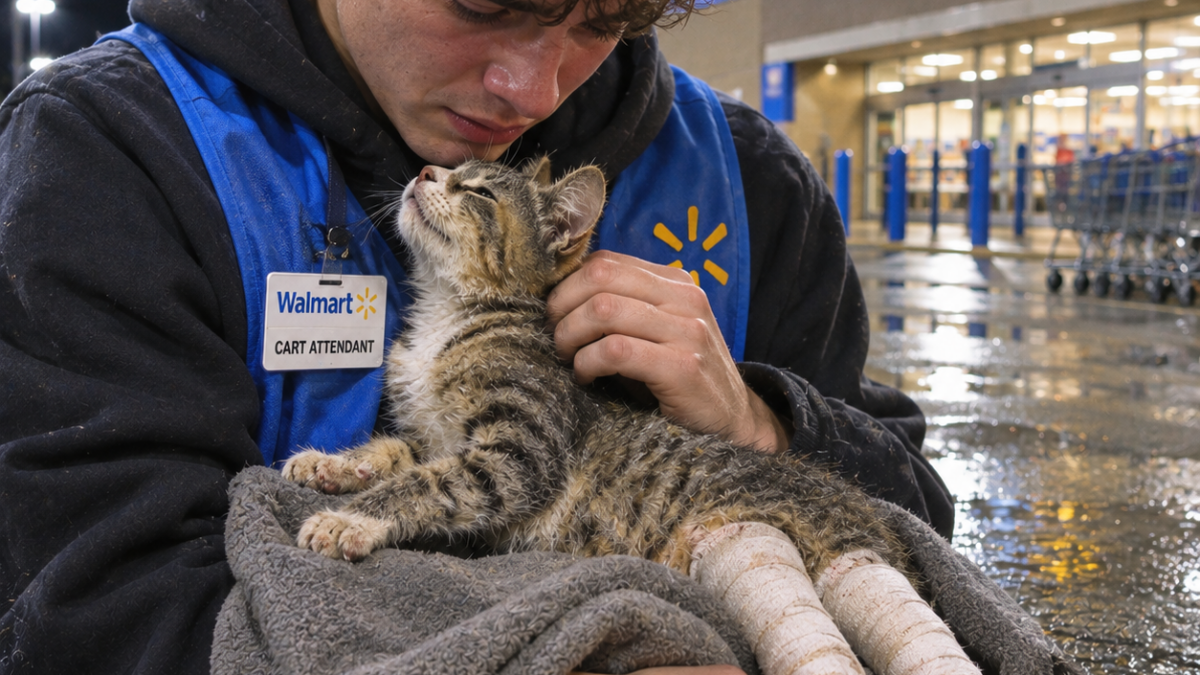
A Cat With Two Broken Legs Dragged Herself 40 Feet Across a Walmart Parking Lot—Then a 19-Year-Old Employee Saw Her Crawling Toward the Lights.
At 11:50 p.m., nineteen-year-old Ethan Parker found a tiny tabby dragging two useless back legs across forty feet of freezing Walmart asphalt toward the store lights—and when his manager ordered him to put the bleeding animal back outside, Ethan wrapped her in his work jacket and said, “Then fire me.”
By sunrise, an emergency veterinarian had found two shattered legs, a fractured pelvis, road burns, and front claws ground almost to the quick, while Ethan learned the surgery that might let the kitten walk again would cost more money than he could earn in an entire month.
But when the store manager punished Ethan for helping her and tried to shut down the fundraiser his coworkers started, security footage revealed something nobody expected: Forty had not been lying alone in that parking lot nearly as long as everyone believed, because another person had already stopped beside her—and chosen to drive away.
At 11:50 p.m., the parking lot looked almost empty.
A few cars remained beneath the tall white lights outside the Walmart on the west edge of Cedar Ridge, Oklahoma.
Wind pushed loose receipts over the asphalt.
A plastic shopping bag had caught against a cart corral and inflated every few seconds like something breathing.
Inside, employees were making closing announcements.
Ten minutes until midnight.
Ethan Parker had forty-two carts left.
He knew because he had counted them.
At nineteen, Ethan had developed the habit of turning every unpleasant task into numbers.
Forty-two carts.
Three corrals.
Ten minutes.
Twenty-three degrees outside.
Seven hours and twelve minutes until he had to wake up again.
Numbers behaved.
Numbers did not care whether you were tired.
They did not tell you that you should have finished community college by now.
They did not ask why your father had left behind more debt than life insurance.
They did not look at your blue Walmart vest and decide they understood exactly how far your life was going.
Ethan pushed a row of carts toward the entrance.
His hands hurt inside thin gloves.
He had spent most of the shift outside because two other cart attendants had called in sick.
His supervisor had promised to send somebody from stocking to help.
Nobody came.
Ethan was used to that too.
PART2:
He returned toward the far end of the lot.
That was when he saw something move.
At first he thought it was another plastic bag.
Small.
Low.
Near the line of parking spaces beside the garden center.
He kept walking.
The shape moved again.
Not blown by the wind.
Forward.
Slowly.
Ethan stopped.
He squinted.
“Hello?”
Nothing.
He walked closer.
The thing moved.
Maybe a squirrel.
No.
Too slow.
Ethan took out his phone and turned on the flashlight.
The beam caught two eyes.
Then stripes.
“Oh, God.”
PART3:
He dropped the cart strap from his hand.
A tiny tabby cat was lying on the asphalt.
Maybe five months old.
Maybe less.
Her front half was upright.
Her back half was not.
Ethan watched her hook her front claws into a crack in the pavement.
Pull.
Her chest slid forward.
Her hind legs dragged behind her.
Completely limp.
She rested.
Then pulled again.
Ethan’s stomach turned.
“Hey.”
The cat looked at him.
Her mouth opened.
No sound came out.
He crouched several feet away.
“Hey, baby.”
She tried to move.
One paw.
Pull.
Another.
Drag.
There was blood on the pavement behind her.
Not much.
Enough.
Ethan followed the faint trail with his flashlight.
It stretched toward the vehicle entrance.
Then disappeared beneath tire marks and dirt.
He looked back at the cat.
She was facing the store.
Toward the automatic doors.
Toward light.
Toward voices.
She had apparently been hit near the edge of the lot.
And she had crawled.
Ethan stood.
Looked at the nearest painted parking lines.
Counted.
Later, someone would measure the distance properly.
Forty feet, three inches.
That night Ethan only understood that for a cat with two useless back legs, it might as well have been forty miles.
He crouched again.
“Don’t move.”
The cat pulled herself another inch.
“I said don’t move.”
Another inch.
Ethan almost laughed.
Then his eyes burned.
“Okay. You’re stubborn.”
He removed his gloves.
The cold hit immediately.
He slid one hand beneath her chest.
The other beneath her hips.
The cat flinched so violently he nearly dropped her.
“Sorry.”
He froze.
Her back legs hung at impossible angles.
One turned outward.
The other dragged straight.
She was panting.
Cats were not supposed to pant in cold weather.
Ethan knew enough to know that.
“Okay.”
His voice shook.
“I’m going to pick you up.”
The kitten stared.
“Please don’t bite me.”
She did not.
When Ethan lifted her, her entire body went rigid for one second.
Then something changed.
She stopped trying to crawl.
Her little head lowered.
Rested against the inside of his elbow.
Ethan felt her breathing.
Fast.
Shallow.
He looked down at the forty feet of asphalt behind them.
For however long she had been there, every movement had depended on her front paws.
Pull.
Rest.
Pull.
Rest.
Now someone else was carrying her.
Ethan pressed her closer.
“I got you.”
The words came out before he thought about them.
“I got you.”
He walked toward the entrance.
The automatic doors opened.
Warm air hit his face.
His manager, Curtis Bell, was standing beside the service desk reviewing closing paperwork.
Curtis looked up.
He was forty-six, broad through the shoulders, with a shaved head and the permanent expression of a man who believed every inconvenience had been arranged specifically to test him.
“What is that?”
Ethan kept walking.
“Cat.”
“I can see it’s a cat.”
“She got hit.”
Curtis stepped around the counter.
“Stop.”
Ethan stopped.
The kitten trembled against his chest.
Curtis pointed toward the doors.
“Animals aren’t allowed inside.”
Ethan stared.
“What?”
“Take it back outside.”
For a second Ethan thought he had misunderstood.
“She can’t walk.”
“I understand.”
“No, you don’t.”
Curtis’s face changed.
“Watch your tone.”
Ethan looked down at the cat.
One front paw had curled into his vest.
“She got hit by a car.”
“Then call animal control.”
“It’s almost midnight.”
“They have after-hours service.”
“I called them last month about that dog behind receiving. It took two hours.”
“That is not our responsibility.”
Ethan stared at him.
Curtis lowered his voice.
“We have food in this building.”
“She’s not going into produce.”
“It does not matter. Health code.”
“She’s bleeding.”
“And you’re dripping it across the entrance.”
Ethan looked down.
A tiny red spot had touched his jacket.
Something inside him went very quiet.
Curtis pointed again.
“Outside.”
Ethan did not move.
“Ethan.”
“No.”
The word surprised both of them.
Curtis’s face hardened.
“What did you say?”
“I’m not putting her outside.”
“You are on the clock.”
“Then clock me out.”
“You don’t get to decide that.”
Ethan adjusted the kitten carefully.
Curtis stepped closer.
“This job pays your bills because you follow instructions.”
Ethan’s heart hammered.
He needed this job.
That fact did not disappear because he was angry.
His mother’s car needed a transmission repair.
He had a community college payment due in three weeks.
His bank balance was $286.41.
He knew because he had checked during lunch.
He could not afford to be brave.
The cat’s front paw tightened against his vest.
Curtis said:
“Put the animal back outside or I will write you up for insubordination.”
Ethan heard himself answer:
“Then fire me.”
The service desk went silent.
A cashier named Denise Carter stopped counting her drawer.
Two overnight stockers turned.
Curtis stared at Ethan.
“You think this is funny?”
“No.”
“You think you’re some hero now?”
“No.”
“Then take the cat outside.”
Denise spoke.
“Curtis.”
He turned.
“What?”
Denise was fifty-eight, had worked at the store eleven years, and possessed the unique confidence of someone who no longer feared most forms of management.
“Give him a box.”
Curtis glared.
Denise continued.
“Put towels in it.”
“We are not running a veterinary clinic.”
“No.”
She pointed at Ethan.
“We’re trying not to be monsters for fifteen minutes.”
One stocker coughed to hide a laugh.
Curtis heard it.
His face reddened.
He looked at the kitten.
For the first time, really looked.
Her back legs.
The abrasions.
The exhausted head resting against Ethan’s arm.
His expression changed for half a second.
Then policy returned.
“Break room.”
Ethan blinked.
“What?”
“Take her to the break room. Put her in a box. Keep her away from food-service areas.”
Denise immediately moved.
“I’ll get towels.”
Curtis pointed at Ethan.
“You still have carts outside.”
Ethan stared.
Denise stopped.
“Curtis.”
He looked at her.
She said:
“I’ll find somebody.”
Curtis sighed.
“Fine.”
He walked away.
Ethan carried the kitten toward the employee hallway.
Denise opened a cardboard box used for paper supplies.
Lined it with two old towels.
The moment Ethan lowered the cat inside, she tried to crawl toward him.
Front paws scratching at cardboard.
“Hey.”
He put his hand beside her.
She stopped.
Denise crouched.
“Poor baby.”
The cat’s front claws were torn.
Not missing.
Worn.
Raw along the tips.
Denise noticed too.
“She’s been crawling.”
“Yeah.”
“How far?”
Ethan looked toward the front doors.
“I don’t know.”
“Long enough.”
The kitten rested her chin on his hand.
Denise looked at Ethan.
“You taking her somewhere?”
“Emergency vet.”
“You got one?”
“I’ll find one.”
“Money?”
He did not answer.
Denise understood.
“You’re nineteen.”
“Last I checked.”
“Emergency vets don’t work for hugs.”
“I know.”
Denise stood.
“I have forty dollars.”
“Denise.”
“Shut up.”
“I’m not taking your money.”
“I didn’t ask.”
“I can figure it out.”
“Sure.”
She folded her arms.
“You got three hundred dollars and a car that sounds like a lawn mower.”
Ethan stared.
“How do you know how much money I have?”
“I’m guessing.”
“That was alarmingly close.”
Denise smiled.
“I raised three boys.”
She took out her wallet.
Ethan shook his head.
“No.”
“Then owe me.”
He looked at the cat.
Denise put two twenties into his vest pocket.
“Fine.”
“Fine.”
At 12:07, Ethan clocked out.
Curtis was waiting beside the time clock.
“You and I are talking tomorrow.”
Ethan looked at him.
“Okay.”
“That wasn’t acceptable.”
“The cat?”
“Your behavior.”
Ethan nodded.
“Okay.”
Curtis seemed irritated that he was not arguing.
“You abandoned assigned duties.”
“Denise found someone for the carts.”
“That isn’t the point.”
Ethan looked toward the break room.
“Can this wait?”
Curtis stared at him.
Then nodded.
“Go.”
Ethan went.
He wrapped the kitten in his work jacket.
The cold outside hit harder now that he had no coat.
His 2008 Honda Civic started on the second try.
He placed the box on the passenger floor, wedging towels around it so it would not slide.
He searched emergency veterinary clinics.
Green Country Veterinary Emergency Center.
Twenty-six minutes away.
He called while driving.
“Emergency vet, this is Rachel.”
“I found a cat.”
“What’s going on?”
“Hit by car. Both back legs don’t work.”
“Is she conscious?”
“Yes.”
“Breathing?”
“Fast.”
“Any heavy bleeding?”
“No.”
“Bring her in. Keep her warm and keep her as still as possible.”
“I’m coming.”
Ethan hung up.
At the next red light, he looked down.
The kitten was watching him.
“Don’t die.”
The light changed.
“Seriously.”
He drove faster than he should have.
The clinic smelled like disinfectant and coffee.
A veterinary technician met him at the door with a small stretcher.
“What happened?”
“Car, I think.”
“How long ago?”
“I don’t know.”
“Your cat?”
“No.”
They lifted her.
She tried to grab Ethan’s sleeve.
The technician paused.
“You can come.”
He followed.
A veterinarian named Dr. Claire Bennett examined the cat.
Mid-thirties.
Dark hair tied back.
Calm voice.
Hands that moved quickly without looking rushed.
She listened to the heart.
Checked gums.
Ran fingers carefully along the spine.
The kitten cried once when Claire reached the pelvis.
Ethan flinched harder than the cat.
Claire looked at him.
“You okay?”
“Yeah.”
“You sure?”
“No.”
“Fair.”
They took X-rays.
Ethan waited in a plastic chair.
His mother called at 12:43.
“You working late?”
“Sort of.”
“Where are you?”
“Vet.”
Silence.
“What happened?”
“I found a cat.”
Another silence.
His mother, Renee Parker, had learned over nineteen years that when Ethan opened with a sentence like that, there was never a cheap ending.
“How bad?”
“I don’t know yet.”
“I’m coming.”
“You don’t have to.”
“I know.”
She hung up.
Claire returned twenty minutes later.
Ethan stood.
Her expression told him before she spoke.
“Both hind legs are fractured.”
He swallowed.
“Okay.”
“One femur is broken. The other fracture is lower, near the tibia.”
“Okay.”
“Pelvis is also fractured.”
Ethan stared.
“That’s three things.”
“Yes.”
“Spine?”
“Looks intact.”
He exhaled.
“Is that good?”
“Very.”
“Nerves?”
“She has sensation in both feet.”
“What does that mean?”
“It means I’m hopeful.”
The word caught him.
“Hopeful she lives?”
“Hopeful she walks.”
He looked through the exam-room window.
The kitten lay beneath a warming blanket.
“Can you fix it?”
“Yes.”
Then Claire paused.
Ethan understood.
“How much?”
“For surgery, hospitalization, imaging, medications, and follow-up, probably around twenty-two hundred dollars.”
He stared.
“Two thousand two hundred?”
“Yes.”
“How much to make her comfortable tonight?”
Claire’s expression softened.
“We’ve already given pain medication.”
“You’re charging me for that?”
“Yes, but we’re treating first.”
“Okay.”
“We’re not going to let her suffer while you decide.”
He nodded.
“What happens if I can’t pay?”
“We talk about options.”
“What options?”
“Rescue transfer. Medical surrender. Payment assistance if available.”
“And if nobody takes her?”
Claire did not answer immediately.
Ethan looked at her.
“Would you put her down?”
“If we cannot provide humane treatment and no organization can accept responsibility, euthanasia can become part of the discussion.”
His eyes burned.
“But she can walk again.”
“I said I’m hopeful.”
“She crawled across a parking lot.”
Claire watched him.
“She clearly wants to keep moving.”
“So fix her.”
“I want to.”
“Then fix her.”
Claire sat.
“Ethan.”
He had forgotten giving his name.
She continued.
“You do not have to personally produce twenty-two hundred dollars tonight.”
“I’ll sign.”
“For what?”
“Whatever.”
“That isn’t how finances work.”
“I’ll owe you.”
“You’re nineteen.”
“So?”
“So I’m not going to let panic make you promise money you cannot possibly pay.”
He laughed once.
“You sound like my mom.”
“Good.”
“She’s annoying.”
“I’m sure she’s devastated.”
Renee arrived twelve minutes later.
Still wearing scrub pants from her shift at an assisted-living facility.
Hair messy.
No makeup.
She hugged Ethan first.
Then looked through the glass.
“Oh, honey.”
Ethan did not know whether she meant him or the cat.
Probably both.
Claire explained again.
Renee asked better questions.
Surgery success rate.
Complications.
Expected recovery.
Quality of life.
Possibility of amputation.
Claire answered.
They went quiet.
Ethan said:
“I have $286.”
Renee closed her eyes.
Claire almost smiled.
“You do not need to announce your bank balance.”
“I have another $400 for tuition.”
Renee turned.
“No.”
“I can use it.”
“No.”
“Mom.”
“No.”
“It’s my money.”
“It’s your school money.”
“I can make more.”
“You make twelve-fifty an hour.”
“I know.”
Renee looked at the kitten.
Then at her son.
“This is how people get trapped, Ethan.”
He went still.
“What?”
“You care about something, so you say yes before you understand what yes costs.”
He knew she was not only talking about the cat.
His father had been like that.
Good heart.
Bad money.
Loans to friends.
Credit cards.
A truck they could not afford.
He died of a heart attack at forty-eight and left Renee with debts she spent three years untangling.
Ethan’s jaw tightened.
“She’s hurt.”
“I know.”
“She crawled forty feet.”
“I know.”
“She didn’t just lie there.”
Renee’s eyes filled.
“I know.”
Ethan lowered his voice.
“If we walk away because she costs too much, what was she crawling toward?”
That broke her.
Renee looked at Claire.
“What do we need tonight?”
Claire answered:
“Six hundred deposit lets us stabilize, monitor, and schedule orthopedic repair tomorrow while we contact rescue partners.”
Renee took out her purse.
Ethan stopped her.
“No.”
She looked at him.
“You have school money.”
“You said no.”
“I changed my mind about my own money.”
“Mom.”
She pulled out a credit card.
“This has eight hundred available.”
“I’ll pay you back.”
“I know.”
Claire said:
“Before either of you puts this on a card, let me make calls.”
Ethan shook his head.
“No delay.”
“It won’t delay treatment.”
“Promise?”
“Yes.”
He looked at her.
“Promise?”
Claire understood he was not asking like an adult negotiating a bill.
He was asking like a kid making sure somebody else would not decide the cat stopped being worth saving when he left the room.
“I promise.”
They signed authorization.
The kitten stayed.
At 2:11 a.m., Ethan finally sat in his car.
His work jacket was still at the clinic.
He wore only a sweatshirt.
Renee sat in the passenger seat.
Neither spoke for a while.
Then she said:
“You told your manager to fire you?”
Ethan looked over.
“How do you know?”
“Denise texted me.”
“How does Denise have your number?”
“She’s had it since you started.”
“That feels like a privacy violation.”
Renee laughed.
Then became serious.
“Did he fire you?”
“Not yet.”
“You need that job.”
“I know.”
“You also did the right thing.”
He looked down.
“Those two things are not always friends.”
“No.”
Renee touched his shoulder.
“But doing the right thing does not mean you stop thinking after.”
“I know.”
“Good.”
She opened the door.
“Drive home before you kill us both.”
At 7:42 the next morning, Ethan was back at the clinic.
He had slept two hours.
Claire showed him the kitten.
She was more alert.
Still unable to use her hind legs.
But she ate three bites of canned food.
Ethan stared through the glass.
“She ate?”
“Yes.”
“All by herself?”
“Mostly.”
“She looks mad.”
Claire smiled.
“She is.”
“Good.”
Claire handed him an estimate.
Orthopedic surgeon available that afternoon.
Total expected bill: $2,187.
Ethan looked at the number.
Then at the cat.
“What do we call her?”
Claire asked.
“I don’t know.”
“You need something better than parking-lot cat.”
He thought.
“Forty.”
Claire frowned.
“What?”
“Forty.”
“Why?”
“She crawled about forty feet.”
“That is either incredibly sweet or slightly depressing.”
“Both.”
Claire looked at the kitten.
“Forty.”
The cat blinked.
“Apparently she accepts.”
Ethan went to work at three.
Curtis called him into the office before he put on his vest.
Assistant manager Melissa Grant sat beside him.
Human resources paperwork lay on the desk.
Ethan’s stomach tightened.
Curtis began:
“Last night created several issues.”
Ethan said nothing.
“You brought an injured stray animal through a public entrance.”
“She was dying.”
“I’m aware.”
“You told me to put her outside.”
Melissa looked toward Curtis.
He ignored her.
“You refused direct instruction.”
“Yes.”
“You left assigned work unfinished.”
“Denise got help.”
“You left before verifying that.”
“I clocked out seven minutes late.”
Curtis leaned forward.
“This is exactly the attitude I’m talking about.”
Ethan took a breath.
He remembered his mother.
Do the right thing.
Keep thinking.
“I’m not trying to have an attitude.”
“You told me to fire you.”
“I said if the choice was putting her back outside or losing my job, then fire me.”
Curtis looked annoyed by the precision.
“That is insubordination.”
Melissa spoke quietly.
“The animal was seriously injured.”
Curtis turned.
“I know.”
“Ethan secured her in the break room and clocked out after relief was arranged.”
“Melissa.”
“I’m just clarifying.”
Curtis’s jaw tightened.
He slid a written warning toward Ethan.
“Final warning for insubordination and violation of workplace safety procedure.”
Ethan read.
Final warning.
His record had one earlier attendance point because his car battery died.
Nothing else.
“This says I abandoned my position.”
Curtis said:
“You did.”
“No.”
“You left.”
“After my shift.”
“You were instructed to complete carts.”
Ethan looked at Melissa.
She did not speak.
He pushed the paper back.
“I’m not signing that.”
Curtis’s eyebrows rose.
“Signature acknowledges receipt, not agreement.”
“Then write that I disagree.”
“We can note it.”
“Write that you told me to put an injured cat back outside.”
Curtis stared.
“That is not relevant.”
“It’s the whole reason.”
“I said the animal could not be in the public area.”
“You said ‘take it back outside.’”
Melissa looked at Curtis again.
He snapped:
“This is not a courtroom.”
Ethan nodded.
“Then I’m not signing something that says I walked off because I felt like it.”
Curtis stood.
“You’re making this harder than it needs to be.”
Ethan stood too.
“No.”
His voice remained calm.
“She was already having a hard night.”
“I’m not going to make helping her something I apologize for.”
Curtis stared at him.
For a moment Ethan thought he was fired.
Instead Curtis said:
“Go to work.”
Ethan left.
Denise was waiting near register six.
“Well?”
“Final warning.”
Her face hardened.
“For saving a cat.”
“For insubordination.”
“Same difference.”
“No.”
Ethan shook his head.
“Not technically.”
Denise narrowed her eyes.
“When did you become management?”
He smiled.
“Never.”
She handed him an envelope.
“What’s this?”
“Money.”
“Denise.”
“Open it.”
Inside:
$312.
Ethan stared.
“What?”
“Night shift.”
He looked at her.
“Everybody gave?”
“Almost.”
A stocker named Jeremy had put in ten dollars.
Melissa twenty-five.
The deli closer fifteen.
Two overnight maintenance workers twenty each.
Denise forty.
Even sixteen-year-old cashier Kayla had given eight dollars from her tip envelope from a second restaurant job.
Ethan shook his head.
“I can’t take this.”
Denise sighed.
“Stop being dramatic.”
“It’s a lot.”
“It’s not yours.”
“What?”
“It belongs to Forty.”
He looked up.
Denise smiled.
“We named the envelope already.”
Ethan laughed.
“You people are insane.”
“Correct.”
By lunch, the story had spread through the store.
Someone printed a picture Ethan had taken at the clinic.
Forty beneath a blanket.
One front paw stretched toward the camera.
A handwritten note went up inside the break room:
FORTY’S SURGERY FUND
No corporate logo.
No public solicitation.
Just coworkers helping.
By the end of Ethan’s shift, the envelope held $487.
Curtis saw it.
He removed the sign.
Denise watched him.
“What are you doing?”
“No fundraising on company property without approval.”
“It’s in the break room.”
“Still company property.”
“It’s employees giving their own money.”
“Take it outside.”
Denise stared.
“You really want this fight?”
Curtis lowered his voice.
“I want policies followed.”
“Of course.”
She took the envelope.
Then put a new sign in the trunk of her car.
Employees donated there.
By the second day, word had escaped the building.
Kayla posted:
Our cart guy found this kitten dragging herself across the parking lot last night. Both back legs are broken. He took her to the emergency vet and is trying to save her.
She attached the photo.
Then:
We call her Forty because she crawled forty feet looking for help.
That sentence changed everything.
Forty feet looking for help.
People shared it.
Cedar Ridge community groups picked it up.
A local teacher donated twenty dollars.
A mechanic fifty.
Someone from Texas sent ten.
A retired woman named Mrs. Alvarez arrived at the store asking for “the boy who saved the cat.”
Curtis told her there was no official fundraiser.
She waited in the parking lot until Ethan’s break.
She pressed a hundred-dollar bill into his hand.
He refused three times.
She finally said:
“I’m eighty-two years old. Do not make me chase you.”
He accepted.
At Green Country Veterinary Emergency Center, Forty underwent surgery.
Dr. Hannah Pierce, the orthopedic surgeon, stabilized both legs with pins.
The pelvis did not require surgery.
That was the first good surprise.
The second came when Forty woke from anesthesia and moved the toes of her left back foot.
Claire called Ethan.
“She moved.”
“What?”
“Her toes.”
“That’s good?”
“It’s very good.”
“Does that mean she’ll walk?”
“It means nerves are functioning.”
“So yes?”
“It means be patient.”
He laughed.
“Everybody keeps saying that.”
“Because you keep asking for guarantees.”
“Fine.”
Pause.
“Will she walk?”
Claire laughed.
“You are exhausting.”
That afternoon, Mara Collins from Second Chance Animal Rescue contacted the clinic.
Second Chance had seen the post.
They offered to cover whatever remained after the employee donations.
Ethan called his mother.
“We got it.”
“What?”
“The bill.”
“All of it?”
“Rescue is covering the balance.”
Renee screamed so loudly he pulled the phone away.
Then she started crying.
Ethan laughed.
“You okay?”
“No.”
“Same.”
By the end of day two, coworkers and strangers had raised $1,427.
More than anyone expected.
Second Chance covered the remaining medical costs and agreed to manage Forty’s formal rescue status during recovery.
That last part bothered Ethan.
“What does formal rescue status mean?”
Mara explained over the phone.
“It means legally and financially, she becomes our responsibility while she’s receiving treatment.”
“But I’m adopting her.”
“We can discuss that when she’s medically cleared.”
“What does discuss mean?”
“It means exactly discuss.”
“I found her.”
“I know.”
“I paid—”
“You helped pay.”
Ethan stopped.
Mara’s voice stayed gentle.
“You saved her life.”
“That does not automatically make you the best permanent home.”
He felt something hot rise in his chest.
“I’m not giving her to someone else.”
“Ethan.”
“No.”
“Listen.”
“I have listened to people tell me what I can’t do for two days.”
“I’m not your manager.”
“That’s good.”
Mara almost laughed.
“I’m trying to protect the cat you love.”
He went quiet.
She continued.
“Eight weeks of crate rest.”
“Medication.”
“Follow-up X-rays.”
“Possible physical therapy.”
“Potential complications.”
“Future arthritis.”
“Maybe another surgery.”
Ethan swallowed.
“I can do it.”
“With what money?”
There it was.
He hated her immediately for asking.
Then hated himself because it was a fair question.
“I’ll work.”
“You already work.”
“I’ll work more.”
“Your mother?”
“She said Forty can live with us.”
“Lease?”
Ethan stopped.
They rented.
He had not checked.
Mara said:
“I am not saying no.”
“It sounds like no.”
“I’m saying loving an animal is not the same thing as having a plan.”
That sentence followed Ethan for weeks.
He did not like it.
Which was probably why he needed it.
At the store, the story became bigger.
A local television station requested an interview.
Ethan refused.
Kayla called him stupid.
“You look good on camera.”
“How do you know?”
“You have a face.”
“That is a low standard.”
The station came anyway to film exterior footage.
They interviewed Denise.
Mrs. Alvarez.
A rescue volunteer.
Then they asked management for comment.
Curtis spoke.
Ethan watched the segment that night.
The reporter stood in the Walmart parking lot.
“Employees and community members rallied after a severely injured kitten was discovered here late Monday night.”
Then Curtis appeared.
“We’re proud of our associates for showing compassion, and we always encourage responsible steps when animals are found on store property.”
Ethan stared at the television.
His mother slowly turned toward him.
“Responsible steps?”
Ethan laughed once.
“He told me to put her outside.”
Renee’s face hardened.
The next day Denise had already seen it.
She walked up to Ethan.
“Responsible steps?”
“Please don’t.”
“I’m going to put responsible steps on his grave.”
“Denise.”
“I’m kidding.”
Pause.
“Mostly.”
Curtis called Ethan into the office again.
“This media attention needs to stop.”
“I didn’t talk to them.”
“Your coworkers are.”
“I don’t control them.”
“Your social media post—”
“I didn’t make it.”
He looked surprised.
“Kayla did.”
Curtis rubbed his forehead.
“Corporate communications called.”
“Okay.”
“They don’t want associates soliciting donations using the store location.”
“We stopped.”
“They also want no implication that management obstructed animal care.”
Ethan looked at him.
“What?”
“You understand how stories get distorted.”
Ethan stared.
Curtis continued.
“You were told we couldn’t bring an animal into customer areas.”
“No.”
His voice changed.
“You told me to put her outside.”
Curtis leaned back.
“I do not remember saying that.”
Ethan felt cold.
“Denise heard you.”
“Denise hears what she wants.”
“Melissa heard.”
Curtis’s expression shifted.
Not much.
Enough.
Ethan asked:
“Why are you doing this?”
“Doing what?”
“Pretending.”
“I’m protecting this store.”
“From what?”
“From a teenager turning a policy conversation into some story where management wanted an animal to die.”
Ethan stood.
“I never said that publicly.”
“You told coworkers.”
“They were there.”
Curtis’s face hardened.
“Go back to work.”
Ethan left.
That evening his schedule for the following week appeared.
Fourteen hours.
He normally worked thirty-two.
He stared.
Denise saw.
“Oh, absolutely not.”
“Maybe payroll got cut.”
“No.”
“Denise.”
“You got punished.”
“Maybe.”
“Stop saying maybe when you know something.”
His mother had said the same thing before.
Ethan looked at the schedule.
Fourteen hours at $12.50.
Before taxes.
He could not pay car insurance with that.
Could not rebuild tuition savings.
Could barely buy gas.
The next morning he asked Curtis.
“Why did my hours get cut?”
“Business need.”
“From thirty-two to fourteen?”
“Availability.”
“My availability didn’t change.”
“We schedule according to labor demand.”
“You gave Jordan thirty-eight.”
“Jordan has broader availability.”
“So do I.”
Curtis looked at him.
“Are you accusing me of something?”
Ethan knew the trap.
“No.”
“Good.”
He left.
For the first time since finding Forty, Ethan felt angry enough to regret helping her.
Not because she had done anything.
Because doing the right thing had become expensive in ways nobody online photographed.
Lost hours.
Tuition.
Fear.
His mother calculating groceries again.
Gas.
The possibility of losing a job over a cat he did not even legally own yet.
That night he drove to the clinic.
Forty was awake.
Her hind legs were immobilized.
Pins beneath dressings.
She hated confinement.
The technician opened the cage just enough for Ethan to put his hand inside.
Forty immediately dragged herself toward him.
Not forty feet.
Four inches.
Still.
She rested her head on his wrist.
Ethan sat on the floor.
“You have terrible timing.”
Forty purred.
“You know that?”
Purr.
“I had plans.”
Purr.
“I was going back to school.”
Forty kneaded his sleeve with one front paw.
“You cost a lot.”
Purr.
He laughed.
“That’s your answer to everything.”
Claire walked by.
Stopped.
“You okay?”
“Yeah.”
“You’re lying.”
“Apparently every adult knows when I’m lying.”
“Your face is bad at it.”
He told her about the schedule.
Claire listened.
Then said:
“Regret finding her?”
Ethan looked at Forty.
For a long time.
“No.”
“Regret telling your manager to fire you?”
“Yes.”
Claire smiled.
“Growth.”
“Shut up.”
She laughed.
“Good night, Ethan.”
At the end of that week, Tyler Monroe from store asset protection approached him in the parking lot.
Twenty-seven.
Quiet.
Usually spoke only when someone stole something.
“Hey.”
Ethan looked up.
“Hey.”
“You remember where you found the cat?”
“Yeah.”
“Exact place?”
Ethan pointed.
Tyler nodded.
“I checked camera coverage.”
Ethan’s pulse changed.
“You saw her get hit?”
“Maybe.”
“What does maybe mean?”
“Come here.”
Inside the loss-prevention office, Tyler closed the door.
“You’re not supposed to be in here.”
“Okay.”
“So don’t touch anything.”
“Okay.”
Tyler pulled up footage.
Timestamp:
11:31:08 p.m.
Parking lot.
Grainy.
A small shape entered from the roadside.
Forty.
She moved between two parked vehicles.
At 11:32, a gray pickup turned into the lot.
The front passenger wheel passed close.
The cat disappeared beneath the truck.
Ethan flinched.
The truck stopped.
For eight seconds.
Driver door opened.
A man stepped out.
Walked backward.
Looked beneath the vehicle.
Ethan leaned closer.
“He saw her.”
Tyler did not answer.
The man stood.
Looked around.
Then got back in.
Drove away.
Forty remained on the pavement.
Ethan’s hands tightened.
“How long before I found her?”
“Eighteen minutes.”
The footage continued.
Forty began moving.
Front paws.
Dragging.
A little at a time.
Toward the store.
Ethan could not watch.
“Stop.”
Tyler paused.
For several seconds they sat silently.
Then Ethan asked:
“Can we identify the truck?”
“Plate isn’t clear from this angle.”
“Other cameras?”
“Maybe entrance camera.”
“Can police do anything?”
“Animal control investigator might want it.”
Ethan looked at him.
“Why did you check?”
Tyler shrugged.
“You asked me Wednesday if cameras saw the accident.”
“I thought you said you couldn’t.”
“I said I wasn’t supposed to use surveillance for personal requests.”
“So why?”
Tyler looked at the frozen image.
“Forty feet.”
Ethan smiled faintly.
“Everybody knows her name.”
“Apparently.”
Then Tyler clicked another file.
“There’s something else.”
Timestamp:
11:40.
Curtis Bell’s black SUV left a parking space.
It drove along the row where Forty was crawling.
Slowed.
Brake lights.
Stopped for three seconds.
Then continued.
Ethan stared.
“No.”
Tyler said nothing.
“Maybe he didn’t see her.”
“Maybe.”
“He was far.”
“Twenty feet.”
Ethan watched again.
Curtis’s SUV stopped.
Forty visible in the headlights.
Then moved on.
Ethan felt something heavier than anger.
“Why didn’t he help?”
Tyler said quietly:
“You’d have to ask him.”
“Did he know when I carried her inside?”
“I don’t know.”
Ethan watched.
Curtis had driven past the cat ten minutes before Ethan found her.
Maybe he thought she was dead.
Maybe he did not understand.
Maybe.
But when Ethan came through the doors carrying a bleeding kitten, Curtis had not been surprised there was an injured animal outside.
Ethan remembered the words.
Take it back outside.
His stomach turned.
Tyler said:
“I saved copies.”
“You could get fired.”
“Probably not.”
“Why?”
“Because footage linked to an animal-control inquiry is a legitimate preservation reason.”
“You already called?”
“Yesterday.”
Ethan looked at him.
Tyler shrugged.
“You’re not the only person capable of making questionable career decisions.”
The gray truck belonged to Robert Danner, a forty-one-year-old subcontractor who delivered vending-machine supplies to businesses throughout Cedar Ridge.
Animal control investigators interviewed him.
At first he said he had not hit any animal.
Then they showed the footage.
He admitted he felt something beneath the truck.
Why did he stop?
“To check for vehicle damage.”
Did he see the cat?
Pause.
“Yes.”
Why leave?
He said he assumed she would die.
The investigator asked why he did not move her from the roadway or call for help.
Danner had no answer anyone liked.
The city later cited him under local animal-cruelty and neglect provisions for knowingly leaving a severely injured animal without reporting it after discovering what had happened.
The charge was not dramatic.
No prison sentence.
A fine.
Community service.
A requirement to pay part of the veterinary restitution fund after he pleaded no contest.
Some people online demanded more.
Ethan did not.
When a reporter asked months later whether he hated the driver, Ethan said:
“I hate what he did.”
That distinction mattered to him.
People made one terrible choice and then another to protect the first.
Ethan had watched Curtis do something similar.
The more damaging investigation was happening inside the store.
Tyler submitted preserved footage and Ethan’s written warning to the regional asset-protection manager.
Melissa Grant provided a statement.
So did Denise.
So did two stockers.
Curtis’s incident report said:
Employee unexpectedly brought stray animal into store and became confrontational when directed to follow standard animal-control procedure.
Melissa’s account said:
Employee entered carrying visibly injured cat. Store manager instructed employee to return animal outside. Employee refused due medical condition.
Two very different stories.
Then regional management saw the parking-lot footage.
Curtis had driven past Forty.
Stopped.
Left.
Later told Ethan to put her back outside.
Then issued a final warning.
Then cut his hours.
Curtis was placed on administrative leave during review.
Ethan did not celebrate.
Denise did enough celebrating for both of them.
“I told you.”
“You tell me everything.”
“I was right.”
“You are occasionally right by accident.”
“Thirty years older than you.”
“That doesn’t mean anything.”
“It means I can insult you more efficiently.”
Corporate restored Ethan’s normal hours immediately.
The final warning disappeared.
He received back pay for the shifts the investigation determined had been cut in retaliation.
Curtis did not return as store manager.
The company did not publish his personnel details.
Word around the store was that he had been terminated after investigators concluded he falsified the incident account and retaliated against an employee who disputed it.
Ethan never confirmed it.
He did not need to.
Two weeks later, a regional manager named Sharon Wells met with him.
“I owe you an apology on behalf of the store.”
Ethan shifted uncomfortably.
“You didn’t do it.”
“No.”
“But I represent people who should have handled it better.”
She handed him a letter.
The company had decided to reimburse the portion of Forty’s emergency costs not already covered by the rescue and donations.
Ethan stared.
“But it’s already paid.”
“Second Chance can redirect that amount to another emergency case.”
He smiled.
“That’s better.”
Sharon continued.
“We’d also like to recognize you.”
“No.”
She blinked.
“What?”
“No ceremony.”
“Ethan—”
“No giant check.”
Her mouth twitched.
“We weren’t planning a giant check.”
“No employee-of-the-month picture with Forty.”
“I wasn’t—”
“And no saying Walmart saved her.”
Sharon laughed.
“All right.”
He relaxed.
“Sorry.”
“No.”
She looked at him.
“That seems fair.”
Forty’s recovery was harder than the viral posts made it look.
Week one, she developed swelling around the right-leg incision.
Ethan panicked.
Claire explained inflammation did not automatically mean infection.
Week two, Forty learned how to remove her soft recovery collar.
Three times.
They replaced it with another style.
She hated everyone for approximately eleven minutes.
Week three, she stopped eating for half a day.
Ethan called the clinic four times.
Claire finally said:
“If she eats by dinner, you owe me coffee.”
Forty ate at 4:17.
Ethan brought Claire coffee the next morning.
Week four, the first follow-up X-rays showed healing.
Not enough.
But progressing.
Ethan asked:
“When can she walk?”
Claire pointed at the image.
“When the bones are ready.”
“Can you give me a date?”
“Bones do not use calendars.”
“I dislike that.”
“I know.”
Forty remained on strict movement restriction.
Most of the time she stayed at the clinic or fostered with a veterinary technician experienced in orthopedic recovery.
Ethan visited nearly every day.
Sometimes before work.
Sometimes after.
Sometimes during a forty-minute meal break if traffic cooperated.
He read his community college textbook beside her.
Anatomy.
He had originally planned to study radiologic technology.
After three weeks at an emergency vet, that plan became less certain.
Claire caught him watching a veterinary technician change Forty’s bandage.
“You thinking vet school?”
Ethan laughed.
“I make twelve-fifty an hour.”
“That wasn’t my question.”
“I barely passed chemistry.”
“Also not my question.”
He looked at Forty.
“Maybe vet tech.”
Claire smiled.
“Good answer.”
At home, Renee watched her son change too.
He still left socks on the floor.
Still forgot trash night.
Still drove a Honda with a dashboard light permanently glowing.
He was not transformed into a saint because he rescued a cat.
But he started saving money differently.
He made a spreadsheet.
Rent contribution.
Gas.
Food.
Cat food.
Insurance.
Potential veterinary savings.
Renee found it on the kitchen table.
“What’s this?”
“My plan.”
“For?”
“Forty.”
She looked at him.
“Mara scared you.”
“She made me mad.”
“Same thing sometimes.”
He pointed.
“I checked our lease.”
“And?”
“Cats allowed with $300 deposit.”
Renee winced.
“I know.”
“Monthly pet rent?”
“Twenty-five.”
“Food?”
“Forty a month.”
“Litter?”
“Twenty.”
“Insurance?”
“I got quotes.”
Renee stared.
“You got pet insurance quotes?”
“I’m trying to be responsible.”
She sat.
“Who are you?”
“Very funny.”
He showed her.
He would delay one community college semester.
Not quit.
Pick up two extra shifts.
Rebuild the tuition fund.
Set aside forty dollars from each paycheck into an emergency account.
Mara visited the house for the adoption assessment.
Ethan hated every minute.
Not because she was rude.
Because he felt judged.
She inspected windows.
Asked where Forty would sleep.
Asked who would care for her during shifts.
Asked what would happen if Renee moved.
Asked what Ethan would do if Forty developed chronic pain.
He answered.
Sometimes badly.
Sometimes honestly.
At the end Mara sat at the kitchen table.
“You know why I’m hard on you?”
“Because you enjoy it.”
“No.”
“Could’ve fooled me.”
She smiled.
“Because rescue is full of animals saved spectacularly and failed quietly afterward.”
Ethan stopped.
“People raise thousands for surgery.”
“Then six months later the dog is surrendered because medication costs seventy dollars.”
“Someone saves a kitten from traffic.”
“Then moves into housing that doesn’t allow pets.”
“Good intentions are the beginning.”
“Not the plan.”
He looked at the spreadsheet.
Mara did too.
“You made this?”
“Yes.”
“It’s terrible.”
“What?”
She turned it.
“You forgot annual vaccines.”
Ethan stared.
Mara laughed.
“I’m kidding.”
He looked offended.
“That was cruel.”
“You’re approved.”
Silence.
“What?”
“When she’s medically cleared, Forty can come home with you.”
Ethan stood so quickly the chair scraped.
“Really?”
“Really.”
Renee cried.
Ethan hugged Mara before remembering he disliked her.
He stepped back.
“Sorry.”
“Too late.”
At week six, Forty stood.
Not fully.
Not gracefully.
A technician supported her abdomen with a sling.
Forty planted both back feet.
Weight.
Two seconds.
Then sat.
Ethan saw the video at work.
He watched it eleven times.
Denise walked past.
“Is that the cat standing?”
“Yes.”
She watched.
Then shouted across the break room:
“FORTY STOOD!”
People cheered.
Ethan turned red.
“I hate all of you.”
Week seven, she took three assisted steps.
Week eight, follow-up X-rays showed enough healing to increase controlled movement.
Claire called Ethan into the clinic’s rehab room.
“Today.”
“What?”
“You’ve asked me approximately seventy thousand times when she can walk.”
“Probably eighty.”
“Today.”
Ethan stared.
“Without the sling?”
“With minimal support first.”
Forty was brought in.
She looked different from the dying kitten in the parking lot.
Coat clean.
Eyes bright.
Some fur shaved from both hind legs.
Thin scars.
She saw Ethan.
Meowed.
He crouched.
“Hey.”
Claire placed Forty on a padded floor.
The cat stood.
Wobbled.
Ethan’s breath caught.
Forty looked at him.
One back leg moved.
Then the other.
Uneven.
Careful.
Step.
Step.
She sat.
Ethan laughed through tears.
“Come on.”
Claire said:
“Don’t pressure her.”
“I’m not.”
“You literally said come on.”
“Sorry.”
Forty stood again.
Step.
Pause.
Step.
Her right leg shook.
She continued.
Ethan lowered himself onto the floor.
Forty walked toward him.
Not dragged.
Walked.
Six feet.
Maybe seven.
Then climbed into his lap.
Ethan covered his face.
Claire looked away.
Veterinary professionals learned to manufacture reasons to look at clipboards during moments like that.
Ethan whispered:
“You did it.”
Forty began purring.
Claire corrected:
“She started.”
Ethan looked up.
“What?”
“She’ll need gradual strengthening.”
“Possible arthritis later.”
“Monitoring.”
“Don’t turn today into an ending.”
He nodded.
“Okay.”
But he smiled.
Because some days deserved to be endings for at least five minutes.
The story could have ended there.
It nearly did online.
Local news ran the follow-up:
KITTEN WHO CRAWLED 40 FEET AFTER BEING HIT WALKS AGAIN.
Forty became locally famous.
People sent toys.
Someone mailed her a tiny Walmart vest.
Ethan refused to put it on her.
Denise did.
Forty tolerated it for six seconds and attacked the Velcro.
The photograph became the store break-room background image for months.
But real healing continued after attention faded.
Forty came home in late January.
Renee had prepared a corner of the living room.
Low bed.
Litter box with easy entry.
Food station.
Two toys.
Ethan arrived with a carrier and enough supplies to open a small pet store.
Renee stared.
“Did you spend all your money?”
“No.”
“That sounded defensive.”
“I used coupons.”
“You are definitely my son.”
He placed the carrier down.
Opened it.
Forty did not come out.
Ethan waited.
Five minutes.
Ten.
Finally one tabby face appeared.
She sniffed.
Took one step.
Then retreated.
Renee whispered:
“Should we—”
“No.”
They waited.
Eventually Forty walked out.
Slowly.
She crossed the rug.
Sniffed the couch.
Found the blanket Ethan had used at the clinic.
Climbed onto it with difficulty.
Curled.
Slept.
That was her homecoming.
No dramatic music.
No perfect moment.
A tired cat taking a nap.
Ethan thought it was beautiful.
The first month was not easy.
Forty hated being alone.
If Ethan left the room, she followed.
If he closed the bathroom door, she cried.
At night she slept pressed against his chest.
The first time he woke with her front claws gripping his shirt, he remembered the parking lot.
Those claws had once been worn bloody pulling her toward people.
Now they caught in cotton.
He never complained.
Forty developed a strange habit.
Whenever headlights passed across the living-room window, she froze.
Her body went low.
Eyes wide.
Ethan noticed.
Mara said it might be fear from the collision.
Maybe.
Maybe not.
Cats did not explain trauma.
They showed it.
Ethan bought thicker curtains.
He also stopped telling people she was fearless.
That description bothered him now.
Forty had not crawled forty feet because she felt no fear.
She had almost certainly been terrified.
Courage was not absence of fear.
He knew that better after dealing with Curtis.
He had been terrified when he said fire me.
He had simply hated the alternative more.
In March, Ethan returned to community college.
Part time.
One anatomy course.
One math course.
He changed his declared program.
Veterinary technology.
Renee pretended not to be surprised.
Claire wrote a recommendation for a scholarship.
Mara connected him with weekend volunteer work at Second Chance.
Denise bragged to customers until Ethan threatened to transfer stores.
He did not.
The Walmart parking lot changed for him.
Every closing shift, he looked at the far end.
Even months later.
Especially months later.
He found nothing most nights.
That was good.
One evening, Tyler walked beside him.
“You know the exact spot?”
“Yeah.”
Ethan stopped.
He could point to it without thinking.
Parking space G17.
Forty had been hit near the outer lane.
Crawled toward the entrance.
Tyler said:
“I measured it.”
“What?”
“The distance.”
“When?”
“After animal control asked.”
“How far?”
“Forty feet, three inches.”
Ethan laughed.
“So her name should be Forty Point Two Five.”
“Terrible name.”
“Agreed.”
They stood there.
Tyler asked:
“You ever think about the guy who hit her?”
“Sometimes.”
“Mad?”
“Yeah.”
“The manager?”
Ethan thought longer.
“Less.”
Tyler looked surprised.
“Why?”
“Because I know what happened.”
“What do you mean?”
“He lost his job.”
“Probably.”
“He embarrassed himself.”
“Definitely.”
“Everybody knows what he did.”
Ethan looked toward the doors.
“I don’t need to keep carrying it too.”
Tyler nodded.
“That sounds mature.”
“I hate that.”
“Me too.”
Six months after Forty’s rescue, Ethan received a letter.
No return name.
Inside was a money order for $500.
And a short handwritten note.
I was the cashier who told your manager the cat shouldn’t come inside because I was worried about health rules. I have thought about it ever since. I’m sorry I saw a policy before I saw what you were carrying. Please use this for Forty or another animal.
Ethan knew immediately who it was.
Carol Ames.
The cashier who had been at the adjacent register that night.
She had later donated fifty dollars.
He had forgotten.
He found her during her Saturday shift.
“Carol.”
She looked up.
“What?”
He held the envelope.
Her face changed.
“You weren’t supposed to know.”
“You signed your initials.”
“I’m old.”
“That’s not an excuse.”
She looked embarrassed.
“I shouldn’t have said she couldn’t come in.”
“You were scared you’d get in trouble.”
“That doesn’t make it right.”
“No.”
Ethan paused.
“But you stayed afterward.”
Carol looked at him.
“You donated.”
“Fifty dollars.”
“You helped.”
“I still got the first moment wrong.”
Ethan thought of Danner.
Curtis.
Everybody who had faced a moment and chosen differently.
Some corrected.
Some protected themselves.
Some doubled down.
“Then the second moment mattered.”
Carol’s eyes filled.
“Keep the money.”
He shook his head.
“Second Chance has another cat.”
“What?”
“Hit by a lawn mower.”
Carol covered her mouth.
“God.”
“She needs surgery.”
He handed the envelope back.
“Donate it to her.”
Carol cried.
Ethan pretended not to notice until she hugged him across register four.
Forty’s one-year anniversary became a local event whether Ethan liked it or not.
Not because Walmart organized it.
Second Chance did.
A fundraiser for emergency medical cases.
They called it Forty Feet Forward.
Ethan objected to the name.
Mara ignored him.
The event was held at the rescue.
No giant stage.
No forced cat appearance.
Forty stayed home because she hated crowds.
Ethan spoke for four minutes.
He had written a speech.
Then abandoned it.
“I thought saving Forty happened when I picked her up.”
He looked at the people gathered.
“It didn’t.”
“Picking her up was the first thing.”
“Then Denise found towels.”
“The emergency clinic treated her before knowing how I’d pay.”
“My mom helped.”
“Coworkers gave money.”
“People I didn’t know donated.”
“Second Chance covered surgery.”
“Veterinarians repaired her legs.”
“Techs did weeks of rehab.”
“My landlord let us add her.”
“People gave advice I did not want.”
Mara smiled in the front row.
Ethan continued.
“I used to think rescue stories needed one hero.”
“They don’t.”
“They need somebody to do the next right thing.”
He paused.
“The person who hit her stopped and left.”
“The next person could have done the same.”
“The manager could have helped and didn’t.”
“Other employees did.”
“Every part of the story is somebody reaching a moment where they can walk past or not.”
He looked down.
“I’m glad enough people didn’t.”
Then he sat.
No dramatic ending.
The fundraiser raised nearly twelve thousand dollars for emergency veterinary cases.
That money saved seven animals over the next year.
One was a senior beagle.
One a kitten with a fractured jaw.
One a dog with an intestinal blockage.
None became famous.
Ethan liked that.
Forty did not care about any of it.
She became a normal cat.
Or as normal as Forty could be.
She stole chicken.
Attacked shoelaces.
Slept directly on textbooks Ethan needed.
Hated vacuum cleaners.
Loved Renee more than Ethan considered acceptable.
He complained:
“I saved you.”
Forty sat in Renee’s lap.
“I drove you to the hospital.”
Purr.
“I signed financial paperwork.”
Forty kneaded Renee’s blanket.
Renee smiled.
“She knows quality.”
“This is betrayal.”
Forty’s walk never became perfectly normal.
A slight hitch remained in the right hind leg.
When tired, she favored it.
On cold mornings, years later, she moved stiffly.
Claire had warned them.
Arthritis.
Old trauma.
Ethan learned that survival did not mean returning to the body you had before something happened.
Sometimes it meant learning the body you had afterward.
Forty learned.
So did Ethan.
At twenty-one, he finished his veterinary technician program.
At graduation Renee cried before his name was called.
Denise cried louder.
Mara brought a photograph of Forty instead of Forty because, as she correctly said, “A graduation arena is not a cat-friendly environment.”
Ethan started work at Green Country Veterinary Emergency Center.
The same place.
Claire was now his supervisor.
On his first overnight shift, an eighteen-year-old girl arrived carrying a dog hit by a car.
She had found him beside the highway.
No owner.
No money.
She was crying.
“I only have eighty dollars.”
Ethan looked down at the dog.
Then at her.
The past did not repeat exactly.
It rhymed.
He said:
“We’ll treat him first.”
The girl looked at him.
“What if I can’t pay?”
“We’ll talk about options.”
“Are you going to put him down?”
Ethan remembered Claire sitting across from him years earlier.
Not offering false promises.
Not letting panic decide.
He said:
“We’re going to figure out what he needs.”
The dog survived.
A rescue covered treatment.
Nobody wrote an article.
That was fine.
Years later, the store replaced the parking-lot lights.
New LED fixtures.
Brighter.
Whiter.
Ethan drove past one night after work.
He almost kept going.
Then turned in.
Forty was at home.
Older now.
Healthy.
Annoying.
He parked near G17.
Got out.
The lot was busy.
Shopping carts.
Families.
Car doors.
Nothing remained of the blood trail.
Of course not.
Rain had taken that the next morning.
Tires took the rest.
Ethan stood where he had first seen the tiny shape moving.
Then walked toward the entrance.
He counted.
One foot.
Two.
Three.
He felt ridiculous.
Kept going.
Forty.
He stopped.
The doors were ahead.
Bright.
Automatic.
Warm.
He turned around.
From this distance, the place she had been hit did not look very far.
That bothered him.
Forty feet.
A healthy person crossed it in seconds.
A shopping cart rolled that distance almost by itself.
But for a kitten dragging two shattered legs and a fractured pelvis, it had required everything she had.
Front claws scraping asphalt.
Body pulling forward inch by inch.
No idea whether anyone inside would notice.
No understanding of veterinary medicine.
No promise that the lights meant safety.
Just movement.
Toward people.
Toward noise.
Toward the possibility that someone might see her.
Ethan thought about the driver stopping.
Looking.
Leaving.
Curtis passing her.
Leaving.
Then a nineteen-year-old cart attendant who almost mistook her for trash blowing across the pavement.
Forty had no way to know which person would finally stop.
She kept moving anyway.
For a long time, people called Ethan a hero.
He never liked it.
Heroes sounded like people who knew what they were doing.
Ethan had known nothing.
He had been tired.
Cold.
Broke.
Afraid of losing his job.
He had picked up a cat because leaving her on asphalt felt impossible.
Everything else came afterward.
The argument.
The veterinarian.
The money.
The coworkers.
The punishment.
The security footage.
The investigation.
The rescue.
The surgeries.
The rehab.
The adoption.
School.
A career.
A life that changed direction because something small had moved beneath a parking-lot light at 11:50 p.m.
Years after Forty first came home, Ethan measured the hallway in Renee’s house.
From the living-room window to his old bedroom door.
Almost exactly forty feet.
He laughed when he realized it.
Then he placed Forty at one end.
Renee stood beside him.
“What are you doing?”
“Nothing.”
“That is never true.”
Forty looked toward the other end of the hallway.
Then at Ethan.
Her muzzle had begun turning pale.
She was no longer the tiny parking-lot kitten.
Her right back leg remained slightly stiff.
Ethan walked to the far end.
Crouched.
“Come here.”
Forty stared.
“Forty.”
Nothing.
Renee laughed.
“She doesn’t perform.”
“I know.”
Ethan tapped the floor.
“Come on.”
Forty stood.
Stretched.
Took three steps.
Stopped to lick her shoulder.
“Seriously?”
Renee laughed harder.
Eventually Forty began walking.
Not crawling.
Walking.
One uneven step after another.
Down the hallway.
Forty feet.
This time there was no blood behind her.
No cold asphalt.
No headlights.
No desperate front claws pulling a broken body toward strangers.
There was carpet.
Warm light.
A bowl of food in the kitchen.
A worn cat bed she mostly ignored.
Renee standing behind her.
Ethan waiting at the other end.
Forty reached him.
He picked her up.
She immediately protested because she had grown into the kind of cat who preferred affection strictly on her own terms.
Ethan laughed and put her down.
Renee looked at him.
“You planned that?”
“No.”
“You’re crying.”
“Allergies.”
“Inside?”
“Very aggressive house.”
She hugged him.
Forty walked away without acknowledging either of them.
That was the ending Ethan liked best.
Not the surgery.
Not the television story.
Not the fundraiser.
Not Curtis losing his position.
Not Robert Danner having to answer for walking away.
Not even Ethan becoming a veterinary technician.
A hallway.
An old cat.
Forty feet.
And a journey she no longer needed anyone to carry her through.
Because the first forty feet of Forty’s life with Ethan had been an act of desperation.
Every foot afterward became something else.
Recovery.
Trust.
Home.
And the boy who once believed heroes had to be extraordinary eventually learned that most of the moments that change a life do not arrive with music, uniforms, or special powers.
Sometimes they happen ten minutes before midnight.
Sometimes you are wearing a cheap blue vest.
Sometimes you are tired and underpaid and worried about what your manager will say.
Sometimes the person—or animal—in front of you cannot tell you what happened.
Cannot promise to repay you.
Cannot explain why helping them will matter.
You simply reach the moment where you can keep walking or stop.
Forty had already spent everything she had trying to reach someone who would stop.
Ethan did.
And years later, whenever anyone asked him why he risked his job for a stray cat he had never seen before, he never gave the dramatic answer people expected.
He usually shrugged.
Then said:
“She had already crawled forty feet.”
As far as Ethan was concerned, after that, walking the last few steps toward her was the easy part.








