A Cat With a Shattered Hip Traveled 11 Miles Through Flood-Ravaged Country for 19 Days—Then Climbed Onto His Family’s Porch and Waited at the Door
PART3:
The children’s rooms were upstairs.
“Get them.”
“I’ll grab bags.”
“No.”
Megan stopped.
Daniel looked at the water.
“Kids.”
“Shoes.”
“Truck.”
“Nothing else.”
She understood immediately.
There are moments when a marriage becomes almost wordless.
No discussion.
No argument.
Just two people dividing fear into tasks.
Megan ran upstairs.
Daniel grabbed the truck keys.
A flashlight.
His wallet.
Phones.
Nothing more.
Then he heard glass break somewhere behind the house.
The power flickered.
Went out.
The entire house went black.
Water hit the foundation hard enough to make the floor vibrate.
Daniel shouted:
“Arlo!”
No answer.
He called again.
“Arlo!”
The cat usually slept in one of three places.
End of Emily’s bed.
Laundry room.
Old armchair near the wood stove.
Daniel checked the chair.
Empty.
Laundry room.
Empty.
Under kitchen table.
Nothing.
Megan came down carrying Luke.
Emily followed barefoot, clutching a stuffed rabbit.
“Dad!”
“Shoes?”
“I can’t find—”
“Doesn’t matter.”
He shoved his own work boots toward her.
“Put those on.”
They reached almost to her knees.
Water came under the back door.
A thin line at first.
Then more.
Megan stared.
“Daniel.”
“I know.”
“Arlo?”
“I can’t find him.”
“We can’t leave him.”
Daniel looked at his wife.
Then at their children.
The choice became visible between them.
Cruel.
Simple.
Impossible.
Warren shouted from outside.
“Now!”
Daniel yelled again.
“Arlo!”
Nothing.
He ran toward the stairs.
Checked beneath beds.
Closets.
Behind the shower curtain for reasons that made no sense.
“Arlo!”
Megan stood near the door holding Luke.
“Daniel!”
He looked at the water spreading across the kitchen.
Later, he would count the time.
From Warren’s first knock until the truck moved.
Seven minutes.
Seven minutes to choose children over possessions.
Seven minutes to leave almost everything they owned.
And one family member they could not find.
Daniel came down.
His face told Megan before he spoke.
“I can’t.”
Her eyes filled.
“We have to go.”
“I know.”
They ran.
Warren helped them through knee-deep water to Daniel’s pickup.
The current nearly took Emily’s borrowed work boot off.
Luke screamed when cold water hit his legs.
Megan climbed into the back seat.
Daniel started the engine.
Headlights cut across moving water.
For one second he looked back at the house.
Porch.
Front window.
Dark roof.
He expected to see gray-and-white fur.
Nothing.
“Arlo!”
The name disappeared beneath rain.
Daniel drove.
The road toward higher ground was already failing.
Water crossed in sheets.
Branches struck the truck.
The children cried.
Megan kept turning toward the rear window.
“Maybe he got into the barn.”
“Maybe.”
“Cats climb.”
“I know.”
“He’ll get high.”
“I know.”
Daniel kept saying it.
I know.
Not because he knew.
Because there was nothing else to say.
They reached the church on Ridge Road at 1:57.
Twenty-two other people were already there.
Wet.
Barefoot.
Wrapped in blankets.
Someone made coffee.
Someone found dry clothes for the children.
Someone asked whether their house was okay.
Daniel said:
“I don’t know.”
He sat beside the gymnasium wall until daylight.
Megan leaned against him.
Emily slept with her head in his lap.
Luke curled beneath two donated coats.
At 5:12, Megan whispered:
“Do you think Arlo got out?”
Daniel looked toward the dark windows.
“Yes.”
He had no evidence.
He said it anyway.
The flood crested before dawn.
Laurel Fork rose more than six feet above normal.
Two bridges washed out.
A mobile home disappeared downstream.
Three barns collapsed.
One road became a trench.
Nobody in the immediate community died.
People called that miraculous.
Daniel understood.
He was grateful.
But gratitude did not prevent grief from attaching itself to smaller things.
On Saturday, two days later, authorities allowed residents back into portions of the valley.
Daniel and Megan returned.
They parked half a mile away because the road near their property had washed out.
The walk felt longer than it was.
Mud everywhere.
Trees down.
Fence posts flattened.
A refrigerator lying in a field that belonged to someone else.
Children’s toys half buried in silt.
Pieces of people’s private lives scattered publicly.
When the Millers reached their house, Megan stopped walking.
The porch leaned.
One support post gone.
The lower windows broken.
Mud covered the siding to a line nearly four feet high.
Inside, everything below that mark had been destroyed.
Furniture moved.
Cabinet doors ripped open.
Photographs swollen with dirty water.
Books fused together.
Drywall peeled.
The smell was unforgettable.
Mud.
River water.
Fuel.
Wet insulation.
Decay beginning.
Emily’s school art floated near the hallway.
Luke’s plastic fire truck was lodged under the dining table.
Daniel stood inside what had been their living room.
Then remembered.
“Arlo.”
They searched.
First the house.
Then barn.
Shed.
Hayloft.
Under porch.
Trees.
Ditches.
Debris piles.
Daniel shook cat food into a metal bowl.
The sound carried across the yard.
Nothing.
Megan called until her voice became hoarse.
They returned at dusk the next day.
Then again.
Day four.
Five.
Six.
Every trip began the same.
“Arlo!”
Every trip ended with silence.
They made flyers.
GRAY-AND-WHITE MALE CAT.
9 YEARS OLD.
TORN LEFT EAR.
RESPONDS TO ARLO.
LOST DURING FLOOD.
They taped them inside the general store.
Gas station.
Church.
Feed store.
Veterinary clinic.
Hardware store.
Telephone poles that had survived.
Megan posted in every local Facebook group she could find.
Daniel drove roads.
Walked fields.
Asked farmers.
Knocked on doors.
One neighbor had seen a gray cat on flood night.
Could have been Arlo.
Another thought she heard a cat crying near the old mill.
Daniel searched there for three hours.
Nothing.
A boy found white fur caught on barbed wire two miles east.
Not Arlo’s.
Someone reported a dead cat beside Highway 221.
Daniel drove there alone.
Orange.
He sat in his truck afterward for ten minutes anyway.
Arlo had been with the Millers almost his entire life.
They found him nine years earlier behind Mason’s Feed & Supply.
Daniel had gone there for fence staples.
He heard a sound behind stacked pallets.
Not really a meow.
More like a squeak.
A gray-and-white kitten lay in a torn feed sack.
Eyes still closed.
Barely breathing.
No mother.
No littermates.
Daniel carried him home inside his jacket.
Megan bottle-fed him every three hours.
At night they kept him in a shoebox beside the bed.
Emily was not born yet.
Luke was years away.
Arlo became the first small living thing they cared for together.
At three weeks he developed pneumonia.
Survived.
At six months he climbed a curtain and pulled the entire rod from the wall.
At two years he disappeared for fourteen hours, then returned carrying half a sandwich nobody recognized.
At four he fought a raccoon behind the barn.
The raccoon won.
Arlo came home with a torn left ear and no apparent humility.
At seven he began sleeping with Emily.
At eight he learned that Luke dropped cereal beneath the kitchen table.
By nine he seemed permanent.
That was the illusion people have about animals until they don’t.
On the seventh day, Megan found Emily sitting beside Arlo’s empty food bowl in the temporary apartment where the family was staying.
“You okay?”
Emily shrugged.
Megan sat beside her.
“He’s dead, isn’t he?”
The question came flat.
Megan’s throat tightened.
“We don’t know.”
“Everybody keeps saying we don’t know.”
“That’s because we don’t.”
“If he was alive he would come home.”
Megan looked toward the window.
Where was home now?
The ruined house?
The barn?
Their apartment twelve miles away?
Cats use scent.
Landmarks.
Territory.
But the flood had rewritten the valley.
Trees uprooted.
Creeks moved.
Roads gone.
Mud covered familiar smells.
Even if Arlo survived, how could he navigate a landscape that no longer looked or smelled like itself?
Megan put her arm around Emily.
“He might be trying.”
The girl rested her head against her mother.
That sentence became painful later.
Because he was.
On the eighth day, Daniel stopped printing flyers.
He still searched.
But differently.
Less urgently.
More like a man paying respect to hope before eventually allowing it to die.
At night he looked at photographs.
Arlo curled beside Luke.
Arlo sleeping in the sink.
Arlo sitting on the tractor hood.
Arlo’s torn ear visible.
Megan asked once:
“Do you think he drowned?”
Daniel said:
“No.”
Too fast.
She understood.
They never asked again.
The nineteenth morning began cold.
October had settled in properly.
The family was still staying in a furnished rental near Boone while insurance adjusters, county officials, and contractors argued about the house.
Daniel had driven to the property before sunrise to meet an electrician.
He arrived at 6:03.
Fog sat low in the valley.
Mud had dried into cracked plates across the yard.
The porch remained unsafe except for the upper section nearest the front door.
Daniel parked.
Turned off the engine.
For several minutes he remained in the truck drinking coffee.
He was exhausted.
Flood recovery created a kind of fatigue unlike ordinary work.
Every object required a decision.
Keep.
Discard.
Claim.
Document.
Replace.
Photograph.
Prove ownership.
Prove damage.
Call someone.
Wait.
Call again.
He finally stepped out.
Cold air.
Quiet.
At 6:15, he walked around the truck.
Looked toward the house.
Then stopped.
Something sat on the porch.
Small.
Gray.
White chest.
Daniel did not move.
His brain refused to identify it.
The shape was too thin.
Too dirty.
Too still.
Then the left ear turned.
Small tear.
Daniel dropped the coffee.
“Arlo?”
The cat looked at him.
No meow.
No movement.
Just eyes.
Daniel ran.
Then stopped halfway because the porch structure was unstable.
He climbed carefully onto the remaining steps.
“Arlo.”
The cat remained sitting on the top step.
Facing the door.
Waiting.
Daniel knelt.
He nearly didn’t recognize him.
Arlo had always been small.
Seven pounds, maybe a little more.
Now he looked skeletal.
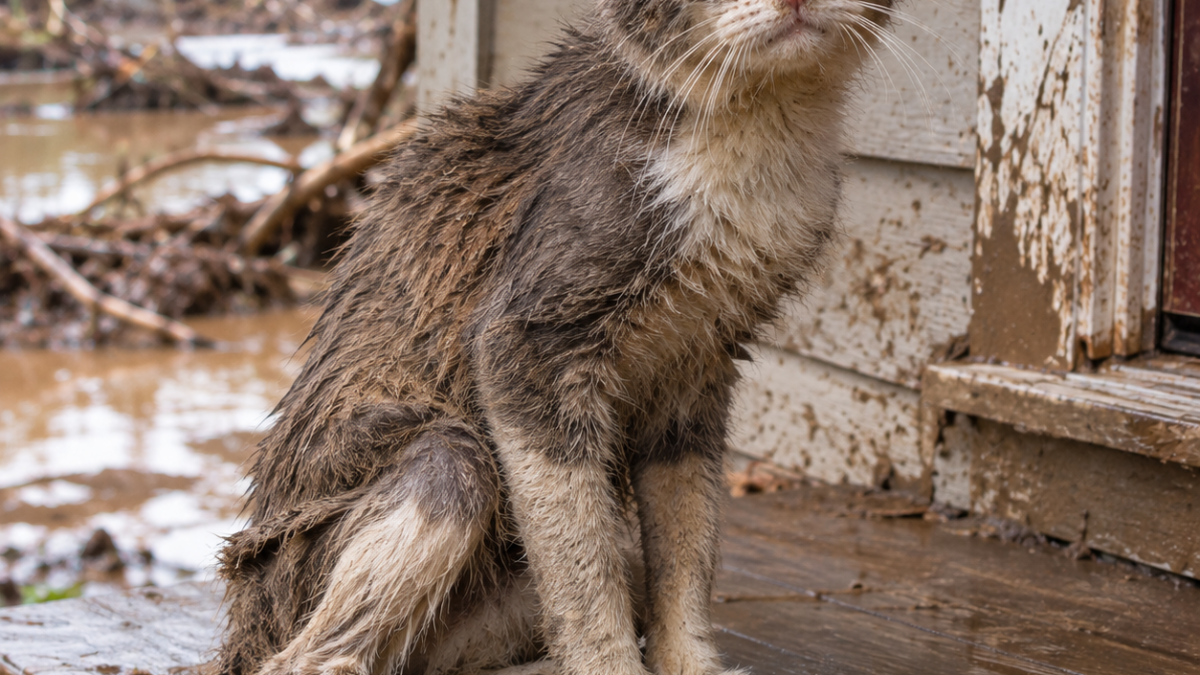
Mud covered his coat in hardened plates.
His hips protruded sharply.
White fur had turned brown-gray.
One eye cloudy.
Paws swollen.
And his right rear leg sat wrong.
Not dangling.
Not obviously shattered.
But the hip angle was unnatural.
When Daniel reached out, Arlo leaned forward.
Pressed his forehead into Daniel’s wrist.
That was when Daniel broke.
He put both hands around the cat.
Not lifting yet.
Just touching.
“You came back.”
Arlo tried to purr.
The sound came dry.
Almost silent.
Daniel cried so hard he couldn’t see.
“I’m sorry.”
“I’m sorry.”
“I’m sorry.”
He didn’t know what he was apologizing for.
Leaving.
Not finding him.
Giving up on day eight.
All of it.
Arlo attempted to stand.
His rear leg collapsed.
Daniel caught him.
The cat weighed almost nothing.
Daniel carried him to the truck.
Wrapped him in his jacket.
Then called Megan.
She answered sleepily.
“Hey.”
Daniel couldn’t speak.
“Daniel?”
He tried.
Nothing.
Her voice sharpened.
“What happened?”
“I found him.”
Silence.
“What?”
“Arlo.”
Megan inhaled.
Then:
“No.”
“He’s here.”
“No, Daniel.”
“He’s here.”
A sound came through the phone.
Half sob.
Half scream.
“Is he alive?”
“Yes.”
“Is he okay?”
Daniel looked at the body in his arms.
“No.”
“But he’s alive.”
Megan was crying.
“Where?”
“Porch.”
“He was sitting on the porch.”
That detail destroyed her.
“He came home?”
“Yes.”
“Daniel.”
“I know.”
“I’m taking him to Dr. Hayes.”
“I’ll meet you.”
“Bring the kids?”
Daniel looked at Arlo.
“Yes.”
“I think so.”
Blue Ridge Animal Hospital was twenty-five minutes away.
Daniel drove carefully.
Every pothole seemed cruel.
Arlo did not move from the jacket.
At one red light, Daniel put his fingers near the cat’s nose.
Breathing.
Still there.
“Stay.”
Same word he had used nine years earlier when the kitten fit inside one hand.
“Stay.”
Dr. Rachel Hayes met them at the clinic.
Megan arrived ten minutes later with Emily and Luke.
The children ran toward Daniel.
Then stopped when they saw Arlo.
Luke whispered:
“That’s not him.”
Emily said:
“Yes, it is.”
She knew the ear.
Dr. Hayes took Arlo immediately.
Weight:
Three pounds, eleven ounces.
The number silenced everyone.
He had weighed seven pounds, four ounces at his last annual exam.
Nearly half gone.
Severe dehydration.
Malnutrition.
Infected left eye.
Embedded thorns.
Cuts.
Paw damage.
And the hip.
X-rays showed a fracture-dislocation of the right rear hip.
Not fresh.
Dr. Hayes studied the image.
“This happened a while ago.”
“The flood?”
“Most likely.”
“And he walked on it?”
She looked at Daniel.
“He didn’t have another option.”
The bone had started healing in the wrong position.
Soft tissue had tightened around it.
Surgery would be complicated.
Possibly not useful.
First priority was survival.
Fluids.
Calories introduced gradually.
Antibiotics.
Eye treatment.
Pain control.
Clean the paw wounds.
Remove debris.
Warmth.
Emily stood beside the exam table.
“Did he walk home like that?”
Dr. Hayes crouched.
“We can’t know every step he took.”
“But yes.”
“He has been using that leg.”
“How long?”
“Judging by the healing?”
“Ten days.”
“Maybe twelve.”
Emily looked at Arlo.
“Why didn’t he stop?”
Dr. Hayes looked toward Daniel.
Then back at the girl.
“Animals stop for different reasons than we do.”
“That doesn’t answer.”
“No.”
The veterinarian smiled sadly.
“It doesn’t.”
A map came later.
Daniel showed Dr. Hayes where the floodwater had moved.
The main channel had swept debris south and east.
If Arlo had been carried or forced away from the property, he might have ended up several miles downstream before reaching stable ground.
A neighbor later found debris from the Miller barn nearly nine miles away.
Based on flood direction, plausible routes, and sightings, Dr. Hayes estimated Arlo had traveled roughly eleven miles to return.
Eleven miles sounds small in a car.
Fifteen minutes.
Maybe twenty.
For a starving cat with an injured hip and damaged paws, eleven miles becomes something else.
Creeks.
Fence lines.
Ditches.
Fields.
Road shoulders.
Predators.
Cold nights.
No map.
No explanation.
Only direction.
Arlo stayed at the clinic for five days.
The first two, he barely ate.
Then began licking food from a spoon.
On day three, Emily visited.
She sat beside the kennel and read aloud from a school book.
Arlo slept.
On day four, Luke brought his stuffed rabbit.
Wanted to leave it inside the cage.
Megan explained the clinic needed the space clean.
Luke compromised by setting it outside.
“Guard him.”
The rabbit performed adequately.
Day five, Arlo stood by himself.
Three legs mostly.
The right rear touched the floor only briefly.
Dr. Hayes smiled.
“Ready to go home.”
Megan asked:
“Which home?”
The question came out accidentally.
Everyone became quiet.
They did not have their real home anymore.
The damaged house had been gutted.
Walls opened.
Floors removed.
Furniture gone.
They were living in a rental with unfamiliar smells.
Arlo had traveled nineteen days to reach one door.
And they were about to take him somewhere else.
Daniel carried him to the truck.
At the rental, Arlo spent the first hour hiding beneath the dining table.
Then Emily lay on the floor nearby.
Said nothing.
Eventually Arlo crawled out.
Climbed with difficulty onto her lap.
Slept.
From then on, the children’s room became his territory.
They placed a folded blanket between the two beds.
No jumping required.
Water nearby.
Food.
Low litter box.
Arlo no longer climbed windowsills.
No longer reached kitchen counters.
No longer jumped onto the washing machine.
His hip remained permanently damaged.
He walked with a deep rolling limp.
Every third or fourth step, the right rear leg swung outward.
The cloudy left eye improved but never cleared completely.
The paw pads healed into thick rough scars.
Two teeth loosened from malnutrition and were eventually removed.
The cat who returned was not physically the same animal who disappeared.
Nobody expected him to be.
What surprised them was how little his personality changed.
He still disliked closed doors.
Still stole turkey.
Still slept on clean laundry.
Still ignored expensive cat beds.
Still demanded food twenty minutes before dinner.
Still woke Luke by walking across his chest.
Survival did not make him grateful.
The family loved him for it.
A week after Arlo returned, a woman named Helen Cooper called.
She lived about four miles south of the Miller property.
“I think I saw your cat.”
Daniel’s heart jumped.
“When?”
“About two weeks ago.”
She described a very thin gray-and-white cat crossing her pasture around dusk.
Moving north.
Slowly.
Favoring one rear leg.
“I didn’t think much of it.”
“We get barn cats.”
“But this one was strange.”
“How?”
“He wasn’t hunting.”
“Wasn’t looking around.”
“Wasn’t following the fence like cats usually do.”
“He just crossed.”
“Straight north.”
Daniel asked:
“Did he stop?”
“Not while I watched.”
“How long?”
“Maybe five minutes.”
“Just kept going.”
“Yes.”
The image stayed with Daniel.
Arlo crossing an open field at dusk.
Limping.
Alone.
No idea whether the house remained.
No way to know whether the family would be there.
Still moving north.
For fourteen months, the Millers rebuilt.
Not exactly.
You cannot rebuild “exactly” after water has moved through your life.
The new electrical outlets were higher.
Furnace relocated.
Lower walls used flood-resistant material.
Important documents moved upstairs.
Emergency kits prepared.
Weather alerts turned on automatically.
The porch was rebuilt stronger.
Daniel raised the foundation beneath one section.
Some furniture returned.
Some didn’t.
The dark waterline on the old living-room framing disappeared beneath new drywall.
But the family remembered where it had been.
Arlo came to the house during construction whenever it was safe.
Daniel brought him in a carrier.
The first visit, Arlo stepped onto the unfinished floor.
Sniffed.
Walked slowly through rooms.
Stopped where the old wood stove had been.
Then reached the front door.
Sat.
Daniel watched.
“You remember.”
Arlo looked toward him.
Then at the door.
When the family finally moved back home, Emily insisted Arlo enter first.
Daniel opened the front door.
Set him down.
Arlo walked inside.
Slowly.
Limping.
The children followed.
That first night, everyone expected him to sleep in their room.
He did.
On the floor between the beds.
But before settling, Arlo walked downstairs.
Across the new living room.
Out the open front door.
Onto the rebuilt porch.
He climbed one step.
Then another.
Stopped on the top step.
Same place where Daniel found him.
He sat facing outward.
Stayed there for almost twenty minutes.
Then came inside.
The next morning, he did it again.
And the next.
Every morning.
Top step.
Facing the valley.
Daniel began noticing the time.
Usually just after sunrise.
Arlo walked out.
Sat.
Watched.
Sometimes five minutes.
Sometimes an hour.
Rain rarely stopped him.
Cold did.
Heavy snow did.
But during reasonable weather, he kept the routine.
Megan once asked:
“What do you think he’s looking for?”
Daniel stood behind the screen door.
“I don’t know.”
“The way home?”
“He’s already home.”
“Maybe that’s why.”
Neither knew what that meant.
They left it alone.
Arlo lived four more years.
Those years mattered.
People tended to tell his story as though everything after the nineteenth morning were epilogue.
It wasn’t.
He lived.
That was the point.
He became older.
Grayer.
His limp deepened.
He learned to climb onto the couch by hooking his front paws onto the cushion and dragging himself up.
When he failed, he stared at whichever family member was closest until assistance arrived.
He refused pet stairs for six months.
Then used them only when nobody appeared to be watching.
His cloudy eye became more obvious with age.
Emily called it his moon eye.
Luke said it made him look like a pirate.
Arlo had no interest in either interpretation.
At eleven, he began spending afternoons in a square of sunlight near the front door.
At twelve, he stopped following the children to the barn.
At thirteen, he slept most of the day.
But every morning:
Porch.
Top step.
Outward.
The children grew around him.
Emily became eleven.
Then twelve.
Luke nine.
Then ten.
The flood became one of those family stories that children remember partly from experience and partly from repeated telling.
Emily remembered the church floor.
Wet socks.
Her father’s giant work boots.
Megan remembered the kitchen water.
Daniel remembered looking toward the porch as he drove away.
Luke remembered almost nothing.
But all of them remembered the nineteenth morning.
Even though only Daniel was there.
They had heard it so many times.
6:15.
Fog.
Dropped coffee.
Top step.
Waiting.
One year, Emily had to write a school essay titled:
“Home Means…”
She wrote about Arlo.
Her teacher asked whether the eleven-mile journey was exaggerated.
Emily brought the veterinary records the next day.
Megan was horrified.
“You brought his medical file to middle school?”
“She didn’t believe me.”
“That doesn’t mean you subpoena the teacher.”
Daniel tried not to laugh.
The essay ended with:
Maybe home is not the place where nothing bad happens.
Maybe it is the place you keep trying to return to after it does.
Daniel kept a copy in his toolbox.
Never told Emily.
Arlo became locally known.
Not famous.
The valley was too busy rebuilding to make celebrities.
But neighbors knew.
People visiting sometimes asked:
“That the flood cat?”
Daniel hated the phrase.
Arlo had a name.
Still, he understood.
One elderly neighbor came by after losing his wife.
Sat on the porch.
Arlo limped over.
Settled beside his boots.
The man stared toward the valley.
“You know something about coming back, don’t you?”
Arlo closed his eyes.
The man cried quietly.
Daniel stayed inside.
Not every moment requires witnesses.
Dr. Hayes saw Arlo twice a year.
Every visit included the same conversation.
“Hip?”
“Still terrible.”
“Pain?”
“Controlled.”
“Jumping?”
“Only when he forgets physics.”
“Weight?”
“Good.”
“Appetite?”
“Insulting.”
At twelve, Dr. Hayes said:
“He has done better than I expected.”
Daniel looked at Arlo.
“Story of his life.”
The flood changed Daniel too.
He never ignored weather warnings again.
Not one.
If the forecast said three inches of rain, he prepared as though the river had a personal grudge.
Megan teased him.
Then stopped because she understood.
Trauma often disguises itself as preparedness.
Some preparedness is useful.
Some is fear wearing work gloves.
Daniel slowly learned the difference.
For years, any hard rain woke him.
He would walk downstairs.
Check the creek gauge online.
Open the front door.
Arlo would often be sitting there.
Top step.
Looking outward.
Daniel began sitting beside him.
Neither did much.
Rain.
Dark.
Valley below.
Sometimes Daniel talked.
“I should have found you.”
Arlo cleaned one paw.
“I searched.”
No response.
“I gave up too soon.”
The cat switched paws.
“You probably don’t care.”
Arlo looked at him.
Daniel laughed quietly.
“Yeah.”
“I know.”
One night, nearly three years after the flood, rain hammered the roof.
Not dangerous.
Just loud.
Daniel woke from a dream about the front door filling with water.
Went downstairs.
Arlo sat on the top step beneath the covered porch.
Daniel sat beside him.
“You know what I think?”
The cat did not answer.
“I think you don’t remember it the way I do.”
Wind moved wet leaves.
“I think I remember leaving.”
“And you remember arriving.”
Arlo blinked.
Daniel felt something inside him settle.
That distinction changed him.
For Daniel, the flood story had always centered on failure.
Couldn’t find the cat.
Had to leave.
Couldn’t protect the house.
Couldn’t save possessions.
Couldn’t stop water.
For Arlo, if animals construct stories at all, maybe the ending was enough.
Door.
Porch.
Daniel.
Home.
Maybe survival did not require carrying the entire road afterward.
Daniel wanted to learn that.
When Arlo turned thirteen, his kidneys began declining.
Slowly.
Nothing unexpected.
Special food.
Medication.
More water.
Blood tests.
He tolerated treatment with the weary contempt of an animal who had survived a flood and considered pills beneath him.
At fourteen, the decline accelerated.
Arlo lost weight again.
Not like the nineteen-day journey.
Gradual.
Age.
His hip hurt more.
The stairs became difficult.
Daniel built a small ramp from the porch to the yard.
Arlo refused it for two weeks.
Then one morning used it.
Daniel said nothing.
Dignity.
Emily was fifteen by then.
Luke thirteen.
They understood.
One December evening, Arlo did not go to the porch.
Daniel noticed immediately.
The cat stayed on the children’s-room blanket.
Did not finish breakfast.
Megan sat beside him.
“He looks tired.”
Daniel knew.
They called Dr. Hayes.
Kidney failure.
Advanced.
Pain manageable.
Time short.
“How short?” Emily asked.
Dr. Hayes looked at the teenager.
“Could be days.”
“Maybe a week.”
Emily’s face changed.
Luke walked outside.
Daniel found him on the porch.
Top step.
Same place.
Luke stared toward the valley.
“He came all the way back just to die four years later.”
Daniel sat beside him.
“Everybody dies eventually.”
“That’s stupid.”
“Yes.”
“Then why come back?”
Daniel looked at his son.
“Because four years isn’t nothing.”
Luke wiped his face angrily.
“He slept with us.”
“Yes.”
“Watched Emily graduate middle school.”
“Yes.”
“Stole my sandwich last month.”
“Turkey.”
“Still.”
Daniel smiled.
“Four years is a life.”
Luke looked down.
“Not enough.”
“No.”
“It never is.”
Arlo’s final days were quiet.
He stopped eating much.
Still drank.
Still purred occasionally.
The family moved his blanket into the living room so he could be near everyone without walking stairs.
On the second morning, he stood.
Slowly.
Daniel watched.
Arlo crossed the room.
Reached the front door.
Daniel opened it.
The cat stepped onto the porch.
Moved to the top step.
Sat.
Facing outward.
The valley was frosted white.
Creek low.
Sun beginning behind the ridge.
Daniel sat beside him.
Megan came.
Then Emily.
Luke.
Nobody spoke.
Arlo remained there almost half an hour.
Then stood.
Turned.
Walked back inside.
It was the last time he went to the porch.
Dr. Hayes came to the house the next afternoon.
They did not make Arlo take one final car ride.
He lay on his folded blanket in the children’s room.
The same room where he had slept after returning from the flood.
Emily sat on one side.
Luke on the other.
Megan held his front paw.
Daniel kept one hand near the torn ear.
Dr. Hayes explained every step.
Arlo was calm.
Very tired.
Before the final injection, Daniel leaned close.
“Eleven miles.”
His voice failed.
He tried again.
“You didn’t have to do that.”
Emily started crying.
Daniel pressed his forehead against Arlo’s.
“But I’m glad you did.”
Arlo’s breathing slowed.
Stopped.
The room remained quiet.
Nobody moved.
Then Luke whispered:
“He made it home.”
Megan cried.
Daniel closed his eyes.
“Yes.”
“He did.”
They buried Arlo on the hill above the house.
Not beside the creek.
Not anywhere floodwater could easily reach.
Daniel chose a flat stone.
Emily chose the inscription.
ARLO
HE FOUND HIS WAY HOME.
Years passed.
The rebuilt house remained.
So did the porch.
The family eventually replaced the railing.
Painted the exterior.
Changed cars.
Children grew.
Emily left for college.
Luke learned a trade.
The valley healed in the imperfect way land heals.
New trees grew.
Creek banks changed.
Some scars remained obvious if you knew where to look.
Others disappeared beneath grass.
Daniel never removed Arlo’s old blanket from the children’s room.
Megan eventually folded it into a cedar chest.
Not because they needed a shrine.
Because some ordinary objects deserve not to be casually discarded.
The photograph remained too.
Not the worst one.
Not Arlo at three pounds, eleven ounces.
Not the clinic image where his hip twisted unnaturally.
Daniel kept a photograph from six months after the flood.
Arlo on the porch.
Scarred paw pads hidden beneath him.
Cloudy eye.
Gray-and-white fur clean again.
Sitting on the top step.
Facing outward.
That photograph told the story better.
Years later, when Luke was seventeen, a friend saw it.
“What’s wrong with his leg?”
“Broken hip.”
“How?”
“Flood.”
Luke explained.
House flooded.
Cat disappeared.
Nineteen days.
Eleven miles.
Three pounds, eleven ounces.
Friend stared.
“You’re saying he walked eleven miles with a broken hip?”
“Pretty much.”
“How did he know where to go?”
Luke shrugged.
“Home.”
The friend laughed slightly.
“No, I mean how?”
Luke looked at the picture.
“I don’t know.”
For years, Daniel had wondered the same thing.
Cats can navigate through scent.
Sun position.
Magnetic cues, perhaps.
Memory.
Familiar terrain.
Scientists could explain pieces.
But none of it fully captured what the family needed the story to mean.
Not supernatural.
Not magic.
Something simpler.
Direction.
Arlo had one.
North.
Up valley.
Toward the only family he had known since he fit in a palm.
Maybe he smelled familiar water.
Maybe recognized ridgelines.
Maybe followed roads.
Maybe memory came one landmark at a time.
Fence.
Field.
Hill.
Tree line.
House.
Or maybe home, for animals, is built less from addresses than from repeated belonging.
Hands that fed you.
Beds you slept beside.
Children whose footsteps you knew.
A porch warmed by morning sun.
A door that always opened.
Daniel liked that explanation.
Not because it was provable.
Because it fit what happened when Arlo finally arrived.
The cat did not claw the door.
Did not cry.
Did not collapse dramatically.
He sat.
Top step.
Facing the door.
Waiting.
As though the last nineteen days had been nothing more than a long delay.
As though he had completed his part.
The rest belonged to them.
Open the door.
Years after Arlo died, Daniel told the story to a neighbor who had recently lost his wife.
They sat on the porch.
Evening light over the valley.
The man had heard pieces.
Asked for the full version.
Daniel told him.
When he finished, the neighbor said:
“Eleven miles.”
“Yeah.”
“Nineteen days.”
“Yeah.”
“Broken hip.”
“Yeah.”
The man looked toward the creek.
“How does something that hurt keep moving that long?”
Daniel thought.
He had carried heavy things in his own life.
Financial trouble.
Fear.
The flood.
The memory of driving away while calling a cat’s name into rain.
Losing his parents.
Watching children leave home.
Grief does not all weigh the same.
But he remembered the moment at 6:15.
The cat.
Top step.
Almost skeletal.
Still upright.
Daniel answered:
“I think sometimes knowing where you’re going matters more than how badly the road hurts.”
The neighbor sat with that.
So did Daniel.
Then he looked at the porch step.
The same one.
Wood replaced once.
Paint newer.
But the place unchanged.
He could still see Arlo there if he let memory sharpen.
Small body.
Mud hardened across his back.
One cloudy eye.
Broken hip.
Paws nearly destroyed.
Looking straight at the door.
Daniel had spent years thinking the most heartbreaking part of the story was everything Arlo endured to reach them.
Eventually he understood something else.
The most beautiful part was that Arlo still expected the door to open.
After nineteen days.
After floodwater.
Pain.
Hunger.
Cold.
Distance.
He reached the house and sat down.
He trusted home to do the rest.
Eleven miles.
Nineteen days.
A shattered hip.
Three pounds, eleven ounces.
And one old gray-and-white cat who refused to stop moving until the place he loved was finally in front of him.
He did not need a new home.
He did not want a different family.
He did not know the house was ruined.
He did not know insurance paperwork or flood maps or rebuilding schedules.
He knew one thing.
This was where his people were supposed to be.
So he kept walking.
And when there was nowhere left to walk, Arlo climbed onto the porch, sat on the top step, and waited for someone he loved to open the door.








