A Cat Was Sealed Inside an Amazon Box With No Air Holes and Left Beside a Dumpster—Then at 6:18 A.M., a Store Employee Heard Him Clawing for His Life
PART3:
Nothing about it looked remarkable from twenty feet away.
Then I got out of the car.
Scratch.
Scratch.
Scratch-scratch-scratch.
I stopped.
“What the hell?”
Sarah looked at me.
Her face had gone pale.
“It was doing that when I got here.”
The box moved.
Barely.
One side flexed outward.
Then another frantic scrape came from inside.
I walked closer.
The box had been sealed completely.
Not folded shut.
Sealed.
Multiple strips of clear packing tape across the center seam.
Tape around both sides.
Tape along the bottom edges.
Whoever had closed it had not done so casually.
They had made sure it stayed closed.
I bent down.
No shipping label.
No holes.
No tears yet large enough for air.
“Did you open it?”
“I tried.”
Sarah held up her keys.
“The tape’s too thick.”
I ran my fingers along the sides.
“Anything sharp?”
“I have scissors in the store.”
“No time.”
The scratching started again.
Faster.
A muffled sound followed.
Not a meow exactly.
More like an exhausted cry trapped behind cardboard.
I pulled out my car key.
Started cutting.
The first layer barely gave.
“Come on.”
Sarah knelt opposite me.
“Careful.”
“I know.”
I cut one strip.
Then another.
The cardboard pushed upward from inside.
Whoever was in there had heard us.
Scratch.
Push.
Scratch.
The key slipped.
I swore.
Sarah grabbed the loose tape and pulled.
It stretched.
Tore.
We ripped the final section open together.
The flaps lifted.
Hot air came out first.
That is what I remember.
Hot, stale air.
Then smell.
Urine.
Blood.
Sweat.
Cardboard.
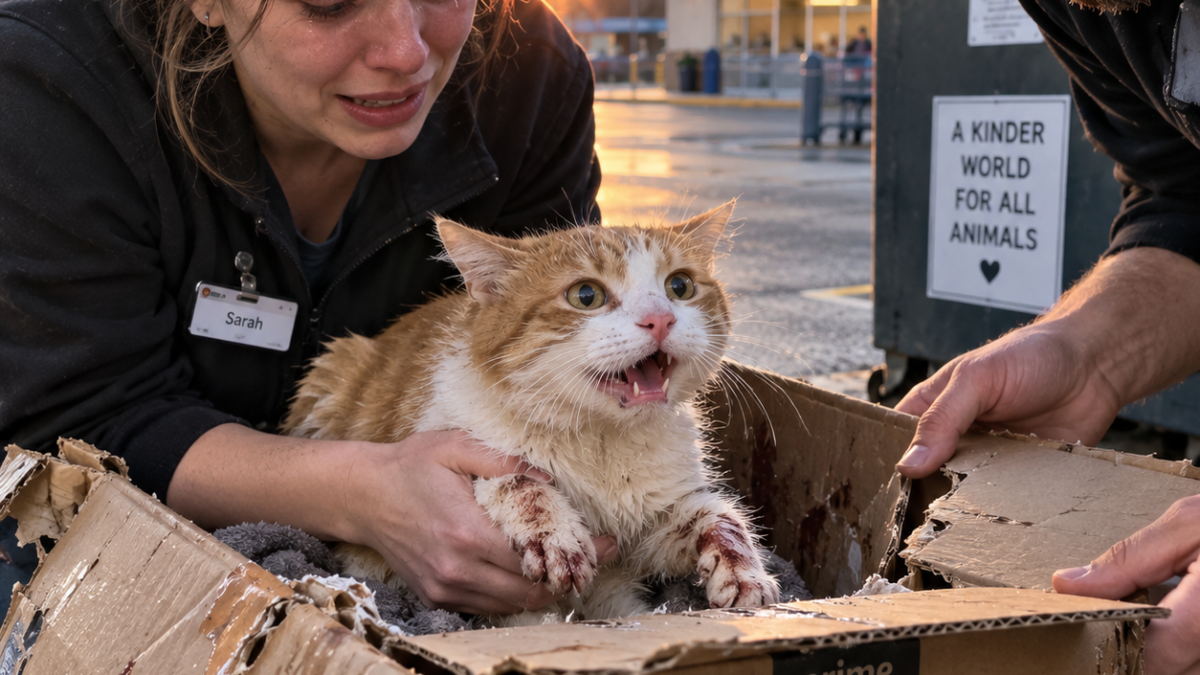
Inside, curled against one corner, was a cat.
Young.
Orange patches over the head and back.
White chest.
White front legs.
Maybe two years old.
He looked smaller because he had folded himself into the tightest shape possible.
His mouth was open.
Cats should not normally pant the way dogs do.
I knew enough to know that.
His tongue showed.
Breathing fast.
Eyes enormous.
Not angry.
Terrified.
The interior of the box looked shredded.
Long claw marks covered every wall.
Some had cut through the top layer of cardboard.
Tiny pieces littered the bottom.
Dark smears ran along one side.
Blood.
I looked at his front paws.
“Oh God.”
Both were raw.
Pads scraped.
Claws damaged.
Two nails appeared gone completely.
The tips of his toes were bloody.
Sarah made a sound behind me.
“Oh my God.”
The cat looked up.
Tried to stand.
His legs shook.
He collapsed.
“Don’t touch him yet.”
Sarah looked at me.
“He’s dying.”
“I know.”
“He needs out.”
“I know.”
I had no idea what I was doing.
That was the truth.
You find an injured animal and suddenly everybody expects instinct to replace training.
Do you lift?
Wait?
Use a towel?
Could he bite?
Could movement make something worse?
Then the cat tried again.
One front paw reached over the side of the box.
He was trying to climb toward us.
That answered the question.
Sarah took off her light cardigan.
Wrapped it around him carefully.
He did not fight.
Did not hiss.
Did not scratch.
The animal who had torn the inside of a cardboard box to pieces simply folded into her arms.
His head pressed against her chest.
Sarah started crying.
Quietly.
“Hey.”
She stroked the top of his head with one finger.
“You’re okay.”
I looked at the sealed box.
Then at the sunrise beginning over the shopping plaza.
The temperature was already around eighty-four degrees.
Twenty-nine Celsius.
At six-thirty in the morning.
Forecast called for mid-nineties.
The asphalt was only going to get hotter.
“How long could he have been in there?”
Sarah asked.
“No idea.”
She looked at the cardboard.
“He did all that?”
“Yes.”
The inside corners were torn where he had apparently tried pushing upward.
Several strips of tape were scratched from below.
He had spent hours trying to find weakness.
There had been none.
Sarah whispered:
“Who does this?”
I did not answer.
Because there is no satisfying answer to cruelty.
We always want motive.
Anger.
Desperation.
Ignorance.
Mental illness.
Something that makes the act fit inside a category.
But all I saw was a box somebody had deliberately taped shut.
No ventilation.
An animal inside.
Dumpster beside it.
Then a car driving away.
That was enough.
“We need a vet.”
Sarah nodded.
“Call.”
I opened my phone.
First clinic:
Closed until eight.
Second:
Voicemail.
Third:
No emergency services.
Sarah kept the cat against her.
His breathing remained rapid.
His head sagged.
“Daniel.”
“I’m trying.”
Fourth clinic had a recorded message forwarding emergencies to a hospital almost thirty minutes away.
I called.
A woman answered.
“Riverbend Emergency Veterinary Center.”
“We found a cat sealed in a box.”
Pause.
“Excuse me?”
“Cardboard box.”
“No air holes.”
“He’s panting.”
“Bleeding paws.”
“How long was he inside?”
“We don’t know.”
“Bring him now.”
“We’re thirty minutes away.”
“Use air conditioning.”
“Do not immerse him in cold water.”
“Do not force him to drink.”
“Keep him cool but not chilled.”
“Can he stand?”
“Barely.”
“We’re coming.”
I hung up.
Sarah was already walking toward her car.
“I’ll drive.”
“No.”
“What?”
“You’re holding him.”
“I can—”
“I’m driving.”
“What about the store?”
For the first time that morning, I remembered we had jobs.
Doors scheduled to open at eight.
Employees arriving in fifteen minutes.
Truck at seven.
I called our general manager.
He answered half asleep.
“Daniel?”
“Emergency.”
“What?”
“We found an injured cat sealed in a box behind the store.”
Long silence.
“You found what?”
“I need to take Sarah to the emergency vet.”
Another pause.
Then:
“Go.”
“What about opening?”
“I’ll call Marcus.”
“I can—”
“Go.”
Good manager.
That simple.
We transferred the cat into my back seat with Sarah beside him.
I kept the air conditioning cool.
Not freezing.
Sarah placed the cardigan beneath his body.
He had stopped panting quite as violently, but his breaths were still fast.
Every few minutes she whispered to him.
“You’re okay.”
“You’re okay.”
“You’re okay.”
At one red light, she looked at me.
“He’s not okay.”
“No.”
“I keep saying that.”
“I know.”
“What else am I supposed to say?”
“Nothing.”
She looked down.
The cat had pressed his forehead against her arm.
“I think he thinks I’m safe.”
“Right now you are.”
Sarah wiped her eyes.
“We’re keeping him.”
“We?”
She looked at me.
“I’m keeping him.”
“You have a landlord.”
“Pets allowed.”
“You travel at Christmas.”
“My sister lives ten minutes away.”
“You’ve known him nineteen minutes.”
She stared at me.
“So?”
Fair.
“You don’t even know if he survives.”
Sarah’s face changed.
“Don’t say that.”
“I’m not saying he won’t.”
“Then don’t say it.”
I nodded.
“Okay.”
We reached the clinic around 7:30.
A technician met us at the door with a carrier and towels.
The moment she saw the cat’s breathing, everything sped up.
“Treatment consent?”
“We’re not the owners.”
“Who is?”
“We don’t know.”
“Stray?”
“Abandoned.”
She looked at Sarah.
“Are you assuming financial responsibility?”
“Yes.”
Instantly.
No hesitation.
I looked at her.
She ignored me.
They took him through the back.
The door closed.
Then there was nothing to do.
That is one of the crueler parts of emergency rooms.
During the crisis, your body has tasks.
Cut tape.
Drive.
Call.
Hold.
Once professionals take over, all that adrenaline has nowhere to go.
Sarah sat.
Her cardigan had blood on it.
She stared.
I brought paper towels from the restroom.
“Here.”
She did not take them.
“That’s his blood.”
“Yes.”
“I know.”
She pressed both hands against her face.
“Sorry.”
“Why?”
“I’m losing it.”
“You found an animal sealed in a box.”
“Seems reasonable.”
She laughed once.
Then cried harder.
I sat beside her.
“What are you going to name him?”
She looked up.
“You’re doing that on purpose.”
“Yes.”
“So I stop thinking he’s dying?”
“Yes.”
She thought.
Then looked at the blood-stained cardigan.
“Prime.”
“No.”
“Why?”
“Too corporate.”
“Cardboard.”
“Terrible.”
“Amazon.”
“Lawsuit.”
She laughed again.
Then:
“Box.”
I looked at her.
“You’re naming the cat Box?”
“Yes.”
“That’s like naming a drowning victim Pool.”
Sarah frowned.
“Fine.”
Then, after two seconds:
“No, I like Box.”
“Of course you do.”
At 8:05, a veterinarian came out.
Dr. Elena Ruiz.
Mid-forties.
Dark hair tied back.
Scrubs.
Expression professional but softer than I expected.
“Who found him?”
“We did.”
Sarah stood.
“How is he?”
“Stable.”
One word.
Sarah exhaled so hard she had to sit again.
Dr. Ruiz continued.
“He’s dehydrated.”
“Moderate-to-severe heat stress.”
“His temperature was elevated, but we caught him before full heatstroke.”
“What about his paws?”
Sarah asked.
“Pads are abraded.”
“Two claws are avulsed.”
“Completely torn out.”
“We cleaned and bandaged everything.”
“Pain medication started.”
“Fluids.”
“Bloodwork looks surprisingly decent considering.”
“Is he going to make it?”
“I believe so.”
Sarah started crying again.
Dr. Ruiz crouched slightly so they were closer to eye level.
“He is very lucky.”
“How long was he in there?”
“We can’t know exactly.”
“Based on dehydration, temperature, bladder, stress, and the damage to the box…”
She paused.
“Probably several hours.”
“Three?”
“Maybe three to four.”
I looked at the clock.
“If we hadn’t found him until the store opened…”
“When?”
“Eight.”
Dr. Ruiz’s face became serious.
“Two additional hours in a sealed cardboard box sitting on asphalt after sunrise?”
“Yes.”
She shook her head.
“Very different outcome.”
Sarah closed her eyes.
“How different?”
Dr. Ruiz did not dramatize it.
She did not need to.
“Potentially fatal.”
Heatstroke.
Hypoxia.
Shock.
Organ damage.
She explained that cardboard itself is not airtight, but multiple tape layers and a sealed box with minimal airflow can still create a dangerous environment, especially under rising temperatures and with an animal exerting itself trying to escape.
“His own panic would increase heat production.”
She said.
“Open-mouth breathing in a cat is an emergency sign.”
“The combination of heat, stress, dehydration, and poor ventilation was becoming dangerous very quickly.”
Sarah whispered:
“Two hours.”
“Possibly less.”
The vet looked at us.
“You came at the right time.”
No.
Sarah came at the right time.
6:15.
Not 6:30.
That difference lodged in my head.
Fifteen minutes.
If she had arrived at her official start time, the box would have sat another fifteen minutes before anyone even parked near it.
Fifteen minutes is nothing in most days.
A shower runs fifteen minutes.
A coffee break.
A drive to work.
That morning, fifteen minutes felt like a wall between two endings.
Dr. Ruiz asked if we wanted to see him.
Sarah stood before the question finished.
Box was in a treatment kennel.
IV catheter in one front leg.
Both paws bandaged.
Eyes calmer.
Still wide.
When Sarah approached, he lifted his head.
Then came to the front.
Slowly.
She put her fingers through.
He pushed his nose into them.
Dr. Ruiz smiled.
“He remembers you.”
Maybe.
Maybe her smell was simply familiar after terror.
Maybe familiar was enough.
Sarah looked at me.
“He’s mine.”
“I know.”
“I’m serious.”
“I know.”
The clinic scanned him.
No microchip.
No collar.
No neuter tattoo.
He was estimated around two years.
Male.
Not severely underweight.
Which suggested he had likely been someone’s pet recently.
That fact made everything uglier.
A feral cat does not normally end up neatly sealed inside an Amazon box.
Someone had handled him.
Placed him inside.
Closed the flaps.
Added tape.
Again.
Again.
Again.
Then left him by a dumpster before sunrise.
The clinic contacted animal control.
We did too.
A report was filed.
The box became evidence.
I drove back to the store after ten.
Sarah stayed at the clinic.
Our general manager had saved the security footage.
Problem:
The area beside the dumpster was outside camera coverage.
Front cameras captured vehicles entering the lot.
But the rear service lane had blind spots.
Police reviewed available footage.
Several cars.
Delivery vans.
No way to identify which one left the box.
That frustrated everybody.
Sarah most of all.
“What if they do it again?”
She asked me that evening.
I did not have an answer.
“What if they have another animal?”
“I don’t know.”
“How can there be no camera there?”
“There will be now.”
The store owner approved one within forty-eight hours.
Not justice.
Prevention.
Sometimes that is what you get.
Box remained hospitalized overnight.
Sarah went home without him.
She said her apartment felt wrong even though the cat had never been there.
That is Sarah.
She had already reorganized her life around an animal she had held for twenty minutes.
By the next afternoon, Box was eating.
Wet food.
Very enthusiastically.
His temperature normal.
Kidney and liver values still okay.
Paws painful.
Bandages required.
Antibiotics.
Pain medication.
Restricted activity.
Dr. Ruiz said he could leave the next day if everything remained stable.
Sarah spent that night shopping.
Litter box.
Carrier.
Bowls.
Cat tree.
Bed.
Second bed.
Toys.
Scratching post.
Window hammock.
I called her.
“You know cats sleep in cardboard boxes.”
Silence.
“That was insensitive.”
“Yes.”
“Sorry.”
Then she laughed.
“I’m throwing every box away forever.”
“You work in retail inventory.”
“I’ll quit.”
Box went home with Sarah on Friday.
The irony of his name became darker once he entered an apartment filled with delivery packages.
For the first week, Sarah cut every cardboard box completely flat before bringing it inside.
She could not stand seeing him near one.
Box himself avoided them.
That was real.
Paper grocery bag?
Fine.
Laundry basket?
Fine.
Plastic storage bin?
Fine.
Cardboard shipping box?
He froze.
Then backed away.
His body remembered something even when we had no idea what story existed in his mind.
Sarah stopped ordering from Amazon for months.
Not because Amazon had anything to do with what happened.
Because the logo made her sick.
Trauma associates broadly.
Human and animal.
The first night at home, Box hid under Sarah’s couch.
Expected.
She placed food.
Water.
Litter nearby.
Then sat on the floor four feet away and read a book.
Did not reach.
Did not call repeatedly.
At midnight, he came out.
Ate.
Looked at her.
Went back underneath.
At three a.m., Sarah woke on the floor.
Something warm was pressed against her hip.
Box.
He had chosen the outside of the couch.
Not underneath.
Beside her.
By the end of the week, he slept on her bed.
By week two, he learned refrigerator sounds.
By week three, he learned Sarah’s alarm.
By week four, he discovered that 4:48 a.m. was an appropriate time to bite her toes.
Recovery came in small stages.
Bandage changes.
Paw soaks.
Veterinary checks.
The torn claw beds healed.
Dr. Ruiz warned the missing claws might regrow abnormally or not at all.
One eventually grew back.
The other never did properly.
Box always had one slightly strange toe.
Sarah called it his “battle foot.”
I told her that was dramatic.
She said:
“So is his entire life.”
Fair.
His pads healed.
Hydration normalized.
Weight remained good.
No permanent organ damage.
Full physical recovery, essentially.
Emotionally, there were clues.
Tape sound frightened him.
The first time Sarah used packing tape to wrap a gift, Box shot under the bed.
She called me crying.
“What did I do?”
“Nothing.”
“He’s terrified.”
“Then stop.”
“I did.”
“What now?”
“Give him time.”
She stopped using packing tape inside the apartment.
Scissors cutting cardboard also made him tense.
Eventually less.
Never completely gone.
But Box loved people.
That surprised us.
After what someone had done, I expected him to distrust strangers.
Instead, he greeted visitors.
Rubbed legs.
Jumped beside people.
Particularly Sarah.
Always Sarah.
If she sat, he appeared.
If she took a shower, he waited outside the bathroom.
If she came home from work late, he yelled until she picked him up.
People said:
“He knows she saved him.”
Maybe.
I do not know how animals conceptualize rescue.
I know he attached to her.
I know the first safe body he felt after hours in darkness belonged to Sarah.
Maybe that was enough.
The story spread after I posted a photograph.
I hesitated before sharing anything.
Police had an open investigation.
So no store name.
No exact city.
No address.
No identifying details.
Just the box.
The cat.
The truth.
I wrote what happened.
6:18.
Sealed package.
No ventilation holes.
Bloody paws.
Emergency vet.
Sarah adopting him.
The photograph showed the moment we first opened the flaps.
Box’s little orange-and-white head rising from shredded cardboard.
Mouth open.
Eyes huge.
One bloody paw on the edge.
I almost deleted the photo.
It felt invasive.
Then animal control asked whether sharing might encourage witnesses.
So I posted.
The reaction was enormous.
Anger first.
People wanted punishment.
Names.
Location.
Video.
Somebody to hate.
I understood.
Then came messages.
People telling stories about abandoned animals they found.
Cats in taped totes.
Puppies in dumpsters.
Rabbits in plastic bins.
That was worse.
Because Box was not unique.
The story people treated as unimaginable had happened in different forms many times.
A rescue worker messaged:
Please remind people never to abandon animals in sealed containers. Shelters and rescues have surrender processes. Even leaving an animal safely at a staffed location is different from trapping it without airflow.
I added that.
Another veterinarian wrote:
Open-mouth breathing in cats should be treated as urgent. Heat stress can progress rapidly.
Added that too.
Then came criticism.
Some people asked why Sarah lifted him instead of leaving him in the box until professionals arrived.
Fair question.
Others criticized driving him ourselves.
Some said we should have called police first.
People online always redesign emergencies after they know the outcome.
We had not known.
We heard scratching.
Opened a box.
Saw an overheating injured animal.
Called a veterinarian.
Went.
Could we have done something differently?
Probably.
Would I undo it?
No.
Box lived.
That does not mean our improvisation became universal instruction.
If anyone faces something similar, the best move is to contact emergency veterinary professionals or animal control and follow guidance based on the animal’s condition.
That is the boring version.
The useful version.
Sarah became locally famous as “Box’s mom.”
She hated it for about a week.
Then leaned into it.
Our store set up a small donation drive for the municipal shelter.
No corporate campaign.
Just a bin.
Cat food.
Dog food.
Towels.
Litter.
Toys.
Customers filled it.
Someone donated one hundred dollars with a note:
FOR ANIMALS WHO DESERVE BETTER THAN A BOX.
Sarah kept the note.
I think she still has it.
Three months after the rescue, Box returned to Riverbend for routine vaccines and neutering.
The clinic staff recognized him instantly.
“Box!”
Dr. Ruiz walked out.
He rubbed against her leg.
She laughed.
“You look significantly less terrible.”
Box meowed.
Sarah translated:
“He says thank you.”
“He said nothing of the sort.”
“No, he definitely did.”
The neuter went smoothly.
When Box woke from anesthesia, Sarah was waiting.
He came home the same day.
That evening she sent me a photograph.
Box asleep on a blanket.
Belly shaved.
Paws healthy.
Caption:
He survived another terrible betrayal by humans.
I replied:
You authorized this one.
She responded:
Details.
Months passed.
The investigation went nowhere.
No clear suspect.
No usable plate.
No confession.
I hated that.
I wanted the story to end with accountability.
Someone identified.
Charged.
Forced to look at what they did.
Real life does not owe stories satisfying endings.
Sometimes the person responsible disappears.
Then the responsibility shifts to what everyone else does afterward.
We added the camera.
Our neighboring stores did too.
Employees were told to check the rear lot during opening.
Animal control posted abandonment resources.
The shelter added secure after-hours surrender information to its website.
Small things.
Maybe they prevent the next box.
That has to count.
At six months, Box discovered snow.
Sarah opened the balcony door two inches.
He sniffed cold air.
Backed away.
Refused winter entirely.
Good judgment.
At eight months, he knocked a plant off her windowsill.
She texted me:
HE HAS BECOME UNGRATEFUL.
I replied:
FULL RECOVERY CONFIRMED.
At one year, we marked what Sarah called his “unboxing day.”
I told her the name was terrible.
She bought him chicken.
Box wore no costume because Sarah was not cruel.
We took one photograph.
Healthy orange-and-white cat sprawled across her couch.
Front paws stretched.
One claw missing.
Eyes half closed.
No fear.
That photo mattered to me more than the original.
The first photograph proved we found him.
The second proved he got to stop surviving.
There is a difference.
Survival is emergency medicine.
Life is knocking things over.
Demanding breakfast.
Sleeping sideways across somebody’s bed.
Screaming at birds.
That is what rescue is for.
The boring parts.
A year and a half after we found Box, Sarah had a bad morning.
Her father had been hospitalized unexpectedly.
She came to work anyway.
Wrong decision.
I found her in the stockroom sitting on an overturned crate.
“You need to go home.”
“I’m fine.”
“No.”
“I need the distraction.”
“You’re crying into paper towels.”
“Inventory paper towels.”
“Still counts.”
She went home.
Later she told me that when she walked through the apartment door, Box came running.
Normal greeting.
Then stopped.
She sat on the floor.
Box climbed into her lap.
Pressed his face beneath her chin.
Stayed there almost an hour.
Sarah told me:
“I held him that first day.”
“Now he holds me.”
Corny.
True.
Her father recovered.
Box remained.
People like symmetry.
The rescued becomes rescuer.
I try not to make animals into metaphors.
Box did not spend his days repaying a debt.
He did not owe Sarah emotional service because she saved him.
He was a cat.
Sometimes affectionate.
Sometimes indifferent.
Sometimes destructive.
That is healthier.
Love without debt.
The biggest change happened in me.
I had always thought cruelty announced itself loudly.
Violence.
Shouting.
People visibly hurting animals.
The sealed box changed that.
Cruelty can be quiet.
Neat.
Tape pressed smoothly along cardboard.
A package placed beside a dumpster before sunrise.
No witnesses.
Then drive away.
From fifty feet, it looked like trash.
Only the scratching made it different.
I started listening differently.
That sounds dramatic.
But I mean literally.
Sounds behind stores.
Movement near dumpsters.
Boxes that should not move.
Our whole opening crew did.
For months, any abandoned package became suspicious.
Most contained garbage.
Old clothes.
Broken dishes.
Once Marcus called me outside because a box was “making noise.”
We approached like bomb technicians.
Opened carefully.
Inside:
A battery-powered Halloween decoration somebody had thrown away.
It screamed when moved.
Sarah laughed until she cried.
“Not funny.”
“It’s a little funny.”
“No.”
Very funny, actually.
That moment mattered.
Because trauma loosened.
The parking lot became a parking lot again.
Not only the place we found Box.
Sarah took time longer.
Every morning she still looked toward the dumpster.
For a year.
Maybe more.
I asked once:
“What are you looking for?”
“Nothing.”
“You always look.”
She sighed.
“Making sure.”
That is what exposure does.
Makes safety something you verify instead of assume.
Box had similar habits.
Closet doors closing too loudly made him alert.
Shipping tape.
Large boxes.
Once Sarah moved apartments.
That was difficult.
Boxes everywhere.
She asked a feline behaviorist for advice before packing.
Best decision she made.
They created a separate safe room.
Used plastic bins when possible.
Kept one familiar space box-free.
Introduced moving supplies gradually.
Box tolerated it.
Not happily.
But no major panic.
The first night in the new apartment, Sarah did not unpack much.
Bed.
Food.
Litter.
Water.
Then sat on the floor.
Box explored.
Eventually climbed onto the windowsill.
Looked outside.
Moved to her lap.
Home established.
That was enough.
Two years after the rescue, Sarah got married.
His name was Andrew.
Nice guy.
Teacher.
Met Box on their third date because Sarah said:
“If the cat hates you, this is over.”
Box sniffed Andrew.
Walked away.
Sarah interpreted neutrality as approval.
Andrew eventually became favorite secondary human.
Never primary.
He accepted rank.
At their wedding, somebody gave them a decorative sign:
HOME IS WHERE THE BOX IS.
I objected on artistic grounds.
They hung it anyway.
When they moved in together, Andrew had a collection of online shopping boxes he liked saving for storage.
Not anymore.
Box outranked recycling habits.
They used clear plastic totes.
Adaptation.
That is what love looks like more often than grand gestures.
Not speeches.
Changing the type of storage container you use because your cat gets scared.
At three years, Box developed asthma.
Mild.
Probably unrelated to his abandonment according to the veterinarian.
Sarah immediately blamed the box.
Dr. Ruiz told her:
“Not everything in his future is caused by his past.”
Important sentence.
Humans do that too.
We turn trauma into the explanation for every later difficulty.
Sometimes asthma is asthma.
Box used inhaled medication when needed.
He hated the spacer mask.
Eventually tolerated it for treats.
No serious complications.
At four years, he became overweight.
This was considered excellent news by everyone except the vet.
“You need to reduce calories.”
Sarah looked offended.
“He almost starved.”
“Four years ago.”
“He has trauma.”
“He has fat.”
I laughed so hard Dr. Ruiz asked me to leave the exam room.
Box went on a diet.
Sarah suffered more.
He lost a pound.
Healthy.
At five years, our store renovated the back lot.
New dumpsters.
New lights.
Cameras covering every angle.
The old patch of asphalt where we found him disappeared beneath fresh paving.
I stood there one morning.
No marker.
No plaque.
Good.
I did not want the place preserved.
Places associated with terrible moments do not always need monuments.
Sometimes they need to become ordinary.
Truck route.
Dumpster.
Employees walking to work.
The important memory lived elsewhere.
In Sarah’s house.
Healthy cat.
That was the memorial.
A local reporter contacted us on the fifth anniversary.
Wanted a follow-up.
Sarah agreed only if the story focused on safe animal surrender.
She showed Box.
He was lying on the back of the couch.
Photographer tried getting him to look toward camera.
Box ignored everybody.
Perfect.
The article ran with a photo of him healthy.
Not the original bloody box image.
I liked that.
The headline was something like:
Five Years After Being Found Sealed in a Box, Rescue Cat Is Thriving
Better.
Less spectacle.
The reporter asked Sarah:
“Do you ever think about who left him?”
“Yes.”
“What would you say?”
Sarah thought.
“I used to think I wanted to scream at them.”
“And now?”
“I’d ask why they didn’t just ask for help.”
That answer surprised me.
No vengeance.
Just why.
Shelters.
Rescues.
Neighbors.
Social media.
Veterinarians.
Animal control.
So many imperfect but safer options.
Why choose tape?
Why remove every route out?
Why leave him beside garbage?
We never knew.
Maybe fear of judgment.
Money.
Cruelty.
Convenience.
The reason did not change the experience inside the box.
Box spent hours in darkness trying to live.
That fact remained.
The reporter asked me:
“What do you remember most?”
I could have said the blood.
The scratching.
The heat.
Instead:
“How fast he stopped fighting once Sarah held him.”
The reporter tilted her head.
“Why that?”
I thought.
“Because all that energy he used trying to escape just disappeared when he realized the hands touching him weren’t trapping him.”
Maybe that was projection.
But I remember his body.
Inside the box:
Frantic.
Claws tearing.
Breathing hard.
Sarah’s arms:
Collapsed.
Not unconscious.
Release.
He stopped trying to save himself because, for the first time in hours, he was not alone.
That image stayed.
Years passed.
Box grew from a young cat into a middle-aged one.
The scars on his paws became difficult to see.
One abnormal claw.
Tiny reminder.
Open cardboard boxes eventually stopped frightening him completely.
That was one of the strangest developments.
Around age seven, Sarah sent me a picture.
Box asleep inside a cardboard box.
I stared.
Called immediately.
“Is this real?”
She laughed.
“He climbed in himself.”
“You staged it.”
“I swear.”
The box was open.
Wide.
No tape.
One side cut low.
Box curled inside.
Relaxed.
I did not know how to feel.
Sarah said:
“I cried.”
“Of course you did.”
“He went in.”
“And came out?”
“Yes.”
“Twice.”
That mattered.
Choice changes the meaning of an object.
A closed box had been prison.
An open box could become bed.
Same material.
Different control.
That lesson felt larger than cats.
Safety is not always eliminating the thing connected to fear.
Sometimes it is restoring choice around it.
Box never liked tape.
That remained.
Fair enough.
Sarah kept the original cardigan.
The one with his blood.
I learned this years later.
“You kept that?”
“Washed.”
“Why?”
“I don’t know.”
“Evidence?”
“No.”
“Sentimental blood shirt?”
“Stop.”
She kept it folded in a storage bin.
Maybe like Karen’s blanket with Arthur.
Like collars.
Photographs.
Humans save objects from turning points.
We tell ourselves it is memory.
Sometimes it is proof.
This happened.
He was there.
I was there.
He lived.
I kept something too.
Not the original box.
Police kept it for a while, then disposed of it.
I kept my car key.
Of course I still needed it for the car until I sold it.
Afterward, I put that key in my desk drawer.
The edge was scratched from cutting tape.
Tiny damage.
Nobody would notice.
I did.
The key that opened a box.
Ridiculous object.
Still there.
When Box was eight, Sarah called me late one evening.
I assumed bad news.
“Daniel?”
“What happened?”
“Nothing.”
“Why are you calling at eleven?”
She was crying.
Great.
“What?”
“He’s sleeping.”
“Okay.”
“In a shipping box.”
Again.
“So?”
“I taped a package earlier.”
My chest tightened.
“What happened?”
“He watched.”
“Did he hide?”
“No.”
“He just watched.”
“And?”
“Then came over.”
I waited.
“I think he’s okay now.”
Sarah cried harder.
Not because Box had forgotten.
We cannot know what cats remember as narrative.
Because his behavior changed.
The trigger no longer controlled the room.
That is healing in observable form.
Years earlier:
Tape sound.
Under bed.
Now:
Watch.
Assess.
Stay.
Safe.
I told her:
“Good.”
Then:
“Go to sleep.”
“You’re emotionally unavailable.”
“It’s eleven.”
She hung up.
Box became twelve.
Then thirteen.
Orange fur lightened.
White around muzzle made no difference because he already had white.
He developed arthritis.
Mild kidney disease.
The ordinary senior-cat list.
Sarah and Andrew added pet stairs.
He ignored them for a month.
Then used them when nobody watched.
Cats maintain pride through plausible deniability.
At fourteen, he slept most of the day.
Still greeted Sarah.
Still hated clinic carriers.
Still loved chicken.
The anniversary posts stopped.
Good.
Not every year needs public remembrance.
Box’s story belonged to him now.
Not the internet.
I retired from retail before Sarah did.
Moved twenty minutes farther west.
We stayed friends.
I visited occasionally.
Box knew me—or at least tolerated my smell.
He never loved me like Sarah.
Fair.
I had cut the tape.
She had held him.
There is a difference.
One afternoon I sat on their couch.
Box climbed beside me.
Not on me.
Beside.
I scratched his cheek.
“Remember the dumpster?”
Andrew said:
“He definitely does not understand that sentence.”
“I know.”
Box closed his eyes.
“Good.”
I meant it.
Some things should not need remembering.
At fifteen, Box’s kidney disease worsened.
Sarah called me after the vet.
“He’s still comfortable.”
She began exactly like Laura had once called about Callie in another story I had heard.
People start difficult updates by reassuring the listener.
Fluids.
Special food.
Medication.
Box accepted.
Mostly.
Good months.
Then bad days.
Sarah did what everyone who rescues a young animal eventually has to face if they are lucky enough.
She watched him become old.
That is the deal nobody thinks about during emergency rescues.
You are desperate for them to live.
Then, if everything goes right, years later you must help them die.
Box reached sixteen.
Far beyond the two-year-old cat in the sealed package.
One morning he stopped eating.
Sarah knew.
The vet confirmed advanced kidney failure.
Treatment might gain short time.
Not meaningful recovery.
Sarah called.
“Can you come?”
Of course.
When I arrived, Box was on a blanket near the window.
Not hiding.
Thin.
Eyes tired.
Sarah sat on the floor beside him.
Andrew behind her.
I lowered myself.
“Hey.”
Box looked at me.
I held my hand near his nose.
He sniffed.
Then pressed his forehead lightly against my fingers.
Same trust.
Older body.
No blood.
No box.
Sarah whispered:
“Do you remember what I said that first day?”
“What?”
“He’s mine.”
I smiled.
“You said it before we knew if he would live.”
“I know.”
“That was insane.”
“I know.”
Box closed his eyes.
Sarah stroked his head.
“He was mine.”
I corrected:
“You were his too.”
That got me crying.
Great.
The veterinarian came to the house.
We did not take Box to the clinic.
He hated carriers enough.
He stayed on his blanket.
Window open slightly.
Warm air.
No cardboard anywhere.
The vet administered sedation.
Box relaxed.
His head rolled gently into Sarah’s hand.
She bent over him.
“You never have to be scared again.”
I almost told her he had not been scared for years.
Then understood.
She was talking to both versions.
The old cat.
And the young cat in the dark box.
She needed to say it once.
Box’s breathing slowed.
Stopped.
Sixteen years old.
Fourteen years after we opened the package.
Sarah stayed bent over him.
Andrew held her shoulders.
I sat nearby.
No dramatic lesson.
Death makes lessons feel insulting in the first minutes.
Later, there was room.
They cremated him.
Sarah kept his ashes in a wooden box.
I laughed when I saw it.
“What?”
She realized.
“Oh my God.”
“Box is in a box.”
“Shut up.”
For the first time since he died, she laughed.
Hard.
Then cried.
Both.
The urn was wooden.
No tape.
We approved.
On a small plate:
BOX
FOUND 6:18 A.M.
HOME FOREVER AFTER
I liked that.
Not:
Abandoned.
Not:
Nearly died.
Not:
Victim.
Found.
Home.
Those were the facts that mattered last.
The story occasionally resurfaces online.
People send it to me without knowing.
“Look at this awful thing.”
I reply:
“I was there.”
Then they ask:
“Is the cat okay?”
For years, I could say yes.
Eventually:
“He had a long life.”
That answer feels better than “he died.”
Because everybody dies.
The question is what came between the box and the end.
For Box:
Fourteen years.
Sarah.
Andrew.
Windows.
Food.
Vet care.
Claw regrowth.
No tape.
Then eventually open cardboard boxes chosen voluntarily.
Sunlight.
Beds.
Feet attacked at dawn.
A whole life.
People remember the fifteen minutes.
Sarah arrived at 6:15 instead of 6:30.
The difference between her routine and schedule.
The veterinarian saying another two hours might have changed everything.
Those numbers are dramatic.
But when I think about Box now, I do not think fifteen minutes.
I think fourteen years.
That is what those minutes opened.
Time.
Enough time to become ordinary.
Enough time to stop being “the cat from the box.”
Enough time for the worst morning of his life to become a story humans remembered more than he seemed to.
That is the outcome every rescue should want.
Not lifelong symbolism.
Ordinary life.
Box got it.
The original photograph is still on my phone somewhere.
I rarely open it.
Young face.
Open mouth.
Blood on cardboard.
People think it is the powerful image.
Maybe.
I prefer another.
Box around seven years old.
Asleep inside an open cardboard box.
One paw hanging over the edge.
Eyes closed.
Completely relaxed.
Nothing covering the top.
No tape.
He could leave anytime.
He stayed because he wanted to.
That photograph says more.
The first one shows what was done to him.
The second shows what no longer controlled him.
Whenever I tell the story now, that is where I end.
Not with whoever abandoned him.
We never found them.
Not with anger.
Anger had years and never produced a name.
I end with choice.
A sealed box.
Then an open one.
A cat who clawed until his paws bled because there was no exit.
Then years later, the same cat sleeping inside cardboard because every exit remained available.
That is what safety looks like.
Not never entering the frightening place again.
Knowing you can leave.
Knowing someone will open the door.
Knowing the hands reaching toward you are there to help.
At 6:18 that morning, Sarah heard tiny claws against cardboard because she arrived fifteen minutes early.
She could have ignored it.
Assumed trash shifting.
A rat.
Something somebody else would handle.
She stopped.
Called me.
We opened the box.
And I have thought about that simple sequence for years.
Hear.
Stop.
Look.
Open.
Sometimes that is all compassion is before it becomes anything larger.
Attention followed by action.
There were no cameras on that corner.
Nobody recorded the person who left Box.
But nobody recorded Sarah arriving either.
Cruelty happened unwitnessed.
So did the beginning of rescue.
That feels important.
Not every good act has an audience.
Sometimes the only witness is an animal who cannot tell anyone what you did.
You do it anyway.
Because something is scratching from inside a box.
Because you hear it.
Because once you hear it, walking away becomes a choice.
Sarah did not walk away.
Neither did I.
Years later, when Box was old and gray around the face, I asked Sarah whether she ever regretted saying “He’s mine” before knowing anything about him.
She looked offended.
“Obviously not.”
“What if he’d been difficult?”
“He was difficult.”
“More difficult.”
“He would’ve still been mine.”
“What if he hated people?”
“We’d figure it out.”
“What if he had expensive medical issues?”
“He did.”
“Fair.”
Then she looked at Box asleep near the window.
“I didn’t adopt him because I knew what kind of cat he’d become.”
That sentence stopped me.
“I adopted him because he was alive.”
Exactly.
Box did not have to earn the rescue by becoming affectionate.
He did not have to become a viral survivor.
Did not have to comfort Sarah.
Did not have to live fourteen years.
His life had value inside that box before we knew whether he would give anybody anything back.
I think that is the part people miss in animal rescue stories.
We love the transformation because it justifies the effort.
Abused dog becomes therapy dog.
Old shelter cat saves kittens.
Rescued cat comforts sick children.
But what if they do nothing extraordinary?
Still worth opening the box.
Still worth treating the paws.
Still worth giving water, shelter, food, time.
Box happened to become a wonderful companion.
That was not the price of admission.
He was alive.
That was enough.
The morning we found him, all I could see was damage.
Blood.
Heat.
Fear.
The end of his story could have been written there.
An anonymous animal beside a dumpster.
Nobody knows his name.
Nobody knows how long he scratched.
Instead, Sarah gave him a ridiculous name.
Box.
He got vet records.
A microchip.
A home address.
A favorite window.
A primary human.
A backup human.
A diet he complained about.
An urn.
A history.
A life went from anonymous to known.
That is what opening the box really did.
We did not just let air in.
We let a future out.
Fourteen years of it.
And every time I pass a dumpster behind a store now, I still listen.
Probably always will.
Most days, there is nothing.
Good.
I hope there is never another Box.
But if there is—
I hope somebody hears him.
I hope somebody stops.
And I hope whatever is sealed shut gets opened in time.








