A Cat Was Returned to the Shelter With a Note Saying “Too Boring”—Then a 74-Year-Old Woman Walked In Looking for Exactly the Kind of Cat Everyone Else Had Overlooked
PART3:
Some animals come back shattered. They howl, tremble, hide, refuse food, or cling to whoever opens the kennel door. Some look confused, searching every face for the person who left them. Some are angry. Some are terrified. Some seem relieved because whatever home they came from was worse than the shelter.
Douglas just looked like he had accepted one more quiet disappointment.
He walked into the kennel when I guided him.
He sniffed the blanket.
He turned in a small circle.
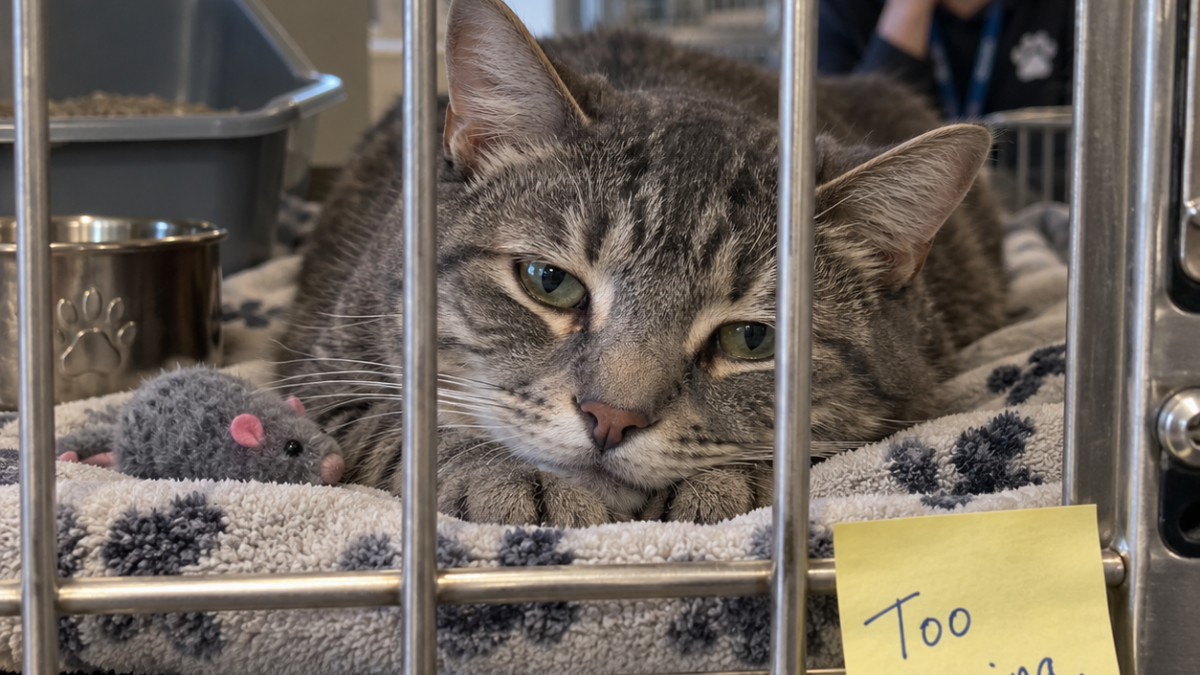
Then he lay down and rested his chin on his paws exactly the way he had in the carrier outside.
Like he was trying not to take up too much room.
I hated that.
I hated the sticky note more every time I saw him.
By nine, the shelter was open.
A few people came in to look at dogs. A woman dropped off donated towels. A man surrendered a litter of kittens he had found under his porch and apologized so many times I wanted to hug him. Life continued in the shelter’s usual rhythm of need, noise, hope, heartbreak, bleach, paperwork, and the occasional miracle.
Douglas watched it all from his kennel.
He did not press against the door.
He did not bat at passing shoelaces.
He did not meow for attention.
When people stopped, he lifted his head. If someone opened the kennel and petted him, he purred. When they moved on, he settled again.
A mother with two children paused in front of him that afternoon.
“Look, a gray kitty,” the little boy said.
The girl crouched.
“He’s just sitting.”
“He’s calm,” I said.
The mother smiled politely, then looked at the kitten cage behind me where three orange babies were climbing each other like tiny drunk pirates.
The children squealed.
They moved on.
Douglas lowered his chin.
I wished he did not understand.
Maybe he did not.
Maybe I was putting too much human hurt onto a cat who simply enjoyed lying down. But after eleven years in shelters, I can tell you animals know more than people want to admit. They may not understand sticky notes or adoption contracts, but they understand leaving. They understand being chosen and unchosen. They understand familiar smells disappearing. They understand cages.
That afternoon, our social media coordinator, Tasha, came in with her camera.
“We should post him,” she said.
“We should post the note too.”
I surprised myself by saying it.
Tasha looked at me.
“You sure?”
“Yes.”
“Some people will be cruel.”
“Some already were.”
She nodded slowly.
We cleaned the kennel window. We gave Douglas a fresh blanket, though he seemed indifferent to the color. Tasha crouched and took a picture of him lying there, chin on paws, eyes half-open, looking not sad exactly, but deeply still.
Then I taped the sticky note to the kennel door.
Too boring.
Blue pen.
Yellow paper.
A little public record of private carelessness.
Tasha photographed that too.
An hour later, the post went up.
Douglas was returned today with this note on his carrier. He is four years old. He is healthy. He is quiet. Apparently, that was the problem.
I thought maybe a few local supporters would share it.
I thought someone might comment, “Poor baby.”
I thought maybe, if we were lucky, the right person would see him in a week or two.
Instead, the internet found Douglas.
By dinner, the post had been shared over a thousand times.
By midnight, ten thousand.
By Wednesday, more than nineteen thousand.
The phone would not stop ringing.
Messages flooded in so fast Tasha had to recruit two volunteers just to help answer them. People wrote from Oregon, Maine, Texas, Arizona, Michigan, Florida, and places I had to look up because I could not believe anyone that far away cared about a quiet gray tabby in Raleigh.
I’ll take him.
Who returns a cat for being calm?
Douglas can be boring at my house forever.
My dream cat.
Tell Douglas I love him.
I’m boring too. We’d get along.
Some people were furious. Some were funny. Some shared pictures of their own “boring” cats sleeping in boxes, sitting on laundry, staring at walls, judging houseplants, and bringing peace to people who needed exactly that.
One older man wrote:
My wife had a cat like Douglas during chemo. He never did anything but sit beside her. That was everything.
I read that one twice.
Then three times.
Because that was what the couple who returned Douglas had not understood.
Not every animal arrives to entertain you.
Some arrive to steady the room.
Still, online attention did not guarantee the right home.
That was the part people outside shelter work often missed. Viral did not mean safe. Viral meant volume. It meant hundreds of people acting from emotion, some sincere, some impulsive, some wanting to be part of a story more than ready for a cat. It meant messages we had to sort carefully because Douglas had already been failed once by people who liked the idea of him more than the truth.
“He needs quiet,” I told Jenna.
“He needs someone who means it,” she said.
“Yes.”
Applications poured in.
Good ones.
Questionable ones.
One person wanted to adopt him as a “mascot” for their office because “boring cats are good for branding.” Rejected.
Another wanted him shipped across the country by the weekend. Rejected.
A family with four toddlers wanted him because he seemed “low maintenance.” Rejected gently.
A college student wrote a beautiful message but admitted she was moving twice in the next year and had never had a pet before. We encouraged her to volunteer first.
Through all of it, Douglas remained Douglas.
He did not know he was famous.
He did not know strangers were defending his honor in comment sections.
He did not know his little yellow note had become a symbol for every quiet creature who had ever been rejected for not performing enough.
He just slept.
Ate.
Purred when petted.
Watched the shelter with calm eyes.
On Thursday morning, Gloria walked in.
I noticed her before she reached the front desk.
She was seventy-four, though I learned that later. She wore a lavender coat buttoned neatly to her throat, dark slacks, and comfortable shoes. Her silver hair was pinned back. She walked slowly, not weakly, with the careful rhythm of someone whose knees had opinions. In one hand, she carried a brown purse. In the other, a folded newspaper clipping.
She approached the receptionist, Marlene, and said something that made Marlene look up sharply.
“I don’t want a playful cat.”
I was restocking adoption folders nearby.
I turned.
Gloria continued, “I want a cat who will just sit with me.”
There are sentences you hear in shelter work that make you stop what you are doing.
That was one of them.
Marlene smiled.
“You came about Douglas?”
Gloria unfolded the newspaper clipping.
The local paper had picked up his story that morning.
“Yes,” she said. “The one they said was boring.”
Her voice did not shake, but something in it did.
I stepped forward.
“I’m Pam. I’m one of the volunteers.”
Gloria looked at me.
“You found him?”
“Yes.”
“Outside?”
“Yes.”
“With the note?”
I nodded.
Her mouth tightened.
“That poor boy.”
Not cat.
Boy.
That told me something.
I led her toward the cat room.
As we walked, she told me she lived alone in a one-bedroom apartment about twenty minutes away. Her husband, Frank, had died three years earlier. They had been married fifty-one years. Their children lived in other states. She was not unhappy, exactly. She had church friends, neighbors, a book club she attended twice a month, and a niece who called every Sunday.
But the apartment was too quiet.
“It’s strange,” she said as we paused outside the cat room door. “When Frank was alive, we could sit in the same room for hours without talking, and it never felt lonely. After he passed, the silence changed.”
I looked at her.
“It got heavier?”
She nodded.
“Yes. That’s the word.”
Inside, Douglas was lying in his kennel.
Chin on paws.
The sticky note was still taped to the door.
Too boring.
Gloria stood in front of him for a long moment.
Her face did not crumple. She did not make a scene. She simply reached up and touched the glass gently with two fingers.
Douglas opened his eyes.
“Well,” Gloria whispered. “Hello there.”
His tail moved once.
Not wildly.
Just enough.
“Would you like to meet him?” I asked.
“That’s why I came.”
We brought Douglas into the visitation room.
It was a small space with two chairs, a bench, a cat tree, and a basket of toys that had seen better days. Many cats entered that room and immediately explored. Some hid under the bench. Some climbed. Some chased feather wands. Some sniffed every corner like detectives.
Douglas walked in, looked around, then sat.
Gloria lowered herself into the chair with a soft breath.
“Take your time,” I said.
“I have plenty,” she replied.
That sentence stayed with me.
Douglas looked at her.
She looked at him.
Neither seemed in a hurry.
After a minute, he stood and walked slowly across the room. He did not jump into her lap. He did not rub dramatically against her legs. He did not meow, perform, or audition.
He simply came to her feet.
Then he lay down beside her shoes and rested his chin on the toe of her left shoe.
Gloria covered her mouth.
I saw her eyes fill.
Not with sadness.
Recognition.
“Oh,” she whispered.
I looked away for a second because some moments are too private even when they happen in front of you.
Douglas closed his eyes.
Gloria lowered one hand and rested it lightly on his back.
He purred.
Soft at first.
Then steady.
The room settled around them.
It was the quietest adoption visit I had ever supervised.
It was also one of the most complete.
After ten minutes, Gloria looked at me.
“I’d like to take him home.”
“We have applications from all over the country,” I said gently, because I had to be honest.
She nodded.
“I imagine you do.”
“But I think…” I looked at Douglas, still resting against her shoe. “I think he may have just made his preference known.”
Gloria smiled through tears.
“I’m boring too, you know.”
“I doubt that.”
“No, I am. I like crosswords. Oatmeal. Old movies. Watching birds. Sitting with tea while the laundry runs. My grandchildren say my apartment is too quiet.”
She stroked Douglas’s back.
“Maybe he and I will be boring together.”
I had to step out of the room before I cried in front of both of them.
The paperwork took longer than the decision.
Gloria answered every question carefully. Yes, her building allowed cats. Yes, she had a veterinarian. Yes, she understood Douglas was quiet. No, she was not expecting a playful kitten. No, she would not declaw. Yes, she had a sunny window. Yes, she had time.
“What are you looking for in a cat?” the form asked.
Gloria wrote:
Company, not entertainment.
I made a copy of that line and kept it in Douglas’s file.
When we placed Douglas into a clean carrier, I braced myself for him to resist. He did not. He walked in, turned around, and sat.
But this time, there was no sticky note.
Gloria leaned down near the carrier door.
“We’re going home,” she told him.
Douglas blinked slowly.
That was his yes.
The next day, Gloria sent a photo.
Douglas sat on her lap in a brown recliner near a window. Sunlight fell across both of them. His chin was down. His eyes were half-closed. Gloria’s hand rested gently on his back. On the small table beside them sat a mug of tea, a pair of reading glasses, and a crossword puzzle folded in half.
They looked like they had been doing that for years.
The shelter posted the photo with Gloria’s permission.
Douglas was returned for being too boring. Gloria drove twenty minutes to adopt him because that’s exactly what she wanted.
Then Tasha did something that made all of us cry.
She placed the original yellow sticky note beside a new one.
The old note said:
Too boring.
The new note, written in the same blue pen, said:
Too perfect.
The post spread even farther than the first.
But this time, I did not care about the numbers.
I cared about the photo.
I cared that Douglas’s chin was resting against Gloria’s sweater.
I cared that his body looked relaxed in a way it never quite had inside the kennel.
I cared that Gloria’s hand curved protectively over his back.
I cared that a cat rejected for being peaceful had found a woman who needed peace more than excitement.
A week later, Gloria called with an update.
“He has a routine,” she told me.
“Already?”
“Oh yes. Breakfast at seven. Window time until nine. Nap on the blue blanket. Then he watches my game shows. He prefers the ones without yelling.”
“That sounds like Douglas.”
“He sleeps beside me now,” she added, softer.
My throat tightened.
“Does he?”
“Not on the bed at first. On the rug. Then the foot of the bed. Last night, he came up and slept against my hip.”
She was quiet for a moment.
“I didn’t realize how long it had been since another living thing slept near me.”
I pressed my fingers against my eyes.
“Gloria…”
“I’m all right,” she said. “I just wanted you to know he is not boring.”
“I know.”
“He is restful.”
That was the word.
Restful.
Some animals are fireworks.
Some are anchors.
Douglas was an anchor.
Over the next months, Gloria sent updates regularly.
Douglas sitting beside her while she read.
Douglas watching birds with grave concentration.
Douglas ignoring a toy mouse but sleeping on the paper bag it came in.
Douglas lying across the newspaper so she could not finish the crossword without acknowledging him.
Douglas on the arm of the recliner while Gloria watched old movies.
Douglas wearing, with visible disapproval, a tiny paper birthday hat on the anniversary of his adoption. Gloria later admitted he wore it for seven seconds and then sat on it.
The best update came in winter.
Gloria left a voicemail because she said she was too emotional to type.
“Pam,” she said, “I had a bad day yesterday. It was Frank’s birthday. I thought I’d be fine, but grief is rude. It comes in without calling first.”
I sat down in the shelter break room and listened.
“I cried in the recliner. Douglas was in the window, and I suppose he heard me. He came over, climbed into my lap, and put his chin right here.”
Her voice broke.
“Right on my wrist. Like he was holding me down to earth.”
She laughed softly.
“Too boring. Can you imagine?”
No.
I could not.
Or maybe I could.
Because the world often misnames gentleness.
It calls quiet people dull.
Calm animals boring.
Steady love ordinary.
Peace emptiness.
It mistakes noise for value and performance for personality.
Douglas did not demand attention, so someone decided he had nothing to offer.
Gloria understood better.
She had lived long enough to know that not every gift arrives loudly.
Some gifts simply sit with you when the room is too quiet.
Six months after his adoption, Gloria brought Douglas back to the shelter for a visit during one of our volunteer appreciation days.
She carried him in a soft carrier lined with a blue blanket. When she opened it in the quiet office, Douglas stepped out, stretched, and looked around.
For one strange second, my heart clenched.
Would he remember?
Would he think he had been returned again?
But Gloria sat down, and Douglas immediately walked to her, leaned against her ankle, and settled there.
He knew who he belonged to.
That was enough.
Everyone came to see him.
Jenna cried.
Miguel pretended not to.
Tasha took too many photos.
Marlene gave Gloria a printed copy of the “Too perfect” post in a frame.
Gloria held it for a long time.
“I want to tell you something,” she said to us.
We quieted.
“When Frank died, everyone told me to stay busy. Join things. Travel. Take classes. Do lunches. Go places. And I did some of that. But what I missed most was not activity. It was presence.”
She looked down at Douglas.
“I missed someone being there when I made coffee. Someone breathing in the room. Someone making small sounds in the quiet.”
Douglas blinked slowly, uninterested in the emotional importance of the moment.
Gloria smiled.
“This cat does not entertain me. He accompanies me. There is a difference.”
I wrote that down later.
He accompanies me.
That was Douglas’s whole heart.
Before she left, Gloria asked for the original sticky note.
We had kept it in a plastic sleeve in his file.
“Are you sure?” I asked.
“Yes.”
I handed it to her.
Too boring.
She looked at it for a long time.
Then she folded it once and tucked it into her purse.
“I’m going to put it in his scrapbook,” she said.
“You’re making him a scrapbook?”
“Of course.”
“Does he know?”
“He supervises by sleeping on the supplies.”
“That sounds right.”
A year after Douglas went home with Gloria, the shelter held a small adoption event called “Perfectly Imperfect.” It featured senior pets, shy pets, calm pets, bonded pairs, three-legged pets, one-eyed pets, pets who needed medication, pets who did not sparkle on first meeting but had whole worlds inside them if given time.
Douglas became the unofficial face of the event.
Not because he attended. Gloria said crowds were not his preference, and we all respected that. But she allowed us to use his story. His photo sat on a poster near the entrance.
Returned for being “too boring.” Adopted for being exactly enough.
That day, a ten-year-old cat named Mabel found a home with a widower who wanted someone to sit beside him while he watched baseball.
A shy black cat named June went home with a librarian who said she liked earning trust slowly.
A bonded pair of senior tabbies were adopted by a retired couple who said their house had enough sunny windows for two.
A quiet orange cat named Biscuit, who had been overlooked for months because he hid whenever children ran past, was adopted by a night-shift nurse who wanted a calm companion for daytime sleep.
By closing time, six of our “boring” animals had homes.
I thought of Douglas all day.
The cat who did nothing.
The cat who changed everything.
That evening, I called Gloria.
“Douglas helped six animals get adopted today,” I told her.
“He’s asleep in a laundry basket,” she said.
“Of course he is.”
“I’ll tell him when he wakes up.”
“Do you think he’ll be proud?”
“No. I think he’ll want dinner.”
We both laughed.
Then Gloria said, “Pam?”
“Yes?”
“Thank you for seeing him.”
I looked across the empty shelter lobby, where the evening light stretched across the floor and the kennels were, for once, a little less full.
“He made it easy.”
“No,” she said. “He made it quiet. People miss quiet all the time.”
She was right.
People do.
I almost missed him too, in a way.
Not that morning on the doorstep. I found him. I cared for him. I defended him in my heart. But even I saw him first through the cruelty of the note. Too boring became the frame around him. The insult became the story.
Gloria saw past the frame.
She saw the cat.
That is what love does when it is wise.
It does not need the world to make something look valuable first.
Douglas lived with Gloria for many years.
He never became playful in the way his first adopters had wanted. He never learned tricks. Never chased feather toys with dramatic leaps. Never knocked books off shelves for attention. Never became a social media clown or a chaos gremlin or a cat who made guests say, “Wow, what a personality.”
He remained exactly himself.
He sat beside Gloria during morning coffee.
He slept on the back of the recliner during old movies.
He supervised laundry.
He warmed her lap during winter.
He pressed his chin against her wrist when she cried.
He greeted her at the door after every grocery trip with a soft chirp that was about as excited as he ever got.
He became, in the plainest and holiest way, company.
And because of him, Gloria’s apartment changed.
Not physically, not much. Same brown recliner. Same lace curtains. Same crossword books stacked near the lamp. Same framed photo of Frank on the table.
But the silence changed.
It was no longer empty.
It had a heartbeat inside it.
One spring afternoon, Gloria sent me a photo of Douglas sitting on the windowsill, watching rain slide down the glass. Beneath it, she wrote:
He makes quiet feel safe.
I printed that message and taped it inside my locker at the shelter.
I still look at it on hard days.
On days when someone returns a dog because it grew too big.
On days when kittens arrive sick.
On days when a senior cat waits and waits because everyone wants young and playful.
On days when I find myself angry at people who treat animals like products and shelters like return counters.
He makes quiet feel safe.
That is enough to keep going.
Years later, when Douglas passed peacefully in Gloria’s apartment at the age of twelve, she called me before she called anyone else.
Her voice was calm in the fragile way people sound when grief has not fully landed yet.
“He went in his sleep,” she said. “In the recliner. On my lap.”
I closed my eyes.
“I’m so sorry.”
“He had breakfast,” she said. “He watched the birds. He had a good morning.”
“He had a good life.”
“Yes,” she whispered. “He did.”
A week later, Gloria came to the shelter with a small envelope.
Inside were two sticky notes.
The original yellow one, faded now, edges curled with age.
Too boring.
And the second one she had written the day after adopting him.
Too perfect.
She had placed them back to back in a little frame.
“I want you to have this,” she said.
I could not speak for a moment.
“Are you sure?”
“Yes. I have all his photos. His blanket. His scrapbook. But this belongs here.”
I hung the frame in the staff room.
Not in the lobby.
Not as decoration for visitors.
For us.
For the people who cleaned kennels before dawn. For the volunteers who carried returned animals inside. For the staff who read cruel notes and still opened doors gently. For everyone who needed to remember that one person’s rejection was not the final truth.
Too boring.
Too perfect.
Both notes.
Same cat.
Different hearts reading him.
That is the lesson Douglas left behind.
Animals do not become worthless because the wrong person cannot recognize their worth.
People either.
Quiet does not mean empty.
Gentle does not mean dull.
Calm does not mean lacking.
A creature does not have to perform to deserve love.
Some souls are fireworks, and we love their sparkle.
Some souls are storms, and we admire their force.
But some are warm lamps in dark rooms.
Some are steady breathing beside you.
Some are a chin resting on your shoe, asking for nothing but permission to stay.
That was Douglas.
A gray tabby left outside a shelter before opening with a sticky note that tried to reduce his whole life to two careless words.
Too boring.
But the world was louder than that note for a while.
Then Gloria was wiser than it forever.
She did not want entertainment.
She wanted presence.
And Douglas, who had been returned for offering too little, gave her exactly what she needed most.
A quiet room that no longer felt empty.
A lap that no longer felt unused.
A grief that no longer had to sit alone.
A love so gentle some people might have missed it entirely.
But Gloria did not miss it.
She drove twenty minutes, sat down in a visitation room, and waited.
Douglas walked over.
He lay beside her feet.
He rested his chin on her shoe.
That was all.
That was everything.
And ten minutes later, he went home.








