A Cat Was Left for Dead in a Roadside Ditch—One Year Later, She Walked Across a Show Stage and Left Every Judge Speechless
PART3:
He stepped into the ditch, boots sinking into cold mud.
“Oh, sweetheart,” he whispered before he knew he was speaking.
The injuries were so severe his mind refused to accept them all at once.
Large sections of her body were exposed and raw.
Mud and tiny stones clung to places that should have been protected by skin and fur.
Her back, sides, hind legs, and the base of her tail were damaged beyond anything Hank could make sense of.
Only her face, chest, and front legs still looked like the cat she had been before cruelty found her.
Hank had hauled livestock once, years earlier.
He had seen farm injuries.
Road injuries.
Predator injuries.
This was none of those.
This had been done.
Deliberately.
His stomach turned so hard he had to swallow twice.
The cat’s eyes followed him.
Not pleading.
Not trusting.
Just aware.
That nearly destroyed him.
“It’s all right,” he said, though nothing about it was.
“I got you.”
He took off his high-visibility vest and lowered it gently over her body.
He expected her to fight or flinch.
She did neither.
When he slid his hands beneath her, she was cold, shockingly light, and trembling so faintly he felt it only because his palms were pressed against what remained of her warmth.
He carried her to the cab of his truck and laid her across the passenger seat on the vest.
For several seconds, he stood there with his hand on the doorframe, unable to move.
Then the cat blinked.
Slow.
Exhausted.
Alive.
Hank slammed the door, climbed into the driver’s seat, and grabbed his phone.
The nearest emergency veterinary hospital was sixteen minutes away.
He made it in nine.
He broke every speed limit between the ramp and the clinic.
Later, when an officer reviewing traffic camera footage asked if he understood how fast he had been driving, Hank said yes.
The officer asked if he would do it again.
Hank said, “In a heartbeat.”
By the time he carried her through the glass doors of Cumberland Emergency Veterinary Hospital, his shirt was soaked from the mud and fluids on the vest.
His hands shook so badly he could barely keep hold of her.
The receptionist looked up.
Her face changed.
“I need help,” Hank said.
That was all he could manage.
A veterinary nurse came from the back at a run.
Her name was Clara Whitcomb.
She had been working emergency veterinary medicine for almost fourteen years, which meant she had seen hit-by-car cases, neglect, infections, broken bones, starvation, and the thousand quiet ways animals paid for human carelessness.
But when Hank unfolded the vest enough for her to see the cat, Clara stopped breathing for one full second.
Not because she was inexperienced.
Because experience did not make horror smaller.
It only taught you what to do while horror stood in front of you.
“Treatment room one,” Clara said, and her voice was steady because the cat needed steady.
“Now.”
The team moved fast.
Warm fluids.
Pain control.
Oxygen.
Sterile drapes.
Blood pressure.
Temperature.
Gentle hands.
The cat did not fight them.
That frightened Clara more than fighting would have.
Animals who still had strength often resisted, even when help arrived. They scratched, bit, twisted, protested the indignity of needles and gloves and strangers. This little cat simply lay there, eyes open, body shaking, as if her strength had retreated deep inside and locked the door.
Dr. Adrian Vale, the lead surgeon on call, entered the room and went silent.
He was a careful man, not dramatic, not sentimental in public. He believed emotion belonged in medicine, but not in the driver’s seat. That morning, even he pressed one hand against the metal table and took a breath.
“How long has she been like this?” he asked.
Hank stood near the wall, pale beneath his road-weathered skin.
“I don’t know. I found her in the ditch.”
Dr. Vale examined her injuries with a focus so intense the room seemed to narrow around him.
“This wasn’t an animal attack,” Clara said softly.
“No,” he answered.
Nobody said more.
Not then.
There would be time for reports, photographs, forensic evaluation, and law enforcement. There would be time for anger. There would be time for questions nobody wanted answered.
Right now, there was only the cat.
Her temperature was dangerously low. She was in shock. Her exposed tissues were contaminated with mud, gravel, and road debris. Infection was not a possibility; it was almost a promise. Her body had lost too much protection. Too much fluid. Too much warmth.
Clara looked at the monitor.
“What are her chances?”
Dr. Vale did not answer quickly.
That told her enough.
“Five percent?” she asked.
He looked at the cat’s face.
“Maybe.”
Hank gripped the back of a chair.
“Can you save her?”
Dr. Vale looked at him, then at the cat.
“I don’t know.”
Hank’s jaw tightened.
“But you can try.”
The room went quiet.
Dr. Vale had performed surgeries under pressure. He had opened animals who were bleeding internally, repaired shattered legs, removed tumors, rebuilt jaws, and kept his hands steady when owners sobbed outside the operating room.
But this case was different.
For the first and only time in his career, he considered euthanasia not because the cat was medically hopeless, but because the suffering in front of him was almost too large to ask any living creature to endure.
The cat blinked again.
Clara placed one gloved finger near the cat’s front paw.
The paw shifted, barely touching her.
Not grabbing.
Not even holding.
Just contact.
Dr. Vale closed his eyes for half a second.
Then he said, “Prep surgery.”
The first operation lasted six hours.
Six hours of cleaning wounds so carefully every motion felt like an apology.
Six hours of removing debris.
Six hours of cutting away dead tissue while preserving everything that still had life.
Six hours of keeping her warm, keeping her pressure stable, keeping her pain controlled, keeping the fragile thread between her body and the world from snapping.
When the largest exposed areas were finally clean enough, Dr. Vale applied a temporary biological covering, a medical collagen matrix used to protect raw tissue and support healing. It was not a miracle. It was not a new body. It was a bridge.
That was all they had to build at first.
A bridge from that night to the next morning.
Clara stayed past the end of her shift.
Nobody asked her to.
Hank stayed too.
He sat in the waiting room with dried mud on his jeans and both elbows on his knees, staring at nothing. At some point, a staff member brought him coffee. It went cold in his hands.
When Dr. Vale finally came out, Hank stood so quickly the chair scraped the floor.
“She survived surgery,” the surgeon said.
Hank’s face crumpled.
Just for a second.
Then he covered it with one hand and turned away, embarrassed by his own relief.
Dr. Vale continued gently.
“She is not out of danger. Not close. The next forty-eight hours matter. Infection, shock, organ stress, pain response—we have to watch all of it.”
Hank nodded.
“What’s her name?”
“We don’t know.”
“No collar?”
“No chip.”
Hank looked toward the treatment area doors.
“She needs a name.”
Clara, standing beside Dr. Vale, had not intended to speak.
But the word came to her before she could stop it.
“Lumen.”
Both men looked at her.
She swallowed.
“It means light.”
Hank looked toward the doors again.
“Lumen,” he repeated.
The name stayed.
For the first four months, Lumen looked like a tiny mummy.
Bandages wrapped nearly her entire body from behind her ears to the base of her tail. Only her face, chest, and front legs remained visible. Tubes, dressings, medication schedules, wound charts, temperature checks, and pain assessments became the architecture of her life.
She underwent surgery after surgery.
Fourteen more procedures over eight months.
Skin grafts.
Flap advancements.
Scar revisions.
Debridements.
Rechecks.
Repairs.
Every operation rebuilt a small piece of what had been taken.
Every recovery lasted weeks.
Every bandage change required patience so deep it became almost sacred.
Clara had changed hundreds of wound dressings in her career. She knew the pain that could come with them even when medication was given, even when hands were gentle, even when every person in the room moved with care.
Lumen never bit.
Not once.
The first time Clara changed her bandages after the initial surgery, she expected fear. She expected panic. She expected the little cat to reach the end of her tolerance and lash out because pain makes prisoners of even the gentlest creatures.
Instead, Lumen purred.
Faintly.
Continuously.
Almost too soft to hear over the hum of the treatment room.
Clara froze.
“Do you hear that?”
The technician beside her looked down.
“She’s purring?”
Lumen’s eyes were half closed. Her body trembled. Her pain medication was working, but no medication erased everything. Still, she purred as Clara lifted the dressing, cleaned the wound edges, and whispered apologies she knew Lumen could not understand.
Or maybe she did.
The purring happened again the next time.
And the next.
And the next.
Word spread through the hospital.
Not in a sensational way.
Quietly.
Staff members began checking on Lumen between appointments. The overnight techs lowered their voices near her kennel. Receptionists asked about her before taking off their coats. Dr. Vale, who never played favorites, spent suspiciously long minutes reviewing her chart.
Hank visited every Friday.
At first, he stood awkwardly near her kennel, cap in both hands.
“Hey, Lumen,” he would say, his rough voice suddenly gentle. “Still bossing everybody around?”
She would blink at him.
Eventually, she began lifting her head when he came in.
Later, she pressed one front paw against the kennel door.
The first time she did that, Hank had to step into the hallway.
Clara found him there, wiping his face with a red bandana.
“Allergies?” she asked softly.
He gave her a look.
“To cats, apparently.”
Clara did not smile until he did.
Donations began after the local news ran a short segment.
At first, the hospital hesitated to share her story publicly. They did not want Lumen turned into spectacle. They did not want cruelty to become entertainment. But medical care like hers cost money, and no shelter budget had been built for a case this severe.
So Clara wrote a careful post.
No graphic photos.
No shocking headline.
Just Lumen’s face, white and small above her bandages, eyes bright despite everything.
She needs long-term care. She is safe now. She is fighting. If you want to help, donations can be made directly to Cumberland Emergency Veterinary Hospital.
The town responded.
Then the county.
Then strangers.
A kindergarten class sent a card covered in crooked hearts and paw prints.
A retired woman mailed five dollars in cash with a note that said, “It isn’t much, but I want her to know old ladies are rooting for her.”
A tattoo shop held a fundraiser.
Hank’s trucking company quietly paid one of the surgical invoices and threatened to deny it if thanked publicly.
Lumen survived the first week.
Then the first month.
Then the second.
Her body did not heal smoothly.
Healing rarely does.
There were infections to fight. Grafts that took. Grafts that failed. Scars that tightened. A fever that made Clara sit beside her kennel for an entire night, counting breaths and bargaining with a God she had not spoken to regularly in years.
“Not after all this,” she whispered. “Please. Not after all this.”
Lumen opened her eyes and purred.
Weak.
Stubborn.
Present.
The fever broke before dawn.
By spring, some of Lumen’s fur had begun to grow back.
Not everywhere.
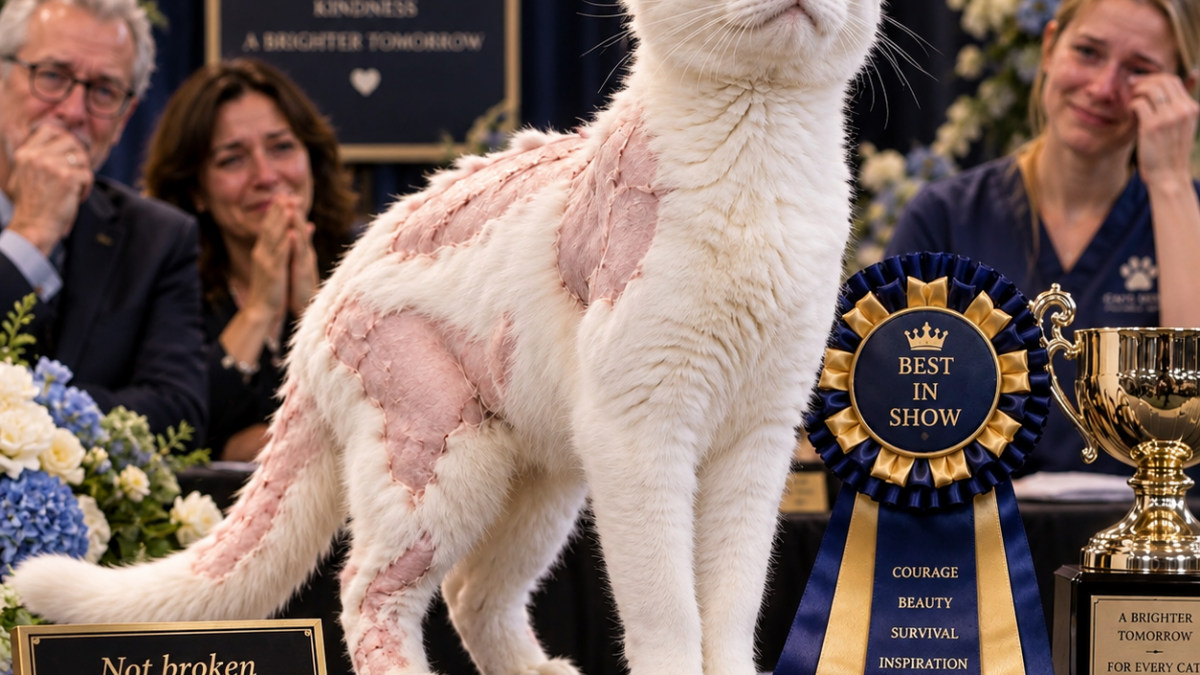
The deepest injuries healed into smooth pink scar tissue where fur would never return. Other areas grew soft white patches that looked almost like islands against a pale map. Some grafted places healed with a slightly different texture, faintly raised, faintly uneven, like her body had been rebuilt by many careful hands and had decided to show the seams.
From far away, she looked unusual.
From close up, she looked like a living record.
A map of everything done to her.
And everything that grew back anyway.
Clara took her home first as a foster.
That was the official word.
Foster.
Temporary.
Medical monitoring.
A quiet environment for recovery.
Everyone at the hospital pretended to believe her.
Lumen entered Clara’s small house on a rainy Tuesday, stepped out of the carrier, examined the living room with solemn seriousness, and walked directly to the sunniest windowsill.
Clara watched her climb with stiff but determined movements.
“You live here now, don’t you?” she asked.
Lumen settled in the sun and closed her eyes.
That was that.
Clara lived alone.
She had not always planned to.
There had been a fiancé once. A wedding date once. A version of her life where evenings included another person’s keys on the counter and another voice asking what she wanted for dinner. But veterinary medicine was long hours, missed holidays, emergency calls, grief brought home in invisible layers. Her fiancé had wanted someone easier to schedule.
Clara did not blame him anymore.
Not much.
Her house had become quiet in the way houses do when the person inside keeps busy enough not to notice. She had plants. Books. One chipped blue mug she used every morning. A laundry basket that was never empty. She told herself she liked the peace.
Then Lumen arrived.
Lumen did not make the house loud.
She made it inhabited.
Each morning, she sat at the window, letting sunlight touch the strange mosaic of her body. Her white fur glowed warm. Her pink scars turned almost translucent, delicate as flower petals. The grafted areas caught the light differently, like pieces of glass in an old church window.
A stained-glass cat.
That was what Clara thought the first morning she saw her fully in the sun.
Not broken.
Not ruined.
Stained glass.
Something shattered and remade into a different kind of beauty.
Lumen learned the house slowly. She disliked sudden noises. She hated the vacuum. She accepted only one brand of soft food, then changed her mind every three weeks for the rest of Clara’s patience. She slept at the foot of the bed but moved beside Clara’s shoulder during thunderstorms. She did not enjoy being picked up by strangers, but she would place one front paw on a visitor’s wrist if she decided they were sad.
Hank still visited.
He claimed he was checking on “the cargo.”
Clara told him cats were not cargo.
Hank told her anything precious being transported from one bad place to one good place counted.
He brought treats Lumen did not like and pretended not to be offended when she sniffed them and walked away.
“She’s got high standards,” he said.
“She survived you driving eighty in a fifty-five,” Clara replied. “Her standards are questionable.”
Hank laughed.
The cruelty investigation remained open for months.
No one was charged.
That was the part Clara hated most.
There were no highway cameras pointed at the ditch. No witnesses. No fingerprints useful enough. No confession. Whoever had done it remained a shadow with hands.
Clara struggled with that.
At night, especially.
She would look at Lumen asleep on the quilt and think of someone capable of such deliberate harm still walking through grocery stores, standing in line for coffee, pumping gas, maybe smiling at neighbors.
The injustice was a stone in her chest.
Dr. Vale told her once, “You may never get legal closure.”
“I know.”
“That doesn’t mean there was no justice.”
Clara looked at him.
He nodded toward Lumen, who was sitting on the reception counter despite several hospital rules and one handwritten sign.
“She lived.”
At the time, Clara thought that answer was too small.
Later, she understood it was enormous.
A year after Lumen’s rescue, Cumberland hosted a regional cat show at the county events center.
Clara had never entered a cat show in her life.
She had once treated a Persian who had won three ribbons and bitten two judges, which had not inspired her. She imagined cat shows as places full of grooming sprays, serious people, and cats named things like Lord Puffington of Cedar Mist.
Then Casey, a younger nurse at the hospital, sent her a link.
“There’s a household pet category,” Casey said. “No pedigree needed.”
“No.”
“You didn’t let me finish.”
“You were going to suggest Lumen.”
“She’s beautiful.”
“She hates car rides.”
“She tolerates them.”
“She once screamed for nineteen minutes because I took a different route home.”
“Strong stage presence.”
Clara shook her head.
“No.”
But the idea stayed.
Not because she wanted attention.
Not because she wanted pity.
Not because she wanted to parade Lumen’s scars like proof of human cruelty or animal resilience.
She wanted, quietly and fiercely, for someone to look at Lumen without knowing anything and see what Clara saw.
Beauty.
Not after the story.
Before it.
She filled out the entry form at midnight, then nearly deleted it.
Household Pet Division.
Name: Lumen.
Color: White.
Sex: Female spayed.
Age: approximately three years.
Special notes: None.
No history.
No explanation.
No tragedy.
Just a cat.
On the morning of the show, Lumen sat in her carrier with the offended dignity of a queen being transported by peasants.
“You’re fine,” Clara said.
Lumen stared.
“I know you hate this.”
Lumen blinked once.
Slow.
Judgmental.
“You can blame Casey.”
At the event center, the air smelled faintly of coffee, grooming products, and nervous humans. Rows of carriers lined the show area. Cats of every size and color watched from decorated cages. Some slept. Some glared. Some accepted the attention as their birthright.
Clara suddenly felt ridiculous.
Lumen did not.
When Clara lifted her onto the judging table, Lumen stood still.
Not frozen.
Not scared.
Still.
Her front paws aligned neatly. Her head lifted. Her eyes faced forward. The lights shone across her body, catching the uneven landscape of white fur, pink scars, and smooth grafted skin.
The judge, a woman in her sixties with silver hair and careful hands, examined her gently.
“Unusual coat pattern,” she murmured.
Clara said nothing.
Lumen’s tail moved once.
The judge checked her body, her posture, her eyes, her temperament. Another judge came over. Then another.
None of them knew.
They saw the scars, of course. They saw the irregular fur. They saw the places where the body had healed differently. But they did not know the ditch, the vest, the six-hour surgery, the bandage changes, the purring through pain, the nights Clara sat awake counting breaths.
They saw a cat who stood on the table as if she belonged there.
Calm.
Stable.
Present.
Not performing.
Not begging.
Not hiding.
Simply there.
When the household pet awards were announced, Clara stood at the back with Lumen in her carrier, expecting nothing and telling herself that expectation had not been the point.
Third place went to a sweet gray tabby.
Second to a large orange cat who had charmed everyone by rolling onto his back and refusing to be judged upright.
Then the head judge lifted the final ribbon.
“Best in Show, Household Pet Division…”
Clara’s hands tightened on the carrier handle.
“Lumen.”
For a moment, she did not move.
Casey, who had come despite pretending she was busy, grabbed her arm.
“Clara.”
“I heard.”
“Then walk.”
Clara carried Lumen forward.
The applause was polite at first, then warmer as Lumen was placed back on the judging table. The ribbon was set beside her. The photographer crouched.
Lumen looked directly into the camera.
Head high.
Eyes forward.
Like nothing in the world had ever succeeded in making her smaller.
The vote had been unanimous.
Only after the awards did someone from the hospital mention her story to the head judge.
Clara had not planned for that.
She came back from packing Lumen’s carrier to find the judge standing very still near the table, one hand pressed lightly against her chest.
“She’s the cat from the highway?” the judge asked.
Clara nodded.
The judge looked toward Lumen.
For a long moment, she said nothing.
Then she whispered, “We chose her because she stood like nothing could bring her down.”
Her eyes filled.
“Now I understand why.”
Clara carried Lumen home with the ribbon tucked carefully in the passenger seat.
Hank came by the next day.
He brought a small can of tuna and a ridiculous gold bow he claimed someone at a truck stop insisted Lumen needed.
Lumen sniffed the bow and rejected it immediately.
“She’s a champion,” Hank said. “Champions get accessories.”
“She said no.”
“She didn’t say no. She implied disrespect.”
“Same thing.”
He knelt with effort, one hand on the couch.
Lumen walked over and placed her paw against his knee.
Hank’s face softened.
“You remember me?” he asked.
Clara did not know if she did.
Not the way humans mean it.
Maybe Lumen remembered his voice. His smell. The first hands that lifted her out of the cold. Maybe she remembered nothing except that this man carried sadness gently.
But she stayed beside him.
That was enough.
The ribbon hung in Clara’s kitchen, not because Clara cared about awards, but because every morning sunlight hit it around the same time Lumen climbed into the window.
Gold light.
White fur.
Pink scars.
A small cat watching birds as if the world owed her nothing and still she had decided to remain in it.
People sometimes asked Clara whether Lumen knew she was special.
Clara always said no.
Cats did not think in those terms.
Lumen knew warmth.
Food.
Sunlight.
The good windowsill.
The sound of Clara opening a can.
The exact blanket worth sleeping on.
The difference between hands that helped and hands that had once harmed.
She knew how to live inside the body she had left.
That was more than many humans managed.
Months passed.
Lumen’s scars changed with time. Some softened. Some tightened. Some remained shiny and hairless. Her fur grew thicker in patches, making the scarred areas look even more like part of a strange, beautiful design. She would never look like the cat she had been before the ditch.
Clara stopped wishing she could.
That was its own healing.
One afternoon, a little girl at the clinic saw Lumen sitting on the reception counter and asked what had happened to her.
The girl’s mother looked embarrassed.
“Don’t ask that.”
“It’s okay,” Clara said.
The little girl stared at Lumen, not with disgust, but with open childlike concern.
“Did it hurt?”
Clara knelt beside her.
“Yes.”
“Is she okay now?”
Clara looked at Lumen.
The cat was calmly pushing a pen off the counter.
“Yes,” Clara said. “She is.”
The girl thought about that.
“She looks like flowers.”
Clara blinked.
“What?”
The girl pointed to the pink scarred patches.
“Like flowers on snow.”
Clara had to stand quickly before she cried in front of a six-year-old.
That night, she told Hank the story over the phone.
“Flowers on snow,” he repeated.
“Better than stained glass?”
“Maybe both.”
Clara looked toward the window where Lumen sat in moonlight.
“Maybe both,” she agreed.
Life did not become perfect.
That is not how survival works.
Lumen still hated certain sounds. She still needed skin checks. Some areas of scar tissue remained sensitive. Cold weather made her stiff. Clara still woke sometimes from dreams of a ditch she had never seen in person but had imagined too vividly.
The person who hurt Lumen was never found.
That remained a fact.
A hard one.
But it did not get to be the final fact.
The final fact was this:
Lumen lived.
She lived in sunlight.
She lived on Clara’s bed, in Hank’s lap when she allowed it, on the clinic counter where she was not supposed to sit, and in the stories of every person who had watched her heal.
She lived in the hands of the surgeon who chose to try.
In the nurse who chose to stay.
In the trucker who chose to stop.
In the strangers who sent five dollars, cards, blankets, and hope.
She lived in a blue ribbon she did not understand and did not need.
One morning, exactly two years after Hank found her, Clara woke to a quiet house and warm light slipping through the curtains.
Lumen was already in the window.
The sun touched her body differently in different places. Her white fur glowed soft gold. Her scars turned translucent pink. The grafted areas held the light in uneven shapes, each one a mark of loss and repair.
Clara stood in the doorway with her coffee, watching.
Someone had tried to take everything from that cat.
Her skin.
Her dignity.
Her life.
They had not succeeded.
Lumen turned her head, saw Clara, and blinked slowly.
Not rude, like a cat judging a late breakfast.
Soft.
Almost kind.
Clara smiled.
“I’m coming.”
Lumen looked back toward the window, toward the birds moving in the yard beyond the glass.
She did not know she was a symbol.
She did not know people cried over her photographs, told her story, or called her brave.
She did not know she had won a ribbon because she walked across a table like the world had never managed to defeat her.
She only knew the morning had arrived.
The sun was warm.
Her body, scarred and strange and wholly hers, had carried her into another day.
And sometimes, that is the greatest victory any living creature can claim.
Not that nothing hurt.
Not that nothing was lost.
Not that cruelty never came.
But that after all of it, she was still here.
Standing in the light.
Unbroken where it mattered most.








