A Cat Was Found After a Car Crash With Her Jaw Broken in Three Places—Then She Made One Tiny Movement No One Expected.
PART3:
Her damaged eye required evaluation and protection.
Then came recovery.
Weeks.
Possibly months.
Assisted feeding.
Restricted movement.
Repeated veterinary visits.
Pain management.
The possibility of complications.
No one could promise that all four legs would function normally.
No one could promise that her sight would fully return.
No one could even guarantee that her small body would tolerate everything required.
Someone quietly raised the possibility of euthanasia.
Not because they did not care.
Because they did.
There are injuries severe enough that compassion sometimes means asking whether treatment is helping an animal or simply asking that animal to endure more pain for an outcome nobody can promise.
Bianca could not understand that discussion.
She lay beneath a blanket.
One eye open.
Jaw unable to close normally.
Legs motionless.
The rescuers who had brought her in looked at her.
They did not want her to suffer.
They also did not want to mistake terrible injuries for hopeless ones.
One of them placed a hand beside Bianca’s head.
The cat shifted slightly toward it.
Tiny movement.
Barely anything.
But she responded.
That mattered.
They made the decision.
Give her a chance.
Not endless treatment regardless of suffering.
Not a promise that every surgery would succeed.
A chance.
If Bianca’s pain could be controlled and the veterinary team believed treatment remained reasonable, they would continue.
Her first procedures focused on the injuries that threatened her basic ability to live.
The jaw was one of the most delicate problems.
Three separate fractures had left it unstable.
Eating was impossible.
Even attempting to move her mouth caused discomfort.
The veterinary team carefully repaired and stabilized it, working to restore alignment while preserving as much normal function as possible.
Then came her legs.
One after another, fractures and severe injuries were stabilized.
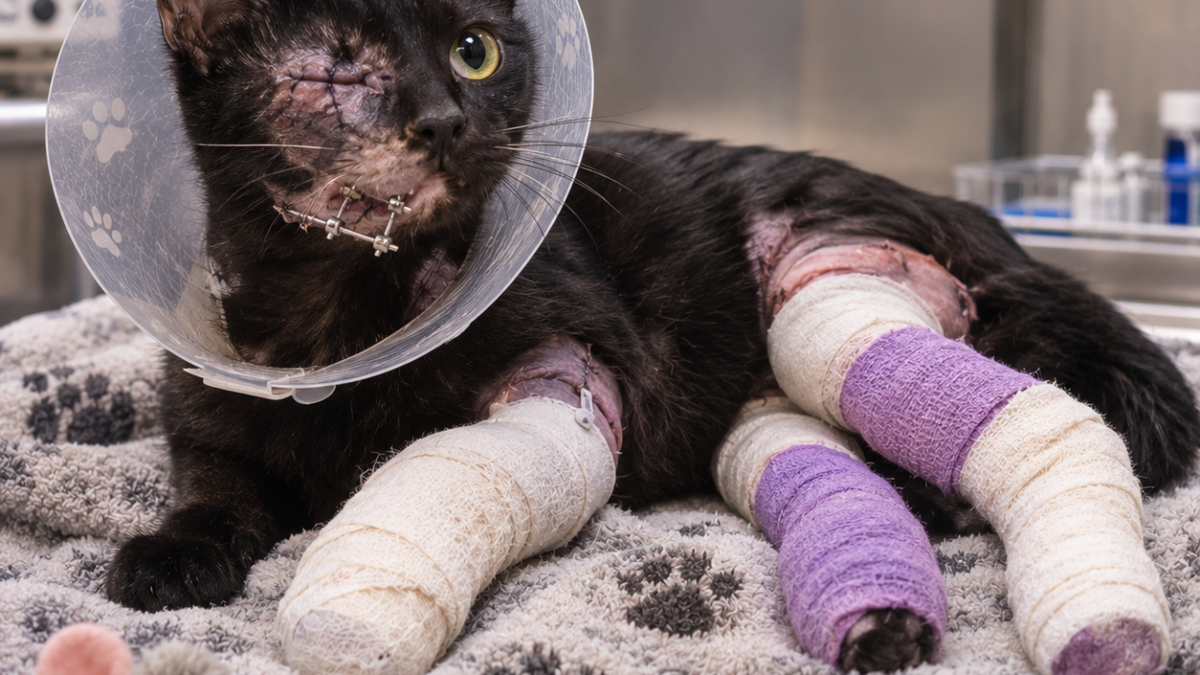
Casts and protective supports covered much of Bianca’s small body.
When she finally woke from anesthesia, she looked almost swallowed by everything around her.
Bandages.
Casts.
Blankets.
Monitoring equipment.
Only her black face remained clearly visible.
The first night after surgery frightened everyone.
Bianca was weak.
Very weak.
She could not simply be offered a bowl of food.
Her jaw was too fragile.
Her body needed nutrition to heal, but the normal way of getting that nutrition was temporarily impossible.
So assisted feeding became part of her life.
Slowly.
Carefully.
Small amounts.
Her veterinary team monitored her constantly.
She needed calories.
Hydration.
Rest.
Pain control.
And time.
Mostly time.
The hardest part was that healing did not look impressive in the beginning.
People imagine recovery as visible progress.
A cat stands.
A cat walks.
A cat eats.
But Bianca’s earliest victories were much smaller.
Her temperature stayed stable.
Good.
She tolerated feeding.
Good.
She rested for two hours without appearing distressed.
Good.
Swelling decreased slightly.
Good.
She lifted her head.
That one made someone smile.
It happened late one afternoon.
Bianca had spent most of the day lying on her side.
A caregiver entered quietly to check her.
The room smelled faintly of disinfectant and warm laundry.
Bianca’s blanket had been folded beneath her so the casts did not press awkwardly against her body.
The caregiver spoke softly.
“Hi, Bianca.”
Her ear moved.
Then slowly, painfully, Bianca raised her head.
Not far.
Only a few inches.
She held it there.
Looked toward the voice.
Then lowered it again.
To anybody else, it would have seemed like nothing.
Inside that room, it felt enormous.
The woman caring for her whispered:
“There you are.”
Bianca began responding more often.
Her appetite could not yet be measured by how much she ate herself because she still depended on assisted feeding.
Instead, people watched her interest.
Did she smell food?
Did she lick?
Did she turn her head toward it?
Did her eyes follow movement?
Some days, yes.
Other days, she was exhausted.
Nobody forced progress into a schedule.
Her body had survived catastrophic trauma.
It had earned patience.
The casts frustrated her.
That became obvious once she had enough energy to be frustrated.
Her paws could not move freely.
She tried shifting.
Stopped.
Tried again.
One caregiver reached into the recovery area and gently adjusted her blanket.
Bianca watched.
Then something happened.
Her front paw moved against the fabric.
Press.
Release.
Press.
The caregiver froze.
Bianca did it again.
A small kneading movement.
Making biscuits.
It was awkward because of the support around her leg.
Weak.
Barely visible.
But unmistakable.
The caregiver called someone over.
“Look.”
“What?”
“Her paw.”
Bianca pressed into the blanket again.
Then released.
The two people stared.
A cat kneading a blanket is one of the most ordinary things in the world.
That was exactly why it meant so much.
Bianca was doing something familiar.
Instinctive.
Comforting.
She was not only enduring procedures.
Some part of her was responding to softness.
Warmth.
Safety.
One caregiver laughed through tears.
“She’s making biscuits.”
Another whispered:
“With a cast.”
For the first time since Bianca arrived, the room felt less like an intensive recovery space and more like somewhere a cat might actually live.
Bianca continued healing.
Not perfectly.
Not in a straight line.
Some mornings she seemed stronger.
Then the next day she appeared exhausted again.
Swelling around the jaw slowly decreased.
The surgical repairs remained stable.
Her legs began forming the new bone and tissue they needed.
Her damaged eye remained a concern.
The veterinary team worked to preserve the vision she still had and protect the healthier eye.
Eventually, it became clear that Bianca would navigate the world primarily with sight from one eye.
That would require adjustment.
It did not mean she could not have a full life.
Cats are remarkably capable of adapting when part of their vision is lost.
But Bianca first had a more immediate challenge.
Standing.
After so much time unable to support herself, her body had become weak.
Casts added weight.
Balance felt different.
Her depth perception had changed.
The first attempts were supported.
A caregiver placed hands beneath her body.
Bianca’s paws touched the floor.
Her legs trembled.
For perhaps two seconds, she remained upright.
Then sank back down.
Nobody called it failure.
They tried again another day.
A little longer.
Then again.
Her strongest leg learned first.
The others followed at their own pace.
Bianca sometimes looked confused.
She would place one paw forward and hesitate before trusting the next.
Her body had once obeyed without thought.
Now every movement needed relearning.
Step.
Balance.
Pause.
Another step.
One afternoon, Bianca managed three.
Three tiny steps.
Then sat down.
The caregiver beside her gasped.
Bianca looked up as if wondering why the human had become emotional.
“You walked.”
Bianca blinked.
“You walked, baby.”
The cat began licking the edge of her bandage.
Apparently the celebration did not impress her.
The next major milestone involved food.
By then, Bianca’s jaw had healed enough for the veterinary team to begin carefully testing what she could manage.
Soft food first.
Very small amounts.
The first bowl was placed in front of her.
Bianca smelled it.
Her nose moved.
Everyone waited.
She lowered her head.
Stopped.
Raised it.
Tried again.
Her mouth had spent weeks either immobilized, healing, or being protected.
Eating was not automatic anymore.
She licked the food.
Once.
Again.
Then attempted a tiny bite.
The room went silent.
Bianca chewed carefully.
Swallowed.
Nobody moved.
She took another.
Someone whispered:
“Oh my God.”
It was barely a mouthful.
For Bianca, it represented independence.
Every meal until then had depended on another person.
Another hand.
Another tube or assisted feeding method.
Another schedule.
Now she had taken food herself.
One bite.
One choice.
Bianca ate only a small amount that day.
Nobody expected more.
The following day she tried again.
Then again.
Her confidence increased.
The feeding assistance remained because she still needed reliable nutrition.
But slowly, the balance changed.
More food from Bianca.
Less help from people.
Eventually, there came a morning when the veterinary team realized she had eaten enough independently that her feeding support could begin to be reduced.
Another milestone.
Bianca had no idea.
She was more interested in getting whatever remained in the bowl.
As the weeks passed, casts were replaced, adjusted, and finally removed as healing allowed.
One leg first.
Then another.
Every removal revealed a limb that looked smaller than before.
Muscles had weakened.
The leg needed rebuilding.
But the bone had healed enough to begin.
Bianca stood without the heavy support.
Her balance wobbled.
One-eyed vision changed how she judged distance.
She compensated.
Head turned slightly.
Whiskers forward.
Slow steps.
The first time she tried walking around a room freely, she drifted toward one side.
Stopped near a chair leg.
Sniffed.
Changed direction.
Nobody picked her up.
They stayed close.
Let her solve it.
Bianca continued.
By the time she reached the opposite side, she looked exhausted.
She also looked pleased.
Her tail lifted slightly.
That became another celebration.
The cat who had arrived unable to stand had crossed a room.
Soon she discovered something she liked even more than walking.
Food.
Once her jaw became strong enough, Bianca developed an appetite that surprised everyone.
Her caregivers laughed the first time she planted herself over a bowl and ate with determined concentration.
No tube.
No syringe.
No assistance.
Just Bianca.
Head down.
Eating.
A technician took a photograph.
In it, Bianca looked completely ordinary.
That made the photograph extraordinary.
People who had not seen the beginning would not understand why watching a cat eat could bring tears.
But the team remembered.
They remembered the fractured jaw.
The swollen face.
The helpless body.
They remembered discussing whether asking her to survive was asking too much.
Now she was licking her bowl clean.
Bianca’s personality emerged quickly once medical crisis stopped dominating every hour.
She was affectionate.
That surprised some people.
After so much painful handling, she could easily have become defensive around hands.
Instead, Bianca leaned toward them.
She loved chin scratches.
Gentle head rubs.
Warm laps.
She began purring loudly enough that people could hear it from several feet away.
And she still kneaded.
Always.
Soft blankets.
Towels.
A caregiver’s sweater.
One afternoon, someone placed a thick fleece bed inside her recovery room.
Bianca climbed into it.
Turned twice.
Lay down.
Then both front paws began pressing.
Left.
Right.
Left.
Right.
No cast now.
No awkward movement.
Just biscuits.
The caregiver who had witnessed that first tiny kneading motion stood nearby.
She covered her mouth.
“What?”
Another volunteer asked.
“Nothing.”
She smiled.
“It’s just different now.”
Back then, one paw had barely pressed against a hospital blanket.
Now Bianca kneaded comfortably with strength behind each movement.
The behavior had not changed.
Everything around it had.
Bianca transitioned from the clinic environment into foster care.
A quiet house.
Soft rugs.
Low furniture.
Food bowls that always stayed in the same location while she adjusted to limited vision.
At first, she moved cautiously.
One eye means the world can feel different.
Judging distance can take practice.
Bianca bumped a chair once.
Stopped.
Sniffed it.
Then walked around.
The next time, she remembered.
Within days, she had mapped the room.
Within weeks, she acted as though she owned it.
Her foster caregiver discovered Bianca preferred sleeping near people.
A cat bed sat beside the couch.
Bianca ignored it.
Instead, she climbed slowly onto the couch using a low step.
She approached the person sitting there.
Turned.
Dropped onto their thigh.
That became her bed.
“She has a perfectly good cat bed,” the foster caregiver complained.
Bianca purred.
Nobody moved her.
Follow-up veterinary visits continued.
X-rays.
Jaw checks.
Leg evaluation.
Eye monitoring.
The first few appointments made Bianca nervous.
She recognized the clinic.
Perhaps the smells.
Perhaps the sounds.
But then Rachel—one of the technicians who had cared for her during the worst weeks—appeared.
Bianca looked up.
Rachel crouched.
“Hi, trouble.”
Bianca walked toward her.
Rachel began crying immediately.
“You’re supposed to pretend this is professional.”
Another technician laughed.
Bianca rubbed against Rachel’s hand.
The same cat who had once needed to be carried everywhere had crossed the exam room because she recognized someone.
During one visit, the veterinarian watched Bianca walk.
Turn.
Jump onto a low platform.
Eat a treat.
Then said something everyone had been waiting to hear.
“She’s ready.”
The foster caregiver froze.
“For adoption?”
“Yes.”
The word created two emotions at once.
Joy.
Fear.
Bianca had survived.
Recovered.
Adapted.
She was ready for a family.
That also meant somebody would have to let her go.
Applications arrived.
People had heard her story.
Some focused heavily on the trauma.
They called her inspiring.
Miraculous.
A warrior.
Her foster caregiver appreciated the kindness.
But Bianca needed more than somebody who loved the idea of rescuing an injured animal.
She needed someone who understood the cat she had become.
The one-eyed vision.
Potential long-term orthopedic monitoring.
Jaw history.
Routine veterinary care.
Possible future arthritis after serious fractures.
And, most importantly, the fact that Bianca was not a tragedy anymore.
She was a cat.
A slightly demanding one.
One family visited.
Then another.
One woman knelt immediately and began crying before Bianca even approached.
The foster caregiver understood.
But Bianca walked away.
Another applicant tried picking her up too quickly.
Bianca objected.
Politely but firmly.
Then came a woman named Claire.
She entered the foster home carrying nothing.
No toys.
No dramatic speech.
She sat on the floor.
Asked questions.
“What side can she see best from?”
“How does she handle stairs?”
“Does she prefer wet or dry food?”
“What kind of litter box works best?”
“Any exercises?”
“Does she get nervous in cars?”
Then Claire waited.
Bianca remained across the room.
Five minutes.
Ten.
Claire did not call her.
Did not reach.
Eventually, Bianca stood.
Walked toward her.
Stopped.
Sniffed her jeans.
Claire whispered:
“Hi.”
Bianca rubbed one side of her face against Claire’s knee.
The foster caregiver felt something painful and happy in her chest.
There.
Bianca climbed into Claire’s lap fifteen minutes later.
Then began kneading.
Claire laughed.
“She’s making biscuits.”
The foster caregiver looked away.
“Yes.”
“She does that a lot?”
“Since she was almost too injured to move.”
Claire stopped laughing.
She looked down at Bianca.
“Really?”
“Yes.”
Bianca pressed one paw.
Then another.
Claire stroked her carefully.
“What happened to her?”
The foster caregiver told her.
Not dramatically.
Car.
Jaw.
Legs.
Eye.
Surgeries.
Assisted feeding.
Recovery.
Claire listened.
When the story ended, she did not say:
Poor thing.
Instead:
“What does she need now?”
That was the right question.
Bianca went home with Claire two weeks later.
The transition was slower than people imagine from adoption photographs.
Bianca spent the first few hours beneath a table.
New smells.
New walls.
New sounds.
Claire stayed nearby but did not force interaction.
Food in predictable places.
Water.
Litter.
Bed.
Blanket from foster care.
That night, Bianca came out.
Walked through the living room.
One careful circuit.
Then another.
Claire sat on the couch reading.
Bianca jumped halfway toward her.
Missed slightly.
Her depth perception still caused occasional mistakes.
Claire gently steadied her.
Bianca tried again.
Made it.
She curled beside Claire.
The next morning, Claire woke with Bianca sleeping against her shoulder.
From then on, the house gradually became Bianca’s.
Window seat.
Soft chair.
Kitchen rug.
Sunny patch near the sliding door.
Bed.
Especially the bed.
Claire bought a cat bed.
Bianca used the cardboard box it came in.
Life became ordinary.
That was the greatest victory.
Bianca ate breakfast.
Napped.
Played.
Kneaded blankets.
Watched birds.
Learned the sound of the treat container.
Followed Claire into the bathroom.
Sat outside the shower.
Disapproved of vacuum cleaners.
Knocked a pen off the table.
Then another.
Then stared directly at Claire while pushing a third.
Nothing in those moments looked heroic.
It did not need to.
The goal of rescue is not to create a hero.
It is to create enough safety that an animal can become ordinary again.
One afternoon, Claire took a video of Bianca eating.
Black cat.
Head over bowl.
Strong appetite.
Nothing else.
She sent it to the rescue.
The people who had cared for Bianca watched.
Someone started crying.
“Why are you crying?”
“She’s eating.”
“She has been eating for months.”
“I know.”
“But?”
“I remember when she couldn’t.”
That memory never completely disappeared.
The rescuer who had found Bianca occasionally received updates.
Each one felt impossible.
Bianca walking.
Bianca jumping onto a couch.
Bianca sleeping upside down.
Bianca demanding food.
Bianca kneading.
The woman kept one photograph from the first day.
She rarely looked at it.
It showed Bianca wrapped in a towel.
Face swollen.
Body still.
Later, Claire sent another image.
Bianca stretched across a cream-colored blanket in sunlight.
One eye closed.
The other half open.
Front paws extended.
The difference was difficult to comprehend.
The first photograph asked:
Will she survive?
The second answered a much better question.
What did she survive for?
For this.
Warmth.
Food.
Hands she trusted.
A home.
Bianca’s life after adoption was not without challenges.
A severe accident leaves history behind.
One leg remained slightly stiff.
Cold weather sometimes seemed to make her slower.
The damaged eye never became normal.
She navigated mostly through her stronger vision and adapted beautifully.
Claire learned not to approach too suddenly from Bianca’s blind side.
She placed furniture consistently.
Then discovered Bianca could adapt even when something changed.
Once, Claire moved a chair.
Bianca walked toward the old location.
Stopped.
Turned.
Found the new route.
Claire apologized.
Bianca did not care.
Humans worried about disability far more than Bianca seemed to.
She knew the world she had.
She learned it.
At annual veterinary appointments, the team monitored her joints and jaw.
The repaired jaw remained functional.
The first time Bianca crunched a small piece of kibble in front of the veterinarian who had helped repair it, everyone laughed.
The veterinarian said:
“That is a very expensive bite.”
Claire replied:
“She has expensive taste.”
Bianca demanded another.
Years passed.
The scars became less visible beneath her black fur.
Not gone.
Just part of her.
One eye always told part of the story.
Her gait another.
But people meeting Bianca for the first time usually noticed something else.
How loudly she purred.
She purred when Claire came home.
When the blanket was warm.
When someone scratched beneath her chin.
Sometimes when food arrived.
Sometimes seemingly for no reason.
And she kneaded.
Constantly.
Claire eventually bought a thick fleece blanket specifically for Bianca.
Dark green.
Soft.
Bianca claimed it instantly.
Every evening she climbed onto the couch.
Turned in a circle.
Then her paws started.
Press.
Release.
Press.
Release.
Biscuits.
Claire occasionally filmed her.
One night, while watching Bianca knead, she remembered something the foster caregiver had told her.
Bianca did the same thing while still in casts.
Claire tried to imagine it.
Three broken legs.
Fractured jaw.
Damaged eye.
Hospital blanket.
One paw trying to knead.
She could not.
The cat in front of her seemed too comfortable.
Too safe.
That was the miracle, if anyone insisted on using the word.
Not that Bianca became physically perfect.
She didn’t.
Not that everything damaged was restored.
It wasn’t.
The extraordinary thing was that a body once associated almost entirely with pain became a place Bianca could live comfortably again.
A home inside a home.
At seven years old, Bianca developed early arthritis in one previously injured leg.
The veterinarian was not surprised.
Claire still hated hearing it.
Medication when needed.
Weight management.
Joint support.
Low steps.
Nothing dramatic.
Bianca adjusted.
Claire installed a small staircase beside the bed.
Bianca ignored it for two days.
Then used it.
A year later, she preferred it.
At nine, she slept more.
At ten, black fur around her muzzle started showing gray.
Claire stared one morning.
“No.”
Bianca blinked.
“You are not getting old.”
Bianca yawned.
“Very disrespectful.”
Time continued.
The rescue occasionally shared Bianca’s updates.
People who remembered the original story were shocked.
She was still there.
Still eating.
Still kneading.
Still living.
One comment said:
“I can’t believe she survived.”
Claire understood.
Sometimes she could not either.
But eventually she stopped thinking of Bianca as a survivor every day.
Survivor was something that happened in the past.
Bianca was:
hungry.
Sleepy.
Annoyed.
Affectionate.
Demanding.
Playful when she felt like it.
Stubborn always.
Those words belonged to the present.
At eleven, Bianca returned to the veterinary clinic for a routine check.
A young technician who had never met her read the medical history.
Her eyes widened.
“Three jaw fractures?”
Claire nodded.
“Three injured legs?”
“Yes.”
“Eye trauma?”
“Yes.”
The technician looked at Bianca.
Bianca was attempting to open a treat container with her paw.
“That’s her?”
Claire laughed.
“That’s her.”
The technician crouched.
“Hi, Bianca.”
Bianca ignored her and focused on the treats.
Claire smiled.
“She doesn’t know she’s impressive.”
That was probably true.
Bianca did not know how many people had debated whether she could recover.
She did not know her first bite of food had made people cry.
She did not know a tiny kneading motion had become proof to frightened caregivers that there was still a cat inside all those casts and bandages.
She did not know how many people had followed her progress.
She simply knew the hand reaching toward her was gentle.
The bowl would be full.
The blanket was soft.
Home was safe.
That was enough.
Eventually, age brought harder days.
At thirteen, kidney values began changing.
At fourteen, arthritis required more support.
Claire moved more beds to floor level.
Added rugs for traction.
Bianca still insisted on joining her on the couch.
Claire lifted her when necessary.
The cat who once depended on people for every movement found herself needing help again.
But now the meaning was completely different.
In the clinic after the accident, Bianca needed help because nobody knew whether she would have a future.
Now she needed help because she had already lived years of one.
That distinction comforted Claire.
One evening, Bianca climbed onto the green blanket with assistance.
She began kneading.
Slowly now.
One paw.
Then the other.
Claire watched.
The movement was weaker than when Bianca was young.
But familiar.
She placed one hand beside Bianca.
The cat leaned toward it.
Fourteen years earlier, people had watched Bianca make that same movement while wondering whether she would ever walk.
Now Claire watched an old cat make biscuits in the home where she had spent most of her life.
Same gesture.
Completely different world.
Bianca eventually died as an elderly cat.
Not beneath headlights.
Not beside a road.
Not unable to eat.
She died after years of breakfasts, naps, veterinary checkups, warm blankets, ridiculous amounts of affection, and thousands of ordinary days.
Claire stayed beside her.
The final hours were quiet.
Bianca rested on the green fleece.
One paw beneath her chin.
Claire stroked the top of her head.
“You did enough.”
Bianca’s eye remained half closed.
“You never had to prove anything.”
A faint purr.
“You know that, right?”
Claire cried.
“You just had to be here.”
Bianca relaxed beneath her hand.
When the moment came, there was no emergency.
No broken bones.
No rush.
Only comfort.
For years afterward, Claire kept the green blanket.
She could not wash it at first.
Then eventually did.
Folded it.
Stored it in a closet.
One day she donated most of Bianca’s unused supplies to a rescue.
Beds.
Bowls.
Medication organizers.
Steps.
She kept the blanket.
Some things do not need to be practical.
The veterinary clinic kept a photograph of Bianca too.
Not the first one.
Nobody wanted the injured cat frozen forever in that moment.
They chose a later photograph.
Bianca leaning over a food bowl.
Eating by herself.
One strong front paw beside the dish.
The image looked completely ordinary.
That was why they loved it.
Because once, Bianca could not open her mouth to eat.
Once, she could not stand.
Once, three of her legs were so damaged that walking sounded impossible.
Once, people wondered whether asking her to keep going was fair.
Then she lifted her head.
Then she kneaded a blanket.
Then she stood.
Then came one step.
Then a bite.
Then another.
Then the feeding support disappeared.
Then the casts came off.
Then she walked to her own bowl.
Then she walked into a home.
Healing did not arrive as one miracle.
It came as hundreds of small permissions her body slowly gave back to her.
Move.
Eat.
Stand.
Trust.
Play.
Rest.
Live.
That was Bianca’s story.
Not that everybody who questioned her chances was wrong to be afraid.
Her condition truly was terrible.
Not that choosing treatment is always the right choice for every severely injured animal.
Sometimes it isn’t.
Bianca’s caregivers simply saw enough possibility, with veterinary guidance and pain control, to give this particular cat a chance.
And Bianca used that chance in the most ordinary, beautiful way possible.
She became somebody’s cat.
The black cat who arrived unable to stand or eat was eventually able to walk across her own home whenever she wanted.
The cat whose jaw had been broken in three places eventually leaned happily over her own food bowl.
And the paw that once struggled to make one tiny movement beneath a cast spent years pressing comfortably into a soft blanket beside someone who loved her.
Bianca did not need to become the cat she had been before the accident.
She became the cat who came after it.
And that life was full.








