A Cat Was Buried Alive Beneath a Collapsed Building for 26 Days—Then Demolition Workers Heard a Faint Purr Coming From Deep Inside the Concrete
PART3:
We moved slowly, shutting down every machine, using only our ears, then rods, then a small inspection camera. The sound came from deep in the collapsed east section, where two slabs of concrete had fallen slightly crooked against each other. By some impossible accident, they had created a triangular pocket of space.
Not a room.
Not even enough space for a child.
Later we measured it.
About two feet long.
Less than a foot high.
Maybe eighteen inches wide at its widest point.
A concrete coffin that had made one mistake.
It had left enough air.
When the camera finally entered through a crack, the image shook badly. Dust coated the lens. We saw only gray at first. Concrete. Shadow. A bar of rusted metal.
Then two eyes opened in the dark.
Faruk stumbled backward so fast he nearly fell.
“There’s something alive,” he whispered.
We widened the crack with hand tools.
No machines.
Too dangerous.
One wrong vibration and the pocket could collapse. One careless cut and the slabs might shift. We used hammers, chisels, a small jack, pry bars wrapped in cloth to reduce impact. Every few minutes, we stopped and listened.
The purring never stopped.
Not when the hammers struck.
Not when dust fell.
Not when sunlight entered that space for the first time in nearly a month.
It continued like a tiny engine refusing to die.
I do not know how to explain what that sound did to us.
Men who had smoked and cursed through twelve-hour shifts became silent. Yusuf wiped his eyes with the back of his wrist and pretended concrete dust was bothering him. Faruk kept saying, “Easy, easy, easy,” though none of us knew whether he was speaking to the cat, the slabs, or himself.
Three hours later, the opening was large enough.
I was the one with the narrowest shoulders.
So I lay flat on my stomach and reached both gloved hands into the gap.
The heat inside was strange.
Not warm exactly.
Stale.
Breath-warmed.
Dead-air warm.
My fingers touched fur.
For a second, the animal did not move.
Then I felt bones.
So many bones beneath the fur that my throat closed.
“Easy,” I whispered. “I have you.”
The purring grew stronger under my hands.
I slid one palm beneath her chest and one under her hips. She weighed almost nothing. Less than a bag of tools. Less than the memory of a cat.
When I drew her out, the entire site went still.
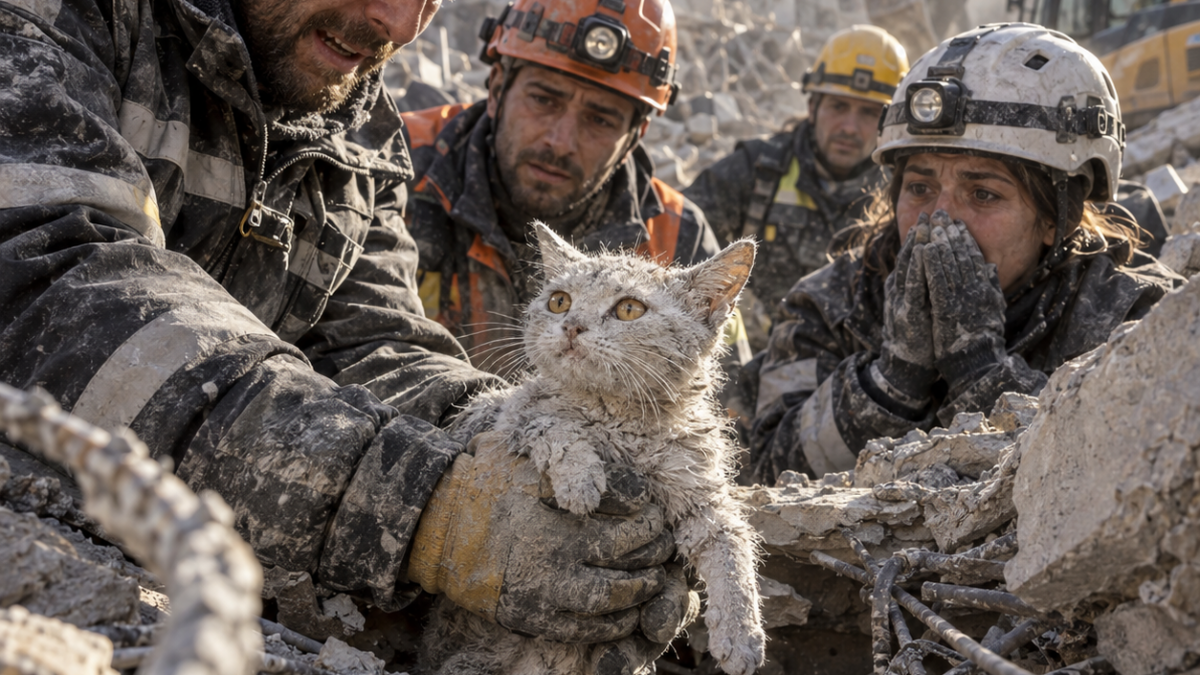
She was white.
Completely white.
Head to tail.
Whiskers.
Ears.
Paws.
Every inch.
But white was not her color.
It was concrete dust.
She had been coated so completely that she no longer looked like an animal. She looked like a small statue carved from the ruins themselves. Like the building had made one last thing before dying.
Then she lifted her head.
Her eyes were amber.
Huge.
Wide open.
They caught the sunlight with such shocking brightness that nobody moved. Against the white dust, those eyes looked unreal. Too alive. Too aware. Too impossible.
She did not blink.
She simply stared at us as if she had been waiting twenty-six days for the world to remember she was there.
Somebody behind me whispered, “Allah…”
Yusuf took off his helmet.
Faruk covered his mouth.
I held her against my chest and could feel her purring through my gloves.
Still.
After everything.
Still.
We wrapped her in my jacket because no one had brought a towel. Why would we have? We had come to prepare rubble for demolition, not receive a living creature from the dead.
Someone called the temporary veterinary clinic operating near the disaster zone. Someone else called the rescue coordinator. Photos were taken in those first minutes. I barely noticed. I was too focused on her breathing.
Fast.
Shallow.
But there.
Her paws were tucked inward as if she expected the world to close around her again.
I kept one hand over her body until we reached the clinic.
“I heard you,” I told her in the truck.
I do not know why.
Maybe because I needed her to know.
Or maybe because I needed to say it for myself.
“I heard you.”
The clinic had been set up in an old municipal office with folding tables, portable lights, donated carriers, and exhausted veterinarians moving between injured animals found after the quake. Cats. Dogs. Birds. A rabbit pulled from a damaged balcony. A cage of finches someone had carried there crying.
Dr. Emre Demir examined her.
He was thirty-eight, though that month had made him look older. He had the focused gentleness of someone who had learned that panic wastes time. When we placed the cat on the table, he put one hand lightly on her side.
She purred under his palm.
His eyes lifted.
“How long?”
“Twenty-six days,” I said.
For the first time since I had known him, Dr. Demir looked unable to speak.
The examination took nearly an hour.
She weighed 2.1 kilograms.
She should have weighed closer to 4.
She had lost nearly half her body weight in twenty-six days.
Her spine, ribs, hips, and shoulder blades stood under the dust like the frame of a collapsed tent. Her legs were so thin that the joints looked too large. Her paw pads were worn smooth. Fine grains of concrete had embedded into her skin. Her claws were rounded, dull, and cracked at the edges from scraping against the floor of the pocket.
“She walked,” Dr. Demir murmured.
“In there?”
He nodded.
“Back and forth. Again and again.”
I imagined it.
Two feet.
Turn.
Two feet.
Turn.
Darkness so complete it had weight.
No food.
No light.
No sky.
Just concrete above, concrete below, concrete pressing close enough that she could not fully stand.
And still she walked.
Her dehydration was critical, but not terminal. That was the miracle inside the miracle.
Dr. Demir found traces of moisture on the dust inside the carrier where we had placed her, then later confirmed what likely saved her: condensation. The cold concrete surfaces inside the pocket had collected tiny amounts of water. She had licked the walls.
A few fractions of a milliliter at a time.
Enough not to live well.
Enough not to die.
Her digestive tract showed traces of insects.
Small beetles.
Larvae, maybe.
Anything that had found its way into that dark pocket had become food.
Dr. Demir estimated she had consumed less than fifteen percent of her daily caloric needs during those twenty-six days.
“How?” Faruk asked.
He had followed us to the clinic and stood by the door twisting his cap.
Dr. Demir did not answer immediately.
He placed a warm towel around her dust-coated body.
“Medically?” he said. “Condensation. Slowed metabolism. Extreme conservation of energy.”
“And not medically?”
The vet looked at the cat.
She stared back with those huge amber eyes, pupils blown wide from so many days in darkness.
“Not medically,” he said softly, “I don’t know.”
Her eyes had suffered too.
After twenty-six days in total darkness, her pupils had dilated so extremely that daylight was painful. Her right eye developed inflammation from the sudden exposure. For weeks after rescue, her pupils remained huge, black circles surrounded by amber, giving her a permanently astonished expression.
As if the whole world were too bright.
As if survival itself kept surprising her.
While Dr. Demir cleaned dust from her whiskers, the purring continued.
The sound filled the small clinic room.
Low.
Steady.
Impossibly calm.
I asked him why.
“Cats purr for many reasons,” he said. “Comfort. Pain management. Self-soothing. Some vibration frequencies may help tissue healing.”
He touched her side again.
The purr vibrated into his hand.
“But I think maybe there is a simpler reason too.”
“What?”
He looked toward the ceiling.
“She made the only sound she could make,” he said. “In the only direction she could send it. Up.”
I said nothing.
“In case someone was listening.”
The words landed in me like a stone dropped into deep water.
For twenty-six days, she had been saying the same thing.
I am here.
I am here.
I am here.
And on the twenty-sixth day, someone finally heard.
The photos spread faster than any of us expected.
At first, they moved through local rescue pages.
Then national news.
Then international media.
A white cat covered in concrete dust, held in gloved hands, amber eyes wide open, a living ghost pulled from the ruins. People shared the images millions of times. Strangers sent messages from countries I had never visited and could not have pointed to on a map quickly enough to avoid embarrassment.
Everyone wanted her name.
We did not know if she had one before.
No collar.
No microchip.
No family came forward.
Maybe her family had moved away after the collapse.
Maybe they had died.
Maybe she had been a stray who took shelter in the wrong building at the wrong time.
We could not ask her.
The rescue team named her Ses.
Voice.
It was Dr. Demir’s suggestion.
No one argued.
Ses remained in the clinic for weeks.
At first, she was too weak to stand long. She slept in a heated enclosure with blankets and a shallow bowl of water nearby. She ate tiny portions because too much food too quickly could harm her starving body. She submitted to treatment with the exhausted dignity of an old queen.
But she purred.
Almost constantly.
When awake, she purred.
When touched, she purred.
When not touched, she purred.
When food arrived, she purred.
When the clinic lights dimmed at night, she purred into the dark.
The staff began recognizing her by sound before sight.
“She is awake,” someone would say.
“How do you know?”
Then they would listen.
That low vibration from the back room.
Ses calling into a world that had already answered once.
I visited whenever work allowed.
At first, I told myself I came for updates because I was part of the rescue. Then because the crew wanted to know. Then because people online asked. Eventually I stopped inventing reasons.
I came because I had heard her when no one else expected sound.
That does something to a person.
It ties you to the life that answered back.
The first time I saw her after her bath, I laughed.
I could not help it.
“She is gray?”
Dr. Demir smiled.
“Light gray tabby.”
The concrete dust washed away to reveal a healthy pale-gray coat with faint stripes and a white patch beneath her chin. She was still thin, still fragile, but no longer a ghost.
Only her eyes kept the ruins.
Huge.
Amber.
Too open.
Her pupils never fully returned to normal size. Dr. Demir said the damage might be permanent. They gave her an owl-like expression, bright and startled, as if she were always seeing something just behind the visible world.
But her body recovered.
She gained weight.
Her fur thickened.
Her paws healed, though some pads remained smooth where they should have been rough. Her claws grew back strong. The inflammation in her right eye improved.
After two months, she looked like a cat again.
Mostly.
But two things never changed.
The first was windows.
Ses refused to enter any room without one.
Closet.
Storage room.
Windowless bathroom.
Interior office.
She stopped at the threshold and would not cross.
No amount of coaxing helped. No treats. No gentle voices. No open door behind her. She would stand there, look inside, look upward, then step back.
“She checks for light,” Dr. Demir said.
By then he had adopted her.
Nobody was surprised.
He claimed it was because she needed medical monitoring. The whole clinic pretended to believe him.
He took her home to an apartment on the third floor, with wide windows in every room and sunlight in the mornings. Before entering any room, Ses inspected it. She still does. She pauses at each doorway, eyes lifting first, searching for escape, sky, proof that the world cannot close completely.
Only then does she enter.
The second thing was the purring.
It became constant.
Not just when she was happy.
Not just when she ate.
Not just when Dr. Demir stroked her head.
Almost always.
A low, steady vibration that begins when she wakes and stops only when she sleeps.
Dr. Demir found no medical reason.
She was healthy.
Relaxed.
Safe.
Yet she purred through entire mornings on the windowsill. Through meals. Through examinations. Through quiet evenings when Dr. Demir read papers at his desk and Ses lay nearby, eyes half closed, body humming like a small emergency generator no one had turned off.
Once, he told me, “I think it became automatic.”
We were sitting in his apartment. Ses lay on the windowsill in late afternoon light, her body warm with sun, her purr constant beneath our conversation.
“Twenty-six days of sending that signal upward,” he said. “Twenty-six days of saying I am here. Then someone heard her.”
He looked at her.
“Maybe she cannot stop sending it.”
I reached out and placed my hand lightly on her side.
She allowed it.
The vibration moved into my palm.
I was back in the rubble.
Back on my stomach.
Reaching into concrete.
Feeling bones beneath dust.
Hearing the impossible sound continue while the world above finally listened.
“What do you think she remembers?” I asked.
Dr. Demir was quiet.
“Enough.”
That was the only answer.
Enough to avoid darkness.
Enough to distrust rooms without windows.
Enough to keep purring.
Years have passed now.
People still write about her sometimes.
The miracle cat.
The ghost cat.
The cat who survived twenty-six days under concrete.
They like the simple version best.
Cat trapped.
Cat purrs.
Workers hear.
Cat saved.
Happy ending.
I understand.
Simple stories are easier to carry.
But when I think of Ses, I do not think first of the rescue.
I think of the twenty-six days before it.
That is the part people rush past because it hurts too much to imagine.
A living creature in a pocket barely larger than a suitcase.
No light.
No real food.
No clean water.
No room to run.
No way to know whether the world still existed above.
She did not know emergency teams had searched.
She did not know the families had gone home.
She did not know demolition permits were being prepared.
She did not know anyone would return to that exact part of the rubble before machines came.
She only knew darkness.
Concrete.
Hunger.
Thirst.
The edges of her own body.
And the sound she could make.
So she made it.
Again and again and again.
Maybe to soothe pain.
Maybe to calm fear.
Maybe to keep her body alive.
Maybe because some part of her believed sound was a kind of rope.
Throw it upward long enough, and perhaps someone might catch the other end.
I have thought about that more than I like to admit.
A person can live entire years inside a silence nobody sees.
Grief.
Depression.
Loneliness.
Fear.
A marriage collapsing politely.
A child suffering quietly.
An old man behind a locked door.
A worker showing up every day with dust in his lungs and nobody asking whether he is tired.
Most of us, at some point, know what it means to send a signal upward without knowing if anyone is listening.
Ses survived because of condensation, insects, slowed metabolism, and the strange mercy of concrete slabs falling crooked instead of flat.
That is the practical answer.
But I believe she survived also because she kept making sound.
A small sound.
A steady sound.
An impossible sound.
Not loud enough for rescue teams on day one.
Not loud enough for the families behind the fence.
Not loud enough for officials with paperwork.
But loud enough for one worker to stop his saw on day twenty-six and say, “Do you hear that?”
Sometimes that is how salvation begins.
Not with a shout.
With someone noticing the smallest sound in the ruin.
I still work demolition.
Buildings still fall.
Concrete still breaks.
Machines still roar.
But I listen differently now.
Before I cut, I stop.
Before I start equipment, I pause.
The younger workers tease me for it sometimes.
“Looking for ghosts, Kemal?”
Yes.
Maybe I am.
Or maybe I am looking for the living things everyone else has already stopped expecting.
On the anniversary of her rescue, I visit Ses.
Dr. Demir makes tea. I bring fish treats she eats with solemn approval. She sits by the window, gray coat shining, huge amber eyes reflecting the city below. She lets me touch her side.
Always briefly.
Never too long.
She is generous, not foolish.
Her purr moves through my hand.
Low.
Steady.
Still sending.
I sometimes wonder if she knows I was the one who pulled her out.
Then I decide it does not matter.
That is a human need.
Recognition.
Narrative.
Gratitude.
Ses owes me none of that.
She did the harder thing.
She stayed alive until my part began.
Once, not long ago, I leaned close and whispered something I had wanted to tell her since that first day.
“You were not alone.”
She opened her enormous eyes and looked at me.
Purring.
Always purring.
Of course, she had been alone.
That was the horror of it.
But maybe she had also made herself company with the only sound she had.
Maybe survival sometimes means creating one small proof of life and offering it to the dark until the dark finally answers.
Some creatures survive not because the world is kind.
It is not.
Some survive because something inside them continues to produce a sound.
A little sound.
Regular.
Impossible.
A signal thrown into silence with the hope that silence is not forever.
Ses purred for twenty-six days inside concrete, in darkness, in hunger, toward nobody.
And on the twenty-sixth day, the silence answered.








