A Cat Survived Being Set on Fire—Then a 72-Year-Old Retired Firefighter Walked In and Asked to See the One Nobody Wanted.
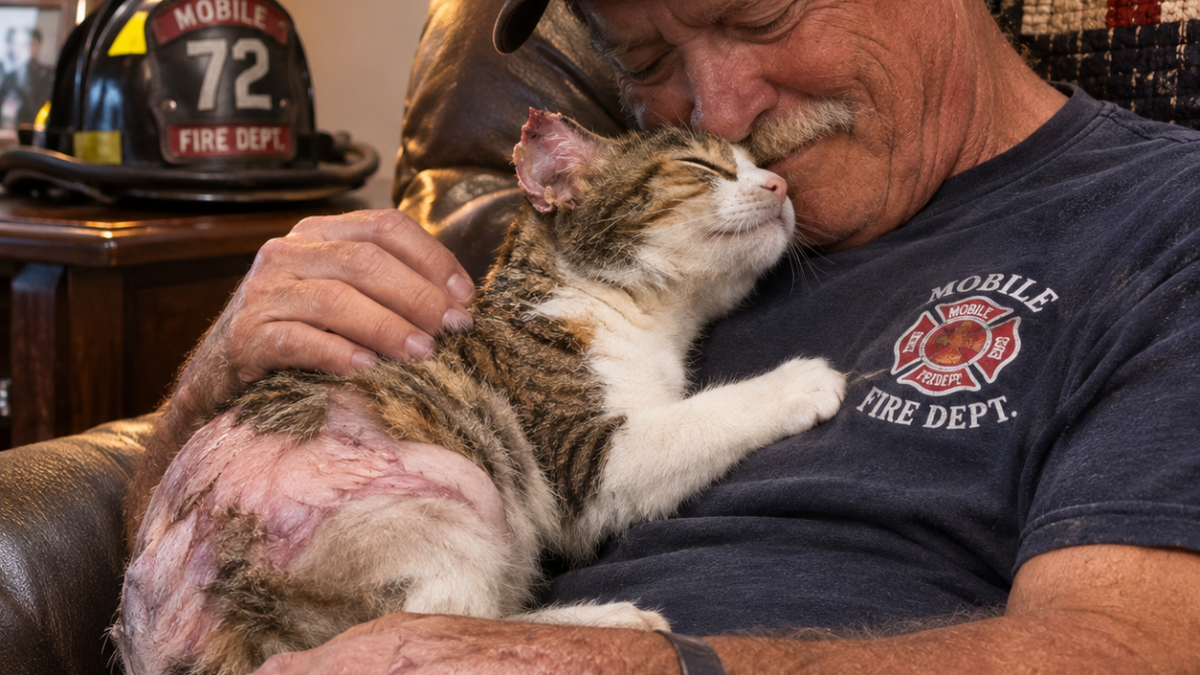
PART3:
“Someone set her on fire.”
The words changed everything.
Marcus looked at the cat again.
She was still trembling.
Still breathing.
Still alive.
He heard the dispatcher tell him not to disturb anything.
Animal control was coming.
Police might respond.
Marcus barely registered it.
The cat made another tiny sound.
He sat down on the concrete beside her.
“I’m here.”
She did not look at him.
“That probably doesn’t mean much.”
His voice shook.
“But I’m here.”
Ten minutes passed.
Then fifteen.
Customers came and went inside.
The trucker had apparently taken over telling people the clerk was handling an emergency.
Marcus did not care if the store emptied itself.
He stayed.
The cat tried once to stand.
Her front legs worked.
Her back legs failed.
Marcus put his hand near her face.
She stared at it.
He expected teeth.
Fear.
A swipe.
Instead, after several seconds, the burned cat pressed her forehead against the side of his wrist.
Marcus closed his eyes.
“Okay.”
He did not move.
“You can do that.”
When animal control officer Denise Holloway arrived, she found Marcus sitting behind the dumpsters with his knees drawn up, one hand resting on the concrete and the injured cat pressed against his forearm.
Denise stopped when she saw them.
“Oh, sweetheart.”
Marcus looked up.
“She’s been like this twenty minutes.”
“Did she walk?”
“Tried.”
“Did you give her water?”
“No. Dispatcher told me not to.”
“Good.”
Denise crouched.
Her face tightened as she examined the burns.
“This is bad.”
Marcus looked toward the gasoline bottle.
“I didn’t touch that.”
Denise followed his gaze.
“You think somebody poured it?”
“I know what gas smells like.”
She stood.
“I’m calling police.”
“Is she going to make it?”
Denise looked down at the cat.
“I don’t know.”
Marcus hated that answer.
He would hate it for the rest of the day.
The cat was transferred to a veterinary hospital that worked with the Mobile shelter.
By the time she arrived, she was going into shock.
Dr. Rebecca Sloan took one look and ordered treatment before anyone finished the intake paperwork.
“Fluids.”
A technician moved.
“Pain management.”
Another moved.
“Get her temperature.”
Rebecca leaned over the cat.
“Easy.”
The left side was worst.
Burns stretched across the back from the shoulder blades toward the hips.
Patches of fur were completely gone.
The skin beneath ranged from deep red to pale areas that frightened Rebecca more because severe burns could destroy nerves and blood supply.
The left ear was damaged.
Not entirely gone.
But part of the outer edge had curled inward.
“Do we have a name?” a technician asked.
Denise looked at the intake sheet.
“No owner.”
“Microchip?”
“Nothing.”
Rebecca glanced toward the treatment table.
“We need something.”
Denise said, “Marcus called her sweetheart.”
One technician shook her head.
“Too many Sweethearts.”
Rebecca looked at the cat.
Burned.
Covered in extinguisher residue.
Alive when everything about her condition suggested she should have been dead.
“Ember.”
Denise looked at her.
“What?”
“Put Ember.”
The technician wrote it on the board.
EMBER.
The name was supposed to be temporary.
It never changed.
The first twenty-four hours were brutal.
Ember needed fluids.
Antibiotics.
Pain medication.
Careful cleaning.
Dressings over the worst burns.
Rebecca and her team examined how deep the heat had penetrated.
Some tissue could be saved.
Some could not.
The left ear might heal, though never normally.
The hair follicles across large portions of her back had been destroyed.
Even if she survived, fur might never grow there again.
That was far ahead.
First, Ember had to survive the night.
Marcus showed up at the hospital after his shift.
He had borrowed a clean shirt from the gas station manager.
Rebecca met him in the lobby.
“You’re the one who found her?”
“Yeah.”
“She’s stable for the moment.”
“For the moment.”
Rebecca nodded.
“That’s all I can promise tonight.”
“Can I see her?”
“She’s sedated.”
“I don’t need her awake.”
Rebecca studied him.
“You don’t own her.”
“I know.”
“You may not be allowed—”
“I just don’t want her waking up and nobody she knows is there.”
Rebecca softened.
“She knows you?”
Marcus looked down.
“She knew me for twenty minutes.”
Rebecca opened the door.
“That might be enough.”
Ember was lying in a temperature-controlled enclosure.
Bandages covered much of her back.
An IV ran into one foreleg.
Her damaged ear was visible above the wrap.
Marcus stood several feet away.
He looked smaller somehow.
The anger had drained out of him.
“You look different.”
Rebecca glanced at him.
“Different?”
“Without the fire.”
He swallowed.
“That sounds stupid.”
“No.”
Marcus moved closer.
“She screamed so loud.”
Rebecca remained silent.
“I thought it was a kid.”
He stared at Ember.
“I keep hearing it.”
“You probably will for a while.”
“People can do that?”
Rebecca knew exactly what he meant.
She had treated cruelty cases for fifteen years.
She had stopped trying to answer that question.
“Yes.”
Marcus’s jaw clenched.
“They catch whoever did it?”
“Police took the bottle.”
“Cameras.”
“What?”
“The station has cameras.”
Rebecca looked at him.
“You told police?”
“I remembered on the drive here.”
“Then call them now.”
Marcus did.
The footage changed the case.
A camera facing the side alley had captured a dark sedan stopping near the rear of the property shortly before Marcus heard Ember screaming.
The image was grainy.
The license plate was partially obscured.
But the video showed two people getting out.
One appeared to carry something.
The other held what looked like a phone.
They disappeared behind the building.
Forty-seven seconds later, they ran back.
One of them was laughing.
The vehicle drove away.
Less than a minute later, Marcus appeared with the extinguisher.
Detective Aaron Pike watched the footage twice.
Then again.
“This wasn’t random fire exposure.”
Officer Denise stood beside him.
“No.”
“They filmed it.”
“Looks like it.”
Aaron’s expression hardened.
“Find me every angle that station has.”
The investigation began while Ember fought to stay alive.
For the first three days, the shelter received almost no information.
That was fine.
Rebecca did not want headlines.
She wanted skin temperature.
Hydration.
Signs of infection.
Appetite.
Pain control.
She wanted Ember to stop shaking whenever someone opened the treatment room door.
She wanted one night without a fever.
On the fourth day, Ember ate voluntarily.
Three bites.
That was all.
Rebecca texted the shelter coordinator, Caroline Hayes.
SHE ATE.
Caroline called immediately.
“How much?”
“Not enough.”
“But she ate?”
“Yes.”
“Rebecca.”
“What?”
“She ate.”
Rebecca smiled for the first time that week.
“She ate.”
Marcus visited again that evening.
He brought nothing.
No toys.
No flowers.
No dramatic donation.
Just himself.
Rebecca appreciated that.
People often brought injured animals objects they could not use because giving something made the humans feel less helpless.
Marcus sat beside Ember’s enclosure.
“You’re getting famous.”
Rebecca looked over.
“She is not.”
“Police came back to the station.”
“That isn’t famous.”
“My manager says news people called.”
Rebecca’s face hardened.
“Who told them?”
“No idea.”
“We’re not releasing pictures.”
“Good.”
Marcus looked at Ember.
“They catch them?”
“Not that I’ve heard.”
Ember opened her eyes.
Marcus froze.
“Hey.”
One eye remained half-closed from medication.
But she looked directly at him.
“Remember me?”
Ember lifted her head slightly.
Marcus placed one finger near the opening.
She sniffed.
Then pressed her nose against it.
Marcus looked at Rebecca.
“She does.”
“Maybe.”
“No.”
He smiled through tears.
“She does.”
The investigation moved faster after a gas station customer recognized the sedan.
Aaron tracked it to twenty-three-year-old Cody Mercer.
The second person in the video was nineteen-year-old Travis Hall.
Neither had a serious criminal record.
That bothered Aaron in a particular way.
People always expected cruelty to arrive wearing a recognizable face.
Sometimes it looked ordinary.
A young man with a job.
Someone who had gone to local schools.
Someone whose mother told reporters he loved animals as a child.
Police obtained the phone.
The video had been deleted.
It was recovered anyway.
Aaron watched twelve seconds before shutting it off.
He had seen homicide scenes.
Domestic violence.
Children hurt by adults they trusted.
The sound still got to him.
Ember screaming.
Laughter behind the camera.
Then Marcus shouting somewhere off-screen.
Aaron did not watch it again unless required for evidence.
Cody and Travis were arrested.
The story became public.
That was when Ember stopped being only a patient.
She became a symbol.
Caroline hated that.
She understood why people reacted.
The shelter phone rang constantly.
Donations arrived.
People offered to adopt Ember before she was medically cleared.
Reporters requested interviews.
Some wrote thoughtful coverage.
Others wanted graphic photographs.
Caroline refused.
“Her worst day is not promotional material.”
One producer said, “But people need to understand the severity.”
“They can understand burns without seeing open tissue.”
“It would increase donations.”
“No.”
“You might help other animals.”
Caroline stared at the phone.
“We’re not using her pain to earn attention.”
She hung up.
Marcus’s name appeared in the news because surveillance footage showed him running out with the extinguisher.
Someone called him a hero.
He rejected it immediately.
“I work at a gas station. The extinguisher was right there.”
The reporter said, “A lot of people might not have acted as quickly.”
Marcus looked uncomfortable.
“Well, they should.”
Then he changed the subject.
“How’s the cat?”
Three weeks after the fire, Ember left veterinary hospitalization.
She was not healed.
Not completely.
But the worst danger had passed.
Rebecca showed Caroline how to manage the remaining dressings.
“She may need medication for a while.”
“Okay.”
“Watch these areas.”
Caroline nodded.
“She’ll probably always have scar tissue here.”
Rebecca indicated the left side.
“Hair?”
“Some might return around the edges.”
“And the center?”
Rebecca shook her head.
“No.”
Caroline looked at Ember.
The cat sat quietly in the carrier.
Large smooth patches of pink skin interrupted the tortoiseshell fur across her back.
The left ear was shorter.
Curled.
Uneven.
“She’s going to look like this.”
“Yes.”
Caroline spoke before realizing how it sounded.
“People are going to stare.”
Rebecca looked at her.
“Then find people worth being stared at by.”
At the shelter, Ember was given a quiet room before moving into the adoption area.
The first weeks were about recovery.
She startled at noises.
The click of a lighter made one employee ban lighters anywhere near the building, though smoking was already prohibited.
The hiss of an aerosol cleaner sent Ember under a blanket.
Once, a maintenance worker dropped a metal tool in the hallway.
Ember launched herself behind a cabinet and would not come out for twenty minutes.
Caroline sat on the floor.
“It’s okay.”
Ember stared from the darkness.
“I know you don’t believe me.”
No movement.
“I can wait.”
So she waited.
Eventually Ember’s nose appeared.
Then one paw.
Then the burned side of her body.
Caroline did not reach.
Ember came the rest of the way herself.
That became the rule with her.
Let Ember decide.
No forced affection.
No grabbing from above.
No surprise.
No pity.
People assumed traumatized animals needed endless touching.
Sometimes what they needed first was control.
Choice.
The ability to say no.
After six weeks, Ember began sleeping stretched out instead of curled protectively around herself.
After eight, she played with a feather wand.
The first time she chased it, three shelter employees stopped working just to watch.
“You people realize we have twenty-seven other cats,” Caroline said.
Nobody moved.
Ember pounced.
Missed.
Her paws slid beneath a blanket.
A volunteer whispered, “Again.”
Caroline moved the feather.
Ember jumped.
Everyone laughed.
“She’s a cat,” one employee said.
Caroline looked at her.
“What?”
“She’s finally just acting like a cat.”
That mattered.
Because suffering has a way of swallowing identity.
Ember was becoming known as the burned cat.
The survivor.
The cruelty case.
But Ember knew none of those words.
She liked tuna.
She hated closed bathroom doors.
She preferred the left side of any pillow.
She attacked shoelaces.
She chirped at birds.
She stole pens.
She would sit directly on paperwork if someone appeared too busy.
That was Ember.
The scars were part of her.
They were not all of her.
When she was finally cleared for adoption, Caroline rewrote her kennel card four times.
The first version focused too much on the fire.
The second sounded sentimental.
The third sounded like a legal report.
She threw them all away.
The final card read:
EMBER
Adult female.
Loves sunny windows, quiet people, soft blankets, feather toys, and sitting exactly where you need to work.
Ember survived serious burns before coming to us. Her injuries healed, but she will always have visible scars and a shortened left ear.
Please do not feel sorry for her.
She does not.
Caroline liked that.
The visitors did too.
They read it.
They smiled.
Some cried.
Then most of them adopted another cat.
The first time it happened, Caroline thought nothing of it.
A young couple came looking for a kitten.
Ember was not a kitten.
Normal.
The second family had two energetic dogs.
Not the best fit.
Fine.
The third woman loved Ember but decided on a long-haired orange cat.
Nothing wrong with that.
Then Caroline started noticing the pattern.
Visitors stopped at Ember.
They asked questions.
“Will the hair grow back?”
“No.”
“Does she need special medicine?”
“Not anymore.”
“Does touching the scars hurt?”
“No, not now.”
“Was she really set on fire?”
“Yes.”
“On purpose?”
“Yes.”
They looked horrified.
Then uncomfortable.
Some said things like:
“She deserves a wonderful home.”
Then walked away.
One woman whispered to her husband, thinking Caroline could not hear:
“I just don’t know if I want to look at that every day.”
Caroline followed them into the hall.
She wanted to say something.
She did not.
People were allowed preferences.
Adoption had to work.
Anger would not put Ember in the right home.
Still, Caroline went into the supply room afterward and shut the door harder than necessary.
A volunteer named Sophie found her.
“What happened?”
“Nothing.”
“That sounded like a nothing door slam.”
Caroline sat on a box of cat litter.
“Someone said they didn’t want to look at Ember’s scars every day.”
Sophie winced.
“Wow.”
“They adopted Daisy.”
“The tabby?”
“Yes.”
“Daisy needs a home too.”
“I know.”
“That doesn’t make the comment less awful.”
“I know.”
Sophie sat beside her.
“Ember doesn’t know she was rejected.”
Caroline stared at the floor.
“No.”
“She’s probably sleeping.”
“Probably.”
They returned to the adoption room.
Ember was asleep upside down, one back leg stretched against the kennel wall.
Sophie pointed.
“Tragic.”
Caroline laughed despite herself.
“Heartbroken.”
Four months passed.
The criminal case remained unresolved.
Cody and Travis had pleaded not guilty.
Their attorneys argued over admissibility of the recovered video.
The defense suggested another person might have ignited the fire outside the frame.
Online, people became vicious.
Some demanded maximum punishment.
Others claimed the case was exaggerated.
One anonymous account accused the shelter of creating the story to raise money.
Marcus saw that post during a night shift.
He responded once.
I PUT THE FIRE OUT MYSELF.
Then he deleted his account because he hated arguing with strangers.
Ember remained at the shelter.
She developed a routine.
Breakfast.
Window.
Nap.
Volunteer lap if available.
Lunch.
More window.
Feather toy.
Dinner.
Scream at anyone who passed without acknowledging her.
At some point, Caroline stopped worrying that Ember would never be adopted.
Not because she believed the perfect person was guaranteed to appear.
Because worrying had begun to make every visitor feel like a test.
Ember deserved better than to have humans stand near her projecting disappointment.
So Caroline decided that as long as Ember was there, the shelter would simply be home.
Then came Thursday.
It was raining.
Not dramatically.
Just one of those gray Gulf Coast afternoons when rain settled over Mobile and seemed unwilling to leave.
The shelter was quiet.
Caroline was reviewing invoices at the front desk when the door opened.
A man stepped inside.
He was tall even with age pulling slightly at his shoulders.
White hair.
Weathered face.
Blue jeans.
Work boots.
And a faded navy T-shirt with MOBILE FIRE DEPARTMENT printed across the chest.
He stood on the entry mat and wiped rain from his forearms.
Caroline smiled automatically.
“Hi. Can I help you?”
“I hope so.”
“Looking to adopt?”
“That’s what they tell me.”
Caroline tilted her head.
“They?”
“My daughter.”
He glanced toward the parking lot.
“She says the house is too quiet.”
“Is she here?”
“No. She also says I’m stubborn, so she refused to come because she thinks I’ll adopt whichever cat she points at just to prove her wrong.”
Caroline smiled.
“That sounds complicated.”
“It’s been complicated for forty-eight years.”
He approached the desk.
“My name’s Frank Delaney.”
“Caroline.”
They shook hands.
His grip was strong.
His hands caught her attention.
Scars.
Pale, shiny marks crossed two fingers and disappeared toward his wrist.
She did not ask.
“Have you owned cats before?”
“Three.”
“Recently?”
“My last one, Rosie, died in February.”
“I’m sorry.”
“Kidney disease.”
He looked toward the adoption rooms.
“Seventeen years.”
“That’s a good long life.”
“Not long enough.”
Caroline understood.
“What are you looking for?”
Frank scratched his chin.
“Cat.”
She waited.
“That’s broad.”
“I’m flexible.”
“Age?”
“Doesn’t matter.”
“Male or female?”
“Doesn’t matter.”
“Long hair? Short?”
“Preferably one with hair somewhere.”
Caroline laughed.
Frank smiled.
“Sorry.”
“No, that helps less than you think.”
He nodded toward the hallway.
“Then show me who’s having a hard time.”
Caroline’s expression changed.
“What do you mean?”
“The one people pass over.”
Frank shrugged.
“Old. Ugly. Grumpy. Three legs. One eye. Whatever you’ve got.”
Caroline studied him.
“Why?”
His answer came easily.
“Because the easy ones will get picked.”
“You don’t know that.”
“No.”
He looked toward the kennels.
“But show me the one nobody wants.”
Caroline thought immediately of Ember.
Then she hesitated.
She had learned not to set Ember up as a test of someone’s goodness.
Frank noticed.
“You thought of one.”
“I did.”
“Well?”
“She isn’t ugly.”
“Didn’t say she had to be.”
“She’s not old.”
“Fine.”
“She has some history.”
Frank’s face remained calm.
“Most of us do.”
Caroline stood.
“Come with me.”
They passed kittens first.
Frank stopped briefly at each enclosure.
He greeted every animal.
One orange kitten reached through the bars.
Frank let it catch his finger.
“You’re trouble.”
The kitten bit gently.
“Definitely trouble.”
Caroline watched.
“You sure you don’t want easy?”
Frank withdrew his finger.
“Keep walking.”
They reached Ember’s room.
The cat was sitting in the window.
Her unburned side faced them.
Frank smiled.
“That her?”
“Yes.”
Caroline opened the door.
Ember turned.
Now the scarred side was visible.
Frank stopped.
Caroline watched his face.
She had seen dozens of reactions.
Shock.
Pity.
Discomfort.
Anger.
Frank’s expression barely changed.
He looked.
Really looked.
The pink hairless skin.
The uneven edge of the ear.
The places where fire had permanently rewritten the outline of her body.
Then his eyes moved to the story card.
He read every word.
Ember jumped down from the window.
Frank remained silent.
Caroline said, “She was found behind a gas station.”
He kept reading.
“Somebody deliberately burned her.”
His jaw tightened once.
“She spent about three weeks receiving treatment.”
Frank nodded.
“The scars are permanent.”
“I figured.”
“She doesn’t need any special medication now.”
Frank looked at Ember.
“Pain?”
“Not from the healed scars.”
“Good.”
“She can be nervous around sudden hissing sounds or some strong smells.”
“Reasonable.”
Caroline looked at his hands.
Frank noticed.
He held one up.
“Warehouse fire.”
“What year?”
“2014.”
The scars crossed his knuckles.
“Glove failed when part of the roof came down.”
Caroline swallowed.
“Were you badly hurt?”
“Bad enough to complain. Not bad enough to retire.”
“You were with Mobile Fire?”
“Thirty-one years.”
Ember approached.
Frank lowered himself slowly onto one knee.
He did not extend his hand.
He simply waited.
Ember sniffed his boot.
Then his jeans.
Frank whispered, “Hello, Probie.”
Caroline smiled.
“Probie?”
“Probationary firefighter.”
Ember looked up.
Frank’s expression softened.
“You look like you’ve had a worse first shift than most.”
Ember sniffed his scarred hand.
Frank did not move.
Her nose traveled across the pale tissue.
Then she rubbed her cheek against his knuckles.
Caroline looked away.
Frank scratched gently beneath Ember’s chin.
The cat leaned into him.
“Yeah.”
His voice had changed.
“You’ll do.”
Caroline turned back.
“You haven’t met the others.”
“Don’t need to.”
“Frank.”
He looked up.
“I’ll take her.”
Caroline had heard those words hundreds of times.
They had never sounded quite like that.
“Are you sure?”
He looked at Ember.
Then at Caroline.
“Ma’am.”
He lifted his scarred hand slightly.
“I’ve been putting out fires my whole life.”
He rubbed Ember’s cheek with his thumb.
“I have one more.”
Caroline turned her face away.
Frank frowned.
“You okay?”
She laughed through tears.
“No.”
“That bad?”
“You have no idea how many times people have stood exactly where you are and walked away.”
Frank looked at Ember again.
“Because of this?”
His fingers hovered over the healed skin without touching it.
“Sometimes.”
He was quiet for several seconds.
Then he said, “People are fools.”
Caroline laughed again.
“That is not an official shelter position.”
“It can be mine.”
The adoption paperwork took forty minutes.
Frank read everything.
Medical notes.
Behavior notes.
Diet.
Microchip registration.
Emergency contact.
He asked practical questions.
What food?
What litter?
Does she scratch furniture?
“Sometimes.”
“Good. I’ve got furniture.”
“Do you have other pets?”
“No.”
“Children visiting?”
“Granddaughter. She’s fourteen and smarter than me.”
“Keep initial introductions quiet.”
“Done.”
“We recommend a carrier.”
Frank looked toward Ember.
“Do I need it to leave?”
“Yes.”
“Why?”
“For safety.”
He sighed.
“Fine.”
He lasted twelve seconds.
Ember cried once inside the carrier.
Frank stopped walking.
“No.”
Caroline looked at him.
“Frank.”
“She hates it.”
“She’ll be safer in the truck.”
“I drove a fire engine through a hurricane. I can transport one cat.”
“That is not remotely relevant.”
Frank looked down at Ember.
She cried again.
He opened the carrier.
Caroline put both hands on her hips.
“Sir.”
“I’m seventy-two. You can’t intimidate me.”
“I absolutely can.”
Frank lifted Ember carefully.
The cat settled instantly against his chest.
He looked triumphant.
“See?”
“You’re impossible.”
“My daughter says that.”
“Put her in the carrier while the truck is moving.”
Frank muttered something.
“What?”
“Nothing.”
“Frank.”
“I said yes, ma’am.”
Caroline walked them to his pickup.
Rain had almost stopped.
Frank placed Ember into the carrier on the passenger seat and secured it with the seat belt.
“Happy?”
“Moderately.”
He looked through the carrier door.
Ember pressed her face against the mesh.
Frank placed two fingers there.
“I’m right here.”
Caroline watched.
Something about the sentence reached into her chest.
Not dramatic.
Not poetic.
Just true.
Frank drove away.
Ember watched him the whole way home.
The house was a small brick place in West Mobile with a wide front porch, two oak trees and a detached garage that contained more tools than any retired man reasonably needed.
Frank carried Ember inside.
He set the carrier on the living-room floor.
Then opened the door and sat in his recliner.
He did not pull her out.
His daughter, Melissa, had told him repeatedly:
Let the cat come out when she’s ready.
Frank believed he was excellent at following instructions when the instructions made sense.
These did.
So he waited.
Five minutes.
Ten.
Ember’s face appeared.
Frank pretended not to notice.
She stepped out.
Sniffed the rug.
Retreated.
Came out again.
The television was showing a baseball game with the volume low.
Frank watched the screen.
Ember crossed the room.
She disappeared beneath a side table.
Frank waited.
An inning passed.
Then another.
Something touched his boot.
He looked down.
Ember stood beside his leg.
“Well.”
He lowered one hand.
She sniffed.
Then jumped.
Straight onto the recliner.
Frank laughed.
“That was quick.”
Ember turned twice and sat against his hip.
“Your room’s down the hall.”
She closed her eyes.
“Apparently not.”
That first night, Frank slept badly.
Not because Ember caused trouble.
Because he kept waking to check whether she was still there.
At three fourteen, he turned on the lamp.
Ember was sitting on his chest.
Frank stared up at her.
“You trying to kill me?”
She blinked.
“You weigh eight pounds.”
Purr.
“Feels like eighty.”
She lowered herself onto his sternum.
Frank turned off the lamp.
“Fine.”
By the end of the week, Ember had taken control of the house.
The expensive cat bed Melissa brought remained unused.
Frank’s recliner became Ember’s.
So did half the couch.
She claimed the windowsill.
The laundry basket.
A cardboard box that had once contained a coffee maker.
Frank complained constantly.
He also rearranged furniture to improve her access to sunlight.
Melissa noticed.
“You moved the side table.”
“No.”
“It has been beside that lamp since Mom was alive.”
Frank looked at Ember sleeping in the window.
“Blocked the sun.”
Melissa smiled.
“You’re ridiculous.”
“Your mother moved furniture.”
“For people.”
“Ember is people.”
Melissa looked at him.
“You’ve had her six days.”
“So?”
Melissa hugged him.
Frank stiffened.
“What’s that for?”
“Nothing.”
“Suspicious.”
His wife, Helen, had died three years earlier.
Cancer.
Forty-six years of marriage ended in a hospital room on a Tuesday morning.
Afterward, Frank discovered there were forms of silence no fire station prepared you for.
At the station, silence meant something was wrong.
At home after Helen died, silence simply existed.
No cabinet closing in the kitchen.
No television from another room.
No voice asking whether he had taken his blood pressure medication.
No argument over thermostat settings.
His daughter visited.
His granddaughter called.
Friends invited him fishing.
He functioned.
But the house felt like a place waiting for its owner to return.
Frank knew she would not.
Ember changed the silence.
Not with much.
A collar bell.
A jump onto furniture.
A bowl moving across tile.
A meow from the hallway because Frank had closed the bathroom door without consulting her.
At six every morning, Ember sat outside his bedroom.
At six-oh-two, if he had not appeared, she yelled.
Frank began calling roll.
“Engine One?”
Meow.
“Truck Five?”
Meow.
“Probie?”
Louder meow.
“Accounted for.”
Some mornings he laughed before coffee.
That had not happened in years.
The first time Ember heard the smoke detector, everything went wrong.
Frank burned toast.
Nothing dramatic.
He was scraping black edges over the sink when the alarm screamed.
Ember disappeared.
Frank dropped the knife.
“Ember?”
No response.
He silenced the detector.
“Ember!”
He searched the living room.
Bedroom.
Laundry room.
Under the dining table.
Nothing.
Panic arrived much faster than reason.
“Ember!”
He found her behind the washing machine.
Pressed into the narrowest possible space.
Eyes enormous.
Body trembling.
Frank lowered himself onto the floor despite the protest from both knees.
“Oh.”
Ember flattened further.
“Okay.”
Frank stayed.
He did not reach.
He knew something about fear.
Not cat fear.
But enough.
He had seen firefighters freeze after explosions.
Men twice his size suddenly unable to walk into structures they would have entered without thought a year earlier.
He had once spent six months pretending he did not hear the sound of the warehouse roof collapsing whenever somebody dropped sheet metal.
People called it memory.
The body called it now.
Frank rested his back against the dryer.
“That wasn’t your fire.”
Ember watched him.
“Mine wasn’t this house either.”
Her ears remained flattened.
“Body doesn’t care much, does it?”
Minutes passed.
Frank’s legs went numb.
He remained.
Finally Ember crept forward.
One paw.
Then another.
She reached his knee.
Frank did not touch her until she pushed her head beneath his hand.
“There you are.”
He carried her into the living room.
The next day he bought a new smoke detector.
Melissa found him reading the packaging.
“What are you doing?”
“Research.”
“You called me at seven this morning asking which smoke alarm has the least terrifying sound.”
“Correct.”
“You cannot remove your smoke alarms because the cat doesn’t like them.”
“I know that.”
“I need you to say it again.”
“I am not removing smoke alarms.”
“Good.”
“Just finding one that talks before it screams.”
Melissa shook her head.
“You spent thirty-one years telling people smoke detectors save lives.”
“And I remain right.”
“Miracle.”
Frank pointed at her.
“Respect your elders.”
The criminal hearing happened six weeks after the adoption.
Frank almost did not attend.
He had no legal role.
Marcus testified.
So did the responding officer.
Veterinary photographs were admitted.
The recovered phone video became the most important evidence.
The defendants eventually changed their pleas.
Caroline called Frank afterward.
“They admitted it.”
Frank sat in his recliner.
Ember slept across his lap.
“What did they get?”
Caroline told him.
It was not as much as some people wanted.
There was jail time.
Probation.
Animal ownership restrictions.
Restitution.
Court-ordered community service.
The judge called the act deliberate and sadistic.
Frank remained quiet.
“You okay?” Caroline asked.
“Yeah.”
“You sound disappointed.”
“I am.”
“In the sentence?”
“In them.”
He stroked Ember’s unscarred cheek.
“I spent thirty-one years watching people risk their lives getting strangers out of burning buildings.”
Caroline listened.
“And those two used fire because they thought suffering was funny.”
Frank shook his head.
“Same species.”
“I know.”
“I never understand that.”
“Maybe you’re not supposed to.”
Frank looked at Ember.
“Good.”
The story might have ended there.
Cat rescued.
Criminals punished.
Retired firefighter adopts survivor.
Perfect.
Except life rarely organizes itself that neatly.
Three months after Ember came home, Frank had a heart attack.
It happened in the kitchen.
He had been making coffee when pain moved across his chest.
At first he ignored it.
Old firefighters were professionals at ignoring symptoms.
Then the mug fell from his hand.
It shattered.
Ember ran.
Frank grabbed the counter.
“Damn.”
He reached for his phone.
His knees weakened.
He sat heavily on the floor.
Ember returned.
Frank dialed 911.
“Seventy-two-year-old male.”
He breathed.
“Chest pain.”
The dispatcher asked questions.
Frank answered.
Ember paced around him.
When he leaned back against the cabinets, she climbed into his lap.
“Not now, Probie.”
She stayed.
Sirens approached.
Ember heard them.
Normally she ran from loud noises.
This time she did not leave.
Paramedics found Frank on the kitchen floor with one hand pressed against his chest and the other resting on a scarred cat.
One paramedic recognized him.
“Captain Delaney?”
Frank squinted.
“Who are you?”
“Eric Mason. You trained my class.”
“Then why are you standing there talking?”
Eric laughed.
“Yep. Definitely you.”
They loaded Frank onto the stretcher.
Ember tried to follow.
Melissa arrived as the ambulance doors closed.
She found Ember sitting at the front door.
Waiting.
Frank spent four days in the hospital.
Melissa stayed at his house.
Every afternoon around the time Frank’s truck normally pulled in, Ember sat beside the front window.
On the second day, Melissa sent a picture.
YOUR PROBIE IS WAITING FOR HER CAPTAIN.
Frank stared at it from the hospital bed.
His roommate, a retired postal worker named Carl, leaned over.
“That the burned cat?”
Frank looked at him.
“How do you know about her?”
“You told me yesterday.”
“I did?”
“After the morphine.”
Frank closed his eyes.
“What else did I tell you?”
“You think hospital coffee violates the Geneva Convention.”
“That’s objectively true.”
Carl pointed at the phone.
“She looks rough.”
Frank’s expression changed.
“She looks fine.”
“I meant the scars.”
“I know what you meant.”
Carl raised both hands.
“No offense.”
Frank looked at the photograph.
“Scars are just where the repair work shows.”
Carl was quiet.
Frank glanced down at his own hands.
“They match.”
He went home two days later.
Melissa drove.
Frank complained about every turn.
“You’re braking too late.”
“I’m fifty.”
“Your age does not improve your braking.”
“Dad.”
“Yellow means prepare to stop.”
“Dad.”
When they pulled into the driveway, Ember appeared in the front window.
Frank smiled before the truck stopped.
Melissa saw.
She said nothing.
The moment the front door opened, Ember ran.
Frank had never seen her move so fast.
She launched onto the couch beside him before he had fully sat.
“Easy.”
She climbed onto his chest.
Frank winced.
“Not there.”
Ember immediately moved to his shoulder.
Melissa laughed.
“She understands cardiology.”
“Obviously.”
For the next two weeks, Ember followed Frank everywhere.
Bathroom.
Kitchen.
Porch.
Bedroom.
When he sat, she sat.
When he stood, she stood.
If he disappeared from sight for more than a minute, she came looking.
Frank called her Lieutenant now.
“You’ve been promoted.”
Melissa said, “For what?”
“Excessive supervision.”
Ember meowed.
“See?”
The shelter posted their adoption story shortly afterward.
Caroline had asked Frank first.
“I don’t want to make you uncomfortable.”
“What are you posting?”
“A photo of Ember when she arrived.”
“Nothing graphic.”
“No.”
“And one now.”
“Yes.”
“What are you writing?”
Caroline hesitated.
“Your line.”
“What line?”
She stared at him.
“You seriously don’t remember?”
“I say lots of things.”
“When I asked if you were certain about adopting her.”
Frank frowned.
Then remembered.
“Oh.”
“Can we use it?”
“Why?”
“Because I think people need it.”
Frank scratched Ember’s chin.
“Fine.”
The shelter posted two photographs.
The first was Ember during recovery.
Bandaged.
Exhausted.
The injuries visible but not graphic.
The second showed her curled on Frank’s recliner.
Eyes closed.
Scarred back exposed without shame.
The caption was short.
Retired Mobile firefighter Frank Delaney spent thirty-one years responding to fires.
When we asked if he was certain he wanted to adopt Ember, a cat who survived being deliberately burned, he told us:
“I’ve been putting out fires my whole life. I have one more.”
Frank never saw the post.
He did not have social media.
He did not know it had been shared thousands of times by morning.
He did not know local firefighters reposted it.
He did not know people in Canada, Scotland, Australia and Japan were sharing a photograph of him asleep in his recliner with Ember tucked against his side.
He found out because his granddaughter called.
“Grandpa, you’re viral.”
Frank looked at the kitchen.
“Do I need antibiotics?”
She laughed.
“Online.”
“Why?”
“Ember.”
“What did she do?”
“You’re impossible.”
“You people keep saying that.”
The comment that was shared most read:
He spent thirty-one years running into fires for strangers. Then he retired and saved one more.
Frank heard it once.
Melissa read it aloud.
He looked uncomfortable.
“I didn’t save her.”
“You adopted her.”
“Marcus saved her.”
“The gas station attendant.”
“Yes.”
“Veterinarians saved her.”
“Okay.”
“Shelter saved her.”
Melissa smiled.
“And you?”
Frank looked toward Ember sleeping on the windowsill.
“I gave her a chair.”
“You gave her a home.”
He was silent.
“Same difference.”
“No.”
Melissa waited.
Frank’s voice became quiet.
“A home isn’t the walls.”
She looked at him.
“It’s knowing somebody’s going to notice if you don’t come back.”
He turned toward the window.
“Helen taught me that.”
Melissa’s eyes filled.
Frank pretended not to notice.
A year passed.
Ember’s scars faded from angry red to pale pink.
They never disappeared.
Neither did Frank’s.
Sometimes children asked about Ember when Frank sat on the front porch.
Most were not cruel.
Children were simply direct.
“What happened to your cat?”
“She got burned.”
“Why doesn’t her hair grow there?”
“Because some burns change skin.”
“Does it hurt?”
“Not anymore.”
One boy pointed at Frank’s hands.
“You burned too?”
“Yep.”
“Same fire?”
Frank laughed.
“No.”
The boy thought about it.
“So you match.”
Frank looked down at Ember.
“That’s what I keep telling people.”
Eventually, the story stopped being news.
Another case took its place.
Then another.
The shelter remained full.
People kept abandoning animals.
People kept rescuing them.
Marcus eventually left the gas station and became an EMT.
When Frank heard, he drove across town to find him.
Marcus was standing beside an ambulance outside a training center.
Frank approached.
“You Marcus Bell?”
Marcus looked confused.
“Yeah.”
Frank held out his hand.
“Frank Delaney.”
The name registered.
“Ember.”
Frank smiled.
“Exactly.”
Marcus stared at him.
“How is she?”
“Runs my house.”
He showed a photograph.
Ember asleep across his pillow.
Marcus laughed.
“She looks good.”
“She is.”
Then his expression changed.
“I wanted to thank you.”
Marcus looked uncomfortable.
“For what?”
“You stayed.”
“I just—”
“No.”
Frank interrupted.
“Lots of people stop a danger.”
He looked Marcus directly in the eye.
“You stayed after.”
Marcus swallowed.
“She was scared.”
“I know.”
“I didn’t want her alone.”
Frank nodded.
“That’s the part.”
Marcus looked away.
“I still think about it sometimes.”
“The screaming?”
Marcus stared.
“How did you know?”
Frank held up his scarred hand.
“Different fire.”
Marcus nodded.
Frank said, “You ever talk to anyone?”
“I’m fine.”
“That wasn’t what I asked.”
Marcus laughed nervously.
“You sound like my girlfriend.”
“She seems intelligent.”
Frank gave him the number of a peer-support counselor who worked with first responders.
Marcus took it.
“You really came out here to check on me?”
“Ember told me to.”
“Sure.”
“She’s demanding.”
Before leaving, Frank shook his hand again.
“You saved my cat.”
Marcus’s eyes filled.
“She wasn’t your cat then.”
Frank smiled.
“She was headed my way.”
Years passed.
Frank’s hair turned fully white.
Ember slowed.
Her left ear remained curled.
Her scarred back remained bare.
Age added gray around her muzzle.
People who saw her for the first time still looked at the scars.
Frank stopped noticing.
That was one of the quietest gifts he gave her.
Not that he loved her despite how she looked.
That eventually he simply did not think of her appearance at all.
She was Ember.
The cat who stole chicken.
The cat who screamed at closed doors.
The cat who somehow knew the precise moment Frank sat down and appeared within seconds.
The cat who slept against his burned hand during thunderstorms.
The cat who sat beside the garage whenever he worked on an old motorcycle he had no intention of finishing.
The cat who waited at the front window whenever his truck left.
One evening, Frank sat on the porch while a storm rolled over Mobile.
Thunder sounded far away.
Ember was curled beside him.
Melissa joined them.
“You know she’s old.”
Frank looked at her.
“Rude.”
“She is.”
“So am I.”
“That’s why I’m saying it.”
He knew where the conversation was going.
He hated it immediately.
“The vet said her kidneys are changing.”
“I heard him.”
“She might need more testing.”
“I scheduled it.”
Melissa looked at him.
“I’m not trying to manage you.”
“Yes, you are.”
“Maybe a little.”
Frank scratched Ember behind the good ear.
“She’s fine tonight.”
Melissa sighed.
“Dad.”
“Tonight matters.”
That ended the argument.
Because Melissa understood exactly what he meant.
Firefighters lived by that too.
The building may collapse eventually.
The patient may worsen.
The storm may arrive.
But right now matters.
Right now you have air.
Right now you have time.
Right now someone is still beside you.
Ember developed kidney disease at fifteen.
Frank learned medications.
Special food.
Subcutaneous fluids.
He hated needles.
That amused everyone who knew him.
“You ran into burning warehouses,” Melissa said.
“Fire doesn’t require me to poke my cat.”
“You’ve had IVs.”
“That was professionals.”
“The vet showed you.”
“I am retired.”
Ember meowed from the counter.
Frank sighed.
“Fine.”
He learned.
Of course he did.
The first time he successfully administered fluids, he looked absurdly proud.
“Still got it.”
Melissa rolled her eyes.
“You hung a bag on a coat hook.”
“Command presence.”
Ember received a treat.
Months passed.
Then came a morning when she would not get out of the recliner.
Frank knew.
Before the veterinarian called.
Before the bloodwork.
Before anyone used the phrase declining kidney function.
Firefighters learned to recognize the point where saving a structure became impossible.
There was always a moment.
A roof sagging.
A floor compromised.
Heat changing character.
Someone had to say:
Back out.
That did not mean you had failed.
It meant you refused to lose more than the fire had already taken.
Frank sat beside Ember that evening.
She looked tired.
He touched the smooth scar on her back.
“You and fire.”
Ember opened her eyes.
“Always causing trouble.”
Purr.
He laughed.
“Yeah.”
He slept in the recliner with her that night.
At two in the morning, he woke.
Ember’s head rested across his burned hand.
The same scars she had sniffed the first day they met.
Frank thought about that shelter.
Caroline.
The kennel.
The story card.
The sentence he had said without planning it.
One more.
He had meant one more fire to put out.
He understood now that some fires could not be extinguished in the ordinary sense.
You could not erase what happened.
You could not make Ember’s fur grow over the scars.
You could not give her back the seconds when she burned.
You could not remove the sound from Marcus’s memory.
You could not turn cruelty into something harmless after the fact.
But you could stop the fire from taking everything.
You could make sure the suffering did not own what came afterward.
Maybe that was what he had meant.
One more.
One more thing the fire did not get.
The vet came to the house two days later.
Ember had stopped eating.
Frank refused to take her to a clinic if he could spare her that final trip.
Caroline came too.
Frank had not asked.
Melissa had.
When Caroline entered, she saw Ember on the recliner.
The same recliner from the viral photograph.
Frank sat beside her.
His hand rested on Ember’s side.
Caroline knelt.
“Hi, beautiful.”
Ember opened her eyes.
Caroline smiled.
“You remember me?”
Frank said, “She doesn’t remember anybody who didn’t bring chicken.”
Caroline laughed through tears.
“Fair.”
The veterinarian explained everything.
Frank already understood.
He asked one question.
“Any chance she hurts if we wait?”
“Possibly.”
Frank nodded.
“Then we don’t wait.”
Melissa began crying.
Frank did not.
Not yet.
He lifted Ember into his arms.
Her body settled against his chest the same way it had the day he carried her from the shelter.
Caroline remembered.
“You refused the carrier.”
Frank looked at her.
“You were bossy.”
“I was correct.”
“That remains disputed.”
Ember purred faintly.
Frank looked down.
“See? She agrees with me.”
The veterinarian gave the first medication.
Ember relaxed.
Frank held her.
Caroline sat beside him.
Melissa held his shoulder.
Frank touched the curled edge of Ember’s ear.
“You did good, Probie.”
His voice finally broke.
“You did real good.”
Ember’s eyes remained on him.
“No more alarms.”
He kissed her head.
“No more smoke.”
Another breath.
“No more being scared.”
Frank closed his eyes.
“You’re off duty.”
Ember’s last breath left quietly.
No sirens.
No flames.
No screaming behind a gas station.
Just an old firefighter holding a scarred cat in a quiet living room.
For several minutes, Frank did not move.
Then he whispered, “Fire’s out.”
Caroline covered her mouth.
Melissa leaned into him.
Frank cried.
He did not apologize for it.
The shelter made no viral post that day.
Caroline asked first.
Frank said no.
“People already got the story.”
“What do you want them to remember?”
He looked toward the empty recliner.
“Not the fire.”
Caroline waited.
“Remember the chair.”
So they waited several weeks.
Then Caroline posted one photograph.
Ember asleep on Frank’s recliner.
No medical image.
No burns.
No before-and-after comparison.
Just a cat at peace.
The caption read:
Ember’s life was never defined by the person who hurt her.
She had years of warm windows, stolen pieces of chicken, baseball games beside Frank, quiet mornings, thunderstorms spent sleeping against his hand, and a recliner she eventually claimed as her own.
The fire left scars.
It did not get the rest.
Frank never saw the post.
He still did not use social media.
He sat in his living room that evening watching baseball.
For the first time in years, the recliner felt too large.
His hand automatically moved toward the place Ember usually slept.
Nothing.
He left it there anyway.
A week later Marcus visited.
He carried a small framed photograph.
Frank opened the door.
“What’s this?”
Marcus handed it over.
It was a photograph taken at the gas station years earlier.
Not of the fire.
Security footage had captured a later moment after animal control arrived.
Marcus sat on the concrete.
Ember was wrapped carefully beside him.
His hand rested near her face.
The image was grainy.
Ordinary.
Frank stared at it.
“I never saw this.”
“Neither did I until recently.”
Frank looked at Marcus.
“You kept one?”
“Made two.”
They sat on the porch.
For a long time neither man spoke.
Finally Marcus said, “I used to think about those guys.”
“The ones who burned her?”
“Yeah.”
“Still do?”
“Not much.”
Frank nodded.
“Good.”
“I think about her coming home with you instead.”
“Better use of your time.”
Marcus smiled.
“She had a good life?”
Frank looked toward the living-room window.
“Hell of a life.”
“That’s good.”
Frank held the photograph.
“Thank you.”
Marcus shook his head.
“You gave her the years.”
“You gave her the first twenty minutes.”
They looked at each other.
Both understood.
Sometimes survival depended on twenty minutes.
Sometimes healing required years.
Neither mattered less.
Months later, Frank volunteered at the shelter.
Caroline laughed when he walked through the door.
“You?”
“Problem?”
“You said shelters made you sad.”
“They do.”
“So why are you here?”
Frank looked toward the cat rooms.
“Too quiet at home.”
Caroline’s expression softened.
“Want another cat?”
“No.”
“Not ready?”
“Maybe never.”
“That’s okay.”
Frank nodded.
“Put me to work.”
Caroline gave him laundry.
He complained.
“You had thirty-one years of fire service and thought shelter volunteering would be glamorous?”
“I had rank.”
“Not here.”
Frank spent Thursdays folding blankets.
Then he started sitting with frightened cats.
That became his specialty.
The ones that hid.
The ones that hissed.
The ones visitors skipped because they would not come forward.
Frank sat outside their kennels.
He read newspapers.
Watched baseball on his phone.
Talked about nothing.
He did not reach unless they did first.
Caroline noticed.
“You’re good at that.”
“What?”
“Waiting.”
Frank folded his paper.
“Learned from Ember.”
A year after her death, a badly injured black cat came in after being trapped in an abandoned building.
One eye had been removed.
The cat hid from everyone.
For three weeks, visitors passed.
Frank sat beside him every Thursday.
On the fourth week, the cat approached.
Frank lowered a scarred hand.
The cat sniffed.
Caroline watched from the hallway.
Frank looked over.
“Don’t start.”
“I didn’t say anything.”
“You’re thinking adoption.”
“Never.”
“I mean it.”
The cat rubbed against his hand.
Caroline smiled.
Frank frowned.
“Absolutely not.”
Two weeks later, Melissa found the black cat asleep on Frank’s couch.
She stood in the doorway.
Frank raised one finger.
“Temporary.”
Melissa burst out laughing.
“Of course.”
Frank named him Ash.
He insisted the name was coincidence.
Nobody believed him.
Years later, when people around Mobile still occasionally repeated the story of the retired firefighter and the burned cat, the details changed.
Some said Frank had rescued Ember directly from the fire.
He had not.
Marcus did.
Some said Frank adopted her the day she reached the shelter.
He had not.
She waited four months.
Some said she became a therapy cat.
She did not.
She mostly slept, stole food and occupied furniture.
Frank corrected people when he heard the exaggerations.
“You don’t have to make it bigger.”
He would point toward the photograph on his mantel.
Ember asleep.
Scarred back visible.
Safe.
“That’s big enough.”
And he was right.
Because there had once been a human being who looked at a living animal and decided fire would be entertaining.
That act was horrifying.
But it lasted minutes.
What came afterward lasted years.
Marcus heard the scream.
Marcus ran.
Marcus pulled the pin from an extinguisher and smothered the flames.
Denise came.
Rebecca treated her.
Technicians changed dressings.
Caroline protected her dignity.
Volunteers waited for her to trust them.
Investigators refused to let deleted evidence remain deleted.
A court put names beside responsibility.
Then, one rainy Thursday, an old firefighter walked into a shelter and asked to meet the cat people kept walking past.
He looked at what fire had done.
He did not recoil.
Maybe because he understood something other visitors did not yet understand.
Fire changed things.
That was its nature.
Wood became charcoal.
Steel warped.
Paint blistered.
Skin scarred.
A building after fire did not look the way it had before.
Neither did a person.
Neither did a cat.
But changed was not the same as destroyed.
Frank had spent thirty-one years learning that distinction.
He had entered homes where entire rooms were black but family photographs survived inside a drawer.
He had carried people down stairs after smoke had made hallways disappear.
He had watched firefighters walk out of buildings with burned gear, shaking hands and faces streaked in soot.
He knew survival was rarely clean.
Survival smelled like smoke.
It limped.
It scarred.
It sometimes woke at night.
It sometimes hid behind a washing machine because a kitchen alarm made the past feel present again.
But survival was still survival.
And Ember had been very, very good at it.
She survived the flames.
Then she survived the treatment.
Then the waiting.
Then the people who looked at her scars and chose something easier.
And finally she met a man whose hands carried scars of their own.
He did not tell her she was beautiful because of what she survived.
He did not turn her pain into poetry.
He simply took her home.
Fed her.
Argued with her.
Changed smoke detectors for her.
Shared chicken he claimed not to be sharing.
Let her steal his recliner.
Held her when storms came.
Allowed her to make a quiet house noisy again.
And when age finally took what fire could not, he stayed with her until the end.
Years later, one sentence remained attached to their story.
People printed it.
Shared it.
Repeated it.
Some thought it was heroic.
Frank never did.
To him it had simply been obvious.
A fire had hurt something.
He knew what to do next.
Put it out.
That was all he had meant when he stood beside Ember’s kennel, looked at a cat covered in scars and said:
“I’ve been putting out fires my whole life.”
Then he reached down with a scarred hand.
Ember leaned into it.
And Frank smiled.
“I have one more.”








