A Cat Had 24 Hours Left Before Euthanasia—Then His New Owner Took Him Home and He Did What Vets Said He Never Would
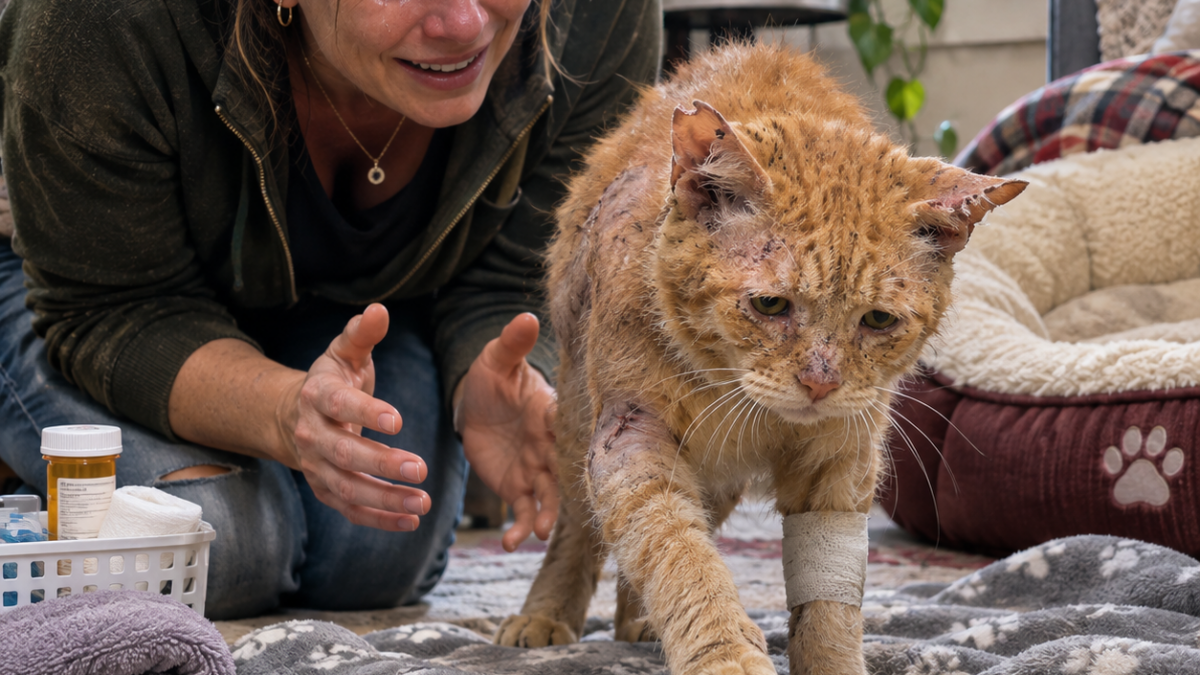
A Cat Had 24 Hours Left Before Euthanasia—Then His New Owner Took Him Home and He Did What Vets Said He Never Would.
Ben Ben had already been abandoned once, adopted once, returned once, and labeled “unadoptable” when a friend sent me his photograph with one devastating sentence beneath it: He is scheduled to be euthanized tomorrow.
I brought home an injured orange cat who had stopped eating, could barely lift his head, and had been told by more than one veterinarian that he might never walk normally again—and I promised myself I would not ask him for a miracle, only enough trust to let his final days be gentle.
Then, less than twenty-four hours after I carried him out of the shelter, I heard something scrape across my kitchen floor and turned around to see Ben Ben dragging himself toward me, fighting for one impossible step that would eventually expose how badly everyone—including me—had underestimated how much life was still left inside the saddest-looking cat in the world.
The photograph arrived on my phone at 7:18 on a Tuesday evening.
I remember the exact time because I was standing in my kitchen, waiting for pasta water to boil, when my friend Rachel sent it.
She worked nights at an emergency veterinary clinic about thirty minutes from my house, and over the years she had sent me plenty of photographs of animals.
Found dogs.
Injured pigeons.
A kitten somebody discovered in a warehouse.
A senior beagle needing temporary foster care.
Most messages began the same way.
Please tell me you’re not full.
Or:
I know you said no more animals, but…
This one contained only a picture.
An orange cat.
He was sitting—or trying to sit—on a folded gray blanket inside what looked like a shelter kennel.
His face was broad and strangely downturned.
Heavy folds of skin around his eyes made him look permanently devastated.
Both ears were damaged.
One folded unevenly toward the side.
His fur was dull.
His body looked far too thin for his large head.
There were shaved patches along his legs.
One front paw was extended awkwardly.
His expression stopped me.
Not because I believed animals display human emotions exactly the way we do.
I knew better.
I had fostered enough cats to understand that facial structure can fool us.
Some cats look angry when they are relaxed.
Some look terrified when they are merely surprised.
Some look deeply offended while eating tuna.
Ben Ben’s face, I would eventually learn, naturally looked sad.
But there was something else in that photograph.
His body.
The way he seemed to fold inward.
The untouched food dish beside him.
His eyes turned not toward the camera but down.
I texted:
Who is he?
Rachel called instead of replying.
That was the first warning.
PART2:
“Before I tell you,” she said, “I am not asking you to take him.”
“You are absolutely asking me to take him.”
“I am not.”
“You sent me a dying-looking cat at dinnertime.”
“He is not necessarily dying.”
“That word necessarily is doing a lot of work.”
Rachel sighed.
“His name is Ben Ben.”
“Ben Ben?”
“That’s what the shelter calls him.”
“What happened?”
“He was found as a stray.”
I turned off the stove.
The pasta water had not even boiled yet.
Rachel continued.
“Orange male. Adult. They estimate maybe eight to ten, but nobody really knows.”
“He looks older.”
PART3:
“Injuries make animals look older.”
“What injuries?”
Silence.
“Rachel.”
“Spine.”
My stomach tightened.
“What about it?”
“He has an old spinal injury and newer trauma.”
“What does that mean?”
“His gait is severely compromised.”
“Can he walk?”
“Not really.”
“Not really means?”
“He can shift himself. Sometimes he gets his back legs under him. He cannot move normally.”
I stared at the photograph.
“What happened to his ears?”
“Old damage. Scar tissue.”
“Face?”
“Scars.”
“Legs?”
“More scars.”
I sat at the kitchen table.
“Was he attacked?”
“We don’t know.”
“Hit by a car?”
“We don’t know.”
“Abused?”
“We don’t know.”
That was another thing rescue teaches you.
Humans want a story.
We want to know who did what.
We want villains and causes.
Animals often arrive with only consequences.
A scar.
A limp.
A broken tooth.
A fear response.
A body that tells you something happened without giving you names.
Rachel said:
“A family adopted him briefly.”
My head lifted.
“He was adopted?”
“Yes.”
“Then why is he back?”
“They returned him.”
“Why?”
“They couldn’t manage the medical care.”
I closed my eyes.
I wanted to be angry.
That is easy when you are not the person paying the bills, cleaning accidents, lifting a disabled animal, waking up for medication, wondering whether you are prolonging suffering.
“What kind of care?”
“Pain control. Mobility assistance. Follow-up diagnostics. Possible long-term medication. They were overwhelmed.”
“How long did they have him?”
“Not long.”
“Did they hurt him?”
“No.”
“Then don’t make them villains.”
“I’m not.”
“Good.”
Rachel was quiet.
Then:
“The shelter thinks he’s out of options.”
I stopped breathing normally.
“What does that mean?”
“His euthanasia is scheduled for tomorrow afternoon.”
I looked again at the photo.
“How long?”
“About twenty-four hours.”
“Why?”
“He’s not eating.”
“What?”
“Barely drinking. He’s been shutting down.”
“Is he in uncontrolled pain?”
“They’re managing it.”
“Then why euthanasia tomorrow?”
“The medical complexity. Poor prognosis. No placement. They don’t think prolonged sheltering is humane.”
That answer was harder to argue with than cruelty would have been.
People love stories where shelters are heartless because heartless institutions are easy to hate.
Reality is usually uglier.
Too many animals.
Not enough homes.
Not enough money.
Not enough experienced medical fosters.
Somebody eventually has to look at a frightened, injured animal and ask whether continuing is helping.
I hated everyone involved for five seconds.
Then hated myself for it.
“Has anybody else applied?”
“No.”
“Any sanctuary?”
“Full.”
“Special-needs rescue?”
“Two declined.”
“Why?”
“Funding and capacity.”
I rubbed my forehead.
Rachel said:
“I really am not calling to pressure you.”
“Why did you send him?”
“Because I thought you should know he existed.”
“That is pressure.”
“I know.”
I looked toward my living room.
At that time, I had two cats.
Milo, seven, who believed food was a constitutional right.
And June, five, who had survived a serious leg injury before I adopted her.
I had space.
Not unlimited space.
I had a spare room.
A job I did mostly from home.
Some savings.
A veterinarian I trusted.
Experience with frightened cats.
But spinal injury?
Diabetes?
No.
Wait.
The diabetes belonged to another cat story. Ben Ben’s problems were different.
That thought made me realize how quickly I was trying to turn him into a case I already understood.
He wasn’t.
He was Ben Ben.
Unknown.
Complicated.
Possibly dying.
I asked:
“Can I see him?”
Rachel exhaled.
“You can.”
“When?”
“Tomorrow morning.”
“That’s too late.”
“Why?”
“Because I’ll spend all night making a decision about a photograph.”
“Probably.”
“I want to see him now.”
“The shelter closes in forty minutes.”
“Call them.”
“Claire.”
“Call them.”
My name is Claire Foster.
I was thirty-nine then.
Divorced.
No children.
I worked from home doing accounting and payroll for several small businesses around Vancouver, British Columbia.
That detail matters because people later assumed I was some kind of professional animal rescuer.
I wasn’t.
I was a woman who liked cats, had fostered several, volunteered sometimes, and had enough poor judgment to answer the phone when Rachel sent photographs.
My divorce had been final two years earlier.
It had been civilized, which somehow made it sadder.
No affair.
No dramatic betrayal.
Just two people who gradually became better roommates than spouses.
My ex-husband, Neil, wanted children.
I had spent years unsure.
Then by the time I understood that unsure probably meant no, he had already become resentful.
We tried counseling.
We tried vacations.
We tried a kitchen renovation, which is a terrible substitute for marriage therapy.
Eventually we stopped trying.
Neil remarried.
He and his wife had a daughter.
I was genuinely happy for him.
Mostly.
Human beings can feel two things at once.
That is another truth animals somehow make easier to accept.
I was lonely sometimes.
Not dramatically.
Not tragic.
My house was not empty.
Milo and June had opinions about everything.
I had friends.
Work.
A sister two provinces away.
A decent life.
But I had developed the habit of taking in problems because solving practical problems was easier than thinking about personal ones.
Rachel knew this.
That was why she hesitated before sending Ben Ben.
The shelter director agreed to stay late.
Her name was Dana Kim.
When I arrived, rain had started.
Cold, thin rain that made the parking lot shine under fluorescent lights.
Rachel met me outside.
“You can still leave.”
“You’ve known me eleven years.”
“Exactly.”
“I’m only looking.”
Rachel laughed.
“What?”
“Nothing.”
“I am.”
“Okay.”
“I’m serious.”
“Claire, I once watched you foster a pigeon for nine days because it looked at you funny.”
“The pigeon was injured.”
“It was also a pigeon.”
We went inside.
The shelter smelled like disinfectant, laundry, wet dog, and canned food.
Dana met us near reception.
She had the exhausted face of someone who had already worked too many hours.
“Thank you for coming.”
“I haven’t agreed to anything.”
“I know.”
She meant it.
That mattered.
Nobody tried emotionally manipulating me.
Nobody said:
If you leave, he dies.
They did not need to.
I already knew.
Dana walked us toward the medical ward.
“He may not respond to you.”
“That’s fine.”
“He’s on pain medication.”
“Okay.”
“His appetite is poor.”
“Rachel said.”
“He may hiss if you touch near his back.”
“Then I won’t.”
Dana stopped outside the kennel.
“Claire.”
I looked at her.
“If you take him, I need you to understand that this could become hospice almost immediately.”
I nodded.
“You may bring him home and lose him tomorrow.”
“I understand.”
“You may spend thousands and still lose him.”
“I understand.”
“He may never regain meaningful mobility.”
“I understand.”
“You may have to make the euthanasia decision yourself.”
That was the sentence I had been avoiding.
I looked through the small glass panel.
Ben Ben lay exactly as he had in the photograph.
Gray blanket.
Orange head.
Body too still.
“I understand.”
Dana opened the door.
Ben Ben did not look at us.
Up close, he was worse.
Not because he was uglier.
Because photographs flatten suffering.
They don’t show smell.
He smelled like antiseptic, old urine, medication, and a cat who had stopped grooming.
His fur clumped along his side.
His face had scars beneath the fur.
His right ear folded strangely.
The left edge looked almost melted from old injury.
One back leg rested at an awkward angle.
A shallow dish of food sat untouched.
Water looked barely disturbed.
I crouched.
“Hi.”
Nothing.
I said his name.
“Ben Ben?”
One ear twitched.
That was all.
I put my hand near the kennel door.
Not inside.
He sniffed faintly.
Then lowered his head.
Dana said:
“He used to be more responsive.”
“Before the adoption?”
“Yes.”
“What happened?”
“We don’t know if the return affected him emotionally the way people imagine. But after he came back, his appetite declined.”
“Stress.”
“Probably part of it.”
“Pain?”
“Also possible.”
“What did the family say?”
“They said he cried at night, had accidents, struggled to move, and needed more care than they could provide.”
I nodded.
“Did they know that before adopting?”
Dana’s face changed.
“Not enough.”
There it was.
Not cruelty.
A failure.
The shelter had wanted him placed.
The family had wanted to save him.
Everyone had wanted a happy outcome badly enough that they had underestimated the reality.
“What happened when they returned him?”
“He withdrew.”
I opened the kennel door slowly.
Dana stayed close.
“Can I?”
“Let him decide.”
I put my fingers on the blanket several inches from Ben Ben.
He did not move.
I waited.
Nothing.
Then I felt something.
His front paw.
It slid perhaps half an inch.
Toward my hand.
I did not breathe.
Another tiny movement.
His paw touched the side of my little finger.
That was all.
No gripping.
No dramatic embrace.
Barely contact.
But he had moved voluntarily for me when everything else in his body seemed to have stopped trying.
I looked at Rachel.
She was crying.
“Don’t.”
“I’m not doing anything.”
“You’re crying.”
“I have allergies.”
“It’s raining.”
“Rain allergies.”
I looked back at Ben Ben.
He did not lift his head.
His paw remained against my finger.
I knew.
Not that he would survive.
Not that I was the perfect person.
Not that love would heal him.
I knew only that I could not leave him there without trying.
“What paperwork?”
Dana did not celebrate.
Another thing I respected.
She sat with me in an office for nearly an hour.
We reviewed everything.
Diagnostics.
Medication.
Pain management.
Previous imaging.
Financial responsibility.
Follow-up.
Emergency criteria.
Euthanasia if suffering could not be controlled.
I signed.
Then stopped.
“What if this is selfish?”
Dana looked at me.
“What part?”
“Taking him because I don’t want him euthanized.”
“That can be selfish.”
I appreciated the honesty.
“How do I know?”
“You don’t.”
She folded her hands.
“You ask what you can realistically provide.”
“Comfort.”
“Yes.”
“Medical care.”
“Yes.”
“Follow-up.”
“Yes.”
“And if he’s suffering?”
“You make the hard decision.”
I swallowed.
“So I’m not saving him.”
Dana shook her head.
“Don’t think that way.”
“What way?”
“Like bringing him home means you owe the world a recovery.”
That sentence became important later.
“You are giving him another environment and another assessment.”
“That sounds very clinical.”
“It is.”
“Not very inspiring.”
“Good.”
She smiled.
“Animals don’t need inspiring. They need appropriate.”
Ben Ben came home at 9:43 that night.
I know because I wrote every medication time down obsessively.
I prepared the spare room before bringing him inside.
Low litter box.
Water.
Food.
Orthopedic bed.
Blankets.
Heating pad beneath half the bed on a safe setting so he could move away from warmth.
No furniture he would need to jump onto.
Night-light even though cats see well in low light; I wanted to see him.
Milo and June were kept out.
Ben Ben stayed in the carrier for twenty-two minutes after I opened it.
I sat against the wall.
“You don’t know me.”
His ear moved.
“I don’t know you either.”
Nothing.
“So that makes two of us.”
Eventually he tried to shift.
His front legs worked.
His back end dragged.
Seeing it in my house was different from seeing it at the shelter.
At the shelter, injury belonged to a case.
At home, every movement belonged to an individual.
He pulled himself forward.
Stopped.
Breathed.
Then moved again.
I wanted to help.
Dana had warned me not to constantly reposition him unless needed.
Let him control what he could.
So I sat on my hands.
Ben Ben reached the edge of the carrier.
Then gave up.
He lay there.
Half inside.
Half out.
I moved the bed closer instead of moving him.
He stayed.
I offered food.
No.
Water.
No.
A little warmed wet food.
No.
Plain chicken.
No.
Tuna water.
His nose moved.
Then nothing.
At midnight, he still had not eaten.
I gave medications as directed.
At 1:00, I checked.
At 2:15.
At 3:40.
At 5:05.
By sunrise, I had slept perhaps forty minutes.
Ben Ben had moved six inches.
That was all.
I sat beside him.
“I don’t know if I’m doing this right.”
He stared toward the floor.
“I thought bringing you home would feel better.”
Nothing.
“It doesn’t.”
I felt guilty saying that to a cat.
“I’m sorry.”
I called the emergency clinic.
Rachel was still working.
“He won’t eat.”
“How long?”
“Since before I got him.”
“I know.”
“What do I do?”
“His meds may make him sleepy.”
“He looks worse.”
“Bring him if you think he’s worse.”
“That sounds like a trick answer.”
“It is the correct answer.”
I stared at him.
Then:
“He’s breathing normally.”
“Good.”
“Responsive to touch.”
“Good.”
“Not vomiting.”
“Good.”
“No seizure.”
“Good.”
“But nothing else.”
Rachel said:
“Claire, the first goal is not a miracle. The first goal is comfort and stability.”
“I know.”
“Do you?”
“No.”
She softened.
“Try warming his food. Small amount. Strong smell. Sit near him. Don’t force.”
“What if he doesn’t eat?”
“Call his vet at opening.”
I did.
Ben Ben’s shelter veterinarian transferred his records to my regular vet, Dr. Samuel Chen.
Sam had treated Milo and June for years.
He saw Ben Ben that morning.
The examination took almost an hour.
Sam reviewed the imaging.
He showed me the spine.
Old damage.
Degenerative changes.
Areas consistent with prior trauma.
Not a simple fresh injury someone could repair with one surgery.
“Can he walk again?”
Sam did not answer immediately.
“I don’t know.”
“Could he?”
“Possibly.”
“What percentage?”
“I don’t have a useful number.”
“Ten?”
“Claire.”
“One?”
“Stop.”
I looked at him.
He continued:
“His neurological function is impaired, but not absent.”
“What does that mean?”
“He has some voluntary movement.”
“That’s good.”
“Yes.”
“Pain sensation?”
“Present.”
“Good?”
“In some ways.”
“Then why did they say he might never walk?”
“Because he might not.”
I hated medicine again.
Sam went through everything.
Spinal injury.
Muscle wasting.
Pain.
Dehydration.
Old wounds.
Infection risk.
Nutrition.
Ear damage.
No quick fix.
No miracle medication.
No one hidden injury explaining all of it.
A body that had survived too much and then stopped functioning well.
Sam said:
“I want to adjust his pain control.”
“Will it make him sleepier?”
“Possibly at first.”
“He isn’t eating.”
“I know.”
“What if—”
“Claire.”
I stopped.
“Take today.”
“What?”
“Today.”
“I don’t understand.”
“You’re trying to live the next six months in this exam room.”
I stared.
“He may not have six months.”
“Exactly.”
That hurt.
Sam continued gently:
“Today: fluids, pain adjustment, appetite support, quiet. Then reassess.”
“One day at a time.”
“Yes.”
“That sounds like something on a mug.”
“Sometimes mugs are right.”
I took Ben Ben home.
He received fluids.
An appetite stimulant.
Adjusted medication.
I bought six different kinds of food like a panicked person in a pet store.
Pâté.
Chunks.
Mousse.
Prescription recovery food.
Chicken.
Turkey.
Salmon.
At home, I warmed a teaspoon of the recovery food.
Put it near his nose.
He turned away.
I cried.
Not because he refused food.
Because I was exhausted.
Because I had spent less than a day with him and already felt responsible for whether he lived.
Because I had signed paperwork believing I could handle hospice and immediately started bargaining for recovery.
“I said I wouldn’t do this.”
Ben Ben did not care.
“I said I wouldn’t ask you for anything.”
Nothing.
“I’m asking anyway.”
I sat on the kitchen floor because the spare room felt too hot.
Ben Ben was on a padded mat beside me.
I had moved him there temporarily while cleaning.
Milo watched from behind a baby gate.
June sat farther back.
I put the food dish down.
“Fine.”
I leaned against the cabinet.
“You don’t have to eat.”
That was a lie.
He absolutely had to eat eventually.
But I stopped pushing.
For fifteen minutes, nothing happened.
Then I heard the scrape.
Soft.
Nails against tile.
I looked.
Ben Ben had moved one front paw.
Then the other.
His chest lifted.
His back legs did not cooperate properly.
He dragged them.
One inch.
Stopped.
I froze.
“Ben?”
He pulled again.
Toward me.
Not toward the food.
Toward my leg.
His body trembled.
He pushed with his front legs.
One back paw caught under him for a fraction of a second.
His hips rose.
Then collapsed.
I gasped.
Ben Ben rested.
I did not touch him.
I was afraid to interrupt whatever was happening.
He tried again.
Front legs.
Back paw.
Lift.
His body rose halfway.
For less than a second, Ben Ben was almost standing.
Then he fell gently onto the mat.
I covered my mouth.
“Oh my God.”
He looked toward me.
Maybe annoyed.
Maybe exhausted.
Probably both.
I started crying.
“Did you just—”
He pulled himself forward and placed his head against my shin.
That was the miracle.
Not that he stood up and ran around twenty-four hours later.
He did not.
He could not.
The miracle was smaller.
More honest.
A cat everyone had described as shutting down tried.
For one second, his body remembered how to fight gravity.
And for the first time since I brought him home, he wanted to move toward something.
I texted Sam immediately.
HE TRIED TO STAND.
His reply:
GOOD. DO NOT MAKE HIM DO IT AGAIN.
That was Sam.
Practical even during miracles.
I sent video from my security camera.
Sam called.
“There is voluntary hind-limb engagement.”
“So he can walk.”
“I didn’t say that.”
“But—”
“I said it’s encouraging.”
“That sounds like veterinarian code for don’t get excited.”
“It is.”
Too late.
I was excited.
Then terrified by my own excitement.
Because hope creates new things to lose.
Ben Ben ate that afternoon.
Three bites.
Then five.
I photographed the dish like a lunatic.
By evening he drank on his own.
Not much.
Enough.
The next morning he ate more.
Then he vomited.
I panicked.
Sam said to monitor.
Ben Ben slept for four hours.
I assumed death at least six times.
Then he woke and demanded food.
Not loudly.
A rough little sound.
But demand was demand.
The first week became a series of tiny victories and immediate setbacks.
He ate breakfast.
Refused dinner.
He stood for two seconds.
Dragged himself the rest of the day.
He used the litter box correctly.
Then had an accident.
He leaned into my hand.
Then hissed when I touched near his hip.
Recovery was not a staircase.
It was weather.
Sun.
Rain.
Sun.
Storm.
Maybe sun again.
I began writing everything down.
Food.
Water.
Medication.
Bathroom.
Pain signs.
Movement.
Sleep.
Mood.
My accounting brain loved a spreadsheet.
Sam laughed when I emailed him a color-coded chart.
“You realize most people just write notes.”
“Most people are inefficient.”
“You have a column called ‘quality of glare.’”
“It matters.”
Ben Ben’s glare strengthened over the second week.
That was good.
His face still looked heartbreakingly sad because of its natural shape.
But his personality began contradicting his face.
He was impatient.
Stubborn.
Food-motivated once appetite returned.
He hated having his ears cleaned.
Loved his chin scratched.
Disliked one brand of prescription food with moral intensity.
He began yelling when I opened the refrigerator.
The first time, I looked around because I did not realize the sound came from him.
“Was that you?”
“Mrrrraaow.”
“You have opinions now?”
Another scream.
“Excellent.”
His mobility work began carefully.
Not heroic physical therapy montages.
Controlled exercises recommended by Sam and a veterinary rehabilitation specialist named Dr. Elena Ruiz.
Weight shifting.
Supported standing.
Gentle range-of-motion work.
Short assisted steps on non-slip surfaces.
Rest.
Pain monitoring.
No forcing.
No “push through it.”
Animals cannot consent to inspirational suffering.
Elena made that clear.
“Our goal is function and comfort.”
“Walking.”
“Maybe.”
“Running?”
She gave me a look.
“Comfort.”
“Right.”
“If running comes later, wonderful.”
I nodded.
“Don’t chase video moments.”
That stung because I had already posted one clip of him standing.
Not publicly.
To friends.
Still.
Elena continued:
“If he gives you three good steps, don’t demand six because three looked exciting.”
I understood.
Ben Ben had already spent enough of his life having no control.
Recovery would not become another thing done to him.
So we went slowly.
The first full stand lasted four seconds.
Then seven.
Then twelve.
The first step looked terrible.
His right back leg crossed oddly.
His hips swayed.
He fell.
I did not cry that time.
I laughed.
Because Ben Ben looked furious.
“Okay.”
He tried again.
“Apparently humiliation is motivating.”
He took one step.
Stopped.
Then another.
I sat two feet away.
No food lure.
Just me.
“Come on.”
He moved.
Third step.
Then collapsed against my knee.
I picked him up only after he settled.
Held him against my chest.
“You did enough.”
His purr surprised me.
Deep.
Loud.
Ridiculous for such a miserable-looking animal.
That purr changed the house.
Milo became curious.
June became suspicious.
We began slow introductions once Ben Ben’s medical condition allowed it.
Scent swapping first.
Blankets.
Bedding.
Then visual access through the gate.
Milo saw Ben Ben and immediately tried to steal his food.
Ben Ben hissed.
Good.
Territorial energy.
June watched from six feet away.
She had her own history with pain.
A badly healed leg before rescue.
She approached more slowly.
The first time Ben Ben stood near the baby gate, June sat opposite.
Neither moved.
Then June blinked slowly.
Ben Ben blinked back.
I know humans can overinterpret cat behavior.
Still, I took it.
Within a month, they could share the living room under supervision.
Ben Ben followed me everywhere he physically could.
That became his defining habit.
Kitchen.
Office.
Bathroom door.
Bedroom.
If I moved, he wanted to know why.
The cat who had barely moved from his shelter blanket became my shadow.
His gait remained awkward.
He lifted one back leg differently.
Sometimes dragged a toe.
We used rugs because hardwood was slippery.
He gained muscle.
His coat improved.
The scars remained.
His ears remained misshapen.
His face still looked sorrowful.
But then he would sprint—his version of sprinting—toward a food bowl, and the illusion collapsed.
“You are committing identity fraud,” I told him.
Sad face.
Happy life.
The internet discovered him almost by accident.
I posted a before-and-after photo on my private page.
Shelter blanket.
Then three weeks later, Ben Ben sitting upright beside my desk.
A friend shared it.
Then another.
Someone asked permission to repost.
Within days, thousands of people knew his face.
They called him the saddest cat in the world.
I hated the name at first.
“He isn’t sad.”
Rachel said:
“He looks sad.”
“He’s currently screaming because I’m eating yogurt.”
“Still looks sad.”
“He bit my spoon.”
“Tragic.”
The nickname stuck.
People followed his progress.
His first assisted steps.
His first independent trip across the living room.
The first time he climbed onto a low cushion.
The day he chased a toy.
The day he discovered catnip and temporarily became an entirely different species.
But I became careful.
No miracle language in medical updates.
No claiming veterinarians were wrong.
Sam had never said recovery was impossible.
He had said uncertain.
The shelter had faced a different situation.
Limited resources.
Different environment.
Ben Ben’s response at home did not prove everyone before me had failed him.
That distinction mattered.
Internet stories flatten people.
The family who returned him became villains in some comments.
I defended them.
People wrote:
HOW COULD ANYONE RETURN HIM?
I answered:
Because his needs were overwhelming and they recognized they could not provide appropriate care.
That did not make the return painless.
But keeping an animal in a home unable to meet his needs would not have been kindness either.
Another comment said:
THE SHELTER WANTED TO KILL HIM.
I deleted it.
The shelter had kept him alive, examined him, medicated him, sought placement, and made a humane decision when options appeared exhausted.
I was able to take him because I had time, resources, help, and luck.
That did not make me morally superior.
Dana messaged once:
“Thank you for saying that.”
I replied:
“You handed him to me.”
She said:
“And you handed him back to himself.”
I stared at that sentence for a long time.
Too poetic for Dana.
But I saved it.
Around month two, Ben Ben climbed.
Not high.
A low ottoman.
He stood below it, stared, rocked backward, and launched his front half.
His back legs scrabbled.
I instinctively reached.
Stopped.
He pulled.
He made it.
Then sat on the ottoman looking deeply miserable.
I laughed so hard I had to sit on the floor.
“You’re happy.”
Sad face.
“You are.”
Sad face.
“Fraud.”
He screamed for dinner.
By month three, he could jog awkwardly.
By month four, he made a small jump from floor to couch cushion.
I sent the video to Elena.
Her response:
HE IS NOT CLEARED FOR PARKOUR.
I replied:
TELL HIM.
His body would always carry consequences.
He remained on pain management.
He had arthritis risk.
He needed monitoring.
His spine did not become normal because his attitude improved.
But he had functional mobility.
More than anyone expected.
That was enough.
Then something happened I had not expected.
A woman named Sandra emailed me.
She said she recognized Ben Ben.
Not from the shelter.
From years earlier.
I almost ignored it.
By then, many people claimed connections.
Someone insisted Ben Ben looked exactly like a cat they lost in Ohio.
We lived in Canada.
Another person said he was reincarnation of her grandfather.
I did not respond.
Sandra included photographs.
That got my attention.
An orange cat.
Younger.
Heavier.
Same unusual facial folds.
Same small white patch beneath the chin.
One ear already damaged slightly.
Not as badly as now.
She wrote:
I think his name used to be Benny.
My hands went cold.
I called.
Sandra had lived in a basement suite three years earlier.
The upstairs tenant was a man named Victor Hale.
Victor had an orange cat named Benny.
“Was he kind to him?”
Sandra went quiet.
“I don’t know.”
That answer scared me.
“What do you know?”
“He kept him outside a lot.”
“Anything else?”
“There were fights.”
“Cat fights?”
“Sometimes.”
“Sometimes?”
Sandra hesitated.
“Victor had a girlfriend. They fought.”
“What does that have to do with the cat?”
“He would throw things.”
My stomach tightened.
“Did you ever see him hurt Benny?”
“No.”
Important.
“Did you see injuries?”
“Yes.”
“What kind?”
“Ear.”
“Which?”
“Left, I think.”
Ben Ben’s left ear was heavily damaged.
Sandra continued.
“Once he disappeared for days and came back limping.”
“Did Victor take him to a vet?”
“I don’t know.”
“What happened to Victor?”
“He moved.”
“When?”
“About a year before Ben Ben was found, maybe more.”
“Did he take the cat?”
“I thought so.”
She sent more photographs.
None proved identity conclusively.
No microchip record.
No veterinary records.
No unique tattoo.
Scars can resemble.
Faces can resemble.
But the possibility haunted me.
I asked Dana if Ben Ben’s intake location matched Victor’s old neighborhood.
It was within several miles.
Possible.
Not proof.
I did not post Victor’s name.
Again, the internet wanted a villain.
I had a cat.
Not enough evidence for a prosecution.
Sandra eventually found one veterinary receipt in old email because she had driven Victor once when his car broke down.
BENNY HALE.
Orange domestic shorthair.
Approximate age matched.
Treatment:
Ear laceration.
Bite wounds.
The clinic still had old records.
Victor was listed as owner.
No microchip.
No photographs.
Then one line in the notes:
Distinctive facial skin folds; normal for patient.
That strengthened the possibility.
Still not certainty.
Dana contacted the municipal animal services office with the information.
They could not conclusively tie Ben Ben to the old record.
Victor had moved out of province.
No active ownership claim.
No basis for dramatic legal action.
The trail ended.
At first, I was disappointed.
I wanted closure.
A complete history.
Who hurt him?
Who abandoned him?
How long had he been outside?
Why did his spine look that way?
Was he hit?
Kicked?
Struck by a car?
Did he fall?
Was it degenerative?
Who returned him?
Who failed him?
Who loved him?
I wanted answers because answers would make his body make sense.
Then Sam said:
“Would knowing change what he needs today?”
I hated when he was right.
“No.”
“Then don’t let his past become the only story you tell about him.”
That changed something.
Ben Ben’s scars were real.
His past mattered.
But suffering can become another cage if everyone sees only what happened before.
He was not a collection of injuries.
He was the cat who screamed at 5:47 every afternoon because dinner officially happened at six.
The cat who sat on my laptop during payroll.
The cat who stole June’s heated bed, then somehow convinced June to share it.
The cat who hated closed bathroom doors.
The cat who would not play with expensive toys but chased twist ties until I confiscated them.
The cat whose face looked permanently heartbroken while his entire personality said:
I own this house.
That was the version I wanted people to know.
Nine months after I brought him home, Rachel visited for dinner.
Ben Ben ran—actually ran—from the hallway when he heard the treat bag.
His gait was still funny.
His back end swung slightly.
But he moved with confidence.
Rachel stopped.
She had not seen him in person for a few months.
“Oh my God.”
Ben Ben screamed.
She crouched.
“Look at you.”
He walked past her.
Straight to the food.
Rachel looked offended.
“I helped save you.”
Ben Ben screamed again.
“For food apparently.”
I laughed.
She watched him eat.
Then said:
“Do you remember that picture?”
“I still have it.”
“I didn’t think…”
She stopped.
“What?”
“I didn’t think he’d make it.”
“Neither did I.”
“You told me you were taking him for hospice.”
“I know.”
Rachel looked toward him.
“What do you call this?”
Ben Ben finished eating and began licking the bowl as if he had not been fed since the Great Depression.
“Extremely aggressive hospice.”
She laughed.
Then her eyes filled.
“He looks exactly the same.”
“What?”
“His face.”
I looked.
Same drooping eyes.
Same sad folds.
Same expression.
But the body behind it had changed.
Muscle.
Clean fur.
Upright posture.
Tail high.
Confidence.
“That’s the funny part.”
“What?”
“People think the face changed.”
“It didn’t.”
“No.”
He had not become a different cat.
He had become safe enough for us to see the rest of him.
That difference matters.
About a year after his adoption, I received a message from the first family.
The family who had returned him.
I had never contacted them.
I did not know their names publicly.
Dana had protected their privacy.
The woman wrote:
I don’t know if you want to hear from me, but I wanted to thank you.
Her name was Melissa Grant.
Not the Melissa from my rescue friend circle. Different Melissa.
She had adopted Ben Ben with her husband and teenage son.
They had kept him nine days.
Only nine.
The internet had made those nine days sound like betrayal.
Her message told another story.
Ben Ben had cried almost continuously at night.
He could not reach their litter box despite adjustments.
He urinated on himself.
Their son tried lifting him and Ben Ben screamed in pain.
They rushed him to an emergency veterinarian twice.
They spent more than $1,600 in one week.
The shelter had explained his medical needs, but Melissa admitted they had heard the word “manageable” and imagined something very different.
Then her husband lost several shifts at work because he stayed home with Ben Ben.
Melissa’s mother was undergoing chemotherapy at the same time.
Their household collapsed under competing needs.
She wrote:
Returning him is still one of the worst things I have ever done.
I stared at that sentence.
Then:
When I saw people calling us monsters online, I believed them.
That hurt.
Because some of those comments existed under posts about Ben Ben I had shared.
I had defended the unknown family generally.
Not enough.
Melissa continued:
I want you to know we did love him. We just weren’t capable of doing what you did.
I replied immediately.
You do not owe me an apology.
She called.
We talked for two hours.
She cried.
I cried.
Ben Ben screamed in the background.
She laughed.
“That sound.”
“You remember?”
“He did that at three in the morning.”
“I’m sorry.”
“No, it’s good.”
She became quiet.
“I didn’t know he could sound like that anymore.”
We arranged a visit only after discussing whether it would stress him.
They came one afternoon.
Melissa.
Her husband Paul.
Their son Ethan, now sixteen.
Ethan stood in my living room looking terrified.
“Does he hate us?”
“No.”
“How do you know?”
“Because he hates almost everyone equally until food appears.”
That helped.
Ben Ben approached.
Sniffed Melissa.
Then Paul.
Then Ethan.
No dramatic recognition.
No rejection.
He accepted treats.
Ethan sat on the floor.
Ben Ben eventually climbed onto his leg.
The boy began crying silently.
“I’m sorry.”
Ben Ben ate the treat from his fingers.
Ethan whispered:
“I’m really sorry.”
I sat across from them and realized something important.
Sometimes everyone in a rescue story needs a second chance.
Not only the animal.
Melissa had spent a year believing she was the person who failed Ben Ben.
Seeing him alive did not erase that pain.
But it changed its shape.
“You returned him because you were overwhelmed.”
“I returned him to a place that almost euthanized him.”
“You didn’t schedule that.”
“But—”
“No.”
I said it firmly.
“You can regret your decision without pretending you wanted him dead.”
She cried.
Paul looked away.
They left a donation for the shelter afterward.
A large one.
Anonymous.
Dana told me anyway because she was terrible at secrets.
That money covered medical care for three senior cats.
Consequences can become repair.
That is different from punishment.
Ben Ben’s story kept spreading.
People asked me to monetize him.
Products.
Merchandise.
Social accounts.
I said yes to some things carefully.
His medical bills were real.
But I set rules.
No fake drama.
No staging weakness.
No withholding food for “before and after” shots.
No claiming he had been hours from death unless context was accurate.
No pretending a veterinarian had ordered euthanasia out of laziness.
No using his scars to invent abuse we could not prove.
His story was emotional enough without lying.
Eventually donations raised in his name supported special-needs animals.
Wheelchair dogs.
Diabetic cats.
Senior animals.
Animals requiring surgeries.
That may be the part of his life I am proudest of.
Not that he became famous.
That people looked at his miserable little face and sent twenty dollars to help an animal whose name they would never know.
Years passed.
Ben Ben aged.
His mobility changed.
The incredible recovery did not freeze his body in time.
That is another part miracle stories often omit.
A cat can exceed expectations and still eventually grow old.
His arthritis worsened.
We added medication.
Then supplements.
Then more rugs.
Then a low step to the couch.
Elena continued periodic rehabilitation checks.
One day she watched him walk and said:
“He’s slowing.”
“I know.”
“You okay?”
“No.”
She smiled sadly.
“Fair.”
By then Ben Ben had lived with me nearly five years.
Five years.
The cat scheduled to die the next afternoon.
I thought about those twenty-four hours constantly.
Not because I believed fate had chosen me.
Because timing is terrifying.
One day later and I would never have met him.
But that does not mean euthanasia would have been an evil act.
This is difficult to say.
People want me to say:
Never give up.
Every animal can be saved.
Love creates miracles.
I cannot.
Sometimes animals cannot be saved.
Sometimes pain cannot be controlled.
Sometimes treatment is not available.
Sometimes keeping an animal alive longer is not kindness.
Ben Ben surviving does not invalidate the animals who do not.
It does not mean every impossible case needs one more procedure.
It means his particular case contained more possibility than anyone could see at that particular moment.
We discovered it because circumstances changed.
Environment changed.
Care changed.
Pain management changed.
Nutrition changed.
Stress changed.
And Ben Ben responded.
That is extraordinary without becoming a universal rule.
At around fourteen—our best estimate—his kidneys began declining.
Slowly.
Sam monitored.
We adjusted diet.
Ben Ben hated the new food.
He staged protests.
One involved knocking the bowl off a rubber mat.
“You are disabled when convenient.”
He screamed.
“Apparently not disabled enough for civil disobedience.”
We compromised.
Veterinary nutrition involves negotiations with animals who do not read laboratory results.
He remained happy.
Still followed me.
Still yelled.
Still stole June’s bed.
Milo died before him.
Cancer at eleven.
That loss changed the house.
Ben Ben searched for Milo for days.
Not dramatically.
He checked the places Milo slept.
The window.
The laundry basket.
The top stair.
Then stopped.
June became quieter.
Ben Ben began sleeping closer to her.
Animals grieve differently, if grief is the word.
I became careful not to impose my own story.
But absence registers.
That much I knew.
Two years later, June died after sudden heart failure.
Then it was only Ben Ben and me.
For the first time since I adopted him, he had no other cat in the house.
He became even more attached.
Bathroom.
Office.
Kitchen.
Bedroom.
If I closed a door:
“MRAAAOW.”
“You survived being a street cat and now a bathroom door defeats you?”
“MRAAAOW.”
“Tragic.”
His face agreed.
At sixteen—or perhaps seventeen—Ben Ben stopped climbing the couch.
Not suddenly.
One day he tried.
Front paws up.
Back legs failed.
I lifted him.
The irony struck me.
Years earlier, I had cried when he stood.
Now I cried because he could not jump.
He looked irritated by both versions of me.
I bought steps.
He used them for several months.
Then stopped.
I moved his favorite bed to the floor.
Everything came down to him.
Food.
Water.
Bed.
Me.
That was fair.
He had spent years following me.
I could meet him lower now.
The final decline began with food.
Of course.
The cat who had once refused to eat at the shelter and later built his entire personality around meals began leaving food again.
At first a little.
Then half.
Sam ran tests.
Kidneys worse.
Anemia.
Weight loss.
Arthritis.
A body reaching limits.
We treated what was treatable.
Fluids.
Medication.
Appetite support.
For a while, he rallied.
I knew this pattern.
I had lived with animals long enough.
Good days can return without changing direction.
That knowledge is painful.
One morning Ben Ben screamed for breakfast like his younger self.
I laughed so hard I cried.
“Welcome back.”
He ate almost everything.
I allowed myself to enjoy it.
Not turn it into a prediction.
That was growth.
The next day he ate less.
Then more.
Then less.
Quality-of-life tracking began.
Sam gave me the same advice Dana had given years earlier.
“Don’t make this about proving anything.”
I nodded.
“No miracles.”
“No obligations.”
“I know.”
“Do you?”
“Yes.”
This time I did.
Ben Ben had already given me more than I had expected.
I did not need him to perform survival again.
One evening, he tried to follow me into the kitchen.
His back legs slid.
He fell gently.
I helped him up.
He stood.
For one second.
The image overlapped perfectly with that first morning.
Ben Ben dragging himself toward me.
Trying to stand.
My kitchen.
My tears.
Only now we were both older.
He took one slow step.
Then stopped.
I crouched.
“Enough.”
He looked at me.
“Come here.”
I sat on the floor.
Ben Ben lowered himself against my leg.
No need to reach me.
I had come down to him.
He purred.
Quiet now.
Still there.
The decision came three days later.
He stopped eating completely.
Even tuna.
Even chicken.
Even the disgusting treat paste he would once have committed crimes for.
He did not scream when I opened the refrigerator.
He no longer followed me.
His breathing changed.
Not emergency.
Effort.
Fatigue.
Sam came to the house.
I had requested home euthanasia years earlier, when it was theoretical.
Now theory sat on my living-room floor.
Ben Ben lay on his gray blanket.
Not the original shelter blanket.
I had lost that long ago.
But gray.
Close enough to make memory cruel.
Sam examined him.
Then looked at me.
I asked:
“Am I early?”
That is what everyone asks.
Or:
Am I late?
We want a perfect moment.
There isn’t one.
Sam said:
“I don’t think you’re early.”
“Am I late?”
“I don’t think so.”
I nodded.
“Then this is it.”
“Yes.”
I sat beside Ben Ben.
His sad face looked exactly the same.
That was almost funny.
“Still working the expression.”
His ear moved.
Sam smiled.
I stroked the folds beside his eyes.
People had loved those folds.
Pitied them.
Meme’d them.
Shared them.
They were simply his face.
Behind them had been years of appetite, stubbornness, running, climbing, screaming, sleeping, surviving.
I thought about the shelter photo.
Twenty-four hours.
I thought I had rescued an animal from death.
Life later taught me the more accurate version.
I had borrowed time with him.
We all borrow time.
Some loans are five years.
Some fifty.
None become ownership.
I put my hand near his front paw.
Ben Ben moved it.
Slowly.
Touched my fingers.
Exactly like the first night at the shelter.
I laughed through tears.
“Of course.”
Sam waited.
No rush.
I said:
“You know, you caused a lot of paperwork.”
Ben Ben breathed.
“Terrible return on investment.”
Another breath.
“You ruined my floors.”
His paw stayed against my hand.
“You became more famous than me.”
Sam laughed quietly.
“And you were supposed to be hospice.”
I leaned close.
“You were terrible at hospice.”
The first medication relaxed him.
His head grew heavy against my arm.
His pain eased.
I felt it in his body.
The tension leaving.
The second medication stopped his heart.
There was no miracle.
No last-minute stand.
No impossible recovery.
No reversal.
And that was okay.
Ben Ben died safe.
Warm.
Known.
With the person who had once promised not to ask him for anything except comfort.
It took me years, but I finally kept that promise.
Afterward, the house was painfully quiet.
I put his bowl away.
Then took it back out.
Then put it away again.
Grief makes ordinary objects adversarial.
His medication schedule remained on my phone.
The alarm rang the next morning.
7:00.
BEN BEN MEDS.
I sat on the edge of my bed and cried.
Then deleted it.
Another alarm rang at dinner.
I deleted that too.
The internet mourned him.
Thousands of messages.
Photographs people had saved.
Stories from people who adopted senior cats because of him.
One woman wrote:
I adopted a paralyzed kitten after following Ben Ben. He lived four years. Thank you.
Another:
My shelter cat had been returned twice. Ben Ben made me give her time.
A veterinarian wrote:
Thank you for showing people prognosis is information, not a moral judgment.
That one mattered.
Melissa—the family who had returned him—sent:
Thank you for giving him the life we wanted for him but couldn’t provide.
I replied:
You were part of getting him there.
She said:
I’m trying to believe that.
I wrote:
Believe it.
Dana sent only a photograph.
The original intake photo.
Ben Ben on the gray blanket.
Sad.
Still.
Beside it, she attached one from a year later.
Ben Ben standing on my kitchen counter.
He was absolutely not allowed on the kitchen counter.
I had apparently taken the photo instead of enforcing rules.
Underneath she wrote:
Same cat. Different chapter.
I printed both.
They still sit together in my office.
People occasionally ask whether Ben Ben’s recovery was a miracle.
I understand why.
Twenty-four hours before euthanasia.
Severe injuries.
Unable to walk.
Then standing.
Walking.
Running.
Years of life.
If miracle is the word someone uses for something astonishing and deeply fortunate, I will not fight them.
But if miracle means love alone healed a broken spine, no.
Love is not medicine.
Love does not replace diagnostics.
Love does not stabilize blood pressure.
Love does not make pain disappear because a person wants it badly enough.
Ben Ben had veterinary care.
Medication.
Nutrition.
Rehabilitation.
Time.
A controlled environment.
Money.
Professional guidance.
And luck.
Love did something else.
Love made us willing to keep doing those things long enough to find out what his body could still do.
That is powerful enough.
The first night I brought Ben Ben home, I believed I was giving him somewhere comfortable to die.
Less than twenty-four hours later, he tried to stand.
I called it a miracle because I needed a word big enough for what I felt.
Years later, I think I understand it differently.
The miracle was not one step.
It was every day after it.
The second step.
The first meal.
The first purr.
The first time he crossed a room.
The first time he ran because dinner was late.
The first time he climbed onto furniture he absolutely should not have been able to reach.
The first time someone laughed at his sad face instead of feeling sorry for him.
The first ordinary morning when I stopped checking whether he was alive before making coffee.
The miracle was ordinary life.
That is what animals facing euthanasia are really being denied when there are no options left.
Not a dramatic rescue video.
Not internet fame.
Ordinary mornings.
Sunlight.
A favorite blanket.
Annoying routines.
Food.
Sleep.
Safety.
Someone saying your name from another room.
Ben Ben got those things.
Not because he deserved them more than the animals who did not.
That is important.
He got them because the right combination of people, resources, timing, and chance came together for him.
That truth keeps me humble.
I cannot save every Ben Ben.
Nobody can.
But I can notice.
I can foster.
I can donate.
I can support shelters making impossible decisions.
I can avoid judging families who admit they cannot provide care.
I can help special-needs adopters understand what they are actually agreeing to.
I can tell the story accurately.
That is what I owe him now.
Not a fairy tale.
The truth is better.
Ben Ben was abandoned—or lost; we never proved exactly how.
He was injured.
He hurt.
He was adopted.
Returned.
He stopped eating.
A shelter ran out of realistic placement options.
A friend sent me a photograph.
I went to meet him.
He touched my finger.
I signed paperwork.
I brought him home expecting death.
He surprised us.
Then years later, death came anyway.
That does not make the rescue unsuccessful.
Death is not failure.
Not after a life.
Not after comfort.
Not after years stolen back from a twenty-four-hour countdown.
If you had shown me the end on the first night, I still would have signed.
Every medication.
Every bill.
Every accident.
Every frightened trip to the veterinarian.
Every ruined rug.
Every early morning.
Every ugly cry.
Every moment I wondered whether I was making the wrong decision.
Every time Ben Ben screamed at me because food was thirty seconds late.
All of it.
Because the point of saving him was never to prevent death forever.
It was to make sure death was not the only thing waiting for him.
For years, there was life in between.
Big, loud, stubborn life.
That is enough.
More than enough.
Sometimes I still hear him.
Not literally.
A refrigerator door opens and for half a second my body expects the scream.
A cat online has heavy folds around its eyes and I think:
Ben.
I see a gray blanket in a store and my chest tightens.
Memory is strange.
It turns ordinary objects into doors.
One evening, almost a year after he died, Rachel came over with takeout.
We sat in the kitchen where Ben Ben first tried to stand.
She looked at the floor.
“Right there?”
“What?”
“Where he did it.”
I knew immediately.
“Yeah.”
“Do you remember?”
“Every second.”
Rachel smiled.
“I thought you were going to call me screaming.”
“I did call Sam screaming.”
“Close enough.”
We ate.
Then she said:
“I still feel guilty.”
“For what?”
“Sending the picture.”
I stared.
“Why?”
“Because I knew what it would do to you.”
“What did it do?”
“It changed your life.”
I looked around the kitchen.
Ben Ben’s absence was still visible if I knew where to look.
A rug positioned oddly because he once needed traction.
A low step near the couch I had not removed.
A small scratch on the baseboard.
“It did.”
“I put that on you.”
“No.”
“I knew you wouldn’t be able to walk away.”
“That was still my choice.”
She looked down.
“What if he had died the first night?”
I thought.
“I would’ve been devastated.”
“Would you regret it?”
“No.”
I knew immediately.
“No.”
“Why?”
“Because he wouldn’t have died in that kennel.”
Rachel’s eyes filled.
“That’s what I hoped.”
I understood then.
She had not sent me a miracle.
She had sent me a cat who needed somewhere to go.
Everything after that was extra.
That is how I prefer to remember it.
Not:
I saved the saddest cat in the world.
But:
Someone told me he needed somewhere safe.
I had somewhere.
So I opened the door.
The rest belonged to Ben Ben.
He was the one who stood.
He was the one who took the first step.
He was the one who learned to balance on damaged legs.
He was the one who ate.
Played.
Ran.
Jumped.
Screamed.
Trusted.
Lived.
I helped.
Many people helped.
But his body did the work.
His story was not proof that determination defeats every prognosis.
Bodies are not moral tests.
Animals who decline are not giving up.
Animals who die are not failing.
Ben Ben was simply fortunate enough that his body still had capacity nobody could confidently predict.
And we were fortunate enough to discover it.
That is why, when people call him the saddest cat in the world, I still smile.
Because they should have seen him at 5:47 p.m.
Dinner at six.
Ben Ben standing in the kitchen, face hanging tragically toward the floor as if he had just learned terrible news.
“Mrrrraaaow.”
“It’s thirteen minutes early.”
“MRAAAOW.”
“You are starving?”
“MRAAAAAOW.”
“You ate at noon.”
“MRAAAOW.”
The most miserable-looking creature on earth.
Absolutely delighted to be alive.
That was Ben Ben.
The face fooled everyone.
Maybe that is fitting.
His entire life became a lesson in how little appearances can tell you about what remains inside.
The shelter saw a body that had stopped moving.
I saw the same thing.
The veterinarians saw severe injuries.
They were right.
The family saw care needs beyond what they could manage.
They were right too.
None of us could see the cat he would become because he had not become him yet.
That version of Ben Ben was waiting somewhere beyond the first step.
Beyond the second.
Beyond a meal.
Beyond one more morning.
We were lucky enough to meet him.
I no longer call what happened after adoption a miracle in the way I once did.
Not because it was less extraordinary.
Because it was more.
Miracle sounds instant.
Ben Ben’s life was built slowly.
Dose by dose.
Meal by meal.
Step by shaky step.
Setback by setback.
Trust by trust.
That is better than magic.
Magic asks nothing.
Healing asks everything.
And Ben Ben gave everything he had.
The night before his euthanasia appointment, he lay in a shelter kennel with untouched food beside him and a face that seemed to tell the world he was finished.
The next night, he was on my kitchen floor trying to stand.
He failed.
Then tried again.
That second attempt is the part I remember most.
Not because he succeeded.
Because after everything that had happened to him, after pain and abandonment and being returned and losing his appetite and almost losing his future, something inside him still said:
Again.
So he tried again.
And for one impossible second, his back legs caught beneath him.
His body rose.
His head lifted.
He looked at me.
Then he fell.
I cried like I had witnessed a resurrection.
I had not.
I had witnessed effort.
Sometimes that is the beginning of everything.
Years later, when it was finally time for me to stop asking Ben Ben for another day, I remembered that kitchen floor.
And I understood something I could not understand then.
Love is not proven by demanding one more attempt forever.
At first, love meant giving him time to try again.
At the end, love meant telling him he did not have to.
Both were rescue.
Both were mercy.
Both were ours.
And somewhere between those two moments, the saddest-looking cat in the world lived one hell of a happy life.








