A Cat Chewed Through the Rope Tied to a Stone and Fought Her Way Out of a Freezing River—Then the Man Who Found Her Gave Her a New Life
PART3:
The other end had been tied to something heavy.
A rock.
A weight.
Something meant to pull her under.
Scout whined behind him.
Tom’s vision narrowed.
For one dangerous second, anger rose so hot inside him that he almost forgot the cold, the river, the mud, everything but the image of a human hand tying that knot.
Then the cat slipped again.
Tom came back to himself.
“No,” he whispered. “No, you don’t.”
He lowered himself onto one knee and reached with both hands.
The cat’s eyes locked on him.
Wide.
Terrified.
Exhausted.
She had no strength left to run from the stranger reaching for her.
That was its own kind of tragedy.
Tom slid one hand beneath her chest and the other behind her body, trying not to press against the rope. She was so cold she barely felt like a living thing. Her claws released the root one at a time, not because she trusted him, but because her body had nothing left.
The current caught her hind legs as he lifted.
For a second, it pulled hard enough to drag both of them forward.
Tom planted his boot deeper in the mud and hauled her against his coat.
“Got you,” he breathed. “I got you.”
The cat made one small sound against his chest.
Then went still.
Tom climbed back up the bank with Scout circling anxiously beside him.
The walk to the truck was only five minutes.
It felt like a mile.
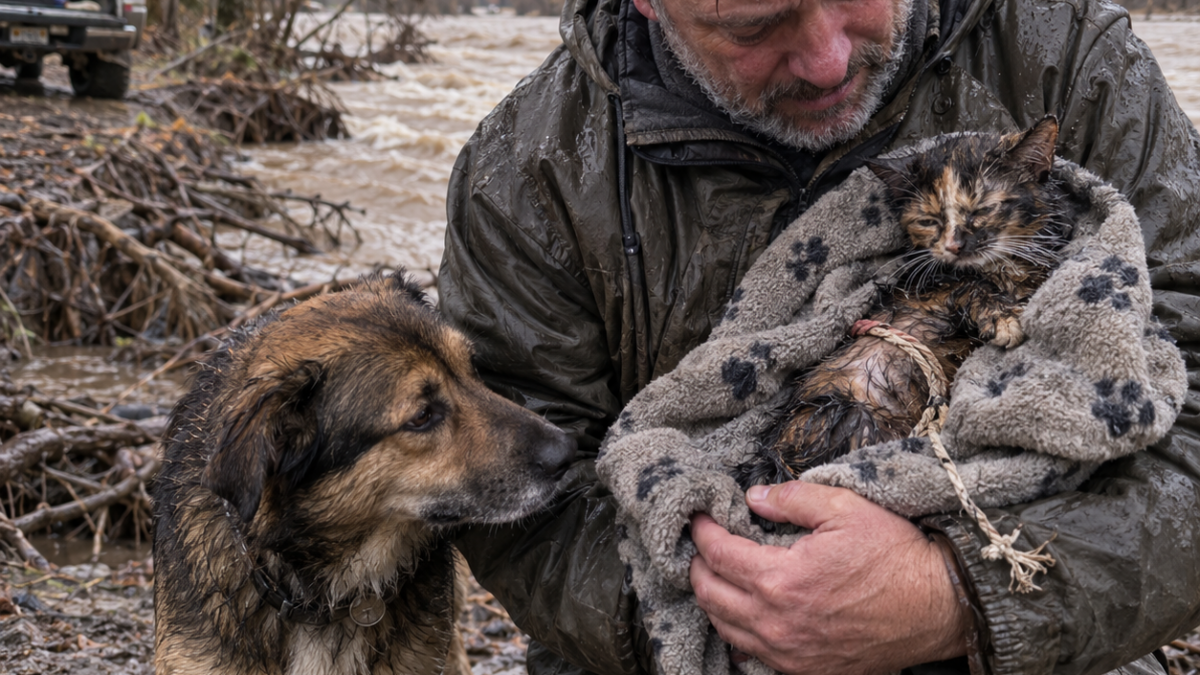
He wrapped the cat in Scout’s blanket, the old blue one Helen had kept on the back seat for muddy paws and cold mornings. Scout jumped into the truck after them, then stood with his front paws on the console, nose pressed toward the bundle.
Tom started the engine with shaking hands.
The nearest emergency veterinary hospital was forty minutes away.
He made it in thirty-one.
The cat did not move the entire drive.
Tom kept one hand on the wheel and one hand lightly on the blanket.
“Stay,” he kept saying.
It was the command he had used with dogs all his life.
It was also a prayer.
“Stay. Stay. Stay.”
Scout sat in the passenger seat, tense and silent, watching the bundle as if he too understood that noise might disturb the fragile thread holding her here.
When Tom carried her through the doors of the emergency vet, the receptionist looked up with the tired expression of someone prepared to ask about appointments, forms, and insurance.
Then she saw the blanket.
Her face changed.
“I found her in the river,” Tom said.
His voice sounded strange, even to himself.
A technician came from the back.
Then another.
Then the veterinarian.
The blanket opened.
The room went quiet.
Not because no one knew what to do.
Because sometimes even trained hands need half a second to face what cruelty has done.
The veterinarian’s name was Dr. Elise Warren. She was in her early forties, with dark hair pulled back, tired eyes, and the practical calm of someone who had chosen a profession where love and grief came through the same door every day.
She touched the cat’s neck gently.
“She’s alive.”
Tom closed his eyes.
The techs moved fast.
Warm towels.
Heating pads.
An IV catheter.
Bloodwork.
Pain medication.
Oxygen.
A thermometer.
When Dr. Warren saw the number, her jaw tightened.
“Thirty-one point seven Celsius,” she said quietly.
One of the techs looked up.
“That low?”
“Severely hypothermic.”
Tom did not know the Celsius number, but he understood the faces.
“How bad?”
Dr. Warren looked at him.
“Normal for a cat is close to thirty-eight to thirty-nine Celsius. She’s almost seven degrees below where she should be.”
Tom swallowed.
“How long was she in there?”
“Hours,” the doctor said. “Likely three or four. Maybe more.”
Tom looked at the cat.
Three or four hours in five-degree water.
Three or four hours in the dark current.
Three or four hours with a rope cutting into her belly and a weight dragging her down.
Dr. Warren examined the rope.
A tech carefully photographed it before removal. Evidence, though Tom already knew what it meant. The knot was too deliberate. The placement too cruel. The frayed end told the rest of the story.
“She chewed through it,” Dr. Warren said.
Nobody spoke.
“She what?” Tom asked.
The doctor pointed gently to the loose end.
“This wasn’t cut by a blade. See the fibers? Ragged, crushed, pulled apart. She chewed through wet nylon while she was underwater or partly submerged.”
Tom looked at the cat’s mouth.
Only then did he see the blood around her lips.
Dr. Warren opened the cat’s mouth with great care.
Her expression changed.
“Two incisors are cracked badly. Possibly to the nerve.”
The technician beside her whispered, “She broke her teeth getting free?”
Dr. Warren did not answer immediately.
Her fingers moved softly over the little cat’s head.
“Yes.”
Tom turned away.
Scout pressed against his leg.
He had seen bad things in his life. Work accidents. Car wrecks. Flood damage. Houses burned down to foundations. Men who thought they were strong weeping beside collapsed roads because everything they owned was under water.
But this tiny animal had been tied to a stone and thrown into a river, and instead of surrendering to the dark, she had bitten the rope until her teeth broke.
That knowledge entered Tom and stayed there.
The first night was not about hope.
It was about warmth.
Dr. Warren told him that hypothermia had to be corrected carefully. Too fast could be dangerous. The cat’s heart rate was low, her blood pressure fragile, her muscles stiff with cold. Her body had begun to shut down, not because she wanted to die, but because the cold had been winning.
Tom waited in the lobby with Scout lying at his feet.
Every time the treatment room door opened, Scout lifted his head.
So did Tom.
Around midnight, Dr. Warren came out.
“She’s stable enough for now,” she said.
“For now,” Tom repeated.
“We’re not through the worst of it. There may be damage from the cold. She has deep rope trauma around the abdomen. The tip of her tail may not survive. The teeth will need attention once she’s stronger. But she made it through the first few hours.”
Tom nodded.
“Can I see her?”
Dr. Warren hesitated only a second.
“Yes. Quietly.”
The cat lay inside a warmed recovery kennel, wrapped in blankets with only her face visible. Her fur, now drying, showed patches of black, orange, cream, and brown beneath the mud. A tortoiseshell. Small. Delicate. Her eyes were closed. Her breathing was shallow but steady.
Tom crouched beside the kennel.
Scout sat next to him.
The dog did not bark.
Did not whine.
He simply lowered himself to the floor and rested his chin on his paws, watching the cat through the glass.
Tom placed one hand against the kennel door.
“You don’t know me,” he whispered. “But I’m here.”
The cat did not move.
He stayed for twenty minutes.
Then thirty.
Dr. Warren eventually touched his shoulder.
“You should go home and rest.”
Tom looked at Scout.
Scout did not move.
“He says no.”
For the first time that night, Dr. Warren almost smiled.
“We have chairs.”
Tom slept badly in one of them, waking every hour to ask if she was still alive.
Each time, someone said yes.
By morning, that word felt like a miracle.
The cat survived the first night.
Then the second.
Her temperature returned slowly. Her heart steadied. She began responding to touch. The rope wound around her middle was cleaned, treated, and bandaged. The damaged tip of her tail darkened despite every effort, the tissue too injured to recover. Dr. Warren told Tom gently that it would have to be removed.
Two cracked teeth would also need extraction once she was strong enough.
Tom approved every treatment.
When the receptionist discussed cost, he reached for his wallet before she finished.
“She fought that hard,” he said. “We’re not stopping because of money.”
“You understand it may be expensive.”
“I understand.”
“She may need long-term care.”
“Then she’ll get long-term care.”
The receptionist looked at him.
“Are you claiming ownership?”
Tom looked toward the treatment room where Scout lay beside the door, refusing to leave the cat’s general direction.
He thought of the river.
The rope.
The tiny broken teeth.
The paw that had not reached for him because she had no strength left.
“I guess she already claimed us,” he said.
The clinic needed a name for the chart.
Tom did not have to think long.
“River,” he said.
Dr. Warren looked up.
“Are you sure?”
“Not because that’s where they left her,” he said. “Because that’s where she beat them.”
So the little tortoiseshell became River.
River Avery, according to the file.
Tom did not correct it.
The first time River lifted her head on her own, the entire clinic seemed to know within minutes. A receptionist brought the news to Tom in the waiting room like a birth announcement. Scout stood immediately, tail moving low and slow.
Dr. Warren allowed them back.
River lay in her kennel, wrapped in soft blankets, her bandaged middle rising and falling steadily. Her eyes were open now. Green, Tom realized. Not bright yet, but present.
Scout stepped forward carefully.
Tom held the leash.
“Easy.”
River’s eyes moved to the dog.
For one terrifying second, Tom worried she would panic.
Instead, Scout lay down outside the kennel.
Not too close.
Not looming.
Just near enough to be seen.
River watched him for a long time.
Then she blinked.
Scout thumped his tail once.
Dr. Warren whispered, “He’s the reason you found her?”
Tom nodded.
“He stopped walking.”
“Good dog.”
Scout did not react.
He already knew.
River stayed at the clinic for nearly three weeks.
During that time, Tom visited every day.
He learned the names of the staff. He learned which vending machine ate quarters. He learned that emergency clinics had their own rhythm, separate from the rest of the world. Panic at midnight. Relief at dawn. Grief in the parking lot. Joy over small things most people would not understand, like a cat eating a teaspoon of food or lifting her head without help.
River’s tail was amputated at the damaged tip. The teeth were removed. The rope wound slowly closed, but even from the beginning Dr. Warren warned him that fur might never grow back where the rope had cut deepest.
“She may always have a ring around her middle,” she said.
Tom looked at River through the kennel glass.
“Then she’ll have a ring.”
The doctor studied him.
“You know recovery may not be simple.”
“I’m not simple either.”
River came home in early November.
Tom had prepared the house like a nervous father.
A soft bed in the living room.
A litter box in the laundry room.
Food bowls.
A heating pad.
A small set of carpeted steps beside the couch because he worried jumping would pull at her healing belly.
He had also moved Scout’s water bowl farther from the main walkway after realizing River froze whenever she heard water slosh.
The fear of water was immediate.
Not dramatic.
Worse.
Careful.
The first time Tom placed a shallow dish of water near her, River approached, stopped, and stared at it. Her body lowered. Her ears shifted back. She sniffed the air, then took one step away.
Tom sat on the floor nearby.
“No hurry.”
She looked at him.
He dipped one finger into the bowl, touched a drop to the floor, then moved his hand away.
River watched.
Scout lay on the other side of the room, pretending not to care while caring very much.
After several minutes, River crept forward and drank.
One tiny sip.
Then she retreated behind the chair.
Tom did not follow.
He learned.
That was the first lesson River taught him.
Survival needed time.
Not speeches.
Not pressure.
Time.
For the first two years, she startled when rain hit the windows.
The sound changed her entire body. Her shoulders dropped. Her pupils widened. Sometimes she ran under the bed. Sometimes she pressed herself into the corner beside the bookcase and shook.
The first time it happened, Tom made the mistake of reaching for her too quickly.
She hissed.
Not meanly.
Fearfully.
He stopped at once.
“I’m sorry,” he said, sitting down several feet away. “I forgot.”
After that, when rain came, Tom sat on the floor near whatever hiding place she chose. Scout usually joined him, lowering his old body with a groan and pretending he had planned to sleep there anyway.
Tom would read aloud sometimes.
Not because River cared about the story.
Because his voice seemed to help.
He read old westerns, hardware catalogs, grocery flyers, and once, because it was the only thing nearby, the instruction manual for his new toaster.
River stayed under the bed for most of that one.
Scout fell asleep during chapter two of “Important Safety Precautions.”
Tom told Helen’s photo later, “You would’ve laughed at me.”
The house changed around River.
Not all at once.
A little every week.
Tom stopped leaving buckets in the mudroom because River disliked the hollow sound they made. He bought a fountain-style water dish, then returned it after River took one look and refused to enter the kitchen for two hours. He learned to fill her water bowl slowly, quietly, and set it down without splashing.
He kept towels by the window during storms.
He put a soft blanket on his lap every morning because River began climbing there after breakfast.
At first, she did it cautiously.
One paw.
Then the other.
Then a stiff, careful turn before settling.
Her body was warm but light, the ring of bare skin around her middle visible whenever she stretched. It was about an inch wide, a permanent band where no fur returned. A pale mark circling her body. Not raw anymore. Not painful to touch after it healed fully. But always there.
The proof of the rope.
The proof of what someone had done.
Tom hated it at first.
Not because of how it looked.
Because of what it meant.
Every time he saw that ring, he imagined the knot. The stone. The river. The hours.
Then one morning, River jumped into his lap, pressed her face against his chest, and began to purr so loudly Scout lifted his head from the rug.
Tom looked down at her.
The scar ring was visible beneath the edge of her fur.
Her body was not hiding it.
She did not know shame.
Only humans tried to put shame where blame belonged.
Tom touched the fur behind her ear.
“You’re right,” he whispered. “That mark isn’t the worst thing about you. It’s the worst thing about someone else.”
River purred harder.
From then on, the ring changed in Tom’s mind.
It was still evidence.
Still terrible.
Still a reminder.
But it was also a boundary line between the life someone tried to end and the life River insisted on having.
Winter came.
River discovered the wood stove and became deeply committed to it. Scout was offended because the rug in front of the stove had been his territory for years. River did not care. She simply walked over, tucked herself against his side, and closed her eyes.
Scout looked at Tom with the expression of a dog whose retirement benefits had been reduced.
“Share,” Tom said.
Scout sighed and stayed still.
By Christmas, River had gained weight.
Not much, but enough that Dr. Warren smiled during her checkup.
“She looks good.”
Tom beamed like he had personally invented feline recovery.
River glared at the thermometer.
“Her teeth healed well,” Dr. Warren said. “The tail site looks clean. Rope scar is stable.”
“Will fur ever grow there?”
The doctor shook her head gently.
“No. Not after this long.”
Tom nodded.
River turned in the carrier, showing the pale ring around her belly as if she had heard and wanted everyone to stop discussing her body.
Dr. Warren smiled.
“She has opinions.”
“She has rules,” Tom said. “I live under them now.”
The clinic staff never forgot River.
When Tom brought her in, technicians found reasons to walk past. Receptionists leaned over the counter. Dr. Warren pretended not to favor her and failed every time.
One of the younger techs once asked Tom, “Does she know what happened?”
Tom looked at River.
She was inside her carrier, calmly ignoring everyone.
“I think her body knows,” he said. “I don’t know what her mind keeps.”
That answer felt true.
River did not remember like humans remembered. She did not tell herself stories. She did not wake and think, I was tied to a stone. She did not understand cruelty as a concept.
But her body remembered water.
Her teeth had remembered nylon.
Her skin remembered rope.
And slowly, with time, her body also learned other things.
A lap could be safe.
A dog could be gentle.
Rain could stay outside.
A water bowl would not pull her under.
Hands could warm instead of hurt.
A house could be quiet without being dangerous.
Years settled around them.
Scout grew older.
His muzzle turned white, his walks shortened, and his naps lengthened. River remained small, stubborn, and particular. She slept beside him more often as his body slowed. Sometimes she pressed her face into his shoulder during storms, as if returning the favor from all the nights he had lain near her hiding places.
When Scout died on a soft April morning, Tom buried him under the maple tree behind the house, beside the flower bed Helen had loved.
River watched from the porch.
She did not understand death the way Tom did.
But that night, she searched the living room.
The rug.
The hallway.
The spot beside the door where Scout had slept.
Then she climbed into Tom’s lap, pressed her face into his chest, and purred so loudly he cried into her fur.
“I know,” he whispered.
He did not know whether she did.
It helped anyway.
After Scout was gone, River became even more attached to Tom’s mornings.
Every day, just after sunrise, she came to him.
It did not matter if he sat in the kitchen, the porch, or the living room. She found him. Climbed slowly into his lap. Turned once. Pressed her face against his chest. Then the purring began.
Deep.
Steady.
A sound too large for such a small body.
Tom used to joke with Dr. Warren that you could hear River purring from the next room.
It was not much of an exaggeration.
“She’s checking on me now,” he said once.
Dr. Warren looked at him.
“Probably.”
He shrugged.
“I found her because Scout stopped. Maybe she figures someone should keep stopping for me.”
Dr. Warren did not answer right away.
Then she said, “Maybe that’s what family does.”
Tom looked at River.
Family.
He had not used that word easily after Helen died.
It felt too large for a man, a dog, and a damaged little cat.
But maybe family was not measured by size.
Maybe it was measured by who noticed when you were missing from yourself.
River lived seven more years.
Seven years of sun patches, stove naps, cautious drinks from shallow bowls, and mornings in Tom’s lap.
Seven years of vet visits where she tolerated Dr. Warren, ignored every compliment, and once slapped a clipboard off the exam table with great purpose.
Seven years of rainstorms survived from under blankets.
Seven years of Christmas trees she pretended not to care about and then slept beneath.
Seven years of Tom saying, “Don’t eat that,” and River hearing, “Please continue.”
Seven years of a bare ring around her middle that never faded.
As Tom aged, River adjusted.
When his knees got worse, she stopped expecting him to bend down with treats and instead waited on the footstool. When his hands became stiffer in winter, she pressed her head beneath his palm and stayed there longer. When he forgot small things, like why he walked into a room, she followed him until he laughed and said, “Well, at least one of us had a plan.”
One summer evening, Dr. Warren came by the house instead of making Tom bring River in.
River was old by then.
Not ancient, maybe, but old in the way rescued animals sometimes become, with the weight of both their actual years and everything their bodies have survived. Her tortoiseshell fur had dulled. Her movements were slower. The ring around her belly remained as visible as ever, pale beneath the patchwork colors.
Tom sat on the porch with her in his lap.
The air smelled like cut grass and warm dust.
Dr. Warren sat beside him.
“She’s tired,” Tom said.
The doctor’s face softened.
“Yes.”
“She hurting?”
“Not badly. Not right now.”
Tom nodded.
River purred beneath his hand.
Weaker than before.
Still there.
“I used to hate that scar,” Tom said.
Dr. Warren looked at him.
“The ring.”
“I know.”
“Thought it was the saddest thing I’d ever seen.”
“And now?”
Tom stroked River’s head.
“Now I think it’s where her first story ended and the real one started.”
Dr. Warren looked away toward the yard.
For a while, neither spoke.
When River died, it was not in water.
That mattered to Tom in a way he could not explain without his voice breaking.
It was morning.
Sunlight lay across the living room floor. The house was quiet except for the clock and the soft creak of Tom’s chair. River was in his lap, wrapped in the blue blanket that had once belonged to Scout, the same blanket he had used to carry her from the river.
She had chosen his lap every morning for seven years.
She chose it then too.
Her breathing slowed.
Tom placed one hand lightly around her body, careful as always near the ring of bare skin, though it had not hurt for years.
“You did good,” he whispered.
River opened her eyes once.
Green.
Cloudy with age now, but still hers.
She purred.
One short, rough sound.
Then she was gone.
Tom sat with her for a long time.
Long enough for the sun to move.
Long enough for the room to become too quiet.
Dr. Warren came later.
She cried when she saw the blanket.
So did Tom.
Neither apologized.
Tom buried River beneath the maple tree beside Scout, near Helen’s flowers. He placed a smooth river stone on top of the small grave, not because the river deserved remembering, but because River had taken that word and made it hers.
For weeks afterward, Tom still woke expecting the sound of paws.
He filled the water bowl once by habit and had to sit down when he realized what he had done.
The house felt enormous.
Then, one rainy afternoon, he stood by the window and watched drops strike the glass.
For years, rain had made River hide.
Then, slowly, it had become something she could sleep through.
Tom touched the windowpane.
“You got there,” he said quietly.
He decided, then, to do something he had avoided for years.
He called Dr. Warren.
“I want to tell her story,” he said.
Not the cruel parts for shock.
Not the details people used to hurt their own hearts and call it compassion.
The real story.
The dog who stopped walking.
The cat who held on.
The rope she chewed through.
The broken teeth.
The fear of rain.
The seven years of mornings.
The purring.
The life after.
A local rescue shared it first.
Then a newspaper.
Then strangers began writing letters.
Some had lost animals.
Some had found them.
Some had survived things themselves and understood, in ways Tom had not expected, what it meant to carry a visible mark from a moment that did not get to define the whole life.
One woman wrote:
I have a scar around my wrist from the worst night of my life. I used to hide it. Today I wore short sleeves.
Tom read that letter three times.
Then he folded it carefully and placed it in the drawer beside River’s vet records.
Another person sent a small painting of a tortoiseshell cat sitting beside a river, the water behind her but not touching her.
Tom hung it near the window.
The river path changed over time.
The bank was repaired.
A sign went up about flood danger.
Scout’s old route grew over in places.
Tom did not walk it often after River died. His knees were worse, and the memories were too many. But one October morning, years after the rescue, he took the path slowly with a cane.
The river was calm that day.
Clearer.
Sunlight moved across it in small pieces.
Tom stopped at the bend where Scout had refused to move.
The root was still there, older now, twisted deeper into the bank.
He stood looking at it for a long time.
He did not imagine River in the water anymore.
Not first.
He imagined her in the window.
On the stove rug.
In his lap.
Beside Scout.
He imagined the loud, stubborn purr that had once filled rooms.
Then he looked down at the river and said, “You didn’t get to keep her.”
The water moved on.
That was all water knew how to do.
But River had known how to do something harder.
She had held on when she was meant to sink.
She had bitten through what was meant to end her.
She had come out of the current carrying a mark that never disappeared.
And then she had lived.
Not just survived.
Lived.
She had hated rain, but learned mornings.
Feared water, but learned trust.
Carried the ring, but not the shame.
She had made an old man’s house warm again.
She had given a dying dog a final purpose and a grieving man seven years of being needed by something small, stubborn, and brave.
The rope mark never faded.
A bare ring around her body, visible from every angle.
Proof of what had been done.
But also proof, every day she climbed into Tom’s lap and purred, that what had been done was not the end of her story.
Someone tried to tie her life to a stone.
River chewed through the rope.








