A Bruised 7-Year-Old Boy Walked Into a Route 66 Diner and Asked Eight Bikers, “You’re the Bad Guys, Right?”—Then His Next Question Made Every Man Stand Up
A Bruised 7-Year-Old Boy Walked Into a Route 66 Diner and Asked Eight Bikers, “You’re the Bad Guys, Right?”—Then His Next Question Made Every Man Stand Up

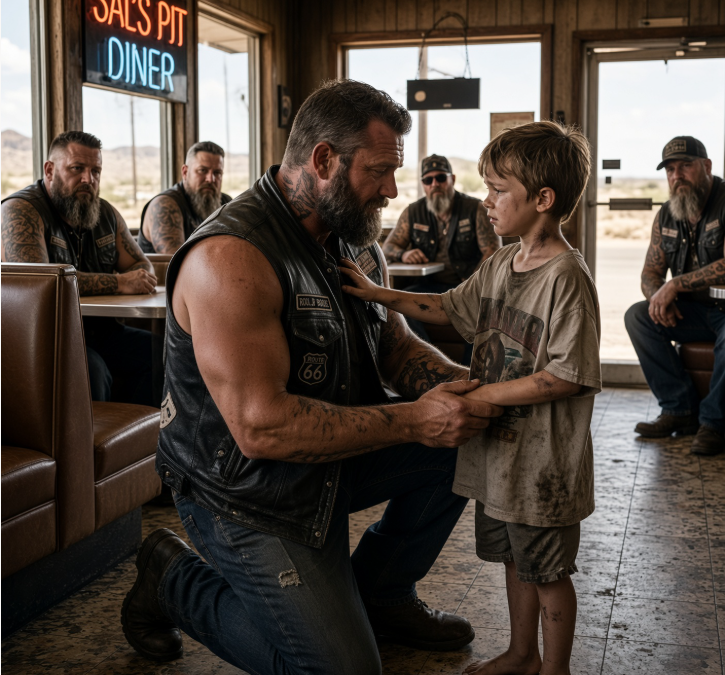
A barefoot seven-year-old boy walked into a Route 66 diner, ignored every ordinary-looking adult in the room, and came straight toward eight bikers everyone else was trying not to stare at.

He touched the Sgt. at Arms patch on my vest, whispered, “My stepdad says you’re monsters,” and then asked us for the one thing no frightened child should ever believe he needs from a stranger.

When he told me the man who had hurt him was already coming to take him back, eight chairs moved at once—and the people that boy had been taught to fear became the only wall between him and the door.

I was sitting at the head of the table at Sal’s Pit when he walked in.

Northern Arizona.

Route 66.

Burnt coffee.

Greasy floors.

A ceiling fan that had probably been clicking since before I learned to ride.

There were eight of us.

Leather cuts.

Heavy boots.

Tattoos.

Gray beards.

Enough scars and bad decisions between us to make most parents choose another table.

I was six-foot-four and close to three hundred pounds.

My patch said SGT. AT ARMS.

People usually crossed the street when they saw me.

The boy didn’t.

He stopped just inside the diner.

Bare feet black with dust.

Oversized shirt.

Split lower lip.

Fading marks along his arms.

And the kind of posture I had seen before in people who expected sudden movement to mean danger.

He scanned the room.

Truckers.

An elderly couple.

Sal behind the counter.

Then us.

And started walking.

Knuckles spoke first.

“Hey there, little man. You lost?”

No answer.

The boy came directly to me.

I slid out of the booth and lowered myself so I wasn’t towering over him.

“Hey, buddy. Where’s your mom?”

His eyes dropped to my vest.

Then the scars across my hands.

“You’re the bad guys, right?”

Nobody laughed.

“My stepdad says bikers are monsters.”

I kept my voice quiet.

“People say a lot of things.”

“He says you hurt people.”

His eyes flicked toward the open diner door.

“He’s coming.”

“Who?”

“My stepdad.”

His breathing sped up.

Then one trembling finger touched my patch.

“Please.”

PART2:

“What do you need?”

The boy swallowed.

His eyes filled, but he fought the tears like crying carried consequences.

Then he whispered a question so desperate that the entire table went silent.

He wasn’t asking us to hurt his stepfather.

He was asking us to make sure he never had to go back.

“He said tonight’s gonna be worse,” the boy whispered. “I can’t go home.”

Behind me, Knuckles was already reaching for his phone.

Tiny stood.

Another brother quietly moved toward the front window.

I stayed on my knees.

“No one here is sending you anywhere right now.”

The boy stared at me like he didn’t understand the sentence.

“You promise?”

I looked him straight in the eyes.

“I promise we’re getting you help.”

That was when tires crunched across the gravel outside.

The boy went white.

He grabbed the back of my vest.

“That’s him.”

I turned toward the window.

A rusted sedan had stopped near the entrance.

The driver’s door opened.

A man climbed out.

The child immediately moved behind me.

Every biker at our table stood.

Not shouting.

Not threatening.

Just standing.

Eight men between one frightened little boy and the front door.

Then the diner bell rang.

The man stepped inside, spotted the child behind my vest, and said:

“Get over here.”

The boy’s grip tightened.

And when the stranger took his first step toward us, he had no idea Knuckles had already made one phone call that was about to change everything…


Disclaimer: This story is fictional and created for entertainment purposes only. Any names, characters, places, or events are fictitious or used fictitiously. No real person or organization is intended to be portrayed.

Recommended for You

View Archive arrow_forward
News

A whole clubhouse full of armed bikers went silent because a 9-year-old boy pointed at the ceiling. I was standing closest to him when it happened. Close enough to see his hand shake. We’d told his mom a hundred times not to bring him around. A kid doesn’t belong where men keep guns in their waistbands and a federal case is hanging over the president’s head. But there he was, sitting under the old oak bar with a toy motorcycle, quiet as a mouse. I thought he wasn’t paying attention. Then he set the toy down, slow and careful, like he already understood something the rest of us hadn’t figured out yet. He stood up and pointed one small finger at the dark corner above the bar. “Camera,” he said. Just that. One soft word. But it landed in that room like a grenade with the pin pulled. Nobody breathed. The president put his glass down without a sound. The sergeant-at-arms reached behind his back. And every brother in that clubhouse turned at the exact same time to look at the thing a 9-year-old had spotted that none of us had bothered to look for. My name is Walt. I’ve been wearing this club’s patch for twenty-six years. I’d never seen a room of grown bikers go that still that fast. The corner was just shadow to me. A smoke detector. An old water stain. Then Tank moved — our sergeant-at-arms, six foot four, hands like cinder blocks. He dragged a barstool under the corner, and the legs scraped the concrete so loud in the silence it made me flinch. He climbed up, pushed up the ceiling tile an inch. Then he froze. “Son of a—” Tank breathed, yanking his hand back. A small black box wedged in the dark. A glass eye on the front. A thin wire running off into the ceiling. A camera, pointed straight down at the bar. Straight down at all of us. Nobody in this club had put it there. The boy’s name was Eli. His mom, Dana, tended bar for us a couple nights a week. She was barely twenty-six, raising him alone after his father walked out. Eli was small for nine, the kind of quiet kid who watched everything and said almost nothing. Some brothers grumbled about a child being in the clubhouse. But Dana had nobody — no family, no sitter money. And Boone, our president, had a soft spot for that boy the size of a county. “He’s no trouble,” Boone always said. “Leave him be.” So we left him be. And on the worst night of the whole year, that one stubborn kindness saved every single man in that room. That night wasn’t a party. Boone was staring down federal charges — conspiracy, racketeering. For months we’d had a leak. Things said inside these walls turned up where they had no business being. Boone was convinced it was a rat, a brother who’d flipped. He called the meeting to smoke him out. Twenty bikers, every one armed, every one suspicious of the man beside him. Men sitting apart who normally sat shoulder to shoulder. Hands too close to belts. Boone was mid-sentence at the head of the bar, a name half-formed in his mouth, a finger starting to lift toward one of our own. He never finished it. When Tank held that camera up in the light, the room exploded. Chairs went over. Two brothers had each other by the collar. Someone shouted “FEDS,” someone shouted “RAT.” Then Boone roared from deep in his chest. “QUIET.” The room slammed shut. You could hear the refrigerator humming. Boone took the camera from Tank, turned it over in his fingers, and set it on the bar gentle, like it might go off. Then he turned to Eli. The boy had backed into the corner, toy motorcycle clutched to his chest, eyes huge and wet. Boone crossed the room and crouched down, folding all six feet of himself to the floor. This huge man with a gray beard and a federal case hanging over his head, getting small so a child wouldn’t be afraid. “Hey,” Boone said. “You’re not in any trouble, son. I give you my word.” Eli’s chin trembled. “How’d you know it was up there, Eli?” What that boy said next made the whole room go cold again. “Because I’ve seen one before,” Eli whispered. “At my house. In my room.” Boone went still. “The man put it up high in my room. He said it was so he could watch me and keep me safe. But Mom didn’t know about it. He said Mom didn’t need to know.” “What man?” “Mom’s friend. Greg. He comes over sometimes. He fixes stuff. He’s good with computers and wires and things.” “And he told you to keep it secret?” Eli nodded fast. “He said if I told Mom, she’d get real mad at me. He said it was our secret and that’s how I knew he was my friend.” Boone closed his eyes for one second. Then he stood up, and his face was wearing something I’d never seen on him. Past anger. The still, terrible face of a man doing arithmetic and hating every number. Dana came out of the storeroom drying her hands on a bar rag. She walked into a silent room full of frozen men. Saw the black box on the bar. Saw her son crying in the corner. “What happened? Is Eli okay?” “He didn’t do anything wrong,” Boone said carefully. “Dana, you got a friend named Greg? Comes around, fixes things?” The color drained from her face. “Greg. He’s been helping me out for a few months. He set up my internet. He set up the camera at my front door so I could see who’s—” She stopped. Her hand drifted to her mouth. “He was at my apartment last week. He was up in Eli’s room. He said he was fixing the wifi.” Boone lifted the camera where she could see it. “This Greg. He ever spend time alone in this clubhouse?” “Last month. My car wouldn’t start in the back lot. I gave him my spare key and told him to wait inside. He was in here alone for maybe an hour.” The rat we’d been hunting for months wasn’t a brother. It had never been a brother. Here’s the part that turns my stomach. Boone had been one sentence from naming Cisco. Cisco had been jumpy for weeks, sitting apart, snapping at people. Turned out Cisco’s wife had been diagnosed with cancer and he was buried under hospital bills, too proud to ask. That was the whole secret. If Eli hadn’t pointed at the ceiling, Boone might have done something to Cisco in front of all of us that could never have been undone. I looked across the room and found Cisco’s face. He’d gone gray, just now realizing how close the edge had been. Boone sat Dana on a barstool and told her everything — that Greg had put a camera in her son’s bedroom and used her spare key to plant one here. Dana came apart, saying she didn’t know, she swore to God she didn’t know. “This is not on you,” Boone said, holding her shoulders. “A man like that counts on you not knowing. He smiled and fixed your car so you’d trust him. This is on him.” He turned to Eli, still clutching that motorcycle. “And you. You did the bravest thing anybody has done inside these walls in years. You told the truth, son, even when a grown man told you to keep it buried.” “You’re really not mad at me?” Boone’s voice cracked. “Son, you’re a hero. Don’t you ever let anybody tell you different.” We didn’t call the police. That’s not our way. The brothers found Greg. I won’t tell you how, and I won’t tell you a word of what was said. There were more cameras. One in Dana’s living room. Another feeding video to an account watching more than just adults — watching more children than only Eli. The matter got handled in a way that made certain no other child would ever wake up to a glass eye watching from the corner of their bedroom. Not ever again. Dana and Eli moved out within the week. New apartment, new locks. The club paid for all of it and wouldn’t let her say thank you once. And Cisco. His wife’s hospital bills got handled, quiet and anonymous. A brother does not get hunted for the crime of being scared and then get forgotten the moment the real wolf shows his face. Eli’s nearly a grown man now. Tall. Steady. He still calls Boone every year on his birthday. Boone still tears up every time the phone rings and it’s him. Every brother who stood in that clubhouse knows the truth. We didn’t protect that boy.






